EP0024246A1 - Zerlegbarer Schutzraum aus Leinwand, wie Dach, Zelt oder dgl. - Google Patents
Zerlegbarer Schutzraum aus Leinwand, wie Dach, Zelt oder dgl. Download PDFInfo
- Publication number
- EP0024246A1 EP0024246A1 EP80401175A EP80401175A EP0024246A1 EP 0024246 A1 EP0024246 A1 EP 0024246A1 EP 80401175 A EP80401175 A EP 80401175A EP 80401175 A EP80401175 A EP 80401175A EP 0024246 A1 EP0024246 A1 EP 0024246A1
- Authority
- EP
- European Patent Office
- Prior art keywords
- panels
- shelter
- shelter according
- canvas
- cables
- Prior art date
- Legal status (The legal status is an assumption and is not a legal conclusion. Google has not performed a legal analysis and makes no representation as to the accuracy of the status listed.)
- Withdrawn
Links
Images


Classifications
-
- E—FIXED CONSTRUCTIONS
- E04—BUILDING
- E04H—BUILDINGS OR LIKE STRUCTURES FOR PARTICULAR PURPOSES; SWIMMING OR SPLASH BATHS OR POOLS; MASTS; FENCING; TENTS OR CANOPIES, IN GENERAL
- E04H15/00—Tents or canopies, in general
- E04H15/18—Tents having plural sectional covers, e.g. pavilions, vaulted tents, marquees, circus tents; Plural tents, e.g. modular
Definitions
- Dismountable shelters such as roofs, tents, or the like, are essentially intended to be used for a limited time and then be dismantled and transported. Consequently, one of their essential qualities is to be light and space-saving.
- the present invention aims to meet this requirement by providing a shelter which allows, with the minimum of material, to cover a maximum of surface or to wrap a maximum of volume.
- a shelter which comprises canvas panels joined at their upper part along a curvilinear edge whose concavity is turned towards the exterior, making it possible to have a lower edge cut straight, and adapted to receive support posts at the outer extreme points of the upper edge, as well as tensioning means starting from the lower edge of the panels, at two points separated by a distance less than that which separates the reception points of the posts.
- a shelter can constitute a canvas roof, a marquee, or possibly be supplemented by side walls and form a complete tent. It is particularly suitable for making a tent or a roof having a multiple number of sides, for example to house a space of hexagonal, octagonal or other shape, the panels then being in number equal to or greater than three. Whatever the shape and dimensions of the shelter made, it has no frame but only a small number of posts, all located at its periphery, so that the internal volume is fully available. On the other hand, the material used, that is to say the material to be transported, is reduced.
- the removable shelter is produced by means of canvas panels, three in the embodiment shown in FIG. 1
- Each of these panels 1, 2 and 3 has a lower edge 4 between two side edges 5, 6 respectively ; which are slightly curved.
- These lateral edges are joined together by an upper edge 8, of curvilinear shape, having its concavity facing outwards.
- this upper edge 8 forms two curves 9 and 11, 11 and 13 or 13 and 9, symmetrical with respect to the median plane of the panel and united in a central apex 10.
- the panels 1,2,3 are joined two by two along their upper edge 8 by seams, or possibly welds or the like, 9, 11 and 13, and the three vertices 10 form the central point of the shelter.
- each of the seams 9, 11, 13, situated opposite the central apex 10 is arranged a member, of the eyelet type or the like, for receiving the end of a support post, respectively 15 , 16 or 17.
- tension cables 18, 19 leave from each of the ends of the lower edge 4 of the panels, while at least one cable 21 provides the painter of the stake.
- the fabric formed by the three panels 1, 2 and 3 can be placed on the stakes 15, 16, 17 and then stretched by means of the cables 18, 19 to form a protective roof or shelter.
- a shelter comprising three panels, as shown in fig. 1
- the whole of the fabric thus protects a portion of the ground of substantially hexagonal shape, delimited by the fixing points of the cables 18, 19 at the lower edge of the panels.
- This lower edge 4 being shorter than the distance which sapares the outer end points 22, 24 of the corresponding seams 9 and 11, that is to say in fact the adjacent stakes 15 and 16, these stakes are located at the 'outside the panels and thus slightly outside the hexagonal surface which' is completely free for the user.
- the tensioning action of the cables 18 and 19, combined with the particular shape of the lines 9, 11 and 13 joining the panels, and with the suspension of the fabric at external end points, ensures the whole of the canvas a regular tension and large enough to minimize the height differences between the different points. Consequently, at practically all points of the roof, the tangent with the steepest slope has an inclination which allows the flow of water. Only the central zone, or zone of assembly of all the panels in the case of a shelter comprising at least three panels, does not meet this condition. For example, in the embodiment shown in FIG. 1, a relatively small area around the central apex 10, tends to approach the horizontal position, which risks being an obstacle to the good flow of water.
- the central apex 10 is preferably straightened by cables or straps stretched between it and each of the end points 22, 24, 25 of the seams 9, 22 and 13.
- the cables 26 can be stretched outside the tent and attached to the central top 10 by means of a canvas loop or other similar member (not shown).
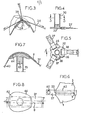
- these cables are fixed on a cap 28 on which the canvas is applied, a hole 19 in the latter allowing fixing, for example, as shown in FIG. 3, the cables 16 pass through not only the hole 19 but the cup 18 itself, and are blocked below the latter at 31 by a knot, a weld or other similar means, or, according to a variant not shown, the cap itself has a central boss which projects into the hole 19 of the fabric and on which the cables are fixed, which prevents them from escaping and ensures their tension.
- the central top 10 thus reaches a height slightly lower than that of the top of the stakes 5, 16, 17, which clears the space below the shelter and gives the canvas the desired slope and tension.
- cables or straps 17 are stretched inside the shelter.
- the central point 10 is then supported by a small vertical post 30 resting on a plate 32 secured, in its central part, to a centering member 34 constituted, in the embodiment shown, by a tenon on which the stake 3C which is hollow (fig. 4 and 5).
- the plate 32 preferably comprises three arms, respectively 35, 36 and 37, each pierced with a hole or a slot 38 in which the cable or strap 27 is hung.
- the cables or straps 27 or 26 are hung on the top of the stakes 15, 16, 17 respectively, that by means of eyelets or the like, independent or integral with those of the fabric.
- the eyelets are carried only by them as shown in FIG. 6.
- the straps 27 then have a length greater than that necessary for tensioning and an eyelet 60 is fixed to the end of each of them.
- the two adjacent canvas panels, 1 and 3, assembled by seam 9, are fixed at the same time on the strap, for example by a seam 62, a weld or any other means, at the end of the junction line 9 but at a certain distance from the end of the strap, so that only the eyelet 60 reaches the top of the post 15 (fig. 1).
- the straps 26, 27 are thus stretched to the desired value once and for all, and remain adjusted even when the fabric is folded.
- the stake 30 can even be released from the plate 32, while the cables remain taut, which facilitates the mounting of the shelter.
- the plate 32 can have any suitable shape.
- the stake 30 can be supported in any suitable manner and the cables or straps can be hung, welded, glued, or the like as required.
- the cables, straps or the like are stretched in such a way that they keep the top 10 in its high position and relieve the fabric along the seams 9 and 11 over a great distance.
- cables 21 for holding the stakes are then replaced by cables 56, 57 fixed at the two ends of the base of the triangle 40, but the tensioning means remain unchanged and the cables 18 and 19 are fixed at two points 45, 46 respectively, distant from the lateral sides of the panel and separated by a distance corresponding to the length of the bottom edge 4 not extended.
- the central apex 10 is also straightened, either by external cables, or by internal cables.
- the hooking eyelets on the support posts 15, 16 and 17 can, according to an alternative embodiment, be omitted.
- Each of the stakes then comprises (FIGS. 7 and 8) a domed and enlarged head 64, which is for example molded in plastic material and fitted, by means of a lower central stud 65, into the stake 15.
- the upper surface convex of the head widens towards the outside of the shelter and has curvatures such that it adapts to the top of the trihedron formed by the panels and the triangle 40.
- the canvas is simply placed on this head but it is however securely maintained and can transmit the action of cables 56 and 57 to the stake.
- the shelter can also be completed with side walls, so as to constitute a complete closed tent (fig. 9).
- the roof of this tent can be formed by the shelter shown in fig. 1, or be provided with one or more awnings, such as those of the shelter shown in FIG. 2.
- the side walls 42 extend downwards each of the panels 1, 2 and 3, between the points 45 and 46 for fixing the tension members, while walls 44 connect these walls 42 between the points 46 and 45 from two different roof panels.
- Tension cables 48, 49 are attached to each of the junction lines between these walls, at an intermediate point between the lower edge of the roof panel and the ground, as indicated at 50 in FIG. 9.
- each wall 42 or 44 has the general shape of a trapezoid, but these trapezoids are inverted.
- the small base 51, 53 of a wall 42 is equal to the large base 61, 63 of a wall 44 and is located, like it, at the lower part of the tent which thus has the shape of a regular hexagon .
- the upper part of the wall 42 is formed by its large base 45, 46, while that of the wall 44 is formed by its small base 66, 67.
- the trapezoids 42 and 44 are isosceles but their lateral sides each have successively a straight part 68, 69 and a curved part 70- 72
- the straight parts 68, 69 of all the walls have the same length while the curves have the same radius of curvature, so that the opposite sides of the adjacent walls 42 and 44 have, flat, profiles isometric, angularly offset.
- the tension cables 48, 49 are fixed at 50 at the transition point between the rectilinear parts 68, 69 and the curved parts 70, 72, which corresponds to the greatest width of the wall 42. It can then be seen that all of the canvas is regularly stretched. The force exerted by the cables 48, 49 is in fact transmitted to the two adjacent walls and, via the wall 42, to the corresponding roof panel.
- the wall 44 may possibly be extended upwards to the roof, but they are preferably limited to the small base 66, 67 and delimits an opening, protected for example by a canopy 40.
- the tent may include a second interior or exterior envelope, of the conventional type or produced according to the invention.
- the two envelopes are of the type of tent shown in FIG. 9, means making it possible to make them permanent or temporary are preferably mounted on them, at different points and mainly at the anointed 50 for fixing the cables of tension, which allows them to be tensioned simultaneously with the same cables.
- One or the other of these envelopes can moreover be integral with a floor mat.
- a shelter or tent of this type can have a variable number of sides.
- the number of roofing panels can be more than three or even possibly be limited to two.
- the ground surface protected by this shelter has the shape of a polygon whose sides are in double shade from that of the roofing panels and the space thus protected is completely free for the user.
- the stakes in small numbers, are always located at the periphery and the center of the roof, even when it is raised by the cables and the small stake 30, leaves a significant height free.
- the amount of canvas needed to make the shelter is much lower than the links usually used to protect a space similar. As a result, the quantity and weight of material to be transported and handled during assembly and disassembly are reduced.
Landscapes
- Engineering & Computer Science (AREA)
- Architecture (AREA)
- Civil Engineering (AREA)
- Structural Engineering (AREA)
- Tents Or Canopies (AREA)
Applications Claiming Priority (2)
| Application Number | Priority Date | Filing Date | Title |
|---|---|---|---|
| FR7920671A FR2463243A1 (fr) | 1979-08-14 | 1979-08-14 | Abri demontable en toile, tel que toit, tente ou analogue |
| FR7920671 | 1979-08-14 |
Publications (1)
| Publication Number | Publication Date |
|---|---|
| EP0024246A1 true EP0024246A1 (de) | 1981-02-25 |
Family
ID=9228843
Family Applications (1)
| Application Number | Title | Priority Date | Filing Date |
|---|---|---|---|
| EP80401175A Withdrawn EP0024246A1 (de) | 1979-08-14 | 1980-08-11 | Zerlegbarer Schutzraum aus Leinwand, wie Dach, Zelt oder dgl. |
Country Status (5)
| Country | Link |
|---|---|
| US (1) | US4367761A (de) |
| EP (1) | EP0024246A1 (de) |
| AU (1) | AU6134180A (de) |
| ES (1) | ES252477Y (de) |
| FR (1) | FR2463243A1 (de) |
Cited By (1)
| Publication number | Priority date | Publication date | Assignee | Title |
|---|---|---|---|---|
| FR2632677A1 (fr) * | 1988-06-10 | 1989-12-15 | Krieger Francis | Toiture en materiau souple |
Families Citing this family (19)
| Publication number | Priority date | Publication date | Assignee | Title |
|---|---|---|---|---|
| US4450656A (en) * | 1981-12-14 | 1984-05-29 | Johannes Lagendijk | Suspended roof |
| US4750508A (en) * | 1986-08-06 | 1988-06-14 | Tatoian James Z | Collapsible beach sunshade |
| WO1991004382A1 (en) * | 1989-09-15 | 1991-04-04 | Connell Mark A | Personal shade device |
| US5234011A (en) * | 1991-08-02 | 1993-08-10 | Lynch James P | Clear span tent structure |
| GB2267919B (en) * | 1992-06-20 | 1996-08-28 | Pamela Veronica Teese | Erectable structure |
| WO1994024392A1 (en) * | 1993-04-15 | 1994-10-27 | John Raymond Cuthill | A structure |
| KR950025264A (ko) * | 1994-02-03 | 1995-09-15 | 이헌조 | 스크롤압축기의 축방향 순응성장치 |
| US6250320B1 (en) | 1999-10-29 | 2001-06-26 | Ronald Roth | Sun cover apparatus |
| US6904924B2 (en) * | 2001-02-14 | 2005-06-14 | Tentnology Ltd. | Triangular frame tent |
| GB0410989D0 (en) * | 2004-05-17 | 2004-06-16 | Tensarc Ltd | Canopy sub-frame |
| DE102004032945A1 (de) * | 2004-07-07 | 2006-02-02 | Aloys Wobben | Einrichtung zur Herstellung und/oder Montage von Gütern |
| US20100108113A1 (en) * | 2008-11-03 | 2010-05-06 | Optisolar, Inc. | Aeroelastic canopy with solar panels |
| USD622412S1 (en) * | 2009-09-23 | 2010-08-24 | Mccarthy Barry | Shade structure |
| USD1016330S1 (en) | 2021-05-25 | 2024-02-27 | Andrea LYNN BROUWERS | Shade structure |
| AU2022206698B9 (en) * | 2021-07-20 | 2024-05-30 | Andrea Lynn BROUWERS | Portable wind resistant shade structure |
| US11933064B2 (en) * | 2021-07-20 | 2024-03-19 | Andrea LYNN BROUWERS | Portable wind-resistant shade structure |
| USD980374S1 (en) * | 2021-12-08 | 2023-03-07 | Shenzhen mengzhilv Tourism Products Co., Ltd | Tent |
| US20240151060A1 (en) * | 2022-11-09 | 2024-05-09 | Extreme Engineering, Llc | Flexible cover system apparatus and methods of use |
| CN221920496U (zh) * | 2024-01-30 | 2024-10-29 | 深圳市维思登电子商务有限公司 | 一种低风阻天幕帐篷 |
Citations (8)
| Publication number | Priority date | Publication date | Assignee | Title |
|---|---|---|---|---|
| US1335332A (en) * | 1917-02-03 | 1920-03-30 | Arnold W Hackfield | Collapsible tent |
| US3060949A (en) * | 1957-01-30 | 1962-10-30 | Charles W Moss | Flexible hyperbolic paraboloid shelter |
| FR1373418A (fr) * | 1963-10-25 | 1964-09-25 | Textile D Articles De Repos So | Tente à armature |
| GB1049904A (en) * | 1964-05-26 | 1966-11-30 | Frankenstein Group Ltd | Improvements in or relating to collapsible shelters |
| FR1470488A (fr) * | 1965-03-02 | 1967-02-24 | Stromeyer & Co Gmbh L | Perfectionnements aux toits de tentes et aux tentes |
| US3327723A (en) * | 1966-03-28 | 1967-06-27 | Kermit H Burgin | Means automatically maintaining a taut tent roof |
| DE1256396B (de) * | 1962-02-13 | 1967-12-14 | Stromeyer & Co G M B H L | Zeltartiges Gebaeude mit an Seilen oder Masten angebrachten Gehaengen zum Tragen der Zelthaut |
| FR2336099A2 (fr) * | 1975-12-22 | 1977-07-22 | Millerioux Bruno | Tente de camping a surfaces de toile tendue |
Family Cites Families (1)
| Publication number | Priority date | Publication date | Assignee | Title |
|---|---|---|---|---|
| US3693641A (en) * | 1970-03-09 | 1972-09-26 | Charles W Moss | Portable shelter |
-
1979
- 1979-08-14 FR FR7920671A patent/FR2463243A1/fr active Granted
-
1980
- 1980-08-07 US US06/175,961 patent/US4367761A/en not_active Expired - Lifetime
- 1980-08-08 ES ES1980252477U patent/ES252477Y/es not_active Expired
- 1980-08-11 AU AU61341/80A patent/AU6134180A/en not_active Abandoned
- 1980-08-11 EP EP80401175A patent/EP0024246A1/de not_active Withdrawn
Patent Citations (8)
| Publication number | Priority date | Publication date | Assignee | Title |
|---|---|---|---|---|
| US1335332A (en) * | 1917-02-03 | 1920-03-30 | Arnold W Hackfield | Collapsible tent |
| US3060949A (en) * | 1957-01-30 | 1962-10-30 | Charles W Moss | Flexible hyperbolic paraboloid shelter |
| DE1256396B (de) * | 1962-02-13 | 1967-12-14 | Stromeyer & Co G M B H L | Zeltartiges Gebaeude mit an Seilen oder Masten angebrachten Gehaengen zum Tragen der Zelthaut |
| FR1373418A (fr) * | 1963-10-25 | 1964-09-25 | Textile D Articles De Repos So | Tente à armature |
| GB1049904A (en) * | 1964-05-26 | 1966-11-30 | Frankenstein Group Ltd | Improvements in or relating to collapsible shelters |
| FR1470488A (fr) * | 1965-03-02 | 1967-02-24 | Stromeyer & Co Gmbh L | Perfectionnements aux toits de tentes et aux tentes |
| US3327723A (en) * | 1966-03-28 | 1967-06-27 | Kermit H Burgin | Means automatically maintaining a taut tent roof |
| FR2336099A2 (fr) * | 1975-12-22 | 1977-07-22 | Millerioux Bruno | Tente de camping a surfaces de toile tendue |
Cited By (2)
| Publication number | Priority date | Publication date | Assignee | Title |
|---|---|---|---|---|
| FR2632677A1 (fr) * | 1988-06-10 | 1989-12-15 | Krieger Francis | Toiture en materiau souple |
| EP0346236A3 (en) * | 1988-06-10 | 1990-02-07 | Francis Krieger | Roofing made of a flexible material |
Also Published As
| Publication number | Publication date |
|---|---|
| ES252477Y (es) | 1981-05-16 |
| FR2463243B1 (de) | 1983-04-22 |
| ES252477U (es) | 1980-11-16 |
| US4367761A (en) | 1983-01-11 |
| AU6134180A (en) | 1981-02-19 |
| FR2463243A1 (fr) | 1981-02-20 |
Similar Documents
| Publication | Publication Date | Title |
|---|---|---|
| EP0024246A1 (de) | Zerlegbarer Schutzraum aus Leinwand, wie Dach, Zelt oder dgl. | |
| FR2477853A1 (fr) | Abri pliant du type en forme de tente pliable en parapluie, et dispositif permettant de fixer de maniere amovible une partie d'etoffe a un support tubulaire | |
| FR2683133A1 (fr) | Appareil de protection contre les insectes, notamment pour moustiquaire. | |
| EP3640414A1 (de) | Faltbares zelt, das zwei regenschutzstrukturen umfasst | |
| EP0290351B1 (de) | Zeltplanenträgerrahmen für einen leichten Unterstand | |
| EP0534843A1 (de) | Gerüst für rechteckiges Zelt mit einem Satteldach | |
| EP2211603A1 (de) | Landwirtschaftlicher unterstand mit vereinfachter dachstruktur | |
| CA3127410A1 (fr) | Hamac et abri ameliores | |
| FR2898928A1 (fr) | Tente comportant une toile souple et des moyens d'armature et ensemble la comportant | |
| CA2496701C (fr) | Dispositif pour la presentation et la conservation de bouquets de fleurs | |
| EP3030731B1 (de) | Vorrichtung zur bildung einer aussenabdeckungsstruktur eines unterstands | |
| EP0721034B1 (de) | Verbesserung für einen abnehmbaren Zaun | |
| FR2753220A1 (fr) | Un dispositif d'abri provisoire multi-usage | |
| FR3069267A1 (fr) | Structure porteuse et dispositif stabilisateur pour tente | |
| FR2475608A1 (fr) | Barriere fabriquee a partir d'une bande de tissu maille confectionnee avec des sangles pour sa fixation sur des montants profiles appropries | |
| EP0286556A1 (de) | Zusammenlegbarer Unterstand | |
| FR2496734A1 (fr) | Construction en toile ou analogue et son procede de fabrication | |
| FR3037383B1 (fr) | Dispositif de desenfumage | |
| FR2758583A1 (fr) | Structure pour piscine demontable, avec parasol | |
| FR2898616A1 (fr) | Batiment a usage agricole a ossature de toiture simplifiee | |
| FR2794486A1 (fr) | Espace scenique couvert demontable et procede de montage | |
| FR2609595A1 (fr) | Dispositif de manoeuvre d'un film plastique recouvrant les arceaux d'un chassis-tunnel ou d'une serre | |
| EP1087076B1 (de) | Modularer Unterstand auf exzentrischem Fuss | |
| WO2023041887A1 (fr) | Parasol comportant une structure souple | |
| FR2675189A1 (fr) | Abri leger pour piscines ou similaires. |
Legal Events
| Date | Code | Title | Description |
|---|---|---|---|
| PUAI | Public reference made under article 153(3) epc to a published international application that has entered the european phase |
Free format text: ORIGINAL CODE: 0009012 |
|
| AK | Designated contracting states |
Designated state(s): AT BE CH DE FR GB IT LI LU NL SE |
|
| 17P | Request for examination filed |
Effective date: 19810825 |
|
| STAA | Information on the status of an ep patent application or granted ep patent |
Free format text: STATUS: THE APPLICATION HAS BEEN WITHDRAWN |
|
| 18W | Application withdrawn |
Withdrawal date: 19840107 |