EP0024253A1 - Poche iléostomique - Google Patents
Poche iléostomique Download PDFInfo
- Publication number
- EP0024253A1 EP0024253A1 EP80810188A EP80810188A EP0024253A1 EP 0024253 A1 EP0024253 A1 EP 0024253A1 EP 80810188 A EP80810188 A EP 80810188A EP 80810188 A EP80810188 A EP 80810188A EP 0024253 A1 EP0024253 A1 EP 0024253A1
- Authority
- EP
- European Patent Office
- Prior art keywords
- self
- adhesive
- skin
- fixing sheet
- film
- Prior art date
- Legal status (The legal status is an assumption and is not a legal conclusion. Google has not performed a legal analysis and makes no representation as to the accuracy of the status listed.)
- Withdrawn
Links
- 238000007455 ileostomy Methods 0.000 title claims 5
- 239000000853 adhesive Substances 0.000 claims description 21
- 239000000463 material Substances 0.000 claims description 10
- 239000004033 plastic Substances 0.000 claims description 7
- 229920003023 plastic Polymers 0.000 claims description 7
- 230000002745 absorbent Effects 0.000 claims description 6
- 239000002250 absorbent Substances 0.000 claims description 6
- 210000000436 anus Anatomy 0.000 claims description 6
- 239000000835 fiber Substances 0.000 claims description 6
- XAGFODPZIPBFFR-UHFFFAOYSA-N aluminium Chemical compound [Al] XAGFODPZIPBFFR-UHFFFAOYSA-N 0.000 claims description 4
- 229910052782 aluminium Inorganic materials 0.000 claims description 4
- 230000001464 adherent effect Effects 0.000 claims description 3
- 230000000844 anti-bacterial effect Effects 0.000 claims description 3
- 230000035876 healing Effects 0.000 claims description 3
- 229920000742 Cotton Polymers 0.000 claims description 2
- 239000000645 desinfectant Substances 0.000 claims description 2
- 239000004744 fabric Substances 0.000 claims description 2
- 239000002657 fibrous material Substances 0.000 claims description 2
- 239000000843 powder Substances 0.000 claims description 2
- 239000003242 anti bacterial agent Substances 0.000 claims 1
- 230000003115 biocidal effect Effects 0.000 claims 1
- 239000012790 adhesive layer Substances 0.000 abstract description 9
- 206010040880 Skin irritation Diseases 0.000 abstract 1
- 230000036556 skin irritation Effects 0.000 abstract 1
- 231100000475 skin irritation Toxicity 0.000 abstract 1
- 239000010410 layer Substances 0.000 description 6
- 230000001070 adhesive effect Effects 0.000 description 4
- 239000004698 Polyethylene Substances 0.000 description 3
- -1 polyethylene Polymers 0.000 description 3
- 229920000573 polyethylene Polymers 0.000 description 3
- 229920001328 Polyvinylidene chloride Polymers 0.000 description 2
- 229920002678 cellulose Polymers 0.000 description 2
- 239000001913 cellulose Substances 0.000 description 2
- 229920001577 copolymer Polymers 0.000 description 2
- 239000005033 polyvinylidene chloride Substances 0.000 description 2
- VEXZGXHMUGYJMC-UHFFFAOYSA-M Chloride anion Chemical compound [Cl-] VEXZGXHMUGYJMC-UHFFFAOYSA-M 0.000 description 1
- XTXRWKRVRITETP-UHFFFAOYSA-N Vinyl acetate Chemical compound CC(=O)OC=C XTXRWKRVRITETP-UHFFFAOYSA-N 0.000 description 1
- BZHJMEDXRYGGRV-UHFFFAOYSA-N Vinyl chloride Chemical compound ClC=C BZHJMEDXRYGGRV-UHFFFAOYSA-N 0.000 description 1
- 210000001015 abdomen Anatomy 0.000 description 1
- 239000002313 adhesive film Substances 0.000 description 1
- 210000003608 fece Anatomy 0.000 description 1
- 239000012530 fluid Substances 0.000 description 1
- 239000004745 nonwoven fabric Substances 0.000 description 1
- 239000002985 plastic film Substances 0.000 description 1
- 229920006255 plastic film Polymers 0.000 description 1
- 229920001296 polysiloxane Polymers 0.000 description 1
- 229920002689 polyvinyl acetate Polymers 0.000 description 1
- 239000011118 polyvinyl acetate Substances 0.000 description 1
- 238000007789 sealing Methods 0.000 description 1
Images

Classifications
-
- A—HUMAN NECESSITIES
- A61—MEDICAL OR VETERINARY SCIENCE; HYGIENE
- A61F—FILTERS IMPLANTABLE INTO BLOOD VESSELS; PROSTHESES; DEVICES PROVIDING PATENCY TO, OR PREVENTING COLLAPSING OF, TUBULAR STRUCTURES OF THE BODY, e.g. STENTS; ORTHOPAEDIC, NURSING OR CONTRACEPTIVE DEVICES; FOMENTATION; TREATMENT OR PROTECTION OF EYES OR EARS; BANDAGES, DRESSINGS OR ABSORBENT PADS; FIRST-AID KITS
- A61F5/00—Orthopaedic methods or devices for non-surgical treatment of bones or joints; Nursing devices ; Anti-rape devices
- A61F5/44—Devices worn by the patient for reception of urine, faeces, catamenial or other discharge; Colostomy devices
- A61F5/443—Devices worn by the patient for reception of urine, faeces, catamenial or other discharge; Colostomy devices having adhesive seals for securing to the body, e.g. of hydrocolloid type seals, e.g. gels, starches, karaya gums
Definitions
- the subject of the present invention is a self-adhesive plastic ostomic (ileostomic or colostomic, even caecostomic) pocket.
- Self-adhesive plastic bags are commonly used to collect feces flowing from artificial anuses.
- the user after removing the non-stick film which covers the self-adhesive layer, applies this layer to the skin surrounding the artificial anus.
- the self-adhesive layer seals the seal between the skin and the pocket.
- the user When the bag is full or when the patient wants to change it for any reason, the user must remove it from the skin and place a new one. As it is always the same surface of skin which receives the adhesive layer, this surface of skin becomes irritated gradually and finally the use of self-adhesive pockets becomes painful or even impossible.
- the sheet for fixing the pocket to the skin has at least two separate self-adhesive zones, extending without interruption around the material inlet orifice; these concentric zones are separated by a non-adhesive zone, and they are coated with a removable non-stick film.
- the object of the present invention is therefore an ostomy bag, plastic, self-adhesive, characterized in that it comprises a flexible bag (1) of plastic material, transparent or opaque and fixed to the opening of a sheet.
- flexible fastener (2) provided with two concentric self-adhesive pads, one of which immediately surrounds the opening to which the flexible bag is attached and the other of which is separated from the pre mière by an intermediate area, non-adhesive, absorbent material which may contain a bactericidal or healing product, the two self-adhesive layers being each coated with a film (9,10) non-stick and removable.
- Figs. 1 and 2 are views, respectively in perspective and in plan, of the pocket still provided with removable non-stick films.
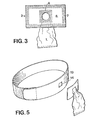
- Figs. 3 and 4 are views, respectively in plan and in axial section, of the pocket after removal of the non-stick films.
- Fig. 5 shows a belt used to hold the pocket against the abdomen.
- the pocket shown comprises a bag 1 made of plastic film, the base of which is closed by a weld line and the inlet of which passes through the central orifice 3 of a flexible fixing sheet 2.
- the edge of the inlet of the bag is folded down at the edge of the orifice 3 and is glued to the internal layer 5 of the sheet 2.
- the sheet 2 On its face intended to be applied to the skin, the sheet 2 is provided with two distinct zones of self-adhesive layer 6 and 7 (fig. 3 and 4) concentric extending continuously around the orifice 3 of material inlet and separated by a non-adhesive area 8. In fig. 2, we can see these self-adhesive layers still coated with removable non-stick films 9 and 10.
- the fixing sheet 2 is shown in FIG. 4 with an exaggerated thickness for the clarity of the drawing.
- This sheet consists of several superimposed layers comprising, from top to bottom in FIG. 4, a porous veil 5 of fibers per example of cotton wool, the fibers of which at least on the surface have been covered with aluminum vapors, an absorbent cellulose layer 11 and an impermeable film 12.
- the sealing of the periphery of layer 11 is ensured by means not shown, such as an impermeable film folded into a U shape and applied to the periphery of the sheet 2 below the self-adhesive layer 7.
- the plastic bag 1 and the waterproof sheet can be made of any suitable polymeric material which is moisture and odor proof and which has the necessary mechanical strength. Suitable materials include for example polyethylene, copolymers of chloride and vinyl acetate with polyvinylidene chloride etc. as well as laminates of these materials, for example laminates of polyvinyl acetate or polyethylene and copolymers of vinyl chloride and polyvinylidene chloride. Bag and film can be transparent or opaque. Their thickness varies depending on the particular polymeric material, but will generally be between 0.05 and 0.3 mm approximately.
- the self-adhesive pads or areas can be rectangular in shape as shown in FIGS. 2 and 3. They can also take a circular or elipsoid shape or even any other suitable shape. These areas generally consist of a simple self-adhesive strip, one of the faces adhering to the fixing sheet, the other being covered with a non-adhesive film (9 or 10), for example a thin sheet of polyethylene or silicone paper which protects the adherent part of the sticky area. It goes without saying that we will preferably choose an adhesive that does not irritate the skin.
- the absorbent zone located between the two adherent pads of the pouch according to the present invention consists of a fibrous material (gauze, tulle or wadding) which may contain a medicinal powder or a disinfectant, or even a product which promotes healing or which calms possibly irritated skin. Excellent results are obtained with products of the "metalline" type from the company Lohmann KG, which are fabrics, felts or nonwovens whose fibers have been coated with aluminum vapor.
- the pouch you can remove either the film 9 or the film 10 and then apply the sheet 2 to the skin so that the orifice 3 faces the artificial anus and the self-adhesive area of which we removed the non-stick film could stick to the skin.
- the film 9 which has been removed it is the inner zone 6 which is active and the device functions like a pocket of known type.
- the film 10 which has been removed it is the external self-adhesive zone 7 which is active and the surface of skin which immediately surrounds the artificial anus can rest. In this situation, the fluid materials can penetrate between the fixing sheet 2 and the skin to the internal edge of the zone 7.
- the mild bactericidal action of the veil of aluminum fiber 5 and the power absorbent of the cellulose layer 11 the skin surface between the artificial anus and the area 7 is not affected.
- a belt 13 of known type is used, with rigid bristle closure called "Velcro" or any other suitable belt.
- the bag 1 is passed from the inside to the outside through a hole 14 made at the appropriate location in the belt 13, a hole whose periphery corresponds to that of the orifice 3, the fixing sheet remaining tight under the belt against the patient's body when he has fastened his belt.
Landscapes
- Health & Medical Sciences (AREA)
- Heart & Thoracic Surgery (AREA)
- Life Sciences & Earth Sciences (AREA)
- Epidemiology (AREA)
- Nursing (AREA)
- Orthopedic Medicine & Surgery (AREA)
- Engineering & Computer Science (AREA)
- Dispersion Chemistry (AREA)
- Biomedical Technology (AREA)
- Vascular Medicine (AREA)
- Chemical & Material Sciences (AREA)
- Animal Behavior & Ethology (AREA)
- General Health & Medical Sciences (AREA)
- Public Health (AREA)
- Veterinary Medicine (AREA)
- Orthopedics, Nursing, And Contraception (AREA)
- Materials For Medical Uses (AREA)
Abstract
La poche comprend un sac souple (1) fixé à une ouverture centrale d'une feuille de fixation souple (2). La feuille de fixation est munie d'une couche auto-adhésive entourant immédiatement l'ouverture et revêtue d'une pellicule anti-adhésive amovible (9) et d'une couche auto-adhésive, également revêtue d'une pellicule anti-adhésive amovible (10), concentrique à la première et suivant le pourtour de la feuille de fixation. On peut retirer à volonté soit la pellicule (9), soit la pellicule (10) et utiliser ainsi tour à tour des surfaces distinctes de peau pour coller la poche, ce qui combat l'irritation de la peau.
Description
- La présente invention a pour objet une poche ostomique (iléostomique ou colostomique, voire caecostomique) plastique auto-adhésive.
- On utilise couramment des poches plastiques auto-adhésives pour recueillir les matières fécales s'écoulant des anus artificiels. L'utilisateur, après avoir retiré la pellicule anti-adhésive qui revêt la couche auto-adhésive, applique celle-ci sur la peau entourant l'anus artificiel. La couche auto-adhésive assure l'étanchéité du joint entre la peau et la poche. Lorsque la poche est pleine ou lorsque le patient veut en changer pour une raison quelconque, l'utilisateur doit l'arracher de la peau et en placer une nouvelle. Comme c'est toujours la même surface de peau qui reçoit la couche adhésive, cette surface de peau s'irrite progressivement et finalement l'emploi de poches auto-adhésives devient pénible ou même impossible.
- La poche qui fait l'objet de l'invention vise à pallier cet inconvénient. Suivant l'invention, la feuille de fixation de la poche sur la peau présente au moins deux zones auto-adhésives distinctes, s'étendant sans interruption autour de l'orifice d'entrée des matières; ces zones concentriques sont séparées par une zone non adhésive, et elles sont revêtues d'une pellicule anti-adhésive amovible.
- L'objet de la présente invention est donc une poche ostomique, plastique, auto-adhésive, caractérisée par le fait qu'elle comporte un sac souple (1) en matière plastique, transparent ou opaque et fixé à l'ouverture d'une feuille de fixation (2) souple, munie de deux plages auto-adhésives, concentriques, dont l'une entoure immédiatement l'ouverture à laquelle est fixé le sac souple et dont l'autre est séparée de la première par une zone intermédiaire, non adhésive, en matériel absorbant qui peut contenir un produit bactéricide ou cicatrisant, les deux couches auto-adhésives étant revêtues chacune d'une pellicule (9,10) anti-adhérente et amovible.
- Le dessin annexé représente, à titre d'exemple, une forme d'exécution de la poche, objet de l'invention.
- Les fig. 1 et 2 sont des vues, respectivement en perspective et en plan, de la poche encore munie des pellicules anti-adhésives amovibles.
- Les fig. 3 et 4 sont des vues, respectivement en plan et en coupe axiale, de la poche après élimination des pellicules anti-adhésives.
- La fig. 5 montre une ceinture servant à maintenir la poche contre l'abdomen.
- La poche représentée comprend un sac 1 en pellicule de matière plastique dont la base est fermée par une ligne de soudure et dont l'entrée passe à travers l'orifice central 3 d'une feuille souple de fixation 2. Le bord de l'entrée du sac est rabattu au bord de l'orifice 3 et est collé sur la couche interne 5 de la feuille 2. Sur sa face destinée à être appliquée sur la peau, la feuille 2 est munie de deux zones distinctes de couche auto-adhésive 6 et 7 (fig.3 et 4) concentriques s'étendant sans interruption autour de l'orifice 3 d'entrée des matières et séparées par une zone non adhésive 8. Sur la fig. 2, on voit ces couches auto-adhésives encore revêtues de pellicules anti-adhésives amovibles 9 et 10.
- La feuille de fixation 2 est représentée à la fig. 4 avec une épaisseur exagérée pour la clarté du dessin. Cette feuille est constituée de plusieurs couches superposées comprenant, de haut en bas sur la fig. 4, un voile poreux 5 de fibres par exemple d'ouate, dont les fibres du moins en surface ont été recouvertes de vapeurs d'aluminium, une couche de cellulose absorbante 11 et une pellicule imperméable 12. L'étanchéité du pourtour de la couche 11 est assurée par des moyens non représentés, tels qu'une pellicule imperméable repliée en forme de U et appliquée sur le pourtour de la feuille 2 en dessous de la couche auto-adhésive 7.
- Le sac plastique 1 et la feuille imperméable peuvent être faits d'une matière polymère, convenable quelconque qui est à l'épreuve de l'humidité et des odeurs et qui possède la résistance mécanique nécessaire. Des matières convenables comprennent par exemple le polyéthylène, les copolymères du chlorure et de l'acétate de vinyle avec le chlorure de polyvinylidène etc ainsi que les stratifiés de ces matières, par exemple les stratifiés de polyvinylacétate ou de polyéthylène et de copolymères du chlorure de vinyle et de chlorure de polyvinylidène. Sac et pellicule peuvent être transparents ou opaques. Leur épaisseur varie en fonction de la matière polymère particulière, mais sera généralement comprise entre 0,05 et 0,3 mm environ.
- Les plages ou zones auto-adhésives peuvent être de forme rectangulaire comme indiqué aux figures 2 et 3. Elles peuvent aussi bien prendre une forme circulaire ou élipsoidique voire toute autre forme appropriée. Ces plages sont en général constituées d'une simple bande auto-collante dont une des faces adhère à la feuille de fixation, l'autre étant recouverte d'une pellicule (9 ou 10) non adhésive, par exemple d'une mince feuille de polyéthylène ou de papier siliconé qui protège la partie adhérente de la zone collante. Il va de soi qu'on choisira de préférence une colle qui n'irrite pas la peau.
- La zone absorbante située entre les deux plages adhérentes de la poche selon la présente invention est constituée d'un matériel fibreux (gaze, tulle ou ouate) qui peut contenir une poudre médicinale ou un désinfectant, voire un produit qui favorise la cicatrisation ou qui calme la peau éventuellement irritée. D'excellents résultats sont obtenus avec les produits du type des "métallines" de la maison Lohmann KG, qui sont des tissus, des feutres ou des non tissés dont les fibres ont été recouvertes de vapeur d'aluminium.
- Pour l'utilisation de la poche, on peut retirer soit la pellicule 9 soit la pellicule 10 puis appliquer la feuille 2 sur la peau de manière que l'orifice 3 soit en regard de l'anus artificiel et que la zone auto-adhésive dont on a retiré la pellicule anti-adhérente puisse se coller à la peau. Lorsque c'est la pellicule 9 qui a été retirée c'est la zone intérieure 6 qui est active et le dispositif fonctionne comme une poche de type connu. Lorsque c'est la pellicule 10 qui a été retirée c'est la zone auto-collante extérieure 7 qui est active et la surface de peau qui entoure immédiatement l'anus artificiel peut se reposer. Dans cette situation, les matières fluides peuvent s'insinuer entre la feuille de fixation 2 et la peau jusqu'au bord interne de la zone 7. Toutefois, grâce à l'action bactéricide douce du voile de fibre d'aluminium 5 et du pouvoir absorbant de la couche de cellulose 11, la surface de peau comprise entre l'anus artificiel et la zone 7 n'est pas affectée.
- Pour assurer le maintien de la poche sur le corps de l'utilisateur, on emploie une ceinture 13 de type connu, à fermeture à poils rigides dite "Velcro" ou toute autre ceinture adéquate. On passe le sac 1 de l'intérieur à l'extérieur à travers un trou 14 pratiqué à l'emplacement approprié dans la ceinture 13, trou dont le pourtour correspond à celui de l'orifice 3, la feuille de fixation restant serrée sous la ceinture contre le corps du patient lorsque celui-ci a bouclé sa ceinture.
Claims (6)
1.- Poche ostomique, plastique, auto-adhésive, caractérisée par le fait qu'elle comporte un sac souple (1) en matière plastique, transparent ou opaque et fixé à l'ouverture d'une feuille de fixation (2) munie de deux plages auto-adhésives, concentriques, dont l'une entoure immédiatement l'ouverture à laquelle est fixé le sac souple et dont l'autre est séparé de la première par une zone intermédiaire, non adhérente, en matériel absorbant qui peut contenir un produit bactéricide ou cicatrisant, les deux zones auto-adhésives étant revêtues chacune d'une pellicule anti-adhésive amovible (9, 10).
2.- Poche iléostomique selon la revendication 1 caractérisée par le fait que la zone intermédiaire située entre les deux plages auto-adhésives est en fibres cellulosiques.
3.- Poche iléostomique selon la revendication 1 caractérisée par le fait que la zone intermédiaire située entre les deux plages auto-adhésives est une gaze ou un tulle comportant une poudre médicinale, un désinfectant ou un antibiotique.
4.- Poche iléostomique selon la revendication 1 caractérisée par le fait que la zone intermédiaire située entre les deux plages auto-adhésives est faite d'ouate ou d'un tissu absorbant, en matière fibreuse dont les fibres sont recouvertes d'aluminium.
5.- Poche iléostomique selon la revendication 1, caractérisée par le fait que la plage auto-adhésive qui entoure immédiatement l'orifice de la feuille de fixation sur la peau est une plage ininterrompue.
6.- Combinaison d'une poche ostomique et d'une ceinture de maintien, caractérisée par le fait que la ceinture est percée d'un trou (14) placé et dimensionné de manière que la poche puisse être disposée à travers ledit trou en ayant son orifice d'entrée en regard de l'anus artificiel du porteur et que la feuille de fixation sur la peau soit serrée contre la peau du porteur lorsque celui-ci a fermé la ceinture.
Applications Claiming Priority (2)
| Application Number | Priority Date | Filing Date | Title |
|---|---|---|---|
| CH727879 | 1979-08-08 | ||
| CH7278/79 | 1979-08-08 |
Publications (1)
| Publication Number | Publication Date |
|---|---|
| EP0024253A1 true EP0024253A1 (fr) | 1981-02-25 |
Family
ID=4322622
Family Applications (1)
| Application Number | Title | Priority Date | Filing Date |
|---|---|---|---|
| EP80810188A Withdrawn EP0024253A1 (fr) | 1979-08-08 | 1980-06-03 | Poche iléostomique |
Country Status (3)
| Country | Link |
|---|---|
| US (1) | US4347843A (fr) |
| EP (1) | EP0024253A1 (fr) |
| JP (1) | JPS5652056A (fr) |
Cited By (3)
| Publication number | Priority date | Publication date | Assignee | Title |
|---|---|---|---|---|
| EP0081907A1 (fr) * | 1981-11-27 | 1983-06-22 | E.R. Squibb & Sons, Inc. | Adaptateur pour dispositifs d'ostomie |
| GB2131698A (en) * | 1982-12-11 | 1984-06-27 | George Young Benzies | Waste retaining receptacles for patients with stomas or similar orifices |
| GB2277031A (en) * | 1993-03-30 | 1994-10-19 | Welland Medical Ltd | Drainable collection bag |
Families Citing this family (7)
| Publication number | Priority date | Publication date | Assignee | Title |
|---|---|---|---|---|
| US5312384A (en) * | 1987-09-18 | 1994-05-17 | Temple John E | Incontinence device and applicator |
| EP1468661A1 (fr) * | 2003-04-17 | 2004-10-20 | The Procter & Gamble Company | Collecteur d'excréments jetable |
| US20050222548A1 (en) * | 2004-04-06 | 2005-10-06 | The Procter & Gamble Company | Disposable excreta management device |
| US7833208B2 (en) * | 2004-12-29 | 2010-11-16 | Kimberly-Clark Worldwide, Inc. | Multilayer absorbent article |
| WO2006090093A1 (fr) * | 2005-02-25 | 2006-08-31 | Gaffney, Edward | Sac perfectionne pour usage par un sujet apres une operation chirurgicale au cours de laquelle une stomie s’est formee |
| WO2007134612A1 (fr) * | 2006-05-24 | 2007-11-29 | Coloplast A/S | Structure adhesive en couches servant à attacher un sac de collecte ou dispositif de collecte a la region peri-anale |
| US10463527B2 (en) * | 2016-01-19 | 2019-11-05 | Velcro BVBA | Configuring elastic supports |
Citations (5)
| Publication number | Priority date | Publication date | Assignee | Title |
|---|---|---|---|---|
| US2896625A (en) * | 1956-12-18 | 1959-07-28 | Fannie B Austin | Colostomy dressing |
| US3081771A (en) * | 1961-04-19 | 1963-03-19 | Clarence I Lee | Ileostomy device |
| GB1328764A (en) * | 1972-05-15 | 1973-09-05 | Marsan A E | Post-surgical drainage pouch |
| FR2246282A1 (fr) * | 1973-10-01 | 1975-05-02 | Hollister Inc | |
| DE2722445A1 (de) * | 1977-05-18 | 1978-11-23 | Toni Hilgers | Halteguertel fuer einen anus-praeter- beutel |
Family Cites Families (4)
| Publication number | Priority date | Publication date | Assignee | Title |
|---|---|---|---|---|
| JPS4019678Y1 (fr) * | 1964-03-07 | 1965-07-08 | ||
| GB1277432A (en) * | 1969-01-14 | 1972-06-14 | Peter Francis Bullen | Improvements in or relating to colostomy devices |
| JPS4910594A (fr) * | 1972-05-30 | 1974-01-30 | ||
| US4062451A (en) * | 1974-09-12 | 1977-12-13 | Johnson & Johnson | Laminated structures comprising films of silane crosslinked acrylate interpolymers having water barrier properties |
-
1980
- 1980-06-03 EP EP80810188A patent/EP0024253A1/fr not_active Withdrawn
- 1980-07-25 US US06/172,113 patent/US4347843A/en not_active Expired - Lifetime
- 1980-08-08 JP JP10977180A patent/JPS5652056A/ja active Pending
Patent Citations (5)
| Publication number | Priority date | Publication date | Assignee | Title |
|---|---|---|---|---|
| US2896625A (en) * | 1956-12-18 | 1959-07-28 | Fannie B Austin | Colostomy dressing |
| US3081771A (en) * | 1961-04-19 | 1963-03-19 | Clarence I Lee | Ileostomy device |
| GB1328764A (en) * | 1972-05-15 | 1973-09-05 | Marsan A E | Post-surgical drainage pouch |
| FR2246282A1 (fr) * | 1973-10-01 | 1975-05-02 | Hollister Inc | |
| DE2722445A1 (de) * | 1977-05-18 | 1978-11-23 | Toni Hilgers | Halteguertel fuer einen anus-praeter- beutel |
Cited By (4)
| Publication number | Priority date | Publication date | Assignee | Title |
|---|---|---|---|---|
| EP0081907A1 (fr) * | 1981-11-27 | 1983-06-22 | E.R. Squibb & Sons, Inc. | Adaptateur pour dispositifs d'ostomie |
| GB2131698A (en) * | 1982-12-11 | 1984-06-27 | George Young Benzies | Waste retaining receptacles for patients with stomas or similar orifices |
| GB2277031A (en) * | 1993-03-30 | 1994-10-19 | Welland Medical Ltd | Drainable collection bag |
| GB2277031B (en) * | 1993-03-30 | 1997-03-26 | Welland Medical Ltd | Drainable collection bag |
Also Published As
| Publication number | Publication date |
|---|---|
| US4347843A (en) | 1982-09-07 |
| JPS5652056A (en) | 1981-05-09 |
Similar Documents
| Publication | Publication Date | Title |
|---|---|---|
| CA1327098C (fr) | Serviette hygienique pliee dans un emballage a rabat | |
| AU2004212904B2 (en) | Conformable wound dressing | |
| US6323386B1 (en) | Wound covering for a foot or hand | |
| JP2806569B2 (ja) | 改良包帯 | |
| US6036679A (en) | Individually wrapped absorbent article | |
| FR2596255A1 (fr) | Tampon jetable absorbant la transpiration | |
| FR2729849A1 (fr) | Pansement adhesif | |
| JP4093594B2 (ja) | フィルム状包帯塗付用補助物 | |
| CA1318465C (fr) | Serviette hygienique emballee individuellement | |
| KR20010014197A (ko) | 대변 처리 디바이스 | |
| JPH02262515A (ja) | 傷用包帯 | |
| JPH10512246A (ja) | 虫駆散薬パッチを収容して提供するためのパッケージ | |
| JP2001505788A6 (ja) | フィルム状包帯塗付用補助物 | |
| JPH0191862A (ja) | 廃棄手段を備えた衛生ナプキン | |
| EP0979640B1 (fr) | Serviette hygiénique | |
| CN1145461C (zh) | 敷贴器和具有该敷贴器的排泄物处理装置 | |
| EP0352208A1 (fr) | Couche-culotte | |
| US4347843A (en) | Ileostomic bag | |
| JP2004113590A (ja) | 吸収性物品 | |
| EP0225910A1 (fr) | Protection contre l'incontinence et procede de fabrication | |
| US20030225387A1 (en) | Absorbent ostomy pad system | |
| FR2548014A1 (fr) | Poche pour stomise | |
| US2896625A (en) | Colostomy dressing | |
| FR2662361A1 (fr) | Pansement de type humide ssj1. | |
| JP4214028B2 (ja) | 吸収性物品の包装構造 |
Legal Events
| Date | Code | Title | Description |
|---|---|---|---|
| PUAI | Public reference made under article 153(3) epc to a published international application that has entered the european phase |
Free format text: ORIGINAL CODE: 0009012 |
|
| AK | Designated contracting states |
Designated state(s): BE DE FR GB IT NL SE |
|
| STAA | Information on the status of an ep patent application or granted ep patent |
Free format text: STATUS: THE APPLICATION IS DEEMED TO BE WITHDRAWN |
|
| 18D | Application deemed to be withdrawn |
Effective date: 19820203 |