EP0024703B2 - Procédé pour la préparation de matériaux pour filtre - Google Patents
Procédé pour la préparation de matériaux pour filtre Download PDFInfo
- Publication number
- EP0024703B2 EP0024703B2 EP80105000A EP80105000A EP0024703B2 EP 0024703 B2 EP0024703 B2 EP 0024703B2 EP 80105000 A EP80105000 A EP 80105000A EP 80105000 A EP80105000 A EP 80105000A EP 0024703 B2 EP0024703 B2 EP 0024703B2
- Authority
- EP
- European Patent Office
- Prior art keywords
- substrate
- process according
- solvent
- resin
- monomer
- Prior art date
- Legal status (The legal status is an assumption and is not a legal conclusion. Google has not performed a legal analysis and makes no representation as to the accuracy of the status listed.)
- Expired
Links
- 238000000034 method Methods 0.000 title claims abstract description 33
- 239000000463 material Substances 0.000 title claims abstract description 30
- 230000008569 process Effects 0.000 title claims abstract description 25
- 239000000758 substrate Substances 0.000 claims abstract description 52
- 239000000178 monomer Substances 0.000 claims abstract description 37
- 239000011347 resin Substances 0.000 claims abstract description 36
- 229920005989 resin Polymers 0.000 claims abstract description 36
- 239000002904 solvent Substances 0.000 claims abstract description 32
- 230000005855 radiation Effects 0.000 claims abstract description 20
- 238000004519 manufacturing process Methods 0.000 claims abstract description 15
- 239000006185 dispersion Substances 0.000 claims abstract description 11
- 239000001913 cellulose Substances 0.000 claims description 8
- 229920002678 cellulose Polymers 0.000 claims description 8
- 239000011248 coating agent Substances 0.000 claims description 7
- 238000000576 coating method Methods 0.000 claims description 7
- 238000010894 electron beam technology Methods 0.000 claims description 7
- 229920005862 polyol Polymers 0.000 claims description 7
- 150000003077 polyols Chemical class 0.000 claims description 7
- 238000005470 impregnation Methods 0.000 claims description 6
- NIXOWILDQLNWCW-UHFFFAOYSA-M Acrylate Chemical compound [O-]C(=O)C=C NIXOWILDQLNWCW-UHFFFAOYSA-M 0.000 claims description 5
- 239000004925 Acrylic resin Substances 0.000 claims description 5
- CERQOIWHTDAKMF-UHFFFAOYSA-M Methacrylate Chemical compound CC(=C)C([O-])=O CERQOIWHTDAKMF-UHFFFAOYSA-M 0.000 claims description 4
- 238000006243 chemical reaction Methods 0.000 claims description 4
- 239000012948 isocyanate Substances 0.000 claims description 4
- 150000002513 isocyanates Chemical class 0.000 claims description 4
- 229920002635 polyurethane Polymers 0.000 claims description 3
- 239000004814 polyurethane Substances 0.000 claims description 3
- 238000007664 blowing Methods 0.000 claims description 2
- 230000001678 irradiating effect Effects 0.000 claims description 2
- 230000035515 penetration Effects 0.000 claims description 2
- 239000003574 free electron Substances 0.000 claims 1
- 230000007246 mechanism Effects 0.000 claims 1
- 239000004745 nonwoven fabric Substances 0.000 abstract description 2
- 239000000123 paper Substances 0.000 description 19
- 239000000243 solution Substances 0.000 description 11
- 239000003795 chemical substances by application Substances 0.000 description 10
- 238000001723 curing Methods 0.000 description 9
- 239000000047 product Substances 0.000 description 8
- 238000007654 immersion Methods 0.000 description 7
- 229920001568 phenolic resin Polymers 0.000 description 7
- 239000005011 phenolic resin Substances 0.000 description 7
- -1 aromatic dicarboxylic acids Chemical class 0.000 description 5
- WXZMFSXDPGVJKK-UHFFFAOYSA-N pentaerythritol Chemical compound OCC(CO)(CO)CO WXZMFSXDPGVJKK-UHFFFAOYSA-N 0.000 description 5
- IJGRMHOSHXDMSA-UHFFFAOYSA-N Atomic nitrogen Chemical compound N#N IJGRMHOSHXDMSA-UHFFFAOYSA-N 0.000 description 4
- ZJCCRDAZUWHFQH-UHFFFAOYSA-N Trimethylolpropane Chemical compound CCC(CO)(CO)CO ZJCCRDAZUWHFQH-UHFFFAOYSA-N 0.000 description 4
- 230000001133 acceleration Effects 0.000 description 4
- 125000004432 carbon atom Chemical group C* 0.000 description 4
- 230000000694 effects Effects 0.000 description 4
- ACCCMOQWYVYDOT-UHFFFAOYSA-N hexane-1,1-diol Chemical compound CCCCCC(O)O ACCCMOQWYVYDOT-UHFFFAOYSA-N 0.000 description 4
- 238000006116 polymerization reaction Methods 0.000 description 4
- 238000003860 storage Methods 0.000 description 4
- ZWEHNKRNPOVVGH-UHFFFAOYSA-N 2-Butanone Chemical compound CCC(C)=O ZWEHNKRNPOVVGH-UHFFFAOYSA-N 0.000 description 3
- NIXOWILDQLNWCW-UHFFFAOYSA-N 2-Propenoic acid Natural products OC(=O)C=C NIXOWILDQLNWCW-UHFFFAOYSA-N 0.000 description 3
- OMIGHNLMNHATMP-UHFFFAOYSA-N 2-hydroxyethyl prop-2-enoate Chemical compound OCCOC(=O)C=C OMIGHNLMNHATMP-UHFFFAOYSA-N 0.000 description 3
- GWZMWHWAWHPNHN-UHFFFAOYSA-N 2-hydroxypropyl prop-2-enoate Chemical compound CC(O)COC(=O)C=C GWZMWHWAWHPNHN-UHFFFAOYSA-N 0.000 description 3
- XEKOWRVHYACXOJ-UHFFFAOYSA-N Ethyl acetate Chemical compound CCOC(C)=O XEKOWRVHYACXOJ-UHFFFAOYSA-N 0.000 description 3
- LYCAIKOWRPUZTN-UHFFFAOYSA-N Ethylene glycol Chemical compound OCCO LYCAIKOWRPUZTN-UHFFFAOYSA-N 0.000 description 3
- OKKJLVBELUTLKV-UHFFFAOYSA-N Methanol Chemical compound OC OKKJLVBELUTLKV-UHFFFAOYSA-N 0.000 description 3
- HVVWZTWDBSEWIH-UHFFFAOYSA-N [2-(hydroxymethyl)-3-prop-2-enoyloxy-2-(prop-2-enoyloxymethyl)propyl] prop-2-enoate Chemical compound C=CC(=O)OCC(CO)(COC(=O)C=C)COC(=O)C=C HVVWZTWDBSEWIH-UHFFFAOYSA-N 0.000 description 3
- 150000001252 acrylic acid derivatives Chemical class 0.000 description 3
- 239000000853 adhesive Substances 0.000 description 3
- 230000001070 adhesive effect Effects 0.000 description 3
- WNLRTRBMVRJNCN-UHFFFAOYSA-N adipic acid Chemical compound OC(=O)CCCCC(O)=O WNLRTRBMVRJNCN-UHFFFAOYSA-N 0.000 description 3
- 230000008901 benefit Effects 0.000 description 3
- 239000007795 chemical reaction product Substances 0.000 description 3
- 238000004132 cross linking Methods 0.000 description 3
- MTHSVFCYNBDYFN-UHFFFAOYSA-N diethylene glycol Chemical compound OCCOCCO MTHSVFCYNBDYFN-UHFFFAOYSA-N 0.000 description 3
- 238000001035 drying Methods 0.000 description 3
- XXMIOPMDWAUFGU-UHFFFAOYSA-N hexane-1,6-diol Chemical compound OCCCCCCO XXMIOPMDWAUFGU-UHFFFAOYSA-N 0.000 description 3
- 239000007788 liquid Substances 0.000 description 3
- 229920000728 polyester Polymers 0.000 description 3
- 239000000126 substance Substances 0.000 description 3
- ZDQNWDNMNKSMHI-UHFFFAOYSA-N 1-[2-(2-prop-2-enoyloxypropoxy)propoxy]propan-2-yl prop-2-enoate Chemical compound C=CC(=O)OC(C)COC(C)COCC(C)OC(=O)C=C ZDQNWDNMNKSMHI-UHFFFAOYSA-N 0.000 description 2
- INQDDHNZXOAFFD-UHFFFAOYSA-N 2-[2-(2-prop-2-enoyloxyethoxy)ethoxy]ethyl prop-2-enoate Chemical compound C=CC(=O)OCCOCCOCCOC(=O)C=C INQDDHNZXOAFFD-UHFFFAOYSA-N 0.000 description 2
- HCLJOFJIQIJXHS-UHFFFAOYSA-N 2-[2-[2-(2-prop-2-enoyloxyethoxy)ethoxy]ethoxy]ethyl prop-2-enoate Chemical compound C=CC(=O)OCCOCCOCCOCCOC(=O)C=C HCLJOFJIQIJXHS-UHFFFAOYSA-N 0.000 description 2
- VHSHLMUCYSAUQU-UHFFFAOYSA-N 2-hydroxypropyl methacrylate Chemical compound CC(O)COC(=O)C(C)=C VHSHLMUCYSAUQU-UHFFFAOYSA-N 0.000 description 2
- NDWUBGAGUCISDV-UHFFFAOYSA-N 4-hydroxybutyl prop-2-enoate Chemical compound OCCCCOC(=O)C=C NDWUBGAGUCISDV-UHFFFAOYSA-N 0.000 description 2
- CSCPPACGZOOCGX-UHFFFAOYSA-N Acetone Chemical compound CC(C)=O CSCPPACGZOOCGX-UHFFFAOYSA-N 0.000 description 2
- 229920000178 Acrylic resin Polymers 0.000 description 2
- LFQSCWFLJHTTHZ-UHFFFAOYSA-N Ethanol Chemical compound CCO LFQSCWFLJHTTHZ-UHFFFAOYSA-N 0.000 description 2
- 238000005520 cutting process Methods 0.000 description 2
- 238000002845 discoloration Methods 0.000 description 2
- 125000002887 hydroxy group Chemical group [H]O* 0.000 description 2
- 239000011261 inert gas Substances 0.000 description 2
- 125000005395 methacrylic acid group Chemical group 0.000 description 2
- 239000000203 mixture Substances 0.000 description 2
- BKFPILLUYYCDSK-UHFFFAOYSA-N n-(4-formamido-3-methylphenyl)formamide Chemical compound CC1=CC(NC=O)=CC=C1NC=O BKFPILLUYYCDSK-UHFFFAOYSA-N 0.000 description 2
- LQNUZADURLCDLV-UHFFFAOYSA-N nitrobenzene Chemical compound [O-][N+](=O)C1=CC=CC=C1 LQNUZADURLCDLV-UHFFFAOYSA-N 0.000 description 2
- 229910052757 nitrogen Inorganic materials 0.000 description 2
- 239000003960 organic solvent Substances 0.000 description 2
- 230000035699 permeability Effects 0.000 description 2
- 229920001223 polyethylene glycol Polymers 0.000 description 2
- 229920000642 polymer Polymers 0.000 description 2
- 229920001451 polypropylene glycol Polymers 0.000 description 2
- CXMXRPHRNRROMY-UHFFFAOYSA-N sebacic acid Chemical compound OC(=O)CCCCCCCCC(O)=O CXMXRPHRNRROMY-UHFFFAOYSA-N 0.000 description 2
- 239000004753 textile Substances 0.000 description 2
- DVKJHBMWWAPEIU-UHFFFAOYSA-N toluene 2,4-diisocyanate Chemical compound CC1=CC=C(N=C=O)C=C1N=C=O DVKJHBMWWAPEIU-UHFFFAOYSA-N 0.000 description 2
- XLYOFNOQVPJJNP-UHFFFAOYSA-N water Substances O XLYOFNOQVPJJNP-UHFFFAOYSA-N 0.000 description 2
- GJIQMPWVGQUEAV-UHFFFAOYSA-N 1,1-dihydroxybutyl prop-2-enoate Chemical compound CCCC(O)(O)OC(=O)C=C GJIQMPWVGQUEAV-UHFFFAOYSA-N 0.000 description 1
- MYWOJODOMFBVCB-UHFFFAOYSA-N 1,2,6-trimethylphenanthrene Chemical compound CC1=CC=C2C3=CC(C)=CC=C3C=CC2=C1C MYWOJODOMFBVCB-UHFFFAOYSA-N 0.000 description 1
- UTHDGOQKIWLLCO-UHFFFAOYSA-N 1-hydroxyhexyl prop-2-enoate Chemical compound CCCCCC(O)OC(=O)C=C UTHDGOQKIWLLCO-UHFFFAOYSA-N 0.000 description 1
- VOBUAPTXJKMNCT-UHFFFAOYSA-N 1-prop-2-enoyloxyhexyl prop-2-enoate Chemical compound CCCCCC(OC(=O)C=C)OC(=O)C=C VOBUAPTXJKMNCT-UHFFFAOYSA-N 0.000 description 1
- SMZOUWXMTYCWNB-UHFFFAOYSA-N 2-(2-methoxy-5-methylphenyl)ethanamine Chemical compound COC1=CC=C(C)C=C1CCN SMZOUWXMTYCWNB-UHFFFAOYSA-N 0.000 description 1
- LCZVSXRMYJUNFX-UHFFFAOYSA-N 2-[2-(2-hydroxypropoxy)propoxy]propan-1-ol Chemical compound CC(O)COC(C)COC(C)CO LCZVSXRMYJUNFX-UHFFFAOYSA-N 0.000 description 1
- OHCUUVLMXARGTH-UHFFFAOYSA-N 2-[2-[2-(2-prop-2-enoyloxypropoxy)propoxy]propoxy]propyl prop-2-enoate Chemical compound C=CC(=O)OCC(C)OCC(C)OCC(C)OCC(C)OC(=O)C=C OHCUUVLMXARGTH-UHFFFAOYSA-N 0.000 description 1
- KXGFMDJXCMQABM-UHFFFAOYSA-N 2-methoxy-6-methylphenol Chemical compound [CH]OC1=CC=CC([CH])=C1O KXGFMDJXCMQABM-UHFFFAOYSA-N 0.000 description 1
- MUZDXNQOSGWMJJ-UHFFFAOYSA-N 2-methylprop-2-enoic acid;prop-2-enoic acid Chemical class OC(=O)C=C.CC(=C)C(O)=O MUZDXNQOSGWMJJ-UHFFFAOYSA-N 0.000 description 1
- FIHBHSQYSYVZQE-UHFFFAOYSA-N 6-prop-2-enoyloxyhexyl prop-2-enoate Chemical compound C=CC(=O)OCCCCCCOC(=O)C=C FIHBHSQYSYVZQE-UHFFFAOYSA-N 0.000 description 1
- WOBHKFSMXKNTIM-UHFFFAOYSA-N Hydroxyethyl methacrylate Chemical compound CC(=C)C(=O)OCCO WOBHKFSMXKNTIM-UHFFFAOYSA-N 0.000 description 1
- CERQOIWHTDAKMF-UHFFFAOYSA-N Methacrylic acid Chemical compound CC(=C)C(O)=O CERQOIWHTDAKMF-UHFFFAOYSA-N 0.000 description 1
- XBDQKXXYIPTUBI-UHFFFAOYSA-M Propionate Chemical compound CCC([O-])=O XBDQKXXYIPTUBI-UHFFFAOYSA-M 0.000 description 1
- DNIAPMSPPWPWGF-UHFFFAOYSA-N Propylene glycol Chemical class CC(O)CO DNIAPMSPPWPWGF-UHFFFAOYSA-N 0.000 description 1
- 241000589614 Pseudomonas stutzeri Species 0.000 description 1
- DAKWPKUUDNSNPN-UHFFFAOYSA-N Trimethylolpropane triacrylate Chemical compound C=CC(=O)OCC(CC)(COC(=O)C=C)COC(=O)C=C DAKWPKUUDNSNPN-UHFFFAOYSA-N 0.000 description 1
- ZCZFEIZSYJAXKS-UHFFFAOYSA-N [3-hydroxy-2,2-bis(hydroxymethyl)propyl] prop-2-enoate Chemical compound OCC(CO)(CO)COC(=O)C=C ZCZFEIZSYJAXKS-UHFFFAOYSA-N 0.000 description 1
- 210000001015 abdomen Anatomy 0.000 description 1
- 238000010521 absorption reaction Methods 0.000 description 1
- KXKVLQRXCPHEJC-UHFFFAOYSA-N acetic acid trimethyl ester Natural products COC(C)=O KXKVLQRXCPHEJC-UHFFFAOYSA-N 0.000 description 1
- 230000009471 action Effects 0.000 description 1
- 238000004026 adhesive bonding Methods 0.000 description 1
- 235000011037 adipic acid Nutrition 0.000 description 1
- 239000001361 adipic acid Substances 0.000 description 1
- 150000001298 alcohols Chemical class 0.000 description 1
- 125000001931 aliphatic group Chemical group 0.000 description 1
- 125000000217 alkyl group Chemical group 0.000 description 1
- 230000015572 biosynthetic process Effects 0.000 description 1
- CDQSJQSWAWPGKG-UHFFFAOYSA-N butane-1,1-diol Chemical compound CCCC(O)O CDQSJQSWAWPGKG-UHFFFAOYSA-N 0.000 description 1
- 230000000711 cancerogenic effect Effects 0.000 description 1
- 229910052799 carbon Inorganic materials 0.000 description 1
- 231100000315 carcinogenic Toxicity 0.000 description 1
- 238000004140 cleaning Methods 0.000 description 1
- 238000003776 cleavage reaction Methods 0.000 description 1
- 239000003086 colorant Substances 0.000 description 1
- 238000004040 coloring Methods 0.000 description 1
- 238000009833 condensation Methods 0.000 description 1
- 230000005494 condensation Effects 0.000 description 1
- 230000001143 conditioned effect Effects 0.000 description 1
- 238000011109 contamination Methods 0.000 description 1
- 125000005442 diisocyanate group Chemical group 0.000 description 1
- 238000010790 dilution Methods 0.000 description 1
- 239000012895 dilution Substances 0.000 description 1
- 238000007598 dipping method Methods 0.000 description 1
- 238000001227 electron beam curing Methods 0.000 description 1
- 230000008030 elimination Effects 0.000 description 1
- 238000003379 elimination reaction Methods 0.000 description 1
- 238000003912 environmental pollution Methods 0.000 description 1
- 230000032050 esterification Effects 0.000 description 1
- 238000005886 esterification reaction Methods 0.000 description 1
- 150000002148 esters Chemical class 0.000 description 1
- 239000004744 fabric Substances 0.000 description 1
- 230000002349 favourable effect Effects 0.000 description 1
- 239000000835 fiber Substances 0.000 description 1
- 230000005484 gravity Effects 0.000 description 1
- 230000036541 health Effects 0.000 description 1
- 125000005842 heteroatom Chemical group 0.000 description 1
- 230000006872 improvement Effects 0.000 description 1
- 239000013067 intermediate product Substances 0.000 description 1
- XJRAOMZCVTUHFI-UHFFFAOYSA-N isocyanic acid;methane Chemical compound C.N=C=O.N=C=O XJRAOMZCVTUHFI-UHFFFAOYSA-N 0.000 description 1
- 229920005610 lignin Polymers 0.000 description 1
- 150000002734 metacrylic acid derivatives Chemical class 0.000 description 1
- 230000005012 migration Effects 0.000 description 1
- 238000013508 migration Methods 0.000 description 1
- 238000002156 mixing Methods 0.000 description 1
- SLCVBVWXLSEKPL-UHFFFAOYSA-N neopentyl glycol Chemical compound OCC(C)(C)CO SLCVBVWXLSEKPL-UHFFFAOYSA-N 0.000 description 1
- 239000001301 oxygen Substances 0.000 description 1
- 229910052760 oxygen Inorganic materials 0.000 description 1
- 238000004806 packaging method and process Methods 0.000 description 1
- 239000003973 paint Substances 0.000 description 1
- ISWSIDIOOBJBQZ-UHFFFAOYSA-N phenol group Chemical group C1(=CC=CC=C1)O ISWSIDIOOBJBQZ-UHFFFAOYSA-N 0.000 description 1
- FSDNTQSJGHSJBG-UHFFFAOYSA-N piperidine-4-carbonitrile Chemical compound N#CC1CCNCC1 FSDNTQSJGHSJBG-UHFFFAOYSA-N 0.000 description 1
- 229920000058 polyacrylate Polymers 0.000 description 1
- 229920005749 polyurethane resin Polymers 0.000 description 1
- 238000002360 preparation method Methods 0.000 description 1
- 235000013772 propylene glycol Nutrition 0.000 description 1
- 239000002994 raw material Substances 0.000 description 1
- 230000035484 reaction time Effects 0.000 description 1
- 230000009467 reduction Effects 0.000 description 1
- 230000000717 retained effect Effects 0.000 description 1
- 229920006395 saturated elastomer Polymers 0.000 description 1
- 230000007017 scission Effects 0.000 description 1
- 239000007858 starting material Substances 0.000 description 1
- 238000003756 stirring Methods 0.000 description 1
- 238000004381 surface treatment Methods 0.000 description 1
- 239000003017 thermal stabilizer Substances 0.000 description 1
- 230000008646 thermal stress Effects 0.000 description 1
- ZIBGPFATKBEMQZ-UHFFFAOYSA-N triethylene glycol Chemical compound OCCOCCOCCO ZIBGPFATKBEMQZ-UHFFFAOYSA-N 0.000 description 1
- 230000037303 wrinkles Effects 0.000 description 1
Images
Classifications
-
- D—TEXTILES; PAPER
- D06—TREATMENT OF TEXTILES OR THE LIKE; LAUNDERING; FLEXIBLE MATERIALS NOT OTHERWISE PROVIDED FOR
- D06M—TREATMENT, NOT PROVIDED FOR ELSEWHERE IN CLASS D06, OF FIBRES, THREADS, YARNS, FABRICS, FEATHERS OR FIBROUS GOODS MADE FROM SUCH MATERIALS
- D06M14/00—Graft polymerisation of monomers containing carbon-to-carbon unsaturated bonds on to fibres, threads, yarns, fabrics, or fibrous goods made from such materials
- D06M14/18—Graft polymerisation of monomers containing carbon-to-carbon unsaturated bonds on to fibres, threads, yarns, fabrics, or fibrous goods made from such materials using wave energy or particle radiation
- D06M14/20—Graft polymerisation of monomers containing carbon-to-carbon unsaturated bonds on to fibres, threads, yarns, fabrics, or fibrous goods made from such materials using wave energy or particle radiation on to materials of natural origin
- D06M14/22—Graft polymerisation of monomers containing carbon-to-carbon unsaturated bonds on to fibres, threads, yarns, fabrics, or fibrous goods made from such materials using wave energy or particle radiation on to materials of natural origin of vegetal origin, e.g. cellulose or derivatives thereof
-
- B—PERFORMING OPERATIONS; TRANSPORTING
- B05—SPRAYING OR ATOMISING IN GENERAL; APPLYING FLUENT MATERIALS TO SURFACES, IN GENERAL
- B05C—APPARATUS FOR APPLYING FLUENT MATERIALS TO SURFACES, IN GENERAL
- B05C9/00—Apparatus or plant for applying liquid or other fluent material to surfaces by means not covered by any preceding group, or in which the means of applying the liquid or other fluent material is not important
- B05C9/08—Apparatus or plant for applying liquid or other fluent material to surfaces by means not covered by any preceding group, or in which the means of applying the liquid or other fluent material is not important for applying liquid or other fluent material and performing an auxiliary operation
- B05C9/12—Apparatus or plant for applying liquid or other fluent material to surfaces by means not covered by any preceding group, or in which the means of applying the liquid or other fluent material is not important for applying liquid or other fluent material and performing an auxiliary operation the auxiliary operation being performed after the application
-
- B—PERFORMING OPERATIONS; TRANSPORTING
- B05—SPRAYING OR ATOMISING IN GENERAL; APPLYING FLUENT MATERIALS TO SURFACES, IN GENERAL
- B05C—APPARATUS FOR APPLYING FLUENT MATERIALS TO SURFACES, IN GENERAL
- B05C9/00—Apparatus or plant for applying liquid or other fluent material to surfaces by means not covered by any preceding group, or in which the means of applying the liquid or other fluent material is not important
- B05C9/08—Apparatus or plant for applying liquid or other fluent material to surfaces by means not covered by any preceding group, or in which the means of applying the liquid or other fluent material is not important for applying liquid or other fluent material and performing an auxiliary operation
- B05C9/14—Apparatus or plant for applying liquid or other fluent material to surfaces by means not covered by any preceding group, or in which the means of applying the liquid or other fluent material is not important for applying liquid or other fluent material and performing an auxiliary operation the auxiliary operation involving heating or cooling
-
- D—TEXTILES; PAPER
- D21—PAPER-MAKING; PRODUCTION OF CELLULOSE
- D21H—PULP COMPOSITIONS; PREPARATION THEREOF NOT COVERED BY SUBCLASSES D21C OR D21D; IMPREGNATING OR COATING OF PAPER; TREATMENT OF FINISHED PAPER NOT COVERED BY CLASS B31 OR SUBCLASS D21G; PAPER NOT OTHERWISE PROVIDED FOR
- D21H25/00—After-treatment of paper not provided for in groups D21H17/00 - D21H23/00
- D21H25/04—Physical treatment, e.g. heating, irradiating
- D21H25/06—Physical treatment, e.g. heating, irradiating of impregnated or coated paper
Definitions
- FR-A-2 241 384 describes the production of paper substrates by grafting on polymers with optionally monomers onto lignocellulose paper materials. Such paper materials are said to have a high absorption capacity for water and are not suitable for filter materials for oil and air filters.
- US-A-4 091 167 cardboard is impregnated with an impregnating agent consisting of a solution of a prepolymer and a monomer, followed by curing with electron beams. This does not address the manufacture of filter materials.
- DE-A-2150 374 generally describes the curing of acrylic resins; there is no reference to the manufacture of filter materials.
- DE-A-1 113677 and DE-B-1 174 740 relate to a process for improving the mechanical properties of textiles made from cellulose-containing fibers, the textiles being intended to be made wrinkle-resistant or dimensionally stable.
- the object of the invention is therefore to provide an economical process for the production of filter materials for motor vehicles which can be carried out with little energy expenditure and little outlay on equipment and leads to end products with superior properties.
- various polymers can be crosslinked by high-energy radiation, for example by UV radiation, ⁇ , ⁇ and y radiation.
- high-energy radiation for example by UV radiation, ⁇ , ⁇ and y radiation.
- Such crosslinking reactions have hitherto been used, for example, in the curing of paints (DE-A-2 029 145).
- electron beam curing can also be applied to the partial coating of cellulose-based paper substrates while maintaining a residual permeability of the treated substrates.
- the invention therefore relates to a method for producing filter materials for oil and air filters for motor vehicles by impregnating a paper substrate based on cellulose with resin and monomer and subsequently curing the substrate.
- the process according to the invention is characterized in that the substrate is impregnated with a solution or dispersion of at least one polyurethane-acrylate resin which is curable by electron beams and isocyanates, polyols and hydroxyl-functional acrylate and methacrylate monomers and monomers which are reactive with NCO groups and which have a concentration contains from 1 to 50% by weight of resin and monomer, based on the weight of the solution or dispersion, then the solvent is removed and the curing is then effected by electron radiation.
- the substrate to be treated is first impregnated with a solution or dispersion, preferably a solution, of the resin and monomers in a suitable inert organic liquid.
- hydroxyl groups of the polyols mentioned can be wholly or partially esterified by acrylic acid and / or methacrylic acid.
- usable monomers according to the invention are trimethylolpropane triacrylate, hexanediol diacrylate, pentaerythritol tetraacrylate, pentaerythritol triacrylate, hexane-1,6-diol diacrylate, Diäthylenglykoldiacrylat, Triäthylenglykoldiacrylat, Tetraäthylenglykoldiacrylat, tripropylene glycol diacrylate, 2-hydroxyethyl acrylate, 2-hydroxypropyl acrylate, and Hexandiolmonoacrylat Butandiolmonoacrylate and the corresponding methacrylates or mixed acrylate Methacrylates.
- Particularly suitable monomers are pentaerythritol triacrylate or pentaerythritol acrylate mixtures with an average degree of esterification of 3 to 3.3 and with a viscosity of 600 to 1 200 mPa - s (measured at 20 ° C. with the Brookfield viscometer, type RVT).
- polyurethane resins are high or low molecular weight resins or oligomers in question the inert organic liquids used are soluble. Examples of this are soluble polyurethane acrylates formed from the aforementioned hydroxy-functional acrylate monomers.
- the molecular weight of such resins or oligomers is preferably in the range from 800-8,000 and their viscosities go from 1,000-50,000 mPa ⁇ s.
- the content of acrylic and / or methacrylic unsaturated monomer units is, for example, 2-6 per molecule.
- Resins of this type were produced by customary procedures, for example as described in DE-A-2 530 896 and DE-A-2 542 314. For example, a polyol is reacted with a diisocyanate. The content of free NCO groups reached is then saturated with hydroxy-functional acrylate or methacrylate monomers.
- the person skilled in the art can choose amounts and reaction conditions so that the desired molecular weights and the desired content of acrylic and / or methacrylic unsaturated monomer units are achieved. The viscosities can be varied, for example, by appropriate dilution of the resins with monomers.
- Suitable inert organic liquids for dissolving or dispersing the monomers or Resins are customary inert organic solvents, such as aliphatic alcohols with, for example, 1 to 6 carbon atoms, in particular methanol and ethanol, aliphatic ketones with, for example, 3 to 6 carbon atoms, in particular dimethyl ketone and methyl ethyl ketone, and also esters, in particular alkyl acetate with, for example, 1 to 4 carbon atoms in the alkyl part, e.g. B. methyl acetate and ethyl acetate. These solvents can be used either alone or in a mixture.
- solvents can be used either alone or in a mixture.
- the monomer and the resin are used in the solvent to impregnate the paper substrates in concentrations of 1.0 to 50% by weight, based on the sum of the weight of the monomers and resin and solvent.
- the solutions thus contain 1.0 to 50 parts by weight of monomer and resin and 99 to 50 parts by weight of solvent. Preferred ranges are 2.0 to 40 parts by weight of monomer and resin and 98.0 to 60 parts by weight of solvent. For example, 10, 20, 30, 40 or 50 parts by weight of monomer and resin and 90, 80, 70, 60 or 50 parts by weight of solvent can be used.
- the concentration of the monomer and resin in the solvent ultimately depends on the desired degree of coverage of the substrate with the monomer or resin.
- the substrate to be treated can be impregnated in any way with the solution or the dispersion of the monomer and resin in the solvents mentioned. Dipping treatment is preferably carried out. After the immersion treatment, the substrate passes through a drip zone and a drying zone, in which temperatures of approximately 120 to 140 ° C. are maintained, depending on the solvent. The solvent is recovered in the pure state from the drying zone and can be used again for the same purpose or for other purposes.
- the amount of resin or monomer remaining on the substrate is independent of the immersion time in the solution and depends only on the concentration of the solution used.
- concentration of the solution used is therefore within the ranges specified above according to the desired degree of occupancy or the desired properties, such as. B. the degree of permeation of the filter material to be produced.
- preferred ranges for the coating are 5 to 45% by weight, in particular 5 to 40% by weight, for example 10 to 25% by weight or 15, 25 or 45% by weight. %, based on the mass of the substrate.
- the following resin / oligomer concentrations generally give the following assignments (measured as an increase in paper mass in%):
- treated paper webs can be transported and stored in the form of rolls. Even if such rolls are stored in a side-by-side form for long periods before crosslinking, no tendency of the impregnated material to migrate due to gravity is observed, rather the applied uncured monomer or resin remains distributed uniformly over the substrate.
- the materials cured according to the invention are particularly easy to process.
- they can be easily processed into folded forms, whereby the tendency to form fractures is reduced in comparison with products conventionally treated and hardened with phenolic resins.
- this also prevents the formation of unwanted dusts.
- such dusts also pose a health risk when processing, since phenolic products are to be considered as carcinogenic substances.
- the paper materials impregnated according to the invention are finally possible before or after a surface treatment hardened.
- the unsaturated acrylate resin is cured by radial chain polymerization, which leads to chain growth with a high three-dimensional degree of branching.
- the substrates subjected to the impregnation, draining and drying treatment are subjected to a short-term irradiation with high-energy jets of a low dose.
- Electron or ⁇ radiation is preferably used for this.
- the radiation can be generated by conventional electron sources.
- one or more multi-stage electron accelerators are used. It has proven to be particularly advantageous to carry out the curing process using the device described below.
- acceleration voltages of approximately 150 to 500 kV have proven to be suitable. In general, acceleration voltages of 200 kV or acceleration voltages of 150 to 200 kV can be used successfully.
- the penetration depth of the electron radiation depends on the specific weight of the impregnated substrate, that is to say on substrate + impregnated monomers and / or resin.
- an electron voltage of 150 to 180 kV is sufficient to penetrate a substrate impregnated according to the invention with a specific weight of 1 to a depth of about 120 f.Lm to 16 ßp.m.
- the curing speed depends on the radiation dose used. In general, dosages from 0.1 to about 16 Mrad, preferably 0.1 to 10 Mrad, and particularly preferably from 1 to about 10 or from 4 to 8 Mrad have been found to be satisfactory for achieving favorable production speeds.
- the substrate impregnated according to the invention if appropriate in conditioned form, is generally guided past a window under an inert gas, such as nitrogen, for example, from which the electron beam emerges.
- the distance of the substrate from the exit window is generally 10 to 50 mm.
- the process according to the invention can be applied to all customary cellulose-based paper materials.
- Filter papers based on cellulose such as are used for the production of oil filters in the motor vehicle industry and of air filters in the motor vehicle industry, are suitable.
- a lignin content in the cellulose does not interfere.
- a particular advantage that arises when using materials based on pure cellulose is that the products obtained remain practically white, so that when the finished products are used as filter materials, there is an indicator effect on possible contamination of the filter. Such an indicator effect is not possible with conventional coating with phenolic resins, since white coloring is not retained with phenolic resins, but discoloration to a dark brown color occurs.
- the procedure according to the invention depending on the amount of the substrates used with resins, products can be produced which, depending on the starting substrate used and the amount of partial coverage, have a controllable residual permeability and can therefore be used as filter materials for oil or air filters in the motor vehicle industry .
- the substrates according to the invention proved to be resistant to mechanical, chemical and temperature influences.
- the polymerized impregnating resins are present as rasites, i.e. H. they are insoluble in organic solvents and can no longer be melted, which is advantageous, for example, for use in motor vehicles at high engine temperatures.
- the process according to the invention is characterized above all by the lower energy expenditure, ie. H. due to the elimination of high hardening temperatures and the reduction of the expenditure on equipment (no long furnace channels are required) and the increased throughput speed.
- the lower energy expenditure ie. H. due to the elimination of high hardening temperatures and the reduction of the expenditure on equipment (no long furnace channels are required) and the increased throughput speed.
- there is no danger to the environment and workplaces from the development of harmful vapors since no low-molecular cleavage or reaction products are released during the polymerization of the impregnating resins used according to the invention.
- Further advantages are that the soaked intermediate products obtained are stable in storage and are not subject to mass migration.
- the solvents used can be easily recovered and can be used for a wide variety of purposes.
- the products obtained are particularly stable and are not subject to discoloration.
- the thermal stress on the substrates is eliminated in the method according to the invention. It is therefore possible to use more sensitive substrates than before. Changes in the paper materials used due to the ionizing effect of the electron beams were not found.
- the shortest treatment time with low space requirements of the system required for the method according to the invention results if at least the removal of the solvent and Electron irradiation of the substrate - optionally also impregnation or coating with the solvent or with a solution of impregnation and solvent - is carried out in successive operations with the substrate strip preferably running continuously.
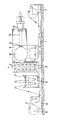
- the method according to the invention can be carried out favorably with a device such as that shown in the figure, the device being included.
- (C) for removing the solvent and the device (D) for irradiating the substrate strip freed from solvent are combined to form a common structural unit.
- multi-part - housing assembly A is a supply or storage chamber or station for a material strip or substrate to be treated f, z.
- B. a roll of paper filter material wound onto a supply roll 10, B an immersion bath for impregnating the substrate with an impregnating agent dissolved in a solvent or, if the material tape f is already coated with impregnating agent, with the solvent,
- the material strip f running off the supply roll 10 at a certain speed is continuously passed through the housing parts or chambers or stations A to E.
- the substrate is first exposed to the radiation-crosslinkable impregnating agent, e.g. B. an acrylic resin, soaked.
- the solvent has the task of allowing the impregnating agent to penetrate into the substrate and thus fulfilling a transport function for the impregnating agent.
- the further impregnated substrate in the chamber C - optionally after passing through a drip zone - by blowing using the nozzles 11, z. B. hot air nozzles, which can be supplied by a fan arranged in or on the housing assembly, again freed from a solvent. It can therefore immediately afterwards by using an inert gas, e.g. B. nitrogen, filled radiation channel 15 of the radiation housing part D, in which the impregnating agent is crosslinked by electron radiation and the substrate is thereby hardened and stiffened.
- an inert gas e.g. B. nitrogen
- Electron irradiation with an acceleration voltage of 150 to 200 kV has proven to be particularly economical for the aforementioned purpose.
- large-area irradiation with a beam region widened in the running direction and fanned out in the scanner 14 is provided.
- an irradiation time of about 0.05 to 0.5 sec a running speed of the material band f of z. B. 30 to 60 m / sec can be achieved.
- This radiation is generally sufficient to penetrate with a cross-linking of z. B. to achieve 120 to 160 g / m 2 in the impregnated layer.
- Simple paths of the substrate strip f through the chambers B, C and E are shown in the schematic drawing. Additional routes can be used to extend these paths as required.
- the invention is also not necessarily limited to the fact that the material or substrate tape is first soaked or coated with the impregnating agent using a solvent in immersion bath B or in another suitable application device. If the material or substrate tape that is wound onto the supply roll 10 or that is supplied in some other way is already externally coated with an impregnating agent, the immersion bath B may need only contain the required solvent. If the tape is already fed in a state in which it has already been treated with a dissolved impregnating agent, the belly immersion bath can be used entirely. omitted. A and / or B can also form part of the common housing assembly.
- the flask is equipped with a condenser (water-cooled), a stirrer with a patent plug, which allows the flask to be covered with nitrogen during the manufacturing process (due to the NCO / water reaction), and a thermometer for temperature control.
- a condenser water-cooled
- a stirrer with a patent plug, which allows the flask to be covered with nitrogen during the manufacturing process (due to the NCO / water reaction)
- a thermometer for temperature control.
- NCO target 6.24% ⁇ 0.1%.
- the temperature is now kept at 75 ° C. for 3 hours.
- NCO target 0.00%
- item 4 is added and mixed thoroughly. After mixing, the reactor contents are cooled to approx. 40 ° C and the resin is filled.
Landscapes
- Health & Medical Sciences (AREA)
- Toxicology (AREA)
- Engineering & Computer Science (AREA)
- Textile Engineering (AREA)
- Paper (AREA)
- Treatments For Attaching Organic Compounds To Fibrous Goods (AREA)
- Filtering Materials (AREA)
- Reinforced Plastic Materials (AREA)
Claims (10)
Priority Applications (1)
| Application Number | Priority Date | Filing Date | Title |
|---|---|---|---|
| AT80105000T ATE3072T1 (de) | 1979-08-22 | 1980-08-22 | Verfahren und vorrichtung zur herstellung von filtermaterialien. |
Applications Claiming Priority (2)
| Application Number | Priority Date | Filing Date | Title |
|---|---|---|---|
| DE2933998 | 1979-08-22 | ||
| DE2933998A DE2933998C2 (de) | 1979-08-22 | 1979-08-22 | Verfahren und Vorrichtung zur Herstellung eines imprägnierten Papier- oder Vliessubstrats |
Publications (3)
| Publication Number | Publication Date |
|---|---|
| EP0024703A1 EP0024703A1 (fr) | 1981-03-11 |
| EP0024703B1 EP0024703B1 (fr) | 1983-04-13 |
| EP0024703B2 true EP0024703B2 (fr) | 1986-07-30 |
Family
ID=6079047
Family Applications (1)
| Application Number | Title | Priority Date | Filing Date |
|---|---|---|---|
| EP80105000A Expired EP0024703B2 (fr) | 1979-08-22 | 1980-08-22 | Procédé pour la préparation de matériaux pour filtre |
Country Status (7)
| Country | Link |
|---|---|
| EP (1) | EP0024703B2 (fr) |
| JP (1) | JPS5663097A (fr) |
| AT (1) | ATE3072T1 (fr) |
| BR (1) | BR8005295A (fr) |
| DE (1) | DE2933998C2 (fr) |
| FI (1) | FI66942C (fr) |
| YU (1) | YU205780A (fr) |
Families Citing this family (11)
| Publication number | Priority date | Publication date | Assignee | Title |
|---|---|---|---|---|
| DE3020333C2 (de) * | 1980-05-29 | 1983-12-29 | MD-Verwaltungsgesellschaft Nicolaus & Co-GmbH & Co KG, 8000 München | Verfahren zur Herstellung von porösem Papier |
| IE56391B1 (en) * | 1984-03-05 | 1991-07-17 | British Library Board | Treatment of archival material by graft polymerisation with monomer |
| GB2180248B (en) * | 1985-09-12 | 1989-11-29 | British Library The | Treatment of archival material by graft polymerisation with monomers |
| DE3711807A1 (de) * | 1987-04-08 | 1988-10-27 | Bausch & Co Viktor | Verfahren zum impraegnieren von flaechigen faserstoffen |
| DE60135834D1 (de) * | 2001-06-08 | 2008-10-30 | Procter & Gamble | Cellulosfasern enthaltend strahlungsaktivierbare Harzverbindungen |
| DE102005032395A1 (de) * | 2005-07-12 | 2007-01-25 | Mahle International Gmbh | Filtermedium für technische Anwendungen und Verfahren seiner Herstellung |
| DE102007019946A1 (de) * | 2007-04-27 | 2008-10-30 | Elringklinger Ag | Flachdichtung und Verfahren zur Herstellung einer Flachdichtung |
| JP5444358B2 (ja) * | 2007-10-05 | 2014-03-19 | フィルセン プロプライエタリー リミテッド | シート材の製造方法 |
| US7867358B2 (en) * | 2008-04-30 | 2011-01-11 | Xyleco, Inc. | Paper products and methods and systems for manufacturing such products |
| AU2015215953B2 (en) * | 2008-10-03 | 2016-11-17 | Filsen Pty Ltd | Method for manufacturing sheet material |
| EP2350386A4 (fr) * | 2008-10-03 | 2015-08-12 | Filsen Pty Ltd | Procédé pour fabriquer un matériau en feuille |
Family Cites Families (7)
| Publication number | Priority date | Publication date | Assignee | Title |
|---|---|---|---|---|
| FR66034E (fr) * | ||||
| BE520401A (fr) * | 1952-06-03 | |||
| NL244572A (fr) * | 1959-04-01 | 1900-01-01 | ||
| SE356469B (fr) * | 1969-06-13 | 1973-05-28 | Conservatome | |
| GB1347679A (en) * | 1970-10-09 | 1974-02-27 | Berger Jenson & Nicholson Ltd | Cross-linking polymers |
| FR2241384B1 (fr) * | 1973-05-30 | 1976-06-11 | Commissariat Energie Atomique | |
| US4091167A (en) * | 1973-09-21 | 1978-05-23 | Rengo Co., Ltd. | Method for preparing paper board having improved wet compression strength |
-
1979
- 1979-08-22 DE DE2933998A patent/DE2933998C2/de not_active Expired
-
1980
- 1980-08-15 YU YU02057/80A patent/YU205780A/xx unknown
- 1980-08-19 FI FI802612A patent/FI66942C/fi not_active IP Right Cessation
- 1980-08-21 JP JP11575280A patent/JPS5663097A/ja active Pending
- 1980-08-21 BR BR8005295A patent/BR8005295A/pt unknown
- 1980-08-22 EP EP80105000A patent/EP0024703B2/fr not_active Expired
- 1980-08-22 AT AT80105000T patent/ATE3072T1/de not_active IP Right Cessation
Also Published As
| Publication number | Publication date |
|---|---|
| ATE3072T1 (de) | 1983-04-15 |
| DE2933998A1 (de) | 1981-03-12 |
| FI66942B (fi) | 1984-08-31 |
| FI802612A7 (fi) | 1981-02-23 |
| EP0024703A1 (fr) | 1981-03-11 |
| EP0024703B1 (fr) | 1983-04-13 |
| JPS5663097A (en) | 1981-05-29 |
| BR8005295A (pt) | 1981-03-04 |
| FI66942C (fi) | 1984-12-10 |
| YU205780A (en) | 1983-02-28 |
| DE2933998C2 (de) | 1987-05-27 |
Similar Documents
| Publication | Publication Date | Title |
|---|---|---|
| EP0024703B2 (fr) | Procédé pour la préparation de matériaux pour filtre | |
| DE2912574C2 (de) | Verfahren zur Herstellung von mit Acrylgruppen abgeschlossenen Urethanoligomeren | |
| DE69612089T2 (de) | Acrylatpolymerbeschichtete bahnförmige materialen und verfahren zu ihrer herstellung | |
| DE68914868T2 (de) | Verfahren zur Herstellung einer Polyesterfolie mit einer dünnen gehärteten Polyurethanbeschichtung und Verwendung der Polyesterfolie. | |
| DE3850377T2 (de) | Strahlenhärtbare Zusammensetzungen aus ungesättigten Polyestern und Komponenten mit wenigstens zwei Vinyläthergruppen. | |
| DE69702892T2 (de) | Verfahren zur herstellung eines bogens aus einem lignocellulosischen material und verfahren zur herstellung eines daraus erzeugten fertigprodukts | |
| DE3104889C2 (de) | Verfahren und Vorrichtung zur Herstellung eines gehärteten Harzüberzugs mit verringertem Oberflächenglanz | |
| DE2746640A1 (de) | Harzmischung fuer die oberflaechenbehandlung von kohlenstoffasern, verfahren zur oberflaechenbehandlung von kohlenstoffasern und nach diesem verfahren beschichtete kohlenstoffasern | |
| DE2906978C3 (de) | Verfahren und Vorrichtung zur kontinuierlichen Herstellung eines Schichtmaterials mit reduziertem Oberflächenglanz | |
| DE3750467T2 (de) | Verfahren zur Verbesserung der Anfärbbarkeit von gewebten oder ungewebten Stoffen. | |
| DE1594118B1 (de) | Klebstoffe auf Basis von isocyanat-Additionsprodukten | |
| DE2724087A1 (de) | Verfahren zur herstellung eines matten, durch strahlung gehaerteten ueberzuges | |
| DE2259109A1 (de) | Hydrophile, haertbare harzzusammensetzung fuer ueberzuege | |
| DE3204038A1 (de) | Koagulierbare waessrige polyurethan-zusammensetzung | |
| DE1217619B (de) | Verfahren zur Modifizierung von Kohlenwasserstoffpolymeren | |
| EP0090174A1 (fr) | Procédé pour renforcer et rendre étanche les bords de pièces textiles | |
| DE2528995C3 (de) | Schlichtemittel für Glasfasern | |
| DE2056707A1 (de) | Haftverbesserung von Polyestern an Kautschuk | |
| DE1546400C3 (de) | Verfahren zur Herstellung eines zu einer Einheit vereinigten Blattmaterials auf Cellulosebasis | |
| DE2041018A1 (de) | Verfahren zur Polymerisation von Polyaethylenterephthalat | |
| DE888766C (de) | Verfahren zur Herstellung von Loesungen von Elastomeren der Polyesterreihe | |
| EP0041205B1 (fr) | Procédé pour la préparation de matériaux filtrants | |
| DE1941412A1 (de) | Verfahren zur kontinuierlichen Herstellung einer flexiblen poroesen Mehrschichtwerkstoffbahn mit hochglaenzender Aussenflaeche | |
| DE2100376C3 (fr) | ||
| DE3614839C2 (fr) |
Legal Events
| Date | Code | Title | Description |
|---|---|---|---|
| PUAI | Public reference made under article 153(3) epc to a published international application that has entered the european phase |
Free format text: ORIGINAL CODE: 0009012 |
|
| AK | Designated contracting states |
Designated state(s): AT BE CH FR GB IT LI LU NL SE |
|
| 17P | Request for examination filed |
Effective date: 19810519 |
|
| ITF | It: translation for a ep patent filed | ||
| GRAA | (expected) grant |
Free format text: ORIGINAL CODE: 0009210 |
|
| RAP1 | Party data changed (applicant data changed or rights of an application transferred) |
Owner name: DUERR ANLAGENBAU GMBH Owner name: WIKOLIN POLYMER CHEMIE GMBH |
|
| AK | Designated contracting states |
Designated state(s): AT BE CH FR GB IT LI LU NL SE |
|
| REF | Corresponds to: |
Ref document number: 3072 Country of ref document: AT Date of ref document: 19830415 Kind code of ref document: T |
|
| ET | Fr: translation filed | ||
| PLBI | Opposition filed |
Free format text: ORIGINAL CODE: 0009260 |
|
| PGFP | Annual fee paid to national office [announced via postgrant information from national office to epo] |
Ref country code: LU Payment date: 19830817 Year of fee payment: 4 |
|
| PG25 | Lapsed in a contracting state [announced via postgrant information from national office to epo] |
Ref country code: LU Free format text: LAPSE BECAUSE OF NON-PAYMENT OF DUE FEES Effective date: 19830831 |
|
| 26 | Opposition filed |
Opponent name: FIRMA CARL FREUDENBERG Effective date: 19830802 |
|
| PGFP | Annual fee paid to national office [announced via postgrant information from national office to epo] |
Ref country code: CH Payment date: 19840724 Year of fee payment: 5 |
|
| PGFP | Annual fee paid to national office [announced via postgrant information from national office to epo] |
Ref country code: FR Payment date: 19840831 Year of fee payment: 5 |
|
| PGFP | Annual fee paid to national office [announced via postgrant information from national office to epo] |
Ref country code: SE Payment date: 19840930 Year of fee payment: 5 Ref country code: BE Payment date: 19840930 Year of fee payment: 5 |
|
| PLAB | Opposition data, opponent's data or that of the opponent's representative modified |
Free format text: ORIGINAL CODE: 0009299OPPO |
|
| R26 | Opposition filed (corrected) |
Opponent name: FIRMA CARL FREUDENBERG Effective date: 19830802 |
|
| RTI2 | Title (correction) |
Free format text: PROCESS FOR PRODUCING FILTER-MATERIALS. |
|
| RAP2 | Party data changed (patent owner data changed or rights of a patent transferred) |
Owner name: DUERR ANLAGENBAU GMBH Owner name: MORTON THIOKOL GMBH |
|
| PUAH | Patent maintained in amended form |
Free format text: ORIGINAL CODE: 0009272 |
|
| STAA | Information on the status of an ep patent application or granted ep patent |
Free format text: STATUS: PATENT MAINTAINED AS AMENDED |
|
| RAP2 | Party data changed (patent owner data changed or rights of a patent transferred) |
Owner name: DUERR GMBH Owner name: MORTON THIOKOL GMBH |
|
| 27A | Patent maintained in amended form |
Effective date: 19860730 |
|
| AK | Designated contracting states |
Kind code of ref document: B2 Designated state(s): AT BE CH FR GB IT LI LU NL SE |
|
| PGFP | Annual fee paid to national office [announced via postgrant information from national office to epo] |
Ref country code: AT Payment date: 19860807 Year of fee payment: 7 |
|
| PGFP | Annual fee paid to national office [announced via postgrant information from national office to epo] |
Ref country code: NL Payment date: 19860831 Year of fee payment: 7 |
|
| ITF | It: translation for a ep patent filed | ||
| NLR2 | Nl: decision of opposition | ||
| NLT2 | Nl: modifications (of names), taken from the european patent patent bulletin |
Owner name: MORTON THIOKOL GMBH TE BREMEN EN DUERR GMBH TE STU |
|
| REG | Reference to a national code |
Ref country code: CH Ref legal event code: PFA |
|
| ET3 | Fr: translation filed ** decision concerning opposition | ||
| NLR3 | Nl: receipt of modified translations in the netherlands language after an opposition procedure | ||
| BECN | Be: change of holder's name |
Effective date: 19860521 |
|
| NLS | Nl: assignments of ep-patents |
Owner name: MORTON THIOKOL GMBH TE BREMEN EN DUERR GMBH TE STU |
|
| NLT1 | Nl: modifications of names registered in virtue of documents presented to the patent office pursuant to art. 16 a, paragraph 1 |
Owner name: MORTON THIOKOL GMBH TE BREMEN EN DUERR ANLAGENBAU |
|
| REG | Reference to a national code |
Ref country code: FR Ref legal event code: TP |
|
| PG25 | Lapsed in a contracting state [announced via postgrant information from national office to epo] |
Ref country code: AT Effective date: 19870822 |
|
| PG25 | Lapsed in a contracting state [announced via postgrant information from national office to epo] |
Ref country code: SE Effective date: 19870823 |
|
| PG25 | Lapsed in a contracting state [announced via postgrant information from national office to epo] |
Ref country code: LI Effective date: 19870831 Ref country code: CH Effective date: 19870831 |
|
| BERE | Be: lapsed |
Owner name: DURR ANLAGENBAU G.M.B.H. Effective date: 19870831 Owner name: WIKOLIN POLYMER CHEMIE G.M.B.H. Effective date: 19870831 |
|
| PG25 | Lapsed in a contracting state [announced via postgrant information from national office to epo] |
Ref country code: NL Effective date: 19880301 |
|
| NLV4 | Nl: lapsed or anulled due to non-payment of the annual fee | ||
| PG25 | Lapsed in a contracting state [announced via postgrant information from national office to epo] |
Ref country code: FR Free format text: LAPSE BECAUSE OF NON-PAYMENT OF DUE FEES Effective date: 19880429 |
|
| REG | Reference to a national code |
Ref country code: CH Ref legal event code: PL |
|
| REG | Reference to a national code |
Ref country code: FR Ref legal event code: ST |
|
| PG25 | Lapsed in a contracting state [announced via postgrant information from national office to epo] |
Ref country code: GB Free format text: LAPSE BECAUSE OF NON-PAYMENT OF DUE FEES Effective date: 19880822 |
|
| GBPC | Gb: european patent ceased through non-payment of renewal fee | ||
| PG25 | Lapsed in a contracting state [announced via postgrant information from national office to epo] |
Ref country code: BE Effective date: 19890831 |
|
| EUG | Se: european patent has lapsed |
Ref document number: 80105000.6 Effective date: 19880707 |