EP0024723A1 - Polyvinyl butyral plastifié avec du tétraéthylèneglycol di-n-heptanoate - Google Patents
Polyvinyl butyral plastifié avec du tétraéthylèneglycol di-n-heptanoate Download PDFInfo
- Publication number
- EP0024723A1 EP0024723A1 EP80105092A EP80105092A EP0024723A1 EP 0024723 A1 EP0024723 A1 EP 0024723A1 EP 80105092 A EP80105092 A EP 80105092A EP 80105092 A EP80105092 A EP 80105092A EP 0024723 A1 EP0024723 A1 EP 0024723A1
- Authority
- EP
- European Patent Office
- Prior art keywords
- polyvinyl butyral
- tetraethyleneglycol
- heptanoate
- plasticizer
- composition
- Prior art date
- Legal status (The legal status is an assumption and is not a legal conclusion. Google has not performed a legal analysis and makes no representation as to the accuracy of the status listed.)
- Granted
Links
- 229920002037 poly(vinyl butyral) polymer Polymers 0.000 title claims abstract description 34
- SSKNCQWPZQCABD-UHFFFAOYSA-N 2-[2-[2-(2-heptanoyloxyethoxy)ethoxy]ethoxy]ethyl heptanoate Chemical compound CCCCCCC(=O)OCCOCCOCCOCCOC(=O)CCCCCC SSKNCQWPZQCABD-UHFFFAOYSA-N 0.000 title claims abstract description 15
- 239000004014 plasticizer Substances 0.000 claims description 34
- 239000000203 mixture Substances 0.000 claims description 25
- 125000002887 hydroxy group Chemical group [H]O* 0.000 claims description 12
- JEYLQCXBYFQJRO-UHFFFAOYSA-N 2-[2-[2-(2-ethylbutanoyloxy)ethoxy]ethoxy]ethyl 2-ethylbutanoate Chemical compound CCC(CC)C(=O)OCCOCCOCCOC(=O)C(CC)CC JEYLQCXBYFQJRO-UHFFFAOYSA-N 0.000 claims description 5
- 239000004372 Polyvinyl alcohol Substances 0.000 claims description 5
- 229920002451 polyvinyl alcohol Polymers 0.000 claims description 5
- 229920003023 plastic Polymers 0.000 claims 1
- 238000006243 chemical reaction Methods 0.000 description 13
- MNWFXJYAOYHMED-UHFFFAOYSA-N heptanoic acid Chemical compound CCCCCCC(O)=O MNWFXJYAOYHMED-UHFFFAOYSA-N 0.000 description 13
- 238000000034 method Methods 0.000 description 10
- XLYOFNOQVPJJNP-UHFFFAOYSA-N water Substances O XLYOFNOQVPJJNP-UHFFFAOYSA-N 0.000 description 10
- 230000000052 comparative effect Effects 0.000 description 9
- 239000003054 catalyst Substances 0.000 description 8
- 238000012360 testing method Methods 0.000 description 8
- YXFVVABEGXRONW-UHFFFAOYSA-N Toluene Chemical compound CC1=CC=CC=C1 YXFVVABEGXRONW-UHFFFAOYSA-N 0.000 description 6
- 239000011521 glass Substances 0.000 description 6
- UWHCKJMYHZGTIT-UHFFFAOYSA-N tetraethylene glycol Chemical compound OCCOCCOCCOCCO UWHCKJMYHZGTIT-UHFFFAOYSA-N 0.000 description 6
- 229920001223 polyethylene glycol Polymers 0.000 description 5
- 239000002904 solvent Substances 0.000 description 5
- 239000002253 acid Substances 0.000 description 4
- 239000000376 reactant Substances 0.000 description 4
- UHOVQNZJYSORNB-UHFFFAOYSA-N Benzene Chemical compound C1=CC=CC=C1 UHOVQNZJYSORNB-UHFFFAOYSA-N 0.000 description 3
- 230000001143 conditioned effect Effects 0.000 description 3
- 238000002360 preparation method Methods 0.000 description 3
- 229920005989 resin Polymers 0.000 description 3
- 239000011347 resin Substances 0.000 description 3
- AWQSAIIDOMEEOD-UHFFFAOYSA-N 5,5-Dimethyl-4-(3-oxobutyl)dihydro-2(3H)-furanone Chemical compound CC(=O)CCC1CC(=O)OC1(C)C AWQSAIIDOMEEOD-UHFFFAOYSA-N 0.000 description 2
- CSNNHWWHGAXBCP-UHFFFAOYSA-L Magnesium sulfate Chemical compound [Mg+2].[O-][S+2]([O-])([O-])[O-] CSNNHWWHGAXBCP-UHFFFAOYSA-L 0.000 description 2
- UIIMBOGNXHQVGW-UHFFFAOYSA-M Sodium bicarbonate Chemical compound [Na+].OC([O-])=O UIIMBOGNXHQVGW-UHFFFAOYSA-M 0.000 description 2
- QAOWNCQODCNURD-UHFFFAOYSA-N Sulfuric acid Chemical compound OS(O)(=O)=O QAOWNCQODCNURD-UHFFFAOYSA-N 0.000 description 2
- 150000007513 acids Chemical class 0.000 description 2
- 150000001875 compounds Chemical class 0.000 description 2
- BDAGIHXWWSANSR-UHFFFAOYSA-N methanoic acid Natural products OC=O BDAGIHXWWSANSR-UHFFFAOYSA-N 0.000 description 2
- 238000000746 purification Methods 0.000 description 2
- JOXIMZWYDAKGHI-UHFFFAOYSA-N toluene-4-sulfonic acid Chemical compound CC1=CC=C(S(O)(=O)=O)C=C1 JOXIMZWYDAKGHI-UHFFFAOYSA-N 0.000 description 2
- 238000005292 vacuum distillation Methods 0.000 description 2
- GCDUWJFWXVRGSM-UHFFFAOYSA-N 2-[2-(2-heptanoyloxyethoxy)ethoxy]ethyl heptanoate Chemical compound CCCCCCC(=O)OCCOCCOCCOC(=O)CCCCCC GCDUWJFWXVRGSM-UHFFFAOYSA-N 0.000 description 1
- CVKMFSAVYPAZTQ-UHFFFAOYSA-N 2-methylhexanoic acid Chemical class CCCCC(C)C(O)=O CVKMFSAVYPAZTQ-UHFFFAOYSA-N 0.000 description 1
- OSWFIVFLDKOXQC-UHFFFAOYSA-N 4-(3-methoxyphenyl)aniline Chemical compound COC1=CC=CC(C=2C=CC(N)=CC=2)=C1 OSWFIVFLDKOXQC-UHFFFAOYSA-N 0.000 description 1
- LFQSCWFLJHTTHZ-UHFFFAOYSA-N Ethanol Chemical compound CCO LFQSCWFLJHTTHZ-UHFFFAOYSA-N 0.000 description 1
- 238000005481 NMR spectroscopy Methods 0.000 description 1
- CTQNGGLPUBDAKN-UHFFFAOYSA-N O-Xylene Chemical compound CC1=CC=CC=C1C CTQNGGLPUBDAKN-UHFFFAOYSA-N 0.000 description 1
- 230000002745 absorbent Effects 0.000 description 1
- 239000002250 absorbent Substances 0.000 description 1
- 238000004458 analytical method Methods 0.000 description 1
- 230000009286 beneficial effect Effects 0.000 description 1
- 230000015572 biosynthetic process Effects 0.000 description 1
- 238000009835 boiling Methods 0.000 description 1
- 239000003610 charcoal Substances 0.000 description 1
- 238000004140 cleaning Methods 0.000 description 1
- 239000012230 colorless oil Substances 0.000 description 1
- 239000002131 composite material Substances 0.000 description 1
- 230000032798 delamination Effects 0.000 description 1
- 150000005690 diesters Chemical class 0.000 description 1
- 238000004821 distillation Methods 0.000 description 1
- 238000000921 elemental analysis Methods 0.000 description 1
- 238000001914 filtration Methods 0.000 description 1
- 235000019253 formic acid Nutrition 0.000 description 1
- 150000002334 glycols Chemical class 0.000 description 1
- 238000010438 heat treatment Methods 0.000 description 1
- PYGSKMBEVAICCR-UHFFFAOYSA-N hexa-1,5-diene Chemical group C=CCCC=C PYGSKMBEVAICCR-UHFFFAOYSA-N 0.000 description 1
- 239000012535 impurity Substances 0.000 description 1
- 238000003475 lamination Methods 0.000 description 1
- 239000007788 liquid Substances 0.000 description 1
- 238000005259 measurement Methods 0.000 description 1
- 238000002156 mixing Methods 0.000 description 1
- 239000003921 oil Substances 0.000 description 1
- 239000003960 organic solvent Substances 0.000 description 1
- 230000035515 penetration Effects 0.000 description 1
- 229920000642 polymer Polymers 0.000 description 1
- 238000010992 reflux Methods 0.000 description 1
- 239000013557 residual solvent Substances 0.000 description 1
- 239000005336 safety glass Substances 0.000 description 1
- 235000017557 sodium bicarbonate Nutrition 0.000 description 1
- 229910000030 sodium bicarbonate Inorganic materials 0.000 description 1
- 230000003595 spectral effect Effects 0.000 description 1
- -1 sulfuric Chemical class 0.000 description 1
- 238000003786 synthesis reaction Methods 0.000 description 1
- CMQCNTNASCDNGR-UHFFFAOYSA-N toluene;hydrate Chemical compound O.CC1=CC=CC=C1 CMQCNTNASCDNGR-UHFFFAOYSA-N 0.000 description 1
- 239000008096 xylene Substances 0.000 description 1
Images
Classifications
-
- B—PERFORMING OPERATIONS; TRANSPORTING
- B32—LAYERED PRODUCTS
- B32B—LAYERED PRODUCTS, i.e. PRODUCTS BUILT-UP OF STRATA OF FLAT OR NON-FLAT, e.g. CELLULAR OR HONEYCOMB, FORM
- B32B17/00—Layered products essentially comprising sheet glass, or glass, slag, or like fibres
- B32B17/06—Layered products essentially comprising sheet glass, or glass, slag, or like fibres comprising glass as the main or only constituent of a layer, next to another layer of a specific material
- B32B17/10—Layered products essentially comprising sheet glass, or glass, slag, or like fibres comprising glass as the main or only constituent of a layer, next to another layer of a specific material of synthetic resin
- B32B17/10005—Layered products essentially comprising sheet glass, or glass, slag, or like fibres comprising glass as the main or only constituent of a layer, next to another layer of a specific material of synthetic resin laminated safety glass or glazing
- B32B17/10807—Making laminated safety glass or glazing; Apparatus therefor
- B32B17/10816—Making laminated safety glass or glazing; Apparatus therefor by pressing
-
- B—PERFORMING OPERATIONS; TRANSPORTING
- B32—LAYERED PRODUCTS
- B32B—LAYERED PRODUCTS, i.e. PRODUCTS BUILT-UP OF STRATA OF FLAT OR NON-FLAT, e.g. CELLULAR OR HONEYCOMB, FORM
- B32B17/00—Layered products essentially comprising sheet glass, or glass, slag, or like fibres
- B32B17/06—Layered products essentially comprising sheet glass, or glass, slag, or like fibres comprising glass as the main or only constituent of a layer, next to another layer of a specific material
- B32B17/10—Layered products essentially comprising sheet glass, or glass, slag, or like fibres comprising glass as the main or only constituent of a layer, next to another layer of a specific material of synthetic resin
- B32B17/10005—Layered products essentially comprising sheet glass, or glass, slag, or like fibres comprising glass as the main or only constituent of a layer, next to another layer of a specific material of synthetic resin laminated safety glass or glazing
- B32B17/1055—Layered products essentially comprising sheet glass, or glass, slag, or like fibres comprising glass as the main or only constituent of a layer, next to another layer of a specific material of synthetic resin laminated safety glass or glazing characterized by the resin layer, i.e. interlayer
- B32B17/10761—Layered products essentially comprising sheet glass, or glass, slag, or like fibres comprising glass as the main or only constituent of a layer, next to another layer of a specific material of synthetic resin laminated safety glass or glazing characterized by the resin layer, i.e. interlayer containing vinyl acetal
-
- C—CHEMISTRY; METALLURGY
- C08—ORGANIC MACROMOLECULAR COMPOUNDS; THEIR PREPARATION OR CHEMICAL WORKING-UP; COMPOSITIONS BASED THEREON
- C08K—Use of inorganic or non-macromolecular organic substances as compounding ingredients
- C08K5/00—Use of organic ingredients
- C08K5/04—Oxygen-containing compounds
- C08K5/10—Esters; Ether-esters
- C08K5/101—Esters; Ether-esters of monocarboxylic acids
- C08K5/103—Esters; Ether-esters of monocarboxylic acids with polyalcohols
Definitions
- Polyvinyl butyral is widely used in combination with one or more layers of glass to provide a composite which is resistant to shattering.
- the polyvinyl butyral typically contains a plasticizer to provide a.balance of mechanical properties satisfactory for subsequent handling and performance requirements. It has been found that while certain plasticizers perform satisfactorily in combination with polyvinyl butyral, high concentrations of the plasticizer are generally necessary for satisfactory handling characteristics. In addition, many known plasticizers are incompatible with polyvinyl butyral outside of limited ranges of hydroxyl content.
- the instant invention provides an improved polyvinyl butyral composition
- polyvinyl butyral having a hydroxyl content of about from 15 to 30 percent, calculated as polyvinyl alcohol, and about from 20 to 55 parts per hundred of tetraethyleneglycol di-n-heptanoate of the formula:
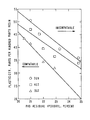
- the figure is a graphical representation of the compatability of the compositions used in the present invention with polyvinyl butyral as compared with known plasticizers.
- the present invention is based on the discovery of a new composition, tetraethyleneglycol di-n-heptanoate, and its particular suitability as a plasticizer for polyvinyl butyral.
- the composition has the following formula:
- This composition can be prepared by bringing into contact tetraethyleneglycol and heptanoic acid. These compounds are believed.to react according to the equation: While the desired product will generally be obtained in all proportions of the.reactants, for maximum purity of the desired tetraethyleneglycol di-n-heptanoate at least two moles of heptanoic acid should be present for each mole of tetraethyleneglycol. Higher concentrations of the heptanoic acid, for example, up to about 2.5 moles of heptanoic acid for each mole of tetraethyleneglycol, are preferred when no additional catalyst or solvent is used in the reaction.
- the reaction of heptanoic acid and tetraethyleneglycol can be carried out without a catalyst. However, the rate and ease of reaction are facilitated by the presence of a catalyst.
- the catalyst can, and the most basic situation, be a minor excess of the heptanoic acid itself.
- Other catalysts which can be used include a variety of acids, including sulfuric, formic, polyphosphoric, or p-toluenesulfonic acid and combinations of such acids.
- the catalyst when used, is generally present in an amount to equal to about from 0.01 to 5.0 weight per cent of the total reactants.
- a solvent in addition to the reactants can be used in the preparation of the tetraethyleneglycol di-n-heptanoate if desired.
- the solvent should be inert to the reactants and should preferably form an azeotrope with the water that is formed in the course of the reaction.
- Particularly satisfactory and convenient are organic solvents such as.toluene, xylene, and benzene.
- the preparation of the compound used in the present invention can be carried out at ambient temperatures and pressures. However, to facilitate the reaction and for ease of removal of the water formed..in the reaction, the synthesis is preferably carried out at elevated temperatures of about from 50 to 300°C. Particularly satisfactory is a temperature equivalent to the boiling point of an azeotrope of water with either the heptanoic acid or solvent used in the reaction.
- the water formed by the reaction of the two components is preferably removed during the course of the reaction to both increase the rate of reaction, drive the reaction to completion and to monitor its progress by measurement of the quantity of water generated.
- the water is conveniently removed by distillation of the azeotrope of water and acid or solvent.
- the tetraethyleneglycol di-n-heptanoate can be recovered as a viscous colorless oil. If desired, residual solvent, water, catalyst or other impurities can be removed by conventional purification techniques, including filtration through anhydrous magnesium sulfate or charcoal or by vacuum distillation.
- the product as prepared frequently contains minor quantities, for example, up to 10 weight percent of various unreacted glycols such as ethylene, diethylene, triethylene and tetraethylene glycols; unreacted heptanoic and alpha-methylhexanoic acids as well as the mono- and di-esters thereof.
- the tetraethyleneglycol di-n-heptanoate (4G7) can be incorporated into polyvinyl butyral as a plasticizer using techniques that are usually used for other plasticizers.
- the polyvinyl butyral and plasticizer are present in quantities which result in a compatible admixture.
- the quantities of plasticizer which can be added to any polyvinyl - butyral vary according to the residual hydoxyl content of the polyvinyl butyral as illustrated in the Figure. Thus, in polyvinyl butyral having a residual hydroxyl content of 20 percent, as much as 49 parts by weight of 4G7 plasticizer can be added per each hundred parts of polyvinyl butyral.
- plasticizer for polyvinyl butyral resins having 25 weight percent residual hydroxyl content, a maximum of only about 32 parts of 4G7 plasticizer can be added per hundred parts of polyvinyl butyral resin. At or below these maximum quantities or at intermediate points along the line indicating maximum compatible plasticizer level, the quantity of plasticizer can be adjusted to achieve the desired level of polymer sheet characteristics.
- the plasticized polyvinyl butyral sheeting can be laminated to one or more layers of glass according to the procedures generally used in the art and illustrated, for example, in U.S. Patents 2,293,656, 3,838,091 and 4,107,366.
- composition used in the instant invention provides outstanding plasticization of polyvinyl butyral. It has been found that the composition is compatible with polyvinyl butyral over a wide range of hydroxyl contents, and provides sheeting with excellent dimensional stability, tensile strength and stiffness at plasticizer concentrations which are lower then those required, for example, using triethyleneglycol di-2-ethyl- butyrate (3GH). In addition, if desired, these compositions can be used in conjunction with triethyleneglycol di-2-ethylbutyrate.
- 3GH triethyleneglycol di-2-ethyl- butyrate
- any proportion of the two plasticizers can.be used, the beneficial effects of the instant compositions are most apparent in such mixtures when the tetraethyleneglycol di-n-heptanoate represents at least 10 weight percent of the blend of the two plasticizers.
- PVA Viscosity ASTM D1343 with a Hoeppler Ball-Drop Viscometer used and a temperature of 20°C instead of 25°C.
- PVB Residual Hydroxyl (Weight Percent as PVA): ASTM D1396.
- Penetration Resistance ANSI Z26.1 using a staircase method to determine mean break height instead of the one level test of Z26.1 as described in U. S. Patent 3,718,516.
- Test samples are prepared by first blending 50g of dry polyvinyl butyral flake with a plasticizer in a 0.47 1 bottle on a roll mill for 2 hours. The blend is then compounded in a sigma-blade Brabender mixer for 10 minutes at 135°C. The resulting melt blend is pressed into 30-mil (0.76 mm) films using a hydraulic press with the. following cycle: (1) preheat - 6 minutes, 180°C, 5 psig (34.5kPa, gage), (2) mold - 1.5 minutes, 180°C and 100 psig, and (3) cool - 4 minutes, 20°C and 100 psig (689kPa, gage).
- a 2 x 3-inch (5.1 X 7.6 cm) film is exposed for 72 hours at 100% relative humidity and 0°C.
- the films are blotted between absorbent paper.
- the paper is then visually examined for evidence of a stain caused by exudation of the plasticizer.
- a compatible blend exhibits no stain.
- the Laminate is immersed in commercial, ammoniacal alcohol glass cleaning solution at 60°C for 30 days. The laminate is then removed from the solution and the resulting edge cloud is measured immediately. After standing at ambient conditions for an additional 30 days, the laminate is reexamined for edge delaminations.
- Tensile Creep (% Elongation): Test sheeting samples nominally 0.03 inch (0.76 mm) thick are conditioned for 4 hours at 68 + 2°F (20.0 + 1.1°C). The samples are then die cut to 0.75 x 4 inches (1.9 x 10.2 cm), marked and clipped into the test oven at 65 ⁇ °C for 1 hour. A 10 psi (69 kPa) load is applied to each specimen and the elongation measured at 30 minutes. The results are calculated by dividing the gage length after testing by the initial gage length and multiplying by 100.
- Plasticizer Content by Vacuum Distillation Molded or extruded sheeting samples are dried in an oven at 60°C for 30-60 minutes and weighed into a test tube. An accurately tared receiver is then attached. The tube is placed in a 285 +2°C heating block and vacuum (13 P a minimum) is applied. After 45 minutes, the receiver containing evolved plasticizer is disconnected and weighed. The parts of plasticizer per hundred parts resin is calculated by multiplying the weight of collected plasticizer by 100 and dividing by the difference between the original sample weight minus the weight plasticizer.
- the mixture was heated to reflux and water removed as the toluene-water azeotrope.
- the reaction was continued until the stoichiometric amount of water was removed.
- Remaining acid was neutralized by adding sodium bicarbonate. The mixture was then filtered through anhydrous magnesium sulfate and distilled under vacuum, b.p. 199°C (6.6 Pa).
- Example 1-15 the resulting tetraethyleneglycol di-n-heptanoate (4G7) was blended at various levels with polyvinyl butyral having hydroxyl contents as indicated in Table I.
- the liquid plasticizer was blended with dried polyvinyl butyral flake and the resulting blend formed into sheeting.
- the resulting sheeting was tested for compatibility and the results indicated in Table I and graphically presented in the Figure.
- Examples 16 and Comparative Examples S & T the general procedure of Examples 1-15 was repeated, using 4G7, 3GH and 3G7 as plasticizers, respectively. Polyvinyl butyral having a hydroxyl content of 23.3 was used for these examples. The resulting plasticized PVB sheets were evaluated and the results summarized in Table II.
- the plasticized sheeting of the present invention exhibits superior dimensional stability as shown by lower creep and higher modulus, while maintaining the tensile strength and compatibility that is necessary for lamination with glass.
- Example 1-15 The general procedure of Example 1-15 was repeated, except that blends of 3GH and 4G7 were used in Examples 19 & 20. The resulting films were tested, and the results were summarized in the following Table V.
Landscapes
- Chemical & Material Sciences (AREA)
- Health & Medical Sciences (AREA)
- Chemical Kinetics & Catalysis (AREA)
- Medicinal Chemistry (AREA)
- Polymers & Plastics (AREA)
- Organic Chemistry (AREA)
- Compositions Of Macromolecular Compounds (AREA)
Applications Claiming Priority (2)
| Application Number | Priority Date | Filing Date | Title |
|---|---|---|---|
| US06/071,537 US4297262A (en) | 1979-08-31 | 1979-08-31 | Polyvinyl butyral plasticized with tetraethyleneglycol di-n-heptanoate |
| US71537 | 1998-05-04 |
Publications (2)
| Publication Number | Publication Date |
|---|---|
| EP0024723A1 true EP0024723A1 (fr) | 1981-03-11 |
| EP0024723B1 EP0024723B1 (fr) | 1982-06-16 |
Family
ID=22101959
Family Applications (1)
| Application Number | Title | Priority Date | Filing Date |
|---|---|---|---|
| EP80105092A Expired EP0024723B1 (fr) | 1979-08-31 | 1980-08-27 | Polyvinyl butyral plastifié avec du tétraéthylèneglycol di-n-heptanoate |
Country Status (8)
| Country | Link |
|---|---|
| US (1) | US4297262A (fr) |
| EP (1) | EP0024723B1 (fr) |
| JP (1) | JPS5846266B2 (fr) |
| BR (1) | BR8005353A (fr) |
| CA (1) | CA1162675A (fr) |
| DE (1) | DE3060555D1 (fr) |
| MX (1) | MX155201A (fr) |
| ZA (1) | ZA803760B (fr) |
Cited By (1)
| Publication number | Priority date | Publication date | Assignee | Title |
|---|---|---|---|---|
| US6559212B1 (en) | 1995-12-29 | 2003-05-06 | Monsanto Company | Plasticized polyvinyl butyral and sheet |
Families Citing this family (11)
| Publication number | Priority date | Publication date | Assignee | Title |
|---|---|---|---|---|
| US5393365A (en) * | 1993-11-19 | 1995-02-28 | E. I. Du Pont De Nemours And Company | Embossed glass/plastic laminate and process for preparing the same |
| DK0815166T3 (da) * | 1995-03-14 | 2000-10-23 | Du Pont | Fremgangsmåde til fremstilling af polyvinylbutyralark |
| US6451435B1 (en) | 1997-12-19 | 2002-09-17 | E. I. Du Pont De Nemours & Co. | Interlayer structure for laminated glass |
| DE69933570T2 (de) | 1998-05-14 | 2007-06-28 | E.I. Dupont De Nemours And Co., Wilmington | Verbundglasscheibe für sicherheitsfenstersystem |
| DE19940991B4 (de) * | 1999-08-28 | 2007-04-05 | Celanese Chemicals Europe Gmbh | Verfahren zur Herstellung von Esterweichmachern |
| WO2003097347A1 (fr) * | 2002-05-16 | 2003-11-27 | E.I. Du Pont De Nemours And Company | Structures stratifiees ayant une resistance elevee aux chocs et procede de fabrication desdites structures |
| EP1539831B1 (fr) * | 2002-08-02 | 2009-09-23 | E.I. Du Pont De Nemours And Company | Procede permettant de reguler les proprietes physiques du polyvinylbutyral (pvb) par regulation de la stereochimie de celui-ci |
| US8197928B2 (en) | 2006-12-29 | 2012-06-12 | E. I. Du Pont De Nemours And Company | Intrusion resistant safety glazings and solar cell modules |
| CN102832281A (zh) * | 2008-04-04 | 2012-12-19 | 纳幕尔杜邦公司 | 包含高熔体流动速率的聚(乙烯醇缩丁醛)包封材料的太阳能电池模块 |
| US20160159051A1 (en) | 2014-12-08 | 2016-06-09 | Solutia Inc. | Poly(vinyl acetal) resin compositions, layers, and interlayers having enhanced optical properties |
| US9963583B2 (en) * | 2014-12-08 | 2018-05-08 | Solutia Inc. | Poly(vinyl acetal) resin compositions, layers, and interlayers having enhanced optical properties |
Citations (2)
| Publication number | Priority date | Publication date | Assignee | Title |
|---|---|---|---|---|
| FR823470A (fr) * | 1936-07-01 | 1938-01-20 | Carbide & Carbon Chem Corp | Matière plastique |
| US2274672A (en) * | 1938-04-30 | 1942-03-03 | Pittsburgh Plate Glass Co | Safety glass |
Family Cites Families (18)
| Publication number | Priority date | Publication date | Assignee | Title |
|---|---|---|---|---|
| US1970578A (en) * | 1930-11-29 | 1934-08-21 | Ig Farbenindustrie Ag | Assistants for the textile and related industries |
| US2045130A (en) * | 1936-02-25 | 1936-06-23 | Pittsburgh Plate Glass Co | Safety glass |
| US2229222A (en) * | 1936-10-10 | 1941-01-21 | Carbide & Carbon Chem Corp | Hexoic acid esters |
| US2306315A (en) * | 1939-01-23 | 1942-12-22 | Pittsburgh Plate Glass Co | Plastic and application thereof |
| US2340482A (en) * | 1939-01-23 | 1944-02-01 | Pittsburgh Plate Glass Co | Plasticized polyvinyl acetal resin |
| US2202160A (en) * | 1939-07-13 | 1940-05-28 | Du Pont | Plastic composition for use in interlayer sheets |
| US2412469A (en) * | 1943-11-16 | 1946-12-10 | Kay Fries Chemicals Inc | Triethylene glycol diheptoate |
| US2453569A (en) * | 1945-06-30 | 1948-11-09 | Monsanto Chemicals | Plasticized polyvinyl acetal resin |
| US2739080A (en) * | 1951-08-28 | 1956-03-20 | Monsanto Chemicals | Process for dyeing a sheet of plasticized polyvinyl butyral resin and ink therefor |
| US2864784A (en) * | 1956-08-15 | 1958-12-16 | Du Pont | Aqueous slurry plasticization of polyvinyl acetal resins |
| US3178334A (en) * | 1961-09-14 | 1965-04-13 | Du Pont | Safety-glass laminate |
| US3296211A (en) * | 1961-11-01 | 1967-01-03 | Aerojet General Co | Hydroxy-terminated polyesters |
| US3361565A (en) * | 1964-01-21 | 1968-01-02 | Du Pont | Silver halide photographic element containing a polyanionic color former and a gelatin antiabrasion layer |
| US3384532A (en) * | 1965-04-21 | 1968-05-21 | Monsanto Co | Plasticized polyvinyl acetals containing admixtures of three different esters |
| US3525703A (en) * | 1966-08-22 | 1970-08-25 | Bridgestone Tire Co Ltd | Method of adhering a synthetic fibre to a rubber,an adhesive solution and a laminate obtained by improving a method of adhering a synthetic fibre to a rubber |
| US3578621A (en) * | 1968-08-27 | 1971-05-11 | Carlisle Chemical Works | Diesters exhibiting internal-external lubricating properties in structural resins |
| US3841955A (en) * | 1972-12-07 | 1974-10-15 | Monsanto Co | Plasticized polyvinyl butyral interlayers |
| JPS51134123A (en) * | 1975-05-15 | 1976-11-20 | Fuji Photo Film Co Ltd | Photosensitive compositions for image formation |
-
1979
- 1979-08-31 US US06/071,537 patent/US4297262A/en not_active Expired - Lifetime
-
1980
- 1980-06-24 ZA ZA00803760A patent/ZA803760B/xx unknown
- 1980-08-25 BR BR8005353A patent/BR8005353A/pt not_active IP Right Cessation
- 1980-08-27 EP EP80105092A patent/EP0024723B1/fr not_active Expired
- 1980-08-27 DE DE8080105092T patent/DE3060555D1/de not_active Expired
- 1980-08-28 CA CA000359195A patent/CA1162675A/fr not_active Expired
- 1980-08-29 MX MX183748A patent/MX155201A/es unknown
- 1980-08-29 JP JP55118566A patent/JPS5846266B2/ja not_active Expired
Patent Citations (2)
| Publication number | Priority date | Publication date | Assignee | Title |
|---|---|---|---|---|
| FR823470A (fr) * | 1936-07-01 | 1938-01-20 | Carbide & Carbon Chem Corp | Matière plastique |
| US2274672A (en) * | 1938-04-30 | 1942-03-03 | Pittsburgh Plate Glass Co | Safety glass |
Cited By (1)
| Publication number | Priority date | Publication date | Assignee | Title |
|---|---|---|---|---|
| US6559212B1 (en) | 1995-12-29 | 2003-05-06 | Monsanto Company | Plasticized polyvinyl butyral and sheet |
Also Published As
| Publication number | Publication date |
|---|---|
| EP0024723B1 (fr) | 1982-06-16 |
| MX155201A (es) | 1988-02-02 |
| CA1162675A (fr) | 1984-02-21 |
| DE3060555D1 (en) | 1982-08-05 |
| JPS5688451A (en) | 1981-07-17 |
| ZA803760B (en) | 1982-01-27 |
| JPS5846266B2 (ja) | 1983-10-15 |
| US4297262A (en) | 1981-10-27 |
| BR8005353A (pt) | 1981-03-10 |
Similar Documents
| Publication | Publication Date | Title |
|---|---|---|
| EP0043269B1 (fr) | Polyvinylbutyral plastifié par du tétraéthylène glycol di-2-éthylhexanoate | |
| EP0041384B2 (fr) | Stratifié à base de polyvinylbutyral | |
| EP0024730B1 (fr) | Laminés de polyvinylbutyral, plastifiés avec le tétraéthylèneglycol di-n-heptanoate | |
| EP0024723B1 (fr) | Polyvinyl butyral plastifié avec du tétraéthylèneglycol di-n-heptanoate | |
| CA1124425A (fr) | Melanges plastifiants pour intercouches de polyvinylbutyral | |
| US5013779A (en) | Plasticized polyvinyl butyral and interlayer thereof | |
| KR100554212B1 (ko) | 부분 아세틸화된 폴리비닐알코올로 이루어진 가소성시이트 | |
| EP0041229B1 (fr) | Laminés de polyvinylbutyral | |
| EP0041231B1 (fr) | Polyvinylbutyral plastifié | |
| WO2007142095A1 (fr) | Couche intermédiaire pour verre stratifié et verre stratifié | |
| CA1137674A (fr) | Recouvrement de verre de securite a base de polyvinylbutyral resistant aux coups | |
| US4144376A (en) | Process for the production of modified, partially acetalized polyvinyl alcohol films | |
| EP0024722A1 (fr) | Di-n-heptanoate de tétraéthylèneglycol | |
| EP0513470A2 (fr) | Compositions d'adipates | |
| EP0432124B1 (fr) | Composition de plastifiant, polyvinylbutyral plastifié et couches intermédiaires à base de ce polyvinylbutyral | |
| US4379116A (en) | Process for the preparation of polyvinylbutyral sheeting and adhesion control | |
| US5013780A (en) | Plasticized polyvinyl butyral and interlayer thereof | |
| US4210705A (en) | Polyvinyl butyral compositions | |
| EP0041230A1 (fr) | Oligomères à base d'oxyde de propylène | |
| JP2004143132A (ja) | ジカルボン酸ジエステル化合物、および該化合物を含有するポリビニルブチラール樹脂組成物 |
Legal Events
| Date | Code | Title | Description |
|---|---|---|---|
| PUAI | Public reference made under article 153(3) epc to a published international application that has entered the european phase |
Free format text: ORIGINAL CODE: 0009012 |
|
| AK | Designated contracting states |
Designated state(s): BE DE FR GB IT NL SE |
|
| 17P | Request for examination filed |
Effective date: 19810305 |
|
| ITF | It: translation for a ep patent filed | ||
| GRAA | (expected) grant |
Free format text: ORIGINAL CODE: 0009210 |
|
| AK | Designated contracting states |
Designated state(s): BE DE FR GB IT NL SE |
|
| REF | Corresponds to: |
Ref document number: 3060555 Country of ref document: DE Date of ref document: 19820805 |
|
| PLBI | Opposition filed |
Free format text: ORIGINAL CODE: 0009260 |
|
| 26 | Opposition filed |
Opponent name: DYNAMIT NOBEL AKTIENGESELLSCHAFT Effective date: 19830316 |
|
| PLBN | Opposition rejected |
Free format text: ORIGINAL CODE: 0009273 |
|
| STAA | Information on the status of an ep patent application or granted ep patent |
Free format text: STATUS: OPPOSITION REJECTED |
|
| 27O | Opposition rejected |
Effective date: 19850620 |
|
| NLR2 | Nl: decision of opposition | ||
| ITTA | It: last paid annual fee | ||
| EAL | Se: european patent in force in sweden |
Ref document number: 80105092.3 |
|
| PGFP | Annual fee paid to national office [announced via postgrant information from national office to epo] |
Ref country code: FR Payment date: 19990526 Year of fee payment: 20 |
|
| PGFP | Annual fee paid to national office [announced via postgrant information from national office to epo] |
Ref country code: DE Payment date: 19990528 Year of fee payment: 20 |
|
| PGFP | Annual fee paid to national office [announced via postgrant information from national office to epo] |
Ref country code: GB Payment date: 19990610 Year of fee payment: 20 |
|
| PGFP | Annual fee paid to national office [announced via postgrant information from national office to epo] |
Ref country code: NL Payment date: 19990615 Year of fee payment: 20 |
|
| PGFP | Annual fee paid to national office [announced via postgrant information from national office to epo] |
Ref country code: SE Payment date: 19990715 Year of fee payment: 20 |
|
| PGFP | Annual fee paid to national office [announced via postgrant information from national office to epo] |
Ref country code: BE Payment date: 19990730 Year of fee payment: 20 |
|
| BE20 | Be: patent expired |
Free format text: 20000827 E.I. *DU PONT DE NEMOURS AND CY |
|
| PG25 | Lapsed in a contracting state [announced via postgrant information from national office to epo] |
Ref country code: GB Free format text: LAPSE BECAUSE OF EXPIRATION OF PROTECTION Effective date: 20000826 |
|
| PG25 | Lapsed in a contracting state [announced via postgrant information from national office to epo] |
Ref country code: NL Free format text: LAPSE BECAUSE OF EXPIRATION OF PROTECTION Effective date: 20000827 |
|
| PG25 | Lapsed in a contracting state [announced via postgrant information from national office to epo] |
Ref country code: SE Free format text: THE PATENT HAS BEEN ANNULLED BY A DECISION OF A NATIONAL AUTHORITY Effective date: 20000830 |
|
| REG | Reference to a national code |
Ref country code: GB Ref legal event code: PE20 Effective date: 20000826 |
|
| EUG | Se: european patent has lapsed |
Ref document number: 80105092.3 |
|
| NLV7 | Nl: ceased due to reaching the maximum lifetime of a patent |
Effective date: 20000827 |