EP0024904A2 - Variometer - Google Patents
Variometer Download PDFInfo
- Publication number
- EP0024904A2 EP0024904A2 EP80302928A EP80302928A EP0024904A2 EP 0024904 A2 EP0024904 A2 EP 0024904A2 EP 80302928 A EP80302928 A EP 80302928A EP 80302928 A EP80302928 A EP 80302928A EP 0024904 A2 EP0024904 A2 EP 0024904A2
- Authority
- EP
- European Patent Office
- Prior art keywords
- sink
- rate
- output
- lift
- differentiation circuit
- Prior art date
- Legal status (The legal status is an assumption and is not a legal conclusion. Google has not performed a legal analysis and makes no representation as to the accuracy of the status listed.)
- Granted
Links
Images



Classifications
-
- G—PHYSICS
- G01—MEASURING; TESTING
- G01P—MEASURING LINEAR OR ANGULAR SPEED, ACCELERATION, DECELERATION, OR SHOCK; INDICATING PRESENCE, ABSENCE, OR DIRECTION, OF MOVEMENT
- G01P3/00—Measuring linear or angular speed; Measuring differences of linear or angular speeds
- G01P3/62—Devices characterised by the determination or the variation of atmospheric pressure with height to measure the vertical components of speed
-
- G—PHYSICS
- G01—MEASURING; TESTING
- G01P—MEASURING LINEAR OR ANGULAR SPEED, ACCELERATION, DECELERATION, OR SHOCK; INDICATING PRESENCE, ABSENCE, OR DIRECTION, OF MOVEMENT
- G01P1/00—Details of instruments
- G01P1/07—Indicating devices, e.g. for remote indication
- G01P1/08—Arrangements of scales, pointers, lamps or acoustic indicators, e.g. in automobile speedometers
Definitions
- This invention relates to a variometer for use in a glider or the like to indicate the rate of ascent or descent during flight.
- variometers operate by monitoring the rate of flow of air into and out of a vessel as the glider ascends or descends causing an increase or decrease in the air pressure, this rate of flow being proportional respectively to the rate of ascent (hereinafter referred to as “lift”) or to the rate of descent (hereinafter referred to as “sink”) which is displayed by a calibrated dial indicator on the glider control panel.
- lift rate of ascent
- sink rate of descent
- the audio circuit comprises a voltage controlled oscillator connected tu the output of the differentiation circuit whereby variations in the output frequency of the oscillator correspond to the variations of the output of the differentiation circuit and hence also the rate of lift or sink.
- the output of the voltage controlled oscillator may be used directly to obtain an audible signal the frequency or pitch of which indicates tne rate of lift or sink and, further the voltage controlled oscillator input may be switched between the output of the differentiation circuit and a reference signal, whereby the audible output alternates in pitch between a level indicating a desired lift or sink and a level indicating the actual lift or sink.
- the rate at which this alternation occurs can be changed, preferably increased, to indicate when positive lift in excess of a predetermined amount, occurs.
- the voltage controlled oscillator may drive a pulse generator such that the repetition rate of pulses generated thereby is indicative of the rate of lift or sink.
- the pitch that is to say the audible pitch, of the pulsed signal may be changed by switching means responsive to comparators connected to one or more reference signals, whereby the pilot can discern whether the actual sink rate is less than or greater than a predetermined sink rate and optionally whether there is positive lift.
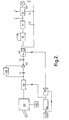
- a pressure transducer 10 is arranged within a casing 12 which in use is mounted on the glider.
- the interior of the casing is in communication with the surrounding atmosphere via apertures 14 and 16 which are not aligned and thereby provide a measure of protection against sudden pressure changes.
- the output signal of the pressure transducer increases or decreased respectively with an increase or decrease in atmospheri pressure and hence a decrease or increase in altitude.
- This output signal is connected to a low pass filter 18 for excluding high frequency effects due to, for example, the wind and is then differentiated by a differentiator 20.
- An audible indication of lift or sink of the glider is provided by a circuit including a chopper or multivibrator 24 controlling an F E T switch 26 to connect either one of its two inputs to a voltage controlled oscillator 32.
- One of the inputs of the switch 26 is connected to an inverting amplifier 30 for the differentiated signal and the other is connected to an adjustatble voltage source 28.
- the rate at which the F E T switch 26 changes over is controlled by the multivibrator 24 and varies with the magnitude of the output of amplifier 30 which is proportional to the rate of change of pressure.
- the rate of change in pressure is constant and the output of amplifier 30 has a constant value.
- the voltage source 28 is set to this constant value in order that, during sink at the normal glide angle the two inputs of the F E T switch are at the same voltage and there is no change in the output frequency of the voltage controlled oscillator 32.
- the changeover rate of the F E T switch 26 is adjusted and there is a difference in applied voltage between its two inputs.
- the voltage controlled oscillator 32 produces a pulsed signal at audible frequencies and this is fed to a loudspeaker or earphones 34 via an audio amplifier 36.
- the pilot hears a pulsed sound at a given rate and a given pitch but during a climb or a steeper descent the audible signal has both a higher or lower rate and a higher or lower pitch.
- a conventional calibrated dial indicator 38 is connected to the amplifier 30 output.
- the gain of amplifier 30 may be variable in by a controller 31. in response to magnitude of the pressure transducer output signal in order to compensate for a nor-linear response of the transducer.
- the multivibrator 24 may be controlled by the output of a second differentiator such that the output of amplifier 30 is always connected to the voltage controlled oscillator 32 except when the second differential is positive, that is when there is lift. This will produce a constant tone of a pitch determined by the rate of ascent or descent interrupted only by a brief pulsed signal on entering a thermal.
- the variometer may include means sensitive to the air speed of the glider such that the audible signal produced is dependent both on a change in altitude and a change in velocity.
- the air speed measuring device preferably takes the form of a Brunswick tube which is a cylindrical tube having a pair of spaced apart circumferential slots in the tube wall which each subtend an angle of approximately 55 0 at the axis of the tube.
- the tube is mounted on the glider with its axis substantially parallel to the direction of air flow and with one end in communication with the interior of the casing 12.
- the characteristics of the tube are such that the pressure within the casing 12 is dependent both on the absolute air pressure suriounding the casing and on the square of the air speed.
- the variometer thus becomes a device which monitors the "total energy" of the glider, i.e. the sum of the potential energy which is proportional to the altitude and the kinetic energy which is proportional to the square of the velocity.
- connection between the Brunswick tube may be interrupted or the slots may be covered if the apparatus is to be used to monitor only changes in potential energy.
- a signal from the pressure transducer 100 is sampled by a sample and hold circuit 102 at regular intervals determined by the frequency of a Master oscillator 103 and division of the shift register 104 which provides the correct timing sequence for a power-up pulse circuit for transducer, sample and hold, and output switch 109.
- Amplifier 107 is A.C.
- capacitor C 2 being alternately connected to the 0 V line and change integrator 110 by the switch 109 and timing circuit 106, so that alternate samples of the transducer output are amplified and integrated to form an output at 110 which is proportional to the rate of change cf the transducer 100 output and therefor the rate of change of altitude this being the rate of lift or sink experienced by the glider.
- the use of this sampling technique has several advantages over the D.C. amplifier system described with reference to Figure 1.
- the capacitors C 1 and C 2 may have relatively small capacitance, the amplifier is net required to be D.C. stable and leakage currents arc not as significant as would be the case with a D.C. coupled circuit.
- the power requirement and warm-up time for the transducer are considerably reduced, and the circuit is relatively insensitive to component value tolerances.
- the output of the sample and hold circuit 102 is also an electrical analogue of altitude and this signal is used via a compensating circuit comprising shaper 108 to adjust the gain of the circuit so that the incremental pressure change sensitivity is increased with altitude by an amount sufficient to compensate for the effects of reducing pressure.
- the shaper and gain control elements consist of a temperature compensated light emitting diode (L.E.D.) drive circuit and photo resistor feed back gain control arrangement being sufficiently accurate to 30,000 ft for use on most gliders.
- the compensating circuit may comprise an Analogue - Digital converter and Read Only Memory storing data representing the desired gain as a function of pressure (and hence altitude also) and coupled to a Digital - Analogue converter resistor network in the gain control elements of the amplifier 107.
- the response time of the variometer is selectable by switching-in an additional capacitor C 3 vie S 1 into the change integrator 110 and by similar additional elements via S 2 in active filter 111, the function of which is to form a low pass filter removing undesirably high frequeney noise and pressure disturbances due to turbulence and wind.
- Terminals X and Y are connected to an audio circuit for producing audible signals indicative of the changing pressure conditions and hence lift or sink.
- a D.C. amplifier 114 drives the audio circuit input at terminal Y and the visual display or indicator which may be a milli-ammeter or digital voltmeter, if a digital output is required. Range selection is accomplished by switching the gain of the D.C. amplifier 114 using switch 113.
- Terminal X which is connected to the output of a low-pass active filter 111 is unaffected by the switch S 3 and is used to drive a dive warning system to the audio circuit.
- the circuit of Figure 3 is preferred, giving audible signals to indicate lift or sink, which signals are in the form of 'pips' or pulses with a repetition rate increasing as the rate of sink or lift increases or decreases relating to a datum value set by the "sink rate" control on the panel of the instrument.
- the tone of the audible 'pips' is changed to a lower frequency on sink below the set value, to a higher frequency for a sink rate smaller than the set value but below zero sink and to a still higher frequency when there is positive lift.
- the audio circuit of Figure 4 is used. This provides an audible indication of the actual lift or sink relative to the desired sink rate.
- the audible output is switched between a reference signal having a preset constant frequency representing the desired sink rate and another signal the frequency of which is a function of the rate of lift or sink so that when the two frequencies are heard to be the same the sink rate is correct.
- the switched signal frequency is higher than the frequency of the reference signal the sink rate is too low and vice versa.
- a voltage controlled oscillator 201 compares the voltages from the set sink rate control 209 which may be a potentiometer, and the inputs of lift / sink analogue voltage at Y via resistor R, and also from an inverting precision rectifier 202 via resistor R 2 , producing a low frequency output of variable frequency according to the rate of sink or lift relative to the value set by set sink control 209, this frequency increasing as the input at Y goes above or below the set value.
- Pulse burst generator 203 is triggered by the output of a voltage controlled oscillator 201 via diode D 1 , producing a tone burst with pitch dependent on the state of frequency selector switch unit 205 which is controlled by comparators 204 such that a low pitch is produced when input Y is below the level set by "set sink rate” control 209, a medium pitch is produced when input Y is between zero and the set level, and a high pitch is produced when input Y is above zero, indicating positive lift.
- This signal is then connected via a volume control 212 and audio amplifier 206 to drive an audio output transducer 213 which may be a loud speaker, a head phone set or pietzo- electric device.
- Silent sink switch S 1 allows the comparator at a point where input Y goes below the level set by control 209 to switch an "inhabit" input of the voltage controlled oscillators 201 positive, preventing any triggering of pulse burst generator 203 in this sector.
- Silent sink sector control 210 operates in a similar way, using the above comparator 204 and one other whose input is backed off by this control from the set sink 211 value the two comparator outputs being gated together to produce an 'inhibit' pulse to the voltage controlled oscillator as described above so that between the sink rates set by 209 and 210 the voltage controlled oscillator produces no output and the pilot will be informed by the lack of audio output that he is flying between the sink rate limits set. This is valuable for Hang Gliding where many pilots prefer to fly in silence.
- a "Dive Warning" system which overrides the other audio tones is generated by sweep generator 208 and pulse burst generator 203 triggered via diode D 2 by the output of comparator 207 when the sink rate signal at X exceeds the value preset by control 211. This warns the pilot that he is in a rapidly sinking airstream even if the silent sink mode is selected.
- the continuous tone system of Figure 4 includes multivibrator 301 which may be voltage controlled via a resistor R 1 , from the input Y and operates an electronic switch 302 so that the input to voltage controlled oscillator 305 is switched alternately between the sink/lift rate analogue input Y and a voltage set by the calibrated "set sink rate” control 315.
- the tone thus generated will be continuous when these two voltages are equal, and will change to a break-tone when the input voltage at Y changes above or below tne value set at 315.
- One portion of the break-tone will remain at constant pitch as a reference while the other will represent the amount by which the rate of lift or sink differs from the set value.
- This signal is connected through a quiet switch 310 and volume control 318 to an audio amplifier 311, driving an audio transducer which may be a loud speaker, a headphone or a pietzo- electronic device.
- the input Y is connected to another differentiation circuit 305 producing the second differential of the pressure change detected by the transducer and this signal is compared by comparator 306 with a predermined threshold or reference voltage set by potentiometer 219 so that when there is a positive change in lift, such as encountered when entering a thermal, the preset reference voltage is exceeded and comparator 306 produces an output to operate switch 307 to douhle the frequency of multivibrator 301 by disconnecting capacitor C 2 .
- Output of the comparator 306 is arranged to inhibit quiet switen 310 via resistor R 2 and a tri-state control to gate 330, so that a succession of fast lifi pips are generated, indicating to the pilct a decrease in sink rate. This system operates over the entire range of the instrument.
- Comparators 308 produce switching signals to operate a lift sector switch 304 when input Y exceeds zero changing the total pitch of the voltage controlled oscillator 303 via capacitor C 1 to indicate that positive lift has been encountered.
- a quiet sink sector control 316 controls the input to comparators 308 such that a signal is produced at the inputs to gate 309 which arc both positive over the range of input Y between the values of sink rate set on control 315 and 316.
- Output of gate 309 operates a mute switch 310 when this condition is fulfilled, providing that the tri-statc control line to gate 309 is negative, that is when quiet sink select switch S 1 is open and lift pips comparator 306 is not switched.
- This circuit may also include a dive warning system similar to that described in the audio circuit of Figure 3.
- the system includes a control 217 for setting the sink rate threshold, a comparator 312 connected to input terminal X, a sweep back generator 313 and an output oscillator 314 with a feedback connection to the input of the sweep generator.
Landscapes
- Physics & Mathematics (AREA)
- General Physics & Mathematics (AREA)
- Medicines Containing Plant Substances (AREA)
- Acyclic And Carbocyclic Compounds In Medicinal Compositions (AREA)
- Pharmaceuticals Containing Other Organic And Inorganic Compounds (AREA)
- Thermistors And Varistors (AREA)
- Compositions Of Oxide Ceramics (AREA)
- Amplifiers (AREA)
- Measuring Fluid Pressure (AREA)
- Measurement Of Velocity Or Position Using Acoustic Or Ultrasonic Waves (AREA)
Priority Applications (1)
| Application Number | Priority Date | Filing Date | Title |
|---|---|---|---|
| AT80302928T ATE17891T1 (de) | 1979-08-24 | 1980-08-22 | Variometer. |
Applications Claiming Priority (2)
| Application Number | Priority Date | Filing Date | Title |
|---|---|---|---|
| GB7929504 | 1979-08-24 | ||
| GB7929504 | 1979-08-24 |
Publications (3)
| Publication Number | Publication Date |
|---|---|
| EP0024904A2 true EP0024904A2 (de) | 1981-03-11 |
| EP0024904A3 EP0024904A3 (en) | 1981-12-30 |
| EP0024904B1 EP0024904B1 (de) | 1986-02-05 |
Family
ID=10507406
Family Applications (1)
| Application Number | Title | Priority Date | Filing Date |
|---|---|---|---|
| EP80302928A Expired EP0024904B1 (de) | 1979-08-24 | 1980-08-22 | Variometer |
Country Status (4)
| Country | Link |
|---|---|
| EP (1) | EP0024904B1 (de) |
| AT (1) | ATE17891T1 (de) |
| AU (1) | AU546659B2 (de) |
| DE (1) | DE3071408D1 (de) |
Cited By (2)
| Publication number | Priority date | Publication date | Assignee | Title |
|---|---|---|---|---|
| DE3431130A1 (de) * | 1984-08-24 | 1986-03-06 | Vdo Adolf Schindling Ag, 6000 Frankfurt | Einrichtung zur darstellung barometrischer luftdruckaenderungen |
| EP0572101A1 (de) * | 1992-05-26 | 1993-12-01 | Arnold & Richter Cine Technik Gmbh & Co. Betriebs Kg | Bedienelement für Kameras mit akustischer Signalisierung |
Family Cites Families (4)
| Publication number | Priority date | Publication date | Assignee | Title |
|---|---|---|---|---|
| GB1011488A (en) * | 1963-06-06 | 1965-12-01 | Standard Telephones Cables Ltd | Electrical speed indicator |
| US3369397A (en) * | 1966-01-26 | 1968-02-20 | Alth Max | Rate of climb indicator |
| US3400581A (en) * | 1966-03-15 | 1968-09-10 | Aviat Instr Mfg Corp | Aircraft flight control system |
| US3726138A (en) * | 1971-09-16 | 1973-04-10 | Bendix Corp | Digital displacement and displacement rate generator |
-
1980
- 1980-08-22 DE DE8080302928T patent/DE3071408D1/de not_active Expired
- 1980-08-22 EP EP80302928A patent/EP0024904B1/de not_active Expired
- 1980-08-22 AT AT80302928T patent/ATE17891T1/de active
- 1980-08-25 AU AU61721/80A patent/AU546659B2/en not_active Ceased
Cited By (2)
| Publication number | Priority date | Publication date | Assignee | Title |
|---|---|---|---|---|
| DE3431130A1 (de) * | 1984-08-24 | 1986-03-06 | Vdo Adolf Schindling Ag, 6000 Frankfurt | Einrichtung zur darstellung barometrischer luftdruckaenderungen |
| EP0572101A1 (de) * | 1992-05-26 | 1993-12-01 | Arnold & Richter Cine Technik Gmbh & Co. Betriebs Kg | Bedienelement für Kameras mit akustischer Signalisierung |
Also Published As
| Publication number | Publication date |
|---|---|
| AU6172180A (en) | 1981-03-05 |
| ATE17891T1 (de) | 1986-02-15 |
| DE3071408D1 (de) | 1986-03-20 |
| EP0024904A3 (en) | 1981-12-30 |
| EP0024904B1 (de) | 1986-02-05 |
| AU546659B2 (en) | 1985-09-12 |
Similar Documents
| Publication | Publication Date | Title |
|---|---|---|
| US3958218A (en) | Aircraft ground proximity warning system with speed compensation | |
| US4079198A (en) | Electro-acoustic impedance bridges | |
| KR20010090704A (ko) | 기체의 음속 측정방법과 장치 | |
| US4966160A (en) | Acoustic admittance measuring apparatus with wide dynamic range and logarithmic output | |
| US4080574A (en) | Apparatus for providing time reference signals | |
| JPS62200412A (ja) | 自動電力制御装置 | |
| WO1998047008A2 (en) | Air data measurement system with circuit for linearizing pressure transducer output | |
| GB1161810A (en) | Vibration Monitoring System. | |
| EP0024904A2 (de) | Variometer | |
| US4086810A (en) | Aircraft instrument | |
| US3968697A (en) | Sound level meter | |
| US2557900A (en) | Position indicator for use in blind flying of towed gliders | |
| US4061042A (en) | Audio signal monitoring system with display of two signal characteristics | |
| US4217506A (en) | Level selective a-c monitoring circuit | |
| GB2062874A (en) | Determining the volumes of confined spaces | |
| US5105150A (en) | Wide-band programmable tachometer and speedometer/odometer apparatus | |
| SE442150B (sv) | Elektronisk krets for metning av skillnaden i kapacitans mellan tva kondensatorer | |
| US3369397A (en) | Rate of climb indicator | |
| US4144753A (en) | Circuit arrangement for determining physical parameters of flowing media by the ultrasonic method | |
| US4398261A (en) | Device for measuring the level of a variable signal with logarithmic conversion | |
| US4175252A (en) | Meter drive circuit | |
| JPH08102632A (ja) | 昇降計測回路 | |
| SE452827B (sv) | Anordning for att utoka dynamikomradet i en integrerande optoelektrisk mottagare | |
| JPS60114723A (ja) | 測定装置 | |
| SU1545169A1 (ru) | Цифровой переносной анемометр |
Legal Events
| Date | Code | Title | Description |
|---|---|---|---|
| PUAI | Public reference made under article 153(3) epc to a published international application that has entered the european phase |
Free format text: ORIGINAL CODE: 0009012 |
|
| AK | Designated contracting states |
Designated state(s): AT CH DE FR GB IT |
|
| PUAL | Search report despatched |
Free format text: ORIGINAL CODE: 0009013 |
|
| AK | Designated contracting states |
Designated state(s): AT CH DE FR GB IT |
|
| 17P | Request for examination filed |
Effective date: 19820630 |
|
| GRAA | (expected) grant |
Free format text: ORIGINAL CODE: 0009210 |
|
| AK | Designated contracting states |
Designated state(s): AT CH DE FR GB IT LI |
|
| REF | Corresponds to: |
Ref document number: 17891 Country of ref document: AT Date of ref document: 19860215 Kind code of ref document: T |
|
| ITF | It: translation for a ep patent filed | ||
| REF | Corresponds to: |
Ref document number: 3071408 Country of ref document: DE Date of ref document: 19860320 |
|
| ET | Fr: translation filed | ||
| PG25 | Lapsed in a contracting state [announced via postgrant information from national office to epo] |
Ref country code: LI Effective date: 19860831 Ref country code: CH Effective date: 19860831 |
|
| PLBE | No opposition filed within time limit |
Free format text: ORIGINAL CODE: 0009261 |
|
| STAA | Information on the status of an ep patent application or granted ep patent |
Free format text: STATUS: NO OPPOSITION FILED WITHIN TIME LIMIT |
|
| 26N | No opposition filed | ||
| GBPC | Gb: european patent ceased through non-payment of renewal fee | ||
| PG25 | Lapsed in a contracting state [announced via postgrant information from national office to epo] |
Ref country code: FR Free format text: LAPSE BECAUSE OF NON-PAYMENT OF DUE FEES Effective date: 19870430 |
|
| REG | Reference to a national code |
Ref country code: CH Ref legal event code: PL |
|
| REG | Reference to a national code |
Ref country code: FR Ref legal event code: ST |
|
| REG | Reference to a national code |
Ref country code: GB Ref legal event code: 728C |
|
| REG | Reference to a national code |
Ref country code: FR Ref legal event code: AR |
|
| REG | Reference to a national code |
Ref country code: GB Ref legal event code: 728A |
|
| REG | Reference to a national code |
Ref country code: FR Ref legal event code: DI |
|
| PG25 | Lapsed in a contracting state [announced via postgrant information from national office to epo] |
Ref country code: AT Effective date: 19890822 |
|
| PG25 | Lapsed in a contracting state [announced via postgrant information from national office to epo] |
Ref country code: DE Effective date: 19900501 |
|
| PGFP | Annual fee paid to national office [announced via postgrant information from national office to epo] |
Ref country code: GB Payment date: 19940819 Year of fee payment: 15 |
|
| PG25 | Lapsed in a contracting state [announced via postgrant information from national office to epo] |
Ref country code: GB Effective date: 19950822 |
|
| GBPC | Gb: european patent ceased through non-payment of renewal fee |
Effective date: 19950822 |