EP0025812B1 - Procédé d'extrusion d'un fil de polypropylène - Google Patents
Procédé d'extrusion d'un fil de polypropylène Download PDFInfo
- Publication number
- EP0025812B1 EP0025812B1 EP79301994A EP79301994A EP0025812B1 EP 0025812 B1 EP0025812 B1 EP 0025812B1 EP 79301994 A EP79301994 A EP 79301994A EP 79301994 A EP79301994 A EP 79301994A EP 0025812 B1 EP0025812 B1 EP 0025812B1
- Authority
- EP
- European Patent Office
- Prior art keywords
- filaments
- polypropylene
- temperature
- hot zone
- extruded
- Prior art date
- Legal status (The legal status is an assumption and is not a legal conclusion. Google has not performed a legal analysis and makes no representation as to the accuracy of the status listed.)
- Expired
Links
- 239000004743 Polypropylene Substances 0.000 title claims description 29
- -1 polypropylene Polymers 0.000 title claims description 29
- 229920001155 polypropylene Polymers 0.000 title claims description 29
- 238000000034 method Methods 0.000 title claims description 15
- 235000004879 dioscorea Nutrition 0.000 claims description 15
- 238000001125 extrusion Methods 0.000 claims description 13
- 238000001816 cooling Methods 0.000 claims description 10
- 239000000155 melt Substances 0.000 claims description 8
- 238000009826 distribution Methods 0.000 claims description 5
- 239000000112 cooling gas Substances 0.000 claims description 4
- 239000007789 gas Substances 0.000 claims description 3
- 238000004804 winding Methods 0.000 claims 1
- 238000010791 quenching Methods 0.000 description 13
- 206010042674 Swelling Diseases 0.000 description 3
- 230000007423 decrease Effects 0.000 description 3
- 239000002184 metal Substances 0.000 description 3
- 239000011347 resin Substances 0.000 description 3
- 229920005989 resin Polymers 0.000 description 3
- 230000008961 swelling Effects 0.000 description 3
- 230000003247 decreasing effect Effects 0.000 description 2
- 230000000694 effects Effects 0.000 description 2
- 239000008188 pellet Substances 0.000 description 2
- 230000000171 quenching effect Effects 0.000 description 2
- 230000001154 acute effect Effects 0.000 description 1
- 230000015572 biosynthetic process Effects 0.000 description 1
- 238000007664 blowing Methods 0.000 description 1
- 230000015556 catabolic process Effects 0.000 description 1
- 239000012141 concentrate Substances 0.000 description 1
- 238000006731 degradation reaction Methods 0.000 description 1
- 230000003467 diminishing effect Effects 0.000 description 1
- 230000001747 exhibiting effect Effects 0.000 description 1
- 238000009413 insulation Methods 0.000 description 1
- 238000004519 manufacturing process Methods 0.000 description 1
- 239000000463 material Substances 0.000 description 1
- 235000013580 sausages Nutrition 0.000 description 1
- 208000024891 symptom Diseases 0.000 description 1
- 239000004753 textile Substances 0.000 description 1
Images

Classifications
-
- D—TEXTILES; PAPER
- D01—NATURAL OR MAN-MADE THREADS OR FIBRES; SPINNING
- D01D—MECHANICAL METHODS OR APPARATUS IN THE MANUFACTURE OF ARTIFICIAL FILAMENTS, THREADS, FIBRES, BRISTLES OR RIBBONS
- D01D5/00—Formation of filaments, threads, or the like
- D01D5/08—Melt spinning methods
- D01D5/084—Heating filaments, threads or the like, leaving the spinnerettes
-
- D—TEXTILES; PAPER
- D01—NATURAL OR MAN-MADE THREADS OR FIBRES; SPINNING
- D01F—CHEMICAL FEATURES IN THE MANUFACTURE OF ARTIFICIAL FILAMENTS, THREADS, FIBRES, BRISTLES OR RIBBONS; APPARATUS SPECIALLY ADAPTED FOR THE MANUFACTURE OF CARBON FILAMENTS
- D01F6/00—Monocomponent artificial filaments or the like of synthetic polymers; Manufacture thereof
- D01F6/02—Monocomponent artificial filaments or the like of synthetic polymers; Manufacture thereof from homopolymers obtained by reactions only involving carbon-to-carbon unsaturated bonds
- D01F6/04—Monocomponent artificial filaments or the like of synthetic polymers; Manufacture thereof from homopolymers obtained by reactions only involving carbon-to-carbon unsaturated bonds from polyolefins
- D01F6/06—Monocomponent artificial filaments or the like of synthetic polymers; Manufacture thereof from homopolymers obtained by reactions only involving carbon-to-carbon unsaturated bonds from polyolefins from polypropylene
Definitions
- Polypropylene yams particularly continuous filament textile face yams, are usually produced with conventional 'down-the-stack' air quench extrusion apparatus. These are housed in a building several stories high with an extruder on an upper floor, air quench cabinets on the floor below, and inter-floor tubes extending down to a lower floor where the yarn is taken up onto packages. Cooled air is blown through the quench cabinets to solidify and cool the yarn.
- the temperature at which the polypropylene melt is extruded is usually of the order of 260°C although lower temperatures have been tried. It is known that in general, as the temperature is lowered the swell on the underside of the spinnerette gets greater with an increase in resonance, and even the occurrence of spin breaks at or near the spinnerette face.
- French Patent No. 1,276,575 discloses extruding polypropylene, having an intrinsic viscosity of approximately 1.3 to 4.5, at a temperature in the range 225°C to 325°C through a short hot zone for the purpose of producing filaments having increased tenacity.
- the phenomenon of resonance occurring in extruded filaments is not addressed by this reference.
- the invention is based upon the realization that if the filaments are extruded into a relatively short hot zone, at or slightly below the temperature of extrusion, before they are contacted by the cooling air, then the extrusion temperature can be decreased without the usual increase in the volume of swell at the spinnerette face. It has been found that as the extrusion temperature decreases the resonance in the filaments decreases; and optimum point is reach around 205°C. When the temperature goes much lower than this optimum point, resonance starts increasing again and then spin breaks occur. The precise optimum point is believed to be influenced by the swell value of the polypropylene and its melt flow. It is considered possible that as the temperature of the melt decreases, the melt becomes more Newtonian in its behaviour. This is believed to be further helped as the swell value of the polypropylene is decreased, for example to below 2.5.
- a method of producing a plurality of polypropylene filaments wherein polypropylene is heated to a temperature at which it is molten and extruded into a plurality of filaments, the filaments first being passed through a hot zone and then through a cooling zone in which cooling gas is passed over the filaments to cool them, characterized by the polypropylene having a narrow molecular weight distribution with a swell_value less than 3 and being extruded at a temperature below 218°C, the temperature of the hot zone being at or slightly below the extrusion temperature, and drawing down the filaments to their undrawn denier in the hot zone, the combination of the swell value of the polypropylene, the temperature of extrusion, and the hot zone interacting to substantially eliminate the occurrence of resonance in the filaments as they are drawn down in the hot zone.
- the hot zone has a temperature sufficiently high to retard cooling of the filaments therein.
- the polypropylene preferably has a swell value less than 2.5.
- the melt flow of the polypropylene may be greater than 20, and is preferably greater than 30.
- Said hot zone is preferably short relative to said second zone, and preferably contains gas in a quiescent state.
- the temperature of said hot zone may be less than 21°C below the temperature of extrusion; it may be above 177°C. It maybe within 16°C of the extrusion temperature.
- the filaments may be drawn down in said hot zone to an undrawn denier per filament of less than 40, for example less than 30.
- cooling gas may be blown transversely over the filaments to cool them.
- the temperature of this cooling gas is preferably less than 32°C as it enters this quenching zone.
- the extrusion temperature may be less than 215°C, such as in the range 213°C to 177°C, or in the range 210°C to 184°C. Preferably it is about 205°C.
- At least two multifilment yarns may be simultaneously produced by extruding a metered stream of said molten polypropylene through a spinnerette having at least two groups of orifices.
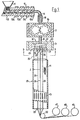
- an extruder 10 has an infeed hopper 11, a screw 12, and band heaters 13a, 13b, 13c and 13d.
- a transfer tube 14 connects the discharge end of the extruder 10 to a metering pump 15.
- the transfer tube 14 and the metering pump 15 are surrounded by band heaters 16 and 17, respectively.
- the discharge side of the metering pump 15 is connected by a tube 18 to a spin pack 19 mounted in a spin block 20 which is surrounded by a band heater 21.
- the spin pack 19 has a cover plate 22, a body 23, a breaker plate 24, and a spinnerette 25.
- the usual heat insulation that covers the band heaters and other parts of the apparatus is not shown.
- a shroud 26 is attached by bolts 27 (see Figure 2) to the underside of the spin block 20. Below the shroud 26 is mounted an air quench cabinet 28 at the bottom of which are finish applying guides 29. Just below the guides 29 is a denier control roll 30.
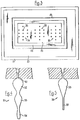
- the shroud 26 defines a rectangular in horizontal section, see Figures 3. At its upper end is a flange 31 through which the bolts 27 pass. At the lower end of the shroud 26 is an inwardly directed collecting trough 32.
- the spinerette 25 has capillaries 33 arranged in three groups 34, 35 and 36, respectively, to produce three milti-filament yarns 37, 38 and 39, respectively.
- different spinnerettes can be used having a different number of capillaries.
- the quench cabinet 28 has a top cover 40 which fits closely around the outside of the trough 32.
- One wall of the quench cabinet 28 is formed of wire mesh 41 supported in a frame 42.
- the opposite wall is formed of slotted sheet metal 43 supported in a frame 44.
- a cooling air plenum 45 registers with the wire mesh 41.
- the quench cabinet is rectangular, similar to the shroud 26 and the face of the spinnerette 25 with the groups of capillaries 34, 35 and 36 spaced apart in a direction parallel to the longer sides of these rectangles.
- the shroud 26 is relatively short and fits closely around the groups 34, 35 and 36 of capillaries but with sufficient clearance so that the yarns 37, 38 and 39, if they sway, do not come in contact with the inner edge of the trough 32.
- the longer side of the shroud 26 is 30.5 cm and the shorter side 17.5 cm; the length of the face of the spinnerette 25 is 20.3 cm and the width 10.2 cm.
- the height of the shroud 26, as seen in Figure 2, is 22.9 cm.
- pellets of polypropylene resin and pellets of colour concentrate are fed via the hopper 11 into the extruder 10.
- the polypropylene has a melt flow of 30 and has a narrow molecular weight distribution with a die swell or swell value below 2, in this instance 1.9.
- the resin and colour are melted and heated by the extruder heaters to a temperature of 205°C and mixed by the screw 12.
- the heaters 13a, 13b, 13c and 13d are set to control their zones at 148°C, 177°C, 191°C and 205°C, respectively.
- the downstream heaters 16, 17, 21 are set to control their zones at 205°C.
- the melt is fed by the screw 12 though the transfer tube 14 to the metering pump 15 which delivers a metered stream of melt through the tube 18 to the spin pack 19. Inside the spin pack this metered stream is hydraulically split and extruded downwards through the capillaries 33 into the multitude of filaments forming the three spaced apart yams 37, 38, and 39.
- the number of capillaries in the spinnerette is chosen to determine the number of filaments in each yam, in this instance 70 filaments.
- the cooling of the yarns is effected by blowing air transversely across them, the air from the plenum 45 entering the quench cabinet through the wire mesh 41 and being exhausted to atmosphere through the slots in the sheet metal 43.
- the cooled yarns then pass through the guides 29 which apply spin finish to them before they are brought together around the denier control roll 30, after which the three yarns are separated and wound onto separate packages 47, 48 and 49.
- the denier control roll pulls the yarns down from the capilaries 33 at a controlled rate, in this instance 600 meters per minute, to determine their undrawn denier, in this instance 900 denier.
- the air inside the shroud 26 is trapped there and remains quiescent. This air is heated by the metal above it, namely the face of the spinnerette 25, the lower end of the pack body 23 and part of the spin block 20, these being heated by the spin block heater 21.
- the molten filaments leaving the capillaries 33 also heat this air.
- the air inside the shroud 26 remains hot at a temperature close to or just below, the temperature of the melt being extruded and prevents substantial cooling of the filaments as they pass therethrough.
- the temperature in the lower portion of the shroud 26 may be at a lower temperature than in the upper portion, but is sufficiently high to retard cooling of the filaments.
- Figure 4 shows in an exaggerated manner a polypropylene filament being extruded from a capillary 50 directly into an air quenching zone 51 by a conventional air squench process.
- the molten polypropylene swells out at 52 under the face of the spinnerette and then forms a series of diminishing swellings 53, 54 before the drawn-down to the size of the filament is completed. This series of swellings is not completely drawn out and results in the filament exhibiting resonance to some degree.
- Figure 5 illustrates the way in which the swell draws down in the present invention.
- An initial swell 55 occurs under the face of the spinnerette, but then due to the combination of the low temperature of extrusion and the extrusion of the filament into a hot quiescent zone 56, the draw down occurs quicker over a shorter distance to a uniform filament 57.
- the total volume of the swell 55 is less than the volume of the elongated swell 52, 53, 54 shown in Figure 4.
- the 900 undrawn denier 70 filament yarn produced by the method of the invention when subsequently drawn at a draw ratio of 3:1 to a continuous filament 300 denier 70 filament yam, produces a uniform yam with substantially no resonance symptoms and improved uniformity of denier from filament to filament.
- the yam also draws with a high efficiency with substantially no draw breaks. This further makes possible multi-end drawing, for example drawing eight yams together on the same drawframe.
- narrow molecular weight distribution polypropylene with a higher melt flow, for example in the range 35 to 45, and with a lower swell value, for example in the range 1.2 to 1.7.
- Narrow molecular weight distribution polypropylene is usually made by thermal degradation of reactor resin, although this can be done chemically.
- the object is to degrade the high molecular weight material.
- the swell value is the ratio of the diameter of the extrudate just below the face of the spinnerette divided by the diameter of the capillary through which it is being extruded. This should be measured using a capillary with basically zero land (length to radius ratio not greater than 0.221) at a temperature of 190°C and at a shear rate of one thousandth of a second. Shear rate equals four times the volumetric flow rate (q in cubic centimetres per second) divided by n times the third power of the capillary radius (in centimeters) i.e.
Landscapes
- Engineering & Computer Science (AREA)
- Textile Engineering (AREA)
- Mechanical Engineering (AREA)
- Chemical & Material Sciences (AREA)
- Chemical Kinetics & Catalysis (AREA)
- General Chemical & Material Sciences (AREA)
- Spinning Methods And Devices For Manufacturing Artificial Fibers (AREA)
- Artificial Filaments (AREA)
Claims (9)
Priority Applications (3)
| Application Number | Priority Date | Filing Date | Title |
|---|---|---|---|
| US05/893,371 US4193961A (en) | 1978-04-04 | 1978-04-04 | Method of extruding polypropylene yarn |
| EP79301994A EP0025812B1 (fr) | 1978-04-04 | 1979-09-25 | Procédé d'extrusion d'un fil de polypropylène |
| DE7979301994T DE2964827D1 (en) | 1978-04-04 | 1979-09-25 | Method of extruding polypropylene yarn |
Applications Claiming Priority (2)
| Application Number | Priority Date | Filing Date | Title |
|---|---|---|---|
| US05/893,371 US4193961A (en) | 1978-04-04 | 1978-04-04 | Method of extruding polypropylene yarn |
| EP79301994A EP0025812B1 (fr) | 1978-04-04 | 1979-09-25 | Procédé d'extrusion d'un fil de polypropylène |
Publications (2)
| Publication Number | Publication Date |
|---|---|
| EP0025812A1 EP0025812A1 (fr) | 1981-04-01 |
| EP0025812B1 true EP0025812B1 (fr) | 1983-02-16 |
Family
ID=26078180
Family Applications (1)
| Application Number | Title | Priority Date | Filing Date |
|---|---|---|---|
| EP79301994A Expired EP0025812B1 (fr) | 1978-04-04 | 1979-09-25 | Procédé d'extrusion d'un fil de polypropylène |
Country Status (3)
| Country | Link |
|---|---|
| US (1) | US4193961A (fr) |
| EP (1) | EP0025812B1 (fr) |
| DE (1) | DE2964827D1 (fr) |
Families Citing this family (13)
| Publication number | Priority date | Publication date | Assignee | Title |
|---|---|---|---|---|
| US4303606A (en) * | 1978-04-04 | 1981-12-01 | Kling Tecs, Inc. | Method of extruding polypropylene yarn |
| DE2840988C2 (de) * | 1978-09-21 | 1986-01-23 | Akzo Gmbh, 5600 Wuppertal | Verfahren zur Herstellung von Monofilen |
| JPS5685417A (en) * | 1979-11-13 | 1981-07-11 | Phillips Petroleum Co | Polyolefin product and method |
| US4347207A (en) * | 1981-01-27 | 1982-08-31 | Kling-Tecs, Inc. | Method of extruding polypropylene yarn |
| US4668463A (en) * | 1982-07-21 | 1987-05-26 | Clopay Corporation | Method of making linear low density polyethylene film |
| US4529368A (en) * | 1983-12-27 | 1985-07-16 | E. I. Du Pont De Nemours & Company | Apparatus for quenching melt-spun filaments |
| DE3539185A1 (de) * | 1984-12-01 | 1986-06-05 | Barmag Barmer Maschinenfabrik Ag, 5630 Remscheid | Verfahren zur herstellung von polypropylen-faeden |
| IT1203862B (it) * | 1987-04-06 | 1989-02-23 | Paolo Bert | Procedimento di filatura e stiro in continuo di filati sintetici e relativo impianto di produzione |
| FI112252B (fi) * | 1990-02-05 | 2003-11-14 | Fibervisions L P | Korkealämpötilasietoisia kuitusidoksia |
| ATE178666T1 (de) * | 1992-01-13 | 1999-04-15 | Hercules Inc | Wärmeverbindbare fasern für wiederstandsfähige vliesstoffe |
| SG50447A1 (en) * | 1993-06-24 | 1998-07-20 | Hercules Inc | Skin-core high thermal bond strength fiber on melt spin system |
| DK0719879T3 (da) * | 1994-12-19 | 2000-09-18 | Fibervisions L P | Fremgangsmåde til fremstilling af fibre til ikke-vævede materialer af høj styrke og de resulterende fibre og ikke-vævede ma |
| CN119900098A (zh) * | 2023-10-27 | 2025-04-29 | 中国石油化工股份有限公司 | 溶胀纺丝系统 |
Family Cites Families (9)
| Publication number | Priority date | Publication date | Assignee | Title |
|---|---|---|---|---|
| NL264104A (fr) * | 1960-04-29 | |||
| NL257951A (fr) * | 1960-06-10 | 1900-01-01 | ||
| US3093444A (en) * | 1961-07-10 | 1963-06-11 | Du Pont | Process of preparing a helically crimped polypropylene filament |
| BE621817A (fr) * | 1961-08-29 | |||
| NL289452A (fr) * | 1962-02-27 | |||
| US3560604A (en) * | 1963-10-25 | 1971-02-02 | Nat Plastic Products Co Inc | Process for making textured polypropylene filaments |
| US3426754A (en) * | 1964-06-12 | 1969-02-11 | Celanese Corp | Breathable medical dressing |
| US3447202A (en) * | 1964-07-06 | 1969-06-03 | Uniroyal Inc | Spinning apparatus with a spinneret and an elongated chamber with means to perform retarded cooling |
| JPS5039721A (fr) * | 1973-08-15 | 1975-04-12 |
-
1978
- 1978-04-04 US US05/893,371 patent/US4193961A/en not_active Expired - Lifetime
-
1979
- 1979-09-25 DE DE7979301994T patent/DE2964827D1/de not_active Expired
- 1979-09-25 EP EP79301994A patent/EP0025812B1/fr not_active Expired
Also Published As
| Publication number | Publication date |
|---|---|
| DE2964827D1 (en) | 1983-03-24 |
| EP0025812A1 (fr) | 1981-04-01 |
| US4193961A (en) | 1980-03-18 |
Similar Documents
| Publication | Publication Date | Title |
|---|---|---|
| EP0025812B1 (fr) | Procédé d'extrusion d'un fil de polypropylène | |
| US4529368A (en) | Apparatus for quenching melt-spun filaments | |
| US3067458A (en) | Melt spinning apparatus and process | |
| US2957747A (en) | Process for producing crimpable polyamide filaments | |
| CA1107472A (fr) | Fil crepe, et methode de production connexe | |
| US4303606A (en) | Method of extruding polypropylene yarn | |
| US4181697A (en) | Process for high-speed spinning of polyamides | |
| US3719442A (en) | Simultaneous production of plurality of filament winding packages | |
| US4347206A (en) | Method of extruding polypropylene yarn | |
| US3447202A (en) | Spinning apparatus with a spinneret and an elongated chamber with means to perform retarded cooling | |
| US4283364A (en) | Melt spinning of synthetic yarns | |
| US8182915B2 (en) | Spinning method | |
| US4648240A (en) | Continuous high speed spin-draw-texturing process for nylon yarn | |
| NL7906954A (nl) | Dunwandige holle draad uit een door smeltspinnen te vervaardigen polymeer, alsmede werkwijze voor het vervaardigen daarvan. | |
| US4338275A (en) | Process for the manufacture of polyester yarns | |
| US4254181A (en) | Filaments having alternate S-twisted and Z-twisted helical sections produced by crimping filaments provided with an eccentric anisotropy of shrinkable property by a preferential cooling on one side upon extrusion thereof through a spinneret | |
| JPS62268863A (ja) | 糸フリースの製造装置 | |
| US3213171A (en) | Process of producing spontaneously crimpable filaments from asymmetrically quenched and drawn fiber-forming polymers | |
| US4514350A (en) | Method for melt spinning polyester filaments | |
| CA1145909A (fr) | Methode de filage du polypropylene | |
| US4436688A (en) | Process for melt-spinning of synthetic polymers | |
| US4153409A (en) | Melt spinning of synthetic yarns | |
| IE48825B1 (en) | Method of extruding polypropylene yarn | |
| US3487142A (en) | Processes and apparatus for the spinning of synthetic fiber-forming polymers | |
| US5766533A (en) | Process and device for cool melt-extruded filaments |
Legal Events
| Date | Code | Title | Description |
|---|---|---|---|
| PUAI | Public reference made under article 153(3) epc to a published international application that has entered the european phase |
Free format text: ORIGINAL CODE: 0009012 |
|
| 17P | Request for examination filed |
Effective date: 19801112 |
|
| AK | Designated contracting states |
Designated state(s): AT BE CH DE FR GB IT LU NL SE |
|
| GRAA | (expected) grant |
Free format text: ORIGINAL CODE: 0009210 |
|
| AK | Designated contracting states |
Designated state(s): BE DE FR GB |
|
| REF | Corresponds to: |
Ref document number: 2964827 Country of ref document: DE Date of ref document: 19830324 |
|
| ET | Fr: translation filed | ||
| PGFP | Annual fee paid to national office [announced via postgrant information from national office to epo] |
Ref country code: FR Payment date: 19920210 Year of fee payment: 13 |
|
| PGFP | Annual fee paid to national office [announced via postgrant information from national office to epo] |
Ref country code: GB Payment date: 19920214 Year of fee payment: 13 |
|
| PGFP | Annual fee paid to national office [announced via postgrant information from national office to epo] |
Ref country code: DE Payment date: 19920219 Year of fee payment: 13 Ref country code: BE Payment date: 19920219 Year of fee payment: 13 |
|
| PG25 | Lapsed in a contracting state [announced via postgrant information from national office to epo] |
Ref country code: GB Effective date: 19920925 |
|
| PG25 | Lapsed in a contracting state [announced via postgrant information from national office to epo] |
Ref country code: BE Effective date: 19920930 |
|
| BERE | Be: lapsed |
Owner name: KLING-TECS INC. Effective date: 19920930 |
|
| GBPC | Gb: european patent ceased through non-payment of renewal fee |
Effective date: 19920925 |
|
| PG25 | Lapsed in a contracting state [announced via postgrant information from national office to epo] |
Ref country code: FR Effective date: 19930528 |
|
| PG25 | Lapsed in a contracting state [announced via postgrant information from national office to epo] |
Ref country code: DE Effective date: 19930602 |
|
| REG | Reference to a national code |
Ref country code: FR Ref legal event code: ST |
|
| PLBE | No opposition filed within time limit |
Free format text: ORIGINAL CODE: 0009261 |
|
| STAA | Information on the status of an ep patent application or granted ep patent |
Free format text: STATUS: NO OPPOSITION FILED WITHIN TIME LIMIT |
|
| REG | Reference to a national code |
Ref country code: DE Ref legal event code: R082 Ref document number: 2964827 Country of ref document: DE Representative=s name: BAUER WAGNER PELLENGAHR SROKA PATENT- & RECHTS, DE |