EP0026304A2 - Appareil de recherche associative de texte pour un système de traitement de texte - Google Patents
Appareil de recherche associative de texte pour un système de traitement de texte Download PDFInfo
- Publication number
- EP0026304A2 EP0026304A2 EP80104756A EP80104756A EP0026304A2 EP 0026304 A2 EP0026304 A2 EP 0026304A2 EP 80104756 A EP80104756 A EP 80104756A EP 80104756 A EP80104756 A EP 80104756A EP 0026304 A2 EP0026304 A2 EP 0026304A2
- Authority
- EP
- European Patent Office
- Prior art keywords
- codes
- text
- code
- string
- addressed
- Prior art date
- Legal status (The legal status is an assumption and is not a legal conclusion. Google has not performed a legal analysis and makes no representation as to the accuracy of the status listed.)
- Ceased
Links
Images

Classifications
-
- B—PERFORMING OPERATIONS; TRANSPORTING
- B41—PRINTING; LINING MACHINES; TYPEWRITERS; STAMPS
- B41J—TYPEWRITERS; SELECTIVE PRINTING MECHANISMS, i.e. MECHANISMS PRINTING OTHERWISE THAN FROM A FORME; CORRECTION OF TYPOGRAPHICAL ERRORS
- B41J5/00—Devices or arrangements for controlling character selection
- B41J5/30—Character or syllable selection controlled by recorded information
- B41J5/44—Character or syllable selection controlled by recorded information characterised by storage of recorded information
- B41J5/46—Character or syllable selection controlled by recorded information characterised by storage of recorded information on internal storages
Definitions
- the invention relates generally to text processing systems having storage for strings of text-representative codes and in particular to an improved content-addressed text search apparatus for use in referencing a desired location in a code string.
- the present invention relates to a search apparatus that locates a reference point based on comparisons with an operator-keyboarded text string (the address string).
- the address string an operator-keyboarded text string
- An improved addressing system recognizes that certain printer responses are ambiguous regarding the corresponding stored codes and automatically expands the family of acceptable comparisons, responsive to the codes which are being compared, to equate ambiguous codes or code patterns. This expansion is not to be confused, however, with a provision for the operator to eliminate a code in the string from the comparison (e.g. by including a no-compare code in the address string). Such a provision requires operator action and has no necessary relation to ambiguous printing operations.
- a content-addressed search apparatus preferably examines the codes under comparison and, for comparison purposes, modifies those codes corresponding to preselected sets of ambiguous codes; a code for any given set being converted to a common code for that set.
- the hyphen-representative codes for syllable and required non-breaking hyphens are preferably converted to the regular hyphen code (selected as the common code for the set) for comparison purposes.
- Code changes are also preferably effected for other ambiguous codes including those codes or groups of codes that represent a shift in the print point without printing, i.e. indent, tab, and space codes.
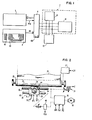
- a text storage typewriter suitable for use according to the invention includes an operation- controlling logic device 2 which is coupled through an interface 4 to printing apparatus 6 and keyboard apparatus 8. Accessible storage for text and other information is provided by a read/write storage device 10 that cooperates with the logic device 2.
- logic device 2 comprises a sequential logic processor 12 that cooperates with a read-only-storage (ROS) 14 which embodies in coded form a set of predefined signal handling responses for the processor 12.
- ROS 14 also holds fixed data used, for example, in calculations.
- Such a signal processing arrangement is well known in the art and is employed, for example, in IBM Electronic Typewriter Models 50 and 60.
- the signal responses are, for the most part, defined by structure of the ROS 14 using various basic operations of processor 12 as building blocks.
- Part of the overall response characteristic is typically built into the interface 4'and the degree of pre- and post-processing of signals that occurs there is typically selected in view of cost, performance and timing considerations. It should be appreciated, however, that essentially similar response characteristics may be achieved using direct wired logic according to techniques known in the art.
- the processor approach merely involves a time-sharing of hardware building blocks as compared to the permanent identification of logic devices to respective branches of a fixed logic system.
- Printing apparatus 6 may take various known forms and, may, for example, be a conventional single element impact printer or a typebar printer or even a matrix printer such as an ink jet printer.
- a presently preferred kind of printing apparatus 6 to cooperate in an implementation of the invention includes paper feed means such as a platen 20 (and associated feed rollers not shown).
- the platen 20 is coupled to an indexing device 22 that responds to a signal IX to cause incremental rotation for advancing an inserted medium such as a sheet of paper 24 along a feed path.
- a character forming element 26 is mounted on a support 28 that cooperates with linear drive apparatus such as a lead screw 30 to be moveable parallel to the platen 20 for defining a line 32 for printing. Position along such line is indicated by a signaL E produced by a motion detector 33 that is coupled to the lead screw 30.
- the element 26 and support taken together comprise a carrier 34 which controllably positioned along a print line by a drive system 36 that responds to control and direction signals ESC and DIR, respectively, in transmitting motion from a motor 38 to the lead screw 30.
- a carrier 34 which controllably positioned along a print line by a drive system 36 that responds to control and direction signals ESC and DIR, respectively, in transmitting motion from a motor 38 to the lead screw 30.
- Actual printing at a present printing position 39 is effected using selection and impacting means (not shown) that cooperate with element 26 and respond to selection and velocity signals indicated as SEL and VEL respectively.
- An upper case/lower case shift operation is also provided in response to a signal SFT.
- Power for printing is supplied by a print shaft 42 that is rotated by the drive system 36 is response to a signal PC.
- a cam and follower system (not shown) transfers motion for selection and impacting of element 26.
- a ribbon carrier and. associated drive device (not shown) hold a ribbon 44 between the element 26 and the platen 20 for making an ink impression on the paper, and ribbon positioning movements are controlled by a signal denoted R.
- a detector 46 that cooperates with print shaft 42 serves to indicate when a print cycle is completed by means of a printer feedback signal PFB.
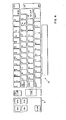
- Included among the keys for a main keyboard area 60 are alphabetic keys, numeric keys, punctuation keys, a carrier return key, a hyphen, and a spacebar.
- An auxiliary keyboard area 62 preferably includes ADVANCE, DELETE, RETURN, PLAY/STOP (P/S), and STORE keys which initiate modes for recording, playback and editing of text strings.
- Various stored codes for the presently preferred implementation are indicated in part in Table 1. It will be appreciated, however, that various coding plans are possible. Certain stored codes are converted from the code produced by the keyboard apparatus and certain keyboard codes of particular interest are indicated in Table 2.
- position encoders which produce either digital or analog output signals.
- typewriters it is more usual to provide a detector which indicates increments of motion, for example, using a disc having radial metering marks and cooperates with a photodetector (indicated in simplified form as detector 33, figure 3) to indicate position shifts.
- logic located in the processor 12 maintains a count (PPOS) in a specific storage location that is indicative of the present printing position.
- PPOS stored number
- the processor 12 determines the total change to the position count corresponding to a commanded operation, e.g., printing of a character, and updates the position count without regard to printer operation.
- the count change is written into a counter 50 (figure 3) of interface 4 using a decoder 52 which responds to an address code assigned to direction and position increment data.
- Logic 54 connected to the counter and decoder outputs then sends commands ESC and DIR to the drive system 36 of printer 6 until the count total is reduced to zero by the feedback pulses E from detector 33.
- This type of print position monitoring and control is used, for example, in the IBM Electronic Typewriter Model 50.
- a printed hyphen may be printed as a result of various operator keyboarding sequences and for a preferred implementation three different codes may be recorded to represent a printed hyphen.
- One is the normal hyphen code that results when the hyphen key is depressed.
- a code ( C 2), required non-breaking hyphen is produced by depressing the hyphen key in conjunction with the code key.
- a syllable hyphen code may be stored automatically in place of a normal hyphen code by logic described below.
- codes producing apparently similar printing operation are equated preferably by converting the codes that belong to the confusion set to a preselected common code for both the stored text string and the address string.
- a conversion to a single space code is preferably effected for comparison purposes.
- the test for the occurrence of a print point shift is preserved in the testing for an address string match.
- Table 2 correspond to a presently preferred implementation that is described in detail below but it should be appreciated that various coding systems for a keyboard actuated printed are possible which would result in ambiguities respective of a printed document.
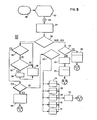
- logic device 2 the main polling logic that is incorporated in the structure of logic device 2 is indicated diagrammatically.
- Such logic struture serves to coordinate the processing of signals KB that arrive at a keyboard buffer 100 of interface 4 (figure 1).
- auxiliary keyboard which preferably control operations with text storage
- main keyboard preferably represents selections as eight bit codes.
- the "TO" flag is checked (Block 234) to determine if a search address is being keyboarded. If so, a branch operation is effected to logic for adding codes to the search address buffer which is labeled as the "TO" buffer (Block 236).
- Such buffer is preferably a series of locations of the storage device 10 (figure 1) and the logic for storage of a text address is described more fully below.
- Section 2 detects hyphen codes and sets flags to indicate whether or not the hyphen is keyed by operator. At Section 3, a flag is set and a branch to special carrier return logic occurs if the code being processed is a carrier return code. Tab and indent tab codes are detected in Section 4 and the tab destination is stored in the variable "TAB DESTINATION". The variable TAB DESTINATION is adjusted to be measured relative to the left margin at Sections 4a and 4b.
- carrier return processing logic at Section 1 tests to determine if the carrier return was automatically inserted. If so, control skips to Section 4 and the carrier return is processed. If not, a temporary index m is set up for the present reference location.
- Section 3 tests for a normal hyphen code (42 16 ) and backs over any preceding multiple word underscore codes at Section 3a.
- Section 3b includes a logic test relating to the position and context of the hyphen to determine if it is to be converted to a syllable hyphen (coded as 70 16 ). If the preceding character is a graphic code other than the hyphen code and the hyphen was keyed and the carrier return was keyed (as determined from the state of previously set flag variable (HYPHEN KEYED FLAG and KEYED FLAG) and the hyphen printed beyond the start of the return zone (PPOS > Rt Margin - 5), then the hyphen code is converted. Section 4 resets the left margin for an indent clear operation. Section 5 causes commands the carrier return operation and sets the indicators E l and E 3 to revised end of last word on line and end of last line positions, respectively.
- index p is incremented to produce a multi- section tab code in storage that indicates tab destination and travel distance.
- an indent tab code F2 16 or F3 16
- the value for the current left margin is also stored in the multi-section code at Section 4a.
- the margin is changed to the new margin value at Section 4b.
- the trailing identifier code is added at Section 5.
- Logic Table 4 hereafter, describes logic for adding a character to the address for a content-addressed search (TO) operation.
- TO content-addressed search
- an erase code triggers a decrementing of the search address index (i) to remove a character from the stored address (T.), and indicates when the operation is completed (e.g. by activating a "thump" causing circuit).
- a case shift request is processed at Section 2 and Section 3 defines the maximum length for the address text string.
- Section 4 coordinates the processing of codes representing a graphic.
- Section 4a equates the coded hyphen and the regular hyphen to the regular hyphen code for search comparison purposes. Then section 4b increments the index i and stores the code using the identifier T . . Section 4c equates all of the codes causing a print position shift to a single space code for purposes of comparison for a content-addressed search. Section 5 causes a code that does not represent a valid search address entry to be ignored.
- Logic for performing a content-addressed search is described in Logic Table 5 hereafter.
- an index t is initialized with the length of the search address and condition indicating variables (flags) are initialized.
- Section 2 starts a loop for comparing line beginnings with the stored address.
- the index i and direction control variable are initialized for a search toward the trailing end of a text string at Section 2b.
- a temporary variable (S) receives a stored code M i and a temporary index (k) receives the value of index i.
- Stepping to the next line is performed at Section 2d. If no more lines are available for testing, an error flag is set at Section 2e, and a command for an indication of error is sent to interface 4, e.g. by an alarm subroutine (not described). At Section 2f, a branch to code comparison logic (described below) is initiated.
- Section 2 initializes, at Section 1, flags for indicating the success state of the matching operation.
- Section 2 starts a loop that successively tests codes in a line for a match to the address codes stored in variable T k .
- Section 2a recognizes space codes in the address string and, in effect, equates them to a single space code for comparison purposes.
- a temporary variable S receives a code from the stored text string M i at Section 2b and at Section 2c a syllable hyphen code or coded hyphen code is converted (in effect equated) for comparison purposes to a regular hyphen code. Codes occurring in the text string that correspond to a shift in print point without printing are equated, in effect, to a single space code for comparison purposes by the logic of Section 2d.
- codes that represent line or text ending positions are detected and set a flag variable indicating a match failure. Codes that do not represent graphic or print point positioning codes are skipped over at Section 2f. If the address and stored codes are not the same, the logic or Section 2g determines whether the codes being tested correspond to a character that is represented by two different codes, e.g. the period and the comma which print the same for upper and lower case. Such codes are equated for comparison purposes and in the preferred embodiment advantage is taken of the fact that one particular code bit has been reserved to distinguish upper case from lower case. If, after equating such characters that are represented by more than one code, the compare still fails, a flag variable (MATCH FAIL FLAG) indicating that fact is set. At Section 2h, a check is made to assure that at least one graphic was a part of the comparison.
- MATCH FAIL FLAG indicating that fact is set.
- Logic for skipping over multiple space codes in a text address is invoked by the test matching logic of Logic Table 6. Such logic is described in Logic Table 7 hereafter, and basically involves an advancing of the address index. Logic for examining the text string and equating print position shifting codes and also any adjacent shifting codes to a single space code is described in Logic Table 8 hereafter. Again, an index incrementing operation advances the compare past these codes and the temporary variable S in Logic Table 6 is set to be the space code.
- Section 1 indicates generally a test for termination which, for the preferred implementation, may be a word ending code or a line ending code or a line found by a search (TO MODE) or at the operator's choice by selecting a key conjunction with the play key. Also, a second depression of the PLAY key is preferably treated as a command to stop. A loop is initiated and a flag (the KEYED FLAG) is set to indicate codes are originating from storage and not the keyboard. A test is made at the start of Section 2 to determine whether the operator has selected the ADJUST mode (which action sets the ADJUST FLAG to 1) indicating that line ending will be automatically adjusted rather than printed as originally keyboarded.
- the ADJUST mode which action sets the ADJUST FLAG to 1 indicating that line ending will be automatically adjusted rather than printed as originally keyboarded.
- Syllable hyphens and discretionary carrier returns are deleted from the text string if they occur at a printer position (PPOS) to the left of the beginning of the return zone (here assumed as the right margin - 5 character position increments) and a carrier return will not be inserted after a syllable hyphen that precedes the beginning of the return zone.
- PPOS printer position
- a carrier return will not be inserted after a syllable hyphen that precedes the beginning of the return zone.
- a space code which is followed by a graphic code triggers a branch to logic for scanning a word for inserting a carrier return (described below).
- the purpose of the logical testing of Section 2b is to locate a word beginning point and additional testing may be required if control codes, for example, can occur between a space and a graphic in circumstances where treatment as a word beginning is desired.
- flag variables are set for indicating that a hyphen or certain control codes have not been encountered as the only characters in the word.
- flag variables (having names descriptive of purpose) are set to indicate the occurrence of a hyphen code in a word and the location of the hyphen relative to the right margin.
- the escapement for the accessed code is added to the total E2 which, when accumulation is complete, indicates the end of the next word.
- the escapement value is accessed from ROS 14 (figure 1) in a table referenced to the text codes.
- a set of zone boundaries (Z12, Z23, Z34 and Z56) for line adjustment are first established in Section 1, and are related to the right margin.
- One of the boundaries corresponds to the usual location of the paper edge.
- a variable E 3 has been established (Logic Table 2) with the stored value of the printer position for the ending of the last line.
- variable E 1 contains (Logic Table 1) the end position for the last word printed.
- E 2 is the variable that contains the location code for the end of the next word to be printed.
- a variable POST ZONE HYPHEN is set to indicate the end of the next word if a hyphen can be used as a word break point.
- the line ending logic is not needed if there will be hyphen in the return zone or this is the first word of a line which is caused to be printed irrespective of end point.
- the variable E 1 , E 2 AND E 3 are compared to the zone boundaries in Section 3 which defines the logic for deciding whether or not to insert a carrier return.
- Logic Table 13 logic for erasing a code from text storage is described.
- separator codes are detected and, for such codes, no erase action is taken.
- Multisection codes are detected at Section 2 to permit special processing of such codes. If a multisection code is not an indent tab or indent clear, it is a tab code (FO or Fl) and can be erased.
- the tab shift distance and tab destination sections of a destination tab code are decremented by one unit for each erase operation. When the shift distance is decremented to zero, as determined at Section 2c, the leading reference address in storage is shifted so that the multisection tab code is in the empty storage gap (effectively erased). A shift command is sent to the printer at Section 2d.
- the logic for the text store operations interacts with the other logic and is triggered, for example, using a STORE FLAG which is toggled between the zero and one states in response to the code indicating the STORE key has been depressed (see Logic Table 14). Additional sophistication may be provided to permit storage of individually retrievable documents as is known in the art.
- Logic Table 16 The logic for advance and return operations is described in Logic Table 16 hereafter.
- TO content-addressed
- the destination is determined according to the selected mode (e.g. line, word) by scanning for a corresponding ending code as is known in the art.
- a direction indicator i is establisned to indicate the direction of reference point movement is toward the leading end (return) or trailing end (advance) of text storage.
- the shifting of the reference point is effected in a separate block of logic (Logic Table 17 hereafter), that is entered by a branching operation at Section 3.
- a temporary index j is set to the location p of the leading end (of the empty space gap) reference position and a temporary variable (ESCAPEMENT) for storing print position shifts is initialized to zero.
- Print position shifts are accumulated in Section 5 for codes toward the leading end of storage until the beginning of the line is located by encountering a code such as a carrier return code. If a destination tab code (F0 16 or F1 16 ) is encountered, the shift distance is extracted from the portion of the multisection code containing such information (the second byte of four) and the index j is reduced to move to the next code.
- the print position shift is determined from a stored table (data stored in ROS 14, figure 1) and added to the total.
- the total in the variable ESCAPEMENT is referenced to the active left margin and the shift from the present printing position PPOS is sent to the interface 4 to cause a print position shift.
- a temporary variable s receives M k .
- the active left margin is changed in Section 4a in recognition of an advance past an ident tab code.
- F2 the destination stored at the third section of the multisection indent tab code is added to the active left margin.
- F3 the tab destination is substracted from the active left margin.
- indexes p and r are adjusted for a shift beyond the present code including the extra shift for the multisection tab codes and indent tab codes.
Landscapes
- Record Information Processing For Printing (AREA)
- Document Processing Apparatus (AREA)
- Information Retrieval, Db Structures And Fs Structures Therefor (AREA)
Applications Claiming Priority (2)
| Application Number | Priority Date | Filing Date | Title |
|---|---|---|---|
| US06/079,414 US4355913A (en) | 1979-09-27 | 1979-09-27 | Content-addressed text search apparatus for typewriters |
| US79414 | 1987-07-30 |
Publications (2)
| Publication Number | Publication Date |
|---|---|
| EP0026304A2 true EP0026304A2 (fr) | 1981-04-08 |
| EP0026304A3 EP0026304A3 (fr) | 1983-03-16 |
Family
ID=22150396
Family Applications (1)
| Application Number | Title | Priority Date | Filing Date |
|---|---|---|---|
| EP80104756A Ceased EP0026304A3 (fr) | 1979-09-27 | 1980-08-12 | Appareil de recherche associative de texte pour un système de traitement de texte |
Country Status (5)
| Country | Link |
|---|---|
| US (1) | US4355913A (fr) |
| EP (1) | EP0026304A3 (fr) |
| JP (1) | JPS5647838A (fr) |
| AU (1) | AU530777B2 (fr) |
| CA (1) | CA1147864A (fr) |
Cited By (2)
| Publication number | Priority date | Publication date | Assignee | Title |
|---|---|---|---|---|
| EP0066046B1 (fr) * | 1981-05-18 | 1986-12-30 | International Business Machines Corporation | Système de traitement d'informations pour la sélection de données en réponse à des conditions complexes |
| WO1988005193A1 (fr) * | 1986-12-29 | 1988-07-14 | Brother Kogyo Kabushiki Kaisha | Systeme de traitement de textes possedant une fonction de recherche et de remplacement |
Families Citing this family (9)
| Publication number | Priority date | Publication date | Assignee | Title |
|---|---|---|---|---|
| AU530568B2 (en) * | 1980-10-31 | 1983-07-21 | Canon Kabushiki Kaisha | Serial printing apparatus with memory and display |
| CA1204215A (fr) * | 1981-09-01 | 1986-05-06 | Hiroyuki Ueda | Equipement electronique avec memoire de series de caracteres et affichage de caracteres |
| US4445795A (en) * | 1981-09-24 | 1984-05-01 | International Business Machines | Method and apparatus for merge processing in a text processing system |
| US5600556A (en) * | 1982-01-29 | 1997-02-04 | Canon Kabushiki Kaisha | Word processor that automatically capitalizes the first letter of sentence |
| JPS58195943A (ja) * | 1982-05-11 | 1983-11-15 | Sanyo Electric Co Ltd | ワ−ドプロセツサ |
| DE3421919A1 (de) * | 1983-06-14 | 1984-12-20 | Canon K.K., Tokio/Tokyo | Speichersteuereinheit |
| JPS61120275A (ja) * | 1984-11-16 | 1986-06-07 | Toshiba Corp | 日本語ワ−ドプロセツサ |
| US4907173A (en) * | 1986-07-14 | 1990-03-06 | Brother Kogyo Kabushiki Kaisha | Word processor |
| US5524227A (en) * | 1994-07-29 | 1996-06-04 | U S West Technologies, Inc. | Method and system for formatting address strings into recognizable token sequences |
Family Cites Families (3)
| Publication number | Priority date | Publication date | Assignee | Title |
|---|---|---|---|---|
| US3358270A (en) * | 1962-11-05 | 1967-12-12 | Gen Electric | Information storage and retrieval system |
| US3386553A (en) * | 1967-04-26 | 1968-06-04 | Itt | Editorial correcting typewriter utilizing data search and information retrievcal techniques |
| US3812945A (en) * | 1972-10-18 | 1974-05-28 | Wang Laboratories | Typewriter system |
-
1979
- 1979-09-27 US US06/079,414 patent/US4355913A/en not_active Expired - Lifetime
-
1980
- 1980-07-14 CA CA000356120A patent/CA1147864A/fr not_active Expired
- 1980-08-01 JP JP10518680A patent/JPS5647838A/ja active Granted
- 1980-08-12 EP EP80104756A patent/EP0026304A3/fr not_active Ceased
- 1980-08-20 AU AU61582/80A patent/AU530777B2/en not_active Ceased
Cited By (3)
| Publication number | Priority date | Publication date | Assignee | Title |
|---|---|---|---|---|
| EP0066046B1 (fr) * | 1981-05-18 | 1986-12-30 | International Business Machines Corporation | Système de traitement d'informations pour la sélection de données en réponse à des conditions complexes |
| WO1988005193A1 (fr) * | 1986-12-29 | 1988-07-14 | Brother Kogyo Kabushiki Kaisha | Systeme de traitement de textes possedant une fonction de recherche et de remplacement |
| US4916656A (en) * | 1986-12-29 | 1990-04-10 | Brother Kogyo Kabushiki Kaisha | Text processing system having search-and-replace function for both character and attribute data |
Also Published As
| Publication number | Publication date |
|---|---|
| US4355913A (en) | 1982-10-26 |
| CA1147864A (fr) | 1983-06-07 |
| EP0026304A3 (fr) | 1983-03-16 |
| JPS5647838A (en) | 1981-04-30 |
| AU530777B2 (en) | 1983-07-28 |
| AU6158280A (en) | 1981-04-09 |
| JPS6128131B2 (fr) | 1986-06-28 |
Similar Documents
| Publication | Publication Date | Title |
|---|---|---|
| US4464070A (en) | Multi-character display controller for text recorder | |
| US4847766A (en) | Dictionary typewriter with correction of commonly confused words | |
| US4138719A (en) | Automatic writing systems and methods of word processing therefor | |
| US4327421A (en) | Chinese printing system | |
| US5060154A (en) | Electronic typewriter or word processor with detection and/or correction of selected phrases | |
| US4355913A (en) | Content-addressed text search apparatus for typewriters | |
| EP0026303B1 (fr) | Appareil d'ajustement de ligne dans un système de traitement de texte | |
| US4354765A (en) | Hyphen characterization apparatus for a typewriter | |
| EP0039393B1 (fr) | Méthode et dispositif pour la terminaison automatique de mots pour appareils enregistreurs de textes | |
| US3821710A (en) | Multimode search and retrieval tape system | |
| EP0063939B1 (fr) | Disposition pour taper à la machine | |
| KR860001012B1 (ko) | 표의문자 코딩장치 | |
| US4888730A (en) | Memory typewriter with count of overused words | |
| EP0026302B1 (fr) | Procédé pour défienir des arrêts de tabulation pour des machines à écrire avec mémorisation de texte | |
| US4728209A (en) | Printing apparatus having a memory for storing composite and printed character information for subsequent erasure | |
| US3895704A (en) | Word processor with right-hand margin control | |
| EP0119396B1 (fr) | Dispositif et méthodes de présentation ou d'affichage de données représentées par des signaux électriques | |
| US4408918A (en) | Halfspace control system for electronic typewriter with correction register | |
| CA1052911A (fr) | Systemes et methodes d'ecriture automatique | |
| US4907900A (en) | Auto-realigned print correction | |
| EP0031446B1 (fr) | Dispositif de contrôle à visualisation de plusieurs caractères pour enregistreur de texte | |
| EP0292726B1 (fr) | Mémoire tampon pour correction | |
| US3823393A (en) | Data transfer device for word processing system | |
| US4955734A (en) | Information processing apparatus | |
| AU607258B2 (en) | Automatic function control for an electronic typewriter |
Legal Events
| Date | Code | Title | Description |
|---|---|---|---|
| PUAI | Public reference made under article 153(3) epc to a published international application that has entered the european phase |
Free format text: ORIGINAL CODE: 0009012 |
|
| AK | Designated contracting states |
Designated state(s): DE FR GB IT |
|
| 17P | Request for examination filed |
Effective date: 19810828 |
|
| PUAL | Search report despatched |
Free format text: ORIGINAL CODE: 0009013 |
|
| AK | Designated contracting states |
Designated state(s): DE FR GB IT |
|
| 18R | Application refused |
Effective date: 19850104 |
|
| STAA | Information on the status of an ep patent application or granted ep patent |
Free format text: STATUS: THE APPLICATION HAS BEEN REFUSED |
|
| R18R | Application refused (corrected) |
Effective date: 19841103 |
|
| RIN1 | Information on inventor provided before grant (corrected) |
Inventor name: RUTKOWSKI, EDWARD VINCENT |