EP0026700B1 - Verfahren zum Beseitigen von in einer Flüssigkeit suspendierten Schwermetallelementen - Google Patents
Verfahren zum Beseitigen von in einer Flüssigkeit suspendierten Schwermetallelementen Download PDFInfo
- Publication number
- EP0026700B1 EP0026700B1 EP19800401343 EP80401343A EP0026700B1 EP 0026700 B1 EP0026700 B1 EP 0026700B1 EP 19800401343 EP19800401343 EP 19800401343 EP 80401343 A EP80401343 A EP 80401343A EP 0026700 B1 EP0026700 B1 EP 0026700B1
- Authority
- EP
- European Patent Office
- Prior art keywords
- particles
- liquid
- magnetite
- ruthenium
- suspension
- Prior art date
- Legal status (The legal status is an assumption and is not a legal conclusion. Google has not performed a legal analysis and makes no representation as to the accuracy of the status listed.)
- Expired
Links
Images
Classifications
-
- B—PERFORMING OPERATIONS; TRANSPORTING
- B03—SEPARATION OF SOLID MATERIALS USING LIQUIDS OR USING PNEUMATIC TABLES OR JIGS; MAGNETIC OR ELECTROSTATIC SEPARATION OF SOLID MATERIALS FROM SOLID MATERIALS OR FLUIDS; SEPARATION BY HIGH-VOLTAGE ELECTRIC FIELDS
- B03C—MAGNETIC OR ELECTROSTATIC SEPARATION OF SOLID MATERIALS FROM SOLID MATERIALS OR FLUIDS; SEPARATION BY HIGH-VOLTAGE ELECTRIC FIELDS
- B03C1/00—Magnetic separation
- B03C1/02—Magnetic separation acting directly on the substance being separated
- B03C1/28—Magnetic plugs and dipsticks
-
- B—PERFORMING OPERATIONS; TRANSPORTING
- B03—SEPARATION OF SOLID MATERIALS USING LIQUIDS OR USING PNEUMATIC TABLES OR JIGS; MAGNETIC OR ELECTROSTATIC SEPARATION OF SOLID MATERIALS FROM SOLID MATERIALS OR FLUIDS; SEPARATION BY HIGH-VOLTAGE ELECTRIC FIELDS
- B03C—MAGNETIC OR ELECTROSTATIC SEPARATION OF SOLID MATERIALS FROM SOLID MATERIALS OR FLUIDS; SEPARATION BY HIGH-VOLTAGE ELECTRIC FIELDS
- B03C1/00—Magnetic separation
- B03C1/005—Pretreatment specially adapted for magnetic separation
- B03C1/01—Pretreatment specially adapted for magnetic separation by addition of magnetic adjuvants
-
- B—PERFORMING OPERATIONS; TRANSPORTING
- B03—SEPARATION OF SOLID MATERIALS USING LIQUIDS OR USING PNEUMATIC TABLES OR JIGS; MAGNETIC OR ELECTROSTATIC SEPARATION OF SOLID MATERIALS FROM SOLID MATERIALS OR FLUIDS; SEPARATION BY HIGH-VOLTAGE ELECTRIC FIELDS
- B03C—MAGNETIC OR ELECTROSTATIC SEPARATION OF SOLID MATERIALS FROM SOLID MATERIALS OR FLUIDS; SEPARATION BY HIGH-VOLTAGE ELECTRIC FIELDS
- B03C1/00—Magnetic separation
- B03C1/02—Magnetic separation acting directly on the substance being separated
- B03C1/025—High gradient magnetic separators
-
- B—PERFORMING OPERATIONS; TRANSPORTING
- B03—SEPARATION OF SOLID MATERIALS USING LIQUIDS OR USING PNEUMATIC TABLES OR JIGS; MAGNETIC OR ELECTROSTATIC SEPARATION OF SOLID MATERIALS FROM SOLID MATERIALS OR FLUIDS; SEPARATION BY HIGH-VOLTAGE ELECTRIC FIELDS
- B03C—MAGNETIC OR ELECTROSTATIC SEPARATION OF SOLID MATERIALS FROM SOLID MATERIALS OR FLUIDS; SEPARATION BY HIGH-VOLTAGE ELECTRIC FIELDS
- B03C2201/00—Details of magnetic or electrostatic separation
- B03C2201/18—Magnetic separation whereby the particles are suspended in a liquid
Definitions
- irradiated fuels from the electro-nuclear industry are reprocessed in order, in particular, to recover the fissile materials contained in the irradiated elements by separating them from the fission products.
- these fuels are dissolved in a nitric medium.
- the solution is subjected to several solvent extractions in order, firstly, to rid the uranium and the plutonium of the fission products associated with them, then to separate them from each other.
- fission products present in irradiated fuels such as ruthenium for example, are not very soluble in the nitric medium from the dissolver in the reprocessing chain.
- ruthenium 106 is abundantly produced by the fission of uranium, deposits of ruthenium form and strongly contaminate the walls of the components of the reprocessing chain which contain the nitric solutions.
- Particles up to a few microns in size can be separated from the. nitric solution by filtration or by centrifugation.
- the ruthenium particles whose size is of the order of or less than one micron cannot be removed by these conventional methods.
- Document US-A-3 351 203 discloses a process for extracting non-magnetic particles such as particles of glass, plastic or stainless steel suspended in a liquid, for example sewage. According to this method, ferromagnetic particles are distributed inside the liquid to be filtered and a filter 24 is produced by means of an electromagnet 16 disposed around the pipe 15 in which the liquid is circulated. When the majority of the particles have been retained, the filtering operation is carried out on the particles in suspension in the liquid.
- This problem is solved according to the present invention. Indeed, it specifically relates to a process for the elimination of metal particles of this size suspended in a liquid.
- This process is particularly applicable to the elimination of heavy metallic elements such as ruthenium in suspension in nitric solutions for reprocessing irradiated fuel elements in nuclear reactors. However, it also applies to the filtration of other liquids charged with insoluble metal particles, such as for example the water in pools for the storage of irradiated fuel elements.
- the method according to the present invention is based on the use of a finely divided ferromagnetic filter aid, in order to separate, by means of a magnetic field, the insoluble heavy metal elements which could not be effectively extracted by other means.
- heavy elements is meant particles whose mass is large relative to that of the particles of the ferromagnetic adjuvant used.
- ruthenium particles and as an adjuvant of magnetite a large fraction of the ruthenium particles has a diameter of a few tenths of a micron, and the magnetite has a diameter distribution curve which has a maximum at around 0.2 pm; moreover, the density of ruthenium is close to 12, and due to the agglomeration of the particles of suspended magnetic adjuvant, these have an even more apparent density, in particular lower than the density of the homogeneous massive magnetite which is close to 5.
- an apparent magnetite density of 3 an average diameter of magnetite particles equal to 0.2 p and a diameter of ruthenium particles equal to 0.6 p, we find that the ratio of the masses is 108.
- the insoluble elements are found in the solution in metallic form.
- they cannot be included in a crystal lattice, such as for example a crystalline ferrite network as can happen with other elements such as copper, manganese in a mixture of iron-based corrosion products in high temperature water.
- these elements cannot be the subject of an electrostatic attraction such as that which would be created between a ferromagnetic adjuvant and dielectric elements such as fibers, textiles, etc. Under these conditions, the forces of attraction between the particles of the ferromagnetic adjuvant and the metallic particles, of the force type of VAN der WAALS, cannot be sufficient to retain the latter.
- the process according to the invention is based on the fact that the particles of this adjuvant tend to spontaneously agglomerate into larger grains.
- the agglomeration is also the fact of the attraction of the tiny magnetic dipoles that become the particles of adjuvant if they undergo the effect of a magnetic field.
- the larger particles that result from these phenomena, the last of which is called magnetic coagulation, are very spongy in nature. They contain a large amount of occluded fluid.
- One or more non-ferromagnetic particles trapped according to this process in such a magnetite agglomerate are then naturally transported with it under the effect of a magnetic field gradient.
- the stirring of the liquid and the application of a magnetic field are carried out by means of a single device constituted by a rotating shaft carrying permanent magnets whose neighboring poles are of the same polarity.
- the ferromagnetic adjuvant particles are attracted to the magnetic poles where they attach, carrying with them the heavy metal particles.
- the yield of the process according to the invention For example, in the case where ruthenium particles contained in the nitric medium for dissolving irradiated fuel are extracted. To this end, the fine ruthenium powder is placed in a 4N solution of uranyl nitrate, which is stirred and slightly heated, for example around 50 ° C., to simulate a nitric solution of irradiated fuel which spontaneously heats up under the effect of the decaying radiation of the fission products.
- the metal powder was previously irradiated in a reactor in order to mark it with radioactive ruthenium 103, a gamma emitter.
- radioactive ruthenium 103 a gamma emitter.
- finely divided magnetite which was prepared separately by alkaline precipitation in a solution of ferrous iron, and whose particles initially measure from 0.1 ⁇ m to a few ⁇ m, the stirring of the liquid is continued for a few minutes.
- the material balance of ruthenium 103 which can easily be established by measuring the activity of this radionuclide in the aliquot of metallic ruthenium before the experiment, then in the magnetite sludges after the extraction, allows to control this yield.
- the yield is between 65 and 85%.
- the ferromagnetic adjuvant used is ferrite, or alternatively magnetite.
- the process for removing heavy metallic elements according to the invention leads to the production of a dense sludge, constituted by a mixture of the ferromagnetic adjuvant and heavy metallic elements.
- the sludge adheres to the poles of the magnets.
- This dense sludge can be easily separated from the wash water by decantation.
- the metal particles can then be separated from the magnetite, either to isolate them under a small volume of waste, or with a view to the profitability of the metals which are their main constituents.
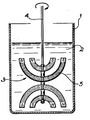
- the container 1 contains a nitric solution of irradiated fuel 2 inside which there is a residue of insoluble fission products, including in particular ruthenium in the finely divided state, which is eliminate to prevent its accumulation by deposition in the components of the dissolution and extraction workshop of the reprocessing plant.
- an amount of magnetite is added to solution 2. The optimal amount of magnetite to add is determined by preliminary experiments.
- the mass ratio of the quantities of ruthenium and magnetite is between 1/6 and 1/12.
- the solution 2 is stirred for a certain time, in order to maintain in suspension and in intimate contact the insoluble particles and the particles of magnetite.
- the duration of the contact in the nitric solution must however be limited so that the dissolution of the magnetite itself remains weak.
- laboratory orientation experiments show that the agitation of the nitric solution can advantageously be limited to less than half an hour.
- FIG. 1 by the general reference 3.
- the latter comprises a rotating shaft 4 carrying permanent magnets 5 which may have the form of bars or horseshoes.
- the number of magnets 5 is sufficient for them to be able to fix all the magnetite added to the solution 2.
- These magnets 5 are arranged in such a way that their neighboring poles are of the same polarity, or, at least, if they are of polarity different, that they are far enough apart that they cannot exert one on the other an action capable of significantly reducing the gradient of the magnetic field near the neighboring poles.
- the speed of rotation of the shaft 4 is limited so that the linear speed of the poles of the magnets 5 remains low enough so that the attraction force exerted by these poles on the magnetite particles is greater than the tearing force that exerts on them the liquid by friction at the level of the polar surfaces.
- the linear speed at the end of the poles can reach between 10 and 20 centimeters per second, when the viscosity of the liquid is of the same order of magnitude as that of water.
- the linear speed to be chosen is inversely proportional to it.
- the magnetic extraction is stopped by removing the agitator 3.
- the magnets 5 are then loaded with sludge at their polar ends. These sludges naturally also retain a little solution containing plutonium and uranium which can be washed by rotating the agitator 3 at low speed in a container identical to container 1 and containing water. This water is renewed to remove the charge of sludge on the magnets 5.
- This sludge is detached from the polar ends by means of water whose linear speed is sufficiently high.
- the agitator 3 can be rotated in a container containing water with a speed of rotation such that the linear speed at the ends of the magnets 5 is greater than 40 cm per second.
- a high speed water jet can be directed at these same ends, the rinsing water being collected in an initially empty container.
- the agitator 3 is immediately reusable.
- the subsequent treatment of the rinsing water consists in separating the magnetite in small volume with all the particles which it has entrained by prior sedimentation.
- the aqueous effluent is then decontaminated by treatment with ion exchange resins.
- Magnetite sludge can be conditioned as solid waste by a known method. If the recovery of platinoid elements such as ruthenium is of interest, they are separated by appropriate prior treatment of the sludge. For example, magnetite can be transformed by oxidation to a much more soluble form of iron, which then simply dissolves to separate the insoluble platinoid elements such as ruthenium.
- the process for removing heavy metal particles according to the invention leads to a dense sludge easily separated from the washing water by decantation and which contains the insoluble fission products.
- the latter can then be separated from the ferromagnetic adjuvant, either to isolate them under a small volume of waste, or for the profitability of the platinoid metals which are the major constituents thereof.
Landscapes
- Solid-Sorbent Or Filter-Aiding Compositions (AREA)
- Manufacture And Refinement Of Metals (AREA)
- Filtering Materials (AREA)
Claims (6)
dadurch gekennzeichnet, daß das Umrühren der Flüssigkeit und das Anlegen des Magnetfeldes mittels eines einzigen Gerätes erfolgen, das von einer drehenden Welle gebildet ist, die Permanentmagnete trägt, deren benachbarte Pole übereinstimmende Polarität aufweisen.
Priority Applications (1)
| Application Number | Priority Date | Filing Date | Title |
|---|---|---|---|
| DE8484200419T DE3072136D1 (en) | 1979-10-02 | 1980-09-19 | Process for removing heavy metallic elements suspended in a liquid |
Applications Claiming Priority (2)
| Application Number | Priority Date | Filing Date | Title |
|---|---|---|---|
| FR7924496A FR2466282A1 (fr) | 1979-10-02 | 1979-10-02 | Procede d'elimination des elements metalliques lourds en suspension dans un liquide a l'aide d'un adjuvant ferromagnetique finement divise |
| FR7924496 | 1979-10-02 |
Related Child Applications (2)
| Application Number | Title | Priority Date | Filing Date |
|---|---|---|---|
| EP19840200419 Division-Into EP0127906B1 (de) | 1979-10-02 | 1980-09-19 | Verfahren zum Trennen von in einer Flüssigkeit suspendierten Schwermetallelementen |
| EP19840200419 Division EP0127906B1 (de) | 1979-10-02 | 1980-09-19 | Verfahren zum Trennen von in einer Flüssigkeit suspendierten Schwermetallelementen |
Publications (2)
| Publication Number | Publication Date |
|---|---|
| EP0026700A1 EP0026700A1 (de) | 1981-04-08 |
| EP0026700B1 true EP0026700B1 (de) | 1985-04-10 |
Family
ID=9230217
Family Applications (2)
| Application Number | Title | Priority Date | Filing Date |
|---|---|---|---|
| EP19800401343 Expired EP0026700B1 (de) | 1979-10-02 | 1980-09-19 | Verfahren zum Beseitigen von in einer Flüssigkeit suspendierten Schwermetallelementen |
| EP19840200419 Expired EP0127906B1 (de) | 1979-10-02 | 1980-09-19 | Verfahren zum Trennen von in einer Flüssigkeit suspendierten Schwermetallelementen |
Family Applications After (1)
| Application Number | Title | Priority Date | Filing Date |
|---|---|---|---|
| EP19840200419 Expired EP0127906B1 (de) | 1979-10-02 | 1980-09-19 | Verfahren zum Trennen von in einer Flüssigkeit suspendierten Schwermetallelementen |
Country Status (4)
| Country | Link |
|---|---|
| EP (2) | EP0026700B1 (de) |
| JP (1) | JPS5658935A (de) |
| DE (1) | DE3070456D1 (de) |
| FR (1) | FR2466282A1 (de) |
Cited By (1)
| Publication number | Priority date | Publication date | Assignee | Title |
|---|---|---|---|---|
| US8361316B2 (en) | 1995-02-21 | 2013-01-29 | Sigris Research, Inc. | Device for mixing and separation of magnetic particles |
Families Citing this family (9)
| Publication number | Priority date | Publication date | Assignee | Title |
|---|---|---|---|---|
| DE3200988A1 (de) * | 1982-01-14 | 1983-07-28 | Thomas A. Dr. 6900 Heidelberg Reed | Verfahren und vorrichtung zur abtrennung von organischen stoffen aus einer suspension oder loesung |
| GB8513868D0 (en) * | 1985-06-01 | 1985-07-03 | British Petroleum Co Plc | Removing mineral matter from solid carbonaceous fuels |
| GB2175916B (en) * | 1985-06-01 | 1988-11-09 | British Petroleum Co Plc | Removing mineral matter from solid carbonaceous fuels |
| US5076950A (en) * | 1985-12-20 | 1991-12-31 | Syntex (U.S.A.) Inc. | Magnetic composition for particle separation |
| ATE73690T1 (de) * | 1985-12-20 | 1992-04-15 | Syntex Inc | Teilchentrennungsverfahren. |
| AU4927496A (en) * | 1995-02-21 | 1996-09-11 | Iqbal W. Siddiqi | Apparatus and method for mixing and separation employing magnetic particles |
| FR2830204A1 (fr) * | 2001-10-02 | 2003-04-04 | Centre Nat Rech Scient | Procede et dispositif de separation de particules marquees en suspension dans un milieu visqueux et son application aux processus microbiologiques |
| FR2884156B1 (fr) * | 2005-04-08 | 2007-09-28 | Galloo Plastics Sa | Procede de separation selective de materiaux absorbants fragmentes en particulier usages, au moyen de suspensions magnetiques |
| CN112138864B (zh) * | 2020-09-14 | 2023-03-14 | 东莞市江合磁业科技有限公司 | 一种基于磁力强度自调的高精度智能化磁选机 |
Family Cites Families (8)
| Publication number | Priority date | Publication date | Assignee | Title |
|---|---|---|---|---|
| US2765075A (en) * | 1955-03-16 | 1956-10-02 | Centrijig Corp | Method for mineral separation |
| US3351203A (en) * | 1965-08-17 | 1967-11-07 | Gen Electric | Separation apparatus and method for its operation |
| US3477948A (en) * | 1965-12-13 | 1969-11-11 | Inoue K | Magnetic filter and method of operating same |
| US3890224A (en) * | 1970-05-04 | 1975-06-17 | Commw Scient Ind Res Org | Process for controlling surface pollutants |
| CH538294A (de) * | 1971-10-25 | 1973-06-30 | Ni I Kt I Emalirovannogo Khim | Verfahren zur Ausscheidung von gelösten Stoffen aus Lösungen |
| JPS5011975A (de) * | 1972-11-06 | 1975-02-06 | ||
| US3931007A (en) * | 1972-12-19 | 1976-01-06 | Nippon Electric Company Limited | Method of extracting heavy metals from industrial waste waters |
| DE2633626A1 (de) * | 1976-07-27 | 1978-02-02 | Lenz Hans Richard Ing Grad | Verfahren zum trennen von ne-metallen aus ne-metallschrott |
-
1979
- 1979-10-02 FR FR7924496A patent/FR2466282A1/fr active Granted
-
1980
- 1980-09-19 EP EP19800401343 patent/EP0026700B1/de not_active Expired
- 1980-09-19 DE DE8080401343T patent/DE3070456D1/de not_active Expired
- 1980-09-19 EP EP19840200419 patent/EP0127906B1/de not_active Expired
- 1980-10-02 JP JP13823680A patent/JPS5658935A/ja active Pending
Cited By (1)
| Publication number | Priority date | Publication date | Assignee | Title |
|---|---|---|---|---|
| US8361316B2 (en) | 1995-02-21 | 2013-01-29 | Sigris Research, Inc. | Device for mixing and separation of magnetic particles |
Also Published As
| Publication number | Publication date |
|---|---|
| EP0026700A1 (de) | 1981-04-08 |
| EP0127906A1 (de) | 1984-12-12 |
| JPS5658935A (en) | 1981-05-22 |
| FR2466282A1 (fr) | 1981-04-10 |
| FR2466282B1 (de) | 1983-11-10 |
| DE3070456D1 (en) | 1985-05-15 |
| EP0127906B1 (de) | 1988-11-30 |
Similar Documents
| Publication | Publication Date | Title |
|---|---|---|
| EP0127906B1 (de) | Verfahren zum Trennen von in einer Flüssigkeit suspendierten Schwermetallelementen | |
| EP0533494A2 (de) | Verfahren zur Behandlung von radioaktiv kontaminiertem Bodenmaterial | |
| JPS61194122A (ja) | 金属の分離方法 | |
| EP2362855A1 (de) | Verfahren zur dekontaminierung eines flüssigen austragstroms, der ein oder mehrere radioaktive chemische elemente enthält, durch eine wirbelschichtbehandlung | |
| FR2948385A1 (fr) | Procede de recuperation selective de l'americium a partir d'une phase aqueuse nitrique | |
| FR2688336A1 (fr) | Procede pour separer le niobium, l'antimoine et/ou au moins un element des groupes viib et viii a partir de solutions aqueuses issues du retraitement des combustibles nucleaires uses. | |
| EP0682806A1 (de) | Verfahren zur behandlung von teilchenmaterial | |
| FR2927725A1 (fr) | Procede de decontamination d'un effluent liquide en un ou plusieurs elements chimiques par extraction solide-liquide mettant en oeuvre une boucle de recyclage | |
| JPH10508697A (ja) | 汚染除去方法 | |
| US4366065A (en) | Separating particles from a liquid | |
| WO2011016916A2 (en) | Compositions and methods for treating nuclear fuel | |
| Gao et al. | Removal behavior and mechanisms of cadmium and lead by coupled ethylenediaminetetraacetic acid washing and electrochemical reduction: influence of current conditions | |
| CA2521639C (en) | Magnetic molecules: process utilizing functionalized magnetic ferritins for the selective removal of contaminants from solution by magnetic filtration | |
| JP6105363B2 (ja) | 汚染物質の除去方法および磁性除染剤の製造方法 | |
| JPS6349528B2 (de) | ||
| WO1999010087A1 (fr) | Procede de separation d'actinides et de lanthanides par transport membranaire au moyen d'un calixarene | |
| EP1678337B1 (de) | Verfahren zur dekontaminierung hexavalentes chrom enthaltender feuerfestmaterialien | |
| JP6025409B2 (ja) | 放射性セシウム汚染土壌の洗浄方法 | |
| JPH0326999A (ja) | 放射性有機物含有廃棄物の処理方法 | |
| BE1011754A3 (fr) | Procede et installation de decontamination de surfaces metalliques. | |
| WO1996011478A1 (fr) | PROCEDE DE DECONTAMINATION PARTIELLE α D'UN EFFLUENT AQUEUX | |
| JP2015150535A (ja) | 陽イオン分離方法 | |
| JP3504595B2 (ja) | 使用済核燃料の前処理方法および前処理装置 | |
| EP0169774A1 (de) | Kontinuierlich arbeitender elektromagnetischer Filter | |
| JP3994203B2 (ja) | 選択硫化と磁気分離による再処理方法 |
Legal Events
| Date | Code | Title | Description |
|---|---|---|---|
| PUAI | Public reference made under article 153(3) epc to a published international application that has entered the european phase |
Free format text: ORIGINAL CODE: 0009012 |
|
| AK | Designated contracting states |
Designated state(s): BE DE GB |
|
| 17P | Request for examination filed |
Effective date: 19810924 |
|
| GRAA | (expected) grant |
Free format text: ORIGINAL CODE: 0009210 |
|
| AK | Designated contracting states |
Designated state(s): BE DE GB |
|
| REF | Corresponds to: |
Ref document number: 3070456 Country of ref document: DE Date of ref document: 19850515 |
|
| PLBE | No opposition filed within time limit |
Free format text: ORIGINAL CODE: 0009261 |
|
| STAA | Information on the status of an ep patent application or granted ep patent |
Free format text: STATUS: NO OPPOSITION FILED WITHIN TIME LIMIT |
|
| 26N | No opposition filed | ||
| PGFP | Annual fee paid to national office [announced via postgrant information from national office to epo] |
Ref country code: DE Payment date: 19890825 Year of fee payment: 10 |
|
| PGFP | Annual fee paid to national office [announced via postgrant information from national office to epo] |
Ref country code: BE Payment date: 19890926 Year of fee payment: 10 |
|
| PGFP | Annual fee paid to national office [announced via postgrant information from national office to epo] |
Ref country code: GB Payment date: 19890930 Year of fee payment: 10 |
|
| PG25 | Lapsed in a contracting state [announced via postgrant information from national office to epo] |
Ref country code: GB Effective date: 19900919 |
|
| PG25 | Lapsed in a contracting state [announced via postgrant information from national office to epo] |
Ref country code: BE Effective date: 19900930 |
|
| BERE | Be: lapsed |
Owner name: COMMISSARIAT A L'ENERGIE ATOMIQUE ETABLISSEMENT D Effective date: 19900930 |
|
| GBPC | Gb: european patent ceased through non-payment of renewal fee | ||
| PG25 | Lapsed in a contracting state [announced via postgrant information from national office to epo] |
Ref country code: DE Effective date: 19910601 |