EP0026876A1 - N-Phenoxyalkylpiperidin-Derivate, Verfahren zu deren Herstellung sowie diese Verbindungen enthaltende Arzneimittel - Google Patents
N-Phenoxyalkylpiperidin-Derivate, Verfahren zu deren Herstellung sowie diese Verbindungen enthaltende Arzneimittel Download PDFInfo
- Publication number
- EP0026876A1 EP0026876A1 EP80105725A EP80105725A EP0026876A1 EP 0026876 A1 EP0026876 A1 EP 0026876A1 EP 80105725 A EP80105725 A EP 80105725A EP 80105725 A EP80105725 A EP 80105725A EP 0026876 A1 EP0026876 A1 EP 0026876A1
- Authority
- EP
- European Patent Office
- Prior art keywords
- group
- radical
- tetrazol
- general formula
- pharmacologically acceptable
- Prior art date
- Legal status (The legal status is an assumption and is not a legal conclusion. Google has not performed a legal analysis and makes no representation as to the accuracy of the status listed.)
- Granted
Links
Classifications
-
- C—CHEMISTRY; METALLURGY
- C07—ORGANIC CHEMISTRY
- C07D—HETEROCYCLIC COMPOUNDS
- C07D211/00—Heterocyclic compounds containing hydrogenated pyridine rings, not condensed with other rings
- C07D211/04—Heterocyclic compounds containing hydrogenated pyridine rings, not condensed with other rings with only hydrogen or carbon atoms directly attached to the ring nitrogen atom
- C07D211/06—Heterocyclic compounds containing hydrogenated pyridine rings, not condensed with other rings with only hydrogen or carbon atoms directly attached to the ring nitrogen atom having no double bonds between ring members or between ring members and non-ring members
- C07D211/36—Heterocyclic compounds containing hydrogenated pyridine rings, not condensed with other rings with only hydrogen or carbon atoms directly attached to the ring nitrogen atom having no double bonds between ring members or between ring members and non-ring members with hetero atoms or with carbon atoms having three bonds to hetero atoms with at the most one bond to halogen, e.g. ester or nitrile radicals, directly attached to ring carbon atoms
- C07D211/56—Nitrogen atoms
- C07D211/58—Nitrogen atoms attached in position 4
-
- A—HUMAN NECESSITIES
- A61—MEDICAL OR VETERINARY SCIENCE; HYGIENE
- A61P—SPECIFIC THERAPEUTIC ACTIVITY OF CHEMICAL COMPOUNDS OR MEDICINAL PREPARATIONS
- A61P11/00—Drugs for disorders of the respiratory system
- A61P11/14—Antitussive agents
-
- A—HUMAN NECESSITIES
- A61—MEDICAL OR VETERINARY SCIENCE; HYGIENE
- A61P—SPECIFIC THERAPEUTIC ACTIVITY OF CHEMICAL COMPOUNDS OR MEDICINAL PREPARATIONS
- A61P37/00—Drugs for immunological or allergic disorders
-
- C—CHEMISTRY; METALLURGY
- C07—ORGANIC CHEMISTRY
- C07D—HETEROCYCLIC COMPOUNDS
- C07D211/00—Heterocyclic compounds containing hydrogenated pyridine rings, not condensed with other rings
- C07D211/04—Heterocyclic compounds containing hydrogenated pyridine rings, not condensed with other rings with only hydrogen or carbon atoms directly attached to the ring nitrogen atom
- C07D211/06—Heterocyclic compounds containing hydrogenated pyridine rings, not condensed with other rings with only hydrogen or carbon atoms directly attached to the ring nitrogen atom having no double bonds between ring members or between ring members and non-ring members
- C07D211/08—Heterocyclic compounds containing hydrogenated pyridine rings, not condensed with other rings with only hydrogen or carbon atoms directly attached to the ring nitrogen atom having no double bonds between ring members or between ring members and non-ring members with hydrocarbon or substituted hydrocarbon radicals directly attached to ring carbon atoms
- C07D211/18—Heterocyclic compounds containing hydrogenated pyridine rings, not condensed with other rings with only hydrogen or carbon atoms directly attached to the ring nitrogen atom having no double bonds between ring members or between ring members and non-ring members with hydrocarbon or substituted hydrocarbon radicals directly attached to ring carbon atoms with substituted hydrocarbon radicals attached to ring carbon atoms
- C07D211/20—Heterocyclic compounds containing hydrogenated pyridine rings, not condensed with other rings with only hydrogen or carbon atoms directly attached to the ring nitrogen atom having no double bonds between ring members or between ring members and non-ring members with hydrocarbon or substituted hydrocarbon radicals directly attached to ring carbon atoms with substituted hydrocarbon radicals attached to ring carbon atoms with hydrocarbon radicals, substituted by singly bound oxygen or sulphur atoms
- C07D211/22—Heterocyclic compounds containing hydrogenated pyridine rings, not condensed with other rings with only hydrogen or carbon atoms directly attached to the ring nitrogen atom having no double bonds between ring members or between ring members and non-ring members with hydrocarbon or substituted hydrocarbon radicals directly attached to ring carbon atoms with substituted hydrocarbon radicals attached to ring carbon atoms with hydrocarbon radicals, substituted by singly bound oxygen or sulphur atoms by oxygen atoms
Definitions
- the invention further relates to pharmaceutical preparations containing compounds of the general formula I and the use of compounds of the general formula I for the preparation of such preparations, the substances according to the invention optionally being used in the form of salts of non-toxic inorganic or organic acids or bases.
- the substances according to the invention have an anti-allergic effect, above all because of their strong antihistamine effect, which can be detected in the skin and bronchial system. Furthermore, an anti-edematous and anti-inflammatory effectiveness is clearly pronounced.
- the acyl groups of the substituent R 1 can mean lower alkanoyl groups, which are optionally substituted by halogen or aryl, or carbocyclic or heterocyclic aroyl groups, which can be replaced by halogen, hydroxyl, lower alkyl, lower alkoxy, lower alkoxycarbonyl, lower acyloxy, carboxyl, nitro, amino, Nitrile, trifluoromethyl, carbamoyl, lower alkylthio, lower alkylsulfinyl, lower alkylsulfonyl, lower alkanoyl, aroyl, acylamino, hydroxy-lower alkyl or lower alkoxy-lower alkyl can be substituted.
- the lower alkyl radicals in the groups mentioned each contain 1 to 6, preferably 1 to 4, carbon atoms, it being possible for the radicals to be straight-chain or branched.
- Heterocyclic aroyl groups are, for example, the furan carbonyl, the thiophene carbonyl and the pyridinecarbonyl radical, carbocyclic aroyl groups, for example the benzoyl radical.
- R 1 can represent the acid residue of a cycloalkyl carboxylic acid, whereby cycloalkyl is preferably understood to mean the cyclopropyl, cyclobutyl, cyclopentyl, cyclohexyl and cycloheptyl residue.
- R 1 acyl also means acid residues of sulfonic acids such as, for example, benzenesulfonic acid and methanesulfonic acid.
- aryl in the definition of the substituent R 1 preferably denotes phenyl or naphthyl. If desired, aryl substituents are hydroxyl, halogen, lower alkyl or lower alkoxy with 1-6 C atoms.
- Halogen atoms are fluorine, chlorine and bromine.
- the alkylene radicals standing for A can be straight-chain or branched.
- the trimethylene radical is preferred.
- the subject of the present invention is in particular all substances which have any possible combination of the substituents mentioned in the examples.
- the group R 1 or the group -BR 2 is converted into another group R 1 or -BR 2 corresponding to the abovementioned meaning by methods known per se and if desired, the reaction product obtained is converted into a pharmacologically acceptable salt.
- the reactive radicals Y 1 and Y 2 of the compounds of the general formula III are chlorine, bromine, mesyloxy and tosyloxy.
- the process according to the invention is carried out, for example, by first condensing compounds of the general formula III with compounds of the general formula IV and isolating the reaction product obtained. This intermediate is then reacted with a compound of the general formula II.
- the reaction is conveniently carried out in an alkaline medium, preferably a lower alcohol such as e.g. Isopropanol in the presence of sodium isopropanolate.
- Another variant consists in first reacting compounds of the general formula II with compounds of the general formula III; the reaction mixture obtained is then reacted with compounds of the general formula IV to give the desired end product of the general formula I.
- a subsequent conversion of the group R 1 in the general formula I into another group R 1 takes place, for example, by acylation of a compound of the formula I in which R 1 is hydrogen with a compound R 1 -Z, where Z is a reactive radical .
- Reactive residues Z can be all residues which are used in peptide chemistry for activating carboxylic acids, for example halogen atoms, the azido group, alkyloxy, aryloxy and acyloxy groups.
- Subsequent conversion of group BF 2 is carried out, for example, by acidic or alkaline hydrolysis of a cyano group to a carboxyl group or carboxamido group, by reaction of a cyano group with hydrochloric acid or a salt thereof to form an I-tetrazol-5-yl group, by conversion of a cyano group to one Amidoxime group, by converting an amidoxime group to an amidino group, by esterification of a carboxyl group, by hydrolysis of an ester group, by reduction of an ester group to a hydroxymethyl group, by amidation of a carboxyl group to a carboxamido group or a tetrazolylcarboxamido group or by reaction of an amidino group with an alkoxivatomale 5-alkoxycarbonyl-4-hydroxy-pyrimidin-2-yl group.
- salt-forming end products of the formula I are optionally obtained in free form or in the form of their salts, which can be converted into one another or into other salts in a customary manner.
- Acid end products such as carboxylic acids and tetrazoles are thus obtained in free form or in the form of their salts with bases.
- Free acidic compounds obtained can be converted in a customary manner, for example by reaction with appropriate basic agents, into the salts with bases, for example salts with organic amines, or metal salts.
- Particularly suitable metal salts are alkali metal salts or alkaline earth metal salts, such as sodium, potassium, magnesium or calcium salts.
- the free acids can be released from the salts in a customary manner, for example by reaction with acidic agents.
- Basic compounds are also obtained in free form or in the form of their salts with acids.
- Salts obtained with acids can be converted into the free compounds in a manner known per se, for example with alkalis or ion exchangers. Of the latter can be implemented win salts with organic or inorganic acids, especially those which are suitable for the formation of therapeutically usable salts.
- acids examples include: hydrogen halide acids, sulfuric acids, phosphoric acids, nitric acid, perchloric acid, aliphatic, alicyclic, aromatic or heterocyclic carbon or sulfonic acids, such as formic acid, vinegar, propionic, amber, glycolic, lactic, apple , Wine, lemon, ascorbic, maleic, hydroxymaleic or pyruvic acid; Phenylacetic, benzoic, p-aminobenzoe, anthranil, p-hydroxybenzoic, salicyl or p-aminosalicyl, embon, methanesulfonic, ethanesulfonic, hydroxyethanesulfonic, ethylenesulfonic acid; Halobenzenesulfonic, toluenesulfonic, naphthalenesulfonic or sulfanilic acid; Methionine, tryptophan, lysine or arginine.
- salts can also be used to purify the new compounds, e.g. by converting the free compounds into their salts, isolating them and converting them back into the free compounds.
- the free compounds are also to be understood as meaningful and expedient, if appropriate, the corresponding salts.
- the compounds of the formula I are mixed in a manner known per se with suitable pharmaceutical carrier substances, flavorings, flavors and colors and are shaped, for example, as tablets or dragées or with the addition of appropriate auxiliaries in water or oil, such as, for example, Olive oil, suspended or dissolved.
- the new substances of the formula I according to the invention and their salts can be administered enterally and parenterally in liquid or solid form. All the usual forms of application are possible here, for example tablets, capsules, dragées, syrups, solutions, suspensions, etc.
- Water is preferably used as the injection medium
- Additives for injection solutions such as stabilizers, solubilizers and buffers.
- Such additives are, for example, tartrate and citrate buffers, ethanol, complexing agents (such as ethylenediaminetetraacetic acid and its non-toxic salts), high molecular weight polymers (such as liquid polyethylene oxide) for viscosity control.
- Liquid carriers for injection solutions must be sterile and are preferably filled into ampoules.
- Solid carriers are, for example, starch, lactose, mannitol, methyl cellulose, talc, highly disperse silica, high molecular weight fatty acids (such as stearic acid), gelatin, agar agar, calcium phosphate, magnesium stearate, animal and vegetable fats, solid high molecular weight polymers (such as polyethylene glycols); Preparations suitable for oral administration can optionally contain flavorings and sweeteners.
- the dosage administered depends on the age, the health and the weight of the recipient, the extent of the disease, the type of further treatments which may be carried out at the same time, the frequency of the treatments and the type of effect desired.
- the daily dose of the active compound is usually 0.1 to 50 mg / kg body weight. Normally 0.5 to 40 and preferably 1.0 to 20 mg / kg / day are effective in one or more applications per day in order to obtain the desired results
- the sodium salt can be obtained from the above compound by neutralization with dilute sodium hydroxide solution and subsequent freeze drying; Yield quantitative, mp. 266-270 ° C (amorphous).
- the substances I are granulated with the aqueous solution from II, dried and sieved.
- the granulate is mixed with the substances under III to form the tabletting compound. Tableting takes place into tablets 7 mm in diameter and 140 mg in weight.
- the experimental arrangement for measuring the bronchospasm basically corresponded to that of KONZETT and R ⁇ SSLER (1940) in the modification according to COLLIER et al. (1960).
- Animals in anesthesia induced with ip 40 mg / kg pentobarbital sodium were integrated with a Y cannula in the trachea and a venous cannula in the jugular vein.
- a cannula integrated into the carotid artery led to a measuring chamber (Statham, P 23 Db) with which the arterial pressure was recorded via a DC voltage measuring bridge.
- the rats were given an air volume of 1 to 2 ml 64 times, depending on the size of the animals, and 7 to 15 ml 72 times per minute to the guinea pigs.
- the anesthetic had to be so deep that spontaneous counter-breathing did not occur. If bronchospasm occurred, triggered by iv administration of the antigen, the entire volume of air offered could no longer flow into the lungs with the same volume of breath and partially flowed through a side arm via a valve.
- the method developed by the BASILE company deviates from the original method described by KONZETT and R ⁇ SSLER in that this air volume is measured indirectly via the flow rate using a thermocouple.
- the strength of a bronchospasm could then be described as a percentage decrease in the available bronchial volume.
- the theoretically maximum possible Bronchospasm was obtained by disconnecting the ventilation tube from the animal so that all of the air supplied flowed out through the valve.
- the antigen was 2 x crystallized ovalbumin. Equal amounts of a solution of the antigen in physiological saline and complete Freund's adjuvant were emulsified and 2 x 0.15 ml i.m. injected into male guinea pigs. The animals were bled and the pooled serum stored at -20 ° C. For passive sensitization, guinea pigs were diluted 0.5 ml of the antiserum 1:50 24-48 hours before the bronchospasm was triggered i.v. injected.
- the compounds according to the invention were i.v. 5 minutes before the addition of the antigen. applied.
- the inhibition of bronchospasm (Br Sp) in% was determined 3 minutes after the antigen addition in comparison to the control group.
Landscapes
- Chemical & Material Sciences (AREA)
- Organic Chemistry (AREA)
- Health & Medical Sciences (AREA)
- Pharmacology & Pharmacy (AREA)
- Animal Behavior & Ethology (AREA)
- Chemical Kinetics & Catalysis (AREA)
- General Chemical & Material Sciences (AREA)
- Medicinal Chemistry (AREA)
- Nuclear Medicine, Radiotherapy & Molecular Imaging (AREA)
- Bioinformatics & Cheminformatics (AREA)
- Engineering & Computer Science (AREA)
- Life Sciences & Earth Sciences (AREA)
- Veterinary Medicine (AREA)
- General Health & Medical Sciences (AREA)
- Public Health (AREA)
- Immunology (AREA)
- Pulmonology (AREA)
- Pharmaceuticals Containing Other Organic And Inorganic Compounds (AREA)
- Plural Heterocyclic Compounds (AREA)
- Hydrogenated Pyridines (AREA)
Abstract
Description
- Die vorliegende Erfindung betrifft Piperidinderivate der allgemeinen Formel I

- R1 Wasserstoff, einen Acylrest oder einen gewuenschtenfalls substituierten Arylrest,
- R2 eine Hydroxymethylgruppe, eine Cyanogruppe, eine Amidinogruppe, die gewuenschtenfalls durch Hydroxyl substituiert sein kann, eine lH-Tetrazol-5-yl-gruppe oder eine Gruppe -CO-R3,
- R3 eine Hydroxygruppe, eine niedere Alkoxygruppe oder eine Aminogruppe, die gewuenschtenfalls durch lH-Tetrazol-5-yl substituiert sein kann,
- X eine Iminogruppe oder eine Oxymethylgruppe,
- A einen Alkylenrest mit 2 bis 4 Kohlenstoffatomen und
- B einen Valenzstrich oder eine 4-Hydroxy-pyrimidin-2,5-diyl-gruppe
- und deren pharmakologisch vertraeglichen Salze sowie Verfahren zu deren Herstellung.
- Weiterhin betrifft die Erfindung pharmazeutische Präparate mit einem Gehalt an Verbindungen der allgemeinen Formel I sowie die Verwendung von Verbindungen der allgemeinen Formel I zur Herstellung solcher Präparate, wobei die erfindungsgemäßen Substanzen gegebenenfalls in der Form von Salzen nichttoxischer anorganischer oder organischer Säuren oder Basen Anwendung finden. Die erfindungsgemäßen Substanzen wirken antiallergisch, vor allem aufgrund ihres starken Antihistamineffekts, der an Haut- und Bronchialsystem nachweisbar ist. Desweiteren sind eine antiödematöse und antiphlogistische Wirksamkeit deutlich ausgeprägt.
- In der DE-OS 27 37 630 sind bereits heterocyclische Oxyalkylpiperidine mit einer Phenoxymethylgruppe in 4-Stellung beschrieben, jedoch besitzen diese Verbindungen ß-blockierende Eigenschaften.
- Die Acylgruppen des Substituenten R1 koennen Niederalkanoyl-Gruppen, die gegebenenfalls durch Halogen oder Aryl substituiert sind, oder carbocyclische oder heterocyclische Aroyl-Gruppen bedeuten, die gegebenenfalls durch Halogen, Hydroxyl, Niederalkyl, Niederalkoxy, Niederalkoxycarbonyl, Niederacyloxy, Carboxyl, Nitro, Amino, Nitril, Trifluormethyl, Carbamoyl, Niederalkylthio, Niederalkylsulfinyl, Niederalkylsulfonyl, Niederalkanoyl, Aroyl, Acylamino, Hydroxyniederalkyl oder Niederalkoxyniederalkyl substituiert sein koennen. Die Niederalkyl-Reste in den genannten Gruppen enthalten jeweils 1 bis 6, vorzugsweise 1 bis 4 Kohlenstoffatome, wobei die Reste geradkettig oder verzweigt sein koennen.
- Heterocyclische Aroyl-Gruppen sind beispielsweise der Furancarbonyl-, das Thiophencarbonyl- und der Pyridincarbonyl-Rest, carbocyclische Aroyl-Gruppen beispielsweise der Benzoyl-Rest.
- Desweiteren kann R1 den Säurerest einer Cycloalkylcarbonsäure darstellen, wobei unter Cycloalkyl vorzugsweise der Cyclopropyl-, Cyclobutyl-, Cyclopentyl-, Cyclohexyl- und Cycloheptyl-Rest verstanden wird.
- Ferner sind unter R1 = Acyl auch Saeurereste von Sulfonsaeuren wie z.B. Benzolsulfonsaeure und Methansulfonsaeure zu verstehen. Der Ausdruck Aryl in der Definition des Substituenten Rl bedeutet vorzugsweise Phenyl oder Naphthyl. Gewünschtenfalls vorhandene Aryl-Substituenten sind Hydroxy, Halogen, Niederalkyl oder Niederalkoxy mit 1-6 C-Atomen.
- Als Halogenatome kommen Fluor, Chlor und Brom in Frage.
- Die fuer A stehenden Alkylenreste koennen geradkettig oder verzweigt sein. Bevorzugt ist der Trimethylenrest.
- Ausser den in den Beispielen genannten Verbindungen sind Gegenstand der vorliegenden Erfindung insbesondere alle Substanzen, die jede moegliche Kombination der in den Beispielen genannten Substituenten aufweisen.
- Gegenstand der Erfindung sind auch Verbindungen der allgemeinen Formel I, in der R1, X und A die angegebene Bedeutung haben, B einen Valenzstrich und R2 eine Cyanogruppe darstellen, als Zwischenprodukte zur Herstellung von analogen Verbindungen mit R2 = 1H-Tetrazol-5-yl.
- Das erfindungsgemaesse Verfahren zur Herstellung der Verbindungen der Formel I ist dadurch gekennzeichnet, dass man in an sich bekannter Weise
eine Verbindung der allgemeinen Formel II
- R1 und X die obengenannte Bedeutung haben, mit einer Verbindung der allgemeinen Formel III

- Y1 und Y2 reaktive Reste bedeuten und A die obengenannte Bedeutung hat,
und einer Verbindung der allgemeinen Formel IV
- B und R2 die obengenannte Bedeutung haben,
- anschliessend gewuenschtenfalls die Gruppe R1 oder die Gruppe -B-R2 durch an sich bekannte Verfahren in eine andere, der obengenannten Bedeutung entsprechende Gruppe R1 oder -B-R2 umwandelt
und das erhaltene Reaktionsprodukt gewuenschtenfalls in ein pharmakologisch vertraegliches Salz ueberfuehrt. - Als reaktive Reste Y1 und Y2 der Verbindungen der allgemeinen Formel III kommen Chlor, Brom, Mesyloxy und Tosyloxy in Frage.
- Das erfindungsgemaesse Verfahren fuehrt man beispielsweise so durch, dass man zunaechst Verbindungen der allgemeinen Formel III mit Verbindungen der allgemeinen Formel IV kondensiert und das erhaltene Reaktionsprodukt isoliert. Dieses Zwischenprodukt wird dann mit einer Verbindung der allgemeinen Formel II zur Reaktion gebracht. Die Umsetzung erfolgt zweckmaessig in alkalischem Medium, vorzugsweise einem niederen Alkohol wie z.B. Isopropanol in Anwesenheit von Natriumisopropanolat.
- Eine andere Variante besteht darin, zunaechst Verbindungen der allgemeinen Formel II mit Verbindungen der allgemeinen Formel III zur Reaktion zu bringen; anschliessend wird das erhaltene Reaktionsgemisch mit Verbindungen der allgemeinen Formel IV zum gewuenschten Endprodukt der allgemeinen Formel I umgesetzt.
- Eine nachtraegliche Umwandlung der Gruppe R1 in der allgemeinen Formel I in eine andere Gruppe R1 erfolgt beispielsweise durch Acylierung einer Verbindung der Formel I, in der R1 fuer Wasserstoff steht, mit einer Verbindung R1-Z, wobei Z einen reaktiven Rest darstellt. Reaktive Reste Z koennen alle Reste sein, die in der Peptidchemie zur Aktivierung von Carbonsaeuren Verwendung finden, beispielsweise Halogenatome, die Azido-Gruppe, Alkyloxy-, Aryloxy- und Acyloxy-Gruppen.
- Eine nachtraegliche Umwandlung der Gruppe B-F2 erfolgt beispielsweise durch saure oder alkalische Hydrolyse einer Cyanogruppe zu einer Carboxylgruppe oder Carboxamidogruppe, durch Umsetzung einer Cyanogruppe mit Stickstoffwasserstoffsaeure oder einem Salz hiervon zu einer lE-Tetrazol-5-yl-gruppe, durch Umwandlung einer Cyanogruppe in eine Amidoximgruppe, durch Umwandlung einer Amidoximgruppe in eine Amidinogruppe, durch Veresterung einer Carboxylgruppe, durch Hydrolyse einer Estergruppe, durch Reduktion einer Estergruppe zu einer Hydroxymethylgruppe, durch Amidierung einer Carboxylgruppe zu einer Carboxamidogruppe oder einer Tetrazolylcarboxamidogruppe oder durch Reaktion einer Amidinogruppe mit einem Alkoxymethylenmalonesterderivat zu' einer -5-Alkoxycarbonyl-4-hydroxy-pyrimidin-2-yl-gruppe.
- Die Verbindungen der Formeln II,III und IV sind aus der Literatur bekannt oder können von bekannten Verbindungen ausgehend nach trivialen Methoden leicht hergestellt werden. So sind z.B. Aryloxymethyl-4-piperidine aus der DE-OS 25 49 999 bekannt.
- Je nach den Verfahrensbedingungen und Ausgangsstoffen erhaelt man gegebenenfalls salzbildende Endstoffe der Formel I in freier Form oder in Form ihrer Salze, die sich in ueblicher Weise ineinander oder in andere Salze umwandeln lassen. So erhaelt man saure Endstoffe, wie Carbonsaeuren und Tetrazole in freier Form oder in Form ihrer Salze mit Basen. Erhaltene freie saure Verbindungen koennen in ueblicher Weise, z.B. durch Umsetzen mit entsprechenden basischen Mitteln, in die Salze mit Basen z.B. Salze mit organischen Aminen, oder Metallsalze uebergefuehrt werden. Als Metallsalze kommen vor allem Alkalimetallsalze oder Erdalkalimetallsalze, wie Natrium-, Kalium-, Magnesium- oder Calciumsalze in Betracht. Aus den Salzen lassen sich die freien Saeuren in ueblicher Weise, z.B. durch Umsetzen mit sauren Mitteln, freisetzen. Ebenso erhält man basische Verbindungen in freier Form oder in Form ihrer Salze mit Säuren. Erhaltene Salze mit Säuren können in an sich bekannter Weise, z.B. mit Alkalien oder Ionenaustauschern in die freien Verbindungen übergeführt werden. Von den letzteren lassen sich durch Umsetzung mit organischen oder anorganischen Saeuren, insbesondere solchen, die zur Bildung von therapeutisch verwendbaren Salzen geeignet sind, Salze gewinnen. Als solche Saeuren seien beispielsweise genannt: Halogenwasserstoffsaeuren, Schwefelsaeuren, Phosphorsaeuren, Salpetersaeure, Perchlorsaeure, aliphatische, alicyclische, aromatische oder heterocyclische Carbon- oder Sulfonsaeuren, wie Ameisen-, Essig-, Propion-, Bernstein-, Glykol-, Milch-, Aepfel-, Wein-, Zitronen-, Ascorbin-, Malein-, Hydroxymalein- oder Brenztraubensaeure; Phenylessig-, Benzoe-, p-Aminobenzoe-, Anthranil-, p-Hydroxybenzoe-, Salicyl- oder p-Aminosalicyl-, Embon-, Methansulfon-, Ethansulfon-, Hydroxyethansulfon-, Ethylensulfonsaeure; Halogenbenzolsulfon-, Toluolsulfon-, Naphthalinsulfon- oder Sulfanilsaeure; Methionin, Tryptophan, Lysin oder Arginin.
- Diese und andere Salze koennen auch zur Reinigung der neuen Verbindungen verwendet werden, z.B. indem man die freien Verbindungen in ihre Salze ueberfuehrt, diese isoliert und wieder in die freien Verbindungen ueberfuehrt. Infolge der engen Beziehungen zwischen den neuen Verbindungen in freier Form und in Form ihrer Salze sind im Vorausgegangenen und nachfolgend unter den freien Verbindungen sinn- und zweckmaessig gegebenenfalls auch die entsprechenden Salze zu verstehen.
- Zur Herstellung von Arzneimitteln werden die Verbindungen der Formel I in an sich bekannter Weise mit geeigneten pharmazeutischen Traegersubstanzen, Aroma-, Geschmacks- und Farbstoffen gemischt und beispielsweise als Tabletten oder Dragees ausgeformt oder unter Zugabe entsprechender Hilfsstoffe in Wasser oder Oel, wie z.B. Olivenoel, suspendiert oder geloest.
- Die erfindungsgemäßen neuen Substanzen der Formel I und ihre Salze können in flüssiger oder fester Form enteral und parenteral appliziert werden. Hierbei kommen alle üblichen Applikationsformen in Frage, beispielsweise Tabletten, Kapseln, Dragees, Sirupe, Lösungen, Suspensionen etc.. Als Injektionsmedium kommt vorzugsweise Wasser zu Anwendung, welches die bei Injektionsloesungen ueblichen Zusaetze wie Stabilisierungsmittel, Loesungsvermittler und Puffer enthaelt. Derartige Zusaetze sind z.B. Tartrat- und Citrat-Puffer, Ethanol, Komplexbildner (wie Ethylendiamintetraessigsaeure und deren nichttoxische Salze), hochmolekulare Polymere (wie fluessiges Polyethylenoxid) zur Viskositaetsregelung. Fluessige Traegerstoffe fuer Injektionsloesungen muessen steril sein und werden vorzugsweise in Ampullen abgefuellt. Feste Traegerstoffe sind z.B. Staerke, Lactose, Mannit, Methylcellulose, Talkum, hochdisperse Kieselsaeuren, hoehermolekulare Fettsaeuren (wie Stearinsaeure), Gelatine, Agar-Agar, Calciumphosphat, Magnesiumstearat, tierische und pflanzliche Fette, feste hochmolekulare Polymere (wie Polyethylenglykole); fuer orale Applikation geeignete Zubereitungen koennen gewuenschtenfalls Geschmacks- und Sueßstoffe enthalten.
- Die verabreichte Dosierung haengt vom Alter, der Gesundheit und dem Gewicht des Empfaengers, dem Ausmass der Krankheit, der Art gleichzeitiger gegebenenfalls durchgefuehrter weiterer Behandlungen, der Haeufigkeit der Behandlungen und der Art der gewuenschten Wirkung ab. Ueblicherweise betraegt die taegliche Dosis der aktiven Verbindung 0.1 bis 50 mg/kg Koerpergewicht. Normalerweise sind 0.5 bis 40 und vorzugsweise 1.0 bis 20 mg/kg/Tag in einer oder mehreren Anwendungen pro Tag wirksam, um die gewuenschten Resultate zu erhalten
- Neben den in den folgenden Beispielen aufgefuehrten Verbindungen sind im Sinne der vorliegenden Anmeldung weiterhin bevorzugt:
- 5-<2-[3-(4-Trifluoracetamido-piperidino)propoxy]phenyl>-1H-tetrazol
- 5-{2-<3-[4-(4-Methoxycarbonyl-benzamido)piperidino]propoxy>- phen}-1H-tetrazol
- 5-{2-<3-[-(4-Carboxy-benzamido)piperidino]propoxy>phenyl}-1H-tetrazol
- 5-{2-<3-[4-(4-Cyano-benzamido)piperidino]propoxy>phenyl}-1H-tetrazol
- 5-{2-<3-[4-(3-Trifluormethyl-benzamido)piperidino]propoxy>- phenyl}-1H-tetrazol
- 5-{2-<3-[4-(4-Amincarbonyl-benzamido)piperidino]propoxy>- phenyll-1H-tetrazol
- 5-{2-<3-[4-(4-Methylmercapto-benzamido)piperidino]propoxy>- phenyl}-1H-tetrazol
- 5-{2-<3-[4-(4-Methylsulfinyl-benzamido)piperidino]propoxy>- phenyl}-1H-tetrazol
- 5-{2-<3-[4-(4-Methylsulfonyl-benzamido)piperidino]propoxy>- phenyl}-1H-tetrazol
- 5-{2-<3-[4-(4-Acetyl-benzamido)piperidino]propoxy)phenyl}-1H-tetrazol
- 5-{2-<3-[4-(2-Benzoyl-benzamido)piperidino]propoxy>phenyl}-1H-tetrazol
- 5-{2-<3-[4-(2-Acetamido-benzamido)piperidino]propoxy>- phenyl}-1H-tetrazol
- 5-{2-<3-[4-(4-Hydroxymethyl-benzamido)piperidino]propoxy>- phenyl}-1H-tetrazol
- 5-{2-<3-[4-(2-Methoxymethyl-benzamido)piperidino]propoxy>- phenyll-1H-tetrazol
- Die nachfolgenden Beispiele zeigen einige der zahlreichen Verfahrensvarianten, die zur Synthese der erfindungsgemäßen Verbindungen verwendet werden können. Sie sollen jedoch nicht eine Einschränkung des Erfindungsgegenstandes darstellen.
- Zu der Loesung von 1.03 g (0.045 mol) Natrium in 100 ml 2-Propanol gibt man 5.35 g (0.045 mol) 2-Hydroxy-benzonitril, erwaermt 10 Minuten zum Rueckfluss, fuegt 13.2 g (0.045 mol) 3-(4-Phenyrlacetamido-piperidino)propylchlorid zu, erhitzt 6 Stunden zum Rueckfluss, engt ein, nimmt in Methylenchlorid auf, waescht mit verd. Natronlauge, engt die organische Phase ein und verreibt den Rueckstand mit Ether. Man isoliert 12.3 g 2-[3-(4-Phenylacetamido-piperidino)-propoxy]benzonitril (73 % d. Th.) vom Schmp. 105 - 107°C.
- In analoger Weise wie in Beispiel 1 beschrieben erhaelt man:
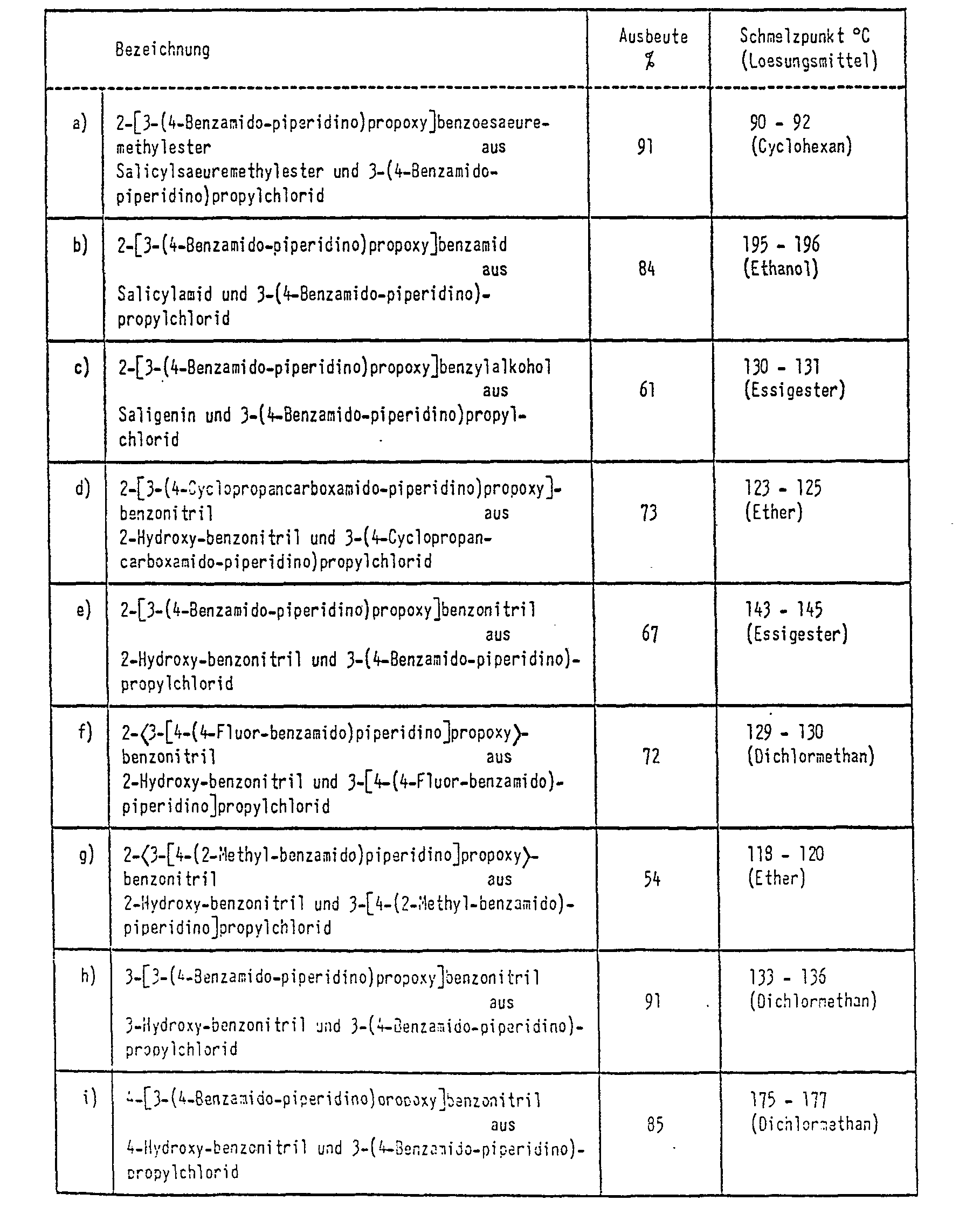
- Eine Mischung aus 7.35 g (0.035 mol) 4-Cyclehexancarboxamidopiperidin, 8.4 g (0.035 mol) 2-(3-Brom-propoxy)benzonitril, 13.9 ml (0.1 mol) Triethylamin und 125 ml Tetrahydrofuran wird 6 Stunden zum Rueckfluss erhitzt, anschliessend in Wasser gegossen, mit Methylenchlorid extrahiert und der Extrakt eingeengt. Es verbleiben 12.4 g 2-[3-(4-Cyclohexancarboxamido-piperidino)-propoxy]benzonitril (97 % d. Th.) vom Schmp. 110 - 112°C.
- In analoger Weise wie in Beispiel 3 beschrieben erhaelt man:

- Zu der Loesung von 11.6 g (0.045 mol) 2-[3-(4-Amino-piperidino)-propoxy]benzonitril (Beispiel 4 b) in 100 ml Methylenchlorid fuegt man 8.4 g Natriumhydrogencarbonat und tropft die Loesung von 9.9 g (0.05 mol) 2-Acetyl-salicylsaeurechlorid zu. Man erwaermt 4 Stunden zum Rueckfluss, giesst in Wasser, extrahiert mit Methylenchlorid und engt den Extrakt ein. Nach Verreiben mit Ether verbleiben 17.0 g 2-<3-[4-(2-dcetoxy-benzamido)-piperidino]propoxy)benzonitril (90 % d. Th.) vom Schmp. 80 - 82°C.
- In analoger Weise wie in Beispiel 5 beschrieben erhaelt man:

- Eine Mischung aus 23.6 g (0.06 mol) 2-[3-(4-Benzamido-piperidino)-propoxy]benzoesaeuremethylester (Beispiel 2 a), 200 ml Ethanol und 200 ml N Natronlauge wird 1 Stunde zum Rueckfluss erhitzt, eingeengt, in Wasser geloest und mit verd. Salzsaeure angesaeuert. Man extrahiert mit einer Mischung aus 9 Teilen Methylenchlorid und 1 Teil Ethanol, engt den Extrakt ein, nimmt den Rueckstand in Aceton auf und faellt mit etherischer Salzsaeure das Hydrochlorid. Es werden 14.5 g 2-[3-(4-Benzamido-piperidino)propoxy]benzoesaeure-Hydrochlorid (59 % d. Th.) vom Schmp. 207 - 208°C erhalten.
- Zu einer Loesung von 5.7 g (0.015 mol) 2-[3-(4-Benzamido- piperidino)propoxy]benzoesaeure (Beispiel 7) in 30 ml N,N-Dimethylformamid gibt man 2.7 g (0.017 mol) N-Carbonyl-diimidazol, ruehrt 1 Stunde bei 100°C, fuegt 1.7 g (0.02 mol) wasserfreies 5-Amino-tetrazol zu, ruehrt 3 Stunden bei 100°C, giesst in Wasser und filtriert. Man erhaelt 3.3 g 2-[3-(4-Benzamido- piperidino)propoxy]benzoesaeure-(1H-tetrazol-5-yl)amid (49 % d. Th.) vom Schmp. 259 - 260°C (aus Ethanol).
- Eine Mischung aus 18.1 g (0.05 mol) 2-[3-(4-Benzamidö-piperidino)-propoxy]benzonitril (Beispiel 2 e), 7.0 g Essigsaeure, 4.5 g (0.07 mol) Natriumazid und 75 ml n-Butanol wird 70 Stunden zum Rueckfluss erhitzt, mit weiteren 1.0 g Natriumazid und 2.0 g Essigsaeure versetzt, weitere 48 Stunden zum Rueckfluss erhitzt, darauf weitgehend eingeengt und filtriert. Man isoliert 15.2 g 5-<2-[3-(4-Benzamido-piperidino)propoxy]phenyl>-1H-tetrazol-Acetat vom Schmp. 260 - 262°C, woraus durch Umsetzung mit verd. Natronlauge und Ansaeuern 10.6 g 5-(2-[3-(4-Benzamido-piperidino)-propoxy]phenyl>-1H-tetrazol (53 % d. Th.) vom Schmp. 275 - 277°C (aus Ethanol) erhalten werden.
- Aus der vorstehenden Verbindung kann durch Neutralisation mit verd. Natronlauge und anschliessende Gefriertrocknung das Natriumsalz erhalten werden; Ausbeute quantitativ, Schmp. 266 - 270°C (amorph).
- In analoger Weise wie in Beispiel 9 beschrieben erhaelt man:

-

- Eine Mischung aus 25.0 g (0.069 mol) 2-[3-(4-Benzamido-piperidino)-propoxy]benzonitril (Beispiel 2 e), 15.9 g (0.15 mol) Natriumcarbonat, 20.7 g (0.30 mol) Hydroxylamin-Hydrochlorid, 125 ml Ethanol und 175 ml Wasser wird 8 Stunden bei 80°C geruehrt, darauf in Wasser gegossen, mit Essigester ausgeruehrt und filtriert. Als Rueckstand verbleiben 20.4 g 2-[3-(4-Benzamido-piperidino)propoxy]-benzamidoxim-Hydrochlorid (68 % d. Th.) vom Schmp. 193 - 194°C.
- Eine Mischung aus 38.0 g (0.088 mol) 2-[3-(4-Benzamido-piperidino)-propoxy]benzamidoxim-Hydrochlorid (Beispiel 11), 500 ml Ethanol und 20 ml Raney-Nickel wird 6 Stunden bei 70°C und 30 bar Wasserstoffdruck hydriert. Nach dem Filtrieren engt man ein, chromatographiert an einer Kieselgelsaeule (Laufmittel: Methylenchlorid / Methanol) und engt die zweite Fraktion ein. Es verbleiben 16.2 g 2-[3-(4-Benzamido-piperidino)propoxy]benzamidin-Hydrochlorid (44 % d. Th.) vom Schmp. 212 - 215°C.
- Eine Mischung aus 7.6 g (0.018 mol) 2-[3-(4-Benzamido-piperidino)-propoxy]benzamidin-Hydrochlorid (Beispiel 12), 4.3 g Ethoxymethylenmalonsaeurediethylester und 100 ml Ethanol wird 2 Stunden zum Rueckfluss erhitzt, eingeengt und der Rueckstand aus Ethanol umkristallisiert. Man erhaelt 6.9 g 2-(2-[3-(4-Benzamido- piperidino)propoxy]phenyl)-4-hydröxy-pyrimidin-5-carbonsaeure- ethylester-Hydrochlorid (70 % d. Th.) vom Schmp. 250 - 252°C.
- In analoger Weise wie in Beispiel 7 beschrieben erhaelt man durch alkalische Verseifung von 2-(2-[3-(4-Benzamido-piperidino)-propoxy]phenyl)-4-hydroxy-pyrimidin-5-carbonsaeureethylester-Hydrochlorid und anschliessendes Neutralisieren die Titelverbindung in 66 % Ausbeute vom Schmp. 145 - 146°C (aus Ethanol).
-

- Die Versuchsanordnung zur Messung des Bronchospasmus entsprach im Prinzip der von KONZETT und RÖSSLER.(1940) in der Modifikation nach COLLIER u.a. (1960). Tieren in mit 40 mg/kg Pentobarbital-Natrium i.p. herbeigeführter Narkose wurde eine Y-Kanüle in die Trachea und eine Venenkanüle in die V. jugularis eingebunden. Eine in die A. carotis eingebundene Kanüle führte zu einer Meßkammer (Statham, P 23 Db), mit welcher der arterielle Druck über eine Gleichspannungsmeßbrücke aufgezeichnet wurde. Mit einer Atempumpe wurde den Ratten ein Luftvolumen von, je nach Größe der Tiere, 1 - 2 ml 64 mal, den Meerschweinchen von 7 - 15 ml 72 mal pro Minute zugeführt. Die Narkose mußte so tief sein, daß eine spontane Gegenatmung nicht auftrat. Beim Auftreten eines Bronchospasmus, ausgelöst durch i.v.-Gabe des Antigens, konnte bei gleichbleibendem Beantmungsvolumen das gesamte angebotene Luftvolumen nicht mehr in die Lunge strömen und floß teilweise durch einen Seitenarm über ein Ventil ab. Die von der Firma BASILE entwickelte Methode weicht infofern von der ursprünglichen von KONZETT und RÖSSLER beschriebenen Methode ab, als dieses Luftvolumen indirekt über die Strömungsgeschwindigkeit mit Hilfe eines Thermoelementes gemessen wird. Die Stärke eines Bronchospasmus konnte dann als prozentuale Abnahme des verfügbaren Bronchialvolumens beschrieben werden. Den theoretisch maximal möglichen Bronchospasmus erhielt man durch Abklemmen des Beatmungsschlauches am Tier, so daß die gesamte zugeführte Luft durch das Ventil abströmte.
- Alle 30 sec wurde durch ein Relais das Ventil für 8 sec geschlossen und das gesamte Volumen in die Lunge gepumpt, um die Bronchen und Alveolen wieder zu entfalten und so einen ausreichenden Gasaustausch zu ermöglichen. Die prozentuale Abnahme des verfügbaren Bronchialvolumens (X) wurde nach folgender Formel errechnet:

- a) = Ausschlag des Schreibers bei Versuchsbeginn in mm.
- b) = Höhe des Ausschlages zu einem bestimmten Zeitpunkt in mm.
- m) = Maximaler Ausschlag in mm nach Abklemmen des Beatmungsschlauches am Tier.
- COLLIER, H.O.J., J.A. HOLGATE, M. SCHACHTER:
- THE BRONCHOCONSTRICTOR ACTION OF BRADYKININ IN THE GUINEA-PIG. Brit. J. Pharmacol. 15, 290 (1960).
- KONZETT, H. und R. RÖSSLER:
- Versuchsanordnung zu Untersuchungen an der Bronchialmuskulatur Naunyn-Schmiedebergs Arch. exp. Path. Pharmak. 195, 71 - 74 (1940).
- Das Antigen war 2 x kristallisiertes Ovalbumin. Gleiche Mengen einer Lösung des Antigens in physiologischer Kochsalzlösung und komplettem Freund'schen Adjuvans wurden emulsiert und 2 x 0,15 ml i.m. bei männlichen Meerschweinchen injiziert. Die Tiere wurden entblutet und das gepoolte Serum bei -20° C aufbewahrt. Zur passiven Sensibilisierung wurden Meerschweinchen 0,5 ml des Antiserum 1 : 50 verdünnt 24 - 48 Stunden vor Auslösen des Bronchospasmus i.v. injiziert.
- (DAVIES und JOHNSON:
- Int. Arch. Allergy 41, 648 - 654 (1971))
- Die erfindungsgemäßen.Verbindungen wurden 5 Minuten vor Zugabe des Antigens i.v. appliziert.
- Die Inhibierung der Bronchospasmen (Br Sp) in % wurden 3 Minuten nach der Antigenzugabe im Vergleich zur Kontrollgruppe bestimmt.
- Inhibierung des Antigen-induzierten Bronchospasmus (Br Sp) in passiv sensibilisierten Meerschweinchen

umsetzt,
Claims (9)

bedeuten,
sowie deren pharmakologisch verträgliche Salze.

bedeuten
sowie deren pharmakologisch verträglichen Salzen, dadurch gekennzeichnet, daß man in an sich bekannter Weise
eine Verbindung der allgemeinen Formel II



anschließend gewünschtenfalls die Gruppe R1 oder die Gruppe -B-R2 durch an sich bekannte Verfahren in eine andere, der obengenannten Bedeutung entsprechende Gruppe R1 oder -B-R2 umwandelt
und das erhaltene Reaktionsprodukt gewünschtenfalls in ein pharmakologisch verträgliches Salz überführt.
Priority Applications (1)
| Application Number | Priority Date | Filing Date | Title |
|---|---|---|---|
| AT80105725T ATE2519T1 (de) | 1979-09-28 | 1980-09-24 | N-phenoxyalkylpiperidin-derivate, verfahren zu deren herstellung sowie diese verbindungen enthaltende arzneimittel. |
Applications Claiming Priority (2)
| Application Number | Priority Date | Filing Date | Title |
|---|---|---|---|
| DE2939292 | 1979-09-28 | ||
| DE19792939292 DE2939292A1 (de) | 1979-09-28 | 1979-09-28 | N-phenoxyalkylpiperidin-derivate, verfahrenn zu deren herstellung sowie diese verbindungen enthaltende arzneimittel |
Publications (2)
| Publication Number | Publication Date |
|---|---|
| EP0026876A1 true EP0026876A1 (de) | 1981-04-15 |
| EP0026876B1 EP0026876B1 (de) | 1983-02-16 |
Family
ID=6082088
Family Applications (1)
| Application Number | Title | Priority Date | Filing Date |
|---|---|---|---|
| EP80105725A Expired EP0026876B1 (de) | 1979-09-28 | 1980-09-24 | N-Phenoxyalkylpiperidin-Derivate, Verfahren zu deren Herstellung sowie diese Verbindungen enthaltende Arzneimittel |
Country Status (10)
| Country | Link |
|---|---|
| US (1) | US4348401A (de) |
| EP (1) | EP0026876B1 (de) |
| JP (1) | JPS5668669A (de) |
| AT (1) | ATE2519T1 (de) |
| CA (1) | CA1139759A (de) |
| CS (1) | CS219950B2 (de) |
| DD (1) | DD153117A5 (de) |
| DE (2) | DE2939292A1 (de) |
| ES (1) | ES495412A0 (de) |
| IL (1) | IL61114A0 (de) |
Cited By (3)
| Publication number | Priority date | Publication date | Assignee | Title |
|---|---|---|---|---|
| EP0088986A3 (en) * | 1982-03-13 | 1983-11-09 | Boehringer Mannheim Gmbh | Bicyclic phenol ethers, process for their preparation and medicines containing these compounds |
| FR2681319A1 (fr) * | 1991-09-12 | 1993-03-19 | Synthelabo | Derives de 1-(phenoxyalkyl)piperidine, leur preparation et leur application en therapeutique. |
| EP1867332A4 (de) * | 2005-04-07 | 2010-01-27 | Toyama Chemical Co Ltd | Pharmazeutische zusammensetzung und verfahren unter verwendung eines antimykotischen mittels in kombination |
Families Citing this family (18)
| Publication number | Priority date | Publication date | Assignee | Title |
|---|---|---|---|---|
| GB9319534D0 (en) * | 1993-09-22 | 1993-11-10 | Boots Co Plc | Therapeutic agents |
| HU215397B (hu) * | 1994-08-29 | 1998-12-28 | Richter Gedeon Vegyészeti Gyár Rt. | (Piperidino-alkil)-aril-éterek, ezeket tartalmazó gyógyszerkészítmények és eljárás ezek előállítására |
| ZA9610741B (en) | 1995-12-22 | 1997-06-24 | Warner Lambert Co | 4-Substituted piperidine analogs and their use as subtype selective nmda receptor antagonists |
| ZA9610736B (en) | 1995-12-22 | 1997-06-27 | Warner Lambert Co | 2-Substituted piperidine analogs and their use as subtypeselective nmda receptor antagonists |
| ZA9610738B (en) | 1995-12-22 | 1997-06-24 | Warner Lambert Co | Subtype selective nmda receptor ligands and the use thereof |
| ZA9610745B (en) * | 1995-12-22 | 1997-06-24 | Warner Lambert Co | 4-Subsituted piperidine analogs and their use as subtype selective nmda receptor antagonists |
| EA007270B1 (ru) * | 2002-03-13 | 2006-08-25 | Янссен Фармацевтика Н.В. | Пиперазинил-, пиперидинил- и морфолинилпроизводные как новые ингибиторы гистондеацетилазы |
| CA2476067C (en) * | 2002-03-13 | 2011-09-20 | Janssen Pharmaceutica N.V. | Carbonylamino-derivatives as novel inhibitors of histone deacetylase |
| ES2306880T3 (es) | 2002-03-13 | 2008-11-16 | Janssen Pharmaceutica Nv | Derivados de sulfonilamino como inhibidores novedosos de la histona desacetilasa. |
| AU2003218737B2 (en) | 2002-03-13 | 2008-04-10 | Janssen Pharmaceutica N.V. | Inhibitors of histone deacetylase |
| PL1781639T3 (pl) * | 2004-07-28 | 2012-07-31 | Janssen Pharmaceutica Nv | Podstawione pochodne indolilo-alkiloaminowe jako nowe inhibitory deacetylazy histonowej |
| AU2006248938B2 (en) | 2005-05-18 | 2011-09-29 | Janssen Pharmaceutica N.V. | Substituted aminopropenyl piperidine or morpholine derivatives as novel inhibitors of histone deacetylase |
| CA2635015C (en) * | 2006-01-19 | 2014-06-03 | Janssen Pharmaceutica N.V. | Substituted indolyl-alkyl-amino-derivatives as inhibitors of histone deacetylase |
| JP5247470B2 (ja) | 2006-01-19 | 2013-07-24 | ジヤンセン・フアーマシユーチカ・ナームローゼ・フエンノートシヤツプ | ヒストンデアセチラーゼのインヒビターとしてのピリジン及びピリミジン誘導体 |
| US8101616B2 (en) * | 2006-01-19 | 2012-01-24 | Janssen Pharmaceutica N.V. | Pyridine and pyrimidine derivatives as inhibitors of histone deacetylase |
| DE602007001190D1 (de) * | 2006-01-19 | 2009-07-09 | Janssen Pharmaceutica Nv | Aminophenylderivate als neue inhibitoren von histondeacetylase |
| AU2007254179B2 (en) | 2006-05-18 | 2013-03-21 | Pharmacyclics Llc | Intracellular kinase inhibitors |
| KR102077864B1 (ko) | 2012-08-01 | 2020-02-14 | 쇼와 덴코 패키징 가부시키가이샤 | 내용물 부착 방지 덮개재 |
Citations (5)
| Publication number | Priority date | Publication date | Assignee | Title |
|---|---|---|---|---|
| GB989568A (en) * | 1962-02-28 | 1965-04-22 | Rhone Poulenc Sa | Piperidine derivatives |
| US3691176A (en) * | 1970-05-25 | 1972-09-12 | Abbott Lab | 1-(4-fluorophenoxypropyl)-4-anilino-piperidines |
| DE2341376A1 (de) * | 1972-08-24 | 1974-03-07 | Ciba Geigy Ag | Piperidin-derivate und verfahren zu ihrer herstellung |
| DE2551235A1 (de) * | 1974-11-15 | 1976-05-20 | Science Union & Cie | Aryloxyalkylpiperidine, verfahren zu ihrer herstellung und diese verbindungen enthaltende arzneimittel |
| DE2737630A1 (de) * | 1977-08-20 | 1979-03-01 | Boehringer Mannheim Gmbh | Neue aminopropanolderivate, verfahren zu ihrer herstellung und diese verbindungen enthaltende arzneimittel |
Family Cites Families (2)
| Publication number | Priority date | Publication date | Assignee | Title |
|---|---|---|---|---|
| US3255196A (en) * | 1966-06-07 | Phenoxyalkyl piperidine derivatives | ||
| US4027028A (en) * | 1975-11-10 | 1977-05-31 | Science Union Et Cie | Arylethers and pharmaceutical compositions |
-
1979
- 1979-09-28 DE DE19792939292 patent/DE2939292A1/de not_active Withdrawn
-
1980
- 1980-09-10 US US06/185,839 patent/US4348401A/en not_active Expired - Lifetime
- 1980-09-23 IL IL61114A patent/IL61114A0/xx unknown
- 1980-09-24 EP EP80105725A patent/EP0026876B1/de not_active Expired
- 1980-09-24 DE DE8080105725T patent/DE3062052D1/de not_active Expired
- 1980-09-24 DD DD80224197A patent/DD153117A5/de unknown
- 1980-09-24 AT AT80105725T patent/ATE2519T1/de not_active IP Right Cessation
- 1980-09-26 JP JP13415080A patent/JPS5668669A/ja active Pending
- 1980-09-26 ES ES495412A patent/ES495412A0/es active Granted
- 1980-09-26 CA CA000361880A patent/CA1139759A/en not_active Expired
- 1980-09-29 CS CS806568A patent/CS219950B2/cs unknown
Patent Citations (5)
| Publication number | Priority date | Publication date | Assignee | Title |
|---|---|---|---|---|
| GB989568A (en) * | 1962-02-28 | 1965-04-22 | Rhone Poulenc Sa | Piperidine derivatives |
| US3691176A (en) * | 1970-05-25 | 1972-09-12 | Abbott Lab | 1-(4-fluorophenoxypropyl)-4-anilino-piperidines |
| DE2341376A1 (de) * | 1972-08-24 | 1974-03-07 | Ciba Geigy Ag | Piperidin-derivate und verfahren zu ihrer herstellung |
| DE2551235A1 (de) * | 1974-11-15 | 1976-05-20 | Science Union & Cie | Aryloxyalkylpiperidine, verfahren zu ihrer herstellung und diese verbindungen enthaltende arzneimittel |
| DE2737630A1 (de) * | 1977-08-20 | 1979-03-01 | Boehringer Mannheim Gmbh | Neue aminopropanolderivate, verfahren zu ihrer herstellung und diese verbindungen enthaltende arzneimittel |
Cited By (4)
| Publication number | Priority date | Publication date | Assignee | Title |
|---|---|---|---|---|
| EP0088986A3 (en) * | 1982-03-13 | 1983-11-09 | Boehringer Mannheim Gmbh | Bicyclic phenol ethers, process for their preparation and medicines containing these compounds |
| FR2681319A1 (fr) * | 1991-09-12 | 1993-03-19 | Synthelabo | Derives de 1-(phenoxyalkyl)piperidine, leur preparation et leur application en therapeutique. |
| EP1867332A4 (de) * | 2005-04-07 | 2010-01-27 | Toyama Chemical Co Ltd | Pharmazeutische zusammensetzung und verfahren unter verwendung eines antimykotischen mittels in kombination |
| US8993603B2 (en) | 2005-04-07 | 2015-03-31 | Toyama Chemical Co., Ltd. | Pharmaceutical composition and method using antifungal agent in combination |
Also Published As
| Publication number | Publication date |
|---|---|
| ES8105729A1 (es) | 1981-06-16 |
| JPS5668669A (en) | 1981-06-09 |
| ES495412A0 (es) | 1981-06-16 |
| CS219950B2 (en) | 1983-03-25 |
| IL61114A0 (en) | 1980-11-30 |
| ATE2519T1 (de) | 1983-03-15 |
| DD153117A5 (de) | 1981-12-23 |
| DE2939292A1 (de) | 1981-04-09 |
| CA1139759A (en) | 1983-01-18 |
| EP0026876B1 (de) | 1983-02-16 |
| US4348401A (en) | 1982-09-07 |
| DE3062052D1 (en) | 1983-03-24 |
Similar Documents
| Publication | Publication Date | Title |
|---|---|---|
| EP0026876B1 (de) | N-Phenoxyalkylpiperidin-Derivate, Verfahren zu deren Herstellung sowie diese Verbindungen enthaltende Arzneimittel | |
| DE2402398C3 (de) | Aromatische Carbonsäureamid-Derivate, Verfahren zu ihrer Herstellung und pharmazeutische Zusammensetzungen | |
| EP0013894B1 (de) | Neue Arylether, Verfahren zu deren Herstellung sowie diese Verbindungen enthaltende Arzneimittel | |
| DE2065636A1 (de) | Neue tricyclische verbindungen | |
| EP0185909B1 (de) | 5-Alkyl-1-phenyl-2-piperazinoalkylpyrazolin-3-on-Verbindungen sowie Verfahren und Zwischenprodukte zu ihrer Herstellung und diese Verbindungen enthaltende Arzneimittel | |
| DE2525226C2 (de) | Oxanilsäure oder Oxanilsäurederivate enthaltende pharmazeutische Mittel, Oxanilsäurederivate und Verfahren zu deren Herstellung | |
| DE3211934A1 (de) | Salicylsaeurederivate, verfahren zu ihrer herstellung, pharmazeutische praeparate auf basis dieser verbindungen und ihre verwendung | |
| DE3813531A1 (de) | Neue 2-aminoalkyl-4-benzyl-1-(2h)-phthalazinon-derivate | |
| EP0171645B1 (de) | Neue 2H-1-Benzopyran-2-on-Derivate, Verfahren zu ihrer Herstellung und Arzneimittel, die diese Verbindungen enthalten | |
| DE1518452C3 (de) | 4 substituierte 2 Benzhydryl 2 butanol Derivate und Verfahren zu ihrer Herstellung | |
| EP0665228B1 (de) | Neue 3-Phenylsulfonyl-3,7-diazabicyclo(3,3,1)nonan-Verbindungen enthaltende Arzneimittel | |
| DE3887463T2 (de) | Durch eine Alkoxy-oder Benzyloxy-Gruppe oder eine Benzylthio-Gruppe substituierte Di-t-butylphenole. | |
| EP0072960B1 (de) | 1,5-Diphenylpyrazolin-3-on-Verbindungen sowie Verfahren und Zwischenprodukte zu ihrer Herstellung und diese Verbindungen enthaltende Arzneimittel | |
| EP0064255A1 (de) | Benzopyranylether, Verfahren zu deren Herstellung sowie diese Verbindungen enthaltende Arzneimittel und Zwischenprodukte | |
| EP0021103B1 (de) | Theophyllin-Derivate, Verfahren zu ihrer Herstellung und diese Verbindungen enthaltende Arzneimittel | |
| DE3882785T2 (de) | Di-t-butylphenylalkyl- und benzyläther. | |
| CH616935A5 (en) | Process for the preparation of chromone derivatives | |
| DE2739380A1 (de) | N-substituierte 2-hydrazono-propionsaeure-derivate, verfahren zur herstellung derselben und arzneimittel, die diese enthalten | |
| DE1695812B2 (de) | Dibenzo [cfl -1,2-thiazepin-derivate, Verfahren zu ihrer Herstellung und sie enthaltende pharmazeutische Zubereitung | |
| EP0071175A2 (de) | Phenylalkyloxirancarbonsäuren, Verfahren zu ihrer Herstellung, ihre Anwendung und sie enthaltende Arzneimittel | |
| EP0289881A2 (de) | Neue 2-Aminoalkyl-4-bennzyl-1-(2H)-phthalazinon-Derivate | |
| EP0088986A2 (de) | Bicyclische Phenolether, Verfahren zu deren Herstellung sowie diese Verbindungen enthaltende Arzneimittel | |
| DE2360355C3 (de) | l-(Cyanophenoxy)-2-hydroxy-3- [2-(5-1HtetrazolyO-chromonyloxy] - propane | |
| DE2062055A1 (de) | Propanolamin Derivate | |
| DE1147946B (de) | Verfahren zur Herstellung von Phenthiazinderivaten und ihren Saeureadditionssalzen |
Legal Events
| Date | Code | Title | Description |
|---|---|---|---|
| PUAI | Public reference made under article 153(3) epc to a published international application that has entered the european phase |
Free format text: ORIGINAL CODE: 0009012 |
|
| 17P | Request for examination filed |
Effective date: 19800924 |
|
| AK | Designated contracting states |
Designated state(s): AT BE CH DE FR GB IT LU NL SE |
|
| ITF | It: translation for a ep patent filed | ||
| GRAA | (expected) grant |
Free format text: ORIGINAL CODE: 0009210 |
|
| AK | Designated contracting states |
Designated state(s): AT BE CH DE FR GB IT LI LU NL SE |
|
| PG25 | Lapsed in a contracting state [announced via postgrant information from national office to epo] |
Ref country code: SE Effective date: 19830216 Ref country code: NL Effective date: 19830216 |
|
| REF | Corresponds to: |
Ref document number: 2519 Country of ref document: AT Date of ref document: 19830315 Kind code of ref document: T |
|
| REF | Corresponds to: |
Ref document number: 3062052 Country of ref document: DE Date of ref document: 19830324 |
|
| ET | Fr: translation filed | ||
| NLV1 | Nl: lapsed or annulled due to failure to fulfill the requirements of art. 29p and 29m of the patents act | ||
| PG25 | Lapsed in a contracting state [announced via postgrant information from national office to epo] |
Ref country code: LU Free format text: LAPSE BECAUSE OF NON-PAYMENT OF DUE FEES Effective date: 19830930 |
|
| PGFP | Annual fee paid to national office [announced via postgrant information from national office to epo] |
Ref country code: FR Payment date: 19840627 Year of fee payment: 5 |
|
| PGFP | Annual fee paid to national office [announced via postgrant information from national office to epo] |
Ref country code: DE Payment date: 19840907 Year of fee payment: 5 |
|
| PGFP | Annual fee paid to national office [announced via postgrant information from national office to epo] |
Ref country code: CH Payment date: 19841001 Year of fee payment: 5 |
|
| PGFP | Annual fee paid to national office [announced via postgrant information from national office to epo] |
Ref country code: BE Payment date: 19841231 Year of fee payment: 5 |
|
| PGFP | Annual fee paid to national office [announced via postgrant information from national office to epo] |
Ref country code: AT Payment date: 19860910 Year of fee payment: 7 |
|
| PG25 | Lapsed in a contracting state [announced via postgrant information from national office to epo] |
Ref country code: AT Effective date: 19870924 |
|
| PG25 | Lapsed in a contracting state [announced via postgrant information from national office to epo] |
Ref country code: LI Effective date: 19870930 Ref country code: CH Effective date: 19870930 Ref country code: BE Effective date: 19870930 |
|
| BERE | Be: lapsed |
Owner name: BOEHRINGER MANNHEIM G.M.B.H. Effective date: 19870930 |
|
| PG25 | Lapsed in a contracting state [announced via postgrant information from national office to epo] |
Ref country code: FR Free format text: LAPSE BECAUSE OF NON-PAYMENT OF DUE FEES Effective date: 19880531 |
|
| REG | Reference to a national code |
Ref country code: CH Ref legal event code: PL |
|
| PG25 | Lapsed in a contracting state [announced via postgrant information from national office to epo] |
Ref country code: DE Effective date: 19880601 |
|
| GBPC | Gb: european patent ceased through non-payment of renewal fee | ||
| REG | Reference to a national code |
Ref country code: FR Ref legal event code: ST |
|
| PG25 | Lapsed in a contracting state [announced via postgrant information from national office to epo] |
Ref country code: GB Free format text: LAPSE BECAUSE OF NON-PAYMENT OF DUE FEES Effective date: 19881118 |
|
| PLBE | No opposition filed within time limit |
Free format text: ORIGINAL CODE: 0009261 |
|
| STAA | Information on the status of an ep patent application or granted ep patent |
Free format text: STATUS: NO OPPOSITION FILED WITHIN TIME LIMIT |