EP0027700A2 - Procédé de séchage par détente pour une solution solvante d'un polymère ou copolymère - Google Patents
Procédé de séchage par détente pour une solution solvante d'un polymère ou copolymère Download PDFInfo
- Publication number
- EP0027700A2 EP0027700A2 EP80303527A EP80303527A EP0027700A2 EP 0027700 A2 EP0027700 A2 EP 0027700A2 EP 80303527 A EP80303527 A EP 80303527A EP 80303527 A EP80303527 A EP 80303527A EP 0027700 A2 EP0027700 A2 EP 0027700A2
- Authority
- EP
- European Patent Office
- Prior art keywords
- copolymer
- pressure
- solvent solution
- polymer
- solvent
- Prior art date
- Legal status (The legal status is an assumption and is not a legal conclusion. Google has not performed a legal analysis and makes no representation as to the accuracy of the status listed.)
- Granted
Links
Images
Classifications
-
- C—CHEMISTRY; METALLURGY
- C08—ORGANIC MACROMOLECULAR COMPOUNDS; THEIR PREPARATION OR CHEMICAL WORKING-UP; COMPOSITIONS BASED THEREON
- C08C—TREATMENT OR CHEMICAL MODIFICATION OF RUBBERS
- C08C2/00—Treatment of rubber solutions
- C08C2/06—Winning of rubber from solutions
-
- C—CHEMISTRY; METALLURGY
- C08—ORGANIC MACROMOLECULAR COMPOUNDS; THEIR PREPARATION OR CHEMICAL WORKING-UP; COMPOSITIONS BASED THEREON
- C08F—MACROMOLECULAR COMPOUNDS OBTAINED BY REACTIONS ONLY INVOLVING CARBON-TO-CARBON UNSATURATED BONDS
- C08F6/00—Post-polymerisation treatments
- C08F6/06—Treatment of polymer solutions
- C08F6/10—Removal of volatile materials, e.g. solvents
Definitions
- This invention relates to an improvement in and relating to a flash-drying process which comprises flashing a solvent solution of a polymer or copolymer maintained at an elevated temperature and pressure into a flashing zone maintained at a lower pressure than the pressure of the solvent solution, thereby evaporating and separating the solvent from the solvent solution.
- the solvent can be evaporated and separated from the solvent solution at an increased ratio of solvent removal by an easy operation without involving troubles such as the thermal degradation and gellation of the polymer or copolymer.
- this invention relates, in a flash-drying process which comprises flashing a solvent solution of a polymer or copolymer maintained at an elevated temperature and pressure into a flashing zone maintained at a lower pressure than the pressure of the solvent solution through a means for releasing said elevated pressure, thereby evaporating and separating the solvent from the solvent solution, to the improvement wherein an inert stripping agent is fed into a flow of the solvent solution at any point between said pressure-releasing means and said flashing zone.
- a flash-drying process which comprises flashing a solvent solution of a polymer or copolymer such as an elastomeric polymer or copolymer or a plastic resin maintained at an elevated temperature and pressure into a flashing zone maintained at a lower pressure than the pressure of the solvent solution through a means for releasing said elevated pressure, for example a pressure-reduction valve, from a flashing nozzle or the like, thereby evaporating and separating the solvent contained from the solvent solution.
- a means for example a pressure-reduction valve from a flashing nozzle or the like
- the ratio of solvent removal attained is at most about 5% by weight. If in an attempt to increase the solvent removal ratio, the temperature of the solvent solution of a polymer or copolymer at an elevated temperature and pressure is increased further, the undesirable termal degradation of the polymer or copolymer and the formation of a gel occur, and the resulting polymer or copolymer cannot be free from contamination.
- the solvent in the case of a solvent solution of an ethylene/propylene/diene copolymer rubber, the solvent can be decreased in content only to about 5 to 7% by weight in order to avoid the trouble of thermal degradation and gel formation, and that in the case of a diene-type rubber such as polyisoprene or polybutadiene, the content of the solvent can be reduced to about 20% by weight at best because such a rubber has lower thermal stability.
- the present inventors made investigations in order to develop an improved process for flash-drying a solvent solution of a polymer or copolymer maintained at an elevated temperature and pressure, which can be performed commercially advantageously by an easy operation at an increased solvent removal ratio without involving troubles such as the thermal degradation of the polymer or copolymer and the formation of a gel.
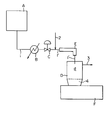
- a solvent solution of a polymer or copolymer sent from a tank..A through a line 1 is heated in a heater B under pressure.
- the solvent solution of a polymer or copolymer which is thus maintained at an elevated temperature and pressure is flashed into a flashing zone d, being under a lower pressure than the pressure of the solvent solution, of a flash-drying device D through a line 1' optionally provided with a heating means E via a means C for releasing the elevated pressure, such as a pressure-reduction valve.
- the solvent in the solvent solution is evaporated and separated.
- the separated solvent vapor is recovered through a line 3.
- the polymer or copolymer 4 is accumulated at the bottom of the flash-drying device D, and recovered.
- an extruder F is fitted to the bottom portion of the flash-drying device D for subsequent polymer processing.
- an inert stripping agent is fed into a flow of the solvent solution at any point between the pressure-releasing means C and the flashing zone d, for example at a point shown by line 2 in the drawing.
- Water is most preferred as the inert stripping agent. Water has the best effect of removing the solvent in the solvent solution. Moreover, use of water has the advantage that the steam which is removed together with the solvent from the flashing zone through line 3 can be easily condensed and separated from the solvent in a device for recovering the solvent.
- the amount of the inert stripping agent fed in the process of this invention can be properly selected depending upon the type of the stripping agent, the type of the solvent solution of a polymer or copolymer, etc.
- the suitable amount of the stripping agent is at least about 5 mole%, preferably at least about 10 mole%, based on the total amount of the solvent in the solvent solution.
- the upper limit may, for example, be about 300 mole%.
- the inert stripping agent is fed after heating.
- the temperature of the heated inert stripping agent is, for example, about 100 to about 250°C. It is especially preferred that the temperature of the stripping agent be equal or close to the temperature of the flow of the solvent solution fed.
- the heating means E which may be optionally provided downstream of the means C in order to maintain the solvent solution of a polymer or copolymer at the desired temperature may be any suitable heating device such as a jacket-type heat exchanger or a multi-tube- type heat exchanger.
- the polymer or copolymer in the solvent solution to be treated by the process of this invention may be any polymer or copolymer such as elastomeric polymers or copolymers or plastic polymer or copolymer resins.
- the process of this invention can be especially favorably applied to a solvent solution of an elastomeric polymer or copolymer, the removal of the solvent from such a solvent solution being especially difficult.
- elastomeric polymers or copolymers examples include ethylene/alpha-olefin copolymer rubbers such as an ethylene/propylene copolymer rubber and an ethylene/butene copolymer rubber; propylene/alpha-olefin rubbers such as a propylene/butene copolymer rubber; ethylene/alpha-olefin/diene copolymer rubbers such as an ethylene/propylene/dicyclopentadiene copolymer rubber and an ethylene/propylene/5-ethylidene-2-norbornene copolymer rubber; diene rubbers such as polyisoprene, polybutadiene, chloroprene rubber, styrene/butadiene rubber (SBR) and acrylonitrile/butadiene rubber (NBR); and butyl rubbery.
- SBR styrene/butadiene rubber
- NBR acrylonitrile/butad
- the solvent which forms the solvent solution of such a polymer or copolymer may, for example, be a hydrocarbon having 4 to 10 carbon atoms.
- the hydrocarbon include aliphatic hydrocarbons such as butane, pentane, hexane, heptane, octane, decane and the linear isomers thereof; alicyclic hydrocarbons such as cyclobutane, cyclopentane, cyclohexane and methylcyclopentane; and aromatic hydrocarbons such as benzene, toluene, xylene, cumene, cymene and ethylbenzene.
- the heater B shown in the attached drawing for maintaining the solvent solution of a polymer or copolymer at an elevated temperature may be any heating device capable of heating the solvent solution in the liquid state under pressure. Heaters of the heat exchanger type are preferred. Heating is done to such an extent that the solvent solution of a polymer or copolymer has a heat energy which permits evaporation of the solvent under the pressure condition of the flashing zone d, that is, under a lower pressure than the pressure of the solvent solution, such as atmospheric pressure to about 5 kg/cm 2 .gauge, when the solvent solution is flashed into the flashing zone d.
- the elevated temperature and pressure are, for example, a temperature of about 100 to about 250°C and a pressure of about 3 to about 40 kg/cm 2 .G.
- the heating temperature may be properly selected depending upon the type of the polymer or copolymer in the solvent solution.
- a temperature of about 130 to about 170 0 C may be cited, and in the case of an ethylene/alpha-olefin/diene copolymer, a temperature of about 150 to about 200°C may be employed.
- the pressure of the solvent solution to be treated may be determined depending upon its temperature which is employed depending upon the type of the solvent solution as stated above.
- the viscosity of the solvent solution is, for example, up to about 10,000 centipoises, preferably about 10 to about 1000 centipoises.
- its residence time must be chosen such that undesirable thermal degradation of the polymer or copolymer may not occur.
- the residence time is up to about 10 minutes.
- the solvent solution of polymer or copolymer is desirably passed through it at a linear velocity of at least about 0.3 meter/sec. in order to prevent contamination of its heat transmitting surface.
- the pressure downstream of the pressure-releasing means is lower than the pressure of the initial solvent solution, for example from atmospheric pressure or a pressure below it to about 5 kg/cm 2 .G, more specifically about atmospheric pressure to about 5 kg/cm 2 .G.
- the temperature downstream of the pressure-releasing means is, for example, about 100 to about 200°C.
- a temperature which may not cause thermal degradation of the polymer or copolymer should be properly chosen.
- this temperature is preferably about 130 to about 170°C, and in the case of an ethylene/alpha-olefin/diene copolymer rubber, it is preferably about 150 to about 200°C.
- a hexane solution of an ethylene/propylene/ dicyclopentadiene copolymer rubber having an ethylene/ propylene molar ratio of 68/32, an iodine value of 12 and a Mooney viscosity (ML1+4, 100°C) of 36 (concentration 90 g/liter) was treated by the process of this invention under the following conditions.
- the polymer which left the exit of the flash drying device had a solvent content of 2.8% by weight.
- Example 2 The same procedure as in Example 1 was repeated except that the feeding of steam was omitted. As a result, the polymer which left the exit of the flash-drying device had a solvent content of 5% by weight.
- the inert stripping agent is fed into the pressure-reduced zone, the solvent can be removed to a greater extent than in the prior art. Moreover, because there is no need to heat the polymer solution to an unduly high temperature, thermal degradation and gellation of the polymer can be prevented.
- the solvent still remaining in a small amount in the polymer can be completely removed by, for example, operating the vent of a vent-type extruder under reduced pressure.
- the process of this invention makes it possible to perform solvent removal of such a solvent solution with a good efficiency without maintaining the heating temperature in a high-pressure zone and the temperature in a lower pressure zone at a high point which may cause thermal degradation of the rubber.
- the apparatus used in performing the process of this invention is compact, and very economical in regard to the site and cost of installation.
Landscapes
- Chemical & Material Sciences (AREA)
- Health & Medical Sciences (AREA)
- Chemical Kinetics & Catalysis (AREA)
- Medicinal Chemistry (AREA)
- Polymers & Plastics (AREA)
- Organic Chemistry (AREA)
- General Chemical & Material Sciences (AREA)
- Addition Polymer Or Copolymer, Post-Treatments, Or Chemical Modifications (AREA)
- Processes Of Treating Macromolecular Substances (AREA)
Applications Claiming Priority (2)
| Application Number | Priority Date | Filing Date | Title |
|---|---|---|---|
| JP13016279A JPS5653104A (en) | 1979-10-09 | 1979-10-09 | Separation of polymer from polymer solution |
| JP130162/79 | 1979-10-09 |
Publications (4)
| Publication Number | Publication Date |
|---|---|
| EP0027700A2 true EP0027700A2 (fr) | 1981-04-29 |
| EP0027700A3 EP0027700A3 (en) | 1981-05-27 |
| EP0027700B1 EP0027700B1 (fr) | 1984-01-25 |
| EP0027700B2 EP0027700B2 (fr) | 1990-05-02 |
Family
ID=15027481
Family Applications (1)
| Application Number | Title | Priority Date | Filing Date |
|---|---|---|---|
| EP80303527A Expired EP0027700B2 (fr) | 1979-10-09 | 1980-10-07 | Procédé de séchage par détente pour une solution solvante d'un polymère ou copolymère |
Country Status (5)
| Country | Link |
|---|---|
| US (1) | US4906329A (fr) |
| EP (1) | EP0027700B2 (fr) |
| JP (1) | JPS5653104A (fr) |
| CA (1) | CA1180845A (fr) |
| DE (1) | DE3066299D1 (fr) |
Cited By (13)
| Publication number | Priority date | Publication date | Assignee | Title |
|---|---|---|---|---|
| US4686279A (en) * | 1982-08-21 | 1987-08-11 | Stamicarbon B.V. | Device and process for recovering polymer from a solution |
| EP0262594A3 (en) * | 1986-10-01 | 1989-11-15 | Polysar Limited | Polymer recovery from solution |
| DE4201046A1 (de) * | 1992-01-17 | 1993-07-22 | Bayer Ag | Verfahren zur reinigung von polymerloesungen |
| EP0768157A1 (fr) * | 1995-10-05 | 1997-04-16 | Bayer Ag | Procédé pour sécher des agglomérats et poudres de polymère |
| EP0768155A1 (fr) * | 1995-10-05 | 1997-04-16 | Bayer Ag | Procédé de fabrication de granulés de matière thermoplastique à partir de solutions de polymères |
| EP1178055A3 (fr) * | 2000-06-22 | 2003-01-29 | JSR Corporation | Procédé pour récupérer un polymère à partir d'une solution |
| EP2255947A1 (fr) | 2009-05-30 | 2010-12-01 | Bayer MaterialScience AG | Dispositif et procédé de mélange de masses fondues polymères dotées d'additifs |
| EP2256146A1 (fr) | 2009-05-30 | 2010-12-01 | Bayer MaterialScience AG | Polycarbonate doté d'une pureté extrêmement élevée, d'une couleur propre correcte et d'une résistance thermique ainsi que dispositif et procédé destinés à sa fabrication |
| EP2255860A1 (fr) | 2009-05-30 | 2010-12-01 | Bayer MaterialScience AG | Dispositif et procédé de dégazage de solutions de polycarbonate contenant des solvants |
| EP2255859A1 (fr) | 2009-05-30 | 2010-12-01 | Bayer MaterialScience AG | Dispositif et procédé de dégazage de solutions de polycarbonate contenant une solution |
| US10570224B2 (en) | 2016-04-15 | 2020-02-25 | Exxonmobil Chemical Patents Inc. | Polymerization using a stripping agent for devolatilization |
| WO2022090526A1 (fr) | 2020-11-02 | 2022-05-05 | Röhm Gmbh | Dispositif de dégazage d'un matériau polymère-monomère multiphase à deux composants et son utilisation dans une extrudeuse de dégazage |
| DE102023115797A1 (de) | 2022-06-29 | 2024-01-04 | Röhm Gmbh | Verbessertes Verfahren zur Herstellung eines Polymers |
Families Citing this family (28)
| Publication number | Priority date | Publication date | Assignee | Title |
|---|---|---|---|---|
| JPS57139107A (en) * | 1981-02-23 | 1982-08-27 | Sumitomo Chem Co Ltd | Separation treatment of copolymer |
| DE3642106A1 (de) * | 1986-12-10 | 1988-06-16 | Bayer Ag | Verfahren zur herstellung von polymerisatpulvern durch zerstaeubungstrocknung |
| US5011819A (en) * | 1988-06-02 | 1991-04-30 | Hewlett-Packard Company | Process using supercritical conditions for producing highly accurate and homogeneous powder mixture useful in fabrication of high quality ceramic superconductors |
| US5037955A (en) * | 1990-06-07 | 1991-08-06 | The Dow Chemical Company | Method for heating a viscous polyethylene solution |
| US5314579A (en) * | 1992-01-13 | 1994-05-24 | Quantum Chemical Corporation | Process for removing hydrocarbons from polymer slurries |
| AU705006B2 (en) * | 1993-09-24 | 1999-05-13 | Chemithon Corporation, The | Solvent removal process |
| ZA945188B (en) * | 1993-09-24 | 1995-03-10 | Chemithon Corp | Process for removal of solvents from detergent pastes. |
| US5723433A (en) * | 1993-09-24 | 1998-03-03 | The Chemithon Corporation | Sovent removal process |
| US6058623A (en) * | 1993-09-24 | 2000-05-09 | The Chemithon Corporation | Apparatus and process for removing volatile components from a composition |
| US5708133A (en) * | 1993-11-09 | 1998-01-13 | Mitsubishi Gas Chemical Company, Inc. | Process for purifying polymer |
| SI9400079B (sl) * | 1994-02-15 | 2003-02-28 | Dr. Weidner Eckhard, Dipl. Ing. | Postopek in naprava za pridobivanje in frakcioniranje majhnih delcev iz raztopin nasičenih s plinom |
| IT1276070B1 (it) * | 1995-10-31 | 1997-10-24 | Siac It Additivi Carburanti | Processo per la preparazione di polimeri a base di etilene a basso peso molecolare |
| US5861474A (en) * | 1996-07-23 | 1999-01-19 | The Dow Chemical Company | Polymer devolatilization |
| US6051682A (en) * | 1996-12-23 | 2000-04-18 | E. I. Du Pont De Nemours And Company | Polymerization of fluoropolymers in carbon dioxide |
| KR100446572B1 (ko) * | 1997-10-31 | 2004-09-04 | 미쯔비시 레이온 가부시끼가이샤 | 토너용 결합제 수지 및 이의 제조방법 |
| US6420516B1 (en) * | 1997-12-23 | 2002-07-16 | The Dow Chemical Company | Finishing design to increase the polymer content in an olefin solution polymerization process |
| US6348636B1 (en) | 1999-12-20 | 2002-02-19 | Basf Corporation | Purification of polymeric dispersions by stripping in the presence of adsorbent materials |
| JP4830215B2 (ja) * | 2000-06-22 | 2011-12-07 | Jsr株式会社 | ポリマーの回収方法 |
| JP4912524B2 (ja) * | 2000-08-23 | 2012-04-11 | 電気化学工業株式会社 | 連続中和方法およびその装置 |
| DE10357183A1 (de) | 2003-12-06 | 2005-06-30 | Bayer Materialscience Ag | Vorrichtung und Verfahren zum Ausdampfen von Monomeren und anderen flüchtigen Bestandteilen aus Polymerschmelzen |
| AU2007221882A1 (en) * | 2006-10-30 | 2008-05-15 | Rohm And Haas Company | Process for stripping polymer dispersions |
| JP2008150418A (ja) * | 2006-12-14 | 2008-07-03 | Dic Corp | ポリエステルポリオールの精製方法 |
| GB0818093D0 (en) * | 2008-10-02 | 2008-11-05 | Weyland As | Method |
| GB0819406D0 (en) | 2008-10-22 | 2008-11-26 | Weyland As | Process |
| EP2368916B1 (fr) * | 2010-03-25 | 2012-08-22 | LANXESS International SA | Processus pour la production d'eau et de caoutchoucs de nitrile sans solvant |
| EP2368917B1 (fr) * | 2010-03-25 | 2013-01-09 | LANXESS International SA | Processus pour la production d'eau et de caoutchoucs de nitrile hydrogéné sans solvant |
| US10730032B2 (en) | 2018-05-16 | 2020-08-04 | Chevron Phillips Chemical Company Lp | Polymer flake degassing system and methods |
| CN110860101B (zh) * | 2019-12-11 | 2024-02-13 | 淄博鲁华泓锦新材料集团股份有限公司 | 脱除聚异戊二烯胶乳中有机溶剂的方法 |
Family Cites Families (10)
| Publication number | Priority date | Publication date | Assignee | Title |
|---|---|---|---|---|
| US3197453A (en) * | 1961-07-11 | 1965-07-27 | Phillips Petroleum Co | Process for purifying monomer feeds for polymerization processes |
| US3195613A (en) * | 1961-10-09 | 1965-07-20 | Phillips Petroleum Co | Method for continuously discharging the contents of a pressurized vessel |
| US3262922A (en) * | 1963-02-08 | 1966-07-26 | Phillips Petroleum Co | Polymerization process |
| US3586089A (en) * | 1967-05-02 | 1971-06-22 | Mitsui Petrochemical Ind | Method and apparatus for separating and drying organic high molecular weight substances |
| US3605872A (en) * | 1968-08-15 | 1971-09-20 | Wiegand Apparatebau Gmbh | Method of causing a liquid to flow in a stream of annular cross section |
| US3683511A (en) * | 1970-09-04 | 1972-08-15 | Firestone Tire & Rubber Co | Method of removing volatiles from an elastomer |
| US3956060A (en) * | 1971-12-30 | 1976-05-11 | Phillips Petroleum Company | Removal of reaction diluent from poly(arylene sulfide) reaction slurry |
| US3941664A (en) * | 1972-08-29 | 1976-03-02 | Phillips Petroleum Company | Control for diluent removal from poly(arylene sulfide) reactor product |
| GB1590532A (en) * | 1976-08-04 | 1981-06-03 | Exxon Research Engineering Co | Elastomer extrusion drying with gas injection |
| DE2719968C2 (de) * | 1977-05-04 | 1987-01-15 | Bayer Ag, 5090 Leverkusen | Verfahren zur Entfernung von Restbestandteilen |
-
1979
- 1979-10-09 JP JP13016279A patent/JPS5653104A/ja active Granted
-
1980
- 1980-10-07 DE DE8080303527T patent/DE3066299D1/de not_active Expired
- 1980-10-07 EP EP80303527A patent/EP0027700B2/fr not_active Expired
- 1980-10-08 CA CA000361855A patent/CA1180845A/fr not_active Expired
-
1987
- 1987-06-16 US US07/062,423 patent/US4906329A/en not_active Expired - Lifetime
Cited By (21)
| Publication number | Priority date | Publication date | Assignee | Title |
|---|---|---|---|---|
| US4686279A (en) * | 1982-08-21 | 1987-08-11 | Stamicarbon B.V. | Device and process for recovering polymer from a solution |
| EP0262594A3 (en) * | 1986-10-01 | 1989-11-15 | Polysar Limited | Polymer recovery from solution |
| DE4201046A1 (de) * | 1992-01-17 | 1993-07-22 | Bayer Ag | Verfahren zur reinigung von polymerloesungen |
| EP0768157A1 (fr) * | 1995-10-05 | 1997-04-16 | Bayer Ag | Procédé pour sécher des agglomérats et poudres de polymère |
| EP0768155A1 (fr) * | 1995-10-05 | 1997-04-16 | Bayer Ag | Procédé de fabrication de granulés de matière thermoplastique à partir de solutions de polymères |
| US5684087A (en) * | 1995-10-05 | 1997-11-04 | Bayer Aktiengesellschaft | Process for producing thermoplastic granulated polymer material from polymer solutions |
| US5786445A (en) * | 1995-10-05 | 1998-07-28 | Bayer Aktiengesellschaft | Process for drying polymeric powders and polymeric agglomerates |
| EP1178055A3 (fr) * | 2000-06-22 | 2003-01-29 | JSR Corporation | Procédé pour récupérer un polymère à partir d'une solution |
| EP2255947A1 (fr) | 2009-05-30 | 2010-12-01 | Bayer MaterialScience AG | Dispositif et procédé de mélange de masses fondues polymères dotées d'additifs |
| EP2256146A1 (fr) | 2009-05-30 | 2010-12-01 | Bayer MaterialScience AG | Polycarbonate doté d'une pureté extrêmement élevée, d'une couleur propre correcte et d'une résistance thermique ainsi que dispositif et procédé destinés à sa fabrication |
| EP2255860A1 (fr) | 2009-05-30 | 2010-12-01 | Bayer MaterialScience AG | Dispositif et procédé de dégazage de solutions de polycarbonate contenant des solvants |
| EP2255859A1 (fr) | 2009-05-30 | 2010-12-01 | Bayer MaterialScience AG | Dispositif et procédé de dégazage de solutions de polycarbonate contenant une solution |
| WO2010139414A1 (fr) | 2009-05-30 | 2010-12-09 | Bayer Materialscience Ag | Dispositif et procédé de dégazage de solutions de polycarbonates contenant des solvants |
| US8383757B2 (en) | 2009-05-30 | 2013-02-26 | Bayer Materialscience Ag | Device and method for degassing solvent-containing polycarbonate solutions |
| US8497345B2 (en) | 2009-05-30 | 2013-07-30 | Bayer Intellectual Property Gmbh | Device and method for degassing solvent-containing polycarbonate solutions |
| DE202010018508U1 (de) | 2009-05-30 | 2017-03-16 | Covestro Deutschland Ag | Polycarbonate mit extrem hoher Reinheit und guter Eigenfarbe und thermischer Beständigkeit sowie eine Vorrichtung zu ihrer Herstellung |
| US9828464B2 (en) | 2009-05-30 | 2017-11-28 | Covestro Deutschland Ag | Ultra-high purity polycarbonates having good inherent color and thermal resistance and a device and a method for producing the same |
| US10435507B2 (en) | 2009-05-30 | 2019-10-08 | Covestro Deutschland Ag | Ultra-high purity polycarbonates having good inherent color and thermal resistance and a device and a method for producing the same |
| US10570224B2 (en) | 2016-04-15 | 2020-02-25 | Exxonmobil Chemical Patents Inc. | Polymerization using a stripping agent for devolatilization |
| WO2022090526A1 (fr) | 2020-11-02 | 2022-05-05 | Röhm Gmbh | Dispositif de dégazage d'un matériau polymère-monomère multiphase à deux composants et son utilisation dans une extrudeuse de dégazage |
| DE102023115797A1 (de) | 2022-06-29 | 2024-01-04 | Röhm Gmbh | Verbessertes Verfahren zur Herstellung eines Polymers |
Also Published As
| Publication number | Publication date |
|---|---|
| JPS63442B2 (fr) | 1988-01-07 |
| JPS5653104A (en) | 1981-05-12 |
| US4906329A (en) | 1990-03-06 |
| CA1180845A (fr) | 1985-01-08 |
| EP0027700B2 (fr) | 1990-05-02 |
| DE3066299D1 (en) | 1984-03-01 |
| EP0027700A3 (en) | 1981-05-27 |
| EP0027700B1 (fr) | 1984-01-25 |
Similar Documents
| Publication | Publication Date | Title |
|---|---|---|
| US4906329A (en) | Flash-drying process for a solvent solution of a polymer or copolymer | |
| US4271060A (en) | Solution polymerization process | |
| US3320220A (en) | Process for separating elastomeric homopolymers and copolymers from solutions thereof | |
| US4313016A (en) | Isobutene removal from C4 streams | |
| CS199229B2 (en) | Method of obtaining polymers | |
| KR20110070877A (ko) | 무수 무용매 중합체의 제조 방법 | |
| JPH0119803B2 (fr) | ||
| US4319021A (en) | Method for high temperature phase separation of solutions containing ethylene copolymer elastomers | |
| CN107250176B (zh) | 用于从聚合物中分离烃的方法 | |
| US3036057A (en) | Flash concentration of solutions containing polyolefins | |
| US3202647A (en) | Elastomer recovery process | |
| US3287301A (en) | Recovery of olefin polymers from solutions thereof | |
| CN111699202A (zh) | 一种回收溶液聚合过程中的烯烃的方法 | |
| US4406750A (en) | Solvent removal from polymer solution utilizing flashed vapor as a heat source | |
| US4408039A (en) | Separation of polymer of conjugated diene from a solution polymerization solvent using prestripping step | |
| US4278506A (en) | Polymer solution purification | |
| KR960003931B1 (ko) | 중합체 용액내의 용매 제거 방법 | |
| CN111295397B (zh) | 一种在溶液聚合过程中回收烯烃的方法 | |
| US3436436A (en) | Method for separation of conjugated diolefin by back wash in extractive distillation | |
| US2969347A (en) | Recovery of olefin polymers from solution | |
| US3505300A (en) | Method of refining resins | |
| US3257349A (en) | Purifying recycle streams in integrated process for preparing halogenated butyl rubber and butyl rubber latex | |
| US20040151642A1 (en) | Process for producing polyolefins | |
| EP0184935A2 (fr) | Procédé de séparation de phase à haute température d'une solution de polymère | |
| US3886109A (en) | Process for preparing a latex of a rubbery polymer from a solution of this polymer in an organic solvent |
Legal Events
| Date | Code | Title | Description |
|---|---|---|---|
| PUAI | Public reference made under article 153(3) epc to a published international application that has entered the european phase |
Free format text: ORIGINAL CODE: 0009012 |
|
| PUAL | Search report despatched |
Free format text: ORIGINAL CODE: 0009013 |
|
| AK | Designated contracting states |
Designated state(s): DE FR GB IT NL |
|
| AK | Designated contracting states |
Designated state(s): DE FR GB IT NL |
|
| 17P | Request for examination filed |
Effective date: 19810923 |
|
| ITF | It: translation for a ep patent filed | ||
| GRAA | (expected) grant |
Free format text: ORIGINAL CODE: 0009210 |
|
| AK | Designated contracting states |
Designated state(s): DE FR GB IT NL |
|
| REF | Corresponds to: |
Ref document number: 3066299 Country of ref document: DE Date of ref document: 19840301 |
|
| ET | Fr: translation filed | ||
| PLBI | Opposition filed |
Free format text: ORIGINAL CODE: 0009260 |
|
| 26 | Opposition filed |
Opponent name: BAYER AG, LEVERKUSEN KONZERNVERWALTUNG RP PATENTAB Effective date: 19841022 |
|
| PUAH | Patent maintained in amended form |
Free format text: ORIGINAL CODE: 0009272 |
|
| STAA | Information on the status of an ep patent application or granted ep patent |
Free format text: STATUS: PATENT MAINTAINED AS AMENDED |
|
| 27A | Patent maintained in amended form |
Effective date: 19900502 |
|
| AK | Designated contracting states |
Kind code of ref document: B2 Designated state(s): DE FR GB IT NL |
|
| ITF | It: translation for a ep patent filed | ||
| ET3 | Fr: translation filed ** decision concerning opposition | ||
| NLR2 | Nl: decision of opposition | ||
| NLR3 | Nl: receipt of modified translations in the netherlands language after an opposition procedure | ||
| ITTA | It: last paid annual fee | ||
| REG | Reference to a national code |
Ref country code: FR Ref legal event code: CD |
|
| NLT1 | Nl: modifications of names registered in virtue of documents presented to the patent office pursuant to art. 16 a, paragraph 1 |
Owner name: MITSUI CHEMICALS, INC. |
|
| PGFP | Annual fee paid to national office [announced via postgrant information from national office to epo] |
Ref country code: GB Payment date: 19991006 Year of fee payment: 20 |
|
| PGFP | Annual fee paid to national office [announced via postgrant information from national office to epo] |
Ref country code: DE Payment date: 19991008 Year of fee payment: 20 |
|
| PGFP | Annual fee paid to national office [announced via postgrant information from national office to epo] |
Ref country code: FR Payment date: 19991011 Year of fee payment: 20 |
|
| PGFP | Annual fee paid to national office [announced via postgrant information from national office to epo] |
Ref country code: NL Payment date: 19991029 Year of fee payment: 20 |
|
| PG25 | Lapsed in a contracting state [announced via postgrant information from national office to epo] |
Ref country code: GB Free format text: LAPSE BECAUSE OF EXPIRATION OF PROTECTION Effective date: 20001006 |
|
| PG25 | Lapsed in a contracting state [announced via postgrant information from national office to epo] |
Ref country code: NL Free format text: LAPSE BECAUSE OF EXPIRATION OF PROTECTION Effective date: 20001007 |
|
| REG | Reference to a national code |
Ref country code: GB Ref legal event code: PE20 Effective date: 20001006 |
|
| NLV7 | Nl: ceased due to reaching the maximum lifetime of a patent |
Effective date: 20001007 |