EP0028030B1 - Verfahren zum Stabilisieren von Polyarylaten mit einem aromatischen Phenol - Google Patents
Verfahren zum Stabilisieren von Polyarylaten mit einem aromatischen Phenol Download PDFInfo
- Publication number
- EP0028030B1 EP0028030B1 EP80106608A EP80106608A EP0028030B1 EP 0028030 B1 EP0028030 B1 EP 0028030B1 EP 80106608 A EP80106608 A EP 80106608A EP 80106608 A EP80106608 A EP 80106608A EP 0028030 B1 EP0028030 B1 EP 0028030B1
- Authority
- EP
- European Patent Office
- Prior art keywords
- polyarylate
- carbon atoms
- aromatic
- phenol
- reduced viscosity
- Prior art date
- Legal status (The legal status is an assumption and is not a legal conclusion. Google has not performed a legal analysis and makes no representation as to the accuracy of the status listed.)
- Expired
Links
- 229920001230 polyarylate Polymers 0.000 title claims abstract description 60
- ISWSIDIOOBJBQZ-UHFFFAOYSA-N Phenol Chemical compound OC1=CC=CC=C1 ISWSIDIOOBJBQZ-UHFFFAOYSA-N 0.000 title claims abstract description 59
- 125000003118 aryl group Chemical group 0.000 title claims abstract description 55
- 230000000087 stabilizing effect Effects 0.000 title claims abstract description 10
- 238000000034 method Methods 0.000 title claims description 42
- 230000008569 process Effects 0.000 title claims description 32
- OFOBLEOULBTSOW-UHFFFAOYSA-N Malonic acid Chemical compound OC(=O)CC(O)=O OFOBLEOULBTSOW-UHFFFAOYSA-N 0.000 claims abstract description 21
- 150000005690 diesters Chemical class 0.000 claims abstract description 19
- 238000004519 manufacturing process Methods 0.000 claims abstract description 5
- 125000004432 carbon atom Chemical group C* 0.000 claims description 39
- 238000006243 chemical reaction Methods 0.000 claims description 23
- 239000002904 solvent Substances 0.000 claims description 18
- USIUVYZYUHIAEV-UHFFFAOYSA-N diphenyl ether Chemical compound C=1C=CC=CC=1OC1=CC=CC=C1 USIUVYZYUHIAEV-UHFFFAOYSA-N 0.000 claims description 17
- 125000002887 hydroxy group Chemical group [H]O* 0.000 claims description 15
- 125000000217 alkyl group Chemical group 0.000 claims description 14
- 239000000203 mixture Substances 0.000 claims description 14
- KKEYFWRCBNTPAC-UHFFFAOYSA-N Terephthalic acid Chemical compound OC(=O)C1=CC=C(C(O)=O)C=C1 KKEYFWRCBNTPAC-UHFFFAOYSA-N 0.000 claims description 12
- QQVIHTHCMHWDBS-UHFFFAOYSA-N isophthalic acid Chemical compound OC(=O)C1=CC=CC(C(O)=O)=C1 QQVIHTHCMHWDBS-UHFFFAOYSA-N 0.000 claims description 12
- -1 magnesium acetate Chemical class 0.000 claims description 11
- 125000001424 substituent group Chemical group 0.000 claims description 10
- UHOVQNZJYSORNB-UHFFFAOYSA-N Benzene Chemical compound C1=CC=CC=C1 UHOVQNZJYSORNB-UHFFFAOYSA-N 0.000 claims description 9
- 239000003054 catalyst Substances 0.000 claims description 9
- WFDIJRYMOXRFFG-UHFFFAOYSA-N Acetic anhydride Chemical group CC(=O)OC(C)=O WFDIJRYMOXRFFG-UHFFFAOYSA-N 0.000 claims description 6
- 150000008065 acid anhydrides Chemical class 0.000 claims description 6
- YXVFYQXJAXKLAK-UHFFFAOYSA-N biphenyl-4-ol Chemical compound C1=CC(O)=CC=C1C1=CC=CC=C1 YXVFYQXJAXKLAK-UHFFFAOYSA-N 0.000 claims description 6
- 125000000753 cycloalkyl group Chemical group 0.000 claims description 6
- WKBOTKDWSSQWDR-UHFFFAOYSA-N Bromine atom Chemical compound [Br] WKBOTKDWSSQWDR-UHFFFAOYSA-N 0.000 claims description 5
- ZAMOUSCENKQFHK-UHFFFAOYSA-N Chlorine atom Chemical compound [Cl] ZAMOUSCENKQFHK-UHFFFAOYSA-N 0.000 claims description 5
- GDTBXPJZTBHREO-UHFFFAOYSA-N bromine Substances BrBr GDTBXPJZTBHREO-UHFFFAOYSA-N 0.000 claims description 5
- 229910052794 bromium Inorganic materials 0.000 claims description 5
- 239000000460 chlorine Substances 0.000 claims description 5
- 229910052801 chlorine Inorganic materials 0.000 claims description 5
- 239000000155 melt Substances 0.000 claims description 5
- KVNYFPKFSJIPBJ-UHFFFAOYSA-N 1,2-diethylbenzene Chemical compound CCC1=CC=CC=C1CC KVNYFPKFSJIPBJ-UHFFFAOYSA-N 0.000 claims description 4
- NPFYZDNDJHZQKY-UHFFFAOYSA-N 4-Hydroxybenzophenone Chemical compound C1=CC(O)=CC=C1C(=O)C1=CC=CC=C1 NPFYZDNDJHZQKY-UHFFFAOYSA-N 0.000 claims description 4
- FYYHWMGAXLPEAU-UHFFFAOYSA-N Magnesium Chemical compound [Mg] FYYHWMGAXLPEAU-UHFFFAOYSA-N 0.000 claims description 4
- 239000002253 acid Substances 0.000 claims description 4
- 150000001491 aromatic compounds Chemical class 0.000 claims description 4
- RWGFKTVRMDUZSP-UHFFFAOYSA-N cumene Chemical compound CC(C)C1=CC=CC=C1 RWGFKTVRMDUZSP-UHFFFAOYSA-N 0.000 claims description 4
- 125000002993 cycloalkylene group Chemical group 0.000 claims description 4
- NNBZCPXTIHJBJL-UHFFFAOYSA-N decalin Chemical compound C1CCCC2CCCCC21 NNBZCPXTIHJBJL-UHFFFAOYSA-N 0.000 claims description 4
- 150000002390 heteroarenes Chemical class 0.000 claims description 4
- 125000004435 hydrogen atom Chemical group [H]* 0.000 claims description 4
- 239000011777 magnesium Substances 0.000 claims description 4
- 229910052749 magnesium Inorganic materials 0.000 claims description 4
- 150000007524 organic acids Chemical class 0.000 claims description 4
- 229920006395 saturated elastomer Polymers 0.000 claims description 3
- 239000004695 Polyether sulfone Substances 0.000 claims description 2
- 125000001743 benzylic group Chemical group 0.000 claims description 2
- UEGPKNKPLBYCNK-UHFFFAOYSA-L magnesium acetate Chemical compound [Mg+2].CC([O-])=O.CC([O-])=O UEGPKNKPLBYCNK-UHFFFAOYSA-L 0.000 claims description 2
- 239000011654 magnesium acetate Substances 0.000 claims description 2
- 229940069446 magnesium acetate Drugs 0.000 claims description 2
- 235000011285 magnesium acetate Nutrition 0.000 claims description 2
- 239000000395 magnesium oxide Substances 0.000 claims description 2
- CPLXHLVBOLITMK-UHFFFAOYSA-N magnesium oxide Inorganic materials [Mg]=O CPLXHLVBOLITMK-UHFFFAOYSA-N 0.000 claims description 2
- AXZKOIWUVFPNLO-UHFFFAOYSA-N magnesium;oxygen(2-) Chemical compound [O-2].[Mg+2] AXZKOIWUVFPNLO-UHFFFAOYSA-N 0.000 claims description 2
- 150000007522 mineralic acids Chemical class 0.000 claims description 2
- QBDSZLJBMIMQRS-UHFFFAOYSA-N p-Cumylphenol Chemical compound C=1C=C(O)C=CC=1C(C)(C)C1=CC=CC=C1 QBDSZLJBMIMQRS-UHFFFAOYSA-N 0.000 claims description 2
- NKTOLZVEWDHZMU-UHFFFAOYSA-N p-cumyl phenol Natural products CC1=CC=C(C)C(O)=C1 NKTOLZVEWDHZMU-UHFFFAOYSA-N 0.000 claims description 2
- 229920002492 poly(sulfone) Polymers 0.000 claims description 2
- 229920006393 polyether sulfone Polymers 0.000 claims description 2
- 239000007858 starting material Substances 0.000 claims description 2
- 239000008096 xylene Substances 0.000 claims description 2
- 150000003738 xylenes Chemical class 0.000 claims description 2
- 150000003751 zinc Chemical class 0.000 claims description 2
- 238000010438 heat treatment Methods 0.000 claims 1
- 229930195734 saturated hydrocarbon Natural products 0.000 claims 1
- 150000008064 anhydrides Chemical class 0.000 abstract description 12
- 229920000642 polymer Polymers 0.000 description 35
- IJGRMHOSHXDMSA-UHFFFAOYSA-N Atomic nitrogen Chemical compound N#N IJGRMHOSHXDMSA-UHFFFAOYSA-N 0.000 description 16
- HEDRZPFGACZZDS-UHFFFAOYSA-N Chloroform Chemical compound ClC(Cl)Cl HEDRZPFGACZZDS-UHFFFAOYSA-N 0.000 description 16
- 238000006116 polymerization reaction Methods 0.000 description 16
- 230000000052 comparative effect Effects 0.000 description 13
- QTBSBXVTEAMEQO-UHFFFAOYSA-N Acetic acid Chemical compound CC(O)=O QTBSBXVTEAMEQO-UHFFFAOYSA-N 0.000 description 9
- IISBACLAFKSPIT-UHFFFAOYSA-N bisphenol A Chemical compound C=1C=C(O)C=CC=1C(C)(C)C1=CC=C(O)C=C1 IISBACLAFKSPIT-UHFFFAOYSA-N 0.000 description 8
- 229910052757 nitrogen Inorganic materials 0.000 description 8
- 125000002947 alkylene group Chemical group 0.000 description 5
- 150000001875 compounds Chemical class 0.000 description 5
- UFWIBTONFRDIAS-UHFFFAOYSA-N Naphthalene Chemical compound C1=CC=CC2=CC=CC=C21 UFWIBTONFRDIAS-UHFFFAOYSA-N 0.000 description 4
- AREMQPPGVQNRIE-UHFFFAOYSA-N acetic acid;4-[2-(4-hydroxyphenyl)propan-2-yl]phenol Chemical compound CC(O)=O.CC(O)=O.C=1C=C(O)C=CC=1C(C)(C)C1=CC=C(O)C=C1 AREMQPPGVQNRIE-UHFFFAOYSA-N 0.000 description 4
- MWPLVEDNUUSJAV-UHFFFAOYSA-N anthracene Chemical compound C1=CC=CC2=CC3=CC=CC=C3C=C21 MWPLVEDNUUSJAV-UHFFFAOYSA-N 0.000 description 4
- 125000000732 arylene group Chemical group 0.000 description 4
- 229920000728 polyester Polymers 0.000 description 4
- 150000003504 terephthalic acids Chemical class 0.000 description 4
- 229910052799 carbon Inorganic materials 0.000 description 3
- 239000007795 chemical reaction product Substances 0.000 description 3
- 230000032050 esterification Effects 0.000 description 3
- 238000005886 esterification reaction Methods 0.000 description 3
- 150000002531 isophthalic acids Chemical class 0.000 description 3
- 150000002989 phenols Chemical class 0.000 description 3
- 238000002360 preparation method Methods 0.000 description 3
- 239000011541 reaction mixture Substances 0.000 description 3
- 239000003381 stabilizer Substances 0.000 description 3
- QPFMBZIOSGYJDE-UHFFFAOYSA-N 1,1,2,2-tetrachloroethane Chemical compound ClC(Cl)C(Cl)Cl QPFMBZIOSGYJDE-UHFFFAOYSA-N 0.000 description 2
- JWAZRIHNYRIHIV-UHFFFAOYSA-N 2-naphthol Chemical compound C1=CC=CC2=CC(O)=CC=C21 JWAZRIHNYRIHIV-UHFFFAOYSA-N 0.000 description 2
- URFNSYWAGGETFK-UHFFFAOYSA-N 4,4'-Dihydroxybibenzyl Chemical compound C1=CC(O)=CC=C1CCC1=CC=C(O)C=C1 URFNSYWAGGETFK-UHFFFAOYSA-N 0.000 description 2
- CSCPPACGZOOCGX-UHFFFAOYSA-N Acetone Chemical compound CC(C)=O CSCPPACGZOOCGX-UHFFFAOYSA-N 0.000 description 2
- XKRFYHLGVUSROY-UHFFFAOYSA-N Argon Chemical compound [Ar] XKRFYHLGVUSROY-UHFFFAOYSA-N 0.000 description 2
- 0 CCCC(*)C(*=C)C(C=C1)=CC(C)(*)C=C1O[N+](*)[O-] Chemical compound CCCC(*)C(*=C)C(C=C1)=CC(C)(*)C=C1O[N+](*)[O-] 0.000 description 2
- 239000004215 Carbon black (E152) Substances 0.000 description 2
- QIGBRXMKCJKVMJ-UHFFFAOYSA-N Hydroquinone Chemical compound OC1=CC=C(O)C=C1 QIGBRXMKCJKVMJ-UHFFFAOYSA-N 0.000 description 2
- ATUOYWHBWRKTHZ-UHFFFAOYSA-N Propane Chemical compound CCC ATUOYWHBWRKTHZ-UHFFFAOYSA-N 0.000 description 2
- XBDQKXXYIPTUBI-UHFFFAOYSA-N Propionic acid Chemical class CCC(O)=O XBDQKXXYIPTUBI-UHFFFAOYSA-N 0.000 description 2
- 150000001242 acetic acid derivatives Chemical class 0.000 description 2
- 125000005595 acetylacetonate group Chemical group 0.000 description 2
- 150000007513 acids Chemical class 0.000 description 2
- WNLRTRBMVRJNCN-UHFFFAOYSA-N adipic acid Chemical compound OC(=O)CCCCC(O)=O WNLRTRBMVRJNCN-UHFFFAOYSA-N 0.000 description 2
- 125000002877 alkyl aryl group Chemical group 0.000 description 2
- 239000003963 antioxidant agent Substances 0.000 description 2
- 235000006708 antioxidants Nutrition 0.000 description 2
- 125000003710 aryl alkyl group Chemical group 0.000 description 2
- 150000001558 benzoic acid derivatives Chemical class 0.000 description 2
- PXKLMJQFEQBVLD-UHFFFAOYSA-N bisphenol F Chemical compound C1=CC(O)=CC=C1CC1=CC=C(O)C=C1 PXKLMJQFEQBVLD-UHFFFAOYSA-N 0.000 description 2
- 238000004821 distillation Methods 0.000 description 2
- 229930195733 hydrocarbon Natural products 0.000 description 2
- 150000002430 hydrocarbons Chemical class 0.000 description 2
- 239000000463 material Substances 0.000 description 2
- 150000003891 oxalate salts Chemical class 0.000 description 2
- XNGIFLGASWRNHJ-UHFFFAOYSA-N phthalic acid Chemical compound OC(=O)C1=CC=CC=C1C(O)=O XNGIFLGASWRNHJ-UHFFFAOYSA-N 0.000 description 2
- 239000000376 reactant Substances 0.000 description 2
- 230000035484 reaction time Effects 0.000 description 2
- 238000011084 recovery Methods 0.000 description 2
- 150000003839 salts Chemical class 0.000 description 2
- CXMXRPHRNRROMY-UHFFFAOYSA-N sebacic acid Chemical compound OC(=O)CCCCCCCCC(O)=O CXMXRPHRNRROMY-UHFFFAOYSA-N 0.000 description 2
- HHVIBTZHLRERCL-UHFFFAOYSA-N sulfonyldimethane Chemical compound CS(C)(=O)=O HHVIBTZHLRERCL-UHFFFAOYSA-N 0.000 description 2
- 238000005809 transesterification reaction Methods 0.000 description 2
- HCNHNBLSNVSJTJ-UHFFFAOYSA-N 1,1-Bis(4-hydroxyphenyl)ethane Chemical compound C=1C=C(O)C=CC=1C(C)C1=CC=C(O)C=C1 HCNHNBLSNVSJTJ-UHFFFAOYSA-N 0.000 description 1
- OKIRBHVFJGXOIS-UHFFFAOYSA-N 1,2-di(propan-2-yl)benzene Chemical compound CC(C)C1=CC=CC=C1C(C)C OKIRBHVFJGXOIS-UHFFFAOYSA-N 0.000 description 1
- MQCPOLNSJCWPGT-UHFFFAOYSA-N 2,2'-Bisphenol F Chemical compound OC1=CC=CC=C1CC1=CC=CC=C1O MQCPOLNSJCWPGT-UHFFFAOYSA-N 0.000 description 1
- HIXDQWDOVZUNNA-UHFFFAOYSA-N 2-(3,4-dimethoxyphenyl)-5-hydroxy-7-methoxychromen-4-one Chemical compound C=1C(OC)=CC(O)=C(C(C=2)=O)C=1OC=2C1=CC=C(OC)C(OC)=C1 HIXDQWDOVZUNNA-UHFFFAOYSA-N 0.000 description 1
- RKSBPFMNOJWYSB-UHFFFAOYSA-N 3,3-Bis(4-hydroxyphenyl)pentane Chemical compound C=1C=C(O)C=CC=1C(CC)(CC)C1=CC=C(O)C=C1 RKSBPFMNOJWYSB-UHFFFAOYSA-N 0.000 description 1
- CGFCKPWPXHKFPU-UHFFFAOYSA-N 3-chloro-4-[1-(2-chloro-4-hydroxyphenyl)ethyl]phenol Chemical compound C=1C=C(O)C=C(Cl)C=1C(C)C1=CC=C(O)C=C1Cl CGFCKPWPXHKFPU-UHFFFAOYSA-N 0.000 description 1
- RXNYJUSEXLAVNQ-UHFFFAOYSA-N 4,4'-Dihydroxybenzophenone Chemical compound C1=CC(O)=CC=C1C(=O)C1=CC=C(O)C=C1 RXNYJUSEXLAVNQ-UHFFFAOYSA-N 0.000 description 1
- VPWNQTHUCYMVMZ-UHFFFAOYSA-N 4,4'-sulfonyldiphenol Chemical class C1=CC(O)=CC=C1S(=O)(=O)C1=CC=C(O)C=C1 VPWNQTHUCYMVMZ-UHFFFAOYSA-N 0.000 description 1
- ACEMPBSQAVZNEJ-UHFFFAOYSA-N 4-[(4-hydroxy-3-methoxy-2,6-dimethylphenyl)methyl]-2-methoxy-3,5-dimethylphenol Chemical compound C1=C(O)C(OC)=C(C)C(CC=2C(=C(OC)C(O)=CC=2C)C)=C1C ACEMPBSQAVZNEJ-UHFFFAOYSA-N 0.000 description 1
- XDGXPHFWSPGAIB-UHFFFAOYSA-N 4-[1-(4-hydroxy-3-methylphenyl)ethyl]-2-methylphenol Chemical compound C=1C=C(O)C(C)=CC=1C(C)C1=CC=C(O)C(C)=C1 XDGXPHFWSPGAIB-UHFFFAOYSA-N 0.000 description 1
- KCAPNGLKHXOABM-UHFFFAOYSA-N 4-[2-(4-hydroxy-2-propan-2-ylphenyl)propan-2-yl]-3-propan-2-ylphenol Chemical compound CC(C)C1=CC(O)=CC=C1C(C)(C)C1=CC=C(O)C=C1C(C)C KCAPNGLKHXOABM-UHFFFAOYSA-N 0.000 description 1
- BKTRENAPTCBBFA-UHFFFAOYSA-N 4-[2-(4-hydroxy-3-phenylphenyl)propan-2-yl]-2-phenylphenol Chemical compound C=1C=C(O)C(C=2C=CC=CC=2)=CC=1C(C)(C)C(C=1)=CC=C(O)C=1C1=CC=CC=C1 BKTRENAPTCBBFA-UHFFFAOYSA-N 0.000 description 1
- IJWIRZQYWANBMP-UHFFFAOYSA-N 4-[2-(4-hydroxy-3-propan-2-ylphenyl)propan-2-yl]-2-propan-2-ylphenol Chemical compound C1=C(O)C(C(C)C)=CC(C(C)(C)C=2C=C(C(O)=CC=2)C(C)C)=C1 IJWIRZQYWANBMP-UHFFFAOYSA-N 0.000 description 1
- ZZXOXJAAKGCFNH-UHFFFAOYSA-N 4-[2-(4-hydroxyphenyl)-1,2-diphenylpropyl]phenol Chemical compound C=1C=CC=CC=1C(C=1C=CC(O)=CC=1)(C)C(C=1C=CC(O)=CC=1)C1=CC=CC=C1 ZZXOXJAAKGCFNH-UHFFFAOYSA-N 0.000 description 1
- XHQYAMKBTLODDV-UHFFFAOYSA-N 4-[2-(4-hydroxyphenyl)heptan-2-yl]phenol Chemical compound C=1C=C(O)C=CC=1C(C)(CCCCC)C1=CC=C(O)C=C1 XHQYAMKBTLODDV-UHFFFAOYSA-N 0.000 description 1
- WCUDAIJOADOKAW-UHFFFAOYSA-N 4-[2-(4-hydroxyphenyl)pentan-2-yl]phenol Chemical compound C=1C=C(O)C=CC=1C(C)(CCC)C1=CC=C(O)C=C1 WCUDAIJOADOKAW-UHFFFAOYSA-N 0.000 description 1
- TYSAZKXCCTWCFI-UHFFFAOYSA-N 4-[3-(4-hydroxy-3-methylphenyl)propyl]-2-methylphenol Chemical compound C1=C(O)C(C)=CC(CCCC=2C=C(C)C(O)=CC=2)=C1 TYSAZKXCCTWCFI-UHFFFAOYSA-N 0.000 description 1
- WXNZTHHGJRFXKQ-UHFFFAOYSA-N 4-chlorophenol Chemical compound OC1=CC=C(Cl)C=C1 WXNZTHHGJRFXKQ-UHFFFAOYSA-N 0.000 description 1
- 229930185605 Bisphenol Natural products 0.000 description 1
- NLZUEZXRPGMBCV-UHFFFAOYSA-N Butylhydroxytoluene Chemical compound CC1=CC(C(C)(C)C)=C(O)C(C(C)(C)C)=C1 NLZUEZXRPGMBCV-UHFFFAOYSA-N 0.000 description 1
- 238000012695 Interfacial polymerization Methods 0.000 description 1
- PWHULOQIROXLJO-UHFFFAOYSA-N Manganese Chemical compound [Mn] PWHULOQIROXLJO-UHFFFAOYSA-N 0.000 description 1
- UCKMPCXJQFINFW-UHFFFAOYSA-N Sulphide Chemical compound [S-2] UCKMPCXJQFINFW-UHFFFAOYSA-N 0.000 description 1
- HCHKCACWOHOZIP-UHFFFAOYSA-N Zinc Chemical compound [Zn] HCHKCACWOHOZIP-UHFFFAOYSA-N 0.000 description 1
- 239000000654 additive Substances 0.000 description 1
- 239000001361 adipic acid Substances 0.000 description 1
- 235000011037 adipic acid Nutrition 0.000 description 1
- 125000001931 aliphatic group Chemical group 0.000 description 1
- 230000003078 antioxidant effect Effects 0.000 description 1
- 229910052786 argon Inorganic materials 0.000 description 1
- 150000008378 aryl ethers Chemical class 0.000 description 1
- FDQSRULYDNDXQB-UHFFFAOYSA-N benzene-1,3-dicarbonyl chloride Chemical compound ClC(=O)C1=CC=CC(C(Cl)=O)=C1 FDQSRULYDNDXQB-UHFFFAOYSA-N 0.000 description 1
- 150000001555 benzenes Chemical class 0.000 description 1
- 230000015572 biosynthetic process Effects 0.000 description 1
- VCCBEIPGXKNHFW-UHFFFAOYSA-N biphenyl-4,4'-diol Chemical group C1=CC(O)=CC=C1C1=CC=C(O)C=C1 VCCBEIPGXKNHFW-UHFFFAOYSA-N 0.000 description 1
- 229940106691 bisphenol a Drugs 0.000 description 1
- 238000009835 boiling Methods 0.000 description 1
- 235000010354 butylated hydroxytoluene Nutrition 0.000 description 1
- 150000001735 carboxylic acids Chemical class 0.000 description 1
- 230000015556 catabolic process Effects 0.000 description 1
- 239000000919 ceramic Substances 0.000 description 1
- 230000015271 coagulation Effects 0.000 description 1
- 238000005345 coagulation Methods 0.000 description 1
- 238000006731 degradation reaction Methods 0.000 description 1
- HBGGXOJOCNVPFY-UHFFFAOYSA-N diisononyl phthalate Chemical compound CC(C)CCCCCCOC(=O)C1=CC=CC=C1C(=O)OCCCCCCC(C)C HBGGXOJOCNVPFY-UHFFFAOYSA-N 0.000 description 1
- 238000007599 discharging Methods 0.000 description 1
- 230000008030 elimination Effects 0.000 description 1
- 238000003379 elimination reaction Methods 0.000 description 1
- 150000002148 esters Chemical class 0.000 description 1
- RTZKZFJDLAIYFH-UHFFFAOYSA-N ether Substances CCOCC RTZKZFJDLAIYFH-UHFFFAOYSA-N 0.000 description 1
- 150000004820 halides Chemical class 0.000 description 1
- 125000001475 halogen functional group Chemical group 0.000 description 1
- 125000001072 heteroaryl group Chemical group 0.000 description 1
- 229920006258 high performance thermoplastic Polymers 0.000 description 1
- 238000011065 in-situ storage Methods 0.000 description 1
- 239000011256 inorganic filler Substances 0.000 description 1
- 229910003475 inorganic filler Inorganic materials 0.000 description 1
- 230000003993 interaction Effects 0.000 description 1
- 239000000314 lubricant Substances 0.000 description 1
- 159000000003 magnesium salts Chemical class 0.000 description 1
- 229910052748 manganese Inorganic materials 0.000 description 1
- 239000011572 manganese Substances 0.000 description 1
- 230000007246 mechanism Effects 0.000 description 1
- 125000002496 methyl group Chemical group [H]C([H])([H])* 0.000 description 1
- 239000006082 mold release agent Substances 0.000 description 1
- 238000000465 moulding Methods 0.000 description 1
- KYTZHLUVELPASH-UHFFFAOYSA-N naphthalene-1,2-dicarboxylic acid Chemical class C1=CC=CC2=C(C(O)=O)C(C(=O)O)=CC=C21 KYTZHLUVELPASH-UHFFFAOYSA-N 0.000 description 1
- NXPPAOGUKPJVDI-UHFFFAOYSA-N naphthalene-1,2-diol Chemical class C1=CC=CC2=C(O)C(O)=CC=C21 NXPPAOGUKPJVDI-UHFFFAOYSA-N 0.000 description 1
- SSDSCDGVMJFTEQ-UHFFFAOYSA-N octadecyl 3-(3,5-ditert-butyl-4-hydroxyphenyl)propanoate Chemical compound CCCCCCCCCCCCCCCCCCOC(=O)CCC1=CC(C(C)(C)C)=C(O)C(C(C)(C)C)=C1 SSDSCDGVMJFTEQ-UHFFFAOYSA-N 0.000 description 1
- 235000005985 organic acids Nutrition 0.000 description 1
- 229940090668 parachlorophenol Drugs 0.000 description 1
- 239000002245 particle Substances 0.000 description 1
- 239000000049 pigment Substances 0.000 description 1
- 239000004014 plasticizer Substances 0.000 description 1
- 229920000058 polyacrylate Polymers 0.000 description 1
- 239000001294 propane Substances 0.000 description 1
- 238000010926 purge Methods 0.000 description 1
- 239000012429 reaction media Substances 0.000 description 1
- 230000009257 reactivity Effects 0.000 description 1
- 230000009467 reduction Effects 0.000 description 1
- 238000010992 reflux Methods 0.000 description 1
- 239000007787 solid Substances 0.000 description 1
- 238000001694 spray drying Methods 0.000 description 1
- 230000006641 stabilisation Effects 0.000 description 1
- 238000011105 stabilization Methods 0.000 description 1
- 125000004079 stearyl group Chemical group [H]C([*])([H])C([H])([H])C([H])([H])C([H])([H])C([H])([H])C([H])([H])C([H])([H])C([H])([H])C([H])([H])C([H])([H])C([H])([H])C([H])([H])C([H])([H])C([H])([H])C([H])([H])C([H])([H])C([H])([H])C([H])([H])[H] 0.000 description 1
- 150000003457 sulfones Chemical class 0.000 description 1
- 150000003462 sulfoxides Chemical class 0.000 description 1
- LXEJRKJRKIFVNY-UHFFFAOYSA-N terephthaloyl chloride Chemical compound ClC(=O)C1=CC=C(C(Cl)=O)C=C1 LXEJRKJRKIFVNY-UHFFFAOYSA-N 0.000 description 1
- CXWXQJXEFPUFDZ-UHFFFAOYSA-N tetralin Chemical compound C1=CC=C2CCCCC2=C1 CXWXQJXEFPUFDZ-UHFFFAOYSA-N 0.000 description 1
- XLYOFNOQVPJJNP-UHFFFAOYSA-N water Substances O XLYOFNOQVPJJNP-UHFFFAOYSA-N 0.000 description 1
- 239000011701 zinc Substances 0.000 description 1
- 229910052725 zinc Inorganic materials 0.000 description 1
Classifications
-
- C—CHEMISTRY; METALLURGY
- C08—ORGANIC MACROMOLECULAR COMPOUNDS; THEIR PREPARATION OR CHEMICAL WORKING-UP; COMPOSITIONS BASED THEREON
- C08G—MACROMOLECULAR COMPOUNDS OBTAINED OTHERWISE THAN BY REACTIONS ONLY INVOLVING UNSATURATED CARBON-TO-CARBON BONDS
- C08G63/00—Macromolecular compounds obtained by reactions forming a carboxylic ester link in the main chain of the macromolecule
- C08G63/02—Polyesters derived from hydroxycarboxylic acids or from polycarboxylic acids and polyhydroxy compounds
- C08G63/12—Polyesters derived from hydroxycarboxylic acids or from polycarboxylic acids and polyhydroxy compounds derived from polycarboxylic acids and polyhydroxy compounds
- C08G63/16—Dicarboxylic acids and dihydroxy compounds
- C08G63/20—Polyesters having been prepared in the presence of compounds having one reactive group or more than two reactive groups
-
- C—CHEMISTRY; METALLURGY
- C08—ORGANIC MACROMOLECULAR COMPOUNDS; THEIR PREPARATION OR CHEMICAL WORKING-UP; COMPOSITIONS BASED THEREON
- C08G—MACROMOLECULAR COMPOUNDS OBTAINED OTHERWISE THAN BY REACTIONS ONLY INVOLVING UNSATURATED CARBON-TO-CARBON BONDS
- C08G63/00—Macromolecular compounds obtained by reactions forming a carboxylic ester link in the main chain of the macromolecule
- C08G63/02—Polyesters derived from hydroxycarboxylic acids or from polycarboxylic acids and polyhydroxy compounds
- C08G63/12—Polyesters derived from hydroxycarboxylic acids or from polycarboxylic acids and polyhydroxy compounds derived from polycarboxylic acids and polyhydroxy compounds
- C08G63/16—Dicarboxylic acids and dihydroxy compounds
- C08G63/18—Dicarboxylic acids and dihydroxy compounds the acids or hydroxy compounds containing carbocyclic rings
- C08G63/19—Hydroxy compounds containing aromatic rings
-
- C—CHEMISTRY; METALLURGY
- C08—ORGANIC MACROMOLECULAR COMPOUNDS; THEIR PREPARATION OR CHEMICAL WORKING-UP; COMPOSITIONS BASED THEREON
- C08G—MACROMOLECULAR COMPOUNDS OBTAINED OTHERWISE THAN BY REACTIONS ONLY INVOLVING UNSATURATED CARBON-TO-CARBON BONDS
- C08G63/00—Macromolecular compounds obtained by reactions forming a carboxylic ester link in the main chain of the macromolecule
- C08G63/78—Preparation processes
- C08G63/82—Preparation processes characterised by the catalyst used
- C08G63/83—Alkali metals, alkaline earth metals, beryllium, magnesium, copper, silver, gold, zinc, cadmium, mercury, manganese, or compounds thereof
Definitions
- This invention is directed to a process for preparing melt stable polyarylates having a reduced viscosity of at least 0.4 dl/g which comprises reacting a diester derivative of a dihydric phenol with an aromatic dicarboxylic acid to produce a polyarylate having a reduced viscosity of at least 0.5 dl/g and then adding a stabilizing amount of an aromatic phenol to the polyarylate.
- Polyarylates are polyesters derived from a dihydric phenol, particularly 2,2-bis(4-hydroxyphenyl)propane also identified as bisphenol-A, and an aromatic dicarboxylic acid, particularly mixtures of terephthalic and isophthalic acids. These polyarylates are high temperature, high performance thermoplastic polymers with a good combination of thermal and mechanical properties. They also have good processability which allows them to be molded into a variety of articles.
- diacetate process a dihydric phenol is converted to its diester derivative which is then reacted with an aromatic dicarboxylic acid to form the polyarylate.
- the reaction of iso and/or terephthalic acids (B) and bisphenol-A diacetate (A) can produce anhydride (F), either by way of the intermediate mixed anhydride (C) or by the direct reaction of two molecules of the phthalic acid (B), accompanied by the loss of water. Due to the reactivity of anhydride (F), only a low equilibrium concentration of anhydride linkages will remain in the polymer backbone at the end of the reaction. These anhydride linkages are believed to be labile enough to cause loss of molecular weight when the polymer is exposed to high temperatures, i.e., 320--400'C, which are those needed to fabricate the polyarylate. Therefore, elimination of these anhydride linkages prior to processing the polyarylate is deemed necessary to help prevent the loss of molecular weight.
- US-PS 4,011,196 describes the addition of a hindered phenol antioxidant or stabilizer in a small or stabilizing amount to a polyester resin-forming reaction mixture during the initial transesterification stage in which a zinc catalyst is used, or during the final polymerization stage before the desired intrinsic viscosity of the polymer is reached.
- Japanese publication J 0130-845 describes aromatic polyesters prepared from aromatic dicarboxylic acids and bisphenols mixed with 0.01 to 1 weight percent of phenolic stabilizers.
- An example in this publication describes the addition of 0.5 parts of 2,6-di-tert-butyl-4-methylphenol dissolved in acetone to an aromatic polyester derived from 2,2-bis(4-hydroxyphenyi)propane and a 1:1 terephthalic and isophthalic acid dichloride mixture.
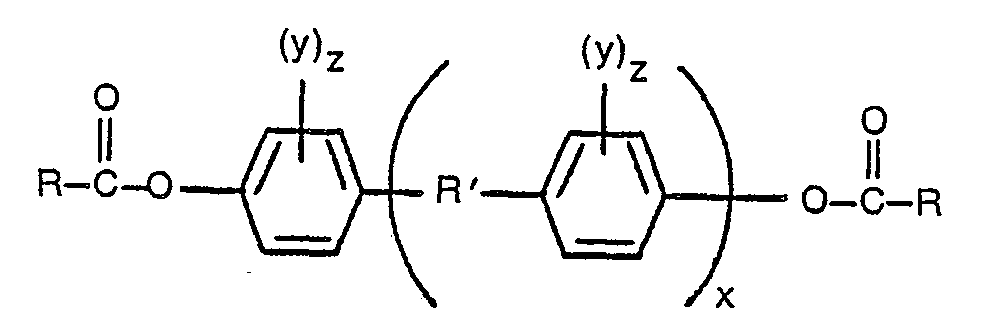
- the present invention is directed to a process for the preparation of a melt stable polyarylate having a reduced viscosity of at least 0.4 dl/g, which comprises reacting a diester derivative of a dihydric phenol with an aromatic dicarboxylic acid, at a temperature of from about 260 to about 350°C, to produce a polyarylate having a reduced viscosity of at least 0.5 dl/g, and then adding a stabilizing amount of an aromatic phenol to the polyarylate.
- the used aromatic phenol should be free of substituents in at least one of the positions ortho to the hydroxy group.
- the obtained polyarylate is substantially free of anhydride linkages.
- the present process comprises reacting:
- the diester derivative of the dihydric phenol is prepared by reacting a dihydric phenol with an acid anhydride derived from acids containing from 2 to 8 carbon atoms under conventional esterification conditions.
- the preferred acid anhydride is acetic anhydride.
- the dihydric phenol is reacted with the acid anhydride in the presence of an esterification catalyst, either in the presence or absence of a solvent.
- dihydric phenols that may be used in this invention include the following:
- dihydric phenols may be used individually or in any combination which when reacted with an aromatic dicarboxylic acid produce polyarylate polymers that essentially do not crystallize during the reaction and recovery steps.
- the preferred dihydric phenol is 2,2-bis(4-hydroxyphenyl)propane.
- the aromatic dicarboxylic acids that may be used in this invention include terephthalic acid, isophthalic acid, any of the naphthalene dicarboxylic acids and mixtures thereof, as well as alkyl substituted homologs of these carboxylic acids, wherein the alkyl group contains from 1 to 4 carbon atoms, and acids containing other inert substituents such as halides, alkyl or aryl ethers, and the like.
- mixtures of isophthalic and terephthalic acids are used.
- the isophthalic acid is to terephthalic acid ratio in the mixture is about 20:80 to about 100:0, while the most preferred acid ratio is about 25:75 to about 50:50.
- from about 0.5 to about 20 percent of aliphatic diacids containing from 2 to about 20 carbon atoms, such as adipic acid, sebacic acid, and the like my be additionally used in the polymerization reaction.
- the dihydric phenols and aromatic dicarboxylic acids are selected so that the polyarylate produced remains in an essentially amorphous state during the polymerization and recovery step.
- aromatic phenols can be used herein including oligomeric and polymeric aromatic phenols.
- the aromatic phenol must have at least one of the positions ortho to the hydroxyl group free of substituents. Also, the total number of unhindered hydroxy groups should not exceed three.
- aromatic phenols are selected from the following formulae: wherein Ar is an aromatic radical derived from a hydrocarbon such as benzene, naphthalene and anthracene and containing 6 to 30 carbon atoms; a is an integer of from 1 to 5; b is an integer of from 1 to 15 with the proviso that the number of unhindered hydroxy groups is at least one and should not exceed 3; c is equal to any remaining free position on the Ar radical, taking into account that there may be up to three hydroxy groups, each with one adjacent unsubstituted position; A is a substituent which is non-reactive with the ester linkage of the polyarylate under the reaction conditions, such as halo, alkyl, aryl, alkylene, arylene, alkylaryl, arylalkyl, -Oaryl, -Oalkyl, -OCOaryl, -OCOalkyl, -COOalkyl, -COOaryl, Iryl, -S
- the preferred aromatic phenols include p-phenylphenol, p-cumylphenol, 4-hydroxybenzophenone, ⁇ -naphthol, hydroxy terminated polysulfone, and hydroxy terminated polyethersulfone.
- the aromatic phenol is added to the polymerization reaction in a stabilizing amount, that is in amounts of from 0.01 to about 10, and preferably, from about 0.1 to about 2.0 mole percent, based on the amount of the starting materials.
- the aromatic phenol is optionally added in a solvent.
- the solvents discussed, infra, are preferred.
- the reaction of the diester derivative of a dihydric phenol with the aromatic dicarboxylic acid is carried out in the presence of from about 10 to about 60, preferably from about 25 to about 40, and most preferably, from about 30 to about 40 weight percent, based on the weight of the polyarylate produced, of a solvent.
- the solvent may be a diphenyl ether compound (also known as diphenyl oxide).
- the diphenyl ether compound may be substituted. These substituents are selected from alkyl groups, chlorine, bromine or any substituent which does not interfere with the polyarylate forming reaction or the reaction forming the diester derivative of the dihydric phenol.
- the solvent may be a cycloaliphatic, substituted aromatic, or heteroaromatic compound, which contains at least one benzylic and/or tertiary hydrogen atom.
- These compounds have a boiling point of from about 150 to about 350°C, preferably from about 180 to about 280°C, and most preferably from about 180 to about 220°C, at atmospheric pressure. Additionally, these compounds have a solubility parameter, at a temperature of 250°C, of ⁇ 4 within the solubility parameter of the polyarylate being produced. Solubility parameter is a measure for correlating polymer solvent interaction. It is defined in "Properties of Polymer", D. W. Van Krevelen, Elsevier Scientific Publishing Co., Amsterdam-Oxford-New York, 1976, pp. 141-155, as the square root of the cohesive energy density.
- cycloaliphatic compounds are of the following formulae: wherein R1 is independently alkyl of 1 to 6 carbon atoms, cycloalkyl of 6 to 18 carbon atoms, and a is an integer of 1 or 2.
- the substituted aromatic compounds are of the following formulae: wherein R 2 is independently alkyl of 1 to 6 carbon atoms, cycloalkyl of 6 to 18 carbon atoms and aralkyl or alkaryl of 7 to 18 carbon atoms and wherein the carbon atom of R 2 attached directly to the benzene nucleus has 1 or 2 attached hydrogen atoms, and b is an integer of 1 to 6.
- R 3 is independently alkyl of 1 to 6 carbon atoms, cycloalkyl of 6 to 18 carbon atoms, c is an integer of 1 or 2, and n is an integer of 1 to 6.
- the preferred compounds encompassed by structures (IV) through (VIII) include xylenes, cumene, diethylbenzene, diisopropyl benzene, tetrahydronaphthalene or decahydronaphthalene.
- cycloaliphatic, substituted aromatic or heteroaromatic compounds may be used with up to 90 weight percent of other compounds such as diphenyl ether or dimethylsulfone.
- the amount of said solvents could vary during the polymerization reaction. For example, it may be advantageous to increase progressively the amount of these solvents to maintain the reaction medium at constant viscosity.
- the reaction of the diester derivative of the dihydric phenol with the aromatic dicarboxylic acid may be performed in the presence of a catalyst.
- a diphenyl ether solvent may also be used with a magnesium catalyst which is selected from magnesium, magnesium oxide and a magnesium salt of an inorganic acid, or organic acid or mixtures thereof.
- the salts of the organic acid include acetates, propionates, benzoates, oxalates, acetylacetonates, or mixtures thereof.
- the catalyst may also include manganese or zinc salts.
- the salts of the organic acids include acetates, propionates, benzoates, oxalates, acetylacetonates, or mixtures thereof.
- the most preferred catalyst is magnesium acetate.
- the catalyst when used, is present in the reaction in a catalytically effective amount which can be, for example, from about 1 to about 1000, preferably from about 10 to about 50 parts per million, based on the weight of the polyarylate produced.
- the reaction of the diester derivative of the dihydric phenol with the aromatic dicarboxylic acid is performed with these reactants present in the ratio of from about 0.85:1.00 to about 1.10:1.00, preferably from about 0.98:1.02 to about 1.02:0.98, diester derivative: aromatic dicarboxylic acid.
- the process of this invention is carried out at a temperature of from about 260 to about 350°C and preferably, from about 275 to about 295°C.
- the present process is generally conducted in an inert atmosphere (such as argon or nitrogen).
- the process is preferably carried out at atmospheric pressure although higher and lower pressures may be used. Obviously, at pressures higher than atmospheric pressure, higher temperatures will result.
- the polymerization reaction is conducted for a period of time sufficient to produce a polyarylate having a reduced viscosity of at least 0.5 di/g (the viscosity may be 1.0 dl/g or even greater), which time is generally less than about 10 hours.
- the reaction time is generally in the range of from about 4 hours to about 8 hours, depending on the particular polyarylate being prepared.
- the addition of the aromatic phenol to the polymerization reaction causes a decrease in molecular weight. Therefore, the polymerization should be carried out until the reduced viscosity is above about 0.05 dl/g of the desired reduced viscosity and then the aromatic phenol added to the polymerization. Following this addition, the polymerization is continued for about 10 to about 180, and preferably, from about 10 to about 45 minutes.
- the polymerization reaction of this invention may be carried out batchwise or continuously and by using any apparatus desired. Moreover, the reactants may be added to the polymerization zone in any way or order desired as long as the aromatic phenol is added after the desired molecular weight has been exceeded as determined by having the reduced viscosity exceed the desired reduced viscosity by about 0.05 dl/g.
- the diester derivative of the dihydric phenol may be formed, in situ, by adding the dihydric phenol together with the acid anhydride, an aromatic dicarboxylic acid and solvent to the reactor and the reaction carried out in a single reaction zone under combined esterification and polymerization conditions as described above. Additionally, the diester derivative of the dihydric phenol may be first prepared and then an aromatic dicarboxylic acid added to the same reaction vessel with the polymerization being carried out under the conditions described above.
- the polyarylate polymer having a reduced viscosity of at least about 0.4 dl/g is recovered in its final form by methods well known to those in the art, such as by direct devolatilization in an extruder under conditions sufficient to remove the solvent, coagulation, spray drying, and the like.
- the polyacrylates may also be prepared by first forming a polyarylate prepolymer having a reduced viscosity of from about 0.1 to about 0.4 dl/g, by reacting the diester derivative of a dihydric phenol with an aromatic dicarboxylic acid under the conditions described previously, for a reaction time of about 3 hours.
- the polyarylate prepolymer may be added directly, after its formation, to a vented extruder wherein the molecular weight is increased to form a polymer having a reduced viscosity of at least 0.5 dl/g.
- the molecular weight of polyarylate prepolymer is increased in the extruder at a temperature of from about 300 to about 350°C, under a vacuum of about 0.4 to about 2.67 mbar and a residence time of from about 10 to about 30 minutes.
- the aromatic phenol can be added to the polymer in the extruder after the desired molecular weight has been exceeded as determined by having the reduced viscosity exceed the desired reduced viscosity by about 0.05 dl/g.
- the process of this invention produces normally solid polyarylates having a reduced viscosity of at least 0.4, (this viscosity may be 1.0 dl/g or even greater) preferably from about 0.6 to about 0.8 dl/gm, as measured in chloroform (0.5 g/100 ml chloroform) or other suitable solvent at 25°C.
- the polyarylates may be prepared in the presence of materials such as molecular weight regulators, anti-oxidants, and the like.
- polyarylates obtained by the process of this invention may be used together with the well-known additives such as plasticizers, pigments, lubricating agents, mold release agents, stabilizers, inorganic fillers, and the like. These polyarylates may also be blended with other polymers.
- a three neck, 250 ml round bottom flask was equipped with a mechanical stirrer, a nitrogen inlet and a vacuum jacketed vigreux column and distillation head.
- 31.20 g (0.10 moles) of bisphenol-A diacetate, 8.30 g (0.05 moles) of isophthalic acid, 8.30 g (0.05 moles) of terephthalic acid and 10.74 g of diphenyl ether were charged to the flask.
- the system was purged with nitrogen for 1 hour at room temperature. While maintaining a constant nitrogen purge the reaction mixture was heated to between 260 and 270°C. Acetic acid began to distill at this point. After one hour, the temperature was increased to between 290 and 300°C.
- a partial vacuum (200 mbar) was applied to the reaction after 2 hours at this temperature.
- the vacuum was reduced to ⁇ 1.33 mbar in a stepwise fashion (66.5 mbar/30 min). After an additional one hour at 290-300 0 C and a full vacuum ( ⁇ 1.33 mbar) the system was allowed to cool to ambient temperature.
- the resulting polyarylate was ground and then dried under vacuum at a temperature of 120 to 130°C for 24 hours.
- the reduced viscosity of this polymer was measured in chloroform (0.50 g/100 ml) at 25°C and found to be 0.52 dl/g.
- the melt stability of the polymer was measured in a Tinius Olsen thermodyne (melt flow cell) at 375°C.
- the polymer was added to the preheated (375°C) chamber of the thermodyne and put under a constant pressure of 3 bar. After 10 and 30 minutes at 375°C, samples of the polymer were taken by allowing the polymer to flow freely from the bottom of the cavity. The reduced viscosity of these samples was measured in chloroform (0.50 g/100 ml) at 25°C and found to be 0.42 and 0.37 dl/g, respectively.
- the polymer was ground and dried as described in Comparative Example A.
- the reduced viscosity of this polymer was measured in chloroform (0.50 g/100 ml) at 25°C and found to be 0.57 dl/g.
- the polymer was then added to Tinius Olsen thermodyne and tested by the procedure described in Comparative Example A.
- the reduced viscosity of the samples obtained after 10 and 30 minutes in the thermodyne were 0.58 and 0.52 dl/g, respectively.
- Example 1 The procedure of Example 1 was exactly repeated except that 0.017 g (1 x 10- 4 moles) of p-phenylphenol was added instead of 0.0085 g of the p-phenylphenol
- Example 1 The procedure of Example 1 was exactly repeated except that 0.039 g (2 x 10- 4 moles) of 4-hydroxyphenone was added.
- Example 1 The procedure of Example 1 was exactly repeated except that 0.029 g (2 x 10- 4 moles) of ⁇ - naphthol was added.
- Example 1 The procedure of Example 1 was exactly repeated except that 0.106 g (2 x 10- 4 moles) of octadecyl 3-(3',5'-di-t-butyl-4'-hydroxyphenyl) propionate (lrganox@ 1079, sold by Ciba-Geigy Corporation) was added.
- the reactor system consisted of a hot oil heated one gallon reactor fitted with a nitrogen inlet, mechanical agitator, and fractionating column (packed with ceramic saddles) connected to an overhead take-off device consisting of a condenser and a receiver.
- the reactor was charged with 1200 grams of bisphenol-A diacetate, 319.1 grams of isophthalic acid, 319.1 grams of terephthalic acid and 740 grams of diphenyl ether (35 weight percent based on the polymer produced).
- the reactor system was purged with nitrogen for 20 minutes and then the heater turned on to raise the temperatures of the reactor to about 280°C (the oil heater was set at about 300°C).
- Acetic acid started to distil when the temperature of the mixture reached about 26°C.
- Acetic acid distillation was followed by measuring its level in the receiver. After about 3.0 hours at 280°C, the power draw on the agitator began to increase which indicated a viscosity increase.
- the reaction was terminated after 5.5 hours at reflux by discharging the contents of the reactor under nitrogen.
- the reaction product was allowed to cool to room temperature.
- the reaction product was ground to particles having an average size below 6.3 mm and stored in an oven at 50-60°C, for about 10-15 hours under a vacuum of 100 mbar.
- the polymer was isolated by feeding the reaction product to a single screw two vent extruder and flashing off the solvent.
- the barrel temperature of the extruder was 325°C
- the first vent was under a vacuum of about 665 mbar
- the second vent was under a vacuum of about 20-27 mbar.
- the residence time of the polymer in the extruder was 2-5 minutes.
- the polymer had a reduced viscosity of 0.82 di/g as measured in chloroform (0.50 gm/100 ml) at 25°C.
- the polymer was then added to a Tinius Olsen thermodyne and tested by the procedure as described in Comparative Example A.
- the reduced viscosity of the samples obtained after 10 and 30 minutes in the thermodyne were 0.72 and 0.66 dl/g, respectively.
- the polymer produced had a reduced viscosity of 0.62 dl/g as measured in chloroform (0.50 g/100 ml) at 25°C.
- the polymer was then added to a Tinius Olsen thermodyne and tested by the procedure as described in Comparative Example A.
- the reduced viscosity of the samples obtained after 10 and 30 minutes in the thermodyne were 0.59 and 0.55 dl/g, respectively.
- the data in the Table shows that without adding an aromatic phenol to the polymerization reaction, as in Comparative Examples A and C, there is a significant reduction in the reduced viscosity of the polymer after processing in the thermodyne for 10 and 30 minutes.
- the viscosity of the polymer prepared in comparative Example A, without aromatic phenol is reduced 19.9 and 28.8 percent, respectively, after 10 and 30 minutes, while the viscosity of the polymer prepared in Comparative Example C, without aromatic phenol, is reduced 12.2 and 23 percent, respectively, after 10 and 30 minutes.
Landscapes
- Chemical & Material Sciences (AREA)
- Health & Medical Sciences (AREA)
- Chemical Kinetics & Catalysis (AREA)
- Medicinal Chemistry (AREA)
- Polymers & Plastics (AREA)
- Organic Chemistry (AREA)
- Polyesters Or Polycarbonates (AREA)
- Polyoxymethylene Polymers And Polymers With Carbon-To-Carbon Bonds (AREA)
Claims (19)


Priority Applications (1)
| Application Number | Priority Date | Filing Date | Title |
|---|---|---|---|
| AT80106608T ATE7705T1 (de) | 1979-10-29 | 1980-10-28 | Verfahren zum stabilisieren von polyarylaten mit einem aromatischen phenol. |
Applications Claiming Priority (2)
| Application Number | Priority Date | Filing Date | Title |
|---|---|---|---|
| US06/089,270 US4281099A (en) | 1979-10-29 | 1979-10-29 | Process for stabilizing polyarylates with an aromatic phenol |
| US89270 | 1979-10-29 |
Publications (2)
| Publication Number | Publication Date |
|---|---|
| EP0028030A1 EP0028030A1 (de) | 1981-05-06 |
| EP0028030B1 true EP0028030B1 (de) | 1984-05-30 |
Family
ID=22216676
Family Applications (1)
| Application Number | Title | Priority Date | Filing Date |
|---|---|---|---|
| EP80106608A Expired EP0028030B1 (de) | 1979-10-29 | 1980-10-28 | Verfahren zum Stabilisieren von Polyarylaten mit einem aromatischen Phenol |
Country Status (6)
| Country | Link |
|---|---|
| US (1) | US4281099A (de) |
| EP (1) | EP0028030B1 (de) |
| JP (1) | JPS5679124A (de) |
| AT (1) | ATE7705T1 (de) |
| CA (1) | CA1155596A (de) |
| DE (1) | DE3068059D1 (de) |
Families Citing this family (40)
| Publication number | Priority date | Publication date | Assignee | Title |
|---|---|---|---|---|
| US4363892A (en) * | 1982-03-05 | 1982-12-14 | E. I. Du Pont De Nemours And Company | Thermoplastic copolyester elastomers modified with salts of phenolic compounds |
| US4386186A (en) * | 1982-03-29 | 1983-05-31 | Union Carbide Corporation | Process for preparing polyarylates |
| US4439586A (en) * | 1982-06-30 | 1984-03-27 | Union Carbide Corporation | Process for preparing polyarylates |
| US4477647A (en) * | 1983-08-30 | 1984-10-16 | General Electric Company | Polyarylate resin of thiodiphenols and isophthalic acid or derivatives thereof |
| US4485230A (en) * | 1983-09-13 | 1984-11-27 | Phillips Petroleum Company | Polyarylate formation by ester interchange reaction |
| US4533720A (en) * | 1983-09-13 | 1985-08-06 | Phillips Petroleum Company | Polyarylate formation by ester interchange reaction using γ- gamma lactones as diluent |
| EP0285554A1 (de) * | 1987-03-19 | 1988-10-05 | Maged A. Dr. Osman | Lineare stäbchenförmige Polyester |
| DE3911558A1 (de) * | 1989-04-08 | 1990-10-11 | Bayer Ag | Brandwidrige polycarbonate und polyester |
| US4958000A (en) * | 1989-05-22 | 1990-09-18 | Amoco Corporation | Process for preparing polyarylates |
| US4937319A (en) * | 1989-06-23 | 1990-06-26 | Hoechst Celanese Corp. | Process for producing aromatic polyesters |
| EP1124879B1 (de) | 1998-10-29 | 2005-11-16 | General Electric Company | Witterungsbeständige blockcopolyestercarbonate, verfahren zu deren herstellung und diese enthaltende polymerlegierungen |
| ES2214046T3 (es) | 1998-10-29 | 2004-09-01 | General Electric Company | Copoliestercarbonatos de bloque resistentes a la intemperie y mezclas que los contienen. |
| US6572956B1 (en) | 1999-04-08 | 2003-06-03 | General Electric Company | Weatherable multilayer resinous articles and method for their preparation |
| US6861482B2 (en) | 1999-05-18 | 2005-03-01 | General Electric Company | Weatherable, thermostable polymers having improved flow composition |
| US6664366B2 (en) | 1999-05-18 | 2003-12-16 | General Electric Company | Thermally stable polymers, method of preparation, and articles made therefrom |
| US6689474B2 (en) | 1999-05-18 | 2004-02-10 | General Electric Company | Thermally stable polymers, method of preparation, and articles made therefrom |
| US6306507B1 (en) | 1999-05-18 | 2001-10-23 | General Electric Company | Thermally stable polymers, method of preparation, and articles made therefrom |
| US8057903B2 (en) | 2001-11-30 | 2011-11-15 | Sabic Innovative Plastics Ip B.V. | Multilayer articles comprising resorcinol arylate polyester and method for making thereof |
| US6812320B2 (en) | 2002-03-25 | 2004-11-02 | General Electric Company | Method for copolyestercarbonate synthesis |
| US6627303B1 (en) | 2003-01-17 | 2003-09-30 | General Electric Company | High modulus weatherable polyester carbonate articles |
| US20040253428A1 (en) * | 2003-06-12 | 2004-12-16 | General Electric Company | Weatherable multilayer articles and method for their preparation |
| US7153576B2 (en) * | 2004-01-20 | 2006-12-26 | General Electric Company | Weatherable multilayer article assemblies and method for their preparation |
| US7321014B2 (en) * | 2004-12-29 | 2008-01-22 | General Electric Company | Transparent compositions, methods for the preparation thereof, and articles derived therefrom |
| US7432327B2 (en) * | 2004-12-30 | 2008-10-07 | Sabic Innovative Plastics Ip B.V. | Transparent polymeric compositions comprising polysiloxane-polycarbonate copolymer, articles made therefrom and methods of making same |
| US7326764B2 (en) * | 2005-05-20 | 2008-02-05 | General Electric Company | Transparent compositions, methods for the preparation thereof, and articles derived therefrom |
| US7273917B2 (en) | 2005-05-20 | 2007-09-25 | General Electric Company | Transparent compositions, methods for the preparation thereof, and articles derived therefrom |
| US7323536B2 (en) * | 2005-05-20 | 2008-01-29 | General Electric Company | Transparent compositions, methods for the preparation thereof, and articles derived therefrom |
| US7323535B2 (en) * | 2005-05-20 | 2008-01-29 | General Electric Company | Transparent compositions, methods for the preparation thereof, and articles derived therefrom |
| DE102005050072A1 (de) | 2005-10-19 | 2007-04-26 | Bayer Materialscience Ag | Lichtstreuende Folien sowie deren Verwendung in Flachbildschirmen |
| DE102006051305A1 (de) | 2006-10-31 | 2008-05-08 | Bayer Materialscience Ag | Verfahren zur Filtration von Substratmaterialien |
| DE102007013273A1 (de) | 2007-03-16 | 2008-09-18 | Bayer Materialscience Ag | Verfahren zur Herstellung mehrschichtiger Behälter |
| DE102007015948A1 (de) | 2007-04-03 | 2008-10-09 | Bayer Materialscience Ag | Modifizierte Polycarbonate, Polyestercarbonate und Polyester mit verbessertem Dehnverhalten und Flammwidrigkeit |
| EP2133202A1 (de) | 2008-06-11 | 2009-12-16 | Bayer MaterialScience AG | Mehrschichtige optische Folienaufbauten mit verbesserten Eigenschaften und deren Verwendung |
| JP4853740B2 (ja) * | 2008-07-01 | 2012-01-11 | 荒川 カツヨ | ひったくり抑止のwバッグ |
| DE102008036406A1 (de) | 2008-08-05 | 2010-02-11 | Bayer Materialscience Ag | Modifizierte Polycarbonate mit verbesserten Oberflächeneigenschaften |
| EP2157133A1 (de) | 2008-08-19 | 2010-02-24 | Bayer MaterialScience AG | Folien mit verbesserten Eigenschaften |
| DE102009025123A1 (de) | 2009-06-16 | 2010-12-23 | Osram Opto Semiconductors Gmbh | Strahlungsemittierende Vorrichtung |
| DE102009058099A1 (de) | 2009-12-12 | 2011-06-16 | Bayer Materialscience Ag | Polycarbonatblends mit hoher Wärmeformbeständigkeit und verbesserten Oberflächeneigenschaften |
| DE102009058462A1 (de) | 2009-12-16 | 2011-06-22 | Bayer MaterialScience AG, 51373 | Polycarbonat mit erhöhter Transmission und bakterizider Wirksamkeit |
| EP2703092A1 (de) | 2012-08-30 | 2014-03-05 | Bayer MaterialScience AG | Verfahren zur Einstellung verschiedener Glanzgrade bei strahlengehärteten Lacken und deren Verwendung |
Family Cites Families (13)
| Publication number | Priority date | Publication date | Assignee | Title |
|---|---|---|---|---|
| BE563173A (de) * | 1956-12-14 | |||
| US4011196A (en) * | 1971-08-19 | 1977-03-08 | Fmc Corporation | Stabilized polyester resin and processes for making them |
| US3775375A (en) * | 1972-06-20 | 1973-11-27 | J Wolfe | Thermoplastic copolyetheresters based on 2,6-naphthalene-dicarboxylic acid |
| US3824213A (en) * | 1973-04-16 | 1974-07-16 | Celanese Corp | Acid-interchange reaction for forming halogenated aromatic polyesters |
| US3948856A (en) * | 1973-09-26 | 1976-04-06 | Celanese Corporation | Acid interchange polymerization process for producing an aromatic polyester |
| US4124566A (en) * | 1976-06-16 | 1978-11-07 | Teijin Limited | Process for preparing polyesters |
| DE2639428C2 (de) * | 1976-09-02 | 1986-01-30 | Bayer Ag, 5090 Leverkusen | Schnell kristallisierende Polyestermassen |
| US4101517A (en) * | 1977-02-22 | 1978-07-18 | Monsanto Company | Preparation of polyesters of 1,2-bis(hydroxyphenyl)ethanes and aromatic dicarboxylic acids |
| US4127560A (en) * | 1977-08-08 | 1978-11-28 | Celanese Corporation | Melt polymerization process for preparing a melt processable resorcinol phthalate polyester utilizing a metal acetate catalyst |
| JPS5446287A (en) * | 1977-09-21 | 1979-04-12 | Sumitomo Chem Co Ltd | Bulk polycondensation |
| JPS5465795A (en) * | 1977-11-04 | 1979-05-26 | Asahi Chem Ind Co Ltd | Preparation of aromatic polyester |
| JPS5478755A (en) * | 1977-12-07 | 1979-06-23 | Unitika Ltd | Resin composition |
| DE2756013A1 (de) * | 1977-12-15 | 1979-06-28 | Unitika Ltd | Aromatische copolyester-masse und deren verwendung zur herstellung von formkoerpern |
-
1979
- 1979-10-29 US US06/089,270 patent/US4281099A/en not_active Expired - Lifetime
-
1980
- 1980-10-24 CA CA000363255A patent/CA1155596A/en not_active Expired
- 1980-10-28 AT AT80106608T patent/ATE7705T1/de not_active IP Right Cessation
- 1980-10-28 JP JP15024380A patent/JPS5679124A/ja active Pending
- 1980-10-28 EP EP80106608A patent/EP0028030B1/de not_active Expired
- 1980-10-28 DE DE8080106608T patent/DE3068059D1/de not_active Expired
Also Published As
| Publication number | Publication date |
|---|---|
| EP0028030A1 (de) | 1981-05-06 |
| JPS5679124A (en) | 1981-06-29 |
| ATE7705T1 (de) | 1984-06-15 |
| US4281099A (en) | 1981-07-28 |
| DE3068059D1 (en) | 1984-07-05 |
| CA1155596A (en) | 1983-10-18 |
Similar Documents
| Publication | Publication Date | Title |
|---|---|---|
| US4281099A (en) | Process for stabilizing polyarylates with an aromatic phenol | |
| US4294956A (en) | Process for preparing polyarylates in the presence of a diphenyl ether | |
| EP0026121B1 (de) | Verfahren zur Herstellung von Polyarylaten in Gegenwart einer Diphenyläther-Verbindung und eines Magnesium-Katalysators | |
| US4294957A (en) | Process for preparing polyarylates | |
| US4321355A (en) | Process for preparing polyarylates | |
| US4374239A (en) | Process for preparing polyarylates | |
| US4439586A (en) | Process for preparing polyarylates | |
| US4338422A (en) | Preparation of polyesters and poly(ester-carbonates) by acidolysis of aromatic polycarbonates | |
| US4978739A (en) | Process for preparing polyarylate from an ester derivative of a dihydric phenol | |
| US4465819A (en) | Semi or fully continuous process for polyester of bisphenol and dicarboxylic acid by transesterification polymerization and product thereof | |
| US4415721A (en) | Semi or fully continuous process for polyester of bisphenol and dicarboxylic acid by transesterification polymerization and product thereof | |
| CA2014746A1 (en) | Process for preparing low color polyarylates | |
| US4958000A (en) | Process for preparing polyarylates | |
| US4853457A (en) | Preparation of spirobiindane polyarylates, and spirobiindane polyarylate-polyethylene terephthalate copolymers, via melt polymerization | |
| US4803236A (en) | Stabilization of aromatic polyesters with mercaptobenzothiazole | |
| US5274069A (en) | Process for preparing improved polyarylates | |
| US4360648A (en) | Process for the preparation of polyesters and poly(ester-carbonates) | |
| CA1303772C (en) | Stabilization of aromatic polyesters with dimercaptothiadiazole | |
| EP0035269B1 (de) | Verfahren zur Herstellung aromatischer Polyester | |
| US5004796A (en) | Preparation of poly(arylate) using a non-solvent | |
| CA1303773C (en) | Stabilization of aromatic polyesters with mercaptobenzothiazole | |
| EP0107503B1 (de) | Anwendung von Polyethylenterephthalatcopolyester für die Herstellung von Filmen und Formmassen | |
| CA1338116C (en) | Preparation of spirobiindane polyarylates, and spirobiindane polyarylate-polyethylene terephathalate copolymers, via melt polymerization |
Legal Events
| Date | Code | Title | Description |
|---|---|---|---|
| PUAI | Public reference made under article 153(3) epc to a published international application that has entered the european phase |
Free format text: ORIGINAL CODE: 0009012 |
|
| AK | Designated contracting states |
Designated state(s): AT BE CH DE FR GB IT NL SE |
|
| 17P | Request for examination filed |
Effective date: 19811013 |
|
| RAP1 | Party data changed (applicant data changed or rights of an application transferred) |
Owner name: UNION CARBIDE CORPORATION |
|
| ITF | It: translation for a ep patent filed | ||
| GRAA | (expected) grant |
Free format text: ORIGINAL CODE: 0009210 |
|
| AK | Designated contracting states |
Designated state(s): AT BE CH DE FR GB IT LI NL SE |
|
| REF | Corresponds to: |
Ref document number: 7705 Country of ref document: AT Date of ref document: 19840615 Kind code of ref document: T |
|
| REF | Corresponds to: |
Ref document number: 3068059 Country of ref document: DE Date of ref document: 19840705 |
|
| ET | Fr: translation filed | ||
| PGFP | Annual fee paid to national office [announced via postgrant information from national office to epo] |
Ref country code: FR Payment date: 19840917 Year of fee payment: 5 |
|
| PGFP | Annual fee paid to national office [announced via postgrant information from national office to epo] |
Ref country code: SE Payment date: 19840930 Year of fee payment: 5 |
|
| BECH | Be: change of holder |
Free format text: 840530 *AMOCO CORP. |
|
| PGFP | Annual fee paid to national office [announced via postgrant information from national office to epo] |
Ref country code: BE Payment date: 19841231 Year of fee payment: 5 |
|
| PLBE | No opposition filed within time limit |
Free format text: ORIGINAL CODE: 0009261 |
|
| STAA | Information on the status of an ep patent application or granted ep patent |
Free format text: STATUS: NO OPPOSITION FILED WITHIN TIME LIMIT |
|
| 26N | No opposition filed | ||
| PGFP | Annual fee paid to national office [announced via postgrant information from national office to epo] |
Ref country code: AT Payment date: 19860919 Year of fee payment: 7 |
|
| PGFP | Annual fee paid to national office [announced via postgrant information from national office to epo] |
Ref country code: NL Payment date: 19861031 Year of fee payment: 7 |
|
| ITPR | It: changes in ownership of a european patent |
Owner name: CESSIONE;AMOCO CORPORATION |
|
| NLS | Nl: assignments of ep-patents |
Owner name: AMOCO CORPORATION TE CHICAGO, ILLINOIS, VER. ST. V |
|
| REG | Reference to a national code |
Ref country code: CH Ref legal event code: PUE Owner name: AMOCO CORPORATION |
|
| REG | Reference to a national code |
Ref country code: GB Ref legal event code: 732 |
|
| REG | Reference to a national code |
Ref country code: FR Ref legal event code: TP |
|
| PG25 | Lapsed in a contracting state [announced via postgrant information from national office to epo] |
Ref country code: AT Effective date: 19871028 |
|
| PG25 | Lapsed in a contracting state [announced via postgrant information from national office to epo] |
Ref country code: SE Effective date: 19871029 |
|
| PG25 | Lapsed in a contracting state [announced via postgrant information from national office to epo] |
Ref country code: LI Effective date: 19871031 Ref country code: CH Effective date: 19871031 Ref country code: BE Effective date: 19871031 |
|
| BERE | Be: lapsed |
Owner name: AMOCO CORP. Effective date: 19871031 |
|
| PG25 | Lapsed in a contracting state [announced via postgrant information from national office to epo] |
Ref country code: NL Effective date: 19880501 |
|
| NLV4 | Nl: lapsed or anulled due to non-payment of the annual fee | ||
| PG25 | Lapsed in a contracting state [announced via postgrant information from national office to epo] |
Ref country code: FR Free format text: LAPSE BECAUSE OF NON-PAYMENT OF DUE FEES Effective date: 19880630 |
|
| REG | Reference to a national code |
Ref country code: CH Ref legal event code: PL |
|
| REG | Reference to a national code |
Ref country code: FR Ref legal event code: ST |
|
| PGFP | Annual fee paid to national office [announced via postgrant information from national office to epo] |
Ref country code: DE Payment date: 19920914 Year of fee payment: 13 |
|
| PGFP | Annual fee paid to national office [announced via postgrant information from national office to epo] |
Ref country code: GB Payment date: 19920929 Year of fee payment: 13 |
|
| PG25 | Lapsed in a contracting state [announced via postgrant information from national office to epo] |
Ref country code: GB Effective date: 19931028 |
|
| GBPC | Gb: european patent ceased through non-payment of renewal fee |
Effective date: 19931028 |
|
| PG25 | Lapsed in a contracting state [announced via postgrant information from national office to epo] |
Ref country code: DE Effective date: 19940701 |
|
| EUG | Se: european patent has lapsed |
Ref document number: 80106608.5 Effective date: 19880707 |