EP0028583B1 - Procédé de préparation de pièces moulées en résine époxy - Google Patents
Procédé de préparation de pièces moulées en résine époxy Download PDFInfo
- Publication number
- EP0028583B1 EP0028583B1 EP80810326A EP80810326A EP0028583B1 EP 0028583 B1 EP0028583 B1 EP 0028583B1 EP 80810326 A EP80810326 A EP 80810326A EP 80810326 A EP80810326 A EP 80810326A EP 0028583 B1 EP0028583 B1 EP 0028583B1
- Authority
- EP
- European Patent Office
- Prior art keywords
- compound
- process according
- reaction
- carboxylic
- anhydride
- Prior art date
- Legal status (The legal status is an assumption and is not a legal conclusion. Google has not performed a legal analysis and makes no representation as to the accuracy of the status listed.)
- Expired
Links
Classifications
-
- H—ELECTRICITY
- H10—SEMICONDUCTOR DEVICES; ELECTRIC SOLID-STATE DEVICES NOT OTHERWISE PROVIDED FOR
- H10W—GENERIC PACKAGES, INTERCONNECTIONS, CONNECTORS OR OTHER CONSTRUCTIONAL DETAILS OF DEVICES COVERED BY CLASS H10
- H10W74/00—Encapsulations, e.g. protective coatings
- H10W74/01—Manufacture or treatment
-
- C—CHEMISTRY; METALLURGY
- C08—ORGANIC MACROMOLECULAR COMPOUNDS; THEIR PREPARATION OR CHEMICAL WORKING-UP; COMPOSITIONS BASED THEREON
- C08G—MACROMOLECULAR COMPOUNDS OBTAINED OTHERWISE THAN BY REACTIONS ONLY INVOLVING UNSATURATED CARBON-TO-CARBON BONDS
- C08G59/00—Polycondensates containing more than one epoxy group per molecule; Macromolecules obtained by polymerising compounds containing more than one epoxy group per molecule using curing agents or catalysts which react with the epoxy groups
- C08G59/18—Macromolecules obtained by polymerising compounds containing more than one epoxy group per molecule using curing agents or catalysts which react with the epoxy groups ; e.g. general methods of curing
- C08G59/40—Macromolecules obtained by polymerising compounds containing more than one epoxy group per molecule using curing agents or catalysts which react with the epoxy groups ; e.g. general methods of curing characterised by the curing agents used
- C08G59/42—Polycarboxylic acids; Anhydrides, halides or low molecular weight esters thereof
-
- C—CHEMISTRY; METALLURGY
- C08—ORGANIC MACROMOLECULAR COMPOUNDS; THEIR PREPARATION OR CHEMICAL WORKING-UP; COMPOSITIONS BASED THEREON
- C08G—MACROMOLECULAR COMPOUNDS OBTAINED OTHERWISE THAN BY REACTIONS ONLY INVOLVING UNSATURATED CARBON-TO-CARBON BONDS
- C08G59/00—Polycondensates containing more than one epoxy group per molecule; Macromolecules obtained by polymerising compounds containing more than one epoxy group per molecule using curing agents or catalysts which react with the epoxy groups
- C08G59/18—Macromolecules obtained by polymerising compounds containing more than one epoxy group per molecule using curing agents or catalysts which react with the epoxy groups ; e.g. general methods of curing
- C08G59/40—Macromolecules obtained by polymerising compounds containing more than one epoxy group per molecule using curing agents or catalysts which react with the epoxy groups ; e.g. general methods of curing characterised by the curing agents used
- C08G59/42—Polycarboxylic acids; Anhydrides, halides or low molecular weight esters thereof
- C08G59/4284—Polycarboxylic acids; Anhydrides, halides or low molecular weight esters thereof together with other curing agents
-
- C—CHEMISTRY; METALLURGY
- C08—ORGANIC MACROMOLECULAR COMPOUNDS; THEIR PREPARATION OR CHEMICAL WORKING-UP; COMPOSITIONS BASED THEREON
- C08G—MACROMOLECULAR COMPOUNDS OBTAINED OTHERWISE THAN BY REACTIONS ONLY INVOLVING UNSATURATED CARBON-TO-CARBON BONDS
- C08G59/00—Polycondensates containing more than one epoxy group per molecule; Macromolecules obtained by polymerising compounds containing more than one epoxy group per molecule using curing agents or catalysts which react with the epoxy groups
- C08G59/18—Macromolecules obtained by polymerising compounds containing more than one epoxy group per molecule using curing agents or catalysts which react with the epoxy groups ; e.g. general methods of curing
- C08G59/40—Macromolecules obtained by polymerising compounds containing more than one epoxy group per molecule using curing agents or catalysts which react with the epoxy groups ; e.g. general methods of curing characterised by the curing agents used
- C08G59/42—Polycarboxylic acids; Anhydrides, halides or low molecular weight esters thereof
- C08G59/4292—Polycarboxylic acids; Anhydrides, halides or low molecular weight esters thereof together with monocarboxylic acids
-
- C—CHEMISTRY; METALLURGY
- C08—ORGANIC MACROMOLECULAR COMPOUNDS; THEIR PREPARATION OR CHEMICAL WORKING-UP; COMPOSITIONS BASED THEREON
- C08G—MACROMOLECULAR COMPOUNDS OBTAINED OTHERWISE THAN BY REACTIONS ONLY INVOLVING UNSATURATED CARBON-TO-CARBON BONDS
- C08G59/00—Polycondensates containing more than one epoxy group per molecule; Macromolecules obtained by polymerising compounds containing more than one epoxy group per molecule using curing agents or catalysts which react with the epoxy groups
- C08G59/18—Macromolecules obtained by polymerising compounds containing more than one epoxy group per molecule using curing agents or catalysts which react with the epoxy groups ; e.g. general methods of curing
- C08G59/68—Macromolecules obtained by polymerising compounds containing more than one epoxy group per molecule using curing agents or catalysts which react with the epoxy groups ; e.g. general methods of curing characterised by the catalysts used
- C08G59/72—Complexes of boron halides
-
- C—CHEMISTRY; METALLURGY
- C08—ORGANIC MACROMOLECULAR COMPOUNDS; THEIR PREPARATION OR CHEMICAL WORKING-UP; COMPOSITIONS BASED THEREON
- C08L—COMPOSITIONS OF MACROMOLECULAR COMPOUNDS
- C08L63/00—Compositions of epoxy resins; Compositions of derivatives of epoxy resins
Definitions
- polyurethane technology is mainly used for the production of plastic castings, which play a major role in the encapsulation of heat-sensitive electronic components in mass production.
- the reason for this is that polyurethane systems only require short mold coating times, for example less than 5 minutes, and that the pot-life is sufficiently long at room temperature. The latter means that relatively large approaches can be used when complex, mechanical dosing devices are not used for the production of smaller articles.
- the pot-life is at least 30 minutes to several hours.
- the use of such a polyurethane technology also has disadvantages. As is well known, it is characterized by an extremely high level of water sensitivity, which necessitates additional drainage actions and numerous precautions.
- the finally available polyurethane castings are unfavorable in terms of aging, water absorption and electrical properties compared to epoxy resin systems.
- Epoxy resin casting systems are also already known, in which short mold coating times (e.g. 5 minutes at 100 ° C.) are required and which have a pot-life (at about 100 g) of more than 30 minutes at room temperature.
- short mold coating times e.g. 5 minutes at 100 ° C.
- pot-life at about 100 g
- such epoxy resin casting systems have the disadvantageous feature of strong exothermic. In many cases, they are therefore completely unsuitable for the encapsulation casting process for electronic components.
- electronic components often contain solder joints, metal coatings and vaccinations and the like, which cannot be exposed to higher temperatures without suffering damage. In many cases, exothermic energy also leads to the formation of voids, which are undesirable.
- the object of the invention is to find a process for the production of epoxy resins which can be used in particular for the production of castings and which does not have the disadvantages of the epoxy resin systems mentioned as prior art.
- the mold-loading time should therefore not exceed 5 minutes at 100 ° C. and the pot-life at room temperature (100 g) should preferably be at least 30 minutes, so that an expensive mechanical metering device is unnecessary.
- strong exotherm should not occur in such a production process as in the known process, which is based on the amine hardening of bisphenol A epoxy resins.
- it is said to be virtually predestined for the encapsulation casting of heat-sensitive electrical parts.
- the end products which result from the use of such a process should, moreover, have at least as good mechanical, chemical and electrical properties as the materials which can be produced by casting processes of other known, fast-curing systems with a sufficiently long pot-life.
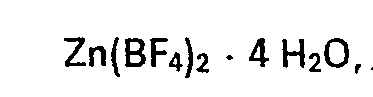
- the invention relates to a process for the production of epoxy resin castings by reacting a liquid, polyfunctional epoxy compound, a carboxylic acid anhydride, optionally a carboxylic acid and / or a carboxylic acid ester, a boron trifluoride complex compound, water, a cyclic ether and one or more compounds (X), which have at least 2 OH groups or at least 2 COOH groups or simultaneously at least 1 OH group and at least 1 COOH group, from the group of aliphatic glycols, polyesters and polyethers with terminal OH groups, polyesters with terminal COOH groups and half esters of Dicarboxylic acid anhydrides, which carry the anhydride group on a carbocyclic ring, with polyols, characterized in that a zinc fluoroborate complex compound is used as the boron trifluoride complex compound and tetrahydropyran is used as the cyclic ether, the mixture components in the reaction in such a ratio of vo are that there are more than 10
- a zinc fluoroborate complex compound of the formula or else uses one which contains tetrahydropyran and optionally water, in each case the complex-bound water being part of the total water of the reaction mixture and the complex-bound tetrahydropyran being counted as part of the total tetrahydropyran of the reaction mixture.
- a carboxylic acid anhydride which is liquid at room temperature or a carboxylic acid anhydride mixture which is liquid at room temperature or else a mixture of one or more carboxylic acid anhydrides with one or more carboxylic acids and / or one or more carboxylic acid esters which is liquid at room temperature.
- Suitable liquid anhydrides are e.g. B. hexahydrophthalic anhydride, methyltetrahydrophthal. acid anhydride and corresponding isomer mixtures or methyl 1,4-endomethylene tetrahydrophthalic anhydride.
- Mixtures of 2 or more anhydrides which are liquid at room temperature due to the crystallization properties (for example eutectic formation) are also preferred.
- Combinations with solid anhydrides, such as phthalic anhydride and tetrahydrophthalic anhydride are also possible here.
- the invention does not fundamentally exclude the use of anhydride mixtures which are solid at room temperature. However, only those anhydride mixtures can be used here which very easily form a solution with all other constituents of the mixture according to the invention.
- half esters in particular also mixtures thereof are present in analogous concentrations in the reaction mixture of the process according to the invention like the other preferred compounds (X) mentioned above.
- the preferred half esters are particularly valuable because they surprisingly cause pronounced crystallization inhibition and thus maintain the reaction mixture for the process according to the invention in the liquid state.
- Suitable liquid epoxy resins for the process according to the invention are, in particular, resins based on bisphenol-A, bisphenol-F, epoxycresol and epoxyphenol novolaks, furthermore polyesters containing epoxy groups, aliphatic polyglycidyl ethers and cycloaliphatic epoxy resins.
- halogen, especially bromine, containing epoxy compounds such as. B. of di-brominated bisphenol A glycidyl ethers and dibromo cresol glycidyl ethers is included in the invention.
- Such additives can cause the castings available to be flame-resistant. Mixtures of different epoxy resins are also very suitable.
- the reaction mixtures for the process according to the invention can also contain conventional additives, such as fillers (e.g. quartz, shale, MgCa silicate, barite and aluminum oxide powder), dyes, mold release agents (e.g. silicones), flame retardants and the like .
- fillers e.g. quartz, shale, MgCa silicate, barite and aluminum oxide powder
- dyes e.g., dyes, mold release agents (e.g. silicones), flame retardants and the like .
- the implementation according to the invention can be carried out in different ways.
- One method is to add and mix all of the ingredients all at once into the vessel from which they are poured or removed for the pouring process.
- a wide variety of premixes can also be produced. In such cases, however, care must be taken to ensure that these premixes do not contain, in addition to the epoxy compounds, substances which cause curing (crosslinking or polymerization) of the epoxy resins.
- the preparation of the reaction mixtures for the process according to the invention is preferably based on two premixes or components, namely a resin component (A) and a hardener component (B).
- the resin component (A) consists of the epoxy resin and optionally additives which are indifferent to the epoxy group, such as, in particular, fillers, dyes and mold release agents.
- the hardener component (B) can also (completely or partially) contain the substances which are indifferent to epoxy groups and which are usually expediently contained in the resin component (A), but with the proviso that these substances are then also indifferent to the hardeners and accelerators are.
- the resin component (A) can, for example, also contain (in whole or in part) the tetrahydropyran.
- the method according to the invention can optionally also be carried out in stages. So disturbs z. B. not if to a limited extent to carry out the actual main reaction, small amounts of water or OH-containing compounds react with the carboxylic anhydride. Correspondingly small amounts of carboxylic acids or carboxylic acid esters will result.
- the method according to the invention relates in particular to the simple casting method using molds, but also includes the pressure gelling method and injection molding.
- the reaction according to the invention is preferably carried out at temperatures between 75 and 120 ° C.
- the simple casting process is generally carried out in such a way that the molds are heated to about 80 ° C., into which the reaction mixture which is expediently at room temperature is then added for the process according to the invention. In many cases it is sufficient to remove the solidified casting from the mold as soon as possible. Then it already has the desired valuable properties. In some cases it is necessary to connect a post-temperature control at temperatures up to 100 "C, preferably at 80" C.
- the castings produced by the method according to the invention can encapsulate or encapsulate electrical parts, in particular heat-sensitive electronic elements.
- the resin component (A 1 ) is mixed for 1 minute with the hardener component (B 1 ) in such a ratio that 45 parts hardener component (B 1 ) are added to 100 parts of epoxy resin.
- For 1 epoxy equivalent 0.38 mol of anhydride, 0.03 OH polyol equivalents and 0.054 mol of water are used.
- the mixture is deaerated in a vacuum (1.333 ⁇ 10 2 Pa) for 10 minutes.
- the resulting reaction mixture is easy to pour at room temperature, has a pot-life of approximately 50 minutes and gels at 40 ° C at 80 ° C.
- Example 2 The procedure is analogous to Example 1, with the difference that the resin component (A 2 ) here 37.0 parts instead of 34.5 parts of the bisphenol A glycidyl ether and that in the hardener component (B 2 ) 9.6 parts of the anhydride mixture, 1.9 parts of the polyester polyol (Capa 305®) and 1.9 line of Zinc fluoroborate complex compound are included.
- the result is a casting resin which gels at 80 ° C within 30 seconds and which has a pot-life at room temperature (100 g) of 45 minutes.
- the reaction mixture is poured according to the information in Example 1, with virtually no exothermic reaction occurring as in Example 1.
- the cast body which was subsequently post-cured for 10 hours at 80 ° C., has practically the same properties as the cast body obtained and cured according to Example 1. Exceptions here are the thrust module T G max, the modulus of elasticity and the electrical values, as can be seen from Table 1.
- Example 1 It is poured into the mold as in Example 1 and left to stand for 6 hours without reheating. With this casting, the temperature does not rise significantly above 80 ° C. Subsequently, the casting body removed from the mold is post-cured at 100 ° C. for 3 hours. The test values are also shown in Table 1.
- Example 2 The procedures of Examples 4 and 5 are illustrated in Table 2.
- the dibrominated bisphenol A glycidyl ether, the dibromo cresol glycidyl ether and the bisphenol A glycidyl ether according to Example 1 are the possible components for the respective resin components (A). All other substances are components of the respective hardener component (B).
- the peak temperature is measured by pouring 100 g of the mixture into a cardboard cup at room temperature and placing it in a convection oven with an operating temperature of 80 ° C. The temperature of the mixture is measured until the peak is exceeded.
Landscapes
- Chemical & Material Sciences (AREA)
- Health & Medical Sciences (AREA)
- Chemical Kinetics & Catalysis (AREA)
- Medicinal Chemistry (AREA)
- Polymers & Plastics (AREA)
- Organic Chemistry (AREA)
- Epoxy Resins (AREA)
- Compositions Of Macromolecular Compounds (AREA)
- Organic Insulating Materials (AREA)
Claims (13)
Applications Claiming Priority (2)
| Application Number | Priority Date | Filing Date | Title |
|---|---|---|---|
| CH990779 | 1979-11-05 | ||
| CH9907/79 | 1979-11-05 |
Publications (3)
| Publication Number | Publication Date |
|---|---|
| EP0028583A2 EP0028583A2 (fr) | 1981-05-13 |
| EP0028583A3 EP0028583A3 (en) | 1981-08-26 |
| EP0028583B1 true EP0028583B1 (fr) | 1984-06-06 |
Family
ID=4356982
Family Applications (1)
| Application Number | Title | Priority Date | Filing Date |
|---|---|---|---|
| EP80810326A Expired EP0028583B1 (fr) | 1979-11-05 | 1980-10-30 | Procédé de préparation de pièces moulées en résine époxy |
Country Status (5)
| Country | Link |
|---|---|
| US (1) | US4321351A (fr) |
| EP (1) | EP0028583B1 (fr) |
| JP (1) | JPS5676431A (fr) |
| CA (1) | CA1146692A (fr) |
| DE (1) | DE3068131D1 (fr) |
Cited By (1)
| Publication number | Priority date | Publication date | Assignee | Title |
|---|---|---|---|---|
| CN104837921A (zh) * | 2012-11-07 | 2015-08-12 | 陶氏环球技术有限公司 | 可固化环氧树脂组合物和由其制成的复合物 |
Families Citing this family (15)
| Publication number | Priority date | Publication date | Assignee | Title |
|---|---|---|---|---|
| US4415469A (en) * | 1981-11-02 | 1983-11-15 | Stauffer Chemical Company | Phase stable compositions containing a paraffinic polyol and an isocyanate reactive prepolymer |
| US4447586A (en) * | 1983-04-11 | 1984-05-08 | Celanese Corporation | Metal fluoborate catalyzed hindered aromatic amine curing agents for polyepoxide resins |
| US4661562A (en) * | 1985-11-04 | 1987-04-28 | Ashland Oil, Inc. | Thermoset polymers from polyepoxides and polycarboxylic acids containing catalytic amounts of alkali and alkaline earth metal cationic complexes |
| EP0235077B1 (fr) * | 1986-01-17 | 1990-09-19 | Ciba-Geigy Ag | Mélanges durcissables à base de composés diglycidyliques et de complexes métalliques |
| US4756787A (en) * | 1986-01-22 | 1988-07-12 | Loctite Corporation | Compositions curable by in situ generation of cations |
| CA1305823C (fr) * | 1986-08-29 | 1992-07-28 | Union Carbide Corporation | Melanges photodurcissables d'ethers cycliques et d'epoxydes cycloaliphatiques |
| KR0169709B1 (ko) * | 1988-12-13 | 1999-03-20 | 하쯔도리 마사미쯔 | 에폭시 수지용 경화제 조성물 및 에폭시 수지 조성물 |
| ES2085294T3 (es) * | 1989-03-21 | 1996-06-01 | Ciba Geigy Ag | Iniciadores para materiales de polimerizacion cationica. |
| US6306322B1 (en) * | 1994-03-17 | 2001-10-23 | Wilhelm Hedrich Vakuumanlagen Gmbh & Co. Kg | Method and device for filling casting molds with casting resin |
| US5977232A (en) * | 1997-08-01 | 1999-11-02 | Rohm And Haas Company | Formaldehyde-free, accelerated cure, aqueous composition for bonding glass fiber heat-resistant nonwovens |
| JP4969095B2 (ja) * | 2005-12-19 | 2012-07-04 | 株式会社ダイセル | 硬化性樹脂組成物およびその製造方法 |
| BRPI0924015A2 (pt) * | 2009-04-21 | 2016-01-26 | Dow Global Technologies Llc | composição de agente de cura, composição curável e produto termofixo |
| US20120208924A1 (en) * | 2009-07-14 | 2012-08-16 | Abb Research Ltd | Epoxy resin composition |
| EP3555230B1 (fr) * | 2016-12-14 | 2021-09-22 | Bromine Compounds Ltd. | Compositions d'époxyde ignifugées exemptes d'antimoine |
| EP4332143A1 (fr) * | 2022-08-29 | 2024-03-06 | Hilti Aktiengesellschaft | Système de résine à plusieurs composants à base d'alcool époxy |
Family Cites Families (11)
| Publication number | Priority date | Publication date | Assignee | Title |
|---|---|---|---|---|
| US3142657A (en) * | 1949-08-12 | 1964-07-28 | Ciba Ltd | Elastic reaction product of a polyepoxide, a glycol, and an acid anhydride |
| CH449261A (de) * | 1955-12-19 | 1967-12-31 | Minnesota Mining & Mfg | Verfahren zur Herstellung gehärteter Harze und Anwendung desselben |
| US2824083A (en) * | 1955-12-27 | 1958-02-18 | Shell Dev | Compositions containing bf3 complexes and their use as curing agents for polyepoxides |
| BE566442A (fr) * | 1957-04-04 | |||
| NL237555A (fr) * | 1958-03-27 | 1900-01-01 | ||
| BE577449A (fr) * | 1958-04-08 | |||
| NL120445C (fr) * | 1959-02-05 | |||
| ES305034A1 (es) * | 1963-10-18 | 1965-04-01 | Ciba Geigy | Procedimiento para endurecer compuestos poliepoxidos cicloalifaticos |
| CH524654A (de) * | 1968-08-07 | 1972-06-30 | Ciba Geigy Ag | Neue, heisshärtbare Mischungen aus Polyepoxidverbindungen, Ringe enthaltenden Polyestern und Polycarbonsäureanhydriden |
| US3954712A (en) * | 1971-11-10 | 1976-05-04 | Ciba-Geigy Corporation | Hot-curable mixtures based on epoxide resin |
| CH583264A5 (fr) * | 1973-09-14 | 1976-12-31 | Ciba Geigy Ag |
-
1980
- 1980-10-27 US US06/200,705 patent/US4321351A/en not_active Expired - Lifetime
- 1980-10-30 DE DE8080810326T patent/DE3068131D1/de not_active Expired
- 1980-10-30 EP EP80810326A patent/EP0028583B1/fr not_active Expired
- 1980-11-03 CA CA000363834A patent/CA1146692A/fr not_active Expired
- 1980-11-05 JP JP15575280A patent/JPS5676431A/ja active Granted
Cited By (2)
| Publication number | Priority date | Publication date | Assignee | Title |
|---|---|---|---|---|
| CN104837921A (zh) * | 2012-11-07 | 2015-08-12 | 陶氏环球技术有限公司 | 可固化环氧树脂组合物和由其制成的复合物 |
| CN104837921B (zh) * | 2012-11-07 | 2018-04-13 | 陶氏环球技术有限公司 | 可固化环氧树脂组合物和由其制成的复合物 |
Also Published As
| Publication number | Publication date |
|---|---|
| DE3068131D1 (en) | 1984-07-12 |
| US4321351A (en) | 1982-03-23 |
| EP0028583A3 (en) | 1981-08-26 |
| JPS6332088B2 (fr) | 1988-06-28 |
| JPS5676431A (en) | 1981-06-24 |
| EP0028583A2 (fr) | 1981-05-13 |
| CA1146692A (fr) | 1983-05-17 |
Similar Documents
| Publication | Publication Date | Title |
|---|---|---|
| EP0028583B1 (fr) | Procédé de préparation de pièces moulées en résine époxy | |
| DE2459471C2 (de) | Mischungen aus Epoxidharzen, Polycarbonsäureanhydriden und Polyesterdicarbonsäuren | |
| EP0366157B1 (fr) | Résines époxydes contenant un polyester à base d'un polyalcoylène glycol et un durcisseur actif à des températures élevées | |
| DE1937715C3 (de) | Heißhärtbare, durch Polyesterzusatz modifizierte Epoxidharzmischungen | |
| EP0272563A2 (fr) | Procédé en deux étapes pour la fabrication de produits moulés | |
| DE2505234A1 (de) | Harz zur isolierung elektrischer teile | |
| DE1082403B (de) | Verfahren zum Haerten eines Glycidylpolyaethers | |
| DE1041689B (de) | Verfahren zum Haerten von harzartigen Glycidylpolyaethern | |
| DE2825614C2 (fr) | ||
| DE1032528B (de) | Verfahren zum Beschleunigen der Haertung von Epoxyharzen | |
| DE1469904B2 (de) | Verfahren zum Herstellen gehärteter Harze mit. einer weitreichenden Elastizität | |
| DE1808671A1 (de) | Haertbare Mischungen aus Epoxidharzen,Polycarbonsaeureanhydriden und Aminbeschleunigern | |
| DE2037701A1 (de) | Neue, epoxidgruppenhaltige Addukte aus Polyepoxidverbindungen und sauren, schwach verzweigten Polyesterdicarbonsauren, Ver fahren zu ihrer Herstellung und Anwendung | |
| DE2512632C2 (de) | Hydroxylgruppen enthaltende Polysiloxanverbindungen | |
| DE2414364A1 (de) | Haertbare harze | |
| EP0383089B1 (fr) | Mélange de résines réactives durcissant à froid et leur utilisation | |
| EP0527107B1 (fr) | Nouveaux systèmes de résines ayant une basse température de moulage | |
| DE2065701A1 (de) | Haertbare harzzusammensetzungen | |
| DE1495389A1 (de) | Haertbare Mischungen aus cycloaliphatischen Polyepoxydverbindungen,Haertungsmitteln und Metallbeschleunigern | |
| EP0191926B1 (fr) | Mélanges de résines d'époxydes thermodurcissables | |
| DE1494194C3 (de) | Verwendung von verzweigten Polyestern zum Härten von Epoxyharzen | |
| DE2903221C2 (fr) | ||
| DE1469904C (de) | Verfahren zum Herstellen ge harteter Harze mit einer weitreichen den Elastizität | |
| DE1091747B (de) | Durch Waerme haertbare Form- und Klebmasse auf der Grundlage von Monoepoxyverbindungen | |
| DE1770024C3 (de) | Heißhärtbare flexibilisierte Epoxidharzmischungen |
Legal Events
| Date | Code | Title | Description |
|---|---|---|---|
| PUAI | Public reference made under article 153(3) epc to a published international application that has entered the european phase |
Free format text: ORIGINAL CODE: 0009012 |
|
| 17P | Request for examination filed |
Effective date: 19801103 |
|
| AK | Designated contracting states |
Designated state(s): CH DE FR GB NL |
|
| PUAL | Search report despatched |
Free format text: ORIGINAL CODE: 0009013 |
|
| AK | Designated contracting states |
Designated state(s): CH DE FR GB NL |
|
| GRAA | (expected) grant |
Free format text: ORIGINAL CODE: 0009210 |
|
| AK | Designated contracting states |
Designated state(s): CH DE FR GB LI NL |
|
| REF | Corresponds to: |
Ref document number: 3068131 Country of ref document: DE Date of ref document: 19840712 |
|
| ET | Fr: translation filed | ||
| PLBE | No opposition filed within time limit |
Free format text: ORIGINAL CODE: 0009261 |
|
| STAA | Information on the status of an ep patent application or granted ep patent |
Free format text: STATUS: NO OPPOSITION FILED WITHIN TIME LIMIT |
|
| 26N | No opposition filed | ||
| PGFP | Annual fee paid to national office [announced via postgrant information from national office to epo] |
Ref country code: NL Payment date: 19950911 Year of fee payment: 16 |
|
| PGFP | Annual fee paid to national office [announced via postgrant information from national office to epo] |
Ref country code: CH Payment date: 19951221 Year of fee payment: 16 |
|
| PG25 | Lapsed in a contracting state [announced via postgrant information from national office to epo] |
Ref country code: LI Effective date: 19961031 Ref country code: CH Effective date: 19961031 |
|
| PG25 | Lapsed in a contracting state [announced via postgrant information from national office to epo] |
Ref country code: NL Effective date: 19970501 |
|
| REG | Reference to a national code |
Ref country code: GB Ref legal event code: 732E |
|
| REG | Reference to a national code |
Ref country code: CH Ref legal event code: PL |
|
| NLV4 | Nl: lapsed or anulled due to non-payment of the annual fee |
Effective date: 19970501 |
|
| PGFP | Annual fee paid to national office [announced via postgrant information from national office to epo] |
Ref country code: FR Payment date: 19970826 Year of fee payment: 18 |
|
| PGFP | Annual fee paid to national office [announced via postgrant information from national office to epo] |
Ref country code: DE Payment date: 19970904 Year of fee payment: 18 |
|
| PGFP | Annual fee paid to national office [announced via postgrant information from national office to epo] |
Ref country code: GB Payment date: 19970923 Year of fee payment: 18 |
|
| REG | Reference to a national code |
Ref country code: FR Ref legal event code: TP |
|
| PG25 | Lapsed in a contracting state [announced via postgrant information from national office to epo] |
Ref country code: GB Free format text: LAPSE BECAUSE OF NON-PAYMENT OF DUE FEES Effective date: 19981030 |
|
| GBPC | Gb: european patent ceased through non-payment of renewal fee |
Effective date: 19981030 |
|
| PG25 | Lapsed in a contracting state [announced via postgrant information from national office to epo] |
Ref country code: FR Free format text: LAPSE BECAUSE OF NON-PAYMENT OF DUE FEES Effective date: 19990630 |
|
| REG | Reference to a national code |
Ref country code: FR Ref legal event code: ST |
|
| PG25 | Lapsed in a contracting state [announced via postgrant information from national office to epo] |
Ref country code: DE Free format text: LAPSE BECAUSE OF NON-PAYMENT OF DUE FEES Effective date: 19990803 |