EP0029003A2 - Salze kationischer Aufheller, deren Herstellung und deren Verwendung auf organischen Materialien sowie deren konzentrierte wässrige Lösungen - Google Patents
Salze kationischer Aufheller, deren Herstellung und deren Verwendung auf organischen Materialien sowie deren konzentrierte wässrige Lösungen Download PDFInfo
- Publication number
- EP0029003A2 EP0029003A2 EP80810324A EP80810324A EP0029003A2 EP 0029003 A2 EP0029003 A2 EP 0029003A2 EP 80810324 A EP80810324 A EP 80810324A EP 80810324 A EP80810324 A EP 80810324A EP 0029003 A2 EP0029003 A2 EP 0029003A2
- Authority
- EP
- European Patent Office
- Prior art keywords
- carbon atoms
- alkyl
- alkylene
- formula
- hydrogen
- Prior art date
- Legal status (The legal status is an assumption and is not a legal conclusion. Google has not performed a legal analysis and makes no representation as to the accuracy of the status listed.)
- Granted
Links
- 0 CC1(*C1)N=C Chemical compound CC1(*C1)N=C 0.000 description 8
- DZFFQSFNUBWNSF-UHFFFAOYSA-N CCC1CNCC1 Chemical compound CCC1CNCC1 DZFFQSFNUBWNSF-UHFFFAOYSA-N 0.000 description 1
- SSKLPAUXZOGCFH-ZZXKWVIFSA-N COC/C=N/[IH]C Chemical compound COC/C=N/[IH]C SSKLPAUXZOGCFH-ZZXKWVIFSA-N 0.000 description 1
Classifications
-
- C—CHEMISTRY; METALLURGY
- C07—ORGANIC CHEMISTRY
- C07D—HETEROCYCLIC COMPOUNDS
- C07D221/00—Heterocyclic compounds containing six-membered rings having one nitrogen atom as the only ring hetero atom, not provided for by groups C07D211/00 - C07D219/00
- C07D221/02—Heterocyclic compounds containing six-membered rings having one nitrogen atom as the only ring hetero atom, not provided for by groups C07D211/00 - C07D219/00 condensed with carbocyclic rings or ring systems
- C07D221/04—Ortho- or peri-condensed ring systems
- C07D221/06—Ring systems of three rings
- C07D221/14—Aza-phenalenes, e.g. 1,8-naphthalimide
-
- C—CHEMISTRY; METALLURGY
- C07—ORGANIC CHEMISTRY
- C07D—HETEROCYCLIC COMPOUNDS
- C07D233/00—Heterocyclic compounds containing 1,3-diazole or hydrogenated 1,3-diazole rings, not condensed with other rings
- C07D233/04—Heterocyclic compounds containing 1,3-diazole or hydrogenated 1,3-diazole rings, not condensed with other rings having one double bond between ring members or between a ring member and a non-ring member
- C07D233/06—Heterocyclic compounds containing 1,3-diazole or hydrogenated 1,3-diazole rings, not condensed with other rings having one double bond between ring members or between a ring member and a non-ring member with only hydrogen atoms or radicals containing only hydrogen and carbon atoms, directly attached to ring carbon atoms
- C07D233/08—Heterocyclic compounds containing 1,3-diazole or hydrogenated 1,3-diazole rings, not condensed with other rings having one double bond between ring members or between a ring member and a non-ring member with only hydrogen atoms or radicals containing only hydrogen and carbon atoms, directly attached to ring carbon atoms with alkyl radicals, containing more than four carbon atoms, directly attached to ring carbon atoms
- C07D233/12—Heterocyclic compounds containing 1,3-diazole or hydrogenated 1,3-diazole rings, not condensed with other rings having one double bond between ring members or between a ring member and a non-ring member with only hydrogen atoms or radicals containing only hydrogen and carbon atoms, directly attached to ring carbon atoms with alkyl radicals, containing more than four carbon atoms, directly attached to ring carbon atoms with substituted hydrocarbon radicals attached to ring nitrogen atoms
-
- C—CHEMISTRY; METALLURGY
- C07—ORGANIC CHEMISTRY
- C07D—HETEROCYCLIC COMPOUNDS
- C07D295/00—Heterocyclic compounds containing polymethylene-imine rings with at least five ring members, 3-azabicyclo [3.2.2] nonane, piperazine, morpholine or thiomorpholine rings, having only hydrogen atoms directly attached to the ring carbon atoms
- C07D295/04—Heterocyclic compounds containing polymethylene-imine rings with at least five ring members, 3-azabicyclo [3.2.2] nonane, piperazine, morpholine or thiomorpholine rings, having only hydrogen atoms directly attached to the ring carbon atoms with substituted hydrocarbon radicals attached to ring nitrogen atoms
- C07D295/08—Heterocyclic compounds containing polymethylene-imine rings with at least five ring members, 3-azabicyclo [3.2.2] nonane, piperazine, morpholine or thiomorpholine rings, having only hydrogen atoms directly attached to the ring carbon atoms with substituted hydrocarbon radicals attached to ring nitrogen atoms substituted by singly bound oxygen or sulfur atoms
- C07D295/084—Heterocyclic compounds containing polymethylene-imine rings with at least five ring members, 3-azabicyclo [3.2.2] nonane, piperazine, morpholine or thiomorpholine rings, having only hydrogen atoms directly attached to the ring carbon atoms with substituted hydrocarbon radicals attached to ring nitrogen atoms substituted by singly bound oxygen or sulfur atoms with the ring nitrogen atoms and the oxygen or sulfur atoms attached to the same carbon chain, which is not interrupted by carbocyclic rings
- C07D295/088—Heterocyclic compounds containing polymethylene-imine rings with at least five ring members, 3-azabicyclo [3.2.2] nonane, piperazine, morpholine or thiomorpholine rings, having only hydrogen atoms directly attached to the ring carbon atoms with substituted hydrocarbon radicals attached to ring nitrogen atoms substituted by singly bound oxygen or sulfur atoms with the ring nitrogen atoms and the oxygen or sulfur atoms attached to the same carbon chain, which is not interrupted by carbocyclic rings to an acyclic saturated chain
-
- C—CHEMISTRY; METALLURGY
- C07—ORGANIC CHEMISTRY
- C07F—ACYCLIC, CARBOCYCLIC OR HETEROCYCLIC COMPOUNDS CONTAINING ELEMENTS OTHER THAN CARBON, HYDROGEN, HALOGEN, OXYGEN, NITROGEN, SULFUR, SELENIUM OR TELLURIUM
- C07F9/00—Compounds containing elements of Groups 5 or 15 of the Periodic Table
- C07F9/02—Phosphorus compounds
- C07F9/06—Phosphorus compounds without P—C bonds
- C07F9/08—Esters of oxyacids of phosphorus
- C07F9/09—Esters of phosphoric acids
- C07F9/11—Esters of phosphoric acids with hydroxyalkyl compounds without further substituents on alkyl
-
- D—TEXTILES; PAPER
- D06—TREATMENT OF TEXTILES OR THE LIKE; LAUNDERING; FLEXIBLE MATERIALS NOT OTHERWISE PROVIDED FOR
- D06L—DRY-CLEANING, WASHING OR BLEACHING FIBRES, FILAMENTS, THREADS, YARNS, FABRICS, FEATHERS OR MADE-UP FIBROUS GOODS; BLEACHING LEATHER OR FURS
- D06L4/00—Bleaching fibres, filaments, threads, yarns, fabrics, feathers or made-up fibrous goods; Bleaching leather or furs
- D06L4/60—Optical bleaching or brightening
- D06L4/614—Optical bleaching or brightening in aqueous solvents
- D06L4/629—Optical bleaching or brightening in aqueous solvents with cationic brighteners
-
- D—TEXTILES; PAPER
- D06—TREATMENT OF TEXTILES OR THE LIKE; LAUNDERING; FLEXIBLE MATERIALS NOT OTHERWISE PROVIDED FOR
- D06L—DRY-CLEANING, WASHING OR BLEACHING FIBRES, FILAMENTS, THREADS, YARNS, FABRICS, FEATHERS OR MADE-UP FIBROUS GOODS; BLEACHING LEATHER OR FURS
- D06L4/00—Bleaching fibres, filaments, threads, yarns, fabrics, feathers or made-up fibrous goods; Bleaching leather or furs
- D06L4/60—Optical bleaching or brightening
- D06L4/664—Preparations of optical brighteners; Optical brighteners in aerosol form; Physical treatment of optical brighteners
-
- Y—GENERAL TAGGING OF NEW TECHNOLOGICAL DEVELOPMENTS; GENERAL TAGGING OF CROSS-SECTIONAL TECHNOLOGIES SPANNING OVER SEVERAL SECTIONS OF THE IPC; TECHNICAL SUBJECTS COVERED BY FORMER USPC CROSS-REFERENCE ART COLLECTIONS [XRACs] AND DIGESTS
- Y10—TECHNICAL SUBJECTS COVERED BY FORMER USPC
- Y10S—TECHNICAL SUBJECTS COVERED BY FORMER USPC CROSS-REFERENCE ART COLLECTIONS [XRACs] AND DIGESTS
- Y10S8/00—Bleaching and dyeing; fluid treatment and chemical modification of textiles and fibers
- Y10S8/916—Natural fiber dyeing
- Y10S8/918—Cellulose textile
-
- Y—GENERAL TAGGING OF NEW TECHNOLOGICAL DEVELOPMENTS; GENERAL TAGGING OF CROSS-SECTIONAL TECHNOLOGIES SPANNING OVER SEVERAL SECTIONS OF THE IPC; TECHNICAL SUBJECTS COVERED BY FORMER USPC CROSS-REFERENCE ART COLLECTIONS [XRACs] AND DIGESTS
- Y10—TECHNICAL SUBJECTS COVERED BY FORMER USPC
- Y10S—TECHNICAL SUBJECTS COVERED BY FORMER USPC CROSS-REFERENCE ART COLLECTIONS [XRACs] AND DIGESTS
- Y10S8/00—Bleaching and dyeing; fluid treatment and chemical modification of textiles and fibers
- Y10S8/92—Synthetic fiber dyeing
- Y10S8/924—Polyamide fiber
-
- Y—GENERAL TAGGING OF NEW TECHNOLOGICAL DEVELOPMENTS; GENERAL TAGGING OF CROSS-SECTIONAL TECHNOLOGIES SPANNING OVER SEVERAL SECTIONS OF THE IPC; TECHNICAL SUBJECTS COVERED BY FORMER USPC CROSS-REFERENCE ART COLLECTIONS [XRACs] AND DIGESTS
- Y10—TECHNICAL SUBJECTS COVERED BY FORMER USPC
- Y10S—TECHNICAL SUBJECTS COVERED BY FORMER USPC CROSS-REFERENCE ART COLLECTIONS [XRACs] AND DIGESTS
- Y10S8/00—Bleaching and dyeing; fluid treatment and chemical modification of textiles and fibers
- Y10S8/92—Synthetic fiber dyeing
- Y10S8/927—Polyacrylonitrile fiber
Definitions
- the present invention relates to new cationic optical brighteners, a process for their preparation and their use for the optical brightening of organic materials and for the production of concentrated aqueous solutions.
- a large number of cationic brighteners are known in the literature which are only of limited solubility in water at room temperature.
- Such brighteners are quaternized ammonium salts of basic brighteners, e.g. are described in the patents, which usually also include the basic brighteners themselves.
- Such connections correspond to the brightener part B given below.
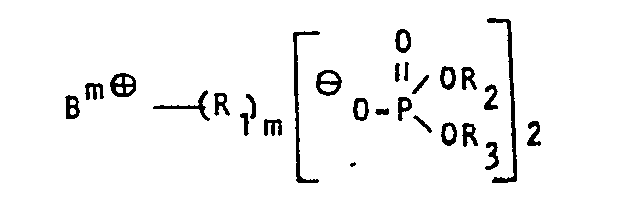
- the invention now relates to new cationic brighteners of the formula wherein B is a brightener with basic tertiary amino groups, m is the number of basic amino groups and R 1 , R 2 and R 3 are unsubstituted or non-chromophorically substituted alkyl or alkenyl each having 1 to 4 carbon atoms.
- Suitable brighteners B are, for example, non-quaternized representatives B 1 from the class of 2-furanyl-benzimidazoles (cf. US Pat. No. 3,497,525; 3,631,168; 3,637,734; 3,900,419; 4,009,994; 4,018,789 and 4,146,725; DE-OS 23 46 316; 28 07 008; 28 52 531 and 28 21 116), 2-azolylbenzimidazoles (see US Pat. No. 4,083,958), 2-stilbenyl benzimidazoles (see US Pat. No.
- the number of basic amino groups is preferably 1 or 2. However, more may also be present.
- Basic tertiary amino groups are preferably understood to mean amino groups of aliphatic or aromatic character.
- Cationic brighteners of the formula are important wherein m 1 represents 1 or 2 and R and R Alkyl with 1 to 4 carbon atoms or benzyl and B is a brightener of the formula wherein M is alkylene-N (R 4 ) (R 5 ), pyrazolyl or pyridinyl, R 4 and R 5 independently of one another unsubstituted or non-chromophore-substituted alkyl having 1 to 6 C atoms, unsubstituted or non-chromophore-substituted alkenyl with 2 up to 6 C atoms or R 4 and R 5 together with the N atom also a 5- to 7-membered heterocyclic ring, R 6 and R 7 independently of one another unsubstituted or non-chromophorically substituted alkyl having 1 to 6 C atoms, unsubstituted or non-chromophore-substituted alkenyl having 2 to 6 carbon atoms
- Suitable non-chromophoric bridge members Q are groups, such as —SO 2 -alkyleneoxy having 2 to 8, preferably 2 to 4, carbon atoms in the alkylene part, —COO-, —SO 2 -, —SO 2 -alkylene-COO-, -SO 2 -alkylene-CON (R) -and-S0 2 N (R) -, in which R represents hydrogen or alkyl having 1 to 6, preferably 1 to 4, carbon atoms, for example by cyano, carbamoyl, carboxy, Carbalkoxy, hydroxy, halogen, alkoxy can be substituted with 1 to 4 carbon atoms or together with R4 forms a piperazine ring.
- the non-chromophoric bridge members X are oxygen, sulfur, -S0 2 N (R) -, -CON (R) -, -OCO-, -COO-, the direct bond, -OC 1-3 -alkylene-CON (R ) - or-OC 1-3 -alkylene-COO- into consideration.
- alkylene radicals can be of various types, straight-chain or branched, and have 1 to 12 and in particular 1 to 6 carbon atoms. You can also wear a hydroxy group.
- Suitable alkyl radicals R 4 and R 5 are those having 1 to 6, preferably 1 to 4, carbon atoms. They can be substituted, for example, with halogen, cyano, hydroxy, alkoxy, phenyl or alkoxycarbonyl having 1 to 4 carbon atoms.
- the radicals R 4 and R 5 can together form a 5- to 7-membered heterocyclic ring, for example a piperidine, pyrrolidine, hexamethyleneimine or morpholine ring, which can be substituted by alkyl groups having 1 to 4 carbon atoms.
- R 4 may also form a piperazine ring together with R.
- Non-chromophore-substituted alkyl groups are to be understood for R 6 in particular the alkoxyalkyl group with a total of 3 to 6 carbon atoms and the benzyl group and for R 7 with hydroxyl, alkoxy with 1 to 4 C atoms, carbalkoxy with 2 to 5 C atoms, cyano To understand phenyl or carbamoyl substituted alkyl.
- the alkenyl groups representing R 6 and R 7 are preferably unsubstituted and preferably contain 3 to 4 carbon atoms and the phenyl radicals can, for example, also be substituted by 1 to 2 alkyl groups each having 1 to 4 Ct atoms, chlorine or alkoxy having 1 to 4 carbon atoms.
- non-chromophoric substituents of the benzene or heterocyclic nuclei are: halogen atoms, alkyl groups with 1 to 6 C atoms, cyclohexyl groups, alkenyl groups with 3 to 6 C atoms, alkoxy groups with 1 to 6 C atoms, alkenyloxy groups with 3 to 6 carbon atoms, phenoxy which can also be substituted with methyl, chlorine or methoxy, alkylsulfonyl groups with 1 to 6 carbon atoms, phenylsulfonyl or phenoxysulfonyl groups which can also be substituted with methyl, chlorine or methoxy, benzylsulfone y 1, cyano , Trifluoromethyl, alkoxycarbonyl having 2 to 7 carbon atoms, carboxy, phenyl, benzyl, - CONZ1Z2 or -SO 2 N 1 Z 2 , where Z 1 is hydrogen, alkyl having 1 up to 4
- R is and R preferably alkyl having 1 to 3 carbon atoms
- R 4 , R 5 and R 6 are preferably unsubstituted alkyl radicals having 1 to 4 carbon atoms, where R4 and R 5 may optionally together form a pyrrolidine, piperidine, hexamethyleneimine or morpholine radical, R 4 can also form a piperazine ring together with R.
- R 7 is preferably alkyl with 1 to 4 carbon atoms, alkenyl with 3 or 4 carbon atoms, cyanoalkyl with 2 or 3 carbon atoms, carbalkoxyalkyl with 1 to 3 carbon atoms in the alkoxy part, benzyl or phenyl.
- X is oxygen, a direct bond dun g, -SO 2 N (R ') -, -CON (R') - or -COO-
- R ' is hydrogen, unsubstituted or substituted by a Cyano-substituted alkyl with 1 to 4 carbon atoms or together with R 4 for a piperazine ring.
- the benzene and heterocyclic rings are preferably substituted with hydrogen, chlorine, alkyl with 1 to 4 carbon atoms or alkoxy with 1 to 4 carbon atoms, the benzimidazole ring also with alkylsulfonyl with 1 to 4 carbon atoms, phenylsulfonyl, cyano, trifluoromethyl, phenoxysulfonyl, alkoxycarbonyl with a total of 2 to 5 carbon atoms, carboxy, -CONZ Z or -SO 2 NZ Z , where Z for hydrogen, alkyl with 1 to 4 carbon atoms, alkenyl with 3 or 4 carbon atoms, hydroxyalkyl with 2 to 4 carbon atoms, alkoxyalkyl with a total of 3 up to 6 carbon atoms, cyclohexyl or benzyl and Z represent hydrogen, alkyl having 1 to 4 carbon atoms or Z and Z can also form a morpholine ring together with the nitrogen atom
- Cationic brighteners of the formula (1) are prepared in a manner known per se by quaternizing a brightener B with at least stoichiometric amounts m of a phosphate of the formula wherein R 1 , R 2 and R 3 have the meaning given above, at temperatures between 60 and 200 ° C., optionally in an inert reaction medium.
- Suitable phosphates of the formula (25) are preferably: trimethyl phosphate, triethyl phosphate, triisopropyl phosphate, tri-n-propyl phosphate, dibutyl methyl phosphate, tribenzyl phosphate, diisopropyl methyl phosphate, triallyl phosphate, tributyl phosphate, tris (2-chloroethyl) methphosphate phosphate. Trimethylphosphate is particularly preferred. Bases of cationic dyes can also be quaternized with these trialkylphosphates.
- Aromatic hydrocarbons such as benzene, toluene and xylene
- Halogenated hydrocarbons such as dichloroethane, trichloroethane, tetrachlorethylene, chlorobenzene or dichlorobenzene
- nitro compounds such as nitromethane, nitropropane, nitrobenzene, alkanols and open or cyclic ethers, such as methanol, ethanol, butanol, dibutyl ether, ethylene glycol, ethylene glycol, ethylene glycol ethylene glycol, ethylene glycol ethylene glycol, ethylene glycol ethylene glycol, ethylene glycol ethylene glycol ethylene glycol, ethylene glycol ethylene glycol ethylene glycol, ethylene glycol ethylene glycol ethylene glycol Ketones such as cyclohexanone or methyl ethyl ketone
- a particularly advantageous process is carried out in excess alkylating agent at 60 to 200 ° C, preferably 100-170 ° C, after which the reaction product is often either on cooling or by adding a suitable solvent, e.g. one of the aforementioned solvents, excretes.
- a suitable solvent e.g. one of the aforementioned solvents, excretes.
- a reaction mixture which still contains water-soluble, excess phosphate of the formula (25) can be diluted with water without isolation of the brightener in order to obtain a ready-to-use, concentrated solution.
- concentrated solutions are also part of the present invention. Purely aqueous solutions are obtained by dissolving the isolated cationic brighteners in the desired amount of water.
- a pH buffer substance can be added to them, e.g. Sodium acetate or sodium lactate.
- a good buffering effect is also obtained by neutralizing the aqueous solutions, which initially react with an excess of phosphate, with alkali metal hydroxides (e.g. sodium hydroxide), carbonates or bicarbonates, water-soluble basic amines or ammonia.
- the new compounds defined above show a more or less pronounced fluorescence in dissolved or finely divided state. They can be used for the optical brightening of a wide variety of synthetic, semi-synthetic or natural organic materials or substances which contain such organic materials.
- the organic materials to be optically brightened can belong to the most varied of processing states (raw materials, semi-finished or finished products).
- the compounds to be used according to the invention include Significance for the treatment of textile organic materials, especially textile fabrics.
- the new optical brighteners according to the present invention can also be used in the following application forms, for example.
- the combined treatment can in many cases advantageously be carried out with the aid of corresponding stable preparations which contain the optically brightening compounds in such a concentration that the desired lightening effect is achieved.
- the brighteners are brought to full effect by post-treatment.
- This can be, for example, a chemical (e.g. acid treatment), a thermal (e.g. heat) or a combined chemical / thermal treatment.
- the amount of the new optical brightener to be used according to the invention can vary within wide limits. Even with very small quantities, in certain cases e.g. of 0.0001% by weight, a clear and durable effect can be achieved. However, amounts of up to about 0.8 percent by weight and optionally up to about 2 percent by weight can also be used. for most practical purposes, amounts between 0.005 and 0.5 percent by weight are of interest.
- the brighteners as such, i.e. to be used purely, but mixed with a wide variety of auxiliaries and coupling agents, e.g. anhydrous sodium sulfate, sodium sulfate decahydrate, sodium chloride, sodium carbonate, alkali metal phosphates, such as sodium or potassium orthophosphate, sodium or potassium pyrophosphate and sodium or potassium tripolyphosphates or alkali metal silicates.
- auxiliaries and coupling agents e.g. anhydrous sodium sulfate, sodium sulfate decahydrate, sodium chloride, sodium carbonate, alkali metal phosphates, such as sodium or potassium orthophosphate, sodium or potassium pyrophosphate and sodium or potassium tripolyphosphates or alkali metal silicates.
- the cationic brighteners according to the invention are suitable for optically brightening organic materials, especially polyacrylonitrile, polyamide and cellulose.
- Example 3 7.0 g of the compound of the formula
- the solubilities of the corresponding methosulfates in water at room temperature are about 0.1% each.
- the brighteners of the formula listed in Table II can also be used in the manner described above getting produced.
- Example 4 6.7 g of the compound of the formula are heated to 110-120 ° C in 8.4 g trimethyl phosphate with stirring for 15 minutes. After this time, a sample is clearly soluble in water. The reaction mixture is diluted with 50 ml of methyl ethyl ketone, allowed to cool and the product which has crystallized out is filtered off. After repeated washing with methyl ethyl ketone and drying in vacuo at 100 ° C., 8.8 g of the compound of the formula are obtained of mp 143 ° C, which contains about 2 moles of water of crystallization. The solubility of this product in water at room temperature is over 50%, that of the corresponding methosulfate is 0.08%.
- the solubility of the product of formula (402) at room temperature is over 100 g in 100 ml of water, that of the corresponding methosulfate or chloride is about 1 g.
- the solubility of the product of formula (403) in water at room temperature is about 42%, that of the corresponding methosulfate is 0.05%.
- Example 5 5.6 g of the compound of the formula are heated to 30 ° C. in 30 ml of trimethyl phosphate with stirring for 60 minutes, during which the reaction product crystallizes out. After this time, a sample of it is clearly soluble in water. It is diluted with 30 ml of methyl ethyl ketone, allowed to cool, suction filtered and the residue is washed repeatedly with methyl ethyl ketone. After drying in vacuo at 100 ° C., 7.2 g of the compound of the formula are obtained in almost colorless crystals of mp. 270 ° C (dec.).
- This product is clearly soluble in water at room temperature in a concentration of about 40% compared to 11% for the corresponding methosulfate.
- the compound of the formula is obtained in an analogous manner of mp. 190 ° C, which contains about 3 1/2 mol of water of crystallization.
- the solubility of this product in water is at least 50%, that of the corresponding methosulfate 16%.
- the compound of the formula is obtained in an analogous manner 250 ° C.
- the solubility of this product in water is over 50% at room temperature, compared to 16% for the corresponding methosulfate.
- the compound of the formula is obtained in a manner similar to that mentioned in the preceding examples which is used without isolation after dilution with water (UV ⁇ max 365 nm in DMF).
- Example 8 A polyacrylonitrile fabric (Orlon 75) is on a dyeing machine at a liquor ratio of 1:20 with an aqueous bath, the contains, treats.
- the polyacrylonitrile fabric is then rinsed in flowing softened water for 30 seconds and dried in a drying cabinet at 70 ° C.
- the fabric treated in this way has a good lightening effect.
- Example 9 A modified polyacrylonitrile fabric (Courtelle) is on a dyeing machine at a liquor ratio of 1:20 with an aqueous bath, the
- the polyacrylonitrile fabric is then rinsed in flowing softened water for 30 seconds and dried in a drying cabinet at 70 ° C.
- the fabric treated in this way has a good lightening effect.
- Example 10 Freshly spun, stretched polyacrylonitrile wet cable (corresponding to 3.0 dry weight) is still immersed in water at 45 ° C. for 4 seconds in 100 ml of an aqueous liquor which contains 0.0005% of a brightener of the formula (101), (301 ), (401), (402), (403), (501), (506) or (601) and has been adjusted to pH 4 with concentrated oxalic acid solution.
- the wet cable is then briefly rinsed with water and dried at 90 to 100 ° C. A well lightened polyacrylonitrile fiber is obtained in this way.
- the coloration can e.g. also at pH 6 (adjusted by adding sodium acetate).
- Increased temperature of the dye liquor e.g. to 40 ° C, increases the pull-out speed.
- Example 11 A bleached cotton fabric is treated on a dyeing machine at a liquor ratio of 1:20 with an aqueous bath containing 0.1X of the brightener of the formula (501), (502), (503), (506), ( 601) or (612), based on the weight of the cotton, and
- the cotton fabric is then rinsed in flowing softened water for 20 seconds and dried in a drying cabinet at 70 ° C.
- the cotton fabric treated in this way has a good lightening effect.
- EXAMPLE 12 A bleached cotton fabric is padded at room temperature with an aqueous liquor which contains 1 g / l of the brightener of the formula (501), (502), (503), (506) or (601). The squeeze effect is 75X.
- the cotton fabric treated in this way has a good lightening effect.
- Example 13 A concentrated liquid detergent is prepared by mixing the following components:
- Example 14 A bleached cotton fabric is washed in a liquor ratio of 1:20 for 15 minutes in a 40 ° C. warm, aqueous liquor, per liter
- the cotton fabric is then rinsed in flowing drinking water for 20 seconds and dried in a drying cabinet at 70 ° C.
- the cotton fabric treated in this way has a good lightening effect.
- Example 15 A fabric made from polyamide 6.6 woven tricot is placed in a dyeing machine in a 1:20 liquor ratio with an aqueous bath containing 0.1% of the brightener of the formula (401) to (403) or (405) to (407) containing the product weight and 3 g / 1 sodium dithionite stabilized with 40% sodium pyrophosphate.
- the polyamide fabric is then rinsed in flowing softened water for 30 seconds and dried in a drying cabinet at 70 ° C.
- the fabric treated in this way has a good lightening effect.
Landscapes
- Chemical & Material Sciences (AREA)
- Organic Chemistry (AREA)
- Textile Engineering (AREA)
- Engineering & Computer Science (AREA)
- Biochemistry (AREA)
- Molecular Biology (AREA)
- General Health & Medical Sciences (AREA)
- Health & Medical Sciences (AREA)
- Life Sciences & Earth Sciences (AREA)
- Coloring (AREA)
- Detergent Compositions (AREA)
- Plural Heterocyclic Compounds (AREA)
- Paper (AREA)
Abstract
Description
- Die vorliegende Erfindung betrifft neue kationische optische Aufheller, ein Verfahren zu deren Herstellung sowie deren Verwendung zum optischen Aufhellen von organischen Materialien sowie zur Herstellung von konzentrierten wässerigen Lösungen.
- Es ist in der Literatur eine grössere Zahl kationischer Aufheller bekannt, die bei Raumtemperatur in Wasser nur beschränkt löslich sind. Solche Aufheller sind quaternierte Ammoniumsalze basischer Aufheller, die z.B. in den Patentschriften beschrieben sind, welche meist auch die basischen Aufheller selbst umfassen. Solche Verbindungen entsprechen dem weiter unten angegebenen Aufhellerteil B.
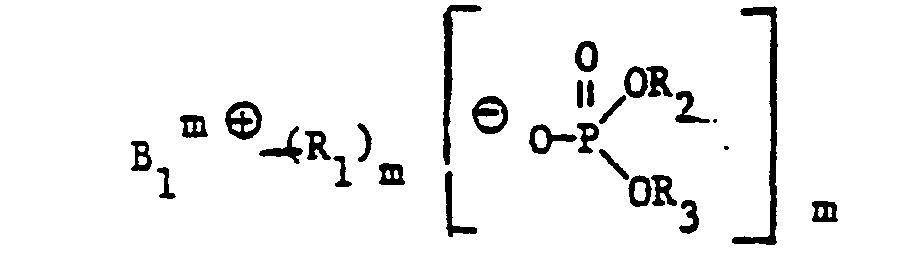
- Die Erfindung betrifft nun neue kationische Aufheller der Formel

- Geeignete Aufheller B sind z.B. nicht quaternierte Vertreter B1 aus der Klasse der 2-Furanyl-benzimidazole (vgl. US-PS 3.497,525; 3,631,168; 3,637,734; 3,900,419; 4,009,994; 4,018,789 und 4,146,725; DE-OS 23 46 316; 28 07 008; 28 52 531 und 28 21 116), 2-Azolylbenzimidazole (vgl. US-PS 4,083,958) 2-Stilbenyl-benzimidazole (vgl. US-PS 3,133,916), basischen 1,2-Bis-(azolyl)-äthylene (vgl. US-PS 2 808 407; 3 259 619; 3 169 960), 2,5-Bis-(benzimidazolyl)-furane (vgl. US-PS 3 005 779), basischen 4,4'-Bis-(azolyl)-stilbene (vgl. US-PS 3 583 984), basischen 2-Phenyl-5-azolyl-thiophene (vgl. US-PS 3 264 315), basischen 1,3-Diphenylpyrazoline (vgl. US-PS 3 131 079; 3 378 389; 3 574 195; 4 183 853; 3 560 485; 3 690 947; 3 865 816; 3 957 815; 4 045 169; 3 849 406; 4 085 101; 3 598 510; 3 141 879; 4 151 163; 3 753 978; 4 129 563; DE-OS 27 55 023; 23 46 316; 28 07 008; FR-PS 1 431 233), basischen.4,4'-Distyryl-biphenyle (vgl. US-PS 3 984 399), basische 1,4-Distyryl-benzole (vgl. US-PS 3 755 446), basischen 3,7-disubstituierten Cumarine (vgl. US-PS 3 251 851; 3 271 412; 3 625 952; 3 663 560; 4 005 098; DE-OS 1 919 181), basischen Naphthalimide (vgl. GB-PS 962 019; 1 22.7 239; US-PS 3 697 525; 3 625 947; 3 880 859; 3 941 791; 3 776 932; 4 075 211; DE-OS 2 064 159; 25 07 459; 26 41 001), basischen 4,4'-Bis-triazinylamino-stilbene (vgl. DE-OS 1 930 309; 2 060 085), basischen 2-Stilben-4-yl-naphtho-triazole (vgl. DE-AS 1 090 169) und der basischen 4,4'-Bis-(triazolyl)-und -(pyrazolyl)-stilbene (vgl. US-PS 3 824 236; 3 796 706).
- Diese neuen kationischen Aufheller zeichnen sich gegenüber jenen der genannten Veröffentlichungen durch eine bei Raum- und höherer Temperatur stark verbesserte Löslichkeit in Wasser und in polaren organischen Lösungsmitteln aus. Diese verbesserte Löslichkeit ermöglicht die Herstellung von Aufhellerlösungen mit Konzentrationen bis zu 60 Gewichtsprozent, vorzugsweise von 10 bis 50 Gewichtsprozent Aufhellersubstanz.
- Die Anzahl basischer Aminogruppen beträgt vorzugsweise 1 oder 2. Es können aber auch noch weitere vorhanden sein.
- Unter basischen tertiären Aminogruppen werden vorzugsweise Aminogruppen aliphatischen oder aromatischen Charakters verstanden.
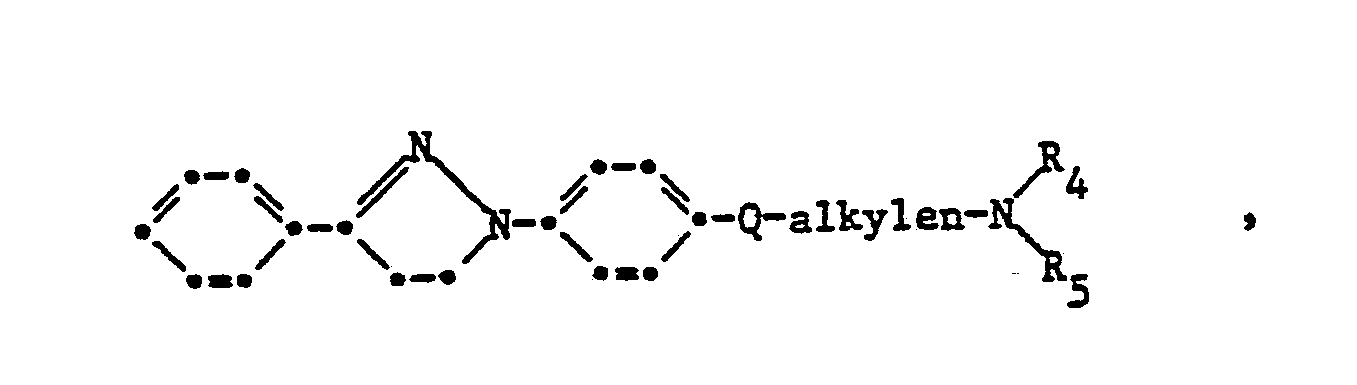
- Von Bedeutung sind kationische Aufheller der Formel
 und R
und R Alkyl mit 1 bis 4 C-Atomen oder Benzyl und B einen Aufheller der Formel





- Als nicht-chromophore Brückenglieder Q kommen Gruppen in Betracht, wie -SO2-alkylenoxy mit 2 bis 8, vorzugsweise 2 bis 4 C-Atomen im Alkylenteil, -COO-, -SO2-, -SO2-alkylen-COO-, -SO2-alkylen-CON(R)-und-S02N(R)-, worin R für Wasserstoff oder Alkyl mit 1 bis 6, vorzugsweise 1 bis 4 C-Atomen steht, das beispielsweise durch Cyano, Carbamoyl, Carboxy, Carbalkoxy, Hydroxy, Halogen, Alkoxy mit 1 bis 4 C-Atomen substituiert sein kann oder das zusammen mit R4 einen Piperazinring bildet.
- Als nicht-chromophore Brückenglieder X kommen Sauerstoff, Schwefel, -S02N(R)-, -CON(R)-, -OCO-, -COO-, die direkte Bindung, -O-C1-3-Alkylen-CON(R)- oder-O-C1-3-Alkylen-COO- in Betracht.
- Die "Alkylen"-Reste können verschiedenartig geradkettig oder verzweigt sein und 1 bis 12 und besonders 1 bis 6 C-Atome aufweisen. Sie können auch eine Hydroxygruppe tragen.
- Geeignete Alkylreste R4 und R5 sind solche mit 1 bis 6, vorzugsweise 1 bis 4 C-Atomen. Sie können beispielsweise mit Halogen, Cyano, Hydroxy, Alkoxy, Phenyl oder Alkoxycarbonyl mit 1 bis 4 C-Atomen substituiert sein. Die Reste R4 und R5 können zusammen einen 5- bis 7-gliedrigen heterocyclischen Ring bilden, z.B. einen Piperidin-, Pyrrolidin-, Hexamethylenimin-oder Morpholinring, der durch Alkylgruppen mit 1 bis 4 C-Atomen substituiert sein kann. R4 kann ferner mit R zusammen einen Piperazinring bilden.
- Unter nicht-chromophor substituierten Alkylgruppen sind für R6 besonders die Alkoxyalkylgruppe mit insgesamt 3 bis 6 Kohlenstoffatomen und die Benzylgruppe zu verstehen und für R7 mit Hydroxy, Alkoxy mit 1 bis 4 C-Atomen, Carbalkoxy mit 2 bis 5 C-Atomen, Cyano, Phenyl oder Carbamoyl substituiertes Alkyl zu verstehen.
- Die für R6 und R7 stehenden Alkenylgruppen sind vorzugsweise unsubstituiert und enthalten vorzugsweise 3 bis 4 Kohlenstoffatome und die Phenylreste können z.B. noch mit 1 bis 2 Alkylgruppen mit je 1 bis 4 CtAtomen, Chlor oder Alkoxy mit 1 bis 4 Kohlenstoffatomen substituiert sein.
- Als nicht-chromophore Substituenten der Benzol- oder heterocyclischen Kerne seien beispielsweise erwähnt: Halogenatome, Alkylgruppen mit 1 bis 6 C-Atomen, Cyclohexylgruppen, Alkenylgruppen mit 3 bis 6 C-Atomen, Alkoxygruppen mit 1 bis 6 C-Atomen, Alkenyloxygruppen mit 3 bis 6 C-Atomen, Phenoxy das noch mit Methyl, Chlor oder Methoxy substituiert sein kann, Alkylsulfonylgruppen mit 1 bis 6 C-Atomen, Phenylsulfonyl- oder Phenoxy-sulfonylgruppen die noch mit Methyl, Chlor oder Methoxy substituiert sein können, Benzylsulfonyl, Cyano, Trifluormethyl, Alkoxycarbonyl mit 2 bis 7 C-Atomen, Carboxy, Phenyl, Benzyl, -CONZ1Z2 oder -SO2N1Z2, worin Z1 für Wasserstoff, Alkyl mit 1 bis 4 Kohlenstoffatomen, Alkenyl mit 3 oder 4 Kohlenstoffatomen, Hydroxyalkyl mit 2 bis 4 Kohlenstoffatomen, Cyclohexyl, Alkoxyalkyl mit insgesamt 3 bis 6 Kohlenstoffatomen, Benzyl oder Dialkylaminoalkyl mit insgesamt 3 bis 7 Kohlenstoffatomen, welches durch Rquaterniert sein kann, Z2 für Wasserstoff, Alkyl mit 1 bis 4 Kohlenstoffatomen oder Alkenyl mit 3 oder 4 Kohlenstoffatomen und Z1 und Z2 zusammen mit dem Stickstoffatom für einen Pyrrolidin-, Piperidin-, N-Alkylpiperazinmit 1 bis 3 Kohleustoffatomen im Alkylteil, Hexamethylenimin oder Morpholinring stehen.

- In Formel (2) bedeuten Rund R
 vorzugsweise Alkyl mit 1 bis 3 Kohlenstoffatomen, R4, R5 und R6 sind vorzugsweise unsubstituierte Alkylreste mit 1 bis 4 Kohlenstoffatomen, wobei R4 und R5 gegebenenfalls noch zusammen einen Pyrrolidin-, Piperidin-,Hexamethylenimin oder Morpholinrest bilden können, R4 kann auch zusammen mit R einen Piperazinring bilden. R7 ist vorzugsweise Alkyl mit 1 bis 4 Kohlenstoffatomen, Alkenyl mit 3 oder 4 Kohlenstoffatomen, Cyanoalkyl mit 2 oder 3 Kohlenstoffatomen, Carbalkoxyalkyl mit 1 bis 3 Kohlenstoffatomen im Alkoxyteil, Benzyl oder Phenyl. D steht vorzugsweise für =N-, X für Sauerstoff, die direkte Bin- dung, -SO2N(R')-, -CON(R')- oder -COO- und R' für Wasserstoff, unsubstituiertes oder durch eine Cyanogruppe substituiertes Alkyl mit 1 bis 4 Kohlenstoffatomen oder zusammen mit R4 für einen Piperazinring.Die Benzol-und die heterocyclischen Ringe sind vorzugsweise mit Wasserstoff, Chlor, Alkyl mit 1 bis 4 Kohlenstoffatomen oder Alkoxy mit 1 bis 4 Kohlenstoffatomen substituiert, der Benzimidazolring ausserdem noch mit Alkylsulfonyl mit 1 bis 4 Kohlenstoffatomen, Phenylsulfonyl, Cyano, Trifluormethyl, Phenoxysulfonyl, Alkoxycarbonyl mit insgesamt 2 bis 5 Kohlenstoffatomen, Carboxy, -CONZ
 Z
Z oder -SO2NZ
 Z
Z , worin Z
 für Wasserstoff, Alkyl mit 1 bis 4 C-Atomen, Alkenyl mit 3 oder 4 C-Atomen, Hydroxyalkyl mit 2 bis 4 C-Atomen, Alkoxyalkyl mit insgesamt 3 bis 6 C-Atomen, Cyclohexyl oder Benzyl und Z
 für Wasserstoff, Alkyl mit 1 bis 4 C-Atomen stehen oder Z
 und Z
und Z zusammen mit dem Stickstoffatom auch einen Morpholinring bilden können.
- Von besonderer Bedeutung sind kationische Aufheller der Formel
 Alkyl mit 1 bis 3 C-Atomen und B einen Aufhellerrest der Formel


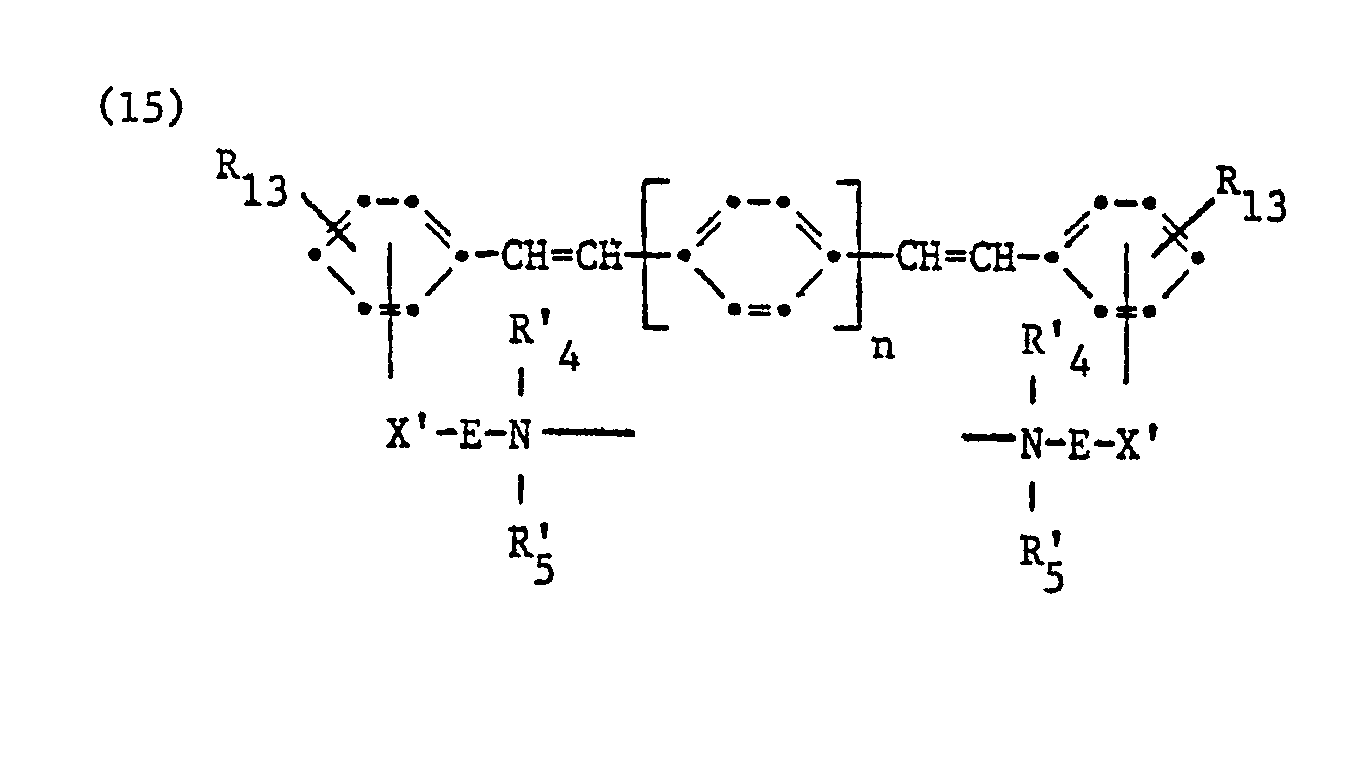

bedeuten, in welchen Reste - RAlkyl mit 1 bis 4 C-Atomen

- RAlkyl mit 1 bis 4 C-Atomen, Benzyl, Phenyl, Alkenyl mit 3 bis 4 C-Atomen, Cyanoalkyl mit 2 oder 3 C-Atomen, Alkoxycarbonylmethyl mit 1 bis 3 C-Atomen im Alkoxyteil,

- R8 Wasserstoff, Methyl, Chlor, Alkylsulfonyl mit 1 bis 4 C-Atomen, Phenylsulfonyl, Cyano, Trifluormethyl, Phenoxysulfonyl, Alkoxycarbonyl mit insgesamt 2 bis 5 C-Atomen, Carboxy, -CONZZ
 oder -SO2NZ
 Z
Z , worin Z
 für Wasserstoff, Alkyl mit 1 bis 4 C-Atomen, Alkenyl mit 3 oder 4 C-Atomen, Hydroxyalkyl mit 2 bis 4 C-Atomen, Alkoxyalkyl mit insgesamt 3 bis 6 C-Atomen, oder Benzyl und Z
 für Wasserstoff, Alkyl mit 1 bis 4 C-Atomen stehen oder Z
 und Z
und Z zusammen mit dem Stickstoffatom auch einen Morpholinring bilden können
- R9, R10, R 11 und R 12 unabhängig voneinander Wasserstoff, Chlor oder Methyl,
- Q1 -COO- oder vorzugsweise -SO2-,
- Y Alkylen mit 2 bis 4 C-Atomen, -N(R')-alkylen mit 2 bis 4 C-Atomen im Alkylenteil, Alkylenoxyalkylen mit insgesamt 4 bis 7 C-Atomen, Alkylen-COO-alkylen oder Alkylen-CONH-alkylen mit jeweils insgesamt 4 bis 7 C-Atomen
- R' Wasserstoff, unsubstituiertes oder durch eine Cyanogruppe substituiertes Alkyl mit 1 bis 4 C-Atomen oder zusammen mit Reinen Piperazinrest

- X' Sauerstoff, Schwefel, die direkte Bindung, -SO2NR'-, -CONR'- oder -COO-
- E unsubstituiertes oder durch eine OH-Gruppe substituiertes Alkylen mit 1 bis 4 C-Atomen,
- R4 Alkyl mit 1 bis 4 C-Atomen, zusammen mit R' einen Piperazinrest oder zusammen mit Reinen Pyrrolidin-, Piperidin-, Hexamethylenimin- oder Morpholinrest

- RAlkyl mit 1 bis 4 C-Atomen oder zusammen mit R4 einen Pyrrolidin-, Piperidin-, Hexamethylenimin- oder Morpholinrest

- R13 Wasserstoff, Chlor, Alkyl mit 1 bis 4 C-Atomen oder Alkoxy mit 1 bis 4 C-Atomen
- n die Zahl 1 oder 2 und
- M' -Alkylen (R
 R
R ) oder den Rest

- Von besonderem Interesse sind
- a) kationische Aufheller der Formel

 für Alkyl mit 1 bis 4 C-Atomen und R9 und R10 unabhängig voneinander für Wasserstoff, Chlor oder Methyl stehen, R
 Alkyl mit 1 bis 4 C-Atomen, Benzyl, Phenyl, Alkenyl mit 3 oder 4 C-Atomen, Cyanoalkyl mit 2 oder 3 C-Atomen, Alkoxycarbonylmethyl mit 1 bis 3 C-Atomen im Alkoxyteil und R8 Wasserstoff, Methyl, Chlor, Alkylsulfonyl mit 1 bis 4 C-Atomen, Phenylsulfonyl, Cyano, Trifluormethyl, Phenoxysulfonyl, Alkoxycarbonyl mit insgesamt 2 bis 5 C-Atomen, Carboxy, CONZ
 Z
Z oder SO2NZ
 Z'2, worin Zi für Wasserstoff, Alkyl mit 1 bis 4 C-Atomen, Alkenyl mit 3 oder 4 C-Atomen, Hydroxyalkyl mit 2 bis 4 C-Atomen, Alkoxyalkyl mit insgesamt 3 bis 6 C-Atomen oder Benzyl und Z
 für Wasserstoff, Alkyl mit 1 bis 4 C-Atomen stehen oder Z
 und Z
und Z zusammen mit dem Stickstoffatom auch einen Morpholinring bilden können, bedeuten,
- b) kationische Aufheller der Formel
 Alkyl mit 1 bis 3 C-Atomen, vorzugsweise Methyl, R
 Alkyl mit 1 bis 4 C-Atomen oder zusammen mit R' einen Piperazinrest oder zusammen mit R
 einen Pyrrolidin-, Piperidin-, Hexamethylenimin-oder Morpholinrest, R
 Alkyl mit 1 bis 4 C-Atomen oder zusammen mit R
 einen Pyrrolidin-, Piperidin-, Hexamethylenimin-oder Morpholinrest, R 11 und R12 Wasserstoff, Methyl oder Chlor, Y Alkylen mit 2 bis 4 C-Atomen, -N(R')-alkylen mit 2 bis 4 C-Atomen im Alkylenteil, Alkylenoxyalkylen mit insgesamt 4 bis 7 C-Atomen, Alkylen-COO-alkylen mit insgesamt 4 bis 7 C-Atomen oder Alkylen-CONH-alkylen mit insgesamt 4 bis 7 C-Atomen und R' Wasserstoff, unsubstituiertes oder durch eine Cyanogruppe substituiertes Alkyl mit 1 bis 4 C-Atomen - oder zusammen mit R
 einen Piperazinring bedeuten, sowie
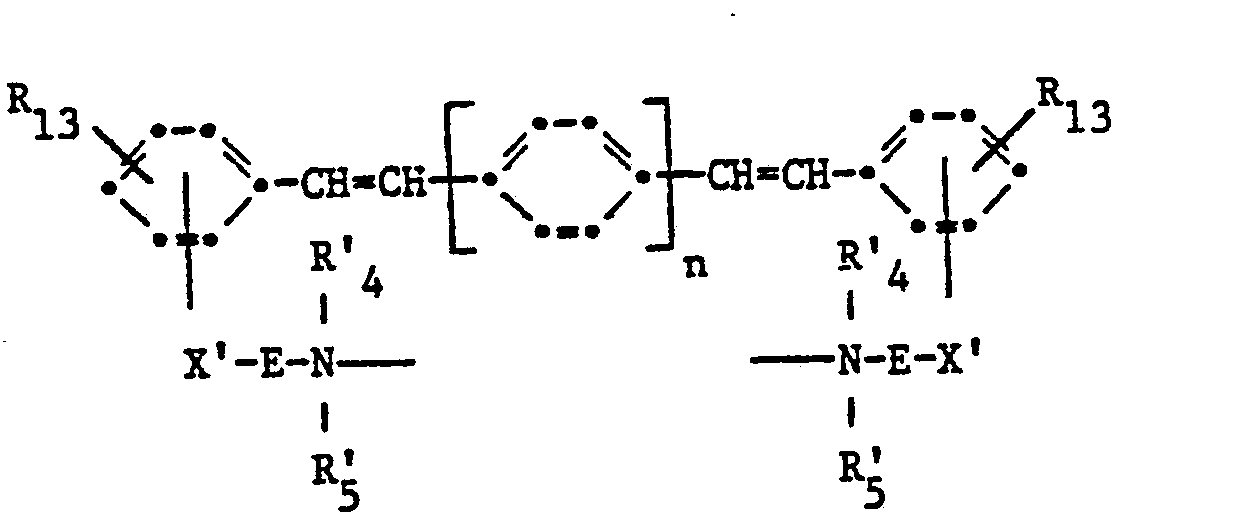
- c) kationische Aufheller der Formel
 einen Piperazinrest, E unsubstituiertes oder durch eine OH-Gruppe substituiertes Alkylen mit 1 bis 4 C-Atomen, R
 Alkyl mit 1 bis 4 C-Atomen, zusammen mit R" einen Piperazinrest oder zusammen mit R
 einen Pyrrolidin-, Piperidin-, Hexamethylenimin-oder Morpholinrest, R
 Alkyl mit 1 bis 4 C-Atomen oder zusammen mit R
 einen Pyrrolidin-, Piperidin-, Hexamethylenimin-oder Morpholinrest, R13 Wasserstoff, Chlor, Alkyl mit 1 bis 4 C-Atomen oder Alkoxy mit 1 bis 4 C-Atomen und n die Zahl 1 oder 2 bedeuten.
- d) kationische Aufheller der Formel

 Alkyl mit 1 bis 4 C-Atomen, Benzyl, Phenyl oder Cyanoalkyl mit 2 bis 3 Kohlenstoffatomen, R
 Wasserstoff, Alkylsulfonyl mit 1 bis 4 Kohlenstoffatomen, Phenylsulfonyl, Phenoxysulfonyl, Sulfamoyl, Alkylsulfamoyl mit 1 bis 4 Kohlenstoffatomen, Alkoxycarbonyl mit 2 bis 4 Kohlenstoffatomen, Cyano oder Chlor und R
 Wasserstoff, Chlor oder Methyl bedeuten,
- e) kationische Aufheller der Formel
 Alkyl mit 1 oder 2 C-Atomen, Y' Alkylen mit 2 bis 4 C-Atomen, -N(R"')-alkylen mit 2 bis 4 C-Atomen im Alkylenteil, Alkylenoxyalkylen mit insgesamt 4 bis 7 C-Atomen oder Alkylen-CON(R"')-alkylen mit insgesamt 4 bis 7 C-Atomen und R''' Wasserstoff, Cyano- äthyl oder zusammen mit R
 einen Piperazinring bedeuten, sowie
- f) kationische Aufheller der Formel
 Alkyl mit 1 oder 2 C-Atomen oder zusammen einen Pyrrolidin-, Piperidin- oder Morpholinrest und n die Zahl 1 oder 2 bedeuten.
- Die Herstellung von kationischen Aufhellern der Formel (1) erfolgt in an sich bekannter Weise durch Quaternierung eines Aufhellers B mit mindestens stöchiometrischen Mengen m eines Phosphates der Formel

- Als Phosphate der Formel (25) kommen vorzugsweise in Betracht: Trimethylphosphat, Triäthylphosphat, Triisopropylphosphat, Tri-n-propylphosphat, Dibutylmethylphosphat, Tribenzylphosphat, Diisopropylmethylphosphat, Triallylphosphat, Tributylphosphat, Tris-(2-chloräthyl)-phosphat und Tris-(methoxyäthyl)-phosphat. Besonders bevorzugt ist Trimethylphosphat- Mit diesen Trialkylphosphaten können auch Basen von kationischen Farbstoffen quaterniert werden.
- Als Reaktionsmedia in denen die Quaternierung vorgenommen werden kann, eignen sich im allgemeinen alle inerten Lösungsmittel. Bevorzugt sind solche, die das Ausgangsprodukt lösen und aus denen sich das Endprodukt sofort ausscheidet. Beispielsweise seien genannt: Aromatische Kohlenwasserstoffe wie Benzol, Toluol und Xylol; Halogenkohlenwasserstoffe wie Dichloräthan, Trichloräthan, Tetrachloräthylen, Chlorbenzol oder Dichlorbenzol, ferner auch Nitroverbindungen wie Nitromethan, Nitropropan, Nitrobenzol, Alkanole und offene oder cyclische Aether wie Methanol, Aethanol, Butanol, Dibutyläther, Aethylenglykol, Aethylenglykolmonomethyläther, Aethylenglykolmonoäthyläther, Anisol oder Dioxan; Ketone wie Cyclohexanon oder Methyläthylketon; Fettsäureamide wie Dimethylformamid oder Dimethylacetamid; Sulfoxyde wie Dimethylsulfoxyd und Carbonsäure-ester oder -nitrile wie Essigester, Essigsäure-butylester, Acetonitril oder Methoxypropionitril. Dabei wird z.B. bei Temperaturen von 60 bis 200°C, vorzugsweise 80 bis 170°C gearbeitet. Zuweilen ist es auch vorteilhaft, Wasser als Lösungsmittel zu verwenden.
- Nach einem besonders vorteilhaften Verfahren arbeitet man in überschüssigem Alkylierungsmittel bei 60 bis 200°C, vorzugsweise 100-170°C, wonach sich das Reaktionsprodukt oft entweder beim Abkühlen oder durch Zugabe eines geeigneten Lösungsmittels, z.B. eines der vorangehend genannten Lösungsmittel, ausscheidet.
- Da die erhaltenen kationischen Aufheller besonders gut wasserlöslich sind, kann man ein Reaktionsgemisch, das noch wasserlösliches, überschüssiges Phosphat der Formel (25) enthält, auch ohne Isolierung des Aufhellers mit Wasser verdünnen, um derart zu einer gebrauchsfertigen, konzentrierten Lösung zu gelangen. Solche konzentrierte Lösungen sind ebenfalls Teil der vorliegenden Erfindung. Rein wässerige Lösungen erhält man durch Lösen der isolierten kationischen Aufheller in der gewünschten Menge Wasser.
- Zur Stabilisierung der wässerigen Lösungen gegen eine allfällige Phosphorsäureester-hydrolyse kann diesen noch eine pH-Puffersubstanz zugegeben werden wie z.B. Natriumacetat oder Natriumlactat. Eine gute Pufferwirkung erhält man auch durch Neutralisation der zunächst meist sauer reagierenden, überschüssiges Phosphat enthaltenden wässerigen Lösungen mit Alkalihydroxiden (z.B. Natriumhydroxid), -carbonaten oder ~bicarbonaten, wasserlöslichen basischen Aminen oder Ammoniak.
- Die zur Quaternierung verwendeten Ausgangsstoffe der Formel (25) sind bekannt oder werden in Analogie zu an sich bekannten Verfahren hergestellt.
- Die vorstehend definierten neuen Verbindungen zeigen in gelöstem oder feinverteiltem Zustande eine mehr oder weniger ausgeprägte Fluoreszenz. Sie können zum optischen Aufhellen der verschiedensten synthetischen, halbsynthetischen oder natürlichen organischen Materialien oder Substanzen, welche solche organische Materialien enthalten, verwendet werden.
- Die optisch aufzuhellenden organischen Materialien können den verschiedenartigsten Verarbeitungszuständen (Rohstoffe, Halbfabrikate oder Fertigfabrikate) angehören.
- Den erfindungsgemäss anzuwendenden Verbindungen kommt u.a. Bedeutung für die Behandlung von textilen organischen Materialien, insbesondere textilen Geweben, zu.
- In Abhängigkeit vom verwendeten Aufheller-Verbindungstyp kann es sich als vorteilhaft erweisen, in neutralem oder alkalischem oder saurem Bade zu arbeiten. Die Behandlung wird üblicherweise bei Temperaturen von etwa 20 bis 140°C, beispielsweise bei Siedetemperatur des Bades oder in deren Nähe (etwa 90°C), durchgeführt. Für die erfindungsgemässe Veredlung textiler Substrate kommen auch Lösungen oder Emulsionen in organischen Lösungsmitteln in Betracht, wie dies in der Färbereipraxis in der sogenannten Lösungsmittelfärberei (Foulard-Thermofixierapplikation, Ausziehfärbeverfahren in Färbemaschinen) praktiziert wird.
- Die neuen optischen Aufhellmittel gemäss vorliegender Erfindung können beispielsweise auch in folgenden Anwendungsformen eingesetzt werden.
-
- a) Mischungen mit Farbstoffen (Nuancierung) oder Pigmenten (Farb-oder insbesondere z.B. Weisspigmenten) oder als Zusatz zu Färbebädern, Druck-, Aetz- oder Reservepasten. Ferner auch zur Nachbehandlung von Färbungen, Drucken oder Aetzdrucken,
- b) in Mischungen mit Netzmitteln, Weichmachern, Quellmitteln, Antioxydantien, Lichtschutzmitteln, Hitzestabilisatoren, chemischen Bleichmitteln (Chlorit-Bleiche, Bleichbäder-Zusätze),
- c) in Mischungen mit Vernetzern, Appreturmitteln (z.B. Stärke oder synthetischen Appreturen) sowie in Kombination mit den verschiedensten Textilveredlungsverfahren, insbesondere Kunstharzausrüstungen (z.B. Knitterfest-Ausrüstungen wie "wash-and-wear", "permanent-press", "noiron"), ferner Flammfest-, Weichgriff-, Schutzablöse ("anti-soiling")-oder Antistatisch-Ausrüstungen oder antimikrobiellen Ausrüstungen,
- d) Einarbeiten der optischen Aufhellmittel in polymere Trägermaterialien (Polymerisations-, Polykondensations- oder Polyadditionsprodukte) in gelöster oder dispergierter Form für Anwendung z.B. in Beschichtungs-, Imprägnier- oder Bindemitteln (Lösungen, Dispersionen, Emulsionen) für Textilien, Vliese, Papier, Leder,
- e) als Zusätze zu sogenannten "master batches",
- f) als Zusätze zu den verschiedensten industriellen Produkten, um dieselben marktfähiger zu machen (z.B. Aspektverbesserung von Seifen, Waschmitteln, Pigmenten),
- g) in Kombination mit anderen, optisch aufhellend wirkenden Substanzen,
- h) in Spinnbadpräparationen, d.h. als Zusätze zu Spinnbädern, wie sie zur Gleitfähigkeitsverbesserung für die Weiterverarbeitung von Synthese-Fasern verwendet werden, oder aus einem speziellen Bad vor der Verstreckung der Faser,
- i) als Szintillatoren, für verschiedene Zwecke photographischer Art, wie z.B. für elektrophotographische Reproduktion oder Supersensibilisierung,
- Wird das Aufhellverfahren mit Textil-Behandlungs- oder Veredlungmethoden kombiniert, so kann die kombinierte Behandlung in vielen Fällen vorteilhafterweise mit Hilfe entsprechender beständiger Präparate erfolgen, welche die optisch aufhellenden Verbindungen in solcher Konzentration enthalten, dass der gewünschte Aufhelleffekt erreicht wird.
- In gewissen Fällen werden die Aufheller durch eine Nachbehandlung zur vollen Wirkung gebracht. Diese kann beispielsweise eine chemische (z.B. Säure-Behandlung), eine thermische (z.B. Hitze) oder eine kombinierte chemisch/thermische Behandlung darstellen.
- Die Menge der erfindungsgemäss zu verwendenden neuen optischen Aufheller, bezogen auf das optisch aufzuhellende Material, kann in weiten Grenzen schwanken. Schon mit sehr geringen Mengen, in gewissen Fällen z.B. solchen von 0,0001 Gewichtsprozent, kann ein deutlicher und haltbarer Effekt erzielt werden. Es können aber auch Mengen bis zu etwa 0,8 Gewichtsprozent und gegebenenfalls bis zu etwa 2 Gewichtsprozent zur Anwendung gelangen. für die meisten praktischen Belange sind vorzugsweise Mengen zwischen 0,005 und 0,5 Gewichtsprozent von Interesse.
- Aus verschiedenen Gründen ist es oft zweckmässig, die Aufheller nicht als solche, d.h. rein einzusetzen, sondern vermischt mit den verschiedensten Hilfs- und Coupiermitteln, wie z.B. wasserfreiem Natriumsulfat, Natriumsulfat-decahydrat, Natriumchlorid, Natriumcarbonat, Alkalimetallphosphaten, wie Natrium- oder Kaliumorthophosphat, Natrium-oder Kaliumpyrophosphat und Natrium- oder Kaliumtripolyphosphaten oder Alkalimetallsilicaten.
- Die erfindungsgemässen kationischen Aufheller sind geeignet zum optischen Aufhellen von organischen Materialien, besonders von Polyacrylnitril, Polyamid und Cellulose.
- In den Beispielen sind Prozente immer Gewichtsprozente. Schmelz-und Siedepunkte sind, sofern nicht anders vermerkt, unkorrigiert und oft sehr unscharf.
-
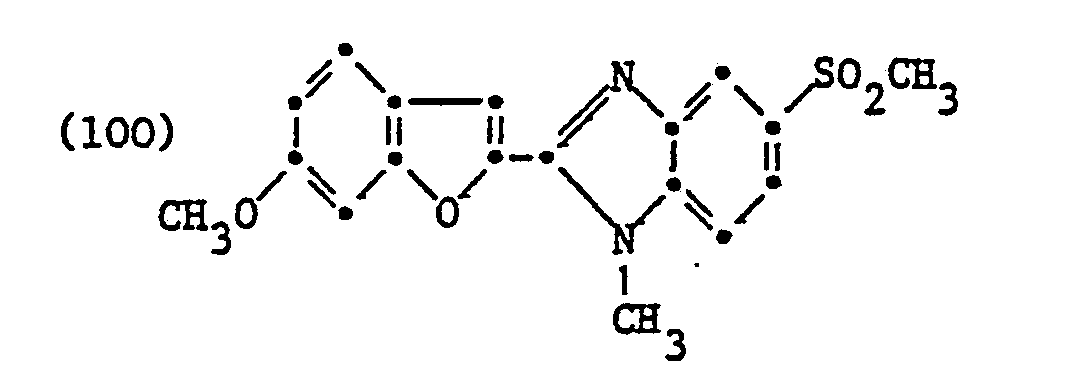

- Kristallisiert man dieses Produkt aus 1,2-Dichloräthan um oder versetzt man das bei der Herstellung entstandene, noch heisse Reaktionsgemisch mit Methyläthylketon anstatt mit Essigsäureäthylester, so erhält man ein Produkt vom Smp. 181°C, das kein Kristall-dimethylphosphat mehr enthält. Die Löslichkeit dieses Produktes beträgt bei Raumtemperatur über 100 g in 100 ml Wasser, jenes des entsprechenden Methosulfats 0,5 g.
-


- In ähnlicher Weise wie in Beispiel 1 oder 2 beschrieben, werden die in Tabelle I aufgeführten Aufheller der Formel


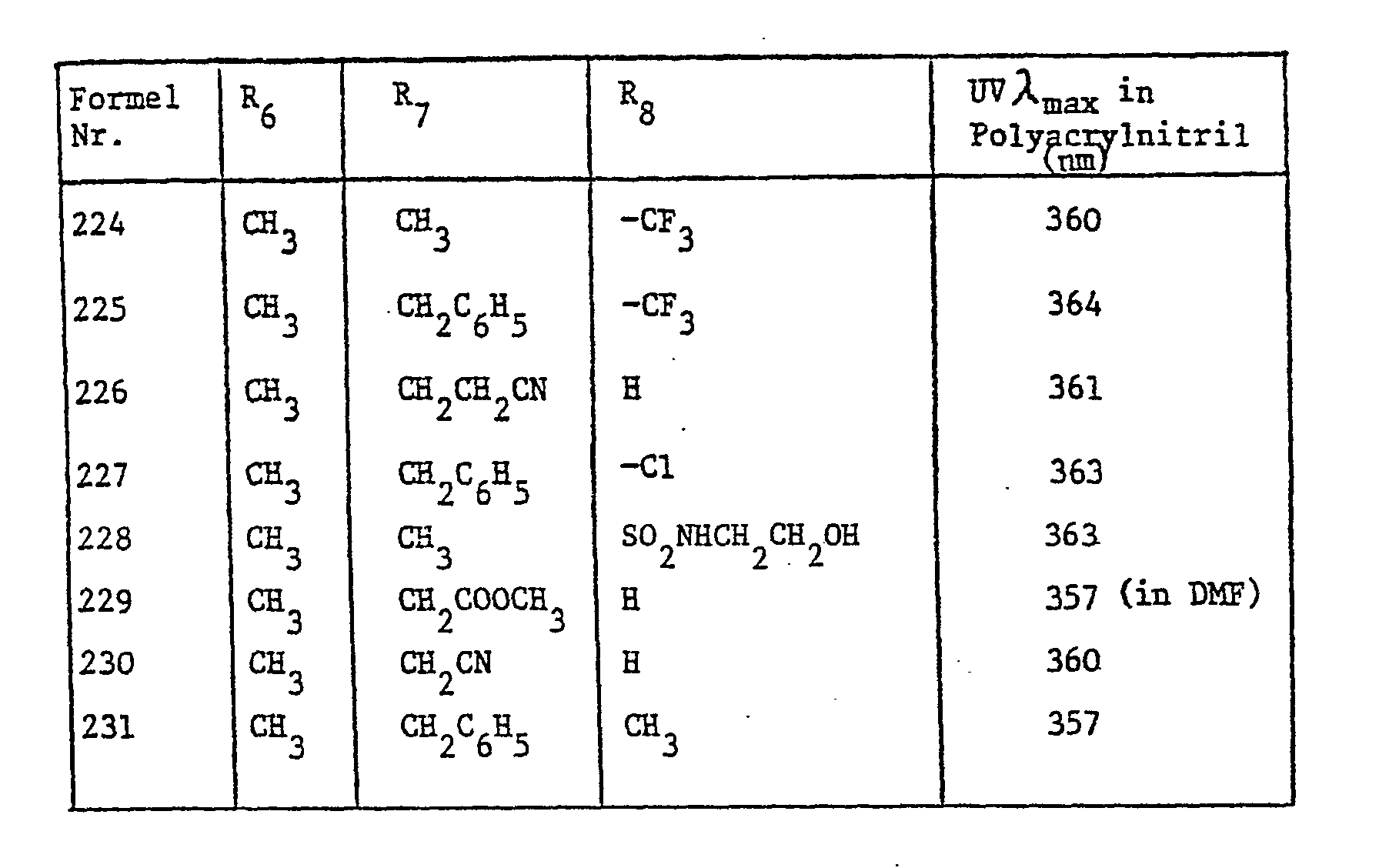
-


- In analoger Weise erhält man die Verbindungen der Formeln
-
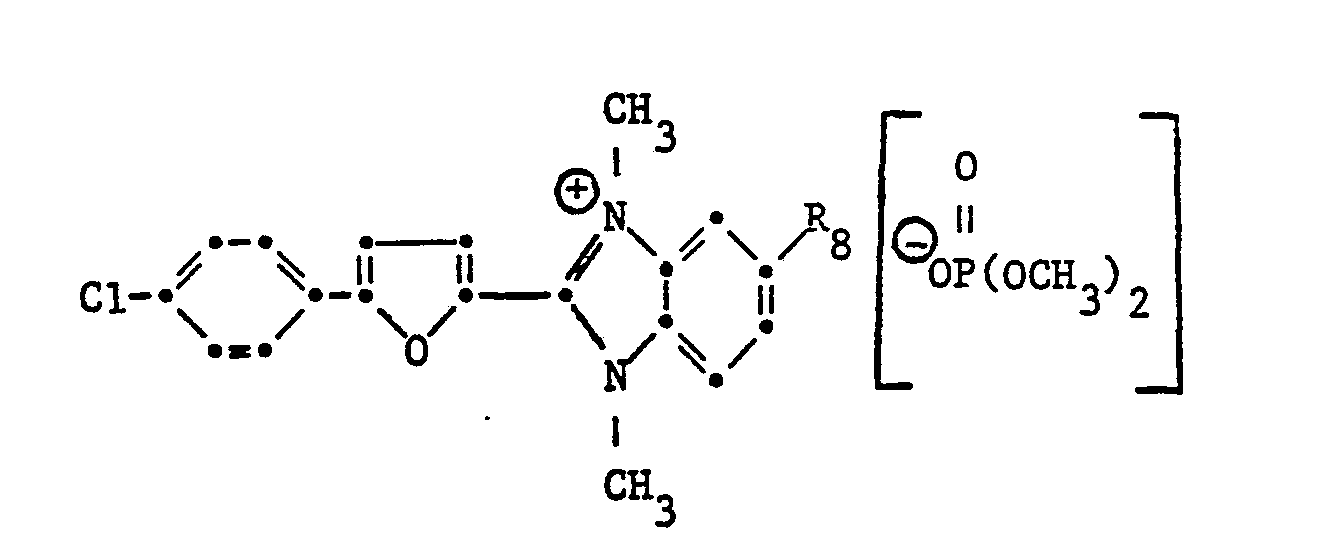

- Die Löslichkeiten der entsprechenden Methosulfate in Wasser bei Raumtemperatur betragen je etwa 0, 1%.
- In der oben beschriebenen Weise können auch die in Tabelle II aufgeführten Aufheller der Formel

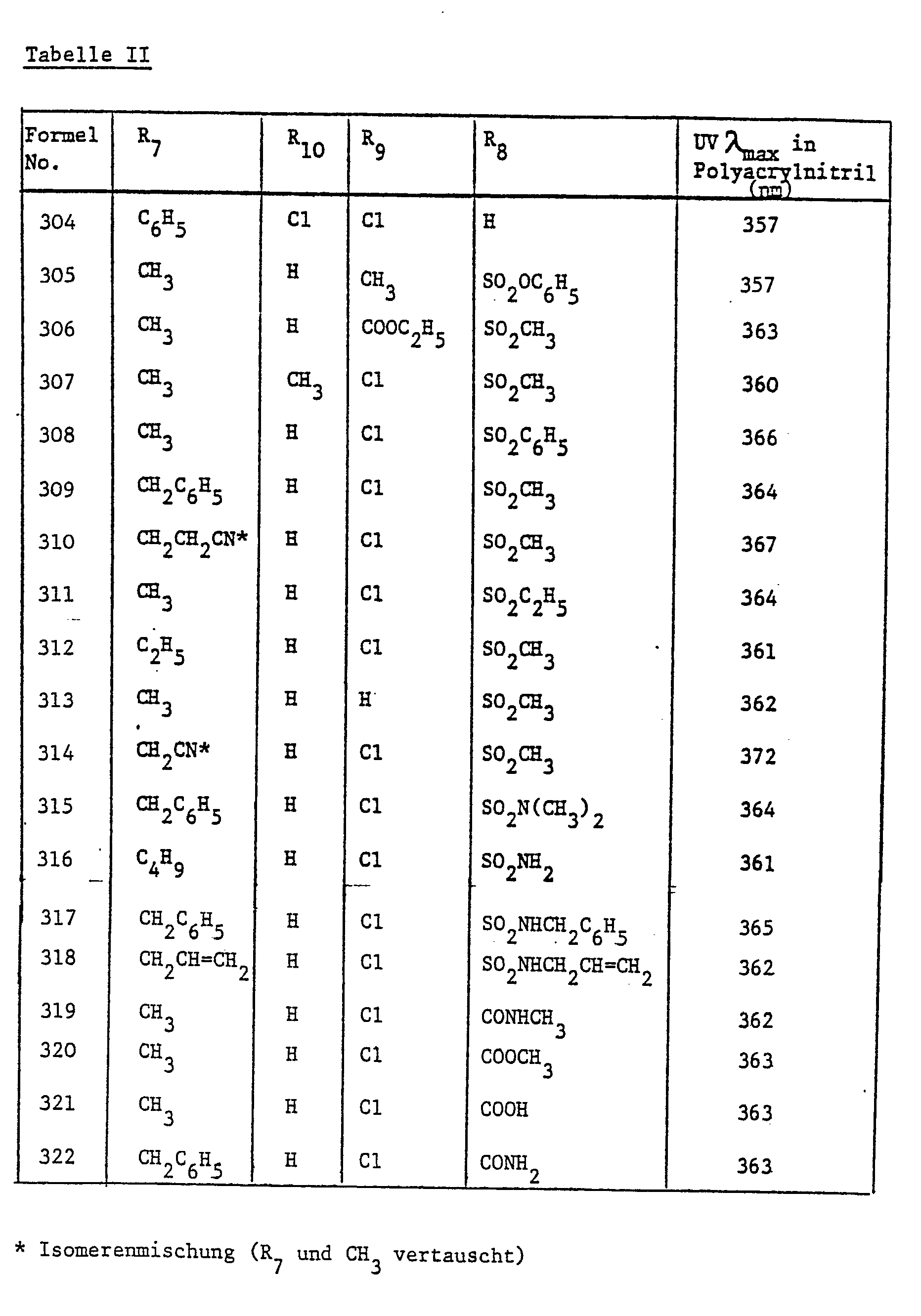
- Beispiel 4: 6,7 g der Verbindung der Formel


- In analoger Weise erhält man die Verbindungen der Formeln (402) und (403).


- Die Löslichkeit des Produktes der Formel (402) beträgt bei Raumtemperatur über 100 g in 100 ml Wasser, jene des entsprechenden Methosulfates oder Chlorids ca. 1 g. Die Löslichkeit des Produktes der Formel (403) in Wasser bei Raumtemperatur beträgt etwa 42%, jene des entsprechenden Methosulfates 0.05%.
- Die in Tabelle III aufgeführten Aufheller der Formel

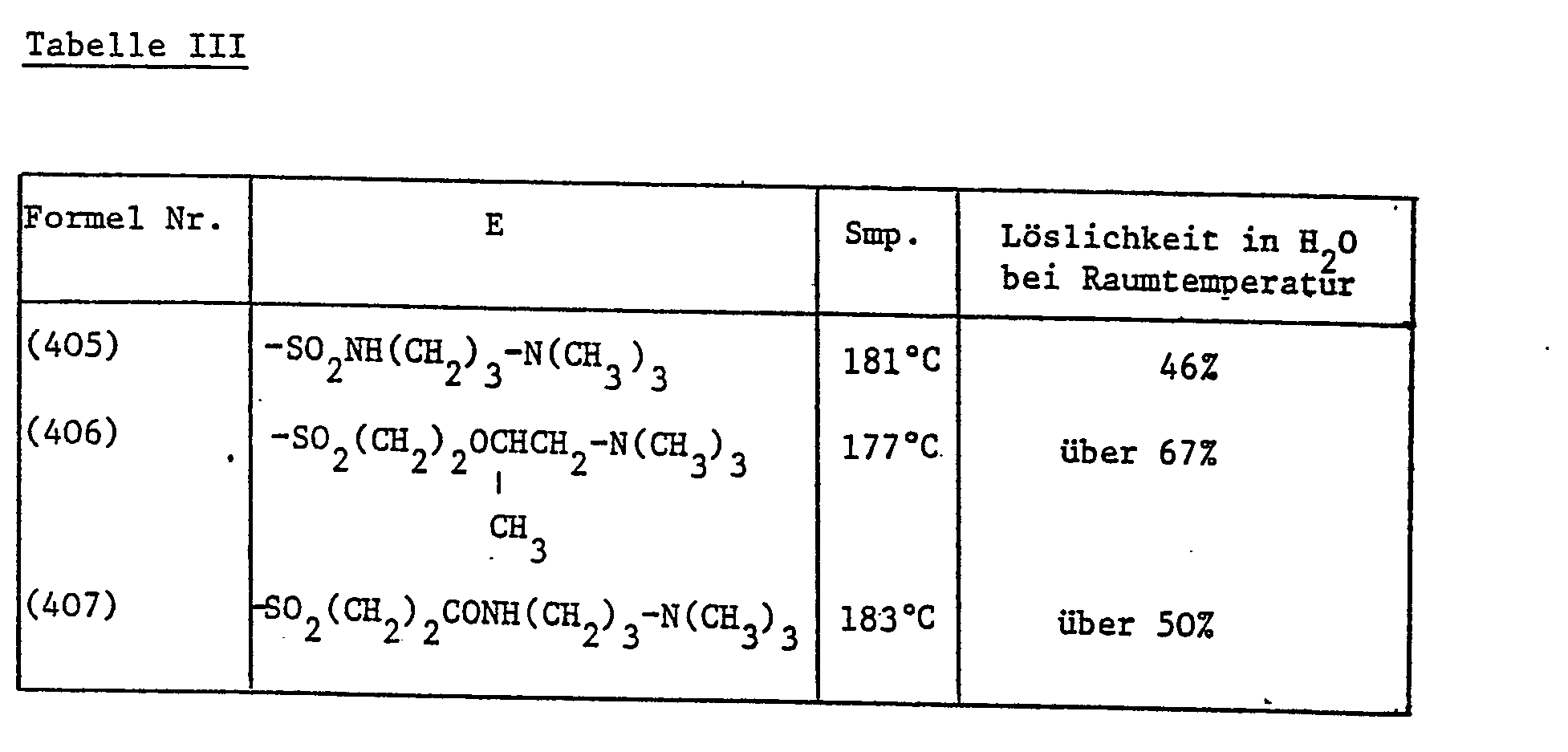
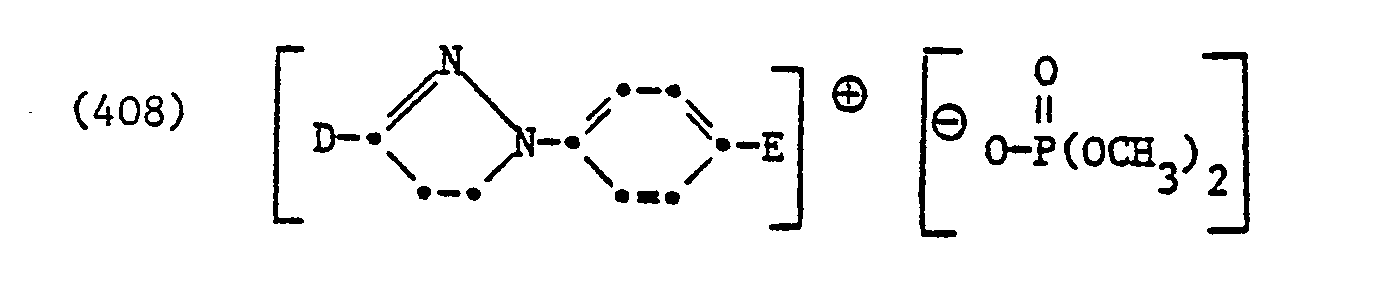


- Beispiel 5: 5,6 g der Verbindung der Formel


- Dieses Produkt ist in Wasser bei Raumtemperatur in einer Konzentration von etwa 40% klar löslich verglichen mit 11% für das entsprechende Methosulfat.
- In analoger Weise erhält man die Verbindung der Formel

- Erhitzt man die Verbindung der Formel (500) anstatt mit Trimethylphosphat mit Triäthylphosphat bei 150°C und arbeitet ansonsten wie beschrieben, so erhält man 6,5 g der Verbindung der Formel

- welche aus 1,2-Dichloräthan umkristallisiert werden kann und 1 1/2 Mol Kristallwasser enthält (Smp. ca. 153°C). Die Löslichkeit dieses Produktes in Wasser beträgt etwa 40%.
- In ähnlicher Weise wie in den vorangehenden Beispielen beschrieben, werden die in Tabelle IV aufgeführten Aufheller der Formel


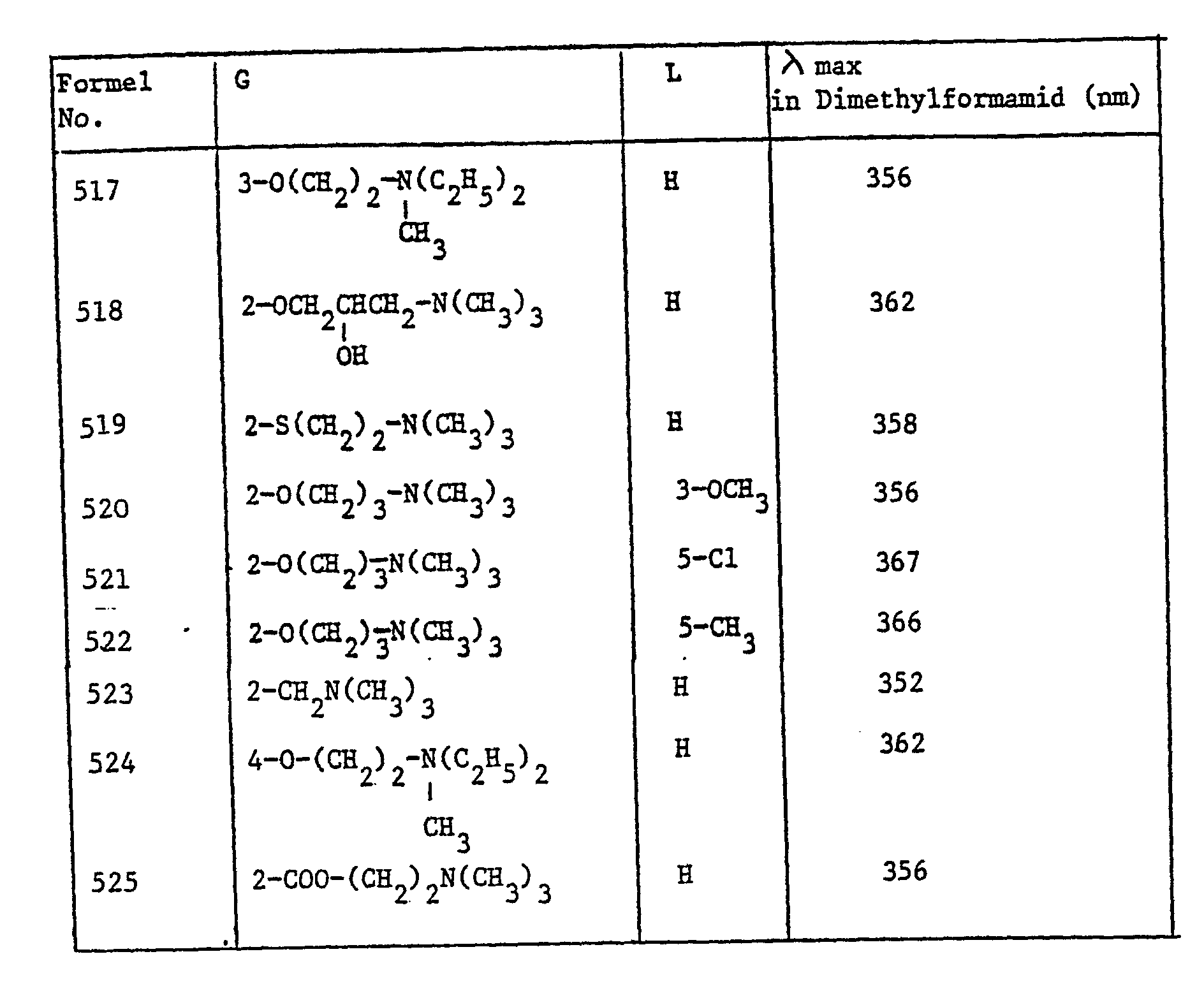
-

- werden in 10 ml Trimethylphosphat unter Rühren während 60 Minuten auf 100°C erhitzt. Nach dieser Zeit ist eine Probe des Reaktionsgemisches klar löslich in Wasser. Man verdünnt mit 30 ml Methyläthylketon, lässt abkühlen, nutscht das auskristallisierte Produkt ab und wäscht es wiederholt mit Methyläthylketon. Nach dem Trocknen im Vakuum bei 100°C erhält man 5,1 g der Verbindung der Formel
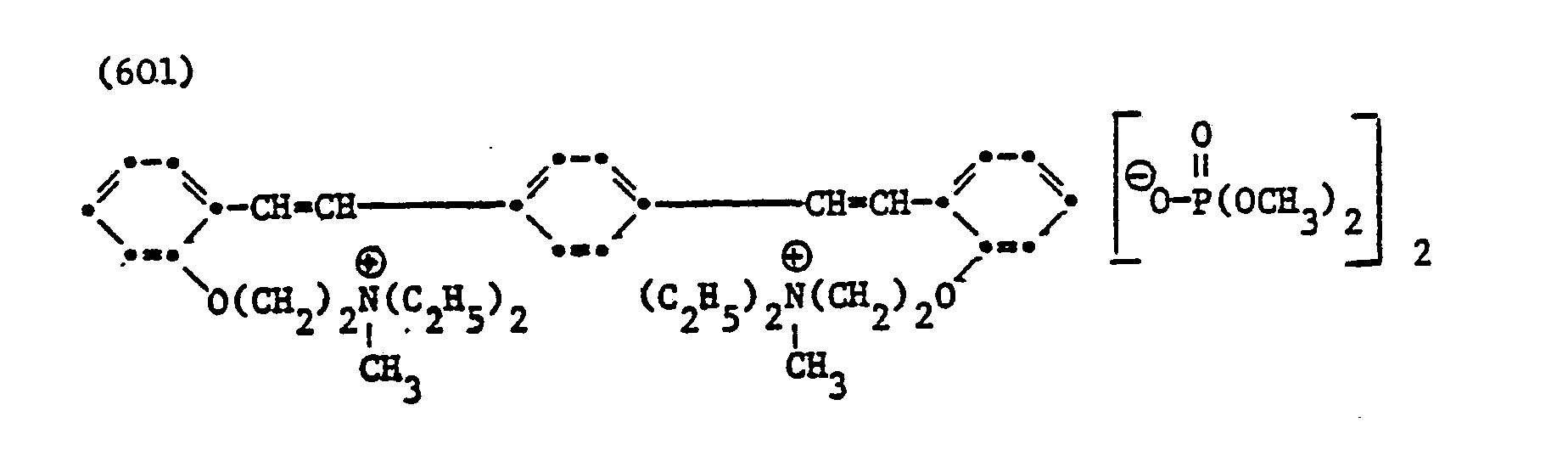
- In analoger Weise erhält man die Verbindung der Formel

- In ähnlicher Weise wie in den vorangehenden Beispielen beschrieben, werden die in Tabelle V aufgeführten Aufheller der Formel

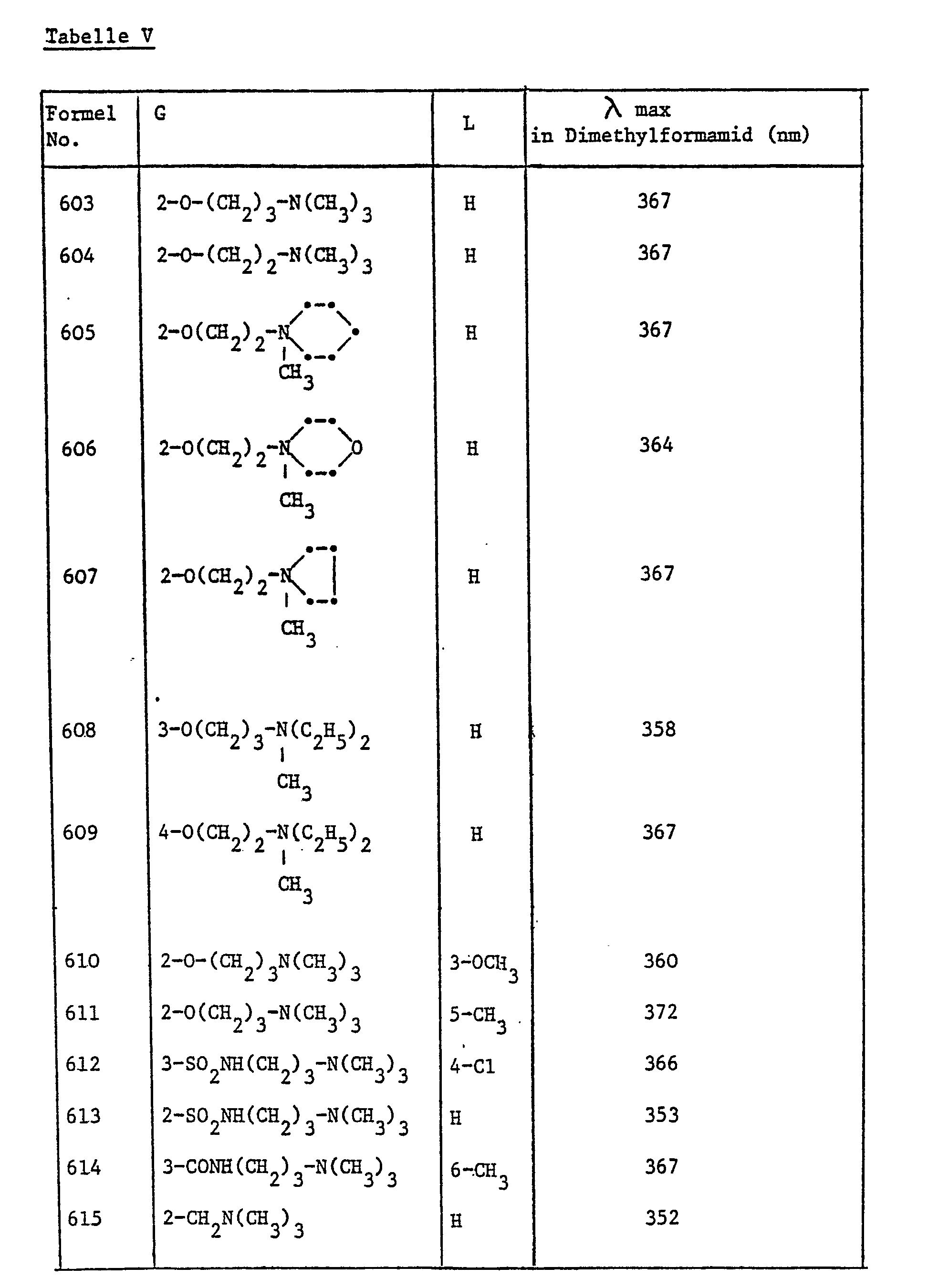
- Beispiel 7: 6,25 g der Verbindung der Formel

- werden in 5,6 g Trimethylphosphat unter Rühren 5 Minuten auf 80°C erwärmt. Nach dieser Zeit ist eine Probe klar löslich in Wasser und das Reaktionsprodukt fällt dick aus. Man verdünnt mit 50 ml Methyläthylketon, lässt abkühlen und filtriert. Der an der Luft zerfliessliche Rückstand wird wiederholt mit Methyläthylketon gewaschen und sofort im Vakuum bei 100°C getrocknet. Man erhält 8,8 g der Verbindung der Formel
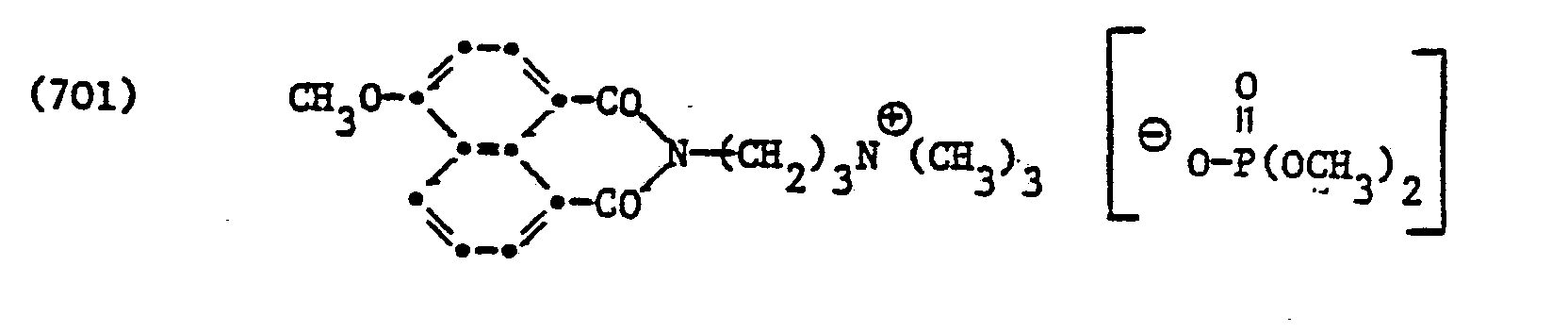
- von Smp. 188°C. Die Löslichkeit dieses Produktes in Wasser beträgt bei Raumtemperatur über 60% verglichen mit 44% mit dem entsprechenden Salz der Phosphorsäure.
- In ähnlicher Weise wie in den vorangehenden Beispielen erwähnt, erhält man die Verbindung der Formel

- Beispiel 8: Ein Polyacrylnitril-Gewebe (Orlon 75) wird auf einem Färbeapparat bei einem Flottenverhältnis von 1:20 mit einem wässrigen Bad, das

- Die Applikation erfolgt gemäss folgendem Temperaturprogramm:

- Anschliessend wird das Polyacrylnitril-Gewebe während 30 Sekunden in fliessendem enthärtetem Wasser gespült und bei 70°C im Trockenschrank getrocknet. Das so behandelte Gewebe weist einen guten Aufhelleffekt auf.
- Beispiel 9: Ein modifiziertes Polyacrylnitrilgewebe (Courtelle) wird auf einem Färbeapparat bei einem Flottenverhältnis von 1:20 mit einem wässerigen Bad, das
-


- Anschliessend wird das Polyacrylnitril-Gewebe während 30 Sekunden in fliessendem enthärtetem Wasser gespült und bei 70°C im Trockenschrank getrocknet. Das so behandelte Gewebe weist einen guten Aufhelleffekt auf.
- Beispiel 10: Frisch ausgesponnenes, verstrecktes Polyacrylnitril-Nasskabel (entsprechend 3,0 Trockengewicht) wird noch feucht bei 45°C für 4 Sekunden in 100 ml einer wässrigen Flotte getaucht, die 0,0005% eines Aufhellers der Formel (101), (301), (401), (402), (403), (501), (506) oder (601) enthält und mit konzentrierter Oxalsäurelösung auf pH 4 eingestellt worden ist. Anschliessend spült man das Nasskabel kurz mit Wasser und trocknet bei 90 bis 100°C. Man erhält auf diese Weise eine gut aufgehellte Polyacrylnitrilfaser.
- Die Ausfärbung kann z.B. auch bei pH 6 (eingestellt durch Zugabe von Natriumacetat) erfolgen. Erhöhte Temperatur der Färbeflotte, z.B. auf 40°C, erhöht die Ausziehgeschwindigkeit.
- Höhere Weisseffekte werden durch Erhöhen der Aufhellerkonzentration, z.B. auf 0,005%, erziehlt.
- Beispiel 11: Ein gebleichtes Baumwoll-Gewebe wird auf einem Färbeapparat bei einem Flottenverhältnis von 1:20 mit einem wässrigen Bad behandelt, das 0,1X des Aufhellers der Formel (501), (502), (503), (506), (601) oder (612), bezogen auf das Gewicht der Baumwolle, und
- 5 g/1 Natriumsulfat enthält.
- Die Applikation erfolgt gemäss folgendem Temperaturprogramm:

- Anschliessend wird das Baumwoll-Gewebe während 20 Sekunden in fliessendem enthärtetem Wasser gespült und bei 70°C im Trockenschrank getrocknet. Das so behandelte Baumwoll-Gewebe weist einen guten Aufhelleffekt auf.
- Beispiel 12: Man foulardiert bei Raumtemperatur ein gebleichtes Baumwoll-Gewebe mit einer wässrigen Flotte, die 1 g/l des Aufhellers der Formel (501), (502), (503), (506) oder (601) enthält. Der Abquetscheffekt beträgt 75X.
- Anschliessend wird während 30 Sekunden bei 130°C auf einem Thermofixiergerät getrocknet.
- Das so behandelte Baumwollgewebe weist einen guten Aufhelleffekt auf.
- Beispiel 13: Ein konzentriertes flüssiges Waschmittel wird durch Mischen fdlgender Komponenten hergestellt:
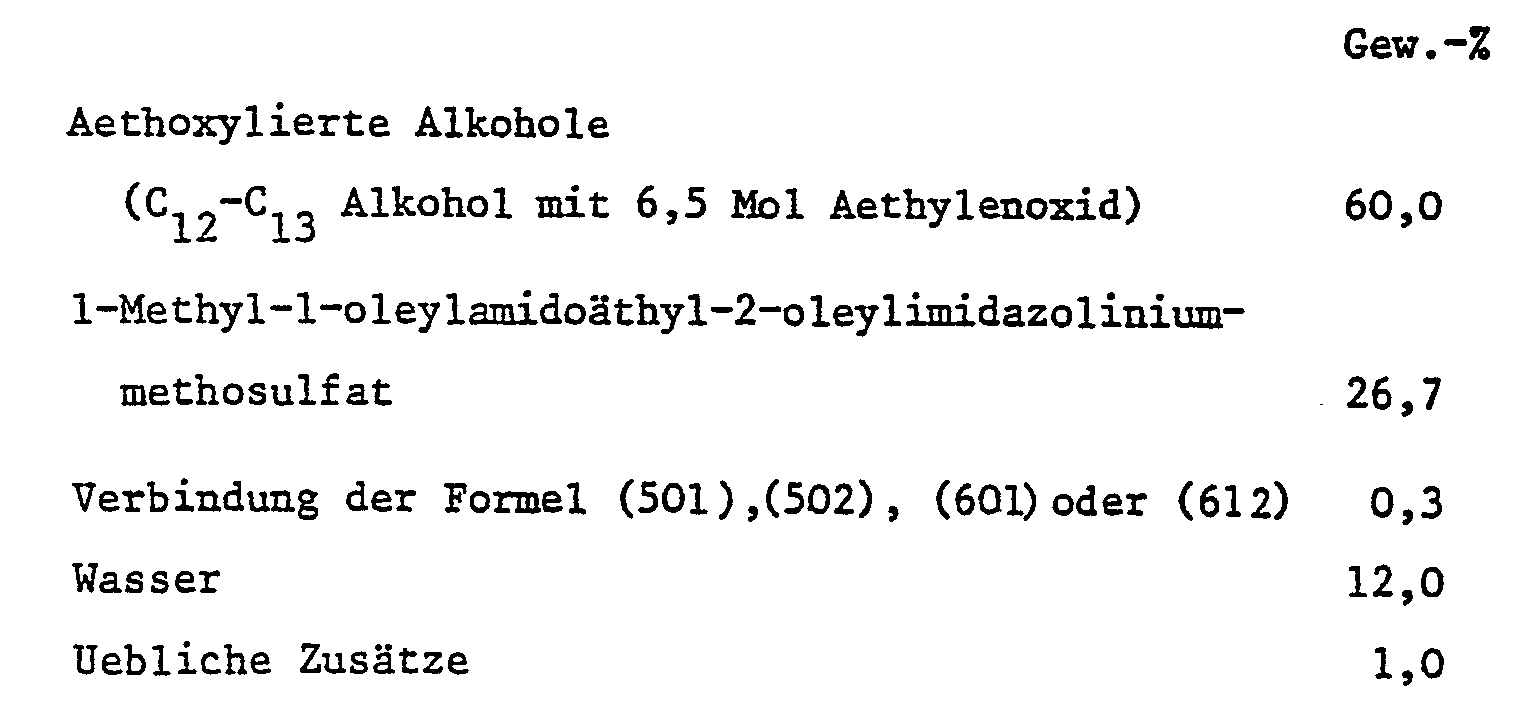
- 2 kg gebleichtes Baumwollgewebe werden während 10 Minuten bei 50°C in 60 Litern Wasser von 100 ppm Härte gewaschen, das 50 bis 60 g des obigen Waschmittels enthalten. Nach dem Spülen und Trocknen weist das Gewebe einen starken Aufhelleffekt und einen weichen Griff auf.
- Aehnliche Resultate werden erhalten, wenn man anstelle der oben angegebenen Imidazolinium-Verbindung nicht-gehärtetes Di-talg-dimethylammoniumchlorid verwendet.
- Beispiel 14: Ein gebleichtes Baumwoll-Gewebe wird im Flottenverhältnis 1:20 während 15 Minuten in einer 40°C warmen, wässrigen Flotte gewaschen, die pro Liter

- Anschliessend wird das Baumwoll-Gewebe während 20 Sekunden in fliessendem Trinkwasser gespült und bei 70°C im Trockenschrank getrocknet. Das so behandelte Baumwoll-Gewebe weist einen guten Aufhelleffekt auf.
- Beispiel 15: Ein Gewebe aus Polyamid 6.6-Webtrikot wird in einem Färbeapparat im Flottenverhältnis 1:20 mit einem wässerigen Bad, das 0,1% des Aufhellers der Formel (401) bis (403) oder (405) bis (407) bezogen auf das Warengewicht und 3 g/1 Natriumdithionit stabilisiert mit 40% Natriumpyrophosphat enthält, behandelt.
- Die Applikation erfolgt gemäss folgendem Temperaturprogramm:

- Anschliessend wird das Polyamid-Gewebe während 30 Sekunden in fliessendem enthärtetem Wasser gespült und bei 70°C im Trockenschrank getrocknet. Das so behandelte Gewebe weist einen guten Aufhelleffekt auf.
bedeuten.
Ganz besondere Bedeutung haben
Claims (16)





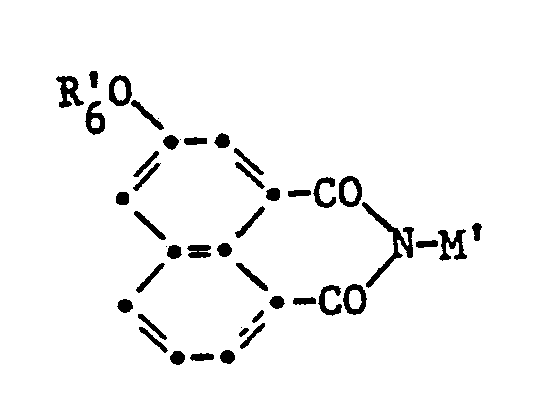
bedeuten, in welchen Reste




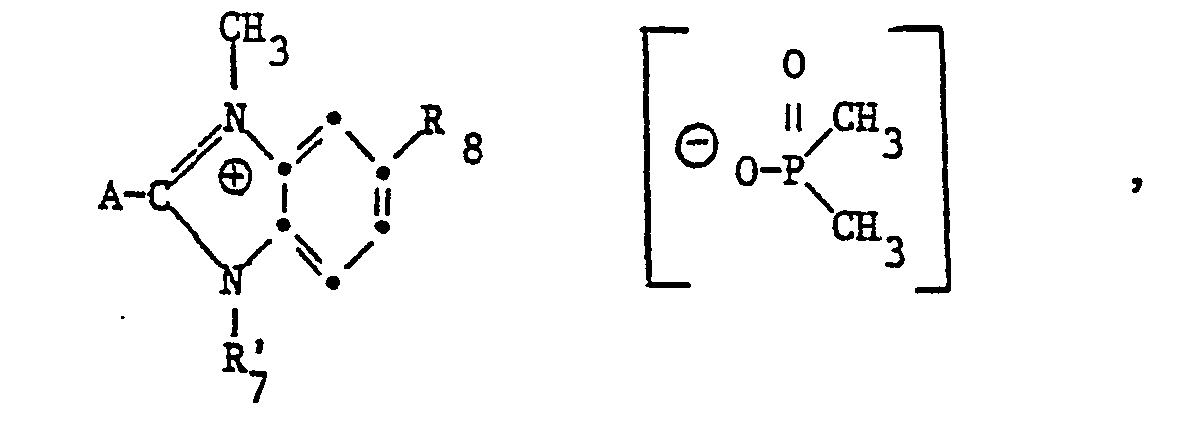


Applications Claiming Priority (2)
| Application Number | Priority Date | Filing Date | Title |
|---|---|---|---|
| CH980879 | 1979-11-01 | ||
| CH9808/79 | 1979-11-01 |
Publications (3)
| Publication Number | Publication Date |
|---|---|
| EP0029003A2 true EP0029003A2 (de) | 1981-05-20 |
| EP0029003A3 EP0029003A3 (en) | 1982-02-17 |
| EP0029003B1 EP0029003B1 (de) | 1984-12-05 |
Family
ID=4355870
Family Applications (1)
| Application Number | Title | Priority Date | Filing Date |
|---|---|---|---|
| EP80810324A Expired EP0029003B1 (de) | 1979-11-01 | 1980-10-27 | Salze kationischer Aufheller, deren Herstellung und deren Verwendung auf organischen Materialien sowie deren konzentrierte wässrige Lösungen |
Country Status (5)
| Country | Link |
|---|---|
| US (3) | US4384121A (de) |
| EP (1) | EP0029003B1 (de) |
| JP (1) | JPS5674154A (de) |
| DE (1) | DE3069775D1 (de) |
| ES (1) | ES8107240A1 (de) |
Cited By (8)
| Publication number | Priority date | Publication date | Assignee | Title |
|---|---|---|---|---|
| EP0235079A1 (de) * | 1986-01-29 | 1987-09-02 | Ciba-Geigy Ag | Verfahren zum Nachbehandeln von mit Reaktivfarbstoffen bedruckten Cellulose- oder cellulosehaltigen Materialien |
| EP0163854A3 (en) * | 1984-04-21 | 1989-07-26 | Bayer Ag | Process for the elimination of fluorescence and cationic or amphoteric aromatic nitro compounds |
| GB2289474A (en) * | 1994-05-12 | 1995-11-22 | Ciba Geigy Ag | Protective use |
| US5688758A (en) * | 1994-07-01 | 1997-11-18 | Ciba Specialty Chemicals Corporation | Textile treatment |
| US7638636B2 (en) | 2002-08-16 | 2009-12-29 | Cytec Technology Corp. | Phosphonium and imidazolium salts and methods of their preparation |
| US7829744B2 (en) | 2003-03-31 | 2010-11-09 | Cytec Technology Corp | Phosphonium salts and their method of preparation |
| CN106049025A (zh) * | 2016-07-15 | 2016-10-26 | 东华大学 | 一种多羧酸无甲醛免烫织物增白液及其应用 |
| WO2018000028A1 (en) * | 2016-07-01 | 2018-01-04 | Boulos & Cooper Pharmaceuticals Pty Ltd | Novel antibiotics |
Families Citing this family (18)
| Publication number | Priority date | Publication date | Assignee | Title |
|---|---|---|---|---|
| US4542222A (en) * | 1980-12-29 | 1985-09-17 | Ciba-Ceigy Corporation | Benzimidazoles |
| DE3535496A1 (de) * | 1985-10-04 | 1987-04-16 | Bayer Ag | Verfahren zur fluoreszenzloeschung und neue kationische naphthalin-peri-dicarbonsaeureimid-derivate |
| US5308545A (en) * | 1985-12-04 | 1994-05-03 | Ciba-Geigy Corporation | Pyrazoline compounds |
| GB2290803A (en) * | 1994-07-01 | 1996-01-10 | Ciba Geigy Ag | Textile treatment |
| US6448281B1 (en) | 2000-07-06 | 2002-09-10 | Boehringer Ingelheim (Canada) Ltd. | Viral polymerase inhibitors |
| EP2335700A1 (de) * | 2001-07-25 | 2011-06-22 | Boehringer Ingelheim (Canada) Ltd. | Hepatitis C Virus Polymerase Inhibitoren mit heterobicylischer Struktur |
| US7098231B2 (en) * | 2003-01-22 | 2006-08-29 | Boehringer Ingelheim International Gmbh | Viral polymerase inhibitors |
| US7223785B2 (en) * | 2003-01-22 | 2007-05-29 | Boehringer Ingelheim International Gmbh | Viral polymerase inhibitors |
| JP4574549B2 (ja) * | 2003-03-24 | 2010-11-04 | 日本化学工業株式会社 | 長い直線的共役系構造部分を持つベンゼン誘導体、その製造方法及び液晶性材料 |
| UY28758A1 (es) * | 2004-02-20 | 2005-09-30 | Boehringer Ingelheim Int | Inhibidores de polimerasa viral |
| WO2006015959A2 (en) * | 2004-08-09 | 2006-02-16 | Ciba Specialty Chemicals Holding Inc. | Use of fluorescent whitening agents as antimicrobials |
| JP5015154B2 (ja) * | 2005-08-12 | 2012-08-29 | ベーリンガー インゲルハイム インターナショナル ゲゼルシャフト ミット ベシュレンクテル ハフツング | ウイルスポリメラーゼインヒビター |
| JP5612198B2 (ja) * | 2010-05-18 | 2014-10-22 | ミリケン・アンド・カンパニーMilliken & Company | 光学的増白剤及びそれを含んだ組成物 |
| BR112012029133A2 (pt) | 2010-05-18 | 2016-09-13 | Milliken & Co | abrilhantadores óticos e composições compreendendo os mesmos |
| AU2015252006A1 (en) | 2014-04-23 | 2016-12-08 | Vinod S. Nair | Cleaning formulations for chemically sensitive individuals: compositions and methods |
| KR20170105074A (ko) | 2015-01-14 | 2017-09-18 | 그레고리 반 버스커크 | 얼룩 방출을 위한 개선된 직물 처리방법 |
| US11217828B2 (en) * | 2016-12-05 | 2022-01-04 | Massachusetts Institute Of Technology | Flame-retardant, non-toxic phosphate ester ionic liquid electrolytes and method of making |
| CN121554453A (zh) * | 2026-01-21 | 2026-02-24 | 杭州唯瑞格化工有限公司 | 一种阳离子型腈纶专用增白剂bac-l及其制备方法 |
Family Cites Families (13)
| Publication number | Priority date | Publication date | Assignee | Title |
|---|---|---|---|---|
| US3507937A (en) * | 1966-10-04 | 1970-04-21 | Procter & Gamble | Reversed zwitterionic phosphorus compounds |
| AU2294367A (en) * | 1968-06-05 | 1969-12-11 | Monash University | Acid addition salts of 2 substituted benzimidazoles |
| DE1770773A1 (de) * | 1968-07-02 | 1971-12-09 | Henkel & Cie Gmbh | Optisches Aufhellungsmittel |
| DE1769718A1 (de) * | 1968-07-02 | 1971-07-15 | Henkel & Cie Gmbh | Weichmachungsmittel fuer Textilien |
| DE2039993A1 (de) * | 1970-08-12 | 1972-02-17 | Basf Ag | Optische Aufheller der Bisstyrylbenzolreihe |
| DE2050725C3 (de) * | 1970-10-15 | 1980-04-30 | Bayer Ag, 5090 Leverkusen | Aufhellungsmittel |
| US4085101A (en) * | 1973-07-18 | 1978-04-18 | Sandoz Ltd. | 1,3-Diaryl-2-pyrazoline derivatives |
| CH590965A5 (de) | 1973-12-19 | 1977-08-31 | Ciba Geigy Ag | |
| DE2533428A1 (de) * | 1975-07-25 | 1977-02-10 | Bayer Ag | Kationische farbstoffe |
| DE2747723C2 (de) * | 1977-10-25 | 1979-12-13 | Hoechst Ag, 6000 Frankfurt | Quaternierte Amin-Amid Kondensationsprodukte und deren Verwendung in ölhaltigen Faserpräparationsmitteln |
| DE2807497A1 (de) | 1978-02-22 | 1979-08-23 | Bayer Ag | Distyryl-verbindungen |
| CH634077A5 (de) * | 1978-05-29 | 1983-01-14 | Ciba Geigy Ag | Kationische aufheller. |
| DE2948183A1 (de) | 1979-11-30 | 1981-06-04 | Cassella Ag, 6000 Frankfurt | Praeparation zum aufhellen von synthesefasern, deren herstellung und verwendung |
-
1980
- 1980-10-27 EP EP80810324A patent/EP0029003B1/de not_active Expired
- 1980-10-27 DE DE8080810324T patent/DE3069775D1/de not_active Expired
- 1980-10-27 US US06/200,738 patent/US4384121A/en not_active Expired - Lifetime
- 1980-10-31 JP JP15237680A patent/JPS5674154A/ja active Granted
- 1980-10-31 ES ES496454A patent/ES8107240A1/es not_active Expired
-
1982
- 1982-09-22 US US06/421,201 patent/US4432886A/en not_active Expired - Fee Related
- 1982-09-22 US US06/421,202 patent/US4433975A/en not_active Expired - Lifetime
Cited By (12)
| Publication number | Priority date | Publication date | Assignee | Title |
|---|---|---|---|---|
| EP0163854A3 (en) * | 1984-04-21 | 1989-07-26 | Bayer Ag | Process for the elimination of fluorescence and cationic or amphoteric aromatic nitro compounds |
| EP0235079A1 (de) * | 1986-01-29 | 1987-09-02 | Ciba-Geigy Ag | Verfahren zum Nachbehandeln von mit Reaktivfarbstoffen bedruckten Cellulose- oder cellulosehaltigen Materialien |
| GB2289474A (en) * | 1994-05-12 | 1995-11-22 | Ciba Geigy Ag | Protective use |
| US6117189A (en) * | 1994-05-12 | 2000-09-12 | Ciba Specialty Chemicals Corporation | Protective method |
| US5688758A (en) * | 1994-07-01 | 1997-11-18 | Ciba Specialty Chemicals Corporation | Textile treatment |
| US7638636B2 (en) | 2002-08-16 | 2009-12-29 | Cytec Technology Corp. | Phosphonium and imidazolium salts and methods of their preparation |
| US7829744B2 (en) | 2003-03-31 | 2010-11-09 | Cytec Technology Corp | Phosphonium salts and their method of preparation |
| US8748668B2 (en) | 2003-03-31 | 2014-06-10 | Cytec Technology Corp. | Phosphonium salts and methods of their preparation |
| US8901339B2 (en) | 2003-03-31 | 2014-12-02 | Cytec Technology Corp. | Phosphonium salts and methods of their preparation |
| US8901338B2 (en) | 2003-03-31 | 2014-12-02 | Cytec Technology Corp. | Phosphonium salts and methods of their preparation |
| WO2018000028A1 (en) * | 2016-07-01 | 2018-01-04 | Boulos & Cooper Pharmaceuticals Pty Ltd | Novel antibiotics |
| CN106049025A (zh) * | 2016-07-15 | 2016-10-26 | 东华大学 | 一种多羧酸无甲醛免烫织物增白液及其应用 |
Also Published As
| Publication number | Publication date |
|---|---|
| ES496454A0 (es) | 1981-10-01 |
| DE3069775D1 (en) | 1985-01-17 |
| US4432886A (en) | 1984-02-21 |
| ES8107240A1 (es) | 1981-10-01 |
| US4433975A (en) | 1984-02-28 |
| EP0029003B1 (de) | 1984-12-05 |
| EP0029003A3 (en) | 1982-02-17 |
| JPH0153301B2 (de) | 1989-11-13 |
| JPS5674154A (en) | 1981-06-19 |
| US4384121A (en) | 1983-05-17 |
Similar Documents
| Publication | Publication Date | Title |
|---|---|---|
| EP0029003B1 (de) | Salze kationischer Aufheller, deren Herstellung und deren Verwendung auf organischen Materialien sowie deren konzentrierte wässrige Lösungen | |
| DE2262633C3 (de) | Sulfogruppen und v-Triazolylreste enthaltende 4,4'-Divinyldiphenyl-Verbindungen und deren Salze | |
| DE2733156C2 (de) | ||
| EP0035470A1 (de) | Textilbehandlungsmittel | |
| EP0059684A1 (de) | Amphotere Styrolderivate | |
| EP0019702B1 (de) | Distyrylbiphenyle, Verfahren zu deren Herstellung sowie deren Verwendung beim optischen Aufhellen organischer Materialien sowie Waschmittel, Textilbehandlungsmittel und Wäschenachbehandlungsmittel, die sie enthalten | |
| DE2704825B2 (de) | Fluoreszenzfarbstoffe, Verfahren zu deren Herstellung und deren Verwendung zum Weißtönen organischer Materialien | |
| EP0163854B1 (de) | Verfahren zur Fluoreszenzlöschung und neue kationische oder amphotere aromatische Nitroverbindungen | |
| EP0019078B1 (de) | Distyrylbenzole, Verfahren zu deren Herstellung, deren Verwendung beim optischen Aufhellen organischer Materialien, sowie Waschmittel, Textilbehandlungsmittel und Wäschenachbehandlungsmittel, die diese Distyrylbenzole enthalten | |
| EP0045279B1 (de) | Neue Aminoxidverbindungen, Verfahren zu deren Herstellung und deren Verwendung als optische Aufheller | |
| CH634077A5 (de) | Kationische aufheller. | |
| EP0603130A1 (de) | Kationische Verbindungen, deren Herstellung und deren Anwendung zur fotochemischen Stabilisierung basisch anfärbbarer Polyamidfasermaterialien | |
| EP0011824A1 (de) | Benzofuranyl-benzimidazole, Verfahren zu ihrer Herstellung sowie ihre Verwendung zum optischen Aufhellen von organischen Materialien | |
| CH653697A5 (de) | Polykationische azoverbindung, ihre herstellung und verwendung. | |
| EP0357545A2 (de) | Kationische Verbindungen, deren Herstellung und deren Anwendung zur fotochemischen Stabilisierung basisch anfärbbarer Polyamid-, Polyacrylnitril-und Polyesterfasermaterialien | |
| DE2921641C2 (de) | ||
| EP0005465A1 (de) | Benzofuranyl-benzimidazole, Verfahren zu ihrer Herstellung sowie ihre Verwendung zum optischen Aufhellen von organischen Materialien | |
| DE2028037A1 (de) | ||
| DE2039492A1 (de) | Kationische Farbstoffe | |
| EP0246551A2 (de) | Sulfonat- oder Sulfonamidgruppen-haltige Bis-benzoxazolylnaphthaline, Verfahren zu deren Herstellung und deren Verwendung | |
| DE2744655A1 (de) | Kationische azofarbstoffe, verfahren zu ihrer herstellung und ihre verwendung | |
| DE2344834A1 (de) | Cumarinderivate und ihre verwendung als optische aufheller | |
| DE3001424A1 (de) | V-triazolyl- eckige klammer auf 4,5-d eckige klammer zu -pyrimidine | |
| DE2011552A1 (de) | 3 eckige Klammer auf 3,4 Dichlor 6 alkyl phenvl eckige Klammer zu Delta tief 2 pyrazolin Derivate, Verfahren zu ihrer Herstellung und ihre Verwendung als optische Aufheller | |
| CH640243A5 (en) | Cationic brighteners |
Legal Events
| Date | Code | Title | Description |
|---|---|---|---|
| PUAI | Public reference made under article 153(3) epc to a published international application that has entered the european phase |
Free format text: ORIGINAL CODE: 0009012 |
|
| 17P | Request for examination filed |
Effective date: 19801029 |
|
| AK | Designated contracting states |
Designated state(s): CH DE FR GB IT |
|
| PUAL | Search report despatched |
Free format text: ORIGINAL CODE: 0009013 |
|
| AK | Designated contracting states |
Designated state(s): CH DE FR GB IT |
|
| ITF | It: translation for a ep patent filed | ||
| GRAA | (expected) grant |
Free format text: ORIGINAL CODE: 0009210 |
|
| AK | Designated contracting states |
Designated state(s): CH DE FR GB IT LI |
|
| REF | Corresponds to: |
Ref document number: 3069775 Country of ref document: DE Date of ref document: 19850117 |
|
| ET | Fr: translation filed | ||
| PLBE | No opposition filed within time limit |
Free format text: ORIGINAL CODE: 0009261 |
|
| STAA | Information on the status of an ep patent application or granted ep patent |
Free format text: STATUS: NO OPPOSITION FILED WITHIN TIME LIMIT |
|
| 26N | No opposition filed | ||
| ITTA | It: last paid annual fee | ||
| PGFP | Annual fee paid to national office [announced via postgrant information from national office to epo] |
Ref country code: FR Payment date: 19950830 Year of fee payment: 16 |
|
| PGFP | Annual fee paid to national office [announced via postgrant information from national office to epo] |
Ref country code: DE Payment date: 19950908 Year of fee payment: 16 |
|
| PGFP | Annual fee paid to national office [announced via postgrant information from national office to epo] |
Ref country code: GB Payment date: 19950914 Year of fee payment: 16 |
|
| PGFP | Annual fee paid to national office [announced via postgrant information from national office to epo] |
Ref country code: CH Payment date: 19951221 Year of fee payment: 16 |
|
| PG25 | Lapsed in a contracting state [announced via postgrant information from national office to epo] |
Ref country code: GB Effective date: 19961027 |
|
| PG25 | Lapsed in a contracting state [announced via postgrant information from national office to epo] |
Ref country code: LI Effective date: 19961031 Ref country code: CH Effective date: 19961031 |
|
| REG | Reference to a national code |
Ref country code: CH Ref legal event code: PL |
|
| GBPC | Gb: european patent ceased through non-payment of renewal fee |
Effective date: 19961027 |
|
| PG25 | Lapsed in a contracting state [announced via postgrant information from national office to epo] |
Ref country code: FR Effective date: 19970630 |
|
| PG25 | Lapsed in a contracting state [announced via postgrant information from national office to epo] |
Ref country code: DE Effective date: 19970701 |
|
| REG | Reference to a national code |
Ref country code: FR Ref legal event code: ST |