EP0029487A2 - Wärmehärtbare wässrige Überzugsmittel und deren Verwendung - Google Patents
Wärmehärtbare wässrige Überzugsmittel und deren Verwendung Download PDFInfo
- Publication number
- EP0029487A2 EP0029487A2 EP80105382A EP80105382A EP0029487A2 EP 0029487 A2 EP0029487 A2 EP 0029487A2 EP 80105382 A EP80105382 A EP 80105382A EP 80105382 A EP80105382 A EP 80105382A EP 0029487 A2 EP0029487 A2 EP 0029487A2
- Authority
- EP
- European Patent Office
- Prior art keywords
- weight
- und
- water
- esterified
- oder
- Prior art date
- Legal status (The legal status is an assumption and is not a legal conclusion. Google has not performed a legal analysis and makes no representation as to the accuracy of the status listed.)
- Granted
Links
- 239000008199 coating composition Substances 0.000 title description 17
- 239000011230 binding agent Substances 0.000 claims abstract description 30
- 229920005989 resin Polymers 0.000 claims abstract description 23
- 239000011347 resin Substances 0.000 claims abstract description 23
- 239000002253 acid Substances 0.000 claims abstract description 19
- 150000001875 compounds Chemical class 0.000 claims abstract description 18
- 238000004132 cross linking Methods 0.000 claims abstract description 14
- 239000011248 coating agent Substances 0.000 claims abstract description 12
- 239000000203 mixture Substances 0.000 claims abstract description 12
- 150000001298 alcohols Chemical class 0.000 claims abstract description 11
- 229920002587 poly(1,3-butadiene) polymer Polymers 0.000 claims abstract description 11
- UFHFLCQGNIYNRP-UHFFFAOYSA-N Hydrogen Chemical compound [H][H] UFHFLCQGNIYNRP-UHFFFAOYSA-N 0.000 claims abstract description 8
- 150000001991 dicarboxylic acids Chemical class 0.000 claims abstract description 8
- 239000001257 hydrogen Substances 0.000 claims abstract description 7
- 229910052739 hydrogen Inorganic materials 0.000 claims abstract description 7
- 239000000049 pigment Substances 0.000 claims abstract description 6
- 125000004432 carbon atom Chemical group C* 0.000 claims abstract description 5
- 239000000654 additive Substances 0.000 claims abstract description 4
- 125000000217 alkyl group Chemical group 0.000 claims abstract description 4
- 239000000945 filler Substances 0.000 claims abstract description 4
- 229910052751 metal Inorganic materials 0.000 claims abstract description 4
- 239000002184 metal Substances 0.000 claims abstract description 4
- 125000002496 methyl group Chemical group [H]C([H])([H])* 0.000 claims abstract description 4
- 239000003960 organic solvent Substances 0.000 claims abstract description 4
- 239000007788 liquid Substances 0.000 claims abstract description 3
- XXROGKLTLUQVRX-UHFFFAOYSA-N allyl alcohol Chemical compound OCC=C XXROGKLTLUQVRX-UHFFFAOYSA-N 0.000 claims description 10
- 150000007514 bases Chemical class 0.000 claims description 8
- ISWSIDIOOBJBQZ-UHFFFAOYSA-N Phenol Chemical compound OC1=CC=CC=C1 ISWSIDIOOBJBQZ-UHFFFAOYSA-N 0.000 claims description 5
- KAKZBPTYRLMSJV-UHFFFAOYSA-N butadiene group Chemical group C=CC=C KAKZBPTYRLMSJV-UHFFFAOYSA-N 0.000 claims description 3
- 125000002887 hydroxy group Chemical group [H]O* 0.000 claims description 3
- 239000007859 condensation product Substances 0.000 claims 1
- 238000003618 dip coating Methods 0.000 claims 1
- 125000004435 hydrogen atom Chemical group [H]* 0.000 claims 1
- WSFSSNUMVMOOMR-NJFSPNSNSA-N methanone Chemical compound O=[14CH2] WSFSSNUMVMOOMR-NJFSPNSNSA-N 0.000 claims 1
- 229920001187 thermosetting polymer Polymers 0.000 abstract description 2
- KWYUFKZDYYNOTN-UHFFFAOYSA-M Potassium hydroxide Chemical compound [OH-].[K+] KWYUFKZDYYNOTN-UHFFFAOYSA-M 0.000 description 36
- ZMANZCXQSJIPKH-UHFFFAOYSA-N Triethylamine Chemical compound CCN(CC)CC ZMANZCXQSJIPKH-UHFFFAOYSA-N 0.000 description 12
- XLYOFNOQVPJJNP-UHFFFAOYSA-N water Substances O XLYOFNOQVPJJNP-UHFFFAOYSA-N 0.000 description 11
- 238000005886 esterification reaction Methods 0.000 description 10
- 230000032050 esterification Effects 0.000 description 9
- 239000000047 product Substances 0.000 description 9
- OKKJLVBELUTLKV-UHFFFAOYSA-N Methanol Chemical compound OC OKKJLVBELUTLKV-UHFFFAOYSA-N 0.000 description 8
- 229920005601 base polymer Polymers 0.000 description 8
- 238000000576 coating method Methods 0.000 description 8
- 125000000391 vinyl group Chemical group [H]C([*])=C([H])[H] 0.000 description 8
- 229920002554 vinyl polymer Polymers 0.000 description 8
- 238000000034 method Methods 0.000 description 7
- 238000006386 neutralization reaction Methods 0.000 description 7
- WSFSSNUMVMOOMR-UHFFFAOYSA-N Formaldehyde Chemical compound O=C WSFSSNUMVMOOMR-UHFFFAOYSA-N 0.000 description 6
- -1 ethylene glycol monoalkyl ethers Chemical class 0.000 description 6
- 239000005011 phenolic resin Substances 0.000 description 6
- QGZKDVFQNNGYKY-UHFFFAOYSA-N Ammonia Chemical compound N QGZKDVFQNNGYKY-UHFFFAOYSA-N 0.000 description 5
- 229920001568 phenolic resin Polymers 0.000 description 5
- ZCYVEMRRCGMTRW-UHFFFAOYSA-N 7553-56-2 Chemical compound [I] ZCYVEMRRCGMTRW-UHFFFAOYSA-N 0.000 description 4
- IJGRMHOSHXDMSA-UHFFFAOYSA-N Atomic nitrogen Chemical compound N#N IJGRMHOSHXDMSA-UHFFFAOYSA-N 0.000 description 4
- JUJWROOIHBZHMG-UHFFFAOYSA-N Pyridine Chemical compound C1=CC=NC=C1 JUJWROOIHBZHMG-UHFFFAOYSA-N 0.000 description 4
- 239000002585 base Substances 0.000 description 4
- 230000007797 corrosion Effects 0.000 description 4
- 238000005260 corrosion Methods 0.000 description 4
- SWXVUIWOUIDPGS-UHFFFAOYSA-N diacetone alcohol Chemical compound CC(=O)CC(C)(C)O SWXVUIWOUIDPGS-UHFFFAOYSA-N 0.000 description 4
- 229910052740 iodine Inorganic materials 0.000 description 4
- 239000011630 iodine Substances 0.000 description 4
- WVDDGKGOMKODPV-UHFFFAOYSA-N Benzyl alcohol Chemical compound OCC1=CC=CC=C1 WVDDGKGOMKODPV-UHFFFAOYSA-N 0.000 description 3
- LFQSCWFLJHTTHZ-UHFFFAOYSA-N Ethanol Chemical compound CCO LFQSCWFLJHTTHZ-UHFFFAOYSA-N 0.000 description 3
- SJRJJKPEHAURKC-UHFFFAOYSA-N N-Methylmorpholine Chemical compound CN1CCOCC1 SJRJJKPEHAURKC-UHFFFAOYSA-N 0.000 description 3
- HEMHJVSKTPXQMS-UHFFFAOYSA-M Sodium hydroxide Chemical compound [OH-].[Na+] HEMHJVSKTPXQMS-UHFFFAOYSA-M 0.000 description 3
- 229910000831 Steel Inorganic materials 0.000 description 3
- 230000002378 acidificating effect Effects 0.000 description 3
- 229920003180 amino resin Polymers 0.000 description 3
- 150000008064 anhydrides Chemical group 0.000 description 3
- 125000003178 carboxy group Chemical group [H]OC(*)=O 0.000 description 3
- 238000004070 electrodeposition Methods 0.000 description 3
- 238000005516 engineering process Methods 0.000 description 3
- FPYJFEHAWHCUMM-UHFFFAOYSA-N maleic anhydride Chemical compound O=C1OC(=O)C=C1 FPYJFEHAWHCUMM-UHFFFAOYSA-N 0.000 description 3
- 239000003973 paint Substances 0.000 description 3
- 238000002360 preparation method Methods 0.000 description 3
- 150000003839 salts Chemical class 0.000 description 3
- 229920006395 saturated elastomer Polymers 0.000 description 3
- 239000007921 spray Substances 0.000 description 3
- 239000010959 steel Substances 0.000 description 3
- WCASXYBKJHWFMY-NSCUHMNNSA-N 2-Buten-1-ol Chemical compound C\C=C\CO WCASXYBKJHWFMY-NSCUHMNNSA-N 0.000 description 2
- YIWUKEYIRIRTPP-UHFFFAOYSA-N 2-ethylhexan-1-ol Chemical compound CCCCC(CC)CO YIWUKEYIRIRTPP-UHFFFAOYSA-N 0.000 description 2
- KXGFMDJXCMQABM-UHFFFAOYSA-N 2-methoxy-6-methylphenol Chemical compound [CH]OC1=CC=CC([CH])=C1O KXGFMDJXCMQABM-UHFFFAOYSA-N 0.000 description 2
- BYDRTKVGBRTTIT-UHFFFAOYSA-N 2-methylprop-2-en-1-ol Chemical compound CC(=C)CO BYDRTKVGBRTTIT-UHFFFAOYSA-N 0.000 description 2
- ROSDSFDQCJNGOL-UHFFFAOYSA-N Dimethylamine Chemical compound CNC ROSDSFDQCJNGOL-UHFFFAOYSA-N 0.000 description 2
- QUSNBJAOOMFDIB-UHFFFAOYSA-N Ethylamine Chemical compound CCN QUSNBJAOOMFDIB-UHFFFAOYSA-N 0.000 description 2
- VZCYOOQTPOCHFL-OWOJBTEDSA-N Fumaric acid Chemical compound OC(=O)\C=C\C(O)=O VZCYOOQTPOCHFL-OWOJBTEDSA-N 0.000 description 2
- RRHGJUQNOFWUDK-UHFFFAOYSA-N Isoprene Chemical compound CC(=C)C=C RRHGJUQNOFWUDK-UHFFFAOYSA-N 0.000 description 2
- KFZMGEQAYNKOFK-UHFFFAOYSA-N Isopropanol Chemical compound CC(C)O KFZMGEQAYNKOFK-UHFFFAOYSA-N 0.000 description 2
- BAVYZALUXZFZLV-UHFFFAOYSA-N Methylamine Chemical compound NC BAVYZALUXZFZLV-UHFFFAOYSA-N 0.000 description 2
- LRHPLDYGYMQRHN-UHFFFAOYSA-N N-Butanol Chemical class CCCCO LRHPLDYGYMQRHN-UHFFFAOYSA-N 0.000 description 2
- PPBRXRYQALVLMV-UHFFFAOYSA-N Styrene Chemical compound C=CC1=CC=CC=C1 PPBRXRYQALVLMV-UHFFFAOYSA-N 0.000 description 2
- YRKCREAYFQTBPV-UHFFFAOYSA-N acetylacetone Chemical compound CC(=O)CC(C)=O YRKCREAYFQTBPV-UHFFFAOYSA-N 0.000 description 2
- 229910021529 ammonia Inorganic materials 0.000 description 2
- MKUWVMRNQOOSAT-UHFFFAOYSA-N but-3-en-2-ol Chemical compound CC(O)C=C MKUWVMRNQOOSAT-UHFFFAOYSA-N 0.000 description 2
- 239000006229 carbon black Substances 0.000 description 2
- 229920001577 copolymer Polymers 0.000 description 2
- 230000007547 defect Effects 0.000 description 2
- 239000008367 deionised water Substances 0.000 description 2
- 229910021641 deionized water Inorganic materials 0.000 description 2
- 150000001993 dienes Chemical class 0.000 description 2
- 238000001652 electrophoretic deposition Methods 0.000 description 2
- JBKVHLHDHHXQEQ-UHFFFAOYSA-N epsilon-caprolactam Chemical compound O=C1CCCCCN1 JBKVHLHDHHXQEQ-UHFFFAOYSA-N 0.000 description 2
- 150000002148 esters Chemical class 0.000 description 2
- LYCAIKOWRPUZTN-UHFFFAOYSA-N ethylene glycol Natural products OCCO LYCAIKOWRPUZTN-UHFFFAOYSA-N 0.000 description 2
- WCASXYBKJHWFMY-UHFFFAOYSA-N gamma-methylallyl alcohol Natural products CC=CCO WCASXYBKJHWFMY-UHFFFAOYSA-N 0.000 description 2
- IQPQWNKOIGAROB-UHFFFAOYSA-N isocyanate group Chemical group [N-]=C=O IQPQWNKOIGAROB-UHFFFAOYSA-N 0.000 description 2
- 238000004519 manufacturing process Methods 0.000 description 2
- 229910052757 nitrogen Inorganic materials 0.000 description 2
- 150000007965 phenolic acids Chemical class 0.000 description 2
- UMJSCPRVCHMLSP-UHFFFAOYSA-N pyridine Natural products COC1=CC=CN=C1 UMJSCPRVCHMLSP-UHFFFAOYSA-N 0.000 description 2
- 239000007787 solid Substances 0.000 description 2
- 239000002904 solvent Substances 0.000 description 2
- 238000003860 storage Methods 0.000 description 2
- VZCYOOQTPOCHFL-UHFFFAOYSA-N trans-butenedioic acid Natural products OC(=O)C=CC(O)=O VZCYOOQTPOCHFL-UHFFFAOYSA-N 0.000 description 2
- GETQZCLCWQTVFV-UHFFFAOYSA-N trimethylamine Chemical compound CN(C)C GETQZCLCWQTVFV-UHFFFAOYSA-N 0.000 description 2
- PMJHHCWVYXUKFD-SNAWJCMRSA-N (E)-1,3-pentadiene Chemical compound C\C=C\C=C PMJHHCWVYXUKFD-SNAWJCMRSA-N 0.000 description 1
- ZQHJVIHCDHJVII-OWOJBTEDSA-N (e)-2-chlorobut-2-enedioic acid Chemical compound OC(=O)\C=C(\Cl)C(O)=O ZQHJVIHCDHJVII-OWOJBTEDSA-N 0.000 description 1
- 125000003903 2-propenyl group Chemical group [H]C([*])([H])C([H])=C([H])[H] 0.000 description 1
- UXKQNCDDHDBAPD-UHFFFAOYSA-N 4-n,4-n-diphenylbenzene-1,4-diamine Chemical compound C1=CC(N)=CC=C1N(C=1C=CC=CC=1)C1=CC=CC=C1 UXKQNCDDHDBAPD-UHFFFAOYSA-N 0.000 description 1
- ATRRKUHOCOJYRX-UHFFFAOYSA-N Ammonium bicarbonate Chemical compound [NH4+].OC([O-])=O ATRRKUHOCOJYRX-UHFFFAOYSA-N 0.000 description 1
- VHUUQVKOLVNVRT-UHFFFAOYSA-N Ammonium hydroxide Chemical compound [NH4+].[OH-] VHUUQVKOLVNVRT-UHFFFAOYSA-N 0.000 description 1
- 241000094396 Bolitoglossa carri Species 0.000 description 1
- 239000004971 Cross linker Substances 0.000 description 1
- 239000004593 Epoxy Substances 0.000 description 1
- 239000013032 Hydrocarbon resin Substances 0.000 description 1
- UEEJHVSXFDXPFK-UHFFFAOYSA-O N-dimethylethanolamine Chemical compound C[NH+](C)CCO UEEJHVSXFDXPFK-UHFFFAOYSA-O 0.000 description 1
- OFOBLEOULBTSOW-UHFFFAOYSA-N Propanedioic acid Natural products OC(=O)CC(O)=O OFOBLEOULBTSOW-UHFFFAOYSA-N 0.000 description 1
- 229910010413 TiO 2 Inorganic materials 0.000 description 1
- GSEJCLTVZPLZKY-UHFFFAOYSA-N Triethanolamine Chemical class OCCN(CCO)CCO GSEJCLTVZPLZKY-UHFFFAOYSA-N 0.000 description 1
- XSQUKJJJFZCRTK-UHFFFAOYSA-N Urea Chemical compound NC(N)=O XSQUKJJJFZCRTK-UHFFFAOYSA-N 0.000 description 1
- 150000008065 acid anhydrides Chemical class 0.000 description 1
- 150000001299 aldehydes Chemical class 0.000 description 1
- 239000003513 alkali Substances 0.000 description 1
- 150000001412 amines Chemical class 0.000 description 1
- 239000001099 ammonium carbonate Substances 0.000 description 1
- 235000012501 ammonium carbonate Nutrition 0.000 description 1
- 235000019445 benzyl alcohol Nutrition 0.000 description 1
- 230000015572 biosynthetic process Effects 0.000 description 1
- 239000002981 blocking agent Substances 0.000 description 1
- 239000004202 carbamide Substances 0.000 description 1
- 239000003054 catalyst Substances 0.000 description 1
- 239000007795 chemical reaction product Substances 0.000 description 1
- HNEGQIOMVPPMNR-IHWYPQMZSA-N citraconic acid Chemical compound OC(=O)C(/C)=C\C(O)=O HNEGQIOMVPPMNR-IHWYPQMZSA-N 0.000 description 1
- 229940018557 citraconic acid Drugs 0.000 description 1
- 238000001816 cooling Methods 0.000 description 1
- 229910052802 copper Inorganic materials 0.000 description 1
- 238000005336 cracking Methods 0.000 description 1
- 239000003431 cross linking reagent Substances 0.000 description 1
- 230000006735 deficit Effects 0.000 description 1
- 238000000151 deposition Methods 0.000 description 1
- 230000008021 deposition Effects 0.000 description 1
- HPNMFZURTQLUMO-UHFFFAOYSA-N diethylamine Chemical compound CCNCC HPNMFZURTQLUMO-UHFFFAOYSA-N 0.000 description 1
- 150000005218 dimethyl ethers Chemical class 0.000 description 1
- 238000007598 dipping method Methods 0.000 description 1
- 230000000694 effects Effects 0.000 description 1
- LIWAQLJGPBVORC-UHFFFAOYSA-N ethylmethylamine Chemical compound CCNC LIWAQLJGPBVORC-UHFFFAOYSA-N 0.000 description 1
- 230000002349 favourable effect Effects 0.000 description 1
- 239000001530 fumaric acid Substances 0.000 description 1
- 150000002334 glycols Chemical class 0.000 description 1
- 229920006270 hydrocarbon resin Polymers 0.000 description 1
- 239000012442 inert solvent Substances 0.000 description 1
- JEIPFZHSYJVQDO-UHFFFAOYSA-N iron(III) oxide Inorganic materials O=[Fe]O[Fe]=O JEIPFZHSYJVQDO-UHFFFAOYSA-N 0.000 description 1
- 239000012948 isocyanate Substances 0.000 description 1
- 150000002513 isocyanates Chemical class 0.000 description 1
- NLYAJNPCOHFWQQ-UHFFFAOYSA-N kaolin Chemical compound O.O.O=[Al]O[Si](=O)O[Si](=O)O[Al]=O NLYAJNPCOHFWQQ-UHFFFAOYSA-N 0.000 description 1
- 229910052622 kaolinite Inorganic materials 0.000 description 1
- VZCYOOQTPOCHFL-UPHRSURJSA-N maleic acid Chemical compound OC(=O)\C=C/C(O)=O VZCYOOQTPOCHFL-UPHRSURJSA-N 0.000 description 1
- 239000011976 maleic acid Substances 0.000 description 1
- 239000007769 metal material Substances 0.000 description 1
- WCYWZMWISLQXQU-UHFFFAOYSA-N methyl Chemical compound [CH3] WCYWZMWISLQXQU-UHFFFAOYSA-N 0.000 description 1
- 238000002156 mixing Methods 0.000 description 1
- 125000005609 naphthenate group Chemical group 0.000 description 1
- 239000003791 organic solvent mixture Substances 0.000 description 1
- 230000035515 penetration Effects 0.000 description 1
- 150000002989 phenols Chemical class 0.000 description 1
- 239000006069 physical mixture Substances 0.000 description 1
- PMJHHCWVYXUKFD-UHFFFAOYSA-N piperylene Natural products CC=CC=C PMJHHCWVYXUKFD-UHFFFAOYSA-N 0.000 description 1
- 229920002857 polybutadiene Polymers 0.000 description 1
- 229920000642 polymer Polymers 0.000 description 1
- 125000002924 primary amino group Chemical group [H]N([H])* 0.000 description 1
- BDERNNFJNOPAEC-UHFFFAOYSA-N propan-1-ol Chemical class CCCO BDERNNFJNOPAEC-UHFFFAOYSA-N 0.000 description 1
- 230000035484 reaction time Effects 0.000 description 1
- 229920003987 resole Polymers 0.000 description 1
- 238000005507 spraying Methods 0.000 description 1
- 239000003381 stabilizer Substances 0.000 description 1
- 239000000126 substance Substances 0.000 description 1
- 125000001424 substituent group Chemical group 0.000 description 1
- 239000000454 talc Substances 0.000 description 1
- 229910052623 talc Inorganic materials 0.000 description 1
- GWEVSGVZZGPLCZ-UHFFFAOYSA-N titanium dioxide Inorganic materials O=[Ti]=O GWEVSGVZZGPLCZ-UHFFFAOYSA-N 0.000 description 1
- 238000004448 titration Methods 0.000 description 1
- QQOWHRYOXYEMTL-UHFFFAOYSA-N triazin-4-amine Chemical class N=C1C=CN=NN1 QQOWHRYOXYEMTL-UHFFFAOYSA-N 0.000 description 1
- IMFACGCPASFAPR-UHFFFAOYSA-N tributylamine group Chemical class C(CCC)N(CCCC)CCCC IMFACGCPASFAPR-UHFFFAOYSA-N 0.000 description 1
- 238000000214 vapour pressure osmometry Methods 0.000 description 1
Classifications
-
- C—CHEMISTRY; METALLURGY
- C09—DYES; PAINTS; POLISHES; NATURAL RESINS; ADHESIVES; COMPOSITIONS NOT OTHERWISE PROVIDED FOR; APPLICATIONS OF MATERIALS NOT OTHERWISE PROVIDED FOR
- C09D—COATING COMPOSITIONS, e.g. PAINTS, VARNISHES OR LACQUERS; FILLING PASTES; CHEMICAL PAINT OR INK REMOVERS; INKS; CORRECTING FLUIDS; WOODSTAINS; PASTES OR SOLIDS FOR COLOURING OR PRINTING; USE OF MATERIALS THEREFOR
- C09D5/00—Coating compositions, e.g. paints, varnishes or lacquers, characterised by their physical nature or the effects produced; Filling pastes
- C09D5/44—Coating compositions, e.g. paints, varnishes or lacquers, characterised by their physical nature or the effects produced; Filling pastes for electrophoretic applications
- C09D5/4403—Coating compositions, e.g. paints, varnishes or lacquers, characterised by their physical nature or the effects produced; Filling pastes for electrophoretic applications with rubbers
-
- C—CHEMISTRY; METALLURGY
- C08—ORGANIC MACROMOLECULAR COMPOUNDS; THEIR PREPARATION OR CHEMICAL WORKING-UP; COMPOSITIONS BASED THEREON
- C08C—TREATMENT OR CHEMICAL MODIFICATION OF RUBBERS
- C08C19/00—Chemical modification of rubber
- C08C19/30—Addition of a reagent which reacts with a hetero atom or a group containing hetero atoms of the macromolecule
- C08C19/34—Addition of a reagent which reacts with a hetero atom or a group containing hetero atoms of the macromolecule reacting with oxygen or oxygen-containing groups
- C08C19/36—Addition of a reagent which reacts with a hetero atom or a group containing hetero atoms of the macromolecule reacting with oxygen or oxygen-containing groups with carboxy radicals
-
- Y—GENERAL TAGGING OF NEW TECHNOLOGICAL DEVELOPMENTS; GENERAL TAGGING OF CROSS-SECTIONAL TECHNOLOGIES SPANNING OVER SEVERAL SECTIONS OF THE IPC; TECHNICAL SUBJECTS COVERED BY FORMER USPC CROSS-REFERENCE ART COLLECTIONS [XRACs] AND DIGESTS
- Y10—TECHNICAL SUBJECTS COVERED BY FORMER USPC
- Y10S—TECHNICAL SUBJECTS COVERED BY FORMER USPC CROSS-REFERENCE ART COLLECTIONS [XRACs] AND DIGESTS
- Y10S524/00—Synthetic resins or natural rubbers -- part of the class 520 series
- Y10S524/901—Electrodepositable compositions
Definitions
- Such coating agents are known (DE-AS 21 20 962, DE-OS 17 20 576).
- the binders mentioned also have specific defects in terms of processing and / or the film properties that can be achieved.
- aqueous coating compositions with good storage stability can be obtained Deliver coating with increased hardness.
- binders based on polybutadienes with a high cis-1.4 content which, as sole binders, offer good corrosion protection, the addition of these crosslinking resins increases the amount of rust caused by the films in the salt spray test.
- the object of the invention was to avoid the disadvantages described while maintaining the good general properties known for these coating compositions.
- the object was achieved in that the addition compound (A) to 10 to 70 equivalent percent, based on the acid number, with one or more alcohols of the general formula (1) is esterified and that at least one of the reactive groups of the crosslinking resin (B) of the general formula (II) corresponds, where in the general formulas (I) and ( II ) R 1 , R 2 and R 3 may be identical or different and denote hydrogen or a methyl group, R 4 is hydrogen or an alkyl group having 1 to 5 carbon atoms and n stands for 0 or 1.
- the acid numbers are determined by titration in pyridine / water with KOH.
- the coating agent according to the invention particularly suitable unsaturated alcohols are, for. B. allyl alcohol, methallyl alcohol, crotyl alcohol, 1-buten-3-ol, 2-ethylhexen-2-ol-1.
- the ones mentioned here Alcohols can be used alone or in a mixture.
- Esterified addition products A are preferably used whose degree of esterification is 25 to 45 equivalent percent.
- saturated alcohols can also be used.
- this group of alcohols are methanol, ethanol, propanols, butanols, ethylene glycol monoalkyl ethers with 1 to 4 carbon atoms in the alkyl radical, benzyl alcohol.
- Both the unsaturated and the saturated alcohols to be used according to the invention are preferably those which have primary hydroxyl groups.
- butadiene homopolymers and / or copolymers are used as base polymers for the preparation of the addition compound of component A.
- Other conjugated diolefins such as e.g. B. 1,3-pentadiene, isoprene or similar.
- aliphatic monoolefins such as ethylene, propylene or aromatic vinyl compounds, such as. B. styrene, are used as comonomers.
- the base polymers should contain at least 50 mole percent, preferably at least 70 mole percent and in particular at least 90 mole percent butadiene units.
- Particularly suitable binders for the coating compositions according to the invention are those which contain homopolybutadiene as the basis.
- the molecular weights of the base polymers are in the range from 400 to 6,000, preferably 700 to 5,000, or in the preferred range from 850 to 5,000 when using butadiene homopolymer.
- the molecular weights are determined by vapor pressure osmometry.
- those butadiene polymers are preferably used in which at least 30%, preferably more than 40%, of the existing where double bonds are 1.4 double bonds. Of these, those products are preferred in which at least 20% of the total double bonds are present as cis-1.4 double bonds. In the case of butadiene polymers whose proportion of vinyl-like double bonds is at most 40%, the proportion of cis-1.4 double bonds should be at least 30%.
- the addition compound is obtained by adding ⁇ , ⁇ -unsaturated dicarboxylic acids to the butadiene polymers.
- ⁇ , ⁇ -Unsaturated dicarboxylic acids to be used advantageously have 8 carbon atoms or less, such as, for. B. maleic acid, chloromaleic acid, fumaric acid, citraconic acid, 1,2-diethyl maleic acid.
- the corresponding acid anhydrides are preferably used in each case.
- Maleic anhydride is particularly preferred in amounts of preferably 12 to 25% by weight.
- the partial esterification of the addition compounds described above is particularly advantageous and technically simple when starting from those compounds in which the diacid function to be esterified is in the anhydride form.
- the esterification can then take place under mild conditions, if appropriate in the presence of small amounts of customary basic or acidic catalysts, in the presence of the unsaturated alcohols according to the invention and, if appropriate, of the saturated alcohols with formation of acidic half esters.
- the partially esterified addition compound of component A. must still have a sufficiently high residual acid number in order to have sufficient water solubility or dispersibility after neutralization. This requirement is met in most cases with acid numbers of 340 mg KOH / g. In order to achieve good processability and taking into account the special requirements of electrocoating as a preferred form of application, preference is given to products which have acid numbers between 40 and 150, in particular between 60 and 120, mg KOH / g.
- the partially esterified addition compounds of butadiene polymers and ⁇ , ⁇ -unsaturated dicarboxylic acids can be made water-soluble or water-dispersible by the methods of the prior art.
- addition compounds are at least partially neutralized with ammonia or another basic compound, such as, for example, an organic amine or an inorganic alkali compound.
- suitable basic compounds are: methylamine, ethylamine, ethylmethylamine, dimethylamine, diethylamine, trimethylamine, triethylamine; Mono-, di- or tributylamines; Mono-, di- or triethanolamines; N.N-diethylethanolamine, N.N-dimethylethanolamine, N-methylmorpholine, sodium hydroxide, potassium hydroxide, ammonium carbonate.
- the amount of basic compounds added must be chosen to be sufficiently high.
- the minimum amount required is usually 0.3 to 0.5 equivalents of base / acid equivalent to.
- the binders according to the invention there are no concerns about using even excess amounts of, for example, 1.5 to 2.0 equivalents of base / acid equivalent.
- the skilled person is therefore the possibility di.e by varying the degree of neutralization performance properties of the claimed coating compositions far to change and th this optimally apparatus to the respective Gebie- hot and the existing Applikatiönsprobleme such.
- B. adapt the anodic deposition.
- the basic compounds are preferably added in a stoichiometric deficit. Degrees of neutralization of 0.5 to 0.8 equivalents of base / acid equivalent have proven to be favorable.
- the binders neutralized in this way can be diluted indefinitely with water.
- organic solvents or solvent mixtures make the binders easier to process and contributes to increasing the stability of the aqueous coating compositions or improving the course of the coatings which have not yet been baked.
- Isopropanol, butanols, diacetone alcohols, alkyl cellosolves and dimethyl ethers of glycols are suitable for the purpose mentioned.
- These solvents can be used in amounts of up to 100 parts by weight, preferably 5 to 50 parts by weight, per 100 parts by weight of binder.
- the solvents are usually added before, during or after the neutralization step. If it is an inert solvent, it is sometimes even advantageous to add it to the addition compounds before the esterification.
- component A. is used in combination with water-soluble or -dispersible crosslinking resin.
- Suitable resins used in such mixtures when heated to form a three-dimensional Sional network react include.
- water-soluble or water-dispersible crosslinking resins which have at least 2 chemically different, reactive groups are used as component B. of the binder.
- the total amount of reactive groups per mole should be at least 2 on average.
- reactive groups per mole at least one reactive group per mole of the general formula (II) correspond.
- the substituents R 1 and R 2 can be the same or different and represent hydrogen or a methyl radical.
- methylol and / or alkoxymcthyl groups of optionally modified, crosslinkable aminoplasts and phenolic resins are suitable, which are reacted with amino compounds, such as, for example, by reacting aldehydes, in particular formaldehyde.
- B. urea or aminotriazines, or with phenolic compounds such as phenol carboxylic acids, in are known to be produced.
- Blocked isocyanate groups are also suitable as reactive groups.
- Corresponding compounds can be obtained by known processes, for example by reacting crosslinker resins containing isocyanate groups with suitable blocking agents, such as. B. caprolactam, phenol or aliphatic hydroxyl compounds such as 2-ethylhexanol.
- Phenol resins of the resol type whose phenolic hydroxyl groups are etherified to 50 to 100% with allyl alcohol, have proven to be particularly advantageous for component B. These are commercial products; their manufacture is e.g. Described in U.S. Patent No. 2,579,330.
- the binders according to the invention contain component A. to 60 to 95% by weight, preferably to 70 to 90% by weight, and component B. to 5 to 40% by weight, preferably 10 to 30% by weight.
- the sum of the unsaturated structural elements according to the general formulas (I) and (II) should preferably be at least 0.5 mol per kg of total binder from components A. and B.
- crosslinking resins according to the invention can be used in amounts of at most 50% by weight, based on component B.
- crosslinking agents such as, for example, water-soluble or -dispersible aminoplasts or phenolic resins customary for the EC sector, can be used in amounts of at most 50% by weight, based on component B.
- the total amount of crosslinking resins should be 45% by weight, preferably wise not exceed 35% by weight, based on the total binder.
- up to 30% by weight of component A. can be substituted by other conventional water-soluble or -dispersible carboxyl group-containing resins suitable for anodic electrocoating, for example based on hydrocarbon resins, diene (co) polymers or epoxy ester resins.
- the proportion of components A. and B. in the total binder should not be less than 65% by weight, preferably 75% by weight.
- Components A. and B. of the binders according to the invention and, if appropriate, further foreign resins can be processed in a physical mixture to give the coating compositions claimed.
- it is advantageous to mix the mixture at a higher temperature e.g. B. at 70 ° C to 150 ° C.
- Such pre-condensates generally show improved paint properties, such as e.g. B. an improved electrophoretic deposition behavior and better binder and pigment compatibility.
- the coating compositions can also contain pigments, fillers, stabilizers and other customary auxiliaries and additives.
- the coating compositions according to the invention are primarily suitable for the anodic electrocoating of metallic materials, in particular steel.
- they are adjusted to a solids content of 1 to 30% by weight, preferably 5 to 20% by weight.
- Voltages in the range from 10 to 500 volts, preferably 50 to 300 volts, can be applied for electrophoretic deposition.
- the bath temperatures should be in the range of 10 to 40 ° C, preferably 20 to 30 ° C.
- the coating compositions according to the invention are baked at temperatures in the range from 120 to 250, preferably 140 to 190 ° C. within 10 to 60, preferably 15 to 40 minutes.
- the aqueous coating compositions according to the invention have excellent storage stability. In this regard, they are in no way inferior to the conventional coating agents of the prior art based on butadiene polymers.
- the coatings obtained with the coating compositions according to the invention show good general properties such as hardness, elasticity and water resistance with, at the same time, excellent corrosion protection, a combination of properties that cannot be achieved by comparable coating compositions of the prior art.
- binders B.5 to B.8 and X listed in Table 1 were prepared in accordance with the procedures given in B.
- a commercial allyl group-containing phenolic resin tMETHYLON® resin 7.5108
- diacetone alcohol was precondensed at 100 ° C. for 2 hours.
- 57 .6 g TiO 2 46.8 g of kaolinite and 3.6 g of carbon black were stirred in and the mixture milled.
- 450 g of paste were stirred with 83.7 g of 5% aqueous ammonia, and the mixture was then made up to 2 603 g with deionized water.
- Binder content 10% by weight (of which 85% by weight is based on component A. and 15% by weight on component B); pigment content: 30% by weight, based on binder; pH: 7.2.
- the tire of the coating composition at 40 ° C could be at a bath temperature of 25 ° C and an applied voltage of 140 volts in 2 Minu - th connected as the anode, zinc-phosphated steel sheet to deposit a film on one of the after rinsing with deionized water and baking at-180 ° C / 20 min gave an elastic coating free of surface defects with a layer thickness of 25 ⁇ .
- Aqueous coating compositions were prepared in accordance with Example 1 and anodically deposited coatings (25 ⁇ dry layer thickness) were produced.
Landscapes
- Chemical & Material Sciences (AREA)
- Organic Chemistry (AREA)
- Life Sciences & Earth Sciences (AREA)
- Health & Medical Sciences (AREA)
- General Chemical & Material Sciences (AREA)
- Materials Engineering (AREA)
- Wood Science & Technology (AREA)
- Engineering & Computer Science (AREA)
- Molecular Biology (AREA)
- Chemical Kinetics & Catalysis (AREA)
- Medicinal Chemistry (AREA)
- Polymers & Plastics (AREA)
- Paints Or Removers (AREA)
- Chemically Coating (AREA)
- Curing Cements, Concrete, And Artificial Stone (AREA)
- Macromonomer-Based Addition Polymer (AREA)
- Addition Polymer Or Copolymer, Post-Treatments, Or Chemical Modifications (AREA)
Abstract
- A. 60 bis 95 Gew-% einer zumindest teilweise neutralisierten und veresterten Additionsverbindung aus einer oder mehrerer a,ß-ungesättigter Dicarbonsäuren und einem flüssigen Butadienpolymerisat und
- B. 5bis40Gew-%einesVernetzerharzes enthält, mit dem Kennzeichen, daß die Additionsverbindung (A) zu 10 bis 70 Äquivalentprozent, bezogen auf die Säurezahl, mit einem oder mehreren Alkoholen der allgemeinen Formel (I)


Description
- Gegenstand der Erfindung sind wärmehärtbare wäßrige Überzugsmittel für Metalloberflächen auf der Grundlage einer Mischung aus Bindemittel, ggf. organischen Lösemitteln sowie ggf. Pigmenten, Füllstoffen und weiteren üblichen Hilfs- und Zusatzstoffen, die als Bindemittel
- A. 60 bis 95 Gew.-% einer wasserlöslichen bzw. wasserdispergierbaren, mit basischen Verbindungen zumindest teilweise neutralisierten und veresterten Additionsverbindungen aus 10 bis 35 Gew.-% einer oder mehrerer α,β-ungesättigter Dicarbonsäuren und 65 bis 90 Gew.-% eines bei 20 °C flüssigen Butadienpolymerisats mit mindestens 50 Mol-% Butadieneinheiten und einem Molgewicht im Bereich von 400 bis 6 000 und
- B. 5 bis 40 Gew.-% eines wasserlöslichen bzw. wasserdispergierbaren Vernetzerharzes mit im Mittel mindestens 2 reaktiven Gruppen pro Mol enthalten.
- Derartige Überzugsmittel sind bekannt (DE-AS 21 20 962, DE-OS 17 20 576). Neben allgemein anerkannten Vorzügen haften den genannten Bindemitteln bezüglich der Verarbeitung und/oder der erzielbaren Filmeigenschaften auch spezifische Mängel an. So kann man durch Kombination wärmereaktiver Formaldehydharze von Phenolcarbonsäuren mit partiell veresterten, carboxylgruppentragenden Butadienpolymerisaten zu wäßrigen Überzugsmitteln mit guter Lagerstabilität ("Badstabilität") gelangen, die Beschichtung mit erhöhter Härte liefern. In Kombination mit Bindemitteln auf Basis von Polybutadienen mit hohem cis-1.4-Anteil, die als Alleinbindemittel einen guten Korrosionsschutz bieten, bewirkt der Zusatz dieser Vernetzerharze mit steigender Menge jedoch eine zunehmende Unterrostung der Filme im Salzsprühtest.
- Aufgabe der Erfindung war es, unter Beibehaltung der für diese Überzugsmittel bekannten guten Allgemeineigenschaften, die geschilderten Nachteile zu vermeiden.
- Die Aufgabe wurde dadurch gelöst, daß die Additionsverbindung (A) zu 10 bis 70 Äquivalentprozent, bezogen auf die Säurezahl, mit einem oder mehreren Alkoholen der allgemeinen Formel (1)


- Die Säurezahlen werden durch Titration in Pyridin/Wasser mit KOH ermittelt.
- Für die Komponente A, der erfindungsgemäßen Überzugsmittel besonders geeignete ungesättigte Alkohole sind z. B. Allylalkohol, Methallylalkohol, Crotylalkohol, 1-Buten-3-ol, 2-Ethylhexen-2-ol-1. Die hier genannten Alkohole können für sich oder im Gemisch eingesetzt werden. Bevorzugt werden solche veresterten Additionsprodukte A. eingesetzt, deren Veresterungsgrad 25 bis 45 Äquivalentprozent beträgt.
- Neben den erfindungsgemäßen ungesättigten Alkoholen können zusätzlich gesättigte Alkohole verwendet werden. Beispiele für diese Gruppe von Alkoholen sind Methanol, Ethanol, Propanole, Butanole, Ethylenglykol-monoalkylether mit 1 bis 4 C-Atomen im Alkylrest, Benzylalkohol.
- Sowohl bei den erfindungsgemäßen ungesättigten, als auch bei den zusätzlich zu verwendenden gesättigten Alkoholen werden vorzugsweise solche verwendet, die primäre Hydroxylgruppen besitzen.
- Zur Herstellung der Additionsverbindung der Komponente A. werden als Basispolymere hierfür bekannte Butadienhomo-und/oder -copolymerisate verwendet. Als Comonomere kommen insbesondere andere konjugierte Diolefine, wie z. B. 1.3-Pentadien, Isopren o. ä. infrage. Ferner können in Mengen bis zu 30 Mol-% aliphatische Monoolefine, wie Ethylen, Propylen oder aromatische Vinylverbindungen, wie z. B. Styrol, als Comonomere eingesetzt Werden. Die Basispolymeren sollen mindestens 50 Molprozent, vorzugsweise mindestens 70 Molprozent und insbesondere mindestens 90 Molprozent Butadieneinheiten enthalten. Für die erfindungsgemäßen Überzugsmittel sind insbesondere solche Bindemittel geeignet, die als Basis Homopolybutadien enthalten. Die Molgewichte der Basispolymeren liegen im Bereich von 400 bis 6 000, vorzugsweise 700 bis 5 000, bzw. bei Verwendung von ButadienhomopoJ.ymerisaten im bevorzugten Bereich vom 850 bis 5 000. Die Molgewichte werden dampfdruckosmometrisch bestimmt.
- Im Rahmen der Erfindung werden vorzugsweise solche Butadienpolymerisate (Basispolymere) eingesetzt, bei denen mindestens 30 %, vorzugsweise mehr als 40 %, der vorhandenen Doppelbindungen 1.4-Doppelbindungen sind. Hiervon werden wiederum jene Produkte bevorzugt, bei denen mindestens 20 % der insgesamt vorhandenen Doppelbindungen als cis-1.4-Doppelbindungen vorliegen. Bei Butadienpolymerisaten, deren Anteil an vinylartigen Doppelbindungen höchstens 40 % beträgt, soll der Anteil an cis-1.4-Doppelbindungen mindestens 30 % betragen.
- Die Additionsverbindung wird durch Anlagerung von α,β-ungesättigten Dicarbonsäuren an die Butadienpolymerisate erhalten. Derartige Verfahren, sowie die dafür eingesetzten Dicarbonsäuren sind aus dem Stand der Technik grundsätzlich bekannt (DE-OS 26 27 635). Vorteilhafterweise einzusetzende α,β-ungesättigte Dicarbonsäuren weisen 8 C-Atome oder weniger auf, wie z. B. Maleinsäure, Chlormaleinsäure, Fumarsäure, Citraconsäure, 1.2-Diethylmaleinsäure. Anstelle der freien Dicarbonsäuren werden vorzugsweise jeweils die entsprechenden Säureanhydride verwendet. Besonders bevorzugt ist Maleinsäureanhydrid in Mengen von vorzugsweise 12 bis 25 Gew.-%.
- Besonders vorteilhaft und technisch einfach gestaltet sich die Teilveresterung der vorstehend beschriebenen Additionsverbindungen, wenn von solchen Verbindungen ausgegangen wird, bei denen die zu veresternde Disäurefunktion in der Anhydridform vorliegt. Die Veresterung kann dann unter milden Bedingungen erfolgen, ggf. in Gegenwart geringer Mengen üblicher basischer oder saurer Katalysatoren, in Anwesenheit der erfindungsgemäßen ungesättigten Alkohole sowie ggf. der gesättigten Alkohole unter Bildung saurer Halbester.
- Wenn nach der Veresterungsreaktion merkliche Mengen nicht umgesetzter Anhydridgruppen in der Additionsverbindung verbleiben, su empfiehlt es sich, diese ggf. nach der später beschriebenen Bindemittelvorkondensation vor der Neutralisation in bekannter Weise zu hydrolysieren. Insbesondere ist diese Maßnahme dann angezeigt, wenn organische Basen zur Neutralisation verwendet werden, die mit Anhydridgruppen unter Ausbildung kovalenter Bindungen reagieren können.
- Die teilweise veresterte Additionsverbindung der Komponente A. muß jedoch noch eine genügend hohe Restsäurezahl aufweisen, um nach der Neutralisation eine ausreichende Wasserlöslichkeit bzw. -dispergierbarkeit zu besitzen. Diese Forderung ist in den meisten Fällen bei Zäurezahlen 340 mg KOH/g erfüllt. Zur Erzielung guter Verarbeitbarkeit und unter Berücksichtigung der besonderen Erfordernisse der Elektrotauchlackierung als bevorzugter Applikationsform werden solche Produkte bevorzugt, die Säurezahlen zwischen 40 und 150, insbesondere zwischen 60 und 120, mg KOH/g aufweisen. Die teilweise veresterten Additionsverbindungen aus Butadienpolymerisaten und α,β-ungesättigten Dicarbonsäuren können nach den Methoden des Standes der Technik wasserlöslich oder wasserdispergierbar gemacht werden. Dies geschieht dadurch, daß die Additionsverbindungen wenigstens teilweise mit Ammoniak oder einer anderen basischen Verbindung, wie beispielsweise einem organischen Amin oder einer anorganischen Alkaliverbindung neutialisiert werden. Beispiele für geeignete basische Verbindungen sind: Methylamin, Ethylamin, Ethylmethylamin, Dimethylamin, Diethylamin, Trimethylamin, Triethylamin; Mono-, Di- oder Tributylamine; Mono-, Di- oder Triethanolamine; N.N-Diethylethanolamin, N.N-Dimethylethanolamin, N-Methylmorpholin, Natriumhydroxid, Kaliumhydroxid, Ammoniumcarbonat.
- Um eine hinreichende Wasserlöslichkeit bzw. -dispergierbarkeit der beschriebenen Bindemittel in Wasser zu erreichen, muß die zugegebene Menge an basischen Verbindungen genügend hoch gewählt werden. Je höher die Restsäurezahl der Additionsprodukte ist, desto geringere Neutralisationsgrade sind zur Erreichung des gewünschten Effektes zulässig. Die erforderliche Mindestmenge liegt in der Regel bei 0.3 bis 0.5 Äquivalenten Base/Säureäquivalent. In bezug auf die erfindungsgemäßen Bindemittel bestehen jedoch keine Bedenken, selbst überstöchiometrische Mengen von beispielsweise 1.5 bis 2.0 Äquivalenten Base/Säureäquivalent anzuwenden. Dem Fachmann bleibt also die Möglichkeit, durch Variation des Neutralisationsgrades di.e anwendungstechnischen Eigenschaften der beanspruchten Überzugsmittel weit zu verändern und diese damit optimal an die jeweiligen apparativen Gegeben- heiten und die bestehenden Applikatiönsprobleme, z. B. die anodische Abscheidung, anzupassen. Vorzugsweise werden jedoch die basischen Verbindungen im stöchiometrischen Unterschuß zugesetzt. Als günstig haben sich Neutralisationsgrade von 0.5 bis 0.8 Äquivalenten Base/Säureäquivalent erwiesen.
- Die derart neutralisierten Bindemittel sind mit Wasser unbegrenzt verdünnbar. Die Praxis hat jedoch gezeigt, daß der Zusatz organischer Lösemittel oder Lösemittelmischungen eine leichtere Verarbeitbarkeit der Bindemittel bewirkt und zur Erhöhung der Stabilität der wäßrigen Überzugsmittel bzw. zur Verbesserung des Verlaufs der noch nicht eingebrannten Überzüge beiträgt. Diese Maßnahmen sind dem Fachmann grundsätzlich bekannt. Für den genannten Zweck eignen sich beispielsweise Isopropanol, Butanole, Diacetonalkohole, Alkylcellosolven und Dimethylether von Glykolen. Diese Lösemittel können in Mengen von bis zu 100 Gew.-Teilen, vorzugsweise 5 bis 50 Gewichtsteilen pro 100 Gewichtsteile Bindemittel eingesetzt werden. Der Zusatz der Lösemittel erfolgt in der Regel vor, während oder nach der Neutralisationsstufe. Sofern es sich um inerte Lösemjttel handelt, ist es gelegentlich sogar vorteilhaft, diese bereits vor der Veresterung den Additionsverbindungen zuzusetzen.
- Im Rahmen der Erfindung wird die Komponente A.in Kombination mit wasserlöslichen bzw. -dispergierbaren Vernetzerharzen verwendet. Geeignete Harze, die in solchen Mischungen bei Erwärmen unter Ausbildung eines dreidimensionalen Netzwerkes reagieren, gehören z. B. zu den Bindemittelklassen der Phenolharze, Aminoharze und Isocyanatharze; ihre Herstellung und Anwendung sind beispielsweise beschrieben in H. Kittel, Lehrbuch der Lacke und Beschichtungen, Verlag A. W. Colomb in der Heenemann GmbH, Stuttgart-Berlin; D. H. Parker, Principles of Surface Coating Technology, Interscience Publishers, New York-London-Sydney, 1965; Encyclopedia of Polymer Science and Technology, Interscience Publishers, New York-London-Sydney, 1965 - 1972; Kirk-Othmer, Encyclopedia of Chemical Technology, Band 3; John Wiley & Sons, New York-Chichester-Brisbane-Toronto, 3. Auflage 1979.
- Als Komponente B. des Bindemittels werden erfindungsgemäß wasserlösliche bzw. wasserdispergierbare Vernetzerharze verwendet, die mindestens 2 chemisch verschiedene, reaktive Gruppen besitzen. Die Gesamtmenge an reaktiven Gruppen pro Mol soll im Mittel mindestens 2 betragen. Bevorzugt werden solche Vernetzerharze,die im Mittel mehr als 2,5, insbesondere mindestens 3, reaktive Gruppen pro Mol besitzen: hiervon soll mindestens eine reaktive Gruppe pro Mol der allgemeinen Formel (II)

- Neben den reaktiven Gruppen der Formel (II) soll mindestens eine weitere reaktive Gruppe vorhanden sein. Im Rahmen der Erfindung eignen sich hierfür Methylol- und/ oder Alkoxymcthylgruppen von ggf. modifizierten, vernetzbaren Aminoplasten und Phenolharzen, die durch Umsetzung von Aldehyden, insbesondere Formaldehyd, mit Aminoverbindungen, wie z. B. Harnstoff oder Aminotriazine, bzw. mit phenolischen Verbindungen wie Phenolcarbonsäuren, in bekannter Weise herstellbar sind. Ferner sind blockierte Isocyanatgruppen als reaktive Gruppen geeignet. Entsprechende Verbindungen können nach bekannten Verfahren erhalten werden, beispielsweise durch die Umsetzung von isocyanatgruppenhaltigen Vernetzerharzen mit geeigneten Blockierungsmitteln, wie z. B. Caprolactam, Phenol oder aliphatischen Hydroxylverbindungen wie 2-Ethylhexanol.
- Für den Fall, daß das verwendete Vernetzerharz selbst acide Gruppen, z. B. Carboxylgruppen trägt, ist jeweils zu prüfen, ob die mit der Komponente A. zugeführte Menge an basischer Verbindung ausreicht, um die Wasserverdünnbarkeit des Gesamtbindemittels zu gewährleisten. Ggf. ist die Menge an basischen Verbindungen entsprechend zu erhöhen.
- Für die Komponente B. erweisen sich als besonders vorteilhaft Phenolharze vom Resoltyp, deren phenolische Hydroxylgruppen zu 50 bis 100 % mit Allylalkohol verethert sind. Es handelt sich hierbei um Handelsprodukte; ihre Herstellung wird z. B. in US-PS 2 579 330 beschrieben.
- Die erfindungsgemäßen Bindemittel enthalten die Komponente A. zu 60 bis 95 Gew.-%, vorzugsweise zu 70 bis 90 Gew.-%, und die Komponente B. zu 5 bis 40 Gew.-%, vorzugsweise 10 bis 30 Gew.-%. Dabei soll die Summe der ungesättigten Strukturelemente gemäß den allgemeinen Formeln (I) und (II) vorzugsweise mindestens 0,5 Mol pro kg Gesamtbindemittel aus Komponente A. und B. betragen.
- Neben den erfindungsgemäßen Vernetzerharzen können weitere Bindemittel, welche als Vernetzungsmittel wirken, wie beispielsweise wasserlösliche bzw. -dispergierbare, für den EC-Sektor übliche Aminoplaste oder Phenolharze in Mengen von höchsten 50 Gew.-%, bezogen auf Komponente B., mitverwendet werden.
- Die Gesamtmenge an Vernetzerharzen soll 45 Gew.-%, vorzugsweise 35 Gew.-%, bezogen auf die Gesamtbindemittel nicht übersteigen. Daneben können bis zu 30 Gew.-% der Komponente A. durch weitere übliche, für die anodische Elektrotauchlackierung geeignete, wasserlösliche bzw. -dispergierbare carboxylgruppenhaltige Harze beispielsweise auf Basis von Kohlenwasserstoffharzen, Dien(co)polymeren oder Epoxidesterharzen substituiert werden. Der Anteil der Komponente A. und B. am Gesamtbindemittel soll jedoch 65 Gew.-%, vorzugsweise 75 Gew.-%, nicht unterschreiten.
- Die Komponenten A. und B. der erfindungemäßen Bindemittel und ggf. weitere Fremdharze können in physikalischer Mischung zu den beanspruchten Überzugsmitteln verarbeitet werden. In vielen Fällen, insbesondere bei Einsatz von Harzen mit relativ niedrigem Molgewicht bzw. niedriger Eigenviskosität, ist es vorteilhaft, die Mischung vor der Weiterverarbeitung einer Vorkondensation bei erhöhter Temperatur, z. B. bei 70 C bis 150 °C, zu unterwerfen. Solche Vorkondensate zeigen gegenüber den physikalischen Mischungen in der Regel verbesserte lacktechnische Eigenschaften, wie z. B. ein verbessertes elektrophoretisches Abscheideverhalten und eine bessere Bindemittel- und Pigmentverträglichkeit.
- Die Überzugsmittel können noch Pigmente, Füllstoffe, Stabilisatoren sowie andere übliche Hilfs- und Zusatzstoffe enthalten.
- Die erfindungsgemäßen Überzugsmittel sind in erster Linie für die anodische Elektrotauchlackierung von metallischen Werkstoffen, insbesondere Stahl, geeignet. Für diesen Anwendungszweck werden sie auf einen Feststoffgehalt von 1 bis 30 Gew.-%, vorzugsweise 5 bis 20 Gew.-%, eingestellt. Zur elektrophoretischen Abscheidung können Spannungen im Bereich von 10 bis 500 Volt, vorzugsweise 50 bis 300 Volt, angelegt werden. Die Badtemperaturen sollten im Bereich von 10 bis 40 °C, vorzugsweise 20 bis 30 °C, liegen. Sie kömmen jedoch auch nach anderen bekannten Verfahren, wie Tauchen, Spritzen oder Fluten, appliziert werden; in diesen Fällen sind je nach Auftragsverfahren höhere Feststoffgehalte von z. B. 40 bis 60 Gew.-% möglich.
- Die erfindungsgemäßen Überzugsmittel werden bei Temperaturen im Bereich von 120 bis 250, vorzugsweise 140 bis 190 °C innerhalb von 10 bis 60, vorzugsweise 15 bis 40 Minuten, eingebrannt. Die erfindungemäßen wäßrigen Überzugsmittel weisen eine ausgezeichnete Lagerstabilität auf. Sie stehen diesbezüglich den üblichen Überzugsmitteln des Standes der Technik auf Basis von Butadienpolymerisaten in nichts nach. Die mit den erfindungsgemäßen Überzugsmitteln erhaltenen Beschichtungen zeigen gute Allgemeineigenschaften wie Härte, Elastizität und Wasserfestigkeit bei zugleich excellentem Korrosionsschutz, eine Eigenschaftskombination, die von vergleichbaren Überzugsmitteln des Standes der Technik nicht erreicht wird.
- Für die Herstellung der Komponente A der erfindungsgemäßen Überzugsmittel wurden die folgenden Basispolymeren (1) bis (4) eingesetzt:
- 1. Homopolybutadien (Iodzahl nach Wijs: 445; 1.4-cis: 1.4-trans:Vinyl = 73:25:2; Molgewicht: 1 700; Viskosität/20 °C: 0.8 Pa·s).
- 2. Homopolybutadien (Iodzahl nach Wijs: 435; 1.4-cis: 1.4-trans:Vinyl = 52:11:37; Molgewicht: 1 600; Viskosität/20 °C: 1.2 Pa.s).
- 3. Homopolybutadien (Iodzahl nach Wijs: 446; 1.4-cis: 1.4-trans:Vinyl = 33:47:20; Molgewicht: 4 540; Viskosität/20 °C: 3.9 Fa.s).
- 4. Homopolybutadien (Iodzahl nach Wijs: 436; 1.4-cis: 1.4-trans:Vinyl = 51:14:35; Molgewicht: 1 500; Viskosität/20 °C: 1.0 Pa·s).
- 1. 2 451 g des Basispolymeren A.1 und 549 g Maleinsäureanhydrid (MSA) wurden in Gegenwart von 3 ml Acetylaceton und 36 g Cu-naphthenat-Lösung (10 % Cu) unter Stickstoff in einer Rührapparatur 1 Stunde bei 180 °C und anschließend 3 Stunden bei 190 °C umgesetzt. Das MSA-Addukt enthielt ≤ 0.1 Gew-% freies MSA und wies eine Säurezahl von 167 mg KOH/g (titriertmit KOH in Pyridin/Wasser) auf. 900 g des MSA-Adduktes wurden mit 70 g Allylalkohol in Gegenwart von 2 g Triethylamin während 1 Stunde bei 80 C, dann 2 Stunden bei 90 °C und schließlich 1 Stunde bei 100 °C verestert. Produkt B.1 wies eine Säurezahl von 95 mg KOH/g auf. Der Veresterungsgrad, bezogen auf die - Säurezahl des MSA-Adduktes beträgt 40 Äquivalent-%.
- 2. 900 g des vorstehend beschriebenen MSA-Adduktes wurden analog zunächst mit 38.9 g Allylalkohol bis zu einer Säurezahl von 122 mg KOH/g, entsprechend 24 Veresterung, und anschließend mit 25.7 g Methanol verestert. Die Endsäurezahl von B.2 betrug 92 mg KOH/g entsprechend einem Gesamtveresterungsgrad von 41 Äquivalent-%.
- 3. 900 g des MSA-Adduktes entsprechend B.1 wurden mit 87 g Crotylalkohol in Gegenwart von 3 g Triethylamin 1 Stunde bei 80 °C, 2 Stunden bei 90 °C und anschließend 2 Stunden bei 100 °C umgesetzt. Die Säurezahl von Produkt B.3 betrug 90 mg KOH/g entsprechend einem Veresterungsgrad von 40 Äquival.ent-%.
- 4. 1 225.5 g des Basispolymeren A.2, 274.5 g MSA und 0.45 g N.N'Diphenyl-p-phenylendiamin wurden 1 Stunde auf 180 °C und anschließend 3 Stunden auf 190 °C unter Stickstoff erhitzt. Der Gehalt an freiem MSA im Reaktionsprodukt betrug weniger als 0.1 Gew-%, als Säurezahl wurden 190 mg KOH/g ermittelt. 1 400 g des so erhaltenen Adduktes wurden bei 60 °C mit 173 g Diacetonalkohol verdünnt, und zu der Lösung wurden 154 g Methallylalkohol und 5 g Triethylamin getropft. Nach einer Reaktionszeit von 2 Stunden bei 90 °C und 2 Stunden bei 100 °C besaß die Mischung eine Säurezahl von 104 mg KOH/g, bezogen auf das Bindemittel. Der Veresterungsgrad errechnet sich zu 40 Äquivalent-%.
- 5. Entsprechend den in B. wiedergegebenen Arbeitsweisen wurden die in der Tabelle 1 angeführten Bindemittel B.5 bis B.8 sowie X hergestellt.

- Eine Mischung aus 340 g der 90prozentigen Lösung des Produktes B.4, 54 g eines handelsüblichen allylgruppenhaltigen Phenolharzes tMETHYLON®-Harz 7,5108) und 120.3 g Diacetonalkohol wurde 2 Stunden bei 100 °C vorkondensiert. In die resultierende Vorkondensatlösung wurden 57.6 g TiO2, 46.8 g Kaolinit und 3.6 g Ruß eingerührt und diese Mischung vermahlen. 450 g Paste wurden mit 83.7 g 5prozentigem wäßrigen Ammoniak verrührt, und anschließend wurde auf 2 603 g mit vollentsalztem Wasser aufgefüllt. Bindemittelgehalt: 10 Gew.-% (davon entfallen 85 Gew.-% auf Komponente A.und 15 Gew.-% auf Komponente B.);Pigmentgehalt: 30 Ge-w.-%, bezogen auf Bindemittel; pH-Wert: 7.2.
- Nach 48stündigem Reifen des Überzugsmittels bei 40°C ließ sich bei einer Badtemperatur von 25 °C und einer angelegten Spannung von 140 Volt innerhalb von 2 Minu- ten auf einem als Anode geschalteten, zinkphosphatierten Stahlblech ein Film abscheiden, der nach dem Abspülen mit vollentsalztem Wasser und Einbrennen bei-180 °C/20 min einen von Oberflächenstorungen freien, elastischen Überzug mit einer Schichtstärhe von 25 µ ergab.
- Entsprechend Beispiel 1 wurden wäßrige Überzugsmittel bereitet und anodisch abgeschiedene Überzüge (25 µ Trockenschichtstärke) hergestellt.

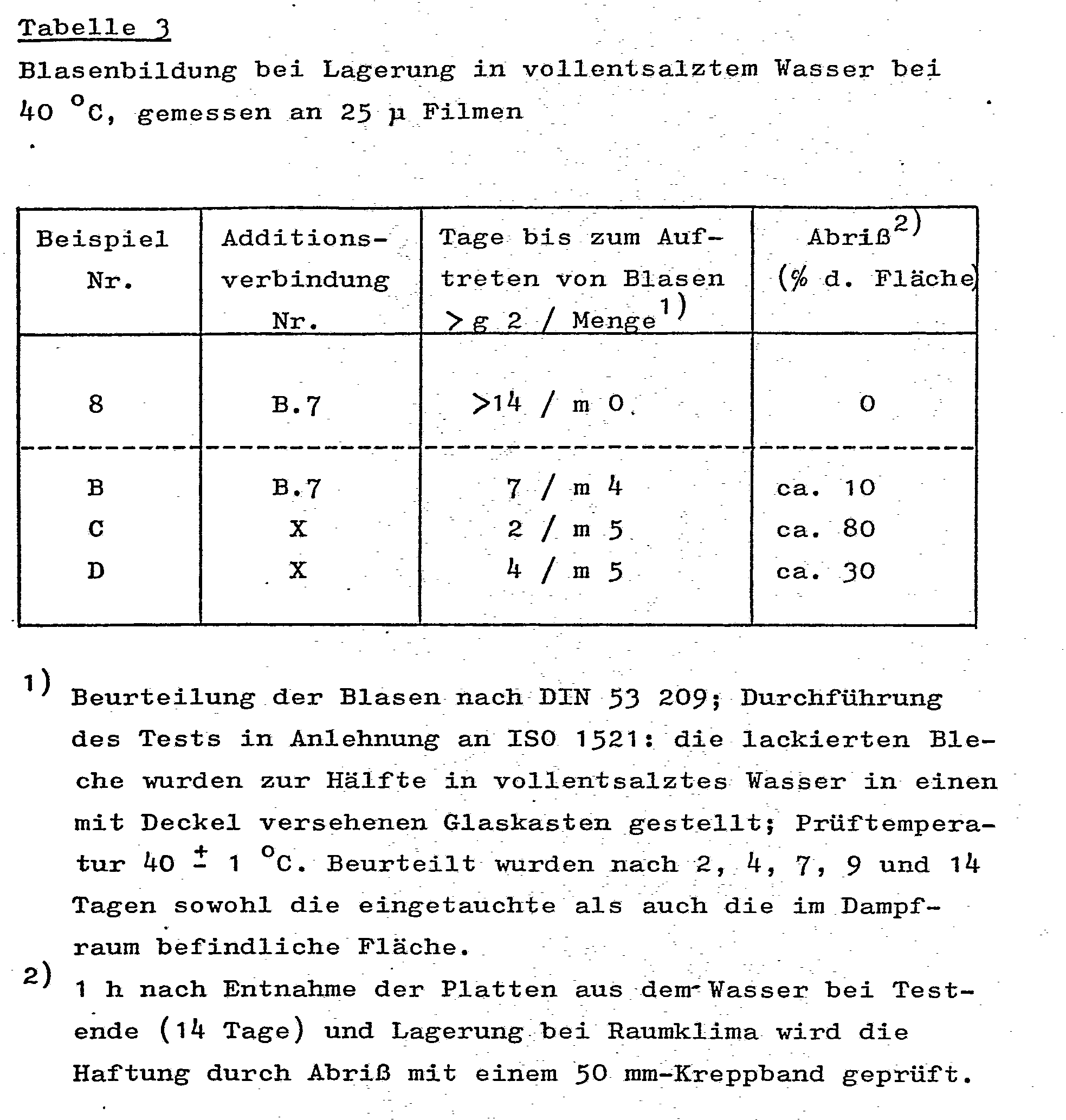
- 306 g des Produktes B.6, 54 g des handelsüblichen Phenolharzes gemäß Beispiel 1 und 154.3 g Diacetonalkohol wurden gemischt und 4 h bei 100 °C vorbehandelt. Nach dem Abkühlen wurden 90 g micronisiertes Talkum; 14.4 g Rutil und 3.6 g Ruß zugefügt'und die Mischung auf einem Dreiwalzenstühl abgerieben. Zu 452 g der erhaltenen Paste wurden 150 g Wasser und 30 g T5prozeMtiges Ammoniak gegeben. Nach 20 Minuten intensiver Durchmischung wurde mit 1 983 g Wasser aufgefüllt. Das wäßrige Überzugsmittel wies einen pH-Wert von 7.5 auf.
- Bei 140 Volt wurden auf zinkphosphatiertem Stahlblech 25 p-Filme abgeschieden und bei 180 °C/20' eingebrannt. Im Salzsprühtest nach ASTM B 117 zeigten diese Filme nach 1 008 Stunden weder Blasen- oder Rißbildung noch Haftungsverlust; die Korrosionsunterwanderung der Lackschicht, ausgehend von einem vor der Prüfung angebrachten Schnitt bis auf das blanke Metall, betrug nach 1 008 Stunden im Mittel 1 mm, ihr Maximalwert 2 mm.
- Entsprechende Prüfplatten, die zunächst 24 Stunden dem Salzsprühtest und anschließend 1 000 Stunden dem Tropentest unterworfen wurden, zeigten keinerlei Blasenbildung oder Filiformkorrosion.
- Mit Buchstaben ekennzeichnete Versuche sind nicht erfindungsgemäß.
Claims (3)


Priority Applications (1)
| Application Number | Priority Date | Filing Date | Title |
|---|---|---|---|
| AT80105382T ATE1611T1 (de) | 1979-11-10 | 1980-09-09 | Waermehaertbare waessrige ueberzugsmittel und deren verwendung. |
Applications Claiming Priority (2)
| Application Number | Priority Date | Filing Date | Title |
|---|---|---|---|
| DE2945459 | 1979-11-10 | ||
| DE2945459A DE2945459C2 (de) | 1979-11-10 | 1979-11-10 | Wärmehärtbare wäßrige Überzugsmittel |
Publications (3)
| Publication Number | Publication Date |
|---|---|
| EP0029487A2 true EP0029487A2 (de) | 1981-06-03 |
| EP0029487A3 EP0029487A3 (en) | 1981-07-22 |
| EP0029487B1 EP0029487B1 (de) | 1982-09-29 |
Family
ID=6085659
Family Applications (1)
| Application Number | Title | Priority Date | Filing Date |
|---|---|---|---|
| EP80105382A Expired EP0029487B1 (de) | 1979-11-10 | 1980-09-09 | Wärmehärtbare wässrige Überzugsmittel und deren Verwendung |
Country Status (9)
| Country | Link |
|---|---|
| US (1) | US4309260A (de) |
| EP (1) | EP0029487B1 (de) |
| JP (1) | JPS5682853A (de) |
| AT (1) | ATE1611T1 (de) |
| BR (1) | BR8007247A (de) |
| CA (1) | CA1157178A (de) |
| DE (1) | DE2945459C2 (de) |
| ES (1) | ES496622A0 (de) |
| SU (1) | SU1136749A3 (de) |
Families Citing this family (1)
| Publication number | Priority date | Publication date | Assignee | Title |
|---|---|---|---|---|
| DE3629581A1 (de) * | 1986-08-30 | 1988-03-03 | Basf Ag | Waessrige bindemitteldispersionen fuer die herstellung von anstrich- und beschichtungsmitteln |
Family Cites Families (7)
| Publication number | Priority date | Publication date | Assignee | Title |
|---|---|---|---|---|
| FR2097843A6 (en) * | 1968-07-24 | 1972-03-03 | Vianova Kunstharz Ag | Water soluble coatings for metals from diene polymers |
| AT289269B (de) * | 1968-07-24 | 1971-04-13 | Vianova Kunstharz Ag | Wässeriges Überzugsmittel |
| CH561269A5 (de) * | 1970-07-22 | 1975-04-30 | Vianova Kunstharz Ag | |
| AT328732B (de) * | 1974-04-03 | 1976-04-12 | Vianova Kunstharz Ag | Verfahren zur herstellung wasserloslicher bindemittel fur die elektrotauchlackierung |
| GB1495457A (en) * | 1975-03-06 | 1977-12-21 | Int Paint Co | Electropaints |
| JPS51116893A (en) * | 1975-04-08 | 1976-10-14 | Ube Ind Ltd | Photo-setting compositions |
| US3974129A (en) * | 1975-07-24 | 1976-08-10 | Shell Oil Company | Polybutadiene resin |
-
1979
- 1979-11-10 DE DE2945459A patent/DE2945459C2/de not_active Expired
-
1980
- 1980-09-09 AT AT80105382T patent/ATE1611T1/de not_active IP Right Cessation
- 1980-09-09 EP EP80105382A patent/EP0029487B1/de not_active Expired
- 1980-11-06 SU SU803002497A patent/SU1136749A3/ru active
- 1980-11-07 ES ES496622A patent/ES496622A0/es active Granted
- 1980-11-07 BR BR8007247A patent/BR8007247A/pt unknown
- 1980-11-07 CA CA000364252A patent/CA1157178A/en not_active Expired
- 1980-11-10 JP JP15710580A patent/JPS5682853A/ja active Pending
- 1980-11-10 US US06/205,129 patent/US4309260A/en not_active Expired - Lifetime
Also Published As
| Publication number | Publication date |
|---|---|
| BR8007247A (pt) | 1981-05-19 |
| SU1136749A3 (ru) | 1985-01-23 |
| EP0029487A3 (en) | 1981-07-22 |
| DE2945459C2 (de) | 1983-10-13 |
| CA1157178A (en) | 1983-11-15 |
| EP0029487B1 (de) | 1982-09-29 |
| US4309260A (en) | 1982-01-05 |
| ES8201196A1 (es) | 1981-12-16 |
| JPS5682853A (en) | 1981-07-06 |
| ES496622A0 (es) | 1981-12-16 |
| DE2945459A1 (de) | 1981-05-21 |
| ATE1611T1 (de) | 1982-10-15 |
Similar Documents
| Publication | Publication Date | Title |
|---|---|---|
| DE2541234C3 (de) | Kationische elektrophoretische Beschichtungsmassen | |
| DE2824418A1 (de) | Carboxylgruppenhaltiger polyester, verfahren zu seiner herstellung und diesen enthaltendes waessriges ueberzugsmittel | |
| EP0082291A1 (de) | Wärmehärtbare kationische wasserverdünnbare Bindemittel | |
| DE3311517A1 (de) | In der hitze selbstvernetzende lackbindemittel, ihre herstellung und verwendung | |
| DE2926001A1 (de) | Lacksystem zum kathodischen elektrotauch-lackieren | |
| EP0066859B1 (de) | Kathodisch abscheidbares wässriges Elektrotauchlack-Uberzugsmittel | |
| DE2715259B2 (de) | Kationische elektrophoretische Anstrichmasse | |
| DE2744360C2 (de) | Kathodisch abscheidbare Elektrotachlackbindemittel | |
| EP0039425B1 (de) | Wasserverdünnbare Bindemittel, ihre Herstellung und Verwendung | |
| DE2704344C2 (de) | Anstrichmittel | |
| DE2452466C3 (de) | Wässrige Beschichtungszusammensetzung | |
| EP0029487B1 (de) | Wärmehärtbare wässrige Überzugsmittel und deren Verwendung | |
| DE2411350A1 (de) | Verfahren zur herstellung waermehaertbarer, fuer das elektrotauchverfahren geeigneter, wasserverduennbarer kunstharze | |
| DE2945569C2 (de) | In der Wärme einzubrennende wäßrige Überzugsmittel für die anodische Elektrotauchlackierung | |
| DE2752198A1 (de) | Waessrige lackzubereitung | |
| DE2737174C2 (de) | ||
| DE2935066C2 (de) | Grundierungsmittel für korrosionsanfällige Substrate | |
| DE2728470A1 (de) | Durch protonisieren mit saeuren wasserverduennbare harze | |
| DE2737755C2 (de) | Lackbindemittel und deren Verwendung | |
| EP0165648A2 (de) | Hitzehärtbares Überzugsmittel und seine Verwendung | |
| DE2038768A1 (de) | Lackbindemittel | |
| DE2759428B2 (de) | Überzugsmittel | |
| EP0231803B1 (de) | Elektrisch abscheidbare Zubereitungen mit niedrigem Gehalt an organischen Lösungsmitteln und Verfahren zu deren Herstellung | |
| AT366081B (de) | Bindemittelkombination fuer korrosionsfeste lacke | |
| DE3124168C2 (de) | Bindemittelsystem für das kathodische Elektrotauchlackieren, Elektrotauchbad auf Basis des Bindemittelsystems und Verfahren zum Beschichten eines leitfähigen Substrats |
Legal Events
| Date | Code | Title | Description |
|---|---|---|---|
| PUAI | Public reference made under article 153(3) epc to a published international application that has entered the european phase |
Free format text: ORIGINAL CODE: 0009012 |
|
| PUAL | Search report despatched |
Free format text: ORIGINAL CODE: 0009013 |
|
| AK | Designated contracting states |
Designated state(s): AT FR GB IT NL SE |
|
| AK | Designated contracting states |
Designated state(s): AT FR GB IT NL SE |
|
| 17P | Request for examination filed |
Effective date: 19810702 |
|
| ITF | It: translation for a ep patent filed | ||
| GRAA | (expected) grant |
Free format text: ORIGINAL CODE: 0009210 |
|
| AK | Designated contracting states |
Designated state(s): AT FR GB IT NL SE |
|
| REF | Corresponds to: |
Ref document number: 1611 Country of ref document: AT Date of ref document: 19821015 Kind code of ref document: T |
|
| PGFP | Annual fee paid to national office [announced via postgrant information from national office to epo] |
Ref country code: SE Payment date: 19830831 Year of fee payment: 4 |
|
| PGFP | Annual fee paid to national office [announced via postgrant information from national office to epo] |
Ref country code: FR Payment date: 19830902 Year of fee payment: 4 |
|
| PGFP | Annual fee paid to national office [announced via postgrant information from national office to epo] |
Ref country code: AT Payment date: 19830928 Year of fee payment: 4 |
|
| PGFP | Annual fee paid to national office [announced via postgrant information from national office to epo] |
Ref country code: NL Payment date: 19830930 Year of fee payment: 4 |
|
| PG25 | Lapsed in a contracting state [announced via postgrant information from national office to epo] |
Ref country code: AT Effective date: 19840909 |
|
| PG25 | Lapsed in a contracting state [announced via postgrant information from national office to epo] |
Ref country code: SE Effective date: 19840910 |
|
| PG25 | Lapsed in a contracting state [announced via postgrant information from national office to epo] |
Ref country code: NL Effective date: 19850401 |
|
| GBPC | Gb: european patent ceased through non-payment of renewal fee | ||
| NLV4 | Nl: lapsed or anulled due to non-payment of the annual fee | ||
| PG25 | Lapsed in a contracting state [announced via postgrant information from national office to epo] |
Ref country code: FR Free format text: LAPSE BECAUSE OF NON-PAYMENT OF DUE FEES Effective date: 19850531 |
|
| REG | Reference to a national code |
Ref country code: FR Ref legal event code: ST |
|
| PG25 | Lapsed in a contracting state [announced via postgrant information from national office to epo] |
Ref country code: GB Effective date: 19881118 |
|
| EUG | Se: european patent has lapsed |
Ref document number: 80105382.8 Effective date: 19850617 |
|
| PLBE | No opposition filed within time limit |
Free format text: ORIGINAL CODE: 0009261 |
|
| STAA | Information on the status of an ep patent application or granted ep patent |
Free format text: STATUS: NO OPPOSITION FILED WITHIN TIME LIMIT |