EP0029531A1 - Procédé et dispositif pour localiser des défauts sur une ligne de communication digitale à vitesse de transmission plus grande - Google Patents
Procédé et dispositif pour localiser des défauts sur une ligne de communication digitale à vitesse de transmission plus grande Download PDFInfo
- Publication number
- EP0029531A1 EP0029531A1 EP80106817A EP80106817A EP0029531A1 EP 0029531 A1 EP0029531 A1 EP 0029531A1 EP 80106817 A EP80106817 A EP 80106817A EP 80106817 A EP80106817 A EP 80106817A EP 0029531 A1 EP0029531 A1 EP 0029531A1
- Authority
- EP
- European Patent Office
- Prior art keywords
- signal
- transmission
- additional
- additional signal
- amplifier
- Prior art date
- Legal status (The legal status is an assumption and is not a legal conclusion. Google has not performed a legal analysis and makes no representation as to the accuracy of the status listed.)
- Granted
Links
- 230000005540 biological transmission Effects 0.000 title claims abstract description 62
- 238000000034 method Methods 0.000 title claims abstract description 21
- 230000004807 localization Effects 0.000 title 1
- 230000000737 periodic effect Effects 0.000 claims abstract description 6
- 230000008929 regeneration Effects 0.000 claims abstract description 5
- 238000011069 regeneration method Methods 0.000 claims abstract description 5
- 230000003321 amplification Effects 0.000 claims description 2
- 230000007257 malfunction Effects 0.000 claims description 2
- 238000003199 nucleic acid amplification method Methods 0.000 claims description 2
- 230000001105 regulatory effect Effects 0.000 claims description 2
- 238000010586 diagram Methods 0.000 description 4
- RYGMFSIKBFXOCR-UHFFFAOYSA-N Copper Chemical compound [Cu] RYGMFSIKBFXOCR-UHFFFAOYSA-N 0.000 description 3
- 239000000654 additive Substances 0.000 description 3
- 230000000996 additive effect Effects 0.000 description 3
- 229910052802 copper Inorganic materials 0.000 description 3
- 239000010949 copper Substances 0.000 description 3
- 230000000903 blocking effect Effects 0.000 description 1
- 230000001419 dependent effect Effects 0.000 description 1
- 230000018109 developmental process Effects 0.000 description 1
- 238000011156 evaluation Methods 0.000 description 1
- 239000000835 fiber Substances 0.000 description 1
- 238000009413 insulation Methods 0.000 description 1
- 239000013307 optical fiber Substances 0.000 description 1
- 230000010355 oscillation Effects 0.000 description 1
- 229920000682 polycarbomethylsilane Polymers 0.000 description 1
- 230000002123 temporal effect Effects 0.000 description 1
- 238000000411 transmission spectrum Methods 0.000 description 1
Images
Classifications
-
- H—ELECTRICITY
- H04—ELECTRIC COMMUNICATION TECHNIQUE
- H04B—TRANSMISSION
- H04B17/00—Monitoring; Testing
- H04B17/40—Monitoring; Testing of relay systems
- H04B17/401—Monitoring; Testing of relay systems with selective localization
- H04B17/402—Monitoring; Testing of relay systems with selective localization using different frequencies
- H04B17/403—Monitoring; Testing of relay systems with selective localization using different frequencies generated by local oscillators
Definitions
- the invention relates to a method for fault location for digital transmission links with a higher transmission speed, which periodically have pulse regenerators for the intermediate points containing the transmission signal, in which at least one additional signal is transmitted over at least part of the transmission link to an evaluating point.
- PCM systems with bit rates of 2 Mbit / s results in the need to develop PCM transmission systems with which a multiplicity of time-division multiplex signals of the PCM basic systems can be transmitted.
- PCM systems with 8, 34 and 140 Mbit / s have proven to be the next hierarchical levels.
- intermediate points are required for spatially extensive transmission links, in which the transmitted digital signal with regard to the frequency response in the transmission medium, and also with regard to the signal amplitude and the signal phase for both transmission directions is equalized and regenerated.
- the intermediate points are fed remotely via an additional direct current path.
- a transmission link can therefore consist of several remote feed sections.
- At least one additional signal to the evaluating point over at least part of the transmission link.
- This can be a so-called pilot tone, which is transmitted from the sending line terminal over the entire transmission distance; it is also known to send out an additional signal with an identifier for this intermediate point from each intermediate point, so that in the absence of this signal a fault in a certain intermediate point or the cable route connected to it can be directly inferred.
- the object of the present invention is now to develop a method for fault location of the type mentioned at the outset which is suitable for digital transmission links with bit repetition frequencies of over 100 Mbit, requires as little effort as possible, and from which. remote feed route that is at risk of lightning and is limited in its spatial extent.
- the object is achieved in that the additional signal is in the transmission range of the digital signal in that: the additional signal is separated from the transmission signal in the intermediate points, amplified in a transmission path that is independent of the pulse regeneration for the digital signal, shaped and then the regenerated digital signal is added, from which the portions that were replaced by the additional signal were previously hidden.
- a particular advantage of the inventive method is that it is "usable both for radio transmission paths, as well as the various copper cable systems as well as for optical fiber systems, so that can be monitored from a central location from a variety of these systems and for example also equivalent circuits upon failure of one of these Systems are easily possible.
- a variant of the method according to the invention is expedient, in which the additional signal at the beginning of the transmission link is fed into this for address-free fault location and is changed in a specific periodic manner in a specific intermediate point in a certain periodic time period .
- a variant of the method according to the invention is preferred, in which an additional, frequency-differing signal is generated in each intermediate point for fault location by means of address and is emitted to the connected transmission link.
- an additional, frequency-differing signal is generated in each intermediate point for fault location by means of address and is emitted to the connected transmission link.
- the use of the method according to the invention is particularly expedient in that, when digital signals are transmitted at a bit rate of 140 Mbit / s, the additional signals are in a 100 Hz grid in the frequency range from 120 to 200 kHz.
- a slightly different leveling of the additional signal in the individual intermediate points can lead to significant level errors by summation over the distance, which are avoided by regulating the amplification of the additional signal in the transmission path separate from the pulse regeneration as a function of the amplitude of a further additional signal emanating from the transmitting line terminal.
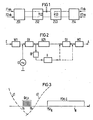
- connection F1an shows a part of a digital transmission link constructed by means of coaxial cables consisting of four intermediate points ZS1 ... ZS4 and the corresponding cable routes.
- the signals for one direction of transmission are fed into this section at connection F1an and emitted to the next section at connection F1ab.
- the signals at terminal F2an are fed into the transmission link area under consideration and transferred at terminal F2ab to the subsequent part of the transmission link.
- the individual intermediate points contain, in a known manner, at least one regenerator for each transmission direction and also remote feed and fault location devices.
- a combined remote feed and fault location device is the "Schaltzizatz" known from carrier frequency technology, which is contained in each of these intermediate points.
- the remote feed devices connected via the connections F1an, F2ab or Flab and F2an are automatically switched off, so that the entire remote feed section is initially shut down.
- the loops S2 and S3 between the two remote feed wires are automatically switched by relays located in each intermediate point.
- the remote supply devices in the terminals then switch on again, the remote supply voltage slowly increasing and the loop connections in the intermediate points ZS1 and ZS4 being broken by the remote supply current flowing on the transmission path, while the loops in ZS2 and ZS3 remain in place.
- a d can be located over the entire loop or over both loops from the respective line terminals from the fault location by transmitting an additional signal that is influenced in each intermediate point.
- FIG. 2 shows part of one of the intermediate points ZS1 ... ZS4 of FIG. 1 for one direction of conversation.
- the remote feed switch W1 connects to the input, by means of which the transmission signals are separated from the remote feed current.
- the equalizer amplifier EV connected to the crossover is used to compensate for the cable frequency response and the cable attenuation, to which the amplitude and time regenerator AZR is connected, in which the digital signals are regenerated with regard to the amplitude and the temporal position.
- a transmission amplifier SV is connected to the output of this regenerator and generates a transmission signal which is emitted via the second remote feed switch W2 to the output A of the intermediate point and thus to the next cable route.
- a generator G which generates an identification tone that designates the intermediate point and feeds it into the transmission path at the input of the equalizer amplifier EV.
- the connection of the generator G is not tied to this feed point, it is also possible to feed the output of the equalizer amplifier EV. This essentially depends on the output level of the generator G.
- a bandpass filter BP is connected to the output of the equalizer amplifier EV and filters the plurality of knowledge tones generated by the generators G of the individual intermediate points out of the transmission signal and via supplies a controller R to an input of the transmission amplifier SV or the output of this amplifier.
- the controller R is used to adjust the amplitude of these location signals.
- the control takes place via a frequency-dependent attenuation quadrupole connected to the output of the controller R, which is connected to the control input of the controller R via a control amplifier.
- the frequency diagram shown in FIG. 3 serves to explain the function of the arrangement according to FIG. 2.
- the location signal and the PCM signal PCMS are shown in the frequency diagram.
- the two frequency limits of the location signal are. denoted by f a and f b , while the position of the PCM signal is represented by the Nyquist frequency and by 1% of this frequency.
- the attenuation curve of the first crossover W1 is represented by "dl" and the attenuation curve of the bandpass in the low-pass range in the frequency range of interest is represented by n dZ ".
- the first crossover W1 thus decouples the PCM signal to be transmitted together with the location signal from the remote supply current and emits it to the equalizer amplifier EV, which also receives an additional oscillation from the generator G which identifies the relevant intermediate point with regard to its frequency, that is to say an "identification tone""represents.
- the two frequency limits f a and f b of the location signal are 120 and 140 kHz. This frequency range is subdivided into a 100 Hz grid, so that there are 200 characteristic frequencies, which correspond to 200 possible intermediate points.
- these vibrations are separated from the transmission signal in accordance with the 200 characteristic frequencies, which in their entirety represent the locating signal, and are transmitted to the controller R, which represents a controllable attenuator and adjusts the level of the location signal.
- the controller R which represents a controllable attenuator and adjusts the level of the location signal.
- the location signal is supplied to either the input or the output of the output amplifier AV.
- the connection depends on whether the output amplifier AV is an analog amplifier or a switching amplifier. If it is an analog amplifier, the output signal of the controller R is fed to the input of the output or transmit amplifier SV. If the transmission amplifier SV is operated as a switching amplifier, then components are generated which lie in the frequency range of the location signal.
- the transmitter amplifier SV contains an additional high-pass filter, the attenuation requirement of which corresponds to the low-pass filter component of the bandpass filter BP and by which the undesired components are suppressed.
- the output signals of the controller R are then added to the transmission signal at the output of the transmission amplifier SV.
Landscapes
- Physics & Mathematics (AREA)
- Electromagnetism (AREA)
- Engineering & Computer Science (AREA)
- Computer Networks & Wireless Communication (AREA)
- Signal Processing (AREA)
- Monitoring And Testing Of Transmission In General (AREA)
- Locating Faults (AREA)
- Dc Digital Transmission (AREA)
- Detection And Prevention Of Errors In Transmission (AREA)
- Error Detection And Correction (AREA)
Priority Applications (1)
| Application Number | Priority Date | Filing Date | Title |
|---|---|---|---|
| AT80106817T ATE5930T1 (de) | 1979-11-09 | 1980-11-05 | Verfahren und anordnung zur fehlerortung auf digitalen uebertragungsstrecken mit hoeherer uebertragungsgeschwindigkeit. |
Applications Claiming Priority (2)
| Application Number | Priority Date | Filing Date | Title |
|---|---|---|---|
| DE2945392A DE2945392C2 (de) | 1979-11-09 | 1979-11-09 | Fehlerortung für digitale Übertragungsstrecken mit höherer Übertragungsgeschwindigkeit |
| DE2945392 | 1979-11-09 |
Publications (2)
| Publication Number | Publication Date |
|---|---|
| EP0029531A1 true EP0029531A1 (fr) | 1981-06-03 |
| EP0029531B1 EP0029531B1 (fr) | 1984-01-18 |
Family
ID=6085632
Family Applications (1)
| Application Number | Title | Priority Date | Filing Date |
|---|---|---|---|
| EP80106817A Expired EP0029531B1 (fr) | 1979-11-09 | 1980-11-05 | Procédé et dispositif pour localiser des défauts sur une ligne de communication digitale à vitesse de transmission plus grande |
Country Status (3)
| Country | Link |
|---|---|
| EP (1) | EP0029531B1 (fr) |
| AT (1) | ATE5930T1 (fr) |
| DE (2) | DE2945392C2 (fr) |
Citations (5)
| Publication number | Priority date | Publication date | Assignee | Title |
|---|---|---|---|---|
| US3904827A (en) * | 1972-08-24 | 1975-09-09 | Philips Corp | System for locating faulty line repeaters of repeater stations in a transmission line |
| DE2632193B2 (de) * | 1976-07-16 | 1978-05-11 | Siemens Ag, 1000 Berlin Und 8000 Muenchen | Verfahren zur Puls-Fehlerortung in einem PCM-System hoher Bitrate |
| US4112293A (en) * | 1976-03-18 | 1978-09-05 | Patelhold Patentverwertungs & Elektro-Holding Ag | Optical fiber data transmission system |
| DE2826675A1 (de) * | 1977-06-20 | 1978-12-21 | Centre Nat Etd Telecomm | Fehlerortungssystem fuer datenuebertragungsleitungen |
| GB2019167A (en) * | 1978-04-11 | 1979-10-24 | Kokusai Denshin Denwa Co Ltd | Monitoring system for optical transmission line repeaters |
Family Cites Families (2)
| Publication number | Priority date | Publication date | Assignee | Title |
|---|---|---|---|---|
| DE1762599B1 (de) * | 1968-07-17 | 1970-11-05 | Siemens Ag | Schaltung zum Schliessen der Fernspeiseschleife fuer reihengespeiste,aus je zwei parallel gespeisten Verstaerkern fuer beide Richtungen bestehende,unbemannte Unterstationen bei Streckenunterbrechungen |
| DE2833022A1 (de) * | 1978-07-27 | 1980-02-07 | Siemens Ag | Schaltungsanordnung zur fernspeisung von zwischenstellen einer einrichtung der nachrichtenuebertragungstechnik |
-
1979
- 1979-11-09 DE DE2945392A patent/DE2945392C2/de not_active Expired
-
1980
- 1980-11-05 AT AT80106817T patent/ATE5930T1/de not_active IP Right Cessation
- 1980-11-05 EP EP80106817A patent/EP0029531B1/fr not_active Expired
- 1980-11-05 DE DE8080106817T patent/DE3066204D1/de not_active Expired
Patent Citations (5)
| Publication number | Priority date | Publication date | Assignee | Title |
|---|---|---|---|---|
| US3904827A (en) * | 1972-08-24 | 1975-09-09 | Philips Corp | System for locating faulty line repeaters of repeater stations in a transmission line |
| US4112293A (en) * | 1976-03-18 | 1978-09-05 | Patelhold Patentverwertungs & Elektro-Holding Ag | Optical fiber data transmission system |
| DE2632193B2 (de) * | 1976-07-16 | 1978-05-11 | Siemens Ag, 1000 Berlin Und 8000 Muenchen | Verfahren zur Puls-Fehlerortung in einem PCM-System hoher Bitrate |
| DE2826675A1 (de) * | 1977-06-20 | 1978-12-21 | Centre Nat Etd Telecomm | Fehlerortungssystem fuer datenuebertragungsleitungen |
| GB2019167A (en) * | 1978-04-11 | 1979-10-24 | Kokusai Denshin Denwa Co Ltd | Monitoring system for optical transmission line repeaters |
Also Published As
| Publication number | Publication date |
|---|---|
| ATE5930T1 (de) | 1984-02-15 |
| EP0029531B1 (fr) | 1984-01-18 |
| DE2945392A1 (de) | 1981-05-21 |
| DE3066204D1 (en) | 1984-02-23 |
| DE2945392C2 (de) | 1985-06-27 |
Similar Documents
| Publication | Publication Date | Title |
|---|---|---|
| DE3642141A1 (de) | Verfahren zur dezentralen netzersatzschaltung | |
| DE68920970T2 (de) | Übertragungsleitungs-Überwachungssystem. | |
| DE3027755A1 (de) | Verfahren zur ueberwachung von zwischenregeneratoren | |
| DE2725250C3 (de) | Kabelfernsehanlage mit abschaltbaren Teilnehmeranschlüssen | |
| EP0031506B1 (fr) | Surveillance des lignes de communication à signaux digitaux à grande vitesse de transmission | |
| CH652543A5 (de) | Verfahren und einrichtung zur ueberwachung einer uebertragungsanlage. | |
| EP0029531B1 (fr) | Procédé et dispositif pour localiser des défauts sur une ligne de communication digitale à vitesse de transmission plus grande | |
| EP0013944B1 (fr) | Procédé et dispositif pour la localisation d'un défaut et la surveillance d'une communication d'informations | |
| DE3427139C2 (de) | Einrichtung zur Übertragung von Daten über eine Fernsprechleitung | |
| DE2339705C2 (de) | Fehlerortungssystem für Leitungsverstärker von Verstärkerstellen in einer Übertragungsstrecke | |
| DE3000339C2 (de) | Übertragungsstrecke für digitale Signale | |
| DE2942410C2 (fr) | ||
| DE3035515C2 (fr) | ||
| EP0033470B1 (fr) | Dispositif de circuit pour former un court-circuit dans un régénérateur d'un système-MIC | |
| EP0092071B1 (fr) | Surveillance d'exploitation de voies de transmission pour signaux numériques | |
| DE3207397C2 (de) | Verfahren zur Überwachung der Funktionsfähigkeit einer digitalen Übertragungsstrecke | |
| DE3015827C2 (de) | Übertragungssystem für digitale Signale mit einer Einrichtung zur Fehlerortung | |
| EP0214657B1 (fr) | Système de transmission d'informations avec surveillance d'après le procédé de localisation de défauts pendant le service | |
| DE3000371C2 (de) | Übertragungsstrecke für digitale Signale | |
| EP0135164B1 (fr) | Système de transmission pour signaux numériques de haut débit binaire avec transmission de signaux auxiliaires | |
| EP0016416B1 (fr) | Localisation de défauts sans adresse | |
| EP0046846B1 (fr) | Système de communication par câble | |
| DE3407669C2 (fr) | ||
| DE2140678C3 (de) | Pegelregelungsanordnung für ein Nachrichtenübertragungssystem mit Steuerung durch Pilotpegelempfänger | |
| DE19653260A1 (de) | Verfahren zur In-Betrieb-Überwachung eines Digitalübertragungssystems |
Legal Events
| Date | Code | Title | Description |
|---|---|---|---|
| PUAI | Public reference made under article 153(3) epc to a published international application that has entered the european phase |
Free format text: ORIGINAL CODE: 0009012 |
|
| AK | Designated contracting states |
Designated state(s): AT BE CH DE FR GB IT NL SE |
|
| 17P | Request for examination filed |
Effective date: 19811014 |
|
| ITF | It: translation for a ep patent filed | ||
| GRAA | (expected) grant |
Free format text: ORIGINAL CODE: 0009210 |
|
| AK | Designated contracting states |
Designated state(s): AT BE CH DE FR GB IT LI NL SE |
|
| REF | Corresponds to: |
Ref document number: 5930 Country of ref document: AT Date of ref document: 19840215 Kind code of ref document: T |
|
| REF | Corresponds to: |
Ref document number: 3066204 Country of ref document: DE Date of ref document: 19840223 |
|
| ET | Fr: translation filed | ||
| PGFP | Annual fee paid to national office [announced via postgrant information from national office to epo] |
Ref country code: FR Payment date: 19841120 Year of fee payment: 5 |
|
| PGFP | Annual fee paid to national office [announced via postgrant information from national office to epo] |
Ref country code: SE Payment date: 19841231 Year of fee payment: 5 Ref country code: BE Payment date: 19841231 Year of fee payment: 5 |
|
| PLBE | No opposition filed within time limit |
Free format text: ORIGINAL CODE: 0009261 |
|
| STAA | Information on the status of an ep patent application or granted ep patent |
Free format text: STATUS: NO OPPOSITION FILED WITHIN TIME LIMIT |
|
| 26N | No opposition filed | ||
| PGFP | Annual fee paid to national office [announced via postgrant information from national office to epo] |
Ref country code: AT Payment date: 19861029 Year of fee payment: 7 |
|
| PGFP | Annual fee paid to national office [announced via postgrant information from national office to epo] |
Ref country code: NL Payment date: 19861130 Year of fee payment: 7 |
|
| PG25 | Lapsed in a contracting state [announced via postgrant information from national office to epo] |
Ref country code: NL Effective date: 19880601 |
|
| NLV4 | Nl: lapsed or anulled due to non-payment of the annual fee | ||
| PGFP | Annual fee paid to national office [announced via postgrant information from national office to epo] |
Ref country code: DE Payment date: 19890126 Year of fee payment: 9 |
|
| PGFP | Annual fee paid to national office [announced via postgrant information from national office to epo] |
Ref country code: CH Payment date: 19890222 Year of fee payment: 9 |
|
| PG25 | Lapsed in a contracting state [announced via postgrant information from national office to epo] |
Ref country code: GB Effective date: 19891105 Ref country code: AT Effective date: 19891105 |
|
| PG25 | Lapsed in a contracting state [announced via postgrant information from national office to epo] |
Ref country code: SE Effective date: 19891106 |
|
| PG25 | Lapsed in a contracting state [announced via postgrant information from national office to epo] |
Ref country code: LI Effective date: 19891130 Ref country code: CH Effective date: 19891130 Ref country code: BE Effective date: 19891130 |
|
| BERE | Be: lapsed |
Owner name: SIEMENS A.G. BERLIN UND MUNCHEN Effective date: 19891130 |
|
| GBPC | Gb: european patent ceased through non-payment of renewal fee | ||
| PG25 | Lapsed in a contracting state [announced via postgrant information from national office to epo] |
Ref country code: FR Effective date: 19900731 |
|
| REG | Reference to a national code |
Ref country code: CH Ref legal event code: PL |
|
| PG25 | Lapsed in a contracting state [announced via postgrant information from national office to epo] |
Ref country code: DE Effective date: 19900801 |
|
| REG | Reference to a national code |
Ref country code: FR Ref legal event code: ST |
|
| EUG | Se: european patent has lapsed |
Ref document number: 80106817.2 Effective date: 19900705 |