EP0030735A2 - Reagenzien für Radioimmunverfahren - Google Patents
Reagenzien für Radioimmunverfahren Download PDFInfo
- Publication number
- EP0030735A2 EP0030735A2 EP80107928A EP80107928A EP0030735A2 EP 0030735 A2 EP0030735 A2 EP 0030735A2 EP 80107928 A EP80107928 A EP 80107928A EP 80107928 A EP80107928 A EP 80107928A EP 0030735 A2 EP0030735 A2 EP 0030735A2
- Authority
- EP
- European Patent Office
- Prior art keywords
- active component
- composition according
- particles
- radioimmunoassay
- matrix
- Prior art date
- Legal status (The legal status is an assumption and is not a legal conclusion. Google has not performed a legal analysis and makes no representation as to the accuracy of the status listed.)
- Granted
Links
Images
Classifications
-
- G—PHYSICS
- G01—MEASURING; TESTING
- G01N—INVESTIGATING OR ANALYSING MATERIALS BY DETERMINING THEIR CHEMICAL OR PHYSICAL PROPERTIES
- G01N33/00—Investigating or analysing materials by specific methods not covered by groups G01N1/00 - G01N31/00
- G01N33/48—Biological material, e.g. blood, urine; Haemocytometers
- G01N33/50—Chemical analysis of biological material, e.g. blood, urine; Testing involving biospecific ligand binding methods; Immunological testing
- G01N33/53—Immunoassay; Biospecific binding assay; Materials therefor
- G01N33/531—Production of immunochemical test materials
- G01N33/532—Production of labelled immunochemicals
- G01N33/534—Production of labelled immunochemicals with radioactive label
Definitions
- Radioimmunoassays and other radioligand procedures require a final separation step in which free and bound radioligand are separated into different phases to enable radioactivity to be measured in one of these phases. In most processes, this separation requires two steps, firstly centrifugation and secondly the removal of the liquid phase by decanting, suction or the like. These steps are labor intensive and are obstacles to the development of fully automated radioimmunoassays.
- this shielding agent not interfere with the antigen-antibody binding and that, if insoluble, the shielding agent should not adsorb the process reactants on its surface.
- the binding or unbound radioligand is rendered insoluble for the purpose of separating these components using techniques and reagents known per se, that is to say by double-antibody separation, chemical precipitation or by using antibodies or antigens which are particulate, water-insoluble Carriers are bound.
- the activated carbon can be mixed with the shielding agent.
- a shielding agent can be used which also adsorbs the radioactive material that has not reacted.
- An example of such a material is bismuth carbonate powder.
- the present invention relates to new shielding agents which can be used as reagents in an improved counting method for radioimmunoassays and related radioligand methods in which the shielding is done in the sample itself.
- These shielding agents comprise individual particles, each of which contains, as a first active component, a shielding material which has a high ability to absorb radiated radioactivity, and as a second active component a material which acts on a reagent or the reaction product of the immune process.
- the second active component is selected from materials selected, the immune process react immunologically with either the reagent or the reaction product.
- Suitable materials include antibodies (first antibody) which are specific for the substances to be determined in the radioimmunoassay, antigens and antibodies (second antibody) which were generated in a second host animal and are directed against the sera of the host animal in which the first antibody is formed has been.
- the second active component may also be a biologically active binding agent by non-immune type, such as transport proteins, eg, thyroxine binding globulin, or receptors cellular origin, such as cytoplasmic estrogen receptors O or hormone receptors from the plasma membrane.
- the first active component can be a shielding agent known in the art which has a high ability to absorb the radiation caused by a radio ligand.
- these materials include the shielding agents previously described for this purpose, i.e. silver, cadmium, tungsten, bismuth or compounds containing these elements, such as the oxides thereof.
- a particularly preferred first active component contains bismuth, particularly preferably bismuth oxide (Bi 2 0 3 ) .
- a particularly preferred embodiment according to the present invention is that the first and the second active component are in combination with a carrier matrix.
- matrices which are used in a conventional manner for immobilizing biologically active molecules, can be obtained from gels, glass or polymeric material.
- Preferred matrix materials for this purpose include agarose, polyacrylamide, starch or polyvinylidene fluoride.
- a suitable method for producing a component according to the present invention is to insolubilize, gel or polymerize the matrix material in the presence of the first active component in order to obtain particles, preferably microparticles, of the polymer material which contain the first active component.
- the second active component is then covalently bound to the surface of the particles or covalently bound to the matrix or captured by the matrix using known types for coupling or capturing or otherwise immobilizing biologically active substances to solid supports.
- the size and properties of the particles are largely dependent on the properties of the first active component. It is preferred that this component be in microcrystalline form, the largest being Crystals have a dimension below 5 microns. Larger particles are also suitable, but the most preferred size is 2 micron crystal dimension.
- a suitable first component such as W ismutoxid by polymerizing the acrylamide monomer in the presence of bismuth in a polyacrylamide matrix incorporate. The polymerization is expediently carried out in a water-organic solvent emulsion. Because of the high density of the particles containing the bismuth oxide, it is desirable to carry out the polymerization using a high density organic solvent such as carbon tetrachloride. In another process aspect, a lower density organic solvent, such as toluene, is used, the particles being sedimented during the polymerization.
- the polymerization reaction mixture contains a conventional monomer inducing agent as well as a conventional emulsifying agent such as manitane monooleate, which is commercially available as Arlacel A from Serva, Heidelberg.
- a representative polymerization mixture contains the following components in parts by weight: 0.4 to 2.0, preferably 1.9 acrylamide; 0.2 to 0.4, preferably 0.4 N, N'-methylenebisacrylamide; 0.1 to 2, preferably 1.0 bismuth oxide; about 10.0 water; and an organic phase of 50 to 250 ml of carbon tetrachloride containing 1 to 4, preferably 2% Arlacel A.
- the polymerization of the polyacrylamide to the matrix is carried out by 0.1 part of a 50% ammonium persulfate solution in water and 0.4 to 0.5 part of N , N, N ', N'-tetramethylethylenediamine activated and carried out at a temperature in the range of about 0 to 10 °, preferably 2 ° C.
- agarose In addition to polyacrylamide, agarose (1-5%, preferably 2%) or starch (40-80%, preferably 60%) can be used as the matrix.
- the agarose or starch matrix is in hot and melted form mixed with the first active component to obtain a homogeneous suspension.
- polyacrylamide S is us- pension in a water-organic solvent system in particulate gelled. Droplets of the starch or agarose gel product or the polyacrylamide polymer are then allowed to solidify into solid particles of the desired size in the range from 1 to 100 microns, preferably less than 10 microns. These particles have a density in the range of 1.2 to 8 g per cubic centimeter.
- the organic phase of the solvent system is shaken, for example by stirring or by sonication.
- PVF polyvinylidene fluoride
- Approximately 0.4 to 3 g, preferably 2 g of PVF are dissolved in 20 ml of dimethylformamide and mixed with 10 to 50 g, preferably 40 g of bismuth oxide. Droplets of the resulting material is allowed to small particles of the desired ize ranging from 1 to 100 microns solidify, which is accomplished by adding this material in 200 to 500 ml of isopropanol, ethanol or water. The particle size can be further reduced by homogenization.
- a homogenizer for example Polytron
- the particles may be desirable to use particles of smaller size than those obtained by the respective method.
- the particles can be separated by sieving or by sedimentation in a liquid or in an air stream.
- surface-active substances such as Tween 20, dextran polyethylene glycol or proteins can be added to the suspension in which the particles are contained, the concentration of these substances to achieve the aggregation of the particles in the suspension to the person skilled in the art is known.
- the coupling of the second active component to the particles containing the first active component can be carried out using a coupling agent.
- Suitable coupling agents are cyanogen bromide or a bivalent coupling agent, such as a dialdehyde, preferably glutaraldehyde, which acts as a link between the reactive groups on the surface of the matrix and the reactive groups of the second active component.
- the coupling of the second active component - in the form of an antiserum - can be obtained by treating the bismuth oxide-coated PVF particles with isopropanol for one hour and then washing the particles three times with 0.1M phosphate buffer with a pH of 7.0 0.15 mol of sodium chloride can be achieved. The particles are then incubated for 24 hours at room temperature.
- the sedimentation rate of the particles containing the first and the second active component is specifically selected in order to ent the reaction rate of the second active component adapting accordingly.
- the particles are specified so that they are preferably deposited within a certain time period of about 1 to 180 minutes, 15 to 30 minutes at the bottom of the tubes.
- the binding capacity of the second component of the particles is so large that the desired immunological reaction takes place during the sedimentation of the particles.
- the first component of the particles is replaced by a material which has the same density as the first component, but a lower ability to absorb radioactivity.
- Suitable radioactive isotopes include radioactive forms of barium and iodine containing compounds. When the particles are sedimented at the bottom of the test tube, the supernatant is removed to allow measurement of the radioactivity in the supernatant or in the sediment.
- the particles which contain the first and the second active component are brought into separate, dried or lyophilized dosage units.
- Each dosage unit is pressed into a tablet.
- the tablets also contain fillers that are necessary to maintain the tablet shape and to increase its disintegration when suspended in water.
- Such tablet compositions are well known in the pharmaceutical industry and contain filling materials such as starch, lactose or magnesium carbonate. In this way, the precise addition of a predetermined amount of the active components to each test tube is improved and simplified.
- a goat anti-rabbit antibody (second antibody) is used using glutaraldehyde on polyacrylamide particles in which bismuth oxide is dispersed bound.
- the material obtained is used in a radioimmunoassay for human chorionic gonadotropin (HCG) using a double antibody method under solid phase shielding.
- HCG human chorionic gonadotropin
- rabbit antibodies against HCG are bound to bismuth oxide-containing polyacrylamide particles.
- incubation volume of 1 ml constant proportions of such particles are incubated with HCG standards and J-HLH.
- the tubes are slowly rotated overnight. They are then left to stand for 15 minutes so that the particles can sediment. They are then counted in a counter.
- the results are essentially identical to those shown in FIG. 1.
- a material is used as the second active component which reacts with the radioligand component of the reaction mixture of the radioimmunoassay by adsorption.
- activated carbon is the preferred second active component.
- Appropriate compositions containing activated carbon and the first active component are easily obtainable by mixing these components with a binder such as agarose and can then be brought into the desired particle size. By producing and / or selecting particles of the desired size and density the sedimentation rate can be selected so that there is an optimal adsorption of the radioligand component.
- bismuth oxide is coated with activated carbon using agarose as a binder by the following process.
- T 4 a radioimmunoassay for thyroxine
- 0.05 ml of T 4 standards are incubated with 0.2 ml of rabbit antiserum against T 4 (1: 100) and 0.2 ml of 125 I - T. (2 00 pg) at 4 ° C. overnight.
- a suspension of 0.4 g of the agarose particles containing the activated carbon and the bismuth oxide in 1 ml of buffer is added.
- the tubes are shaken for 5 seconds and then left in an upright position for 15 minutes. They are then measured in an automatic gamma counter (LKB-Wallac Ultro Gamma II). The standard curve obtained can be seen in FIG. 2.
Landscapes
- Health & Medical Sciences (AREA)
- Immunology (AREA)
- Life Sciences & Earth Sciences (AREA)
- Engineering & Computer Science (AREA)
- Molecular Biology (AREA)
- Biomedical Technology (AREA)
- Chemical & Material Sciences (AREA)
- Hematology (AREA)
- Urology & Nephrology (AREA)
- Biotechnology (AREA)
- Microbiology (AREA)
- Cell Biology (AREA)
- Food Science & Technology (AREA)
- Medicinal Chemistry (AREA)
- Physics & Mathematics (AREA)
- Analytical Chemistry (AREA)
- Biochemistry (AREA)
- General Health & Medical Sciences (AREA)
- General Physics & Mathematics (AREA)
- Pathology (AREA)
- Medicines Containing Antibodies Or Antigens For Use As Internal Diagnostic Agents (AREA)
- Solid-Sorbent Or Filter-Aiding Compositions (AREA)
Abstract
Description
- Radioimmunverfahren und andere Radioligandverfahren erfordern einen abschliessenden Trennungsschritt, bei dem freier und gebundener Radioligand in verschiedene Phasen getrennt werden, um das Messen der Radioaktivität in einer dieser Phasen zu ermöglichen. In den meisten Verfahren bedingt diese Trennung zwei Schritte, nämlich erstens eine Zentrifugation und dann zweitens die Entfernung der flüssigen Phase durch Dekantieren, Absaugen oder ähnliches. Diese Schritte sind arbeitsintensiv und stellen für die Entwicklung vollständig automatisierter Radioimmunverfahren Hindernisse dar.
- Die Entfernung des Ueberstandes führt zu grossen Schwierigkeiten hinsichtlich der Genauigkeit des Tests und hat das Risiko, dass die Oberfläche der Teströhrchen verunreinigt werden. Ein anderer Weg, um diese Schwierigkeiten zu umgehen, besteht darin, gebundenen und freien Radioliganden in verschiedene Phasen zu trennen und dann die Strahlung einer dieser Phasen selektiv abzuschirmen während beide Phasen sich im Teströhrchen befinden. Die energiemässig kleine Gammastrahlung von 125J (27-35 keV), dem dominierenden Markierungsmittel bei Radioimmunverfahren, durchdringt Materialien mit hoher Dichte sehr spärlich. Durch Einschluss eines Abschirmmittels in das Verfahren wird es möglich, die Strahlung von einer der resultierenden Phasen aus dem Röhrchen zu verhindern.
- Im U.S.-Patent Nr. 4,158,135 wird eine Analysenmethode beschrieben, bei der die radioaktive Substanz zwischen einer flüssigen und einer festen Phase verteilt wird, wobei die Strahlung einer Phase gemessen wird, wogegen die Strahlung der anderen Phase abgeschirmt wird, indem dieser ein die Strahlung absorbierendes Mittel zugesetzt wird. In dieser Weise kann das Radioimmunverfahren ohne physikalische Trennung der beiden Phasen durchgeführt werden. Die Wahl eines geeigneten, die Strahlung absorbierenden Mittels hängt in starkem Mass von dem im Verfahren verwendeten radioaktiven Isotop ab. So kann zum Beispiel, wenn das weit verbreitete 125 J verwendet wird, mit einer Vielzahl von Elementen, auch solchen mit einer niedrigen Ordnungs-. zahl Z, eine effektive Abschirmung der'Strahlung erreicht werden. Geeignete Elemente umfassen Silber, Cadmium, Wolfram und Wismut. Bei den im oben erwähnten U.S.-Patent spezifisch beschriebenen Ausführungsformen wird Wolframpulver als Abschirmmittel verwendet.
- Bei der Auswahl des geeigneten Abschirmmittels und dessen physikalischer Form ist es erwünscht, dass dieses Abschirmmittel mit der Antigen-Antikörperbindung nicht interferiert und dass das Abschirmmittel, sofern unlöslich, die Reaktanten des Verfahrens nicht auf seiner Oberfläche adsorbiert. Gemäss dem oben erwähnten U.S.-Patent wird das Unlöslichmachen des gebundenen-oder ungebundenen Radioliganden zum Zweck der Trennung dieser Komponenten mit an sich bekannten Techniken und Reagenzien durchgeführt, das heisst durch Doppelantikörpertrennung, chemische Ausfällung oder durch Verwendung von Antikörpern oder Antigenen die an partikelförmige, wasserunlösliche Träger gebunden sind. Es ist aber auch möglich, das radioaktive Material, das nicht reagiert hat, durch Adsorbtion an einen speziellen Adsorber unlöslich zu machen, wobei gewöhnlich Aktivkohle verwendet wird, welche vorzugsweise mit Dextran behandelt ist. Gemäss einem weiteren Aspekt des oben erwähnten U.S.-Patentes kann die Aktivkohle mit dem Abschirmmittel vermischt werden. Schliesslich kann gemäss dem oben erwähnten U.S.-Patent ein Abschirmmittel verwendet werden, welches auch das radioaktive Material, welches nicht reagiert hat, adsorbiert. Ein Beispiel eines solchen Materials ist Wismutcarbonatpulver.
- Die vorliegende Erfindung betrifft neue Abschirmmittel, welche als Reagenzien bei einer verbesserten Zählmethode für Radioimmunverfahren und verwandte Radioligandverfahren verwendet werden können, bei denen die Abschirmung in der Probe selbst erfolgt. Diese Abschirmmittel umfassen einzelne Partikel, wobei jedes als erste aktive Komponente ein Abschirmmaterial enthält, das eine hohe Fähigkeit aufweist, ausgestrahlte Radioaktivität zu absorbieren, und als zweite aktive Komponente ein Material, welches auf ein Reagens oder das Reaktionsprodukt des Immunverfahrens einwirkt.
- Gemäss einem Aspekt der vorliegenden Erfindung ist die zweite aktive Komponente aus Materialien ausgewählt, welche entweder mit dem Reagens oder dem Reaktionsprodukt des Immunverfahrens immunologisch reagieren. Geeignete Materialien umfassen Antikörper (erster Antikörper), welche für die im Radioimmunverfahren zu bestimmenden Substanzen spezifisch sind, Antigene und Antikörper (zweiter Antikörper), welche in einem zweiten Wirtstier erzeugt wurden und gegen die Seren des Wirtstieres gerichtet sind, in welchem der erste Antikörper gebildet wurde. Die zweite aktive Komponente kann auch ein biologisch aktives Bindemittel vom Nicht-Immuntyp sein, wie z.B. Transportproteine, z.B. thyroxinbindendes Globulin, oder Rezeptoren cellulären Ursprungs, wie cytoplasmatische Oestrogenrezeptoren oder Hormonrezeptoren aus der Plasmamembran.
- Die erste aktive Komponente kann ein der Fachwelt bekanntes Abschirmmittel sein, welches eine hohe Fähigkeit aufweist, die durch einen Radioliganden hervorgerufene Strahlung zu absorbieren. Im speziellen umfassen diese Materialien die bereits früher für diese Zwecke beschriebenen Abschirmmittel, das heisst Silber, Cadmium, Wolfram, Wismut oder Verbindungen welche diese Elemente enthalten, wie die Oxide davon. Eine besonders bevorzugte erste aktive Komponente enthält Wismut, besonders bevorzugt Wismutoxid (Bi2 0 3).
- Eine besonders bevorzugte Ausführungsform gemäss vorliegender Erfindung besteht darin, dass die erste und die zweite aktive Komponente in Kombination mit einer Trägermatrix sind. Solche Matrices, welche nach herkömmlicher Weise zur Immobilisierung biologisch aktiver Moleküle verwendet werden, können aus Gelen, Glas oder polymerem Material erhalten werden. Bevorzugte Matrixmaterialien für diesen Zweck umfassen Agarose, Polyacrylamid, Stärke oder Polyvinylidenfluorid.
- Ein geeignetes Verfahren zur Herstellung einer Komponente gemäss vorliegender Erfindung besteht darin, das Matrixmaterial in Gegenwart der ersten aktiven Komponente zu insolubilisieren, gelieren oder polymerisieren, um Partikel, vorzugsweise Mikropartikel, des Polymermaterials zu erhalten, welche die erste aktive Komponente enthalten. Die zweite aktive Komponente wird darauf kovalent an die Oberfläche der Partikel gebunden oder kovalent an die Matrix gebunden oder wird durch die Matrix eingefangen, wobei bekannte Arten zum Kuppeln oder Einfangen oder anderweitigem Immobilisieren biologisch aktiver Substanzen an feste Träger verwendet werden.
- Die Grösse und die Eigenschaften der Partikel sind zu einem grossen Teil von den Eigenschaften der ersten aktiven Komponente abhängig. Es ist bevorzugt, dass diese Komponente in mikrokristalliner Form ist, wobei die grössten Kristalle eine Dimension unterhalb 5 Mikron haben. Auch grössere Partikel sind geeignet, doch liegt die am meisten bevorzugte Grösse bei 2 Mikron Kristalldimension. So kann man zum Beispiel eine geeignete erste Komponente, wie Wismutoxid durch Polymerisieren des Acrylamidmonomers in Gegenwart von Wismutoxid in eine Polyacrylamidmatrix inkorporieren. Die Polymerisation wird zweckmässig in einer wasser-organischen Lösungsmittel-Emulsion durchgeführt. Wegen der hohen Dichte der das Wismutoxid enthaltenden Partikel ist es wünschenswert, die Polymerisation unter Verwendung eines organischen Lösungsmittels mit hoher Dichte, wie Kohlenstofftetrachlorid, durchzuführen. Nach einem anderen Verfahrensaspekt wird ein organisches Lösungsmittel mit geringerer Dichte, wie Toluol, verwendet, wobei die Partikel während der Polymerisation sedimentiert werden.
- Neben den oben-erwähnten Komponenten enthält das Polymerisationsreaktionsgemisch ein herkömmliches, die Polymerisation des Monomers induzierendes Mittel, sowie ein herkömmliches Emulgiermittel, wie Manitanmonooleat, welches käuflich als Arlacel A von Serva, Heidelberg, erhältlich ist. Ein repräsentatives Polymerisationsgemisch enthält die folgenden Komponenten in Gewichtsteilen: 0,4 bis 2,0, vorzugsweise 1,9 Acrylamid; 0,2 bis 0,4, vorzugsweise 0,4 N,N'-Methylenbisacrylamid; 0,1 bis 2, vorzugsweise 1,0 Wismutoxid; ungefähr 10,0 Wasser; und eine organische Phase von 50 bis 250 ml Kohlenstofftetrachlorid enthaltend 1 bis 4, vorzugsweise 2% Arlacel A. Die Polymerisation des Polyacrylamides zur Matrix wird durch 0,1 Teile einer 50%igen Ammoniumpersulphatlösung in Wasser und 0,4 bis 0,5 Teile N,N,N',N'-Tetramethyläthylendiamin aktiviert und bei einer Temperatur im Bereich von ungefähr 0 bis 10°, vorzugsweise 2°C durchgeführt.
- Neben Polyacrylamid kommen als Matrix Agarose (1-5%, vorzugsweise 2%) oder Stärke (40-80%, vorzugsweise 60%) in Betracht. Die Agarose- oder Stärkematrix wird in heisser und geschmolzener Form mit der ersten aktiven Komponente gemischt um eine homogene Suspension zu erhalten. Wie bei Polyacrylamid wird die vorerwähnte Sus- pension in einem wasser-organischen Lösungsmittelsystem in Partikel geliert. Tröpfchen des Stärke oder Agarosegelproduktes oder des Polyacrylamidpolymers lässt man dann zu festen Partikeln der gewünschten Grösse im Bereich von 1 bis 100 Mikron, vorzugsweise weniger als 10 Mikron, verfestigen. Diese Partikel haben eine Dichte im Bereich von 1,2 bis 8 g pro Kubikcentimeter. Um eine Trennung der Partikel während derer Verfestigung zu erreichen, wird die organische Phase des Lösungsmittelsystems geschüttelt, zum Beispiel durch Rühren oder durch Beschallen.
- Eine andere geeignete Matrix ist Polyvinylidenfluorid (PVF). Ungefähr 0,4 bis 3 g, vorzugsweise 2 g PVF werden in 20 ml Dimethylformamid gelöst und mit 10 bis 50 g, vorzugsweise 40 g Wismutoxid gemischt. Tröpfchen des erhaltenen Materials lässt man zu kleinen Partikeln der gewünschten Grösse im Bereich von 1 bis 100 Mikron verfestigen, was durch Zugabe dieses Materials in 200 bis 500 ml Isopropanol, Aethanol oder Wasser geschieht. Die Partikelgrösse kann durch Homogenisation weiter reduziert werden.
- Nach einem weiteren Aspekt der vorliegenden Erfindung wird die erste und die zweite aktive Komponente mit dem Gel oder dem Polymermaterial in geschmolzener, gelöster oder nicht polymerisierter Form gut durchmischt, worauf die Mischung dann ausgegossen oder anderweitig zu einer starren Matrix unlöslich gemacht wird, welche dann zum Beispiel durch Mahlen zu den Partikeln der gewünschten Grösse fein verteilt wird. Es ist aber auch möglich, die Matrix erst grob zu zerteilen, dann in einer Wasserphase zu suspendieren und schliesslich mit einem Homogenisator (zum Beispiel Polytron) zu den Partikeln der gewünschten Grösse zu homogenisieren.
- Unabhängig von derMethode zur Herstellung der Partikel kann es gewünscht sein, Partikel kleinerer Grösse zu verwenden als die gemäss der jeweiligen Methode erhaltenen. In diesem Falle können die Partikel durch Sieben oder durch Sedimentation in einer Flüssigkeit oder in einem Luftstrom getrennt werden.
- Um die gewünschte Sedimentationscharakteristik der jeweiligen Partikel zu erhalten, kann man der Suspension, in welcher die Partikel enthalten sind, oberflächenaktive Stoffe, wie Tween 20, Dextranpolyäthylenglykol oder Proteine zusetzen, wobei die Konzentration dieser Stoffe zur Erzielung der Aggregation der Partikel in der Suspension dem Fachmann bekannt ist.
- Das Kuppeln der zweiten aktiven Komponente zu den Partikeln enthaltend die erste aktive Komponente (verteilt im Gel oder in der Polymermatrix) kann unter Verwendung eines Kupplungsmittels erfolgen. Als Kupplungsmittel eignet sich Bromcyan oder ein bivalentes Kupplungsmittel, wie ein Dialdehyd, vorzugsweise Glutaraldehyd, welcher als Bindeglied zwischen den reaktiven Gruppen an der Oberfläche der Matrix und den reaktiven Gruppen der zweiten aktiven Komponente agiert.
- Wenn PVF als Matrix verwendet wird, kann die Kupplung der zweiten aktiven Komponente - in der Form eines Antiserums - durch einstündige Behandlung der mit Wismutoxid beschichteten PVF Partikel mit Isopropanol und anschliessendes dreimaliges Waschen der Partikel mit 0,1M Phosphatpuffer vom pH 7,0, enthaltend 0,15 Mol Natriumchlorid, erreicht werden. Darauf werden die Partikel während 24 Stunden bei Raumtemperatur inkubiert.
- Nach einem Aspekt der vorliegenden Erfindung wird die Sedimentationsrate der Partikel enthaltend die erste und die zweite aktive Komponente, wie sie durch herkömmliche Sedimentationsverfahren erhalten wird, speziell ausgewählt, um die Reaktionsrate der zweiten aktiven Komponente entsprechend anzupassen. Durch Auswahl einer Kombination von Partikelgrösse und Partikeldichte innerhalb des oben erwähnten Bereiches kann die Sedimentationsrate der Partikel so spezifiziert werden, dass sie sich innerhalb einer bestimmten Zeitperiode von ungefähr 1 bis 180 Minuten, vorzugsweise 15 bis 30 Minuten am Boden der Röhrchen absetzen. Die Bindungskapazität der zweiten Komponente der Partikel ist so gross, dass die erwünschte immunologische Reaktion während der Sedimentation der Partikel stattfindet. In einer weiteren Ausführungsform wird die erste Komponente der Partikel durch ein Material ersetzt, das die gleich hohe Dichte hat wie die erste Komponente, jedoch eine geringere Fähigkeit zur Absorption von Radioaktivität. Geeignete radioaktive Isotope umfassen radioaktive Formen von Barium und Jod enthaltenden Verbindungen. Wenn die Partikel am Boden der Teströhre sedimentiert sind, wird der Ueberstand entfernt, um eine Messung der Radioaktivität im Ueberstand oder im Sediment zu ermöglichen.
- Gemäss einer speziellen Ausführungsform der vorliegenden Erfindung werden die Partikel, die die erste und die zweite aktive Komponente enthalten, in separate, getrocknete oder lyophilisierte Dosierungseinheiten gebracht. Jede Dosierungseinheit wird zu einer Tablette verpresst. Die Tabletten enthalten auch Füllstoffe, die notwendig sind, um die Tablettenform aufrecht zu erhalten und ihre Desintegration beim Suspendieren in Wasser zu erhöhen. Derartige Tablettenzusammensetzungen sind in der pharmazeutischen Industrie bestens bekannt und enthalten Füllmaterialien, wie Stärke, Lactose oder Magnesiumcarbonat. Auf diese Weise wird die genaue Zugabe einer vorbestimmten Menge der aktiven Komponenten zu jedem Teströhrchen verbessert und vereinfacht.
- In einer spezifischen Ausführungsform dieses Aspektes der Erfindung wird ein Ziegenantikaninchenantikörper (zweiter Antikörper) unter Verwendung von Glutaraldehyd an Polyacrylamid-Partikel, in denen Wismutoxid dispergiert ist, gebunden. Das erhaltene Material wird in einem Radioimmunverfahren für menschliches Choriongonadotropin (HCG) verwendet, wobei eine Doppelantikörpermethode unter Festphasenabschirmung verwendet wird. Bei diesem Verfahren werden HCG-Standards (0,1 ml), 125 J-HLH (0,2 ng) und Kaninchenantiserum gegen HCG (1:4000) in einem Gesamtvolumen von
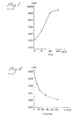
- 0,5 ml während einer Stunde bei Raumtemperatur inkubiert. Dann wird 1 ml einer Suspension enthaltend 0,1 ml Polyacrylamidpartikel mit zweitem Antikörper und Wismutoxid sowie 0,4 g Wismutoxid suspendiert in 1 ml Puffer zugegeben. Die Röhrchen werden während drei Stunden langsam rotiert. Daraufhin werden die Röhrchen während 15 Minuten zur Sedimentation stehengelassen und dann in einem Counter gezählt. Die erhaltenen Daten sind in der Standardkurve, die in Fig. 1 wiedergegeben wird, zusammengefasst.
- Nach einem anderen Verfahren werden Kaninchenantikörper gegen HCG an Wismutoxid enthaltende Polyacrylamidpartikel gebunden. In einem Inkubationsvolumen von 1 ml werden konstante Anteile solcher Partikel mit HCG Standards und J-HLH inkubiert. Die Röhrchen werden über Nacht langsam rotiert. Sie werden dann für 15 Minuten stehengelassen, damit die Partikel sedimentieren können. Sie werden dann in einem Counter gezählt. Die Ergebnisse sind im wesentlichen identisch mit denjenigen die in Fig. 1 dargestellt sind.
- In einer weiteren Ausführungsweise wird als zweite aktive Komponente ein Material verwendet, welches mit der Radioligandkomponente des Reaktionsgemisches des Radioimmunverfahrens durch Adsorption reagiert. Bei dieser Ausführungsweise ist Aktivkohle die bevorzugte zweite aktive Komponente. Entsprechende Zusammensetzungen enthaltend Aktivkohle und die erste aktive Komponente sind durch Mischen dieser Komponenten mit einem Bindemittel wie Agarose, leicht erhältlich und können dann in die gewünschte Partikelgrösse gebracht werden. Durch Herstellen und/oder Auswählen von Partikeln der gewünschten Grösse und Dichte kann die Sedimentationsrate so gewählt werden, dass sich eine optimale Adsorption der Radioligandkomponente ergibt. In einer spezifischen Ausführungsweise wird Wismutoxid unter Verwendung von Agarose als Binder nach dem nachfolgenden Verfahren mit Aktivkohle überzogen. 100 g Wismutoxid werden mit 1 bis 100 g, vorzugsweise2,5 g, Aktivkohle gemischt. 25 ml geschmolzene 1,5%ige Agarose wird zugegeben, und das Reaktionsgemisch wird bis zur Homogenität gemischt. Es wird über Nacht im Kühlschrank behalten. Das Gel wird in einem Mörser gründlich gemahlen. Das fragmentierte Gel wird in 250 ml 0,075M Barbitalpuffer enthaltend 0,25% Rinderserumalbumin und 0,05% Dextran T70 suspendiert. Selbstverständlich können neben Agarose auch die früher erwähnten Matrixmaterialien, wie Stärke, Polyacrylamid und PVF, mit Aktivkohle als zweiter aktiver Komponente verwendet werden. Die Aktivkohle wird mit dem Wismutoxid in den oben erwähnten Verhältnissen gemischt, wonach die Matrixpartikel so hergestellt werden, wie dies früher für Matrixpartikel beschrieben ist, die nur Wismutoxid enthalten.
- 1 ml dieser Suspension wird als Absorptions-Abschirmmittel in einem Radioimmunverfahren für Thyroxin (T4) verwendet. Bei dieser Bestimmung werden 0,05 ml T4 Standards mit 0,2 ml Kaninchenantiserum gegen T4 (1:100) und 0,2 ml 125 J-T. (200 pg) bei 4°C über Nacht inkubiert. Es wird eine Suspension von 0,4 g der Agarosepartikel enthaltend die Aktivkohle und das Wismutoxid in 1 ml Puffer zugeführt. Die Röhrchen werden während 5 Sekunden geschüttelt und dann in aufrechter Position während 15 Minuten stehengelassen. Sie werden dann in einem automatischen GammaZähler (LKB-Wallac Ultro Gamma II) gemessen. Die erhaltene Standardkurve ist aus Fig. 2 ersichtlich.
Claims (12)
Applications Claiming Priority (2)
| Application Number | Priority Date | Filing Date | Title |
|---|---|---|---|
| SE7910382A SE444989B (sv) | 1979-12-17 | 1979-12-17 | Reagenskomposition for radioimmunologiska bestemningsmetoder |
| SE7910382 | 1979-12-17 |
Publications (3)
| Publication Number | Publication Date |
|---|---|
| EP0030735A2 true EP0030735A2 (de) | 1981-06-24 |
| EP0030735A3 EP0030735A3 (en) | 1982-05-12 |
| EP0030735B1 EP0030735B1 (de) | 1985-06-19 |
Family
ID=20339569
Family Applications (1)
| Application Number | Title | Priority Date | Filing Date |
|---|---|---|---|
| EP80107928A Expired EP0030735B1 (de) | 1979-12-17 | 1980-12-16 | Reagenzien für Radioimmunverfahren |
Country Status (4)
| Country | Link |
|---|---|
| EP (1) | EP0030735B1 (de) |
| JP (1) | JPS5694268A (de) |
| DE (1) | DE3070793D1 (de) |
| SE (1) | SE444989B (de) |
Cited By (1)
| Publication number | Priority date | Publication date | Assignee | Title |
|---|---|---|---|---|
| EP0979656A3 (de) * | 1998-05-11 | 2004-03-03 | Enea Ente Per Le Nuove Tecnologie, L'energia E L'ambiente | Zusammensetzung enthaltend auf festen Teilchen immobilisierte Radioisotopen, sowie deren Verwendung in der Brachytherapie |
Family Cites Families (4)
| Publication number | Priority date | Publication date | Assignee | Title |
|---|---|---|---|---|
| GB1411382A (en) * | 1971-12-16 | 1975-10-22 | Radiochemical Centre Ltd | Methods of analysis |
| US4001583A (en) * | 1974-10-04 | 1977-01-04 | Barrett M James | Covalently bound biological substances to plastic materials and use in radioassay |
| SE401405B (sv) * | 1976-08-16 | 1978-05-02 | Thorell Jan Ivan | Sett vid en analys, vid vilken ett radioaktivt emne fordelas mellan en flytande och en fast fas |
| US4271139A (en) * | 1978-03-27 | 1981-06-02 | Hiram Hart | Scintillation proximity assay |
-
1979
- 1979-12-17 SE SE7910382A patent/SE444989B/sv unknown
-
1980
- 1980-12-16 JP JP17665280A patent/JPS5694268A/ja active Granted
- 1980-12-16 DE DE8080107928T patent/DE3070793D1/de not_active Expired
- 1980-12-16 EP EP80107928A patent/EP0030735B1/de not_active Expired
Cited By (1)
| Publication number | Priority date | Publication date | Assignee | Title |
|---|---|---|---|---|
| EP0979656A3 (de) * | 1998-05-11 | 2004-03-03 | Enea Ente Per Le Nuove Tecnologie, L'energia E L'ambiente | Zusammensetzung enthaltend auf festen Teilchen immobilisierte Radioisotopen, sowie deren Verwendung in der Brachytherapie |
Also Published As
| Publication number | Publication date |
|---|---|
| EP0030735A3 (en) | 1982-05-12 |
| JPH0149900B2 (de) | 1989-10-26 |
| SE444989B (sv) | 1986-05-20 |
| JPS5694268A (en) | 1981-07-30 |
| SE7910382L (sv) | 1981-06-18 |
| EP0030735B1 (de) | 1985-06-19 |
| DE3070793D1 (en) | 1985-07-25 |
Similar Documents
| Publication | Publication Date | Title |
|---|---|---|
| EP1419386B1 (de) | Verfahren zur herstellung von protein-beladenen mikropartikeln | |
| DE2522086C2 (de) | Reagenz zum Abtrennen und Bestimmen von in biologischen Fluiden vorhandenen AK:Ag-Komplexen | |
| DE69121849T2 (de) | Bindung von Liganden an Gold | |
| DE2751588B2 (de) | Verfahren zur Bestimmung eines Liganden oder der Liganden-Bindungskapazität in einem flüssigen Medium | |
| DE2546379A1 (de) | Immobilisierte biologisch aktive substanz und deren verwendung | |
| DE2037087A1 (de) | Verfahren und Vorrichtung zur Bestimmung von Schilddrusenhormongehalt | |
| DE1598945B2 (de) | Verfahren zur bestimmung von proteinen und polypeptiden | |
| DE2734118A1 (de) | Radioimmunologisches verfahren und einrichtung zur bestimmung von antigenen | |
| DE2421035B2 (de) | Diagnostiziermittel zur durchfuehrung radioimmunologischer bestimmungen | |
| EP0019741A1 (de) | Latex-Reagenz, Verfahren zu seiner Herstellung, seine Verwendung und ein das Reagenz enthaltendes Mittel | |
| DE2608667A1 (de) | Diagnostisches feststoffreagens und verfahren zu dessen herstellung | |
| DE2264255A1 (de) | Verfahren zur bestimmung des schilddruesenhormonspiegels und kombinationspackung zur durchfuehrung des verfahrens | |
| DE2751589A1 (de) | Verfahren zur bestimmung eines liganden oder der liganden-bindungskapazitaet in einem fluessigen medium | |
| DE2710810A1 (de) | Verfahren zur radioimmunologischen bestimmung der antigen- oder antikoerperkonzentration in proben und vorrichtung zur durchfuehrung des verfahrens | |
| DE2419884A1 (de) | Verfahren und vorrichtung zur bestimmung von trijodthyronin | |
| DE2728801A1 (de) | Verfahren zur radio-immunologischen bestimmung von schilddruese stimulierendem hormon und reagenz zur durchfuehrung des verfahrens | |
| DE3783209T2 (de) | Verfahren und apparat zur bestimmung von immunologischen reaktiven substanzen von klinischem interesse. | |
| DE2523207A1 (de) | Verfahren zur bestimmung von antikoerpern | |
| DE3022681C2 (de) | ||
| DE2721267C2 (de) | Antikörpergel | |
| DE2727206A1 (de) | Verfahren zur bestimmung des saettigungsgrades des antikoerpers einer biologisch aktiven verbindung in einer biologischen fluessigkeit | |
| DE2754645C2 (de) | Verfahren zum Nachweis und zur Bestimmung von Antigenen oder Antikörpern in Flüssigkeiten | |
| EP0030735B1 (de) | Reagenzien für Radioimmunverfahren | |
| DE2701928A1 (de) | Radiologisches verfahren zur quantitativen bestimmung von methotrexat | |
| DE2905154A1 (de) | Teilchenfoermige reagenzien fuer immunoassays |
Legal Events
| Date | Code | Title | Description |
|---|---|---|---|
| PUAI | Public reference made under article 153(3) epc to a published international application that has entered the european phase |
Free format text: ORIGINAL CODE: 0009012 |
|
| 17P | Request for examination filed |
Effective date: 19801216 |
|
| AK | Designated contracting states |
Designated state(s): BE CH DE GB NL SE |
|
| PUAL | Search report despatched |
Free format text: ORIGINAL CODE: 0009013 |
|
| AK | Designated contracting states |
Designated state(s): BE CH DE GB NL SE |
|
| GRAA | (expected) grant |
Free format text: ORIGINAL CODE: 0009210 |
|
| AK | Designated contracting states |
Designated state(s): BE CH DE GB LI NL SE |
|
| REF | Corresponds to: |
Ref document number: 3070793 Country of ref document: DE Date of ref document: 19850725 |
|
| PLBE | No opposition filed within time limit |
Free format text: ORIGINAL CODE: 0009261 |
|
| STAA | Information on the status of an ep patent application or granted ep patent |
Free format text: STATUS: NO OPPOSITION FILED WITHIN TIME LIMIT |
|
| 26N | No opposition filed | ||
| PGFP | Annual fee paid to national office [announced via postgrant information from national office to epo] |
Ref country code: NL Payment date: 19891231 Year of fee payment: 10 |
|
| PGFP | Annual fee paid to national office [announced via postgrant information from national office to epo] |
Ref country code: BE Payment date: 19900102 Year of fee payment: 10 |
|
| PGFP | Annual fee paid to national office [announced via postgrant information from national office to epo] |
Ref country code: CH Payment date: 19900103 Year of fee payment: 10 |
|
| PGFP | Annual fee paid to national office [announced via postgrant information from national office to epo] |
Ref country code: GB Payment date: 19901210 Year of fee payment: 11 |
|
| PGFP | Annual fee paid to national office [announced via postgrant information from national office to epo] |
Ref country code: SE Payment date: 19901214 Year of fee payment: 11 |
|
| PG25 | Lapsed in a contracting state [announced via postgrant information from national office to epo] |
Ref country code: LI Effective date: 19901231 Ref country code: CH Effective date: 19901231 Ref country code: BE Effective date: 19901231 |
|
| PGFP | Annual fee paid to national office [announced via postgrant information from national office to epo] |
Ref country code: DE Payment date: 19910131 Year of fee payment: 11 |
|
| BERE | Be: lapsed |
Owner name: THORELL JAN I. Effective date: 19901231 |
|
| PG25 | Lapsed in a contracting state [announced via postgrant information from national office to epo] |
Ref country code: NL Effective date: 19910701 |
|
| NLV4 | Nl: lapsed or anulled due to non-payment of the annual fee | ||
| REG | Reference to a national code |
Ref country code: CH Ref legal event code: PL |
|
| PG25 | Lapsed in a contracting state [announced via postgrant information from national office to epo] |
Ref country code: GB Effective date: 19911216 |
|
| PG25 | Lapsed in a contracting state [announced via postgrant information from national office to epo] |
Ref country code: SE Effective date: 19911217 |
|
| GBPC | Gb: european patent ceased through non-payment of renewal fee | ||
| PG25 | Lapsed in a contracting state [announced via postgrant information from national office to epo] |
Ref country code: DE Effective date: 19920901 |
|
| EUG | Se: european patent has lapsed |
Ref document number: 80107928.6 Effective date: 19920704 |