EP0030809A2 - Geschoss mit Splitterwirkung der Hülle - Google Patents
Geschoss mit Splitterwirkung der Hülle Download PDFInfo
- Publication number
- EP0030809A2 EP0030809A2 EP80304324A EP80304324A EP0030809A2 EP 0030809 A2 EP0030809 A2 EP 0030809A2 EP 80304324 A EP80304324 A EP 80304324A EP 80304324 A EP80304324 A EP 80304324A EP 0030809 A2 EP0030809 A2 EP 0030809A2
- Authority
- EP
- European Patent Office
- Prior art keywords
- casing
- wire
- coiling
- adjacent
- flat faces
- Prior art date
- Legal status (The legal status is an assumption and is not a legal conclusion. Google has not performed a legal analysis and makes no representation as to the accuracy of the status listed.)
- Granted
Links
Images


Classifications
-
- F—MECHANICAL ENGINEERING; LIGHTING; HEATING; WEAPONS; BLASTING
- F42—AMMUNITION; BLASTING
- F42B—EXPLOSIVE CHARGES, e.g. FOR BLASTING, FIREWORKS, AMMUNITION
- F42B12/00—Projectiles, missiles or mines characterised by the warhead, the intended effect, or the material
- F42B12/02—Projectiles, missiles or mines characterised by the warhead, the intended effect, or the material characterised by the warhead or the intended effect
- F42B12/20—Projectiles, missiles or mines characterised by the warhead, the intended effect, or the material characterised by the warhead or the intended effect of high-explosive type
- F42B12/22—Projectiles, missiles or mines characterised by the warhead, the intended effect, or the material characterised by the warhead or the intended effect of high-explosive type with fragmentation-hull construction
- F42B12/26—Projectiles, missiles or mines characterised by the warhead, the intended effect, or the material characterised by the warhead or the intended effect of high-explosive type with fragmentation-hull construction the projectile wall being formed by a spirally-wound element
Definitions
- This invention relates to explosive fragmentation devices, such as, for example, grenades, mortar bombs, shell bodies and guided missile warhead cases.
- Such devices generally comprise a mass of explosive within a metal casing, and are intended to explode on deployment so as to shatter the casing and send out fragments of the casing with high velocity.
- the object is to disable personnel, fighting vehicles or aircraft as the case may be, within a range which may be struck by the high velocity fragments.
- a known form of grenade comprising a casing formed by coiling pre-notched wire of rectangular cross-section, the coils being of varying diameter and arranged to overlie adjacent coils so as to define an oval (ie prolate spheroid) shaped casing.
- the contacting surfaces of adjacent coils are arranged to lie normal to the axis of the casing so formed, giving the surface of the casing a stepped appearance.
- the coils are not fixed together other than by their own resilience, and accordingly it has been found necessary to provide a light outer casing of metal to prevent the ingress of moisture and the escape of explosive. Because of the oval shape, the outer casing has had to be made in two parts joined at the section of maximum diameter.
- the known grenade suffers from a number of design disadvantages.
- the method of coiling necessitates leaving relatively large apertures at the ends of the coil. It will be apparent also that the method results in a lesser surface density of notched wire towards the ends of the coil than in its mid region.
- These factors lead to a reduction in the number of fragments produced by a grenade of given size, and to unevenness in the fragment distribution pattern.
- the effectiveness of the grenade is hence reduced.
- the metal cuter casing does not produce effective metal fragments, and hence the ratio of effective metal mass to explosive mass is reduced. Also the need for an outer casing to be ruptured and penetrated reduces the effectiveness of the wire fragments.
- Crevice corrosion can occur at the join in the outer casing, and further the whole structure is mechanically weaker, and hence less able to withstand rough handling by virtue of its construction from several separate components.
- a serious shortcoming of the design is the possibility of explosive material migrating into friction points between the coils, and between the coiled main casing and the outer casing - leading to a safety risk from accidental explosion.
- Mortar bombs conventionally comprise a mass of explosive within a forged or cast metal casing which may be machined to final-shape.
- the conventional design suffers from the great disadvantage that the distribution of fragments on detonation cannot be optimised. It depends upon the inherent weaknesses in the casing which cannot readily be predetermined, and accordingly an unduly wide spectrum of sizes, from several large fragments down to small dust size particles, form the distribution pattern. The probability of securing a considerable number of hits is thus greatly reduced as compared with the desired effect from an even distribution of relatively small but optimised size of fragments.
- the present invention together with certain preferred aspects thereof seeks to mitigate or avoid at least some of the aforesaid shortcomings of the prior known explosive fragmentation devices.
- a casing for an explosive fragmentation device said casing being formed from wire having a pair of opposed flat faces, the wire being coiled so that the said opposed flat faces of adjacent turns overlay one another and are substantially normal to the surface of the casing, the surface of the casing being curved in the longitudinal direction of coiling.
- the said opposed flat faces of adjacent turns overlay one another substantially completely.
- a convenient method of bonding is soldering or brazing.
- the wire will normally be formed with weakened sections at intervals along its length.
- the weakened sections are in the form of notches extending transversely of the wire across a face other than the said opposed flat faces.
- the wire can conveniently be of square or other rectangular cross-section.
- the length of wire 1 shown therein is of mild steel and of generally square cross-section, and has weakened sections in the form of notches 2 extending transversely across one face 3 of the wire at regular intervals along its entire length.
- the wire has a pair of opposed flat faces 4, 5 adjacent the notched face 3.
- the other two faces 3 and 6 are also flat, but this need not necessarily be so.
- faces 4 and 5 need not necessarily be parallel to each other prior to coiling, eg a trapezoidal shape may be chosen to counter the colastic effect so the faces 4 and 5 after coiling become approximately parallel.
- the mortar bomb casing 7 shown in Figs 3, 4 and 5 is formed from the notched wire stock shown in Figures 1 and 2, the casing 7 is in the form of a single coil having a number of turns 8 formed from a single length of the wire stock 1. The coil is wound such that the notches 2 all lie on the inner surface thereof.
- the casing is given an outer surface which is curved in the longitudinal direction of coiling by varying the diameter of the turns 8 progressively along the axis of the coil so as to provide the desired overall form.
- the adjacent turns 8 are bonded together by their faces 4, 5. This is achieved in the preferred method by first copper-plating the wire after coiling - eg in a chemical bath or electrolytically. The copper-plated coil is then brazed - eg in a vacuum furnace or an induction furnace to fuse the copper coatings of adjacent turns together along the adjacent faces 4, 5. Other possible methods of bonding will be apparent to the skilled reader - eg electric resistance welding, fusion welding and soldering, etc.
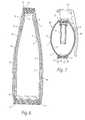
- the casing 11 comprises two coils 12, 13 each formed from notched mild steel wire stock of the kind shown in Figures 1 and 2.
- the coils 12, 13 are wound with the notched face of the wire 1 on the inner surface of the coils, although the notches 2 are not shown in Figure 6.
- the two coils 12, 13 are each wound such that the flat faces 4 , 5 of each turn lay substantially normal to the surface of their respective coil.
- the outer coil 13 is wound so that its inner surface conforms closely to the outer surface of the inner coil 12.
- the surfaces of the coils 12, 13 are copper-plated and the two coils are assembled one within the other as shown in Figure 6, with the turns 8 of the inner coil 12 overlapping longitudinally with the turns 8 of the outer coil 13 by half the width of the wire to provide greater strength in the finished double coil.
- the copper coating is fused by brazing to bond together adjacent turns 8 of each individual coil along their adjacent faces 4, 5 and also to bond the outer face of coil 12 to the inner face of coil 13.
- each coil 12, 13 are then machined flat.
- a recess 14 is formed in the inner coil 12, having an internal screw threaded portion 15 for the attachment of a tail cap and fins for stabilisation (not shown).
- a recess 16 is formed in the inner coil 12, having an internal screw threaded portion 17 for the attachment of a nose cap and fuzing unit (not shown).
- the exterior surface of the coil 13 is machined to a desired shape, including the provision of a groove 18 for a driving band (not shown).
- the double coil construction of the casing 11 makes for greater strength than the single coil construction of the casing 7, and still allows for the production of small and optimum sized metal fragments on detonation.
- a triple coil type of construction for the casing can be employed when required.
- FIG 7 there is shown an uncharged hand grenade 20 having a casing 21 formed of a single coil of notched wire 1 of the type shown in Figures 1 and 2.
- the coil is wound with the notches 2 (not shown) on the inner surface thereof.
- the casing 21 is curved in the longitudinal direction of coiling to a substantially prolate spheroidal form, by varying the diameter of turns 8 progressively along the axis of coiling.
- the opposed flat faces 4, 5 overlay one another completely and are at all points disposed substantially normal tc the surface of the casing.
- the surface of the wire is copper-plated and the copper coating is fused by a brazing process to bond adjacent turns 8 together along their mating faces 4, 5.
- the upper and lower ends of the coil are machined to receive as a press fit respectively a light pressed steel housing 21 and a light steel bush 22.
- a light pressed steel housing 21 Within the housing 21 there is received as a press fit an internally screw-threaded bush 23.
- a striker mechanism 24 (shown in outline only - not sectioned), including a handle 25 which can be released to activate the grenade.
- the casing 20, after insertion of the mechanism 24, should be inverted and filled with an explosive composition (not shown), for example a mixture of RDX and TNT, to a level just within the bush 22, but leaving space for insertion of a felt disc 26 and an end plug 27 having a square pattern of v-shaped notches 28 in its inwardly-directed surface.
- an explosive composition for example a mixture of RDX and TNT
- the casing is sealed by a pressed- steel cap 29 sealed to a flange 30 on the bush 22 in a single-roll seam.
- the felt disc 26 serves to prevent accidental detonation during assembly resulting from frictional contact between the notched plug 27 and the explosive material.
- the mass of notched wire per unit area can remain constant over the entire surface of the coil, thus leading to a more even fragment distribution.
- the wire is capable of being formed more nearly to a spherical or spheroidal shape with smaller apertures at the ends.
- the apertures in which the housing 21 and the bush 22 are received are smaller than is normally possible with conventional coiling.
- wculd require successive turns to decrease in diameter so rapidly that their faces 4, 5 would overlap one another only sightly or not at all.
- the opposed flat faces 4, 5 can overlap substantially completely whatever the longitudinal curvature of the casing. This factor makes pcssible effective bonding of these faces as for example by brazing, to provide a sealed unitary structure of the required shape having considerable rigidity and strength. The need for a separate outer casing is thus avoided, with its attendant disadvantages. Also the possibility of accidental detonation as a result of explosive material being trapped between relatively movable turns, of an inner and an outer casing, is eliminated.
Landscapes
- Engineering & Computer Science (AREA)
- Chemical & Material Sciences (AREA)
- Combustion & Propulsion (AREA)
- General Engineering & Computer Science (AREA)
- Wire Processing (AREA)
- Filling Or Discharging Of Gas Storage Vessels (AREA)
Applications Claiming Priority (2)
| Application Number | Priority Date | Filing Date | Title |
|---|---|---|---|
| GB7943069 | 1979-12-13 | ||
| GB7943069 | 1979-12-13 |
Publications (3)
| Publication Number | Publication Date |
|---|---|
| EP0030809A2 true EP0030809A2 (de) | 1981-06-24 |
| EP0030809A3 EP0030809A3 (en) | 1981-08-05 |
| EP0030809B1 EP0030809B1 (de) | 1984-11-21 |
Family
ID=10509836
Family Applications (1)
| Application Number | Title | Priority Date | Filing Date |
|---|---|---|---|
| EP80304324A Expired EP0030809B1 (de) | 1979-12-13 | 1980-12-02 | Geschoss mit Splitterwirkung der Hülle |
Country Status (6)
| Country | Link |
|---|---|
| US (1) | US4398467A (de) |
| EP (1) | EP0030809B1 (de) |
| DE (1) | DE3069676D1 (de) |
| GB (1) | GB2065839B (de) |
| IL (1) | IL61665A (de) |
| NL (1) | NL8102896A (de) |
Cited By (2)
| Publication number | Priority date | Publication date | Assignee | Title |
|---|---|---|---|---|
| EP0163029A3 (de) * | 1984-04-02 | 1986-12-17 | Aktiebolaget Bofors | Mantel für Explosivgeschoss |
| US5095821A (en) * | 1987-10-14 | 1992-03-17 | Hug Interlizenz Ag | Fragmentation casing and method of making |
Families Citing this family (10)
| Publication number | Priority date | Publication date | Assignee | Title |
|---|---|---|---|---|
| BE889289A (fr) * | 1981-06-18 | 1981-12-18 | Prb N V Prb Sa | Tete creuse a fragmentation controlee pour engin explosif |
| DE3016861C2 (de) * | 1980-05-02 | 1984-07-12 | Messerschmitt-Bölkow-Blohm GmbH, 8000 München | Gefechtskopf mit einer Hülle zur Splitterbildung |
| DE3722023A1 (de) * | 1987-07-03 | 1989-01-12 | Rheinmetall Gmbh | Geschoss mit sprengladung |
| US5396212A (en) * | 1992-04-27 | 1995-03-07 | Cooper Industries, Inc. | Transformer winding |
| DE19600167C1 (de) * | 1996-01-04 | 2003-07-17 | Diehl Stiftung & Co | Penetrator |
| SG82583A1 (en) * | 1997-04-23 | 2001-08-21 | Diehl Stiftung & Co | Fragmentation body for a fragmentation projectile |
| US9038539B2 (en) * | 2013-06-14 | 2015-05-26 | The United States Of America As Represented By The Secretary Of The Army | Warhead case and method for making same |
| AT515209B1 (de) | 2014-03-14 | 2015-07-15 | Hirtenberger Defence Systems Gmbh & Co Kg | Geschoss |
| RU174290U1 (ru) * | 2017-04-03 | 2017-10-10 | Государственное научное учреждение "Институт порошковой металлургии" | Осколочный элемент заданного дробления |
| RU2709122C1 (ru) * | 2019-08-29 | 2019-12-16 | Федеральное казенное предприятие "Научно-исследовательский институт "Геодезия" (ФКП "НИИ "Геодезия" | Противолавинный снаряд |
Family Cites Families (16)
| Publication number | Priority date | Publication date | Assignee | Title |
|---|---|---|---|---|
| US33541A (en) * | 1861-10-22 | Improvement in shells for ordnance | ||
| US1203062A (en) * | 1915-08-02 | 1916-10-31 | John B Semple | Grenade. |
| US2337765A (en) * | 1942-12-31 | 1943-12-28 | Nahirney John | Bomb |
| US2393274A (en) * | 1943-09-04 | 1946-01-22 | Budd Edward G Mfg Co | Fragmentation bomb |
| US2393275A (en) * | 1943-09-04 | 1946-01-22 | Budd Edward G Mfg Co | Method of making fragmentation bombs |
| US2458576A (en) * | 1943-10-04 | 1949-01-11 | Nicholas L Etten | Fragmentation bomb |
| GB580415A (en) | 1943-12-01 | 1946-09-06 | Jack Twyford | Improvements relating to bullets and similar projectiles |
| FR1257604A (fr) * | 1946-11-27 | 1961-04-07 | Soc Tech De Rech Ind | Perfectionnements aux projectiles et aux bombes à fragmentation préparée destinés à agir contre le personnel |
| US3298308A (en) * | 1960-11-11 | 1967-01-17 | Aerojet General Co | Composite casing for fragmentationtype explosive weapon and method of forming same |
| FR1372643A (fr) * | 1963-08-08 | 1964-09-18 | Procédé de fabrication d'un corps de bombe à fragmentation préparée | |
| US3349711A (en) * | 1964-12-07 | 1967-10-31 | Remington Arms Co Inc | Process of forming jacketed projectiles |
| BE686286A (de) * | 1966-09-01 | 1967-02-15 | ||
| BE696474A (de) * | 1967-03-31 | 1967-09-01 | ||
| BE765457A (fr) * | 1971-04-08 | 1971-08-30 | Prb Sa | Projectiles anti-personnel, |
| US3757693A (en) * | 1971-05-21 | 1973-09-11 | Avco Corp | Fragmentation wrap for explosive weapons |
| FR2312009A1 (fr) * | 1975-05-23 | 1976-12-17 | Thomson Brandt | Enveloppe de charge explosive et notamment projectile a fragmentation |
-
1980
- 1980-12-02 DE DE8080304324T patent/DE3069676D1/de not_active Expired
- 1980-12-02 EP EP80304324A patent/EP0030809B1/de not_active Expired
- 1980-12-04 GB GB8038877A patent/GB2065839B/en not_active Expired
- 1980-12-05 US US06/213,755 patent/US4398467A/en not_active Expired - Lifetime
- 1980-12-09 IL IL61665A patent/IL61665A/xx not_active IP Right Cessation
-
1981
- 1981-06-16 NL NL8102896A patent/NL8102896A/nl not_active Application Discontinuation
Cited By (2)
| Publication number | Priority date | Publication date | Assignee | Title |
|---|---|---|---|---|
| EP0163029A3 (de) * | 1984-04-02 | 1986-12-17 | Aktiebolaget Bofors | Mantel für Explosivgeschoss |
| US5095821A (en) * | 1987-10-14 | 1992-03-17 | Hug Interlizenz Ag | Fragmentation casing and method of making |
Also Published As
| Publication number | Publication date |
|---|---|
| DE3069676D1 (en) | 1985-01-03 |
| US4398467A (en) | 1983-08-16 |
| NL8102896A (nl) | 1983-01-17 |
| EP0030809A3 (en) | 1981-08-05 |
| GB2065839A (en) | 1981-07-01 |
| IL61665A (en) | 1984-04-30 |
| EP0030809B1 (de) | 1984-11-21 |
| GB2065839B (en) | 1983-06-02 |
Similar Documents
| Publication | Publication Date | Title |
|---|---|---|
| US4497253A (en) | Armor-piercing projectile | |
| US3978796A (en) | Focused blast-fragment warhead | |
| US2798431A (en) | Fragmentation warhead | |
| US4398467A (en) | Explosive fragmentation devices with coiled wire progressively varied | |
| EP0754928B1 (de) | Geschoss das sich bei der Zündung in zwei Teile teilt und Explosionsverfahren dafür | |
| CA1323800C (en) | Fragmentation casing for a high-explosive device | |
| US3974771A (en) | Splinter warhead for guided flying bodies for combating aerial targets | |
| US5979332A (en) | Fragmentation body for a fragmentation projectile | |
| US4444112A (en) | Multi-capability projectile and method of making same | |
| US4193348A (en) | Projectile for centerfire pistol and revolver cartridges | |
| US5325787A (en) | Armor-piercing fragmentation projectile | |
| JPH028699A (ja) | 破片ジャケットを備えた弾丸 | |
| US4768441A (en) | Subcaliber segmented sabot projectile and manufacturing process | |
| GB2107032A (en) | Explosive devices | |
| US4481886A (en) | Hollow charge | |
| US5445079A (en) | Armor-piercing fragmentation projectile | |
| US20230132848A1 (en) | Casing for a fragmentation weapon, fragmentation weapon, and method of manufacture | |
| US4699063A (en) | Explosive practice hand grenade and method of manufacture thereof | |
| EP0196283B1 (de) | Panzerbrechendes Geschoss | |
| US4510870A (en) | Charge liner construction and method | |
| DE19753188C2 (de) | Splitterbildende Hülle für Munition | |
| US5515786A (en) | Projectiles for attacking hard targets and method for controlling initiation of a projectile | |
| US5155297A (en) | Projectile-forming explosive charge insert | |
| US4435887A (en) | Method of making projectile | |
| EP1304540A2 (de) | Munition mit einer profilierten Sprengladung |
Legal Events
| Date | Code | Title | Description |
|---|---|---|---|
| PUAI | Public reference made under article 153(3) epc to a published international application that has entered the european phase |
Free format text: ORIGINAL CODE: 0009012 |
|
| PUAL | Search report despatched |
Free format text: ORIGINAL CODE: 0009013 |
|
| AK | Designated contracting states |
Designated state(s): BE DE FR IT SE |
|
| AK | Designated contracting states |
Designated state(s): BE DE FR IT SE |
|
| 17P | Request for examination filed |
Effective date: 19820112 |
|
| ITF | It: translation for a ep patent filed | ||
| GRAA | (expected) grant |
Free format text: ORIGINAL CODE: 0009210 |
|
| AK | Designated contracting states |
Designated state(s): BE DE FR IT SE |
|
| BECH | Be: change of holder |
Free format text: 841121 *ROYAL ORDNANCE P.L.C. |
|
| REF | Corresponds to: |
Ref document number: 3069676 Country of ref document: DE Date of ref document: 19850103 |
|
| ET | Fr: translation filed | ||
| PLBE | No opposition filed within time limit |
Free format text: ORIGINAL CODE: 0009261 |
|
| STAA | Information on the status of an ep patent application or granted ep patent |
Free format text: STATUS: NO OPPOSITION FILED WITHIN TIME LIMIT |
|
| 26N | No opposition filed | ||
| ITPR | It: changes in ownership of a european patent |
Owner name: CESSIONE;ROYAL ORDNANCE PLC |
|
| ITTA | It: last paid annual fee | ||
| PGFP | Annual fee paid to national office [announced via postgrant information from national office to epo] |
Ref country code: FR Payment date: 19941108 Year of fee payment: 15 |
|
| PGFP | Annual fee paid to national office [announced via postgrant information from national office to epo] |
Ref country code: SE Payment date: 19941115 Year of fee payment: 15 |
|
| PGFP | Annual fee paid to national office [announced via postgrant information from national office to epo] |
Ref country code: DE Payment date: 19941122 Year of fee payment: 15 |
|
| PGFP | Annual fee paid to national office [announced via postgrant information from national office to epo] |
Ref country code: BE Payment date: 19941125 Year of fee payment: 15 |
|
| EAL | Se: european patent in force in sweden |
Ref document number: 80304324.9 |
|
| PG25 | Lapsed in a contracting state [announced via postgrant information from national office to epo] |
Ref country code: SE Effective date: 19951203 |
|
| PG25 | Lapsed in a contracting state [announced via postgrant information from national office to epo] |
Ref country code: BE Effective date: 19951231 |
|
| BERE | Be: lapsed |
Owner name: ROYAL ORDNANCE P.L.C. Effective date: 19951231 |
|
| PG25 | Lapsed in a contracting state [announced via postgrant information from national office to epo] |
Ref country code: FR Effective date: 19960830 |
|
| PG25 | Lapsed in a contracting state [announced via postgrant information from national office to epo] |
Ref country code: DE Effective date: 19960903 |
|
| REG | Reference to a national code |
Ref country code: FR Ref legal event code: ST |