EP0031109A2 - Neue Guanidiniumverbindungen, Verfahren zu deren Herstellung und deren Verwendung als mikrobiozide Mittel - Google Patents
Neue Guanidiniumverbindungen, Verfahren zu deren Herstellung und deren Verwendung als mikrobiozide Mittel Download PDFInfo
- Publication number
- EP0031109A2 EP0031109A2 EP80107880A EP80107880A EP0031109A2 EP 0031109 A2 EP0031109 A2 EP 0031109A2 EP 80107880 A EP80107880 A EP 80107880A EP 80107880 A EP80107880 A EP 80107880A EP 0031109 A2 EP0031109 A2 EP 0031109A2
- Authority
- EP
- European Patent Office
- Prior art keywords
- formula
- cyanamide
- preparation
- mol
- compounds
- Prior art date
- Legal status (The legal status is an assumption and is not a legal conclusion. Google has not performed a legal analysis and makes no representation as to the accuracy of the status listed.)
- Granted
Links
- ZRALSGWEFCBTJO-UHFFFAOYSA-N Guanidine Chemical class NC(N)=N ZRALSGWEFCBTJO-UHFFFAOYSA-N 0.000 title claims abstract description 10
- 238000002360 preparation method Methods 0.000 title claims abstract description 8
- 238000000034 method Methods 0.000 title claims abstract description 5
- 230000003641 microbiacidal effect Effects 0.000 title abstract description 4
- 229940124561 microbicide Drugs 0.000 title 1
- 125000003342 alkenyl group Chemical group 0.000 claims abstract description 3
- 125000006231 alkoxy propyl group Chemical group 0.000 claims abstract description 3
- 125000000217 alkyl group Chemical group 0.000 claims abstract description 3
- 150000001450 anions Chemical class 0.000 claims abstract description 3
- 125000004432 carbon atom Chemical group C* 0.000 claims abstract description 3
- XZMCDFZZKTWFGF-UHFFFAOYSA-N Cyanamide Chemical compound NC#N XZMCDFZZKTWFGF-UHFFFAOYSA-N 0.000 claims description 13
- 150000001875 compounds Chemical class 0.000 claims description 11
- 239000002253 acid Substances 0.000 claims description 7
- GSUHAMCBFBLBPY-UHFFFAOYSA-N methoxyurea;sulfuric acid Chemical compound OS(O)(=O)=O.CONC(N)=O GSUHAMCBFBLBPY-UHFFFAOYSA-N 0.000 claims description 4
- NNBBQNFHCVVQHZ-UHFFFAOYSA-N methyl carbamimidothioate;sulfuric acid Chemical compound CSC(N)=N.OS(O)(=O)=O NNBBQNFHCVVQHZ-UHFFFAOYSA-N 0.000 claims description 4
- 239000002855 microbicide agent Substances 0.000 claims 1
- QTBSBXVTEAMEQO-UHFFFAOYSA-N Acetic acid Chemical compound CC(O)=O QTBSBXVTEAMEQO-UHFFFAOYSA-N 0.000 description 19
- 239000000243 solution Substances 0.000 description 11
- XLYOFNOQVPJJNP-UHFFFAOYSA-N water Substances O XLYOFNOQVPJJNP-UHFFFAOYSA-N 0.000 description 11
- 239000000203 mixture Substances 0.000 description 10
- 229960000583 acetic acid Drugs 0.000 description 7
- KFZMGEQAYNKOFK-UHFFFAOYSA-N Isopropanol Chemical compound CC(C)O KFZMGEQAYNKOFK-UHFFFAOYSA-N 0.000 description 6
- 239000007788 liquid Substances 0.000 description 5
- 239000000725 suspension Substances 0.000 description 5
- 238000012360 testing method Methods 0.000 description 5
- FCLWDXWLZQMPAX-UHFFFAOYSA-N C(CCCCCCCCCCC)NNCCN(NCCCCCCCCCCCC)CCC Chemical compound C(CCCCCCCCCCC)NNCCN(NCCCCCCCCCCCC)CCC FCLWDXWLZQMPAX-UHFFFAOYSA-N 0.000 description 4
- 150000001298 alcohols Chemical class 0.000 description 4
- 230000000844 anti-bacterial effect Effects 0.000 description 4
- 230000015572 biosynthetic process Effects 0.000 description 4
- 239000000645 desinfectant Substances 0.000 description 4
- 230000000694 effects Effects 0.000 description 4
- LEQAOMBKQFMDFZ-UHFFFAOYSA-N glyoxal Chemical compound O=CC=O LEQAOMBKQFMDFZ-UHFFFAOYSA-N 0.000 description 4
- ZXEKIIBDNHEJCQ-UHFFFAOYSA-N isobutanol Chemical compound CC(C)CO ZXEKIIBDNHEJCQ-UHFFFAOYSA-N 0.000 description 4
- 238000004519 manufacturing process Methods 0.000 description 4
- 241000894006 Bacteria Species 0.000 description 3
- 150000001412 amines Chemical class 0.000 description 3
- -1 for example Chemical class 0.000 description 3
- 238000003756 stirring Methods 0.000 description 3
- IJGRMHOSHXDMSA-UHFFFAOYSA-N Atomic nitrogen Chemical compound N#N IJGRMHOSHXDMSA-UHFFFAOYSA-N 0.000 description 2
- RGHNJXZEOKUKBD-SQOUGZDYSA-N D-gluconic acid Chemical compound OC[C@@H](O)[C@@H](O)[C@H](O)[C@@H](O)C(O)=O RGHNJXZEOKUKBD-SQOUGZDYSA-N 0.000 description 2
- 241000605739 Desulfovibrio desulfuricans Species 0.000 description 2
- LFQSCWFLJHTTHZ-UHFFFAOYSA-N Ethanol Chemical compound CCO LFQSCWFLJHTTHZ-UHFFFAOYSA-N 0.000 description 2
- 150000007513 acids Chemical class 0.000 description 2
- 230000001476 alcoholic effect Effects 0.000 description 2
- 238000006243 chemical reaction Methods 0.000 description 2
- 230000000052 comparative effect Effects 0.000 description 2
- 238000009472 formulation Methods 0.000 description 2
- 230000000855 fungicidal effect Effects 0.000 description 2
- 239000012362 glacial acetic acid Substances 0.000 description 2
- 229940015043 glyoxal Drugs 0.000 description 2
- 238000010438 heat treatment Methods 0.000 description 2
- JVTAAEKCZFNVCJ-UHFFFAOYSA-N lactic acid Chemical compound CC(O)C(O)=O JVTAAEKCZFNVCJ-UHFFFAOYSA-N 0.000 description 2
- BDAGIHXWWSANSR-UHFFFAOYSA-N methanoic acid Natural products OC=O BDAGIHXWWSANSR-UHFFFAOYSA-N 0.000 description 2
- 239000003921 oil Substances 0.000 description 2
- 150000003839 salts Chemical class 0.000 description 2
- 239000000523 sample Substances 0.000 description 2
- 239000002904 solvent Substances 0.000 description 2
- 238000003786 synthesis reaction Methods 0.000 description 2
- OSWFIVFLDKOXQC-UHFFFAOYSA-N 4-(3-methoxyphenyl)aniline Chemical compound COC1=CC=CC(C=2C=CC(N)=CC=2)=C1 OSWFIVFLDKOXQC-UHFFFAOYSA-N 0.000 description 1
- 241000195493 Cryptophyta Species 0.000 description 1
- RGHNJXZEOKUKBD-UHFFFAOYSA-N D-gluconic acid Natural products OCC(O)C(O)C(O)C(O)C(O)=O RGHNJXZEOKUKBD-UHFFFAOYSA-N 0.000 description 1
- RWSOTUBLDIXVET-UHFFFAOYSA-N Dihydrogen sulfide Chemical compound S RWSOTUBLDIXVET-UHFFFAOYSA-N 0.000 description 1
- SXRSQZLOMIGNAQ-UHFFFAOYSA-N Glutaraldehyde Chemical compound O=CCCCC=O SXRSQZLOMIGNAQ-UHFFFAOYSA-N 0.000 description 1
- 150000001242 acetic acid derivatives Chemical class 0.000 description 1
- 239000013543 active substance Substances 0.000 description 1
- 239000000654 additive Substances 0.000 description 1
- 150000001299 aldehydes Chemical class 0.000 description 1
- 125000003277 amino group Chemical group 0.000 description 1
- 244000052616 bacterial pathogen Species 0.000 description 1
- 239000003899 bactericide agent Substances 0.000 description 1
- 230000003115 biocidal effect Effects 0.000 description 1
- 125000002091 cationic group Chemical group 0.000 description 1
- 239000003086 colorant Substances 0.000 description 1
- 239000008139 complexing agent Substances 0.000 description 1
- 239000012141 concentrate Substances 0.000 description 1
- 238000001816 cooling Methods 0.000 description 1
- 230000007797 corrosion Effects 0.000 description 1
- 238000005260 corrosion Methods 0.000 description 1
- 239000010779 crude oil Substances 0.000 description 1
- 239000003792 electrolyte Substances 0.000 description 1
- 235000019253 formic acid Nutrition 0.000 description 1
- 239000003205 fragrance Substances 0.000 description 1
- 239000000174 gluconic acid Substances 0.000 description 1
- 235000012208 gluconic acid Nutrition 0.000 description 1
- 229940093915 gynecological organic acid Drugs 0.000 description 1
- 229910000037 hydrogen sulfide Inorganic materials 0.000 description 1
- 238000002347 injection Methods 0.000 description 1
- 239000007924 injection Substances 0.000 description 1
- 238000011081 inoculation Methods 0.000 description 1
- 229910052500 inorganic mineral Inorganic materials 0.000 description 1
- 239000004310 lactic acid Substances 0.000 description 1
- 235000014655 lactic acid Nutrition 0.000 description 1
- 230000002503 metabolic effect Effects 0.000 description 1
- WSFSSNUMVMOOMR-NJFSPNSNSA-N methanone Chemical compound O=[14CH2] WSFSSNUMVMOOMR-NJFSPNSNSA-N 0.000 description 1
- 239000011707 mineral Substances 0.000 description 1
- 238000002156 mixing Methods 0.000 description 1
- 229910052757 nitrogen Inorganic materials 0.000 description 1
- 150000007524 organic acids Chemical class 0.000 description 1
- 235000005985 organic acids Nutrition 0.000 description 1
- 239000003208 petroleum Substances 0.000 description 1
- 239000000126 substance Substances 0.000 description 1
- 239000000052 vinegar Substances 0.000 description 1
- 235000021419 vinegar Nutrition 0.000 description 1
- 238000009736 wetting Methods 0.000 description 1
Classifications
-
- C—CHEMISTRY; METALLURGY
- C07—ORGANIC CHEMISTRY
- C07C—ACYCLIC OR CARBOCYCLIC COMPOUNDS
- C07C279/00—Derivatives of guanidine, i.e. compounds containing the group, the singly-bound nitrogen atoms not being part of nitro or nitroso groups
- C07C279/04—Derivatives of guanidine, i.e. compounds containing the group, the singly-bound nitrogen atoms not being part of nitro or nitroso groups having nitrogen atoms of guanidine groups bound to acyclic carbon atoms of a carbon skeleton
- C07C279/12—Derivatives of guanidine, i.e. compounds containing the group, the singly-bound nitrogen atoms not being part of nitro or nitroso groups having nitrogen atoms of guanidine groups bound to acyclic carbon atoms of a carbon skeleton being further substituted by nitrogen atoms not being part of nitro or nitroso groups
-
- A—HUMAN NECESSITIES
- A01—AGRICULTURE; FORESTRY; ANIMAL HUSBANDRY; HUNTING; TRAPPING; FISHING
- A01N—PRESERVATION OF BODIES OF HUMANS OR ANIMALS OR PLANTS OR PARTS THEREOF; BIOCIDES, e.g. AS DISINFECTANTS, AS PESTICIDES OR AS HERBICIDES; PEST REPELLANTS OR ATTRACTANTS; PLANT GROWTH REGULATORS
- A01N47/00—Biocides, pest repellants or attractants, or plant growth regulators containing organic compounds containing a carbon atom not being member of a ring and having no bond to a carbon or hydrogen atom, e.g. derivatives of carbonic acid
- A01N47/40—Biocides, pest repellants or attractants, or plant growth regulators containing organic compounds containing a carbon atom not being member of a ring and having no bond to a carbon or hydrogen atom, e.g. derivatives of carbonic acid the carbon atom having a double or triple bond to nitrogen, e.g. cyanates, cyanamides
- A01N47/42—Biocides, pest repellants or attractants, or plant growth regulators containing organic compounds containing a carbon atom not being member of a ring and having no bond to a carbon or hydrogen atom, e.g. derivatives of carbonic acid the carbon atom having a double or triple bond to nitrogen, e.g. cyanates, cyanamides containing —N=CX2 groups, e.g. isothiourea
- A01N47/44—Guanidine; Derivatives thereof
Definitions
- the invention relates to guanidinium salts of the formula 1 wherein R 1 and R 2 are the same or different and alkyl, 2-hydroxyalkyl or alkenyl each having 8-18 C atoms or C 8 -C 18 alkoxypropyl, m and n 2 or 3, a is a number from 1 to 4 and A means an anion.
- Preferred compounds of the formula 1 are those in which R 1 , R 2 and a are as defined above and m and n 3 and A are acetates.
- These compounds are prepared by mixing 1 mole of a compound of formula 2 reacted with 1 to 4 moles of cyanamide in the presence of an acid.
- the reaction is preferably carried out in water or lower alcohols at temperatures from 40 to 100 0 C, preferably 50 - 90 ° C carried out.
- the procedure is expediently such that the acid is first added to the amine of the formula 2 and the corresponding salt is thus produced.
- An aqueous or alcoholic solution of cyanamide is then added to this salt and the mixture is left to react for about 2 to 5 hours with stirring.
- Mineral acids, vinegar serve as acids acid, lactic acid, formic acid, gluconic acid or other organic acids.
- Acetic acid is preferably used.
- Another possibility for the preparation of the compounds of formula 1 is that a compound of formula 2 is reacted with methoxyurea sulfate or S-methylthiourea sulfate in aqueous and / or alcoholic solution. In this case, there is no need to add an acid separately, as is the case with the reaction with cyanamide.
- guanidinium groups can be introduced. Since all four amino groups are identical, the exact position of the guanidinium groups cannot be determined when using less than four moles of cyanamide, methoxyurea sulfate or S-methylthiourea sulfate.
- the amines of the formula 2 which serve as the starting product are obtained by the process described in the German patent application P 29 38 710.8 by using alkylalkylenediamines of the formula with glyoxal to bisaldimines of the formula implemented and this bisaldimine then catalytically reduced.
- the compounds of formula 1 according to the invention are obtained in the synthesis as brown, more or less viscous liquids which are miscible in any ratio with water and / or lower alcohols.
- the pure products can be distilled off by distilling off the solvent Shape.
- the compounds show a pronounced biocidal activity against gram-positive and gram-negative bacteria as well as against mold and algae. Particularly noteworthy is the excellent activity against sulfate-reducing bacteria of the Desulfovibrio desulfuricans type, whose metabolic products, especially hydrogen sulfide, are responsible for the greatest degree of corrosion damage to oil exploration probes, oil field pipes, crude oil treatment plants, flood water pipes and flood water injection probes. In addition, bacteria of this type develop very rapid resistance, so that a frequent change of the bactericides used is required, which requires a wide range of such products.
- the outstanding solubility of the compounds according to the invention makes it possible to use high-percentage concentrates e.g. to be used in alcohols, which can be diluted with water as required and precisely dosed on site, which is of great advantage for use in the petroleum sector.
- the compounds according to the invention can also advantageously be used quite generally as disinfectants.
- the good short-term effect allows use as a hand and surface disinfectant.
- Liquid preparations of such disinfectants are generally prepared in water or lower alcohols such as isopropanol or water / alcohol mixtures. They contain 5 to 70% by weight, preferably 20 to 55% by weight, of the guanidinium compounds according to the invention.
- For the preparation of such liquid preparations one can start directly from the solutions which are obtained in the synthesis of these guanidinium compounds. These solutions are diluted by adding water or alcohol the desired final concentration.
- Such formulations can of course also contain other substances and auxiliaries which are usually used in such preparations.
- These include, for example, cationic or nonionic surface-active substances, electrolytes, complexing agents, solubilizers, lower aldehydes such as, for example, formaldehyde, glyoxal or glutardialdehyde, and also colorants and fragrances.
- cationic or nonionic surface-active substances include electrolytes, complexing agents, solubilizers, lower aldehydes such as, for example, formaldehyde, glyoxal or glutardialdehyde, and also colorants and fragrances.
- Bactericidal and fungicidal activity suspension test with approx. 10 6 germs / ml, exposure time 24 and 48 hours at 20 ° C, indication of the minimum microbicidal concentration in ⁇ g / ml.
- Bactericidal and fungicidal short-term effects - suspension test conditions as example 1, exposure time 1 hour and 4 hours. Indication of the minimum active concentration in / ug / ml
- composition of the formulations :
Landscapes
- Life Sciences & Earth Sciences (AREA)
- Organic Chemistry (AREA)
- Chemical & Material Sciences (AREA)
- Health & Medical Sciences (AREA)
- Plant Pathology (AREA)
- Engineering & Computer Science (AREA)
- Dentistry (AREA)
- General Health & Medical Sciences (AREA)
- Wood Science & Technology (AREA)
- Zoology (AREA)
- Environmental Sciences (AREA)
- Pest Control & Pesticides (AREA)
- Agronomy & Crop Science (AREA)
- Agricultural Chemicals And Associated Chemicals (AREA)
- Organic Low-Molecular-Weight Compounds And Preparation Thereof (AREA)
- Acyclic And Carbocyclic Compounds In Medicinal Compositions (AREA)
Abstract
Description
- Gegenstand der Erfindung sind Guanidiniumsalze der Formel 1
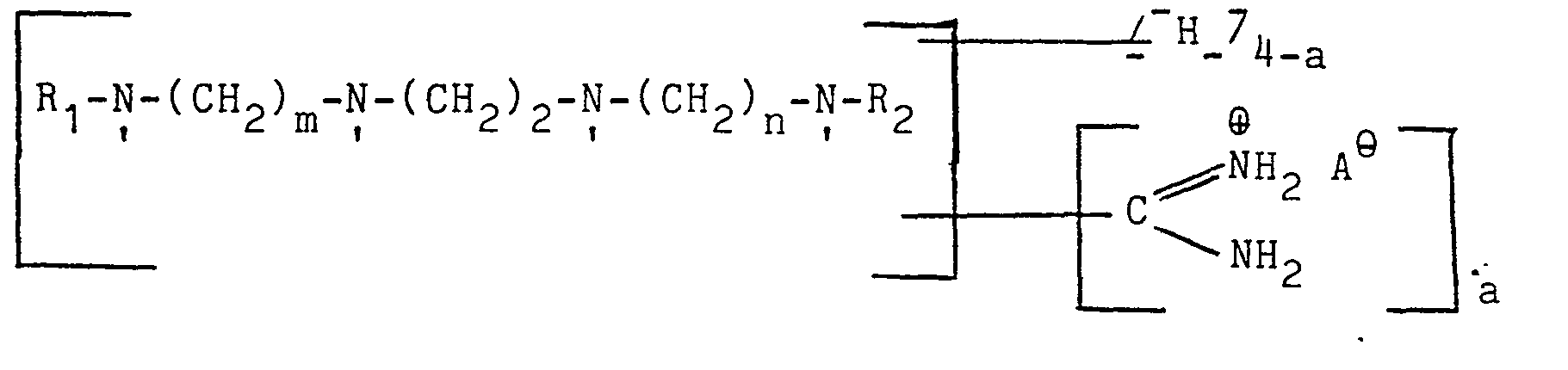
- Bevorzugt sind solche Verbindungen der Formel 1, worin R1, R2 und a die obige Bedeutung haben und m und n 3 und A das Acetation bedeuten.
- Diese Verbindungen werden hergestellt, indem man 1 Mol einer Verbindung der Formel 2

- Die Reaktion wird vorzugsweise in Wasser oder niederen Alkoholen bei Temperaturen von 40 bis 1000C, vorzugsweise 50 - 90°C durchgeführt. Dabei geht man zweckmäßigerweise so vor, daß man zunächst die Säure zu dem Amin der Formel 2 gibt und so das entsprechende Salz erzeugt. Anschließend gibt man zu diesem Salz eine wässrige oder alkoholische Lösung von Cyanamid und läßt ca. 2 bis 5 Stunden unter Rühren reagieren. Als Säuren dienen Mineralsäure, Essigsäure, Milchsäure, Ameisensäure, Gluconsäure oder andere organische Säuren. Vorzugsweise wird Essigsäure verwendet.
- Eine andere Möglichkeit zur Herstellung der Verbindungen der Formel 1 besteht darin, daß man eine Verbindung der Formel 2 mit Methoxyharnstoff-sulfat oder S-Methylthioharnstoff-sulfat in wässriger und/oder alkoholischer Lösung umsetzt. In diesem Fall entfällt die gesonderte Zugabe einer Säure wie es bei der Umsetzung mit Cyanamid der Fall ist.
- Entsprechend dem Molverhältnis von Amin der Formel 2 und Cyanamid, Methoxyharnstoff-sulfat bzw. S-Methylthioharnstoff-sulfat lassen sich bis zu vier Guanidinium-Gruppen einführen. Da alle vier Aminogruppen gleichartig sind, läßt sich bei Verwendung von weniger als vier Mol Cyanamid, Methoxyharnstoff-sulfat bzw. S-Methylthioharnstoff-sulfat die genaue Position der Guanidinium-Gruppen nicht feststellen.
- Die als Ausgangsprodukt dienenden Amine der Formel 2 werden nach dem in der deutschen Patentanmeldung P 29 38 710.8 beschriebenen Verfahren erhalten, indem man Alkylalkylendiamine der Formel


- Die erfindungsgemäßen Verbindungen der Formel 1 fallen bei der Synthese als braune, mehr oder weniger viskose Flüssigkeiten an, die in jedem Verhältnis mit Wasser und/oder niederen Alkoholen mischbar sind. Die reinen Produkte können durch Abdestillation der Lösungsmittel in pastöser Form gewonnen werden.
- Die Verbindungen zeigen eine ausgeprägte biozide Wirksamkeit gegen grampositive und gramnegative Bakterien sowie gegen Schimmelpilze und Algen. Besonders hervorzuheben ist die hervorragende Wirkung gegen sulfatreduzierende Bakterien vom Typ Desulfovibrio desulfuricans, deren Stoffwechselprodukte, insbesondere Schwefelwasserstoff, für Korrosionsschäden größten Ausmaßes an Erdölfördersonden, Ö1- feldleitungen, Rohölaufbereitungsanlagen, Flutwasserleitungen und Flutwassereinpreßsonden verantwortlich sind. Zudem entwickeln Bakterien dieses Typs sehr schnelle Resistenz, so daß ein häufiger Wechsel der eingesetzten Bakterizide vonnöten ist, was ein breites Angebot an derartigen Produkten verlangt. Die hervorragende Löslichkeit der erfindungsgemäßen Verbindungen erlaubt es, hochprozentige Konzentrate z.B. in Alkoholen einzusetzen, die an Ort und Stelle mit Wasser beliebig verdünnt und präzise dosiert werden können, was für den Einsatz im Erdölsektor von großem Vorteil ist.
- Infolge ihres ausgezeichneten großen Wirkungsspektrums, ihrer guten Wasserlöslichkeit und Hautverträglichkeit können die erfindungsgemäßen Verbindungen außerdem vorteilhaft ganz allgemein als Desinfektionsmittel verwendet werden. Die gute Kurzzeitwirkung erlaubt den Einsatz als Hände- und Flächendesinfektionsmittel.
- Flüssige Zubereitungen solcher Desinfektionsmittel werden im allgemeinen in Wasser oder niederen Alkoholen wie z.B. Isopropanol oder Wasser/Alkohol-Gemischen hergestellt. Sie enthalten 5 bis 70 Gew.-%, vorzugsweise 20 bis 55 Gew.-% der erfindungsgemäßen Guanidiniumverbindungen . Für die Herstellung solcher flüssiger Zubereitungen kann man direkt von den Lösungen ausgehen, die bei der Synthese dieser Guanidiniumverbindungen anfallen. Man verdünnt diese Lösungen durch Zugabe von Wasser bzw. Alkohol auf die gewünschte Endkonzentration. Selbstverständlich können in solchen Formulierungen außerdem noch weitere Substanzen und Hilfsmittel enthalten sein, wie sie üblicherweise in solchen Zubereitungen mitverwendet werden. Hierzu gehören z.B. kationische oder nichtionische oberflächenaktive Substanzen, Elektrolyte, Komplexbildner, Lösungsvermittler, niedere Aldehyde wie z.B. Formaldehyd, Glyoxal od'er Glutardialdehyd sowie Farb- und Duftstoffe. Diese Zusätze dienen beispielsweise zur Verbesserung des Netzvermögens, der Härtestabilität, zur Viskositätseinstellung und zur Erhöhung der Kältestabilität der Lösungen.
- 252 g (0,4 Mol) N,N'-Dilaurylaminopropylethylendiamin werden auf 75°C erwärmt und bei dieser Temperatur 420 g (1,4 Mol) 20 %ige Essigsäure zugetropft. Zur Vervollständigung der Aminsalzbildung wird 15 Minuten bei 75°C nachgerührt. Dann tropft man bei der gleichen Temperatur 116 g (1,38 Mol) 50 %ige wäßrige Cyanamid-Lösung hinzu und rührt 4 Stunden nach. Die resultierende klare rötlich-braune Lösung hat eine pH-Wert von 7. Mit 50 %iger Essigsäure wird auf 6,5 eingestellt. Es ist kein freies Cyanamid mehr nachzuweisen. Das Produkt ist klarflüssig und 45 %ig.
- 54,2 g (0,085 Mol) N,N'-Dilaurylaminopropylethylendiamin werden in 320 g 6 %ige Essigsäure gegeben und unter Erwärmen bei gleichzeitiger Aminsalzbildung gelöst. Bei 70°C werden innerhalb von 20 Minuten 12,6 g (0,3 Mol) Cyanamid, das vorher in 15 ml Wasser gelöst wurde, zugegeben. Man rührt 5 Stunden bei 70°C nach. Man erhält eine klare dünnflüssige 23 %ige Lösung mit einem pH-Wert von 6,4 ( 1 %ig gemessen). Es ist kein freies Cyanamid mehr nachzuweisen.
- 252 g (0,4 Mol) N,N'-Dilaurylaminopropylethylendiamin werden in 80 g Isobutanol auf 70°C erwärmt. Bei dieser Temperatur werden im Laufe von 20 Minuten 48 g (0,8 Mol) Eisessig zugetropft. Nach kurzem Nachrühren werden 282 g (0,8 Mol) 12 %ige wäßrige Cyanamid-Lösung bei 70 - 80°C zugetropft (40 Minuten). Man rührt unter Stickstoff 2 Stunden bei 70 - 80°C, anschließend 2 Stunden bei 90 - 95°C nach, läßt auf 30 - 40°C abkühlen und gibt nacheinander 48 g Eisessig und 60 g Isopropanol zu. Das Produkt ist klarflüssig bei einem Gehalt von 50 %. Freies Cyanamid ist nicht mehr nachzuweisen.
- 57,2 g (0,1 Mol) N,N'-Dilaurylaminopropylethylenediamin werden unter Erwärmen in 20 g Isobutanol gelöst. Innerhalb von 25 Minuten werden bei 70°C 24 g (0,4 Mol) Essigsäure zugetropft. Man heizt auf 75 - 80°C und tropft bei dieser Temperatur 33,6 g (0,4 Mol) 50 %ige wäßrige Cyanamid-Lösung innerhalb von 20 Minuten zu. Man gibt noch 45 g Wasser hinzu und rührt 3 Stunden bei 90 - 95°C nach. Nach dem Abkühlen auf 350C werden 15 g Isopropanol zugegeben. Man erhält eine klare füssige 53 %ige Lösung vom pH-Wert 6,4.
- Die Konstitution der nach den Beispielen 1 bis 4 erhaltenen Verbindungen der Formel 1 ist aus der folgenden Tabelle ersichtlich:
-


- Bakterizide und fungizide Wirkung: Suspensionsversuch mit ca. 106 Keimen/ml, Einwirkzeit 24 und 48 Stdn. bei 20°C, Angabe der minimalen mikrobiziden Konzentration in µg/ml.

- Bakterizide und fungizide Kurzzeitwirkung - Suspensionsversuch, Bedingungen wie Beispiel 1, Einwirkzeit 1 Stunde und 4 Stunden. Angabe der minimalen Wirkkonzentration in /ug/ml

- Bakterizide Wirkung gegen Desulfovibrio desulfuricans - Suspensionsversuch, Bedingungen wie Beispiel 1. Angabe der minimalen mikrobioziden Konzentration in µg/ml

- Vergleichsprodukt: wie Anwendungsbeispiel 1
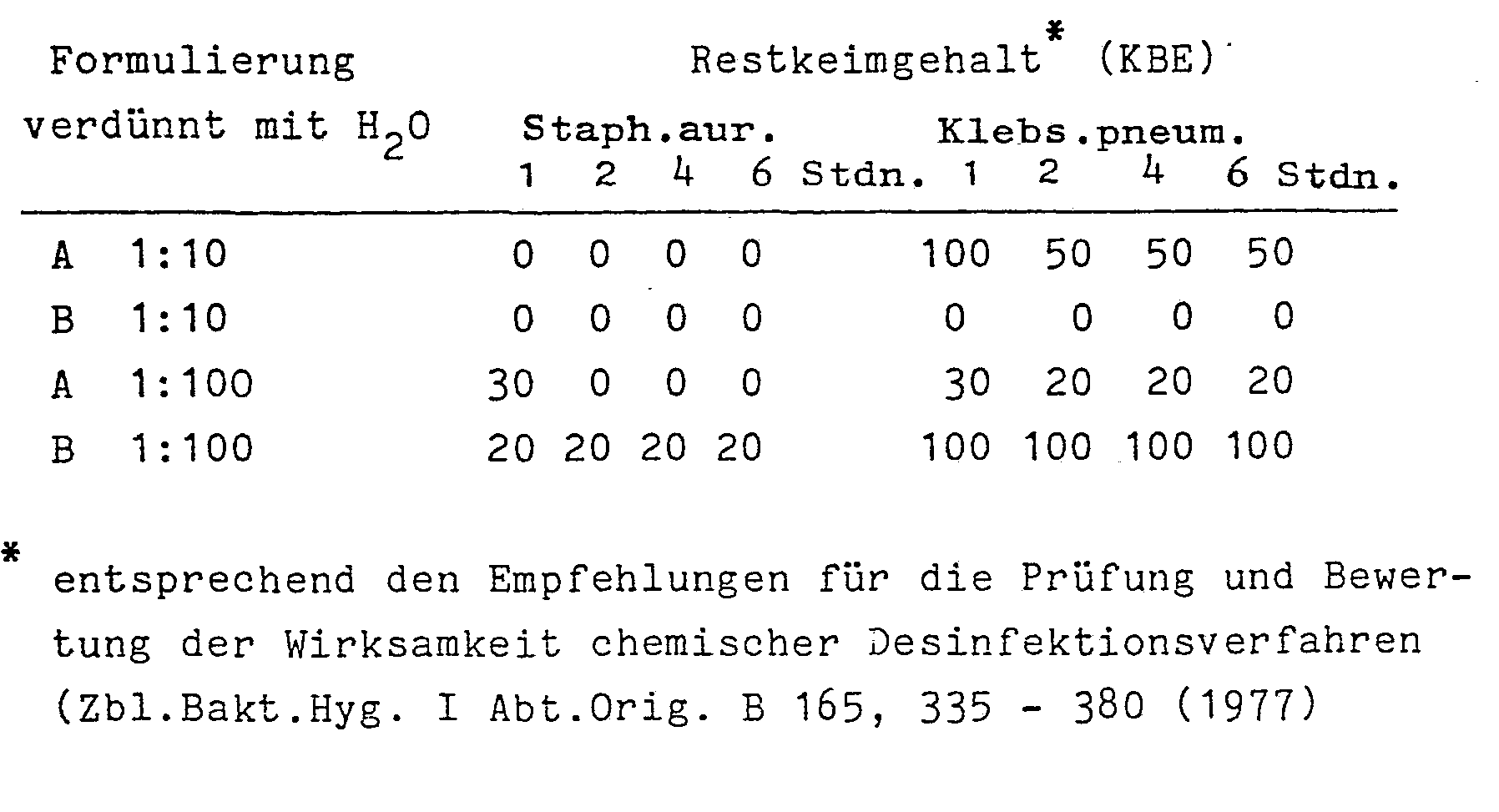
- Prüfung der Flächendesinfektionswirkung an Staph.aur. und Klebs.pneum., Beimpfung von 50 x 50 mm großen Stücken aus Schichtpreßstoff, PVC-Boden oder OP-Fliesen. Keimgehalt pro ml CSL-Suspension: 108 - 109. Nach Antrocknung der Keimsuspension (90 Min.) werden die Flächen aus einer Entfernung von 30.- 40 cm mit dem Mittel besprüht.
- Zusammensetzung der Formulierungen:

- Prüfergebnis:
Claims (3)


Applications Claiming Priority (2)
| Application Number | Priority Date | Filing Date | Title |
|---|---|---|---|
| DE19792952167 DE2952167A1 (de) | 1979-12-22 | 1979-12-22 | Neue guanidiniumverbindungen, verfahren zu deren herstellung und deren verwendung als mikrobiozide mittel |
| DE2952167 | 1979-12-22 |
Publications (3)
| Publication Number | Publication Date |
|---|---|
| EP0031109A2 true EP0031109A2 (de) | 1981-07-01 |
| EP0031109A3 EP0031109A3 (en) | 1981-11-11 |
| EP0031109B1 EP0031109B1 (de) | 1983-05-11 |
Family
ID=6089544
Family Applications (1)
| Application Number | Title | Priority Date | Filing Date |
|---|---|---|---|
| EP80107880A Expired EP0031109B1 (de) | 1979-12-22 | 1980-12-13 | Neue Guanidiniumverbindungen, Verfahren zu deren Herstellung und deren Verwendung als mikrobiozide Mittel |
Country Status (8)
| Country | Link |
|---|---|
| US (1) | US4339459A (de) |
| EP (1) | EP0031109B1 (de) |
| JP (1) | JPS56118056A (de) |
| AR (1) | AR228443A1 (de) |
| AU (1) | AU6561680A (de) |
| BR (1) | BR8008361A (de) |
| DE (2) | DE2952167A1 (de) |
| ES (1) | ES497784A0 (de) |
Cited By (1)
| Publication number | Priority date | Publication date | Assignee | Title |
|---|---|---|---|---|
| WO2012041910A1 (de) * | 2010-10-01 | 2012-04-05 | Elektra Management S.R.O. | Lösung von guanidinium-verbindungen, verfahren unter einsatz dieser lösung sowie deren verwendung |
Families Citing this family (3)
| Publication number | Priority date | Publication date | Assignee | Title |
|---|---|---|---|---|
| JPH075537B2 (ja) * | 1985-07-23 | 1995-01-25 | 大日本インキ化学工業株式会社 | イミノクタジン・3アルキルベンゼンスルホン酸塩の製造方法 |
| DE3531356A1 (de) * | 1985-09-03 | 1987-03-12 | Hoechst Ag | Mikrobiozide mittel auf basis von alkyl-di-guanidiniumsalzen |
| US5081298A (en) * | 1990-12-12 | 1992-01-14 | General Electric Company | Bis(pentaalkylguanidinium) alkane salts as phase transfer catalysts |
Family Cites Families (3)
| Publication number | Priority date | Publication date | Assignee | Title |
|---|---|---|---|---|
| DE1249457B (de) * | 1965-09-01 | 1967-09-07 | Farbwerke Hoechst Aktiengesell schaft vormals Meister Lucius a Bruning Frankfurt/M | Verwendung von Alkyl dl guamdmsalzen als Mii-robizide |
| GB1294443A (en) * | 1969-02-14 | 1972-10-25 | Evans Medical Ltd | Process for the preparation of guanidino derivatives |
| SE417569B (sv) * | 1975-10-22 | 1981-03-30 | Kemanobel Ab | Vissa angivna blandningar av guaniderade alifatiska polyaminer, eller deras syraadditionssalter till anvendning som pesticid och antimikrobiellt medel |
-
1979
- 1979-12-22 DE DE19792952167 patent/DE2952167A1/de not_active Withdrawn
-
1980
- 1980-12-13 EP EP80107880A patent/EP0031109B1/de not_active Expired
- 1980-12-13 DE DE8080107880T patent/DE3063201D1/de not_active Expired
- 1980-12-15 US US06/216,164 patent/US4339459A/en not_active Expired - Fee Related
- 1980-12-16 ES ES497784A patent/ES497784A0/es active Granted
- 1980-12-19 AU AU65616/80A patent/AU6561680A/en not_active Abandoned
- 1980-12-19 AR AR283732A patent/AR228443A1/es active
- 1980-12-19 BR BR8008361A patent/BR8008361A/pt unknown
- 1980-12-19 JP JP17912980A patent/JPS56118056A/ja active Pending
Cited By (1)
| Publication number | Priority date | Publication date | Assignee | Title |
|---|---|---|---|---|
| WO2012041910A1 (de) * | 2010-10-01 | 2012-04-05 | Elektra Management S.R.O. | Lösung von guanidinium-verbindungen, verfahren unter einsatz dieser lösung sowie deren verwendung |
Also Published As
| Publication number | Publication date |
|---|---|
| DE3063201D1 (en) | 1983-06-16 |
| ES8200653A1 (es) | 1981-11-01 |
| AR228443A1 (es) | 1983-03-15 |
| EP0031109B1 (de) | 1983-05-11 |
| DE2952167A1 (de) | 1981-07-02 |
| US4339459A (en) | 1982-07-13 |
| BR8008361A (pt) | 1981-07-07 |
| ES497784A0 (es) | 1981-11-01 |
| AU6561680A (en) | 1981-07-02 |
| EP0031109A3 (en) | 1981-11-11 |
| JPS56118056A (en) | 1981-09-16 |
Similar Documents
| Publication | Publication Date | Title |
|---|---|---|
| DE2138278B2 (de) | Antimikrobielle Zusammensetzung | |
| DE2223766A1 (de) | Bis-biguanidsalze,Verfahren zu deren Herstellung und deren Verwendung | |
| DE2530243C2 (de) | Verwendung von N-substituierten Aminoalkanolen als antimikrobielle Wirkstoffe | |
| DE2641836C2 (de) | Alkylierte Polyamine, deren Herstellung und Verwendung als Mikrobicide &tgr | |
| EP0031109B1 (de) | Neue Guanidiniumverbindungen, Verfahren zu deren Herstellung und deren Verwendung als mikrobiozide Mittel | |
| DE2808943A1 (de) | Neue guanidiniumsalze, verfahren zu ihrer herstellung sowie diese verbindungen enthaltende mikrobicide zubereitungen | |
| CH655248A5 (de) | Flockulations- bzw. emulsionsbrechende mittel und darin enthaltene quaternaere ammoniumverbindungen. | |
| AT334134B (de) | Bekampfung von pilzschadlingen | |
| DE2635389C2 (de) | Konservierungs- und Desinfektionsmittel | |
| DE2657193A1 (de) | Neue umsetzungsprodukte von epsilon -caprolactam und beta-hydroxyalkylaminen, sowie deren aethylenoxidaddukte, deren herstellung und verwendung als antimikrobielle mittel | |
| DE3040993A1 (de) | Salze von n-substituierten guanidinen, ihre herstellung und verwendung als antimikrobielle substanzen | |
| DE2833135A1 (de) | Verwendung von substituierten oligocarbamidinen als mikrobistatika sowie diese enthaltende antimikrobielle mittel | |
| DE2263596C3 (de) | Mikrobicide Mittel | |
| DE3304164A1 (de) | Reaktionsprodukte aus borsaeure, diethanolamin und monoethanolaminen und deren verwendung als korrosionsschutzmittel | |
| DE2629599A1 (de) | Beta-sulfenylacrylsaeure-verbindungen und verfahren zu ihrer herstellung | |
| DE2355026A1 (de) | Neue omega-amino-carbonsaeureamide, deren herstellung, sowie verwendung als antimikrobielle mittel | |
| DE2246595C3 (de) | 1,3,3-Trimethyl-1 -n-dodecylaminomethyl-5-aminocyclohexan, dessen Herstellung und Verwendung als Mikrobicid | |
| AT333977B (de) | Antimikrobielle bzw. algizide mittel | |
| DE2247370C3 (de) | 1,3,3-Trimethyl-1 -noctylaminomethyl-5-n-octylamino-cyclohexan, Verfahren zu deren Herstellung und deren Verwendung als mikrobicider Wirkstoff | |
| DE2244778B2 (de) | 1 -n-Dodecylaminomethyl-2-aminocyclopentan, dessen Herstellung und Verwendung als mikrobicider Wirkstoff | |
| DE2262333C3 (de) | Verfahren zur Herstellung eines Gemisches von Tripopylentetraminderivaten und deren Verwendung als Mikrobicid | |
| DE2220026A1 (de) | Antimikrobielle mittel zur wasserkonservierung | |
| DE3148047A1 (de) | Verwendung von alkylendiaminderivaten als antimikrobielle wirkstoffe | |
| DE2244814A1 (de) | Verfahren zur herstellung von mikrobicid wirksamen verbindungen oder verbindungsgemischen | |
| DE3147990C2 (de) |
Legal Events
| Date | Code | Title | Description |
|---|---|---|---|
| PUAI | Public reference made under article 153(3) epc to a published international application that has entered the european phase |
Free format text: ORIGINAL CODE: 0009012 |
|
| AK | Designated contracting states |
Designated state(s): BE CH DE FR GB IT NL SE |
|
| PUAL | Search report despatched |
Free format text: ORIGINAL CODE: 0009013 |
|
| AK | Designated contracting states |
Designated state(s): BE CH DE FR GB IT NL SE |
|
| 17P | Request for examination filed |
Effective date: 19820206 |
|
| ITF | It: translation for a ep patent filed | ||
| GRAA | (expected) grant |
Free format text: ORIGINAL CODE: 0009210 |
|
| AK | Designated contracting states |
Designated state(s): BE CH DE FR GB IT LI NL SE |
|
| REF | Corresponds to: |
Ref document number: 3063201 Country of ref document: DE Date of ref document: 19830616 |
|
| ET | Fr: translation filed | ||
| PG25 | Lapsed in a contracting state [announced via postgrant information from national office to epo] |
Ref country code: SE Effective date: 19831214 |
|
| PG25 | Lapsed in a contracting state [announced via postgrant information from national office to epo] |
Ref country code: LI Effective date: 19831231 Ref country code: CH Effective date: 19831231 Ref country code: BE Effective date: 19831231 |
|
| PLBE | No opposition filed within time limit |
Free format text: ORIGINAL CODE: 0009261 |
|
| STAA | Information on the status of an ep patent application or granted ep patent |
Free format text: STATUS: NO OPPOSITION FILED WITHIN TIME LIMIT |
|
| 26N | No opposition filed | ||
| PG25 | Lapsed in a contracting state [announced via postgrant information from national office to epo] |
Ref country code: NL Effective date: 19840701 |
|
| NLV4 | Nl: lapsed or anulled due to non-payment of the annual fee | ||
| PG25 | Lapsed in a contracting state [announced via postgrant information from national office to epo] |
Ref country code: FR Free format text: LAPSE BECAUSE OF NON-PAYMENT OF DUE FEES Effective date: 19840831 |
|
| REG | Reference to a national code |
Ref country code: CH Ref legal event code: PL |
|
| PG25 | Lapsed in a contracting state [announced via postgrant information from national office to epo] |
Ref country code: DE Effective date: 19840901 |
|
| REG | Reference to a national code |
Ref country code: FR Ref legal event code: ST |
|
| GBPC | Gb: european patent ceased through non-payment of renewal fee | ||
| PG25 | Lapsed in a contracting state [announced via postgrant information from national office to epo] |
Ref country code: GB Effective date: 19881118 |
|
| EUG | Se: european patent has lapsed |
Ref document number: 80107880.9 Effective date: 19850605 |