EP0031255B1 - Aluminosilicates cristallins, leur production et leur application - Google Patents
Aluminosilicates cristallins, leur production et leur application Download PDFInfo
- Publication number
- EP0031255B1 EP0031255B1 EP80304659A EP80304659A EP0031255B1 EP 0031255 B1 EP0031255 B1 EP 0031255B1 EP 80304659 A EP80304659 A EP 80304659A EP 80304659 A EP80304659 A EP 80304659A EP 0031255 B1 EP0031255 B1 EP 0031255B1
- Authority
- EP
- European Patent Office
- Prior art keywords
- crystalline aluminosilicate
- process according
- crystals
- compound
- mole ratio
- Prior art date
- Legal status (The legal status is an assumption and is not a legal conclusion. Google has not performed a legal analysis and makes no representation as to the accuracy of the status listed.)
- Expired
Links
Images

Classifications
-
- C—CHEMISTRY; METALLURGY
- C01—INORGANIC CHEMISTRY
- C01B—NON-METALLIC ELEMENTS; COMPOUNDS THEREOF; METALLOIDS OR COMPOUNDS THEREOF NOT COVERED BY SUBCLASS C01C
- C01B39/00—Compounds having molecular sieve and base-exchange properties, e.g. crystalline zeolites; Their preparation; After-treatment, e.g. ion-exchange or dealumination
- C01B39/02—Crystalline aluminosilicate zeolites; Isomorphous compounds thereof; Direct preparation thereof; Preparation thereof starting from a reaction mixture containing a crystalline zeolite of another type, or from preformed reactants; After-treatment thereof
- C01B39/36—Pentasil type, e.g. types ZSM-5, ZSM-8 or ZSM-11
- C01B39/38—Type ZSM-5
- C01B39/40—Type ZSM-5 using at least one organic template directing agent
-
- B—PERFORMING OPERATIONS; TRANSPORTING
- B01—PHYSICAL OR CHEMICAL PROCESSES OR APPARATUS IN GENERAL
- B01J—CHEMICAL OR PHYSICAL PROCESSES, e.g. CATALYSIS OR COLLOID CHEMISTRY; THEIR RELEVANT APPARATUS
- B01J29/00—Catalysts comprising molecular sieves
- B01J29/04—Catalysts comprising molecular sieves having base-exchange properties, e.g. crystalline zeolites
- B01J29/06—Crystalline aluminosilicate zeolites; Isomorphous compounds thereof
- B01J29/40—Crystalline aluminosilicate zeolites; Isomorphous compounds thereof of the pentasil type, e.g. types ZSM-5, ZSM-8 or ZSM-11, as exemplified by patent documents US3702886, GB1334243 and US3709979, respectively
-
- C—CHEMISTRY; METALLURGY
- C07—ORGANIC CHEMISTRY
- C07C—ACYCLIC OR CARBOCYCLIC COMPOUNDS
- C07C1/00—Preparation of hydrocarbons from one or more compounds, none of them being a hydrocarbon
- C07C1/20—Preparation of hydrocarbons from one or more compounds, none of them being a hydrocarbon starting from organic compounds containing only oxygen atoms as heteroatoms
-
- C—CHEMISTRY; METALLURGY
- C07—ORGANIC CHEMISTRY
- C07C—ACYCLIC OR CARBOCYCLIC COMPOUNDS
- C07C2529/00—Catalysts comprising molecular sieves
- C07C2529/04—Catalysts comprising molecular sieves having base-exchange properties, e.g. crystalline zeolites, pillared clays
- C07C2529/06—Crystalline aluminosilicate zeolites; Isomorphous compounds thereof
Definitions
- This invention pertains to crystalline aluminosilicates having a unique crystal form and a process for producing such crystalline aluminosilicates in the presence of fluoride ions.
- zeolites porous substances generally known as zeolites. They include, for example, naturally occurring zeolites such as mordenite and clinoptilonite and synthetic zeolites, A, X and Y produced by hydrothermally reacting an aqueous solution containing a silicon compound and an aluminum compound.
- EP-A-0 022 640 describes a ZSM-5 type zeolite which can be acid-activated.
- These synthetic zeolites are produced by hydrothermal reaction in the presence of organic cations.
- ZSM-5 is produced by hydrothermal reaction in the presence of a tetrapropylammonium cation. This method can lead to the formation of a skeletal structure containing Si0 2 and AI 2 0 3 in a wide range of mole ratios.
- EP-A-0 002 899 describes the olefination of methanol by a zeolite catalyst.
- zeolites are generally considered as better catalysts as their particle sizes are greater.
- ZSM-5 synthesized by the aforesaid conventional method is a hexahedral crystal having a particle size of usually as small as about 0.1 micrometer, and from the aforesaid standpoint, there is still room for improvement in its particle size.
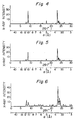
- this object is achieved by a crystalline aluminosilicate characterized by having in its X-ray diffraction pattern determined by the standard powder method using K. radiation of copper at least seven diffraction lines showing the following relative intensities at the positions of the following respective diffraction angles (28): taking the intensity of the diffraction line at a diffraction angle of 8.8° ⁇ 0.3° or 23.2° ⁇ 0.3° as 100 and characterized in that the ratio of the length of the longest direction of the crystals thereof to that of the shortest direction of said crystals which crosses the longest direction at right angles thereto is 1.5 or higher and the length of the shortest direction is at least 14 micrometers.
- the X-ray diffraction pattern is obtained by using, for example, a recording X-ray diffractometer (Geigerflex Model DS manufactured by Rigaku Denki Co., Japan) and making measurements by the standard powder diffraction method using the K a radiation of copper.
- a recording X-ray diffractometer Geigerflex Model DS manufactured by Rigaku Denki Co., Japan
- the absolute value of the diffraction angles (28) of the several X-ray diffraction lines obtained by measuring thus may vary within a small range due to errors that might result in preparing the sample or in making the measurement.
- the value ⁇ 0.3 in the foregoing diffraction angles (28) shows the range of such a variation.
- the crystalline aluminosilicate of this invention has within the diffraction angles 7-25° at least seven diffraction lines which can be clearly distinguished from each other and are characterized by having the several relative intensities indicated hereinabove. Further, there is no overlapping of these diffraction lines, i.e., two of the diffraction lines overlapping to appear as a single diffraction line, to result in the number of diffraction lines becoming less than seven.
- the seven diffraction lines of the crystalline aluminosilicate of this invention can be shown typically by the following diffraction angles and relative intensities. with the proviso that the relative intensities are shown taking the intensity of the diffraction line at a diffraction angle of 8.8° or 23.2° as 100.
- the Bragg's formula can be used for obtaining the spacing (A) of the crystal from the diffraction angle (28) of the X-ray diffraction line.
- the crystalline aluminosilicates (abbreviated hereinafter to crystals) of this invention are characterized by having a unique crystal form in that as compared with the conventional ZSM-5 crystals there is externally a special growth at a specific crystal face only.
- the crystal of this invention is basically a pillar-like octahedron. Two opposing surfaces of the octahedron are hexagonal, and the other six surfaces are tetragonal.
- the crystal of this invention also encompasses those having the shape of a pillar-like octahedron whose vertices and edges have been worn.
- the ratio of the length of its long axis (the longest distance between opposing vertices of the hexagonal surface) to that of its short axis (the shortest of the axes which cross the long axis at right angles thereto) is 1.5 or higher.
- the length of the long axis reaches as large as several tens of micrometers.
- the crystal of this invention may exist not only as a single crystal but also as a polycrystal such as a twinned crystal.
- the crystals of this invention are also distinctive in that they exhibit catalytic properties entirely different from the conventional zeolites.
- the prepared crystals are calcined, ion-exchanged with ammonium chloride and calcined to convert them into so-called IIH + type" crystals before they are used as an acid catalyst.
- the crystals of this invention usually do not exhibit catalytic activity when used as such. Further, their activity as an acid catalyst is not manifested by the usual activation operation, i.e. the calcination-ion exchange-calcination operation, mentioned above.
- the crystals of this invention when treated with an acid such as hydrochloric acid, etc. are activated to acid catalysts.
- crystals of this invention makes it possible to use them as such as an adsorbent for separating the hydrocarbons. Again, they can be used as a solid acid for isomerizing the hydrocarbons by an acid treatment.
- the crystals of this invention may also be regarded as being distinctive in their composition in that they are produced, as hereinafter described, in the presence of a fluorine compound. Hence, they differ from the conventional zeolites in their composition, and there can be provided crystalline aluminosilicates which genetically contain fluorine.
- This invention also provides a convenient process for producing the crystalline aluminosilicates.
- a process for producing a crystalline aluminosilicate by submitting a silicon compound and an aluminum compound to a hydrothermal reaction in an aqueous medium in the copresence of an organic cation and an alkali, characterized by carrying out said hydrothermal reaction in the presence of a fluorine compound.
- the compounds other than the fluorine compound that are used in the process of this invention i.e., the silicon compound, aluminum compound, the compound providing the organic cations, and alkali
- the same compounds as those known in the prior art of producing the zeolites by the hydrohtermal synthetic method can be used.
- the fluorine compound to be used in the invention process may be any of the fluorine compounds so long as it is one that forms the fluoride ions during the hydrothermal synthetic reaction.
- Those which form fluoride ions when dissolved in water for example, sodium fluoride and ammonium fluoride can naturally be used.
- those which form the fluoride ions when submitted to hydrolysis such as silicon fluoride, boron fluoride and sulfur fluoride can also be used.
- those which form the fluoride ions by dissolving in water particularly sodium fluoride and ammonium fluoride, are preferred.
- silicon compound Usable as the silicon compound are those compounds that have been usually used as the silica source in the hydrothermal synthetic reaction, such as sodium silicate, solid silica, silica gel and silica sol, of which preferred is silica sol.
- silica sol of which preferred is silica sol.
- conveniently used are such products as Ludox (trade mark) produced by Du Pont Company, Snowtex (trade mark) produced by Nissan Chemical Industries, Ltd., and Cataloid (trade mark) produced by Shokubai Kasei Ind., Ltd.
- Example of the aluminum compound which can be used are sodium aluminate and freshly prepared aluminum hydroxide.
- the sodium compounds are used as the alkali in the process of this invention. From practical considerations the use of caustic soda is convenient. It may be of the usually used grade. While it is also possible to use as the alkali compound those other than the sodium compounds, in such cases extreme difficulty if usually experienced in forming the crystals.
- the sodium aluminate When sodium aluminate has been used as the aluminum compound, the sodium aluminate also functions as an alkali metal compound.
- the quaternary ammonium cation is advantageously used as the organic cation.
- this quaternary ammonium ion is represented by the formula wherein R is a lower alkyl group.
- R is a lower alkyl group.
- quaternary ammonium ion mention can be made of such ions as tetramethylammonium, tetraethylammonium, tetrapropylammonium and tetrabutylammonium.
- the quaternary ammonium ion of the foregoing general formula (1) can be derived from a quaternary ammonium compound of the formula wherein R is as defined in the case of formula (1 ), X is a halogen atom such as chlorine, bromine and iodine, or an anion such as a residue of an acid, for example sulfate ion, a hydroxy ion; or it can also be obtained by forming the foregoing quaternary ammonium compound of formula (2) in the reaction system by using a tertiary amine of the formula wherein R is as defined in the case of formula (1), conjointly with a compound of the formula wherein R and X are as defined in the case of formula (2).
- quaternary ammonium compounds of the general formula (2) include such compounds as tetrapropylammonium bromide, tetramethylammonium bromide, tetraethylammonium bromide, tetrapropylammonium chloride, tetrabutylammonium bromide and tetrabutylammonium chloride; as well as the tetramethylammonium-, tetraethylammonium-, tetrapropylammonium- and tetrabutylammonium-hydroxides and -sulfates.
- tertiary amines of the general formula (3) there can be mentioned, for example, trimethylamine, triethylamine, tripropylamine and tributylamine.
- Specific examples of the compounds of the general formula (4) are methyl bromide, ethyl bromide, propyl bromide, propyl chloride, butyl bromide, butyl chloride, methyl alcohol, ethyl alcohol, dimethyl sulfate and diethyl sulfate.
- the process of this invention is carried out by submitting the silicon and aluminum compounds, the starting compounds, to a hydrothermal synthetic reaction in an aqueous medium in the presence of a fluorine compound, an organic cation and an alkali.
- the crystallization by means of the hydrothermal synthetic reaction is carried out at a temperature ranging between 100° and 200°C, preferably 130-170°C. It is preferred to perform the reaction under autogenous pressure.
- crystals possessing a unique crystal form one of the important requisites is the control of the temperature conditions. As to the rate of temperature rise in crystallizing the starting mixture prepared at room temperature, the faster, the better.
- the preferred rate of temperature rise is at least 1°C per minute, most preferred being a value of at least 2°C per minute. If the rate of temperature rise is less than 1°C per minute, the time required for raising the temperature of the starting material, which is at room temperature, to the crystallization temperature becomes prolonged, and hence the time that the mixture is held in a temperature zone not optimal for the crystallization becomes long. As a consequence, the growth of other classes of crystal forms or formation of seed crystals takes precedence during this period, and it becomes impossible to achieve an adequate growth of the desired crystals.
- the time required for crystallization varies depending upon such factors as the crystallization temperature and the mole ratio of the starting materials compounded, but it is usually within the range 4-150 hours. For example, when the crystallization is carried out at 150°C, crystals of desired size can be obtained in 20-100 hours. While agitation at the time of crystallization conduces to desirable effects when the time required for the crystallization is short, the effects are small when the crystallization time extends over 20 hours.
- a desirable practice is to perform the shear mixing of the starting mixture to be crystallized prior to submitting it to the hydro.thermal synthetic reaction, since it becomes possible to achieve a thorough mixing of the starting mixture.
- shear mixing is meant a mixing action which sets up a shearing stress in the starting mixture.
- this can be achieved by the use of, say, a high-speed rotary mixer, a homogenizer or a colloid mill.
- a shearing stress can be set up in the starting mixture usually by rotating the rotary member such that its terminal edge- portion has a linear speed of at least 10 meters per second.
- this mole ratio becomes directly the Si0 2 /AI 2 0 3 mole ratio in the crystal in almost all instances. If the Si0 2 /AI 2 0 3 mole ratio is less than 50, the Si0 2 /AI 2 0 3 mole ratio of the crystal becomes too small.
- the readily available commercial silica sol usually contains about 1000 parts per million of AI 2 0 3 . Hence, it is also possible to obtain the crystals of this invention by practicing the invention seemingly without adding especially an aluminum compound but by using only this silica sol. If the R 4 N'/SiO 2 mole ratio is less than 0.1, difficulty will be experienced in forming the crystals in this invention with good reproducibility.
- the Na + /SiO 2 mole ratio is also important. If this mole ratio is less than 0.1, the crystallization becomes inadequate, and only a gelled mixture can be obtained. On the other hand, if the Na + /Si0 2 mole ratio exceeds 0.8, the crystals become small.
- the F-/Si0 2 mole ratio is less than 0.1, the effects obtained by the addition of fluorine do not appear readily, and hence crystals having a unique crystal form cannot be obtained. As the F-/Si0 2 mole ratio becomes greater, there is a tendency to an increase in the ratio of the longest edge to the shortest edge.
- the crystals of this invention are suitably used directly as an adsorbent without any pretreatment.
- they can be used conveniently for separation of the various hydrocarbon isomers or for the adsorption of organic substances from aqueous solutions of organic substances.
- the acid sites of the crystals of this invention become revealed by an acid treatment, they can be used as a solid acid catalyst. They are thus suitable for use as catalyst in the isomerization, disproportionation and alkylation of hydrocarbons. Further, they are also suitably used in the production of olefins, paraffin and aromatic compounds from methanol.
- the acid-treated crystals of this invention demonstrate especially good performances when used as catalyst for the synthesis of particularly the olefins from methanol and/or diethyl ether by the dehydration reaction in that their rate of catalytic degradation is small and that they give the intended products with a high selectivity.
- the starting mixture was then transferred to a corrosion-resistant pressure vessel, after which the temperature was raised to 150°C over the course of one hour and then held in this state for 61 hours under autogenous pressure. This was followed by cooling the reaction product, separating the resulting crystals by filtration and washing the crystals in water until the wash liquid became neutral followed by drying the crystals at 110°C for 10 hours.
- Example 2 The experiment was operated as in Example 1 but varying the mole ratios between the starting materials, and the temperature and time of crystallization.
Landscapes
- Chemical & Material Sciences (AREA)
- Organic Chemistry (AREA)
- Life Sciences & Earth Sciences (AREA)
- Materials Engineering (AREA)
- Engineering & Computer Science (AREA)
- Chemical Kinetics & Catalysis (AREA)
- General Life Sciences & Earth Sciences (AREA)
- Geology (AREA)
- Crystallography & Structural Chemistry (AREA)
- Inorganic Chemistry (AREA)
- Silicates, Zeolites, And Molecular Sieves (AREA)
- Catalysts (AREA)
- Organic Low-Molecular-Weight Compounds And Preparation Thereof (AREA)
Claims (21)

Applications Claiming Priority (2)
| Application Number | Priority Date | Filing Date | Title |
|---|---|---|---|
| JP166696/79 | 1979-12-21 | ||
| JP54166696A JPS581045B2 (ja) | 1979-12-21 | 1979-12-21 | 結晶性アルミノシリケ−ト |
Publications (3)
| Publication Number | Publication Date |
|---|---|
| EP0031255A2 EP0031255A2 (fr) | 1981-07-01 |
| EP0031255A3 EP0031255A3 (en) | 1981-08-05 |
| EP0031255B1 true EP0031255B1 (fr) | 1985-07-24 |
Family
ID=15836038
Family Applications (1)
| Application Number | Title | Priority Date | Filing Date |
|---|---|---|---|
| EP80304659A Expired EP0031255B1 (fr) | 1979-12-21 | 1980-12-19 | Aluminosilicates cristallins, leur production et leur application |
Country Status (3)
| Country | Link |
|---|---|
| EP (1) | EP0031255B1 (fr) |
| JP (1) | JPS581045B2 (fr) |
| DE (1) | DE3070908D1 (fr) |
Families Citing this family (16)
| Publication number | Priority date | Publication date | Assignee | Title |
|---|---|---|---|---|
| JPS593932B2 (ja) * | 1980-12-03 | 1984-01-26 | 三菱瓦斯化学株式会社 | 結晶性アルミノシリケ−トの製造方法 |
| JPS6052086B2 (ja) * | 1981-07-14 | 1985-11-18 | 三菱瓦斯化学株式会社 | 結晶性アルミノシリケ−ト組成物 |
| US4593133A (en) * | 1982-05-14 | 1986-06-03 | Exxon Research & Engineering Co. | Zeolite L |
| US4544539A (en) * | 1982-05-14 | 1985-10-01 | Exxon Research & Engineering Co. | Zeolite L with cylindrical morphology |
| JPS59204137A (ja) * | 1983-04-30 | 1984-11-19 | Asahi Chem Ind Co Ltd | 1,4−ジ置換ベンゼンの製造法 |
| JPS59128210A (ja) * | 1982-12-30 | 1984-07-24 | Asahi Chem Ind Co Ltd | 結晶性アルミノシリケ−ト、その製造方法及びそのアルミノシリケ−トから成るモノアルキルベンゼンのアルキル化用触媒 |
| DE3361440D1 (en) * | 1982-12-30 | 1986-01-16 | Asahi Chemical Ind | A crystalline aluminosilicate, a process for producing the same, and a catalyst comprising the crystalline aluminosilicate |
| JPS59139341A (ja) * | 1983-01-20 | 1984-08-10 | Mitsubishi Gas Chem Co Inc | ヒドロキシカルボン酸誘導体の製造方法 |
| JPS59161328A (ja) * | 1983-03-01 | 1984-09-12 | Mitsubishi Gas Chem Co Inc | ヒドロキシカルボン酸誘導体の製造法 |
| JPS59190928A (ja) * | 1983-04-11 | 1984-10-29 | Asahi Chem Ind Co Ltd | トルエンの不均化法 |
| JPS60110343U (ja) * | 1983-12-27 | 1985-07-26 | 沖電気工業株式会社 | 自動給紙機構 |
| FR2567868A1 (fr) * | 1984-07-20 | 1986-01-24 | Raffinage Cie Francaise | Nouveau procede de synthese de zeolites du type aluminosilicate, produits obtenus par ce procede et utilisation de ces produits |
| FR2619319B1 (fr) * | 1987-08-14 | 1990-01-12 | Inst Francais Du Petrole | Catalyseur du type aluminosilicate renfermant au moins un metal noble et son utilisation en isomerisation d'une coupe c8 aromatique |
| FR2631621B1 (fr) * | 1988-05-19 | 1990-09-07 | Inst Francais Du Petrole | Nouvelles zeolithes de type structural ton, leur preparation et leur utilisation |
| FR2639257B1 (fr) * | 1988-11-24 | 1991-03-01 | Inst Francais Du Petrole | Catalyseur et son utilisation pour un procede de deparaffinage catalytique |
| EP1984313B1 (fr) * | 2005-12-28 | 2020-07-15 | Chevron U.S.A., Inc. | Composition de tamis moleculaire ssz- 74 |
Citations (2)
| Publication number | Priority date | Publication date | Assignee | Title |
|---|---|---|---|---|
| EP0002899A1 (fr) * | 1977-12-23 | 1979-07-11 | The British Petroleum Company p.l.c. | Procédé de préparation d'aluminosilicates et leur utilisation comme supports de catalyseurs et catalyseurs |
| EP0022640A1 (fr) * | 1979-07-09 | 1981-01-21 | Commonwealth Scientific And Industrial Research Organisation | Catalyseurs zéolitiques, procédé pour leur préparation et leur utilisation pour la conversion de l'éthanol en éthylène et des deux en hydrocarbures supérieurs |
Family Cites Families (3)
| Publication number | Priority date | Publication date | Assignee | Title |
|---|---|---|---|---|
| JPS4945477B1 (fr) * | 1969-03-05 | 1974-12-04 | ||
| US3849463A (en) * | 1969-12-18 | 1974-11-19 | Mobil Oil Corp | Prevention of silica pore obstruction in crystalline aluminosilicates |
| JPS5034309A (fr) * | 1973-07-11 | 1975-04-02 |
-
1979
- 1979-12-21 JP JP54166696A patent/JPS581045B2/ja not_active Expired
-
1980
- 1980-12-19 EP EP80304659A patent/EP0031255B1/fr not_active Expired
- 1980-12-19 DE DE8080304659T patent/DE3070908D1/de not_active Expired
Patent Citations (2)
| Publication number | Priority date | Publication date | Assignee | Title |
|---|---|---|---|---|
| EP0002899A1 (fr) * | 1977-12-23 | 1979-07-11 | The British Petroleum Company p.l.c. | Procédé de préparation d'aluminosilicates et leur utilisation comme supports de catalyseurs et catalyseurs |
| EP0022640A1 (fr) * | 1979-07-09 | 1981-01-21 | Commonwealth Scientific And Industrial Research Organisation | Catalyseurs zéolitiques, procédé pour leur préparation et leur utilisation pour la conversion de l'éthanol en éthylène et des deux en hydrocarbures supérieurs |
Also Published As
| Publication number | Publication date |
|---|---|
| JPS581045B2 (ja) | 1983-01-10 |
| JPS5688820A (en) | 1981-07-18 |
| EP0031255A2 (fr) | 1981-07-01 |
| DE3070908D1 (en) | 1985-08-29 |
| EP0031255A3 (en) | 1981-08-05 |
Similar Documents
| Publication | Publication Date | Title |
|---|---|---|
| Chao et al. | Kinetic studies on the formation of zeolite ZSM-5 | |
| US4088605A (en) | ZSM-5 containing aluminum-free shells on its surface | |
| US5240892A (en) | Small crystal ZSM-5, as a catalyst | |
| JP4880104B2 (ja) | 特殊な粒度の結晶および結晶の集合体を含むゼオライトeuo、並びにc8芳香族化合物の異性化触媒としてのその使用 | |
| EP0104800B1 (fr) | Procédé pour la préparation d'aluminosilicates cristallins | |
| EP0031255A2 (fr) | Aluminosilicates cristallins, leur production et leur application | |
| JPH03183617A (ja) | 炭化水素の脱水素環化および/または異性化法において触媒を使用する方法 | |
| CA1269088A (fr) | Zeolite ayant une structure de type paulingite (ecr-18) et methode de preparation | |
| EP0128766B1 (fr) | Procédé pour la préparation de zéolite à haut contenu en silice du type faujasite | |
| WO2003029144A1 (fr) | Tamis moleculaires cristallins | |
| US4519998A (en) | Process for the preparation of a crystalline titanoborosilicate | |
| CA1248931A (fr) | Preparation de la zeolite l | |
| EP0053499B1 (fr) | Procédé pour la préparation d'aluminosilicates cristallins | |
| EP0142347B1 (fr) | Procédé pour la préparation de zéolites du type L par technique nucléaire | |
| JPH0521843B2 (fr) | ||
| US4537757A (en) | Crystalline aluminosilicate AZ-1 and a process for producing the same | |
| EP0113473B1 (fr) | Catalyseur zéolithique et procédé pour le préparer | |
| JPS6144805B2 (fr) | ||
| EP0091049B1 (fr) | Zéolithe LZ-133 | |
| EP0142354A2 (fr) | Préparation de zéolite L à partir de gels riches en alumine | |
| EP0070657B1 (fr) | Aluminosilicate cristallin contenant des éléments transitoires | |
| US5215736A (en) | Mordenite type zeolite and its preparation process | |
| US3649178A (en) | Synthesis of sodium zeolite w-z | |
| EP0158491A2 (fr) | Synthèse de produits zéolitiques | |
| JPH0339969B2 (fr) |
Legal Events
| Date | Code | Title | Description |
|---|---|---|---|
| PUAI | Public reference made under article 153(3) epc to a published international application that has entered the european phase |
Free format text: ORIGINAL CODE: 0009012 |
|
| PUAL | Search report despatched |
Free format text: ORIGINAL CODE: 0009013 |
|
| AK | Designated contracting states |
Designated state(s): DE FR GB IT NL |
|
| AK | Designated contracting states |
Designated state(s): DE FR GB IT NL |
|
| 17P | Request for examination filed |
Effective date: 19810903 |
|
| ITF | It: translation for a ep patent filed | ||
| GRAA | (expected) grant |
Free format text: ORIGINAL CODE: 0009210 |
|
| AK | Designated contracting states |
Designated state(s): DE FR GB IT NL |
|
| REF | Corresponds to: |
Ref document number: 3070908 Country of ref document: DE Date of ref document: 19850829 |
|
| ET | Fr: translation filed | ||
| PLBE | No opposition filed within time limit |
Free format text: ORIGINAL CODE: 0009261 |
|
| STAA | Information on the status of an ep patent application or granted ep patent |
Free format text: STATUS: NO OPPOSITION FILED WITHIN TIME LIMIT |
|
| 26N | No opposition filed | ||
| PGFP | Annual fee paid to national office [announced via postgrant information from national office to epo] |
Ref country code: NL Payment date: 19871231 Year of fee payment: 8 |
|
| PG25 | Lapsed in a contracting state [announced via postgrant information from national office to epo] |
Ref country code: GB Effective date: 19881219 |
|
| PGFP | Annual fee paid to national office [announced via postgrant information from national office to epo] |
Ref country code: DE Payment date: 19890131 Year of fee payment: 9 |
|
| PG25 | Lapsed in a contracting state [announced via postgrant information from national office to epo] |
Ref country code: NL Effective date: 19890701 |
|
| NLV4 | Nl: lapsed or anulled due to non-payment of the annual fee | ||
| GBPC | Gb: european patent ceased through non-payment of renewal fee | ||
| PG25 | Lapsed in a contracting state [announced via postgrant information from national office to epo] |
Ref country code: FR Free format text: LAPSE BECAUSE OF NON-PAYMENT OF DUE FEES Effective date: 19890831 |
|
| REG | Reference to a national code |
Ref country code: FR Ref legal event code: ST |
|
| PG25 | Lapsed in a contracting state [announced via postgrant information from national office to epo] |
Ref country code: DE Effective date: 19900901 |