EP0032028A2 - Verfahren und Apparat zur Formung elektrischer Leiterbahnen - Google Patents
Verfahren und Apparat zur Formung elektrischer Leiterbahnen Download PDFInfo
- Publication number
- EP0032028A2 EP0032028A2 EP80304609A EP80304609A EP0032028A2 EP 0032028 A2 EP0032028 A2 EP 0032028A2 EP 80304609 A EP80304609 A EP 80304609A EP 80304609 A EP80304609 A EP 80304609A EP 0032028 A2 EP0032028 A2 EP 0032028A2
- Authority
- EP
- European Patent Office
- Prior art keywords
- etching
- conductive layer
- electrically conductive
- electrical interconnections
- electrode
- Prior art date
- Legal status (The legal status is an assumption and is not a legal conclusion. Google has not performed a legal analysis and makes no representation as to the accuracy of the status listed.)
- Granted
Links
Images



Classifications
-
- B—PERFORMING OPERATIONS; TRANSPORTING
- B24—GRINDING; POLISHING
- B24B—MACHINES, DEVICES, OR PROCESSES FOR GRINDING OR POLISHING; DRESSING OR CONDITIONING OF ABRADING SURFACES; FEEDING OF GRINDING, POLISHING, OR LAPPING AGENTS
- B24B37/00—Lapping machines or devices; Accessories
- B24B37/005—Control means for lapping machines or devices
- B24B37/013—Devices or means for detecting lapping completion
-
- C—CHEMISTRY; METALLURGY
- C23—COATING METALLIC MATERIAL; COATING MATERIAL WITH METALLIC MATERIAL; CHEMICAL SURFACE TREATMENT; DIFFUSION TREATMENT OF METALLIC MATERIAL; COATING BY VACUUM EVAPORATION, BY SPUTTERING, BY ION IMPLANTATION OR BY CHEMICAL VAPOUR DEPOSITION, IN GENERAL; INHIBITING CORROSION OF METALLIC MATERIAL OR INCRUSTATION IN GENERAL
- C23F—NON-MECHANICAL REMOVAL OF METALLIC MATERIAL FROM SURFACE; INHIBITING CORROSION OF METALLIC MATERIAL OR INCRUSTATION IN GENERAL; MULTI-STEP PROCESSES FOR SURFACE TREATMENT OF METALLIC MATERIAL INVOLVING AT LEAST ONE PROCESS PROVIDED FOR IN CLASS C23 AND AT LEAST ONE PROCESS COVERED BY SUBCLASS C21D OR C22F OR CLASS C25
- C23F1/00—Etching metallic material by chemical means
-
- G—PHYSICS
- G01—MEASURING; TESTING
- G01N—INVESTIGATING OR ANALYSING MATERIALS BY DETERMINING THEIR CHEMICAL OR PHYSICAL PROPERTIES
- G01N17/00—Investigating resistance of materials to the weather, to corrosion, or to light
- G01N17/02—Electrochemical measuring systems for weathering, corrosion or corrosion-protection measurement
-
- H—ELECTRICITY
- H10—SEMICONDUCTOR DEVICES; ELECTRIC SOLID-STATE DEVICES NOT OTHERWISE PROVIDED FOR
- H10P—GENERIC PROCESSES OR APPARATUS FOR THE MANUFACTURE OR TREATMENT OF DEVICES COVERED BY CLASS H10
- H10P50/00—Etching of wafers, substrates or parts of devices
- H10P50/60—Wet etching
- H10P50/66—Wet etching of conductive or resistive materials
- H10P50/663—Wet etching of conductive or resistive materials by chemical means only
- H10P50/667—Wet etching of conductive or resistive materials by chemical means only by liquid etching only
-
- H—ELECTRICITY
- H10—SEMICONDUCTOR DEVICES; ELECTRIC SOLID-STATE DEVICES NOT OTHERWISE PROVIDED FOR
- H10P—GENERIC PROCESSES OR APPARATUS FOR THE MANUFACTURE OR TREATMENT OF DEVICES COVERED BY CLASS H10
- H10P74/00—Testing or measuring during manufacture or treatment of wafers, substrates or devices
- H10P74/23—Testing or measuring during manufacture or treatment of wafers, substrates or devices characterised by multiple measurements, corrections, marking or sorting processes
- H10P74/238—Testing or measuring during manufacture or treatment of wafers, substrates or devices characterised by multiple measurements, corrections, marking or sorting processes comprising acting in response to an ongoing measurement without interruption of processing, e.g. endpoint detection or in-situ thickness measurement
-
- H—ELECTRICITY
- H10—SEMICONDUCTOR DEVICES; ELECTRIC SOLID-STATE DEVICES NOT OTHERWISE PROVIDED FOR
- H10W—GENERIC PACKAGES, INTERCONNECTIONS, CONNECTORS OR OTHER CONSTRUCTIONAL DETAILS OF DEVICES COVERED BY CLASS H10
- H10W20/00—Interconnections in chips, wafers or substrates
- H10W20/01—Manufacture or treatment
- H10W20/031—Manufacture or treatment of conductive parts of the interconnections
Definitions
- the present invention relates to a method of forming electrical interconnections on a semiconductor substrate by the wet chemical etching of an electrically conductive layer formed on the substrate, the method involving the monitoring of the progress of the etching whereby to ascertain the terminal point of etching; the invention also relates to apparatus for carrying out the above method and to a form of electrode connector preferably used in such apparatus.
- Another object of the present invention is to provide a method of forming electrical interconnections of high quality, in which etching is consistently carried out.
- a method of forming electrical interconnections on a semiconductor substrate formed with a number of semiconductor circuit elements comprising depositing an electrically conductive layer over substantially the entire surface of the semiconductor substrate, and etching the electrically conductive layer to produce electrical interconnections in a pattern previously defined on the conductive layer by a photolithographic process, characterised in that the etching process includes the operations of placing a connecting element composed of the electrochemically same material as that of the electrically conductive layer so that at least one point of said connecting element is in contact with the electrically conductive layer, dipping the assembly in an etching solution to perform wet chemical etching of the electrically conductive layer, and monitoring the progress of etching by monitoring the electric current flow produced in an external circuit by an electrochemical cell set up between the electrically conductive layer acting as one electrode and another electrode disposed in said solution and constituted by an electric conductor composed of a material electrochemically different from the material of the electrically conductive layer, the cell electrode constituted by
- the electric current produced between an electrode formed by the conductive layer (typically aluminium) carried by the semi-conductor wafer,and the other electrode (for example, a platinum wire) changes according to the area of exposed aluminium of the semiconductor wafer. More specifically, since the area of exposed aluminium is large in the initial stage of etching, a large current is obtained, but at termination of the etching, the area of exposed aluminium is small and therefore, the current is small.
- the conductive layer typically aluminium
- the other electrode for example, a platinum wire
- an aluminium wire composed of the same material as that of the electrically conductive layer is used as the contact element to be taken out from the semiconductor wafer. Furthermore, the aluminium of said connecting element can increase the size of electric current flowing in the monitoring electrochemical cell so that the residual current at the end of etching is greater than would otherwise be the case with the result that the percentage change of the electric current at termination of etching is reduced and detection of termination of etching becomes difficult. This problem can be overcome by coating the connecting element with an insulating material so that the exposed area of the connecting element is reduced.
- a semiconductor wafer has convexities and concavities formed by etching treatment for opening diffusion windows, and therefore, in many cases, the semi- conductor wafer is contacted by the connecting element by line or point contact. Accordingly, the actual monitoring current value will depend on the kind of the diffusion treatment conducted on the contact points, and detection of the termination of the etching becomes even more difficult. This defect is eliminated by enclosing the periphery of the electrode with an elastic resin.
- a photoresist is coated on a substrate on which aluminium is vacuum-deposited, a mask is placed on the photoresist, the assembly is exposed to actinic rays to effect a development treatment, a baking treatment is then performed, and aluminium is selectively removed by using an etching solution.
- one or more connecting elements must be taken out from the conductive layer formed in the substrate.
- connection cannot be confirmed and a fault can.not be detected until the assembly is dipped in an etching solution. Accordingly, in this case, the operational efficiency is extremely low. Furthermore, when a fault is detected, the assembly nust be removed from the etching solution and dipped again after connection has been properly made. Therefore, it is difficult to calculate the etching time and it becomes impossible to perform appropriate etching.
- the basic principle of the electrical-connection forming methods to be described hereinafter, is to form conductive tracks by the chemical etching of a conductive layer formed on a substrate, while monitoring the progress of etching by monitoring the electrical current flow produced by an electrochemical cell set up between the conductive layer, acting as one electrode, and another electrode disposed in the etching solution.
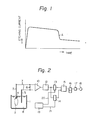
- Figure 1 illustrates a typical form of current-time curve for the monitoring current. Since the value of the current flowing between the electrodes during etching changes according to the exposed area of the conductive layer, when the etching process is nearing completion and the area of the conductive layer is rapidly reducing as a pattern is cut in portions thereof, the current value will fall substantially. Therefore, a point of primary termination (point A) can be detected. However, since the thickness of the conductive layer (for example, vacuum-deposited aluminium) is not absolutely uniform, unwanted conductive material is still left locally at this primary termination point, and therefore, additional etching should be performed.
- point A point of primary termination
- the time for this additional etching can be determined based on the measurement of the change of the etching monitoring current.
- the etching current does not precisely represent the etching speed. Therefore, this method of determining the additional etching time is disadvantageous in that an appropriate etching time cannot be precisely determined.
- this defect can be eliminated by forming electrical interconnections while calculating an optimum time for etching an electrically conductive layer by utilizing means for monitoring the progress of the etching, means for measuring the etching speed, means for storing the initial thickness of the electrically conductive layer, and computing means.
- reference numerals 1, 2 and 3 respectively indicate an etching tank, a substrate having aluminium vacuum-deposited thereon,and an aluminium wire.
- a holding member 4 composed of a resin is provided to bring the aluminium vacuum-deposited on the substrate 2 into contact with a connecting element constituted by an aluminium wire 3, and to maintain them in this contacted state.
- Reference numerals 5, 6, 7, 8, 10 and 12 respectively indicate a platinum wire, a resistor, connecting leads, an etching solution comprising phosphoric acid as the main ingredient, an amplifier and an analog-digital converter.
- Reference numerals 13 and 14 indicate registers, and reference numerals 15, 16, 17, 18, 19, 20 and 21 respectively indicate a comparator circuit, a flip-flop, a driver, a buzzer, a control circuit, an initial sample signal line and an inspection sample signal line.
- a photoresist is applied thereon followed by a mask and the whole assembly is exposed to actinic rays to effect a development treatment. Then, a baking treatment is carried out and aluminium in the area where the photoresist is not applied is selectively removed by using the etching solution 8.
- an electrochemical cell is set up between the aluminium on the substrate 2 and the platinum wire 5. Connection to the aluminium on the substrate is made by means of the connecting element 3.
- the resistor 6 is connected to the platinum wire 5 and to the connecting element 3 through the connecting leads 7.
- the electrochemical cell set up causes an electric current to flow through the resistor 6, the platinum wire 5 acting as a positive pole and the conductive layer acting as a negative pole.
- the connecting element 3 contacting the electrically conductive layer on the substrate 2 should be conposed of an electrochemically same material as that of the electrically conductive layer.
- the material of the element 3 should have the same electrochemical potential as that of the electrically conductive layer. If the element 3 is composed of a material electrochemically different from the material of the electrically conductive layer,then since both the substrate 2 and theelement 3 brought into contact therewith are dipped in the etching solution 8, a short circuit is formed in the contact portion and etching is completed preferentially in the periphery of the contact portion, while no circuit is formed in the other portion of the electrically conductive layer. Therefore, in such a case, correct monitoring of the progress of the etching is impossible.
- the platinum wire 5 is used as the counter electrode for the substrate 2.
- an electrically conductive substance electrochemically different from the material of the electrically conductive layer is used as the counter electrode,an electrochemical cell is produced. Therefore any such electrically conductive substance can be used instead of the platinum wire 5, to implement the method of the present invention.
- the electric voltage produced by the electric current flowing through the resistor 6 is amplified by the amplifier 10 and converted to a digital signal by the analog-digital converter 12.
- the electric current produced in the initial stage of etching of the substrate 2 is set in the register 13 through the initial sample signal line 20. Then, the electric current is set in the register 14 through the inspection sample signal line 21 at predetermined intervals of, for example, 30 seconds.
- the content of the register 13 is compared with the content of the register 14 by the comparator circuit 15. When the current value is below 70% of the initial current value, the flip-flop 16 is set and the buzzer 18 is actuated by the driver 17, whereby an operator is informed that termination of etching is close at hand.
- the buzzer 18 but also another indicator may be used as the informing means.
- the above-mentioned ratio of the monitored current to the initial current is not limited to 70%, but a ratio of 60% through 80% may be adopted.
- a signal indicating the terminal point can appropriately be produced according to the size of the substrate 2.
- comparison is made after the analog signal has been converted to a digital signal.
- the electric current value produced in the initial stage of etching is stored in a condenser and the analog voltage held therein is compared with an analog signal of a voltage converted from a sampled current.
- the terminal point is determined by comparing the sampled current with the initial current.
- the intended objects of the present invention can similarly be attained in a modification where such comparison is not made but termination is detected by confirmation of lowering of the electric current value to a sufficiently low level.
- the current value depends on the area of exposed aluminum, the current value is greatly reduced when etching comes close to the point of termination. Accordingly, the point of termination of etching can easily be detected by the above-mentioned procedures.
- the buzzer is actuated when the sampled current I L is reduced to 70% of the initial current Io.
- the etching tank 1 is disposed in a chamber or the like and a cover is arranged thereon and it is difficult to inspect the substrate 2 with the naked eye, the progress of the etching can be detected according to the present invention.
- ionization of the aluminium layer is influenced by the monitoring current. Accordingly, in the case where a plurality of substrates are simultaneously etched and one of them is monitored by the circuit illustrated in Fig. 2, then because of the affect of the current on ionization of the aluminium, there is a time difference between the termination of the etching process for the monitored wafer and the remaining wafers. An embodiment for reducing this current effect is illustrated in Fig. 4.
- reference numeral 22 represents an improved form of the control circuit 19 illustrated in Fig. 2.
- Reference numerals 23 and 24 respectively indicate a relay and a contact of the relay 23.
- the relay 23 shown in Fig. 4 is actuated to close the contact 24, and after completion of loading of the registers 13 and 14, the relay 23 is de-energized to open the contact 24. If this arrangement is adopted so that an electric current is allowed to flow only for several milliseconds at the time of the measurement, the current etching effect can substantially be ignored.
- the relay 23 is used for the switching operation. If a semiconductor such as a transistor is used for this switching operation, the time of flowing of the electric current can be shortened and the current effect can further be reduced.
- the substrate 2 of the foregoing embodiments need not be composed of a completely insulating material. If a substrate which is sufficiently more difficult to electrolyze than the electrically conductive layer is used, a sufficient change of the current value is brought about at the termination of etching to enable the termination of etching to be detected according to the above-mentioned procedures.
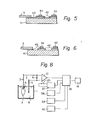
- F ig. 5 is a sectional view illustrating circuit elements of a semiconductor before etching
- Fig. 6 is a sectional view illustrating circuit elements of the semiconductor after etching, the general form of the semiconductors being known.
- reference numerals 41, 42, 42 and 44 indicate a semiconductor silicon wafer or substrate, an insulating layer of silicon dioxide or the like, a vacuum-deposited aluminium layer and a photoresist according to a pattern of electrical interconnections.
- the aluminium layer 43 in the area where the photoresist 44 is not applied is selectively removed as illustrated in Fig. 6. Since the thickness of the aluminium layer 43 is 4000 through 15000 ⁇ , if an aluminium wire having a diameter sufficiently larger than this thickness, for example, 0.1 mm, is used as the aluminium wire 3, it is possible to prevent the aluminium wire 3 from being preferentially etched and cut.
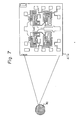
- IC chips 41a are generally formed on a semiconductor substrate 41, and electrical interconnections of a complicated pattern are formed for these IC chips 41a.
- desired electrical interconnections can also be formed for the other IC chips 41a. It is considered that the reason for this is that interconnection layers of the respective IC chips 41a are electrically conductively cormunicated with the aluminium wire through the semi- conductor substrate which is electrically conductive to some extent.
- etching can be performed with a very high scientific precision and also with good reproducibility irrespective of the skill or experience of an operator and therefore, electrical interconnections of high quality can be formed in high yields.
- Fig. 8 is a diagram illustrating an etching tank and monitor circuit according to the present invention.
- reference numerals 10, 37, 38, 39, 40 and 26 respectively indicate the amplifier, a tiner, a switch for setting the initial thickness of the aluminium conductive layer 2 for electrical interconnections of a wafer, a standard current setting circuit for detecting when etching approaches the terminal point, a thumb wheel switch for setting the additional etching thickness for additional etching to be conducted after detection of the approach to the terminal point, and a processing unit.
- Reference numeral 18 indicates the buzzer
- reference numeral 25 indicates a starting switch.
- the timer 37 is actuated to measure the etching time.
- the electric current produced by the ronitoring electrochemical cell is converted to a voltage by the resistor 6, amplified by the amplifier 10 and supplied to a processing unit 26 for comparison with the value of the standard current setting circuit 39.
- the processing unit 26 reads an output T of the timer 37 and an output W of the initial thickness setting thumb wheel switch 38 at this point and calculates the quantity etched per unit of time, that is, the etching rate W/T, and then, the processing unit 26 reads the output W' of the additional etching thickness setting thumb wheel switch 40 and calculates the additional etching time T by dividing the read value by the above-mentioned etching rate.
- the buzzer 18 is activated to indicate completion of etching.
- the etching rate is calculated for each cycle of etching, it is possible to handle delicate changes in the etching conditions (such as changes in the composition of the etching solution 8 and the temperature of the etching solution 8) appropriately, and therefore, etching can be carried out uniformly and electrical interconnections of high quality can be obtained. Moreover, even if many experiments are not particularly made for determining optimum etching conditions, desired etching can be performed effectively.
- two switches that is, the thumb wheel switch 38 for setting the initial thickness of the electrically conductive layer and the thumb wheel switch 40 for setting the additional etching thickness.
- the initial thickness W of the electrically conductive layer and the additional etching* thickness W' are known in advance, the intended objects of the present invention can similarly be attained even if only one switch for setting the ratio W'/W is provided.
- reference numerals 1 through 21 indicate the same elements and members as in Fig. 2.
- Reference numerals 30, 31, 32, 33, 34, 35 and 36 indicate a timer, a time setting switch, a comparator circuit, a flip-flop, a driver, a buzzer and a reset signal line of the flip-flop 16, respectively.
- the timer 30 is started, and after several seconds, the flip-flop 16 is reset by the reset signal line 36 and ringing of the buzzer 18 is stopped.
- the timer 30 is kept actuated and the time counted by the timer 30 is compared with the time set by the time setting switch 31 by the comparator circuit 32.
- the flip-flop 33 is set and the buzzer 35 is actuated through the driver 34 to indicate termination of etching.
- etching is continued for a certain time after the etching current has arrived at a timely determined level, for example, 70% of Io (see Fig. 3), and therefore, nonuniformity of the degree of etching owing to a difference of the size or shape of the patterns on the substrate can effectively be eliminated in the formed interconnections.
- Fig. 10 is a diagram illustrating another etching tank and monitor circuit according to the present invention.
- reference numerals 1 through 10 indicate the same elements and members as in Fig. 2.
- Reference numerals 45,47,48,49, 50,51, 52,53,54,55, 56 and 57 respectively indicate an additional etching thickness memory circuit for storing the thickness of additional etching to be conducted after detection of the terminal point of etching, a processing unit provided with a computing and controlling capacity, a monitoring current memory circuit a timer, a buzzer, a start switch, a thermocouple for measuring the temperature of the etching solution 8, an amplifier,an AD converter, another AD converter, a contact of a reed relay,and a thickness memory circuit for storing the initial thickness of the aluminium conductive layer of the substrate 2; the circuits shown as reference numerals 45 and 57 can also be formed as one circuit.
- the timer 49 When the substrate 2 is placed in the etching tank 1 and the start switch 51 is depressed, the timer 49 is actuated to perform measurement of the etching time, and a signal from the timer 49 is fed to the processing unit 47 at predetermined intervals of, for example, 30 seconds. On receipt of a signal from the timer 49, the processing unit 47 closes the contact 56 of the reed relay for about 10 milliseconds to measure the monitoring circuit. This circuit is converted to a voltage by the resistor 6, amplified by the amplifier 10, put into the processing unit 47 and compared with the value of the monitoring current memory circuit 48.
- the newly measured current value is stored in the monitoring current memory circuit 48.
- the newly measured current value is much smaller than the previously measured current value, that is, the value stored in the monitoring current memory circuit 48, it is judged that the etching process has reached the primary terminal point (point A) illustrated in Fig. 1.
- the temperature of the etching solution 8 is sensed by the thermocouple 52, amplified by the amplifier 53, converted to a digital signal by the AD converter 54 and fed to the processing unit 47.
- the temperature of the etching solution 8 is measured by the thermocouple 52 under the control of the timer 49, for example, at intervals of 10 seconds.
- the total thickness etched Q, up to a time Ml at a primary terminal point corresponds to a time integration of R' which is represented by the following formula: wherein M stands for the etching time.
- This total etched thickness Q approximates the total sum of the products of the time AM and R' calculated each time the temperature is measured. That is the total etched thickness Q is approximately represented by the following formula:
- the value S is read out from the initial thickness memory circuit 57 and the value W' is read out from the additional etching thickness memory circuit 45, and the value of SQ is calculated where S represents which is the ratio of the additional etching thickness of an electrically conductive layer to the initial thickness and which may be expressed by a percentage.
- a value P is calculated according to the following formula: When the value P is close to 0, etching is terminated and the buzzer 50 is actuated.
- etching is carried out while measuring the temperature of the etching solution, even if the etching solution 8 is heated by a heater to elevate the temperature of the etching solution 8 and accelerate etching, termination of etching can be detected appropriately and precisely.
- Fig. 11 is a diagram illustrating the change of the nonitoringcurrent with a lapse of time according to the present invention. More specifically,characteristics observed when a substrate having aluminium vacuum-deposited ° thereon in a thickness of 12000 A is dipped in an etching solution consisting of 85% phosphoric acid and etching is carried out at 40°C. are illustrated in Fig. 11. In this case, the time required for etching to arrive at the primary terminal point A is about 20 minutes, and an appropriate time for the additional etching is about 90 seconds when the value set in an additional etching thickness memory circuit is 7.5 percent.
- etching can be performed while appropriately handling delicate changes of etching conditions such as the temperature of the etching solution and the quality of aluminium vacuum--deposited on the substrate 2. Therefore, etching can be performed uniformly and electrical interconnections of high quality can be formed. Moreover, even if various experiments are not particularly made for determining optimum conditions, desired etching can be performed appropriately and precisely.
- the contact 56 of the reed relay since the contact 56 of the reed relay is closed for 10 milliseconds at every interval of 30 seconds, the variation of the etching time due to the flow of electric current can substantially be ignored. Therefore, even when a great number of substrates are simultaneously etched, the intended effects can be attained by monitoring only one substrate. If a semiconductor switch is used instead of the reed relay, the etching current can be measured by closing the switch only for a much shorter time, for example, 100 micro seconds.
- a freely settable thumb wheel switch may conveniently be used for each of the initial thicknesss memory circuit 57 for storing the initial thickness of the aluminum conductive layer, and the additional etching quantity memory circuit 45.
- the intended objects can similarly be attained even if a fixed memory, such as a read-only memory, is used instead of the above switch.
- the newly measured current value is compared with an immediately preceding measured value for determination of the primary terminal point A.
- the newly measured current value is compared with a current value measured two or three samplings before the newly measured value.
- Fig. 12 illustrates an embodiment where etching is carried out under reduced pressure.
- reference numerals 61, 62, 63, 64, 65 and 66 represent an attachment stand formed of stainless steel, a bell jar formed of glass, an air-tight packing, a pressure reduction opening, a signal line take-out opening and an electrode introduction terminal, respectively.
- the etching tank 1 containing the substrate 2 and the platinum wire 5 dipped in the etching solution 8 is placed in the bell jar 62, and a signal line is drawn out from the signal line take-out opening 65 and the electrode introduction terminal 66 is sealed.
- the pressure reduction opening 64 is connected to a vacuum pump (not shown) and the. pressure in the bell jar 32 is reduced.
- aluminium of the substrate 2 reacts with the etching solution 8, for example, phosphoric acid
- hydrogen is produced from the electrode 5.
- the reaction is carried out under reduced pressure, the thus formed hydrogen is separated promptly and conveniently. Therefore, etching can be performed uniformly.
- visual inspection of the etching state of the substrate 2 becomes more difficult.
- etching can be carried out under optimum conditions without visual inspection as pointed out hereinbefore, the quality of electrical interconnections can be further improved in the embodiment of Fig. 12.
- Fig. 13 is a top plan view showing a first embodiment of a connector according to the present invention and Fig. 14 is a cross-sectional view of the connector of Fig. 13.
- Reference numeral 81 indicates a connector proper, and reference numerals 82 and 83 indicate a first connecting element and a second connecting element, respectively, for example, aluminium wires.
- Reference numeral 84 indicates a screw and reference numeral 85 indicates a fulcrum.
- Reference numeral 86 is a gap in which a semiconductor wafer is inserted, reference numerals 87 and 88 indicate contact portions and reference numeral 89 indicates a dividing groove.
- the connector proper 81 and screw 84 are formed of a material for example, a fluorine resin, not corroded by an etching solution.
- the semiconductor wafer 41 is inserted in the gap 86 of the connector so that a vacuum-deposited aluminium face of said wafer is facing upwards, and when the connector is fastened by the screw 84, the contact portions 87 and 88 of the elements 82 and 83 break the photoresist 44 (of Fig. 5) and are strongly pressed to thealuminium layer 43.
- the dividing groove 89 is disposed so that both the contact portions 87 and 88 are uniformly contacted with the aluminium layer 43.
- Fig. 15 is a diagram illustrating the structure of an etching apparatus in which the connector of the present invention as illustrated in Figs. 13 and 14 is utilized.
- Reference numerals 101, 102, 103, 104, 105, 106, 107, 108, 109 and 110 indicate the connector of Figs. 13 and 14, a semiconductor wafer, a platinum wire acting as one electrode, an etching tank, an etching solution, a switch having two circuits, a break contact of the switch 106, a make contact of the switch 106, an etching monitoring circuit and a circuit for confirmation of connection of the connecting elements.
- References 92, 93 indicate aluminium wires which not only serve as the connecting elements 82, 83 but also as leads connecting these elements to the switch 106.
- the intensity of the electric current produced when the platinum wire 103 is used as a positive pole and the semiconductor wafer 102 is used as a negative pole changes according to the area of aluminium. Therefore, this current is monitored by the etching monitoring circuit 109 and the progress of the etching is determined based on the detected current value.
- the connecting elements in contact with the aluminium layer of the semi- conductor wafer 102 are constituted by wires formed of the same material as the electrically conductive layer (aluminium) of the semiconductorwafer 102, and these wires are not only very soft but will also be etched simultaneously with the conductive layer of the semiconductor wafer 102. Accordingly, if the aluminium wires are used repeatedly, it becomes difficult to provide a firm and sure contact between said aluminium wires and the aluminium layer of the semiconductor wafer 102. Therefore, connection of the aluminium wires 92 and 93 should be confirmed when they are used repeatedly.
- connection confirming circuit 110 For confirmation of the proper connection of the wires 92 and 93 by the confirming circuit 110, there may be adopted a method in which a certain electric current is caused to flow from the aluminium wire 92 and the electric current is detected and measured at the aluminium wire 93.
- the electrode contact portions 87 and 88 of the connector 101 arc completely connected to the aluminium layer of the semiconductor wafer 102, confirmation of connection of the wires 92, 93 becomes possible for the first time.
- two aluminium wires 92 and 93 are brought into contact with the semiconductor wafer 102. Needless to say, the intended effects can similarly be attained even if more than two connecting elements are used.
- Fig. 16 is a top plan view showing another embodiment of the electrode connector according to the present invention
- Fig. 17 is a cross-sectional view of the connector of Fig. 16.
- reference numerals 151, 152, 153, 154, 155, 156, 157 and 158 indicate a connector proper, a spring, a flucrum, a gap into which a semiconductor wafer is inserted, an aluminium wire acting as a connecting element resist, a contact portion to be brought into contact with an electrically conductive layer, that is, an aluminium layer, of the inserted semiconductor wafer, and a pressure applying zone, respectively.
- the pressure applying zone 158 of the connector is manually pressed to open the gap 154 and a semiconductor wafer is inserted into the gap 154 so that the vacuum-deposited aluminium layer of said semiconductor wafer faces upwards.
- the manual pressure is released from the pressure applying zone 158, the contact portion of the aluminium wire 155 is brought into contact with the a luminium face of said semiconductor wafer by the elastic force of the spring 152.
- the aluminium wire 155 is coated with the resist 156 except for the contact portion 157 to be brought into contact with the semi- conductor wafer.
- a fluorine resin FEP having a heat shrinkability is used as the resist 156, since the resist 156 adheres closely to the aluminium wire 155, the effects are further enhanced.
- the terminal point can be detected stably and assuredly with reduced errors, with the result that etching can be performed with a high precision.
- Fig. 18 is a top plan view showing still another embodiment of the electrode connector of the present invention.
- Fig. 19 is a cross-sectional view of the electrode connector of Fig. 18 and
- Fig. 20 is a sectional view taken along line A-A of Fig. 19.
- Reference numerals 151 through 158 in Figs. 18 to 20 indicate the same elements and members illustrated in Figs. 16 and 17.
- Reference numeral 1-59 indicates an elastic resin.
- a silicone resin is preferably used as the elastic resin 159, because silicone resin has a high resistance to the corrosive action of an etching solution such as phosphoric acid and does not adversely effect a semiconductor wafer.
- the periphery of the contact portion 157 of the aluminium wire 155 is surrounded by the resin 159 so that the height of the surrounding resin 159 is larger than the height of the contact portion 157.-
- the contact portion 157 of the connecting element breaks the insulating layer of the semiconductor wafer and is connected to the aluminium layer as the electrically conductive layer. Since the peripheral portion of the contact portion 157 in the vicinity of the semiconductor wafer is covered with the resin 159, the contact point 157 is not immersed in the etching solution and the aluminium of this portion is left as is.
- the contact portion 157 is brought into contact with the aluminium layer by a point contact, a high effect comparable to the effect attained by a broader face contact can be attained because of the presence of the resin 159. Furthermore, since the area of aluminium left after etching is broad and various diffusion zones are included therein, the output voltage can be made highly uniform and the terminal point of etching can be detected more precisely.
- the peripheral portion of the aluminium wire 155 as the electrode is surrounded by an elastic resin 159 and the apparent contact area between the aluminium wire 155 and the electrically conductive layer is increased while separating the electrically conductive layer from an etching solution, the terminal point of etching can be detected stably and assuredly and detection errors can remarkably be reduced. Therefore, etching can be accomplished with an enhanced precision.
Landscapes
- Chemical & Material Sciences (AREA)
- Mechanical Engineering (AREA)
- Life Sciences & Earth Sciences (AREA)
- Engineering & Computer Science (AREA)
- Analytical Chemistry (AREA)
- General Physics & Mathematics (AREA)
- Environmental Sciences (AREA)
- Physics & Mathematics (AREA)
- Health & Medical Sciences (AREA)
- Ecology (AREA)
- Biodiversity & Conservation Biology (AREA)
- Biochemistry (AREA)
- General Health & Medical Sciences (AREA)
- Environmental & Geological Engineering (AREA)
- Immunology (AREA)
- Pathology (AREA)
- Chemical Kinetics & Catalysis (AREA)
- General Chemical & Material Sciences (AREA)
- Materials Engineering (AREA)
- Metallurgy (AREA)
- Organic Chemistry (AREA)
- Weting (AREA)
Applications Claiming Priority (7)
| Application Number | Priority Date | Filing Date | Title |
|---|---|---|---|
| JP13074979A JPS5655093A (en) | 1979-10-12 | 1979-10-12 | Method of forming electric circuit |
| JP164105/79 | 1979-12-19 | ||
| JP17480379U JPS5694039U (de) | 1979-12-19 | 1979-12-19 | |
| JP16410579A JPS5687327A (en) | 1979-12-19 | 1979-12-19 | Method of connecting electrode |
| JP174803/79U | 1979-12-19 | ||
| JP84241/80U | 1980-06-18 | ||
| JP1980084241U JPS6331390Y2 (de) | 1980-06-18 | 1980-06-18 |
Publications (3)
| Publication Number | Publication Date |
|---|---|
| EP0032028A2 true EP0032028A2 (de) | 1981-07-15 |
| EP0032028A3 EP0032028A3 (en) | 1982-01-20 |
| EP0032028B1 EP0032028B1 (de) | 1985-08-21 |
Family
ID=27466940
Family Applications (1)
| Application Number | Title | Priority Date | Filing Date |
|---|---|---|---|
| EP80304609A Expired - Lifetime EP0032028B1 (de) | 1979-10-12 | 1980-12-19 | Verfahren und Apparat zur Formung elektrischer Leiterbahnen |
Country Status (2)
| Country | Link |
|---|---|
| US (1) | US4338157A (de) |
| EP (1) | EP0032028B1 (de) |
Cited By (1)
| Publication number | Priority date | Publication date | Assignee | Title |
|---|---|---|---|---|
| EP0690488A3 (de) * | 1994-06-30 | 1998-01-07 | International Business Machines Corporation | Echt-Zeit-Messung der Ätzate während eines chemischen Ätzverfahrens |
Families Citing this family (18)
| Publication number | Priority date | Publication date | Assignee | Title |
|---|---|---|---|---|
| JPS58141531A (ja) * | 1982-02-18 | 1983-08-22 | Toshiba Corp | 半導体素子用金属薄膜エツチング装置 |
| US4989157A (en) * | 1985-01-22 | 1991-01-29 | The Boeing Company | Automated chemical milling controller |
| JPH0451474Y2 (de) * | 1986-05-15 | 1992-12-03 | ||
| US5573624A (en) * | 1992-12-04 | 1996-11-12 | International Business Machines Corporation | Chemical etch monitor for measuring film etching uniformity during a chemical etching process |
| US5788801A (en) * | 1992-12-04 | 1998-08-04 | International Business Machines Corporation | Real time measurement of etch rate during a chemical etching process |
| US5480511A (en) * | 1994-06-30 | 1996-01-02 | International Business Machines Corporation | Method for contactless real-time in-situ monitoring of a chemical etching process |
| US5501766A (en) * | 1994-06-30 | 1996-03-26 | International Business Machines Corporation | Minimizing overetch during a chemical etching process |
| US5489361A (en) * | 1994-06-30 | 1996-02-06 | International Business Machines Corporation | Measuring film etching uniformity during a chemical etching process |
| US5516399A (en) * | 1994-06-30 | 1996-05-14 | International Business Machines Corporation | Contactless real-time in-situ monitoring of a chemical etching |
| US5445705A (en) * | 1994-06-30 | 1995-08-29 | International Business Machines Corporation | Method and apparatus for contactless real-time in-situ monitoring of a chemical etching process |
| JP3340317B2 (ja) * | 1995-08-24 | 2002-11-05 | 松下電器産業株式会社 | 金属の表面状態評価方法及び半導体装置の製造方法 |
| EP0760473B1 (de) * | 1995-08-24 | 2003-10-29 | Matsushita Electric Industrial Co., Ltd. | Metalloberflächenzustandsevaluationsmethode und Halbleiterproduktionsmethode |
| KR100265556B1 (ko) * | 1997-03-21 | 2000-11-01 | 구본준 | 식각장치 |
| US6599761B2 (en) * | 2001-07-26 | 2003-07-29 | Hewlett-Packard Development Company | Monitoring and test structures for silicon etching |
| US6737286B2 (en) * | 2001-11-30 | 2004-05-18 | Arizona Board Of Regents | Apparatus and method for fabricating arrays of atomic-scale contacts and gaps between electrodes and applications thereof |
| EP1473387A1 (de) * | 2003-05-02 | 2004-11-03 | Siemens Aktiengesellschaft | Verfahren zur Entschichtung eines Bauteils |
| DE102006062037B4 (de) * | 2006-12-29 | 2013-10-31 | Advanced Micro Devices, Inc. | Verfahren zum Steuern eines elektrochemischen Ätzprozesses und System mit einer elektrochemischen Ätzanlage |
| JP2010528297A (ja) | 2007-05-23 | 2010-08-19 | アリゾナ ボード オブ リージェンツ フォー アンド オン ビハーフ オブ アリゾナ ステイト ユニバーシティ | 統合された電気化学的検出および電気的検出のためのシステムおよび方法 |
Family Cites Families (11)
| Publication number | Priority date | Publication date | Assignee | Title |
|---|---|---|---|---|
| US3475242A (en) * | 1966-12-19 | 1969-10-28 | Fmc Corp | Process and apparatus for controlling metal etching operation |
| US3594696A (en) * | 1968-06-21 | 1971-07-20 | Essex International Inc | Electrical terminal connector |
| US3678348A (en) * | 1970-11-23 | 1972-07-18 | Communications Transistor Corp | Method and apparatus for etching fine line patterns in metal on semiconductive devices |
| US3715250A (en) * | 1971-03-29 | 1973-02-06 | Gen Instrument Corp | Aluminum etching solution |
| US3837945A (en) * | 1972-03-22 | 1974-09-24 | Fmc Corp | Process of etching copper circuits with alkaline persulfate and compositions therefor |
| US3890215A (en) * | 1974-02-08 | 1975-06-17 | Bell Telephone Labor Inc | Electrochemical thinning of semiconductor devices |
| US4058438A (en) * | 1975-07-18 | 1977-11-15 | The United States Of America As Represented By The Secretary Of The Army | Rapid universal sensing cell |
| US4082602A (en) * | 1977-05-02 | 1978-04-04 | Bell Telephone Laboratories, Incorporated | Photovoltaic cell manufacture |
| US4178052A (en) * | 1977-10-13 | 1979-12-11 | Tronomed, Inc. | Medical terminal clip member for attachment to patient electrodes |
| JPS5546568A (en) * | 1978-09-30 | 1980-04-01 | Chiyou Lsi Gijutsu Kenkyu Kumiai | Method of fabricating semicondcuctor device |
| US4208240A (en) * | 1979-01-26 | 1980-06-17 | Gould Inc. | Method and apparatus for controlling plasma etching |
-
1980
- 1980-09-09 US US06/185,439 patent/US4338157A/en not_active Expired - Lifetime
- 1980-12-19 EP EP80304609A patent/EP0032028B1/de not_active Expired - Lifetime
Cited By (1)
| Publication number | Priority date | Publication date | Assignee | Title |
|---|---|---|---|---|
| EP0690488A3 (de) * | 1994-06-30 | 1998-01-07 | International Business Machines Corporation | Echt-Zeit-Messung der Ätzate während eines chemischen Ätzverfahrens |
Also Published As
| Publication number | Publication date |
|---|---|
| US4338157A (en) | 1982-07-06 |
| EP0032028B1 (de) | 1985-08-21 |
| EP0032028A3 (en) | 1982-01-20 |
Similar Documents
| Publication | Publication Date | Title |
|---|---|---|
| EP0032028B1 (de) | Verfahren und Apparat zur Formung elektrischer Leiterbahnen | |
| US5788801A (en) | Real time measurement of etch rate during a chemical etching process | |
| JP3149334B2 (ja) | 化学エッチング工程中のエッチング速度のリアルタイム測定 | |
| JP3145609B2 (ja) | 化学エッチング工程の非接触リアルタイム装置内監視 | |
| US5338390A (en) | Contactless real-time in-situ monitoring of a chemical etching process | |
| US4103228A (en) | Method for determining whether holes in dielectric layers are opened | |
| US5573624A (en) | Chemical etch monitor for measuring film etching uniformity during a chemical etching process | |
| WO1981000646A1 (en) | Device manufacture involving pattern delineation in thin layers | |
| US5489361A (en) | Measuring film etching uniformity during a chemical etching process | |
| US5882598A (en) | Wafer gap conductivity cell for characterizing process vessels and semiconductor fabrication processes and method of use | |
| KR970013166A (ko) | 금속의 표면상태 평가방법 및 반도체장치의 제조방법 | |
| WO2006036494A2 (en) | Method and apparatus for determining concentration of defects and/or impurities in a semiconductor wafer | |
| JPS6120043A (ja) | 現像の終点検出方法 | |
| JPS61280539A (ja) | 液体漏れ検出装置 | |
| JPS62256438A (ja) | エツチング終点制御パタ−ン | |
| CN116209896B (zh) | 腐蚀环境监控系统以及腐蚀环境监控方法 | |
| JPH0567063B2 (de) | ||
| US6144039A (en) | Low melting pads for instant electrical connections | |
| Glang et al. | Tolerance limitations of etched film resistors | |
| JPH036661B2 (de) | ||
| JP3607070B2 (ja) | 絶縁膜の欠陥検出方法 | |
| KR100217817B1 (ko) | 건식식각 종료시점 측정방법 및 그 장치 | |
| JPS58118115A (ja) | パタ−ンの形成方法 | |
| US6492188B1 (en) | Monitor method for quality of metal ARC (antireflection coating) layer | |
| JPS61167947A (ja) | 現像の終点検出方法 |
Legal Events
| Date | Code | Title | Description |
|---|---|---|---|
| PUAI | Public reference made under article 153(3) epc to a published international application that has entered the european phase |
Free format text: ORIGINAL CODE: 0009012 |
|
| 17P | Request for examination filed |
Effective date: 19810107 |
|
| AK | Designated contracting states |
Designated state(s): DE FR GB |
|
| PUAL | Search report despatched |
Free format text: ORIGINAL CODE: 0009013 |
|
| AK | Designated contracting states |
Designated state(s): DE FR GB |
|
| GRAA | (expected) grant |
Free format text: ORIGINAL CODE: 0009210 |
|
| AK | Designated contracting states |
Designated state(s): DE FR GB |
|
| REF | Corresponds to: |
Ref document number: 3071021 Country of ref document: DE Date of ref document: 19850926 |
|
| ET | Fr: translation filed | ||
| PLBE | No opposition filed within time limit |
Free format text: ORIGINAL CODE: 0009261 |
|
| STAA | Information on the status of an ep patent application or granted ep patent |
Free format text: STATUS: NO OPPOSITION FILED WITHIN TIME LIMIT |
|
| 26N | No opposition filed | ||
| PGFP | Annual fee paid to national office [announced via postgrant information from national office to epo] |
Ref country code: GB Payment date: 19921102 Year of fee payment: 13 |
|
| PGFP | Annual fee paid to national office [announced via postgrant information from national office to epo] |
Ref country code: FR Payment date: 19921109 Year of fee payment: 13 |
|
| PGFP | Annual fee paid to national office [announced via postgrant information from national office to epo] |
Ref country code: DE Payment date: 19930226 Year of fee payment: 13 |
|
| PG25 | Lapsed in a contracting state [announced via postgrant information from national office to epo] |
Ref country code: GB Effective date: 19931219 |
|
| GBPC | Gb: european patent ceased through non-payment of renewal fee |
Effective date: 19931219 |
|
| PG25 | Lapsed in a contracting state [announced via postgrant information from national office to epo] |
Ref country code: FR Effective date: 19940831 |
|
| PG25 | Lapsed in a contracting state [announced via postgrant information from national office to epo] |
Ref country code: DE Effective date: 19940901 |
|
| REG | Reference to a national code |
Ref country code: FR Ref legal event code: ST |