EP0032663A2 - Verfahren zur Herstellung von Vinylphosphonsäurederivaten - Google Patents
Verfahren zur Herstellung von Vinylphosphonsäurederivaten Download PDFInfo
- Publication number
- EP0032663A2 EP0032663A2 EP81100040A EP81100040A EP0032663A2 EP 0032663 A2 EP0032663 A2 EP 0032663A2 EP 81100040 A EP81100040 A EP 81100040A EP 81100040 A EP81100040 A EP 81100040A EP 0032663 A2 EP0032663 A2 EP 0032663A2
- Authority
- EP
- European Patent Office
- Prior art keywords
- acid
- acid derivatives
- dimethyl
- vinylphosphonic
- methyl
- Prior art date
- Legal status (The legal status is an assumption and is not a legal conclusion. Google has not performed a legal analysis and makes no representation as to the accuracy of the status listed.)
- Granted
Links
Classifications
-
- C—CHEMISTRY; METALLURGY
- C07—ORGANIC CHEMISTRY
- C07F—ACYCLIC, CARBOCYCLIC OR HETEROCYCLIC COMPOUNDS CONTAINING ELEMENTS OTHER THAN CARBON, HYDROGEN, HALOGEN, OXYGEN, NITROGEN, SULFUR, SELENIUM OR TELLURIUM
- C07F9/00—Compounds containing elements of Groups 5 or 15 of the Periodic Table
- C07F9/02—Phosphorus compounds
- C07F9/28—Phosphorus compounds with one or more P—C bonds
- C07F9/38—Phosphonic acids [RP(=O)(OH)2]; Thiophosphonic acids ; [RP(=X1)(X2H)2(X1, X2 are each independently O, S or Se)]
- C07F9/40—Esters thereof
- C07F9/4068—Esters of pyrophosphonic acids; Esters of phosphonic acid anhydrides
-
- C—CHEMISTRY; METALLURGY
- C07—ORGANIC CHEMISTRY
- C07F—ACYCLIC, CARBOCYCLIC OR HETEROCYCLIC COMPOUNDS CONTAINING ELEMENTS OTHER THAN CARBON, HYDROGEN, HALOGEN, OXYGEN, NITROGEN, SULFUR, SELENIUM OR TELLURIUM
- C07F9/00—Compounds containing elements of Groups 5 or 15 of the Periodic Table
- C07F9/02—Phosphorus compounds
- C07F9/28—Phosphorus compounds with one or more P—C bonds
- C07F9/38—Phosphonic acids [RP(=O)(OH)2]; Thiophosphonic acids ; [RP(=X1)(X2H)2(X1, X2 are each independently O, S or Se)]
- C07F9/3804—Phosphonic acids [RP(=O)(OH)2]; Thiophosphonic acids ; [RP(=X1)(X2H)2(X1, X2 are each independently O, S or Se)] not used, see subgroups
- C07F9/3826—Acyclic unsaturated acids
-
- C—CHEMISTRY; METALLURGY
- C07—ORGANIC CHEMISTRY
- C07F—ACYCLIC, CARBOCYCLIC OR HETEROCYCLIC COMPOUNDS CONTAINING ELEMENTS OTHER THAN CARBON, HYDROGEN, HALOGEN, OXYGEN, NITROGEN, SULFUR, SELENIUM OR TELLURIUM
- C07F9/00—Compounds containing elements of Groups 5 or 15 of the Periodic Table
- C07F9/02—Phosphorus compounds
- C07F9/28—Phosphorus compounds with one or more P—C bonds
- C07F9/38—Phosphonic acids [RP(=O)(OH)2]; Thiophosphonic acids ; [RP(=X1)(X2H)2(X1, X2 are each independently O, S or Se)]
- C07F9/3895—Pyrophosphonic acids; phosphonic acid anhydrides
-
- C—CHEMISTRY; METALLURGY
- C07—ORGANIC CHEMISTRY
- C07F—ACYCLIC, CARBOCYCLIC OR HETEROCYCLIC COMPOUNDS CONTAINING ELEMENTS OTHER THAN CARBON, HYDROGEN, HALOGEN, OXYGEN, NITROGEN, SULFUR, SELENIUM OR TELLURIUM
- C07F9/00—Compounds containing elements of Groups 5 or 15 of the Periodic Table
- C07F9/02—Phosphorus compounds
- C07F9/28—Phosphorus compounds with one or more P—C bonds
- C07F9/38—Phosphonic acids [RP(=O)(OH)2]; Thiophosphonic acids ; [RP(=X1)(X2H)2(X1, X2 are each independently O, S or Se)]
- C07F9/40—Esters thereof
- C07F9/4003—Esters thereof the acid moiety containing a substituent or a structure which is considered as characteristic
- C07F9/4015—Esters of acyclic unsaturated acids
Landscapes
- Chemical & Material Sciences (AREA)
- Organic Chemistry (AREA)
- Health & Medical Sciences (AREA)
- Life Sciences & Earth Sciences (AREA)
- Biochemistry (AREA)
- General Health & Medical Sciences (AREA)
- Molecular Biology (AREA)
- Low-Molecular Organic Synthesis Reactions Using Catalysts (AREA)
- Fireproofing Substances (AREA)
Abstract
Description
- Vinylphosphonsäurederivate können bekanntlich aus 2-Chlorethanphosphonsäurederivaten gewonnen werden. Die Synthese dieser 2-Chlorethanphosphonsäurederivate ist aber technisch aufwendig. Technisch einfacher verläuft die Synthese von 2-Acetoxyethanphosphonsäurediestern aus Vinylacetat und Dialkylphosphiten (DE-OS 21 27 821). Aus dem 2-Acetoxyethanphosphonsäuredimethylester kann man dann durch Abspaltung von Essigsäure bei 550°C in ca. 50 %-iger Ausbeute Vinylphoshonsäuredimethylester gewinnen [M. Yamagami et al., Nippon Kagaku Kaisha 10, 1991 (1972) 7. Erwünscht ist nun ein einfacheres Verfahren, aus 2-Acetoxyethanphosphonsäurediestern Vinylphosphonsäurederivate herzustellen.
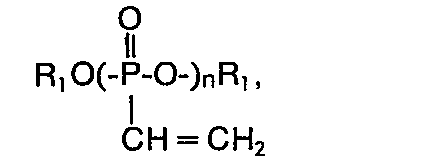
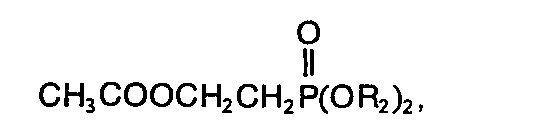
- Es wurde nun überraschenderweise gefunden, daß man auf einfache und wirtschaftliche Weise Vinylphosphonsäurederivate der allgemeinen Formel


- Es ist überraschend, daß bereits in einem erheblich tieferen'Temperaturbereich als bekannt Vinylphosphonsäurederivate gebildet werden und dabei insbesondere nicht Essigsäure sondernAlkylacetat abgespalten wird.
- Als Ausgangsmaterialien kommen z.B. in Frage 2-Acetoxyethanphosphonsäuredimethyl-, diethyl-, diisopropyl- und di-n-butylester. Besonders bevorzugt ist der 2-Acetoxyethanphosphonsäuredimethylester.
- Als saure oder basische Katalysatoren kommen zahlreiche Verbindungen in Frage. Als saure Katalysatoren lassen sich verwenden:
- A) Schwefelsäure oder Phosphorsäure
- B) Halogenhaltige Carbonsäuren mit einem PKa-Wert < 2,5 wie Dichloressigsäure, Trichloressigsäure, Trifluoressigsäure
- C) Aromatische Sulfonsäuren mit einem PKa-Wert < 2,5 wie Benzolsulfonsäure, p-Toluolsulfonsäure
- D) Bevorzugt Phosphinsäuren mit 2 bis 18 Kohlenstoffatomen wie Dimethylphosphinsäure, Methylethylphosphinsäure, Dioktylphosphinsäure, Methylphenylphosphinsäure, Diphenylphosphinsäure
- E) Besonders bevorzugt Phosphonsäuren mit 1 bis 18 Kohlenstoffatomen und deren Halbester mit 1 bis 4 Kohlenstoffatomen im Alkoholrest wie Methanphosphonsäure, Propanphosphonsäure, Propanphosphonsäuremononethylester, Oktadekanphosphonsäure, 2-Acetoxyethanphosphonsäure, 2-Acetoxyethanphosphonsäuremonomethylester, Vinylphosphonsäure, Vinylphosphonsäuremonomethylester, Vinylphosphonsäuremonoethylester, Benzolphosphonsäure
- F) Ebenfalls besonders bevorzugt Pyrophosphonsäuren oder deren Halbester wie Methanpyrophosphonsäure, Benzolpyrophosphonsäure, Vinylpyrophosphonsäure, Vinylpyrophosphonsäuremonomethylester
- G) Sehr geeignet sich auch die sauren Reaktionsgemische, die bei dem erfindungsgemäßen Verfahren entstehen.
- Als basische Katalysatoren lassen sich verwenden:
- A) Tertiäre aliphatische und aromatische Amine und Phosphine mit 3 bis 18 Kohlenstoffatomen wie Trimethylamin, Tripropylamin, Tributylamin, Triphenylamin, Trimethylphosphin, Triethylphosphin, Tripropylphosphin, Tributylphosphin, Triphenylphosphin und Tris-(p-dimethylaminophenyl)-phosphin und die entsprechenden gemischten Amine, Phosphine, Phospholane und Phospholene wie Dimethylethylamin, Diethylbutylamin, N-Dimethylanilin, 4-Methyl-N-dimethylanilin, N-Diethylanilin, N,N-Tetra- methylphenyldiamin oder N-Methylpyrrolidin; Methyldiethylphosphin, Dimethylpropylphosphin, Diethylbenzylphosphin, 1-Methylphospholen-3 und 1-Ethyl-3-methylphospholen-3.
- B) Quartäre Ammoniumsalze bzw. Phosphoniumsalze mit 3 bis 18 Kohlenstoffatomen wie Tetramethylammoniumchlorid oder -bromid, Tetraethylphosphoniumchlorid. Trimethylbenzylammoniumchlorid, Triethylbenzylammoniumchlorid, Triethylbenzylammoniumbromid, Trimethylbenzylphosphoniumchlorid, Triphenylethylphosphonium-2,4-diaminoben- zosulfonat;
- C) Heterocyclische Verbindungen mit aromatischem Charakter wie Pyridin, Chinolin, ihre verschiedenen Alkyl- und Dialkyl-, vorzugsweise Methyl- bzw. Dimethyl-derivate, Imidazol, N-Vinyl-imidazol, Benzthiazol, 2-Amino-6-eth- oxy-benzthiazol, ferner Phosphabenzole;
- D) Säureamide wie Dimethylformamid, Dimethylformamid, N-Dimethylacetamid, N-Diethylpropionamid, N-Dimethylbenzamid, N-Methyl-pyrrolidon, N,N'-Tetramethylterephthal- säurediamid oder Harnstoffe wie Tetramethylharnstoff und Trimethylphenylharnstoff;
- E) Sonstige Stickstoff- oder Phosphorverbindungen mit einer .höheren Wertigkeit eines N- oder P-Atoms als 3 wie Pyridin-N-oxid, Trimethylphospinoxid, Tributylphosphinoxid, Trihexylphosphinoxid, Triphenylphosphinoxid, Trihexylphosphinoxid, Triphenylphosphinoxid, Dimethylphenylphosphinoxid, Dimethylphenylphosphinoxid, Dimethylphenylphosphinsulfid, Dimethylchlormethylphosphinoxid, Dimethyleikosylphosphinoxid, Dimethyldodecylphosphinoxid, Dimethylphosphinoxid, Dimethylpyrrolidinyl-1-methyl- phosphinoxid, Triphenylphosphin-dichlorid, Dimethyldodecylphosphinsulfid, Triphenylphosphinimin, Dimethylchlormethylphosphindichlorid, N-2-Dimethylphosphinyl- ethyl-methyl-acetamid, N-2-Dimethylphosphinyl-ethyl-methyl-amin, Phospholenoxid wie 1-Methylphospholen-1-oxid und 1-Ethyl-3-methyl-phospholen-1-oxid;
- F) Amide der phosphinigen und phosphonigen Säure und der Phosphin- und Phosphonsäuren sowie ihrer Thioanaloga, wie Ethanphosphonsäure-bis-diethylamid, Methan-butanphosphinigsäure-dimethylamid, Diethylphosphinigsäureisobutylamid. Ferner Triamide der Phosphor- und der Thiophosphorsäure wie Hexamethylphosphorsäuretriamid.
- Die Katalysatoren werden in Mengen von 0,01 bis 10, bevorzugt 0,1 bis 5 Gew.-% eingesetzt. Bei Verwendung kurzkettiger Alkanphosphonsäuren mit bis zu 4 Kohlenstoffatomen, deren Monoalkylestern oder der bereits gewonnenen sauren Reaktionsgemische können auch größere Mengen von 10 bis 50 Gew.-% eingesetzt werden, da die bei dieser Arbeitsweise anfallenden Gemische an Vinyl- und Alkanphosphonsäurederivaten für sich interessante Zwischenprodukte darstellen können.
- Das Verfahren wird im allgemeinen so durchgeführt, daß das Ausgangsprodukt mit dem Katalysator vermischt wird und auf die erforderliche Reaktionstemperatur von 150 bis 270°C, vorzugsweise 170 bis 230°C gebracht wird.
- Höhere Temperaturen sind möglich, bringen aber keinen Vorteil. Es besteht dann die Gefahr der verstärkten Bildung von Nebenprodukten, aber auch der Polymerisation.
- Das sich abspaltende Alkylacetat destilliert dann zusammen mit geringen Mengen Alkanol und Dialkylether ab. Die Destillation erfolgt unter Normaldruck, gegebenenfalls unter Zuhilfenahme eines Inertgases, wie z.B. Stickstoff. Es kann jedoch im Einzelfall vorteilhaft sein, im Vakuum abzudestillieren. Die Abspaltung des Alkylacetats ist nach 2 bis etwa 20 Stdn. beendet. Es kann zweckmäßig sein, danach noch 1 bis 4 Std. bei der Reaktionstemperatur nachzurühren. Das Verfahren kann auch kontinuierlich gestaltet werden.
- Es kann vorteilhaft sein, Polymerisationsinhibitoren, wie z.B. Hydrochinon, Hydrochinonmonomethylether oder Phenothiazin, zuzusetzen.
- Geht man von 2-Acetoxyethanphosphonsäurediestern aus, die von ihrer Herstellung her mit geringen Mengen des entsprechenden Monoesters verunreinigt sind, ist ein weiterer Zusatz eines Katalysators nicht notwendig. Es ist dabei zweckmäßig, die Reaktion bei etwa 250°C zu beginnen. Wenn sich dann das saure Reaktionsprodukt, das ja ebenfalls als Katalysator für die Reaktion wirkt, in genügendem Ausmaß gebildet hat, kann man das Verfahren bei tieferen Temperaturen, beispielsweise bei 180 bis 220°C, weiterführen.
- Das Reaktionsprodukt besteht im wesentlichen aus einem Gemisch von Vinylphosphonsäuredi- und monoalkylester, Vinylphosphonsäure, Vinylpyrophosphonsäuredi- und monoalkylester und Vinylpyrophosphonsäure. Die Anwesenheit weiterer Derivate der Vinylphosphonsäure, oligomerer Pyrophosphonsäuren, ist anzunehmen. Für die Praxis ist eine Isolierung der einzelnen Komponenten aus diesem Gemisch nicht erfor- .derlich und man kann dieses Reaktionsgemisch daher direkt verwenden für die Herstellung von Produkten für die Flammhemmung. Weiterhin kann es eingesetzt werden nach dem Verfahren der DE-OS 21 29 584 zur Herstellung von Vinyl- und/ oder 2-Chlorethanphosphonsäuredichlorid. Will man aus dem erhaltenen Reaktionsgemisch die Einzelkomponenten in reiner Form isolieren, so neutralisiert man das Reaktionsgemisch zunächst in einem geeigneten Lösungsmittel mit Alkali und trennt die ausgefallenen Salze von den Di-estern ab. Die Alkalisalze der Phosphonsäuren bzw. Pyrophosphonsäuren lassen sich durch fraktionierte Kristallisation von den Salzen der Phosphonsäuremonoester bzw. Pyrophosphonsäuremonoester trennen.
- 200 g 2-Acetoxyethanphosphonsäuredimethylester und 1 g 4-Dimethylaminopyridin werden unter Rühren auf 225 bis 230°C erhitzt. Im Verlauf von 2 Std. destillieren über eine Kolonne 74 g Methylacetat (98 % d.Th.) ab. In einer der Apparatur nachgeschalteten Kühlfalle sammeln sich 7 g niedrig siedender Produkte. Es wird eine Stunde nachgerührt bei Reaktionstemperatur. Man erhält 118 g eines Reaktionsproduktes, das auf Grund des 1H--NMR-Spektrums ca. 85 % Vinyl phosphonsäurederivate enthält.
- 200 g 2-Acetoxyethanphosphonsäuredimethylester und 10 g Triphenylphosphin werden unter Rühren auf 210 bis 225°C erhitzt. Im Verlaufe von 3,5 Std. destillieren 71 g Methylacetat (94 % d.Th.) ab. Eine Stunde wird nachgerührt bei Reaktionstemperatur. Man erhält 124 g eines Reaktionsproduktes, das im wesentlichen 70 % Vinylphosphonsäurederivate enthält.
- 300 g 2-Acetoxyethanphosphonsäuredimethylester, die herstellungsgemäß 1 g 2-Acetoxyeth anphosphonsäuremonomethylester enthalten, werden 1 Std. unter Rühren auf 2460C erhitzt, dann 3 Std. auf 220 bis 230°C. Es destillieren über eine Kolonne 108 g Methylacetat ab, die 2,4 % Methanol und 2,5 % Dimethylether enthalten. In einer der Apparatur nachgeschalteten Kühlfalle sammeln sich 6,5 g Methylacetat und 3 g Dimethylether. Nun wird 1 Std. bei 210 bis 230°C nachder gerührt. In deriApparatur nachgeschalteten Kühlfalle sammeln sich erneut 6 g niedrig siedende Produkte. Es verbleiben 170 g eines Reaktionsgemisches, das im wesentlichen 70 % Vinylphosphonsäurederivate enthält.
- 300 g 2-Acetoxycthanphosphonsäuredimethylester und 6 g Phosphorsäuretrisdimethylamid werden während 7 Std. unter Rühren auf 200 bis 220°C erhitzt. Dabei destillieren 105 g Methylacetat über eine Kolonne ab. In einer der Apparatur nachgeschalteten Kühlfalle finden sich 8 g niedrig siedender Produkte. Man erhält 182 g eines Reaktionsgemisches, das im wesentlichen aus Vinylphosphonsäurederivaten besteht.
- 300 g 2-Acetoxyethanphosphonsäuredimethylester und 3 g Trimethylphosphinoxid werden 8,5 Std. unter Rühren auf 200 bis 220°C erhitzt. Dabei destillierten 93 g Methylacetat ab. In einer der Apparatur nachgeschalteten Kühlfalle sammeln sich 7,5 g niedrig siedender Produkte. Es wird 1 Std. bei 215°C nachgerührt. Man erhält 180 g eines Reaktionsgemisches, das 6 % Vinylphosphonsäuredimethylester, 17 % Vinylphosphonsäuremonomethylester, 5 % Vinylphosphonsäure, 2 % Vinylpyrophosphonsäuredimethylester, 19 % Vinylpyrophosphonsäuremonomethylester und 15 % Vinylpyrophosphonsäure enthält, bezogen auf die Gesamtmenge der Phosphorsignale im 31P-NMR-Spektrum.
- 300 g 2-Acetoxyethanphosphonsäuredimethylester und 6 g Dimethylformamid werden auf 215°C unter Rühren erhitzt. In 5 Std. und 35 Min. destillieren über eine Kolonne 104 g Methylacetat ab. In einer der Apparatur nachgeschalteten Kühlfalle sammeln sich 7,5 g niedrig siedender Produkte. Man erhält 180 g eines Reaktionsgemisches, das 7 % Vinylphosphonsäuredimethylester, 23 % Vinylphosphonsäuremonomethylester, 7 % Vinylphosphonsäure, 1 % Vinylpyrophosphonsäuredimethylester, 17 % Vinylpyrophosphonsäuremonomethylester und 16 % Vinylpyrophosphonsäure enthält, bezogen auf die Gesamtmenge der Phosphorsignale im 31P-NMR-Spektrum.
- 200 g 2-Acetoxyethanphosphonsäurediethylester und 7 g Triphenylphosphin werden auf 200 bis 235°C unter Rühren 3 Std. erhitzht. Über eine Kolonne destillieren 79 g Ethylacetat ab. In einer der Apparatur nachgeschalteten Kühlfalle sammeln sich 4 g niedrig siedender Produkte. Man erhält 109 g eines Reaktionsgemisches, das 23 % Vinylphosphonsäurediethylester, 20 % Vinylphosphonsäuremonoethylester und 23 % Vinylphosphonsäure enthält, bezogen auf die Gesamtmenge der Phosphorsignale im 31P-NMR-Spektrum. Die Anteile an Pyrophosphonsäurederivaten wurden nicht bestimmt.
- 1180 g 2-Acetoxyethanphosphonsaüredimethylester und 20 g Vinylphosphonsäure werden unter Stickstoffatmosphäre auf 210 bis 220°C unter Rühren erhitzt. Innerhalb 9 Std. destillieren 476 g Methylacetat ab, die 1 % Methanol und 4,6 % Dimethylether enthalten. In einer der Apparatur nachgeschalteten Kühlfalle sammeln sich weitere 33 g niedrig siedende Produkte, die im wesentlichen aus Dimethylether bestehen. Man erhält 685 g eines Reaktionsproduktes, das im wesentlichen 70 % Vinylphosphonsäurederivate enthält.
- 1700 g 2-Acetoxyethanphosphonsäuredimethylcster und 154 g des Reaktionsproduktes von Beispiel 8 werden unter Rühren 16 Std. auf 190 bis 195°C erhitzt. Es destillieren 687 g Methylacetat ab, die 6,8 % Methanol und 0,2 % Dimethylether enthalten. In einer der Apparatur nachgeschalteten Kühlfalle sammeln sich 35 g niedrig siedende Produkte. Man erhält 1126 g eines Reaktionsproduktes, das im wesentlichen 70 % Vinylphosphonsäurederivate enthält.
- 784,4 g 2-Acetoxyethanphosphonsäuredimethylester und 214 g des Reaktionsproduktes von Beispiel 9 werden 10 Std. unter Rühren auf 190 bis 195°C erhitzt. Dabei destillieren 296 g . Methylacetat ab, die 3,4 % Methanol und 0,2 % Dimethylether enthalten. In einer der Apparatur nachgeschalteten Kühlfalle sammeln sich 41 g niedrig siedende Produkte. Man erhält 649 g eines Reaktionsproduktes, das im wesentlichen 70 % Vinylphosphonsäurederivate enthält.
Claims (1)
- Verfahren zur Herstellung von Vinylphosphonsäurederivaten der allgemeinen Formel


Applications Claiming Priority (2)
| Application Number | Priority Date | Filing Date | Title |
|---|---|---|---|
| DE19803001894 DE3001894A1 (de) | 1980-01-19 | 1980-01-19 | Verfahren zur herstellung von vinyphophonsaeurederivaten |
| DE3001894 | 1980-01-19 |
Publications (3)
| Publication Number | Publication Date |
|---|---|
| EP0032663A2 true EP0032663A2 (de) | 1981-07-29 |
| EP0032663A3 EP0032663A3 (en) | 1981-10-28 |
| EP0032663B1 EP0032663B1 (de) | 1983-04-13 |
Family
ID=6092476
Family Applications (1)
| Application Number | Title | Priority Date | Filing Date |
|---|---|---|---|
| EP81100040A Expired EP0032663B1 (de) | 1980-01-19 | 1981-01-07 | Verfahren zur Herstellung von Vinylphosphonsäurederivaten |
Country Status (5)
| Country | Link |
|---|---|
| US (1) | US4388252A (de) |
| EP (1) | EP0032663B1 (de) |
| JP (1) | JPS56104894A (de) |
| CA (1) | CA1158661A (de) |
| DE (2) | DE3001894A1 (de) |
Cited By (13)
| Publication number | Priority date | Publication date | Assignee | Title |
|---|---|---|---|---|
| EP0061115A3 (en) * | 1981-03-20 | 1982-11-03 | Hoechst Aktiengesellschaft | Process for preparing vinyl-phosphonic acid |
| EP0065739A1 (de) * | 1981-05-22 | 1982-12-01 | Hoechst Aktiengesellschaft | Verfahren zur Herstellung von Vinylphosphonsäure |
| EP0065741A1 (de) * | 1981-05-22 | 1982-12-01 | Hoechst Aktiengesellschaft | Verfahren zur Herstellung von Vinylphosphonsäurediestern |
| EP0061116A3 (en) * | 1981-03-20 | 1983-01-26 | Hoechst Aktiengesellschaft | Process for preparing vinyl-phosphonic-acid dichloride and 2-chloro-ethane-phosphonic-acid dichloride |
| EP0123297A3 (en) * | 1983-04-22 | 1985-12-27 | Cassella Aktiengesellschaft | Cross-linked hydrophylic copolymers, their preparation and use |
| EP0329595A3 (en) * | 1988-02-19 | 1990-12-27 | Hoechst Aktiengesellschaft | Process for preparing alkyl esters of alkenylphosphinic acid |
| EP0456049A1 (de) * | 1990-05-07 | 1991-11-13 | BASF Aktiengesellschaft | Verfahren zur Herstellung von Vinylphosphonsäurederivaten |
| WO1994018210A1 (de) * | 1993-02-09 | 1994-08-18 | Basf Aktiengesellschaft | Verwendung von aminovinylphosphonsäureestern als lichtschutzmittel und stabilisatoren für organisches material |
| EP0658563A1 (de) * | 1993-12-14 | 1995-06-21 | Hoechst Aktiengesellschaft | Verfahren zur Herstellung von Vinylphosphonsäuredialkylestern |
| EP0685484A3 (de) * | 1994-05-06 | 1996-03-27 | Hoechst Ag | Verfahren zur Herstellung von Vinylphosphonsäuren. |
| EP0722948A1 (de) * | 1995-01-18 | 1996-07-24 | Hoechst Aktiengesellschaft | Verfahren zur Herstellung von Vinylphosphonsäuredimethylester aus 2-Acetoxyethanphosphonäuredimethylester |
| US6534669B2 (en) | 2000-11-02 | 2003-03-18 | Basf Aktiengesellschaft | Preparation of alkenylphosphonic acid derivatives |
| US7399876B2 (en) | 2003-10-30 | 2008-07-15 | Basf Aktiengesellschaft | Preparation of an alkenylphosphonic acid derivative |
Families Citing this family (6)
| Publication number | Priority date | Publication date | Assignee | Title |
|---|---|---|---|---|
| DE3210419A1 (de) * | 1982-03-22 | 1983-09-22 | Hoechst Ag, 6230 Frankfurt | Verfahren zur herstellung von derivaten der vinylphosphon- oder vinylpyrophosphonsaeure |
| US4738870A (en) * | 1986-03-27 | 1988-04-19 | The Dow Chemical Company | Adherent photopolymerizable compositions |
| DE3622786A1 (de) * | 1986-07-07 | 1988-02-04 | Benckiser Knapsack Gmbh | Verfahren zur herstellung von vinyldiphosphonsaeure und ihren salzen |
| DE3724653A1 (de) * | 1987-07-25 | 1989-02-02 | Henkel Kgaa | Olefinische diphosphonsaeuren, verfahren zu ihrer herstellung und ihre verwendung als thresholder sowie komplexierend wirkende, olefinische diphosphonsaeuren enthaltende zusammensetzungen |
| WO1996024599A1 (en) * | 1995-02-10 | 1996-08-15 | Akzo Nobel N.V. | Synthesis of a hydrocarbylvinyl phosphonic acid hydrocarbyl ester |
| US7057065B2 (en) * | 2003-03-19 | 2006-06-06 | Rhodia Inc. | Process for production of vinylphosphonic acids and silyl esters thereof |
Family Cites Families (3)
| Publication number | Priority date | Publication date | Assignee | Title |
|---|---|---|---|---|
| US3062792A (en) * | 1960-03-01 | 1962-11-06 | Eastman Kodak Co | Polymers derived from tetraalkyl vinylidenediphosphonates |
| DE2127821C3 (de) * | 1971-06-04 | 1981-04-30 | Hoechst Ag, 6000 Frankfurt | Verfahren zur Herstellung von Acyloxyalkanphosphonsäurediestern bzw. Acyloxyalkanphosphinsäureestern |
| DE2758580A1 (de) * | 1977-12-29 | 1979-07-05 | Hoechst Ag | Verfahren zur herstellung von phosphin- und phosphonsaeure-anhydriden |
-
1980
- 1980-01-19 DE DE19803001894 patent/DE3001894A1/de not_active Withdrawn
-
1981
- 1981-01-07 DE DE8181100040T patent/DE3160156D1/de not_active Expired
- 1981-01-07 EP EP81100040A patent/EP0032663B1/de not_active Expired
- 1981-01-12 US US06/224,316 patent/US4388252A/en not_active Expired - Lifetime
- 1981-01-16 CA CA000368657A patent/CA1158661A/en not_active Expired
- 1981-01-16 JP JP396181A patent/JPS56104894A/ja active Granted
Cited By (16)
| Publication number | Priority date | Publication date | Assignee | Title |
|---|---|---|---|---|
| EP0061115A3 (en) * | 1981-03-20 | 1982-11-03 | Hoechst Aktiengesellschaft | Process for preparing vinyl-phosphonic acid |
| EP0061116A3 (en) * | 1981-03-20 | 1983-01-26 | Hoechst Aktiengesellschaft | Process for preparing vinyl-phosphonic-acid dichloride and 2-chloro-ethane-phosphonic-acid dichloride |
| EP0065739A1 (de) * | 1981-05-22 | 1982-12-01 | Hoechst Aktiengesellschaft | Verfahren zur Herstellung von Vinylphosphonsäure |
| EP0065741A1 (de) * | 1981-05-22 | 1982-12-01 | Hoechst Aktiengesellschaft | Verfahren zur Herstellung von Vinylphosphonsäurediestern |
| EP0123297A3 (en) * | 1983-04-22 | 1985-12-27 | Cassella Aktiengesellschaft | Cross-linked hydrophylic copolymers, their preparation and use |
| EP0329595A3 (en) * | 1988-02-19 | 1990-12-27 | Hoechst Aktiengesellschaft | Process for preparing alkyl esters of alkenylphosphinic acid |
| EP0456049A1 (de) * | 1990-05-07 | 1991-11-13 | BASF Aktiengesellschaft | Verfahren zur Herstellung von Vinylphosphonsäurederivaten |
| WO1994018210A1 (de) * | 1993-02-09 | 1994-08-18 | Basf Aktiengesellschaft | Verwendung von aminovinylphosphonsäureestern als lichtschutzmittel und stabilisatoren für organisches material |
| EP0658563A1 (de) * | 1993-12-14 | 1995-06-21 | Hoechst Aktiengesellschaft | Verfahren zur Herstellung von Vinylphosphonsäuredialkylestern |
| US5475128A (en) * | 1993-12-14 | 1995-12-12 | Hoechst Aktiengesellschaft | Process for preparing dialkyl vinylphosphonates |
| EP0685484A3 (de) * | 1994-05-06 | 1996-03-27 | Hoechst Ag | Verfahren zur Herstellung von Vinylphosphonsäuren. |
| US5811575A (en) * | 1994-05-06 | 1998-09-22 | Clariant Gmbh | Process for preparing vinyl-phosphonic acids |
| EP0722948A1 (de) * | 1995-01-18 | 1996-07-24 | Hoechst Aktiengesellschaft | Verfahren zur Herstellung von Vinylphosphonsäuredimethylester aus 2-Acetoxyethanphosphonäuredimethylester |
| US5763637A (en) * | 1995-01-18 | 1998-06-09 | Hoechst Aktiengesellschaft | Process for preparing dimethyl vinylphosphonate from dimethyl 2-acetoxyethanephosphonate |
| US6534669B2 (en) | 2000-11-02 | 2003-03-18 | Basf Aktiengesellschaft | Preparation of alkenylphosphonic acid derivatives |
| US7399876B2 (en) | 2003-10-30 | 2008-07-15 | Basf Aktiengesellschaft | Preparation of an alkenylphosphonic acid derivative |
Also Published As
| Publication number | Publication date |
|---|---|
| DE3001894A1 (de) | 1981-07-23 |
| US4388252A (en) | 1983-06-14 |
| JPH029595B2 (de) | 1990-03-02 |
| CA1158661A (en) | 1983-12-13 |
| EP0032663B1 (de) | 1983-04-13 |
| EP0032663A3 (en) | 1981-10-28 |
| DE3160156D1 (en) | 1983-05-19 |
| JPS56104894A (en) | 1981-08-20 |
Similar Documents
| Publication | Publication Date | Title |
|---|---|---|
| EP0032663B1 (de) | Verfahren zur Herstellung von Vinylphosphonsäurederivaten | |
| DE19923619C2 (de) | Verfahren zur Herstellung von Dialkylphosphinsäuren und deren Salzen | |
| EP0391329B1 (de) | Verfahren zur Herstellung von Alkylphosphonigsäurdiestern und/oder Dialkylphosphinigsäureestern | |
| EP0034239B1 (de) | Verfahren zur Herstellung von Alkanphosphonsäurediarylestern und bzw Alkanphosphinsäurearylestern | |
| EP1061084B1 (de) | Verfahren zur Herstellung von Alkylphosphonsäuren | |
| EP0065739B1 (de) | Verfahren zur Herstellung von Vinylphosphonsäure | |
| EP0061115B1 (de) | Verfahren zur Herstellung von Vinylphosphonsäure | |
| EP0047460B1 (de) | Verfahren zur Herstellung von Vinylphosphonsäuredichlorid und 2-Chlorethanphosphonsäuredichlorid | |
| EP0038466B1 (de) | Verfahren zur Herstellung von Vinylphosphonsäurederivaten | |
| DE19715667A1 (de) | Verfahren zur Herstellung von Vinylphosphonsäure-Verbindungen | |
| EP0047461B1 (de) | Verfahren zur Herstellung von Vinylphosphonsäurederivaten | |
| EP0065741B1 (de) | Verfahren zur Herstellung von Vinylphosphonsäurediestern | |
| EP0061116B1 (de) | Verfahren zur Herstellung von Vinylphosphonsäuredichlorid und 2-Chlorethanphosphonsäuredichlorid | |
| DE2357676C2 (de) | Verfahren zur Herstellung von 2-Halogenäthanphosphonsäuredihalogenid und Vinylphosphonsäuredihalogenid | |
| EP0144743B1 (de) | Verfahren zur Herstellung organischer Chlorphosphane | |
| DE1139491B (de) | Verfahren zur Herstellung von organischen Chlorphosphinen | |
| DE19737460A1 (de) | Verfahren zur Herstellung von 1,1-Dialkoxyalkyl-phosphorverbindungen | |
| DE3046221A1 (de) | Verfahren zur herstellung von verbindungen mit einer p=n-p-gruppierung | |
| DE2719385A1 (de) | Verfahren zur herstellung von phosphon- und phosphinsaeuren |
Legal Events
| Date | Code | Title | Description |
|---|---|---|---|
| PUAI | Public reference made under article 153(3) epc to a published international application that has entered the european phase |
Free format text: ORIGINAL CODE: 0009012 |
|
| AK | Designated contracting states |
Designated state(s): BE CH DE FR GB IT NL |
|
| PUAL | Search report despatched |
Free format text: ORIGINAL CODE: 0009013 |
|
| AK | Designated contracting states |
Designated state(s): BE CH DE FR GB IT NL |
|
| 17P | Request for examination filed |
Effective date: 19820213 |
|
| ITF | It: translation for a ep patent filed | ||
| GRAA | (expected) grant |
Free format text: ORIGINAL CODE: 0009210 |
|
| AK | Designated contracting states |
Designated state(s): BE CH DE FR GB IT LI NL |
|
| REF | Corresponds to: |
Ref document number: 3160156 Country of ref document: DE Date of ref document: 19830519 |
|
| ET | Fr: translation filed | ||
| PGFP | Annual fee paid to national office [announced via postgrant information from national office to epo] |
Ref country code: NL Payment date: 19890131 Year of fee payment: 10 |
|
| PGFP | Annual fee paid to national office [announced via postgrant information from national office to epo] |
Ref country code: BE Payment date: 19900112 Year of fee payment: 10 |
|
| ITTA | It: last paid annual fee | ||
| PG25 | Lapsed in a contracting state [announced via postgrant information from national office to epo] |
Ref country code: BE Effective date: 19910131 |
|
| PG25 | Lapsed in a contracting state [announced via postgrant information from national office to epo] |
Ref country code: NL Effective date: 19910801 |
|
| NLV4 | Nl: lapsed or anulled due to non-payment of the annual fee | ||
| PGFP | Annual fee paid to national office [announced via postgrant information from national office to epo] |
Ref country code: FR Payment date: 19971215 Year of fee payment: 18 |
|
| PGFP | Annual fee paid to national office [announced via postgrant information from national office to epo] |
Ref country code: CH Payment date: 19971218 Year of fee payment: 18 |
|
| PGFP | Annual fee paid to national office [announced via postgrant information from national office to epo] |
Ref country code: GB Payment date: 19980102 Year of fee payment: 18 |
|
| PGFP | Annual fee paid to national office [announced via postgrant information from national office to epo] |
Ref country code: DE Payment date: 19980316 Year of fee payment: 18 |
|
| PG25 | Lapsed in a contracting state [announced via postgrant information from national office to epo] |
Ref country code: GB Free format text: LAPSE BECAUSE OF NON-PAYMENT OF DUE FEES Effective date: 19990107 |
|
| PG25 | Lapsed in a contracting state [announced via postgrant information from national office to epo] |
Ref country code: LI Free format text: LAPSE BECAUSE OF NON-PAYMENT OF DUE FEES Effective date: 19990131 Ref country code: CH Free format text: LAPSE BECAUSE OF NON-PAYMENT OF DUE FEES Effective date: 19990131 |
|
| GBPC | Gb: european patent ceased through non-payment of renewal fee |
Effective date: 19990107 |
|
| REG | Reference to a national code |
Ref country code: CH Ref legal event code: PL |
|
| PG25 | Lapsed in a contracting state [announced via postgrant information from national office to epo] |
Ref country code: FR Free format text: LAPSE BECAUSE OF NON-PAYMENT OF DUE FEES Effective date: 19990930 |
|
| PG25 | Lapsed in a contracting state [announced via postgrant information from national office to epo] |
Ref country code: DE Free format text: LAPSE BECAUSE OF NON-PAYMENT OF DUE FEES Effective date: 19991103 |
|
| REG | Reference to a national code |
Ref country code: FR Ref legal event code: ST |
|
| PLBE | No opposition filed within time limit |
Free format text: ORIGINAL CODE: 0009261 |
|
| STAA | Information on the status of an ep patent application or granted ep patent |
Free format text: STATUS: NO OPPOSITION FILED WITHIN TIME LIMIT |