EP0032996A2 - Thermoplastische Formmassen aus Celluloseestern - Google Patents
Thermoplastische Formmassen aus Celluloseestern Download PDFInfo
- Publication number
- EP0032996A2 EP0032996A2 EP80107702A EP80107702A EP0032996A2 EP 0032996 A2 EP0032996 A2 EP 0032996A2 EP 80107702 A EP80107702 A EP 80107702A EP 80107702 A EP80107702 A EP 80107702A EP 0032996 A2 EP0032996 A2 EP 0032996A2
- Authority
- EP
- European Patent Office
- Prior art keywords
- weight
- vinyl
- cellulose
- esters
- ethylene
- Prior art date
- Legal status (The legal status is an assumption and is not a legal conclusion. Google has not performed a legal analysis and makes no representation as to the accuracy of the status listed.)
- Granted
Links
- 229920002678 cellulose Polymers 0.000 title claims description 33
- 238000009757 thermoplastic moulding Methods 0.000 title claims description 8
- 239000000203 mixture Substances 0.000 claims description 36
- 229920001567 vinyl ester resin Polymers 0.000 claims description 29
- XTXRWKRVRITETP-UHFFFAOYSA-N Vinyl acetate Chemical compound CC(=O)OC=C XTXRWKRVRITETP-UHFFFAOYSA-N 0.000 claims description 14
- 229920000578 graft copolymer Polymers 0.000 claims description 14
- 125000000391 vinyl group Chemical group [H]C([*])=C([H])[H] 0.000 claims description 12
- 239000001913 cellulose Substances 0.000 claims description 9
- 239000005038 ethylene vinyl acetate Substances 0.000 claims description 9
- 229920001200 poly(ethylene-vinyl acetate) Polymers 0.000 claims description 9
- CERQOIWHTDAKMF-UHFFFAOYSA-N Methacrylic acid Chemical compound CC(=C)C(O)=O CERQOIWHTDAKMF-UHFFFAOYSA-N 0.000 claims description 7
- 239000000758 substrate Substances 0.000 claims description 7
- 125000001931 aliphatic group Chemical group 0.000 claims description 6
- SMZOUWXMTYCWNB-UHFFFAOYSA-N 2-(2-methoxy-5-methylphenyl)ethanamine Chemical compound COC1=CC=C(C)C=C1CCN SMZOUWXMTYCWNB-UHFFFAOYSA-N 0.000 claims description 5
- 229920002301 cellulose acetate Polymers 0.000 claims description 4
- 239000004711 α-olefin Substances 0.000 claims description 4
- 125000005907 alkyl ester group Chemical group 0.000 claims description 3
- 238000000465 moulding Methods 0.000 description 16
- 239000000243 solution Substances 0.000 description 15
- LRHPLDYGYMQRHN-UHFFFAOYSA-N N-Butanol Chemical compound CCCCO LRHPLDYGYMQRHN-UHFFFAOYSA-N 0.000 description 14
- 239000004014 plasticizer Substances 0.000 description 13
- 239000000178 monomer Substances 0.000 description 12
- 238000000034 method Methods 0.000 description 9
- -1 dibutylacelate Chemical compound 0.000 description 8
- YXFVVABEGXRONW-UHFFFAOYSA-N Toluene Chemical compound CC1=CC=CC=C1 YXFVVABEGXRONW-UHFFFAOYSA-N 0.000 description 6
- 125000000218 acetic acid group Chemical group C(C)(=O)* 0.000 description 6
- 125000000484 butyl group Chemical group [H]C([*])([H])C([H])([H])C([H])([H])C([H])([H])[H] 0.000 description 6
- NIXOWILDQLNWCW-UHFFFAOYSA-M Acrylate Chemical compound [O-]C(=O)C=C NIXOWILDQLNWCW-UHFFFAOYSA-M 0.000 description 5
- 238000006243 chemical reaction Methods 0.000 description 5
- 150000002148 esters Chemical class 0.000 description 5
- 239000002904 solvent Substances 0.000 description 5
- 229920002554 vinyl polymer Polymers 0.000 description 5
- IJGRMHOSHXDMSA-UHFFFAOYSA-N Atomic nitrogen Chemical compound N#N IJGRMHOSHXDMSA-UHFFFAOYSA-N 0.000 description 4
- FERIUCNNQQJTOY-UHFFFAOYSA-N Butyric acid Chemical group CCCC(O)=O FERIUCNNQQJTOY-UHFFFAOYSA-N 0.000 description 4
- NIQCNGHVCWTJSM-UHFFFAOYSA-N Dimethyl phthalate Chemical compound COC(=O)C1=CC=CC=C1C(=O)OC NIQCNGHVCWTJSM-UHFFFAOYSA-N 0.000 description 4
- VVQNEPGJFQJSBK-UHFFFAOYSA-N Methyl methacrylate Chemical compound COC(=O)C(C)=C VVQNEPGJFQJSBK-UHFFFAOYSA-N 0.000 description 4
- WYURNTSHIVDZCO-UHFFFAOYSA-N Tetrahydrofuran Chemical compound C1CCOC1 WYURNTSHIVDZCO-UHFFFAOYSA-N 0.000 description 4
- FLKPEMZONWLCSK-UHFFFAOYSA-N diethyl phthalate Chemical compound CCOC(=O)C1=CC=CC=C1C(=O)OCC FLKPEMZONWLCSK-UHFFFAOYSA-N 0.000 description 4
- 238000001704 evaporation Methods 0.000 description 4
- 230000008020 evaporation Effects 0.000 description 4
- 239000010408 film Substances 0.000 description 4
- 238000004519 manufacturing process Methods 0.000 description 4
- 229920000642 polymer Polymers 0.000 description 4
- 238000006116 polymerization reaction Methods 0.000 description 4
- XLYOFNOQVPJJNP-UHFFFAOYSA-N water Substances O XLYOFNOQVPJJNP-UHFFFAOYSA-N 0.000 description 4
- UHOVQNZJYSORNB-UHFFFAOYSA-N Benzene Chemical compound C1=CC=CC=C1 UHOVQNZJYSORNB-UHFFFAOYSA-N 0.000 description 3
- YMWUJEATGCHHMB-UHFFFAOYSA-N Dichloromethane Chemical compound ClCCl YMWUJEATGCHHMB-UHFFFAOYSA-N 0.000 description 3
- OKKJLVBELUTLKV-UHFFFAOYSA-N Methanol Chemical compound OC OKKJLVBELUTLKV-UHFFFAOYSA-N 0.000 description 3
- HEMHJVSKTPXQMS-UHFFFAOYSA-M Sodium hydroxide Chemical compound [OH-].[Na+] HEMHJVSKTPXQMS-UHFFFAOYSA-M 0.000 description 3
- 150000001298 alcohols Chemical class 0.000 description 3
- 238000005452 bending Methods 0.000 description 3
- 125000004432 carbon atom Chemical group C* 0.000 description 3
- 238000010559 graft polymerization reaction Methods 0.000 description 3
- 229930195733 hydrocarbon Natural products 0.000 description 3
- 150000002430 hydrocarbons Chemical class 0.000 description 3
- 238000001746 injection moulding Methods 0.000 description 3
- 239000000155 melt Substances 0.000 description 3
- 229920002959 polymer blend Polymers 0.000 description 3
- IUVKMZGDUIUOCP-BTNSXGMBSA-N quinbolone Chemical group O([C@H]1CC[C@H]2[C@H]3[C@@H]([C@]4(C=CC(=O)C=C4CC3)C)CC[C@@]21C)C1=CCCC1 IUVKMZGDUIUOCP-BTNSXGMBSA-N 0.000 description 3
- CXWXQJXEFPUFDZ-UHFFFAOYSA-N tetralin Chemical compound C1=CC=C2CCCCC2=C1 CXWXQJXEFPUFDZ-UHFFFAOYSA-N 0.000 description 3
- OZAIFHULBGXAKX-UHFFFAOYSA-N 2-(2-cyanopropan-2-yldiazenyl)-2-methylpropanenitrile Chemical compound N#CC(C)(C)N=NC(C)(C)C#N OZAIFHULBGXAKX-UHFFFAOYSA-N 0.000 description 2
- NIXOWILDQLNWCW-UHFFFAOYSA-N 2-Propenoic acid Natural products OC(=O)C=C NIXOWILDQLNWCW-UHFFFAOYSA-N 0.000 description 2
- QTBSBXVTEAMEQO-UHFFFAOYSA-M Acetate Chemical compound CC([O-])=O QTBSBXVTEAMEQO-UHFFFAOYSA-M 0.000 description 2
- QTBSBXVTEAMEQO-UHFFFAOYSA-N Acetic acid Chemical compound CC(O)=O QTBSBXVTEAMEQO-UHFFFAOYSA-N 0.000 description 2
- CSCPPACGZOOCGX-UHFFFAOYSA-N Acetone Chemical compound CC(C)=O CSCPPACGZOOCGX-UHFFFAOYSA-N 0.000 description 2
- LFQSCWFLJHTTHZ-UHFFFAOYSA-N Ethanol Chemical compound CCO LFQSCWFLJHTTHZ-UHFFFAOYSA-N 0.000 description 2
- KFZMGEQAYNKOFK-UHFFFAOYSA-N Isopropanol Chemical compound CC(C)O KFZMGEQAYNKOFK-UHFFFAOYSA-N 0.000 description 2
- NBIIXXVUZAFLBC-UHFFFAOYSA-N Phosphoric acid Chemical compound OP(O)(O)=O NBIIXXVUZAFLBC-UHFFFAOYSA-N 0.000 description 2
- PPBRXRYQALVLMV-UHFFFAOYSA-N Styrene Chemical compound C=CC1=CC=CC=C1 PPBRXRYQALVLMV-UHFFFAOYSA-N 0.000 description 2
- WNLRTRBMVRJNCN-UHFFFAOYSA-N adipic acid Chemical compound OC(=O)CCCCC(O)=O WNLRTRBMVRJNCN-UHFFFAOYSA-N 0.000 description 2
- 150000007933 aliphatic carboxylic acids Chemical class 0.000 description 2
- 238000000149 argon plasma sintering Methods 0.000 description 2
- 230000015572 biosynthetic process Effects 0.000 description 2
- ZFMQKOWCDKKBIF-UHFFFAOYSA-N bis(3,5-difluorophenyl)phosphane Chemical compound FC1=CC(F)=CC(PC=2C=C(F)C=C(F)C=2)=C1 ZFMQKOWCDKKBIF-UHFFFAOYSA-N 0.000 description 2
- 239000003054 catalyst Substances 0.000 description 2
- MVPPADPHJFYWMZ-UHFFFAOYSA-N chlorobenzene Chemical compound ClC1=CC=CC=C1 MVPPADPHJFYWMZ-UHFFFAOYSA-N 0.000 description 2
- 229920001577 copolymer Polymers 0.000 description 2
- 238000005336 cracking Methods 0.000 description 2
- DOIRQSBPFJWKBE-UHFFFAOYSA-N dibutyl phthalate Chemical compound CCCCOC(=O)C1=CC=CC=C1C(=O)OCCCC DOIRQSBPFJWKBE-UHFFFAOYSA-N 0.000 description 2
- FBSAITBEAPNWJG-UHFFFAOYSA-N dimethyl phthalate Natural products CC(=O)OC1=CC=CC=C1OC(C)=O FBSAITBEAPNWJG-UHFFFAOYSA-N 0.000 description 2
- 229960001826 dimethylphthalate Drugs 0.000 description 2
- XBDQKXXYIPTUBI-UHFFFAOYSA-N dimethylselenoniopropionate Natural products CCC(O)=O XBDQKXXYIPTUBI-UHFFFAOYSA-N 0.000 description 2
- 239000002270 dispersing agent Substances 0.000 description 2
- 125000001495 ethyl group Chemical group [H]C([H])([H])C([H])([H])* 0.000 description 2
- 235000013305 food Nutrition 0.000 description 2
- 239000003999 initiator Substances 0.000 description 2
- 238000002347 injection Methods 0.000 description 2
- 239000007924 injection Substances 0.000 description 2
- 125000002496 methyl group Chemical group [H]C([H])([H])* 0.000 description 2
- 229910052757 nitrogen Inorganic materials 0.000 description 2
- BDJRBEYXGGNYIS-UHFFFAOYSA-N nonanedioic acid Chemical compound OC(=O)CCCCCCCC(O)=O BDJRBEYXGGNYIS-UHFFFAOYSA-N 0.000 description 2
- XNGIFLGASWRNHJ-UHFFFAOYSA-N phthalic acid Chemical compound OC(=O)C1=CC=CC=C1C(O)=O XNGIFLGASWRNHJ-UHFFFAOYSA-N 0.000 description 2
- 239000002685 polymerization catalyst Substances 0.000 description 2
- 229920000098 polyolefin Polymers 0.000 description 2
- CXMXRPHRNRROMY-UHFFFAOYSA-N sebacic acid Chemical compound OC(=O)CCCCCCCCC(O)=O CXMXRPHRNRROMY-UHFFFAOYSA-N 0.000 description 2
- 238000003786 synthesis reaction Methods 0.000 description 2
- 239000006188 syrup Substances 0.000 description 2
- 235000020357 syrup Nutrition 0.000 description 2
- YLQBMQCUIZJEEH-UHFFFAOYSA-N tetrahydrofuran Natural products C=1C=COC=1 YLQBMQCUIZJEEH-UHFFFAOYSA-N 0.000 description 2
- 229920001169 thermoplastic Polymers 0.000 description 2
- 239000004416 thermosoftening plastic Substances 0.000 description 2
- MFEWNFVBWPABCX-UHFFFAOYSA-N 1,1,2,2-tetraphenylethane-1,2-diol Chemical compound C=1C=CC=CC=1C(C(O)(C=1C=CC=CC=1)C=1C=CC=CC=1)(O)C1=CC=CC=C1 MFEWNFVBWPABCX-UHFFFAOYSA-N 0.000 description 1
- PAOHAQSLJSMLAT-UHFFFAOYSA-N 1-butylperoxybutane Chemical compound CCCCOOCCCC PAOHAQSLJSMLAT-UHFFFAOYSA-N 0.000 description 1
- VBZBISQOWJYWCC-UHFFFAOYSA-N 2-(2-carboxypropan-2-yldiazenyl)-2-methylpropanoic acid Chemical compound OC(=O)C(C)(C)N=NC(C)(C)C(O)=O VBZBISQOWJYWCC-UHFFFAOYSA-N 0.000 description 1
- XMNIXWIUMCBBBL-UHFFFAOYSA-N 2-(2-phenylpropan-2-ylperoxy)propan-2-ylbenzene Chemical compound C=1C=CC=CC=1C(C)(C)OOC(C)(C)C1=CC=CC=C1 XMNIXWIUMCBBBL-UHFFFAOYSA-N 0.000 description 1
- 239000004342 Benzoyl peroxide Substances 0.000 description 1
- OMPJBNCRMGITSC-UHFFFAOYSA-N Benzoylperoxide Chemical compound C=1C=CC=CC=1C(=O)OOC(=O)C1=CC=CC=C1 OMPJBNCRMGITSC-UHFFFAOYSA-N 0.000 description 1
- DKPFZGUDAPQIHT-UHFFFAOYSA-N Butyl acetate Natural products CCCCOC(C)=O DKPFZGUDAPQIHT-UHFFFAOYSA-N 0.000 description 1
- MQIUGAXCHLFZKX-UHFFFAOYSA-N Di-n-octyl phthalate Natural products CCCCCCCCOC(=O)C1=CC=CC=C1C(=O)OCCCCCCCC MQIUGAXCHLFZKX-UHFFFAOYSA-N 0.000 description 1
- XTJFFFGAUHQWII-UHFFFAOYSA-N Dibutyl adipate Chemical compound CCCCOC(=O)CCCCC(=O)OCCCC XTJFFFGAUHQWII-UHFFFAOYSA-N 0.000 description 1
- PYGXAGIECVVIOZ-UHFFFAOYSA-N Dibutyl decanedioate Chemical compound CCCCOC(=O)CCCCCCCCC(=O)OCCCC PYGXAGIECVVIOZ-UHFFFAOYSA-N 0.000 description 1
- OTMSDBZUPAUEDD-UHFFFAOYSA-N Ethane Chemical class CC OTMSDBZUPAUEDD-UHFFFAOYSA-N 0.000 description 1
- XEKOWRVHYACXOJ-UHFFFAOYSA-N Ethyl acetate Natural products CCOC(C)=O XEKOWRVHYACXOJ-UHFFFAOYSA-N 0.000 description 1
- VQTUBCCKSQIDNK-UHFFFAOYSA-N Isobutene Chemical group CC(C)=C VQTUBCCKSQIDNK-UHFFFAOYSA-N 0.000 description 1
- YIVJZNGAASQVEM-UHFFFAOYSA-N Lauroyl peroxide Chemical compound CCCCCCCCCCCC(=O)OOC(=O)CCCCCCCCCCC YIVJZNGAASQVEM-UHFFFAOYSA-N 0.000 description 1
- CTQNGGLPUBDAKN-UHFFFAOYSA-N O-Xylene Chemical compound CC1=CC=CC=C1C CTQNGGLPUBDAKN-UHFFFAOYSA-N 0.000 description 1
- CYTYCFOTNPOANT-UHFFFAOYSA-N Perchloroethylene Chemical group ClC(Cl)=C(Cl)Cl CYTYCFOTNPOANT-UHFFFAOYSA-N 0.000 description 1
- YYQRGCZGSFRBAM-UHFFFAOYSA-N Triclofos Chemical compound OP(O)(=O)OCC(Cl)(Cl)Cl YYQRGCZGSFRBAM-UHFFFAOYSA-N 0.000 description 1
- 229960000583 acetic acid Drugs 0.000 description 1
- KXKVLQRXCPHEJC-UHFFFAOYSA-N acetic acid trimethyl ester Natural products COC(C)=O KXKVLQRXCPHEJC-UHFFFAOYSA-N 0.000 description 1
- 239000001361 adipic acid Substances 0.000 description 1
- 235000011037 adipic acid Nutrition 0.000 description 1
- 230000032683 aging Effects 0.000 description 1
- XYLMUPLGERFSHI-UHFFFAOYSA-N alpha-Methylstyrene Chemical compound CC(=C)C1=CC=CC=C1 XYLMUPLGERFSHI-UHFFFAOYSA-N 0.000 description 1
- 229910000147 aluminium phosphate Inorganic materials 0.000 description 1
- 239000007864 aqueous solution Substances 0.000 description 1
- 239000011324 bead Substances 0.000 description 1
- 235000019400 benzoyl peroxide Nutrition 0.000 description 1
- BJQHLKABXJIVAM-UHFFFAOYSA-N bis(2-ethylhexyl) phthalate Chemical compound CCCCC(CC)COC(=O)C1=CC=CC=C1C(=O)OCC(CC)CCCC BJQHLKABXJIVAM-UHFFFAOYSA-N 0.000 description 1
- 239000000969 carrier Substances 0.000 description 1
- 150000008280 chlorinated hydrocarbons Chemical class 0.000 description 1
- 150000001875 compounds Chemical class 0.000 description 1
- 238000001816 cooling Methods 0.000 description 1
- 238000000354 decomposition reaction Methods 0.000 description 1
- 229940100539 dibutyl adipate Drugs 0.000 description 1
- 230000000694 effects Effects 0.000 description 1
- 239000000839 emulsion Substances 0.000 description 1
- 238000007720 emulsion polymerization reaction Methods 0.000 description 1
- ZGMHVMZHXRSJHD-FPLPWBNLSA-N ethenyl (Z)-tetradec-9-enoate Chemical compound CCCC\C=C/CCCCCCCC(=O)OC=C ZGMHVMZHXRSJHD-FPLPWBNLSA-N 0.000 description 1
- BTOIAAYVFNXNPA-UHFFFAOYSA-N ethenyl 2-chloropropanoate Chemical compound CC(Cl)C(=O)OC=C BTOIAAYVFNXNPA-UHFFFAOYSA-N 0.000 description 1
- MEGHWIAOTJPCHQ-UHFFFAOYSA-N ethenyl butanoate Chemical compound CCCC(=O)OC=C MEGHWIAOTJPCHQ-UHFFFAOYSA-N 0.000 description 1
- GFJVXXWOPWLRNU-UHFFFAOYSA-N ethenyl formate Chemical compound C=COC=O GFJVXXWOPWLRNU-UHFFFAOYSA-N 0.000 description 1
- AFSIMBWBBOJPJG-UHFFFAOYSA-N ethenyl octadecanoate Chemical compound CCCCCCCCCCCCCCCCCC(=O)OC=C AFSIMBWBBOJPJG-UHFFFAOYSA-N 0.000 description 1
- UIWXSTHGICQLQT-UHFFFAOYSA-N ethenyl propanoate Chemical compound CCC(=O)OC=C UIWXSTHGICQLQT-UHFFFAOYSA-N 0.000 description 1
- 229920001038 ethylene copolymer Polymers 0.000 description 1
- 238000010528 free radical solution polymerization reaction Methods 0.000 description 1
- 239000012362 glacial acetic acid Substances 0.000 description 1
- 238000010438 heat treatment Methods 0.000 description 1
- BSUSCYPJOYHRBF-UHFFFAOYSA-N hexane-1,4-diol;phthalic acid Chemical compound CCC(O)CCCO.OC(=O)C1=CC=CC=C1C(O)=O BSUSCYPJOYHRBF-UHFFFAOYSA-N 0.000 description 1
- FUZZWVXGSFPDMH-UHFFFAOYSA-N hexanoic acid Chemical compound CCCCCC(O)=O FUZZWVXGSFPDMH-UHFFFAOYSA-N 0.000 description 1
- 125000000959 isobutyl group Chemical group [H]C([H])([H])C([H])(C([H])([H])[H])C([H])([H])* 0.000 description 1
- 125000001449 isopropyl group Chemical group [H]C([H])([H])C([H])(*)C([H])([H])[H] 0.000 description 1
- 239000002655 kraft paper Substances 0.000 description 1
- 239000004922 lacquer Substances 0.000 description 1
- 229920003145 methacrylic acid copolymer Polymers 0.000 description 1
- 238000013508 migration Methods 0.000 description 1
- 230000005012 migration Effects 0.000 description 1
- 238000002156 mixing Methods 0.000 description 1
- 125000004108 n-butyl group Chemical group [H]C([H])([H])C([H])([H])C([H])([H])C([H])([H])* 0.000 description 1
- 125000004123 n-propyl group Chemical group [H]C([H])([H])C([H])([H])C([H])([H])* 0.000 description 1
- MPSANAJOWZLFLO-UHFFFAOYSA-N octane-1,4-diol;phthalic acid Chemical compound CCCCC(O)CCCO.OC(=O)C1=CC=CC=C1C(O)=O MPSANAJOWZLFLO-UHFFFAOYSA-N 0.000 description 1
- 230000003647 oxidation Effects 0.000 description 1
- 238000007254 oxidation reaction Methods 0.000 description 1
- 238000004806 packaging method and process Methods 0.000 description 1
- GULAEPPQYOTQDE-UHFFFAOYSA-N phthalic acid;propane-1,2-diol Chemical compound CC(O)CO.OC(=O)C1=CC=CC=C1C(O)=O GULAEPPQYOTQDE-UHFFFAOYSA-N 0.000 description 1
- 239000000049 pigment Substances 0.000 description 1
- 238000002360 preparation method Methods 0.000 description 1
- BDERNNFJNOPAEC-UHFFFAOYSA-N propan-1-ol Chemical compound CCCO BDERNNFJNOPAEC-UHFFFAOYSA-N 0.000 description 1
- RGBXDEHYFWDBKD-UHFFFAOYSA-N propan-2-yl propan-2-yloxy carbonate Chemical compound CC(C)OOC(=O)OC(C)C RGBXDEHYFWDBKD-UHFFFAOYSA-N 0.000 description 1
- 235000019260 propionic acid Nutrition 0.000 description 1
- 230000005855 radiation Effects 0.000 description 1
- 239000011541 reaction mixture Substances 0.000 description 1
- 229920006395 saturated elastomer Polymers 0.000 description 1
- MWNQXXOSWHCCOZ-UHFFFAOYSA-L sodium;oxido carbonate Chemical compound [Na+].[O-]OC([O-])=O MWNQXXOSWHCCOZ-UHFFFAOYSA-L 0.000 description 1
- 239000007787 solid Substances 0.000 description 1
- 239000007921 spray Substances 0.000 description 1
- 230000035882 stress Effects 0.000 description 1
- KQYLUTYUZIVHND-UHFFFAOYSA-N tert-butyl 2,2-dimethyloctaneperoxoate Chemical compound CCCCCCC(C)(C)C(=O)OOC(C)(C)C KQYLUTYUZIVHND-UHFFFAOYSA-N 0.000 description 1
- GJBRNHKUVLOCEB-UHFFFAOYSA-N tert-butyl benzenecarboperoxoate Chemical compound CC(C)(C)OOC(=O)C1=CC=CC=C1 GJBRNHKUVLOCEB-UHFFFAOYSA-N 0.000 description 1
- 229950011008 tetrachloroethylene Drugs 0.000 description 1
- 239000010409 thin film Substances 0.000 description 1
- 229920006352 transparent thermoplastic Polymers 0.000 description 1
- STCOOQWBFONSKY-UHFFFAOYSA-N tributyl phosphate Chemical compound CCCCOP(=O)(OCCCC)OCCCC STCOOQWBFONSKY-UHFFFAOYSA-N 0.000 description 1
- 229960001147 triclofos Drugs 0.000 description 1
- XZZNDPSIHUTMOC-UHFFFAOYSA-N triphenyl phosphate Chemical compound C=1C=CC=CC=1OP(OC=1C=CC=CC=1)(=O)OC1=CC=CC=C1 XZZNDPSIHUTMOC-UHFFFAOYSA-N 0.000 description 1
- KOZCZZVUFDCZGG-UHFFFAOYSA-N vinyl benzoate Chemical compound C=COC(=O)C1=CC=CC=C1 KOZCZZVUFDCZGG-UHFFFAOYSA-N 0.000 description 1
- 230000002087 whitening effect Effects 0.000 description 1
- 239000008096 xylene Substances 0.000 description 1
Classifications
-
- C—CHEMISTRY; METALLURGY
- C08—ORGANIC MACROMOLECULAR COMPOUNDS; THEIR PREPARATION OR CHEMICAL WORKING-UP; COMPOSITIONS BASED THEREON
- C08L—COMPOSITIONS OF MACROMOLECULAR COMPOUNDS
- C08L1/00—Compositions of cellulose, modified cellulose or cellulose derivatives
- C08L1/08—Cellulose derivatives
- C08L1/10—Esters of organic acids, i.e. acylates
-
- C—CHEMISTRY; METALLURGY
- C08—ORGANIC MACROMOLECULAR COMPOUNDS; THEIR PREPARATION OR CHEMICAL WORKING-UP; COMPOSITIONS BASED THEREON
- C08L—COMPOSITIONS OF MACROMOLECULAR COMPOUNDS
- C08L51/00—Compositions of graft polymers in which the grafted component is obtained by reactions only involving carbon-to-carbon unsaturated bonds; Compositions of derivatives of such polymers
- C08L51/003—Compositions of graft polymers in which the grafted component is obtained by reactions only involving carbon-to-carbon unsaturated bonds; Compositions of derivatives of such polymers grafted on to macromolecular compounds obtained by reactions only involving unsaturated carbon-to-carbon bonds
-
- C—CHEMISTRY; METALLURGY
- C08—ORGANIC MACROMOLECULAR COMPOUNDS; THEIR PREPARATION OR CHEMICAL WORKING-UP; COMPOSITIONS BASED THEREON
- C08L—COMPOSITIONS OF MACROMOLECULAR COMPOUNDS
- C08L51/00—Compositions of graft polymers in which the grafted component is obtained by reactions only involving carbon-to-carbon unsaturated bonds; Compositions of derivatives of such polymers
- C08L51/02—Compositions of graft polymers in which the grafted component is obtained by reactions only involving carbon-to-carbon unsaturated bonds; Compositions of derivatives of such polymers grafted on to polysaccharides
Definitions
- the invention relates to thermoplastic molding compositions made from organic cellulose esters and ethylene-vinyl ester copolymers modified by grafting reaction with vinyl monomers, in particular with unsaturated esters.
- Molding compositions made from cellulose acetate cannot be processed thermoplastically without the addition of plasticizers, since this ester begins to decompose before softening.
- plasticizers In the case of cellulose acetopropionates and acetobutyrates, too, the softening and decomposition temperatures are so close to one another that these molding compositions must also be mixed with plasticizers before their thermoplastic processing. This achieves the necessary reduction in processing temperature and processing viscosity.
- the main plasticizers used for organic cellulose esters are aliphatic esters of phthalic acid, adipic acid, azelaic acid, sebacic acid and phosphoric acid such as dimethyl phthalate and diethyl phthalate.
- the cellulose ester molding compositions modified with plasticizers show very good transparency, it would be desirable to further improve their heat resistance for some applications.
- the plasticizers migrate to the surface of the moldings over time, so that e.g. Films made from modified cellulose esters cannot be used for packaging certain foods.
- polymeric plasticizers for mixed cellulose esters is also known.
- US Pat. No. 3,682,850 describes thermoplastic mixtures of 40-90% by weight of cellulose esters and 10-60% by weight of an ethylene-vinyl acetate copolymer with a vinyl acetate content of 75-99% by weight, which have good mechanical strength values and high transparency are marked.
- Mixtures of mixed cellulose esters and ethylene-vinyl ester copolymers with less than 75% by weight of built-in vinyl ester in the ethylene copolymer component are transparent within certain limits, but with increasing proportion by weight of the ethylene-vinyl ester copolymer in the blend they have an increasing tendency to cracking (cracking) when bending or bending Strain on.
- Suitable cellulose esters for the production of the molding compositions according to the invention are cellulose esters of aliphatic carboxylic acids with 1-5 C atoms, preferably Celluloseace - tat, acetopropionate and acetobutyrate.
- cellulose acetates secondary cellulose acetates are preferably used.
- the relative viscosities ( ⁇ rel ) of 2% by weight solutions of the aliphatic cellulose esters used in acetone are between 2.5 and 6.0, preferably between 3.5 and 5.0, at 20 ° C.
- the ethylene-vinyl ester copolymers used as the graft substrate are prepared by the known methods of high or medium pressure synthesis, if appropriate in solvents such as tert. Butanol.
- Suitable vinyl esters are organic vinyl esters of saturated, optionally halogen-substituted, in particular chlorine-substituted aliphatic monocarboxylic acids with 1-18 C atoms or aromatic monocarboxylic acids with 7-11 C atoms.
- the ethylene-vinyl ester copolymers produced by the high-pressure synthesis process have melt index values - according to DIN 53 735 at 190 ° C and a load of 2.16 kp - between 0.1 and 100, preferably between 1.0 and 10, in particular 3 , 5 to 6.
- the intrinsic viscosities [n] measured in tetralin at 120 ° C are generally between 0.6 and 1.5 [dl / g].
- the molecular weights determined by the light scattering method are preferably between 50,000 and 1 million.
- the non-uniformity U G. Schulz, z. Phys. Chem. (B) 43 (1339) pages 25-34) defined according to the relationship M / M-1 is in the range from 5 to 30.
- These copolymers are in hydrocarbons or alcohols soluble:
- the molecular weights measured by means of light scattering are preferably between 40,000 and one million.
- the non-uniformity U is 1 to 6.
- the copolymers are soluble in hydrocarbons and alcohols and preferably have intrinsic viscosities between 0.5 and 2.5 [dl / g] in toluene.
- Vinyl esters and / or alkyl esters of (meth) acrylic acid are primarily used as monomers for the preparation of the graft polymers.
- Suitable are the C 1 -C 14 , preferably the C 1 -C 4 alkyl esters of acrylic and / or methacrylic acid, such as methyl (meth) acrylate, ethyl (meth) acrylate, n-propyl and isopropyl (meth) acrylate , n-butyl and isobutyl (meth) acrylate and 2-ethylhexyl (meth) acrylate.
- Suitable vinyl esters are the vinyl esters of aliphatic or aromatic monocarboxylic acids already described above, preferably vinyl acetate.
- Suitable monomers are C 2 -C 4 ⁇ -olefins such as ethylene, propylene and isobutylene and optionally acrylic acid and methacrylic acid.
- vinylaromatics such as styrene or ⁇ -methylstyrene, optionally in a mixture with the (meth) acrylic esters.
- the graft polymerization is carried out in solution or in bulk.
- solvents Hydrocarbons such as benzene, toluene, xylene, alcohols such as methanol, ethanol, propanol, isopropanol, n-butanol, tert.
- Butanol chlorinated hydrocarbons such as chlorobenzene, methylene chloride, tetrachlorethylene, methyl, ethyl or butyl acetate and glacial acetic acid or their mixtures.
- the graft polymerization is preferably carried out in a homogeneous phase, but in principle it can also be carried out in a heterogeneous phase. It is also entirely possible to first produce a homogeneous phase from the graft substrate, vinyl monomers and, if appropriate, solvent, to disperse the solution in water and then to polymerize, if appropriate after adding a catalyst.
- the grafting reaction can also be carried out with or without solvent in polymerization screws, and the evaporation of the solvent or the residual monomers from the graft polymerization batch is carried out in evaporation screws, thin-film evaporators or spray dryers.
- the polymerization is carried out at temperatures between -20 ° C and + 250 ° C , preferably from + 30 ° C to + 180 ° C and at pressures between normal pressure up to 300 bar, preferably up to 25 bar.
- the polymerization catalysts can be added to the polymerization batch before, during or after the dissolving or mixing process. After the homogeneous graft substrate solution has been prepared, the catalysts are preferably introduced into the reaction mixture with the monomers or separately from the monomers.
- the polymerization catalysts are expediently used in an amount of 0.001 to 2% by weight, based on the sum of the graft substrate and graft monomers. These quantities can of course be exceeded by far.
- Per or azo compounds or radical-providing, highly substituted ethane derivatives such as e.g. Benzpinacol can be used.
- Examples include: benzoyl peroxide, tert. Butyl perpivalate, lauroyl peroxide, tert. Butyl peroctoate, tert-butyl perbenzoate, di-tert. Butyl peroxide, tert. Butyl perisononanate, diisopropyl percarbonate, dicylohexyl percarbonate, dicumyl peroxide, tert. Butyl perneodecanoate, azobisisobutyronitrile or esters of azobisisobutyric acid such as e.g. their bis-ethyl esters.
- Initiator radicals can also be generated with known redox systems or with the aid of UV radiation, actinic light or accelerated electrons.
- the molding compositions according to the invention can optionally also be modified with low molecular weight plasticizers.
- Suitable low molecular weight plasticizers are dimethyl phthalate, diethyl phthalate, triphenyl phosphate, methyl ethylene glycol phthalate, di-n-butyl sebacate, ethyl butylene glycol phthalate, butyl butylene glycol phthalate, dibutyl phthalate, dioctyl adipate, dioctyl phthalate and triethyl benzyl phthalate.
- the molding compositions may also contain A DDI tive, for example, to color the polymer mixtures to pigment, to improve their oxidation or light resistance or to reduce flammability.
- the molding compositions according to the invention made from ethylene-vinyl ester graft copolymers and organic cellulose esters show a remarkable increase in the notched impact strength measured according to DIN 53 453. They are also characterized by improved dimensional stability under heat, e.g. is measured as Vicat softening temperature according to DIN 53 460. The Vicat softening temperatures are up to 40 ° C above the softening temperatures of the cellulose esters modified with low molecular weight plasticizers.
- the polymer mixtures according to the invention also show improved mechanical properties such as, for example, an increase in hardness, tensile strength, flexural strength and the modulus of elasticity. Also, the known effect of the so-called plasticizer migration does not occur practically, which means that such molding compositions are particularly well suited, for example, to applications which come into contact with food.
- blends of cellulose esters and graft copolymers of ethylene-vinyl ester copolymers according to the present invention can be carried out without problems on known extruders and injection molding machines continuously and discontinuously and show good flowability.
- Moldings of all kinds can be produced, as well as acetate silk, block acetate, film carriers for security films, electrical insulating films and lacquers.
- the improved hot air and aging resistance of the polymer mixtures also makes it possible to use them for outdoor applications.
- EVA ethylene-vinyl acetate copolymer
- the polymer syrup is introduced into the 2nd reactor.
- the average residence time in the second reactor is 4 minutes about 0.
- the monomer conversion after leaving the second reactor is practically 100%.
- the polymer syrup is worked up using an evaporation screw.
- the graft product has an intrinsic viscosity of and has the following composition: 36.5% EVA and 63.5% vinyl acetate.
- the graft copolymer contains 52% ethylene-vinyl acetate copolymer and 48% polymerized units made from vinyl acetate.
- the intrinsic viscosity measured in tetrahydrofuran is Based on this working procedure B, the graft copolymers C to H listed in Table 1 are produced.
- An aqueous emulsion of an ethylene-vinyl acetate copolymer (53% vinyl acetate, Mooney viscosity 10) with a solids content of 47% is mixed under nitrogen with 1500 g of water, 200 g of methyl methacrylate and 50 g of an 8% aqueous solution of a pH 6 with sodium hydroxide solution. 5 adjusted 1: 1 copolymers of methacrylic acid and methyl methacrylate (dispersant) were added and the mixture was stirred at 70 ° C. for 30 minutes. Then 2 solutions are added simultaneously within 4 hours:
- the mixture is then stirred at 70 ° C for 2 hours.
- the bead polymer formed is filtered off through a 50 ⁇ sieve, washed with water and dried in a circulating air cabinet at 50 ° C. 1500 g of a graft polymer insoluble in tetrahydrofuran with the composition 31% EVA and 69% polymerized units of methyl methacrylate are obtained.
- Cellulose acetobutyrate with about 45% butyric acid and about 19% acetic acid groups is mixed intensively with the amounts of the graft copolymers given in Table 2 on a roller at 170 ° C., the sum of both components being 100%.
- the rolled sheets were granulated and then injection molded at a melt temperature of 230 0 C on an injection molding machine into test specimens.
- Cellulose acetopropionate containing approx. 57.5% propionic acid and approx. 5.5% acetic acid groups is mixed intensively with the amounts of the graft copolymers given in Table 3 on a roller at 170 ° C., the sum of both components being 100%.
- the rolled skins are granulated and then injection molded into test specimens at a melt temperature of 230 ° C on an injection molding machine.
Landscapes
- Chemical & Material Sciences (AREA)
- Health & Medical Sciences (AREA)
- Chemical Kinetics & Catalysis (AREA)
- Medicinal Chemistry (AREA)
- Polymers & Plastics (AREA)
- Organic Chemistry (AREA)
- Compositions Of Macromolecular Compounds (AREA)
- Graft Or Block Polymers (AREA)
- Manufacture Of Macromolecular Shaped Articles (AREA)
Abstract
Description
- Die Erfindung betrifft thermoplastische Formmassen aus organischen Celluloseestern und durch Pfropfreaktion mit Vinylmonomeren, insbesondere mit ungesättigten Estern modifizierten Ethylen-Vinylestercopolymerisaten.
- Formmassen aus Celluloseacetat können ohne Zusatz von Weichmachern nicht thermoplastisch verarbeitet werden, da sich dieser Ester vor dem Erweichen zu zersetzen beginnt. Auch bei Celluloseacetopropionaten und -acetobutyraten liegen die Erweichungs- und Zersetzungstemperatur so nahe beieinander, daß auch diese Formmassen vor ihrer thermoplastischen Verarbeitung mit Weichmachern abgemischt werden müssen. Damit erreicht man die notwendige Herabsetzung der Verarbeitungstemperatur und Verarbeitungsviskosität.
- Als Weichmacher für organische Celluloseester dienen vornehmlich aliphatische Ester der Phthalsäure, Adipinsäure, Azelainsäure, Sebacinsäure und Phosphorsäure wie beispielsweise Dimethylphthalat, Diethylphthalat. Dibutyladipat, Dioctyladipat, Dibutylacelat, Trichlorethylphosphat und Tributylphosphat. Oft ist es auch vorteilhaft, Weichmachergemische einzusetzen.
- Obwohl die mit Weichmachern modifizierten Celluloseesterformmassen eine sehr gute Transparenz zeigen, wäre es wünschenswert, für manche Anwendungszwecke ihre Wärmeformbeständigkeit weiter zu verbessern. Außerdem wandern die Weichmacher mit der Zeit an die Oberfläche der Formkörper, so daß'z.B. Folien aus modifizierten Celluloseestern nicht zur Verpackung von bestimmten Lebensmitteln verwendet werden können.
- Aus der deutschen Auslegeschrift 1 303 219 sind Abmischungen aus organischen Celluloseestern, niedermolekularen Weichmachern und Olefinpolymerisaten bekannt. Bei einem höheren Gehalt an Olefinpolymerisaten sind jedoch solche Formmassen nicht mehr transparent. Außerdem dienen hier herkömmliche niedermolekulare Ester mit den bekannten Nachteilen als Weichmacher.
- Die Verwendung polymerer Weichmacher für Cellulosemischester ist ebenfalls bekannt. In der US-Patentschrift 3 682 850 werden thermoplastische Mischungen aus 40-90 Gew.-% Celluloseestern und 10-60 Gew.-% eines Ethylen-Vinylacetatcopolymeren mit einem Vinylacetatgehalt von 75-99 Gew.-% beschrieben, die durch gute mechanische Festigkeitswerte und hohe Transparenz gekennzeichnet sind.
- Aus der Deutschen Offenlegungsschrift 2 426 178 sind ferner transparente thermoplastische Formmassen aus organischen Celluloseestern und Ethylen-Vinylestercopolymeren bekannt. Die eingesetzten Ethylen-Vinylestercopolymeren enthalten 30-98, vorzugsweise 60-98 Gew.-% eingebauten Vinylester.
- Mischungen aus Cellulosemischestern und Ethylen-Vinylestercopolymeren mit weniger als 75 Gew.-% an eingebautem Vinylester in der Ethylencopolymerisatkomponente sind in bestimmten Grenzen transparent,'weisen aber mit steigendem Gewichtsanteil des Ethylenvinylestercopolymeren in der Abmischung eine zunehmende Neigung zu Weißbruch (Crazing) bei Biege- oder Dehnungsbeanspruchung auf.
- Diese Minderung der Transparenz ist für spezielle Anwendungen unerwünscht. Die nicht ausreichende Verträglichkeit der Polymeren erschwert zugleich die Herstellung weicher, flexibler Formmassen, die auch unter extremer Dehnungs- oder Biegebeanspruchung hohe Transparenz ohne Weißbruch aufweisen sollen.
- Es wurde nun gefunden, daß die vorerwähnten Nachteile überwunden und hochtransparente, weiche und flexible Formmassen auf der Basis von organischen Celluloseestern und Ethylen-Vinylestercopolymeren mit bis zu 75 Gew.-% eingebautem Vinylester erhalten werden, wenn Celluloseester aliphatischer Carbonsäuren mit Pfropfprodukten aus Vinylmonomeren, insbesondere aus ungesättigten Estern und Ethylen-Vinylestercopolymeren abgemischt werden.
- Gegenstand der Erfindung sind somit thermoplastische Formmassen, bestehend im wesentlichen aus
- 1) 1-99, vorzugsweise 40-95 Gew.-% eines Celluloseesters einer oder mehrerer aliphatischer C'-C5-Carbonsäuren und
- 2) 99-1, vorzugsweise 5-60 Gew.-% eines Pfropfpolymerisates, aus
- a) 5-90 Gew.-% eines Ethylen-Vinylestercopolymerisats mit 5-75 Gew.-% eingebautem Vinylester als Pfropfsubstrat und polymerisierten Einheiten von
- b) 10-95 Gew.-% Vinylestern und/oder Alkylestern der Acryl- und/oder Methacrylsäure und
- c) 0-20 Gew.-% C2-C4-α-Olefinen, wobei die Summe der Komponenten 1) und 2) und a) bis c) stets 100 Gew.-% beträgt.
- Geeignete Celluloseester zur Herstellung der erfindungsgemäßen Formmassen sind Celluloseester aliphatischer Carbonsäuren mit 1-5 C-Atomen, vorzugsweise Celluloseace--tat, -acetopropionat und -acetobutyrat.
- Die Verfahren zur Herstellung von organischen Celluloseestern sind seit langem bekannt und werden beispielsweise in Ullmanns Encyklopädie der technischen Chemie (Verlag Urban u. Schwarzenberg, München-Berlin, 1963) im 5. Band auf den Seiten 182 bis 201 beschrieben.
- Bevorzugte Celluloseacetobutyrate enthalten
- 40 bis 50 Gew.-% Buttersäuregruppen und
- 15 bis 26 Gew.-% Essigsäuregruppen.
- Besonders bevorzugt für die erfindungsgemäßen Formmassen eignen sich Celluloseacetobutyrate mit folgender Zusammensetzung:
- 42 bis 46 Gew.-% Buttersäuregruppe und
- 18 bis 22 Gew.-% Essigsäuregruppen.
- Bevorzugte Celluloseacetopropionate enthalten im allgemeinen
- 50 bis 66 Gew.-% Propionsäuregruppen und
- 1 bis 12 Gew.-% Essigsäuregruppen
- 54 bis 60 Gew.-% Propionsäuregruppen und
- 4 bis 9 Gew.-% Essigsäuregruppen.
- Von den Celluloseacetaten werden bevorzugt Sekundär-Celluloseacetate eingesetzt.
- Die relativen Viskositäten (ηrel) von 2 Gew.-%igen Lösungen der verwendeten aliphatischen Celluloseester in Aceton liegen bei 20°C zwischen 2,5 und 6,0, bevorzugt zwischen 3,5 und 5,0.
- Die als Pfropfsubstrat dienenden Ethylen-Vinylester-Copolymerisate werden nach den bekannten Verfahren der Hoch-oder Mitteldrucksynthese, gegebenenfalls in Lösungsmitteln wie tert. Butanol, hergestellt.
- Als Vinylester kommen organische Vinylester von gesättigten, gegebenenfalls durch Halogen, insbesondere durch Chlor, substituierten aliphatischen Monocarbonsäuren mit 1-18 C-Atomen oder aromatischen Monocarbonsäuren mit 7-11 C-Atomen in Frage. Namentlich seien genannt: Vinylformiat, Vinylacetat, Vinylpropionat, Vinylchlorpropionat, Vinylbutyrat, Vinylcapronat, Vinyllaurinat, Vinylmyristinat, Vinylstearat, Vinylbenzoat, vorzugsweise Vinylacetat.
- Die nach dem Verfahren der Hochdrucksynthese hergestellten Ethylen-Vinylester-Copolymerisate besitzen Schmelzindexwerte - nach DIN 53 735 bei 190°C und einer Belastung von 2,16 kp - zwischen 0,1 und 100, vorzugsweise zwischen 1,0 und 10, insbesondere von 3,5 bis 6. Die in Tetralin bei 120°C gemessenen Grenzviskositäten [n] liegen im allgemeinen zwischen 0,6 und 1,5 [dl/g]. Die nach der Methode der Lichtstreuung ermittelten Molekulargewichte liegen vorzugsweise zwischen 50 000 und 1 Million. Die nach der Beziehung M /M - 1 definierte Uneinheitlichkeit U (G. Schulz, z. phys. Chem. (B) 43 (1339) Seiten 25-34) liegt im Bereich von 5 bis 30. Diese Copolymerisate sind im Kohlenwasserstoffen oder Alkoholen löslich:
- Die beispielsweise nach dem Verfahren der Lösung- oder Emulsionspolymerisation hergestellten Ethylen-Vinyl- ester-Copolymerisate, die 5 bis 75 Gewichtsprozent Vinylester, vorzugsweise 25 bis 55 Gewichtsprozent Vinylester enthalten, besitzen Schmelzindexwerte bei 190°C und einer Belastung von 2,16 kp, die größer als 100 sein können, vorzugsweise liegt der Schmelzindexbereich unter 15, insbesondere zwischen 0,5 und 5. Die mittels Lichtstreuung gemessenen Molekulargewichte liegen vorzugsweise zwischen 40 000 und einer Million. Die Uneinheitlichkeit U beträgt 1 bis 6. Die Copolymerisate sind löslich in Kohlenwasserstoffen und Alkoholen und besitzen vorzugsweise Grenzviskositäten zwischen 0,5 und 2,5 [dl/g] in Toluol.
- Als Monomere zur Herstellung der Pfropfpolymerisate werden in erster Linie Vinylester und/oder Alkylester der (Meth)Acrylsäure eingesetzt. Geeignet sind die C1-C14-, vorzugsweise die C1-C4-Alkylester der Acryl-und/oder Methacrylsäure wie Methyl(meth)acrylat, Ethyl-(meth)acrylat, n-Propyl- und Isopropyl(meth)acrylat, n-Butyl- und Isobutyl(meth)acrylat und 2-Ethyl-hexyl-(meth)acrylat. Geeignete Vinylester sind die bereits weiter oben beschriebenen Vinylester aliphatischer oder aromatischer Monocarbonsäuren, vorzugsweise Vinylacetat.
- Weitere geeignete Monomere sind C2-C4- α-Olefine wie Ethylen, Propylen und Isobutylen sowie gegebenenfalls Acrylsäure und Methacrylsäure.
- Falls keine transparenten Pfropfcopolymeren gewünscht werden, können auch Vinylaromaten wie Styrol oder α-Methyl-styrol, gegebenenfalls in Abmischung mit den (Meth)Acrylestern eingesetzt werden.
- Die Pfropfpolymerisation wird in Lösung oder in Masse durchgeführt. Als Lösungsmittel seien genannt: Kohlenwasserstoffe wie Benzol, Toluol, Xylol, Alkohole wie Methanol, Ethanol, Propanol, iso-Propanol, n-Butanol, tert. Butanol, chlorierte Kohlenwasserstoffe wie Chlorbenzol, Methylenchlorid, Tetrachlorethylen, Essigsäuremethyl-, -ethyl- oder -butylester und Eisessig oder ihre Gemische.
- Die Pfropfpolymerisation wird bevorzugt in homogener Phase durchgeführt, kann aber prinzipiell auch in heterogener Phase erfolgen. Es-ist auch durchaus möglich, zunächst eine homogene Phase aus Pfropfsubstrat, Vinylmonomeren und gegebenenfalls Lösungsmittel herzustellen, die Lösung in Wasser zu dispergieren und dann, gegebenenfalls nach Zusatz eines Katalysators, zu polymerisieren.
- Die Pfropfreaktion kann auch mit oder ohne Lösungsmittel in Polymerisationsschnecken durchgeführt werden, und das Abdampfen des Lösungsmittels oder der Restmonomeren aus dem Pfropfpolymerisationsansatz in Ausdampfschnecken, Dünnschichtverdampfern oder Sprühtrocknern erfolgt.
- Die Polymerisation wird bei Temperaturen zwischen -20°C und +250°C, vorzugsweise von +30°C bis +180°C und bei Drucken zwischen Normaldruck bis 300 bar, vorzugsweise bis 25 bar durchgeführt.
- Die Polymerisationskatalysatoren können vor, während oder nach dem Löse- bzw. Mischvorgang dem Polymerisationsansatz zugefügt werden. Vorzugsweise werden die Katalysatoren nach Herstellung der homogenen Pfropfsubstratlösung mit den Monomeren oder getrennt von den Monomeren in die Reaktionsmischung eingetragen.
- Die Polymerisationskatalysatoren werden zweckmäßigerweise in einer Menge von 0,001 bis 2 Gew.-%, bezogen auf die Summe von Pfropfsubstrat und Pfropfmonomeren eingesetzt. Diese Mengen können selbstverständlich weit überschritten werden.
- Als Polymerisationskatalysatoren können Per- oder Azoverbindungen oder Radikale liefernde hochsubstituierte Ethanderivate wie z.B. Benzpinakol verwendet werden. Beispielhaft seien genannt:Benzoylperoxid, tert. Butylperpivalat, Lauroylperoxid, tert. Butylperoctoat, tert.-Butylperbenzoat, di-tert. Butylperoxid, tert. Butylperisononanat, Diisopropylpercarbonat, Dicylohexylpercarbonat, Dicumylperoxid, tert. Butylperneodecanoat, Azobisisobuttersäurenitril oder Ester der Azobisisobuttersäure wie z.B. deren Bis-ethylester.
- Initiatorradikale können ferner mit bekannten Redoxsystemen oder auch mit Hilfe von UV-SrraLlung, aktinischem Licht oder beschleunigten Elektronen erzeugt werden.
- Die erfindungsgemäßen Formmassen können gegebenenfalls noch mit niedermolekularen Weichmachern modifiziert werden.
- Geeignete niedermolekulare Weichmacher sind Dimethylphthalat, Diethylphthalat, Triphenylphosphat, Methylethylenglykolphthalat, Di-n-butylsebacat, Ethyl-butylenglykol-phthalat, Butyl-butylenglykol-phthalat, Dibutylphthalat, Dioctyladipat, Dioctylphthalat, Butylbenzylphthalat und Triacetin.
- Die erfindungsgemäßen Formmassen können außerdem Addi- tive enthalten, z.B. um die Polymermischungen zu färben, zu pigmentieren, um ihre Oxidations- oder Lichtbeständigkeit zu verbessern oder Entflammbarkeit zu verringern.
- Die erfindungsgemäßen Formmassen aus Ethylen-Vinylester-Pfropfcopolymerisaten und organischen Celluloseestern zeigen einen bemerkenswerten Anstieg der nach DIN 53 453 gemessenen Kerbschlagzähigkeit. Sie zeichnen sich außerdem durch eine verbesserte Formbeständigkeit in der Wärme aus, die z.B. nach DIN 53 460 als Vicat-Erweichungstemperatur gemessen wird. Die Vicat-Erweichungstemperaturen liegen bis zu 40°C über den Erweichungstemperaturen der mit niedermolekularen Weichmachern modifizierten Celluloseestern.
- Gegenüber diesen herkömmlichen Celluloseester-Formmassen zeigen die erfindungsgemäßen Polymermischungen außerdem noch verbesserte mechanische Eigenschaften wie beispielsweise eine Erhöhung der Härte, der Zugfestigkeit, der Biegefestigkeit und des Elastizitäts-Moduls. Auch tritt der bekannte Effekt der sogenannten Weichmacherwanderung praktisch nicht auf, wodurch solche Formmassen auch beispielsweise für Anwendungen, die einen Kontakt mit Lebensmitteln schaffen, besonders gut geeignet sind.
- Die Abmischungen aus Celluloseestern und Pfropfcopolymeren aus Ethylen-Vinylester-Copolymerisaten gemäß vorliegender Erfindung lassen sich problemlos auf bekannten Extrudern und Spritzgußmaschinen kontinuierlich und diskontinuierlich verarbeiten und zeigen dabei eine gute Fließfähigkeit.
- Es lassen sich Formkörper jeder Art herstellen sowie Acetatseide, Blockacetat, Folienträger für Sicherheitsfilme, Elektroisolierfolien und Lacke. Die verbesserte Heißluft-und Alterungsbeständigkeit der Polymermischungen macht auch ihren Einsatz für Außenanwendungen möglich.
- Die folgenden Beispiele erläutern die Erfindung. Prozentangaben beziehen sich stets auf das Gewicht.
- In einer 2-Kessel-Anlage zur kontinuierlichen Polymerisation, die mit 2 je 5 1-Reaktoren mit Kühl/Heizmantel, Vorrichtungen zur Monomer- und Initiatordosierung und Innentemperaturregelung versehen ist, wird bei 70°C Reaktionstemperatur nach folgender Vorschrift polymerisiert: Je Stde. werden die folgenden Lösungen in den Reaktor 1 eingetragen:
- 0,75 kg Ethylen-Vinylacetat-Copolymerisat (EVA) mit 45 % eingebautem Vinylacetat .
0,6 kg Vinylacetat und
2,95 kg tert. Butanol; - 0,7 kg Vinylacetat
0,022 kg tert. Butylperpivalat und
1,5 kg tert. Butanol. - Nach einer mittleren Verweilzeit von 40-45 Min. im 1. Reaktor und einem mittleren Monomerumatz von etwa 85 % wird der Polymerisatsirup in den 2. Reaktor eingetragen. Die mittlere Verweilzeit im 2. Reaktor beträgt etwa 40 Min. Der Monomerumsatz nach Verlassen des 2. Reaktors liegt bei praktisch 100 %. Der Polymerisatsirup wird über eine Ausdampfschnecke aufgearbeitet. Das Pfropfprodukt weist eine Grenzviskosität von

- In einem 40 l-Autoklaven wird unter Stickstoff bei 70°C in eine Lösung von 4500 g eines Ethylen-Vinylacetatcopolymeren mit 45 % eingebautem Vinylacetat und einer Mooney-Viskosität von 20 in 13 500 g tert. Butanol eine Lösung von 4000 g Vinylacetat und 16,8 g tert. Butylperpivalat in 4000 g tert. Butanol innerhalb von 4 Std. hinzugegeben. Man rührt anschließend noch 3 Std bei 70°C nach. Das entstandene Pfropfcopolymerisat wird durch Abstrippen der flüchtigen Anteile auf einer Ausdampfschnecke isoliert. Das Pfropfcopolymerisat enthält 52 % Ethylen-Vinylacetatcopolymer und 48 % polymerisierte Einheiten aus Vinylacetat. Die in Tetrahydrofuran gemessene Grenzviskosität beträgt


- Eine wäßrige Emulsion eines Ethylen-Vinylacetatcopolymeren (53 % Vinylacetat, Mooney-Viskosität 10) mit einem Feststoffgehalt von 47 % wird unter Stickstoff mit 1500 g Wasser, 200 g Methylmethacrylat und 50 g einer 8 %igen wäßrigen Lösung eines mit Natronlauge auf pH 6,5 eingestellten 1:1-Copolymeren von Methacrylsäure und Methylmethacrylat (Dispergator) versetzt und 30 Minuten bei 70°C gerührt. Dann werden gleichzeitig 2 Lösungen innerhalb von 4 Std. hinzugegeben:
- 50 g der 8 %igen Dispergatorlösung, verdünnt mit 1250 g Wasser;
- 1200 g Methylmethacrylat und 5,0 g tert. Butylperpivalat.
- Anschließend wird 2 Std. bei 70°C nachgerührt. Das entstandene Perlpolymerisat wird über ein 50 µ Sieb abfiltriert, mit Wasser gewaschen und im Umluftschrank bei 50°C getrocknet. Man erhält 1500 g eines in Tetrahydrofuran unlöslichen Pfropfpolymeren mit der Zusammensetzung 31 % EVA und 69 % polymerisierten Einheiten aus Methylmethacrylat.
- Celluloseacetobutyrat mit ca. 45 % Buttersäure- und ca. 19 % Essigsäuregruppen wird mit den in der Tabelle 2 angegebenen Mengen der Pfropfcopolymeren auf einer Walze bei 170°C intensiv vermischt, wobei die Summe beider Komponenten 100 % beträgt.
- Die Walzfelle werden granuliert und anschließend bei einer Massetemperatur von 2300C auf einer Spritzgußmaschine zu Prüfkörpern verspritzt.
- In Tabelle 2 und 3 bedeuten:
- an = Schlagzähigkeit nach Din 53 453 in [kJ/m2]
- ak = Kerbschlagzähigkeit nach DIN 53 453 in [kJ/m2]
- Vicat = Erweichungstemperatur in °C nach DIN 53 460, Verfahren B, Kraft 49,05 [N]
- Hk 30 = Kugeldruckhärte nach 30 s nach DIN 54 456 in [N/mm2]
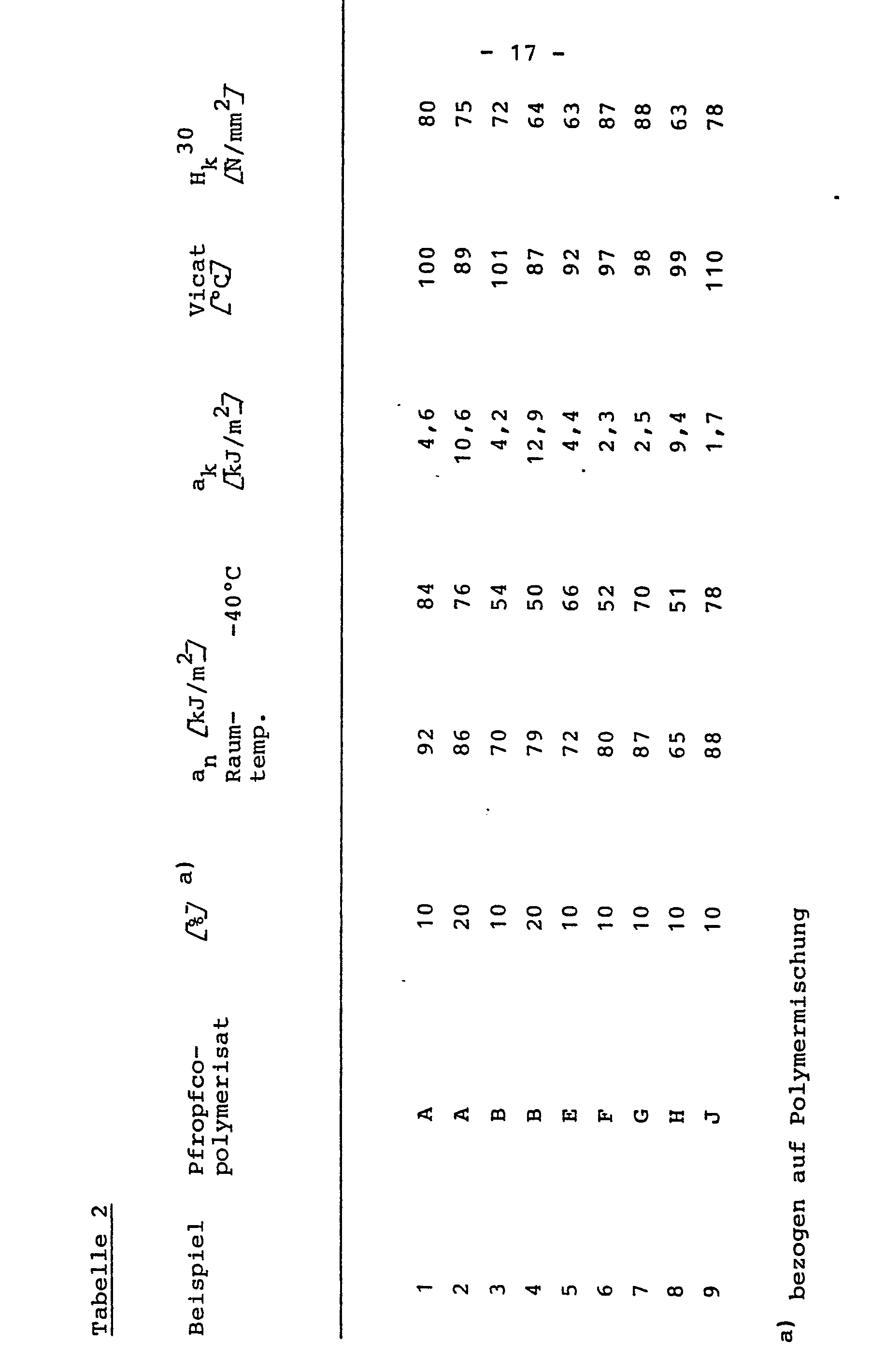
- Celluloseacetopropionat enthaltend ca. 57,5 % Propionsäure- und ca. 5,5 % Essigsäuregruppen, wird mit den in der Tabelle 3 angegebenen Mengen der Pfropfcopolymeren auf einer Walze bei 170°C intensiv vermischt, wobei die Summe beider Komponenten 100 % beträgt.
- Die Walzfelle werden granuliert und anschließend bei einer Massetemperatur von 230°C auf einer Spritzgußmaschine zu Prüfkörpern verspritzt.

und besonders bevorzugte Celluloseacetopropionate.haben folgende Zusammensetzung:
Claims (4)
7obei die Summe der Komponenten 1) und 2) und a) bis c) jeweils 100 Gew.-% beträgt.
wobei die Summe der Komponenten 1) und 2) und a) bis c) jeweils 100 Gew.-% beträgt.
wobei die Summe der Komponenten 1 und 2) 100 Gew.-% beträgt.
Priority Applications (1)
| Application Number | Priority Date | Filing Date | Title |
|---|---|---|---|
| AT80107702T ATE6264T1 (de) | 1979-12-21 | 1980-12-06 | Thermoplastische formmassen aus celluloseestern. |
Applications Claiming Priority (2)
| Application Number | Priority Date | Filing Date | Title |
|---|---|---|---|
| DE19792951747 DE2951747A1 (de) | 1979-12-21 | 1979-12-21 | Thermoplastische formmassen aus celluloseestern |
| DE2951747 | 1979-12-21 |
Publications (3)
| Publication Number | Publication Date |
|---|---|
| EP0032996A2 true EP0032996A2 (de) | 1981-08-05 |
| EP0032996A3 EP0032996A3 (en) | 1981-11-18 |
| EP0032996B1 EP0032996B1 (de) | 1984-02-15 |
Family
ID=6089277
Family Applications (1)
| Application Number | Title | Priority Date | Filing Date |
|---|---|---|---|
| EP80107702A Expired EP0032996B1 (de) | 1979-12-21 | 1980-12-06 | Thermoplastische Formmassen aus Celluloseestern |
Country Status (6)
| Country | Link |
|---|---|
| US (1) | US4357267A (de) |
| EP (1) | EP0032996B1 (de) |
| JP (1) | JPS5693746A (de) |
| AT (1) | ATE6264T1 (de) |
| CA (1) | CA1165035A (de) |
| DE (2) | DE2951747A1 (de) |
Families Citing this family (7)
| Publication number | Priority date | Publication date | Assignee | Title |
|---|---|---|---|---|
| DE3220909A1 (de) * | 1982-06-03 | 1983-12-08 | Röhm GmbH, 6100 Darmstadt | Alkoholgeloeste druckfarbe oder lack |
| US4603160A (en) * | 1984-04-30 | 1986-07-29 | Eastman Kodak Company | Acrylic castings and process for the preparation thereof |
| US4650821A (en) * | 1985-07-01 | 1987-03-17 | Eastman Kodak Company | Novel acrylic castings and process for the preparation thereof |
| DE3607626A1 (de) * | 1986-03-07 | 1987-09-10 | Bayer Ag | Celluloseester-formmassen mit verbesserter zaehigkeit |
| JP6805647B2 (ja) * | 2016-08-31 | 2020-12-23 | 富士ゼロックス株式会社 | 樹脂組成物、及び、樹脂成形体 |
| JP6848267B2 (ja) * | 2016-08-31 | 2021-03-24 | 富士ゼロックス株式会社 | 樹脂組成物、及び、樹脂成形体 |
| EP3480247B1 (de) * | 2016-08-31 | 2023-11-08 | FUJIFILM Business Innovation Corp. | Harzzusammensetzung und formartikel aus harz |
Family Cites Families (4)
| Publication number | Priority date | Publication date | Assignee | Title |
|---|---|---|---|---|
| US2787602A (en) * | 1952-11-20 | 1957-04-02 | American Viscose Corp | Phonograph record |
| US3088791A (en) * | 1959-02-06 | 1963-05-07 | Du Pont | Graft polymerization of a vinyl monomer to a polymeric substrate by low temperature irradiation |
| US3645939A (en) * | 1968-02-01 | 1972-02-29 | Us Plywood Champ Papers Inc | Compatibilization of hydroxyl containing materials and thermoplastic polymers |
| US4267090A (en) * | 1979-01-22 | 1981-05-12 | National Distillers And Chemical Corp. | Process for preparing vinyl acetate-ethylene copolymer latices |
-
1979
- 1979-12-21 DE DE19792951747 patent/DE2951747A1/de not_active Withdrawn
-
1980
- 1980-12-06 AT AT80107702T patent/ATE6264T1/de not_active IP Right Cessation
- 1980-12-06 DE DE8080107702T patent/DE3066653D1/de not_active Expired
- 1980-12-06 EP EP80107702A patent/EP0032996B1/de not_active Expired
- 1980-12-11 US US06/215,328 patent/US4357267A/en not_active Expired - Lifetime
- 1980-12-18 JP JP17813580A patent/JPS5693746A/ja active Granted
- 1980-12-19 CA CA000367194A patent/CA1165035A/en not_active Expired
Non-Patent Citations (1)
| Title |
|---|
| Keine Entgegenhaltungen. * |
Also Published As
| Publication number | Publication date |
|---|---|
| CA1165035A (en) | 1984-04-03 |
| DE2951747A1 (de) | 1981-07-02 |
| JPS6237056B2 (de) | 1987-08-11 |
| ATE6264T1 (de) | 1984-03-15 |
| JPS5693746A (en) | 1981-07-29 |
| DE3066653D1 (en) | 1984-03-22 |
| EP0032996A3 (en) | 1981-11-18 |
| US4357267A (en) | 1982-11-02 |
| EP0032996B1 (de) | 1984-02-15 |
Similar Documents
| Publication | Publication Date | Title |
|---|---|---|
| DE1495694C3 (de) | Verfahren zur Herstellung von Polymerisaten des Vinylchlorids | |
| DE4311436A1 (de) | Modifiziertes CPE zur Erhöhung der Schlagzähigkeit von PVC | |
| DE2938967C2 (de) | ||
| EP0032998B1 (de) | Thermoplastische Formmassen aus Celluloseester-Copfropfpolymerisaten oder deren Abmischungen mit Celluloseestern | |
| DE60012891T2 (de) | Funktionalisierte polyproypelene und verfahren zu ihren herstellung | |
| EP0032996B1 (de) | Thermoplastische Formmassen aus Celluloseestern | |
| DE2426178C3 (de) | Thermoplastische Formmassen aus Celluloseestern und Äthylen-Vinylester-Copolymerisaten | |
| DE3836779A1 (de) | Celluloseester/polymerkombinationen, deren herstellung und verwendung | |
| EP0004284B1 (de) | Allylverbindungen enthaltende Pfropfcopolymerisate und Verfahren zu ihrer Herstellung | |
| EP0118009B1 (de) | Verwendung einer wässrigen Poly(meth)acrylat-Sekundärdispersion als verdickendes Bindemittel für Buntsteinputz | |
| DE2361717A1 (de) | Bewitterungsstabile thermoplasten | |
| EP0054857B1 (de) | Thermoplastische Formmassen aus Copfropfpolymerisaten von Celluloseestern | |
| EP0054860A2 (de) | Thermoplastische Formmassen aus Copfropfpolymerisaten | |
| DE2951800A1 (de) | Thermoplastische formmassen aus copfropfpolymerisaten von celluloseestern | |
| DE1720950A1 (de) | Verfahren zur Herstellung von Vinylchloridmassen hoher Schlagfestigkeit | |
| DE2951748C2 (de) | Thermoplastische Formmassen aus Cellulseestern und Celluloseester-Copfropfpolymerisaten | |
| EP0007531B1 (de) | Carboxylgruppenhaltige Vinylchloridcopolymerisate und ihre Verwendung | |
| EP0378863A2 (de) | Oxetanylgruppen enthaltende thermoplastische Formmassen | |
| DE1251025B (de) | Verfahren zur Herstellung von Copolymerisaten des Athvlens mit N-Vmyllactamen | |
| DE3005382A1 (de) | Thermoplastische elastomere masse und verwendung derselben | |
| DE2018606B2 (de) | Formmasse mit hoher Schlagzähigkeit und Verfahren zu ihrer Herstellung | |
| DE1644842A1 (de) | Farb- oder Lackmasse auf Vinylchloridharzbasis | |
| DE2155560A1 (de) | Vernetzte formkoerper aus mischpolymerisaten des vinylchlorids | |
| DE2438864B2 (de) | Verfahren zur herstellung von acrylatpolymeren | |
| DE2111720A1 (de) | Schlagfeste Vinylchlorid-Polymerisate |
Legal Events
| Date | Code | Title | Description |
|---|---|---|---|
| PUAI | Public reference made under article 153(3) epc to a published international application that has entered the european phase |
Free format text: ORIGINAL CODE: 0009012 |
|
| 17P | Request for examination filed |
Effective date: 19801206 |
|
| AK | Designated contracting states |
Designated state(s): AT BE DE FR GB IT NL |
|
| PUAL | Search report despatched |
Free format text: ORIGINAL CODE: 0009013 |
|
| AK | Designated contracting states |
Designated state(s): AT BE DE FR GB IT NL |
|
| ITF | It: translation for a ep patent filed | ||
| GRAA | (expected) grant |
Free format text: ORIGINAL CODE: 0009210 |
|
| AK | Designated contracting states |
Designated state(s): AT BE DE FR GB IT NL |
|
| REF | Corresponds to: |
Ref document number: 6264 Country of ref document: AT Date of ref document: 19840315 Kind code of ref document: T |
|
| ET | Fr: translation filed | ||
| REF | Corresponds to: |
Ref document number: 3066653 Country of ref document: DE Date of ref document: 19840322 |
|
| PLBE | No opposition filed within time limit |
Free format text: ORIGINAL CODE: 0009261 |
|
| STAA | Information on the status of an ep patent application or granted ep patent |
Free format text: STATUS: NO OPPOSITION FILED WITHIN TIME LIMIT |
|
| 26N | No opposition filed | ||
| PGFP | Annual fee paid to national office [announced via postgrant information from national office to epo] |
Ref country code: DE Payment date: 19891118 Year of fee payment: 10 |
|
| PGFP | Annual fee paid to national office [announced via postgrant information from national office to epo] |
Ref country code: FR Payment date: 19891129 Year of fee payment: 10 |
|
| PGFP | Annual fee paid to national office [announced via postgrant information from national office to epo] |
Ref country code: GB Payment date: 19891130 Year of fee payment: 10 |
|
| PGFP | Annual fee paid to national office [announced via postgrant information from national office to epo] |
Ref country code: AT Payment date: 19891213 Year of fee payment: 10 |
|
| PGFP | Annual fee paid to national office [announced via postgrant information from national office to epo] |
Ref country code: BE Payment date: 19891220 Year of fee payment: 10 |
|
| ITTA | It: last paid annual fee | ||
| PGFP | Annual fee paid to national office [announced via postgrant information from national office to epo] |
Ref country code: NL Payment date: 19891231 Year of fee payment: 10 |
|
| PG25 | Lapsed in a contracting state [announced via postgrant information from national office to epo] |
Ref country code: GB Effective date: 19901206 Ref country code: AT Effective date: 19901206 |
|
| PG25 | Lapsed in a contracting state [announced via postgrant information from national office to epo] |
Ref country code: BE Effective date: 19901231 |
|
| BERE | Be: lapsed |
Owner name: BAYER A.G. Effective date: 19901231 |
|
| PG25 | Lapsed in a contracting state [announced via postgrant information from national office to epo] |
Ref country code: NL Effective date: 19910701 |
|
| GBPC | Gb: european patent ceased through non-payment of renewal fee | ||
| NLV4 | Nl: lapsed or anulled due to non-payment of the annual fee | ||
| PG25 | Lapsed in a contracting state [announced via postgrant information from national office to epo] |
Ref country code: FR Effective date: 19910830 |
|
| PG25 | Lapsed in a contracting state [announced via postgrant information from national office to epo] |
Ref country code: DE Effective date: 19910903 |
|
| REG | Reference to a national code |
Ref country code: FR Ref legal event code: ST |