EP0032997B1 - Machine à écrire avec système d'effacement, munie d'un dispositif de sélection automatique du mode d'effacement, manuel ou automatique - Google Patents
Machine à écrire avec système d'effacement, munie d'un dispositif de sélection automatique du mode d'effacement, manuel ou automatique Download PDFInfo
- Publication number
- EP0032997B1 EP0032997B1 EP19800107705 EP80107705A EP0032997B1 EP 0032997 B1 EP0032997 B1 EP 0032997B1 EP 19800107705 EP19800107705 EP 19800107705 EP 80107705 A EP80107705 A EP 80107705A EP 0032997 B1 EP0032997 B1 EP 0032997B1
- Authority
- EP
- European Patent Office
- Prior art keywords
- erase
- character
- key
- typewriter
- Prior art date
- Legal status (The legal status is an assumption and is not a legal conclusion. Google has not performed a legal analysis and makes no representation as to the accuracy of the status listed.)
- Expired
Links
Images


Classifications
-
- B—PERFORMING OPERATIONS; TRANSPORTING
- B41—PRINTING; LINING MACHINES; TYPEWRITERS; STAMPS
- B41J—TYPEWRITERS; SELECTIVE PRINTING MECHANISMS, i.e. MECHANISMS PRINTING OTHERWISE THAN FROM A FORME; CORRECTION OF TYPOGRAPHICAL ERRORS
- B41J5/00—Devices or arrangements for controlling character selection
- B41J5/30—Character or syllable selection controlled by recorded information
- B41J5/44—Character or syllable selection controlled by recorded information characterised by storage of recorded information
- B41J5/46—Character or syllable selection controlled by recorded information characterised by storage of recorded information on internal storages
-
- B—PERFORMING OPERATIONS; TRANSPORTING
- B41—PRINTING; LINING MACHINES; TYPEWRITERS; STAMPS
- B41J—TYPEWRITERS; SELECTIVE PRINTING MECHANISMS, i.e. MECHANISMS PRINTING OTHERWISE THAN FROM A FORME; CORRECTION OF TYPOGRAPHICAL ERRORS
- B41J29/00—Details of, or accessories for, typewriters or selective printing mechanisms not otherwise provided for
- B41J29/26—Devices, non-fluid media or methods for cancelling, correcting errors, underscoring or ruling
- B41J29/36—Devices, non-fluid media or methods for cancelling, correcting errors, underscoring or ruling for cancelling or correcting errors by overprinting
Definitions
- This invention relates to improvements to electronic typewriters to allow both automatic and manual erase functions with a minimum amount of keying.
- the automatic erasing typewriter of the document US-A-3,780,846 will produce a backspace in response to the first erase depression and a second backspace to, in effect, search for an erasable character in the line memory, and when such character is found, it will be erased.
- the present invention seeks to improve operation of an automatically erasing typewriter in the event that the character sought to be erased is not contained in the line memory, and enables the automatically erasing typewriter to achieve the erasing function with a minimum amount of decision-making on the part of the operator.
- the operator employs the same initial techniques regardless of whether or not the character sought to be erased is retained in the line memory.
- the operator strokes the erase key which initiates the automatic erasing operation. In the event that the erroneously typed character is contained in the line memory, it is automatically erased as taught in the document US-A-3,780,846.
- the typewriter when an erase operation is initiated, if the typewriter finds a space function in the associated line memory location, the backspace is terminated and the machine is conditioned for manual erase. Operating the space bar then deconditions the typewriter from the erase mode without causing an escapement to thereby enable the typist to continue typing to, in effect, "erase” the space by inserting a character therein.
- the automatically erasing typewriter of the present invention is of the kind which can type a sequence of characters on a page in response to operator actuation of a sequence of keys on the keyboard and is of the kind which includes:
- the typewriter further includes:
- a backspace is initiated which has the effect of displacing the print point one character space rearwardly.
- Moving the print point has two effects; firstly, the type carrier or print means is displaced corresponding to moving of the print point, and secondly, the line memory location addressed is also correspondingly displaced.
- the line memory contains a character code
- a print cycle is initiated with the erase media enabled and the automatic erase function is carried out.
- the typewriter print cycle is inhibited and instead the typewriter is conditioned to manually erase, in which, on the next keystroke, comprising an erasable character, manual erase is effected by initiating a print cycle with the erase media enabled, inhibiting or preventing escapement of the print means and finally, deconditioning the typewriter from an erase mode.
- the typewriter either re- initiates the automatic erase sequence in the event that the subsequently stroked key is the erase key, or merely deconditions the typewriter from an erase mode if the subsequently stroked key is the space bar.
- the keyboard 14 causes associated switches to make in a predetermined pattern thereby transmitting signals from the keyboard 14 to the keyboard control 16.
- the keyboard control unit 16 captures the electronic inputs from bail codes B1 through B7 and generates an appropriate strobe or control signal which then causes the total data signals to be transmitted to the character and velocity decode logic 18.
- the character and velocity decode logic 18 then converts the signals from the keyboard control 16 into signals which represent the position on the type element of the character selected by the key lever depression. This is accomplished by converting the keyboard control 16 signal into signals to magnet drivers 20 which then effect the rotation (R1, R2, R3) and the tilt (T1, T2) of a single type element 11, or other conventional' selection technique, to position the desired type font at the print point and then the selection of other controls such as the velocity (V1, V2) with which that type font is propelled toward the printed page.
- the keyboard control 16 signals are simultaneously read into the escapement and erase logic 22 which, then, through a conventional table look-up, determines the assigned escapement values for each of the characters which are represented by the output of the keyboard control 16.
- These escapement values or widths may be a standard width such as for example using a 1/60th of an inch (0.423 mm) per unit, 6 units for a 10 pitch escapement or 5 units for a 12 pitch escapement. Additionally, with the escapement of characters being defined as units of 1/60th of an inch (0.423 mm), it is possible to assign escapement values to characters proportional to their actual printing width, otherwise known as proportionally spaced characters. This thereby provides the capability of escaping the typewriter 10 responsive to the keyboard control signals and effecting proportionally spaced character printing.
- the position of the carrier 13 (see figure 2) or the print point defining means of the typewriter 10 is constantly stored in the escapement register 24 which is a portion of the escapement and erase logic 22, thereby providing a current location, measured from the leftmost point of travel of the print carrier 13, and this value is updated as the print carrier 13 translates left or right under the control of any of the keyboard signals.
- the escapement and erase logic 22 outputs the width of the characters which have been selected at the keyboard to the escapement counter 26. This is necessary to provide a control over the escapement functions of the printer.
- the escapement counter 26 then stores on a temporary basis the information necessary to control the translation of the print carrier 13 over a predetermined or preselected distance.
- the escapement counter 26 is controlled in its operation by the signals emanating from integrator 28 which has input signals representing the output of a pitch selection switch 15 and the photoemitter/sensor 17 associated with the lead screw 19 and the escapement signals wheel 21 which indicates which portion of a rotation the lead screw 19 has been rotated through.
- the pulses created by the photoemitter/sensor 17 and wheel 21 on the end of the rotatable lead screw 19 of the typewriter 10 effect decrementing of the escapement counter 26.
- the photoemitter/sensor 17 will then pulse the escapement counter 26, through the integrator 28, and cause the escapement counter 26 to provide an output signal to the appropriate magnet drivers 30 to cause movement of the print carriage 13.
- the escapement or movement of the print carriage 13 is a result of signals emanating from the magnet drivers 30 which are provided their input from the escapement counter 26.
- the escapement signal, the direction signal, the drive signal and the erase signal all emanate from the magnet drivers which are controlled ultimately from the keyboard 14.
- the escapement magnet driver 30 causes the release of the lead screw 19 and thus allows its rotation together with the emitter wheel 21 which interacts with the photoemitter/sensor 17, thus creating the signals discussed above.
- the direction magnet driver 30 controls the engagement of the clutches 31 in the drive unit 33 to determine the forward or reverse direction of the carrier, by controlling the rotational direction of the lead screw 19.
- the drive magnet driver 30 provides the engagement or the coupling between the main drive motor 43 of the typewriter 10 and the lead screw 19, through the power transmission or drive unit 33.
- the erase magnet driver 30 controls the elevation, from its withdrawn position of an erase media or tape (shown in figure 2 wound on a reel 23) so that any subsequent printing effected by the print element causes the impacting of the erase media against the page to effect erasure, if the character being impacted was the same character as was previously impacted onto the printing ribbon at that print point.
- the printer control unit 32 contains the character velocity decode logic 18, the escapement and erase logic 22, the escapement register 24, the escapement counter 26 and the line memory 34. As signals are decoded by the character and velocity decode logic 18 for subsequent utilization by the magnet drivers 20 for selection, that same information is temporarily stored in a memory designated as the line memory 34.
- This memory or register 34 is capable of receiving and storing data in the sequence in which they have been received.
- the line memory 34 is capable of being read in reverse to determine characters which have been previously printed and machine functions which have occurred during that particular line of operation, such as the initiation of a tabulation or space command.
- Functions of the typewriter 10 are controlled by the function portion 36 of the keyboard.
- the functions which may be included into such a typewriter 10 include tabulation, space, carrier return, shift, index and erase.
- typewriter 10 is capable of automatic erase.
- three functions are performed; in response to actuation of erase key 25, firstly, the line memory is interrogated for the present print point and determination is made as to whether or not an erasable character is found at that location. Assuming an erasable character is found, the erase media is enabled (or lifted) so that when a print operation occurs, the type element will drive the erase media into the page rather than the print media.
- the type carrier which drives the erase media to the paper matches the character which is to be erased, the previously typed character is deleted, either by lifting off the ink deposit in the first print operation or by covering the ink so that it is not visible.
- the character read from the memory is employed to select a corresponding typeface and a print cycle operation is executed.
- the typewriter 10 merely performs a backspace and then begins the sequence again.
- the line memory will not contain an erasable character. This can occur if the operator, after typing a full or partial line, indexes the carriage. This has the effect of clearing the line memory, thus insuring that no erasable character will be found in subsequently interrogating the line memory. If the operator has indexed the carriage to register it with a preceding line, while the line memory will contain no erasable characters, the page will indeed contain erasable characters, and therefore, the operator may desire an erase operation to be performed.
- a second instance when interrogation of the line memory will reveal no erasable character occurs if the line memory contains a space. If, for example, the operator has erroneously operated the space bar 27, and wished to "erase" the space, the line memory containing the space will not have erasable character.
- the typewriter in response to an erase command, the typewriter, in effect, skips the space and erases the immediately preceding character which may not be the operation desired by the operator.
- a manual erase In a manual erase, firstly, the print point is selected to correspond to the character to be erased (i.e., typically requiring a backspace function), the erase media is enabled such that on a following depression of a character key, the typeface will impact the erase media into the paper, and if the character which has been stroked corresponds to the character to be erased, it will be erased.
- Some typewriters for example, are capable of the automatic erase function, and are also capable of implementing the manual erase operation. This is effected by engaging simultaneously the "code” key and the erase key which has the effect of "teaching" the typewriter to perform the manual erase function.
- the electronic control circuits of the typewriter contain logic to implement either the automatic erase or the manual erase, and the selection is made by the electronic controls based upon the status of the line memory. In effect, if an automatic erase operation at the effective print location is possible, it will be performed. On the other hand, if the line memory contains either a non-erasable character such as the space, or if the line memory is empty, the electronic controls will implement a manual erase. If the following keystroke is that of an erasable character, the manual erase operation will be performed. Otherwise, the electronic controls either reinitiate automatic erase, if the following keystroke is the erase key, or simply decondition from manual erase if the following keystroke is neither an erasable character nor the erase key.
- an "automatic erase” is an erase function performed in response to selection of only the “erase” function without operator selection of the character to be erased.
- “manual erase” is an "erase” function in which the operator selects the character to be erased.
- Conditioning for a manual erase is an operation in which an erase latch is set so that, on a following print cycle, the erase media is lifted and interposed between the type element and paper.
- deconditioning from manual erase corresponds to resetting the erase latch.
- the special function portion 36 of the keyboard 14 Upon the initiation of an erase command, the special function portion 36 of the keyboard 14, generates a signal which is passed through to the function decoder logic 38 and decoded.
- the output of the function decode logic 38 is gated into the escapement and erase logic 22 which, in turn, recognizes that the function is an erase operation.
- the escapement and erase logic 22 accesses the line memory 34 to determine the character which was previously printed in the next leftmost character position from that of the present print point. If the line memory 34 has signals stored in that position corresponding to an erasable character, the automatic erase function is performed. On the other hand, if the character position accessed does not contain an erasable character or if the line memory at that position is empty, the logic conditions the machine for manual erase and awaits the next keystroke operation.
- next keystroke operation is a second actuation of the erase key
- the machine is deconditioned from manual erase operation and again begins a sequence of operations in attempting to perform an automatic erase operation.
- the manual erase operation is performed. The operator is allowed to decondition the machine from manual erase and return it to its normal operating state by operation of the space bar. If, on the other hand, another function key is depressed, such as a tabulation function, index function, carriage return or shift, the function is performed, the machine is deconditioned from manual erase, and it returns to its normal operating state.
- the block diagrammed control apparatus 32 of figure 1 is employed to implement the functions described above.
- the apparatus 32 interfaces with the print mechanism 13 and its drive through the magnet drives 20 and 30. While the action of the electronic controls 32 may, with state of the art techniques, be operated at very high rates, the printer operation, requiring, as it does, mechanical movements, is much more limited.
- Typical electronic typewriters on the market today have an operating cycle that has four distinct states. A first state is a rest or wait state. As a key is actuated and decoded, the typewriter shifts to a second state at which point the print cycle is initiated. Once the print cycle is begun, it must be completed in a fixed time frame since that time frame is fixed by the rotation of a shaft.
- the typewriter is in its third state. At this time, escapement may be performed. When escapement, or the time for escapement is concluded, the machine is in its fourth state. At this time, the various control signals which have controlled the print cycle and escapement are turned off and the machine returns to its original state. In response to various conditions the typewriter may skip various functions, for example, while the machine cycle always includes a time during which escapement is effected, in certain conditions no escapement actually occurs.
- the automatic erase function typically requires two iterations of the four machine states.
- the typewriter When actuation of the erase key is decoded, the typewriter has moved from a rest state to a second state. A print cycle is begun but no print operation occurs (i.e., a no-print cycle). At the conclusion of the print cycle an erase latch has been set so that escapement is initiated and is accomplished as a backspace.
- the control signals are turned off and the machine is in a quasi-rest state, similar to a rest state except that the erase function is only partially complete, not only is an erase latch set but a second cycle latch is set indicating that line memory interrogation has resulted in detection of an erasable character.
- the typewriter of the present invention initiates similar action in response to erase key depression as outlined immediately above.
- a manual rather than automatic erase latch is set indicating the failure to find an erasable character in the interrogated line memory location.
- the machine returns to a wait state in which no further operation will be initiated until a further key depression is detected.
- the machine again goes through its various states corresponding to the first iteration of the machine states for automatic erase.
- a preferred embodiment employs random logic in the form of a programmed processor to implement the control 32, for example, a microprocessor, although it is within the scope of the invention to implement control 32 in the form of discrete logic or hard wired circuits.
- a microprocessor used was an Intel 8048 (RTM).
- RTM Intel 8048
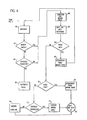
- FIG. 3 and 4 illustrate the signal and logic flow.
- control 32 in its normal state awaits a keyboard input.
- the character and velocity decode logic 18 determines, at function 51, whether or not the input corresponds to a character. If it is a character, functions 53 and 54 are performed to store the character in a line memory 34, and execute a print cycle wherein the character is printed on the paper at the present print point.
- the print sequence 54 includes a function to space (or escape) the print carriage such that, at the conclusion of the normal print operation, the print point has moved to the next character location, ready for a following print sequence. This operation typically requires only a single iteration of the four machines states described above.
- the function decode logic 38 determines whether an erase function has been commanded. If it has not, the function decode logic 38 checks for the existence of other function commands, in portions of the logic which are not germane to the present invention and therefore are not described herein.
- the erase command is gated through the function decode logic 38 to the escapement and erase logic 22.
- a quantity is loaded into the escapement counter 26 which, as disclosed, for example, in the document FR-A-2,426,574, operates to backspace the print carrier. Since the escapement register 24 is used to access the line memory, once the backspace operation (function 62) is concluded, the escapement register 24 stores the location of the print point so it accesses the line memory at the "backspaced" location.
- the escapement and erase logic interrogates the line memory 34 at function 63 to determine whether the location accessed is empty. If it is not empty, then the escapement and erase logic 22 determines at function 64 whether or not the signals stored in the line memory 34 correspond to an erasable character.
- the second cycle latch 107 (see fig. 5) is set and the automatic erase function 65 is performed. Those functions are not disclosed in detail here since they are identified in document US-A-3,780,846. In brief compass, the erase media is enabled (lifted) by the magnetic drive 30, and a print command is issued corresponding to the character found in the line memory.
- the escapement and erase logic 22 determines that the memory location accessed was empty, or an erasable character was not found at the memory location. If, on the other hand, either at functions 63 or 64, the escapement and erase logic 22 determined that the memory location accessed was empty, or an erasable character was not found at the memory location, then the escapement and erase logic 22 conditions the typewriter 10 for a manual erase at function 66 (i.e., the manual latch 112 is set). This prepares the erase media for engagement on the conditions which are specified below. Once that operation has been performed, the escapement erase logic 22 awaits the next keystroke at function 67. The preceding functions from depression of the erase key up to function 66 correspond to a single iteration of the four machine states.
- the keyboard control 16 sends the corresponding signals to the character and velocity decode logic 18.
- the same signals are received by the function decode logic 38 which determines that this keystroke actuation is not that of an erase key, i.e., function 68.
- the function decode logic 38 determines that the next keystroke actuation was not a space bar, i.e., function 70.
- the character and velocity decode logic 18 determines that the next keystroke actuation was indeed that of an erasable character which information is gated into the escapement erase logic 22. While the machine cycles through the second cycle in which both print and escape functions are skipped, the second cycle latch 112 is set.
- the character and velocity decode logic 18 formulates a print command to the magnet drive 20 which has the effect of rotating and tilting the type ball, or other similar effects, depending upon the print apparatus employed in the typewriter.
- the magnet drive 30 now energizes the erase magnet to lift the erase media.
- a manual erase operation is performed wherein the operator has selected the character, and the machine has lifted the erase media such that the type ball forces the erase media into the paper to effect the erasure.
- the machine is deconditioned from the manual erase mode, that is, the latches are reset.
- the decode logic 38 determines at function 74 that a function has been selected. This selected function is executed through the escapement and erase logic 22 in combination with the other apparatus necessary to perform the selected function. At the same time, the machine is deconditioned from manual erase.
- function decode logic 38 determines that the next actuated key was the space bar. This information is gated to the escapement and erase logic 22. The effect of this operation is to decondition the typewriter from manual erase (function 71) in that the previously prepared circuit for the erase magnet through the magnet drive 30 is eliminated.
- function decode logic 38 deconditions the machine from manual erase, at function 69, by interrupting the previously prepared circuit for the erase magnet through magnet drive 30 and the sequence shown in figure 4 is repeated again starting at the backspace function 62.
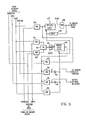
- Figure 5 illustrates in detail the components of the erase and escape logic 22 required to implement one embodiment of the present invention.
- the erase and escape logic 22 is provided with two sets of signals inputs, a first set from keyboard decoding logic 38 and 18 identifying the actuation of a key corresponding to a character, space, erase or other function; and a second set of input signals from a decoding circuit arranged to decode the addressed content of the line memory 34 corresponding to the print point, the second set including signals identifying a character, function, space or empty state of the memory location.
- the two sets of signals are supplied, in selected combinations to AND gates 100-102.
- AND gate 100 subjected to an input identifying an erase key actuation and a corresponding character decode from the line memory, provides an output to set the second cycle latch 107.
- the set output of latch 107 is coupled through further AND gate 108.
- the output of AND gate 108 is provided to the printer to cause execution of an erase cycle.
- the printer erase cycle includes a print cycle in which the erase media is enabled and impacted by the print element into the paper, and a skipped escape cycle.
- the same output of gate 108 is provided to a delay circuit 109, the output of which is arranged to reset the second cycle latch 107.
- This operation corresponds to execution of the automatic erase function.
- the AND gate 100 detects the depression of an erase key and the presence of a character in the relevant location in the line memory, and as mentioned above, the second cycle latch 107 is set so that at an appropriate time, the automatic erase function is executed.
- AND gates 101 and 102 are provided, the first subjected to an input from the actuated erase key and a corresponding decode of an empty location in the line memory.
- AND gate 102 is also subjected to an input derived from the depression of an erase key, with the corresponding decode from the line memory corresponding to storage of a function command or space.
- the outputs of AND gates 101 and 102 are coupled to an OR gate 110.
- the output of either one of AND gates 101 or 102 indicates that an automatic erase function cannot be executed since an erasable character is not found at the corresponding print point in the line memory 34.
- the output of OR gate 110 is coupled to an AND gate 111, clocked at an appropriate time in the machine cycle to set a manual erase latch 112.
- setting the manual erase latch 112 temporarily inhibits execution or a printer erase cycle. However, it should be recalled that, at the time the line memory 34 is interrogated, the print point has already been backspaced or escaped and therefore, the typewriter is in condition to execute a manual erase depending upon the next key actuation. Setting the manual erase latch 112 puts the machine in a quasi- wait state, similar to a normal wait state except for the set condition of the manual erase latch 112.
- the set output of the manual erase latch 112 provides an input to AND gates 103-106.
- the other input to AND gate 103 is provided from a character key actuation, and production of an output from AND gate 103 provides a setting input to the second cycle latch 107. Accordingly, when AND gate 103 produces an output, the printer will execute an erase cycle, causing an impact of the type element in the print cycle, but with the erase media lifted.
- the output of the delay circuit 109 is also arranged to reset the manual erase latch 112 so that at the conclusion of the erase cycle both the second cycle latch 107 and the manual erase latch 112 are reset.
- AND gate 104 has a second input provided from a decoded function key actuation, and the output of AND gate 104 is coupled to the printer to execute the selected function. The same output, coupled through a buffer 113, resets the manual erase latch 112.
- AND gate 105 The other input to AND gate 105 is provided by a decoded space bar actuation, and the output of the gate is provided to the printer which causes a no-print no-escape cycle, and the same output, coupled through buffer 114 is provided to reset the manual erase latch 112.
- AND gate 106 has a second input provided by the decoded erase key actuation, and the output of AND gate 106 is provided to reset the manual erase latch 112.
- the clock inputs to AND gate 108 and 111 can be replaced by other state-determining signals in the typewriter as will be apparent to those skilled in the art.
- the only requirements are that, for example, once the second cycle latch 107 is set, the other electronic components should be allowed to settle so that the signal provided to the printer for the erase cycle are not indeterminate.
- the clocking function at AND gate 111 is provided to prevent a race condition at the manual erase latch 112.
- the clocking function is arranged to insure that the resetting of the manual erase latch 112 occurs prior to the setting of the same latch so that when the erase key 25 is depressed, the manual erase latch 112 is maintained set in the event that the decoded contents of the line memory 34 correspond to either an empty location or a function command. Similar function is performed by the delay circuit 109, and those skilled in the art will appreciate that other apparatus or signals for delaying the resetting of second cycle latch 107 can be employed, for example, other machine-state determined signals.
- the preferred embodiment of the invention employs a stored program processor, preferably a microprocessor.
- Appendices A, B and C illustrate the program instructions (or code) used in a preferred embodiment of the invention incorporating the logic previously described herein.
- Appendices A and B comprise the code itself, including a series of statements listed in the column entitled “Statement”. The remaining portions of Appendices A and B, consisting of the column labelled "Source” and the material to the right of the column labelled “Statement” are explanatory material helpful in understanding functions performed by the program instructions.
- Appendix C identifies the meaning of several of the statements to enable the reader to more readily comprehend the subject matter of Appendices A and B.
- Appendices A and B are but portions of the program instructions used to control a typewriter implemented in accordance with this invention, but capable of other functions not directly pertinent to the invention, and therefore, there are other collections of code referred to which are not directly pertinent to the instant invention.
- Appendix A is the collection of codes which is referred to when the typewriter recognizes that the erase key has been stroked.
- Appendix B is a portion of the code which is referred to when the typewriter recognizes a printable character has been stroked.
- Instruction L33 includes a jump to L11 which is found in Appendix B. This instruction is the output instruction which causes the various control bits to be effective and the printer is thereafter controlled. Accordingly, in the event that the typewriter was responding to depression of an erase key, and the buffer did not include an erasable character, the cycle of the print shaft which is initiated which instruction L11, results in a no print, no escape, and the only significant event accomplished in this operation of code is setting of the manual erase flag.
- the code at Appendix B is entered.
- the first instruction includes a jump to L502 if the manual erase flag is set (L502 is found in Appendix A).
- the first few statements at L502 insure that the shift magnet becomes set if the character case is different from the case which would otherwise be printed to insure that upon printing, the printed case agrees with the keyboard selected character case.
- the next instruction, L506, turns on the erase flag, and then the instruction string, starting at L17, is executed which terminates at L11 (Appendix B).
- the first pass through the code entered when a printable character is stroked with the manual erase flag set, has the effect of turning on the erase flag, but in other respects, rotation of the print shaft which is initiated at L11 is again a no print, no escape cycle.
- the next cycle of the print shaft will be the cycle in which the print element is driven toward the paper for imprinting the character keyed by the operator. With the erase flag on, (at L506) the print element will be driven into the erase media to effect an erase operation.
- Appendices A and B is effective to set a manual erase flag if the erase key is actuated and the relevant buffer position does not contain a printable character.
- the code also illustrates that actuation of a printable character with the manual erase flag set will inhibit normal printing operation and instead result in an erase function.
- the next depression of the erase key performs the same functions except that at function 64, the electronics recognize that an erasable character is not in the line memory. Accordingly, at function 66, the typewriter conditions itself for manual erase, and at function 67 awaits the next keystroke. If the next keystroke is an erase key, this is recognized by the electronics, the previously effected conditioning for manual erase is deconditioned, and the logic returns to function 62 to initiate a further backspace. Since all other conditions are the same, the F is erased.
- the operator depresses the erase key following the erase of the G.
- the typewriter conditions itself for manual erase and awaits the next keystroke. If the next keystroke is operation of the space bar, the resulting function performed by the electronics to merely decondition the typewriter for manual erase and await the next keystroke. Since this deconditioning does not result in the escape function, the next keystroke is the text that the operator desired to place adjacent the F.
- the line memory does not contain signals representing these characters, for example, because the operator has moved the platen following typing and has then relocated the platen to the text above, actuation of the erase key will result in a determination, at function 63, that the memory is empty.
- the machine then conditions itself for manual erase and awaits the next keystroke. If the next keystroke is an N, a print cycle is performed but with the machine conditioned for manual erase, the media employed is the erase media rather than the print media and therefore, the N is erased.
Landscapes
- Accessory Devices And Overall Control Thereof (AREA)
- Record Information Processing For Printing (AREA)
Claims (7)
Applications Claiming Priority (2)
| Application Number | Priority Date | Filing Date | Title |
|---|---|---|---|
| US11673380A | 1980-01-30 | 1980-01-30 | |
| US116733 | 1980-01-30 |
Publications (3)
| Publication Number | Publication Date |
|---|---|
| EP0032997A2 EP0032997A2 (fr) | 1981-08-05 |
| EP0032997A3 EP0032997A3 (en) | 1983-06-29 |
| EP0032997B1 true EP0032997B1 (fr) | 1985-03-13 |
Family
ID=22368889
Family Applications (1)
| Application Number | Title | Priority Date | Filing Date |
|---|---|---|---|
| EP19800107705 Expired EP0032997B1 (fr) | 1980-01-30 | 1980-12-08 | Machine à écrire avec système d'effacement, munie d'un dispositif de sélection automatique du mode d'effacement, manuel ou automatique |
Country Status (6)
| Country | Link |
|---|---|
| EP (1) | EP0032997B1 (fr) |
| JP (1) | JPS6013834B2 (fr) |
| CA (1) | CA1158588A (fr) |
| DE (1) | DE3070295D1 (fr) |
| ES (1) | ES498831A0 (fr) |
| MX (1) | MX152308A (fr) |
Families Citing this family (4)
| Publication number | Priority date | Publication date | Assignee | Title |
|---|---|---|---|---|
| JPS57160681A (en) * | 1981-03-31 | 1982-10-04 | Brother Ind Ltd | Typewriter |
| JPS5942986A (ja) * | 1982-09-02 | 1984-03-09 | Sharp Corp | 自動訂正機能を備えた電子式タイプライタ |
| US4682902A (en) * | 1983-11-30 | 1987-07-28 | Brother Kogyo Kabushiki Kaisha | Writing plotting apparatus with keyboard |
| EP0228300B1 (fr) * | 1985-12-29 | 1990-05-02 | Brother Kogyo Kabushiki Kaisha | Machine à écrire comportant un dispositif pour l'interruption de l'opération d'effaçage automatique et/ou suspension de cela à chaque espace entre les mots successifs |
Family Cites Families (4)
| Publication number | Priority date | Publication date | Assignee | Title |
|---|---|---|---|---|
| US3278897A (en) * | 1962-12-10 | 1966-10-11 | Imp Tobacco Co Ltd | Method and apparatus for error correction of information recorded in a combined printing and recording machine |
| US3780846A (en) * | 1972-08-03 | 1973-12-25 | Ibm | Automatic erasing typewriter system |
| CA1118702A (fr) * | 1978-05-22 | 1982-02-23 | Carl F. Johnson | Effacement du soulignement |
| US4245918A (en) * | 1978-05-22 | 1981-01-20 | International Business Machines Corporation | Erase through tab |
-
1980
- 1980-11-21 CA CA000365225A patent/CA1158588A/fr not_active Expired
- 1980-12-08 DE DE8080107705T patent/DE3070295D1/de not_active Expired
- 1980-12-08 EP EP19800107705 patent/EP0032997B1/fr not_active Expired
-
1981
- 1981-01-16 JP JP398581A patent/JPS6013834B2/ja not_active Expired
- 1981-01-27 ES ES498831A patent/ES498831A0/es active Granted
- 1981-01-28 MX MX18575181A patent/MX152308A/es unknown
Also Published As
| Publication number | Publication date |
|---|---|
| EP0032997A3 (en) | 1983-06-29 |
| ES8203717A1 (es) | 1982-04-01 |
| JPS56113489A (en) | 1981-09-07 |
| JPS6013834B2 (ja) | 1985-04-09 |
| MX152308A (es) | 1985-06-26 |
| ES498831A0 (es) | 1982-04-01 |
| CA1158588A (fr) | 1983-12-13 |
| DE3070295D1 (en) | 1985-04-18 |
| EP0032997A2 (fr) | 1981-08-05 |
Similar Documents
| Publication | Publication Date | Title |
|---|---|---|
| CA1181711A (fr) | Dispositif d'impression serielle | |
| US4880325A (en) | Ink ribbon cassette including means for identifying the type of ink ribbon contained therein and containing an ink ribbon having end indication means | |
| US3780846A (en) | Automatic erasing typewriter system | |
| US3630336A (en) | Proportional spacing printer incorporating word underscore control | |
| US4374626A (en) | Erasing typewriter with automatic/manual selection | |
| GB2156559A (en) | Automatic word correcting system | |
| JPS6144074B2 (fr) | ||
| EP0026286B1 (fr) | Procédé de transcodeur du trait d'union pour un système de traitement de texte | |
| CA1323594C (fr) | Fonction de tabulateur pour machine a ecrire electronique | |
| EP0032997A2 (fr) | Machine à écrire avec système d'effacement, munie d'un dispositif de sélection automatique du mode d'effacement, manuel ou automatique | |
| CA1100081A (fr) | Traduction non-disponible | |
| CA1118702A (fr) | Effacement du soulignement | |
| US5322376A (en) | Serial printing apparatus including an error correcting capability and having a memory | |
| US3754631A (en) | Positioning typewriter | |
| EP0026302B1 (fr) | Procédé pour défienir des arrêts de tabulation pour des machines à écrire avec mémorisation de texte | |
| EP0327780B1 (fr) | Fonction pour le remplacement limité dans un mot pour une machine à écrire électronique | |
| US4799811A (en) | Automatic relocate on continuation of document playout | |
| KR900005767B1 (ko) | 전자식 타자기에서 라인간격 임의 지정방법 | |
| EP0031446A2 (fr) | Dispositif de contrôle à visualisation de plusieurs caractères pour enregistreur de texte | |
| EP0345088B1 (fr) | Dispositif de traitement de caractères | |
| US5248206A (en) | Printer carriage positioning apparatus for character deletion | |
| GB2143353A (en) | Printer | |
| JPS62218166A (ja) | 語消去可能な印字装置 | |
| JPH0115392B2 (fr) | ||
| JPH01145180A (ja) | 自動訂正機能付電子タイプライター |
Legal Events
| Date | Code | Title | Description |
|---|---|---|---|
| PUAI | Public reference made under article 153(3) epc to a published international application that has entered the european phase |
Free format text: ORIGINAL CODE: 0009012 |
|
| AK | Designated contracting states |
Designated state(s): BE CH DE FR GB IT NL |
|
| 17P | Request for examination filed |
Effective date: 19810828 |
|
| PUAL | Search report despatched |
Free format text: ORIGINAL CODE: 0009013 |
|
| AK | Designated contracting states |
Designated state(s): BE CH DE FR GB IT LI NL |
|
| ITF | It: translation for a ep patent filed | ||
| GRAA | (expected) grant |
Free format text: ORIGINAL CODE: 0009210 |
|
| AK | Designated contracting states |
Designated state(s): BE CH DE FR GB IT LI NL |
|
| PG25 | Lapsed in a contracting state [announced via postgrant information from national office to epo] |
Ref country code: NL Effective date: 19850313 |
|
| REF | Corresponds to: |
Ref document number: 3070295 Country of ref document: DE Date of ref document: 19850418 |
|
| ET | Fr: translation filed | ||
| NLV1 | Nl: lapsed or annulled due to failure to fulfill the requirements of art. 29p and 29m of the patents act | ||
| PG25 | Lapsed in a contracting state [announced via postgrant information from national office to epo] |
Ref country code: LI Effective date: 19851231 Ref country code: CH Effective date: 19851231 |
|
| PLBE | No opposition filed within time limit |
Free format text: ORIGINAL CODE: 0009261 |
|
| STAA | Information on the status of an ep patent application or granted ep patent |
Free format text: STATUS: NO OPPOSITION FILED WITHIN TIME LIMIT |
|
| 26N | No opposition filed | ||
| REG | Reference to a national code |
Ref country code: CH Ref legal event code: PL |
|
| ITTA | It: last paid annual fee | ||
| REG | Reference to a national code |
Ref country code: FR Ref legal event code: GC |
|
| REG | Reference to a national code |
Ref country code: GB Ref legal event code: 732 |
|
| REG | Reference to a national code |
Ref country code: FR Ref legal event code: TP |
|
| ITPR | It: changes in ownership of a european patent |
Owner name: CESSIONE;LEXMARK INTERNATIONAL INC. |
|
| ITPR | It: changes in ownership of a european patent |
Owner name: PEGNO;J.P. MORGAN DELAWARE |
|
| PGFP | Annual fee paid to national office [announced via postgrant information from national office to epo] |
Ref country code: FR Payment date: 19951114 Year of fee payment: 16 |
|
| PGFP | Annual fee paid to national office [announced via postgrant information from national office to epo] |
Ref country code: BE Payment date: 19951123 Year of fee payment: 16 |
|
| PGFP | Annual fee paid to national office [announced via postgrant information from national office to epo] |
Ref country code: GB Payment date: 19951124 Year of fee payment: 16 |
|
| PGFP | Annual fee paid to national office [announced via postgrant information from national office to epo] |
Ref country code: DE Payment date: 19951129 Year of fee payment: 16 |
|
| PG25 | Lapsed in a contracting state [announced via postgrant information from national office to epo] |
Ref country code: GB Effective date: 19961208 |
|
| PG25 | Lapsed in a contracting state [announced via postgrant information from national office to epo] |
Ref country code: BE Effective date: 19961231 |
|
| BERE | Be: lapsed |
Owner name: LEXMARK INTERNATIONAL INC. Effective date: 19961231 |
|
| GBPC | Gb: european patent ceased through non-payment of renewal fee |
Effective date: 19961208 |
|
| PG25 | Lapsed in a contracting state [announced via postgrant information from national office to epo] |
Ref country code: FR Effective date: 19970829 |
|
| PG25 | Lapsed in a contracting state [announced via postgrant information from national office to epo] |
Ref country code: DE Effective date: 19970902 |
|
| REG | Reference to a national code |
Ref country code: FR Ref legal event code: ST |