EP0033079A1 - Neue Perylen-3,4,9,10-tetracarbonsäurediimide und deren Verwendung - Google Patents
Neue Perylen-3,4,9,10-tetracarbonsäurediimide und deren Verwendung Download PDFInfo
- Publication number
- EP0033079A1 EP0033079A1 EP81100170A EP81100170A EP0033079A1 EP 0033079 A1 EP0033079 A1 EP 0033079A1 EP 81100170 A EP81100170 A EP 81100170A EP 81100170 A EP81100170 A EP 81100170A EP 0033079 A1 EP0033079 A1 EP 0033079A1
- Authority
- EP
- European Patent Office
- Prior art keywords
- alkyl
- phenyl
- formula
- hydrogen
- alkoxy
- Prior art date
- Legal status (The legal status is an assumption and is not a legal conclusion. Google has not performed a legal analysis and makes no representation as to the accuracy of the status listed.)
- Granted
Links
Classifications
-
- H—ELECTRICITY
- H10—SEMICONDUCTOR DEVICES; ELECTRIC SOLID-STATE DEVICES NOT OTHERWISE PROVIDED FOR
- H10F—INORGANIC SEMICONDUCTOR DEVICES SENSITIVE TO INFRARED RADIATION, LIGHT, ELECTROMAGNETIC RADIATION OF SHORTER WAVELENGTH OR CORPUSCULAR RADIATION
- H10F77/00—Constructional details of devices covered by this subclass
- H10F77/40—Optical elements or arrangements
- H10F77/42—Optical elements or arrangements directly associated or integrated with photovoltaic cells, e.g. light-reflecting means or light-concentrating means
- H10F77/45—Wavelength conversion means, e.g. by using luminescent material, fluorescent concentrators or up-conversion arrangements
-
- C—CHEMISTRY; METALLURGY
- C08—ORGANIC MACROMOLECULAR COMPOUNDS; THEIR PREPARATION OR CHEMICAL WORKING-UP; COMPOSITIONS BASED THEREON
- C08K—Use of inorganic or non-macromolecular organic substances as compounding ingredients
- C08K5/00—Use of organic ingredients
- C08K5/16—Nitrogen-containing compounds
- C08K5/34—Heterocyclic compounds having nitrogen in the ring
- C08K5/3412—Heterocyclic compounds having nitrogen in the ring having one nitrogen atom in the ring
- C08K5/3432—Six-membered rings
- C08K5/3437—Six-membered rings condensed with carbocyclic rings
-
- C—CHEMISTRY; METALLURGY
- C08—ORGANIC MACROMOLECULAR COMPOUNDS; THEIR PREPARATION OR CHEMICAL WORKING-UP; COMPOSITIONS BASED THEREON
- C08L—COMPOSITIONS OF MACROMOLECULAR COMPOUNDS
- C08L67/00—Compositions of polyesters obtained by reactions forming a carboxylic ester link in the main chain; Compositions of derivatives of such polymers
-
- C—CHEMISTRY; METALLURGY
- C08—ORGANIC MACROMOLECULAR COMPOUNDS; THEIR PREPARATION OR CHEMICAL WORKING-UP; COMPOSITIONS BASED THEREON
- C08L—COMPOSITIONS OF MACROMOLECULAR COMPOUNDS
- C08L69/00—Compositions of polycarbonates; Compositions of derivatives of polycarbonates
-
- C—CHEMISTRY; METALLURGY
- C09—DYES; PAINTS; POLISHES; NATURAL RESINS; ADHESIVES; COMPOSITIONS NOT OTHERWISE PROVIDED FOR; APPLICATIONS OF MATERIALS NOT OTHERWISE PROVIDED FOR
- C09B—ORGANIC DYES OR CLOSELY-RELATED COMPOUNDS FOR PRODUCING DYES, e.g. PIGMENTS; MORDANTS; LAKES
- C09B5/00—Dyes with an anthracene nucleus condensed with one or more heterocyclic rings with or without carbocyclic rings
- C09B5/62—Cyclic imides or amidines of peri-dicarboxylic acids of the anthracene, benzanthrene, or perylene series
-
- C—CHEMISTRY; METALLURGY
- C09—DYES; PAINTS; POLISHES; NATURAL RESINS; ADHESIVES; COMPOSITIONS NOT OTHERWISE PROVIDED FOR; APPLICATIONS OF MATERIALS NOT OTHERWISE PROVIDED FOR
- C09D—COATING COMPOSITIONS, e.g. PAINTS, VARNISHES OR LACQUERS; FILLING PASTES; CHEMICAL PAINT OR INK REMOVERS; INKS; CORRECTING FLUIDS; WOODSTAINS; PASTES OR SOLIDS FOR COLOURING OR PRINTING; USE OF MATERIALS THEREFOR
- C09D133/00—Coating compositions based on homopolymers or copolymers of compounds having one or more unsaturated aliphatic radicals, each having only one carbon-to-carbon double bond, and at least one being terminated by only one carboxyl radical, or of salts, anhydrides, esters, amides, imides, or nitriles thereof; Coating compositions based on derivatives of such polymers
- C09D133/04—Homopolymers or copolymers of esters
- C09D133/06—Homopolymers or copolymers of esters of esters containing only carbon, hydrogen and oxygen, the oxygen atom being present only as part of the carboxyl radical
- C09D133/10—Homopolymers or copolymers of methacrylic acid esters
- C09D133/12—Homopolymers or copolymers of methyl methacrylate
-
- C—CHEMISTRY; METALLURGY
- C09—DYES; PAINTS; POLISHES; NATURAL RESINS; ADHESIVES; COMPOSITIONS NOT OTHERWISE PROVIDED FOR; APPLICATIONS OF MATERIALS NOT OTHERWISE PROVIDED FOR
- C09K—MATERIALS FOR MISCELLANEOUS APPLICATIONS, NOT PROVIDED FOR ELSEWHERE
- C09K11/00—Luminescent materials, e.g. electroluminescent or chemiluminescent
- C09K11/06—Luminescent materials, e.g. electroluminescent or chemiluminescent containing organic luminescent materials
-
- Y—GENERAL TAGGING OF NEW TECHNOLOGICAL DEVELOPMENTS; GENERAL TAGGING OF CROSS-SECTIONAL TECHNOLOGIES SPANNING OVER SEVERAL SECTIONS OF THE IPC; TECHNICAL SUBJECTS COVERED BY FORMER USPC CROSS-REFERENCE ART COLLECTIONS [XRACs] AND DIGESTS
- Y02—TECHNOLOGIES OR APPLICATIONS FOR MITIGATION OR ADAPTATION AGAINST CLIMATE CHANGE
- Y02E—REDUCTION OF GREENHOUSE GAS [GHG] EMISSIONS, RELATED TO ENERGY GENERATION, TRANSMISSION OR DISTRIBUTION
- Y02E10/00—Energy generation through renewable energy sources
- Y02E10/50—Photovoltaic [PV] energy
- Y02E10/52—PV systems with concentrators
Definitions
- the invention relates to a method for concentrating light by means of fluorescent compounds and new perylene-3,4,9, 10-tetracarboxylic acid diimides.
- connections required as fluorescence centers in these devices must have a high light fastness, in particular in the case of the conversion of light energy into electrical energy, so that the devices have a service life which is sufficient for the application.
- the compounds used as fluorescence centers must have high light fastness in the plastics used.
- the object of the present invention was to provide suitable compounds for the known devices for light concentration as fluorescence centers which have high fluorescence with high light fastness in the medium used and which have no adverse effect on the medium.
- Suitable non-water-solubilizing groups are: the halogens such as bromine and preferably chlorine, C 1 to C 12 alkyl, C 1 to C 8 alkoxy, phenyl, C 7 to C 10 phenalkyl, Phenylsulfonyl, C 2 - to C5-alkanoylamino, aroylamino, such as benzoylamino, carbamoyl, NC 1 - to C 4 -alkylcarbamoyl, sulfonamoyl, N-phenylsulfamoyl, NC 1 - to C 4 -alkylsulfamoyl, N, N-bis- ( C 1 - to C 4 -alkyl) sulfamoyl, sulfamoyl in which the amide nitrogen belongs to a 5- or 6-membered saturated heterocyclic ring, and furfuryl- (2), where the phenyl
- the invention also relates to new perylene - 3, 4, 9,10-tetracarboxylic acid diimides of the formula in which A 1 and A 2 are hydrogen or A 1 isopropyl and A 2 is hydrogen or A 2 isopropyl and A 1 is hydrogen.
- the dyes are characterized by very good fastness properties.
- the compounds of the formulas I and Ia are very lightfast in the plastics from which the plastic plates used for the light concentration are produced convert incident light into fluorescent light in high yield.
- the wavelength of the emitted fluorescent light is between 500 and 600 nm.
- Thiomorpholinyl, piperazinyl or NC 1 to C 4 alkyl piperazinyl R ' is C 1 to C 12 alkyl, phenyl or C 7 to C 10 phenalkyl and the phenyl radicals in X', Y 'and R' are optionally chlorine, C 1 to C 4 alkyl or C 1 - Are substituted to C 4 alkoxy and the number of substituents is 1 or 2.
- R 1 Compounds of the formula I in which R 1 is particularly preferred are: 2-methylphenyl; 2,3-, 2,4-, 2,5- and 2,6-dimethylphenyl, 2,4,6-trimethylphenyl, 2-ethylphenyl, 2,6-diethylphenyl, 2-isopropylphenyl, 2,4 and 2,5 -Di-isopropylphenyl, 2-methoxyphenyl, 2-chlorophenyl, 2,4- and 2,5-dichlorophenyl, 2-phenylsulfopnenyl, 2,5-dichloro-4-benzoylaminophenyl, 2-chloro-4-N-methylsulfamoylphenyl, 2,5-dichloro-4-N, N-dimethylsulfamoyl-phenyl, 1-benzylpyrazolyl- (5), 1-n-butylpyrazolyl- (5), 1- (4'-chlorophenyl)
- R 1 is 2-methylphenyl, 2-chlorophenyl, 2,3-dimethylphenyl, 2,4-dimethylphenyl, 2,5-dimethylphenyl, 2,4- Dichlorophenyl, l-benzylpyrazolyl- (5), 1-n-butylpyrazolyl- (5), 1- (4-chlorophenyl) -pyrazolyl- (5), 1-phenyl-3-methyl-pyrazolyl- (5), 2, 6-dimethylphenyl, 2,4,6-trimethylphenyl, 2-isopropylphenyl, 2,4-diisopropylphenyl or 1-phenylpyrazolyl- (5).
- the compounds of the formula (I) are known or are prepared by processes known per se by reacting perylene-3,4,9,10-tetracarboxylic anhydride with amines of the formula R1-NH2.
- the new dyes of the formula Ia in a manner known per se by condensation of perylene-3,4,9,10-tetracarboxylic acid or its anhydride with 2-isopropylaniline, 2,4-diisopropyl- or 2,5-diisopropylaniline in solution - Or diluents, such as quinoline, naphthalene or trichlorobenzene, or in an excess of the aniline compound at a higher temperature, for example at temperatures between 180 and 230 ° C.
- the reaction is conveniently carried out in the presence of agents which accelerate the condensation, e.g. of zinc chloride, zinc acetate, zinc propionate or hydrochloric acid.
- the dyes are isolated from the reaction mixture in a conventional manner, for example by filtration.
- the filtration is advantageously carried out at higher temperatures, such as 80 to 120 ° C., optionally after diluting the reaction mixture with inert solvents, for example with lower carboxamides, such as formamide, aromatic solvents, such as toluene or chlorobenzene, or preferably alcohols, such as methanol, ethanol or Isobutanol.
- the dyes can be boiled out with dilute sodium hydroxide solution or sodium carbonate solution.
- the dyes are optionally further cleaned, e.g. by fractional precipitation from concentrated sulfuric acid, by recrystallization from high-boiling, easily removable solvents or by boiling with solvents under grinding conditions. If necessary, the cleaning process is repeated one or more times or different cleaning processes are combined in order to obtain very pure compounds (I).
- the compounds (I) are incorporated into plastics suitable for the application.
- the plastic is granulated with the required amount of (I) powdered and the granules are then extruded to form sheet-like structures.
- plastics (medium) come e.g. polymethyl methacrylate, polymethyl acrylate, polystyrene, polydiethylene glycol diallyl biscarbonate, and also suitable polyamides and polycarbonates are also suitable for use for light concentration in solar cells.
- the new dyes of the formula Ia are excellently suitable for coloring plastics, in particular thermoplastic plastics in bulk. They provide very clear, bright, fluorescent orange colors that have very good lightfastness.
- the dye can also be used in a mixture with other dyes for coloring plastics, very clear, brilliant colorations being obtained.
- the new dyes are also excellent for the production of plastic plates for Kon described in DE-OS 26 20 115 centering of light, the new dyes serving as fluorescent centers.
- Perylene tetracarboxylic acid bis-arylimides e.g.
- the technically interesting arylimides from p-aminoazobenzene, p-phenetidine, p-anisidine, 3,5-dimethylaniline or p-chloroaniline result in red coloring at normal processing temperatures, which show no fluorescence.
- the new dyes on the other hand, bright orange colors are obtained, which fluoresce in a transparent color in daylight.
- the new dyes are also much more soluble in organic solvents and plastics than e.g. the above-mentioned bisarylamides. As a result of the better solubility, a much better distribution of the new dye in the plastics is achieved, so that special fine distribution and finishing measures are not absolutely necessary before use.
- the filter material is stirred with about 1200 parts of 2% aqueous sodium carbonate solution, heated to about 95 ° C., filtered and washed neutral. Traces of any perylene tetracarboxylic acid still present are removed. After drying, the dye is obtained in very good yield.
- 0.05 part of perylene-3,4,9,10-tetracarboxylic acid bis- (2 ', 4' - diisopropylanilide) is dry-mixed in a high-speed mixer with 100 parts of ground polystyrene block polymer.
- the mixture is melted and homogenized on a screw press at a cylinder temperature of 200 to 250 ° C.
- the colored plastic mass is granulated by hot knocking off the nozzle head or by pulling threads with cooling.
- the granulate thus obtained is then molded in an injection molding apparatus at 200 to 250 0 C to form moldings or pressed by pressing to arbitrary fields. Bright orange moldings or moldings are obtained which fluoresce and have very good light fastness.
- polystyrene block polymer a polystyrene emulsion polymer, a suspension polymer or a copolymer of styrene with butadiene and acrylonitrile or acrylic esters can also be used.
Landscapes
- Chemical & Material Sciences (AREA)
- Organic Chemistry (AREA)
- Medicinal Chemistry (AREA)
- Health & Medical Sciences (AREA)
- Chemical Kinetics & Catalysis (AREA)
- Polymers & Plastics (AREA)
- Materials Engineering (AREA)
- Engineering & Computer Science (AREA)
- Life Sciences & Earth Sciences (AREA)
- Wood Science & Technology (AREA)
- Plural Heterocyclic Compounds (AREA)
- Compositions Of Macromolecular Compounds (AREA)
- Nitrogen Condensed Heterocyclic Rings (AREA)
Abstract
Description
- Die Erfindung betrifft ein Verfahren zur Konzentrierung von Licht mittels fluoreszierender Verbindungen und neue Perylen-3,4,9,lO-tetracarbonsäurediimide.
- Aus den DE-OS 26 20 115 und 25 54 226 sind Vorrichtungen bekannt, in denen sichtbares Licht in einer Kunststoffplatte durch eingelagerte Fluoreszenzzentren auf eine kleine Fläche konzentriert werden kann.
- Die in diesen Vorrichtungen als Fluoreszenzzentren benötigten Verbindungen müssen insbesondere im Falle der Umwandlung von Lichtenergie in elektrische Energie eine hohe Lichtechtheit aufweisen, damit die Vorrichtungen eine für die Anwendung ausreichende Lebensdauer aufweisen. D.h. die als Fluoreszenzzentren verwendeten Verbindungen müssen in den verwendeten Kunststoffen eine hohe Lichtechtheit aufweisen.
- Aufgabe der vorliegenden Erfindung war es, für die bekannten Vorrichtungen zur Lichtkonzentrierung als Fluoreszenzzentren geeignete Verbindungen bereitzustellen, die eine hohe Fluoreszenz bei gleichzeitig hoher Lichtechtheit in dem verwendeten Medium aufweisen und die auf das Medium keine nachteilige Wirkung ausüben.
- Es wurde gefunden, daß man bei der flächenmäßigen Konzentrierung von Licht mittels fluoreszierender Verbindungen in einer Kunststoffplatte hervorragende Ergebnisse erzielt, wenn an als fluoreszierende Verbindungen solche der Formel

- Als nicht wasserlöslich machende Gruppen (Substituenten) kommen z.B. in Betracht: die Halogene wie Brom und vorzugsweise Chlor, Cl- bis C12-Alkyl, C1- bis C8-Alkoxy, Phenyl, C7- bis C10-Phenalkyl, Phenylsulfonyl, C2- bis C5-Alkanoyl- amino, Aroylamino, wie Benzoylamino, Carbamoyl, N-C1- bis C4-Alkylcarbamoyl, Sulfonamoyl, N-Phenylsulfamoyl, N-C1- bis C4-Alkylsulfamoyl, N,N-Bis-(C1- bis C4-alkyl)sulfamoyl, Sulfamoyl, bei dem der Amidstickstoff einem 5- oder 6-gliedrigen gesättigten heterocyclischen Ring angehört, und Furfuryl-(2), wobei die Phenylreste gegebenenfalls noch durch Chlor, Brom, C1- bis C4-Alkyl, Cl- bis C4-Alkoxy substituiert sind und die Zahl dieser Substituenten bis zu 3, vorzugsweise 0, 1 oder 2 beträgt.
- Gegenstand der Erfindung sind außerdem neue Perylen--3, 4, 9,10-tetracarbonsäurediimide der Formel

- Die Verbindungen der Formeln I und Ia sind in den Kunstoffen, aus denen die für die Lichtkonzentrierung verwendeten Kunststoffplatten hergestellt werden, sehr lichtecht und wandeln eingestrahltes Licht in hoher Ausbeute in Fluoreszenzlicht um. Die Wellenlänge des ausgestrahlten Fluoreszenzlichts liegt zwischen 500 und 600 nm.
- Als aromatische und heterocyclische Reste, die in ortho--Stellung substituiert sind und die keine wasserlöslich machende Gruppen enthalten, kommen für R1 z.B. in Betracht:
- al) Reste der Formel


- a2) Reste der Formel

- b) Pyrazolyl-(5)-reste der Formel

- c) Benzisothiazolyl-(3) der Formel


- Thiomorpholinyl, Piperazinyl oder N-C1- bis C4-Alkyl- piperazinyl
R' C1- bis C12-Alkyl, Phenyl oder C7 bis C10-Phen- alkyl und wobei die Phenylreste in X', Y' und R' gegebenenfalls durch Chlor, C1- bis C4-Alkyl oder C1- bis C4-Alkoxy substituiert sind und die Zahl der Substituenten 1 oder 2 beträgt. - Für R1 sind im einzelnen z.B. zu nennen:
- al) als Reste der Formel (II), die sich vom Anilin ableiten:
- 2-Methylphenyl; 2,3-, 2,4-, 2,5- und 2,6-Dimethylphenyl, 2,4,6-Trimethylphenyl, 2-Methyl-5-chlorphenyl, 2-Methyl-4-chlorphenyl, 2-Methyl-4-methoxyphenyl, 2,5--Dimethyl-4-methoxyphenyl, 2-Methyl-4-methoxy-5-chlorphenyl, 2-Methyl-5-(dimethylsulfamoyl)-phenyl, 2-Äthylphenyl, 2,6-Diäthylphenyl, 2,6-Diäthyl-4--methylphenyl, 2-Isopropylphenyl, 2,4- und 2,5-Diisopropylphenyl, 2-n-Butylphenyl, 2-sec-Butylphenyl, 2-n--Pentylphenyl, 2-n-Hexylphenyl, 2-(2'-Methylpentyl)--phenyl, 2-n-Octylphenyl, 2-Methoxyphenyl, 2-Äthoxyphenyl, 2,5-Dimethoxyphenyl, 2,5-Diäthoxyphenyl, 2,4-Dimethoxyphenyl, 2,4-Dimethoxy-5-chlorphenyl, 2,4-Diäthoxyphenyl, 2,3-Dimethoxyphenyl, 2,3-Diäthoxyphenyl, 2,3-Methylendioxyphenyl, 2-Methoxy-5-acetyl- amino-phenyl, 2-Methoxy-4-acetylaminophenyl, 2-Meth- oxy-5-chlorphenyl, 2-Methoxy-5-(N-phenylcarbamoyl)--phenyl, 2-Methyl-5-(4'-Methoxybenzoyl-)aminophenyl, 2-Phenylphenyl, 2-Phenylsulfonyl-phenyl, 2-Chlorphenyl; 2,3-, 2,4- und 2,5-Dichlorphenyl, 2,4,5- und 2,4,6-Trichlorphenyl, 2-Bromphenyl, 2,5-Dichlor-4--benzoylamino-phenyl, 2,5-Dichlor-4-propionylamino--phenyl, 2-Chlor-4-N-methylsulfamoylphenyl, 2-Chlor--4-sulfopyrrolidido-phenyl, 2,5-Dichlor-4-N,N-di- methylsulfamoyl-phenyl, 2-Chlor-4-methoxyphenyl, 2-Chlor-4-äthoxyphenyl;
- a2) Reste der Formeln (IIIa), (IIIb) und (IV), die sich vom 1-Naphthyl amin, bzw. 8-Aminochinolin ableiten; Naphthyl-(l), 5,6,7,8-Tetrahydronaphthyl-(1), Chinolyl-(8).
- b) Pyrazolyl-(5)-reste der Formel (V): 1-Methylpyrazolyl-(5); 1-Äthylpyrazolyl-(5), 1-n-
- -Butylpyrazolyl-(5); 1-(2'-Äthylhexyl)-pyrazolyl-(5); 1-Phenylpyrazolyl-(5), 1-(4'-Chlorphenyl)-pyrazolyl--(5); 1-Phenyl-3-methyl-pyrazolyl-(5); 1-(4'-Chlorphenyl)-3-methyl-pyrazolyl-(5); 1-Benzylpyrazolyl-(5); 1-(2'-Phenylpropyl)-pyrazolyl-(5), 1-(2'-Chlorbenzyl)--pyrazolyl-(5), 1-(2',6'-Dichlorbenzyl)-pyrazolyl-(5), 1-(2',3'-Dimethoxybenzyl)-pyrazolyl-(5), 1-(2'--Methoxybenzyl)-pyrazolyl-(5), 1-(Furfuryl-2)-pyrazolyl-(5); und
- c) Benzisothiazolyl-(3).
- Von den für R1 genannten Resten sind solche-bevorzugt, die als Substituenten kein Brom enthalten.
- Besonders bevorzugt sind Verbindungen der Formel I, in der R1 für: 2-Methylphenyl; 2,3-, 2,4-, 2,5- und 2,6-Dimethylphenyl, 2,4,6-Trimethylphenyl, 2-Äthylphenyl, 2,6-Diäthylphenyl, 2-Isopropylphenyl, 2,4 und 2,5-Di-isopropylphenyl, 2-Methoxyphenyl, 2-Chlorphenyl, 2,4- und 2,5-Dichlorphenyl, 2-Phenylsulfopnenyl, 2,5-Dichlor-4-benzoylaminophenyl, 2-Chlor-4-N-methylsulfamoyl-phenyl, 2,5-Dichlor-4-N,N-di- methylsulfamoyl-phenyl, 1-Benzylpyrazolyl-(5), 1-n-Butylpyrazolyl-(5), 1-(4'-Chlorphenyl)-pyrazolyl-(5), 1-Phenyl--3-methylpyrazolyl-(5) oder 1-Phenylpyrazolyl-(5) steht.
- Aufgrund der besonders guten Eigenschaften sind Verbindungen der Formel I ganz besonders bevorzugt, in der R1 für 2-Methylphenyl, 2-Chlorphenyl, 2,3-Dimethylphenyl, 2,4--Dimethylphenyl, 2,5-Dimethylphenyl, 2,4-Dichlorphenyl, l-Benzylpyrazolyl-(5), 1-n-Butylpyrazolyl-(5), 1-(4-Chlorphenyl)-pyrazolyl-(5), 1-Phenyl-3-methyl-pyrazolyl-(5), 2,6-Dimethylphenyl, 2,4,6-Trimethylphenyl, 2-Isopropylphenyl, 2,4-Diisopropylphenyl oder 1-Phenylpyrazolyl-(5) steht.
- Die Verbindungen der Formel (I) sind bekannt oder werden nach an sich bekannten Verfahren durch Umsetzen von Perylen-3,4,9,10-tetracarbonsäureanhydrid mit Aminen der Formel R1-NH2 hergestellt.
- So können die neuen Farbstoffe der Formel Ia in an sich bekannter Weise durch Kondensation von Perylen-3,4,9,10--tetracarbonsäure oder deren Anhydrid mit 2-Isopropylanilin, 2,4-Diisopropyl- oder 2,5-Diisopropylanilin in Lösungs- oder Verdünnungsmitteln, wie Chinolin, Naphthalin oder Trichlorbenzol, oder in einem Überschuß der Anilinverbindung bei höherer Temperatur, beispielsweise bei Temperaturen zwischen 180 und 230°C hergestellt werden. Die Umsetzung führt man zweckmäßigerweise in Gegenwart von Mitteln durch, welche die Kondensation beschleunigen, z.B. von Zinkchlorid, Zinkacetat, Zinkpropionat oder Salzsäure.
- Aus dem Reaktionsgemisch isoliert man die Farbstoffe in üblicher Weise, beispielsweise durch Filtration. Vorteilhafterweise erfolgt die Filtration bei höheren Temperaturen, wie 80 bis 120°C, gegebenenfalls nach dem Verdünnen des Reaktionsgemisches mit inerten Lösungsmitteln, z.B. mit niederen Carbonsäureamiden, wie Formamid, aromatischen Lösungsmitteln, wie Toluol oder Chlorbenzol, oder vorzugsweise Alkoholen, wie Methanol, Äthanol oder Isobutanol. Zur Entfernung etwa noch vorhandener Spuren an Perylen--3,4,9,10-tetracarbonsäure kann man die Farbstoffe mit verdünnter Natronlauge oder Sodalösung auskochen.
- Die Farbstoffe werden gegebenenfalls noch weiter gereinigt, z.B. durch fraktionierte Fällung aus konzentrierter Schwefelsäure, durch Umkristallisieren aus hochsiedenden, leicht entfernbaren Lösungsmitteln oder durch Auskochen mit Lösungsmitteln untsr Mahlbedingungen. Gegebenenfalls wird das Reinigungsverfahren ein- oder mehrfach wiederholt oder es werden verschiedene Reinigungsverfahren kombiniert, um sehr reine Verbindungen (I) zu erhalten.
- Zur Anwendung für die Lichtkonzentration werden die Verbindungen (I) in für die Anwendung geeigneten Kunststoffen eingearbeitet. Hierzu wird der Kunststoff als Granulat mit der benötigten Menge an (I) bepudert und die Granulate dann zu Flächengebilden extrudiert. Als Kunststoffe (Medium) kommen z.B. für eine Verwendung zur Lichtkonzentration für Solarzellen vorzugsweise Polymethylmethacrylat, Polymethylacrylat, Polystyrol, Polydiäthylenglykol-diallylbiscarbonat, ferner auch geeignete Polyamide und Polycarbonate in Betracht.
- Die neuen-Farbstoffe der Formel Ia eignen sich ausgezeichnet zum Einfärben von Kunststoffen, insbesondere von thermoplastischen Kunststoffen in der Masse. Sie liefern sehr klare, leuchtende, fluoreszierende orange Färbungen, die eine sehr gute Lichtechtheit aufweisen. Der Farbstoff läßt sich auch im Gemisch mit anderen Farbstoffen zum Einfärben von Kunststoffen verwenden, wobei sehr klare, brillante Färbungen erhalten werden. Die neuen Farbstoffe sind außerdem hervorragend zur Herstellung von in der DE-OS 26 20 115 beschriebenen Kunststoffplatten zur Konzentrierung von Licht geeignet, wobei die neuen Farbstoffe als Fluoreszenzzentren dienen.
- Perylentetracarbonsäure-bis-arylimide, z.B. die technisch interessanten Arylimide aus p-Aminoazobenzol, p-Phenetidin, p-Anisidin, 3,5-Dimethylanilin oder p-Chloranilin, ergeben bei normalen Verarbeitungstemperaturen Rotfärbungen, die keine Fluoreszenz aufweisen. Mit den neuen Farbstoffen werden dagegen leuchtende Orangefärbungen erhalten, die in transparenter Einfärbung im Tageslicht fluoreszieren. Die neuen Farbstoffe sind in organischen Lösungsmitteln und in Kunststoffen auch wesentlich besser löslich als z.B. die vorstehend genannten.Bisarylamide. Als Folge der besseren Löslichkeit wird eine viel bessere Verteilung des neuen Farbstoffes in den Kunststoffen erreicht, so daß vor der Anwendung besondere Feinverteilungs- und Finishmaßnahmen nicht zwingend erforderlich sind.
- Die Erfindung soll durch die folgenden Beispiele weiter erläutert werden. Die im folgenden angegebenen Teile und Prozentangaben beziehen sich auf das Gewicht.
- In geschmolzenem Polymethylacrylat werden 0,01 % des Farbstoffs der Formel
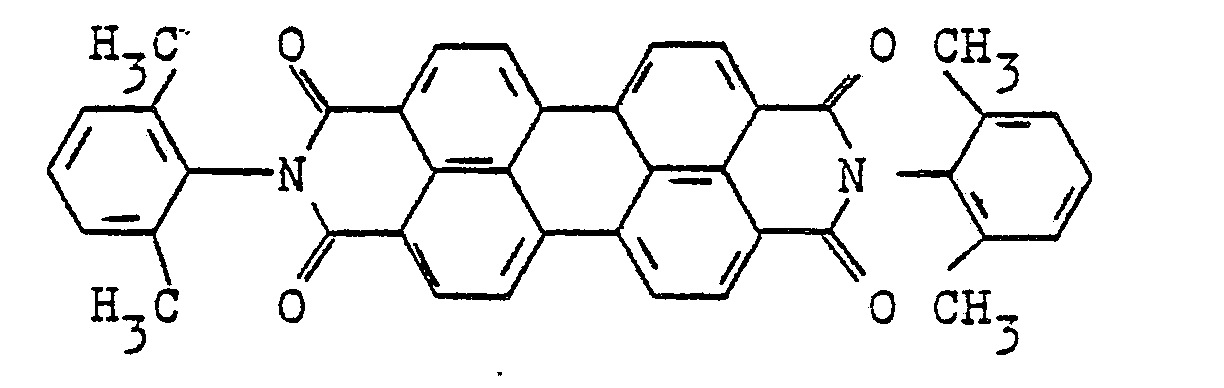
- 1000 Teile Polymethylacrylatgranulat werden mit 0,05 Teilen des Farbstoffs der Formel

- Entsprechend den Beispielen 1 oder 2 werden Fluoreszenzplatten mit Farbstoffen der Formel


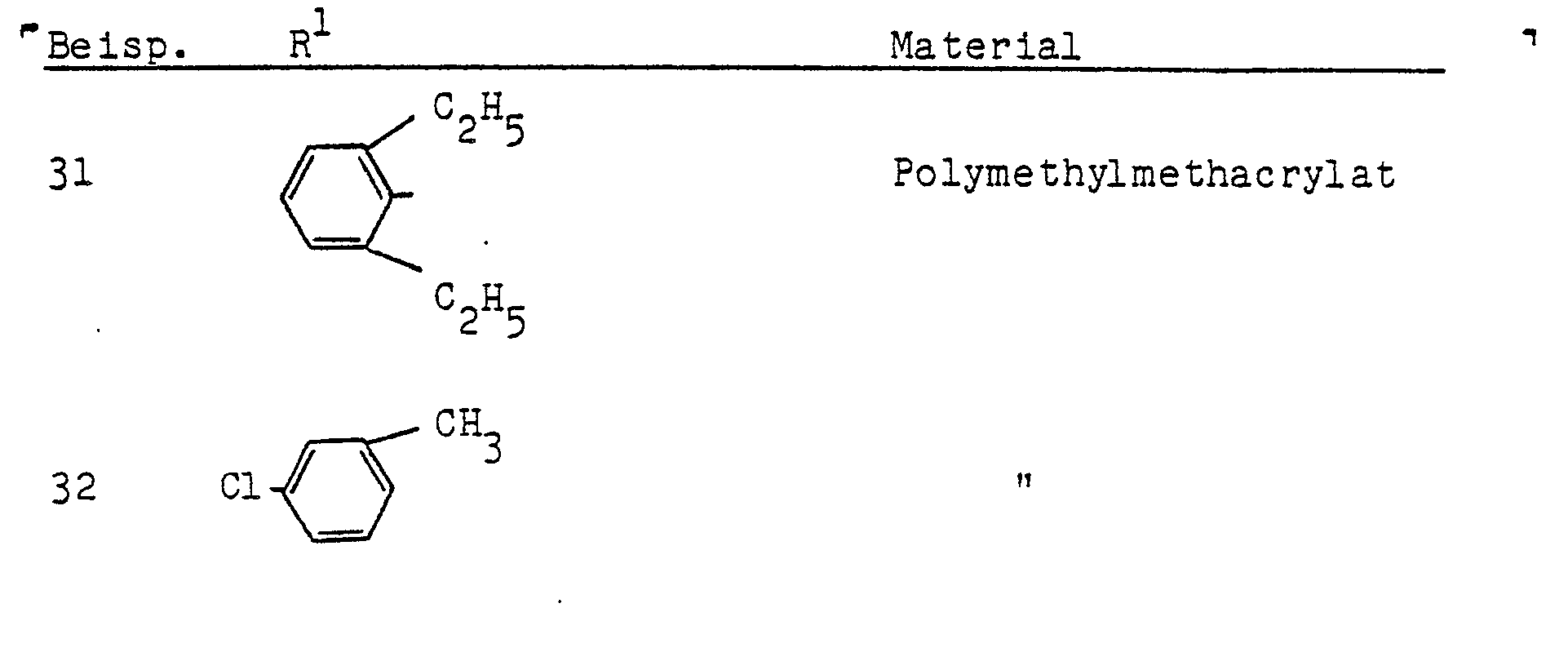
- Man verfährt wie in Beispiel 2 angegeben, verwendet jedoch als Medium Polymethylmethacrylat und den Farbstoff der Formel -

- In 840 Teilen Chinolin werden bei 100°C 40,8 Teile kristallisiertes Zinkacetat, 117 Teile Perylentetracarbonsäu- re und 135 Teile 2,4-Diisopropylanilin eingetragen. Unter überleiten eines schwachen Stickstoffstromes erhitzt man auf 225 bis 230°C und hält bei dieser Temperatur, bis eine aufgearbeitete Probe, mit verdünnter Sodalösung aufgekocht, keine Perylentetracarbonsäure mehr anzeigt. Dies ist nach etwa 2 Stunden der Fall. Nach dem Abkühlen auf etwa 100°C wird filtriert, mit Chinolin, dann mit Methanol und anschließend mit Wasser gewaschen. Das Filtergut rührt man mit etwa 1200 Teilen 2%iger wäßriger Sodalösung an, erhitzt auf etwa 95°C, filtriert und wäscht neutral. Spuren möglicherweise noch vorhandener Perylentetracarbonsäure werden dabei entfernt. Nach dem Trocknen erhält man den Farbstoff mit sehr guter Ausbeute.
- Verfährt man wie vorstehend angegeben, verwendet jedoch anstelle des 2,4-Diisopropylanilins die gleiche Menge 2,5-Diisopropylanilin oder 99 Teile 2-Isopropylanilin, so erhält man in sehr guten Ausbeuten Perylentetracarbonsäure-N,N'-bis-(2',5'-diisopropylanilid), bzw. -N,N'-bis-(2'--isopropylanilid).
- 0,05 Teile Perylen-3,4,9,10-tetracarbonsäure-bis-(2',4'--diisopropylanilid) werden in einem Schnellmischer mit 100 Teilen gemahlenem Polystyrol-Blockpolymerisat trocken gemischt. Das Gemisch wird auf einer Schneckenpresse bei einer Zylindertemperatur von 200 bis'250 C geschmolzen und homogenisiert. Die gefärbte plastische Masse wird durch Heißabschlagen am Düsenkopf oder durch Ausziehen von Fäden unter Kühlung granuliert. Das so erhaltene Granulat wird anschließend in einer Spritzgußvorrichtung bei 200 bis 2500C zu Formkörpern verspritzt oder auf Pressen zu beliebigen Körpern verpreßt. Man erhält leuchtend orangefarbene Spritzlinge oder Preßlinge, die fluoreszieren und sehr gute Lichtechtheit aufweisen.
- Anstelle von Polystyrol-Blockpolymerisat kann auch ein Polystyrol-Emulsionspolymerisat, ein Suspensionspolymerisat oder ein Mischpolymerisat von Styrol mit Butadien und Acrylnitril oder Acrylestern verwendet werden.
- Ganz ähnliche Färbungen mit praktisch den gleichen Eigenschaften erhält man, wenn man anstelle des Perylen--3,4,9,10-tetracarbonsäure-N,N'-bis-(2',4'-diisopropylani- lids) das Perylen-3,4,9,10-tetracarbonsäure-N,N'-bis--(2',5'-diisopropylanilid) oder das Perylen-3,4,9,10--tetracarbonsäure-N,N'-bis-(2'-isopropylanilid) verwendet.
Claims (8)


Applications Claiming Priority (4)
| Application Number | Priority Date | Filing Date | Title |
|---|---|---|---|
| DE19803001858 DE3001858A1 (de) | 1980-01-19 | 1980-01-19 | Farbstoffe der perylentetracarbonsaeurediimidreihe und deren verwendung zum faerben von kunststoffen |
| DE3001857 | 1980-01-19 | ||
| DE3001858 | 1980-01-19 | ||
| DE19803001857 DE3001857A1 (de) | 1980-01-19 | 1980-01-19 | Verfahren zur flaechenmaessigen konzentrierung von licht |
Publications (2)
| Publication Number | Publication Date |
|---|---|
| EP0033079A1 true EP0033079A1 (de) | 1981-08-05 |
| EP0033079B1 EP0033079B1 (de) | 1984-10-24 |
Family
ID=25783248
Family Applications (1)
| Application Number | Title | Priority Date | Filing Date |
|---|---|---|---|
| EP81100170A Expired EP0033079B1 (de) | 1980-01-19 | 1981-01-13 | Neue Perylen-3,4,9,10-tetracarbonsäurediimide und deren Verwendung |
Country Status (3)
| Country | Link |
|---|---|
| US (1) | US4379934A (de) |
| EP (1) | EP0033079B1 (de) |
| DE (1) | DE3166743D1 (de) |
Cited By (10)
| Publication number | Priority date | Publication date | Assignee | Title |
|---|---|---|---|---|
| EP0055363A1 (de) * | 1980-12-27 | 1982-07-07 | BASF Aktiengesellschaft | Perylentetracarbonsäurediimide und deren Verwendung |
| EP0081766A1 (de) * | 1981-12-15 | 1983-06-22 | Bayer Ag | Lichtsammelsysteme unter Verwendung von halogenierten Perylenderivaten als Lichtwandler |
| US4446324A (en) * | 1980-12-27 | 1984-05-01 | Basf Aktiengesellschaft | Perylenetetracarboxylic acid diimides and their use |
| EP0156997A1 (de) * | 1984-01-13 | 1985-10-09 | BASF Aktiengesellschaft | Verfahren zum flächenmässigen Konzentrieren von Licht |
| EP0422474A3 (en) * | 1989-10-11 | 1991-11-13 | Basf Aktiengesellschaft | Fluorescent pigments |
| EP0465410A1 (de) * | 1990-06-27 | 1992-01-08 | Ciba-Geigy Ag | Perylentetracarbonsäurediimide mit langkettigen Alkanoylaminoresten |
| EP0327162A3 (de) * | 1988-02-01 | 1992-05-27 | Philips Patentverwaltung GmbH | Anzeigevorrichtung |
| EP0637493A1 (de) * | 1993-08-02 | 1995-02-08 | NORDICA S.p.A. | Verfahren zur Herstellung von Spritzgiessteilen mit ausgewählter Opazität oder Transparenz |
| EP0727457A3 (de) * | 1995-02-14 | 1996-11-13 | Constab Polymer Chemie Gmbh | Pigmenthaltige Zusammensetzung eines hochtemperaturbeständigen Kunststoffs |
| EP3101087A1 (de) * | 2015-06-03 | 2016-12-07 | Basf Se | Mehrfachchromophore auf mit einem perylenediimidgerüst |
Families Citing this family (18)
| Publication number | Priority date | Publication date | Assignee | Title |
|---|---|---|---|---|
| DE3934190A1 (de) * | 1989-10-13 | 1991-04-18 | Basf Ag | Malonsaeurefarbstoffe und deren polykondensationsprodukte |
| DE3934329A1 (de) * | 1989-10-13 | 1991-04-18 | Basf Ag | Polymerisierbare perylen-3,4,9,10-tetracarbonsaeurebisimide sowie deren polymerisate |
| US5280121A (en) * | 1990-06-27 | 1994-01-18 | Ciba-Geigy Corporation | Perylenetetracarboxylic acid diimides containing long-chain alkanoylamino radicals |
| DE4424817A1 (de) * | 1994-07-14 | 1996-01-18 | Basf Ag | Vernetzte Polymerteilchen mit Fluoreszenzfarbstoff |
| JP2001518078A (ja) * | 1997-03-05 | 2001-10-09 | チバ スペシャルティ ケミカルズ ホールディング インコーポレーテッド | クラウンエーテル誘導化ペリレン |
| US6893147B2 (en) | 2002-04-05 | 2005-05-17 | General Electric Company | Lamp lens or bezel with visual effect |
| US7718238B2 (en) * | 2002-05-13 | 2010-05-18 | Sabic Innovative Plastics Ip B.V. | Plastics articles such as bottles with visual effect |
| DE10226181A1 (de) * | 2002-06-12 | 2003-12-24 | Basf Ag | Verfahren zur Überführung von Perylen-3,4:9,10-tetracarbonsäurediimide in eine für die Anwendung als Fluoreszenzfarbmittel geeignete Form |
| US20090229652A1 (en) * | 2008-01-14 | 2009-09-17 | Mapel Jonathan K | Hybrid solar concentrator |
| ES2438490T3 (es) * | 2008-03-03 | 2014-01-17 | Basf Se | Microcápsulas, su producción y empleo |
| US20100139749A1 (en) * | 2009-01-22 | 2010-06-10 | Covalent Solar, Inc. | Solar concentrators and materials for use therein |
| US9287419B2 (en) | 2011-01-05 | 2016-03-15 | Nitto Denko Corporation | Wavelength conversion perylene diester chromophores and luminescent films |
| WO2013049062A2 (en) | 2011-09-26 | 2013-04-04 | Nitto Denko Corporation | Highly-fluorescent and photo-stable chromophores for enhanced solar harvesting efficiency |
| WO2013052381A2 (en) | 2011-10-05 | 2013-04-11 | Nitto Denko Corporation | Wavelength conversion film having pressure sensitive adhesive layer to enhance solar harvesting efficiency |
| CN110431140B (zh) | 2017-01-18 | 2022-11-01 | 巴斯夫欧洲公司 | 基于氰基芳基取代的亚萘甲酰基苯并咪唑化合物的荧光着色剂 |
| JP7297756B2 (ja) | 2017-12-19 | 2023-06-26 | ビーエーエスエフ ソシエタス・ヨーロピア | シアノアリール置換ベンゾ(チオ)キサンテン化合物 |
| US11898075B2 (en) | 2018-03-20 | 2024-02-13 | Basf Se | Yellow light emitting device |
| KR102840276B1 (ko) | 2018-06-22 | 2025-07-30 | 바스프 에스이 | 디스플레이 및 조명 응용분야를 위한 녹색 방출체로서의 광안정성 시아노-치환된 붕소-디피로메텐 염료 |
Family Cites Families (11)
| Publication number | Priority date | Publication date | Assignee | Title |
|---|---|---|---|---|
| GB852202A (en) | 1956-03-31 | 1960-10-26 | Hoechst Ag | New dyestuff of the perylene tetracarboxylic acid series |
| FR78658E (fr) | 1960-09-05 | 1962-08-24 | Sandoz Sa | Application de dérivés du pérylène pour teindre dans la masse |
| DE1190118B (de) | 1963-11-22 | 1965-04-01 | Bayer Ag | Fotowiderstaende und Fotoelemente mit erhoehter Empfindlichkeit im kurzwelligen Spektralgebiet |
| DE2139688A1 (de) | 1971-08-07 | 1973-02-15 | Basf Ag | Farbstoffe zum faerben von kunststoffen |
| DE2147024A1 (de) | 1971-09-21 | 1973-03-29 | Basf Ag | Farbstoffe der perylentetracarbonsaeurediimidreihe |
| DE2210170A1 (de) | 1972-03-03 | 1973-09-06 | Basf Ag | Farbstoff der perylentetracarbonsaeurediimidreihe |
| CH562852A5 (en) | 1972-08-15 | 1975-06-13 | Basf Ag | Perylene tetracarboxylic diimide dyes - contg n-substd pyrazole groups,for mass-colouring of plastics |
| DE2525630A1 (de) | 1975-06-09 | 1976-12-30 | Gerhard Von Dipl Ing Hacht | Einrichtung zur umsetzung von strahlungsenergie, insbesondere sonnenstrahlung in elektrischen strom |
| CH612541A5 (de) * | 1976-05-06 | 1979-07-31 | Fraunhofer Ges Forschung | |
| GB2019026B (en) | 1978-04-12 | 1982-07-07 | Secr Defence | Liquid crystal display devices |
| DE2851513C3 (de) | 1978-11-29 | 1993-11-18 | Bayer Ag | Lichtsammelsystem |
-
1980
- 1980-12-08 US US06/214,228 patent/US4379934A/en not_active Expired - Lifetime
-
1981
- 1981-01-13 DE DE8181100170T patent/DE3166743D1/de not_active Expired
- 1981-01-13 EP EP81100170A patent/EP0033079B1/de not_active Expired
Cited By (11)
| Publication number | Priority date | Publication date | Assignee | Title |
|---|---|---|---|---|
| EP0055363A1 (de) * | 1980-12-27 | 1982-07-07 | BASF Aktiengesellschaft | Perylentetracarbonsäurediimide und deren Verwendung |
| US4446324A (en) * | 1980-12-27 | 1984-05-01 | Basf Aktiengesellschaft | Perylenetetracarboxylic acid diimides and their use |
| EP0081766A1 (de) * | 1981-12-15 | 1983-06-22 | Bayer Ag | Lichtsammelsysteme unter Verwendung von halogenierten Perylenderivaten als Lichtwandler |
| US4492648A (en) * | 1981-12-15 | 1985-01-08 | Bayer Aktiengelsellschaft | Light-collecting systems using halogenated perylene derivatives as light converters |
| EP0156997A1 (de) * | 1984-01-13 | 1985-10-09 | BASF Aktiengesellschaft | Verfahren zum flächenmässigen Konzentrieren von Licht |
| EP0327162A3 (de) * | 1988-02-01 | 1992-05-27 | Philips Patentverwaltung GmbH | Anzeigevorrichtung |
| EP0422474A3 (en) * | 1989-10-11 | 1991-11-13 | Basf Aktiengesellschaft | Fluorescent pigments |
| EP0465410A1 (de) * | 1990-06-27 | 1992-01-08 | Ciba-Geigy Ag | Perylentetracarbonsäurediimide mit langkettigen Alkanoylaminoresten |
| EP0637493A1 (de) * | 1993-08-02 | 1995-02-08 | NORDICA S.p.A. | Verfahren zur Herstellung von Spritzgiessteilen mit ausgewählter Opazität oder Transparenz |
| EP0727457A3 (de) * | 1995-02-14 | 1996-11-13 | Constab Polymer Chemie Gmbh | Pigmenthaltige Zusammensetzung eines hochtemperaturbeständigen Kunststoffs |
| EP3101087A1 (de) * | 2015-06-03 | 2016-12-07 | Basf Se | Mehrfachchromophore auf mit einem perylenediimidgerüst |
Also Published As
| Publication number | Publication date |
|---|---|
| US4379934A (en) | 1983-04-12 |
| EP0033079B1 (de) | 1984-10-24 |
| DE3166743D1 (en) | 1984-11-29 |
Similar Documents
| Publication | Publication Date | Title |
|---|---|---|
| EP0033079B1 (de) | Neue Perylen-3,4,9,10-tetracarbonsäurediimide und deren Verwendung | |
| DE3434059C2 (de) | Tetrachlorperylen-3,4,9,10-tetracarbonsäurediimide | |
| EP0156997B1 (de) | Verfahren zum flächenmässigen Konzentrieren von Licht | |
| EP0133156B1 (de) | Neue 1,4-Diketopyrrolo-(3,4-c)-pyrrole | |
| EP0054217B1 (de) | Anthrachinonfarbstoffe, Verfahren zu ihrer Herstellung, ihre Verwendung sowie flüssigkristalline Materialien enthaltend Anthrachinonfarbstoffe | |
| EP0256983B1 (de) | Feste Lösungen von Pyrrolo-[3,4-c]-pyrrolen | |
| EP3470467B1 (de) | Methinfarbstoffe zum färben von kunststoffen | |
| EP0227980B1 (de) | Fluoreszierende aroxysubstituierte Perylen-3,4,9,10-tetracarbonsäurediimide und ihre Verwendung zur flächenmässigen Konzentrierung von Licht | |
| EP3470471A1 (de) | Methinfarbstoffe | |
| EP0056870B1 (de) | Neues Perylen-3,4,9,10-tetracarbonsäurediimid und dessen Verwendung | |
| EP3508536A1 (de) | Methinfarbstoffe zum massefärben von synthetischen polyamiden | |
| EP0769532A1 (de) | Naphthalinlactamimid-Fluoreszenzfarbstoffe | |
| DE3235526C2 (de) | Substituierte Perylen-3,4,9,10-tetracarbonsäurediimide | |
| DE2157547C3 (de) | ||
| EP0055363B1 (de) | Perylentetracarbonsäurediimide und deren Verwendung | |
| DE3001857A1 (de) | Verfahren zur flaechenmaessigen konzentrierung von licht | |
| DE3609804A1 (de) | Thiazolyl-cyan-cumarine und ihre verwendung zur flaechenmaessigen konzentrierung von licht | |
| DE2532540A1 (de) | Neue disazopigmente und verfahren zu deren herstellung | |
| DE2147024A1 (de) | Farbstoffe der perylentetracarbonsaeurediimidreihe | |
| DE2146027A1 (de) | Farbstoffe der perylentetracarbonsaeurediimidreihe | |
| DE2616486A1 (de) | Farbstoffe der perylentetracarbonsaeurediimidreihe | |
| DE3049215A1 (de) | Perylentetracarbonsaeurediimid und dessen verwendung | |
| CH562852A5 (en) | Perylene tetracarboxylic diimide dyes - contg n-substd pyrazole groups,for mass-colouring of plastics | |
| DE3001858A1 (de) | Farbstoffe der perylentetracarbonsaeurediimidreihe und deren verwendung zum faerben von kunststoffen | |
| EP0163609A2 (de) | Verfahren zum Färben von hochmolekularem organischem Material, neue polycyclische Verbindungen sowie deren Herstellung |
Legal Events
| Date | Code | Title | Description |
|---|---|---|---|
| PUAI | Public reference made under article 153(3) epc to a published international application that has entered the european phase |
Free format text: ORIGINAL CODE: 0009012 |
|
| AK | Designated contracting states |
Designated state(s): CH DE FR GB IT |
|
| 17P | Request for examination filed |
Effective date: 19820128 |
|
| ITF | It: translation for a ep patent filed | ||
| GRAA | (expected) grant |
Free format text: ORIGINAL CODE: 0009210 |
|
| AK | Designated contracting states |
Designated state(s): CH DE FR GB IT LI |
|
| REF | Corresponds to: |
Ref document number: 3166743 Country of ref document: DE Date of ref document: 19841129 |
|
| ET | Fr: translation filed | ||
| PLBE | No opposition filed within time limit |
Free format text: ORIGINAL CODE: 0009261 |
|
| STAA | Information on the status of an ep patent application or granted ep patent |
Free format text: STATUS: NO OPPOSITION FILED WITHIN TIME LIMIT |
|
| 26N | No opposition filed | ||
| ITTA | It: last paid annual fee | ||
| PGFP | Annual fee paid to national office [announced via postgrant information from national office to epo] |
Ref country code: CH Payment date: 19971219 Year of fee payment: 18 |
|
| PGFP | Annual fee paid to national office [announced via postgrant information from national office to epo] |
Ref country code: GB Payment date: 19980102 Year of fee payment: 18 |
|
| PG25 | Lapsed in a contracting state [announced via postgrant information from national office to epo] |
Ref country code: GB Free format text: LAPSE BECAUSE OF NON-PAYMENT OF DUE FEES Effective date: 19990113 |
|
| PG25 | Lapsed in a contracting state [announced via postgrant information from national office to epo] |
Ref country code: LI Free format text: LAPSE BECAUSE OF NON-PAYMENT OF DUE FEES Effective date: 19990131 Ref country code: CH Free format text: LAPSE BECAUSE OF NON-PAYMENT OF DUE FEES Effective date: 19990131 |
|
| GBPC | Gb: european patent ceased through non-payment of renewal fee |
Effective date: 19990113 |
|
| REG | Reference to a national code |
Ref country code: CH Ref legal event code: PL |
|
| PGFP | Annual fee paid to national office [announced via postgrant information from national office to epo] |
Ref country code: FR Payment date: 19991215 Year of fee payment: 20 |
|
| PGFP | Annual fee paid to national office [announced via postgrant information from national office to epo] |
Ref country code: DE Payment date: 19991223 Year of fee payment: 20 |