EP0033453A1 - Système et procédé pour l'impression de copies recto verso - Google Patents
Système et procédé pour l'impression de copies recto verso Download PDFInfo
- Publication number
- EP0033453A1 EP0033453A1 EP81100296A EP81100296A EP0033453A1 EP 0033453 A1 EP0033453 A1 EP 0033453A1 EP 81100296 A EP81100296 A EP 81100296A EP 81100296 A EP81100296 A EP 81100296A EP 0033453 A1 EP0033453 A1 EP 0033453A1
- Authority
- EP
- European Patent Office
- Prior art keywords
- count
- copy
- sheets
- printing
- copies
- Prior art date
- Legal status (The legal status is an assumption and is not a legal conclusion. Google has not performed a legal analysis and makes no representation as to the accuracy of the status listed.)
- Granted
Links
- 238000007639 printing Methods 0.000 title claims description 90
- 238000000034 method Methods 0.000 title claims description 24
- 239000000463 material Substances 0.000 claims description 18
- 238000011084 recovery Methods 0.000 abstract description 37
- 238000003384 imaging method Methods 0.000 abstract description 5
- 230000000717 retained effect Effects 0.000 abstract 1
- 230000000694 effects Effects 0.000 description 11
- 230000000007 visual effect Effects 0.000 description 3
- 230000008859 change Effects 0.000 description 2
- 230000004044 response Effects 0.000 description 2
- 101150045677 ACA2 gene Proteins 0.000 description 1
- 101100214868 Autographa californica nuclear polyhedrosis virus AC54 gene Proteins 0.000 description 1
- 101100377936 Saccharomyces cerevisiae (strain ATCC 204508 / S288c) CST6 gene Proteins 0.000 description 1
- 230000003247 decreasing effect Effects 0.000 description 1
- 230000007812 deficiency Effects 0.000 description 1
- 230000002950 deficient Effects 0.000 description 1
- 238000005516 engineering process Methods 0.000 description 1
- 230000006870 function Effects 0.000 description 1
- 230000007246 mechanism Effects 0.000 description 1
- 230000001343 mnemonic effect Effects 0.000 description 1
- 230000008569 process Effects 0.000 description 1
- 230000003134 recirculating effect Effects 0.000 description 1
Images





Classifications
-
- G—PHYSICS
- G03—PHOTOGRAPHY; CINEMATOGRAPHY; ANALOGOUS TECHNIQUES USING WAVES OTHER THAN OPTICAL WAVES; ELECTROGRAPHY; HOLOGRAPHY
- G03G—ELECTROGRAPHY; ELECTROPHOTOGRAPHY; MAGNETOGRAPHY
- G03G21/00—Arrangements not provided for by groups G03G13/00 - G03G19/00, e.g. cleaning, elimination of residual charge
- G03G21/02—Counting the number of copies; Billing
-
- G—PHYSICS
- G03—PHOTOGRAPHY; CINEMATOGRAPHY; ANALOGOUS TECHNIQUES USING WAVES OTHER THAN OPTICAL WAVES; ELECTROGRAPHY; HOLOGRAPHY
- G03G—ELECTROGRAPHY; ELECTROPHOTOGRAPHY; MAGNETOGRAPHY
- G03G15/00—Apparatus for electrographic processes using a charge pattern
- G03G15/22—Apparatus for electrographic processes using a charge pattern involving the combination of more than one step according to groups G03G13/02 - G03G13/20
- G03G15/23—Apparatus for electrographic processes using a charge pattern involving the combination of more than one step according to groups G03G13/02 - G03G13/20 specially adapted for copying both sides of an original or for copying on both sides of a recording or image-receiving material
- G03G15/231—Arrangements for copying on both sides of a recording or image-receiving material
- G03G15/232—Arrangements for copying on both sides of a recording or image-receiving material using a single reusable electrographic recording member
- G03G15/234—Arrangements for copying on both sides of a recording or image-receiving material using a single reusable electrographic recording member by inverting and refeeding the image receiving material with an image on one face to the recording member to transfer a second image on its second face, e.g. by using a duplex tray; Details of duplex trays or inverters
Definitions
- This invention relates to duplex copy printing systems and methods.
- Copying of material is well known and many diverse systems and methods have heretofore been suggested and used to achieve the desired end.
- One such system is an electrical-signal-driven printer wherein signals representative of the visual images on each page to be printed are supplied to the printer in numerical page order. If only one side of a recording medium (such as a paper copy sheet, for example) is to have an image printed thereon, each signal may be used when received to print the visual image on sheets as fed through the printer.
- the electrical signals must be inserted, when received, in some form of a recirculating delay line and the delay line recycled as needed to print the number of copies desired.
- each electrical signal representative of a page to be imaged is brought to a copying, or printing, area where the image is formed on the sheet and the sheet then discharged from the printer.
- duplex copies i.e. copies having an image on both sides of the copy sheet
- different electrical signals representative of each page must be brought at different times to the printing area and the copy sheet must be brought to the printing area with one side exposed for printing during a first pass and the opposite side exposed for printing during a subsequent second pass.
- further complications are introduced when multiple copies of each page are to be printed.
- Job recovery has been heretofore suggested and used with respect to copying devices, including those capable of printing multiple copies and effecting duplex copying. Such job recovery, however, has not been completely satisfactory, at least for all instances, and particularly with respect to recovery from jams occurring during second side copying of multiple duplex copies.
- This invention seeks to provide an improved method and system for printing complete sets of duplex copies including generation of replacement copies due to jams.
- a system for printing duplex copies comprising printing means for printing images on copy sheets at a printing area, a storage receptacle for storing copy sheets, a duplex tray and means for causing movement of copy sheets in a copy sheet path from the storage receptacle through the printing area to the duplex tray and from the duplex tray through the printing area to an exit station, is characterised by first sensor means for maintaining a count of copy sheets in duplex tray, second sensor means for maintaining a count of copy sheets received at said exit station, and means, effective upon a jam occurring during normal printing, to determine the copy sheets lost and to cause replacement copies to be printed prior to resumption of normal copy printing.
- a method of printing duplex copies comprising initially sequentially feeding copy sheets to a printing area for printing on one side of the sheets, storing the sheets in a duplex tray after copying has occurred on one side, sequentially feeding the copy sheets in the duplex tray to the printing area for copying on the other side of the sheets, and then collecting the sheets twice fed through the printing area at an exit station, is characterised by maintaining a count of copy sheets in the duplex tray and a count of copy sheets at the exit station, determining, upon occurrence of a jam during normal printing, at least in part from the counts, copies lost due to the jam, and using the determination of copies lost to generate replacement copies.
- the invention could be defined as a method for generating duplex copies of a plurality of images without loss of copies due to copy material jams occurring during copy generation, comprising sequentially providing to a printing area at least a representation of each image to be printed, providing dual-sided copy material to the printing area with the copy material being capable of having an image printed on each side thereof, causing the image then being represented at the printing area to be printed on a predetermined first side of the copy material, storing the copy material having an image on the first side thereof in a duplex tray, maintaining a count of copy material in the duplex tray; causing the copy material to be withdrawn from the duplex tray and fed to the printing area for printing on the second side thereof of a different image represented at the printing area, moving to an exit station the copy material twice fed to the printing area, maintaining a count of copy material received at the exit station, interrupting copy generation whenever a jam occurs with respect to the copy material, using the counts to determine copied images lost from each side of copy material involved in the jam; representing at the printing area the representation of images
- Such a method may include placing the new copies in the duplex tray when the new copies are made to replace copies lost due to a jam of the copy material that occurs during the second side copying.
- Such a method may also include providing a count of total pages in a set of images to be copied, dividing the count of total pages by two and then subtracting therefrom the count of copy material in the duplex tray and the count of copy material received at the exit station.
- such a method may also include providing a count of the copy sheets fed to the printing area for determination of completion of each set of copies being generated.
- the invention may alternatively be defined as a method for printing images of both sides of each of a plurality of recording media in response to received electrical signals representative of the images without loss of printed images due to jams occurring with respect to the recording media, comprising providing first and second pluralities of electrical signals representative of first and second groups of images, respectively, presenting the first plurality of electrical signals at a printing area to thereby cause the first group of images to be printed on one side of the recording media, storing the recording media with the images on one side thereof in a duplex tray, maintaining a count of recording media in the duplex tray, presenting the second plurality of electrical signals at the printing area along with the recording media withdrawn from the duplex tray thereby to cause the second group of images to be printed on the other side of the recording media, passing the recording media having been twice presented at the printing area to an exit pocket, maintaining a count of recording media passed to the exit pocket, interrupting printing of images on the other side of recording media when a jam occurs with respect to the recording media, using the counts to determine printed images of both the first and
- Such a method may include determining the total number of images made during printing exclusive of images made to replace images lost due to jams, and using the determination for billing purposes.
- determination of the total number of images made exclusive of images made to replace images lost due to jams may include maintaining a count of the number of images made on each side of the recording media and precluding an increase of the count when printing images to replace lost images.
- the invention extends to a method for billing the total number of images copied by a device for printing duplex copies wherein copy sheets are stored in a duplex tray after printing on one side and moved to an exit station after printing on both sides, and wherein replacement copies are generated to replace copies lost due to jams, double feeds or blank pages, comprising maintaining a count of copy sheets stored in the duplex tray, maintaining a count of copy sheets received at the exit station after being copied on both the first and second sides, determining the number of replacement copies made by the device to replace copies lost due to jams, double feeds or blank pages, and determining from the counts the total number of copies to be billed, the total number of copies to be billed being exclusive of the replacement copies determined to have been made.
- the invention further extends to a system for effecting job recovery in a printing device having a storage receptacle for storing copy sheets, a duplex tray for storing copy sheets with one side having copy thereon, and means establishing a path for the copy sheets from the storage receptacle through a printing area to the duplex tray and from the duplex tray through the printing area to a copy sheet exit station, comprising first means for determining the number of copy sheets withdrawn from the storage receptacle and from the duplex tray, second means for determining the number of copy sheets in the duplex tray, third means for determining the number of copy sheets received at the copy sheet exit station, and means connected with the first, second and third determining means and responsive thereto for causing the printing device to generate replacement copies due to copy sheet losses occurring during a jam.
- the printer 21 may be used to form an image (normally visual although nonvisual images could also be formed) on a recording medium (such as a discrete paper sheet, although a continuous web surface could also be utilized).
- a recording medium such as a discrete paper sheet, although a continuous web surface could also be utilized.
- the image is formed in response to an electrical signal representative of the image when the electrical signal representation is presented,at a copying, or printing, area.
- the recording media, in the form of copy sheets, are transported to the copying area one by one so that the image is formed thereon in the manner disclosed and only those details of the printer as are necessary for an understanding of this invention are described herein.
- Blank copy sheets from a copy sheet tray 31 are transported to a rotating xerographic drum 25 which has thereon the image to be printed.
- copy sheets are fed past a transfer station 27 where the images are transferred onto one side of the sheet at the copying, or printing, area.
- Each sheet printed at transfer station 27 is then transferred along a copy sheet path through a fixing, or fusing, station 29. Thereafter copy sheets are transported either along a path 39 to an exit pocket 43 or along a path 45 to a duplex tray 33.
- Copy sheets with no printing on either side are initially withdrawn from the copy sheet tray 31, whereas copy sheets printed on one side are withdrawn from the duplex tray 33.
- the withdrawn copy sheet is fed along a copy sheet path 35 through a synchronizing gate 37 prior to being conveyed to transfer station 27 so that each sheet is fed to the transfer station in synchronism with the movement of the image on drum 25.
- the path of the copy sheet is controlled by a diversion vane 47. If the copy sheet is transported along path 39, it can be reversed by reversing means 41. Finished copy sheets 23 accumulate in the exit pocket 43.
- a FED sensor 49 is located alongside the path 35 to effect a count of all copy sheets, whether from copy sheet tray 31 or duplex tray 33, fed to the copying area.
- an EXIT sensor 51 is located adjacent the exit pocket 43 to effect a count of copy sheets discharged from the copy area along path 39, and hence effectively discharged from the printer.
- a TRAY sensor 53 is located at the duplex tray 33 to sense the presence of any copy sheet in the duplex tray, and indicates either that the duplex tray is empty or not empty, having at least one copy therein.
- An additional sensor 55 is located alongside the path 45 to effect a count of all copy sheets fed into the duplex tray 33.
- a corresponding counter is provided in a processor 57, which processor may be a microprocessor which includes processing for the entire operation of the printer and which controls imaging and copy sheet control unit 59 as disclosed in US -4,099,254, FR-2,366,129 and DE-2,744,323.
- the processor also includes an indicator controlled by the sensor 53.
- the function of the processor 57 is for job recovery as described hereinafter.
- the processor 57 also receives information as to the total number of prints imaged for the set then being printed from PRINTINT register 61, information as to the total number of pages for the set from SI GNUMBR register 63, and information as to the number of sets then made for a particular job from NUMSETS register 65.
- the processor 57 is also connected to an INTERRUPT switch 67 for effecting interruption of copying as desired by an operator.
- printer 21 operates generally by writing one page of data at a time in alternating memory files so that page 1 is written on a first file (file 1), page 2 is written on a second file (file 0), page 3 is then written on file 1 immediately next to page 1, and so forth until all pages are written.
- the data are then read back for duplex copy printing purposes by reading the entire first file (file 1) before reading the second file (file 0).
- all of the pointers of the first file are reversed so that the last page (page 9, for example) is read first followed by each immediately adjacent page (pages 7, 5, 3 and then 1, for example) with each copy sheet imaged for the odd numbered pages of file 1, i.e. copy sheets having an image on one side thereof, being transferred to duplex tray 33.
- the copy sheet carrying page 9 is stored at the bottom of duplex tray 33 with the copy sheets carrying pages 7, 5, 3 and then 1 being stacked thereabove.
- file 0 is read in regular, or normal, order as written, that is, pages 2, 4, 6, 8 and then 10, with each of the even numbered pages being printed on copy sheets withdrawn from duplex tray 33.
- the copy sheets in the duplex tray 33 have their printed faces uppermost and the tray is a Last In First Out (LIFO) storage.
- LIFO Last In First Out
- each copy sheet is imaged on the opposite side and the copy sheets twice exposed at the printing area are then conveyed to exit pocket 43, where a complete set is collected with each copy sheet having an odd numbered page on one side and the immediately following even number page on the opposite side, i.e. the first copy sheet has page 1 on one side and page 2 on the opposite side, the second copy sheet has page 3 on one side and page 4 on the other side, and so on.
- recovery can be effected by simply reprinting the copies lost.
- two copies are lost due to a jam
- two replacement copies are generated after clearing the jam, and the printing job can proceed in the normal manner.
- the number of lost copies must first be determined and then replacement copies must be generated with each replacement requiring printing of the first side of each copy sheet before copy generation can be continued in normal fashion with respect to second side printing.
- a first count is maintained of the total number of pages fed to the printing area, sensed by sensor 49 and counted in the FED counter, for determining when each set to be copied is complete and the next set started; a second count is maintained of the number of copy sheets then in the duplex tray, sensed by sensors 55 and 49 and counted in the TRAY # counter; and a third count is maintained of the number of copy sheets reaching the exit pocket, sensed by sensor 51 and counted in the EXIT # counter.
- the count in TRAY # counter is increased by signals from sensor 55 and decreased by signals from sensor 49 during second side copying.
- a jam occurs during side one copying, replacement sheets are generated after the jam is cleared and normal copy generation is continued.
- a determination is made of sheets lost in the jam by subtracting the count of sheets in the TRAY # counter and in the EXIT # coun er from one-half the total number of pages in the set, then the first sides of pages determined to have been lost are recopied, and those replacement pages placed in the duplex tray, after which the normal printing operation is continued except that those pages that made it to the exit pocket before occurrence of the jam are not reprinted.
- the number of pages lost in a jam is determined by the formula : where TP equals total number of pages in the set to be printed, C T equals the count in the duplex TRAY # counter, and C equals the count in the EXIT counter.
- the imaging control unit is then recycled to cause the electrical signals indicative of the pages on file 1 (odd numbered pages) to be presented at the copying area and new or replacement copies are printed for pages 7, 5 and 3.
- Double sheet feeds can occur both into and out of the duplex tray. Double feed is corrected by remaking the entire set. Hence, here again, rebilling for pages serving as replacement copies must be precluded. Likewise, precluding a billing for blank pages must be effected for accurate billing information.
- Control of processing for achieving the abovementioned ends can be effected by means of a software program for the processor, which processor is preferably a microprocessor, and may be of the type shown, for example, US-4,086,658, DE-2,743,284, FR-2,366,625 and GB-1,532,609.
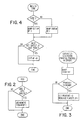
- the FED signal initiates, not only an increase in the count in the FED counter but also (FIGURE 2) a decision whether the copier is in duplex mode and the copy sheet comes from the duplex tray. If so, the TRAY number counter is decremented by one when SIDE 2 and duplex copying is being carried out. This is effected in the program steps at addresses 7FD6 to 7FDE, and is necessary to maintain the proper count in the TRAY number counter to enable job recovery as described above.
- the count in the PRINTINT register 61 is incremented ( Figure 3) as a print is made by interrupting the character generator in the imaging unit of the printer, as indicated in the program addresses A8CB to A8CD. This initiates a check to determine whether the count in the PRINTINT register equals the count in the SIGNUMBR, thus indicating that the set is completed. If so, the PRINTINT register is reset to zero and the count in the NUMSETS register is increased by one thus bumping the SET count, as indicated in the program addresses A8EA to A912 and A925 to A938.
- billing takes place each time a print is made.
- a determination is made as to whether SIDE 2 is being printed. If so the sheet just billed goes into the exit pocket and the EXIT number counter is increased by one. If not, then the TRAY number counter is increased by one. This is effected by program steps at addresses AC47 to AC54. In either case, when the entire set is indicated to be in the exit pocket, then the EXIT number counter is reset to zero. This is effected by comparing the count in the PRINTINT register with the count in the EXIT number counter, program addresses AC55 to AC80.
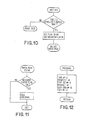
- the recovery registers are set up so that the count in SKIP1ST # is zero, and those in SKIP2ND # and PRINTINT are each equal to twice the EXIT number count (program steps BC19 to BC20). Then the count in REMAKE # is made equal to half the count in SIGNUMBR less the counts in EXIT and TRAY (program steps 9CBF to 9CD6). The count in NUMSETS is made zero. Set up is then completed by setting the printer for side one printing.
- program addresses 9D4D to 9D51 and, if not, more pages are brought in program addresses 9D53 to 9D6A.
- the SKIP1ST # register is decremented by one (program addresses 9D6B to 9D6D). It is then determined whether there are any more pages to skip (program address 9D6E) and, if so, skipping of pages is repeated. When all pages to be skipped have been skipped, the first page in the page buffer is that which needs to be printed to effect job recovery.
- the REMAKE number is greater than zero, then it is decremented by one (program addresses 9E45 to 9E47). If it then equals zero, a special side change control is effected to change from side one to side two after this page is placed in the duplex tray (program addresses 9E48 to 9E4E).
- program addresses 9E48 to 9E4E When the REMAKE # is found to be equal to zero, the program allows the system to print the page, unless SKIP2ND is not equal to zero. After the page is printed, the order will be entered again until all pages to be skipped are skipped and all pages to be printed have been printed.
- a copy interrupt sets up the recovery registers so that the background print job will continue from the point of interruption when the copy job is complete.
- a copy interrupt occurs, (Fig.8), it is determined whether a first set is being printed, and, if so, the recovery registers are set up as described after a jam during the first set (program addresses B64B to B673). If not, copy interrupt is activated on a set boundary so that there is no special recovery requirement, so that the registers are not altered because they are correct.
- a copy interrupt can occur on other than a set boundary for second and subsequent printing sets, but only if a jam occurs or is in progress when a copy interrupt is initiated. If so, jam recovery takes over and sets up the registers appropriately, as described above.
- Special error recovery is provided for double feed which may occur at any time either on prints going into the duplex tray or caning out of the duplex tray.
- a double feed is detected either when during printing out of the duplex tray, the duplex tray becanes empty before canpleting that set (double feed occurring out of duplex tray) or, upon completing the set, there are still sheets in the duplex tray (double feed occurring going into the duplex tray).
- a double feed causes a deficient set of copies to be generated and the point of deficiency cannot be determined since it can be anywhere in the set. This means that the entire set needs to be remade.
- a billing inhibit control is provided in the printer and can be the same mechanism for both copy and print modes. When a copy interrupt occurs, it must reflect the proper inhibit state in the proper mode (print or copy).
- Any page can be forced blank by an operator, and such pages are not to be billed. At the time a page is printed there may be several other prints in the paper path on their way to the exit pocket. It is important to inhibit billing on the correct pages and not to inhibit billing on an arbitrary page due to potential paper jams and recovery necessary for billing control.
- the blank page control byte is a shift register which is shifted each time a sheet is billed with bit zero indicating that the next page is not to be billed.
- the appropriate bit is set in the shift register relative to when a page is ⁇ to be billed.
- the entire set is to be remade and the sides previously billed are not to be rebilled by generation of replacement copies.
- the number of prints billed in the set is added to the prevailing value of the billing inhibit count so that the inhibit count is changed by adding thereto P RINTINT , i.e. the number of sheets to be remade (program addresses BCB8 to BCD8).
- P RINTINT i.e. the number of sheets to be remade
- this embodiment of the invention provides an improved method and system for job recovery and is particularly well suited for automatically effecting job recovery from jams occurring during second side printing of duplex printing copies as well as providing updated billing information in conjunction therewith.
- the embodiment described uses the same technology as the printer to which it is applied. It will be understood, therefore, that the invention could be applied by means of interconnected latch logic control, if, for example, this was used for controlling the operation of the printer.
Landscapes
- Physics & Mathematics (AREA)
- General Physics & Mathematics (AREA)
- Control Or Security For Electrophotography (AREA)
- Counters In Electrophotography And Two-Sided Copying (AREA)
- Controlling Sheets Or Webs (AREA)
- Facsimiles In General (AREA)
- Paper Feeding For Electrophotography (AREA)
- Accessory Devices And Overall Control Thereof (AREA)
Applications Claiming Priority (2)
| Application Number | Priority Date | Filing Date | Title |
|---|---|---|---|
| US06/118,361 US4317629A (en) | 1980-02-04 | 1980-02-04 | Job recovery method and system |
| US118361 | 1998-07-17 |
Publications (2)
| Publication Number | Publication Date |
|---|---|
| EP0033453A1 true EP0033453A1 (fr) | 1981-08-12 |
| EP0033453B1 EP0033453B1 (fr) | 1984-04-18 |
Family
ID=22378099
Family Applications (1)
| Application Number | Title | Priority Date | Filing Date |
|---|---|---|---|
| EP81100296A Expired EP0033453B1 (fr) | 1980-02-04 | 1981-01-16 | Système et procédé pour l'impression de copies recto verso |
Country Status (5)
| Country | Link |
|---|---|
| US (1) | US4317629A (fr) |
| EP (1) | EP0033453B1 (fr) |
| JP (1) | JPS56121056A (fr) |
| CA (1) | CA1155478A (fr) |
| DE (1) | DE3163126D1 (fr) |
Cited By (2)
| Publication number | Priority date | Publication date | Assignee | Title |
|---|---|---|---|---|
| EP0087912B1 (fr) * | 1982-02-26 | 1986-08-13 | Mita Industrial Co. Ltd. | Appareil d'enregistrement |
| EP0619562A1 (fr) * | 1993-03-08 | 1994-10-12 | Canon Kabushiki Kaisha | Appareil d'impression et méthode de traitement de l'impression |
Families Citing this family (16)
| Publication number | Priority date | Publication date | Assignee | Title |
|---|---|---|---|---|
| JPS57178258A (en) * | 1981-04-28 | 1982-11-02 | Canon Inc | Both side recorder |
| US4561772A (en) * | 1983-05-25 | 1985-12-31 | Xerox Corporation | Recirculative document duplex copying |
| JPS60235568A (ja) * | 1984-05-08 | 1985-11-22 | Canon Inc | 情報記憶装置 |
| US4724460A (en) * | 1985-06-28 | 1988-02-09 | Kabushiki Kaisha Toshiba | Copying device |
| US4963946A (en) * | 1986-03-04 | 1990-10-16 | Minolta Camera Kabushiki Kaisha | Copying machine capable of discharging paper without forming image thereon |
| JPS63311272A (ja) * | 1987-06-13 | 1988-12-20 | Minolta Camera Co Ltd | 複写装置 |
| KR0149197B1 (ko) * | 1994-06-14 | 1998-12-15 | 우석형 | 잼 자동제거를 위한 잼용지 자동배출 제어방법 |
| JP3459688B2 (ja) * | 1994-07-25 | 2003-10-20 | キヤノン株式会社 | 画像出力装置および画像出力方法 |
| KR100208698B1 (ko) * | 1997-05-20 | 1999-07-15 | 윤종용 | 잼 복구장치를 장착한 복합기 및 선택적인 잼 복구 방법 |
| US6772232B1 (en) | 1999-08-26 | 2004-08-03 | Hewlett-Packard Development Company, L.P. | Address assignment procedure that enables a device to calculate addresses of neighbor devices |
| JP2004203550A (ja) * | 2002-12-25 | 2004-07-22 | Fuji Xerox Co Ltd | 印刷装置 |
| US20050168767A1 (en) * | 2004-02-02 | 2005-08-04 | International Business Machines Corporation | Method and system for reprinting pages |
| US8179573B2 (en) * | 2004-12-21 | 2012-05-15 | Hewlett-Packard Development Company, L.P. | Scanning two images of media |
| JP4175329B2 (ja) * | 2005-02-28 | 2008-11-05 | ブラザー工業株式会社 | 印刷システム、印刷装置およびプログラム |
| KR20060117065A (ko) * | 2005-05-12 | 2006-11-16 | 삼성전자주식회사 | 토너 절약모드를 이용한 인쇄용지 걸림 제거 방법 및화상형성 장치 |
| JP6658237B2 (ja) * | 2016-04-11 | 2020-03-04 | コニカミノルタ株式会社 | 課金システム、画像形成システム、課金システムの制御方法、及び課金システムの制御プログラム |
Citations (4)
| Publication number | Priority date | Publication date | Assignee | Title |
|---|---|---|---|---|
| US4012032A (en) * | 1975-11-28 | 1977-03-15 | International Business Machines Corporation | Document reproduction having output means with plural outputs operable in a plurality of modes |
| US4090787A (en) * | 1976-02-25 | 1978-05-23 | International Business Machines Corporation | Automatic copier mode controls |
| US4194829A (en) * | 1978-09-15 | 1980-03-25 | Eastman Kodak Company | Apparatus for producing duplex copies |
| US4204730A (en) * | 1977-11-24 | 1980-05-27 | Olympus Optical Co., Ltd. | Electrophotographic apparatus |
Family Cites Families (9)
| Publication number | Priority date | Publication date | Assignee | Title |
|---|---|---|---|---|
| US3588472A (en) * | 1966-11-18 | 1971-06-28 | Xerox Corp | Logic control apparatus |
| US3682544A (en) * | 1970-10-26 | 1972-08-08 | Burroughs Corp | Electronic controller for copying machine |
| US3944794A (en) * | 1972-12-05 | 1976-03-16 | Xerox Corporation | Copying system control |
| US4086658A (en) * | 1976-10-04 | 1978-04-25 | International Business Machines Corporation | Input/output and diagnostic arrangements for programmable machine controllers having multiprogramming capabilities |
| US4099254A (en) * | 1976-10-04 | 1978-07-04 | International Business Machines Corporation | Method and apparatus for electronic collation |
| US4130354A (en) * | 1977-08-30 | 1978-12-19 | Xerox Corporation | Reproduction machine having duplex job recovery capabilities |
| US4163897A (en) * | 1977-10-19 | 1979-08-07 | International Business Machines Corporation | Automatic copy recovery |
| US4206996A (en) * | 1978-05-05 | 1980-06-10 | International Business Machines Corporation | Job recovery method and apparatus |
| US4210319A (en) * | 1978-06-28 | 1980-07-01 | Xerox Corporation | Copy set counter duplex tray |
-
1980
- 1980-02-04 US US06/118,361 patent/US4317629A/en not_active Expired - Lifetime
-
1981
- 1981-01-16 DE DE8181100296T patent/DE3163126D1/de not_active Expired
- 1981-01-16 EP EP81100296A patent/EP0033453B1/fr not_active Expired
- 1981-01-29 CA CA000369669A patent/CA1155478A/fr not_active Expired
- 1981-02-04 JP JP1446481A patent/JPS56121056A/ja active Granted
Patent Citations (4)
| Publication number | Priority date | Publication date | Assignee | Title |
|---|---|---|---|---|
| US4012032A (en) * | 1975-11-28 | 1977-03-15 | International Business Machines Corporation | Document reproduction having output means with plural outputs operable in a plurality of modes |
| US4090787A (en) * | 1976-02-25 | 1978-05-23 | International Business Machines Corporation | Automatic copier mode controls |
| US4204730A (en) * | 1977-11-24 | 1980-05-27 | Olympus Optical Co., Ltd. | Electrophotographic apparatus |
| US4194829A (en) * | 1978-09-15 | 1980-03-25 | Eastman Kodak Company | Apparatus for producing duplex copies |
Cited By (3)
| Publication number | Priority date | Publication date | Assignee | Title |
|---|---|---|---|---|
| EP0087912B1 (fr) * | 1982-02-26 | 1986-08-13 | Mita Industrial Co. Ltd. | Appareil d'enregistrement |
| EP0619562A1 (fr) * | 1993-03-08 | 1994-10-12 | Canon Kabushiki Kaisha | Appareil d'impression et méthode de traitement de l'impression |
| US6048115A (en) * | 1993-03-08 | 2000-04-11 | Canon Kabushiki Kaisha | Printing apparatus and printing processing method |
Also Published As
| Publication number | Publication date |
|---|---|
| JPH036503B2 (fr) | 1991-01-30 |
| DE3163126D1 (en) | 1984-05-24 |
| EP0033453B1 (fr) | 1984-04-18 |
| US4317629A (en) | 1982-03-02 |
| JPS56121056A (en) | 1981-09-22 |
| CA1155478A (fr) | 1983-10-18 |
Similar Documents
| Publication | Publication Date | Title |
|---|---|---|
| EP0033453B1 (fr) | Système et procédé pour l'impression de copies recto verso | |
| DE69221432T2 (de) | Bilderzeugungsgerät mit Längenbestimmung des Aufzeichnungsträgers | |
| EP0295612B1 (fr) | Procédé de commande pour un dispositif à copier double-face/multiplex | |
| US4944031A (en) | Operational condition setting device for an office machine | |
| JPH03102081A (ja) | 両面記録の方法及び装置 | |
| EP2019342B1 (fr) | Appareil de formation d'images pour la formation d'images sur une feuille | |
| JPH041369B2 (fr) | ||
| GB2160063A (en) | Printing system for page printer | |
| US5103267A (en) | Image forming system for performing simplex and duplex recording | |
| US4975738A (en) | Method of forming an image on both sides of a sheet | |
| US5206684A (en) | Recording apparatus including a memory into which information is written in a particular order and from which memory information is read in the reverse order | |
| US4253759A (en) | Copy machine having duplexing feature | |
| US5132720A (en) | Method of forming two-sided prints | |
| JPH07164717A (ja) | ハードウエア取替え間隔を予測する用紙計数値の正規化方法 | |
| US5757509A (en) | Image forming machine | |
| JPH11115280A (ja) | プリンタ | |
| JPH06324569A (ja) | 画像形成装置 | |
| JP3440736B2 (ja) | プリンタ装置 | |
| US5835815A (en) | Image forming machine including a host computer, a printer, a copying machine, and a document supply device | |
| EP0106337B1 (fr) | Appareil d'enregistrement à laser | |
| JPS58101074A (ja) | 像形成装置の制御方式 | |
| JP2522799B2 (ja) | プリンタのプリント制御方法 | |
| US5434601A (en) | Paper feed control system | |
| JP2684724B2 (ja) | 記録装置 | |
| JPH0538865A (ja) | 画像形成装置 |
Legal Events
| Date | Code | Title | Description |
|---|---|---|---|
| PUAI | Public reference made under article 153(3) epc to a published international application that has entered the european phase |
Free format text: ORIGINAL CODE: 0009012 |
|
| AK | Designated contracting states |
Designated state(s): DE FR GB IT NL SE |
|
| 17P | Request for examination filed |
Effective date: 19810828 |
|
| ITF | It: translation for a ep patent filed | ||
| GRAA | (expected) grant |
Free format text: ORIGINAL CODE: 0009210 |
|
| AK | Designated contracting states |
Designated state(s): DE FR GB IT NL SE |
|
| PG25 | Lapsed in a contracting state [announced via postgrant information from national office to epo] |
Ref country code: SE Effective date: 19840418 Ref country code: NL Effective date: 19840418 |
|
| REF | Corresponds to: |
Ref document number: 3163126 Country of ref document: DE Date of ref document: 19840524 |
|
| ET | Fr: translation filed | ||
| NLV1 | Nl: lapsed or annulled due to failure to fulfill the requirements of art. 29p and 29m of the patents act | ||
| PLBE | No opposition filed within time limit |
Free format text: ORIGINAL CODE: 0009261 |
|
| STAA | Information on the status of an ep patent application or granted ep patent |
Free format text: STATUS: NO OPPOSITION FILED WITHIN TIME LIMIT |
|
| 26N | No opposition filed | ||
| PGFP | Annual fee paid to national office [announced via postgrant information from national office to epo] |
Ref country code: GB Payment date: 19901220 Year of fee payment: 11 |
|
| PGFP | Annual fee paid to national office [announced via postgrant information from national office to epo] |
Ref country code: FR Payment date: 19901227 Year of fee payment: 11 |
|
| ITTA | It: last paid annual fee | ||
| PGFP | Annual fee paid to national office [announced via postgrant information from national office to epo] |
Ref country code: DE Payment date: 19910131 Year of fee payment: 11 |
|
| PG25 | Lapsed in a contracting state [announced via postgrant information from national office to epo] |
Ref country code: GB Effective date: 19920116 |
|
| GBPC | Gb: european patent ceased through non-payment of renewal fee | ||
| PG25 | Lapsed in a contracting state [announced via postgrant information from national office to epo] |
Ref country code: FR Effective date: 19920930 |
|
| PG25 | Lapsed in a contracting state [announced via postgrant information from national office to epo] |
Ref country code: DE Effective date: 19921001 |
|
| REG | Reference to a national code |
Ref country code: FR Ref legal event code: ST |