EP0033862A1 - Verfahren zur Herstellung eines Formkörpers aus pulver- bis granulatförmigem thermoplastischem Kunststoff - Google Patents
Verfahren zur Herstellung eines Formkörpers aus pulver- bis granulatförmigem thermoplastischem Kunststoff Download PDFInfo
- Publication number
- EP0033862A1 EP0033862A1 EP81100362A EP81100362A EP0033862A1 EP 0033862 A1 EP0033862 A1 EP 0033862A1 EP 81100362 A EP81100362 A EP 81100362A EP 81100362 A EP81100362 A EP 81100362A EP 0033862 A1 EP0033862 A1 EP 0033862A1
- Authority
- EP
- European Patent Office
- Prior art keywords
- preform
- plastic
- produced
- pressure
- producing
- Prior art date
- Legal status (The legal status is an assumption and is not a legal conclusion. Google has not performed a legal analysis and makes no representation as to the accuracy of the status listed.)
- Granted
Links
- 229920001169 thermoplastic Polymers 0.000 title claims abstract description 5
- 239000004416 thermosoftening plastic Substances 0.000 title claims abstract description 5
- 238000000034 method Methods 0.000 title claims description 16
- 239000004033 plastic Substances 0.000 claims abstract description 24
- 229920003023 plastic Polymers 0.000 claims abstract description 24
- 238000000465 moulding Methods 0.000 claims abstract description 9
- 238000002844 melting Methods 0.000 claims abstract description 5
- 230000008018 melting Effects 0.000 claims abstract description 5
- 238000003856 thermoforming Methods 0.000 claims abstract description 5
- 238000005245 sintering Methods 0.000 claims abstract 3
- 238000003825 pressing Methods 0.000 claims description 4
- 239000012815 thermoplastic material Substances 0.000 claims description 4
- 238000004519 manufacturing process Methods 0.000 claims description 3
- 230000015572 biosynthetic process Effects 0.000 claims 1
- 239000008187 granular material Substances 0.000 abstract description 2
- 239000002245 particle Substances 0.000 abstract description 2
- 239000000843 powder Substances 0.000 abstract description 2
- -1 polyethylene Polymers 0.000 description 5
- 229920000642 polymer Polymers 0.000 description 5
- PPBRXRYQALVLMV-UHFFFAOYSA-N Styrene Chemical compound C=CC1=CC=CC=C1 PPBRXRYQALVLMV-UHFFFAOYSA-N 0.000 description 4
- 239000000463 material Substances 0.000 description 4
- 238000007493 shaping process Methods 0.000 description 4
- 239000004743 Polypropylene Substances 0.000 description 3
- 229920001155 polypropylene Polymers 0.000 description 3
- 239000004952 Polyamide Substances 0.000 description 2
- 239000004698 Polyethylene Substances 0.000 description 2
- 238000000071 blow moulding Methods 0.000 description 2
- 238000001125 extrusion Methods 0.000 description 2
- 239000000945 filler Substances 0.000 description 2
- 230000000704 physical effect Effects 0.000 description 2
- 229920002647 polyamide Polymers 0.000 description 2
- 229920000573 polyethylene Polymers 0.000 description 2
- 229920000098 polyolefin Polymers 0.000 description 2
- 239000007787 solid Substances 0.000 description 2
- ZAMOUSCENKQFHK-UHFFFAOYSA-N Chlorine atom Chemical compound [Cl] ZAMOUSCENKQFHK-UHFFFAOYSA-N 0.000 description 1
- 229930182556 Polyacetal Natural products 0.000 description 1
- 239000004793 Polystyrene Substances 0.000 description 1
- 230000004913 activation Effects 0.000 description 1
- 239000000654 additive Substances 0.000 description 1
- 239000002216 antistatic agent Substances 0.000 description 1
- 230000000712 assembly Effects 0.000 description 1
- 238000000429 assembly Methods 0.000 description 1
- 239000003054 catalyst Substances 0.000 description 1
- 238000006243 chemical reaction Methods 0.000 description 1
- 229910052801 chlorine Inorganic materials 0.000 description 1
- 239000000460 chlorine Substances 0.000 description 1
- 238000005097 cold rolling Methods 0.000 description 1
- 239000003086 colorant Substances 0.000 description 1
- 238000001816 cooling Methods 0.000 description 1
- 229920001577 copolymer Polymers 0.000 description 1
- 238000005260 corrosion Methods 0.000 description 1
- 230000007797 corrosion Effects 0.000 description 1
- 238000011161 development Methods 0.000 description 1
- 230000018109 developmental process Effects 0.000 description 1
- 239000000975 dye Substances 0.000 description 1
- 239000003063 flame retardant Substances 0.000 description 1
- 238000009434 installation Methods 0.000 description 1
- 239000000314 lubricant Substances 0.000 description 1
- 239000000203 mixture Substances 0.000 description 1
- 239000000049 pigment Substances 0.000 description 1
- 229920003229 poly(methyl methacrylate) Polymers 0.000 description 1
- 239000004417 polycarbonate Substances 0.000 description 1
- 229920000515 polycarbonate Polymers 0.000 description 1
- 239000004926 polymethyl methacrylate Substances 0.000 description 1
- 229920006324 polyoxymethylene Polymers 0.000 description 1
- 229920002223 polystyrene Polymers 0.000 description 1
- 239000004800 polyvinyl chloride Substances 0.000 description 1
- 229920000915 polyvinyl chloride Polymers 0.000 description 1
- 238000003672 processing method Methods 0.000 description 1
- 239000002994 raw material Substances 0.000 description 1
- 238000007789 sealing Methods 0.000 description 1
- 239000011265 semifinished product Substances 0.000 description 1
- 238000005496 tempering Methods 0.000 description 1
- 239000002699 waste material Substances 0.000 description 1
Images
Classifications
-
- B—PERFORMING OPERATIONS; TRANSPORTING
- B29—WORKING OF PLASTICS; WORKING OF SUBSTANCES IN A PLASTIC STATE IN GENERAL
- B29C—SHAPING OR JOINING OF PLASTICS; SHAPING OF MATERIAL IN A PLASTIC STATE, NOT OTHERWISE PROVIDED FOR; AFTER-TREATMENT OF THE SHAPED PRODUCTS, e.g. REPAIRING
- B29C51/00—Shaping by thermoforming, i.e. shaping sheets or sheet like preforms after heating, e.g. shaping sheets in matched moulds or by deep-drawing; Apparatus therefor
- B29C51/02—Combined thermoforming and manufacture of the preform
-
- B—PERFORMING OPERATIONS; TRANSPORTING
- B29—WORKING OF PLASTICS; WORKING OF SUBSTANCES IN A PLASTIC STATE IN GENERAL
- B29B—PREPARATION OR PRETREATMENT OF THE MATERIAL TO BE SHAPED; MAKING GRANULES OR PREFORMS; RECOVERY OF PLASTICS OR OTHER CONSTITUENTS OF WASTE MATERIAL CONTAINING PLASTICS
- B29B11/00—Making preforms
- B29B11/06—Making preforms by moulding the material
-
- B—PERFORMING OPERATIONS; TRANSPORTING
- B29—WORKING OF PLASTICS; WORKING OF SUBSTANCES IN A PLASTIC STATE IN GENERAL
- B29C—SHAPING OR JOINING OF PLASTICS; SHAPING OF MATERIAL IN A PLASTIC STATE, NOT OTHERWISE PROVIDED FOR; AFTER-TREATMENT OF THE SHAPED PRODUCTS, e.g. REPAIRING
- B29C43/00—Compression moulding, i.e. applying external pressure to flow the moulding material; Apparatus therefor
- B29C43/32—Component parts, details or accessories; Auxiliary operations
- B29C43/56—Compression moulding under special conditions, e.g. vacuum
-
- B—PERFORMING OPERATIONS; TRANSPORTING
- B29—WORKING OF PLASTICS; WORKING OF SUBSTANCES IN A PLASTIC STATE IN GENERAL
- B29C—SHAPING OR JOINING OF PLASTICS; SHAPING OF MATERIAL IN A PLASTIC STATE, NOT OTHERWISE PROVIDED FOR; AFTER-TREATMENT OF THE SHAPED PRODUCTS, e.g. REPAIRING
- B29C51/00—Shaping by thermoforming, i.e. shaping sheets or sheet like preforms after heating, e.g. shaping sheets in matched moulds or by deep-drawing; Apparatus therefor
- B29C51/26—Component parts, details or accessories; Auxiliary operations
- B29C51/28—Component parts, details or accessories; Auxiliary operations for applying pressure through the wall of an inflated bag or diaphragm
-
- B—PERFORMING OPERATIONS; TRANSPORTING
- B29—WORKING OF PLASTICS; WORKING OF SUBSTANCES IN A PLASTIC STATE IN GENERAL
- B29C—SHAPING OR JOINING OF PLASTICS; SHAPING OF MATERIAL IN A PLASTIC STATE, NOT OTHERWISE PROVIDED FOR; AFTER-TREATMENT OF THE SHAPED PRODUCTS, e.g. REPAIRING
- B29C2791/00—Shaping characteristics in general
- B29C2791/004—Shaping under special conditions
- B29C2791/008—Using vibrations during moulding
-
- B—PERFORMING OPERATIONS; TRANSPORTING
- B29—WORKING OF PLASTICS; WORKING OF SUBSTANCES IN A PLASTIC STATE IN GENERAL
- B29C—SHAPING OR JOINING OF PLASTICS; SHAPING OF MATERIAL IN A PLASTIC STATE, NOT OTHERWISE PROVIDED FOR; AFTER-TREATMENT OF THE SHAPED PRODUCTS, e.g. REPAIRING
- B29C43/00—Compression moulding, i.e. applying external pressure to flow the moulding material; Apparatus therefor
- B29C43/02—Compression moulding, i.e. applying external pressure to flow the moulding material; Apparatus therefor of articles of definite length, i.e. discrete articles
- B29C43/10—Isostatic pressing, i.e. using non-rigid pressure-exerting members against rigid parts or dies
- B29C43/12—Isostatic pressing, i.e. using non-rigid pressure-exerting members against rigid parts or dies using bags surrounding the moulding material or using membranes contacting the moulding material
-
- B—PERFORMING OPERATIONS; TRANSPORTING
- B29—WORKING OF PLASTICS; WORKING OF SUBSTANCES IN A PLASTIC STATE IN GENERAL
- B29K—INDEXING SCHEME ASSOCIATED WITH SUBCLASSES B29B, B29C OR B29D, RELATING TO MOULDING MATERIALS OR TO MATERIALS FOR MOULDS, REINFORCEMENTS, FILLERS OR PREFORMED PARTS, e.g. INSERTS
- B29K2105/00—Condition, form or state of moulded material or of the material to be shaped
- B29K2105/25—Solid
- B29K2105/251—Particles, powder or granules
-
- B—PERFORMING OPERATIONS; TRANSPORTING
- B29—WORKING OF PLASTICS; WORKING OF SUBSTANCES IN A PLASTIC STATE IN GENERAL
- B29K—INDEXING SCHEME ASSOCIATED WITH SUBCLASSES B29B, B29C OR B29D, RELATING TO MOULDING MATERIALS OR TO MATERIALS FOR MOULDS, REINFORCEMENTS, FILLERS OR PREFORMED PARTS, e.g. INSERTS
- B29K2995/00—Properties of moulding materials, reinforcements, fillers, preformed parts or moulds
- B29K2995/0037—Other properties
- B29K2995/005—Oriented
- B29K2995/0053—Oriented bi-axially
Definitions
- the invention relates to a process for the production of a molded body from powdery to granular thermoplastic.
- thermoplastic materials To produce molded articles from thermoplastic materials, it has hitherto been customary to plasticize the materials and then to deform them using torpedo, piston or screw units with the aid of pressure and temperature. In all cases, the polymer is brought to flow and heated to different degrees above its crystallite melting point or its softening temperature. After the molded body has been formed, it must be cooled to room temperature again. This requires systems that consist of functional assemblies for plasticizing, molding and cooling. Because of the low thermal efficiency of these units, however, the energy expenditure for the conversion of polymer raw materials in the molded body is several times higher than that which can be calculated from the material characteristics. This also means that increases in throughput on processing machines result in a disproportionately large increase in the installation of electrical energy.
- This object is basically achieved in that the plastic is heated in a mold cavity by pressure and high-frequency vibrations to a temperature between the softening temperature and the melting temperature and is shaped into a preform by exerting a pressing pressure and in that the preform is immediately formed into a shaped body .
- thermoplastically processable plastics are suitable for the process according to the invention, for example olefin polymers, such as polyethylene or polypropylene; Styrene polymers, such as polystyrene or copolymers of styrene; Polymers containing chlorine, such as polyvinyl chloride or chlorinated polyolefins; Polyamides, polymethyl methacrylate, polyacetal, polycarbonate and mixtures of these polymers.
- plastics can contain the usual additives, such as fillers, pigments, dyes, antistatic agents, Stabili-L J "contain catalysts, flame retardants or lubricants.
- the plastics in powder to granulate form, in a preferably multi-part, closed form are exposed to a pressure of about 10 to 200 bar oscillating at about 15 to 21 kHz, expediently 19 to 20 kHz.
- the pressure is graded in such a way that below the crystallite melting point there is a grain boundary liability which is sufficient to bond the individual plastic particles to form a solid.
- a plastic part thus created can be heated up to the softening point and in the solid state in a subsequent process step, e.g. by thermoforming, to be formed into a shaped body.
- the resulting plastic part or a preform formed from it is immediately further molded without additional heat.
- the pressed preform can also already contain corresponding contours, which depend on the conditions of the subsequent shaping and for the Bedeu-L J molded article to be produced These are, for example, sealing or flanged edges or requirements for filler openings and the like. It is also possible to produce preforms which are made up of at least two layers, for example layers of the same type of material with different colors or different types of material such as polyethylene and polyamide, in order to produce molded articles with special decorative properties or with specific usage properties with regard to their later use, in which the plastics to be used are sintered one after the other, ie the individual plastic streams are pushed one after the other under the preform produced first, thereby forming the desired layer structure .
- the powdery to granular thermoplastic material is filled.
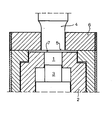
- the dosage of the amount of plastic corresponds to the volume of the preform to be produced; then the upper working piston 4 is set in high-frequency vibrations, in particular in vibrations with a frequency of approximately 15 to 21 kHz and an amplitude of approximately 20 to 60 / um.
- the mechanical energy expended is transferred to the plastic and converted into heat.
- the upper plate 6 and the one below the plate 2 of the press table are tempered, so that the temperature of the preform can be adapted to the conditions of the subsequent shaping into the shaped body. Tempering these plates can also be important with a view to improving the usage properties of the molded parts insofar as the biaxial orientation taking place in the subsequent shaping processes is only optimal if the deformation temperature is adjusted accordingly. It was found, for example, that the biaxial stretching of a polypropylene preform only leads to transparent moldings when the forming temperature is between 139 and 142 ° C. Temperatures deviating from this lead to moldings which are differently opaque.
- the preform produced in this way is then fed to a molding station and is immediately formed into a molded body in the same heat by methods known per se, such as thermoforming, stamping, extrusion molding, stretch blow molding and blow molding.
- methods known per se such as thermoforming, stamping, extrusion molding, stretch blow molding and blow molding.
- hollow bodies such as cups, tubes, cans and the like can be produced from the preform.
Landscapes
- Engineering & Computer Science (AREA)
- Mechanical Engineering (AREA)
- Manufacturing & Machinery (AREA)
- Blow-Moulding Or Thermoforming Of Plastics Or The Like (AREA)
- Casting Or Compression Moulding Of Plastics Or The Like (AREA)
- Processing And Handling Of Plastics And Other Materials For Molding In General (AREA)
- Moulds For Moulding Plastics Or The Like (AREA)
- Processes Of Treating Macromolecular Substances (AREA)
- Shaping By String And By Release Of Stress In Plastics And The Like (AREA)
Abstract
Description
- Die Erfindung bezieht sich auf ein Verfahren zur Herstellung eines Formkörpers aus pulver- bis granulatförmigem thermoplastischem.Kunststoff durch Sintern und anschließendes Warmverformen des so entstandenen Kunststoffteils.
- Zur Herstellung von Formkörpern aus thermoplastischen Kunststoffen ist es bisher üblich, die Werkstoffe zu plastifizieren und sodann über Torpedo-, Kolben- oder Schneckenaggregate unter Zuhilfenahme von Druck und Temperatur zu verformen. In allen Fällen wird hierbei das Polymer zum Fließen gebracht und dazu unterschiedlich hoch über seinen Kristallitschmelzpunkt bzw. seine Erweichungstemperatur aufgeheizt. Nach Ausbildung des Formkörpers muß dieser auf Raumtemperatur wieder abgekühlt werden. Es werden hierfür Anlagen benötigt, die aus funktionalen Baugruppen bestehen für das Plastifizieren, Formen und Abkühlen. Wegen der niedrigen thermischen Wirkungsgrade dieser Einheiten liegt der Energieaufwand für die Umwandlung von Polymerrohstoffen im Formkörper jedoch um ein mehrfaches über dem, der sich aus den Werkstoffkenndaten rechnerisch ermitteln läßt. Daraus resultiert auch, daß Durchsatzsteigerungen an Verarbeitungsmaschinen überproportional steigende Installation von elektrischer Energie zur Folge haben.
- Es ist bisher nicht gelungen, die in den Kunststoffen theoretisch inhärenten mechanischen Potentiale zu aktivieren. Diese Potentiale, die durch die Struktur der Kristallite sowie die Orientierung der Molekülketten bestimmt sind, können bei den herkömmlichen Verfahren nur zu einem geringen Teil ausgeschöpft werden. Es ist zwar bekannt, durch Nachfolgeverfahren, wie z.B. Recken, Kalt- LWr/BL rfließpressen, Kaltwalzen oder Schlagpressen, einen weiteren Anteil dieses mechanischen Potentials zu aktivieren; eine hinsichtlich Energieaufwand, Abfallreduzierung und Aktivierung des mechanischen Potentials befriedigende Lösung ist damit indes nicht gegeben, da in jedem Fall von einem nach dem bekannten Verfahren der Thermoplastverarbeitung hergestellten Vorformling bzw. Halbzeug ausgegangen wird.
- Es war daher Aufgabe der Erfindung ein besonders energiesparendes Verfahren zur Herstellung von Formkörpern aus thermoplastischen Kunststoffen zu schaffen, das von den geschilderten Nachteilen frei ist und insbesondere die Möglichkeit eröffnet, das hohe mechanische Potential der Kunststoffe im Sinne einer Verbesserung der physikalischen Eigenschaften der Formkörper zu nutzen.
- Diese Aufgabe wird grundsätzlich dadurch gelöst, daß der Kunststoff in einem Formhohlraum durch Druck- und hochfrequente Schwingungen bis auf eine Temperatur zwischen der Erweichungstemperatur und der Schmelztemperatur erwärmt und durch Ausüben eines Preßdruckes zu einem Vorformling geformt wird und daß der Vorformling unmittelbar zu einem Formkörper umgeformt wird.
- Für das erfindungsgemäße Verfahren sind alle thermoplastisch verarbeitbaren Kunststoffe geeignet, beispielsweise Olefinpolymerisate, wie Polyäthylen oder Polypropylen; Styrolpolymerisate, wie Polystyrol oder Copolymere des Styrols; Chlor enthaltende Polymerisate, wie Polyvinylchlorid oder chlorierte Polyolefine; Polyamide, Polymethylmethacrylat, Polyacetal, Polycarbonat sowie Mischungen dieser Polymerisate.
- Diese Kunststoffe können die üblichen Zusatzstoffe, wie Füllstoffe, Pigmente, Farbstoffe, Antistatika, Stabili-L J "satoren, Flammschutzmittel oder Gleitmittel enthalten.
- Die Kunststoffe werden in Pulver- bis Granulatform in einer vorzugsweisen mehrteilig ausgebildeten, geschlossenen Form einem mit etwa 15 bis 21 kHz, zweckmäßig 19 bis 20 kHz oszillierenden Druck von etwa 10 bis 200 bar ausgesetzt. Die Pressung ist in der Weise abgestuft, daß sich unterhalb des Kristallitschmelzpunktes eine Korngrenzenhaftung ergibt, die ausreicht, um die einzelnen Kunststoffpartikel zu einem Festkörper zu verbinden. Durch Erhöhung der Oszillatorfrequenz oder wahlweise durch Variation der Pressung kann ein so entstandenes Kunststoffteil bis zum Erweichungspunkt erwärmt und in festem Zustand in einem nachfolgenden Verfahrensschritt, z.B. durch Thermoformen, zu einem Formkörper umgeformt werden. Das so entstandene Kunststoffteil bzw. ein daraus gebildeter Vorformling wird unmittelbar anschließend ohne zusätzlichen Wärmebedarf weiterverformt. Bei einem solchen Vorgehen ist somit nur die Energie aufzuwenden, die für die eigentliche Formgebung benötigt wird. Energie für das Erwärmen der Kunststoffe auf Temperaturen über ihrem Erweichungspunkt, wie es bei der Verarbeitung durch Plastifizierung zwingend ist, wird nicht benötigt. Daraus ergeben sich Energieeinsparungen von 40 % und darüber. Von Vorteil ist ferner die Verbesserung der physikalischen Eigenschaften der Formkörper. So konnte beispielsweise an einem Formkörper aus Polypropylen festgestellt werden, daß die Berstdruckfestigkeit von 6 bar auf 20 bar angehoben war, bei gleichzeitiger Verbesserung der Spannungs-Korrosionsbeständigkeit um den Faktor 2,8.
- Nach dem erfindungsgemäßen Verfahren kann der gepreßte Vorformling auch schon entsprechende Konturen enthalten, die von den Bedingungen der nachfolgenden Umformung abhängen und für den herzustellenden Formkörper von Bedeu-L J "tung sind, wie z.B. Siegel- oder Bördelränder bzw. Anfor- ' mungen für Einfüllöffnungen und dergleichen. Außerdem ist es möglich Vorformlinge herzustellen, die aus mindestens zwei Schichten aufgebaut sind, beispielsweise Schichten aus gleichartigen Werkstoffen mit unterschiedlicher Einfärbung oder verschiedenartigen Werkstoffen, wie Polyäthylen und Polyamid, um hieraus Formkörper zu fertigen, die besondere Dekoreigenschaften haben bzw. hinsichtlich ihrer späteren Verwendung spezifische Gebrauchseigenschaften aufweisen müssen. Hierbei werden die einzusetzenden Kunststoffe nacheinander gesintert, d.h. die einzelnen Kunststoffströme schieben sich nacheinander unter den zuerst hergestellten Vorformling und bilden dadurch den gewünschten Schichtaufbau.
- Weiterbildungen der Erfindung ergeben sich aus den Unteransprüchen.
- Nachstehend wird die Erfindung anhand der Zeichnung näher erläutert.
- In die Aufnahmekammer 1 eines beweglichen Preßtisches 2 wird der pulver- bis granulatförmige thermoplastische Kunststoff eingefüllt. Die Dosierung der Kunststoffmenge entspricht dem Volumen des herzustellenden Vorformlings; dann wird der obere Arbeitskolben 4 in hochfrequente Schwingungen versetzt, insbesondere in Schwingungen mit einer Frequenz von ca. 15 bis 21 kHz und einer Amplitude von ca. 20 bis 60/um. An der Wirkfläche 5 des Arbeitskolbens wird die aufgewendete mechanische Energie auf den Kunststoff übertragen und in Wärme umgesetzt. Durch axiales Verschieben des Druckkolbens 3 wird sodann erreicht, daß der an der Fläche 5 des Arbeitskolbens 4 erweichte Kunststoff in die Druckkammer 7 gelangt, so daß aus der Aufnahmekammer 1 ständig neuer Kunststoff an die Wirkfläche 5 des Arbeitskolbens 4 heranführbar ist, bis das in der Aufnahmekammer 1 befindliche Kunststoffvolumen in die Druckkammer 7 gefördert ist. Die Viskosität des Kunststoffes, der von der Wirkfläche 5 des Arbeitskolbens 4 in die Druckkammer 7 abfließt, kann durch die Arbeitsgeschwindigkeit des Druckkolbens 3 gesteuert werden, da durch sie die Verweilzeit des Kunststoffes unter der Wirkfläche 5 des Arbeitskolbens 4 einstellbar ist. Nach der Füllung der Druckkammer 7 wird durch eine Arbeitsbewegung des Preßtisches 2, der zusammen mit dem in der oberen Arbeitsstellung befindlichen Druckkolben eine geschlossene Preßfläche bildet, ein Vorformling hergestellt.
- Besonders vorteilhaft ist es, wenn die obere Platte 6 und die unter Platte 2 des Preßtisches temperiert sind, so daß die Temperatur des Vorformlings den Bedingungen der nachfolgenden Umformung zum Formkörper angepaßt werden kann. Eine Temperierung dieser Platten kann auch im Hinblick auf die Verbesserung der Gebrauchseigenschaften der Formteile insofern von Bedeutung sein, als die in den nachfolgenden Formgebungsverfahren ablaufende biaxiale Orientierung nur dann optimal gegeben ist, wenn die Verformungstemperatur entsprechend angepaßt ist. So wurde festgestellt, daß die biaxiale Verstreckung eines Vorformlings aus Polypropylen nur dann zu transparenten Formkörpern führt, wenn die Umformtemperatur zwischen 139 und 1420C liegt. Hiervon abweichende Temperaturen führen zu Formkörpern, die unterschiedlich opak sind.
- Der auf diese Weise hergestellte Vorformling wird anschließend einer Formstation zugeführt und in der gleichen Wärme nach an sich bekannten Verfahren, wie Thermoformen, Stamping, Fließpressen, Streckblasen und Blasformen unmittelbar zu einem Formkörper umgeformt. Aus dem Vorformling können insbesondere Hohlkörper, wie Becher, Tuben, Dosen und dergleichen gefertigt werden.
Claims (7)
Priority Applications (1)
| Application Number | Priority Date | Filing Date | Title |
|---|---|---|---|
| AT81100362T ATE4416T1 (de) | 1980-01-28 | 1981-01-19 | Verfahren zur herstellung eines formkoerpers aus pulver- bis granulatfoermigem thermoplastischem kunststoff. |
Applications Claiming Priority (2)
| Application Number | Priority Date | Filing Date | Title |
|---|---|---|---|
| DE3002910 | 1980-01-28 | ||
| DE19803002910 DE3002910A1 (de) | 1980-01-28 | 1980-01-28 | Verfahren zur herstellung eines formkoerpers aus pulver- bis granulatfoermigem thermoplastischem kunststoff |
Publications (2)
| Publication Number | Publication Date |
|---|---|
| EP0033862A1 true EP0033862A1 (de) | 1981-08-19 |
| EP0033862B1 EP0033862B1 (de) | 1983-08-10 |
Family
ID=6093067
Family Applications (1)
| Application Number | Title | Priority Date | Filing Date |
|---|---|---|---|
| EP81100362A Expired EP0033862B1 (de) | 1980-01-28 | 1981-01-19 | Verfahren zur Herstellung eines Formkörpers aus pulver- bis granulatförmigem thermoplastischem Kunststoff |
Country Status (6)
| Country | Link |
|---|---|
| US (1) | US4487728A (de) |
| EP (1) | EP0033862B1 (de) |
| JP (1) | JPS56123812A (de) |
| AT (1) | ATE4416T1 (de) |
| BR (1) | BR8100285A (de) |
| DE (2) | DE3002910A1 (de) |
Cited By (4)
| Publication number | Priority date | Publication date | Assignee | Title |
|---|---|---|---|---|
| EP0179171A3 (en) * | 1982-09-29 | 1987-06-16 | The Dow Chemical Company | Improved method of forming blanks for the solid-phase forming of thermoplastic articles |
| WO1989003298A1 (fr) * | 1987-10-15 | 1989-04-20 | Schunk Maschinen Und Automation Gmbh | Procede et dispositif de fabrication de moules en materiaux particulaires |
| EP0374429A1 (de) * | 1988-12-17 | 1990-06-27 | Kernforschungszentrum Karlsruhe Gmbh | Verfahren zur Reproduktion eines strukturierten, plattenförmigen Körpers |
| CN102013612A (zh) * | 2010-09-30 | 2011-04-13 | 高文彬 | 电力绝缘子烧结密封端子板的制作工艺 |
Families Citing this family (6)
| Publication number | Priority date | Publication date | Assignee | Title |
|---|---|---|---|---|
| FR2664851B1 (fr) * | 1990-07-20 | 1992-10-16 | Oreal | Procede de compactage d'un melange pulverulent permettant d'obtenir un produit compact absorbant ou partiellement delitable et produit obtenu par ce procede. |
| DK220990D0 (da) * | 1990-09-14 | 1990-09-14 | Obtec As | Artikler af harpiks-holdige pulveragtige materialer |
| DE19637904A1 (de) * | 1996-09-18 | 1998-03-19 | Buna Sow Leuna Olefinverb Gmbh | Verfahren zur Formgebung von pulverförmigen, thermisch instabilen Thermoplastformmassen |
| RU2404055C2 (ru) * | 2009-02-19 | 2010-11-20 | Борис Ергазович Байгалиев | Способ изготовления изделий из порошковых полимерных материалов (варианты) |
| US9089715B2 (en) | 2009-11-26 | 2015-07-28 | Saluda Medical Pty Limited | Forming feedthroughs for hermetically sealed housings using two-material powder injection molding |
| RU2527049C2 (ru) * | 2012-10-01 | 2014-08-27 | Федеральное государственное бюджетное образовательное учреждение высшего профессионального образования "Казанский национальный исследовательский технический университет им. А.Н. Туполева-КАИ" (КНИТУ-КАИ) | Способ изготовления изделий из гранулированных полимерных материалов (варианты) |
Citations (1)
| Publication number | Priority date | Publication date | Assignee | Title |
|---|---|---|---|---|
| US3717427A (en) * | 1970-12-03 | 1973-02-20 | A Bodine | Sonic apparatus for working plastic material |
Family Cites Families (7)
| Publication number | Priority date | Publication date | Assignee | Title |
|---|---|---|---|---|
| FR1468659A (fr) * | 1964-08-07 | 1967-02-10 | N G T | Procédé de fabrication d'objets en matière plastique et installation permettant la réalisation du procédé |
| DE1805090A1 (de) * | 1968-10-25 | 1970-05-21 | Bosch Gmbh Robert | Verfahren und Vorrichtung zum Herstellen von Gegenstaenden aus Kunststoff |
| CH509099A (de) * | 1969-06-16 | 1971-06-30 | Von Roll Ag | Verfahren und Vorrichtung zur Herstellung von Blöcken |
| US4014965A (en) * | 1972-11-24 | 1977-03-29 | The Dow Chemical Company | Process for scrapless forming of plastic articles |
| DE2558827A1 (de) * | 1975-12-27 | 1977-07-14 | Demag Kunststofftech | Verfahren zum spritzgiessen von formteilen aus keramischer masse und spritzgiessmaschine hierfuer |
| DE2611420C3 (de) * | 1976-03-18 | 1979-07-26 | Vereinigung Zur Foerderung Des Instituts Fuer Kunststoffverarbeitung In Industrie Und Handwerk An Der Rhein.- Westf. Technischen Hochschule Aachen E.V., 5100 Aachen | Verfahren zum Herstellen von Formteilen aus Polymeren durch Schlagschmelzen von pulver- oder granulatförmigen Rohstoffen |
| GB1528560A (en) * | 1977-04-16 | 1978-10-11 | Johnson & Sons Ltd W | Vibratory presses |
-
1980
- 1980-01-28 DE DE19803002910 patent/DE3002910A1/de not_active Withdrawn
-
1981
- 1981-01-19 DE DE8181100362T patent/DE3160730D1/de not_active Expired
- 1981-01-19 BR BR8100285A patent/BR8100285A/pt unknown
- 1981-01-19 AT AT81100362T patent/ATE4416T1/de not_active IP Right Cessation
- 1981-01-19 EP EP81100362A patent/EP0033862B1/de not_active Expired
- 1981-01-28 JP JP1028081A patent/JPS56123812A/ja active Pending
-
1983
- 1983-06-29 US US06/509,057 patent/US4487728A/en not_active Expired - Fee Related
Patent Citations (1)
| Publication number | Priority date | Publication date | Assignee | Title |
|---|---|---|---|---|
| US3717427A (en) * | 1970-12-03 | 1973-02-20 | A Bodine | Sonic apparatus for working plastic material |
Cited By (6)
| Publication number | Priority date | Publication date | Assignee | Title |
|---|---|---|---|---|
| EP0179171A3 (en) * | 1982-09-29 | 1987-06-16 | The Dow Chemical Company | Improved method of forming blanks for the solid-phase forming of thermoplastic articles |
| WO1989003298A1 (fr) * | 1987-10-15 | 1989-04-20 | Schunk Maschinen Und Automation Gmbh | Procede et dispositif de fabrication de moules en materiaux particulaires |
| EP0374429A1 (de) * | 1988-12-17 | 1990-06-27 | Kernforschungszentrum Karlsruhe Gmbh | Verfahren zur Reproduktion eines strukturierten, plattenförmigen Körpers |
| US4981558A (en) * | 1988-12-17 | 1991-01-01 | Kernforschungszentrum Karlsruhe Gmbh | Process for the reproduction of a microstructured, plate-shaped body |
| CN102013612A (zh) * | 2010-09-30 | 2011-04-13 | 高文彬 | 电力绝缘子烧结密封端子板的制作工艺 |
| CN102013612B (zh) * | 2010-09-30 | 2012-08-29 | 高文彬 | 电力绝缘子烧结密封端子板的制作工艺 |
Also Published As
| Publication number | Publication date |
|---|---|
| DE3160730D1 (en) | 1983-09-15 |
| DE3002910A1 (de) | 1981-07-30 |
| ATE4416T1 (de) | 1983-08-15 |
| US4487728A (en) | 1984-12-11 |
| EP0033862B1 (de) | 1983-08-10 |
| BR8100285A (pt) | 1981-08-04 |
| JPS56123812A (en) | 1981-09-29 |
Similar Documents
| Publication | Publication Date | Title |
|---|---|---|
| EP0371425B1 (de) | Verfahren zur Herstellung tiefgezogener Kunststoff-Formteile | |
| DE3128221C2 (de) | ||
| DE69932924T2 (de) | Extrusionsformpressen optischer gegenstände | |
| DE2642330A1 (de) | Laminierter kunststoffbogen und verfahren zu dessen herstellung | |
| EP0033862B1 (de) | Verfahren zur Herstellung eines Formkörpers aus pulver- bis granulatförmigem thermoplastischem Kunststoff | |
| DE3840542C1 (en) | Process for producing a thin-walled, thermoformed plastic moulding and its use | |
| DE2108774A1 (de) | Verfahren und Vorrichtung zur Herstellung von Hohlkörpern aus Kunststoffen | |
| DE2261328A1 (de) | Gewinnung von thermoplastischem schaum | |
| DE2600923C2 (de) | Verfahren zum Spritzgießen von Polyäthlen mit sehr hohem Molekulargewicht | |
| DE3813694A1 (de) | Verfahren und anlage zur grossseriellen verarbeitung von hochleistungs-faserverbundwerkstoffen | |
| DE1950212A1 (de) | Verfahren und Vorrichtung zur Herstellung von Hohlkoerpern aus Thermoplasten durch Spritzgiessblasformen | |
| DE2404658A1 (de) | Verfahren zum kontinuierlichen strangpressformen waermehaertender harze | |
| DE2209608C2 (de) | Verfahren zum Herstellen von Formkörpern aus thermoplastischem Kunststoff | |
| DE2305150A1 (de) | Polymerhaltige gegenstaende bzw. formteile und verfahren zu ihrer herstellung | |
| DE2361727A1 (de) | Verfahren zur herstellung von geformten thermoplastischen erzeugnissen | |
| DE19733598A1 (de) | Verfahren zur Herstellung eines dünnwandigen, hinterspritzten Kunststoff-Formteiles | |
| DE4015125C2 (de) | Verfahren zur Herstellung von Formkörpern | |
| DE2953869C1 (de) | Verfahren zum Herstellen einer Flasche aus Polypropylen | |
| EP0084135A2 (de) | Verfahren zur Herstellung von Formkörpern aus faserverstärkten Schichtstoffen | |
| DE1604434A1 (de) | Spritzgussform | |
| DE68918113T2 (de) | Thermoverformbare polyaryletherketon-/polyvinylfluorid-schichtstoffe. | |
| DE68915978T2 (de) | Verfahren zum Tiefziehen eines Gegenstandes aus einer thermoplastischen Folie. | |
| EP1513665B1 (de) | Verfahren zur herstellung eines wärmetauscherkastens eines kraftfahrzeuges | |
| DE2601815A1 (de) | Verfahren und vorrichtung zur blasformung von werkstoffen aus hitzehaertenden hochmolekularen verbindungen | |
| DE2611420C3 (de) | Verfahren zum Herstellen von Formteilen aus Polymeren durch Schlagschmelzen von pulver- oder granulatförmigen Rohstoffen |
Legal Events
| Date | Code | Title | Description |
|---|---|---|---|
| PUAI | Public reference made under article 153(3) epc to a published international application that has entered the european phase |
Free format text: ORIGINAL CODE: 0009012 |
|
| AK | Designated contracting states |
Designated state(s): AT BE CH DE FR GB IT NL SE |
|
| 17P | Request for examination filed |
Effective date: 19811022 |
|
| ITF | It: translation for a ep patent filed | ||
| GRAA | (expected) grant |
Free format text: ORIGINAL CODE: 0009210 |
|
| AK | Designated contracting states |
Designated state(s): AT BE CH DE FR GB IT LI NL SE |
|
| REF | Corresponds to: |
Ref document number: 4416 Country of ref document: AT Date of ref document: 19830815 Kind code of ref document: T |
|
| REF | Corresponds to: |
Ref document number: 3160730 Country of ref document: DE Date of ref document: 19830915 |
|
| ET | Fr: translation filed | ||
| PLBE | No opposition filed within time limit |
Free format text: ORIGINAL CODE: 0009261 |
|
| STAA | Information on the status of an ep patent application or granted ep patent |
Free format text: STATUS: NO OPPOSITION FILED WITHIN TIME LIMIT |
|
| 26N | No opposition filed | ||
| PGFP | Annual fee paid to national office [announced via postgrant information from national office to epo] |
Ref country code: NL Payment date: 19890131 Year of fee payment: 10 |
|
| PGFP | Annual fee paid to national office [announced via postgrant information from national office to epo] |
Ref country code: FR Payment date: 19891213 Year of fee payment: 10 |
|
| PGFP | Annual fee paid to national office [announced via postgrant information from national office to epo] |
Ref country code: AT Payment date: 19891218 Year of fee payment: 10 |
|
| PGFP | Annual fee paid to national office [announced via postgrant information from national office to epo] |
Ref country code: SE Payment date: 19891219 Year of fee payment: 10 Ref country code: CH Payment date: 19891219 Year of fee payment: 10 |
|
| PGFP | Annual fee paid to national office [announced via postgrant information from national office to epo] |
Ref country code: BE Payment date: 19891229 Year of fee payment: 10 |
|
| PGFP | Annual fee paid to national office [announced via postgrant information from national office to epo] |
Ref country code: DE Payment date: 19900108 Year of fee payment: 10 |
|
| ITTA | It: last paid annual fee | ||
| PGFP | Annual fee paid to national office [announced via postgrant information from national office to epo] |
Ref country code: GB Payment date: 19900131 Year of fee payment: 10 |
|
| PG25 | Lapsed in a contracting state [announced via postgrant information from national office to epo] |
Ref country code: GB Effective date: 19910119 Ref country code: AT Effective date: 19910119 |
|
| PG25 | Lapsed in a contracting state [announced via postgrant information from national office to epo] |
Ref country code: SE Effective date: 19910120 |
|
| PG25 | Lapsed in a contracting state [announced via postgrant information from national office to epo] |
Ref country code: LI Effective date: 19910131 Ref country code: CH Effective date: 19910131 Ref country code: BE Effective date: 19910131 |
|
| PG25 | Lapsed in a contracting state [announced via postgrant information from national office to epo] |
Ref country code: DE Effective date: 19910216 |
|
| PG25 | Lapsed in a contracting state [announced via postgrant information from national office to epo] |
Ref country code: NL Effective date: 19910801 |
|
| NLV4 | Nl: lapsed or anulled due to non-payment of the annual fee | ||
| GBPC | Gb: european patent ceased through non-payment of renewal fee | ||
| PG25 | Lapsed in a contracting state [announced via postgrant information from national office to epo] |
Ref country code: FR Effective date: 19910930 |
|
| REG | Reference to a national code |
Ref country code: CH Ref legal event code: PL |
|
| REG | Reference to a national code |
Ref country code: FR Ref legal event code: ST |
|
| EUG | Se: european patent has lapsed |
Ref document number: 81100362.3 Effective date: 19910910 |