EP0033926A2 - Système de dépôt de nuit - Google Patents
Système de dépôt de nuit Download PDFInfo
- Publication number
- EP0033926A2 EP0033926A2 EP81100713A EP81100713A EP0033926A2 EP 0033926 A2 EP0033926 A2 EP 0033926A2 EP 81100713 A EP81100713 A EP 81100713A EP 81100713 A EP81100713 A EP 81100713A EP 0033926 A2 EP0033926 A2 EP 0033926A2
- Authority
- EP
- European Patent Office
- Prior art keywords
- container
- safe
- window
- bag
- objects
- Prior art date
- Legal status (The legal status is an assumption and is not a legal conclusion. Google has not performed a legal analysis and makes no representation as to the accuracy of the status listed.)
- Withdrawn
Links
Images

Classifications
-
- E—FIXED CONSTRUCTIONS
- E05—LOCKS; KEYS; WINDOW OR DOOR FITTINGS; SAFES
- E05G—SAFES OR STRONG-ROOMS FOR VALUABLES; BANK PROTECTION DEVICES; SAFETY TRANSACTION PARTITIONS
- E05G7/00—Safety transaction partitions, e.g. movable pay-plates; Bank drive-up windows
- E05G7/001—Bank depositories
-
- E—FIXED CONSTRUCTIONS
- E05—LOCKS; KEYS; WINDOW OR DOOR FITTINGS; SAFES
- E05G—SAFES OR STRONG-ROOMS FOR VALUABLES; BANK PROTECTION DEVICES; SAFETY TRANSACTION PARTITIONS
- E05G1/00—Safes or strong-rooms for valuables
- E05G1/005—Portable strong boxes, e.g. which may be fixed to a wall or the like
Definitions
- This invention relates to a "night-safe" depositing system for irretrievably receiving, sealingly packaging, and safe keeping valuables, in particular money, and to a method for the personalized sealing of a container inside the "night-safe”.
- the safe keeping and conveyance of valuables implies a satisfactory solution of several problems connected with the organization and operative set-up, as well as with safeguarding in general.
- problems there are those concerning the allotment of the responsibilities, e.g. to the consigner, carrier, and consignee of the valuables, or to the personnel in charge of the shipping, transporting, and receiving operations; the workability of the transportation service, which may be conditioned, among others, by the practical possibility or impossibility of carrying out the transportation at low traffic density hours; the accessibility of the safe keeping areas, which may vary, e.g.
- night safe systems which are in general utilized for receiving and safe keeping containers, either of the soft or rigid types, which are usually installed at banks.
- night safe systems are mainly operated for the mere purpose of receiving and safe keeping valuables which the consigner him/herself is to take to a "night safe” installed at the consignee's.
- the object of this invention is to provide a "night safe" depositing system, which can irretrievably accept objects loaded therein, even if loosely loaded; enables the objects thus loaded to be packaged from the outside within a sealed container;and can safe keep the thus sealed package until it is withdrawn from the system by the appointed personnel. It is thus achieved that the integrity of the sealed package serves to substantiate the authenticity of its contents.
- Another object of the present invention is to provide a "night safe" system enabling a consigner to deposit or deliver valuables to a carrier without leaving its place, which affords the advantage that the moment can be positively settled when the responsibility, and accordingly the risk, connected with the consigner ceases, and those connected with the carrier begin.
- Another object is to arrange that the "night safe" system of this invention affords the possibility of closing and sealing a container placed inside a safe, such that a means may be provided of counting the articles or objects as they are loaded into the container.
- Another object of this invention is to provide a .method for the personalized sealing of a container, such as to make it extremely difficult, if not impossible, to violate it without the violation passing unnoticed upon checking, e.g. upon delivery by the consigner to the carrier or by the carrier to the consignee. This enables a definite and unquestionable division of any responsibilities involved as well as a distribution of the risk for insurance purposes.
- the inventive method requires no complex means for its implementation, can be readily effected, involves no expensive equipment, and is reliable to an almost absolute degree.
- a "night safe” depositing system for sealingly packaging and safe keeping valuables, which comprises a safe having a loading window and a withdrawal door, characterized in that it further i comprises a bag-like container adapted for insertion, in an empty condition, into the safe through said window and for arrangement therein such as to present its mouth, accessible for receiving objects and for being closed and sealed through said window, said container being provided with identification and reference data carrying means which is only accessible, once the container has been sealed, by violating the sealed package, and is intended for withdrawal, following the sealing thereof, through said withdrawal door.
- a method for the personalized sealing of a container of valuables comprising the steps of applying at least one signature to a suitable foil-like support and simultaneously reproducing the or each signature by transfer in a plurality of copies, and applying the foil-like support seal-fashion to the closed container such that the container requires for its opening the breaking or alteration of the support, the integrity of the seal being subsequently verifiable by comparing for similarity the or each signature on the support and those on the transfer copy or copies.
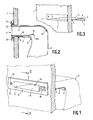
- the system according to the invention comprises a safe 1 having a loading window 2 and a withdrawal door (not shown), preferably provided on facing wall, oppositely located to the wall wherein the window 2 is formed.
- a shelf member 4 which is secured, such as by welding but is preferably anchored through hinge connective elements 5, to the inner surface of the safe.
- the shelf member 4 is bent downwardly at its free end 6 and terminated with a serration 7 intended to serve as a trapping or intercepting element for any plucking means actuated from the safe outside in an effort to fish out objects which have already been loaded into the safe.
- a loading device can be inserted through the window 2, which device is of substantially hopper-like configuration.
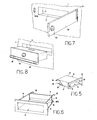
- said hopper device or member 8 may have a substantially parallelepipedal configuration, with upper 9, bottom 10, left 11, and right 12 side walls.
- the outside dimensions of the hopper member 8 are such as to allow it to be removably inserted through the loading window 2 drawer-fashion.
- the hopper member 8 has also a front wall 13 wherein a slot 14 is formed which has a size matching that defined by the walls 9 to 12.
- the wall 13 functions as an abutment stop for the hopper member 8 against the wall of the safe 1.
- the wall 13 may also function as an element for accommodating and supporting a lock, generally indicated at 15, which is intended for locking the hopper member 8 in its inserted position.
- the wall 13 may accommodate a counter device 16, which is operative to count the objects or parcels introduced through the slot 14.
- the counter device 16 may also be associated with identifying and acceptance means effective to identify the types of objects passing through the hopper member and in the affirmative admit them to the safe inside.
- FIG 6 there is illustrated another embodiment of the hopper member 8, which is here provided with but the bottom or lower wall 10. It simply comprises here framing members or elements 17, and has a front wall 13 with a slot 14, similarly to the embodiment shown in Figure 5.
- each hopper member extends over a shorter length than the top wall 9 or framing elements 17, and is terminated with a ridge, generally indicated at 19, which has its end also pointing downwards and serrated as at 19a.
- the hopper member 8 has stop or retention elements 20 which may be made of rubber, plastics material and the like materials and are intended for blocking the mouth of a bag container 21 between the wall 13 and outer face of the safe wall.
- the bag container 21 may be formed from any suitable flexible material whereby the bag 21 can be introduced into the safe through the window 2. After inserting the bag 21 through the window 2 such that only the terminating portion of its mouth is allowed to protrude outwardly, one hopper member 8 is fitted in the bag mouth such as to block the bag 21 between the retention elements I 20 and safe 1.
- the hopper member 8 performs several functions in addition to that of retaining the bag mouth; namely, it functions as a bag mouth spreading element, and as a guiding element for the articles to be introduced into the bag and therefore into the safe. Owing to the provision of counter means 16, where desired, it also functions as a counter element which penetrates the bag 21 to count the objects or articles introduced therein from the inside thereof.
- the hopper member 8 further functions as an element for controllably forwarding objects from the outside to the safe.
- the bag 21 can be withdrawn from the safe to permit the bag 21 to be closed and sealed, enables the counter .1 and accepting means to be disengaged from the bag contents, thereby the bag, after being closed and sealed at or through the loading window 2, can be removed from the safe through the specially provided withdrawal door, which may be accessible, for example, from a building outside.
- the loading window 2 can be shut by means of a door 40 hinged to the safe as at 41.
- the door 40 may be provided with a lock 42 for locking the door 40.
- Figure 8 shows an alternative means of closing the loading window which comprises a plug member 43 provided with a lock 44 and pulling handle 45, it being insertable drawer-fashion through the window 2.
- the sealing of the bag container 21 may be carried out in a variety of manners.
- the sealing operation may be carried out by heat application, e.g. by means of conventional such devices.
- the container 21 may be provided with a flap or tab rigidly attached to the bag inside surface and arranged to protrude through the bag mouth such that it can receive impressions for the identification of the contents and the signature or signatures of the personnel who have completed the loading operation. That flap or tab (not shown in the drawings), prior to the closing of the bag, is put back into the bag, which is then closed and sealed along a seam line such as the one generally indicated at 22 in Figure 4. Transfer copies of the or each signature are kept by the personnel for comparison if necessary.
- FIGS 9 and 10 show another device for carrying out the sealing, from outside the safe 1, of the mouth of the bag container 21.
- the mouth of the bag 21 is purposely provided with suitable tightening cords 23, which are passed through holes 24 into a closing device, generally indicated at 25, which has a box-like body 26 inside which, at the openings 24, there are arranged small rollers 27 effective to guide the cords or strings 23 and block them against a stationary blocking element 28.
- the cords 23 are pulled as far as they allow into the device 25, and then tied into a knot as generally indicated at 29.
- the box-like body 26 may be closed by means of a cover or lid 30 hinged to the box-like body 26 by means of a hinge 31 and having a snap action latch 32 adapted for engaging a detent 33 on the box-like body 26.
- the latch 32 is housed in a housing 34, wherein there is also accommodated a resilient element, e.g. a spring, and which is accessible from the top (see Figure 10) of the cover 30 through a slit 35.
- the latch 32 On its side facing the cover 30, the latch 32 is formed, for instance, with a recess 36 wherein the latch 32 can be engaged, such as by means of a screwdriver, in order to release it from the detent element 33.
- the width of the strap 39 is such that it completely covers, after it has been closed and sealed on the inside of the cover 34, the slit 35, thereby the recess 36 of the latch can only be acceded to by manipulating or breaking the strap 39 itself.
- the cords 29 are knotted together within the box-like body 26, and the cover 30 is closed such that it snaps closed onto the detent 33.
- the bag cannot be re-opened without damaging it or breaking the seal formed by the identification and reference strap 39,
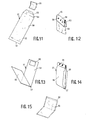
- Figures 11 and 12 illustrate a container 21 comprising a tubular body 50 formed from a heat sealable sheet plastics material.
- the container 21 has its bottom 51 closed and either welded or glued along a seam line 52. After the welding or gluing, the container 21 is turned inside out such that the seam 52 is left entirely on the inside of the tubular body 50.
- the container 21 is provided with a tab or flap 53 intended to be folded over and around the mouth 54 of the container 21, when the latter is to be closed.
- the container 21, in its closed condition can be sealed by a foil-like supporting element 55 being folded, for example, over and around the mouth 54, optionally above the tab 53, and secured in position by means of rivets 56 passed from one flap of the folded support 55 to the other through the walls of the container 21 and optionally through the tab 53 ( Figure 12).
- the support 55 Prior to its being affixed as a seal to the container 21, there are applied one or more signatures, and possibly other alphanumeric information items relating to the identity of the container 21 and its contents.
- the signature(s) is transfer duplicated through the support 55 on a number of copies, e.g. three copies, one copy being left for reference to the person(s) who have written in their signature(s), a second copy being for the carrier of the container 21, and a third copy being intended for delivery to the consignee of the container 21.
- Figures 13 and 14 illustrate an embodiment wherein a bag-like container 21 is formed from a sheet of paper which is glued and/or sewn along a longitudinal joining line (not shown in the drawing).
- the bag 1 can be folded along a transverse fold region 57, thereby it comprises two adjacent segments, a short one indicated at 58 and a longer one indicated at 59.
- the fold region 57 may include a seam or weld line effective to divide the interior of the container in two compartments having a common bottom and respective access mouths.
- the longer segment 59 carries, near its mouth and on its outer wall intended to remain facing the short segment 58 after the bag has been folded, a pouch 60 adapted for containing, for instance, a plurality of paper sheets for transfer writing.
- the pouch 60 may alternatively be affixed to the corresponding outer wall of the segment 58.
- the exterior of the . pouch 60 may be formed, for example, from a clear or transparent material and may carry pre-printed a number of alphanumeric information items. Moreover, it can receive and retain on itself one or more signatures and other optional identification and personalization marks, and allow them to be duplicated by transfer, e.g. through carbon paper or the like, on the sheets of paper contained in the pouch.
- the same person(s) in charge of or responsible for the packaging of the container 21 After the person(s) in charge of or responsible for the packaging of the container 21 has introduced into the latter, for example, cash, the same person(s) will apply suitable indications concerning the nature and amount of the contents to the pouch 60, and what is still more important, will write his/her signature, which remains then clearly visible on the exterior of the pouch 60 and duplicated on the copy sheets contained in the pouch. Then, the copies may be withdrawn from the pouch 60 and duly distributed to the consigner, carrier, and consignee.
- the bag will be next folded along the fold region 57 until the end of the short segment 58 is brought to rest on and against the pouch 60. At this moment, the free end of the longer segment 59, which projects beyond the shorter segment 58, is folded over and around the end of the segment 58, and secured and/or sealed against it, e.g. by means of rivets 61. Thus, the rivets will engage the segment 59, pouch 60, segment 58, and again the segment 59, together as shown in Figure 14.
- Figure 15 illustrates a pouch 62, shown folded in half, which may be formed, for instance, from a plastics material and has at least one wall 63 adapted for receiving and retaining thereon one or more signatures and optional alphanumeric information.
- the pouch 62 similarly to the pouch 55, may also be utilized with different containers from the ones shown in Figures 11 to 14, and it may serve, for instance, as a personalized seal for a container of the rigid type, e.g. a metal one, since it can be wrapped and riveted around a cover portion, and at the same time around a portion of the container body, thereby the opening of the container implies the violation or alteration of the seal formed by the pouch 62.
- the consignee of a sealed container which has been sealed in accordance with the personalized sealing method of this invention will check that the contents corresponds to the list shown on an accompanying bill. Should the consignee detect any discrepancies, he/she will first verify the authenticity of the signature(s) on the pouch 55, or 60, or 62, and on a transfer copy delivered to him/her, which copy has been obtained simultaneously with the application of the information and signature to the pouch. If the marks and signatures are authentic, any errors and/or manipulations must be attributed to the person who packaged the container, namely the consigner. If on the contrary, the signature(s) are not authentic, then violation and manipulation must have occurred, which are surely the responsibility of the carrier.
- the method according to the invention affords the possibility of personalizing the sealing of a container such that it becomes readily and positively possible to determine which is responsible for violation or manipulation during, for example, the packaging and transporting operations of a valuables container.
- This provision is especially advantageous, not only against theft, but also because it serves to cut a clear demarcation of the responsibilities between the consignment and transport operations.
- the means carrying identification and reference information also allow the copying, such as by transfer, of the signature(s) and/or other markings while being applied by the appointed person(s).
- the means carrying identification and reference information also allow the copying, such as by transfer, of the signature(s) and/or other markings while being applied by the appointed person(s).
- the identification and reference information is either inserted into the sealed bag container 21 or serves itself as a scaling element, it will not be accessible, after the container 21 has been closed, unless the container 21 or its seal are juggled with.
- a specific feature of the embodiment of the invention wherein the identification and reference information items are written onto a flap to be inserted into the container prior to the sealing thereof, is that the flap is rigid with the inner wall of the containers.
- the shape of the bag-like container 21 may be changed within broad limits.
- the bag container 21 itself may be either integrally formed from a heat sealable material, such as a plastics material, or made in part of canvas and a heat sealable material or of a fabric, cloth, and the like, throughout.
- the hopper member 8 may support by itself the closure door 40 for the window 2. In that case, after using it as a loading device, the hopper member 8 would normally serve as a closure element.
- the door 40 may be hingedly connected to the wall 13 and provided, for example, with a spring latch engageable in a recess 42a of the safe 1, whence it may be released by operating with a key the lock 15 of the hopper member 8.
- the door 40 may be hinged as shown in Figure 7 and contoured to rest upon and block the hopper member 8 within the window 2, during the time when no loading operations are effected.
- a fixed box-like structure (not shown) being preferably apertured to match the inside passageway of the window 2 and extending inwardly to the safe, e.g. over the entire length of the shelf 4. In this manner, access through the window 2 to the safe inside, such as with breaking tools or tools fishing from the safe, is rendered still more difficult.
- the hopper member 8 may be hinged to the safe 1 either alone or along with the door 40, in which case it would be suitably designed to afford a pivotal movement from a position of withdrawal through the window 2 from outside the safe 1 to a position of introduction through the window 2, and viceversa.
- the member 8 may also comprise a monitoring device, such as a display unit, a TV system, a buzzer or sound signalling device, an optical-acoustical signalling device, a warning device, etc., either in situ or remotely located from the objects introduced into a container 21.
- a monitoring device such as a display unit, a TV system, a buzzer or sound signalling device, an optical-acoustical signalling device, a warning device, etc., either in situ or remotely located from the objects introduced into a container 21.
Landscapes
- Business, Economics & Management (AREA)
- Finance (AREA)
- Package Closures (AREA)
- Bag Frames (AREA)
- Packages (AREA)
- Closing Of Containers (AREA)
Applications Claiming Priority (4)
| Application Number | Priority Date | Filing Date | Title |
|---|---|---|---|
| IT84911/80A IT1154211B (it) | 1980-02-12 | 1980-02-12 | Impianto di cassa continua di versamento per il confezionamento sigillato e la custodia do oggetti di valore |
| IT8491180 | 1980-02-12 | ||
| IT84946/80A IT1141833B (it) | 1980-07-02 | 1980-07-02 | Metodo di sigillatura personalizzata per un contenitore di valori e contenitore cosi' sigillato |
| IT8494680 | 1980-07-02 |
Publications (2)
| Publication Number | Publication Date |
|---|---|
| EP0033926A2 true EP0033926A2 (fr) | 1981-08-19 |
| EP0033926A3 EP0033926A3 (fr) | 1982-01-27 |
Family
ID=26330129
Family Applications (1)
| Application Number | Title | Priority Date | Filing Date |
|---|---|---|---|
| EP81100713A Withdrawn EP0033926A3 (fr) | 1980-02-12 | 1981-02-02 | Système de dépôt de nuit |
Country Status (2)
| Country | Link |
|---|---|
| EP (1) | EP0033926A3 (fr) |
| ES (1) | ES499141A0 (fr) |
Cited By (3)
| Publication number | Priority date | Publication date | Assignee | Title |
|---|---|---|---|---|
| GB2235179A (en) * | 1989-08-02 | 1991-02-27 | Brambles Holdings Ltd | Safe and bag therefor |
| GB2261024A (en) * | 1991-10-30 | 1993-05-05 | Alpa Ind Ltd | Anti-theft device |
| NL1004930C2 (nl) * | 1997-01-04 | 1998-07-20 | Bavak Beveiligingsgroep Bv | Samenstel voor het in een houder opslaan van papiergeld, alsmede houder en behuizing voor een dergelijke houder. |
Family Cites Families (5)
| Publication number | Priority date | Publication date | Assignee | Title |
|---|---|---|---|---|
| FR543357A (fr) * | 1922-02-27 | 1922-09-01 | Cachet pour la sécurité postale et d'autres usages | |
| US1635736A (en) * | 1925-11-27 | 1927-07-12 | Clare W Banta | Deposit safe |
| GB865089A (en) * | 1956-07-16 | 1961-04-12 | Thomas Henry Last | Improvements in cash boxes, deed boxes and similar lockable containers |
| NL141268B (nl) * | 1970-08-18 | 1974-02-15 | Nederlanden Staat | Inrichting voor het deponeren van voorwerpen in een kluis. |
| SE382796C (sv) * | 1973-08-22 | 1977-11-07 | Robur Konsult Ab | Anordning for automatiserad hantering av bankkassetter |
-
1981
- 1981-02-02 EP EP81100713A patent/EP0033926A3/fr not_active Withdrawn
- 1981-02-05 ES ES499141A patent/ES499141A0/es active Granted
Cited By (5)
| Publication number | Priority date | Publication date | Assignee | Title |
|---|---|---|---|---|
| GB2235179A (en) * | 1989-08-02 | 1991-02-27 | Brambles Holdings Ltd | Safe and bag therefor |
| GB2261024A (en) * | 1991-10-30 | 1993-05-05 | Alpa Ind Ltd | Anti-theft device |
| GB2261024B (en) * | 1991-10-30 | 1996-05-22 | Alpa Ind Ltd | An anti-theft device for use in preventing removal of items in a posting box |
| NL1004930C2 (nl) * | 1997-01-04 | 1998-07-20 | Bavak Beveiligingsgroep Bv | Samenstel voor het in een houder opslaan van papiergeld, alsmede houder en behuizing voor een dergelijke houder. |
| EP0852279A3 (fr) * | 1997-01-04 | 1998-09-30 | Bavak Beveiligingsgroep B.V. | Assemblage pour le stockage de papier monnaie dans un récipient, ainsi que récipient et boítier pour un tel récipient |
Also Published As
| Publication number | Publication date |
|---|---|
| ES8204037A1 (es) | 1982-05-01 |
| ES499141A0 (es) | 1982-05-01 |
| EP0033926A3 (fr) | 1982-01-27 |
Similar Documents
| Publication | Publication Date | Title |
|---|---|---|
| US4720040A (en) | Security deposit bag | |
| RU2375752C2 (ru) | Упаковочное устройство и контейнер для листовых объектов | |
| CN101443251B (zh) | 用于存放钞票或其他有价值文件的设备、系统和方法 | |
| HUP0400787A2 (en) | Apparatus for the storage and transport of bank notes | |
| US8434673B2 (en) | Tamper evident enclosure for the storage and transport of documents | |
| EP0389495A1 (fr) | Systeme de verrouillage. | |
| JP7249050B2 (ja) | 貨幣処理装置 | |
| JPH0135390B2 (fr) | ||
| NL1004930C2 (nl) | Samenstel voor het in een houder opslaan van papiergeld, alsmede houder en behuizing voor een dergelijke houder. | |
| GB2352006A (en) | Security bag closing module | |
| US20100239190A1 (en) | Tamper-Evident System and Methods For Storing Property | |
| AU2005308777B2 (en) | A device for processing sheet objects such as banknotes | |
| US7559459B2 (en) | Filling of cash boxes for cash dispensers | |
| EP0033926A2 (fr) | Système de dépôt de nuit | |
| US5681113A (en) | Security ballot pouch | |
| EP1856363B1 (fr) | Procede et systeme global de transport sur d'objets de valeur | |
| US8245905B2 (en) | Locking ballot receptacle | |
| GB2496533A (en) | Tamper evident enclosure for the storage and transport of documents | |
| CA1311448C (fr) | Pochette de depot inviolable | |
| EP4004886B1 (fr) | Dispositif de stockage temporaire et de gestion d'objets de valeur | |
| EP2490187A1 (fr) | Tiroir-caisse et système de gestion de tiroir-caisse | |
| EP0788081A1 (fr) | Sac de sécurité | |
| ITRM980125A1 (it) | Cassaforte e battenti contrapposti per il ritiro e la consegna di valori in un contenitore | |
| WO2006123952A1 (fr) | Indicateurs d'effraction pour bagages | |
| GB2520274A (en) | A method of packaging banknotes |
Legal Events
| Date | Code | Title | Description |
|---|---|---|---|
| PUAI | Public reference made under article 153(3) epc to a published international application that has entered the european phase |
Free format text: ORIGINAL CODE: 0009012 |
|
| AK | Designated contracting states |
Designated state(s): AT CH DE FR |
|
| PUAL | Search report despatched |
Free format text: ORIGINAL CODE: 0009013 |
|
| 17P | Request for examination filed |
Effective date: 19811016 |
|
| AK | Designated contracting states |
Designated state(s): AT CH DE FR |
|
| STAA | Information on the status of an ep patent application or granted ep patent |
Free format text: STATUS: THE APPLICATION IS DEEMED TO BE WITHDRAWN |
|
| 18D | Application deemed to be withdrawn |
Effective date: 19830708 |
|
| RIN1 | Information on inventor provided before grant (corrected) |
Inventor name: CONFORTI, LEOPOLDO |