EP0034011A1 - Procédé de production de méthanol - Google Patents
Procédé de production de méthanol Download PDFInfo
- Publication number
- EP0034011A1 EP0034011A1 EP81300344A EP81300344A EP0034011A1 EP 0034011 A1 EP0034011 A1 EP 0034011A1 EP 81300344 A EP81300344 A EP 81300344A EP 81300344 A EP81300344 A EP 81300344A EP 0034011 A1 EP0034011 A1 EP 0034011A1
- Authority
- EP
- European Patent Office
- Prior art keywords
- catalyst
- reactor
- liquid
- methanol
- process according
- Prior art date
- Legal status (The legal status is an assumption and is not a legal conclusion. Google has not performed a legal analysis and makes no representation as to the accuracy of the status listed.)
- Granted
Links
Images
Classifications
-
- C—CHEMISTRY; METALLURGY
- C07—ORGANIC CHEMISTRY
- C07C—ACYCLIC OR CARBOCYCLIC COMPOUNDS
- C07C29/00—Preparation of compounds having hydroxy or O-metal groups bound to a carbon atom not belonging to a six-membered aromatic ring
- C07C29/15—Preparation of compounds having hydroxy or O-metal groups bound to a carbon atom not belonging to a six-membered aromatic ring by reduction of oxides of carbon exclusively
- C07C29/151—Preparation of compounds having hydroxy or O-metal groups bound to a carbon atom not belonging to a six-membered aromatic ring by reduction of oxides of carbon exclusively with hydrogen or hydrogen-containing gases
- C07C29/1512—Preparation of compounds having hydroxy or O-metal groups bound to a carbon atom not belonging to a six-membered aromatic ring by reduction of oxides of carbon exclusively with hydrogen or hydrogen-containing gases characterised by reaction conditions
- C07C29/1514—Preparation of compounds having hydroxy or O-metal groups bound to a carbon atom not belonging to a six-membered aromatic ring by reduction of oxides of carbon exclusively with hydrogen or hydrogen-containing gases characterised by reaction conditions the solvents being characteristic
-
- C—CHEMISTRY; METALLURGY
- C07—ORGANIC CHEMISTRY
- C07C—ACYCLIC OR CARBOCYCLIC COMPOUNDS
- C07C29/00—Preparation of compounds having hydroxy or O-metal groups bound to a carbon atom not belonging to a six-membered aromatic ring
- C07C29/15—Preparation of compounds having hydroxy or O-metal groups bound to a carbon atom not belonging to a six-membered aromatic ring by reduction of oxides of carbon exclusively
- C07C29/151—Preparation of compounds having hydroxy or O-metal groups bound to a carbon atom not belonging to a six-membered aromatic ring by reduction of oxides of carbon exclusively with hydrogen or hydrogen-containing gases
- C07C29/1512—Preparation of compounds having hydroxy or O-metal groups bound to a carbon atom not belonging to a six-membered aromatic ring by reduction of oxides of carbon exclusively with hydrogen or hydrogen-containing gases characterised by reaction conditions
-
- C—CHEMISTRY; METALLURGY
- C07—ORGANIC CHEMISTRY
- C07C—ACYCLIC OR CARBOCYCLIC COMPOUNDS
- C07C29/00—Preparation of compounds having hydroxy or O-metal groups bound to a carbon atom not belonging to a six-membered aromatic ring
- C07C29/15—Preparation of compounds having hydroxy or O-metal groups bound to a carbon atom not belonging to a six-membered aromatic ring by reduction of oxides of carbon exclusively
- C07C29/151—Preparation of compounds having hydroxy or O-metal groups bound to a carbon atom not belonging to a six-membered aromatic ring by reduction of oxides of carbon exclusively with hydrogen or hydrogen-containing gases
- C07C29/153—Preparation of compounds having hydroxy or O-metal groups bound to a carbon atom not belonging to a six-membered aromatic ring by reduction of oxides of carbon exclusively with hydrogen or hydrogen-containing gases characterised by the catalyst used
Definitions
- This invention concerns a method for making methanol in a liquid-phase methanol reactor wherein a methanol-forming catalyst is entrained in an inert liquid and contacted with a synthesis gas comprising hydrogen and carbon monoxide.
- methanol is prepared from carbon monoxide and hydrogen by saturating an inert organic liquid medium, such as pseudocumene, with the carbon monoxide and hydrogen and contacting the saturated liquid medium with a methanol-forming catalyst.
- an inert organic liquid medium such as pseudocumene
- the preferred method of liquid-phase methanol production included use of a fluidized bed catalyst, wherein a circulating inert liquid hydrocarbon and the synthesis gas feed were cocurrently introduced into the bottom of a reactor and the hydrocarbon liquid, with some assistance from the gas feed, fluidized the catalyst.
- the physical limits of the reaction zone, co-extensive with the volume of the fluidized catalyst bed are controlled principally by such factors as catalyst particle size and the velocity of the liquid hydrocarbon.
- the previously preferred method is not without its undesirable aspects. For example, total control of the fluidized bed requires relative uniformity of catalyst particle size, otherwise liquid velocities sufficient to fluidize large particles will carry small particles out of the desired reaction zone.
- the hydrocarbon liquid which functions as a heat sink for the highly exothermic synthesis reaction, usually possesses a significant temperature gradient over the length of its passage through the reactor. Control of reaction temperature is therefore significantly hindered.
- a still further consequence of the relatively low liquid velocities required by the fluidized bed process lies in the necessity of cooling the hydrocarbon liquid externally of the reactor, since the poor heat transfer characteristics attributable to the low velocity preclude cooling the liquid inside the reactor, for example by means of a cooling coil
- One object of this invention is to provide a liquid phase methanol synthesis process in which the attrition of catalyst particles is virtually eliminated as a problem.
- a further object is to provide such a process wherein a great range of fluid velocities through the reactor may be utilized.
- a still further object of the invention is to provide a liquid phase methanol reaction process permitting significantly greater control over temperature profiles within the reactor.
- the process of the present invention utilizes relatively small catalyst particles entrained in an inert hydrocarbon liquid as opposed to a fluidized catalyst bed in the liquid phase production of methanol.
- advantages of the instant process are savings in catalyst costs, the availability of higher temperature operation of the reactor and improved temperature profiles within the reactor, and the use of less expensive reactors.
- Catalyst costs are reduced through the combined effect of several aspects of the nev entrained catalyst process as compared to the fluidized bed method.
- the preparation of catalyst particles for the fluidized bed liquid phase methanol production system typically requires obtaining catalyst powder and, through use of suitable binders, pelletizing the catalyst into particles of uniform size that will resist attrition.
- the catalyst may be used in the powdered form and, therefore, significant preparatory work may be avoided.
- the controlling mechanism in the liquid-phase methanol synthesis is the mass transfer of reactant across the liquid film surrounding the catalyst particles, whether the system under consideration incorporates a fluidized bed or the entrained catalyst process. Diminishing the catalyst particle size results in increasing the available surface area of catalyst, thereby decreasing the resistance to mass transfer.
- the catalyst in powdered form preferably having a particle size of less than about 125 microns, and more preferably from about 10 to about 125 microns, is purposefully suspended in an inert hydrocarbon liquid and the catalyst entrained in the liquid is circulated through the reactor.
- the catalyst entrained in the liquid is circulated through the reactor.
- the ability to increase the velocity of the inert hydrocarbon liquid and entrained catalyst through the reactor provides several options not available to the practitioner of the heretofore preferred fluidized bed liquid phase methanol process. Rather than encountering a significant gradient from the inlet to outlet liquid temperatures , for example the liquid may be circulated through the reactor at a rate great enough so that the temperature gradient of the liquid can be markedly reduced. Thus a relatively narrow optimum reactor temperature range highly favorable to equilibrium conditions may be maintained and the highly exothermic reaction may proceed under conditions approaching isothermal.
- the liquid-entrained catalyst system permits avoidance of heat-exchange external of the reactor and allows removal of excess heat via a cooling coil in the reactor, for example Also, since the catalyst, which preferably makes up to 5 tc 40 weight percent of the liquid-catalyst mixture, provides additional heat capacity as compared to the fluidized bed system, the volumetric circulation rate of process liquid will be lower with the entrained catalyst system.
- the liquid hydrocarbon employed must be capable of dissolving at least small amounts of hydrogen, carbon monoxide, and methanol; must be stable and substantially inert; and most of it must remain liquid in the reactor at the temperature and pressure employed. Naturally, the catalyst must not dissolve or react with the liquid. Generally, the vapor pressure of the liquid should not exceed 34 atm. abs. (500 psia) at a temperature of 250°C. Organic compounds are preferred.
- Examples of compounds which may be used are aromatics, such as alkylated naphthalenes having 10 to 14 carbon atoms, alkylated biphenyls having 12 to 14 carbon atoms, and polyalkylbenzenes having 7 to 12 carbon atoms and 1 to 5 alkyl substitution groups (e.g., pseudocumene, xylene, and diethylbenzene); saturated alcohols having from 5 to 20 carbon atoms (e.g., cyclohexanol and n-octyl alcohol); saturated esters having from 5 to 15 carbon atoms (e.g., n-amyl acetate and ethyl n-valerate); saturated paraffins (including cycloparaffins) having 6 to 30 carbon atoms (e.g., hexane, dimethylpentane, and hexadecane); and blends of the foregoing, with paraffins and aromatics being preferred.
- aromatics such as al
- the reaction temperature is broadly from 100 to 500°C, preferably from 200 to 400°C, and most desirably from 215 to 275°C. Pressures of 200 to 10,000 psia, preferably from 500 to 3,500 psia, and most desirably from 500 to 1,500 psia, may be employed.
- the ratio of hydrogen to carbon monoxide in the feed gas is preferably from 0.6 mole of hydrogen per mole of carbon monoxide up to 10 moles per mole. Other gases, such as carbon dioxide and methane, may be present in the synthesis gas.
- the flow rate of reactants is broadly from 0.1 to 10 kgs of feed gas per kg of catalyst per hour and preferably from 0.3 to 5.
- the liquid flow through the reactor should be sufficient to prevent excessive temperature rise, and is generally from 200 to 20,000 grams per gram-mole of methanol produced and preferably from 500 to 10,000.
- the catalyst employed can be any methanol-forming catalyst active within the specified temperature range, i.e., 100 to 500°C.
- Methanol-forming catalysts are described in detail in the following literature references: French Patent No. 1,489,682; Shokubai (Tokyo) 1966, 8, 279-83; U.S.S.R. Patents Nos. 219,569; 264,355; 269,924; and 271,497; German Patent No. 1,300,917; Khim. Prom. Ukr. 1969 (6), 7-10; Kogyo Kagaku Zassi 1969, 72 (11), 2360-3; German Patent Publications Nos.
- the active elements of the methanol-forming catalysts which may be used include copper, zinc, aluminum, magnesium, zinc, chromium, molybdenum, uranium, tungsten, vanadium and rare earths.
- the low-temperature methanol catalysts such as those described in U.S. Patent No. 3,326,956, are especially useful.
- the amount of catalyst entrained in the inert liquid can vary as desired or required with from about 5 to about 40 weight percent catalyst in the inert liquid being preferred.
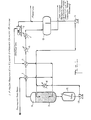
- FIG. 1 One version of a three-phase liquid-entrained catalyst reactor system is shown in FIG. 1.
- Synthesis gas feed comprising hydrogen and carbon monoxide is preheated by reactor product gas in heat exchanger 1, combined with recycle gas and fed to the bottom of reactor 2 through a series of standard orifices to distribute gas bubbles throughout the reactor.
- the liquid-catalyst mixture preferably comprising approximately 5-40 weight percent methanol catalyst powder in paraffinic oil and coming from surge drum 12 by way of circulating oil pump 13 and heat exchanger 4, enters the top of reactor 2 just below the vapor disengagement zone 3.
- the liquid-catalyst mixture enters at a temperature of approximately 240°C and, as it travels downward in the reactor, increases in temperature by absorbing the heat liberated in the methanol reaction.
- the synthesis and product gases, flowing countercurrently, are gradually cooled as they rise to the top of the reactor.
- the countercurrent flow of gases and liquid-catalyst has a beneficial thermodynamic effect in that the gases exiting the reactor are cooler than when the fluidized bed catalyst is used and the lower temperature favors the methanol reaction equilibrium. Because of the lower temperature, the circulating oil vapor pressure will be lower than in the fluidized bed system. This decreases the load on the condensed oil return system and therefore increases the overall thermal efficiency of the process.
- the liquid and entrained catalyst exit the bottom of reactor 2 and enter an agitated surge drum 12, which prevents liquid-catalyst separation.
- High pressure steam can be generated from boiler feed water at heat exchanger 4 before recycle of the liquid and catalyst through the reactor. Circulation through the heat exchanger unit must be carefully controlled to prevent any buildup of solids, fouling and erosion.
- the reactor product gas is cooled by first preheating synthesis gas feed at heat exchanger 1, then recycle gas at heat exchanger 5, then boiler feed water at heat exchanger 6 and is given a final cooling by air or cooling water at heat exchanger 7.
- Methanol and any vaporized process liquid are condensed and separated in the vapor-liquid separator 8.
- the methanol stream produced is suitable for fuel use directly or can be sent to a distillation system (not shown) to produce chemical grade product. Unconverted gases arc recycled back to the reactor via recycle compressor 9 and heat exchanger 5.
- the reactor may be designed to include a disengagement zone at the top.
- the velocity of the product gas stream at the to of the reactor could be reduced by providing an expansion zone.
- the larger cross-sectional area of such a zone would result in a lower flow velocity of the exiting gas within the zone and reduce the likelihood of catalyst fines being carried from the liquid by the product gas and exiting the reactor along with the product gas.
- the disengagement zone could include an expansion zone in the form of an inverted truncated cone, with the small diameter end of such a zone being of the same diameter as the reactor and located just above the upper level of liquid in the reactor and with the product gas exiting the reactor at the large diameter end of the zone.
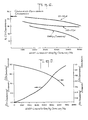
- the highly preferred entrained catalyst particle size of 37-74 microns yields, at commercially practical flow rates, significantly greater CO conversion than obtained with the larger particies. Indeed, at low flow rates reactions using the catalyst particles sized from 37 to 74 microns virtually reach the calculated equilibrium conversion point.
- FIG. 3 is a cross-plot of the CO conversion-WHSV relationships shown in FIG. 2.
- the conversion parameter shows the relative rate of CO conversion in the entrained catalyst mode to that of the fluidized bed mode.
- the entrained mode yields a CO conversion equivalent to 4 or 5 times that of the fluidized mode and therefore requires only 20-25% of the catalyst necessary for equivalent production via a fluidized bed operation.
Landscapes
- Chemical & Material Sciences (AREA)
- Organic Chemistry (AREA)
- Chemical Kinetics & Catalysis (AREA)
- Organic Low-Molecular-Weight Compounds And Preparation Thereof (AREA)
- Low-Molecular Organic Synthesis Reactions Using Catalysts (AREA)
Priority Applications (1)
| Application Number | Priority Date | Filing Date | Title |
|---|---|---|---|
| AT81300344T ATE3536T1 (de) | 1980-02-12 | 1981-01-27 | Verfahren zur herstellung von methanol. |
Applications Claiming Priority (2)
| Application Number | Priority Date | Filing Date | Title |
|---|---|---|---|
| US12090380A | 1980-02-12 | 1980-02-12 | |
| US120903 | 1980-02-12 |
Publications (2)
| Publication Number | Publication Date |
|---|---|
| EP0034011A1 true EP0034011A1 (fr) | 1981-08-19 |
| EP0034011B1 EP0034011B1 (fr) | 1983-05-25 |
Family
ID=22393189
Family Applications (1)
| Application Number | Title | Priority Date | Filing Date |
|---|---|---|---|
| EP81300344A Expired EP0034011B1 (fr) | 1980-02-12 | 1981-01-27 | Procédé de production de méthanol |
Country Status (9)
| Country | Link |
|---|---|
| US (1) | US4567204A (fr) |
| EP (1) | EP0034011B1 (fr) |
| AT (1) | ATE3536T1 (fr) |
| AU (1) | AU539503B2 (fr) |
| CA (1) | CA1157053A (fr) |
| DE (1) | DE3160327D1 (fr) |
| NZ (1) | NZ196237A (fr) |
| PL (1) | PL129189B1 (fr) |
| ZA (1) | ZA81696B (fr) |
Cited By (4)
| Publication number | Priority date | Publication date | Assignee | Title |
|---|---|---|---|---|
| EP0117944A3 (en) * | 1982-12-13 | 1986-05-14 | Imperial Chemical Industries Plc | Methanol synthesis and catalyst therefor |
| WO1986003190A1 (fr) * | 1984-11-23 | 1986-06-05 | Sintef | Procede de preparation de methanol en phase liquide |
| US4628065A (en) * | 1984-06-21 | 1986-12-09 | Institut Francais Du Petrole | Process for methanol synthesis from carbon oxides and hydrogen in the presence of a soluble copper and zinc catalyst |
| EP0363802A3 (fr) * | 1988-10-11 | 1991-08-07 | Air Products And Chemicals, Inc. | Production volumétrique élevée de méthanol dans un réacteur à phase liquide |
Families Citing this family (16)
| Publication number | Priority date | Publication date | Assignee | Title |
|---|---|---|---|---|
| US4639470A (en) * | 1980-02-12 | 1987-01-27 | Chem Systems, Inc. | Method for making methanol |
| US4628066A (en) * | 1986-02-12 | 1986-12-09 | Air Products And Chemicals, Inc. | Process for the production of methanol |
| US4766154A (en) * | 1987-02-06 | 1988-08-23 | Air Products And Chemicals, Inc. | Liquid phase methanol reactor staging process for the production of methanol |
| US4801574A (en) * | 1987-12-02 | 1989-01-31 | Air Products And Chemicals, Inc. | In-situ activation of CuO/ZnO/Al2 O3 catalysts in the liquid phase |
| US5179129A (en) * | 1991-03-01 | 1993-01-12 | Air Products And Chemicals, Inc. | Staged liquid phase methanol process |
| IT1245393B (it) * | 1991-03-22 | 1994-09-20 | Eniricerche Spa | Bistema catalitico e procedimento per la produzione di metanolo da gas di sintesi in fase liquida |
| US5385949A (en) * | 1991-03-26 | 1995-01-31 | University Of Pittsburgh | Alkali or alkaline earth metal promoted catalyst and a process for methanol synthesis using alkali or alkaline earth metals as promoters |
| US5221652A (en) * | 1991-03-26 | 1993-06-22 | The University Of Pittsburgh | Methanol synthesis using a catalyst combination of alkali or alkaline earth salts and reduced copper chromite for methanol synthesis |
| ES2090854T3 (es) * | 1992-02-04 | 1996-10-16 | Air Prod & Chem | Procedimiento para producir metanol en fase liquida con reciclado rico en co. |
| US5392594A (en) * | 1993-02-01 | 1995-02-28 | Air Products And Chemicals, Inc. | Integrated production of fuel gas and oxygenated organic compounds from synthesis gas |
| US6444712B1 (en) | 2000-09-28 | 2002-09-03 | Exxonmobil Chemical Patents, Inc. | Methanol, olefin, and hydrocarbon synthesis process |
| US6495609B1 (en) | 2000-11-03 | 2002-12-17 | Exxonmobil Chemical Patents Inc. | Carbon dioxide recovery in an ethylene to ethylene oxide production process |
| WO2010078035A2 (fr) | 2008-12-17 | 2010-07-08 | Synch Energy Corporation | Procédé et système pour transformer du biogaz en combustibles liquides |
| DE102017206763A1 (de) * | 2017-04-21 | 2018-10-25 | Siemens Aktiengesellschaft | Verfahren und Vorrichtung zum Umsetzen von Kohlenstoffdioxid zu Methanol |
| CA3072183A1 (en) | 2019-02-08 | 2020-08-08 | David O. Trahan | Methanol production reactor apparatus and method of operation using a homogenous catalyst |
| FR3162749A1 (fr) * | 2024-06-04 | 2025-12-05 | Khimod | Synthèse de méthanol par hydrogénation catalytique du dioxyde de carbone |
Citations (1)
| Publication number | Priority date | Publication date | Assignee | Title |
|---|---|---|---|---|
| AT175877B (de) * | 1950-08-10 | 1953-08-25 | Ruhrchemie Ag | Verfahren zur katalytischen Kohlenoxydhydrierung zwecks Gewinnung von gasförmigen, flüssigen oder festen Syntheseprodukten, die mindestens 30%, vorzugsweise über 45%, sauerstoffhaltige Verbidungen enthalten |
Family Cites Families (4)
| Publication number | Priority date | Publication date | Assignee | Title |
|---|---|---|---|---|
| DE932367C (de) * | 1951-07-22 | 1955-08-29 | Ruhrchemie Ag | Verfahren zur Gewinnung von Kohlenoxydhydrierungsprodukten |
| GB1296212A (fr) * | 1969-03-04 | 1972-11-15 | ||
| US3888896A (en) * | 1973-05-29 | 1975-06-10 | Chem Systems | Methanol production |
| US4031123A (en) * | 1975-11-21 | 1977-06-21 | Chem Systems Inc. | Methanol production in a paraffinic medium |
-
1981
- 1981-01-27 DE DE8181300344T patent/DE3160327D1/de not_active Expired
- 1981-01-27 AT AT81300344T patent/ATE3536T1/de not_active IP Right Cessation
- 1981-01-27 EP EP81300344A patent/EP0034011B1/fr not_active Expired
- 1981-02-02 ZA ZA00810696A patent/ZA81696B/xx unknown
- 1981-02-09 AU AU67120/81A patent/AU539503B2/en not_active Ceased
- 1981-02-11 NZ NZ196237A patent/NZ196237A/xx unknown
- 1981-02-11 PL PL1981229620A patent/PL129189B1/pl unknown
- 1981-02-11 CA CA000370623A patent/CA1157053A/fr not_active Expired
-
1984
- 1984-07-23 US US06/633,231 patent/US4567204A/en not_active Expired - Lifetime
Patent Citations (1)
| Publication number | Priority date | Publication date | Assignee | Title |
|---|---|---|---|---|
| AT175877B (de) * | 1950-08-10 | 1953-08-25 | Ruhrchemie Ag | Verfahren zur katalytischen Kohlenoxydhydrierung zwecks Gewinnung von gasförmigen, flüssigen oder festen Syntheseprodukten, die mindestens 30%, vorzugsweise über 45%, sauerstoffhaltige Verbidungen enthalten |
Cited By (6)
| Publication number | Priority date | Publication date | Assignee | Title |
|---|---|---|---|---|
| EP0117944A3 (en) * | 1982-12-13 | 1986-05-14 | Imperial Chemical Industries Plc | Methanol synthesis and catalyst therefor |
| US5137924A (en) * | 1982-12-13 | 1992-08-11 | Imperial Chemical Industries Plc | Catalytic process |
| US4628065A (en) * | 1984-06-21 | 1986-12-09 | Institut Francais Du Petrole | Process for methanol synthesis from carbon oxides and hydrogen in the presence of a soluble copper and zinc catalyst |
| WO1986003190A1 (fr) * | 1984-11-23 | 1986-06-05 | Sintef | Procede de preparation de methanol en phase liquide |
| JPH062686B2 (ja) * | 1984-11-23 | 1994-01-12 | オンサゲル,オラブ ティー | 液相中でメタノ−ルを製造する方法 |
| EP0363802A3 (fr) * | 1988-10-11 | 1991-08-07 | Air Products And Chemicals, Inc. | Production volumétrique élevée de méthanol dans un réacteur à phase liquide |
Also Published As
| Publication number | Publication date |
|---|---|
| AU539503B2 (en) | 1984-10-04 |
| PL229620A1 (fr) | 1981-11-13 |
| CA1157053A (fr) | 1983-11-15 |
| NZ196237A (en) | 1982-12-21 |
| US4567204A (en) | 1986-01-28 |
| EP0034011B1 (fr) | 1983-05-25 |
| ATE3536T1 (de) | 1983-06-15 |
| PL129189B1 (en) | 1984-04-30 |
| AU6712081A (en) | 1981-08-20 |
| ZA81696B (en) | 1982-03-31 |
| DE3160327D1 (en) | 1983-07-07 |
Similar Documents
| Publication | Publication Date | Title |
|---|---|---|
| EP0034011B1 (fr) | Procédé de production de méthanol | |
| DE69806260T2 (de) | Verfahren zur optimierung der kohlenwasserstoffsynthese | |
| US4031123A (en) | Methanol production in a paraffinic medium | |
| EP1390445A2 (fr) | Procede de synthese fischer-tropsch | |
| US4956392A (en) | Process for producing methanol or mixed alcohol | |
| US4529738A (en) | Process for operating highly exothermic reactions | |
| EP1322575B1 (fr) | Procede fischer-tropsch | |
| US5216034A (en) | Process for the production of methanol | |
| US4267393A (en) | Process for producing ethers by reacting olefins with alcohols | |
| US2472377A (en) | Process for hydrocarbon synthesis | |
| US4910227A (en) | High volumetric production of methanol in a liquid phase reactor | |
| US4639470A (en) | Method for making methanol | |
| US6900248B2 (en) | High-pressure fischer-tropsch synthesis process using an optimized coolant | |
| US2479496A (en) | Controlling catalytic exothermic reactions of gasiform reactants | |
| US2474845A (en) | Process for synthesizing hydrocarbons | |
| AU2002302752B2 (en) | Fischer-Tropsch process | |
| US2631159A (en) | Hydrocarbon synthesis | |
| US4125553A (en) | Process for making oxygenated carbon compounds | |
| AU2002302752A1 (en) | Fischer-Tropsch process | |
| JPS6024774B2 (ja) | メタノ−ルの製造法 | |
| US2284525A (en) | Process for the hydrogenation of adiponitrile | |
| US2627522A (en) | Method and apparatus for carrying out exothermic catalytic reactions | |
| WO2020035231A1 (fr) | Procédé de production de méthanol dans un réacteur présentant une dérivation | |
| CA1205092A (fr) | Conversion catalytique du gaz de synthese en hydrocarbure |
Legal Events
| Date | Code | Title | Description |
|---|---|---|---|
| PUAI | Public reference made under article 153(3) epc to a published international application that has entered the european phase |
Free format text: ORIGINAL CODE: 0009012 |
|
| AK | Designated contracting states |
Designated state(s): AT BE CH DE FR GB IT LU NL SE |
|
| 17P | Request for examination filed |
Effective date: 19810928 |
|
| ITF | It: translation for a ep patent filed | ||
| GRAA | (expected) grant |
Free format text: ORIGINAL CODE: 0009210 |
|
| AK | Designated contracting states |
Designated state(s): AT BE CH DE FR GB IT LI LU NL SE |
|
| REF | Corresponds to: |
Ref document number: 3536 Country of ref document: AT Date of ref document: 19830615 Kind code of ref document: T |
|
| PG25 | Lapsed in a contracting state [announced via postgrant information from national office to epo] |
Ref country code: AT Effective date: 19830601 |
|
| REF | Corresponds to: |
Ref document number: 3160327 Country of ref document: DE Date of ref document: 19830707 |
|
| ET | Fr: translation filed | ||
| PGFP | Annual fee paid to national office [announced via postgrant information from national office to epo] |
Ref country code: CH Payment date: 19840123 Year of fee payment: 4 |
|
| PGFP | Annual fee paid to national office [announced via postgrant information from national office to epo] |
Ref country code: LU Payment date: 19840126 Year of fee payment: 4 |
|
| PG25 | Lapsed in a contracting state [announced via postgrant information from national office to epo] |
Ref country code: LU Free format text: LAPSE BECAUSE OF NON-PAYMENT OF DUE FEES Effective date: 19840131 |
|
| PLBE | No opposition filed within time limit |
Free format text: ORIGINAL CODE: 0009261 |
|
| 26N | No opposition filed | ||
| PLBE | No opposition filed within time limit |
Free format text: ORIGINAL CODE: 0009261 |
|
| STAA | Information on the status of an ep patent application or granted ep patent |
Free format text: STATUS: NO OPPOSITION FILED WITHIN TIME LIMIT |
|
| 26N | No opposition filed | ||
| PG25 | Lapsed in a contracting state [announced via postgrant information from national office to epo] |
Ref country code: LI Effective date: 19850131 Ref country code: CH Effective date: 19850131 |
|
| REG | Reference to a national code |
Ref country code: CH Ref legal event code: PL |
|
| ITPR | It: changes in ownership of a european patent |
Owner name: CESSIONE;AIR PRODUCTS AND CHEMICALS INC. |
|
| REG | Reference to a national code |
Ref country code: GB Ref legal event code: 732 |
|
| REG | Reference to a national code |
Ref country code: FR Ref legal event code: TP |
|
| PGFP | Annual fee paid to national office [announced via postgrant information from national office to epo] |
Ref country code: SE Payment date: 19921215 Year of fee payment: 13 |
|
| ITTA | It: last paid annual fee | ||
| PG25 | Lapsed in a contracting state [announced via postgrant information from national office to epo] |
Ref country code: SE Effective date: 19940128 |
|
| EUG | Se: european patent has lapsed |
Ref document number: 81300344.9 Effective date: 19940810 |
|
| PGFP | Annual fee paid to national office [announced via postgrant information from national office to epo] |
Ref country code: GB Payment date: 19971218 Year of fee payment: 18 |
|
| PGFP | Annual fee paid to national office [announced via postgrant information from national office to epo] |
Ref country code: NL Payment date: 19971231 Year of fee payment: 18 |
|
| PGFP | Annual fee paid to national office [announced via postgrant information from national office to epo] |
Ref country code: FR Payment date: 19980107 Year of fee payment: 18 |
|
| PGFP | Annual fee paid to national office [announced via postgrant information from national office to epo] |
Ref country code: DE Payment date: 19980130 Year of fee payment: 18 |
|
| PGFP | Annual fee paid to national office [announced via postgrant information from national office to epo] |
Ref country code: BE Payment date: 19980209 Year of fee payment: 18 |
|
| PG25 | Lapsed in a contracting state [announced via postgrant information from national office to epo] |
Ref country code: GB Free format text: LAPSE BECAUSE OF NON-PAYMENT OF DUE FEES Effective date: 19990127 |
|
| PG25 | Lapsed in a contracting state [announced via postgrant information from national office to epo] |
Ref country code: BE Free format text: LAPSE BECAUSE OF NON-PAYMENT OF DUE FEES Effective date: 19990131 |
|
| BERE | Be: lapsed |
Owner name: AIR PRODUCTS AND CHEMICALS INC. Effective date: 19990131 |
|
| PG25 | Lapsed in a contracting state [announced via postgrant information from national office to epo] |
Ref country code: NL Free format text: LAPSE BECAUSE OF NON-PAYMENT OF DUE FEES Effective date: 19990801 |
|
| GBPC | Gb: european patent ceased through non-payment of renewal fee |
Effective date: 19990127 |
|
| PG25 | Lapsed in a contracting state [announced via postgrant information from national office to epo] |
Ref country code: FR Free format text: LAPSE BECAUSE OF NON-PAYMENT OF DUE FEES Effective date: 19990930 |
|
| PG25 | Lapsed in a contracting state [announced via postgrant information from national office to epo] |
Ref country code: DE Free format text: LAPSE BECAUSE OF NON-PAYMENT OF DUE FEES Effective date: 19991103 |
|
| REG | Reference to a national code |
Ref country code: FR Ref legal event code: ST |