EP0034447A2 - Elektrokatalysator - Google Patents
Elektrokatalysator Download PDFInfo
- Publication number
- EP0034447A2 EP0034447A2 EP81300505A EP81300505A EP0034447A2 EP 0034447 A2 EP0034447 A2 EP 0034447A2 EP 81300505 A EP81300505 A EP 81300505A EP 81300505 A EP81300505 A EP 81300505A EP 0034447 A2 EP0034447 A2 EP 0034447A2
- Authority
- EP
- European Patent Office
- Prior art keywords
- lithiated
- cobalto
- electrode
- lithium
- electrocatalyst
- Prior art date
- Legal status (The legal status is an assumption and is not a legal conclusion. Google has not performed a legal analysis and makes no representation as to the accuracy of the status listed.)
- Withdrawn
Links
- 239000010411 electrocatalyst Substances 0.000 title claims abstract description 44
- 229910052744 lithium Inorganic materials 0.000 claims abstract description 47
- WHXSMMKQMYFTQS-UHFFFAOYSA-N Lithium Chemical compound [Li] WHXSMMKQMYFTQS-UHFFFAOYSA-N 0.000 claims abstract description 44
- UBEWDCMIDFGDOO-UHFFFAOYSA-N cobalt(II,III) oxide Inorganic materials [O-2].[O-2].[O-2].[O-2].[Co+2].[Co+3].[Co+3] UBEWDCMIDFGDOO-UHFFFAOYSA-N 0.000 claims abstract description 36
- QVGXLLKOCUKJST-UHFFFAOYSA-N atomic oxygen Chemical compound [O] QVGXLLKOCUKJST-UHFFFAOYSA-N 0.000 claims abstract description 23
- 239000001301 oxygen Substances 0.000 claims abstract description 23
- 229910052760 oxygen Inorganic materials 0.000 claims abstract description 23
- 230000009467 reduction Effects 0.000 claims abstract description 11
- MHAJPDPJQMAIIY-UHFFFAOYSA-N Hydrogen peroxide Chemical group OO MHAJPDPJQMAIIY-UHFFFAOYSA-N 0.000 claims abstract description 8
- -1 peroxyl ions Chemical class 0.000 claims abstract description 8
- 238000001311 chemical methods and process Methods 0.000 claims abstract description 5
- 229940097156 peroxyl Drugs 0.000 claims abstract description 3
- PXHVJJICTQNCMI-UHFFFAOYSA-N Nickel Chemical group [Ni] PXHVJJICTQNCMI-UHFFFAOYSA-N 0.000 claims description 18
- WMFOQBRAJBCJND-UHFFFAOYSA-M Lithium hydroxide Chemical compound [Li+].[OH-] WMFOQBRAJBCJND-UHFFFAOYSA-M 0.000 claims description 17
- 238000000034 method Methods 0.000 claims description 17
- 229910052759 nickel Inorganic materials 0.000 claims description 9
- 229910052596 spinel Inorganic materials 0.000 claims description 9
- 239000011029 spinel Substances 0.000 claims description 9
- 229920001343 polytetrafluoroethylene Polymers 0.000 claims description 8
- 239000004810 polytetrafluoroethylene Substances 0.000 claims description 8
- 239000003054 catalyst Substances 0.000 claims description 7
- 239000006185 dispersion Substances 0.000 claims description 6
- 229910052751 metal Inorganic materials 0.000 claims description 6
- 239000002184 metal Substances 0.000 claims description 6
- OKTJSMMVPCPJKN-UHFFFAOYSA-N Carbon Chemical compound [C] OKTJSMMVPCPJKN-UHFFFAOYSA-N 0.000 claims description 4
- 229910002804 graphite Inorganic materials 0.000 claims description 3
- 239000010439 graphite Substances 0.000 claims description 3
- YTBWYQYUOZHUKJ-UHFFFAOYSA-N oxocobalt;oxonickel Chemical compound [Co]=O.[Ni]=O YTBWYQYUOZHUKJ-UHFFFAOYSA-N 0.000 claims 1
- 238000000354 decomposition reaction Methods 0.000 abstract description 5
- 230000007774 longterm Effects 0.000 abstract description 4
- 150000001875 compounds Chemical class 0.000 description 19
- QTBSBXVTEAMEQO-UHFFFAOYSA-N Acetic acid Chemical compound CC(O)=O QTBSBXVTEAMEQO-UHFFFAOYSA-N 0.000 description 12
- XLYOFNOQVPJJNP-UHFFFAOYSA-N water Substances O XLYOFNOQVPJJNP-UHFFFAOYSA-N 0.000 description 12
- 239000000047 product Substances 0.000 description 11
- 229910001868 water Inorganic materials 0.000 description 11
- 238000004108 freeze drying Methods 0.000 description 10
- 238000006722 reduction reaction Methods 0.000 description 10
- 229910005949 NiCo2O4 Inorganic materials 0.000 description 8
- 239000003792 electrolyte Substances 0.000 description 8
- 238000005868 electrolysis reaction Methods 0.000 description 6
- 238000010438 heat treatment Methods 0.000 description 6
- 238000006138 lithiation reaction Methods 0.000 description 6
- 238000007613 slurry method Methods 0.000 description 6
- 238000005979 thermal decomposition reaction Methods 0.000 description 6
- 229910002651 NO3 Inorganic materials 0.000 description 5
- NHNBFGGVMKEFGY-UHFFFAOYSA-N Nitrate Chemical compound [O-][N+]([O-])=O NHNBFGGVMKEFGY-UHFFFAOYSA-N 0.000 description 5
- 238000004458 analytical method Methods 0.000 description 5
- 238000006243 chemical reaction Methods 0.000 description 5
- UFHFLCQGNIYNRP-UHFFFAOYSA-N Hydrogen Chemical compound [H][H] UFHFLCQGNIYNRP-UHFFFAOYSA-N 0.000 description 4
- 238000010521 absorption reaction Methods 0.000 description 4
- QZPSXPBJTPJTSZ-UHFFFAOYSA-N aqua regia Chemical compound Cl.O[N+]([O-])=O QZPSXPBJTPJTSZ-UHFFFAOYSA-N 0.000 description 4
- 239000000446 fuel Substances 0.000 description 4
- 239000001257 hydrogen Substances 0.000 description 4
- 229910052739 hydrogen Inorganic materials 0.000 description 4
- 238000011068 loading method Methods 0.000 description 4
- 239000002244 precipitate Substances 0.000 description 4
- UFMZWBIQTDUYBN-UHFFFAOYSA-N cobalt dinitrate Chemical class [Co+2].[O-][N+]([O-])=O.[O-][N+]([O-])=O UFMZWBIQTDUYBN-UHFFFAOYSA-N 0.000 description 3
- 229910001981 cobalt nitrate Inorganic materials 0.000 description 3
- 238000010348 incorporation Methods 0.000 description 3
- BASFCYQUMIYNBI-UHFFFAOYSA-N platinum Chemical compound [Pt] BASFCYQUMIYNBI-UHFFFAOYSA-N 0.000 description 3
- 239000000843 powder Substances 0.000 description 3
- 238000002360 preparation method Methods 0.000 description 3
- 239000000126 substance Substances 0.000 description 3
- 238000012360 testing method Methods 0.000 description 3
- 238000007669 thermal treatment Methods 0.000 description 3
- IJGRMHOSHXDMSA-UHFFFAOYSA-N Atomic nitrogen Chemical compound N#N IJGRMHOSHXDMSA-UHFFFAOYSA-N 0.000 description 2
- 229910021580 Cobalt(II) chloride Inorganic materials 0.000 description 2
- 229910021503 Cobalt(II) hydroxide Inorganic materials 0.000 description 2
- KDLHZDBZIXYQEI-UHFFFAOYSA-N Palladium Chemical compound [Pd] KDLHZDBZIXYQEI-UHFFFAOYSA-N 0.000 description 2
- 230000015572 biosynthetic process Effects 0.000 description 2
- 229910017052 cobalt Inorganic materials 0.000 description 2
- 239000010941 cobalt Substances 0.000 description 2
- GUTLYIVDDKVIGB-UHFFFAOYSA-N cobalt atom Chemical compound [Co] GUTLYIVDDKVIGB-UHFFFAOYSA-N 0.000 description 2
- XLJKHNWPARRRJB-UHFFFAOYSA-N cobalt(2+) Chemical compound [Co+2] XLJKHNWPARRRJB-UHFFFAOYSA-N 0.000 description 2
- IVMYJDGYRUAWML-UHFFFAOYSA-N cobalt(II) oxide Inorganic materials [Co]=O IVMYJDGYRUAWML-UHFFFAOYSA-N 0.000 description 2
- 238000002484 cyclic voltammetry Methods 0.000 description 2
- 230000006866 deterioration Effects 0.000 description 2
- 238000001035 drying Methods 0.000 description 2
- 238000003411 electrode reaction Methods 0.000 description 2
- 239000000706 filtrate Substances 0.000 description 2
- 239000007789 gas Substances 0.000 description 2
- XLYOFNOQVPJJNP-UHFFFAOYSA-M hydroxide Chemical compound [OH-] XLYOFNOQVPJJNP-UHFFFAOYSA-M 0.000 description 2
- 229910001416 lithium ion Inorganic materials 0.000 description 2
- IIPYXGDZVMZOAP-UHFFFAOYSA-N lithium nitrate Chemical compound [Li+].[O-][N+]([O-])=O IIPYXGDZVMZOAP-UHFFFAOYSA-N 0.000 description 2
- 238000005259 measurement Methods 0.000 description 2
- 239000000203 mixture Substances 0.000 description 2
- UPWOEMHINGJHOB-UHFFFAOYSA-N oxo(oxocobaltiooxy)cobalt Chemical compound O=[Co]O[Co]=O UPWOEMHINGJHOB-UHFFFAOYSA-N 0.000 description 2
- 229910002518 CoFe2O4 Inorganic materials 0.000 description 1
- 229920006358 Fluon Polymers 0.000 description 1
- 101000606535 Homo sapiens Receptor-type tyrosine-protein phosphatase epsilon Proteins 0.000 description 1
- HBBGRARXTFLTSG-UHFFFAOYSA-N Lithium ion Chemical compound [Li+] HBBGRARXTFLTSG-UHFFFAOYSA-N 0.000 description 1
- 102100039665 Receptor-type tyrosine-protein phosphatase epsilon Human genes 0.000 description 1
- CZAYMIVAIKGLOR-UHFFFAOYSA-N [Ni].[Co]=O Chemical class [Ni].[Co]=O CZAYMIVAIKGLOR-UHFFFAOYSA-N 0.000 description 1
- 229910052799 carbon Inorganic materials 0.000 description 1
- 230000003197 catalytic effect Effects 0.000 description 1
- 125000002091 cationic group Chemical group 0.000 description 1
- 150000001768 cations Chemical class 0.000 description 1
- 238000000975 co-precipitation Methods 0.000 description 1
- 239000011248 coating agent Substances 0.000 description 1
- 238000000576 coating method Methods 0.000 description 1
- 150000001868 cobalt Chemical class 0.000 description 1
- 229910001429 cobalt ion Inorganic materials 0.000 description 1
- 229910000428 cobalt oxide Inorganic materials 0.000 description 1
- ASKVAEGIVYSGNY-UHFFFAOYSA-L cobalt(ii) hydroxide Chemical compound [OH-].[OH-].[Co+2] ASKVAEGIVYSGNY-UHFFFAOYSA-L 0.000 description 1
- 239000008367 deionised water Substances 0.000 description 1
- 229910021641 deionized water Inorganic materials 0.000 description 1
- 238000000605 extraction Methods 0.000 description 1
- 239000011521 glass Substances 0.000 description 1
- 238000003780 insertion Methods 0.000 description 1
- 230000037431 insertion Effects 0.000 description 1
- 229910052741 iridium Inorganic materials 0.000 description 1
- GKOZUEZYRPOHIO-UHFFFAOYSA-N iridium atom Chemical compound [Ir] GKOZUEZYRPOHIO-UHFFFAOYSA-N 0.000 description 1
- 238000002386 leaching Methods 0.000 description 1
- 239000007788 liquid Substances 0.000 description 1
- 229910003002 lithium salt Inorganic materials 0.000 description 1
- 159000000002 lithium salts Chemical class 0.000 description 1
- 239000000463 material Substances 0.000 description 1
- 150000002815 nickel Chemical class 0.000 description 1
- 229910000480 nickel oxide Inorganic materials 0.000 description 1
- 150000002823 nitrates Chemical group 0.000 description 1
- 229910052757 nitrogen Inorganic materials 0.000 description 1
- 229910000510 noble metal Inorganic materials 0.000 description 1
- 230000003647 oxidation Effects 0.000 description 1
- 238000007254 oxidation reaction Methods 0.000 description 1
- GNRSAWUEBMWBQH-UHFFFAOYSA-N oxonickel Chemical compound [Ni]=O GNRSAWUEBMWBQH-UHFFFAOYSA-N 0.000 description 1
- 229910052763 palladium Inorganic materials 0.000 description 1
- 229910052697 platinum Inorganic materials 0.000 description 1
- 238000001556 precipitation Methods 0.000 description 1
- 230000036647 reaction Effects 0.000 description 1
- 238000000926 separation method Methods 0.000 description 1
- 239000002002 slurry Substances 0.000 description 1
- 239000007787 solid Substances 0.000 description 1
- 238000013112 stability test Methods 0.000 description 1
- 238000003756 stirring Methods 0.000 description 1
- 239000000758 substrate Substances 0.000 description 1
Images



Classifications
-
- B—PERFORMING OPERATIONS; TRANSPORTING
- B01—PHYSICAL OR CHEMICAL PROCESSES OR APPARATUS IN GENERAL
- B01J—CHEMICAL OR PHYSICAL PROCESSES, e.g. CATALYSIS OR COLLOID CHEMISTRY; THEIR RELEVANT APPARATUS
- B01J23/00—Catalysts comprising metals or metal oxides or hydroxides, not provided for in group B01J21/00
- B01J23/70—Catalysts comprising metals or metal oxides or hydroxides, not provided for in group B01J21/00 of the iron group metals or copper
- B01J23/76—Catalysts comprising metals or metal oxides or hydroxides, not provided for in group B01J21/00 of the iron group metals or copper combined with metals, oxides or hydroxides provided for in groups B01J23/02 - B01J23/36
- B01J23/78—Catalysts comprising metals or metal oxides or hydroxides, not provided for in group B01J21/00 of the iron group metals or copper combined with metals, oxides or hydroxides provided for in groups B01J23/02 - B01J23/36 with alkali- or alkaline earth metals
-
- C—CHEMISTRY; METALLURGY
- C25—ELECTROLYTIC OR ELECTROPHORETIC PROCESSES; APPARATUS THEREFOR
- C25B—ELECTROLYTIC OR ELECTROPHORETIC PROCESSES FOR THE PRODUCTION OF COMPOUNDS OR NON-METALS; APPARATUS THEREFOR
- C25B11/00—Electrodes; Manufacture thereof not otherwise provided for
- C25B11/04—Electrodes; Manufacture thereof not otherwise provided for characterised by the material
- C25B11/051—Electrodes formed of electrocatalysts on a substrate or carrier
- C25B11/073—Electrodes formed of electrocatalysts on a substrate or carrier characterised by the electrocatalyst material
- C25B11/091—Electrodes formed of electrocatalysts on a substrate or carrier characterised by the electrocatalyst material consisting of at least one catalytic element and at least one catalytic compound; consisting of two or more catalytic elements or catalytic compounds
Definitions
- This invention relates to catalysts, especially electrocatalysts, and to electrocatalytically active electrodes and electrical cells containing such electrodes.
- electrocatalysts both in order to increase the reaction rate of electrolytic reactions and also to make them take place closer to their thermodynamically predicted potentials.
- electrocatalysts the incorporation of such electrocatalysts into fuel cells enables the cells to operate near to their theoretical potentials even when substantial current is drawn from them, the electrocatalyst .reducing the overvoltage for electrode reaction.
- electrocatalysts reduces the minimum voltage necessary for electrolysis to occur and enables the voltage to be kept low as the rate of electrolysis is increased, thereby facilitating high operational efficiencies.
- the compounds may be used as purely chemical catalysts, for example for the decomposition of hydrogen peroxide or peroxyl ions.
- such compounds may be used in gas extraction cells in which they function both electrochemically and chemically in order to enhance the yield of purified gas and thereby increase the power efficiency.
- the traditional electrodes which have been employed in such cells are nickel screens which operate at about 2.1 volts at a current density of 200mA/cm 2 in 45% KOH at 85°C.
- nickel screens which operate at about 2.1 volts at a current density of 200mA/cm 2 in 45% KOH at 85°C.
- various electrocatalysts typically in the form of a dispersion of the catalytic compound in polytetrafluoroethylene (PTPE)
- the operating potential can be reduced to around 1.85 volts, at 1A/cm 2 , resulting in a performance which is comparable to that of cells utilising noble metal electrodes, such as platinum, palladium and iridium electrodes the high cost of which has precluded their widespread use, even though attempts have been made to use them more effectively by supporting them on low-cost substrates.
- noble metal electrodes such as platinum, palladium and iridium electrodes the high cost of which has precluded their widespread use, even though attempts have been made to use them
- the present invention provides lithiated cobalto-cobaltic oxide, and electrolytic cells, electrodes, and electrochemical and chemical processes employing lithiated cobalto-cobaltic oxide.
- novel lithiated compounds of the present invention are derived from Co 3 O 4 , which may be obtained by heating a decomposible oxysalt of cobalt in air at a temperature below 900°C; above 900°C, the spinel structure degrades to that of the lower oxide, CoO, with loss of oxygen.
- Co 3 O 4 the cobalto-cobaltic oxide will from now on be referred to as Co 3 O 4 , although it will be appreciated that near-stoichiometric variations thereof may also be employed.
- the present invention may also advantageously be applied to mixed nickel cobalt oxides of the type referred to above, up to and including NiCo 2 O 4 , especially at relatively high lithium contents of 3 atom percent and more, but, again for convenience, the following description will be restricted to lithiated C o 3 0 4 .
- novel lithiated Co 3 O 4 compounds according to the present invention will usually contain at least 0.5 atom percent lithium based on the total metal content and the lithium content will usually not exceed 20 atom percent.
- the present invention is primarily based on our surprising discovery that lithiated Co 3 O 4 is an especially efficient electrocatalyst, it is also based on our further surprising discovery that superior electrocatalytic and other properties can be obtained in the novel lithiated Co 3 O 4 compounds by employing a degree of lithiation higher than that which has previously been employed in other electrocatalysts:
- the lithiated Co 3 O 4 compounds of the present invention will usually have a lithium content of more than 2 atom percent, for example from 3 to 15 percent.
- Especially preferred compounds contain from 5 to 12 atom percent Li and, especially, from 6 to 11 atom percent Li, compounds containing about 10 atom percent Li having been found to give especially good results when used in oxygen evolution and reduction electrodes.
- the electrocatalysts of the present invention it has proved possible to obtain an oxygen evolution half-cell potential of 1.52 volts vs D H E (Dynamic 2 Hydrogen Electrode) at lA/cm , as compared with 1.6 volts using NiCo 2 O 4 , and, in addition, the electrocatalysts have shown excellent long term stability over periods of up to 6,000 hours.
- the compounds of the present invention cannot readily be prepared by co-precipitation methods such as those described in British Patent Specification 1, 461,764, because of the large difference in solubility between lithium and cobalt (and nickel) salts, but they may, for example, readily be prepared by thermal decomposition or freeze-drying, starting, for example, from a mixture of lithium and cobalt nitrates, generally followed by vacuum decomposition and thermal treatment, e.g. at from 300°C to 600°C for from 5 to 10 hours, in order to stabilise the compound and obtain the desired spinel structure.
- cobaltic oxide or hydroxide is treated with a solution of lithium hydroxide and the product is heat treated to form the lithiated product.
- cobalt hydroxide is prepared by precipitation from a soluble cobalt salt, e.g. CoCl 2 , solution using a suitable hydroxide, e.g. KOH, and then washed with a solution of lithium hydroxide, e.g. a 5 weight % solution, after which it is drained, dried, and finally heated in air.
- lithiated Co 3 O 4 compounds prepared by the slurry method have excellent electrocatalytic properties comparable to those prepared by freeze-drying and, especially, that the method has the very important advantage that the compounds can be prepared by heat ng at lower temperatures and shorter times than those necessary to obtain the optimum product from a freeze-drying method.
- the total lithium content of the lithiated Co 3 O 4 compounds of the present invention will generally be made up of "combined” lithium which occupies cationic sites in the spinel lattice which may previously have been occupied by cobalt ions, and "free” lithium which is believed to be present as LiO in admixture with the spinel.
- the combined lithium content should also preferably be at least 2 atom percent based on total metal content, with preferred combined lithium contents lying in the range of from 2 to 8 atom percent.
- the ratio of “combined” and “free” lithium will vary according to the method of preparation and the conditions of the subsequent heat treatment; for example, it is believed that the combined lithium will increase as the time and temperature of the final heat treatment are increased. It also appears that true lithiation (i.e. incorporation of Li atoms into cation sites in the spinel lattice) of the freeze-dried product occurs to a greater degree than in the products prepared by the thermal decomposition and slurry methods,
- the total, free, and combined lithium contents can readily be determined by analysis.
- the sample can be leached in dilute acetic acid in order to remove free lithium, which can be determined by atomic absorption analysis of the leached solution.
- the combined lithium can similarly be determined by dissolving the remaining solid in aqua regia, with atomic absorption analysis of the resulting solution.
- the total lithium content can be obtained by adding the free and combined lithium contents or, if desired, can simply be determined by dissolving a portion of the sample in aqua regia, followed by atomic absorption measurement.
- the lithiated Co 3 O 4 electrocatalysts of the present invention may be used in those applications where other electrocatalysts, e.g. NiCo 2 O 4 , have previously been employed and that they may be used to fabricate electrodes by methods similar to those previously used for those other clectrocatalysts.
- they may be applied as powders, optionally in admixture with graphite or another electrocatalyst, in polymeric dispersion, e.g. polytetrafluoroethylene (PTFE) dispersion, to supports, e.g. nickel screens, which are dried and then cured to form polymer-bonded electrodes.
- PTFE polytetrafluoroethylene
- the new lithiated compounds thus promise great savings in efficiency in both electrolysis and fuel cells, especially those employing oxygen evolution and reduction electrodes, as well as in other applications such as secondary cells, e.g. metal-air batteries, and chemical processes involving oxidation and reduction reactions.
- samples of pure Co 3 O 4 were also prepared from cobalt nitrate by each of the above methods.
- Table 1 shows measured powder resistivities of the various electrocatalysts thereby prepared. The above results appear to indicate that the freeze-drying technique gives electrocatalysts having a desirably lower resistivity as compared with those prepared by the thermal decomposition technique.
- the various electrocatalysts prepared by freeze-drying were then evaluated for oxygen evolution performance, as follows.
- Each powdered electrocatalyst was mixed with PTFE dispersion (Fluon (Registered Trade Mark) ex ICI) and was then painted onto a 100 mesh (British Standard) nickel screen, dried at 110°C for one hour and then cured at 300°C for one hour in air in order to form a PTFE-bonded electrode.
- the catalyst/PTFE weight ratio was 10/3 in each case although, of course, other ratios can be employed.
- the nickel screens used in this Example were themselves lithiated prior to being coated with the electrocatalyst.
- the lithiation of the screens was carried out by immersing them in lithium hydroxide solution (although solutions of other lithium salts could be used) drying in air, re-immersing the screens in the lithium solution, drying in air, and then heating in air eg at 600-700°C for about 2 hours.
- the electrode was then immersed in a thermostated glass cell containing 45% KOH, prepared from Analar Grade KOII, and distilled, deionized water. A 5 x 5cm platinum foil was used as the counterelectrode.
- the potential of the working electrode was controlled by a 3A Chemical Electronics potentiostat and was measured against a Dynamic Hydrogen Electrode (DHE).
- DHE Dynamic Hydrogen Electrode
- an interrupter technique was used to measure the ohmic drop between the Luggin capillary and the working electrode.
- a 7% Li Co 3 O 4 electrocatalyst (prepared as in Example 2 above by freeze-drying) was tested as the anode in a water electrolysis cell.
- the cathode was a PTFE-bonded NiCo 2 S 4 of the type described and claimed in British Patent 1, 556, 452; the anode/cathode separation was 0.5cm and the electrolyte employed was 5N KOH at 70°C.
- a li th iated Co 3 O 4 electrocatalyst was prepared by freeze-drying a mixed nitrate solution containing 90 atom percent Co ++ and 10 atom percent Li + . The resulting product was found on analysis to contain 6.6 atom percent lithium.
- the electrocatalyst was used to form a PTTE-bonded electrode at an electrocatalyst loading of about 15mg/cm 2
- the electrode was then used as an anode in an electrolytic cell with a PTFE-bonded NiCo 2 S 4 cathode and 45% KOH as the electrolyte.
- the cell was then subjected to a long term stability test over 6,000 hours at 85°C and at a current density of 1A/cm 2 .
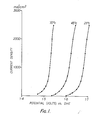
- Figure 2 is a plot of full-cell potential vs time.
- the curve shown is not generally iR corrected but the three values shown were checked in this respect and the appropriate figures are indicated.
- Figure 3 shows the half-cell oxygen evolution plot of a similar PTFE-bonded lithiated Co 3 O 4 anode, initially and after 5,800 hours of continuous running at a current density of 1A/cm 2 in 45% KOH at 85°C. In this case the values were iR corrected.
- This Example illustrates the preparation and properties of an clectrocatalyst according to the present invention prepared by a slurry method.
- a lithium hydroxide solution was prepared by dissolving 6g of LiOH.H20 (Analar) in 100cc of water. This solution was then added to the Co(OH) 2 precipitate in the Buchner funnel until all the solution had drained through the funnel. The Buchner funnel was again connected to the water pump for another 10 minutes and then the precipitate was dried at 105°C for 5 hours in air.
- samples of lithiated Co 3 O 4 prepared by freeze-drying and thermal decomposition of a mixed nitrate solution were also analysed in the above manner and the surface area and resistivity of all the samples was measured.
- the samples prepared by the slurry method exhibit excellent surface area and resistivity values even when heated at 300°C for 5 hours.
- the free lithium can be removed by dilute acetic acid before the electrocatalyst is used to prepare an electrode but in most cases this will not be necessary.
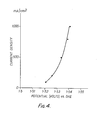
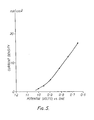
- Figures 4 and 5 illustrate the half-cell oxygen evolution and reduction performances, respectively, of a lithiated Co 3 O 4 electrocatalyst prepared by the slurry method described above.
- the electrocatalyst which was prepared by thermal treatment at 300°C for 5 hours, was found to contain 2.5 atom percent of lithium and had a BET specific surface area of 5cm 2 /g and a resistivity of 3.4 ohm.cm.
- the electrocatalyst was used to prepare PTFE-bonded electrodes as described in Example 2 above, at a loading of 17mg/cm2 for the oxygen reduction electrode and 16m 2 g for the oxygen evolution electrode.
- the electrolyte in the oxygen evolution cell was 5N KOH, and the operating temperature 70 C.
- the oxygen reduction cell was operated at room temperature using air, and 5N KOH as the electrolyte. In each case the values shown are iR corrected.
- FIG. 5 shows that the electrocatalyst is also active for the reduction of oxygen.
- An electrode was prepared as follows. 30 parts by weight of a powdered lithiated Co 3 O 4 prepared by freeze-drying of a mixed nitrate solution and having a total lithium content of 6.3% were intimately mixed with 70% by weight graphite powder and the resulting mixture was dispersed in PTFE and painted onto a 100 mesh nickel screen at a loading of 16mg/cm 2 . A comparison electrode using 100% graphite at the same loading was also prepared.
- Figure 6 is a cyclic voltammogram showing the oxygen reduction performances of the two electrodes using air, and 5N KOH at 18 C as the electrolyte.
- the sweep rate was lOmV/sec.
- the curves are iR corrected.
- the cyclic voltammetry results indicate that the electrocatalyst according to the present invention is stable at oxygen reduction potentials (vs DHE) from the open current voltage of 1.1 volt, to 500mV.
Landscapes
- Chemical & Material Sciences (AREA)
- Engineering & Computer Science (AREA)
- Chemical Kinetics & Catalysis (AREA)
- Materials Engineering (AREA)
- Organic Chemistry (AREA)
- Electrochemistry (AREA)
- Metallurgy (AREA)
- Inert Electrodes (AREA)
- Catalysts (AREA)
- Electrodes For Compound Or Non-Metal Manufacture (AREA)
- Inorganic Compounds Of Heavy Metals (AREA)
Applications Claiming Priority (2)
| Application Number | Priority Date | Filing Date | Title |
|---|---|---|---|
| GB8004483 | 1980-02-11 | ||
| GB8004483 | 1980-02-11 |
Publications (2)
| Publication Number | Publication Date |
|---|---|
| EP0034447A2 true EP0034447A2 (de) | 1981-08-26 |
| EP0034447A3 EP0034447A3 (de) | 1981-12-02 |
Family
ID=10511256
Family Applications (1)
| Application Number | Title | Priority Date | Filing Date |
|---|---|---|---|
| EP81300505A Withdrawn EP0034447A3 (de) | 1980-02-11 | 1981-02-06 | Elektrokatalysator |
Country Status (4)
| Country | Link |
|---|---|
| US (1) | US4464239A (de) |
| EP (1) | EP0034447A3 (de) |
| JP (1) | JPS56152744A (de) |
| GB (1) | GB2068925B (de) |
Cited By (4)
| Publication number | Priority date | Publication date | Assignee | Title |
|---|---|---|---|---|
| EP0101422A3 (de) * | 1982-07-19 | 1985-04-10 | Energy Conversion Devices, Inc. | Elektrode mit modifizierter Oberfläche |
| EP0384563A1 (de) * | 1989-01-23 | 1990-08-29 | Imperial Chemical Industries Plc | Verfahren zur Oxidation von Ammoniak und Katalysator dafür |
| EP0473236A3 (en) * | 1990-08-30 | 1992-04-01 | Stichting Energieonderzoek Centrum Nederland(Ecn) | Tape suitable for use in fuel cells, electrode suitable for use in a fuel cell, method for sintering an electrode of this type and a fuel cell provided with an electrode of this type |
| CN1040972C (zh) * | 1993-08-12 | 1998-12-02 | H·C·施塔克公司 | 钴/钴氧化物粉末及其制造方法和应用 |
Families Citing this family (6)
| Publication number | Priority date | Publication date | Assignee | Title |
|---|---|---|---|---|
| US4670122A (en) * | 1986-05-05 | 1987-06-02 | The Dow Chemical Company | Low over-voltage electrodes for alkaline electrolytes |
| GB2242898B (en) * | 1990-04-12 | 1993-12-01 | Technology Finance Corp | Lithium transition metal oxide |
| US7517606B2 (en) * | 1998-02-24 | 2009-04-14 | Cabot Corporation | Fuel cells and batteries including metal-carbon composite powders |
| US7879750B2 (en) * | 2006-11-30 | 2011-02-01 | General Electric Company | Anodes for alkaline electrolysis |
| US9512526B2 (en) * | 2013-12-19 | 2016-12-06 | Toyota Motor Engineering & Manufacturing North America, Inc. | Water oxidation catalyst including lithium cobalt germanate |
| CN111450851B (zh) * | 2020-03-02 | 2023-12-19 | 江苏大学 | 一种硫掺杂的钴基纳米析氧电催化剂的制备方法 |
Family Cites Families (7)
| Publication number | Priority date | Publication date | Assignee | Title |
|---|---|---|---|---|
| BE573509A (de) * | ||||
| GB859738A (en) * | 1956-12-03 | 1961-01-25 | Csf | Improvements in or relating to thermistors and methods of preparing thermistor materials |
| GB1397793A (en) * | 1972-04-25 | 1975-06-18 | British Oxygen Co Ltd | Grinding process |
| JPS5167937A (de) * | 1974-12-06 | 1976-06-12 | Hitachi Ltd | |
| IL50217A (en) * | 1976-08-06 | 1980-01-31 | Israel State | Electrocatalytically acitve spinel type mixed oxides |
| US4049027A (en) * | 1976-08-26 | 1977-09-20 | Yardney Electric Corporation | Active material for pressed nickel electrodes |
| EP0017400B1 (de) * | 1979-04-05 | 1984-05-30 | United Kingdom Atomic Energy Authority | Elektrochemische Zelle und Verfahren zur Herstellung von Ionenleitern für diese Zelle |
-
1981
- 1981-02-06 EP EP81300505A patent/EP0034447A3/de not_active Withdrawn
- 1981-02-06 GB GB8103750A patent/GB2068925B/en not_active Expired
- 1981-02-10 JP JP1886181A patent/JPS56152744A/ja active Pending
-
1983
- 1983-11-10 US US06/550,716 patent/US4464239A/en not_active Expired - Fee Related
Cited By (7)
| Publication number | Priority date | Publication date | Assignee | Title |
|---|---|---|---|---|
| EP0101422A3 (de) * | 1982-07-19 | 1985-04-10 | Energy Conversion Devices, Inc. | Elektrode mit modifizierter Oberfläche |
| EP0384563A1 (de) * | 1989-01-23 | 1990-08-29 | Imperial Chemical Industries Plc | Verfahren zur Oxidation von Ammoniak und Katalysator dafür |
| US5041276A (en) * | 1989-01-23 | 1991-08-20 | Imperial Chemical Industries Plc | Ammonia oxidation |
| US5122497A (en) * | 1989-01-23 | 1992-06-16 | Imperial Chemical Industries Plc | Catalyst for ammonia oxidation |
| EP0473236A3 (en) * | 1990-08-30 | 1992-04-01 | Stichting Energieonderzoek Centrum Nederland(Ecn) | Tape suitable for use in fuel cells, electrode suitable for use in a fuel cell, method for sintering an electrode of this type and a fuel cell provided with an electrode of this type |
| US5356731A (en) * | 1990-08-30 | 1994-10-18 | Stichting Energieonderzoek Centrum Nederland | Molten cabonate fuel cell with sintered LiCoO2 electrode |
| CN1040972C (zh) * | 1993-08-12 | 1998-12-02 | H·C·施塔克公司 | 钴/钴氧化物粉末及其制造方法和应用 |
Also Published As
| Publication number | Publication date |
|---|---|
| GB2068925B (en) | 1984-02-01 |
| JPS56152744A (en) | 1981-11-26 |
| US4464239A (en) | 1984-08-07 |
| GB2068925A (en) | 1981-08-19 |
| EP0034447A3 (de) | 1981-12-02 |
Similar Documents
| Publication | Publication Date | Title |
|---|---|---|
| Schwartz et al. | Carbon dioxide reduction to alcohols using perovskite‐type electrocatalysts | |
| Chu et al. | Methanol electro‐oxidation on unsupported Pt‐Ru alloys at different temperatures | |
| US4132619A (en) | Electrocatalyst | |
| CA1227158A (en) | Electrochemical reduction of carbon oxides to carboxylic acid | |
| US3964933A (en) | Carbon article including electrodes and methods of making the same | |
| Matsuki et al. | Oxygen reduction electrocatalysis on some manganese oxides | |
| CN109728311B (zh) | 负载铁钴硫化物的金属有机框架化合物中空微球 | |
| JPH0763627B2 (ja) | 改良された触媒材料 | |
| Li et al. | Study of the bifunctional catalytic activity on Sr and Mn co-doped PrFeO3-δ Zinc-Air batteries cathode | |
| CN112968185A (zh) | 植物多酚改性的超分子网络框架结构锰基纳米复合电催化剂的制备方法 | |
| US4101716A (en) | Use of high surface area mixed metal oxides of manganese and calcium in electrochemical processes | |
| JP2003288905A (ja) | 電極触媒の製造方法 | |
| CN113512737A (zh) | 一种氢氧化镍电催化剂、制备方法、电化学活化方法及其应用 | |
| US4464239A (en) | Electrocatalyst | |
| KR20160128951A (ko) | 산소 발생 촉매, 전극 및 전기화학반응 시스템 | |
| Jeong et al. | Amorphous ruthenium‐chromium oxides for electrochemical capacitors | |
| Broyde | Tungsten bronze fuel cell catalysts | |
| EP0013572B1 (de) | Mittels Sauerstoff depolarisierte Kathode und ihre Verwendung in der Elektrolyse | |
| CA1120099A (en) | Borides of molybdenum as catalyst in fuel cell electrodes | |
| US3405010A (en) | Spinel-ruthenium catalyzed electrode | |
| Machida et al. | Methanol oxidation characteristics of rare earth tungsten bronze electrodes doped with platinum | |
| CN110745881A (zh) | 钙掺杂的钌酸钇及其制备方法和在电化学装置中的应用 | |
| JP2000067877A (ja) | 電極触媒の製造方法 | |
| US4882024A (en) | Hydrogen generator having a low oxygen overpotential electrode | |
| CN120366815A (zh) | 一种过渡金属镍单原子双功能电催化剂及其制备方法与应用 |
Legal Events
| Date | Code | Title | Description |
|---|---|---|---|
| PUAI | Public reference made under article 153(3) epc to a published international application that has entered the european phase |
Free format text: ORIGINAL CODE: 0009012 |
|
| AK | Designated contracting states |
Designated state(s): BE CH DE FR IT |
|
| PUAL | Search report despatched |
Free format text: ORIGINAL CODE: 0009013 |
|
| AK | Designated contracting states |
Designated state(s): BE CH DE FR IT |
|
| 17P | Request for examination filed |
Effective date: 19820601 |
|
| STAA | Information on the status of an ep patent application or granted ep patent |
Free format text: STATUS: THE APPLICATION IS DEEMED TO BE WITHDRAWN |
|
| 18D | Application deemed to be withdrawn |
Effective date: 19850123 |