EP0034533A2 - Verfahren zur Kälte- und/oder Wärmeerzeugung mittels eines Absorptionskreislaufes, insbesondere verwendbar für Raumheizungen - Google Patents
Verfahren zur Kälte- und/oder Wärmeerzeugung mittels eines Absorptionskreislaufes, insbesondere verwendbar für Raumheizungen Download PDFInfo
- Publication number
- EP0034533A2 EP0034533A2 EP81400216A EP81400216A EP0034533A2 EP 0034533 A2 EP0034533 A2 EP 0034533A2 EP 81400216 A EP81400216 A EP 81400216A EP 81400216 A EP81400216 A EP 81400216A EP 0034533 A2 EP0034533 A2 EP 0034533A2
- Authority
- EP
- European Patent Office
- Prior art keywords
- heat
- fluid
- liquid phase
- absorption
- fraction
- Prior art date
- Legal status (The legal status is an assumption and is not a legal conclusion. Google has not performed a legal analysis and makes no representation as to the accuracy of the status listed.)
- Granted
Links
Images


Classifications
-
- F—MECHANICAL ENGINEERING; LIGHTING; HEATING; WEAPONS; BLASTING
- F25—REFRIGERATION OR COOLING; COMBINED HEATING AND REFRIGERATION SYSTEMS; HEAT PUMP SYSTEMS; MANUFACTURE OR STORAGE OF ICE; LIQUEFACTION SOLIDIFICATION OF GASES
- F25B—REFRIGERATION MACHINES, PLANTS OR SYSTEMS; COMBINED HEATING AND REFRIGERATION SYSTEMS; HEAT PUMP SYSTEMS
- F25B30/00—Heat pumps
- F25B30/04—Heat pumps of the sorption type
-
- F—MECHANICAL ENGINEERING; LIGHTING; HEATING; WEAPONS; BLASTING
- F25—REFRIGERATION OR COOLING; COMBINED HEATING AND REFRIGERATION SYSTEMS; HEAT PUMP SYSTEMS; MANUFACTURE OR STORAGE OF ICE; LIQUEFACTION SOLIDIFICATION OF GASES
- F25B—REFRIGERATION MACHINES, PLANTS OR SYSTEMS; COMBINED HEATING AND REFRIGERATION SYSTEMS; HEAT PUMP SYSTEMS
- F25B15/00—Sorption machines, plants or systems, operating continuously, e.g. absorption type
- F25B15/02—Sorption machines, plants or systems, operating continuously, e.g. absorption type without inert gas
-
- Y—GENERAL TAGGING OF NEW TECHNOLOGICAL DEVELOPMENTS; GENERAL TAGGING OF CROSS-SECTIONAL TECHNOLOGIES SPANNING OVER SEVERAL SECTIONS OF THE IPC; TECHNICAL SUBJECTS COVERED BY FORMER USPC CROSS-REFERENCE ART COLLECTIONS [XRACs] AND DIGESTS
- Y02—TECHNOLOGIES OR APPLICATIONS FOR MITIGATION OR ADAPTATION AGAINST CLIMATE CHANGE
- Y02A—TECHNOLOGIES FOR ADAPTATION TO CLIMATE CHANGE
- Y02A30/00—Adapting or protecting infrastructure or their operation
- Y02A30/27—Relating to heating, ventilation or air conditioning [HVAC] technologies
-
- Y—GENERAL TAGGING OF NEW TECHNOLOGICAL DEVELOPMENTS; GENERAL TAGGING OF CROSS-SECTIONAL TECHNOLOGIES SPANNING OVER SEVERAL SECTIONS OF THE IPC; TECHNICAL SUBJECTS COVERED BY FORMER USPC CROSS-REFERENCE ART COLLECTIONS [XRACs] AND DIGESTS
- Y02—TECHNOLOGIES OR APPLICATIONS FOR MITIGATION OR ADAPTATION AGAINST CLIMATE CHANGE
- Y02B—CLIMATE CHANGE MITIGATION TECHNOLOGIES RELATED TO BUILDINGS, e.g. HOUSING, HOUSE APPLIANCES OR RELATED END-USER APPLICATIONS
- Y02B30/00—Energy efficient heating, ventilation or air conditioning [HVAC]
- Y02B30/62—Absorption based systems
Definitions
- the invention relates to the field of absorption refrigeration machines.
- an absorption heat pump which produces, at an average operating temperature level T 2 , a quantity of heat Q 2 greater than the quantity of heat Q 1 which was supplied to it at an average temperature level T 1 higher than T 2 , by pumping heat to a heat source at an average temperature level T 3 lower than T 2 , this heat source being able to be by for example ground water or outside air.
- Such an installation of known type can operate according to the principle diagram which is represented in FIG. 1.
- the cycle involves a working fluid which plays the role of solute and which is, for example, ammonia and a solvent which is, for example, water.
- the working fluid is vaporized by heating the solution contained in the boiler B01 with the addition of the quantity of heat Q 1 supplied via the exchanger E 1 .
- the vapor which is formed generally contains solvent and it is rectified by contact with the reflux which is sent at the head of the zone of rectification R1.
- the vapor which leaves at the head of the rectification zone R1 is thus formed of practically pure refrigerant.
- This vapor is condensed in the exchanger E2 by heating an external fluid which arrives by the conduit 1 and leaves by the conduit 2.
- the condensate thus formed is collected in the tank Bl. A fraction of this condensate is evacuated by the conduit 3 and sent as reflux by the pump Pl at the head of the rectification zone R1.
- the remaining fraction is evacuated through line 4, expanded in the expansion valve V1 and sent through line 5 to the exchanger E3.
- the exchanger E3 it is vaporized by pumping heat to an external fluid which arrives by the conduit 6 and leaves again by the conduit 7.
- the vapor phase is evacuated by the conduit 8; it is absorbed in the lean solution coming from the boiler BO1 and arriving by the conduit 9, through the valve V2, by yielding heat to an external fluid which arrives by the conduit 10 and leaves by the conduit 11.
- the rich solution thus formed is collected in tank B2 and taken up by pump P2 which sends it through line 12 to boiler B01.
- Such an operating diagram is generally satisfactory when the installation operates by producing cold and by rejecting heat in the exchangers E2 and E4 at a relatively low temperature, for example 30 or 40 ° C.
- the heating fluid will often be water, the temperature of arrival in the exchangers E2 and E4 will generally change during the year.
- the heat pump provides all or at least a large part of the heat necessary for heating, the water outlet temperature may reach and exceed values of the order of 50 ° C.
- the working fluid is ammonia or a fluid having a comparable boiling point and critical temperature, the pressure at which the generator and the condenser E2 are found increases rapidly when the outlet temperature of the heated fluid increases.
- a variant of this known method consists in only partially vaporizing the working fluid in the evaporator E 3 ; the residual liquid phase is then returned entirely to the desorption zone (US 2,392,894, 4,003,215 and US 4,037,649, FR 2,412,800, EP 1272). This variant does not remedy the drawback stated above.
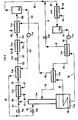
- the working heat transfer fluid (F) is vaporized by heating the solution contained in the boiler B02, the necessary heat being supplied via the exchanger E6.
- the vapor which is formed is rectified in the rectification column R2, by contact first with the rich solution arriving from the absorption zone via the conduit 14, then with the solution sent to the head of the rectification column R2 by the line 15.
- the vapor leaving through line 16 is mixed with the solution arriving through line 17.
- the liquid vapor mixture thus obtained is sent through line 18 into the exchanger E7 in which the vapor phase is condensed at least in part by yielding heat to an external fluid which arrives via line 19 and leaves via line 20.
- the solution obtained leaves the exchanger E7 through the duct 21, - saturated or slightly sub-cooled.
- the higher the water content of this solution the lower the pressure.
- the saturation pressure changes in the following manner with the concentration of ammonia x expressed as the weight fraction of ammonia.
- a first zone comprising the exchangers. gants E7, E8 and E9 as well as the entire circuit consisting of lines 18, 21, 23, 24, 25, 26, the expansion valve V3 and the settling tank B4 and a second zone formed by the rest of the device .
- the quantities of solvent (S) and of refrigerant (F) entering the first zone and leaving the second zone must be the same as the quantities solvent and refrigerant leaving the first zone and entering the second zone.
- the outlet temperature of the exchanger E9 is generally much lower than the temperature of the steam leaving via the pipe 16
- the solvent content of the steam leaving via the pipe 16 is higher than the solvent content of the steam leaving the tray B4.
- the vapor which is evacuated through line 27 is mixed with the lean solution arriving through line 28 and the liquid-vapor mixture thus formed is sent through line 29 into the exchanger E10.
- the vapor phase is then absorbed by yielding heat to an external fluid which arrives via the conduit 30 and leaves through the conduit 31.
- the rich solution thus formed emerges from the exchanger E10 by the conduit 32 and it is collected in the tank B5, from where it is evacuated via line 33 to be taken up by pump P5, which sends it via line 34 to the exchanger E11.
- the exchanger E11 it exchanges heat with the lean solution which is evacuated via the pipe 35 of the boiler B02, cooled in the exchanger Ell, evacuated from the exchanger E11 by the pipe 36, expanded in the expansion valve V4 and recycled to the absorption zone through line 28.
- the invention can be defined as follows:
- the solution from the absorption step can be introduced at different points in the rectification zone. It is possible in particular to introduce it entirely at an intermediate point of the rectification zone, the solution coming from the vaporization step being sent to the head. However, it is possible (although less preferred) to introduce only part (50 to 100%) of the adsorption solution at an intermediate point of the rectification zone and to introduce the rest at another point, for example at the head or bottom or directly at the desorption stage.
- the invention also relates to the case where two separate columns, but connected together, are used, one corresponding to the upper part of the single column mentioned above (area situated above the intermediate point defined above) and l 'other at the bottom (below the intermediate point).
- the heat which is supplied during the desorption stage can have any origin. It can come in particular from the combustion of a gaseous or liquid hydrocarbon, such as natural gas or a fuel used for domestic heating, or even for high power installations, an industrial fuel. Heat can be transmitted directly by the combustion gases through an exchange surface or via a heat transfer fluid such as for example pressurized water or an organic heat transfer fluid.
- a gaseous or liquid hydrocarbon such as natural gas or a fuel used for domestic heating, or even for high power installations, an industrial fuel.
- Heat can be transmitted directly by the combustion gases through an exchange surface or via a heat transfer fluid such as for example pressurized water or an organic heat transfer fluid.
- the process supplies heat to an external fluid in the 1 exchangers E7 and E10 and takes heat from an external fluid in the exchanger E9.
- the temperature of the mixture of fluids (F) and (S) changes as well as in general the temperature of the external fluids. It is therefore advantageous to operate these exchanges against the current, the mixture of the fluids (F) and (S) following, during the condensation step and the absorption step, a decreasing temperature evolution parallel to l 'evolution of increasing temperature of the external fluid and during' the vaporization step an evolution of increasing temperature parallel to the evolution of decreasing temperature of the external fluid.
- the invention applies very particularly to the case where the fluid (F) is ammonia and the fluid (S) is water.
- other fluids can also be used pure or as a mixture.
- the fluid (F) can be, for example, a hydrocarbon whose molecule contains from 3 to 5 carbon atoms, such as propane, normal butane, isobutane, normal pentane, isopentane, or a halogenated hydrocarbon of the "Freon" type, the molecule of which has one or two carbon atoms and at least one fluorine atom, for example difluorochloromethane (R-22), dichlorofluoromethane (R-21) or difluorodichloromethane (R-12).
- a hydrocarbon whose molecule contains from 3 to 5 carbon atoms, such as propane, normal butane, isobutane, normal pentane, isopentane, or a halogenated hydrocarbon of the "Freon" type, the molecule of which has one or two carbon atoms and at least one fluorine atom, for example difluorochloromethane (R-22), dichlorofluoromethane (R-21) or diflu
- the solvent may then be, for example, dimethylformamide, diethylformamide, ethylene glycol, diethylene glycol, triethylene glycol, dimethyl ether of tetraethylene glycol, dibutylphthalate, dimethyl sulfoxide, N-methylpyrrolidone, N, N-dimethylacetamide, isobutyl acetate, benzyl alcohol, aniline or even a hydrocarbon chosen, for example, from paraffinic hydrocarbons.
- the fluid (F) can also be, for example, methylamine and the fluid (S) water.
- any pair of working fluid (F), solvent (S) may be suitable provided that the products used are chemically stable under the temperature and pressure conditions at which one operates, that the working fluid and the solvent can be vaporized. pure or mixed under the temperature and pressure conditions at which one operates, the volatility of the working fluid being however greater than the volatility of the solvent.
- the absorption step is carried out by bringing a solution coming from the desorption step and which arrives via line 51 into contact with a vapor phase which comes from the evaporation stage and which arrives via line 50.
- the mixture which arrives via line 51 has the following composition (in molar fractions):
- the vapor phase which arrives via line 50 contains 99.96% of ammonia.
- the vapor phase flow rate is 72.1 kg / h and the solution flow rate is 224.4 kg / h.
- the liquid-vapor mixture is sent via line 52 to the exchanger E103 and the absorption step is carried out by ceding the heat of absorption to the water of a heating circuit which arrives via line 53 to 40 ° -C and leaves via line 54 at 55 ° C.
- the solution obtained is collected in tank B101 and taken up by pump P102 which sends it through line 55 in the exchanger E106. In the exchanger E106 it is reheated by exchanging heat with the lean solution arriving through the conduit 56.
- the column is equipped with a boiler which is heated by the fumes of a burner operating with natural gas, through the exchange surface E108.
- the heat thus supplied to the boiler is 40636 Kcal / h.
- the fumes exit from the boiler through line 58 at a temperature of 280 ° C. They are then sent to the exchanger E107 from where they exit through line 59 at a temperature of 180 ° C.
- the steam exiting at the head of the rectification column is evacuated via line 61. Via line 62 there arrives a flow rate of 16.8 kg / h of solution. This latter solution comes from the passage, through the distribution valve V101, of a fraction of the solution which arrives through the conduit 63. The remaining fraction of the solution which arrives through the conduit 63 passes through the distribution valve V102 and it is sent via line 64 at the head of column C101. The liquid-vapor mixture obtained after mixing the overhead vapor with the add-in arriving through the conduit 62 is sent through the conduit 65 to the exchanger E101 from which it emerges through the conduit 66.
- the heat of condensation which represents 28934 Kcal / h, is supplied against the current to the water of a heating circuit which arrives through line 67 at a temperature of 40 ° C and leaves through line 68 at a temperature of 55 ° C.
- the solution resulting is sent by the conduit 66 to the exchanger E105 from where it emerges by the conduit 67. It is expanded through the expansion valve V104 then sent by the conduit 68 to the exchanger E102 from which it emerges by the line 69.
- the heat of vaporization is taken against the current on the water of a water table which arrives via line 70 at 12 ° C and leaves via line 71 at 4 ° C.
- the liquid-vapor mixture leaving the exchanger E102 is collected in the tank B102 where the liquid phase and the vapor phase are separated.
- the liquid phase is evacuated through line 72 and sent by pump P101 into line 73 through which it enters the exchanger E105 from which it emerges through line 63 at a temperature of 40 ° C.
- the vapor phase is recycled via line 50 in the absorption step.
- the absorption step is carried out by bringing a solution coming from the desorption step into contact and which arrives via the conduit 81 with a vapor phase. which comes from the evaporation step and which arrives via line 80.
- the water-ammonia mixture which arrives via line 81 contains 5% of ammonia (in molar fraction).
- the liquid-vapor mixture thus obtained is sent through line 82 into exchanger E203 and the absorption step is carried out by ceding the heat of absorption to the water of a heating circuit which arrives through line 83 at 26 ° C and leaves via line 84 at 32 ° C.
- the solution obtained which represents a flow rate of 202.6 kg / h, is collected in tank B201.
- the steam exiting at the head of column C201 is evacuated through line 93. It is mixed with a flow rate of 89.6 kg / h of solution arriving through line 94 after passage through the distribution valve V201. The remaining fraction of the solution which arrives via the conduit 96 passes through the distribution valve V202 and is introduced at the head of the column C201.
- the solution thus obtained is sent via line 89 to the exchanger E205 from where it exits through the conduit 100. It is then expanded through the expansion valve V204 and it is sent via the conduit 101 to the exchanger E206 in which it is partially vaporized by exchanging heat with outside air which arrives by the conduit 102 at 10 ° C and leaves via the conduit 103 at 5 ° C.
- the humidity. relative air dity being 50% there is no condensation of water from this outside air and no defrosting is necessary under these operating conditions.
- the liquid vapor vapor mixture leaving the exchanger E206 is sent via the conduit 104 into the exchanger E207 in which the vaporization of the water-ammonia mixture is continued by heat exchange with the fumes from the exchanger E209 which arrive via the conduit 89 and leave via line 105.
- the liquid vapor mixture obtained leaves the exchanger E207 through line 106 at a temperature of 15 ° C. and it is collected in tank B202. In the tank 202, the liquid phase and the vapor phase are separated.
- the liquid phase is discharged through line 107, pumped by pump P201 and sent through line 108 to the exchanger E205.
- the vapor phase is removed through line 80 and recycled to the absorption step.
- This example shows that it is advantageous to introduce the charge at an intermediate point of the column and the reflux at the head.
- the fluid of the heating circuit to which the heat is transmitted during the stages of condensation and absorption can also be air.
- the heat can be transmitted to the outside air which is heated before being sent to the room to be heated. It can also be transmitted to the indoor air of the room which is heated and which is in this case recirculated, or to a mixture of outside air and indoor air.
- the fluid which circulates in the heating circuit can feed the exchangers in which the heat supplied by the process is transmitted during the stages of condensation or absorption, either in parallel or in series.
- the different stages of the process can be carried out with different types of equipment.
- the rectification column can be produced with trays, for example with caps or flaps, either by using different types of packing, or by separate elements of dimension smaller than the diameter of the column (such as for example the Raschig rings, the rings Pall, the saddles of Berl used in chemical engineering) or in woven elements (such as for example the "Multiknit" fillings manufactured by Tissmétal).
- trays for example with caps or flaps, either by using different types of packing, or by separate elements of dimension smaller than the diameter of the column (such as for example the Raschig rings, the rings Pall, the saddles of Berl used in chemical engineering) or in woven elements (such as for example the "Multiknit" fillings manufactured by Tissmétal).
- the exchangers can be, for example, plate exchangers, for example brazed aluminum exchangers, or alternatively double tube exchangers.
- the mixtures carried out between a gaseous phase and a liquid phase can be carried out either by simple online mixing, or in an enclosure comprising either mechanical or static agitation, the mixture resulting in the latter case from the passage of the phases of which the mixing is carried out, for example, around a propeller or through a packing.
- Said mixtures and the supply of heat by at least partial condensation of said mixtures can be carried out either successively, the mixing zone being distinct from the exchanger in which the heat is supplied to the outside, or simultaneously by cooling the enclosure in which mixing is carried out.
- the pressure in the desorption zone is generally between 3 and 25 bars and the pressure in the absorption zone is generally between 1 and 15 bars.
- the temperature of the mixture of fluids (F) and (S) at the end of the condensation and absorption stages is generally understood between 20 and 100 ° C and the temperature of the mixture during the vaporization stage is generally between - 15 and 50 ° C.
- the evaporation step which in the case of heat pump operation is used to take heat in order to provide it during the condensation and absorption steps, can also be used to produce cold , the heat given off during the absorption and condensation stages then being either used as heating means or discharged into the ambient medium.
Landscapes
- Engineering & Computer Science (AREA)
- Physics & Mathematics (AREA)
- Mechanical Engineering (AREA)
- Thermal Sciences (AREA)
- General Engineering & Computer Science (AREA)
- Sorption Type Refrigeration Machines (AREA)
Applications Claiming Priority (2)
| Application Number | Priority Date | Filing Date | Title |
|---|---|---|---|
| FR8003460 | 1980-02-15 | ||
| FR8003460A FR2476287A1 (fr) | 1980-02-15 | 1980-02-15 | Procede de production de froid et/ou de chaleur par cycle a absorption utilisable notamment pour le chauffage de locaux |
Publications (3)
| Publication Number | Publication Date |
|---|---|
| EP0034533A2 true EP0034533A2 (de) | 1981-08-26 |
| EP0034533A3 EP0034533A3 (en) | 1982-08-25 |
| EP0034533B1 EP0034533B1 (de) | 1984-08-01 |
Family
ID=9238661
Family Applications (1)
| Application Number | Title | Priority Date | Filing Date |
|---|---|---|---|
| EP81400216A Expired EP0034533B1 (de) | 1980-02-15 | 1981-02-11 | Verfahren zur Kälte- und/oder Wärmeerzeugung mittels eines Absorptionskreislaufes, insbesondere verwendbar für Raumheizungen |
Country Status (6)
| Country | Link |
|---|---|
| US (1) | US4341084A (de) |
| EP (1) | EP0034533B1 (de) |
| JP (1) | JPS56138663A (de) |
| DE (1) | DE3165148D1 (de) |
| DK (1) | DK58881A (de) |
| FR (1) | FR2476287A1 (de) |
Cited By (2)
| Publication number | Priority date | Publication date | Assignee | Title |
|---|---|---|---|---|
| EP0177624A1 (de) * | 1982-06-16 | 1986-04-16 | The Puraq Company | Absorptionskälteprozess |
| EP1358920A1 (de) | 2002-04-30 | 2003-11-05 | Hans Dr.-Ing. Förster | Verfahren und Vorrichtung für die nichtadiabatische Rektifikation ohne Rücklauferzeugung |
Families Citing this family (13)
| Publication number | Priority date | Publication date | Assignee | Title |
|---|---|---|---|---|
| DE3100348A1 (de) * | 1981-01-08 | 1982-08-05 | Dieter Dr.-Ing. 5064 Rösrath Markfort | "resorptions-anlage zur waermetransformtation" |
| FR2497931A1 (fr) * | 1981-01-15 | 1982-07-16 | Inst Francais Du Petrole | Procede de chauffage et de conditionnement thermique au moyen d'une pompe a chaleur a compression fonctionnant avec un fluide mixte de travail et appareil pour la mise en oeuvre dudit procede |
| FR2504249A1 (fr) * | 1981-04-15 | 1982-10-22 | Inst Francais Du Petrole | Procede de production de froid et/ou de chaleur au moyen d'un cycle a absorption |
| FR2539220A1 (fr) * | 1983-01-10 | 1984-07-13 | Inst Francais Du Petrole | Procede de production de froid et/ou de chaleur au moyen d'un cycle a absorption comportant au moins deux etapes d'absorption |
| US4598556A (en) * | 1984-09-17 | 1986-07-08 | Sundstrand Corporation | High efficiency refrigeration or cooling system |
| US5829259A (en) * | 1994-01-13 | 1998-11-03 | Rocky Research | Aqueous absorption fluids |
| US5419145A (en) * | 1994-01-13 | 1995-05-30 | Rocky Research | Chemical energy storage system |
| US5577388A (en) * | 1994-01-13 | 1996-11-26 | Rocky Research | Aqueous absorption fluids |
| US6656380B2 (en) | 2001-10-16 | 2003-12-02 | Supachill Technologies Pty. Ltd. | Super-coolable composition having long-duration phase change capability, process for preparation of same, process for super-cooling same and articles comprising same |
| US6681581B2 (en) * | 2001-11-20 | 2004-01-27 | Supachill Technologies Pty. Ltd. | Pre-conditioned solute for use in cryogenic processes |
| DE10219262B4 (de) * | 2002-04-30 | 2004-09-16 | Förster, Hans, Dr.-Ing. | Absorptionskälteverfahren für Temperaturen unter 0 °C ohne druckausgleichendem Gas |
| CN103649652B (zh) * | 2011-07-04 | 2016-08-17 | 富士通株式会社 | 吸附式热泵的控制方法、信息处理系统及控制装置 |
| EP3285025B1 (de) * | 2016-08-18 | 2019-07-03 | Andreas Bangheri | Absorptionswärmepumpe und verfahren zum betreiben einer absorptionswärmepumpe |
Family Cites Families (18)
| Publication number | Priority date | Publication date | Assignee | Title |
|---|---|---|---|---|
| US2182098A (en) * | 1934-09-29 | 1939-12-05 | Mallory & Co Inc P R | Duplex solution thermo-compression process |
| US2182453A (en) * | 1936-01-18 | 1939-12-05 | William H Sellew | Heat transfer process and apparatus |
| US2408802A (en) * | 1940-01-15 | 1946-10-08 | Glen W Miller | Absorption refrigeration cycle |
| US2392894A (en) * | 1944-02-19 | 1946-01-15 | Worthington Pump & Mach Corp | Refrigeration system |
| US3402570A (en) * | 1966-12-23 | 1968-09-24 | Ralph C. Schlichtig | Refrigeration systems and refrigerants used therewith |
| US3817050A (en) * | 1972-12-26 | 1974-06-18 | Texaco Inc | Two-stage ammonia absorption refrigeration system with at least three evaporation stages |
| DE2402777A1 (de) * | 1974-01-22 | 1975-07-24 | Reinhard F Dr Hoehne | Raumwaermepumpe |
| US4003215A (en) * | 1974-06-24 | 1977-01-18 | University Of Adelaide | Absorption refrigeration system |
| US4037649A (en) * | 1975-04-04 | 1977-07-26 | Hartka Dale R | Heating and refrigeration system |
| US4167101A (en) * | 1975-08-14 | 1979-09-11 | Institut Francais Du Petrole | Absorption process for heat conversion |
| FR2321098A1 (fr) * | 1975-08-14 | 1977-03-11 | Inst Francais Du Petrole | Thermotransformateur a absorption |
| US4031712A (en) * | 1975-12-04 | 1977-06-28 | The University Of Delaware | Combined absorption and vapor-compression refrigeration system |
| DE2629441A1 (de) * | 1976-06-30 | 1978-01-05 | Linde Ag | Verfahren zur erhoehung der temperatur eines waermetraegers |
| US4102388A (en) * | 1976-09-23 | 1978-07-25 | Shell Oil Company | Heat recovery process |
| DE2743508A1 (de) * | 1977-09-24 | 1979-03-29 | Deutsche Forsch Luft Raumfahrt | Heizungsanlage mit waermepumpe |
| DE2758547A1 (de) * | 1977-12-23 | 1979-06-28 | Borsig Gmbh | Verfahren zur verbesserung der energiebilanz von absorptionskaelteanlagen |
| FR2437588A1 (fr) * | 1978-09-28 | 1980-04-25 | Inst Francais Du Petrole | Perfectionnement aux absorbeurs utilises dans les pompes a chaleur et machines frigorifiques a absorption |
| FR2454591A1 (fr) * | 1979-04-17 | 1980-11-14 | Inst Francais Du Petrole | Procede perfectionne de production de froid et/ou de chaleur au moyen d'un cycle a absorption |
-
1980
- 1980-02-15 FR FR8003460A patent/FR2476287A1/fr active Granted
-
1981
- 1981-02-11 EP EP81400216A patent/EP0034533B1/de not_active Expired
- 1981-02-11 DE DE8181400216T patent/DE3165148D1/de not_active Expired
- 1981-02-11 DK DK58881A patent/DK58881A/da not_active Application Discontinuation
- 1981-02-13 US US06/234,214 patent/US4341084A/en not_active Expired - Lifetime
- 1981-02-16 JP JP2214381A patent/JPS56138663A/ja active Pending
Cited By (2)
| Publication number | Priority date | Publication date | Assignee | Title |
|---|---|---|---|---|
| EP0177624A1 (de) * | 1982-06-16 | 1986-04-16 | The Puraq Company | Absorptionskälteprozess |
| EP1358920A1 (de) | 2002-04-30 | 2003-11-05 | Hans Dr.-Ing. Förster | Verfahren und Vorrichtung für die nichtadiabatische Rektifikation ohne Rücklauferzeugung |
Also Published As
| Publication number | Publication date |
|---|---|
| JPS56138663A (en) | 1981-10-29 |
| EP0034533B1 (de) | 1984-08-01 |
| DE3165148D1 (en) | 1984-09-27 |
| FR2476287A1 (fr) | 1981-08-21 |
| EP0034533A3 (en) | 1982-08-25 |
| DK58881A (da) | 1981-08-16 |
| FR2476287B1 (de) | 1984-02-10 |
| US4341084A (en) | 1982-07-27 |
Similar Documents
| Publication | Publication Date | Title |
|---|---|---|
| EP0034533B1 (de) | Verfahren zur Kälte- und/oder Wärmeerzeugung mittels eines Absorptionskreislaufes, insbesondere verwendbar für Raumheizungen | |
| EP0644996B1 (de) | Verfahren und anlage zur kühlung eines fluids, insbesondere für die verflüssigung von erdgas | |
| CA2188825C (fr) | Procede de sechage de gaz au glycol incluant la purification des rejets gazeux | |
| CA1135518A (fr) | Procede perfectionne de production de froid et/ou de chaleur au moyen d'un cycle a absorption | |
| EP0783031B1 (de) | Verfahren zur Entfernung von Wasser, Saüren und Benzin aus Erdgas, unter Verwendung eines Lösungsmittelgemisches | |
| EP0691155B1 (de) | Verfahren zur Entsäuerung eines Gases um konzentrierte, saure Gase herzustellen | |
| EP0768502B1 (de) | Verfahren und Vorrichtung zur Verflüssigung und Behandlung von Erdgas | |
| EP1035904B1 (de) | Verfahren zur entwässerung eines feuchten gases mittels einer entwässerungsflüssigkeit, mit tiefregeneration der entwässerungsflüssigkeit | |
| CA2230092C (fr) | Procede de desacidification avec production de gaz acides en phase liquide | |
| FR2814379A1 (fr) | Procede de desacidification d'un gaz par absorption dans un solvant avec un controle de la temperature | |
| EP0162746B1 (de) | Absorptionsverfahren zur Kälte- und/oder Wärmeerzeugung mit einem aus mehreren Bestandteilen bestehenden Gemisch als Arbeitsmittel | |
| EP2137475B1 (de) | Verfahren zur kühlung einer kryogenen austauschleitung | |
| FR2544998A1 (fr) | Nouveau procede de fractionnement d'un melange gazeux de plusieurs constituants | |
| CA1309966C (fr) | Procede de distillation avec recuperation d'energie par recompression de vapeur a l'aide d'un ejecteur | |
| CA2452991A1 (fr) | Procede de desacidification et de deshydratation d`un gaz naturel | |
| EP1118827A1 (de) | Verfahren zur partiellen Verflüssigung einer kohlenwasserstoffreichen Fraktion wie Erdgas | |
| EP0064434B1 (de) | Verfahren zur Erzeugung von Kälte und/oder Wärme mittels eines Absorptionszyklus | |
| CA1136875A (fr) | Absorbeurs utilises dans les pompes a chaleur et machines frigorifiques a absorption | |
| CA1060336A (fr) | Procede de production de chaleur par absorption | |
| EP0598657B1 (de) | Verfahren zum Regenerieren von flüssigen Trocknungsmitteln | |
| FR2481362A1 (fr) | Procede pour l'utilisation de chaleur de refroidissement pour la production d'energie mecanique et eventuellement la production simultanee de froid | |
| EP0087540B1 (de) | Verfahren zur Kälte- und/oder Wärmeerzeugung bei Verwendung von Kohlendioxid und einem Kondensationsmedium | |
| CA1137768A (fr) | Etape de desorption des pompes a chaleur et machines frigorifiques a absorption | |
| CA1281994C (fr) | Procede autorefrigere d'extraction de fractions lourdes d'hydrocarbures | |
| FR2495292A1 (fr) | Perfectionnement aux absorbeurs utilises dans les pompes a chaleur et machines frigorifiques a absorption |
Legal Events
| Date | Code | Title | Description |
|---|---|---|---|
| PUAI | Public reference made under article 153(3) epc to a published international application that has entered the european phase |
Free format text: ORIGINAL CODE: 0009012 |
|
| AK | Designated contracting states |
Designated state(s): BE DE GB IT NL SE |
|
| PUAL | Search report despatched |
Free format text: ORIGINAL CODE: 0009013 |
|
| AK | Designated contracting states |
Designated state(s): BE DE GB IT NL SE |
|
| 17P | Request for examination filed |
Effective date: 19830205 |
|
| ITF | It: translation for a ep patent filed | ||
| GRAA | (expected) grant |
Free format text: ORIGINAL CODE: 0009210 |
|
| AK | Designated contracting states |
Designated state(s): BE DE GB IT NL SE |
|
| REF | Corresponds to: |
Ref document number: 3165148 Country of ref document: DE Date of ref document: 19840927 |
|
| PGFP | Annual fee paid to national office [announced via postgrant information from national office to epo] |
Ref country code: DE Payment date: 19850329 Year of fee payment: 5 |
|
| PLBE | No opposition filed within time limit |
Free format text: ORIGINAL CODE: 0009261 |
|
| STAA | Information on the status of an ep patent application or granted ep patent |
Free format text: STATUS: NO OPPOSITION FILED WITHIN TIME LIMIT |
|
| 26N | No opposition filed | ||
| PGFP | Annual fee paid to national office [announced via postgrant information from national office to epo] |
Ref country code: NL Payment date: 19870228 Year of fee payment: 7 |
|
| PG25 | Lapsed in a contracting state [announced via postgrant information from national office to epo] |
Ref country code: GB Effective date: 19890211 |
|
| PG25 | Lapsed in a contracting state [announced via postgrant information from national office to epo] |
Ref country code: SE Effective date: 19890212 |
|
| PG25 | Lapsed in a contracting state [announced via postgrant information from national office to epo] |
Ref country code: BE Effective date: 19890228 |
|
| BERE | Be: lapsed |
Owner name: INSTITUT FRANCAIS DU PETROLE Effective date: 19890228 |
|
| PG25 | Lapsed in a contracting state [announced via postgrant information from national office to epo] |
Ref country code: NL Effective date: 19890901 |
|
| GBPC | Gb: european patent ceased through non-payment of renewal fee | ||
| PG25 | Lapsed in a contracting state [announced via postgrant information from national office to epo] |
Ref country code: DE Effective date: 19891101 |
|
| EUG | Se: european patent has lapsed |
Ref document number: 81400216.8 Effective date: 19900118 |