EP0034775A2 - Procédé homogène pour la détermination sélective de ligands - Google Patents
Procédé homogène pour la détermination sélective de ligands Download PDFInfo
- Publication number
- EP0034775A2 EP0034775A2 EP81101026A EP81101026A EP0034775A2 EP 0034775 A2 EP0034775 A2 EP 0034775A2 EP 81101026 A EP81101026 A EP 81101026A EP 81101026 A EP81101026 A EP 81101026A EP 0034775 A2 EP0034775 A2 EP 0034775A2
- Authority
- EP
- European Patent Office
- Prior art keywords
- enzyme
- ligand
- modulator
- reaction
- antibody
- Prior art date
- Legal status (The legal status is an assumption and is not a legal conclusion. Google has not performed a legal analysis and makes no representation as to the accuracy of the status listed.)
- Withdrawn
Links
Images

Classifications
-
- G—PHYSICS
- G01—MEASURING; TESTING
- G01N—INVESTIGATING OR ANALYSING MATERIALS BY DETERMINING THEIR CHEMICAL OR PHYSICAL PROPERTIES
- G01N33/00—Investigating or analysing materials by specific methods not covered by groups G01N1/00 - G01N31/00
- G01N33/48—Biological material, e.g. blood, urine; Haemocytometers
- G01N33/50—Chemical analysis of biological material, e.g. blood, urine; Testing involving biospecific ligand binding methods; Immunological testing
- G01N33/53—Immunoassay; Biospecific binding assay; Materials therefor
- G01N33/536—Immunoassay; Biospecific binding assay; Materials therefor with immune complex formed in liquid phase
- G01N33/542—Immunoassay; Biospecific binding assay; Materials therefor with immune complex formed in liquid phase with steric inhibition or signal modification, e.g. fluorescent quenching
-
- C—CHEMISTRY; METALLURGY
- C07—ORGANIC CHEMISTRY
- C07D—HETEROCYCLIC COMPOUNDS
- C07D475/00—Heterocyclic compounds containing pteridine ring systems
- C07D475/06—Heterocyclic compounds containing pteridine ring systems with a nitrogen atom directly attached in position 4
- C07D475/08—Heterocyclic compounds containing pteridine ring systems with a nitrogen atom directly attached in position 4 with a nitrogen atom directly attached in position 2
Definitions
- the invention relates to a homogeneous method for the competitive determination of ligands, in particular those of higher molecular weight specification using an enzyme modulator as a marker of the ligand to be determined, an enzyme modulator-ligand conjugate-binding receptor, enzyme and substrate.
- the invention has for its object to provide a method for the competitive determination of ligands, which is applicable in a simple manner to an abundance of ligands and in particular also has a high detection limit with very good accuracy when determining higher molecular or large ligands. In particular, it should do this be able to quantify the ligands using homogeneous methodologies, ie without the need for separation techniques.
- This object is achieved by creating a method of the type mentioned at the outset, which is characterized in that at least one of the reaction partners influencing the measurement reaction is sterically enlarged.
- the steric enlargement of at least one of the reaction partners makes it possible to extend the specific binding methods for the detection and determination of ligands according to DE-PS 27 54 086 (Miles Laboratories, USA) to the determination of larger or higher molecular weight ligands and in particular the measurement accuracy of such methods to increase.
- the reversibly binding enzyme modulators described there and in particular those with a binding constant for the reversible binding between enzyme modulator and enzyme between 10 5 to ⁇ 10 9 m the application of the conventional methods is hampered by a partly inadequate measurement accuracy, but also partly by that Determination of larger ligands no longer applicable due to their size.
- the method according to the invention can be used with particular advantage in methods for determining ligands in which enzyme modulators which irreversibly and / or covalently bind the reference enzyme are used.
- Methods using such enzyme modulators as markers are in the applicant's German patent application P 30 06 710.8 filed on the same day (title: enzyme modulator-ligand conjugate and method using it for the determination of ligands and in particular biologically active compounds) has been described, to which express reference is made.
- the enzyme modulators described therein especially so-called "Affinity labeling" substances bz w.
- Active site directed reagents but also haloketone analogues of NAD, site-specific haloketones, haloacetyl derivatives or halomethyl compounds.
- microbially producible inhibitors of low molecular weight such as pepstatin, chymostatin, etc., are used as described in detail in the applicant's parallel application.
- ligand basically covers all those ligands that have been described in columns 22 to 46 of DE-AS 22 23 385, to which express reference is made for the purposes of the present invention.
- the covalent binding of the enzyme modulator to the ligand generally takes place at the sites of the ligand, as has also been described in DE-AS 22 23 385.
- these groups include an abundance of biologically active systems such as hormones, e.g. Thyroxine, many steroids, such as the estrogenic, cortisone, corticosterone and estrodiol, polypeptides, such as insulin, but also active substances of drugs as such, e.g. Prostaglandins, sugar, frequently used drugs such as benzdiazepinones, antibiotics, etc.
- receptor is generally a so-called antibody, the production of which is correspondingly high, for example by immunizing animals purified antigens, carrier-bound hapten, etc. is known.
- the antibodies are frequently ⁇ -globulins which, as stated at the beginning, are able to bind the ligand with high specificity.
- enzyme denotes those enzymes which are reversible in a measurement reaction with the enzyme modulator component of the enzyme modulator-ligand conjugate. or preferably, bind practically irreversibly and covalently, which results in a correspondingly quantitative “disruption” or “blocking” of the enzyme activity.
- the (reference) enzymes can thus be selected from the series of the enzymes known in the field of enzymology or listed in the applicant's parallel application above, in coordination with the selected enzyme modulator substance of the conjugate complex. These can be chosen with regard to the criteria of equity, the specificity of the effect, their stability, their detectability, their non-existence in the endogenous system, etc., only illustrative e.g.
- D.H.F. reductase, pepsin advantageously also in derivatized form, e.g. as acetyl compounds, chymotrypsin, esterase, leucine, aminopepsidase, cathepsin D, proteinase, etc., can be mentioned.
- the enzyme modulator-ligand conjugate is generally generated from the quantitative, covalently and irreversibly binding or non-covalently reversibly binding enzyme modulator, the latter alternative being less preferred, and the ligand according to methods analogous to that of the Find formation of ligand-tag conjugates where arkersubstanzen other M, such as enzymes, coenzymes, etc., use, are generally known.
- the coupling reactions essentially depend on the reactive or activatable groups available or insertable on the ligand or enzyme modulator. In general, the known methods of peptide chemistry, A are ffinmaschineschromat passing, the solid-phase technology, analogous applied.
- Analogous reactions which are used for the synthesis of the antigen, ie coupling to albumin, thyroglobulin etc., can advantageously be used, for example in the case of small haptens.
- Coupling processes with bifunctional reagents such as carbodiimides (eg 1-cyclohexyl-3- (morpholineethyl) carbodiimide), glutaraldehyde, m-maleimidobenzyl-N-hydroxysuccinimide ester, etc., and special processes such as reductive amination, mixed anhydride methods are also advantageous , Thioether method, etc.
- With larger ligands ! sometimes the introduction of an extended chain, also called “spacer” or "bridge", with a length of; about 1 to 20 carbon atoms advantageous.
- the method according to the invention is also fundamentally based on the fact that a conjugate, consisting of ligand, bound to an enzyme modulator, can complex with the receptor directed against the ligand and thus compete with unlabelled (conjugated) ligand for the binding sites on the receptor.
- E rfindungsgemäss be advantageously enlarge the receptor of the enzyme, a combination of enlarged receptor and enlarged enzyme or enzyme modulator or an enlarged. appropriate combinations thereof are considered.
- reaction partners mentioned can advantageously be enlarged by the use of antibodies or their corresponding Fab parts.
- the steric enlargement of the receptor i.e. a ligand antibody
- a ligand antibody can be done by adding an anti-antibody and the formation of a resultant antibody-anti-antibody complex.
- the steric enlargement of the receptor prevents large amounts of the enzyme from approaching the modulator portion of the complexed ligand-enzyme modulator conjugate, even with large antigens as ligands.
- the additional hindrance according to the invention of the enzyme reaction with the complexed modulator component of the bound ligand-enzyme modulator conjugate can also be achieved in other ways, for example by enlarging the reference enzyme so that the enzyme by itself is sterically prevented from approaching the conjugate.
- the enzyme can be enlarged by reacting the enzyme with anti-enzyme antibody which is not directed against the active center.
- an enlargement of the enzyme by chemical fixation of the enzyme to water-soluble polymers, such as P or olylysine, etc. can be carried out dextrans.
- the combined use of a both enlarged receptor component e.g. by the addition of antibodies acting against the specific antigen-binding receptor, with anti-enzyme antibodies or Fab particle-enlarged enzyme or enzymes which are bound to soluble polymers.
- ligand or antigen-enzyme modulator conjugate with the specific binding receptor which may also have been additionally increased with anti-antibody complexes, is followed by the addition of anti-enzyme modulator antibodies, possibly also with anti-antibodies another animal species or by binding to water-soluble Polymers enlarged.
- This enlarged antibodies against the enzyme modulators are prevented complexed antibody at the approach to the ligand in this method modulator conjugate, but are capable of dieEnzymmodulatoranteile the uncomplexed A NTI genmodulator conjugates to bind. If the enzyme is now added, the small enzyme is now only influenced by the bound enzyme modulator portions of the antigen-modulator conjugates.
- the measured quantity directly represents the free enzyme-modulator-antigen conjugate, since the modulator properties are still unchanged, in the case described last, the bound part of the enzyme-modulator part in the conjugate is recorded in the measuring reactions.
- the method according to the invention can be carried out in such a way that in an aqueous, optionally buffered solution, the sample, the specific binding receptor (antibody), the anti-antibody of another animal species, the antigen (hapten) modulator conjugate, in particular Cases of the anti-modulator antibody, the anti-anti-modulator antibody, the enzyme, possibly bound to water-soluble polymers, sometimes the anti-enzyme antibody and the substrate are brought together and the rate of the enzyme reaction is measured.
- the order of addition of the individual components depends on the ligand to be determined, which will be discussed in more detail below. Regardless of the order in which the respective components are added, it can generally be preferred according to the invention to carry out the addition of the antibodies to the desired steric enlargement of the reaction partner (s) before adding this reaction partner to the reaction mixture or components prereacted with antibodies for steric enlargement to use.
- the components used in the measurement reaction are produced in a manner known per se.
- the enzyme modulator insofar as the enzyme modulator is reversible, reference is made to DE-AS 27 54 086 (Miles).
- irreversible, covalently binding enzyme modulators processes according to the above-mentioned parallel application of the applicant on the same day can be considered, reference also being made in general to DE-AS 22 23 385 (Syva) for the respective binding sites of the ligands.
- antibodies and the corresponding Fab fragments are known per se.
- antibodies which act against the ligand can be supplied, for example, as a combination of antibodies from rabbits and antibodies from sheep, etc. This also enables better steric coverage to be achieved.
- the methods using the enzyme modulator-ligand conjugate for the determination of a ligand and in particular biologically active compounds are distinguished e.g. by combining the (serum) sample, the enzyme modulator-ligand conjugate, a receptor reacting under the influence of the activity of the enzyme modulator component, the reference enzyme and a substrate for this purpose in a suitable sequence and measuring the activity of the reference enzyme in a liquid medium.
- the above-mentioned components are usually sterically enlarged by prior reaction.
- the process can be carried out in a homogeneous manner, which is often the most convenient method.
- the homogeneous method of operation is based in principle on the fact that after the ligand-enzyme modulator conjugate has been complexed with the receptor, usually an antibody, the enzyme modulator effect is lost or greatly changed.
- the enzyme modulator effect is lost or greatly changed.
- the enzyme modulator activity present or remaining after the formation of the "complex" of ligand-enzyme modulator conjugate and receptor is normally a measure of the free (not receptor-bound) ligand-enzyme modulator conjugate.
- calibration curves can be obtained with which the samples to be determined (unknown with regard to the ligand content) can be related.
- the same principle can also be carried out in the form of solid-phase techniques, for example with immobilized antibodies.
- the ligand-enzyme modulator conjugate When proteins are being determined, it may be expedient to couple several enzyme modulators or inhibitors per molecule when producing the ligand-enzyme modulator conjugate, in which the ligand is accordingly a protein.
- the (steric) hindrance of the modulator effect can in this case after the entry of antibodies by additional anti-IgG antibodies, i.e. an additional steric hindrance for the enzyme / enzyme modulator reaction.
- the uncomplexed ligand-enzyme modulator conjugate is also usually accessible here for the reference enzyme, which is why the measured change in activity of the enzyme with the free, i.e. non-antibody-bound portion of the ligand-enzyme modulator conjugate corresponds.
- the enzyme is relatively small, for example in the case of pepsin, but the ligand to be detected is very large, for example the "Australia" hepatitis antigen, for example the coupled enzyme modulator portion, which is also referred to below as an inhibitor portion, may be sterically difficult to block.
- the use of anti-inhibitor antibodies together with anti-IgG antibodies allows the inhibitory effect of the bound modulator (bound in the antibody-antigen complex) to be determined, followed by an enzymatic indicator reaction.
- the measurement variable can detect both the free and the bound ligand-enzyme modulator conjugate, depending on the methodology used.
- substrates present in particular are selected with regard to the enzyme reaction.
- special "tailor-made" chromogenic or fluorogenic substrates e.g. for small peptides e.g. proteolytic enzymes, known which after reaction result in a strong change in absorption, absorbance emission, the emission maximum, etc. It is known to increase the sensitivity by coupling with a luminescent enzyme system.
- known solid-phase substrates e.g. Proteins (caseins or hemoglobin) or special smaller peptides coupled to a solid matrix, e.g. to a gel filtration matrix, polyacrylamide, glass particles, agarose, etc. Couplings to enzyme chains are also possible for optimization.
- T3 can be used for example. T4 , rT 3 . T 2 , etc ...., for steroids, such as cortisol, estriol, estradiol, testosterone, progesterone, ..., for pharmaceuticals such as digoxin, digitoxin, phenytoin, diphenylhydantoin, morphine, gentamycin, amphetamine, barbiturates, etc. , as well as for vitamins, food pollutants, herbicides, insecticides, aflatoxins, etc.
- These methods can be used in particular for all antigens, such as TSH, HCG, prolactin, IgG, hepatitis antigen, etc.
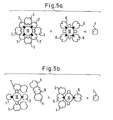
- FIGS. 1 to 5b The measures according to the invention are shown schematically in the attached FIGS. 1 to 5b. This is based on the following symbols:
- 0.1 mmol of pepstatin are dissolved in 10 ml of dry dimethyl sulfoxide. Then 10 ml of dry tetrahydrofuran are added. The solution is cooled to 0 ° C. and 0.125 mmol tri-n-butylamine are added. 0.1 mmol of isobutyl chloroformate follow. After 15 minutes, 0.1 mmol of IgG are added. The reaction is complete after 2 h at room temperature. Water is added to the reaction mixture in the cold. The precipitate is filtered off with suction, dialyzed and purified chromatographically on a Sephadex column.
- 0.1 mmol of methotrexate are dissolved in 10 ml of dry dimethyl sulfoxide. Then 10 ml of dry tetrahydrofuran are added. The solution is cooled to 0 ° C. and 0.125 mmol tri-n-butylamine are added. This is followed by 0.1 mmol of isobutyl chloroformate. After 15 minutes, 0.1 mmol of ⁇ -aminocaproic acid are added. With stirring, the reaction takes place within 2 h at room temperature. The reaction mixture was cooled again to 0 ° C. and 0.1 mmol tri-n-butylamine were added. 0.1 mmol of isobutyl chloroformate follow.
- reaction mixture After 15 minutes, the reaction mixture is added to a solution of 150 mg of HuIgG in 20 ml of water. After 2 hours, dialysis is carried out against water; 16 h in total. The dialysate is freeze-dried after chromatographic purification.
Landscapes
- Health & Medical Sciences (AREA)
- Chemical & Material Sciences (AREA)
- Immunology (AREA)
- Life Sciences & Earth Sciences (AREA)
- Engineering & Computer Science (AREA)
- Organic Chemistry (AREA)
- Urology & Nephrology (AREA)
- Biomedical Technology (AREA)
- Hematology (AREA)
- Molecular Biology (AREA)
- Biotechnology (AREA)
- Microbiology (AREA)
- Food Science & Technology (AREA)
- Medicinal Chemistry (AREA)
- Physics & Mathematics (AREA)
- Analytical Chemistry (AREA)
- Biochemistry (AREA)
- General Health & Medical Sciences (AREA)
- General Physics & Mathematics (AREA)
- Pathology (AREA)
- Cell Biology (AREA)
- Measuring Or Testing Involving Enzymes Or Micro-Organisms (AREA)
- Peptides Or Proteins (AREA)
Applications Claiming Priority (2)
| Application Number | Priority Date | Filing Date | Title |
|---|---|---|---|
| DE3006709 | 1980-02-22 | ||
| DE19803006709 DE3006709A1 (de) | 1980-02-22 | 1980-02-22 | Homogenes verfahren zur kompetitiven bestimmung von liganden |
Publications (2)
| Publication Number | Publication Date |
|---|---|
| EP0034775A2 true EP0034775A2 (fr) | 1981-09-02 |
| EP0034775A3 EP0034775A3 (fr) | 1981-09-09 |
Family
ID=6095336
Family Applications (1)
| Application Number | Title | Priority Date | Filing Date |
|---|---|---|---|
| EP81101026A Withdrawn EP0034775A3 (fr) | 1980-02-22 | 1981-02-13 | Procédé homogène pour la détermination sélective de ligands |
Country Status (3)
| Country | Link |
|---|---|
| EP (1) | EP0034775A3 (fr) |
| JP (1) | JPS56133661A (fr) |
| DE (1) | DE3006709A1 (fr) |
Cited By (8)
| Publication number | Priority date | Publication date | Assignee | Title |
|---|---|---|---|---|
| EP0055868A3 (fr) * | 1981-01-02 | 1982-08-04 | Hans A. Dr. Thoma | Procédé de détermination de ligands ou de récepteurs par réaction de compétition, trousse d'essai pour la réalisation dudit procédé et son application |
| EP0055869A3 (en) * | 1981-01-02 | 1982-08-11 | Hans A. Dr. Thoma | Process for the determination of ligands, test kit for carrying out the process and its application |
| GB2120785A (en) * | 1982-05-26 | 1983-12-07 | Celltech Ltd | Enzyme immunoassay |
| EP0110640A3 (en) * | 1982-11-19 | 1985-01-09 | Minnesota Mining And Manufacturing Company | Receptor-based histamine assay |
| EP0122059A3 (en) * | 1983-03-14 | 1985-07-03 | Syva Company | Enzymatic poly-reactant channeling binding assay |
| EP0095089B1 (fr) * | 1982-05-24 | 1986-03-05 | Miles Laboratories, Inc. | Méthode de test de fixation homogène, système réactif, nécessaire d'essai et appareil pour la réalisation du test |
| EP0117648A3 (fr) * | 1983-01-31 | 1988-02-03 | Boots-Celltech Diagnostics Limited | Immunoessai |
| EP0155104A3 (fr) * | 1984-02-24 | 1988-07-27 | AMERSHAM INTERNATIONAL plc | Essai d'analyte libre |
Families Citing this family (10)
| Publication number | Priority date | Publication date | Assignee | Title |
|---|---|---|---|---|
| JPS59178360A (ja) * | 1983-03-29 | 1984-10-09 | Fujirebio Inc | 抗原決定基具有物質測定方法 |
| JPS59164960A (ja) * | 1983-03-11 | 1984-09-18 | Fujirebio Inc | 抗原決定基具有物質の測定法 |
| JPS59178361A (ja) * | 1983-03-29 | 1984-10-09 | Fujirebio Inc | 抗原決定基具有物質測定法 |
| US4650751A (en) * | 1983-04-29 | 1987-03-17 | Technicon Instruments Corporation | Protected binding assay avoiding non-specific protein interference |
| JPS60123767A (ja) * | 1983-12-09 | 1985-07-02 | Fujirebio Inc | 酵素を用いた抗原決定基具有物質測定法 |
| EP0150905A3 (fr) * | 1984-01-05 | 1987-01-14 | Ortho Diagnostic Systems Inc. | Essai anti-idiotype utilisant un transfert d'énergie fluorescente |
| DE3430905A1 (de) * | 1984-08-22 | 1986-02-27 | Boehringer Mannheim Gmbh, 6800 Mannheim | Verfahren zur bestimmung einer immunologisch bindefaehigen substanz |
| JPS6180049A (ja) * | 1984-09-28 | 1986-04-23 | Fujirebio Inc | 酵素を利用した抗原決定基具有物質測定法 |
| JPS6180050A (ja) * | 1984-09-28 | 1986-04-23 | Fujirebio Inc | 酵素を利用した抗原決定基具有物質測定方法 |
| DE10036328B4 (de) * | 2000-06-15 | 2004-10-14 | Degussa Ag | Polymervergrößerte Liganden, Verfahren zu deren Herstellung und deren Verwendung |
Family Cites Families (5)
| Publication number | Priority date | Publication date | Assignee | Title |
|---|---|---|---|---|
| US4134792A (en) * | 1976-12-06 | 1979-01-16 | Miles Laboratories, Inc. | Specific binding assay with an enzyme modulator as a labeling substance |
| US4130462A (en) * | 1976-12-16 | 1978-12-19 | Syva Company | Receptor steric hindrance immunoassay for receptor determination |
| GB1595101A (en) * | 1977-03-15 | 1981-08-05 | Hoffmann La Roche | Enzyme modifier immunoassay |
| IT1105734B (it) * | 1977-07-14 | 1985-11-04 | Syva Co | Prova di legame di competizione di antienzima omogeneo |
| US4273866A (en) * | 1979-02-05 | 1981-06-16 | Abbott Laboratories | Ligand analog-irreversible enzyme inhibitor conjugates and methods for use |
-
1980
- 1980-02-22 DE DE19803006709 patent/DE3006709A1/de not_active Withdrawn
-
1981
- 1981-02-13 EP EP81101026A patent/EP0034775A3/fr not_active Withdrawn
- 1981-02-20 JP JP2481581A patent/JPS56133661A/ja active Pending
Cited By (8)
| Publication number | Priority date | Publication date | Assignee | Title |
|---|---|---|---|---|
| EP0055868A3 (fr) * | 1981-01-02 | 1982-08-04 | Hans A. Dr. Thoma | Procédé de détermination de ligands ou de récepteurs par réaction de compétition, trousse d'essai pour la réalisation dudit procédé et son application |
| EP0055869A3 (en) * | 1981-01-02 | 1982-08-11 | Hans A. Dr. Thoma | Process for the determination of ligands, test kit for carrying out the process and its application |
| EP0095089B1 (fr) * | 1982-05-24 | 1986-03-05 | Miles Laboratories, Inc. | Méthode de test de fixation homogène, système réactif, nécessaire d'essai et appareil pour la réalisation du test |
| GB2120785A (en) * | 1982-05-26 | 1983-12-07 | Celltech Ltd | Enzyme immunoassay |
| EP0110640A3 (en) * | 1982-11-19 | 1985-01-09 | Minnesota Mining And Manufacturing Company | Receptor-based histamine assay |
| EP0117648A3 (fr) * | 1983-01-31 | 1988-02-03 | Boots-Celltech Diagnostics Limited | Immunoessai |
| EP0122059A3 (en) * | 1983-03-14 | 1985-07-03 | Syva Company | Enzymatic poly-reactant channeling binding assay |
| EP0155104A3 (fr) * | 1984-02-24 | 1988-07-27 | AMERSHAM INTERNATIONAL plc | Essai d'analyte libre |
Also Published As
| Publication number | Publication date |
|---|---|
| JPS56133661A (en) | 1981-10-19 |
| DE3006709A1 (de) | 1981-08-27 |
| EP0034775A3 (fr) | 1981-09-09 |
Similar Documents
| Publication | Publication Date | Title |
|---|---|---|
| EP0809111B1 (fr) | Procede d'analyse utilisant des recepteurs oligomeres | |
| DE3006709A1 (de) | Homogenes verfahren zur kompetitiven bestimmung von liganden | |
| DE69214942T2 (de) | Verfahren für spezifische bindungsassays unter verwendung eines freisetzbaren liganden | |
| DE2522086C2 (de) | Reagenz zum Abtrennen und Bestimmen von in biologischen Fluiden vorhandenen AK:Ag-Komplexen | |
| DE69936916T2 (de) | Liganden-bindetest und kit mit einer abtrennzone für störende probenkomponenten | |
| DE2323467C2 (de) | Verfahren zum Nachweis und zur Bestimmung von Haptenen | |
| EP0363942B1 (fr) | Procédé pour la détermination d'une substance liante spécifique | |
| EP0397113B1 (fr) | Méthode de détection de substances capables de se lier spécifiquement dans les fluides corporels | |
| DE69116236T2 (de) | Bestimmung von Analyten, die Bindungsstellen für mindestens zwei Bindungsgruppen haben | |
| DE10009503A1 (de) | Verfahren zur Immobilisierung von Konjugaten in diagnostischen Tests | |
| DE69930404T2 (de) | Methode zum nachweis von analyten | |
| DE69635275T2 (de) | Stabilisierte wässerige steroidimmunteststandarts mit cyclodextrinen | |
| DE69106002T2 (de) | Testverfahren und reagenziensatz dafür. | |
| CH641570A5 (en) | Process for the determination of an immunologically active material and reagent for carrying out this process | |
| EP0685070B1 (fr) | Agregats de proteines acyles et leur utilisation pour eviter les perturbations dans des dosages immunologiques | |
| DE69232801T2 (de) | Abtrennungsverfahren | |
| DE3829245A1 (de) | Verfahren zur bestimmung einer spezifisch bindefaehigen substanz | |
| DE10048417A1 (de) | Verbindungen mit verzweigtem Linker | |
| EP0349988B1 (fr) | Méthode pour déterminer une substance spécifique capable de lier | |
| DE2830862A1 (de) | Homogener, kompetitiver antienzym- bindungstest und reagenz zur durchfuehrung des verfahrens | |
| DE69328727T2 (de) | Immunologisches nachweisverfahren unter verwendung von zwei bestimmbaren markern | |
| DE69636013T2 (de) | Verfahren zum erlangen von rezeptor-freigabeligand (reland)-komplexen und testansätze | |
| DE69304528T3 (de) | Verfahren zur bestimmung der menge eines schilddrüsenhormon-liganden in einer biologischen flüssigkeit und satz zur durchführung dieses verfahrens | |
| DE69232902T2 (de) | Trennung und Analyse | |
| DE3790240C2 (fr) |
Legal Events
| Date | Code | Title | Description |
|---|---|---|---|
| PUAI | Public reference made under article 153(3) epc to a published international application that has entered the european phase |
Free format text: ORIGINAL CODE: 0009012 |
|
| PUAL | Search report despatched |
Free format text: ORIGINAL CODE: 0009013 |
|
| AK | Designated contracting states |
Designated state(s): AT BE CH DE FR GB IT LU NL SE |
|
| AK | Designated contracting states |
Designated state(s): AT BE CH DE FR GB IT LU NL SE |
|
| 17P | Request for examination filed |
Effective date: 19820309 |
|
| STAA | Information on the status of an ep patent application or granted ep patent |
Free format text: STATUS: THE APPLICATION IS DEEMED TO BE WITHDRAWN |
|
| 18D | Application deemed to be withdrawn |
Effective date: 19830831 |