EP0035174A1 - Neue Isoindolinfarbstoffe und deren Verwendung - Google Patents
Neue Isoindolinfarbstoffe und deren Verwendung Download PDFInfo
- Publication number
- EP0035174A1 EP0035174A1 EP81101165A EP81101165A EP0035174A1 EP 0035174 A1 EP0035174 A1 EP 0035174A1 EP 81101165 A EP81101165 A EP 81101165A EP 81101165 A EP81101165 A EP 81101165A EP 0035174 A1 EP0035174 A1 EP 0035174A1
- Authority
- EP
- European Patent Office
- Prior art keywords
- dyes
- alkyl
- formula
- parts
- isoindoline
- Prior art date
- Legal status (The legal status is an assumption and is not a legal conclusion. Google has not performed a legal analysis and makes no representation as to the accuracy of the status listed.)
- Granted
Links
- 239000000975 dye Substances 0.000 title claims abstract description 42
- GWVMLCQWXVFZCN-UHFFFAOYSA-N isoindoline Chemical class C1=CC=C2CNCC2=C1 GWVMLCQWXVFZCN-UHFFFAOYSA-N 0.000 title claims abstract description 10
- 239000004033 plastic Substances 0.000 claims abstract description 7
- 229920003023 plastic Polymers 0.000 claims abstract description 7
- 239000000976 ink Substances 0.000 claims abstract description 6
- 239000003973 paint Substances 0.000 claims abstract description 6
- 125000001997 phenyl group Chemical group [H]C1=C([H])C([H])=C(*)C([H])=C1[H] 0.000 claims abstract description 6
- 230000003381 solubilizing effect Effects 0.000 claims abstract description 6
- 125000001637 1-naphthyl group Chemical group [H]C1=C([H])C([H])=C2C(*)=C([H])C([H])=C([H])C2=C1[H] 0.000 claims abstract description 4
- 125000001797 benzyl group Chemical group [H]C1=C([H])C([H])=C(C([H])=C1[H])C([H])([H])* 0.000 claims abstract description 3
- 125000001424 substituent group Chemical group 0.000 claims description 10
- WKBOTKDWSSQWDR-UHFFFAOYSA-N Bromine atom Chemical compound [Br] WKBOTKDWSSQWDR-UHFFFAOYSA-N 0.000 claims description 5
- GDTBXPJZTBHREO-UHFFFAOYSA-N bromine Substances BrBr GDTBXPJZTBHREO-UHFFFAOYSA-N 0.000 claims description 5
- 229910052794 bromium Inorganic materials 0.000 claims description 5
- 229910052801 chlorine Inorganic materials 0.000 claims description 5
- 239000000460 chlorine Substances 0.000 claims description 5
- 125000001309 chloro group Chemical group Cl* 0.000 claims description 3
- ZAMOUSCENKQFHK-UHFFFAOYSA-N Chlorine atom Chemical compound [Cl] ZAMOUSCENKQFHK-UHFFFAOYSA-N 0.000 claims description 2
- 230000000485 pigmenting effect Effects 0.000 claims description 2
- 125000000951 phenoxy group Chemical group [H]C1=C([H])C([H])=C(O*)C([H])=C1[H] 0.000 claims 3
- 238000004043 dyeing Methods 0.000 abstract description 5
- 230000005012 migration Effects 0.000 abstract description 2
- 238000013508 migration Methods 0.000 abstract description 2
- QTBSBXVTEAMEQO-UHFFFAOYSA-N Acetic acid Chemical compound CC(O)=O QTBSBXVTEAMEQO-UHFFFAOYSA-N 0.000 description 13
- OKKJLVBELUTLKV-UHFFFAOYSA-N Methanol Chemical compound OC OKKJLVBELUTLKV-UHFFFAOYSA-N 0.000 description 9
- 238000000034 method Methods 0.000 description 7
- 239000000203 mixture Substances 0.000 description 7
- 239000000049 pigment Substances 0.000 description 7
- LYCAIKOWRPUZTN-UHFFFAOYSA-N Ethylene glycol Chemical compound OCCO LYCAIKOWRPUZTN-UHFFFAOYSA-N 0.000 description 6
- ZMXDDKWLCZADIW-UHFFFAOYSA-N N,N-Dimethylformamide Chemical compound CN(C)C=O ZMXDDKWLCZADIW-UHFFFAOYSA-N 0.000 description 6
- YXFVVABEGXRONW-UHFFFAOYSA-N Toluene Chemical compound CC1=CC=CC=C1 YXFVVABEGXRONW-UHFFFAOYSA-N 0.000 description 6
- 229960000583 acetic acid Drugs 0.000 description 6
- 239000012362 glacial acetic acid Substances 0.000 description 5
- GWEVSGVZZGPLCZ-UHFFFAOYSA-N Titan oxide Chemical compound O=[Ti]=O GWEVSGVZZGPLCZ-UHFFFAOYSA-N 0.000 description 4
- HNYOPLTXPVRDBG-UHFFFAOYSA-N barbituric acid Chemical compound O=C1CC(=O)NC(=O)N1 HNYOPLTXPVRDBG-UHFFFAOYSA-N 0.000 description 4
- BDAGIHXWWSANSR-UHFFFAOYSA-N methanoic acid Natural products OC=O BDAGIHXWWSANSR-UHFFFAOYSA-N 0.000 description 4
- RZVCEPSDYHAHLX-UHFFFAOYSA-N 3-iminoisoindol-1-amine Chemical compound C1=CC=C2C(N)=NC(=N)C2=C1 RZVCEPSDYHAHLX-UHFFFAOYSA-N 0.000 description 3
- WSFSSNUMVMOOMR-UHFFFAOYSA-N Formaldehyde Chemical compound O=C WSFSSNUMVMOOMR-UHFFFAOYSA-N 0.000 description 3
- 125000004432 carbon atom Chemical group C* 0.000 description 3
- 239000004922 lacquer Substances 0.000 description 3
- 239000002904 solvent Substances 0.000 description 3
- XLYOFNOQVPJJNP-UHFFFAOYSA-N water Substances O XLYOFNOQVPJJNP-UHFFFAOYSA-N 0.000 description 3
- QQZJAOVFTGBDSP-UHFFFAOYSA-N 1-(4-methoxyphenyl)-1,3-diazinane-2,4,6-trione Chemical compound C1=CC(OC)=CC=C1N1C(=O)NC(=O)CC1=O QQZJAOVFTGBDSP-UHFFFAOYSA-N 0.000 description 2
- OSWFIVFLDKOXQC-UHFFFAOYSA-N 4-(3-methoxyphenyl)aniline Chemical compound COC1=CC=CC(C=2C=CC(N)=CC=2)=C1 OSWFIVFLDKOXQC-UHFFFAOYSA-N 0.000 description 2
- LRHPLDYGYMQRHN-UHFFFAOYSA-N N-Butanol Chemical compound CCCCO LRHPLDYGYMQRHN-UHFFFAOYSA-N 0.000 description 2
- CTQNGGLPUBDAKN-UHFFFAOYSA-N O-Xylene Chemical compound CC1=CC=CC=C1C CTQNGGLPUBDAKN-UHFFFAOYSA-N 0.000 description 2
- 150000007656 barbituric acids Chemical class 0.000 description 2
- 239000003086 colorant Substances 0.000 description 2
- 238000004040 coloring Methods 0.000 description 2
- 238000009833 condensation Methods 0.000 description 2
- 230000005494 condensation Effects 0.000 description 2
- XBDQKXXYIPTUBI-UHFFFAOYSA-N dimethylselenoniopropionate Natural products CCC(O)=O XBDQKXXYIPTUBI-UHFFFAOYSA-N 0.000 description 2
- 235000019253 formic acid Nutrition 0.000 description 2
- 239000008187 granular material Substances 0.000 description 2
- 239000003960 organic solvent Substances 0.000 description 2
- 239000011541 reaction mixture Substances 0.000 description 2
- 159000000000 sodium salts Chemical class 0.000 description 2
- 239000004408 titanium dioxide Substances 0.000 description 2
- -1 ureido, sulfamoyl Chemical group 0.000 description 2
- 239000008096 xylene Substances 0.000 description 2
- NQRLWRODNCDUHY-UHFFFAOYSA-N 6-n,6-n,2-trimethylacridine-3,6-diamine Chemical compound C1=C(C)C(N)=CC2=NC3=CC(N(C)C)=CC=C3C=C21 NQRLWRODNCDUHY-UHFFFAOYSA-N 0.000 description 1
- RSWGJHLUYNHPMX-UHFFFAOYSA-N Abietic-Saeure Natural products C12CCC(C(C)C)=CC2=CCC2C1(C)CCCC2(C)C(O)=O RSWGJHLUYNHPMX-UHFFFAOYSA-N 0.000 description 1
- 0 CCCC1C**C1 Chemical compound CCCC1C**C1 0.000 description 1
- 235000013162 Cocos nucifera Nutrition 0.000 description 1
- 244000060011 Cocos nucifera Species 0.000 description 1
- 239000004640 Melamine resin Substances 0.000 description 1
- 229920000877 Melamine resin Polymers 0.000 description 1
- 125000005118 N-alkylcarbamoyl group Chemical group 0.000 description 1
- 239000004793 Polystyrene Substances 0.000 description 1
- KHPCPRHQVVSZAH-HUOMCSJISA-N Rosin Natural products O(C/C=C/c1ccccc1)[C@H]1[C@H](O)[C@@H](O)[C@@H](O)[C@@H](CO)O1 KHPCPRHQVVSZAH-HUOMCSJISA-N 0.000 description 1
- 235000011054 acetic acid Nutrition 0.000 description 1
- 239000002253 acid Substances 0.000 description 1
- 125000005236 alkanoylamino group Chemical group 0.000 description 1
- 125000003545 alkoxy group Chemical group 0.000 description 1
- 125000004453 alkoxycarbonyl group Chemical group 0.000 description 1
- 229920000180 alkyd Polymers 0.000 description 1
- 125000000217 alkyl group Chemical group 0.000 description 1
- 125000005153 alkyl sulfamoyl group Chemical group 0.000 description 1
- 125000004390 alkyl sulfonyl group Chemical group 0.000 description 1
- 125000003435 aroyl group Chemical group 0.000 description 1
- 125000005239 aroylamino group Chemical group 0.000 description 1
- 125000003118 aryl group Chemical group 0.000 description 1
- 125000005161 aryl oxy carbonyl group Chemical group 0.000 description 1
- 125000004391 aryl sulfonyl group Chemical group 0.000 description 1
- 125000004104 aryloxy group Chemical group 0.000 description 1
- 125000003917 carbamoyl group Chemical group [H]N([H])C(*)=O 0.000 description 1
- 125000001589 carboacyl group Chemical group 0.000 description 1
- 238000000576 coating method Methods 0.000 description 1
- 235000019646 color tone Nutrition 0.000 description 1
- 150000001875 compounds Chemical class 0.000 description 1
- 150000001991 dicarboxylic acids Chemical class 0.000 description 1
- 239000003085 diluting agent Substances 0.000 description 1
- 238000001125 extrusion Methods 0.000 description 1
- 238000001914 filtration Methods 0.000 description 1
- 229910052736 halogen Inorganic materials 0.000 description 1
- 150000002367 halogens Chemical class 0.000 description 1
- 125000005842 heteroatom Chemical group 0.000 description 1
- 239000000463 material Substances 0.000 description 1
- XDQKXGXEXMQZGB-UHFFFAOYSA-N methyl 6-chloro-5-fluoro-1h-indole-2-carboxylate Chemical compound FC1=C(Cl)C=C2NC(C(=O)OC)=CC2=C1 XDQKXGXEXMQZGB-UHFFFAOYSA-N 0.000 description 1
- 125000001624 naphthyl group Chemical group 0.000 description 1
- 125000000449 nitro group Chemical group [O-][N+](*)=O 0.000 description 1
- ISWSIDIOOBJBQZ-UHFFFAOYSA-N phenol group Chemical group C1(=CC=CC=C1)O ISWSIDIOOBJBQZ-UHFFFAOYSA-N 0.000 description 1
- 229920002223 polystyrene Polymers 0.000 description 1
- 235000019260 propionic acid Nutrition 0.000 description 1
- IUVKMZGDUIUOCP-BTNSXGMBSA-N quinbolone Chemical compound O([C@H]1CC[C@H]2[C@H]3[C@@H]([C@]4(C=CC(=O)C=C4CC3)C)CC[C@@]21C)C1=CCCC1 IUVKMZGDUIUOCP-BTNSXGMBSA-N 0.000 description 1
- 238000010992 reflux Methods 0.000 description 1
- 239000000725 suspension Substances 0.000 description 1
- KHPCPRHQVVSZAH-UHFFFAOYSA-N trans-cinnamyl beta-D-glucopyranoside Natural products OC1C(O)C(O)C(CO)OC1OCC=CC1=CC=CC=C1 KHPCPRHQVVSZAH-UHFFFAOYSA-N 0.000 description 1
- 125000002023 trifluoromethyl group Chemical group FC(F)(F)* 0.000 description 1
Classifications
-
- C—CHEMISTRY; METALLURGY
- C09—DYES; PAINTS; POLISHES; NATURAL RESINS; ADHESIVES; COMPOSITIONS NOT OTHERWISE PROVIDED FOR; APPLICATIONS OF MATERIALS NOT OTHERWISE PROVIDED FOR
- C09B—ORGANIC DYES OR CLOSELY-RELATED COMPOUNDS FOR PRODUCING DYES, e.g. PIGMENTS; MORDANTS; LAKES
- C09B57/00—Other synthetic dyes of known constitution
- C09B57/04—Isoindoline dyes
Definitions
- the invention relates to new isoindoline dyes and their use.
- the new dyes have the general formula I in which both R independently of one another are C 1 -C 4 -alkyl or benzyl, phenyl or 1-naphthyl which is optionally substituted by non-solubilizing groups.
- the new dyes (I) are pigments that stain paints, plastics and printing inks in yellow to orange shades with high color strength.
- the dyeings have very good fastness to light and weather and very good fastness to migration.
- the dyes (I) with R substituted phenyl or 1-naphthyl show significantly less darkening when exposed to and exposed to full-tone dyeings.
- Non-solubilizing substituents are understood to mean those which do not cause the dye to be soluble in water or in organic solvents.
- substituents are, for example, halogen, alkyl or alkoxy, each having 1 to 6 carbon atoms, nitro, trifluoromethyl, carbamoyl, ureido, sulfamoyl or cyan; Alkoxycarbonyl, alkanoyl, N-alkylcarbamoyl, N-alkylureido or alkanoylamino, each with a total of 2 to 6 carbon atoms; Alkylsulfonyl or alkylsulfamoyl, each with 1 to 6 carbon atoms; Aryloxycarbonyl, aroyl, aroylamino, arylsulfonyl, N-arylcarbamoyl, N-arylsulfamoyl, aryl, N-arylureido, arylazo
- Chlorine, bromine, C 1 - to C 4 -alkyl, C 1 - to C 4 -alkoxy and phen-, oxy are preferred as non-solubilizing substituents.
- the number of these substituents can be up to 2, preferably 0 or 1. In the case of 2 substituents, these can be the same or different.
- phenyl radicals A are optionally substituted by non-solubilizing groups.
- dyes of the formula II in which the phenyl radicals A are optionally mono- or disubstituted by chlorine, bromine, C 1 - to C 4 -alkyl or C 1 - to C 4 -alkoxy, these being the same or in the case of 2 substituents can be different.
- Dyes of the formula III are particularly preferred, in which XC is 1 - to C 4 -alkyl, phenyl or naphthyl and the substituent -OX is in the 3- or 4-position.
- the new dyes are obtained by condensing one mole of a 1,3-diiminoisoindoline of the formula IV with 2 moles of a barbituric acid of the formula
- the condensation of the diiminoisoindolines of the formula (IV) with the barbituric acid (V) can, according to the information in DE-OS 26 28 409, be carried out in water or in an organic solvent or diluent or mixtures thereof.
- the condensation takes place particularly well in aliphatic mono- or dicarboxylic acids such as formic acid, acetic acid, propionic acid or mixtures thereof, which is why these solvents are preferably used.
- the amount of solvent used is not critical. The minimum amount is determined by the stirrability of the reaction mixture. In general, 10 to 20 times the amount by weight of solvent, based on the barbituric acid used.
- the reaction is usually carried out at temperatures between 50 ° C and 150 ° C, preferably between 70 ° C and 120 ° C.
- the process products are isolated from the reaction mixture by filtration and can generally be used as such directly as a pigment. However, the process products can also be converted into pigment forms which are optimal for the intended use, using known forming processes.
- the process product can be used directly as a pigment, e.g. B. in paints or plastics. Colorings are obtained in pure orange tones with very good light, weather and softening properties.
- Example 2 0.5 part of the dye obtained according to Example 1 is tumbled onto 100 parts of polystyrene granules (standard brand). The colored granules are homogenized by extrusion (190 to 195 ° C). Orange-colored extrudates are obtained, the coloring of which has good lightfastness.
Landscapes
- Chemical & Material Sciences (AREA)
- Organic Chemistry (AREA)
- Inks, Pencil-Leads, Or Crayons (AREA)
- Compositions Of Macromolecular Compounds (AREA)
- Paints Or Removers (AREA)
Abstract
Description
- Die Erfindung betrifft neue Isoindolinfarbstoffe und deren Verwendung.
- Die neuen Farbstoffe haben die allgemeine Formel I
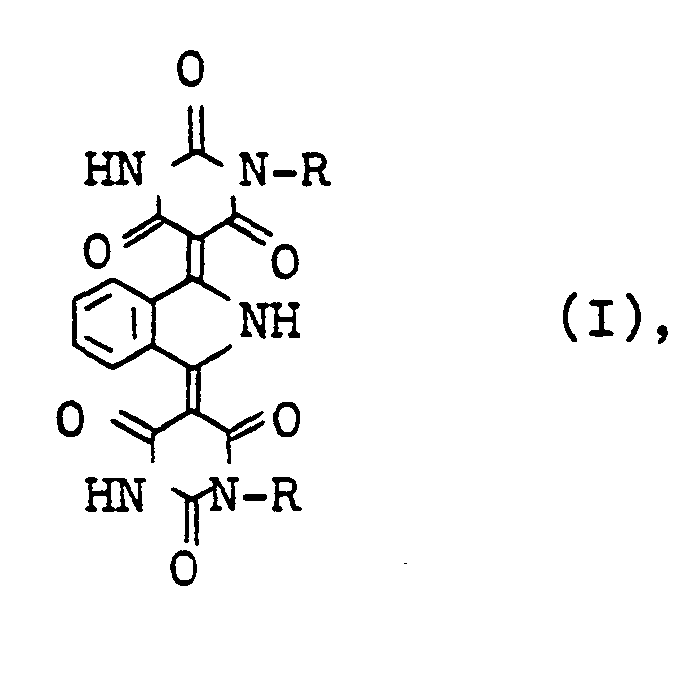
- Die neuen Farbstoffe (I) sind Pigmente, die Lacke, Kunststoffe und Druckfarben in gelben bis orangen Farbtönen mit hoher Farbstärke anfärben. Die Färbungen weisen sehr gute Licht- und Wetterechtheiten sowie sehr gute Migrationsechtheiten auf.
- Die Farbstoffe (I) mit R = C1- bis C4-Alkyl haben gegenüber dem aus der DE-OS 20 41 999, Beispiel 1 bekannten Farbstoff, der als nächstliegender Stand der Technik anzusehen ist, im Weißverschnitt eine hönere Farbstärke.
- Die Farbstoffe (I) mit R = substituiertes Phenyl oder 1-Naphthyl zeigen deutlich geringeres Nachdunkeln bei Belichtung und Bewetterung von volltonnahen Färbungen.
- Unter nicht löslichmachenden Substituenten werden solche verstanden, die weder in Wasser noch in organischen Lösungsmitteln Löslichkeit des Farbstoffs bewirken. Solche Substituenten sind beispielsweise Halogen, Alkyl oder Alkoxy mit je 1 bis 6 C-Atomen, Nitro, Trifluormethyl, Carbamoyl, Ureido, Sulfamoyl oder Cyan; Alkoxycarbonyl, Alkanoyl, N-Alkylcarbamoyl, N-Alkylureido oder Alkanoylamino mit insgesamt je 2 bis 6 C-Atomen; Alkylsulfonyl oder Alkylsulfamoyl mit je 1 bis 6 C-Atomen; Aryloxycarbonyl, Aroyl, Aroylamino, Arylsulfonyl, N-Arylcarbamoyl, N-Arylsulfamoyl, Aryl, N-Arylureido, Arylazo, Aryloxy oder ein ankondensierter 5 oder 6gliedriger Heteroring, der im Ring eine -C-NH-Gruppierung enthält. 0
- Als nicht löslichmachende Substituenten sind Chlor, Brom, C1- bis C4-Alkyl, C1- bis C4-Alkoxy und Phen- , oxy bevorzugt. Die Zahl dieser Substituenten kann bis zu 2, vorzugsweise 0 oder 1, betragen. Im Falle von 2 Substituenten können diese gleich oder verschieden sein.
- Von den Verbindungen der Formel I sind aus coloristischen und anwendungstechnischen Gründen solche der Formel II bevorzugt:

- Besonders bevorzugt sind Farbstoffe der Formel III,

- Die neuen Farbstoffe erhält man durch Kondensieren von einem Mol eines 1,3-Diiminoisoindolins der Formel IV


- worin R die oben angegebene Bedeutung hat. Für den Fall, daß im Farbstoff die Substituenten R verschieden sein sollen, können Gemische von Barbitursäuren (V) mit (IV) kondensiert werden.
- Die Kondensation der Diiminoisoindoline der Formel (IV) mit der Barbitursäure (V) kann entsprechend den Angaben in der DE-OS 26 28 409 in Wasser oder in einem organischen Lösungs-.oder Verdünnungsmittel oder Gemischen davon erfolgen. Besonders gut erfolgt die Kondensation in aliphatischen Mono- oder Dicarbonsäuren wie Ameisensäure, Essigsäure, Propionsäure oder Mischungen davon, weshalb diese Lösungsmittel bevorzugt verwendet werden. Die Menge des verwendeten Lösungsmittels ist unkritisch. Die Mindestmenge wird durch die Rührbarkeit des Reaktionsgemisches bestimmt. Im allgemeinen wendet man die 10- bis 20-fache Gewichtsmenge an Lösungsmittel, bezogen auf die angewandte Barbitursäure, an.
- Die Umsetzung erfolgt in der Regel bei Temperaturen zwischen 50 °C und 150 °C, vorzugsweise zwischen 70 °C und 120 °C.
- Die Verfahrensprodukte werden durch Filtrieren aus dem Reaktionsgemisch isoliert und können im allgemeinen als solche direkt als Pigment verwendet werden. Man kann die Verfahrensprodukte aber auch nach an sich bekannten Formierungsverfahren in für den vorgesehenen Verwendungszweck optimale Pigmentformen überführen.
- Die folgenden Beispiele sollen die Erfindung weiter erläutern. Die Teile und Prozentangaben beziehen sich auf das Gewicht.
- a) 140 Teile N-(4'-Methoxyphenyl)-barbitursäure und 56 Teile des Monoadduktes von Äthylenglykol an 1,3-Diiminoisoindolin werden in 1900 Teilen Eisessig 2 Stunden auf 110 °C erwärmt. Die Suspension wird warm filtriert, das Filtergut mit Eisessig und Methanol gewaschen und getrocknet. Ausbeute: 144 Teile des Farbstoffs der Formel I mit

- Das Verfahrensprodukt kann direkt als Pigment verwendet werden, z. B. in Lacken oder Kunststoffen. Man erhält Färbungen in reinen Orangetönen mit sehr guten Licht-, Wetter- und Weichmacherechtheiten.
- b) 10 Teile des nach a) erhaltenen Farbstoffs werden in 55 Teilen Dimethylformamid 3 h bei 110 °C gerührt. Der Farbstoff wird abfiltriert, mit Dimethylformamid und Methanol gewaschen und getrocknet. Ausbeute: 9 Teile Farbstoff der oben angegebenen Konstitution. Der Farbstoff gibt Färbungen mit im Vergleich zu a) verbesserter Wetterechtheit. Der Farbstoff hat außerdem ein höheres Deckvermögen als der nach a) erhaltene Farbstoff.
- Man arbeitet wie in Beispiel 1 a) angegeben, verwendet jedoch anstelle der N-(4'-Methoxyphenyl)-barbitursäure, die äquivalente Menge an Barbitursäure der Formel (V), wobei R die in der folgenden Tabelle angegebene Bedeutung hat. Man erhält die entsprechenden Farbstoffe der Formel I, in der R die in der Spalte 2 angegebene Bedeutung hat. Die Farbstoffe färben Lacke, Kunststoffe und Druckfarben in den in Spalte 3 angegebenen Farbtönen an.

- 17 Teile N-Methylbarbitursäure/Natriumsalz und 10 Teile des Monoaddukts von Äthylenglykol an 1,3-Diiminoisoindolin werden in 150 Teilen Eisessig 2 h bei Raumtemperatur und 3 h bei 90 °C gerührt. Der Farbstoff wird warm abfiltriert, mit Eisessig und Methanol gewaschen und getrocknet. Ausbeute: 15 Teile Farbstoff der Formel I mit R = -CH3, der direkt zum Pigmentieren von Lack und Kunststoffen verwendet werden kann. Man erhält sehr farbstarke Färbungen in reinem neutral gelben Farbton, mit guter Lichtechtheit.
- Man verfährt wie in Beispiel 9, verwendet jedoch anstelle von Eisessig eine Lösung aus 120 Teilen Wasser, 10 Teilen Ameisensäure und 10 Teilen des Natriumsalzes einer C3- bis C4-Alkylnaphthalinsulfonsäure und erhitzt 4 Stunden am Rückfluß. Man erhält 15 Teile des Farbstoffes der Formel I.mit R = -CH3 in einer Pigmentform, die ein besonders hohes Deckvermögen aufweist.
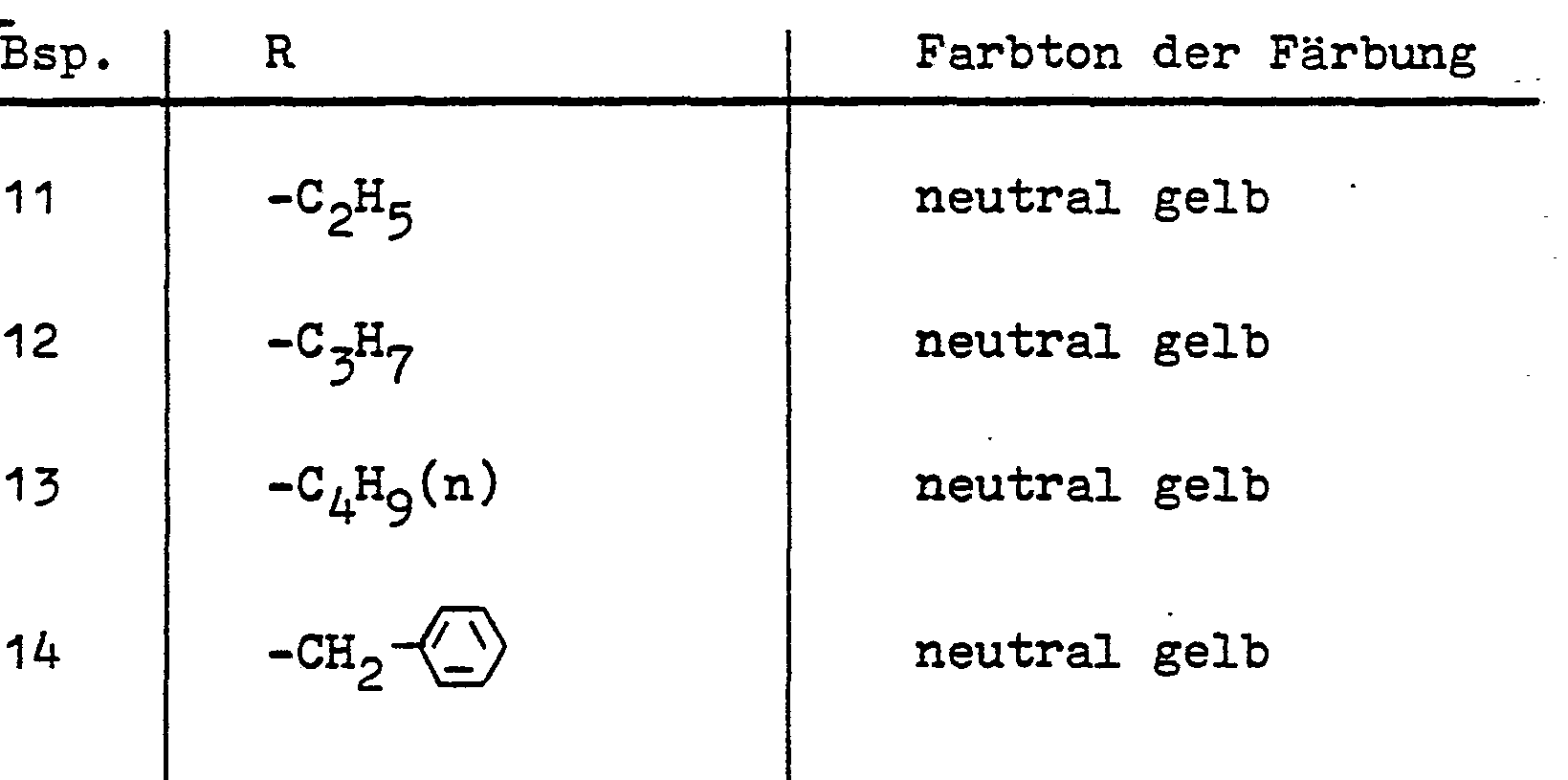
- Man arbeitet wie in den Beispielen 9 oder 10, verwendet jedoch Barbitursäuren der Formel (V), in der R die in Spalte 2 angegebene Bedeutung hat. Man erhält die entsprechenden Farbstoffe der Formel I, die Färbungen in den in Spalte 3 angegebenen Farbtönen liefern. In den coloristischen und anwendungstechnischen Eigenschaften entsprechen die Farbstoffe praktisch den nach Beispiel 9 und 10 erhaltenen.
- 10 Teile des nach Beispiel 1 erhaltenen Farbstoffes und 95 Teile Einbrennlackmischung, die 70 % Kokosalkydharz (60 %ig in Xylol gelöst) und 30 % Melaminharz (ungefähr 55 %ig gelöst in Butanol/Xylol) enthält, werden in einem Attritor angerieben. Nach dem Auftragen und einer Einbrennzeit von 30 Minuten bei 120 °C werden orangefarbene-Volltonlackierungen mit guter Licht- und Überspritzechtheit erhalten. Durch Zumischen von Titandioxyd werden orangefarbene Weißaufhellungen erhalten.
- Verwendet man die in den Beispielen 2 bis 14 beschriebenen Farbstoffe, so werden Lackierungen in ähnlichen Farbtönen und ähnlichen Eigenschaften erhalten.
- 0,5 Teile des nach Beispiel 1 erhaltenen Farbstoffs werden auf 100 Teile Polystyrolgranulat (Standard-Marke) aufgetrommelt. Das angefärbte Granulat wird durch Extrudieren homogenisiert (190 bis 195 °C). Man erhält orangefarbene Extrudate, deren Färbung gute Lichtechtheit aufweist.
- Verwendet man Mischungen aus 0,5 Teilen Farbstoff und 1 Teil Titandioxyd, so erhält man deckende, orangefarbene Färbungen.
- Verwendet man die Pigmentfarbstoffe, die nach den Beispielen 2 bis 14 erhalten werden, so erhält man analoge Färbungen.
- 8 Teile des nach Beispiel 1 erhaltenen Pigmentfarbstoffes, 40 Teile eines mit Phenol/Formaldehyd modifizierten Kolophoniumharzes und 55 bis 65 Teile Toluol werden in einem Dispergieraggregat innig vermischt. Man erhält eine orangefarbene Toluol-Tiefdruckfarbe. Die mit dieser Farbe erhaltenen Drucke weisen gute Lichtechtheit auf.
- Bei Verwendung der Farbstoffe aus den Beispielen 2 bis 14 werden ähnliche Ergebnisse erhalten.
Claims (7)


Applications Claiming Priority (2)
| Application Number | Priority Date | Filing Date | Title |
|---|---|---|---|
| DE19803007300 DE3007300A1 (de) | 1980-02-27 | 1980-02-27 | Neue isoindolinfarbstoffe |
| DE3007300 | 1980-02-27 |
Publications (2)
| Publication Number | Publication Date |
|---|---|
| EP0035174A1 true EP0035174A1 (de) | 1981-09-09 |
| EP0035174B1 EP0035174B1 (de) | 1983-06-01 |
Family
ID=6095655
Family Applications (1)
| Application Number | Title | Priority Date | Filing Date |
|---|---|---|---|
| EP81101165A Expired EP0035174B1 (de) | 1980-02-27 | 1981-02-19 | Neue Isoindolinfarbstoffe und deren Verwendung |
Country Status (4)
| Country | Link |
|---|---|
| US (1) | US4480097A (de) |
| EP (1) | EP0035174B1 (de) |
| JP (1) | JPS56133365A (de) |
| DE (2) | DE3007300A1 (de) |
Cited By (2)
| Publication number | Priority date | Publication date | Assignee | Title |
|---|---|---|---|---|
| EP0132818A1 (de) * | 1983-07-30 | 1985-02-13 | BASF Aktiengesellschaft | Farbstarke Isoindolinpigmente, deren Herstellung und Verwendung |
| EP3960824A4 (de) * | 2019-04-22 | 2022-07-27 | Toyo Ink SC Holdings Co., Ltd. | Färbezusammensetzung mit isoindolinverbindung und verwendung davon |
Families Citing this family (9)
| Publication number | Priority date | Publication date | Assignee | Title |
|---|---|---|---|---|
| DE3327563A1 (de) * | 1983-07-30 | 1985-02-07 | Basf Ag, 6700 Ludwigshafen | Farbstarke isoindolinpigmente, deren herstellung und verwendung |
| CH668980A5 (de) * | 1985-07-05 | 1989-02-15 | Basf Ag | Verfahren zur formierung von isoindolinpigmenten. |
| DE3935858A1 (de) * | 1989-10-27 | 1991-05-02 | Bayer Ag | Verfahren zur herstellung von pigmenten auf isoindolbasis |
| US6143067A (en) * | 1998-01-28 | 2000-11-07 | Ciba Specialty Chemicals Corporation | Isoindoline pigment having improved low shear dispersibility |
| CN103013159A (zh) * | 2012-12-13 | 2013-04-03 | 先尼科化工(上海)有限公司 | 无水制备异吲哚啉颜料的方法 |
| JP7124313B2 (ja) * | 2017-12-25 | 2022-08-24 | 東洋インキScホールディングス株式会社 | カラーフィルタ用着色剤、着色組成物およびカラーフィルタ |
| CN109762361B (zh) * | 2019-03-15 | 2021-04-20 | 宇虹颜料股份有限公司 | 一种颜料黄150的制备方法 |
| CN113943495B (zh) * | 2021-11-02 | 2023-10-27 | 江苏丽王科技股份有限公司 | 一种异吲哚啉颜料及其制备方法 |
| EP4538267A1 (de) * | 2022-06-13 | 2025-04-16 | DIC Corporation | Isoindolinverbindung |
Citations (4)
| Publication number | Priority date | Publication date | Assignee | Title |
|---|---|---|---|---|
| DE2041999A1 (de) * | 1970-08-25 | 1972-03-02 | Basf Ag | Pigmentfarbstoffe |
| DE2121254A1 (en) * | 1971-04-30 | 1972-11-09 | Dynamit Nobel Ag, 5210 Troisdorf | Catalytic polyamide acid solns prodn - useful as electrical wire coatings, having good storage props |
| FR2135259A1 (de) * | 1971-05-03 | 1972-12-15 | Basf Ag | |
| DE2628409A1 (de) * | 1976-06-24 | 1978-01-12 | Basf Ag | Verfahren zur herstellung von pigmentfarbstoffen |
Family Cites Families (4)
| Publication number | Priority date | Publication date | Assignee | Title |
|---|---|---|---|---|
| US3499906A (en) * | 1966-05-20 | 1970-03-10 | Merck & Co Inc | 5,9-diethyl-2'-hydroxy-2-substituted-6,7-benzomorphans |
| DE1670748A1 (de) * | 1966-09-09 | 1973-05-30 | Bayer Ag | Verfahren zur herstellung neuer isoindolinderivate |
| US3923806A (en) * | 1971-05-03 | 1975-12-02 | Basf Ag | Disperse dyes based on isoindolene derivatives |
| CH633030A5 (de) * | 1978-06-19 | 1982-11-15 | Ciba Geigy Ag | Bis-isoindolinpigmente. |
-
1980
- 1980-02-27 DE DE19803007300 patent/DE3007300A1/de not_active Withdrawn
-
1981
- 1981-01-26 US US06/228,624 patent/US4480097A/en not_active Expired - Fee Related
- 1981-02-19 DE DE8181101165T patent/DE3160377D1/de not_active Expired
- 1981-02-19 EP EP81101165A patent/EP0035174B1/de not_active Expired
- 1981-02-26 JP JP2619781A patent/JPS56133365A/ja active Granted
Patent Citations (6)
| Publication number | Priority date | Publication date | Assignee | Title |
|---|---|---|---|---|
| DE2041999A1 (de) * | 1970-08-25 | 1972-03-02 | Basf Ag | Pigmentfarbstoffe |
| FR2107064A5 (en) * | 1970-08-25 | 1972-05-05 | Basf Ag | Iso-indoline dyes - for use as pigment dyes in thermoplastics, paints and printing inks |
| DE2121254A1 (en) * | 1971-04-30 | 1972-11-09 | Dynamit Nobel Ag, 5210 Troisdorf | Catalytic polyamide acid solns prodn - useful as electrical wire coatings, having good storage props |
| FR2135259A1 (de) * | 1971-05-03 | 1972-12-15 | Basf Ag | |
| DE2628409A1 (de) * | 1976-06-24 | 1978-01-12 | Basf Ag | Verfahren zur herstellung von pigmentfarbstoffen |
| FR2355886A1 (fr) * | 1976-06-24 | 1978-01-20 | Basf Ag | Procede de preparation de colorants pigmentaires |
Cited By (2)
| Publication number | Priority date | Publication date | Assignee | Title |
|---|---|---|---|---|
| EP0132818A1 (de) * | 1983-07-30 | 1985-02-13 | BASF Aktiengesellschaft | Farbstarke Isoindolinpigmente, deren Herstellung und Verwendung |
| EP3960824A4 (de) * | 2019-04-22 | 2022-07-27 | Toyo Ink SC Holdings Co., Ltd. | Färbezusammensetzung mit isoindolinverbindung und verwendung davon |
Also Published As
| Publication number | Publication date |
|---|---|
| DE3160377D1 (en) | 1983-07-07 |
| DE3007300A1 (de) | 1981-09-10 |
| JPS6328109B2 (de) | 1988-06-07 |
| EP0035174B1 (de) | 1983-06-01 |
| US4480097A (en) | 1984-10-30 |
| JPS56133365A (en) | 1981-10-19 |
Similar Documents
| Publication | Publication Date | Title |
|---|---|---|
| EP0017214B1 (de) | Neue Isoindolinfarbstoffe und deren Verwendung | |
| EP0035174B1 (de) | Neue Isoindolinfarbstoffe und deren Verwendung | |
| EP0035672B1 (de) | Neue Isoindolinfarbstoffe und deren Verwendung | |
| EP0088920B1 (de) | Isoindolinfarbstoffe und deren Verwendung | |
| EP0035139B1 (de) | Isoindolinfarbstoffe und deren Verwendung | |
| EP0020299A1 (de) | Nickelkomplexe von Azinen, Verfahren zu deren Herstellung, Verfahren zum Pigmentieren hochmolekularen organischen Materials sowie das so enthaltene Material | |
| EP0017003B1 (de) | Isoindolinfarbstoffe und deren Verwendung als Pigmente | |
| EP0035141A1 (de) | Isoindolinfarbstoffe und deren Verwendung | |
| EP0190692A2 (de) | Bis-isoindolinpigmente und ihre Verwendung | |
| EP0019588A1 (de) | Verfahren zum Pigmentieren von Lacken aus hochmolekularem organischem Material mittels eines Pigmentes der Isoindolinreihe | |
| DE2247009C3 (de) | Iminoisoindolinonfarbstoffe und Verwendung zum Pigmentieren von hochmolekularem organischem Material | |
| EP0015570B1 (de) | Isoindolinpigmente und deren Verwendung | |
| DE3927028A1 (de) | Neue isoindolinpigmente | |
| DE3111650A1 (de) | "neue isolindolinfarbstoffe und deren verwendung" | |
| DE1569773B1 (de) | Pigment der Bis-(tetrachlor-isoindolin-l-on-3-ylidenimino)-aryl-reihe und Verfahren zu dessen Herstellung | |
| DE2909644A1 (de) | Isoindolinfarbstoffe | |
| DE2909567A1 (de) | Neue isoindolinfarbstoffe | |
| EP0322359B1 (de) | Neue Isoindolinpigmente enthaltend mindestens einen Triazolopyrimidonrest | |
| DE3409316A1 (de) | Neue isoindolinfarbstoffe | |
| DE3642856A1 (de) | Isoindolin-metallkomplexe | |
| EP0183193A2 (de) | Neue Isoindolinverbindungen, deren Metallkomplexe und deren Verwendung | |
| EP0022076B1 (de) | Iminoisoindolinonfarbstoffe, Verfahren zu deren Herstellung und deren Verwendung | |
| EP0043010B1 (de) | Pigmentfarbstoffe | |
| DE1569773C (de) | Pigment der Bis (tetrachlor isoindo Im 1 on 3 yhdenimino) aryl reihe und Verfahren zu dessen Herstellung | |
| DE2400561A1 (de) | Iminoisoindolinonfarbstoffe und verfahren zu deren herstellung |
Legal Events
| Date | Code | Title | Description |
|---|---|---|---|
| PUAI | Public reference made under article 153(3) epc to a published international application that has entered the european phase |
Free format text: ORIGINAL CODE: 0009012 |
|
| AK | Designated contracting states |
Designated state(s): CH DE FR GB IT |
|
| 17P | Request for examination filed |
Effective date: 19810923 |
|
| ITF | It: translation for a ep patent filed | ||
| GRAA | (expected) grant |
Free format text: ORIGINAL CODE: 0009210 |
|
| AK | Designated contracting states |
Designated state(s): CH DE FR GB IT LI |
|
| REF | Corresponds to: |
Ref document number: 3160377 Country of ref document: DE Date of ref document: 19830707 |
|
| ET | Fr: translation filed | ||
| PLBE | No opposition filed within time limit |
Free format text: ORIGINAL CODE: 0009261 |
|
| STAA | Information on the status of an ep patent application or granted ep patent |
Free format text: STATUS: NO OPPOSITION FILED WITHIN TIME LIMIT |
|
| 26N | No opposition filed | ||
| PGFP | Annual fee paid to national office [announced via postgrant information from national office to epo] |
Ref country code: CH Payment date: 19900118 Year of fee payment: 10 |
|
| PGFP | Annual fee paid to national office [announced via postgrant information from national office to epo] |
Ref country code: FR Payment date: 19900125 Year of fee payment: 10 |
|
| PGFP | Annual fee paid to national office [announced via postgrant information from national office to epo] |
Ref country code: DE Payment date: 19900222 Year of fee payment: 10 |
|
| ITTA | It: last paid annual fee | ||
| PGFP | Annual fee paid to national office [announced via postgrant information from national office to epo] |
Ref country code: GB Payment date: 19900228 Year of fee payment: 10 |
|
| PG25 | Lapsed in a contracting state [announced via postgrant information from national office to epo] |
Ref country code: DE Effective date: 19910216 |
|
| PG25 | Lapsed in a contracting state [announced via postgrant information from national office to epo] |
Ref country code: GB Effective date: 19910219 |
|
| PG25 | Lapsed in a contracting state [announced via postgrant information from national office to epo] |
Ref country code: LI Effective date: 19910228 Ref country code: CH Effective date: 19910228 |
|
| GBPC | Gb: european patent ceased through non-payment of renewal fee | ||
| PG25 | Lapsed in a contracting state [announced via postgrant information from national office to epo] |
Ref country code: FR Effective date: 19911031 |
|
| REG | Reference to a national code |
Ref country code: CH Ref legal event code: PL |
|
| REG | Reference to a national code |
Ref country code: FR Ref legal event code: ST |