EP0035573B2 - Tonerpartikel für die elektrophotographie und sie verwendendes elektrophotographisches verfahren - Google Patents
Tonerpartikel für die elektrophotographie und sie verwendendes elektrophotographisches verfahren Download PDFInfo
- Publication number
- EP0035573B2 EP0035573B2 EP80901548A EP80901548A EP0035573B2 EP 0035573 B2 EP0035573 B2 EP 0035573B2 EP 80901548 A EP80901548 A EP 80901548A EP 80901548 A EP80901548 A EP 80901548A EP 0035573 B2 EP0035573 B2 EP 0035573B2
- Authority
- EP
- European Patent Office
- Prior art keywords
- weight
- toner particles
- bisphenol
- epoxy resin
- finely divided
- Prior art date
- Legal status (The legal status is an assumption and is not a legal conclusion. Google has not performed a legal analysis and makes no representation as to the accuracy of the status listed.)
- Expired
Links
Images

Classifications
-
- G—PHYSICS
- G03—PHOTOGRAPHY; CINEMATOGRAPHY; ANALOGOUS TECHNIQUES USING WAVES OTHER THAN OPTICAL WAVES; ELECTROGRAPHY; HOLOGRAPHY
- G03G—ELECTROGRAPHY; ELECTROPHOTOGRAPHY; MAGNETOGRAPHY
- G03G9/00—Developers
- G03G9/08—Developers with toner particles
- G03G9/087—Binders for toner particles
- G03G9/08742—Binders for toner particles comprising macromolecular compounds obtained otherwise than by reactions only involving carbon-to-carbon unsaturated bonds
- G03G9/08753—Epoxyresins
-
- G—PHYSICS
- G03—PHOTOGRAPHY; CINEMATOGRAPHY; ANALOGOUS TECHNIQUES USING WAVES OTHER THAN OPTICAL WAVES; ELECTROGRAPHY; HOLOGRAPHY
- G03G—ELECTROGRAPHY; ELECTROPHOTOGRAPHY; MAGNETOGRAPHY
- G03G9/00—Developers
- G03G9/08—Developers with toner particles
- G03G9/087—Binders for toner particles
- G03G9/08775—Natural macromolecular compounds or derivatives thereof
- G03G9/08782—Waxes
Definitions
- This invention relates to finely divided toner particles for use in electrophotography utilizing a flash fixation procedure. It also relates to an electrophotographic process wherein an image developed with the specified toner particles is fixed by a flash fixation procedure.
- flash fixation used herein is meant a fixation procedure wherein a toner image is fixed by irradiating the toner image with a high energy ultraviolet or visible light to instantly elevate the temperature of the toner to a temperature at which the toner is molten.
- Most of the conventional finely divided toner particles comprise resin binders which are based upon styrene/acrylic acid ester copolymers, as described in, for example, Japanese Laid-open Patent Applications Nos. 17434/72, 17435/72, 8141/73, 16646/73, 75033/73, 78936/73, 79639/73, 90238/73, 90132/74, 44836/75 and 23941/77.
- the styrene/acrylic acid ester copo- lymerbased toners are used in an electrophotographic process wherein the developed toner images are fixed by means of flash fixation, the styrene/acrylic acid ester copolymer tends to be degraded, namely, the main chain of the styrene/ acrylic acid ester copolymer tends to be broken at the ester bond portions, thereby to produce low molecular weight substances such as styrene, xylene, isopropylbenzene, butanol, isobutyl acetate, methyl methacrylate and butyl methacrylate.
- the binder is, in practice, generally a resin such as a styrene acrylic acid resin other binders have been proposed for use in conventional electrophotographic processes.
- a resin such as a styrene acrylic acid resin
- other binders have been proposed for use in conventional electrophotographic processes.
- US Patent Specification 3 753 910 it is proposed to use a mixture of a solid epoxy resin obtained by reacting epichlorohydrin with bisphenol and phthalic anhydride with 2 to 25%, based on the weight of epoxy resin, of a polyvinyl acetal. In the examples the amount of polyvinyl acetal is always at least 10%.
- compositions are not satisfactory for flash fixation.
- polyvinyl acetal, phthalates, phosphates or stearate mentioned above are all liable to emit offensive and harmful gases during flash fixation. Accordingly these systems suffer from the same problems as the traditional styrene acrylic systems and in general conventional finely divided toner particles that are used in electrophotographic processes all produce offensive and harmful gases, that is to say gaseous low molecular weight substances which emit an offensive odour and are detrimental to health.
- the present invention is based partly on the discovery that it is possible to produce finely divided toner particles which are suitable for being fixed by flash fixation provided at least 95% of the binder resin is a particular type of epoxy and provided that the composition is formulated so as to avoid the inclusion of materials that give evolution of harmful or offensive gases during flash fixation. It is based partly on the discovery that the use of montanic acid ester wax gives improved copy quality.
- Finely divided toner particles according to the invention for use in electrophotography comprise, based on the weight of the toner particles, 0.6 to 8% by weight of carbon, 0 to 5% by weight of a dye as colourant, and 62 to 99.4% by weight of a binder resin at least 95% by weight of the binder resin being an unblocked bisphenol A/epichlorohydrin type epoxy resin having a melting point of from 60 to 160°C, an epoxy equivalent of from 450 to 5,500 and a weight average molecular weight of from 900 to 8,250, the balance being optional additives, and the toner particles further comprise 1% to 20% by weight, based on the weight of the toner particles, of a montanic acid ester wax, and the content of the particles is such that, when they are fixed by flash fixation, there is substantially no evolution of harmful or offensive gases.
- any ingredients in the particles additional to the specified carbon, dye and epoxy binder resin must not, in total, be such that they result in substantial evolution of harmful or offensive gases.
- the invention also includes an electrophotographic process for developing an electrostatic latent image with finely divided toner particles that comprise 0.6 to 8% carbon, 0 to 5% dye and 62 to 99.4% by weight of a binder resin and then fixing the developed image characterised in that the developed image is fixed by flash fixation by irradiating it with a high energy ultraviolet or visible light and at least 95% by weight of the binder is an epoxy resin the toner includes montanic acid ester wax and the particles do not evolve harmful or offensive gases, all as defined above.
- the entirety or at least 95% by weight of the binder resin contained in the finely divided toner particles consists of the above-specified bisphenol A/epichlorohydrin type epoxy resin.
- One or more other resin binders may be used in combination with the bisphenol A/epochlorohydrin type epoxy resin for the purpose of, for example, modifying antistatic properties.
- the amount of such resin binders should not be more than 5% by weight based on the total weight of the resin binders.
- the above-specified bisphenol A/epichlorohydrin type epoxy resin has a molecular structure, which is very stable against a high energy ultraviolet light exposure, and thus, even when the epoxy resin is exposed to the ultraviolet light, no offensive and harmful gases are evolved therefrom.
- the bisphenol A/epichlorohydrin type epoxy resin used should not be blocked at room temperature, and should be readily and rapidly melted when exposed to a flash light of a moderate intensity.
- the bisphenol A/ epichlorohydrin type epoxy resin should possess a melting point of from 60 to 160°C, preferably from 80 to 120°C, and an epoxy equivalent of from 450 to 5,500 and a weight average molecular weight of from about 900 to about 8,250.
- the bisphenol A/epichlorohydrin type epoxy resin there can be mentioned commercially available epoxy resins such as, for example, Epikote (trade name) 1001, 1004, 1007 and 1009, supplied by Shell Chemical Co.; Araldite (trade name) 6071, 7071, 7072, 6084, 7097, 6097 and 6099, supplied by Ciba-Geigy Co.; D.E.R. (trade name) 660, 661, 662, 664, 667, 668 and 669, supplied by Dow Chemical Co., and; Epiclon (trade name) 1050, 3050, 4050 and 7050, supplied by Dainippon Ink Co.
- the amount of the bisphenol A/epichlorohydrin type epoxy resin used may be varied in the range of from 62 to 99.4% by weight, based on the weight of the toner particles.
- a finely divided carbon powder having a size as minute as possible occupy the core of each of the finely divided toner particles.
- the finely divided carbon powder should be present in an amount sufficient for melting the binder resin when the toner particles are exposed to flash light.
- the amount of the finely divided carbon powder should be at least 0.6% by weight, preferably at least 4% by weight, based on the weight of the toner particles.
- the maximum permissible amount of the finely divided carbon powder is 8% by weight, preferably 6% by weight, based on the weight of the toner particles.
- a minor amount of a dye may be incorporated in the finely divided toner particles for the purpose of adjusting the color tone of the toner particles and/or preventing irregular reflection of the flash light on the surface of the toner particle.
- the dye a Nigrosine base dye is preferably used. However, the Nigrosine base dye and some of the other organic dyes tend to be decomposed upon exposure to a flash light, as hereinbefore mentioned. Therefore, the amount of the dye should not exceed about 5% by weight, based on the weight of the toner particles.
- a preferably amount of the dye is generally in the range of from 1 to 3% by weight.
- montanic acid ester wax used herein is meant a montan wax, the predominant ingredient of which is esters of C20-30 fatty acids including montanic acid (i.e., a monobasic straight chain saturated fatty acid having 28 carbon atoms).
- the amount of the montanic acid ester wax used is in the range of from about 1% to about 20% by weight, based on the total weight of the toner particles.
- the amount of the montanic acid ester wax is too small, toner particles having the desired blocking resistance and lubricating properties cannot be obtained.
- the amount of the montanic acid ester wax is too large, undesirable wax films are formed on the surface of a carrier and on the surface of a photosensitive element, and consequently, the charge of electricity fluctuates and the resulting latent image is not satisfactory as the result of fog formation in the copies and incomplete transfer of the toner image.
- the finely divided toner particles of the present invention may have incorporated therein minor amounts of suitable additives.
- an electrifying agent such as polyphenylene-polyamine ( «AFP-B» [trade name], supplied by Orient Chemical Industries Co.) may be used in an amount of not more than about 3% by weight, based on the weight of the toner particles.
- the finely divided toner particles of the present invention may be prepared by a conventional process wherein the respective ingredients are kneaded together, and the kneaded product is pulverised and classified into the particles of the desired size.
- the electrophotographic process wherein the finely divided toner particles of the present invention are used as a developer, may be conventional.
- the latent image is developed with the finely divided toner particles of the present invention and the developed toner image is fixed by exposing the toner image to a high energy ultraviolet or visible light.
- the developed toner image may be exposed to flash light emitted from Xenon flash lamp of 300 to 1,500 j/pulse.
- Example 3 is of the invention.
- Examples 1 and 2 demonstrate the formulation of other compositions that do not give harmful or offensive odours during flash fixation.
- finely divide toner particles were prepared from 46 parts of the same bisphenol A/ epichlorohydrin type eposy resin as that used in example 1, 46 parts of a styrene/n-butyl acrylate copolymer having a weight average molecular weight of about 60,000 and a melting point of 140°C ( «Hymer SBM»-600, trade name, supplied by Sanyo Chemical Co.) and 6 parts of Nigrosine Black EX.
- finely divided toner particles were prepared from 93 parts of a bisphenol A/epichlorohydrin type epoxy resin having an epoxy equivalent of about 950, a weight average molecular weight of about 1,400 and a melting point of about 100°C ( «Epikote 1004», trade name, supplied by Shell Chemical Co.), 5 parts of the same carbon black powder as that used in example 1 and 2 parts of Nigrosine Black EX.
- letter copies were produced in a manner similar to that employed in example 1. Upon flash fixation of the developed toner image, only a negligible amount of offensive odor was emitted.
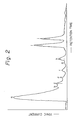
- Fig. 1 The chart of the gas chromatographic mass spectrometry of the gaseous organic compounds evolved is illustrated in Fig. 1, wherein peaks a, d, e and g signify air, methyl isobutyl ketone, toluene and xylene, respectively.
- finely divided toner particles were prepared from 83 parts of a bisphenol A/epichlorohydrin type epoxy resin, 5 parts of a carbon black powder, 2 parts of Nigrosine Black EX and 10 parts of a montanic acid ester wax (Ester Waxes E, supplied by Hoechst A.G., this wax has a dropping point of 79 to 85, an acid number of 15 to 20, a saponification number of 130 to 160 and a density of 1.01 to 1.03 g/cm 3 ).
- the epoxy resin, the carbon black powder and the Nigrosine Black EX were the same as those used in example 2.
- a air
- b n-butanol
- c methyl methacrylate plus trichloroethylene
- d methyl isobutyl ketone
- e toluene
- f isobutyl acetate
- g xylene
- h styrene
- i a-methylstyrene plus butyl methacrylate
- j unidentified acrylic compounds.
- the arrows in Fig. 2 means that the low molecular weight compounds corresponding to the peaks indicated by the arrows are sources of the offensive odor.
Landscapes
- Physics & Mathematics (AREA)
- Spectroscopy & Molecular Physics (AREA)
- General Physics & Mathematics (AREA)
- Chemical & Material Sciences (AREA)
- Chemical Kinetics & Catalysis (AREA)
- Developing Agents For Electrophotography (AREA)
- Fixing For Electrophotography (AREA)
Claims (8)
Applications Claiming Priority (2)
| Application Number | Priority Date | Filing Date | Title |
|---|---|---|---|
| JP54105954A JPS598825B2 (ja) | 1979-08-22 | 1979-08-22 | フラッシュ定着方法 |
| JP105954/79 | 1979-08-22 |
Publications (4)
| Publication Number | Publication Date |
|---|---|
| EP0035573A4 EP0035573A4 (de) | 1981-08-28 |
| EP0035573A1 EP0035573A1 (de) | 1981-09-16 |
| EP0035573B1 EP0035573B1 (de) | 1985-06-12 |
| EP0035573B2 true EP0035573B2 (de) | 1989-04-12 |
Family
ID=14421211
Family Applications (1)
| Application Number | Title | Priority Date | Filing Date |
|---|---|---|---|
| EP80901548A Expired EP0035573B2 (de) | 1979-08-22 | 1981-03-09 | Tonerpartikel für die elektrophotographie und sie verwendendes elektrophotographisches verfahren |
Country Status (6)
| Country | Link |
|---|---|
| US (1) | US4352877A (de) |
| EP (1) | EP0035573B2 (de) |
| JP (1) | JPS598825B2 (de) |
| DE (1) | DE3070756D1 (de) |
| IT (1) | IT1132456B (de) |
| WO (1) | WO1981000628A1 (de) |
Families Citing this family (11)
| Publication number | Priority date | Publication date | Assignee | Title |
|---|---|---|---|---|
| JPS56158340A (en) * | 1980-05-13 | 1981-12-07 | Konishiroku Photo Ind Co Ltd | Toner for developing electrostatic charge image |
| JPS58168053A (ja) * | 1982-03-29 | 1983-10-04 | Toray Ind Inc | フラツシユ定着用現像剤 |
| JPS58203451A (ja) * | 1982-05-21 | 1983-11-26 | Toray Ind Inc | フラツシユ定着用現像剤 |
| JPS59129862A (ja) * | 1983-01-17 | 1984-07-26 | Fujitsu Ltd | 粉体現像用トナ− |
| JPS61132959A (ja) * | 1984-12-03 | 1986-06-20 | Fujitsu Ltd | フラツシユ定着方法 |
| JPS6211997A (ja) * | 1985-07-10 | 1987-01-20 | 株式会社アルフア | ガソリンの盗難防止警報装置 |
| US4698290A (en) * | 1985-12-11 | 1987-10-06 | Xerox Corporation | Process for energy reduction with flash fusing |
| JP3179531B2 (ja) * | 1991-09-07 | 2001-06-25 | 花王株式会社 | フラッシュ定着用電子写真用現像剤組成物 |
| US5733701A (en) * | 1995-09-19 | 1998-03-31 | Minolta Co., Ltd. | Non-contact hot fusing toner |
| US5932386A (en) * | 1996-09-05 | 1999-08-03 | Minolta Co., Ltd. | Non-contact hot fusing toner |
| WO2001014936A1 (en) * | 1999-08-20 | 2001-03-01 | Fujitsu Limited | Image forming device |
Family Cites Families (10)
| Publication number | Priority date | Publication date | Assignee | Title |
|---|---|---|---|---|
| BE558347A (de) * | 1956-06-14 | |||
| NL255481A (de) * | 1959-09-04 | |||
| FR1453524A (fr) * | 1964-09-01 | 1966-06-03 | Kalle Ag | Procédé et matériel pour la préparation d'une image hautement résistante à la chaleur |
| GB1157077A (en) * | 1966-09-13 | 1969-07-02 | Molins Machine Co Ltd | Particulate Ink Systems |
| GB1210665A (en) * | 1966-11-23 | 1970-10-28 | Addressograph Multigraph | Photoelectrostatic developing material |
| US3474223A (en) * | 1966-12-02 | 1969-10-21 | Xerox Corp | Selective flash fusing |
| NL159795C (de) * | 1968-07-22 | Minnesota Mining & Mfg | ||
| JPS4934157B1 (de) * | 1970-08-15 | 1974-09-12 | ||
| NL7415325A (nl) * | 1974-11-25 | 1976-05-28 | Oce Van Der Grinten Nv | Tonerpoeder voor het ontwikkelen van elektro- statische beelden. |
| JPS51147325A (en) * | 1975-06-13 | 1976-12-17 | Canon Inc | Toner for electro-photography |
-
1979
- 1979-08-22 JP JP54105954A patent/JPS598825B2/ja not_active Expired
-
1980
- 1980-08-20 US US06/253,837 patent/US4352877A/en not_active Expired - Lifetime
- 1980-08-20 WO PCT/JP1980/000187 patent/WO1981000628A1/ja not_active Ceased
- 1980-08-20 DE DE8080901548T patent/DE3070756D1/de not_active Expired
- 1980-08-22 IT IT24253/80A patent/IT1132456B/it active
-
1981
- 1981-03-09 EP EP80901548A patent/EP0035573B2/de not_active Expired
Also Published As
| Publication number | Publication date |
|---|---|
| EP0035573A4 (de) | 1981-08-28 |
| JPS5630139A (en) | 1981-03-26 |
| WO1981000628A1 (fr) | 1981-03-05 |
| EP0035573A1 (de) | 1981-09-16 |
| EP0035573B1 (de) | 1985-06-12 |
| IT8024253A0 (it) | 1980-08-22 |
| JPS598825B2 (ja) | 1984-02-27 |
| DE3070756D1 (en) | 1985-07-18 |
| IT1132456B (it) | 1986-07-02 |
| US4352877A (en) | 1982-10-05 |
Similar Documents
| Publication | Publication Date | Title |
|---|---|---|
| EP0035573B2 (de) | Tonerpartikel für die elektrophotographie und sie verwendendes elektrophotographisches verfahren | |
| US4699863A (en) | Electrophotographic flash fixation process employing toner having improved light absorption properties and toner therefor | |
| US4565763A (en) | Process for producing toner | |
| EP0282740A2 (de) | Elektrophotographischer Toner und Entwicklungszusammensetzungen | |
| US4513075A (en) | Developer materials for electrostatic images | |
| JPS6013168B2 (ja) | 電子写真トナ− | |
| US5085964A (en) | Carrier for developer | |
| EP0211583A2 (de) | Zusammensetzungen von eingekapselten farbigen Tonern | |
| EP0110711B1 (de) | Roter magnetischer Entwickler vom Einkomponententyp | |
| US5629120A (en) | Electrostatic image developing carrier and electrostatic image developer | |
| US5154998A (en) | Toner for developing electrostatically charged images | |
| GB2043932A (en) | Composite magnetic developer for electrostatic latent images | |
| KR840000557B1 (ko) | 전자사진 처리방법 | |
| JPS5914746B2 (ja) | フラッシ定着用粉体現像トナ− | |
| JPS59129862A (ja) | 粉体現像用トナ− | |
| JPH06230600A (ja) | 電子写真用トナー | |
| CA1062068A (en) | Dry electrophotographic developer | |
| JPH02118670A (ja) | フラッシュ定着用カラートナー | |
| WO2001006321A1 (fr) | Poudre imprimante pour electrophotographie et procede de formation d'images | |
| JP2735165B2 (ja) | トナー | |
| JP2001022123A (ja) | 電子写真用トナー及び画像形成方法 | |
| US5830616A (en) | Magnetic latent image developing toner | |
| JPH02251860A (ja) | 静電印刷用乾式トナー | |
| JPH0153461B2 (de) | ||
| KR0132293B1 (ko) | 자성토너 |
Legal Events
| Date | Code | Title | Description |
|---|---|---|---|
| PUAI | Public reference made under article 153(3) epc to a published international application that has entered the european phase |
Free format text: ORIGINAL CODE: 0009012 |
|
| 17P | Request for examination filed |
Effective date: 19810428 |
|
| AK | Designated contracting states |
Designated state(s): DE FR GB |
|
| GRAA | (expected) grant |
Free format text: ORIGINAL CODE: 0009210 |
|
| AK | Designated contracting states |
Designated state(s): DE FR GB |
|
| REF | Corresponds to: |
Ref document number: 3070756 Country of ref document: DE Date of ref document: 19850718 |
|
| ET | Fr: translation filed | ||
| PLBI | Opposition filed |
Free format text: ORIGINAL CODE: 0009260 |
|
| 26 | Opposition filed |
Opponent name: OCE-NEDERLAND B.V. Effective date: 19860131 |
|
| PLAB | Opposition data, opponent's data or that of the opponent's representative modified |
Free format text: ORIGINAL CODE: 0009299OPPO |
|
| R26 | Opposition filed (corrected) |
Opponent name: OCE-NEDERLAND B.V., VENLO Effective date: 19860131 |
|
| PLAB | Opposition data, opponent's data or that of the opponent's representative modified |
Free format text: ORIGINAL CODE: 0009299OPPO |
|
| R26 | Opposition filed (corrected) |
Opponent name: OCE-NEDERLAND B.V., VENLO Effective date: 19860131 |
|
| PUAH | Patent maintained in amended form |
Free format text: ORIGINAL CODE: 0009272 |
|
| STAA | Information on the status of an ep patent application or granted ep patent |
Free format text: STATUS: PATENT MAINTAINED AS AMENDED |
|
| 27A | Patent maintained in amended form |
Effective date: 19890412 |
|
| AK | Designated contracting states |
Kind code of ref document: B2 Designated state(s): DE FR GB |
|
| ET3 | Fr: translation filed ** decision concerning opposition | ||
| PGFP | Annual fee paid to national office [announced via postgrant information from national office to epo] |
Ref country code: FR Payment date: 19990810 Year of fee payment: 20 |
|
| PGFP | Annual fee paid to national office [announced via postgrant information from national office to epo] |
Ref country code: GB Payment date: 19990818 Year of fee payment: 20 |
|
| PGFP | Annual fee paid to national office [announced via postgrant information from national office to epo] |
Ref country code: DE Payment date: 19990823 Year of fee payment: 20 |
|
| PG25 | Lapsed in a contracting state [announced via postgrant information from national office to epo] |
Ref country code: GB Free format text: LAPSE BECAUSE OF EXPIRATION OF PROTECTION Effective date: 20000819 |
|
| REG | Reference to a national code |
Ref country code: GB Ref legal event code: PE20 Effective date: 20000819 |