EP0036896B1 - Blockpolymerisationsreaktor - Google Patents
Blockpolymerisationsreaktor Download PDFInfo
- Publication number
- EP0036896B1 EP0036896B1 EP19800101641 EP80101641A EP0036896B1 EP 0036896 B1 EP0036896 B1 EP 0036896B1 EP 19800101641 EP19800101641 EP 19800101641 EP 80101641 A EP80101641 A EP 80101641A EP 0036896 B1 EP0036896 B1 EP 0036896B1
- Authority
- EP
- European Patent Office
- Prior art keywords
- reaction chamber
- bulk polymerization
- section
- polymerization reactor
- reactor
- Prior art date
- Legal status (The legal status is an assumption and is not a legal conclusion. Google has not performed a legal analysis and makes no representation as to the accuracy of the status listed.)
- Expired
Links
- 238000012662 bulk polymerization Methods 0.000 title claims description 24
- 238000006243 chemical reaction Methods 0.000 claims description 43
- 238000006116 polymerization reaction Methods 0.000 claims description 23
- 238000010008 shearing Methods 0.000 claims description 17
- 239000000463 material Substances 0.000 claims description 9
- 239000011347 resin Substances 0.000 claims description 7
- 229920005989 resin Polymers 0.000 claims description 7
- 238000010276 construction Methods 0.000 claims description 5
- 238000000034 method Methods 0.000 description 18
- 239000007791 liquid phase Substances 0.000 description 14
- 229920000642 polymer Polymers 0.000 description 11
- 239000012071 phase Substances 0.000 description 5
- 238000004040 coloring Methods 0.000 description 4
- 230000000704 physical effect Effects 0.000 description 4
- 239000004033 plastic Substances 0.000 description 4
- 229920003023 plastic Polymers 0.000 description 4
- 230000015572 biosynthetic process Effects 0.000 description 3
- 235000019646 color tone Nutrition 0.000 description 3
- 230000000052 comparative effect Effects 0.000 description 3
- 239000004816 latex Substances 0.000 description 3
- 229920000126 latex Polymers 0.000 description 3
- 230000007246 mechanism Effects 0.000 description 3
- 239000000203 mixture Substances 0.000 description 3
- 239000000178 monomer Substances 0.000 description 3
- CSNNHWWHGAXBCP-UHFFFAOYSA-L Magnesium sulfate Chemical compound [Mg+2].[O-][S+2]([O-])([O-])[O-] CSNNHWWHGAXBCP-UHFFFAOYSA-L 0.000 description 2
- 239000005062 Polybutadiene Substances 0.000 description 2
- PPBRXRYQALVLMV-UHFFFAOYSA-N Styrene Chemical group C=CC1=CC=CC=C1 PPBRXRYQALVLMV-UHFFFAOYSA-N 0.000 description 2
- 230000002159 abnormal effect Effects 0.000 description 2
- 229920000122 acrylonitrile butadiene styrene Polymers 0.000 description 2
- 230000006866 deterioration Effects 0.000 description 2
- 238000007720 emulsion polymerization reaction Methods 0.000 description 2
- 238000010528 free radical solution polymerization reaction Methods 0.000 description 2
- 239000007788 liquid Substances 0.000 description 2
- 239000008188 pellet Substances 0.000 description 2
- 229920002857 polybutadiene Polymers 0.000 description 2
- SCUZVMOVTVSBLE-UHFFFAOYSA-N prop-2-enenitrile;styrene Chemical compound C=CC#N.C=CC1=CC=CC=C1 SCUZVMOVTVSBLE-UHFFFAOYSA-N 0.000 description 2
- 229920000638 styrene acrylonitrile Polymers 0.000 description 2
- 238000010557 suspension polymerization reaction Methods 0.000 description 2
- 238000004383 yellowing Methods 0.000 description 2
- NLHHRLWOUZZQLW-UHFFFAOYSA-N Acrylonitrile Chemical group C=CC#N NLHHRLWOUZZQLW-UHFFFAOYSA-N 0.000 description 1
- 241000212749 Zesius chrysomallus Species 0.000 description 1
- 238000003763 carbonization Methods 0.000 description 1
- 230000001419 dependent effect Effects 0.000 description 1
- WNAHIZMDSQCWRP-UHFFFAOYSA-N dodecane-1-thiol Chemical compound CCCCCCCCCCCCS WNAHIZMDSQCWRP-UHFFFAOYSA-N 0.000 description 1
- 229920001971 elastomer Polymers 0.000 description 1
- 230000008030 elimination Effects 0.000 description 1
- 238000003379 elimination reaction Methods 0.000 description 1
- 229920000578 graft copolymer Polymers 0.000 description 1
- 239000011346 highly viscous material Substances 0.000 description 1
- 238000004898 kneading Methods 0.000 description 1
- 229910052943 magnesium sulfate Inorganic materials 0.000 description 1
- 235000019341 magnesium sulphate Nutrition 0.000 description 1
- 238000012423 maintenance Methods 0.000 description 1
- 150000001247 metal acetylides Chemical class 0.000 description 1
- 239000011259 mixed solution Substances 0.000 description 1
- 230000002093 peripheral effect Effects 0.000 description 1
- 238000011084 recovery Methods 0.000 description 1
- 239000005060 rubber Substances 0.000 description 1
- 239000007787 solid Substances 0.000 description 1
- 239000000243 solution Substances 0.000 description 1
- 238000003756 stirring Methods 0.000 description 1
- 239000011345 viscous material Substances 0.000 description 1
- XLYOFNOQVPJJNP-UHFFFAOYSA-N water Substances O XLYOFNOQVPJJNP-UHFFFAOYSA-N 0.000 description 1
Images

Classifications
-
- C—CHEMISTRY; METALLURGY
- C08—ORGANIC MACROMOLECULAR COMPOUNDS; THEIR PREPARATION OR CHEMICAL WORKING-UP; COMPOSITIONS BASED THEREON
- C08F—MACROMOLECULAR COMPOUNDS OBTAINED BY REACTIONS ONLY INVOLVING CARBON-TO-CARBON UNSATURATED BONDS
- C08F2/00—Processes of polymerisation
-
- B—PERFORMING OPERATIONS; TRANSPORTING
- B01—PHYSICAL OR CHEMICAL PROCESSES OR APPARATUS IN GENERAL
- B01J—CHEMICAL OR PHYSICAL PROCESSES, e.g. CATALYSIS OR COLLOID CHEMISTRY; THEIR RELEVANT APPARATUS
- B01J19/00—Chemical, physical or physico-chemical processes in general; Their relevant apparatus
- B01J19/18—Stationary reactors having moving elements inside
-
- B—PERFORMING OPERATIONS; TRANSPORTING
- B01—PHYSICAL OR CHEMICAL PROCESSES OR APPARATUS IN GENERAL
- B01J—CHEMICAL OR PHYSICAL PROCESSES, e.g. CATALYSIS OR COLLOID CHEMISTRY; THEIR RELEVANT APPARATUS
- B01J2219/00—Chemical, physical or physico-chemical processes in general; Their relevant apparatus
- B01J2219/00049—Controlling or regulating processes
- B01J2219/00051—Controlling the temperature
- B01J2219/00054—Controlling or regulating the heat exchange system
- B01J2219/00056—Controlling or regulating the heat exchange system involving measured parameters
- B01J2219/00058—Temperature measurement
- B01J2219/00063—Temperature measurement of the reactants
-
- B—PERFORMING OPERATIONS; TRANSPORTING
- B01—PHYSICAL OR CHEMICAL PROCESSES OR APPARATUS IN GENERAL
- B01J—CHEMICAL OR PHYSICAL PROCESSES, e.g. CATALYSIS OR COLLOID CHEMISTRY; THEIR RELEVANT APPARATUS
- B01J2219/00—Chemical, physical or physico-chemical processes in general; Their relevant apparatus
- B01J2219/00049—Controlling or regulating processes
- B01J2219/00051—Controlling the temperature
- B01J2219/00074—Controlling the temperature by indirect heating or cooling employing heat exchange fluids
- B01J2219/00087—Controlling the temperature by indirect heating or cooling employing heat exchange fluids with heat exchange elements outside the reactor
- B01J2219/00094—Jackets
-
- B—PERFORMING OPERATIONS; TRANSPORTING
- B01—PHYSICAL OR CHEMICAL PROCESSES OR APPARATUS IN GENERAL
- B01J—CHEMICAL OR PHYSICAL PROCESSES, e.g. CATALYSIS OR COLLOID CHEMISTRY; THEIR RELEVANT APPARATUS
- B01J2219/00—Chemical, physical or physico-chemical processes in general; Their relevant apparatus
- B01J2219/18—Details relating to the spatial orientation of the reactor
- B01J2219/185—Details relating to the spatial orientation of the reactor vertical
Definitions
- the present invention relates to a bulk polymerization reactor according to the preamble of claim 1.
- a bulk polymerization reactor of this type is known from GB-A-994.789.
- Emulsion polymerization processes, suspension polymerization processes, solution polymerization processes and bulk polymerization processes have been known as methods for industrially producing plastics on the basis of highpolymer forming reactions. Which process should be chosen is partly dependent upon what purpose the produced plastics are used for.
- the choice is greatly influenced by how to remove the heat of reaction and/or how to cope with the viscous material which increases as the polymerization reaction develops.
- the bulk polymerization process is most advantageous since its easiness in constructing a closed system assures saving of resources and energy, and less polution of environment.
- various problems have to be solved such as instability in reaction, abnormal stagnation of material whose viscosity increases exponentially as the polymerization develops, and reduction in surface for removal of heat which inevitably follows enlargement in construction of the reactor.
- this process is applicable to very limited types of plastics when compared with emulsion polymerization, suspension polymerization and solution polymerization processes.
- viscosity of the system increases as the bulk polymerization develops and big difficulty is experienced in properly handling highly viscous materials. That is, abnormal stagnant layers grow in the area near the wall of the reaction chamber and/or the rotary mixer shaft. Such stagnation in the liquid phase at high temperatures tends to eventuate in deterioration of polymers with low heat stability such as colouring and, in the worst case, carbonization. Polymer in the stagnant layers is involved in the polymer flows in the liquid phase and causes undesirable colouring of the normal polymer and/or inclusion of carbonized spot in the normal polymer, thereby seriously lowering the commercial value of the produced plastics.
- the conventional bulk polymerization reactor is accompanied with a further problem, i.e. instability of reaction.
- Polymerization reaction is in general a kind of exothermic reaction and high viscosity of the system prevents easy control of the heat of reaction, thereby causing formation of hot spots and/or uncontrolled development in polymerization.
- a bulk polymerization reactor comprising a vertically elongated cylindrical polymerization vat of a jacket construction which defines a reaction chamber provided with a material supply port and a bottom product resin discharge port, a rotary shaft vertically extending through said reaction chamber, and at least one horizontal perforated disc fixed to said rotary shaft whilst leaving a cylindrical clearance between its periphery and a corresponding wall section of said reaction chamber, characterized in that said rotary shaft (2, Fig.
- FIG. 1 A typical embodiment of the improved bulk polymerization reactor in accordance with the present invention is shown in Fig. 1, in which the reactor takes the form of a vertical, cylindrical polymerization vat V of a jacket construction which internally defines a reaction chamber 1.
- the jacket construction includes known heater and/or cooler equipment.
- the polymerization vat V is closed atop whilst allowing idle passage of a rotary shaft 2 which extends vertically towards the bottom of the reaction chamber 1.
- the rotary shaft 2 includes a first longitudinal section 2a on the center axis A of the reaction chamber 1 and operationally coupled to a given drive source (not shown), a second off-center longitudinal section 2b which extends at least through the liquid phase within the reaction chamber 1, and a third longitudinal section 2c integrally connecting these two longitudinal sections 2a and 2b.
- a plurality of perforated discs 3 fixed horizontally to the off-center longitudinal section 2b of the rotary shaft 2. Although four sets of discs are used in the illustration, the number of the perforated disc can be selected freely in accordance with the process conditions in actual polymerization.
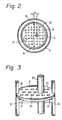
- Each disc 3 is provided with a number of apertures 31 (Fig. 2) formed these through. The diameter of each disc 3 is smaller than that of the corresponding section of the reaction chamber 1 so that slight cylindrical clearance C is left between the periphery of the disc 3 and the wall of the corresponding section of the reaction chamber 1 as clearly seen in Fig. 2.
- a pair of opposite arms 4 extend radially from the shaft 2b and securely hold, at their outer ends, shearing blades 6 which extend vertically over a prescribed distance.
- the shearing blades 6 are fixed to the peripheral section of the associated disc 3 and a clearance should be left between the outer face of each blade 6 and the wall of the reaction chamber 1.
- the vertical plane containing a pair of blades 6 at a certain level preferably offsets that containing a pair of blades 6 at an adjacent level.
- the angle of offset is 90 degrees.
- the polymerization vat V is further provided with a supply port 7 opening in the reaction chamber 1 near its top and a discharge part 8 arranged at its bottom.
- the degree of eccentricity ⁇ of the off-center longitudinal section 2b of the shaft 2 from the center axis of the reaction chamber 1 should preferably be 150% or smaller of the diameter of the off-center longitudinal section 2b, and more preferably in a range from 10 to 110% of the diameter of the off-center longitudinal section 2b.
- the clearance between the outer face of the shearing blade 6 and the corresponding wall of the reactor should preferably be 60 mm. or smaller, and more preferably in a range from 5 to 25 mm.
- any revolving speed above 30/RPM tends to cause furious vertical mixing in the liquid phase which leads to unstable polymerization in the reactor and increased consumption of electric power.
- the dimension of the shearing blades 6 should be designed so that the total shearing by the blades 6 should preferably cover 80% or more of the wall of the reaction chamber 1 in the liquid phase, and more preferably 101 % or more.
- each perforated disc 3 should be in a range from 35 to 65% of the entire transverse cross section of the corresponding section of the reaction chamber 1.
- the presence of the perforated discs 3 contributes to maintenance of a stable state of the liquid phase in the reactor, since the discs 3 greatly inhibit vertical mixing of the liquid phase in the reaction chamber 1.
- perforated discs of a total opening smaller than 35% may assure high conversion of polymerization such as 98%.
- continued running of a reactor with such perforated discs eventuates in formation of undesirably coloured products and gradual reduction in yield.
- adherence of coloured polymer on the perforated discs is recognized after long running of the reactor.
- the perforated disc 3 is ordinarily provided with circular apertures 31 as shown in Figs. 2 and 3.
- apertures of any other shape such as a slit, a polygon or a sector are useful for the perforated disc of the present invention depending on the requirements in practice.
- Dimension of each aperture should be selected depending upon the viscosity of the liquid phase to be processed whilst taking the above-described total opening of the disc into account also.
- 25 parts by weight of the latex of the above-described composition was mixed with 25 parts by weight of styrene monomer, and, after sufficient stirring of the mixture, 0.8 parts by weight of magnesium sulfate was further added.
- the mixed solution was divided into water and polymer/monomer phase, and the latter was mixed with 29 parts by weight of styrene monomer, 21 parts by weight of acrylonitrile monomer and 0.15 parts by weight of normal dodecyl mercaptan in order to obtain a unform solution, i.e. material dope.
- composition of this material dope was as follows;
- This material dope was subjected to preparatory bulk polymerization so that the resultant intermediate material was 50% by weight in solid form and the latter was processed through the reactor shown in Fig. 1 to 95% conversion of polymerizate in order to continuously deliver ABS resin separated from the monomer.
- ABS pellets were provided with stable colour tone and physical properties as in the following table.
- the physical properties of the produced resin were as follows:
- the Izod impact strength was 18 to 24 kg - cm/cm (with notch) and the yellowness index was 23 to 32%.
Landscapes
- Chemical & Material Sciences (AREA)
- Organic Chemistry (AREA)
- Chemical Kinetics & Catalysis (AREA)
- Health & Medical Sciences (AREA)
- Medicinal Chemistry (AREA)
- Polymers & Plastics (AREA)
- Polymerisation Methods In General (AREA)
- Other Resins Obtained By Reactions Not Involving Carbon-To-Carbon Unsaturated Bonds (AREA)
Claims (8)
Priority Applications (2)
| Application Number | Priority Date | Filing Date | Title |
|---|---|---|---|
| DE8080101641T DE3067088D1 (en) | 1980-03-27 | 1980-03-27 | Bulk polymerization reactor |
| EP19800101641 EP0036896B1 (de) | 1980-03-27 | 1980-03-27 | Blockpolymerisationsreaktor |
Applications Claiming Priority (1)
| Application Number | Priority Date | Filing Date | Title |
|---|---|---|---|
| EP19800101641 EP0036896B1 (de) | 1980-03-27 | 1980-03-27 | Blockpolymerisationsreaktor |
Publications (2)
| Publication Number | Publication Date |
|---|---|
| EP0036896A1 EP0036896A1 (de) | 1981-10-07 |
| EP0036896B1 true EP0036896B1 (de) | 1984-03-21 |
Family
ID=8186643
Family Applications (1)
| Application Number | Title | Priority Date | Filing Date |
|---|---|---|---|
| EP19800101641 Expired EP0036896B1 (de) | 1980-03-27 | 1980-03-27 | Blockpolymerisationsreaktor |
Country Status (2)
| Country | Link |
|---|---|
| EP (1) | EP0036896B1 (de) |
| DE (1) | DE3067088D1 (de) |
Family Cites Families (1)
| Publication number | Priority date | Publication date | Assignee | Title |
|---|---|---|---|---|
| BE608707A (fr) * | 1960-10-01 | 1962-03-29 | Basf Ag | Procédé et dispositif pour la polymérisation continue de composés polymérisables à liaisons éthyléniques |
-
1980
- 1980-03-27 EP EP19800101641 patent/EP0036896B1/de not_active Expired
- 1980-03-27 DE DE8080101641T patent/DE3067088D1/de not_active Expired
Also Published As
| Publication number | Publication date |
|---|---|
| EP0036896A1 (de) | 1981-10-07 |
| DE3067088D1 (en) | 1984-04-26 |
Similar Documents
| Publication | Publication Date | Title |
|---|---|---|
| KR890000743B1 (ko) | 연속 괴상 중합장치 | |
| US4438074A (en) | Continuous polymerization reactor | |
| US2727884A (en) | Process of mass polymerization in vertical unmixed strata | |
| US3243481A (en) | Process for making graft copolymers of vinyl aromatic compounds and stereospecific rubbers | |
| US3709664A (en) | High shear mixing apparatus for making silica gels | |
| US4985208A (en) | Polymerization reaction apparatus | |
| US7511101B2 (en) | Plug flow reactor and polymers prepared therewith | |
| EP0027274B1 (de) | Kontinuierliches Massenpolymerisationsverfahren zur Herstellung eines Copolymers aus einem aromatischen Vinylmonomer und Maleinsäureanhydrid | |
| NL8000099A (nl) | Werkwijze ter bereiding van aromatische polyesters. | |
| HU176398B (en) | Process and apparatus for continuous producing vinylchloride-polymers in aequous emulsions | |
| US3513145A (en) | Continuous mass polymerization processes | |
| DE19711022A1 (de) | Verwendung eines Mehrstufenrührers zur Herstellung von Polymerisaten | |
| US2745823A (en) | Control of temperature in emulsion polymerization | |
| US4277585A (en) | Vertical autoclave for bulk polymerization of vinyl chloride | |
| US3498754A (en) | Continuous polycondensation apparatus | |
| US4325915A (en) | Bulk polymerization reactor | |
| US3909207A (en) | Vertical stirred mass polymerization apparatus | |
| EP0036896A1 (de) | Blockpolymerisationsreaktor | |
| US3562238A (en) | Suspension polymerization process for vinyl chloride polymers | |
| CN113634218A (zh) | 烯烃气相聚合的装置及其方法 | |
| US3424733A (en) | Method and apparatus for handling of a fluid | |
| CA1139533A (en) | Bulk polymerization reactor | |
| US3749555A (en) | Polymerization reactor | |
| US3840509A (en) | Process for preparing polymers from styrene | |
| US4419488A (en) | Process for continuous production of high impact polystyrene |
Legal Events
| Date | Code | Title | Description |
|---|---|---|---|
| PUAI | Public reference made under article 153(3) epc to a published international application that has entered the european phase |
Free format text: ORIGINAL CODE: 0009012 |
|
| 17P | Request for examination filed |
Effective date: 19810514 |
|
| AK | Designated contracting states |
Designated state(s): DE FR IT |
|
| RBV | Designated contracting states (corrected) |
Designated state(s): DE FR IT |
|
| ITF | It: translation for a ep patent filed | ||
| GRAA | (expected) grant |
Free format text: ORIGINAL CODE: 0009210 |
|
| AK | Designated contracting states |
Designated state(s): DE FR IT |
|
| REF | Corresponds to: |
Ref document number: 3067088 Country of ref document: DE Date of ref document: 19840426 |
|
| ET | Fr: translation filed | ||
| PLBE | No opposition filed within time limit |
Free format text: ORIGINAL CODE: 0009261 |
|
| STAA | Information on the status of an ep patent application or granted ep patent |
Free format text: STATUS: NO OPPOSITION FILED WITHIN TIME LIMIT |
|
| 26N | No opposition filed | ||
| ITTA | It: last paid annual fee | ||
| PGFP | Annual fee paid to national office [announced via postgrant information from national office to epo] |
Ref country code: FR Payment date: 19960126 Year of fee payment: 17 |
|
| PGFP | Annual fee paid to national office [announced via postgrant information from national office to epo] |
Ref country code: DE Payment date: 19960328 Year of fee payment: 17 |
|
| PG25 | Lapsed in a contracting state [announced via postgrant information from national office to epo] |
Ref country code: FR Free format text: LAPSE BECAUSE OF NON-PAYMENT OF DUE FEES Effective date: 19971128 |
|
| PG25 | Lapsed in a contracting state [announced via postgrant information from national office to epo] |
Ref country code: DE Effective date: 19971202 |
|
| REG | Reference to a national code |
Ref country code: FR Ref legal event code: ST |