EP0037082B1 - Verfahren zur Herstellung von 1-Carbapenem-Derivaten und von Zwischenprodukten via silyl-substituierter Dithioacetale - Google Patents
Verfahren zur Herstellung von 1-Carbapenem-Derivaten und von Zwischenprodukten via silyl-substituierter Dithioacetale Download PDFInfo
- Publication number
- EP0037082B1 EP0037082B1 EP81102270A EP81102270A EP0037082B1 EP 0037082 B1 EP0037082 B1 EP 0037082B1 EP 81102270 A EP81102270 A EP 81102270A EP 81102270 A EP81102270 A EP 81102270A EP 0037082 B1 EP0037082 B1 EP 0037082B1
- Authority
- EP
- European Patent Office
- Prior art keywords
- carbon atoms
- alkyl
- phenyl
- hydrogen
- group
- Prior art date
- Legal status (The legal status is an assumption and is not a legal conclusion. Google has not performed a legal analysis and makes no representation as to the accuracy of the status listed.)
- Expired
Links
- 0 C*[C@](C(C1)N2C(*)C1=O)(C2=O)S Chemical compound C*[C@](C(C1)N2C(*)C1=O)(C2=O)S 0.000 description 10
- JDGXZLNQVSUASY-UHFFFAOYSA-N NCCOCCCS Chemical compound NCCOCCCS JDGXZLNQVSUASY-UHFFFAOYSA-N 0.000 description 1
- BSUISYZZSMTNCZ-UHFFFAOYSA-N OCCN(CCO)CCS Chemical compound OCCN(CCO)CCS BSUISYZZSMTNCZ-UHFFFAOYSA-N 0.000 description 1
Classifications
-
- C—CHEMISTRY; METALLURGY
- C07—ORGANIC CHEMISTRY
- C07D—HETEROCYCLIC COMPOUNDS
- C07D205/00—Heterocyclic compounds containing four-membered rings with one nitrogen atom as the only ring hetero atom
- C07D205/02—Heterocyclic compounds containing four-membered rings with one nitrogen atom as the only ring hetero atom not condensed with other rings
- C07D205/06—Heterocyclic compounds containing four-membered rings with one nitrogen atom as the only ring hetero atom not condensed with other rings having one double bond between ring members or between a ring member and a non-ring member
- C07D205/08—Heterocyclic compounds containing four-membered rings with one nitrogen atom as the only ring hetero atom not condensed with other rings having one double bond between ring members or between a ring member and a non-ring member with one oxygen atom directly attached in position 2, e.g. beta-lactams
-
- C—CHEMISTRY; METALLURGY
- C07—ORGANIC CHEMISTRY
- C07D—HETEROCYCLIC COMPOUNDS
- C07D477/00—Heterocyclic compounds containing 1-azabicyclo [3.2.0] heptane ring systems, i.e. compounds containing a ring system of the formula:, e.g. carbapenicillins, thienamycins; Such ring systems being further condensed, e.g. 2,3-condensed with an oxygen-, nitrogen- or sulphur-containing hetero ring
- C07D477/02—Preparation
- C07D477/04—Preparation by forming the ring or condensed ring systems
-
- C—CHEMISTRY; METALLURGY
- C07—ORGANIC CHEMISTRY
- C07D—HETEROCYCLIC COMPOUNDS
- C07D477/00—Heterocyclic compounds containing 1-azabicyclo [3.2.0] heptane ring systems, i.e. compounds containing a ring system of the formula:, e.g. carbapenicillins, thienamycins; Such ring systems being further condensed, e.g. 2,3-condensed with an oxygen-, nitrogen- or sulphur-containing hetero ring
- C07D477/10—Heterocyclic compounds containing 1-azabicyclo [3.2.0] heptane ring systems, i.e. compounds containing a ring system of the formula:, e.g. carbapenicillins, thienamycins; Such ring systems being further condensed, e.g. 2,3-condensed with an oxygen-, nitrogen- or sulphur-containing hetero ring with hydrogen atoms, hydrocarbon or substituted hydrocarbon radicals, directly attached in position 4, and with a carbon atom having three bonds to hetero atoms with at the most one bond to halogen, e.g. an ester or nitrile radical, directly attached in position 2
-
- C—CHEMISTRY; METALLURGY
- C07—ORGANIC CHEMISTRY
- C07F—ACYCLIC, CARBOCYCLIC OR HETEROCYCLIC COMPOUNDS CONTAINING ELEMENTS OTHER THAN CARBON, HYDROGEN, HALOGEN, OXYGEN, NITROGEN, SULFUR, SELENIUM OR TELLURIUM
- C07F7/00—Compounds containing elements of Groups 4 or 14 of the Periodic Table
- C07F7/02—Silicon compounds
- C07F7/08—Compounds having one or more C—Si linkages
- C07F7/0803—Compounds with Si-C or Si-Si linkages
- C07F7/081—Compounds with Si-C or Si-Si linkages comprising at least one atom selected from the elements N, O, halogen, S, Se or Te
- C07F7/0812—Compounds with Si-C or Si-Si linkages comprising at least one atom selected from the elements N, O, halogen, S, Se or Te comprising a heterocyclic ring
-
- C—CHEMISTRY; METALLURGY
- C07—ORGANIC CHEMISTRY
- C07F—ACYCLIC, CARBOCYCLIC OR HETEROCYCLIC COMPOUNDS CONTAINING ELEMENTS OTHER THAN CARBON, HYDROGEN, HALOGEN, OXYGEN, NITROGEN, SULFUR, SELENIUM OR TELLURIUM
- C07F7/00—Compounds containing elements of Groups 4 or 14 of the Periodic Table
- C07F7/02—Silicon compounds
- C07F7/08—Compounds having one or more C—Si linkages
- C07F7/10—Compounds having one or more C—Si linkages containing nitrogen having a Si-N linkage
-
- Y—GENERAL TAGGING OF NEW TECHNOLOGICAL DEVELOPMENTS; GENERAL TAGGING OF CROSS-SECTIONAL TECHNOLOGIES SPANNING OVER SEVERAL SECTIONS OF THE IPC; TECHNICAL SUBJECTS COVERED BY FORMER USPC CROSS-REFERENCE ART COLLECTIONS [XRACs] AND DIGESTS
- Y02—TECHNOLOGIES OR APPLICATIONS FOR MITIGATION OR ADAPTATION AGAINST CLIMATE CHANGE
- Y02P—CLIMATE CHANGE MITIGATION TECHNOLOGIES IN THE PRODUCTION OR PROCESSING OF GOODS
- Y02P20/00—Technologies relating to chemical industry
- Y02P20/50—Improvements relating to the production of bulk chemicals
- Y02P20/55—Design of synthesis routes, e.g. reducing the use of auxiliary or protecting groups
Definitions
- This invention relates to the total synthesis of certain 1-carbapenems and their pharmaceutically acceptable salt, ester and amide derivatives which are useful as antibiotics.
- Such compounds may generically be represented by the following structural formula: wherein R 6 and R 7 , are independently selected from the group consisting of hydrogen, substituted and unsubstituted: alkyl, alkenyl, and alkynyl, having from 1-10 carbon atoms; cycloalkyl, cylcoalkylalkyl, and alkylcylcoalkyl, having 3-6 carbon atoms in the cycloalkyl ring and 1-6 carbon atoms in the alkyl moieties; phenyl; aralkyl, aralkenyl, and aralkynyl wherein the aryl moiety is phenyl and the aliphatic portion has 1-6 carbon atoms; wherein the substituent or substituents relative to the above-named radicals are selected from the group consisting of:
- R 2' is as defined but preferably is an ester moiety defined under R 2' ;
- R 1' is hydrogen or a readily removable known protecting group such as a triorganosilyl group;
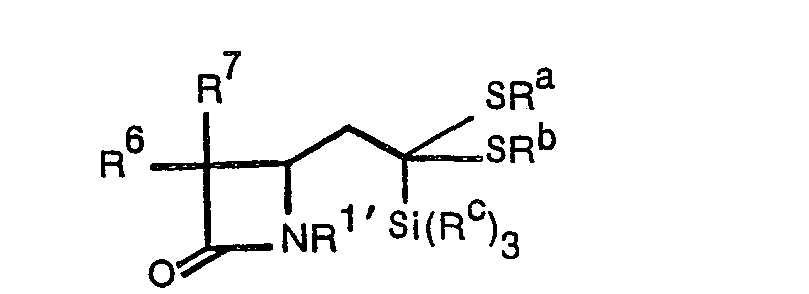
- R a and R b are independently selected from alkyl having 1-6 carbon atoms, such as methyl, ethyl or phenyl, trityl, benzyl, methoxybenzyl, ethoxybenzyl; additionally, R a and R b may be joined together, to form ⁇ (CH 2 ) 3 ⁇ to bridge the two sulphur atoms;
- R c is alkyl having 1-6 carbon atoms, such as methyl, ethyl or phenyl. The details of the total synthesis are given below.
- R 1' is hydrogen or a readily removable known protecting group
- R a and R b are independently selected from: alkyl having 1-6 carbon atoms, phenyl, trityl, benzyl, methoxybenzyl, ethoxybenzyl and ⁇ (CH 2 ) 3 ⁇ (joinder of R a and R b );
- R c is alkyl having 1 ⁇ 6 carbon atoms, or phenyl; and wherein R 6 and R 7 are independently selected from the group consisting of: hydrogen; substituted and unsubstituted: alkyl, alkenyl, and alkynyl, having from 1-10 carbon atoms; cycloalkyl, cycloalkylalkyl, and alkylcycloalkyl having 3-6 carbon atoms in the cycloalkly ring and 1-6 carbon atoms in the alkyl moieties; phenyl; aralkyl, aral
- antibiotics which are useful in animal and human therapy and in inanimate systems. These antibiotics are active against a broad range of pathogens which representatively include both gram positive bacteria such as S. aureus, Strep, pyogenes, and B. subtilis, and gram negative bacteria such as E. coli, Pseudomonas, Proteus morganii, Serratia, and Klebsiella. Further objects of this invention are to provide chemical processes for the preparation of such antibiotics and their non-toxic pharmaceutically acceptable salts and pharmaceutical compositions comprising such antibiotics.
- L-aspartic acid 1 is esterified according to well known procedures.
- a solvent such as benzene, toluene or chloroform
- an esterifying agent such as benzyl alcohol, methanol, ethanol or isopropanol
- HCI p-toluene sulfonic acid
- HBr p-toluene sulfonic acid
- R° is any convenient carboxyl protecting group such as benzyl, methyl, ethyl or isopropyl.
- the resulting species 2 in a solvent such as ether, THF or DME is treated with trimethylchlorosilane, for example, followed by treatment with EtMgBr, MeMgl, OMgBr, t-BuMgCI, for example at a temperature of from -40 to 50°C for from 1 to 72 hours to provide azetidinone 3.
- Reduction of species 3 with a reducing agent such as NaBH 4 in a solvent such as methanol, ethanol or isopropanol at a temperature of from -10 to 40°C for from 1 to 6 hours provides 4.
- Et, Me, 0, iPr, and t-Bu stand for: ethyl, methyl, phenyl, isopropyl, and tert-butyl, respectively.
- the transformation 6-> 7 establishes the protecting group R 1 which may be a triorganosilyl group, such as t-butyldimethylsilyl, t-butyldiphenylsilyl, triphenylsilyl, isopropyldimethylsilyl, or may be 3,4-dimethoxybenzyl, for example.
- R 1 may be a triorganosilyl group, such as t-butyldimethylsilyl, t-butyldiphenylsilyl, triphenylsilyl, isopropyldimethylsilyl, or may be 3,4-dimethoxybenzyl, for example.
- Silyl protection is preferred, and typically R 1 ' is established by treating 6 in a solvent such as dimethylformamide, acetonitrile, hexamethylphosphoramide or tetrahydrofuran with a silylating agent such as t-butyldimethylchlorosilane, t-butyldiphenylchlorosilane or triphenylchlorosilane, at a temperature of from -20°C to 25°C for from 0.5 to 24 hours in the presence of a base such as triethylamine diisopropylethylamine or imidazole.
- a solvent such as dimethylformamide, acetonitrile, hexamethylphosphoramide or tetrahydrofuran
- a silylating agent such as t-butyldimethylchlorosilane, t-butyldiphenylchlorosilane or triphenylchlorosilane
- the transformation 7 ⁇ 8 is accomplished by treating 7 in a solvent such as tetrahydrofuran, dimethoxyethane or diethylether with a carbanion generically represented by the following structure: wherein M is a metal cation such as lithium, potassium copper or magnesium, for example, and R a , R b and R° are as defined above at a temperature of from -100 to 0°C and from 0.5 to 4 hours.
- a solvent such as tetrahydrofuran, dimethoxyethane or diethylether
- M is a metal cation such as lithium, potassium copper or magnesium, for example
- R a , R b and R° are as defined above at a temperature of from -100 to 0°C and from 0.5 to 4 hours.
- the carbanion reagent is prepared prior to addition of substrate 7 on treatment of the di- organothiomonoorganosilylmethane with a strong base such as n-butyl-lithium, t-butyllithium, phenyllithium or lithium diisopropylamide (LDA).
- a strong base such as n-butyl-lithium, t-butyllithium, phenyllithium or lithium diisopropylamide (LDA).
- Resulting intermediate 8 can be mono-, or dialkylated at ring position 3.
- Alkylation of 8 provides 9.
- 8 is treated with a strong base such as lithium diisopropylamide, lithium 2,2,6,6-tetramethylpiperidide, potassium hydride, lithium hexamethyldisilazane or phenyllithium in a solvent such as tetrahydrofuran (THF), hexamethylphosphoramide, ether or dimethoxyethane, at a temperature of from -80°C to 0°C whereupon the alkylating agent of choice, R 6 X° is added (X° is chloro, iodo or bromo); alternatively the alkylating agent may be R 6 -tosylate, R 6 -mesylate or an aldehyde or ketone such as azcetaldehyde to provide monoalkylated species 9.
- dialkylated species 10 may be obtained from 9 by repeating the alky
- the eventual 6-substituents can also be established by direct acylation using an acylating agent such as N-acyl imdazole.
- an acylating agent such as N-acyl imdazole.
- N-acyl imidazole acylating reagents are listed below. Also given below is a detailed description of this second approach for establishing, R 6 and R 7 .
- R is a removable known carboxyl protecting group, such as benzyl.
- the 6-substituents may also be established by acylation.
- acylating agents may be demonstrated in the following manner with regard to a preferred starting, or intermediate material 10: wherein R 7 and R 1' are as defined above.
- R 6' is defined relative to the definition of R 6 and in that sense is the balance of the previously identified group R 6 .
- R 6' CH(OH)- R 6 .
- An especially preferred material 10 is when R 7 is hydrogen and R 6' is methyl.
- such 1'-hydroxy R'species 10 are prepared according to the following scheme:
- the alkylation 8 ⁇ 9, Scheme II is accomplished as previously described, by treating 8 in a solvent such as tetrahydrofuran, dimethoxyethane, diethylether, hexamethylphosphoramide, at a temperature of from -100° to -20°C with a strong base such as lithium diisopropylamide, lithium hexamethyldisilazide, lithium 2,2,6,6-tetramethylpiperidide or potassium hydride followed by the addition of an equivalent to 10 fold excess of an aldehyde.
- This reaction gives a mixture of isomers from which the desired trans-R form 9 (or 10) can be conveniently separated by chromatography or crystallization.
- Intermediate 8 may proceed directly to 9 as indicated above, or it may take the circuitous path via 9'.
- the direct acylation, to 9' is accomplished by treating 8 with two or more equivalents of a base such as lithium diisopropylamide, lithium hexamethyldisilazide, lithium 2,2,6,6-tetramethylpiperidide, in a solvent such as tetrahydrofuran, diethylether, or dimethoxyethane, for example, at a temperature of from -100 to -20°C with an acylating agent such as N-acyl imidazole. Addition of the 8 plus base mixture to the acylating agent is preferred.
- the reduction, &' ⁇ 9 is accomplished by contacting the ketone with a reducing agent such as potassium tri(sec-butyl)borohydride, lithium tri(sec-butyl)borohydride, sodium borohydride, sodium tris(methoxyethoxy)aluminium hydride or lithium aluminium hydride in a solvent such as diethylether, tetrahydrofuran or toluene at a temperature of from -78° to 25°C.
- a reducing agent such as potassium tri(sec-butyl)borohydride, lithium tri(sec-butyl)borohydride, sodium borohydride, sodium tris(methoxyethoxy)aluminium hydride or lithium aluminium hydride in a solvent such as diethylether, tetrahydrofuran or toluene at a temperature of from -78° to 25°C.
- a reducing agent such as potassium tri(sec-butyl)borohydride, lithium
- unresolved 9 (cis and trans) may be oxidized to 9' for reduction to 9 as indicated above:
- the oxidation is accomplished with an oxidizing agent such as dipyridine chromium (VI) oxide, trifluoroacetic anhydride-dimethylsulfoxide-triethylamine, pyridinium dichromate, acetic anhydride-dimethylsulfoxide in a solvent such as methylene chloride or acetonitrile, at a temperature of from -78 to 25°C for from 5 minutes to 5 hours.
- an oxidizing agent such as dipyridine chromium (VI) oxide, trifluoroacetic anhydride-dimethylsulfoxide-triethylamine, pyridinium dichromate, acetic anhydride-dimethylsulfoxide in a solvent such as methylene chloride or acetonitrile
- the transformation is accomplished by treating 10 in a solvent such as methanol, ethanol, isopropanol or water at a temperature of from 0 to 80°C with a Lewis acid such as mercuric chloride, silver tetrafluoroborate or thallium trinitrate.
- a solvent such as methanol, ethanol, isopropanol or water at a temperature of from 0 to 80°C with a Lewis acid such as mercuric chloride, silver tetrafluoroborate or thallium trinitrate.
- the oxidation 11 ⁇ 12 is preferably achieved with a 1.0 to 5.0 fold excess of an oxidizing agent such as m-chloroperbenzoic acid, peracetic acid, hydrogen peroxide or pertrifluorocacetic acid, in a solvent such as chloroform, carbontetrachloride or chlorobenzene, at a temperature of from 25°C to 130°C for from 0.5 to 24 hours.
- an oxidizing agent such as m-chloroperbenzoic acid, peracetic acid, hydrogen peroxide or pertrifluorocacetic acid
- the addition 12 ⁇ 13 is accomplished by treating 12 with 1,1'-carbonyidimidazole, for example, in a solvent such as tetrahydrofuran, dimethoxyethane or DMF, at a temperature of from 0 to 50°C, followed by the addition of 0.5 to 3.0 equivalents of (R 2' O 2 CCH 2 CO 2 ) 2 Mg, at a temperature of from 0 to 50°C for from 1 to 48 hours.
- R 2' is a readily removable carboxyl protecting group such as p-nitrobenzyl or benzyl. It should also be noted that R 2 ' may be a pharmaceutically acceptable ester moiety; such ester groups are representatively mentioned below. (DMF is dimethylformamide.)
- Removal of protecting group R 1' may be accomplished by a variety of known procedures such as hydrolysis or hydrogenation.
- R 1' is a triorganosilyl group (for example, [(CH 3 ) 3 C] (CH 3 ) 2 Si-) removal is typically accomplished by acidic aqueous hydrolysis of 13 in a solvent such as methanol, ethanol, tetrahydrofuran, dioxane or DMF, in the presence of an acid such as hydrochloric or sulfuric, acetic at a temperature of from 0 to 100°C for from 2 to 18 hours.
- a solvent such as methanol, ethanol, tetrahydrofuran, dioxane or DMF
- the diazo species 15 is prepared from 14 by treating 14 in a solvent such as CH 3 CN, CH 2 Cl 2 or THF, with an azide such as p-carboxybenzenesulfonylazide, toluenesulfonylazide nor methanesulfonylazide, in the presence of a base such as triethylamine, pyridine or (C 2 H 5 ) 2 NH, for from 1 to 50 hours at 0 ⁇ 25°C. (THF is tetrahydrofuran.)
- Cyclization (15 ⁇ 16) is accomplished by treating 15 in a solvent such as benzene, toluene or THF, at a temperature of from 50-110°C for from 1-5 hours in the presence of a catalyst such as bis (acetyl- acetonato)Cu(II) [Cu(acac) 2 ], CuS0 4 , Cu powder, Rh(OAc) 2 , or Pd(OAC) 2 .
- the cyclization may be accomplished by irradiating 15 through a pyrex filter (a wave length greater than 300 nm) in a solvent such as benzene, CC1 4 or diethylether at a temperature of from 0-25°C for from 0.5 to 2 hours.
- a pyrex filter a wave length greater than 300 nm
- acylating the keto ester 16 with a known acylating agent R°X such as p-toluenesulfonic acid anhydride, p-nitrophenylsulfonic acid anhydride, 2,4,6-triisopropylphenyisulfonic acid anydride, methanesulfonic acid anydride, trifluoromethane sulfonic acid anhydride, diphenyl chlorophosphate, toluenesulfonyl chloride or p-bromophenylsulfonyl chloride; wherein X is the corresponding leaving group such as toluene sulfonyloxy, p-nitrophenylsulfonyloxy, diphenylphosphoryl, and other leaving groups which are established by conventional procedures and are well known in the art.
- R°X such as p-toluenesulfonic acid anhydride, p-nitrophenylsulfonic acid anhydride,
- the above acylation to establish leaving groups X is conducted in a solvent such as methylene chloride, acetonitrile or dimethylforamide, in the presence of a base such as diisopropylethylamine, triethylamine or 4-diemthylamino-pyridine at a temperature of from -20 to 40°C for from 0.1 to 5 hours.
- a solvent such as methylene chloride, acetonitrile or dimethylforamide
- a base such as diisopropylethylamine, triethylamine or 4-diemthylamino-pyridine at a temperature of from -20 to 40°C for from 0.1 to 5 hours.
- the leaving group X of intermediate 17 can also be halogen.
- the halogen leaving group is established by treating 17 with a halogenating agent such as ⁇ 3 PCl 2 , ⁇ 3 PBr 2 , ( ⁇ O) 3 PBr 2 or oxalyl chloride in a solvent such as CH2CI2, CH3CN or THF, in the presence of a base such as diisopropylethylamine, triethylamine, or 4-dimethylaminopyridine. [0 - phenyl.]
- a halogenating agent such as ⁇ 3 PCl 2 , ⁇ 3 PBr 2 , ( ⁇ O) 3 PBr 2 or oxalyl chloride
- a solvent such as CH2CI2, CH3CN or THF
- a base such as diisopropylethylamine, triethylamine, or 4-dimethylaminopyridine.
- the reaction 17 ⁇ 18 is accomplished by treating 17 in a solvent such as dioxane, dimethylformamide, dimethylsulfoxide, acetonitrile or hexamethylphosphoramide, in the presence of an approximately equivalent to excess of the mercaptan reagent HSR 8 , wherein R 8 is as defined above, in the presence of a base such as sodium hydrogen carbonate, potassium carbonate, triethylamine or diisopropylethylamine, at a temperature of from -40 to 25°C for from 1 to 72 hours.
- a solvent such as dioxane, dimethylformamide, dimethylsulfoxide, acetonitrile or hexamethylphosphoramide
- the mercaptan reagent may be represented as HSCH 2 CH 2 NHR°, for example; wherein R° is a readily removable known N-protecting group such as p-nitrobenzyloxycarbonyl, (-C0 2 PNB) or o-nitrobenzyloxycarbonyl.
- the specifically illustrated mercaptan reagent, HSCH 2 CH 2 NHR° is typically prepared by treating the aminoethylmercaptan in the presence of the desired acid chloride in the presence of a base such as sodium bicarbon-ate or sodium hydroxide, in a solvent such as aqueous diethylether, aqueous dioxane or aqueous acetone, at a temperature of from 0 to 25°C for from 0.5 to 4 hours.
- a base such as sodium bicarbon-ate or sodium hydroxide
- a solvent such as aqueous diethylether, aqueous dioxane or aqueous acetone
- the final deblocking step 18 ⁇ I is accomplished by conventional procedures such as solvolysis or hydrogenation.
- a solvent such as dioxane-water-ethanol or tetrahydrofuran-aqueous dipotassium hydrogen phosphate-isopropanol is treated under a hydrogen pressure of from 1 to 4 atmospheres in the presence of a hydrogenation catalyst such as palladium on charcoal, palladium hydroxide or platinum oxide, at a temperature of from 0 to 50°C for from 0.25 to 4 hours to provide I.
- a hydrogenation catalyst such as palladium on charcoal, palladium hydroxide or platinum oxide
- suitable reagents HSR 8 utilized in the transformation 17 ⁇ 18 are listed below. The list is arranged according to structural and functional characteristics of the thia side chain ⁇ SR 8 ; annotation is provided where necessary.
- the thia side chain of choice is derived from the corresponding mercaptan reagent HSR 8 . When the mercaptan contains a functional group which might interfere with the intended course of reaction, the offending group is covered.
- acylation e.g., -C0 2 PNB
- esterification e.g., PNB ester
- Aliphatic Mercaptans HSR 8 wherein R 8 is 1 ⁇ 10 carbon alkyl, cycloalkyl, alkenyl, cycloalkenyl, or alkynyl; R 8 may be branched or unbranched,
- Substituted Aliphatic Mercaptans HSR 8 wherein R 8 is a 1 ⁇ 10 carbon branched or unbranched alkyl, cycloalkyl, alkenyl, cycloalkenyl or alkynyl group substituted by one or more halo, wherein R 1 and R 2 are as previously defined relative to substituents on R 8.
- Preferred substituents are basic nitrogen containing groups.
- Aryl Mercaptans HSR 8 wherein R 8 is phenyl or substituted phenyl.
- the substituents are independently selected from those previously defined for R 8 .
- Especially preferred substituents include alkyl, halo, hydroxy, alkoxy, acyloxy, acyl, carboxy, mercapto, sulfinyl, sulfonyl, amino, substituted amino, aminoalkyl, substituted aminoalkyl, amido, and ureido.
- X F, Cl, Br, OH, OR, , NH 2 , NHR 1 , NR 1 R 2 , CH 2 NH 2 , CH 2 NR 1 R 2 , CO 2 H, CO 2 R 1 , COR 1 , CONH 2 , CONR 1 R 2 , R 1 CONH, R 1 NHCONH, SR 1 , , SO 2 R 1 , CH 3 , CF 3 ; R1 and R 2 are as previously defined under R 8 .
- Heteroaryl Mercaptans HSR 8 wherein R 8 is a substituted or unsubstituted heteroaryl group containing 1-4 0, N or S atoms. Typical substituents include those mentioned above under "Aryl Mercaptans”.
- Arylaliphatic Mercaptans HSR 8 where R 8 is a 1 ⁇ 6 carbon branched or unbranched alkyl, cycloalkyl, alkenyl, or alkynyl group substituted by a phenyl or substituted phenyl group.
- Typical phenyl substituents include those mentioned under "Aryl Mercaptans”.
- HSR 8 Heteroarylaliphatic and Heterocyclicaliphatic Mercaptans: HSR 8 wherein R 8 is a 1-6 carbon branched or unbranched alkyl, cycloalkyl, alkenyl, or alkynyl group substituted by a heteroaryl or heterocyclic group containing 1-4, 0, N, or S atoms.
- the heteroaryl or heterocyclic group is unsubstituted or substituted by those substituents mentioned under "Aryl Mercaptans", (No. 3, above).
- HSR 8 are representative of this class:
- the compounds of the present invention may also generally be represented by the following structural formula: wherein X' is oxygen, sulfur or NR' (R' is hydrogen or loweralkyl having from 1 to 6 carbon atoms); and R 3 ' is hydrogen, or, is representatively selected to provide the pharmaceutically acceptable salt, ester anhydride (R 3' is acyl) and amide moieties known in the bicyclic ⁇ -lactam antibiotic art; R 3' may also be a readily removable known blocking group.
- the radical represented by ⁇ COX'R 3' is, inter alia, ⁇ COOH (X' is oxygen and R 3' is hydrogen) and all radicals known to be effective as pharmaceutically acceptable ester, anhydride (R 3 ' is acyl) and amide radicals in the bicyclic ⁇ -lactam antibiotic art, such as the cephalosporins and penicillins and nuclear analogues thereof.
- Suitable blocking esters include those selected from the following list which is representative:
- Silyl esters under this category of blocking groups, may conveniently be prepared from a halosilane of the formula: wherein X' is a halogen such as chloro or bromo and R 4 is alkyl, e.g., methyl, ethyl, t-butyl.
- esters and amides of interest are the above-listed starting materials and final products having the ⁇ COX'R 3' group at the 3-position; wherein X' is oxygen, sulfur or NR' (R' is H or R 3' ), and R 3' is alkyl having 1 ⁇ 6 carbon atoms, straight or branched, such as methyl, ethyl or t-butyl; carbonylmethyl, including phenacyl; aminoalkyl including 2-methylaminoethyl, 2-diethylaminoethyl; alkanoyloxyalkyl wherein the alkanoyloxy portion is straight or branched and has 1-6 carbon atoms and the alkylportion has 1-6 carbon atoms, such as pivaloyloxymethyl; haloalkyl wherein halo is chloro, and the alkyl portion is straight
- amides are also embraced by the present invention, i.e., wherein X' is the group.
- Representative of such amides are those wherein R' is selected from the group consisting of hydrogen and lower alkyl such as methyl and ethyl.
- the most preferred-COX'R 3 ' radicals of the present invention are those wherein (relative to Structure I above), X' is oxygen and R 3 ' is hydrogen; loweralkyl having 1-4 carbon atoms; lower alkenyl such as 3-methylbutenyl, or 4-butenyl; benzyl and substituted benzyl such as p-nitrobenzyl; pivaloyloxymethyl, 3-phthalidyl; and phenacyl.
- the compounds of the present invention (I) are valuable antibiotics active against various gram- positive and gram-negative bacteria and accordingly find utility in human and veterinary medicine.
- Representative pathogens which are sensitive to antibiotics I include: Staphyloccus aureus, Escherichia coli, Klebsiella pneumoniae, Bacillus subtilis, Salmonella typhosa, Pseudomonas and Bacterium proteus.
- the antibacterials of the invention are not limited to utility as medicaments; they may be used in all manner of industry, for example: additives to animal feed, preservation of food, disinfectants, and in other industrial systems where control of bacterial growth is desired.
- compositions may be employed in aqueous compositions in concentrations ranging from 0.1 to 100 parts of antibiotic per million parts of solution in order to destroy and inhibit the growth of harmful bacteria on medical and dental equipment and as bactericides in industrial applications, for example in waterbased paints and in the white water of paper mills to inhibit the growth of harmful bacteria.
- the products of this invention may be used in any of a variety of pharmaceutical preparations. They may be employed in capsule, powder form, in liquid solution, or in suspension. They may be administered by a variety of means; those of principal interest include: orally, topically or parenterally by injection (intravenously or intramuscularly).
- Such tablets and capsules designed for oral administration, may be in unit dosage form, and may contain conventional excipients, such as binding agents, for example, syrup, acacia, gelatin, sorbitol, tragacanth, or polyvinylpyrrolidone; fillers, for example, lactose, sugar, cornstarch, calcium phosphate, sorbitol, or glycerine; lubricants, for example, magnesium stearate, talc, polyethylene glycol, silica; disintegrants, for example, potato starch; or acceptable wetting agents such as sodium lauryl sulphate.
- the tablets may be coated according to methods well known in the art.
- Oral liquid preparations may be in the form of aqueous or oily suspensions, or solutions, or they may be presented as a dry product for reconstitution with water or other suitable vehicle before use.
- Such liquid preparations may contain conventional additives such as suspending agents, for example, sorbitol, methyl cellulose, glucose/sugar syrup, gelatin, hydroxyethylcellulose, or carboxymethyl cellulose.
- Suppositories will contain conventional suppository bases, such as cocoa butter or other glycerides.
- compositions for injection may be prepared in unit dosage form in ampules, or in multidose containers.
- the compositions may take such forms as suspensions, solutions, or emulsions in oily or aqueous vehicles, and may contain formulatory agents such as suspending, stabilizing and/or dispersing agents.
- the active ingredient may be in powder form for reconstitution, at the time of delivery, with a suitable vehicle, such as sterile water.
- compositions may also be prepared in suitable forms for absorption through the mucous membranes of-the nose and throat or bronchial tissues and may conveniently take the form of liquid sprays or inhalants, lozenges, or throat paints.
- the preparation may be presented in liquid or semi-solid form.
- Topical applications may be formulated in hydrophobic or hydrophilic bases as ointments, creams, lotions, paints, or powders.
- a daily dosage consists of from about 5 to about 600 mg of active ingredient per kg. of body weight of the subject in one or more treatments per day.
- a preferred daily dosage for adult humans lies in the range of from about 10 to 240 mg. of active ingredient per kg. of body weight.
- Another factor influencing the precise dosage regimen, apart from the nature of the infection and peculiar identity of the individual being treated, is the molecular weight of the chosen species of this invention (I).
- compositions for human delivery per unit dosage may contain from 0.1 % to 99% of active material, the preferred range being from about 10-60%.
- the composition will generally contain from about 15 mg. to about 1500 mg. of the active ingredient; however, in general, it is preferable to employ a dosage amount in the range of from about 250 mg to-1000 mg.
- the unit dosage is usually the pure compound I in sterile water solution or in the form of a soluble powder intended for solution.
- the pH of such solutions typically will correspond to the zwitterionic point; however, consideration of individual properties of solubility and stability may require such aqueous solutions to have a pH other than that of the zwitterionic point, for example in the range of 5.5 to 8.2.
- the presentation of the synthetic scheme as comprising distinct steps in a given sequence is more in the nature of a descriptive convenience than as a necessary requirement; for one will recognize that the mechanically dissected scheme represents a unified scheme of synthesis and that certain steps, in actual practice, are capable of being merged, conducted simultaneously, or effected in a reverse sequence without materially altering the progress of synthesis.
- dibenzyl (S)-aspartate p-toluenesulfonic acid salt 48.6 g, 0.1 mole
- ice-cold diethyl ether 300 ml
- ice-cold water 100 ml
- ice-cold saturated aqueous potassium carbonate 50 ml
- the mixture is shaken vigorously and the layers are separated.
- the aqueous portion is extracted with more cold diethyl ether (2 x 100 ml).
- the combined ether solution is washed with brine, dried with magnesium sulfate, and evaporated under vacuum to provide dibenzyl (S)-aspartate (31.4 g, 0.1 mole) as a colorless liquid).
- the dibenzyl (S)-aspartate in anhydrous diethyl ether (200 ml) is cooled in an ice-bath under a nitrogen atmosphere.
- Trimethylchlorosilane (12.7 ml, 0.1 mole) is added to the stirred solution to give a white precipitate.
- Triethylamine (14.0 ml, 0.1 mole) is then added to the mixture.
- the cooling bath is removed and the mixture is stirred at room temperature (22-25°C) for 2 hrs.
- the mixture is then filtered directly into a 3- neck, 1.0 liter, round bottom flask fitted with a sintered glass funnel, magnetic stirrer, and a vacuum-nitrogen inlet.
- Methane sulfonyl chloride (11.46 g, 100 mmol) is added dropwise by syringe to a solution of 4(S)-4-hydroxymethyl azetidin-2-one (10.1 g, 100 mmol) and triethyl amine (10.1 g 100 mmol) in 15 ml of dry methylene chloride at 0°C. (Warming is necessary in order to initially solubilize the alcohol. The resulting solution is then cooled to 0°C prior to addition of the other reagents). The resulting solution is stirred at 0°C for 1 hr. during which time a voluminous precipitate is produced.
- reaction mixture is filtered and the filtrate is concentrated under vacuum.
- the two solid residues are combined and treated with 500 ml of chloroform.
- the resulting mixture is filtered to yield substantially pure 4(S)-4- methanesulfonyloxymethyl azetidin-2-one as a white solid.
- the filtrate which contains most of the triethylamine hydrochloride, is concentrated under vacuum and chromatographed on 200 g of silica gel (4:1 chloroform:methanol) to yield an additional quantity of mesylate.
- t-butyldimethylchlorosilane (7.51 g, 49.8 mmol) is added in one portion to an ice-cold, stirring solution of (4S)-4-iodomethyl-azetidin-2-one (10.0 g, 47.4 mmol) and triethylamine (5.04 g, 49.8 mmol) in anhydrous dimethylformamide (100 ml).
- a voluminous white precipitate forms almost immediately.
- the reaction mixture is stirred at 0 ⁇ 5° for 1 hour and then allowed to warm to room temperature. Most of the solvent is removed under vacuum to give a residue which is partitioned between diethyl ether (250 ml) and water.
- dibenzyl (S)-aspartate p-toluenesulfonic acid salt 48.6 g, 0.1 mole
- diethylether 300 ml
- water 100 ml
- saturated aqueous potassium carbonate 50 ml
- the layers are separated and the aqueous portion is extracted with more ether (2 x 100 ml).
- the combined ethereal extracts are washed with brine, dried with magnesium sulfate, filtered, and evaporated under vacuum to afford dibenzyl (S)-aspartate (31.5 g) as a water white liquid.
- the dibenzyl (S)-aspartate in anhydrous diethyl ether (200 ml) is cooled in an ice bath and stirred under a nitrogen atmosphere while trimethylchlorosilane (12.7 ml, 0.1 mole) and triethylamine (14.0 ml, 0.1 mole) are added successively over a few minutes.
- the cooling bath is removed and the mixture is stirred at room temperature for 2 hours.
- the mixture is then filtered under a blanket of nitrogen into a three-neck, one-liter, round bottom flask fitted with a sintered glass funnel, vacuum-nitrogen inlet, and a mechanical stirrer.
- Additional anhydrous ether (2 ⁇ 50 ml) is used to wash the precipitate of triethylammonium hydrochloride.
- the funnel containing the precipitate is replaced by a dropping funnel and the ethereal filtrate of dibenzyl (4S)-N-trimethyl silyl-aspartate is cooled in an ice bath and stirred under a nitrogen atmosphere while 2.1 M t-butyl magnesium chloride in ether (48 ml, 0.1 mole) is added drop wise over 9 minutes. A gummy precipitate forms during the addition.
- the cooling bath is then removed and the mixture is allowed to stand at room temperature overnight.
- the mixture is cooled in an ice-bath and stirred vigorously while ammonium chloride saturated 2N hydrochloric acid (100 ml) is added over a few minutes. After stirring vigorously several more minutes, the mixture is diluted with water (100 ml) and ethyl acetate (100 ml) and the layers are separated. The aqueous portion is extracted with ethyl acetate (2 x 100 ml). The combined organic solution is washed with water (100 ml), 5% aqueous sodium bicarbonate (100 ml), and brine (100 ml), dried with magnesium sulfate, filtered, and evaporated under vacuum to a yellow semi-solid.
- reaction mixture is stirred at -78°C for 10 min., then quenched by addition of saturated aqueous ammonium chloride solution.
- the reaction mixture is poured into ether (200 ml) and extracted with 2.5N hydrochloric acid solution (50 ml), water (50 ml) and brine and dried over magnesium sulfate.
- Trifluoroacetic anhydride (6.0 mmol) is added by syringe to a solution of dimethylsulfoxide (8.0 mmol) in anhydrous methylene chloride (10 ml) at -78°C. The resulting mixture is stirred at -78°C for 20 min., during which time a white precipitate forms.
- K-Selectride (potassium tri-sec-butylborohydride) (4.8 mmol) in a solution of tetrahydrofuran is added dropwise by syringe to a mixture of (3S,4R)-1-(t-butyldimethylsilyl)-3-(1-oxoethyl)-4-[2,2-(trimethylenedithia)-2-trimethylsilylethyl]-azetidin-2-one (2.0 mmol) and potassium iodide (2.0 mmol) in anhydrous ether (20 ml) at room temperature.
- 1,1'-Carbonyldimidazole (1.10 mmol) is added in one portion to a solution of (3S,4R)-1-(t-butyldimethylsilyl-3-[(R)-1-hydroxyethyl]-4-carboxymethyl-azetidin-2-one (1.0 mmol) in anhydrous tetrahydrofuran (5 ml) at room temperature. The resulting solution is stirred at room temperature for 6 hours. In a second flask, magnesium ethoxide (5 mmol) is added in one portion to a solution of the mono-p-nitrobenzyl ester of malonic acid (10 mmol) in anhydrous tetrahydrofuran (25 ml).
- Triethylamine (263 mg, 2.6 mmol) is added by syringe to a mixture of (3S,4R)-3-[(R)-1-hydroxyethyl]-4-[3-(4-nitrobenzyl)oxycarbonyl-2-oxopropyl]azetidin-2-one (253 mg, 0.72 mmol) and p-carboxybenzene sulfonylazide (196 mg, 0.84 mmol) in dry acetonitrile (6 ml) at 0°C.
- the cooling bath is removed and the reaction mixture is stirred at room temperature for 1 hour. The mixture is then diluted with ethyl acetate (50 ml) and filtered.
- the ether layer is extracted with 150 ml 0.25 N HCI, and then with 200 ml brine. Each aqueous layer is then backwashed successively with 100 ml Et 2 O. The combined Et 2 0 layers are dried over anhydrous MgS0 4 , filtered, and concentrated under a N 2 stream. The crystalline residue is slurried in a small amount of ether, filtered, and the pale yellow crystals are dried under high vacuum to give 4.7 g. p-nitrobenzyloxycarbonylaminoethanethiol (65% yield).
- Diisopropylethylamine (22 mg, 0.17 mmol) is added by syringe and the resulting solution is stirred at 0°C for 1 minute prior to the.addition of a solution of freshly recrystallized p-toluene sulfonic anhydride (51 mg, 0.156 mmol) in dry acetonitrile (1 ml).
- the resulting solution is stirred at -78°C for 3 minutes, then added through a Teflon tube to a solution of S-ethyltrifluoromethylthioacetate (41.1 mmol) in tetrahydrofuran (120 ml). The total time required for the addition is 8 minutes.
- the resulting solution is stirred at -78°C for an additional 10 minutes, then quenched by the addition of saturated aqueous ammonium chloride solution (50 ml).
- the reaction mixture is then diluted with ether (500 ml) and washed with 50 ml of 2.5 N hydrochloric acid solution. The phases are separated and the aqueous phase is backwashed with ether (100 ml).
- a partial suspension of sodium borohydride (10.0 mmol) in isopropanol (10 ml) is added rapidly to a solution of (3S,4R)-1-(t-butyldimethylsilyl)-3-(1-oxo-2,2,2-trifluoroethyl)-4-[2,2-(trimethylenedithia)-2-trimethylsilylethyl]-azetidin-2-one (10.0 mmol) is anhydrous tetrahydrofuran (50 ml) at -78°C. The resulting mixture is stirred at -78°C for 30 min. then allowed to warm to room temperature.
- reaction mixture When no oxidizing agent remains, the reaction mixture is concentrated in vacuo and the residue is dissolved in 2:1 petroleum ether:ether (100 ml) and washed with water (3 x 15 ml), then dried over anhydrous magnesium sulfate. Removal of solvents in vacuo gives 861 mg of a white solid which is recrystallized from petroleum ether- ether to yield 745 mg (87%) of white crystals, m.p. 134-136°C.
Landscapes
- Chemical & Material Sciences (AREA)
- Organic Chemistry (AREA)
- Health & Medical Sciences (AREA)
- Life Sciences & Earth Sciences (AREA)
- Molecular Biology (AREA)
- Pharmaceuticals Containing Other Organic And Inorganic Compounds (AREA)
- Nitrogen Condensed Heterocyclic Rings (AREA)
Claims (14)

















Applications Claiming Priority (2)
| Application Number | Priority Date | Filing Date | Title |
|---|---|---|---|
| US13439780A | 1980-03-27 | 1980-03-27 | |
| US134397 | 1980-03-27 |
Publications (2)
| Publication Number | Publication Date |
|---|---|
| EP0037082A1 EP0037082A1 (de) | 1981-10-07 |
| EP0037082B1 true EP0037082B1 (de) | 1985-03-20 |
Family
ID=22463190
Family Applications (1)
| Application Number | Title | Priority Date | Filing Date |
|---|---|---|---|
| EP81102270A Expired EP0037082B1 (de) | 1980-03-27 | 1981-03-26 | Verfahren zur Herstellung von 1-Carbapenem-Derivaten und von Zwischenprodukten via silyl-substituierter Dithioacetale |
Country Status (4)
| Country | Link |
|---|---|
| EP (1) | EP0037082B1 (de) |
| JP (1) | JPS5716891A (de) |
| DE (1) | DE3169321D1 (de) |
| HK (1) | HK30786A (de) |
Families Citing this family (15)
| Publication number | Priority date | Publication date | Assignee | Title |
|---|---|---|---|---|
| EP0018594B1 (de) * | 1979-04-27 | 1985-08-21 | Merck & Co. Inc. | Verfahren zur Herstellung von 3-(1-Hydroxyäthyl)-azetidinonen |
| US4552873A (en) * | 1981-08-19 | 1985-11-12 | Sankyo Company Limited | Carbapenem compounds, and compositions containing them |
| JPS58164591A (ja) * | 1982-03-25 | 1983-09-29 | Kowa Co | 新規なβ―ラクタム系化合物 |
| US4683301A (en) * | 1982-04-08 | 1987-07-28 | Bristol-Myers Company | Carbapenem antibiotics |
| US4552696A (en) * | 1982-04-09 | 1985-11-12 | Bristol-Myers Company | Carbapenem antibiotics |
| US4710568A (en) * | 1982-04-09 | 1987-12-01 | Bristol-Myers Company | Carbapenem antibiotics |
| US4642341A (en) * | 1982-04-09 | 1987-02-10 | Bristol-Myers Company | Carbapenem antibiotics |
| US4665170A (en) * | 1982-06-18 | 1987-05-12 | Bristol-Myers Company | Carbapenem antibiotics |
| US4536335A (en) * | 1982-06-18 | 1985-08-20 | Bristol-Myers Company | Carbapenem antibiotics |
| US4640799A (en) * | 1982-06-18 | 1987-02-03 | Bristol-Myers Company | Carbapenem antibiotics |
| FI832619A7 (fi) * | 1982-07-26 | 1984-01-27 | Sandoz Ag | Fluoralkylerade karbapenemderivat |
| US4746736A (en) * | 1982-09-28 | 1988-05-24 | Bristol-Myers Company | Carbapenem antibiotics |
| US4732977A (en) * | 1982-09-28 | 1988-03-22 | Bristol Myers Company | Carbapenem antibiotics |
| WO1985001502A1 (fr) * | 1983-09-28 | 1985-04-11 | Takeda Chemical Industries, Ltd. | Derives de l'acide 7-oxo-1-azabicyclo ad3.2.0 bd hept-2-ene carboxylique, leurs procedes de preparation et leur utilisation |
| US4665169A (en) * | 1985-09-11 | 1987-05-12 | Bristol-Myers Company | Carbapenem antibiotics |
Family Cites Families (1)
| Publication number | Priority date | Publication date | Assignee | Title |
|---|---|---|---|---|
| US4174316A (en) * | 1978-08-14 | 1979-11-13 | Merck & Co., Inc. | 4-Iodomethylazetidin-2-one |
-
1981
- 1981-03-26 EP EP81102270A patent/EP0037082B1/de not_active Expired
- 1981-03-26 DE DE8181102270T patent/DE3169321D1/de not_active Expired
- 1981-03-27 JP JP4534981A patent/JPS5716891A/ja active Pending
-
1986
- 1986-05-01 HK HK307/86A patent/HK30786A/xx unknown
Also Published As
| Publication number | Publication date |
|---|---|
| HK30786A (en) | 1986-05-09 |
| EP0037082A1 (de) | 1981-10-07 |
| DE3169321D1 (en) | 1985-04-25 |
| JPS5716891A (en) | 1982-01-28 |
Similar Documents
| Publication | Publication Date | Title |
|---|---|---|
| EP0071908B1 (de) | 1- und 1,1-disubstituierte, 6-substituierte, 2-carbamimidoyl-1-carbadethiapen-2-em-3-carbonsäuren, Verfahren zur Herstellung und diese enthaltende antibiotische Zusammensetzung | |
| US4383946A (en) | Process for the preparation of 1-carbapenems and intermediates via silyl-substituted dithioacetals | |
| EP0037081A1 (de) | Verfahren zur Herstellung von 1-Carbapenem-Derivaten und von Zwischenprodukten via Trithioorthoacetate | |
| EP0001628B1 (de) | 3,6-Disubstituierte 7-oxo-1-azabicylo-(3.2.0.)-2-hepten-2-carbonsäure, ihre Herstellung und sie enthaltende pharmazeutische Zusammensetzungen | |
| EP0007973B1 (de) | Verfahren zur Herstellung von Thienamycin und Zwischenprodukten | |
| EP0017992A1 (de) | 2-Substituierte-6-substituierte-1-Carbadethiapen-2-em-3-carbonsäuren, Verfahren zu ihrer Herstellung, sie enthaltende antibiotische pharmazeutische Zusammensetzungen und Verfahren zur Herstellung von Zwischenprodukten | |
| US4350631A (en) | 6- and 4-Substituted-1-azabicyclo[3.2.0]heptan-3,7-dione-2-carboxylates | |
| EP0001627B1 (de) | 3-Substituierte 6-(1'-Hydroxyäthyl)-7-oxo-1-azabicyclo-(3.2.0)-2-hepten-2-carbonsäure, ihre Herstellung und sie enthaltende pharmazeutische Zusammensetzungen | |
| EP0037080B1 (de) | 4-(3-Carboxy-2-oxopropyl)-azetidino-2-one und Verfahren zu ihrer Herstellung | |
| US4217453A (en) | 6-Amido-3-substituted-amino-1-azabicyclo[3.2.0]hept-2-en-7-one-2-carboxylic acid | |
| US4318912A (en) | 6-(1-Hydroxyethyl)-3-substituted-1-azabicyclo(3.2.0)-hept-2-en-7-one-2-carboxylic acid | |
| EP0038869A1 (de) | Verfahren zur Herstellung von 1-Carbapenemen und Zwischenprodukte für ihre Herstellung | |
| US4262010A (en) | 6-(1-Hydroxyethyl)-2-(2-aminoethylthio)-1,1-disubstituted-1-carbadethiapen-2-em-3-carboxylic acids | |
| US4218463A (en) | 3-Substituted thio-6-amido-7-oxo-1-azabicyclo[3.2.0]hept-2-ene-2-carboxylic acid | |
| EP0037082A1 (de) | Verfahren zur Herstellung von 1-Carbapenem-Derivaten und von Zwischenprodukten via silyl-substituierter Dithioacetale | |
| US4218459A (en) | 6-Amido-1-carba-2-penem-3-carboxylic acid | |
| US4262009A (en) | 6- And 1,1-disubstituted-1-carbadethiapen-2-em-3-carboxylic acid | |
| EP0026816B1 (de) | Zwischenprodukte zur Herstellung von Thienamycin und Verfahren zur Herstellung von Zwischenprodukten | |
| US4310538A (en) | 3-Halo-1-azabicyclo[3.2.0]hept-2-en-7-one-2-carboxylic acid | |
| EP0160876A1 (de) | 1-Hetero-6-[1-hydroxyethyl]-2-SR8-1-carbadethiapen-2-em-3-carbonsäuren | |
| EP0030032B1 (de) | In 6-,1- und 2-Stellung substituierte 1-Carbadethiapen-2-em-carbonsäuren, Verfahren zu ihrer Herstellung, sie enthaltende pharmazeutische Zusammensetzungen und Zwischenprodukte | |
| US4530841A (en) | 6- And 6,6-disubstituted-3-substituted amino-1-azabicyclo-[3.2.0]hept-2-en-7-one-2-carboxylic acid | |
| US4298741A (en) | 6-Amido-3-substituted-1-azabicyclo[3.2.0]-hept-2-en-7-one-2-carboxylic acid | |
| US4224336A (en) | 3-(2-Aminoethylthio)-6-amido-7-oxo-1-azabicyclo[3.2.0]-hept-2-ene-2-carboxylic acid | |
| US4347367A (en) | 3-Substituted-6-(1'-hydroxyethyl)-7-oxo-1-azabicyclo[3.2.0]-hept-2-ene-2-carboxylic acid |
Legal Events
| Date | Code | Title | Description |
|---|---|---|---|
| PUAI | Public reference made under article 153(3) epc to a published international application that has entered the european phase |
Free format text: ORIGINAL CODE: 0009012 |
|
| AK | Designated contracting states |
Designated state(s): CH DE FR GB NL |
|
| 17P | Request for examination filed |
Effective date: 19820322 |
|
| GRAA | (expected) grant |
Free format text: ORIGINAL CODE: 0009210 |
|
| AK | Designated contracting states |
Designated state(s): CH DE FR GB LI NL |
|
| REF | Corresponds to: |
Ref document number: 3169321 Country of ref document: DE Date of ref document: 19850425 |
|
| ET | Fr: translation filed | ||
| PLBE | No opposition filed within time limit |
Free format text: ORIGINAL CODE: 0009261 |
|
| STAA | Information on the status of an ep patent application or granted ep patent |
Free format text: STATUS: NO OPPOSITION FILED WITHIN TIME LIMIT |
|
| 26N | No opposition filed | ||
| PGFP | Annual fee paid to national office [announced via postgrant information from national office to epo] |
Ref country code: NL Payment date: 19860331 Year of fee payment: 6 |
|
| PG25 | Lapsed in a contracting state [announced via postgrant information from national office to epo] |
Ref country code: LI Effective date: 19870331 Ref country code: CH Effective date: 19870331 |
|
| PG25 | Lapsed in a contracting state [announced via postgrant information from national office to epo] |
Ref country code: NL Effective date: 19871001 |
|
| NLV4 | Nl: lapsed or anulled due to non-payment of the annual fee | ||
| GBPC | Gb: european patent ceased through non-payment of renewal fee | ||
| PG25 | Lapsed in a contracting state [announced via postgrant information from national office to epo] |
Ref country code: FR Free format text: LAPSE BECAUSE OF NON-PAYMENT OF DUE FEES Effective date: 19871130 |
|
| REG | Reference to a national code |
Ref country code: CH Ref legal event code: PL |
|
| PG25 | Lapsed in a contracting state [announced via postgrant information from national office to epo] |
Ref country code: DE Effective date: 19871201 |
|
| REG | Reference to a national code |
Ref country code: FR Ref legal event code: ST |
|
| PG25 | Lapsed in a contracting state [announced via postgrant information from national office to epo] |
Ref country code: GB Effective date: 19881118 |