EP0038041A2 - Plaque composite rectangulair en bois et procédé pour sa fabrication - Google Patents
Plaque composite rectangulair en bois et procédé pour sa fabrication Download PDFInfo
- Publication number
- EP0038041A2 EP0038041A2 EP81102761A EP81102761A EP0038041A2 EP 0038041 A2 EP0038041 A2 EP 0038041A2 EP 81102761 A EP81102761 A EP 81102761A EP 81102761 A EP81102761 A EP 81102761A EP 0038041 A2 EP0038041 A2 EP 0038041A2
- Authority
- EP
- European Patent Office
- Prior art keywords
- wood
- plate
- board
- elements
- wooden elements
- Prior art date
- Legal status (The legal status is an assumption and is not a legal conclusion. Google has not performed a legal analysis and makes no representation as to the accuracy of the status listed.)
- Ceased
Links
Images



Classifications
-
- E—FIXED CONSTRUCTIONS
- E04—BUILDING
- E04C—STRUCTURAL ELEMENTS; BUILDING MATERIALS
- E04C2/00—Building elements of relatively thin form for the construction of parts of buildings, e.g. sheet materials, slabs, or panels
- E04C2/02—Building elements of relatively thin form for the construction of parts of buildings, e.g. sheet materials, slabs, or panels characterised by specified materials
- E04C2/10—Building elements of relatively thin form for the construction of parts of buildings, e.g. sheet materials, slabs, or panels characterised by specified materials of wood, fibres, chips, vegetable stems, or the like; of plastics; of foamed products
- E04C2/12—Building elements of relatively thin form for the construction of parts of buildings, e.g. sheet materials, slabs, or panels characterised by specified materials of wood, fibres, chips, vegetable stems, or the like; of plastics; of foamed products of solid wood
Definitions
- the invention relates to a wood composite panel, in particular a furniture or building panel, according to the preamble of claim 1.
- the invention further relates to a method for producing a wood composite body, in particular a wood composite panel of the aforementioned type.
- a wood composite panel of the aforementioned type is known from DE-AS 1 175 856.
- the fiber directions in the connecting surfaces of adjacent wooden elements run at an intersection angle to one another and at an angle of inclination to the panel surface, so that the panel surface consists of end grain.
- end grain only emerges in the area of a pair of mutually opposite or mutually parallel edge surfaces of the plate.
- This known board like other common wood composite boards, has improved dimensional stability and flexural strength compared to simple solid boards, as far as the generally used plywood boards are concerned, but the edge surfaces made of longitudinal wood are comparatively sensitive to damage caused by mechanical use or by the action of water or aggressive liquids .
- a wood composite panel for flooring purposes which consists of a multi-layered wood composite body with layers or layers arranged transversely to the board plane due to failure of the strip body running obliquely to the layer planes and subsequent, again layered gluing of this strip body with alternating opposite directions inclined fiber direction is produced.
- the fiber directions in neighboring wooden elements run at an angle to each other, but the connecting surfaces on which the gluing takes place are formed by end grain. This makes gluing difficult.
- the panel surfaces also consist of longitudinal wood in this composite body, which leads to the aforementioned disadvantages.
- a wood composite panel which is composed of strip-shaped elements lying next to each other in the panel plane of changing fiber direction.
- the strip-shaped elements are produced from a plate body, which was formed by gluing boards on their longitudinal edge sides, by cuts obliquely to the fiber direction, so that the fibers run obliquely to the longitudinal direction of the strip.
- the strip-shaped elements are then glued to a plate on their side edge surfaces, which in turn are formed by end grain.
- the directions of the fibers in the neighboring wooden elements are at an angle to each other, but in all cases parallel to the plane of the board, so that the board surfaces are again formed by longitudinal wood.
- the object of the invention is to provide a wood composite panel which is characterized by high hardness and resistance of the edge surfaces with high dimensional stability and strength of the panel body.
- the inventive solution to this problem is characterized in a wood composite panel of the type mentioned by the features of claim 1.
- the wood composite panel according to the invention can be limited in a development of the aforementioned features in such a way that at least two edge surfaces of the panel arranged opposite one another are formed by end grain.
- a rectangular or square plate this can be achieved, for example, simply by arranging the mutually parallel edge surfaces along the longitudinal wood surfaces of the wooden elements or at right angles to these longitudinal wood surfaces.
- a plate body with at least two pairs of oppositely arranged and through End faces formed be produced, for example by arranging the edges of a rectangular or square plate at an angle of 45 ° to the longitudinal wood surfaces of the wooden elements.
- the object of the invention also extends to the creation of a method for producing a composite wood panel of the aforementioned type.
- the inventive method for solving this problem is characterized by the features specified in claim 17 or 18 or 21.
- Common to these processes is the joining of wooden elements by means of glue joints on their longitudinal wood surfaces, the fiber directions in adjacent elements being arranged crosswise and obliquely to a surface of the wooden body to be produced.
- the specified procedure is particularly suitable for the production of wood composite panels, but moreover also for the production of wood composite bodies of another shape, for example block-like bodies.
- a wood composite body of high strength and dimensional stability results with comparatively little production effort, at least one of the Main surfaces - that is to say the surfaces extending parallel to the plane of the plate - can be formed uniformly by end grain.
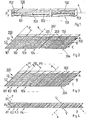
- the parallelogram bodies 101 to 104 etc. are then glued to a sheet body 200, with the surface alignment of their base surfaces flush with each other on the side edge surfaces 150, 151 which are parallel to one another, the surfaces 201 and 202 of which on both sides are formed by longitudinal wood in accordance with the fiber direction x.
- parallelogram bodies 101 to 104, etc. corresponding to different widths result according to FIG. 3, but this obviously does not influence the manufacturing process.
- the sheet 300 obtained according to FIG. 3 is thus equivalent to the sheet 200 according to FIG. 2 with regard to further processing.
- the sheets are then, as indicated in FIGS. 2 and 3, broken down into strips A, W, C by cuts S1, S2, the side faces 203 and 204 of which are formed by end grain due to the arrangement of the fiber direction x.
- the body is then glued to one another on the longitudinal wood surfaces 201 and 202, specifically in the manner shown in FIG. 4, alternately with fiber directions x and y arranged crosswise. This results directly in a plate body PL with end-wood surfaces U and V.
- the plate body has a line-shaped structure, each line consisting of one of the strip bodies A to F etc.
- the fiber directions x and y are arranged in the manner shown in FIG. 5 inclined at an intersection angle v, in the example by about 90 °. This results in the desired high bond strength with perfect gluing on the longitudinal wood base surfaces or surfaces 201 and 202 of the wooden elements. Accordingly, the fiber directions are all inclined to the plate surfaces U, V, according to FIG. 5 at an angle u of approximately 55 °. This results in an overall uniform structure of the plate body, the surfaces of which consist uniformly of end grain.
- the prism height of the wooden elements - corresponding to the thickness of the starting boards 100 and thus the strip bodies A, B etc. - is dimensioned smaller than the length of the parallelogram pages.
- the fiber directions in all adjacent wood element rows A, B, etc. are alternately arranged crosswise. If necessary, however, it is also possible to glue one or more pairs of adjacent rows with matching or only slightly different fiber directions, so that there are different districts with alternating crosswise fiber directions within the entire panel area. This allows certain load conditions and deformation influences to be taken into account.
- connection of the wooden elements shown in the example within a strip body or a row of plates on the parallelogram sides formed by longitudinal wood is particularly advantageous. This also results in reliable gluing.
- the use of wood element rows of different widths as well as of wooden elements of different dimensions in one direction parallel to the row plane concerned can serve the same purpose, moreover, in certain circumstances also to achieve special optical effects. If necessary, rows formed as one-piece wooden elements can even be provided within the plate body. 5 this is indicated for the line formed by the strip body F.
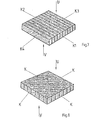
- FIG. 6 shows a plate body of the type indicated in FIG. 5 on a smaller scale. 7, the surfaces and edge surfaces K 1 and K 2 of which are made of end grain wood, while the side edge surfaces K 3 and K 4 of longitudinal wood.
- the end face edge surfaces result from the end faces W of the wooden elements, indicated in FIGS. 5 and 6, perpendicular to the plane of the board. If necessary, such an end face arrangement can already be provided for the starting material.
- an edge surface which is in itself made of longitudinal wood can also be provided with a front wood cladding by means of a narrow edge strip RST.
- Such an edge strip can e.g. cut as a horizontal stripe QST from a board and glued to the longitudinal wood edge surface, so that finally there is also a front wood edge surface KFL.
- a finished plate of the type indicated in FIG. 8 can be produced, the side edges of which K as well as the surfaces U and V consist of end grain .
- Such a plate can also be produced from the triangular surface sections F1, as are obtained when the intermediate product plate body PL is cut to size according to FIG. 6, by diagonal gluing.
- the entire finished plate then consists, for example, of four plate sections glued to its catheter edge surface.
- the side edge surfaces of the prefabricated panel are formed by the hypothine edge surfaces, which are all made of end grain wood.
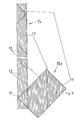
- FIG. 9 A further possibility of the composition of a finished plate PLa from an intermediate plate body PL in the manner of FIG. 5 is indicated in FIG. 9.
- the comparatively narrow and elongated plate body PL is disassembled in such a way that isosceles-triangular sections F1 and trapezoidal sections F2 and possibly a parallelogram-shaped section F3 or several such sections result.
- the plate sections mentioned are glued to their longitudinal wood edge surfaces with the aligned alignment of their end-wood edge surfaces, so that, in turn, there is again a board delimited on all sides by end-wood.
- the remaining remaining sections of the plate body PL can in turn be used in the manner indicated in FIG. 6 for the sections F1 for the composition of other plates, so that there is practically no waste overall.
- FIGS. 10 and 11 A further embodiment of the manufacturing method according to the invention, which is particularly considered as the starting material when using boards with larger dimensions, is now explained with reference to FIGS. 10 and 11.
- first one Block body 50 made of flat glued board or plate material with the single boards or single panels 1, 2, 3, etc.
- the fiber direction-xx is assumed in the usual way parallel to the board plane and indicated in Fig. 10.
- plate bodies a'to e etc. are now produced from the block body 50, the surfaces 51 and 52 of which (see FIG. 11), which are arranged parallel to the plane of the plate, are made of end grain wood.
- strip bodies A, B, C, etc. are then broken down by parallel cuts into strip bodies A, B, C, etc., the side surfaces of which correspond to the surfaces 51 and 52 mentioned and are made of end grain wood, while the surfaces 53 and 54 are made of the parallelogram-shaped prismatic strip bodies Longitudinal wood exist.
- strip bodies again correspond to the intermediate products indicated in FIGS. 2 and 3, but obtained here in a different way, which each form a row of wooden elements within the plate body.
- the further processing, ie the assembly of the strip bodies into a plate body is then carried out in the same way as explained with reference to FIGS. 4 and 5.
- board or plate material of different widths can be used within a sheet 300 according to FIG. 3, a block 50 can be produced from board or plate material of different thicknesses. This is assumed in the example according to FIG. 10.
- FIG. 1 Another embodiment of the manufacturing method according to the invention is characterized by comparatively small cutting work. This is followed in the manner shown in FIG A sheet body 200 or 300 of the same or different strip width similar to FIGS. 2 and 3 is produced from prismatic, here elongated, strip-shaped wooden elements 101, 102 etc., which can essentially correspond to the elements with the same reference numerals according to FIG. 1 .
- the direction of the fibers in the wooden elements 101, 102, etc. runs essentially parallel to the side surfaces 152 and 153, so that there is a perfect gluing to the longitudinal wood within a surface body.
- a block body 400 can now be produced with perfect gluing by layer-by-layer gluing of the surface bodies 200 and 300 (see FIG. 12), which consists of wooden elements with alternating crosswise fiber directions.
- This block body is then broken down according to FIG. 13 by parallel cuts S3, S4, S5 etc. directly into plate bodies PL of the desired thickness, the surfaces U and V of which are made of end grain.
Landscapes
- Engineering & Computer Science (AREA)
- Life Sciences & Earth Sciences (AREA)
- Wood Science & Technology (AREA)
- Architecture (AREA)
- Civil Engineering (AREA)
- Structural Engineering (AREA)
Applications Claiming Priority (2)
| Application Number | Priority Date | Filing Date | Title |
|---|---|---|---|
| DE19803014018 DE3014018A1 (de) | 1980-04-11 | 1980-04-11 | Holzverbundplatte und verfahren zur herstellung eines holzverbundkoerpers |
| DE3014018 | 1980-04-11 |
Publications (2)
| Publication Number | Publication Date |
|---|---|
| EP0038041A2 true EP0038041A2 (fr) | 1981-10-21 |
| EP0038041A3 EP0038041A3 (fr) | 1982-04-14 |
Family
ID=6099794
Family Applications (1)
| Application Number | Title | Priority Date | Filing Date |
|---|---|---|---|
| EP81102761A Ceased EP0038041A3 (fr) | 1980-04-11 | 1981-04-10 | Plaque composite rectangulair en bois et procédé pour sa fabrication |
Country Status (2)
| Country | Link |
|---|---|
| EP (1) | EP0038041A3 (fr) |
| DE (1) | DE3014018A1 (fr) |
Cited By (6)
| Publication number | Priority date | Publication date | Assignee | Title |
|---|---|---|---|---|
| WO2007048149A1 (fr) * | 2005-10-28 | 2007-05-03 | Johann Berger | Plaque de construction ou similaire, procédé de fabrication et utilisation |
| EP2988910A1 (fr) * | 2013-04-24 | 2016-03-02 | Timber Structures 3.0 AG | Élément de construction, procédé de liaison d'éléments en bois, programme informatique |
| CN115419238A (zh) * | 2022-09-26 | 2022-12-02 | 台州学院 | 一种提高木地板短边阳角拼接平直度的施工工艺 |
| CN116175706A (zh) * | 2023-02-17 | 2023-05-30 | 茂友木材股份有限公司 | 一种纵横交错编织效果的重组装饰木材制造方法 |
| EP4279262A1 (fr) | 2022-05-17 | 2023-11-22 | DOKA GmbH | Panneau de matériau |
| EP4458536A1 (fr) * | 2023-05-03 | 2024-11-06 | MINDA Industrieanlagen GmbH | Procédé de fabrication d'une plaque de bois rectangulaire à partir de planches individuelles et dispositif de fabrication de plaque de bois |
Families Citing this family (1)
| Publication number | Priority date | Publication date | Assignee | Title |
|---|---|---|---|---|
| FI102407B1 (fi) * | 1997-05-07 | 1998-11-30 | Mikko Zitting | Liitos, menetelmä liitoksen toteuttamiseksi, liitoksen osa ja menetelmä liitoksen osan valmistamiseksi |
Family Cites Families (4)
| Publication number | Priority date | Publication date | Assignee | Title |
|---|---|---|---|---|
| DE663121C (de) * | 1938-07-29 | Rudolf Ludwig Dr | Furnierblatt aus schmalen aneinandergereihten Furnierstoffen | |
| DE800993C (de) * | 1948-12-08 | 1950-12-18 | Heinz Vahle | Tischlerplatte |
| DE1046855B (de) * | 1954-10-04 | 1958-12-18 | Hego G M B H | Verleimte Holzplatte, insbesondere Mosaikparkettplatte |
| DE1175856B (de) * | 1962-10-29 | 1964-08-13 | Robert Schallhart Dipl Ing | Holzverbundplatte |
-
1980
- 1980-04-11 DE DE19803014018 patent/DE3014018A1/de not_active Ceased
-
1981
- 1981-04-10 EP EP81102761A patent/EP0038041A3/fr not_active Ceased
Cited By (10)
| Publication number | Priority date | Publication date | Assignee | Title |
|---|---|---|---|---|
| WO2007048149A1 (fr) * | 2005-10-28 | 2007-05-03 | Johann Berger | Plaque de construction ou similaire, procédé de fabrication et utilisation |
| EA012763B1 (ru) * | 2005-10-28 | 2009-12-30 | Йоханн Бергер | Строительная плита, строительный элемент, способ их изготовления (вариант) и их применение, а также применение тонких внутренних слоев с волокном |
| EP2988910A1 (fr) * | 2013-04-24 | 2016-03-02 | Timber Structures 3.0 AG | Élément de construction, procédé de liaison d'éléments en bois, programme informatique |
| US10456948B2 (en) | 2013-04-24 | 2019-10-29 | Timber Structures 3.0 Ag | Component, method for connecting wood elements, computer program |
| US11235489B2 (en) | 2013-04-24 | 2022-02-01 | Timber Structures 3.0 Ag | Component, method for connecting wood elements, computer program |
| EP4279262A1 (fr) | 2022-05-17 | 2023-11-22 | DOKA GmbH | Panneau de matériau |
| DE102022204906A1 (de) | 2022-05-17 | 2023-11-23 | Doka Gmbh | Werkstoffplatte |
| CN115419238A (zh) * | 2022-09-26 | 2022-12-02 | 台州学院 | 一种提高木地板短边阳角拼接平直度的施工工艺 |
| CN116175706A (zh) * | 2023-02-17 | 2023-05-30 | 茂友木材股份有限公司 | 一种纵横交错编织效果的重组装饰木材制造方法 |
| EP4458536A1 (fr) * | 2023-05-03 | 2024-11-06 | MINDA Industrieanlagen GmbH | Procédé de fabrication d'une plaque de bois rectangulaire à partir de planches individuelles et dispositif de fabrication de plaque de bois |
Also Published As
| Publication number | Publication date |
|---|---|
| DE3014018A1 (de) | 1981-10-15 |
| EP0038041A3 (fr) | 1982-04-14 |
Similar Documents
| Publication | Publication Date | Title |
|---|---|---|
| DE69712798T2 (de) | Bearbeitete holzwerkstoffe, daraus hergestellte holzverbundprodukte und verfahren zu ihrer herstellung | |
| DE69223596T2 (de) | Verbundstoff mit diagonaler Holzmaserung | |
| WO2014068039A1 (fr) | Panneau composite en bois | |
| EP0038041A2 (fr) | Plaque composite rectangulair en bois et procédé pour sa fabrication | |
| DE69517046T2 (de) | Verbindungskonstruktion für holzelemente | |
| CH660392A5 (de) | Schalungstraeger aus holz sowie verfahren zur herstellung eines derartigen holz-schalungstraegers. | |
| EP0426015B1 (fr) | Produits lamellés en bois tels que poutres, planches et panneaux multiples collés et procédé pour leur fabrication | |
| EP0388507A2 (fr) | Poutre en bois et procédé pour sa fabrication | |
| EP2030747A1 (fr) | Panneau de construction léger ainsi que son procédé de fabrication | |
| EP0272342B1 (fr) | Table ou plan de travail et procédé de fabrication | |
| DE4244311A1 (de) | Herstellung von Parkettlaminaten | |
| AT507231B1 (de) | Verfahren und vorrichtung zur herstellung von kreuzlagen-platten | |
| DE19961366A1 (de) | Parkettelement, | |
| DE943972C (de) | Verfahren zum Zusammenstueckeln von Ausschnitten aus aestigen Holzbrettern zu fehlerfreien Holzflaechen | |
| CH670126A5 (en) | Wooden constructional component - comprises layers of squared timber glued together | |
| DE4123682A1 (de) | Wand-, decken- oder balkenelement aus verleimten holzeinzelelementen sowie daraus hergestellte vollholzwand | |
| DE102015010118A1 (de) | Verfahren zur Herstellung von Holzbauteilen | |
| EP3730709A1 (fr) | Élément mural pour un cadre en bois | |
| DE1609898B1 (de) | Stossausbildung fuer hoelzerne Hallentraeger od.dgl.aus verleimten Lamellen | |
| EP3127669A1 (fr) | Procede de fabrication de composants en bois | |
| DE2408779A1 (de) | Plattenelement und verfahren zu seiner herstellung | |
| DE10024084C1 (de) | Holzplatte aus einer Vielzahl von Holzelementen und Verfahren zu deren Herstellung | |
| DE889689C (de) | Hoelzerne, vor allem als Fussbodenbelag zu verwendende mehrschichtige Diele | |
| EP0202612A2 (fr) | Poutre en bois lamellé collé et son procédé de fabrication | |
| EP4570495A1 (fr) | Lame de parquet et son procédé de fabrication |
Legal Events
| Date | Code | Title | Description |
|---|---|---|---|
| PUAI | Public reference made under article 153(3) epc to a published international application that has entered the european phase |
Free format text: ORIGINAL CODE: 0009012 |
|
| AK | Designated contracting states |
Designated state(s): AT BE CH DE FR GB IT LI LU NL SE |
|
| PUAL | Search report despatched |
Free format text: ORIGINAL CODE: 0009013 |
|
| AK | Designated contracting states |
Designated state(s): AT BE CH DE FR GB IT LI LU NL SE |
|
| 17P | Request for examination filed |
Effective date: 19821015 |
|
| D17P | Request for examination filed (deleted) | ||
| R17P | Request for examination filed (corrected) |
Effective date: 19821015 |
|
| STAA | Information on the status of an ep patent application or granted ep patent |
Free format text: STATUS: THE APPLICATION HAS BEEN REFUSED |
|
| 18R | Application refused |
Effective date: 19841210 |
|
| RIN1 | Information on inventor provided before grant (corrected) |
Inventor name: HERO, FRANZ |