EP0039087A2 - Verfahren zum Steuern einer Plasmaanzeigevorrichtung mit Selbstverschiebung - Google Patents
Verfahren zum Steuern einer Plasmaanzeigevorrichtung mit Selbstverschiebung Download PDFInfo
- Publication number
- EP0039087A2 EP0039087A2 EP81103249A EP81103249A EP0039087A2 EP 0039087 A2 EP0039087 A2 EP 0039087A2 EP 81103249 A EP81103249 A EP 81103249A EP 81103249 A EP81103249 A EP 81103249A EP 0039087 A2 EP0039087 A2 EP 0039087A2
- Authority
- EP
- European Patent Office
- Prior art keywords
- shift
- write
- discharge
- rows
- voltage pulse
- Prior art date
- Legal status (The legal status is an assumption and is not a legal conclusion. Google has not performed a legal analysis and makes no representation as to the accuracy of the status listed.)
- Granted
Links
Images









Classifications
-
- G—PHYSICS
- G09—EDUCATION; CRYPTOGRAPHY; DISPLAY; ADVERTISING; SEALS
- G09G—ARRANGEMENTS OR CIRCUITS FOR CONTROL OF INDICATING DEVICES USING STATIC MEANS TO PRESENT VARIABLE INFORMATION
- G09G3/00—Control arrangements or circuits, of interest only in connection with visual indicators other than cathode-ray tubes
- G09G3/20—Control arrangements or circuits, of interest only in connection with visual indicators other than cathode-ray tubes for presentation of an assembly of a number of characters, e.g. a page, by composing the assembly by combination of individual elements arranged in a matrix no fixed position being assigned to or needed to be assigned to the individual characters or partial characters
- G09G3/22—Control arrangements or circuits, of interest only in connection with visual indicators other than cathode-ray tubes for presentation of an assembly of a number of characters, e.g. a page, by composing the assembly by combination of individual elements arranged in a matrix no fixed position being assigned to or needed to be assigned to the individual characters or partial characters using controlled light sources
- G09G3/28—Control arrangements or circuits, of interest only in connection with visual indicators other than cathode-ray tubes for presentation of an assembly of a number of characters, e.g. a page, by composing the assembly by combination of individual elements arranged in a matrix no fixed position being assigned to or needed to be assigned to the individual characters or partial characters using controlled light sources using luminous gas-discharge panels, e.g. plasma panels
- G09G3/288—Control arrangements or circuits, of interest only in connection with visual indicators other than cathode-ray tubes for presentation of an assembly of a number of characters, e.g. a page, by composing the assembly by combination of individual elements arranged in a matrix no fixed position being assigned to or needed to be assigned to the individual characters or partial characters using controlled light sources using luminous gas-discharge panels, e.g. plasma panels using AC panels
- G09G3/29—Control arrangements or circuits, of interest only in connection with visual indicators other than cathode-ray tubes for presentation of an assembly of a number of characters, e.g. a page, by composing the assembly by combination of individual elements arranged in a matrix no fixed position being assigned to or needed to be assigned to the individual characters or partial characters using controlled light sources using luminous gas-discharge panels, e.g. plasma panels using AC panels using self-shift panels with sequential transfer of the discharges from an input position to a further display position
Definitions
- the present invention relates to a newly developed driving system for data writing which has prevented the overwrite in the non-selected display rows (shift rows) in the driving system of self shift type gas discharge panel, in more detail, in the self shift type gas discharge panel for multi-row display.
- the self shift type gas discharge panel belongs to the field of a gas discharge panel of an AC memory driving system, wherein the information written in the form of discharge spots is shifted to the other end from the write side end of the shift channel in such a manner, as one period of shift discharge cell arrangement is considered as one picture element and during this shift process the static display can be obtained by stopping the shift operation on the particular discharge cell groups.
- a variety of types are conventionally proposed.
- Such a panel has an advantage that it can be reduced in size rather than the ordinary display unit utilizing a cathode-ray tube in addition to excellent display functions attached by the memory operation. Therefore, it is often employed as the monitor display and keyboard display used as the terminals of computer systems.
- the self shift display using such a panel is mainly intented to multi-row display, and the structure allows, by making real the independent shift operation for display rows, for example, the display data in the remaining non-selected display rows to be held at the specified location while new characters are written, or update is carried out at the selected display rows.
- the driving circuit is generally simplified and reduced in size by providing in common the write drivers for the write electrodes of the display rows.
- Such a structure allows, on the occasion of writing data to the selected display rows, the discharge spots to be generated also simultaneously at the write discharge cells of the non-selected display rows.
- such a structure has a disadvantage that an extra discharge, so-called overwrite is generated at said shift discharge cells of the non-selected display rows in accordance with the condition of wall charge at the surface of the dielectric layer corresponding to the shift discharge cells which are in-phase to said write discharge cells and adjacent to them.
- Such overwrite phenomenon will be explained in more detail by making reference to the multi-row display self shift type gas discharge providing the meander electrode structure proposed in the U.S.Patent No. 4,190,788 by Yoshikawa et al. assigned by the same assignee as the present invention.
- Figure 1 schematically shows the electrode arrangement of such a panel.
- two shift channels SC1 and SC2 are represented in order to simplify the explanation, and a single display row is configurated by a single shift channel.
- These shift channels are formed between two Y electrode groups yli, y2i (i is a positive integer) which are alternately arranged on the not illustrated lower substrate and have the meander pattern and two X electrode groups xlj, x2j (j is a positive integer) which are alternately arranged at the inside of upper substrate opposing to said Y electrode groups.
- the surface of said electrodes is coated with the dielectric layer on the respective substrates, and the write electrodes W1, W2 are provided for channels in such a manner as adjacent to the extreme right electrode x-11 belonging to the one said X electrode group and opposing to the extreme right electrode y11 of the one Y electrode group.
- the discharge cells ai, bi, ci and di of 4-group, 4-phase (Phase A to Phase D) with one end being opposed and connected in common alternately are regularly and periodically arranged in accordance with the combination of four electrode groups within the clearance formed between aforementioned electrodes being filled with the discharge gas, and thereby the discharge spots generated by the write discharge cells W can be shifted sequentially along the arrangement of these discharge cells.
- said write discharge cell w considers the so-called opposing discharge area formed between the opposing write electrodes W1, W2 and the shift electrode y11 as the normal write discharge cell, but moreover the write discharge area w i of the surface discharge mode is also formed between the adjacent write electrode and shift electrode x11.
- said two Y electrode groups are individually led to two kinds of buses indicated as Y11, Y12 and Y21, Y22 for each row, in order to make possible the shift operation of discharge spots for each display row, and are connected individually to the Y shift drivers (not illustrated). Moreover, said two Y electrode groups are led respectively to the buses indicated as X1 and X2 with each display row connected in common. Further, as explained above, said write electrode groups are led respectively with the electrodes in the same order of each display row connected in common and then are connected to the corresponding write drivers (not illustrated).
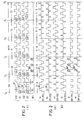
- Figure 2 shows the driving voltage waveforms for attaining the shift operation and sway shift operation bridging a plurality of display rows.
- the first display row SC1 is selected and the second display row SC2 is in the non-selected condition.
- (A) and (C) show the electrode voltage waveforms applied to electrodes of the selected 1st display row and non-selected 2nd display row through the indicated buses, while (B) and (D) show the cell voltage waveforms which are applied as the combined waveforms of said voltages applied on the electrodes to the discharge cell groups between the indicated electrodes of the 1st and 2nd display rows.
- the shift operation of the gas discharge panel having the meander electrode structure is carried out in such a way that four basic pulse trains indicated as 1 to 4 in the four steps to to t 3 are distributed in the manner as sequentially rotating to plural buses. It is supposed, for example, that each display row is set in the static display mode (fixed mode) during the period from TO to T 1 in Fig. 2, the common shift voltage pulse SP is applied to the buses Y11 and Y21 for the one Y electrodes of each row, and the shift voltage pulse SP in the same phase is applied to two buses X1 and X2 for X electrodes.
- the shift voltage pulses SP which have a phase difference of ⁇ e corresponding to the time width of the erase voltage pulse at the rising and falling edge of the shift voltage pulses SP for said buses for X electrodes are applied to the buses Y12 and Y22 for other Y electrodes of the display rows.
- the AC shift voltage pulse train is applied to the adjacent discharge cell groups di and ai of the phases D and A of the display rows, while the narrow erase voltage pulses EP as indicated in the figure are applied by means of said phase difference of ⁇ e to the remaining adjacent discharge cell grpuos bi and ci of the phases B and C. Therefore, the information of each display row written previously during the period from T 0 to T 1 is held at the adjacent two discharge cells di and ai in such a manner as occupying in common the discharge spots.
- the write operation is carried out in the step where the discharge cells di and ai of the phases D and A are activated among the one cycle of the shift operation consisting of four steps to to t 3 .
- the write voltage pulses WP based on the common write information are applied to the write electrodes W1 and W2.
- the write voltage waveforms indicated by w, w' of (B) in the same figure are applied to the write discharge cell w and the surface discharge write area w' of each display row.
- said write voltage pulse WP is applied directly as WP' to the write cell w, and when said pulse WP is applied as the narrow pulse WP" which is partly cancelled to the surface discharge write area w', the first discharge spots are generated respectively at these write discharge areas.
- the shift pulses SP as indicated in the figure are applied to the cells ai of the phase A group to which the first shift discharge cell a1 of both the display rows SC1 and SC2 belongs, the discharge spot is simultaneously generated at said shift discharge cell a1 adjacent to the write discharge cell w by means of the priming effect of said write discharge spot.
- the discharge spot generated at the discharge cell a1 is shifted to the two adjacent discharge cells a1 and b1 of the phases A and B in accordance with the change-over of said basic pulse train applied in the next step t 1 .
- These discharge spots are, in the case of the selected 1st display row SC1, sequentially shifted to the other end (extreme left side) along the display row SC1 in such a manner as the two adjacent discharge cells b1 and c1, c1 and d1 are occupied simultaneously, while the basic pulse train as indicated is applied in the next steps t 2 , t 3 .
- the erase voltage pulse EP is effectively applied to the discharge cell groups from which the discharge spots are already shifted and thereby the erase operation is carried out for the relevant discharge spots.
- FIG. 3(A) schematically shows the write and shift operations of discharge spots in the selected rows in correspondence to the cell voltage waveforms of Fig. 2(B).
- the discharge spots located at said shift discharge cells a1 and b1 return to the cell a1 because the discharge cell groups of the phases D and A are activated.
- the shift discharge cells of the phases D and C are activated as in the case of selected rows, but the discharge spots are shifted reversely in succession toward the adjacent backward cells of the phases D and C from the cells of the phases D and A.
- the discharge spots corresponding to the write information generated as in the case of selected rows by the write operation are erased in this timing because the erase voltage pulse EP is applied to the relevant shift cell a1.
- the discharge spots of the written discharge cells d2 and a3 are held in such a manner that these spots are swayed to the right or left occupying adjacent two cells in the sequence of a3-b3 ⁇ a3.d2 ⁇ d2 ⁇ c2 by the basic pulse application in accordance with said sway shift operation mode.
- Figure 3(B) schematically indicates the sway shift operation in the non-selected rows.
- the self shift type gas discharge panel for multi-row display of this type employs the structure that, even if the write discharge spots are generated on the non-selected display rows simultaneously with the selected display rows, they are principally erased automatically and therefore result in any problem on the display functions.
- the firing voltage of said shift cell d1 is lower than the ordinary value due to such excessive charges. This phenomenon will be explained in more detail.
- the gas discharge panel of this type has a particular problem that the charge area excessively accumulates at both the ends of the shift channels, while the shift operation of discharge spot is repeated, and thereby an abnormal discharge easily occurs due to unequal distribution of the accumulated wall charges. From such circumstances, when the discharge spot is generated at the write discharge cell w (and surface discharge write area w'), an unwanted erroneous discharge, namely the overwrite occurs also at the said shift discharge cell d1 by means of the priming effect and shift voltage pulse at this time. Since the abnormal discharge spot not based on the information is not erased automatically unlike the said write discharge spot, resultingly an erroneous display occurs, degrading the display quality of the panel.
- This invention offers an improved driving system for the self shift type gas disharge panel.
- the present invention is characterized in the self shift type gas discharge panel for multi-row display where the write voltage pulse is supplied in common to the write electrodes in the same sequence of plurality of display rows so that on the occasion of applying the write voltage pulse to the write electrodes of selected display rows, the write discharge at the said non-selected display rows is prevented by applying the pulse voltage which is the same in the polarity as said write voltage pulse and has equivalent or wider time width to the shift electrode opposing to the write electrode of non-selected display rows.
- the present invention is characterized in that the said common write voltage pulse for the non-selected rows is invalidated.
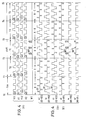
- Figure 4 shows a driving voltage waveform conforming to an embodiment of the present invention.
- the succeeding write operation can be set to a very advantageous condition by setting the static display operation mode in such a condition that the shift cell groups bi and ci of the phases B and C are activated in all the display rows.
- the AC shift voltage pulse SP is applied to the cell groups bi, ci of the phases B and C
- the AC erase voltage pulse EP is applied to the cell groups di, ai of the phases D and A. Therefore, the discharge spots are generated continuously only at said cell groups bi and ci.
- the shift operation is carried out at the selected display row SC1, while the sway shift operation at the non-selected display row is respectively as in the case above starting from said discharge cell groups bi and ci.
- the data is written in such a timing that the discharge cell groups di and ai of the phases D and A during one cycle of said shift operation are activated as in the case of a conventional driving method. Namely, in the case of Fig.
- the step t 1 in the period T 1 - T 5 corresponding to one shift operation means the timing for activating the cell groups of the phases D and A, and when the write voltage pulse WP1 is applied to the write electrode W1 of the selected row SC1 in every step t 1 , the first discharge spot is generated at the selected write cell w (and surface discharge write area w') as explained previously.
- This discharge spot is shifted in the sequence of adjacent two discharge cells a1 ⁇ b1 ⁇ b1 ⁇ c1 ⁇ ... in the next steps t 2 , t 3 ... as explained above together with the discharge spot at the shift discharge cell a1 generated simultaneously.
- Figure 5(A) schematically shows the movement of discharge spots based on the write and shift operations at said selected display row SC1.
- the non-selected display row SC2 is so configurated that the cells are sequentially activated by the sway operation in the order of the cell groups ci and di of the phases C and D, the cell groups bi and ci of the phases B and C, the cell groups ai and bi of the phases A and B, the cell groups bi and ci of the phases B and C, and moreover in said write operation, the shift voltage pulse SP as shown in Fig. 4(C) is applied to the Y side buses Y21 and Y22 of the non-selected rows. Therefore, the discharge spot is not generated at this non-selected row SC2.
- the shift voltage pulse SP which is in the same phase as the write pulse WP1 to be applied to the write electrode W2 is being applied to the bus Y21 and thereby, since a low level write voltage waveform WP1' as shown in Fig. 4(D) is applied to the write cell w defined by the shift electrode y11 and write electrode W2 connected to said bus, the write discharge spot is not generated.
- this shift pulse has a phase difference of ⁇ e to the shift pulse SP to be applied to the X side buses X1, X2, when the erase voltage pulse EP as shown in Fig.
- said write voltage pulse WP1 is kept narrower than the write voltage pulse WP shown in Fig. 2 and has a waveform that the falling edge matches the falling edge of the shift voltage pulse SP to be applied to said shift electrode group xli, only a low level write voltage waveform WP1" as shown in w' of Fig. 4(B) and (C) is applied to the surface discharge write area w' defined by the extremely right shift electrode x11 and write electrode W2 and resultingly, the discharge spot is not generated as in the case of said write cell w.
- the shift pulse SP having a phase difference of half a period to the voltage waveform to be applied to said write electrode W2 and X side buses XI, X2 is applied to said bus Y22
- the AC shift pulse SP as shown in Fig. 4(D) is applied to the shift cell groups bi, ci of the phases B and C determined by the intersecting points of the shift electrodes y2i and x1i, x2i connected to these buses.
- the shift discharge cells c2 and d2 written prior to the write operation at the non-selected row SC2 are reversely shifted to the shift discharge cells b2 and c2 by this shift pulse train.
- the shift cell groups bi, ci of the phases B and C are selected for a discharge during the static display operation
- the shift cell groups bi and ci of the phase different from that of the shift cell groups di and ai activated in the selected row are activated in the non-selected display rows on the occasion of giving-the write operation to the selected display rows.
- the shift voltage pulse SP in this condition is in the phase relation as almost cancelling the write voltage pulse WP1 supplied to the write electrode resulting in such advantages that the write discharge at the non-selected rows can be suppressed without any particular control and there is no fear of giving adverse influence on the ordinary shift operation.
- the discharge spots generated at said shift cells b2 and c2 are sway-shifted on the adjacent two discharge cells in the sequence of a2.b2 ⁇ b2 ⁇ c2 ... and as a result that shift pulse SP as shown in Fig. 4(C) is applied to the buses X1, X2, Y21, Y22 in the next steps t 2 , t 3 ... and the cell voltage waveform as shown in Fig. 4(D) is applied to the shift cell groups ai to di.
- Figure 5(B) schematically shows the sway shift operation of discharge spots in the relevant non-selected display row SC2.
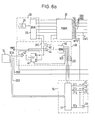
- Figure 6 shows an outline of a system of a character display device where the above mentioned embodiment is practically employed.
- the self shift panel represented by the code PDP is indicated as the panel having the eight display rows ROW1 to ROW8, each of which allows the display of 32 characters in total.
- a character point is of the 7x9 dots structure and said one display row is composed of nine shift channels provided in parallel.
- said display device provides the keyboard 10, the counter circuit unit 20, the timing signal generator unit 30, the control signal generating circuit unit 40, the row selection circuit unit 50, the shift driving circuit unit 60, the write signal generating circuit unit 70, and the write driving circuit unit 80.
- Said keyboard 10 generates respectively the character code signal CCS corresponding to the character information and write command signal STB in response to the character key operation by an operator and also generates the row selection signal RCS by the carriage return key operation.
- the counter circuit unit 20 mainly composed of the 8-bit counter 22 which counts the pulses sent from the clock pulse generator 21, inputs the lower 6-bit output to the timing signal generating circuit unit 30, while the upper 2-bit output is input to the control signal generating circuit unit 40, respectively. Since the 8-bit output corresponds to one cycle of the shift operation, it is called therefore the shift clock signal SKS.
- Said timing signal generating circuit unit 30 is composed of a programmable read-only-memory (PROM) which generates the timing signals HOS, SHS, SWS for each one step of the above mentioned static display operation, the shift operation and the sway shift operation and also generates the write timing signal WTS for the write operation.
- PROM programmable read-only-memory
- said PROM has seven memory areas and the 1st and 2nd memory areas store the timing signal which controls the generation of the basic pulse trains 1 to 4 to be supplied to the X side buses XI and X2 used in common for each row.
- the 3rd and 4th memory areas store the timing signal which controls the generation of the basic pulse trains to @ only for the static display operation and shift operation supplied to the independent Y side buses Yi1 and Yi2 of each row.
- the 5th and 6th memory areas store the timing signal which controls the generation of the basic pulse trains 1 to 4 used only for the sway shift operation ot said Y side buses, while the remaining 7th memory area stores the timing signal which controls the generation of the write voltage pulse.
- These seven timing signals are led in parallel from the corresponding seven output leads l 11 to l 17 .
- Said memory areas are of the 256 bytes structure.
- the control signal generating circuit unit 40 comprises the flip-flop circuit (FF circuit) 41, the NAND gate 42, AND gates 43, 44, and the novenary counter 45.
- FF circuit flip-flop circuit
- the Q output of said FF circuit 41 becomes "1" being synchronized with said shift clock signal SKS, opening the gates of the two AND gates 43, 44.
- the novenary counter 45 sequentially counts said shift clock signal SKS and outputs the counter output as the line scan signal LSS for leading the character pattern signal in the form of a binary signal, while it also outputs the signal OCS which indicates the end of the shift operation of one character including the inter-character space each time nine shift clock signals SKS are input.
- the signal OCS is input to said FF circuit 41 and used for resetting the output condition.
- the row selection circuit unit 50 is indicated as having the functions for selecting total of eight rows in the case of the figure, and comprises four AND gates 51 to 54, a decoder 55 and a pulse train distribution control circuit 56.
- the AND gates 51 to 54 are provided for controlling the 4-digit binary code indicating the row specification signal RSS to pass or not by the Q output of said FF circuit 41.
- the decoder 55 decodes said binary code and generates the display row selection signal being provided with the 8-line output terminals corresponding to the 8-display rows ROW 1 to ROW 8.
- the pulse train distribution control circuit 56 applies respectively, in accordance with said row selection signal, the basic pulse train in the distribution sequence for the shift operation to the shift driver of the selected display rows, while the basic pulse train is applied in the distribution sequence for the sway shift operation to the shift drivers of the non-selected display rows.
- said pulse train distribution control circuit provides two inverters 561, 562 for supplying the basic pulse train to the buses XI, X2 of two phases of the X side and eight switch gate circuits 563 to 570 for supplying selectively the basic pulse trains for the shift operation and the sway shift operation to the 8-pair, 16 buses Yi1, Yi2 of two phases of the Y side for the display rows ROW1 to ROW8.
- these switch gate circuits comprise two pairs of an AND gate pair consisting of two gates 5701-5702, 5703-5704, NOR gates 5705, 5706 inserted between four signal lines 1 13 to 1 16 of said PROM 30 and the inverter 5707, in view of switching in accordance with said row selection signal the shift timing signal SHS and the sway shift timing signal SWS for the Y side bus of the display rows.
- the AND gates 5701 and 5703 operate, connecting the signal lines l 13 - l 37 and l 14 - l 38 for realizing the shift operation.
- the AND gates 5702 and 5704 operate, connecting the signal lines l 15 - l 37 and l 15 - l 38 for realizing the sway shift operation.
- said row specification signal RCS is set to "0" and said row selection signal generation is suspended, all said switch gate circuits 563 to 570 are connected to the signal lines l 13 , l 14 of said PROM and thereby said static display operation is carried out.
- the shift driving circuit unit 60 provides 18 drivers (not illustrated) connected respectively to two buses X1, X2 of the X side of said PDP and 8-pair, 16 Y side buses Yi1, Yi2, and these drivers output respectively the shift voltage pulses SP, when said timing signals for the static display, the shift and sway shift operations (four basic pulse trains 1 to 4) HOS, SHS and SWS are received.
- the write signal generating circuit unit 70 is composed of the character generator 71 which sequentially outputs the character pattern signals of 7x9 dots IF 1 to IF 9 corresponding to said character code signal CCS sent from the keyboard 10 in 9 bits for seven lines in accordance with said line scan signal LSS and the AND gate group 72 which controls these pattern signal outputs to pass or not in accordance with said write timing signal WTS.
- the write driving circuit unit 80 provides nine drivers, each of which generates the write voltage pulse WP1 with an input of said character pattern signals IF1 to I F 9 and outputs these pulses selectively in common to nine write electrodes of eight display rows ROW1 to ROW 8 of said PDP.
- FIG. 7(A) shows the driving voltage waveforms for explaining such a conventional write operation
- Fig. 7(B) shows the driving voltage waveform for explaining the write operation of the present invention, respecitvely.
- the cell voltage waveforms of the selected row SC1 and the non-selected row SC2 those of the write cell w, the surface discharge write area w' and the shift cell group ai of the phase A are indicated.
- two write pulses WP11 and WP12 based on the write information are sequentially applied to the write electrodes of the display row in the first step to of one shift cycle.
- the write voltage waveforms indicated as w and w' in the same figure are applied to the write cell w and the surface discharge display area w' of the display rows.
- the first write pulse WP11 which is wider (about 12/usec) and higher in level than the shift pulse PS is applied directly as WP'11 to the write cell w, and as the partly cancelled narrow pulse WP"11 to the surface discharge write area w'.
- the write discharge spots are generated respectively at these write positions and simultaneously the discharge spots are also generated at the adjacent first shift cell a1.
- two write pulses WP21, WP 22 are sequentially applied at the 2nd step t 1 of one shift cycle.
- the falling edge of the first wide write pulse WP21 is matched with the falling edge of the shift pulse SP1 applied to the buses X'1, X2 of the X side by shortening the rising time.
- the rising edge of the shift pulse SP2 applied to the bus Y21 of the Y side of the non-selected row SC2 is matched with the rising edge of said write pulse WP21 by shortening the rising time.
- said write pulse WP21 and said shift pulses SP1, SP2 are set in the same phase and same pulse width.
- the shift cells of the phases D and Y are activated at the selected rows, while the shift cells of the phases B and C are activated at the non-selected row.
- the cell voltage waveforms of the write cell w and the surface discharge write area w' obtained by combining such modified pulses are formed as the ordinary write voltage waveform WP'21 at the write cell of the selected display row SC1 as shown by w, w' of Fig. 7(B), but they become low amplitude voltage waveforms WP'21, WP"21 at the write cell and the surface discharge write area of the non-selected display rows, not contributing to the write operation.
- the overwrite at the non-selected display rows can be prevented also by these driving waveforms as in the case of the waveforms shown if Fig. 4.
- the selected row SC1 when the rising edge of the shift pulse SP3 applied to the bus Y11 of the Y side is overlapped with the write pulse WP21 by shortening the rising time, the write voltage indicated as WP'21 is applied to the relevant write cell w, and as a result the self-erase of the write discharge can be prevented also as in the case of the write voltage WP"11 shown in Fig. 7(A).
- the present invention can be adopted to panels as explained previously such as the panel having the meander type shift channel described in the specification of the U.S.Patent No. 4,185,229, in addition to the self shift type gas discharge panel of the meander electrode type. Moreover, the present invention can also be adopted to the panel comprising the electrode structure, where the number of electrode groups is increased more than 2-group x 2-group and those providing the parallel electrode structure or the matrix electrode structure and monolithic structure described in the specification of the U.S. Patent No. 3,944,875.
- the driving system for preventing an abnormal discharge and overwrite occurring accidentally to the selected display rows is proposed.
- the self shift type gas discharge panel has a peculiar disadvantage that an accidental abnormal discharge not based on information occurs at both the ends of the shift channel, as the shift operation is repeated.
- an abnormal discharge results from an unequal distribution of wall charges accumulated at both the ends of said shift channel.
- the electrons are excessively accumulated at the cells at the information reading side, while ions are accumulated in the cells at the terminating side.
- the relevant cells erroneously fire by means of the shift voltage, although they cannot fire by themselves, because such an abnormal wall charge lowers the firing voltage of corresponding cells in comparison to the ordinary firing voltage.
- the total write sequence for eliminating such an erroneous discharge is also already proposed. This total write sequence is outlined below briefly. Prior to the operation for generating discharge spots to be displayed corresponding to an input information, all the discharge cells of the shift channels are once lit and then the erase operation is performed in order to neutralize said abnormal wall charges under the condition that all the cells are lit. Thus, an erroneous discharge can be prevented.
- the unipolar shift voltage pulse discharge sustaining voltage pulse
- a shift voltage pulse causes the discharge once at the relevant write cell by means of the priming effect due to the discharge at the adjacent shift discharge cells, thus accumulating the wall charges.
- Such wall charges are in the same polarity as the write voltage pulse based on an input information and in the reverse polarity to said shift voltage pulse applied succeedingly.
- the above mentioned remaining wall charge and newly accumulated wall charge are insufficient for generating an erroneous discharge due to a voltage level in case of the shift voltage pulse during the shift operation.
- the write voltage pulse during the write operation is higher than said shift voltage in its voltage level and allows superimposition of said accumulated wall charge thereon.
- a high voltage is applied to the write cell and an intensified discharge occurs.
- the priming effect due to this write discharge is effectively given to the adjacent shift cells, further lowering the firing voltage of the relevant cells. Therefore, the shift cell which is the same in the phase as said write cell and is adjacent thereto generates an unwanted erroneous discharge, namely a so-called overwrite simultaneously with said write discharge due to the lowered firing voltage resulting from a multiplied effect of said remaining wall charge and said priming effect.
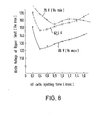
- Figure 8 shows the operation margin characteristic, where the total ignite period is plotted on the horizontal axis, while the upper limit level of the write voltage on the vertical axis with the shift voltage is changed as the parameter.
- This characteristic shows that the upper limit level of the write voltage changes depending on the total write period.
- V Wmin the lower limit level of the write voltage
- V Wmax the write operation margin determined by the difference from the upper limit level (V Wmax ) becomes the minimum in case the total write period is 0,4 msec, indicating that the total ignite is likely to occur.
- the shift operation margin (determined by a difference between the upper level (V Smax ) and the lower level (V Smin ) of the shift voltage) is small and an accidental and abnormal discharge occurs easily, but the write operation margin is large and the overwrite can be eliminated perfectly.
- the present invention proposes the following driving system in view of preventing the overwrite in such a driving condition that a "flickering" and an accidental abnormal discharge are successfully eliminated.
- this newly proposed driving system is characterized in said total write sequence which is done to a selected single display row or all the display rows that the operation that the write cells are lit by the artificial write information under the condition that the shift channel is selected to the backward shift operation mode, is added after the total erase operation.
- this invention is intended to clear the dielectric layer surface in the vicinity of the relevant write cells by intentionally generating the overwrite phenomenon before the specified write operation and by exhausting such an erroneous discharge information to the side of the write cell.
- Figure 9 shows the driving voltage waveforms solving the above mentioned problems.
- the waveform of the 1st display row SC1 is typically indicated under the supposition that the relevant row is selected.
- the buses Y11, Y12 of the Y side of the selected row SC1 are in the ground potential, and the ignite voltage pulse RP having the potential exceeding the discharge start voltage is applied respectively to the buses X1 and X2 mentioned above at the timing that the shift voltage pulse SP is applied to the buses XI, X2 of the X side common to the display rows.
- the wall charge due to such a discharge is in the same polarity as the second highest shift pulse, the repeated write discharge does not occur and therefore such a wall charge is directly accumulated at the dielectric layer surface on the write cell.
- the ignite pulse RP is applied to the selected row SC1
- the shift pulse not illustrated is applied to the non-selected display row SC2. For this reason, in the discharge cells of the relevant non-selected row any discharge does not occur by the cancellation effect by both the pulses.
- the operation for eliminating an accumulated wall charge in the vicinity of the write cell is carried out by writing an artificial information, while applying the backward shift in the next period T 3 - T 4 .
- two write voltage pulses WP21, WP22 based on the artificial write information which is generated along with the relevant total write sequence are sequentially applied to the write electrode W1 of the selected row SC1, and the write voltage waveform as indicated as wi in Fig. 9(B) is applied to the write cell w.
- the write operation itself is the same as that of Fig. 7 explained previously and therefore an explanation is omitted.
- the write discharge spot in this case is accompanied by a discharge power larger than an ordinary one because of the remaining wall charge on the aforementioned write cell.
- the discharge spot is also generated at the first shift cell a1 adjacent to the write cell.
- the shift pulse SP is applied also to the shift cell d1
- an erroneous discharge, namely the overwrite is generated at the said cell d1 by the priming effect of said intensified write discharge in case the remaining wall charge still exists on the dielectric layer surface corresponding to the same cell.
- the discharge spot generated at said write discharge cell w is erased by the 2nd write pulse WP22 as explained above, and as a result the dielectric layer surface corresponding to the write cell is cleared.
- the dotted line curve of wi in Fig. 9(B) shows a variation of such a wall charge (wall voltage).
- the discharge spots generated at said shift cells a1 and di are sustained by the shift pulses which are applied respectively alternately to a pair of opposing shift electrodes y11 and x11, y12 and x21 which determine the relevant cell, and the polarity inversion of the wall voltage is repeated as indicated by the dotted line in ai and di of Fig. 9(B).
- the erase pulse EP is applied to the shift cell groups ai, bi of the phases A and B, while the shift pulse SP to the shift cell groups ci, di of the phases C and D respectively as said basic pulse train to each bus is switched on.
- the discharge spots are generated simultaneously at said shift cell d1 and the shift cell c1 adjacent thereto.
- the discharge spot generated at said shift cell a1 is erased, when the erase pulse EP is applied at this timing.
- each discharge spot is sequentially shifted to the side of the write cell w along the selected row SC1 in such a manner as co-occupying two adjacent discharge cells b1 ⁇ c1, a1 ⁇ b1, while the basic pulse train as indicated in the figure is applied in the next steps t' 2 , t' 3 .
- the backward shift operation is carried out.
- the above mentioned backward shift operation is carried out only by alternately interchanging the basic pulse trains 1 to 4 which are to be applied to the buses X1 and X2 of two phases of the X side.
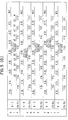
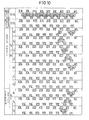
- FIG. 10 schematically shows the shift mode of the discharge spot in the total write sequence in correspondence to the cell voltage waveforms shown in Fig. 9(B).
- Such a new total write sequence successfully reduces the amount of an abnormally accumulated wall charge at the dielectric layer surface corresponding to all the shift cells in such a degree as not inducing an accidental erroneous discharge, and moreover eliminates (erases) the accumulated wall charge on the write cells.
- Such a total write sequence can be executed by adding the following structure to the driving circuit shown in Fig. 6.
- the basic pulse trains (timing signal) for the above mentioned all cells ignite operation, the all cells erase operation and the backward shift operation are additionally stored in the 1st to 6th memory areas of said PROM 30, and the timing signal for controlling the generation of the ignite voltage pulse is stored in the newly added area by adding a new memory area.
- an output of the ignite voltage pulse generating circuit is connected in common to said buses X1 and X2 at the X side and an input to this generating circuit is connected to the timing signal for said ignite timing.
- the instruction for the total write sequence is issued from the carriage return key of said keyboard 10 and the automatic carriage return circuit.
- a character information which totally realizes the write operation to all the write cells of the display rows, such as "I" can be used as the artificial write information.
- the driving system for the self shift type gas discharge panel of the present invention is capable of eliminating said accidental abnormal discharge which is a peculiar disadvantage of such a panel, and preventing an overwrite phenomenon, even under the optimum visual condition.
- the overwrite is not generated at all at the selected rows and the remaining non-selected rows. Therefore, the stable and accurate write operation can be realized with a large write operation margin. For this reason, the present invention is very effective for improving the display quality of such a display panel.
Landscapes
- Engineering & Computer Science (AREA)
- Physics & Mathematics (AREA)
- Power Engineering (AREA)
- Plasma & Fusion (AREA)
- Computer Hardware Design (AREA)
- General Physics & Mathematics (AREA)
- Theoretical Computer Science (AREA)
- Control Of Indicators Other Than Cathode Ray Tubes (AREA)
Applications Claiming Priority (4)
| Application Number | Priority Date | Filing Date | Title |
|---|---|---|---|
| JP58898/80 | 1980-04-30 | ||
| JP5889880A JPS56154793A (en) | 1980-04-30 | 1980-04-30 | Self-shift type gas discharge panel driving method |
| JP5889980A JPS56154794A (en) | 1980-04-30 | 1980-04-30 | Multi-line disiplay self-shift type gas discharge panel writing system |
| JP58899/80 | 1980-04-30 |
Publications (3)
| Publication Number | Publication Date |
|---|---|
| EP0039087A2 true EP0039087A2 (de) | 1981-11-04 |
| EP0039087A3 EP0039087A3 (en) | 1982-08-11 |
| EP0039087B1 EP0039087B1 (de) | 1987-03-25 |
Family
ID=26399914
Family Applications (1)
| Application Number | Title | Priority Date | Filing Date |
|---|---|---|---|
| EP81103249A Expired EP0039087B1 (de) | 1980-04-30 | 1981-04-30 | Verfahren zum Steuern einer Plasmaanzeigevorrichtung mit Selbstverschiebung |
Country Status (3)
| Country | Link |
|---|---|
| US (1) | US4458244A (de) |
| EP (1) | EP0039087B1 (de) |
| DE (1) | DE3176046D1 (de) |
Families Citing this family (4)
| Publication number | Priority date | Publication date | Assignee | Title |
|---|---|---|---|---|
| US4513281A (en) * | 1982-04-05 | 1985-04-23 | At&T Bell Laboratories | AC plasma panel shift with intensity control |
| US4734686A (en) * | 1985-11-20 | 1988-03-29 | Matsushita Electronics Corp. | Gas discharge display apparatus |
| JPS62171385A (ja) * | 1986-01-24 | 1987-07-28 | Mitsubishi Electric Corp | 中間調表示方式 |
| JP4507470B2 (ja) * | 2001-07-13 | 2010-07-21 | 株式会社日立製作所 | プラズマディスプレイパネル表示装置 |
Family Cites Families (11)
| Publication number | Priority date | Publication date | Assignee | Title |
|---|---|---|---|---|
| US3944875A (en) * | 1971-08-10 | 1976-03-16 | Fujitsu Limited | Gas discharge device having a function of shifting discharge spots |
| FR2159631A5 (de) * | 1971-11-05 | 1973-06-22 | Thomson Csf | |
| US3991341A (en) * | 1974-11-04 | 1976-11-09 | Bell Telephone Laboratories, Incorporated | Plasma discharge shift registers |
| US4051409A (en) * | 1976-01-13 | 1977-09-27 | Ncr Corporation | Load and hold system for plasma charge transfer devices |
| US4185229A (en) * | 1976-07-02 | 1980-01-22 | Fujitsu Limited | Gas discharge panel |
| JPS538053A (en) * | 1976-07-09 | 1978-01-25 | Fujitsu Ltd | Gas discharging panel |
| FR2391523A1 (fr) * | 1977-05-17 | 1978-12-15 | Fujitsu Ltd | Procede et dispositif d'attaque pour un panneau a decharge dans un gaz |
| US4233544A (en) * | 1979-05-09 | 1980-11-11 | Ncr Corporation | Input-keep alive arrangement for plasma charge transfer device |
| US4283660A (en) * | 1979-08-23 | 1981-08-11 | Ncr Corporation | Multiline charge transfer panel input and hold system |
| US4257068A (en) * | 1979-11-29 | 1981-03-17 | Rca Corporation | System for periodically reversing the order of video data in a flat panel display device |
| US4336535A (en) * | 1980-04-16 | 1982-06-22 | Ncr Corporation | Cursor for plasma shift register display |
-
1981
- 1981-04-29 US US06/258,785 patent/US4458244A/en not_active Expired - Lifetime
- 1981-04-30 DE DE8181103249T patent/DE3176046D1/de not_active Expired
- 1981-04-30 EP EP81103249A patent/EP0039087B1/de not_active Expired
Also Published As
| Publication number | Publication date |
|---|---|
| DE3176046D1 (en) | 1987-04-30 |
| EP0039087A3 (en) | 1982-08-11 |
| US4458244A (en) | 1984-07-03 |
| EP0039087B1 (de) | 1987-03-25 |
Similar Documents
| Publication | Publication Date | Title |
|---|---|---|
| EP0157248B1 (de) | Verfahren zur Steuerung einer Gasentladungsanzeigevorrichtung | |
| EP0135382B1 (de) | Gasentladungsanzeigevorrichtung und Verfahren zum Betreiben einer derartigen Vorrichtung | |
| KR100314331B1 (ko) | 플라즈마디스플레이패널의구동방법 | |
| US6448960B1 (en) | Driving method of plasma display panel | |
| US4684849A (en) | Method for driving a gas discharge display panel | |
| US6288692B1 (en) | Plasma display for high-contrast interlacing display and driving method therefor | |
| US7227516B2 (en) | Plasma display apparatus | |
| KR100764347B1 (ko) | Ac형 pdp의 구동 방법 및 구동 장치 | |
| KR20000011949A (ko) | 표시패널구동방법및방전식표시장치 | |
| JPH10301528A5 (de) | ||
| KR20040064213A (ko) | 플라즈마 디스플레이 패널에서의 수직 방향 누화 억제 | |
| US20050057443A1 (en) | Method of driving plasma display panel | |
| EP0039087A2 (de) | Verfahren zum Steuern einer Plasmaanzeigevorrichtung mit Selbstverschiebung | |
| KR100529203B1 (ko) | 표시 장치 및 표시 패널 구동 방법 | |
| JP3787713B2 (ja) | プラズマディスプレイ装置 | |
| US4247802A (en) | Self shift type gas discharge panel and system for driving the same | |
| US5247288A (en) | High speed addressing method and apparatus for independent sustain and address plasma display panel | |
| KR20010085248A (ko) | 플라스마 디스플레이 패널에서의 인가전압의 설정 방법 및구동방법 | |
| US4132924A (en) | System for driving a gas discharge panel | |
| WO1991016702A1 (en) | Method for driving an independent sustain and address plasma display panel to prevent errant pixel erasures | |
| US4426646A (en) | Self shift type gas discharge panel, driving system | |
| US5920295A (en) | Memory drive system of a DC type of plasma display panel | |
| US4190789A (en) | Driving system for a self-shift type gas discharge panel | |
| KR19990030316A (ko) | Ac형 플라즈마 디스플레이패널의 구동방법 | |
| JP2005122116A (ja) | 表示装置 |
Legal Events
| Date | Code | Title | Description |
|---|---|---|---|
| PUAI | Public reference made under article 153(3) epc to a published international application that has entered the european phase |
Free format text: ORIGINAL CODE: 0009012 |
|
| AK | Designated contracting states |
Designated state(s): DE FR GB NL |
|
| RHK1 | Main classification (correction) |
Ipc: G09G 3/28 |
|
| PUAL | Search report despatched |
Free format text: ORIGINAL CODE: 0009013 |
|
| AK | Designated contracting states |
Designated state(s): DE FR GB NL |
|
| 17P | Request for examination filed |
Effective date: 19820827 |
|
| GRAA | (expected) grant |
Free format text: ORIGINAL CODE: 0009210 |
|
| AK | Designated contracting states |
Kind code of ref document: B1 Designated state(s): DE FR GB NL |
|
| ET | Fr: translation filed | ||
| REF | Corresponds to: |
Ref document number: 3176046 Country of ref document: DE Date of ref document: 19870430 |
|
| PLBE | No opposition filed within time limit |
Free format text: ORIGINAL CODE: 0009261 |
|
| STAA | Information on the status of an ep patent application or granted ep patent |
Free format text: STATUS: NO OPPOSITION FILED WITHIN TIME LIMIT |
|
| 26N | No opposition filed | ||
| PGFP | Annual fee paid to national office [announced via postgrant information from national office to epo] |
Ref country code: FR Payment date: 19960410 Year of fee payment: 16 |
|
| PGFP | Annual fee paid to national office [announced via postgrant information from national office to epo] |
Ref country code: GB Payment date: 19960422 Year of fee payment: 16 |
|
| PGFP | Annual fee paid to national office [announced via postgrant information from national office to epo] |
Ref country code: DE Payment date: 19960429 Year of fee payment: 16 |
|
| PGFP | Annual fee paid to national office [announced via postgrant information from national office to epo] |
Ref country code: NL Payment date: 19960430 Year of fee payment: 16 |
|
| PG25 | Lapsed in a contracting state [announced via postgrant information from national office to epo] |
Ref country code: GB Effective date: 19970430 |
|
| PG25 | Lapsed in a contracting state [announced via postgrant information from national office to epo] |
Ref country code: NL Effective date: 19971101 |
|
| GBPC | Gb: european patent ceased through non-payment of renewal fee |
Effective date: 19970430 |
|
| PG25 | Lapsed in a contracting state [announced via postgrant information from national office to epo] |
Ref country code: FR Free format text: LAPSE BECAUSE OF NON-PAYMENT OF DUE FEES Effective date: 19971231 |
|
| PG25 | Lapsed in a contracting state [announced via postgrant information from national office to epo] |
Ref country code: DE Free format text: LAPSE BECAUSE OF NON-PAYMENT OF DUE FEES Effective date: 19980101 |
|
| NLV4 | Nl: lapsed or anulled due to non-payment of the annual fee |
Effective date: 19971101 |
|
| REG | Reference to a national code |
Ref country code: FR Ref legal event code: ST |