EP0039241A2 - Verfahren und Einrichtung zur Herstellung eines Nitrophosphatdüngemittels - Google Patents
Verfahren und Einrichtung zur Herstellung eines Nitrophosphatdüngemittels Download PDFInfo
- Publication number
- EP0039241A2 EP0039241A2 EP81301881A EP81301881A EP0039241A2 EP 0039241 A2 EP0039241 A2 EP 0039241A2 EP 81301881 A EP81301881 A EP 81301881A EP 81301881 A EP81301881 A EP 81301881A EP 0039241 A2 EP0039241 A2 EP 0039241A2
- Authority
- EP
- European Patent Office
- Prior art keywords
- mixing chamber
- slurry
- fed
- phosphate
- acid
- Prior art date
- Legal status (The legal status is an assumption and is not a legal conclusion. Google has not performed a legal analysis and makes no representation as to the accuracy of the status listed.)
- Granted
Links
- 238000000034 method Methods 0.000 title claims abstract description 23
- 239000003337 fertilizer Substances 0.000 title claims abstract description 17
- 238000002156 mixing Methods 0.000 claims abstract description 56
- 239000002002 slurry Substances 0.000 claims abstract description 31
- NBIIXXVUZAFLBC-UHFFFAOYSA-N Phosphoric acid Chemical compound OP(O)(O)=O NBIIXXVUZAFLBC-UHFFFAOYSA-N 0.000 claims abstract description 24
- QGZKDVFQNNGYKY-UHFFFAOYSA-N Ammonia Chemical compound N QGZKDVFQNNGYKY-UHFFFAOYSA-N 0.000 claims abstract description 18
- 229910019142 PO4 Inorganic materials 0.000 claims abstract description 18
- GRYLNZFGIOXLOG-UHFFFAOYSA-N Nitric acid Chemical compound O[N+]([O-])=O GRYLNZFGIOXLOG-UHFFFAOYSA-N 0.000 claims abstract description 16
- 239000011435 rock Substances 0.000 claims abstract description 16
- 229910017604 nitric acid Inorganic materials 0.000 claims abstract description 15
- 150000003013 phosphoric acid derivatives Chemical class 0.000 claims abstract description 15
- 238000006243 chemical reaction Methods 0.000 claims abstract description 13
- 239000010452 phosphate Substances 0.000 claims abstract description 13
- XLYOFNOQVPJJNP-UHFFFAOYSA-N water Substances O XLYOFNOQVPJJNP-UHFFFAOYSA-N 0.000 claims abstract description 13
- 230000002378 acidificating effect Effects 0.000 claims abstract description 12
- 229910000147 aluminium phosphate Inorganic materials 0.000 claims abstract description 12
- QAOWNCQODCNURD-UHFFFAOYSA-N Sulfuric acid Chemical compound OS(O)(=O)=O QAOWNCQODCNURD-UHFFFAOYSA-N 0.000 claims abstract description 10
- 239000003795 chemical substances by application Substances 0.000 claims abstract description 10
- 125000002467 phosphate group Chemical group [H]OP(=O)(O[H])O[*] 0.000 claims abstract description 10
- 239000001117 sulphuric acid Substances 0.000 claims abstract description 10
- 235000011149 sulphuric acid Nutrition 0.000 claims abstract description 10
- 229910021529 ammonia Inorganic materials 0.000 claims abstract description 8
- 239000002253 acid Substances 0.000 claims abstract description 6
- 239000012467 final product Substances 0.000 claims abstract description 4
- 239000007788 liquid Substances 0.000 claims abstract description 4
- 229910017464 nitrogen compound Inorganic materials 0.000 claims abstract description 4
- 150000002830 nitrogen compounds Chemical class 0.000 claims abstract description 4
- 239000000203 mixture Substances 0.000 claims description 12
- 238000001694 spray drying Methods 0.000 claims description 7
- 238000004519 manufacturing process Methods 0.000 claims description 4
- 239000000843 powder Substances 0.000 claims description 4
- 230000020477 pH reduction Effects 0.000 claims description 3
- 150000007513 acids Chemical class 0.000 claims description 2
- 150000001875 compounds Chemical class 0.000 claims description 2
- 239000007787 solid Substances 0.000 claims description 2
- 239000008187 granular material Substances 0.000 claims 1
- KRKNYBCHXYNGOX-UHFFFAOYSA-N citric acid Chemical compound OC(=O)CC(O)(C(O)=O)CC(O)=O KRKNYBCHXYNGOX-UHFFFAOYSA-N 0.000 abstract description 15
- 239000011343 solid material Substances 0.000 abstract description 5
- 235000021317 phosphate Nutrition 0.000 description 13
- 239000001506 calcium phosphate Substances 0.000 description 9
- PAWQVTBBRAZDMG-UHFFFAOYSA-N 2-(3-bromo-2-fluorophenyl)acetic acid Chemical compound OC(=O)CC1=CC=CC(Br)=C1F PAWQVTBBRAZDMG-UHFFFAOYSA-N 0.000 description 4
- 235000019739 Dicalciumphosphate Nutrition 0.000 description 4
- NEFBYIFKOOEVPA-UHFFFAOYSA-K dicalcium phosphate Chemical compound [Ca+2].[Ca+2].[O-]P([O-])([O-])=O NEFBYIFKOOEVPA-UHFFFAOYSA-K 0.000 description 4
- 235000019691 monocalcium phosphate Nutrition 0.000 description 4
- LFVGISIMTYGQHF-UHFFFAOYSA-N ammonium dihydrogen phosphate Chemical compound [NH4+].OP(O)([O-])=O LFVGISIMTYGQHF-UHFFFAOYSA-N 0.000 description 3
- 229910000387 ammonium dihydrogen phosphate Inorganic materials 0.000 description 3
- YYRMJZQKEFZXMX-UHFFFAOYSA-L calcium bis(dihydrogenphosphate) Chemical compound [Ca+2].OP(O)([O-])=O.OP(O)([O-])=O YYRMJZQKEFZXMX-UHFFFAOYSA-L 0.000 description 3
- MNNHAPBLZZVQHP-UHFFFAOYSA-N diammonium hydrogen phosphate Chemical compound [NH4+].[NH4+].OP([O-])([O-])=O MNNHAPBLZZVQHP-UHFFFAOYSA-N 0.000 description 3
- 229910000390 dicalcium phosphate Inorganic materials 0.000 description 3
- 229940038472 dicalcium phosphate Drugs 0.000 description 3
- 238000009472 formulation Methods 0.000 description 3
- 235000019837 monoammonium phosphate Nutrition 0.000 description 3
- 239000006012 monoammonium phosphate Substances 0.000 description 3
- 229910000150 monocalcium phosphate Inorganic materials 0.000 description 3
- NBIIXXVUZAFLBC-UHFFFAOYSA-K phosphate Chemical compound [O-]P([O-])([O-])=O NBIIXXVUZAFLBC-UHFFFAOYSA-K 0.000 description 3
- 239000000047 product Substances 0.000 description 3
- QORWJWZARLRLPR-UHFFFAOYSA-H tricalcium bis(phosphate) Chemical compound [Ca+2].[Ca+2].[Ca+2].[O-]P([O-])([O-])=O.[O-]P([O-])([O-])=O QORWJWZARLRLPR-UHFFFAOYSA-H 0.000 description 3
- 239000004254 Ammonium phosphate Substances 0.000 description 2
- IJGRMHOSHXDMSA-UHFFFAOYSA-N Atomic nitrogen Chemical compound N#N IJGRMHOSHXDMSA-UHFFFAOYSA-N 0.000 description 2
- 239000005696 Diammonium phosphate Substances 0.000 description 2
- 235000019289 ammonium phosphates Nutrition 0.000 description 2
- 239000011575 calcium Substances 0.000 description 2
- ZCCIPPOKBCJFDN-UHFFFAOYSA-N calcium nitrate Chemical compound [Ca+2].[O-][N+]([O-])=O.[O-][N+]([O-])=O ZCCIPPOKBCJFDN-UHFFFAOYSA-N 0.000 description 2
- 238000000354 decomposition reaction Methods 0.000 description 2
- 229910000388 diammonium phosphate Inorganic materials 0.000 description 2
- 235000019838 diammonium phosphate Nutrition 0.000 description 2
- 239000003517 fume Substances 0.000 description 2
- 229910052602 gypsum Inorganic materials 0.000 description 2
- 239000010440 gypsum Substances 0.000 description 2
- 239000000155 melt Substances 0.000 description 2
- 239000002367 phosphate rock Substances 0.000 description 2
- 229910000391 tricalcium phosphate Inorganic materials 0.000 description 2
- 235000019731 tricalcium phosphate Nutrition 0.000 description 2
- 229940078499 tricalcium phosphate Drugs 0.000 description 2
- OAICVXFJPJFONN-UHFFFAOYSA-N Phosphorus Chemical compound [P] OAICVXFJPJFONN-UHFFFAOYSA-N 0.000 description 1
- 229910000148 ammonium phosphate Inorganic materials 0.000 description 1
- ZRIUUUJAJJNDSS-UHFFFAOYSA-N ammonium phosphates Chemical class [NH4+].[NH4+].[NH4+].[O-]P([O-])([O-])=O ZRIUUUJAJJNDSS-UHFFFAOYSA-N 0.000 description 1
- BFNBIHQBYMNNAN-UHFFFAOYSA-N ammonium sulfate Chemical compound N.N.OS(O)(=O)=O BFNBIHQBYMNNAN-UHFFFAOYSA-N 0.000 description 1
- 229910052921 ammonium sulfate Inorganic materials 0.000 description 1
- 239000001166 ammonium sulphate Substances 0.000 description 1
- 235000011130 ammonium sulphate Nutrition 0.000 description 1
- 229910052925 anhydrite Inorganic materials 0.000 description 1
- 229910000389 calcium phosphate Inorganic materials 0.000 description 1
- 235000011010 calcium phosphates Nutrition 0.000 description 1
- OSGAYBCDTDRGGQ-UHFFFAOYSA-L calcium sulfate Chemical compound [Ca+2].[O-]S([O-])(=O)=O OSGAYBCDTDRGGQ-UHFFFAOYSA-L 0.000 description 1
- 238000010586 diagram Methods 0.000 description 1
- 238000001914 filtration Methods 0.000 description 1
- 238000005469 granulation Methods 0.000 description 1
- 230000003179 granulation Effects 0.000 description 1
- BHEPBYXIRTUNPN-UHFFFAOYSA-N hydridophosphorus(.) (triplet) Chemical compound [PH] BHEPBYXIRTUNPN-UHFFFAOYSA-N 0.000 description 1
- 230000014759 maintenance of location Effects 0.000 description 1
- 239000000463 material Substances 0.000 description 1
- 238000006386 neutralization reaction Methods 0.000 description 1
- 229910052757 nitrogen Inorganic materials 0.000 description 1
- 239000002245 particle Substances 0.000 description 1
- 229910052698 phosphorus Inorganic materials 0.000 description 1
- 239000011574 phosphorus Substances 0.000 description 1
- 239000002994 raw material Substances 0.000 description 1
- 150000003839 salts Chemical class 0.000 description 1
- 238000005201 scrubbing Methods 0.000 description 1
- 239000002689 soil Substances 0.000 description 1
- 239000012265 solid product Substances 0.000 description 1
Images
Classifications
-
- C—CHEMISTRY; METALLURGY
- C05—FERTILISERS; MANUFACTURE THEREOF
- C05B—PHOSPHATIC FERTILISERS
- C05B11/00—Fertilisers produced by wet-treating or leaching raw materials either with acids in such amounts and concentrations as to yield solutions followed by neutralisation, or with alkaline lyes
- C05B11/04—Fertilisers produced by wet-treating or leaching raw materials either with acids in such amounts and concentrations as to yield solutions followed by neutralisation, or with alkaline lyes using mineral acid
- C05B11/06—Fertilisers produced by wet-treating or leaching raw materials either with acids in such amounts and concentrations as to yield solutions followed by neutralisation, or with alkaline lyes using mineral acid using nitric acid (nitrophosphates)
Definitions
- THIS invention relates to a method of producing nitrophosphate fertilizers, and to apparatus for use in the production of nitrophosphate fertilizers.
- Phosphate bearing rock from which most phosphate based fertilizer is produced contains essentially tricalcium phosphate (Ca 3 (P0 4 ) 2 ) which is quite insoluble in water or acid soils.
- tricalcium phosphate Ca (H 2 PO 4 ) 2
- dicalcium phosphate CAHP0 4
- the.rock is generally treated with sulphuric acid.
- MAP monoammonium phosphate
- DAP diammonium phosphate
- the phosphate bearing rock may be treated with nitric acid to yield a mixture of calcium nitrate, phosphoric acid and monocalcium phosphate as well as inert solid compounds. Ammoniation of this mixture produces a mixture of ammonium phosphate, dicalcium phosphate and ammonium nitrate which is termed generally nitrophosphates.
- nitrophosphate feedstocks have high moisture contents and give rise to high recycle rations in the plant.
- a method of producing nitrophosphate fertilizers including the steps of:
- an amount of phosphoric acid may be added into the mixing chamber to adjust the N:P (nitrogen:phosphorus) ratio of the final product and to stabilize the nitrophosphates formed.
- the phosphoric acid prevents decomposition of the ammonium nitrate formed.
- the amount of phosphoric acid added will depend on the desired fertilizer formulation.
- the temperature during the ammoniation reaction is approximately 130 C and can be as high as 170°C. However the temperature should be controlled so that it does not reach a level at which the nitrophosphates would decompose. Water may be added into the mixing chamber during the ammoniation step to control the temperature.
- nitric acid to rock used is important and depending on the type of phosphate rock used, would be in the order of 2:1 by mass. Generally a 60% nitric acid solution is used.
- the ammoniating agent is preferably ammonia.
- the acidic slurry formed may be filtered before being fed into the mixing chamber. to remove the inert solid materials present therein.
- the slurry is preferably fed directly into the mixing chamber in order to conserve the heat evolved in the acidification step.
- the reaction between the nitric acid and the rock is an exothermic reaction and the temperature of the slurry will rise to 60-70 C.
- the heat of reaction is useful in the next step to evaporate off the liquid present.
- the method may be carried out batchwise but preferably it is carried out continuously, i.e. with continuous feed of the slurry into the mixing chamber.
- the slurry is preferably fed tangentially into the mixing chamber.
- the ammoniating agent, sulphuric acid and.phosphoric acid are preferably fed into the mixing chamber through a sparger.
- ammoniated slurry may be fed into a spray drying chamber and dried to a powder.
- ammoniated slurry may be fed into a granulator and granulated.
- the invention also provides apparatus for use in the production of nitrophosphate fertilizers comprising a tank reactor for reacting nitric acid with phosphate bearing rock and a mixing chamber connected to the tank reactor for receiving acidic slurry from the reactor, the mixing chamber having a preferably tangential inlet for the acidic slurry, at least one other inlet for an ammoniating agent and a nozzle pipe along which the mixture can pass to a chamber outlet.
- the other inlet or inlets are preferably connected to a sparger inside the mixing chamber.
- the mixing chamber may discharge into a spray drying chamber.
- the mixing chamber may discharge into a granulator.
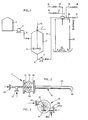
- Raw phosphate rock is fed along a conduit 1 into a stirred tank reacter 2.
- 60% nitric acid is stored in a tank 3 and is fed by a pump 4 along a pipe 5 into the reactor 2.
- the nitric acid will be at about 30°C and under a pressure of l5kPa.
- the nitric acid and rock are stirred by a stirrer 6 and react to form a mixture of nitrogen compounds, water and citric acid soluble phosphate compounds and inert solid materials such as gypsum.
- Approximately 20 minutes retention time in the reactor is sufficient to convert substantially all the phosphates into a water soluble form.
- the reaction is exothermic and under adiabatic conditions the temperature will rise to 60-70°C. Some nitrous fumes will be evolved during the reaction. These fumes are extracted and scrubbed by means not shown.
- the acidic slurry is pumped by a pump 7 along pipes 8,9 to a pipe reactor with a mixing chamber indicated schematically at 11.
- the slurry passes to the mixing chamber at a temperature of approximately 60°C and-a pressure of 750 kPa.
- Ammonia is fed into the mixing chamber along pipes 12 and 13.
- the ammonia will be at a pressure of approximately 900 kPa.
- the ammoniation reaction occurs at a pressure of approximately 600 kPa and at a temperature of approximately 130°C.
- Water may be introduced into the mixing chamber along pipes 16 and 17 to control the temperature in the mixing chamber.
- the neutralization reaction between the ammonia and the acidic slurry is virtually instantaneous and the heat -evolved. evaporates the water introduced.
- Sulphuric acid can be added directly into the reactor 2 as indicated by arrow 14. However, it is preferred to add the sulphuric acid directly into the mixing chamber along pipes 18 and 19. Normally,when the acidic slurry is ammoniated and dried the soluble phosphates will revert into insoluble phosphates. This reaction is inhibited by the addition of a small amount of sulphuric acid, in the order of 5%.
- Phosphoric acid can optionally be added directly into the reactor 2 but again it is preferred to add it along pipes 20 and 21 directly into the mixing chamber.
- the phosphoric acid is added to adjust the N:P ratio of the final product in order to optimise the downstream formulation of complex fertilizers.
- the phosphoric acid is equally desirable to stabilize the process and to prevent decomposition of ammonium nitrate formed in the mixing chamber. The amount of phosphoric acid added will depend on the final desired fertilizer formulation.
- the mixing chamber 11 discharges into a spray drying chamber 22 where the steam is flashed off and the solid product particles are dried and cooled by a current.of air.
- the exhaust fumes are extracted by an extractor 23 and passed to a scrubbing plant (not shown).
- the dry powdery product which collects at the bottom of the chamber at a temperature of approximately 35°C and with a moisture content of about 5% can then be used as a dry feed material in a NPK granulation plant.
- the dry powder product can be considered to be a mixture of monoammonium phosphate, ammonium nitrate, ammonium sulphate and some calcium phosphate.
- the overall process conversion of phosphate bearing rock to water soluble phosphate is in the order of 78% and the overall conversion to citric acid soluble phosphates is in the order of 97%
- the product from the mixing chamber 11 can be obtained as a melt and introduced directly into a drum granulator (not shown) to produce granular NPK fertilizers.
- a nozzle pipe 30 extends either into a drum granulator or into a spray drying tower. There are four inlets 31, 32 and 33, 38 to the nozzle.
- the acidic slurry enters through one tangential inlet 33, ammonia is introduced via inlet 32, water is introduced through inlet 31, sulphuric acid through the pipe 38a and phosphoric acid through pipe 38b to the second tangential inlet 38.
- the inlets 31 and 32 lead to a sparger section 34 which has a number of outlets into an auxiliary chamber 35 to which the tangential inlets 33 and 38 are connected. Mixing takes place in this auxiliary chamber 35 and in the nozzle 30 and the mixture then exits via outlet 36.
- the mixing occurs at a pressure of approximately 600 kPa and at a temperature of approximately 130°C.
- a considerable amount of moisture evaporates from the mixture leaving the outlet 36, and the mixing chamber and nozzle can be designed and operated in such a way as to produce either a powder or a melt.
- the remainder of the moisture is driven off either in the spray drying tower or in the drum granulator.
Landscapes
- Chemical & Material Sciences (AREA)
- Organic Chemistry (AREA)
- Fertilizers (AREA)
- Agricultural Chemicals And Associated Chemicals (AREA)
Priority Applications (1)
| Application Number | Priority Date | Filing Date | Title |
|---|---|---|---|
| AT81301881T ATE14868T1 (de) | 1980-04-28 | 1981-04-28 | Verfahren und einrichtung zur herstellung eines nitrophosphatduengemittels. |
Applications Claiming Priority (2)
| Application Number | Priority Date | Filing Date | Title |
|---|---|---|---|
| ZA802539 | 1980-04-28 | ||
| ZA802539 | 1980-04-28 |
Publications (3)
| Publication Number | Publication Date |
|---|---|
| EP0039241A2 true EP0039241A2 (de) | 1981-11-04 |
| EP0039241A3 EP0039241A3 (en) | 1982-01-20 |
| EP0039241B1 EP0039241B1 (de) | 1985-08-14 |
Family
ID=25574682
Family Applications (1)
| Application Number | Title | Priority Date | Filing Date |
|---|---|---|---|
| EP81301881A Expired EP0039241B1 (de) | 1980-04-28 | 1981-04-28 | Verfahren und Einrichtung zur Herstellung eines Nitrophosphatdüngemittels |
Country Status (8)
| Country | Link |
|---|---|
| EP (1) | EP0039241B1 (de) |
| JP (1) | JPS56169195A (de) |
| AT (1) | ATE14868T1 (de) |
| AU (1) | AU539973B2 (de) |
| DE (1) | DE3171785D1 (de) |
| NZ (1) | NZ196957A (de) |
| ZM (1) | ZM3281A1 (de) |
| ZW (1) | ZW9981A1 (de) |
Cited By (5)
| Publication number | Priority date | Publication date | Assignee | Title |
|---|---|---|---|---|
| RU2145316C1 (ru) * | 1999-03-02 | 2000-02-10 | Общество с ограниченной ответственностью "Эковита" | Способ получения сложных удобрений |
| RU2228322C1 (ru) * | 2003-03-17 | 2004-05-10 | Открытое акционерное общество "Акрон" | Способ получения сложных водорастворимых удобрений |
| RU2233819C1 (ru) * | 2003-08-21 | 2004-08-10 | ОАО "Минудобрения" | Способ получения сложного удобрения |
| WO2007054293A1 (de) * | 2005-11-08 | 2007-05-18 | Ami Agrolinz Melamine International Gmbh | Rohrreaktor zur herstellung von schwefelhaltigem stickstoffdünger |
| CN102093113A (zh) * | 2011-01-19 | 2011-06-15 | 天津百斯特化肥有限公司 | 含有三种氮素的速效缓释复合肥料的生产方法 |
Families Citing this family (6)
| Publication number | Priority date | Publication date | Assignee | Title |
|---|---|---|---|---|
| RU2221759C1 (ru) * | 2003-03-11 | 2004-01-20 | Открытое акционерное общество "Кирово-Чепецкий химический комбинат им. Б.П. Константинова" | Способ получения сложного удобрения с сульфатной добавкой |
| RU2240992C1 (ru) * | 2003-11-05 | 2004-11-27 | Открытое акционерное общество "Научно-исследовательский институт по удобрениям и инсектофунгицидам им. проф. Я.В.Самойлова" | Способ получения сложных удобрений |
| RU2261234C1 (ru) * | 2004-07-19 | 2005-09-27 | Открытое акционерное общество "Кирово-Чепецкий химический комбинат им. Б.П. Константинова" (ОАО КЧХК) | СПОСОБ ПОЛУЧЕНИЯ СЛОЖНОГО КАЛЬЦИЙСОДЕРЖАЩЕГО УДОБРЕНИЯ С РЕГУЛИРУЕМЫМ СООТНОШЕНИЕМ Са:Р2O5 |
| RU2314278C1 (ru) * | 2006-03-29 | 2008-01-10 | Открытое акционерное общество "Научно-исследовательский институт по удобрениям и инсектофунгицидам им. Я.В. Самойлова" | Способ получения гранулированного сложного удобрения |
| RU2347789C1 (ru) * | 2007-07-04 | 2009-02-27 | Андрей Геннадиевич Петропавловский | Удобрение "аквадон" |
| CZ2016577A3 (cs) | 2016-09-20 | 2018-05-16 | Hanon Systems | Výměník tepla se zvýšenou korozní odolností |
Family Cites Families (8)
| Publication number | Priority date | Publication date | Assignee | Title |
|---|---|---|---|---|
| BE526307A (de) * | ||||
| GB357473A (en) * | 1930-02-21 | 1931-09-24 | Kali Forschungsanstalt Gmbh | An improved process for the production of a fertilizer mixture and the product produced thereby |
| FR925332A (fr) * | 1945-04-19 | 1947-09-01 | Prod Chim Du Limbourg | Procédé de fabrication rapide d'engrais composés |
| FR1279405A (fr) * | 1960-11-09 | 1961-12-22 | Potasse & Engrais Chimiques | Procédé de stabilisation du sulfate de calcium et ses applications |
| FR1414268A (fr) * | 1964-11-10 | 1965-10-15 | Guano Werke Aktien Ges | Procédé de fabrication d'engrais polyvalents |
| FR1448797A (fr) * | 1965-03-12 | 1966-03-18 | Potasse & Engrais Chimiques | Perfectionnement à la fabrication des engrais complexes |
| US3431097A (en) * | 1965-12-14 | 1969-03-04 | Grace W R & Co | Method of preventing reversion in the preparation of ammonium phosphates by the addition of vermiculite |
| AT343152B (de) * | 1976-04-26 | 1978-05-10 | Kemira Oy | Verfahren zur herstellung von mehrnahrstoffdungemitteln durch aufschluss von rohphosphat mit salpetersaure gegebenenfalls unter zusatz von phosphorsaure und/oder schwefelsaure wahrend des aufschlusses |
-
1981
- 1981-04-27 ZW ZW99/81A patent/ZW9981A1/xx unknown
- 1981-04-28 NZ NZ196957A patent/NZ196957A/xx unknown
- 1981-04-28 DE DE8181301881T patent/DE3171785D1/de not_active Expired
- 1981-04-28 AU AU69933/81A patent/AU539973B2/en not_active Expired
- 1981-04-28 JP JP6349381A patent/JPS56169195A/ja active Pending
- 1981-04-28 AT AT81301881T patent/ATE14868T1/de not_active IP Right Cessation
- 1981-04-28 ZM ZM32/83A patent/ZM3281A1/xx unknown
- 1981-04-28 EP EP81301881A patent/EP0039241B1/de not_active Expired
Cited By (6)
| Publication number | Priority date | Publication date | Assignee | Title |
|---|---|---|---|---|
| RU2145316C1 (ru) * | 1999-03-02 | 2000-02-10 | Общество с ограниченной ответственностью "Эковита" | Способ получения сложных удобрений |
| RU2228322C1 (ru) * | 2003-03-17 | 2004-05-10 | Открытое акционерное общество "Акрон" | Способ получения сложных водорастворимых удобрений |
| RU2233819C1 (ru) * | 2003-08-21 | 2004-08-10 | ОАО "Минудобрения" | Способ получения сложного удобрения |
| WO2007054293A1 (de) * | 2005-11-08 | 2007-05-18 | Ami Agrolinz Melamine International Gmbh | Rohrreaktor zur herstellung von schwefelhaltigem stickstoffdünger |
| CN102093113A (zh) * | 2011-01-19 | 2011-06-15 | 天津百斯特化肥有限公司 | 含有三种氮素的速效缓释复合肥料的生产方法 |
| CN102093113B (zh) * | 2011-01-19 | 2013-11-20 | 天津芦阳化肥股份有限公司 | 含有三种氮素的速效缓释复合肥料的生产方法 |
Also Published As
| Publication number | Publication date |
|---|---|
| JPS56169195A (en) | 1981-12-25 |
| DE3171785D1 (en) | 1985-09-19 |
| EP0039241A3 (en) | 1982-01-20 |
| ZM3281A1 (en) | 1983-05-23 |
| AU539973B2 (en) | 1984-10-25 |
| ZW9981A1 (en) | 1981-09-29 |
| AU6993381A (en) | 1981-11-05 |
| NZ196957A (en) | 1983-02-15 |
| ATE14868T1 (de) | 1985-08-15 |
| EP0039241B1 (de) | 1985-08-14 |
Similar Documents
| Publication | Publication Date | Title |
|---|---|---|
| EP1630150B1 (de) | Verfahren zur herstellung eines mikronährstoff enthaltenden düngemittels | |
| EP0039241B1 (de) | Verfahren und Einrichtung zur Herstellung eines Nitrophosphatdüngemittels | |
| US3985538A (en) | Pipe reactor-continuous ammoniator process for production of granular phosphates | |
| US3425819A (en) | Method of preparing a complex fertilizer comprising urea coated with ammonium phosphate | |
| US3301657A (en) | Fertilizer process comprising two-stage ammoniation with counter current gas treatment | |
| US3974262A (en) | Two stage process for producing ammonium phosphates | |
| GB2129410A (en) | Production of calcium phosphates | |
| US2945754A (en) | Granular fertilizer from calcium metaphosphate | |
| RU2221758C1 (ru) | Сложное азотно-фосфорное удобрение и способ его получения | |
| US2680679A (en) | Manufacture of fertilizers | |
| Young et al. | Phosphate fertilizers and process technology | |
| US3993466A (en) | Fertilizer production | |
| US3415638A (en) | Process for preparing ammonium phosphate | |
| US3396003A (en) | Method of ammoniating phosphate rock | |
| US3436205A (en) | Process for producing granular nitric phosphate fertilizer with high phosphate availability | |
| US3006754A (en) | Production of superphosphate fertilizers | |
| EP0227884B1 (de) | Verfahren zur Herstellung von flüssigen Düngemitteln in hochkonzentrierter Lösung und so hergestellte Düngemittel | |
| US4568374A (en) | Process for the preparation of fertilizers by the partial solubilization of phosphate rocks | |
| US3695835A (en) | Ammonium polyphosphate manufacture | |
| US2954286A (en) | Phosphate-containing complex fertilizer material production | |
| SU1139721A1 (ru) | Способ получени неслеживающегос удобрени | |
| RU2400459C2 (ru) | Способ и устройство для производства серосодержащих азотных удобрений | |
| SU1468889A1 (ru) | Способ получени удобрений | |
| US3484192A (en) | Ammonium polyphosphate produced at atmospheric pressure | |
| US3192034A (en) | Manufacture of granular fertilizers |
Legal Events
| Date | Code | Title | Description |
|---|---|---|---|
| PUAI | Public reference made under article 153(3) epc to a published international application that has entered the european phase |
Free format text: ORIGINAL CODE: 0009012 |
|
| AK | Designated contracting states |
Designated state(s): AT BE CH DE FR GB IT NL SE |
|
| PUAL | Search report despatched |
Free format text: ORIGINAL CODE: 0009013 |
|
| AK | Designated contracting states |
Designated state(s): AT BE CH DE FR GB IT NL SE |
|
| 17P | Request for examination filed |
Effective date: 19820301 |
|
| ITF | It: translation for a ep patent filed | ||
| GRAA | (expected) grant |
Free format text: ORIGINAL CODE: 0009210 |
|
| AK | Designated contracting states |
Designated state(s): AT BE CH DE FR GB IT LI NL SE |
|
| PG25 | Lapsed in a contracting state [announced via postgrant information from national office to epo] |
Ref country code: LI Effective date: 19850814 Ref country code: CH Effective date: 19850814 Ref country code: AT Effective date: 19850814 |
|
| REF | Corresponds to: |
Ref document number: 14868 Country of ref document: AT Date of ref document: 19850815 Kind code of ref document: T |
|
| REF | Corresponds to: |
Ref document number: 3171785 Country of ref document: DE Date of ref document: 19850919 |
|
| ET | Fr: translation filed | ||
| REG | Reference to a national code |
Ref country code: CH Ref legal event code: PL |
|
| PLBI | Opposition filed |
Free format text: ORIGINAL CODE: 0009260 |
|
| 26 | Opposition filed |
Opponent name: SOCIETE CHIMIQUE DES CHARBONNAGES Effective date: 19860417 |
|
| NLR1 | Nl: opposition has been filed with the epo |
Opponent name: SOCIETE CHIMIQUE DES CHARBONNAGES |
|
| PLBN | Opposition rejected |
Free format text: ORIGINAL CODE: 0009273 |
|
| STAA | Information on the status of an ep patent application or granted ep patent |
Free format text: STATUS: OPPOSITION REJECTED |
|
| 27O | Opposition rejected |
Effective date: 19880125 |
|
| NLR2 | Nl: decision of opposition | ||
| ITTA | It: last paid annual fee | ||
| EAL | Se: european patent in force in sweden |
Ref document number: 81301881.9 |
|
| PGFP | Annual fee paid to national office [announced via postgrant information from national office to epo] |
Ref country code: FR Payment date: 20000411 Year of fee payment: 20 |
|
| PGFP | Annual fee paid to national office [announced via postgrant information from national office to epo] |
Ref country code: GB Payment date: 20000426 Year of fee payment: 20 |
|
| PGFP | Annual fee paid to national office [announced via postgrant information from national office to epo] |
Ref country code: SE Payment date: 20000427 Year of fee payment: 20 Ref country code: DE Payment date: 20000427 Year of fee payment: 20 |
|
| PGFP | Annual fee paid to national office [announced via postgrant information from national office to epo] |
Ref country code: NL Payment date: 20000428 Year of fee payment: 20 |
|
| PGFP | Annual fee paid to national office [announced via postgrant information from national office to epo] |
Ref country code: BE Payment date: 20000622 Year of fee payment: 20 |
|
| BE20 | Be: patent expired |
Free format text: 20010428 *OMNIA FERTILIZER LTD |
|
| PG25 | Lapsed in a contracting state [announced via postgrant information from national office to epo] |
Ref country code: GB Free format text: LAPSE BECAUSE OF EXPIRATION OF PROTECTION Effective date: 20010427 |
|
| PG25 | Lapsed in a contracting state [announced via postgrant information from national office to epo] |
Ref country code: NL Free format text: LAPSE BECAUSE OF EXPIRATION OF PROTECTION Effective date: 20010428 |
|
| PG25 | Lapsed in a contracting state [announced via postgrant information from national office to epo] |
Ref country code: SE Free format text: THE PATENT HAS BEEN ANNULLED BY A DECISION OF A NATIONAL AUTHORITY Effective date: 20010429 |
|
| REG | Reference to a national code |
Ref country code: GB Ref legal event code: PE20 Effective date: 20010427 |
|
| EUG | Se: european patent has lapsed |
Ref document number: 81301881.9 |
|
| NLV7 | Nl: ceased due to reaching the maximum lifetime of a patent |
Effective date: 20010428 |