EP0040077A1 - Vorrichtung zur Temperaturmessung von Säugetieren - Google Patents
Vorrichtung zur Temperaturmessung von Säugetieren Download PDFInfo
- Publication number
- EP0040077A1 EP0040077A1 EP81302073A EP81302073A EP0040077A1 EP 0040077 A1 EP0040077 A1 EP 0040077A1 EP 81302073 A EP81302073 A EP 81302073A EP 81302073 A EP81302073 A EP 81302073A EP 0040077 A1 EP0040077 A1 EP 0040077A1
- Authority
- EP
- European Patent Office
- Prior art keywords
- temperature
- hub
- approximately
- anchor
- telemetric
- Prior art date
- Legal status (The legal status is an assumption and is not a legal conclusion. Google has not performed a legal analysis and makes no representation as to the accuracy of the status listed.)
- Granted
Links
Images




Classifications
-
- A—HUMAN NECESSITIES
- A61—MEDICAL OR VETERINARY SCIENCE; HYGIENE
- A61D—VETERINARY INSTRUMENTS, IMPLEMENTS, TOOLS, OR METHODS
- A61D17/00—Devices for indicating trouble during labour of animals ; Methods or instruments for detecting pregnancy-related states of animals
- A61D17/002—Devices for indicating trouble during labour of animals ; Methods or instruments for detecting pregnancy-related states of animals for detecting period of heat of animals, i.e. for detecting oestrus
-
- A—HUMAN NECESSITIES
- A01—AGRICULTURE; FORESTRY; ANIMAL HUSBANDRY; HUNTING; TRAPPING; FISHING
- A01K—ANIMAL HUSBANDRY; AVICULTURE; APICULTURE; PISCICULTURE; FISHING; REARING OR BREEDING ANIMALS, NOT OTHERWISE PROVIDED FOR; NEW BREEDS OF ANIMALS
- A01K29/00—Other apparatus for animal husbandry
- A01K29/005—Monitoring or measuring activity
-
- A—HUMAN NECESSITIES
- A61—MEDICAL OR VETERINARY SCIENCE; HYGIENE
- A61B—DIAGNOSIS; SURGERY; IDENTIFICATION
- A61B10/00—Instruments for taking body samples for diagnostic purposes; Other methods or instruments for diagnosis, e.g. for vaccination diagnosis, sex determination or ovulation-period determination; Throat striking implements
- A61B10/0012—Ovulation-period determination
- A61B2010/0019—Ovulation-period determination based on measurement of temperature
Definitions
- the present invention relates to the temperature measurement of female mammals.
- Dairymen have known for years that cow's body temperature is capable of foretelling the onset of estrus as well as conditions of poor health, like, for example, mastitis and other fever-inducing ailments. They also knew that a cow's temperature varied greatly with ambient conditions and were by no means the same from one animal to the next even under identical conditions. It has therefore been recognized that a long term temperature history of a particular cow related to the change in ambient conditions would be very helpful in detecting the small abnormalities in the temperature profile for a given animal that are needed for a reliable prediction of estrus or a febrile illness. Hitherto, there has not been an effective way of obtaining this information.
- Implantations of temperature probes in the ear canal or rectum have not proved effective in obtaining sufficiently accurate temperature readings necessary for the reliable prediction of estrus or ill health. It has been determined that only temperature measurements taken deep inside the body are sufficiently free of ambient climatic factors and other external influences to a point where the necessary degree of accuracy is attainable under herd management conditions. Also, as a practical matter, relatively long term implants are necessary since the herd owner cannot afford the labour cost of having to take the deep body temperature of each individual animal separately at least once a day and preferably at the same time.
- vaginal canal The best possibility for a true deep body temperature reading essentially unaffected by external conditions appears to be the vaginal canal, despite tests in human subjects which have shown to the contrary.
- the difficulty with probes implanted into the vaginal canal is that muscular action tends to expel the probe relatively quickly.
- a method of monitoring deep body temperature in mammalian females using a battery powered radio telemetric temperature measuring device of a size adapted for insertion into the uterine canal carried by an expandable anchor of approximately the same size in collapsed condition as said telemetric device comprising collapsing the anchor and inserting it while thus collapsed along with the telemetric device attached thereto into the vagina to a depth where the assembly thus formed lies adjacent the cervix, expanding the anchor in situ, and monitoring the temperature daily from a remote external location.
- the temperature is monitored at approximately the same time each day for a period not less than approximately one complete estrus cycle, and the temperature each day is compared with the average temperature over the immediately preceding approximately ten day period to detect any abrupt changes therein of a magnitude of at least approximately 0.8 0 '.
- the temperature may be monitored for approximately 50 days, with the daily temperature being taken between approximately 5:00 and 7:00 a.m.
- the subject may be inseminated no later than one day following the day upon which the abrupt temperature change is detected, or the subject may be treated for febrile illness if said abrupt temperature change persists over one day.
- a method for effecting long term intravaginal implantation of a telemetric probe in mammals which comprises the steps of: attaching a self-contained battery powered probe adapted for insertion into the vaginal canal to an expandable anchoring device of a size capable of being introduced into the vagina in collapsed condition, inserting the assembly thus formed into the vagina while maintaining said anchoring device in collapsed condition, and releasing the anchoring device into its expanded condition while thus implanted.
- a device for intravaginal implantation in mammalian females comprising an axially-extending hub encircled by at least two rings of radially-extending springable spine-like fingers co-operating with said hub to define a multi-pointed star, a respective said star being at each of the opposed extremities of the hub, the hub being devoid of any projecting portion accessible to the vaginal wall musculature to the extent that contortions thereof would be effective to expel the device.
- the temperature sensing probe used in the method is conventional and it consists of a battery powered transmitter containing a temperature-sensing thermistor which sends out a pulsed signal, the rapidity of which corresponds to the temperature of the transmitter and also the deep body temperature of the animal when implanted in her vaginal canal 12.
- the transmitter has been shown without detail but approximately its actual size in relation to a grown cow's vagina 12.
- the resulting signal is sensed at a remote location outside the animal's body.
- the location of the receiver is optional depending upon its sensitivity and the strength of the signal generated, some receivers being responsive to signals originating miles away from the transmitter.
- signal strength and receiver sensitivity is a matter of choice well within the skill of the art and will depend to a considerable degree upon several extraneous factors such as the size of the herd, the ability of the equipment to differentiate among the several animals, the degree of confinement of the herd, if any, and other similar parameters.
- the signal that is received is recorded and analyzed during a preselected time period, say five minutes, at the same or approximately the same time each day.
- a preselected time period say five minutes
- the baseline against which the spikes are most evident is likely to be established during such a time period; therefore, for cattle at least, the measurements are preferably made during this minimum baseline temperature interval.
- tunable receivers are unnecessary provided the transmitted signal is relatively weak.
- the receiver is placed in reasonably close proximity to the particular transmitter whose temperature signal is to be decoded so as to screen out other extraneous signals.
- the battery powered radio transmitter containing the temperature-sensitive'thermistor is implanted at the mouth of the cervix 14, where, for purposes of making dependable and accurate predictions, it must stay for at least one complete estrus cycle and preferably fifty days or longer. Because of the stress-induced fluctuations in temperature, handling of the animal should be minimized; however, a 50 day test performed at the proper time will allow the animal to settle down while at the same time provide good baseline temperature data against which the spikes become easy to detect as will be apparent presently. Notwithstanding the long term implantation of the radio transmitter, it remains readily accessible to service, repair and change batteries, all without having to resort to surgical invasion of the animal or.require the services of a veterinary surgeon.
- the act of implantation is a simple one capable of being carried out by unskilled personnel using standard techniques and instruments like, for instance, a trochar tube and pushrod or plunger inside the latter.
- the problems do not arise in connection with placement of the probe but rather with how to keep it in place.
- the muscle contractions and relaxations of the vaginal walls are such that they quickly eject any foreign object like the probe.
- the problem is solved by an expandable anchoring device which is introduced into the vagina and which yields under the influence of the contracting vaginal muscles thus preventing them from getting a sufficient hold to eject either the anchor or the transmitter attached thereto back out through the vulva.
- One spider-like form of anchor which has been used with good results is shown in Figure 1 and identified by reference numeral 10.
- the anchor 10 is implantable using well-known techniques within the vagina 12 of a mammalian female at the mouth of the cervix 14, the particular anatomy illustrated being that of a cow or heifer, although the animal could equally be a sow, a mare, or a ewe.
- the method of implantation is simply one of collapsing the radially-extending spider-like legs 16 emanating from the hub 18 of each star 20 preparatory to placing same in a speculum tube (not shown).
- a pushrod or the like not shown
- Suitable precautions are, of course, taken to insure that no injury of the delicate tissue in the vaginal area takes place and that the entire procedure is carried out under antiseptic conditions.
- the anchor 10 is part of an assembly 24 that includes, as discussed earlier, a conventional battery-powered radio transmitter 26 containing a temperature sensing thermistor which sends out a pulsed signal and some means 28 for fastening the latter to the hubs 18 intermediate the stars 20 on opposite ends thereof.
- the speculum tube must be sized to accommodate the entire assembly while, at the same time, remaining small enough to pass easily through the vulva opening.
- the fastening means 28 comprises a short length of sterile cord or suture material tying the transmitter to the exposed medial portion of the stem.
- the 2-star version of the anchor 10 has proven quite satisfactory for use in heifers and small cows.
- the 4-star version of the anchor shown in Figure 3 comprises two additional stars 20C and 20D are interposed between stars 20A and 20B found in both the 2-star and 4- star versions.
- the 4-star version is entirely adequate and should result in essentially 100% retention over extended period of time, say 50 days and longer.
- the preferred anchor would be a 6-star version (not shown).
- a 2-star unit has proven quite adequate as an achoring device for holding small objects in the vagina of cows, heifers and mares of reproductive age although, to be on the safe side, the 4-star version is preferable for use in the more mature females.
- the anchor used is similar to a vaginal device known as the "Hei-Gro", which is used to stimulate growth and is described in U. S . Patent Specification 4,091,807.
- This device comprises a plurality of stars or spiders and a projecting cone and stem portion which extend rearwardly from the rearmost star.
- the device in this form does tend to be expelled after a period of time which, although sufficient for promoting growth, is insufficient to enable long term temperature readings to be taken. It has been found, surprisingly, that if the projecting stem and cone portion is removed, leaving only the stars and the connecting portion of the stem therebetween, then virtually 100% retention over extended periods of time (50 days or more) can be achieved.
- the length of the arms 16 in the "Hei-Gro" unit measured between opposite ends thereof seems to average somewhere slightly in excess of 6 cm.
- the Applicant has found that for smaller mammalian females like, for example, sows and ewes, a further modified unit having stars with a radius of only about 3.5 cm. proved quite adequate although it is preferred that the radius should be at least 3.5 cm, the overall axial length of the device being about 4 cm.
- the full size 2-star modified unit apparently was too large to be inserted all the way to the entrance of the cervix since it remained clearly visible at the vulva opening.
- the Applicant has modified the commercially available "Hei-Gro" growth promotion device so as to convert the latter to anchoring device capable of holding small objects in situ within the vagina of mammalian females of various species and sizes for prolonged period of time while, at the same time leaving their normal reproductive functions unimpaired.
- the herd manager or other investigator can begin gathering data for the purpose of ascertaining when the animal is in condition to conceive or, alternatively, is not ovulating and cannot be impregnated. This same data will be effective to indicate the onset of a febrile illness well before any overt clinical signs becomes apparent.
- the results of actual deep body temperature measurements in three species of female livestock mammals form the subject matter of the graphs appearing herein as Figures 4 - 9, inclusive, to which detailed reference will soon be made; however, before doing so, it is appropriate to explain more about when the probe should be implanted and why it should be kept in place for an extended period of time.
- Cows and other female animals are known to have cyclic variations in basal body temperature which cycle bears a relationship to the estrous cycle. This cycle was discovered to differ a great deal from that of the human female.
- One major difference is the fact that women experience a near constant temperature pattern from period-to-period, whereas, cattle and other animals do not.
- the fact of the matter is that farm animals exhibit a changing temperature pattern which seems to depend to some degree at least upon the climate and the season. For instance, it can be demonstrated that the normal body temperature baseline takes on an ascending pattern during prolonged periods of cold weather and a descending one when it is warm.
- estrus cycle is such that a pronounced spike in the order of 0.8 0 C is noted on the day of estrus in a cow, for example, while an equally prominant dip in temperature takes place on the preceding day and again on the following day when ovulation occurs.
- This cyclic pattern happens in cows with so-called "silent heats" as well as those with normal heat periods.
- This 0.8° spike lasts for one day only and it is detected by measuring it against her average body temperature over the preceding ten day period or thereabouts.
- a cow's greatest milk is produced provided she is inseminated within 90 days after parturition; yet, statistics show that about one- third of all dairy cows miss this target for the reason that over 40% of these cows never have a heat period recorded within the first sixty days after they have calved and an additional 12% or so go over ninety days. Even after the first heat period following parturition is recorded, about one in every six thereafter is missed. For these reasons alone, it is of the utmost importance if cost-effective dairy herd management is to be achieved, that each of these heat periods, and preferably the first, is reliably detected.
- Mare I showed four spikes (A, B, C and D) that surpassed a threshold line (spike indicates about 3/4 o C above mean). These spikes are spaced at regular intervals that coincide with the expected time between ovulations. Also, spikes A, B and D were associated with estrus. The mare was not teased during the period of spike C, so that estrus status is now known.
- Each data point (dot) represents a once-daily reading taken at approximately 7:30 a.m. between May 9 and August 12, 1979.
- the ordinate scale is in radio counts per 5 minute period.
- Mare II charted in Figure 5 showed four substantial temperature spikes (magnitude about 3/4 o C above mean) which extend above the threshold line.
- Spikes B and D occurred at the last day of the estrus period.
- the mare was not teased during the period of spike A, so her receptivity is not known.
- the spike C occurred during mid-estrus and, curiously, no spike appeared during the subsequent estrus period.
- Each data point (dot) represents a once-daily reading taken at approximately 7:30 a.m. between June lst and August 10, 1979.
- the left side scale is in radio counts per 5 minute period.
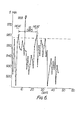
- the intravaginal temperature graph of Figure 6 was taken of a sow instead of a mare.
- the sow exhibited two heat periods of 2 days duration which is characteristic of sows.
- the sow was accidentally bred on the second day after spike C and became pregnant.
- Spikes A and C were nineteen days apart which matches exactly the normal ovulation interval for sows.
- Spike B was quite high and indicates a fever of short duration which might well have been due to a mold infection such as a virus might cause.
- heifer 1474 initially experienced three normal heat periods and there were temperature spikes (A and B) recorded as shown.
- the transmitter was not implanted in the heifer during the period marked xxx.
- Spike C was not accompanied by standing heat, however, the interval was normal to the previous spike and the heifer was bred. It is believed that she became pregnant and then miscarried because she came in heat 28 days later with a spike occurring the subsequent morning. The 29 day interval was too long for normalcy.
- the heifer was bred again during a heat and spike episode and she became pregnant.
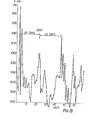
- FIG. 8 to which reference will next be made details the temperature pattern of yet another heifer.
- Heifer 1494 presented spikes A, B and C during her test period. She was just reaching puberty when brought into the experiment. She only expressed heat once and that was accompanied by spike B ; nevertheless, she did have normal intervals between the three significant spikes. Following spike C she did not show any mating behavious or spikes during a period of very hot weather. Eventually, she did come in heat and had a smaller spike. She was bred and became pregnant.
- a cow 690 was selected because of her infertility as a subject for examination of spike conditions during known reproductive insufficiency. There were two very high spikes without associated heat. She had a quentionable heat once and a definite standing heat towards the end of the observation period. The cow was bred and spike B and did not become pregnant. Apparently, the cow is physiologically out of phase and there was no normal periodicity in her record at all. This example clearly illustrates the value of the remotely-sensed temperature method of the present invention in detecting acyclicity and probably ovulation failure.
- the foregoing charts clearly reflect the day-to-day physiological conditions of the subjects.
- her temperature reading is noticeably greater than her previous ten day average and exceeds all previous highs during that time interval, the probability is that she is preparing to ovulate and she should be bred on either the day of the estrus spike or early the next day.
- the method and device described above solves three heretofore unsolved problems, namely: 1) it provides for remote interrogation and possibly even automated monitoring of an animal's deep body temperature by means of an indwelling probe implanted without surgery; 2) it provides information on ovulation on all animals, both those experiencing active estrus and those who are not; and 3) it detects feverish conditions in advance of clinical illness.
Landscapes
- Life Sciences & Earth Sciences (AREA)
- Health & Medical Sciences (AREA)
- Veterinary Medicine (AREA)
- Biophysics (AREA)
- Animal Husbandry (AREA)
- Environmental Sciences (AREA)
- Pregnancy & Childbirth (AREA)
- Engineering & Computer Science (AREA)
- Wood Science & Technology (AREA)
- Zoology (AREA)
- Animal Behavior & Ethology (AREA)
- General Health & Medical Sciences (AREA)
- Public Health (AREA)
- Biodiversity & Conservation Biology (AREA)
- Measuring And Recording Apparatus For Diagnosis (AREA)
Applications Claiming Priority (4)
| Application Number | Priority Date | Filing Date | Title |
|---|---|---|---|
| US06/149,250 US4387724A (en) | 1980-05-12 | 1980-05-12 | Method for remotely monitoring the long term deep body temperature in female mammals |
| US149250 | 1980-05-12 | ||
| US194583 | 1980-10-06 | ||
| US06/194,583 US4377157A (en) | 1980-10-06 | 1980-10-06 | Intravaginal anchoring device |
Publications (2)
| Publication Number | Publication Date |
|---|---|
| EP0040077A1 true EP0040077A1 (de) | 1981-11-18 |
| EP0040077B1 EP0040077B1 (de) | 1984-07-04 |
Family
ID=26846580
Family Applications (1)
| Application Number | Title | Priority Date | Filing Date |
|---|---|---|---|
| EP81302073A Expired EP0040077B1 (de) | 1980-05-12 | 1981-05-11 | Vorrichtung zur Temperaturmessung von Säugetieren |
Country Status (5)
| Country | Link |
|---|---|
| EP (1) | EP0040077B1 (de) |
| DE (1) | DE3164553D1 (de) |
| GB (1) | GB2077593B (de) |
| IE (1) | IE51115B1 (de) |
| NZ (1) | NZ197067A (de) |
Cited By (2)
| Publication number | Priority date | Publication date | Assignee | Title |
|---|---|---|---|---|
| EP0933068A1 (de) * | 1998-02-02 | 1999-08-04 | Frans Verdroncken | Gerät und Verwendung zur Messung, Aufzeichnung und Überwachung der Temperatur von Säugetieren |
| US7577476B2 (en) * | 2001-10-26 | 2009-08-18 | Athena Feminine Technologies, Inc | System and method for transducing, sensing, or affecting vaginal or body conditions, and/or stimulating perineal musculature and nerves using 2-way wireless communications |
Families Citing this family (5)
| Publication number | Priority date | Publication date | Assignee | Title |
|---|---|---|---|---|
| DE3124121A1 (de) * | 1981-06-19 | 1982-12-30 | Rheintechnik Weiland & Kaspar Kg, 6680 Neunkirchen | Vorrichtung zur bestimmung des eisprungs bei haustieren wie schweinen, kuehen und pferden |
| DE3509503C2 (de) * | 1985-03-16 | 1987-02-12 | Hermann-Josef Dr. 5300 Bonn Frohn | Vorrichtung zur Messung eines Körperparameters |
| GB9604833D0 (en) * | 1996-03-07 | 1996-05-08 | Great Valley Ltd | Improvements in and relating to monitoring |
| GB0617451D0 (de) | 2006-09-05 | 2006-10-18 | Medical Prediction Ltd | |
| DE102011052563A1 (de) | 2011-08-10 | 2013-02-14 | Förster Technik GmbH | Vorrichtung mit einem Sensor zur Messung eines Vitalwerts in einem Tier |
Citations (3)
| Publication number | Priority date | Publication date | Assignee | Title |
|---|---|---|---|---|
| US2509825A (en) * | 1947-09-27 | 1950-05-30 | Honeywell Regulator Co | Heat sensitive device |
| US4091807A (en) * | 1976-11-04 | 1978-05-30 | Dickinson Ben Wade O Iii | Intra-vaginal device and method of use |
| DD141355A1 (de) * | 1979-01-11 | 1980-04-23 | Manfred Ludwig | Temperaturmess-und anzeigegeraet,insbesondere zur feststellung des ovulationszeitpunktes |
-
1981
- 1981-05-08 GB GB8114073A patent/GB2077593B/en not_active Expired
- 1981-05-11 EP EP81302073A patent/EP0040077B1/de not_active Expired
- 1981-05-11 DE DE8181302073T patent/DE3164553D1/de not_active Expired
- 1981-05-11 IE IE1050/81A patent/IE51115B1/en not_active IP Right Cessation
- 1981-05-12 NZ NZ197067A patent/NZ197067A/en unknown
Patent Citations (3)
| Publication number | Priority date | Publication date | Assignee | Title |
|---|---|---|---|---|
| US2509825A (en) * | 1947-09-27 | 1950-05-30 | Honeywell Regulator Co | Heat sensitive device |
| US4091807A (en) * | 1976-11-04 | 1978-05-30 | Dickinson Ben Wade O Iii | Intra-vaginal device and method of use |
| DD141355A1 (de) * | 1979-01-11 | 1980-04-23 | Manfred Ludwig | Temperaturmess-und anzeigegeraet,insbesondere zur feststellung des ovulationszeitpunktes |
Cited By (3)
| Publication number | Priority date | Publication date | Assignee | Title |
|---|---|---|---|---|
| EP0933068A1 (de) * | 1998-02-02 | 1999-08-04 | Frans Verdroncken | Gerät und Verwendung zur Messung, Aufzeichnung und Überwachung der Temperatur von Säugetieren |
| US7577476B2 (en) * | 2001-10-26 | 2009-08-18 | Athena Feminine Technologies, Inc | System and method for transducing, sensing, or affecting vaginal or body conditions, and/or stimulating perineal musculature and nerves using 2-way wireless communications |
| US7957794B2 (en) | 2001-10-26 | 2011-06-07 | Athena Feminine Technology | System and method for transducing, sensing, or affecting vaginal or body conditions, and/or stimulating perineal musculature and nerves using 2-way wireless communications |
Also Published As
| Publication number | Publication date |
|---|---|
| EP0040077B1 (de) | 1984-07-04 |
| NZ197067A (en) | 1985-04-30 |
| GB2077593A (en) | 1981-12-23 |
| IE51115B1 (en) | 1986-10-01 |
| DE3164553D1 (en) | 1984-08-09 |
| IE811050L (en) | 1981-11-12 |
| GB2077593B (en) | 1984-07-04 |
Similar Documents
| Publication | Publication Date | Title |
|---|---|---|
| US4387724A (en) | Method for remotely monitoring the long term deep body temperature in female mammals | |
| CN101528138B (zh) | 用于提供与雌性哺乳动物的生育力有关的信息的装置 | |
| US4677967A (en) | Intravaginal anchor | |
| USRE32758E (en) | Method for remotely monitoring the long term deep body temperature in female mammals | |
| US4651137A (en) | Intravaginal parturition alarm and method for use | |
| AU2010335065B9 (en) | Detection method | |
| EP0040077B1 (de) | Vorrichtung zur Temperaturmessung von Säugetieren | |
| US5203345A (en) | Method of using a support anchor for the vagina of a mammalian female | |
| CA1182531A (en) | Telemetering vaginal temperature of farm animals | |
| Palomares | Estrus detection | |
| DK159300B (da) | Anordning til temperaturmaaling paa pattedyr | |
| Ball et al. | Oestrous behaviour and its detection | |
| WO2008138076A2 (en) | Device for animals and mode of operation of the detection methodology of the device to monitor, to report and to alarm changes of the intra - abdominal pressure by using communication technology | |
| Phillips | Reproductive Behaviour | |
| Švejdová et al. | Current options for measuring the surface temperature of dairy cattle in a stable technology | |
| US20070179410A1 (en) | Cervigage | |
| ALLU | INFRARED THERMOGRAPHY AND BEHAVIOURAL BIOMETRICS | |
| NZ582407A (en) | Detection method for detecting presence of oestrus in a milking animal | |
| Moran | 14 Mating and Calving Management of Dairy Heifers | |
| CA2054858A1 (en) | Support anchor for the vagina of a mammalian female | |
| Roelofs et al. | Estrus detection technologies to improve pregnancy rates | |
| Lawitts | Estrus detection in the cow from measurements of changes in the electrical resistnace [sic] of the cervical mucus |
Legal Events
| Date | Code | Title | Description |
|---|---|---|---|
| PUAI | Public reference made under article 153(3) epc to a published international application that has entered the european phase |
Free format text: ORIGINAL CODE: 0009012 |
|
| AK | Designated contracting states |
Designated state(s): CH DE FR IT |
|
| 17P | Request for examination filed |
Effective date: 19820508 |
|
| ITF | It: translation for a ep patent filed | ||
| GRAA | (expected) grant |
Free format text: ORIGINAL CODE: 0009210 |
|
| AK | Designated contracting states |
Designated state(s): CH DE FR IT LI |
|
| REF | Corresponds to: |
Ref document number: 3164553 Country of ref document: DE Date of ref document: 19840809 |
|
| ET | Fr: translation filed | ||
| RAP2 | Party data changed (patent owner data changed or rights of a patent transferred) |
Owner name: NEW MEXICO STATE UNIVERSITY FOUNDATION, INC. |
|
| PLBE | No opposition filed within time limit |
Free format text: ORIGINAL CODE: 0009261 |
|
| STAA | Information on the status of an ep patent application or granted ep patent |
Free format text: STATUS: NO OPPOSITION FILED WITHIN TIME LIMIT |
|
| 26N | No opposition filed | ||
| REG | Reference to a national code |
Ref country code: CH Ref legal event code: PUE Owner name: NEW MEXICO STATE UNIVERSITY TECHNOLOGY TRANSFER CO |
|
| REG | Reference to a national code |
Ref country code: FR Ref legal event code: TP |
|
| ITTA | It: last paid annual fee | ||
| ITPR | It: changes in ownership of a european patent |
Owner name: CESSIONE;NEW MEXICO STATE UNIVERSITY TECHNOLOGY TR |
|
| PGFP | Annual fee paid to national office [announced via postgrant information from national office to epo] |
Ref country code: FR Payment date: 19930525 Year of fee payment: 13 |
|
| PGFP | Annual fee paid to national office [announced via postgrant information from national office to epo] |
Ref country code: CH Payment date: 19930526 Year of fee payment: 13 |
|
| PGFP | Annual fee paid to national office [announced via postgrant information from national office to epo] |
Ref country code: DE Payment date: 19930602 Year of fee payment: 13 |
|
| PG25 | Lapsed in a contracting state [announced via postgrant information from national office to epo] |
Ref country code: LI Effective date: 19940531 Ref country code: CH Effective date: 19940531 |
|
| PG25 | Lapsed in a contracting state [announced via postgrant information from national office to epo] |
Ref country code: FR Effective date: 19950131 |
|
| REG | Reference to a national code |
Ref country code: CH Ref legal event code: PL |
|
| PG25 | Lapsed in a contracting state [announced via postgrant information from national office to epo] |
Ref country code: DE Effective date: 19950201 |
|
| REG | Reference to a national code |
Ref country code: FR Ref legal event code: ST |