EP0040136B1 - Procédé de séparation du polymère d'une dispersion aqueuse de polytétrafluoréthylène préparée en présence d'un sel de lithium d'un acide perfluoroalcanesulfonique - Google Patents
Procédé de séparation du polymère d'une dispersion aqueuse de polytétrafluoréthylène préparée en présence d'un sel de lithium d'un acide perfluoroalcanesulfonique Download PDFInfo
- Publication number
- EP0040136B1 EP0040136B1 EP81400702A EP81400702A EP0040136B1 EP 0040136 B1 EP0040136 B1 EP 0040136B1 EP 81400702 A EP81400702 A EP 81400702A EP 81400702 A EP81400702 A EP 81400702A EP 0040136 B1 EP0040136 B1 EP 0040136B1
- Authority
- EP
- European Patent Office
- Prior art keywords
- dispersion
- polymer
- salt
- lithium salt
- hydroxide
- Prior art date
- Legal status (The legal status is an assumption and is not a legal conclusion. Google has not performed a legal analysis and makes no representation as to the accuracy of the status listed.)
- Expired
Links
- 229920001343 polytetrafluoroethylene Polymers 0.000 title claims description 18
- 239000004810 polytetrafluoroethylene Substances 0.000 title claims description 18
- 239000006185 dispersion Substances 0.000 title claims description 14
- 238000000034 method Methods 0.000 title claims description 13
- -1 polytetrafluoroethylene Polymers 0.000 title claims description 9
- 229920000642 polymer Polymers 0.000 title claims description 5
- 229910003002 lithium salt Inorganic materials 0.000 title description 7
- 159000000002 lithium salts Chemical class 0.000 title description 7
- 239000002253 acid Substances 0.000 title description 5
- 150000003839 salts Chemical class 0.000 claims description 15
- 239000003995 emulsifying agent Substances 0.000 claims description 14
- 238000001246 colloidal dispersion Methods 0.000 claims description 9
- XLYOFNOQVPJJNP-UHFFFAOYSA-M hydroxide Chemical compound [OH-] XLYOFNOQVPJJNP-UHFFFAOYSA-M 0.000 claims description 6
- 238000005345 coagulation Methods 0.000 claims description 5
- 230000015271 coagulation Effects 0.000 claims description 5
- BFKJFAAPBSQJPD-UHFFFAOYSA-N tetrafluoroethene Chemical group FC(F)=C(F)F BFKJFAAPBSQJPD-UHFFFAOYSA-N 0.000 claims description 4
- WHXSMMKQMYFTQS-UHFFFAOYSA-N Lithium Chemical compound [Li] WHXSMMKQMYFTQS-UHFFFAOYSA-N 0.000 claims description 3
- 229910052784 alkaline earth metal Inorganic materials 0.000 claims description 3
- 150000003863 ammonium salts Chemical class 0.000 claims description 3
- 150000001768 cations Chemical class 0.000 claims description 3
- 229910052744 lithium Inorganic materials 0.000 claims description 3
- 150000008044 alkali metal hydroxides Chemical class 0.000 claims description 2
- 229910052783 alkali metal Inorganic materials 0.000 claims 1
- 238000006116 polymerization reaction Methods 0.000 description 14
- 229910052799 carbon Inorganic materials 0.000 description 6
- 239000000843 powder Substances 0.000 description 5
- 239000003513 alkali Substances 0.000 description 4
- 239000003792 electrolyte Substances 0.000 description 4
- 239000000203 mixture Substances 0.000 description 4
- XLYOFNOQVPJJNP-UHFFFAOYSA-N water Substances O XLYOFNOQVPJJNP-UHFFFAOYSA-N 0.000 description 4
- HEMHJVSKTPXQMS-UHFFFAOYSA-M Sodium hydroxide Chemical compound [OH-].[Na+] HEMHJVSKTPXQMS-UHFFFAOYSA-M 0.000 description 3
- 150000007513 acids Chemical class 0.000 description 3
- 239000012736 aqueous medium Substances 0.000 description 3
- 239000007864 aqueous solution Substances 0.000 description 3
- 238000003756 stirring Methods 0.000 description 3
- 150000003460 sulfonic acids Chemical class 0.000 description 3
- OKTJSMMVPCPJKN-UHFFFAOYSA-N Carbon Chemical group [C] OKTJSMMVPCPJKN-UHFFFAOYSA-N 0.000 description 2
- FAPWRFPIFSIZLT-UHFFFAOYSA-M Sodium chloride Chemical compound [Na+].[Cl-] FAPWRFPIFSIZLT-UHFFFAOYSA-M 0.000 description 2
- 150000001450 anions Chemical class 0.000 description 2
- 150000001735 carboxylic acids Chemical class 0.000 description 2
- 239000004615 ingredient Substances 0.000 description 2
- 239000000178 monomer Substances 0.000 description 2
- BWHMMNNQKKPAPP-UHFFFAOYSA-L potassium carbonate Chemical compound [K+].[K+].[O-]C([O-])=O BWHMMNNQKKPAPP-UHFFFAOYSA-L 0.000 description 2
- SQGYOTSLMSWVJD-UHFFFAOYSA-N silver(1+) nitrate Chemical compound [Ag+].[O-]N(=O)=O SQGYOTSLMSWVJD-UHFFFAOYSA-N 0.000 description 2
- 238000005245 sintering Methods 0.000 description 2
- 239000011734 sodium Substances 0.000 description 2
- VWDWKYIASSYTQR-UHFFFAOYSA-N sodium nitrate Chemical compound [Na+].[O-][N+]([O-])=O VWDWKYIASSYTQR-UHFFFAOYSA-N 0.000 description 2
- MKTOIPPVFPJEQO-UHFFFAOYSA-N 4-(3-carboxypropanoylperoxy)-4-oxobutanoic acid Chemical compound OC(=O)CCC(=O)OOC(=O)CCC(O)=O MKTOIPPVFPJEQO-UHFFFAOYSA-N 0.000 description 1
- QGZKDVFQNNGYKY-UHFFFAOYSA-O Ammonium Chemical compound [NH4+] QGZKDVFQNNGYKY-UHFFFAOYSA-O 0.000 description 1
- LSNNMFCWUKXFEE-UHFFFAOYSA-M Bisulfite Chemical compound OS([O-])=O LSNNMFCWUKXFEE-UHFFFAOYSA-M 0.000 description 1
- PXGOKWXKJXAPGV-UHFFFAOYSA-N Fluorine Chemical compound FF PXGOKWXKJXAPGV-UHFFFAOYSA-N 0.000 description 1
- DGAQECJNVWCQMB-PUAWFVPOSA-M Ilexoside XXIX Chemical compound C[C@@H]1CC[C@@]2(CC[C@@]3(C(=CC[C@H]4[C@]3(CC[C@@H]5[C@@]4(CC[C@@H](C5(C)C)OS(=O)(=O)[O-])C)C)[C@@H]2[C@]1(C)O)C)C(=O)O[C@H]6[C@@H]([C@H]([C@@H]([C@H](O6)CO)O)O)O.[Na+] DGAQECJNVWCQMB-PUAWFVPOSA-M 0.000 description 1
- 229910019142 PO4 Inorganic materials 0.000 description 1
- 239000005662 Paraffin oil Substances 0.000 description 1
- DWAQJAXMDSEUJJ-UHFFFAOYSA-M Sodium bisulfite Chemical compound [Na+].OS([O-])=O DWAQJAXMDSEUJJ-UHFFFAOYSA-M 0.000 description 1
- VJMAITQRABEEKP-UHFFFAOYSA-N [6-(phenylmethoxymethyl)-1,4-dioxan-2-yl]methyl acetate Chemical compound O1C(COC(=O)C)COCC1COCC1=CC=CC=C1 VJMAITQRABEEKP-UHFFFAOYSA-N 0.000 description 1
- 238000013019 agitation Methods 0.000 description 1
- 229910001854 alkali hydroxide Inorganic materials 0.000 description 1
- 150000001447 alkali salts Chemical class 0.000 description 1
- 150000001342 alkaline earth metals Chemical class 0.000 description 1
- ROOXNKNUYICQNP-UHFFFAOYSA-N ammonium peroxydisulfate Substances [NH4+].[NH4+].[O-]S(=O)(=O)OOS([O-])(=O)=O ROOXNKNUYICQNP-UHFFFAOYSA-N 0.000 description 1
- VAZSKTXWXKYQJF-UHFFFAOYSA-N ammonium persulfate Chemical compound [NH4+].[NH4+].[O-]S(=O)OOS([O-])=O VAZSKTXWXKYQJF-UHFFFAOYSA-N 0.000 description 1
- 229910001870 ammonium persulfate Inorganic materials 0.000 description 1
- ITHZDDVSAWDQPZ-UHFFFAOYSA-L barium acetate Chemical compound [Ba+2].CC([O-])=O.CC([O-])=O ITHZDDVSAWDQPZ-UHFFFAOYSA-L 0.000 description 1
- 238000003490 calendering Methods 0.000 description 1
- 125000004432 carbon atom Chemical group C* 0.000 description 1
- ABDBNWQRPYOPDF-UHFFFAOYSA-N carbonofluoridic acid Chemical class OC(F)=O ABDBNWQRPYOPDF-UHFFFAOYSA-N 0.000 description 1
- 150000001732 carboxylic acid derivatives Chemical class 0.000 description 1
- 239000003638 chemical reducing agent Substances 0.000 description 1
- 239000003795 chemical substances by application Substances 0.000 description 1
- 125000001309 chloro group Chemical group Cl* 0.000 description 1
- 239000011248 coating agent Substances 0.000 description 1
- 238000000576 coating method Methods 0.000 description 1
- 230000001143 conditioned effect Effects 0.000 description 1
- 238000007796 conventional method Methods 0.000 description 1
- 229920001577 copolymer Polymers 0.000 description 1
- 238000000354 decomposition reaction Methods 0.000 description 1
- 238000007872 degassing Methods 0.000 description 1
- XPPKVPWEQAFLFU-UHFFFAOYSA-J diphosphate(4-) Chemical compound [O-]P([O-])(=O)OP([O-])([O-])=O XPPKVPWEQAFLFU-UHFFFAOYSA-J 0.000 description 1
- 235000011180 diphosphates Nutrition 0.000 description 1
- ZPWVASYFFYYZEW-UHFFFAOYSA-L dipotassium hydrogen phosphate Chemical compound [K+].[K+].OP([O-])([O-])=O ZPWVASYFFYYZEW-UHFFFAOYSA-L 0.000 description 1
- 229910000396 dipotassium phosphate Inorganic materials 0.000 description 1
- 235000019797 dipotassium phosphate Nutrition 0.000 description 1
- 230000000694 effects Effects 0.000 description 1
- 238000007720 emulsion polymerization reaction Methods 0.000 description 1
- 238000001125 extrusion Methods 0.000 description 1
- 229910052731 fluorine Inorganic materials 0.000 description 1
- 239000011737 fluorine Substances 0.000 description 1
- 238000000265 homogenisation Methods 0.000 description 1
- 230000000977 initiatory effect Effects 0.000 description 1
- BAUYGSIQEAFULO-UHFFFAOYSA-L iron(2+) sulfate (anhydrous) Chemical compound [Fe+2].[O-]S([O-])(=O)=O BAUYGSIQEAFULO-UHFFFAOYSA-L 0.000 description 1
- 239000003350 kerosene Substances 0.000 description 1
- 238000004519 manufacturing process Methods 0.000 description 1
- 239000002609 medium Substances 0.000 description 1
- 238000002844 melting Methods 0.000 description 1
- 230000008018 melting Effects 0.000 description 1
- 150000002978 peroxides Chemical class 0.000 description 1
- JRKICGRDRMAZLK-UHFFFAOYSA-L peroxydisulfate Chemical compound [O-]S(=O)(=O)OOS([O-])(=O)=O JRKICGRDRMAZLK-UHFFFAOYSA-L 0.000 description 1
- NBIIXXVUZAFLBC-UHFFFAOYSA-K phosphate Chemical compound [O-]P([O-])([O-])=O NBIIXXVUZAFLBC-UHFFFAOYSA-K 0.000 description 1
- 239000010452 phosphate Substances 0.000 description 1
- 229910000027 potassium carbonate Inorganic materials 0.000 description 1
- USHAGKDGDHPEEY-UHFFFAOYSA-L potassium persulfate Chemical compound [K+].[K+].[O-]S(=O)(=O)OOS([O-])(=O)=O USHAGKDGDHPEEY-UHFFFAOYSA-L 0.000 description 1
- LWIHDJKSTIGBAC-UHFFFAOYSA-K potassium phosphate Substances [K+].[K+].[K+].[O-]P([O-])([O-])=O LWIHDJKSTIGBAC-UHFFFAOYSA-K 0.000 description 1
- 238000002360 preparation method Methods 0.000 description 1
- 238000005096 rolling process Methods 0.000 description 1
- 238000000926 separation method Methods 0.000 description 1
- 229910001961 silver nitrate Inorganic materials 0.000 description 1
- 229910052708 sodium Inorganic materials 0.000 description 1
- 239000011780 sodium chloride Substances 0.000 description 1
- 235000010267 sodium hydrogen sulphite Nutrition 0.000 description 1
- 239000004317 sodium nitrate Substances 0.000 description 1
- 235000010344 sodium nitrate Nutrition 0.000 description 1
- ZNCPFRVNHGOPAG-UHFFFAOYSA-L sodium oxalate Chemical compound [Na+].[Na+].[O-]C(=O)C([O-])=O ZNCPFRVNHGOPAG-UHFFFAOYSA-L 0.000 description 1
- 229940039790 sodium oxalate Drugs 0.000 description 1
- 229910001220 stainless steel Inorganic materials 0.000 description 1
- 239000010935 stainless steel Substances 0.000 description 1
- WYXIGTJNYDDFFH-UHFFFAOYSA-Q triazanium;borate Chemical compound [NH4+].[NH4+].[NH4+].[O-]B([O-])[O-] WYXIGTJNYDDFFH-UHFFFAOYSA-Q 0.000 description 1
Classifications
-
- C—CHEMISTRY; METALLURGY
- C08—ORGANIC MACROMOLECULAR COMPOUNDS; THEIR PREPARATION OR CHEMICAL WORKING-UP; COMPOSITIONS BASED THEREON
- C08F—MACROMOLECULAR COMPOUNDS OBTAINED BY REACTIONS ONLY INVOLVING CARBON-TO-CARBON UNSATURATED BONDS
- C08F6/00—Post-polymerisation treatments
- C08F6/14—Treatment of polymer emulsions
Definitions
- the present invention relates to a process for treating aqueous colloidal dispersions of polytetrafluoroethylene (PTFE) obtained by emulsion polymerization of tetrafluoroethylene in the presence of the lithium salt of a perfluoroalkanesulfonic acid as an emulsifier.
- PTFE polytetrafluoroethylene
- aqueous colloidal dispersions of PTFE are prepared by bringing the gaseous monomer, or a mixture of monomers in the case of the preparation of copolymers, into contact with an aqueous solution containing an agent in a pressure-resistant autoclave.
- initiation capable of forming free radicals at the polymerization temperature, optionally a buffer to maintain the medium at a given pH, and an emulsifier which is generally an alkali or ammonium salt of a carboxylic or sulfonic acid whose carbon chain does not carries only fluorine and possibly chlorine atoms.
- the polymerization is initiated by free radicals originating from the decomposition of a water-soluble peroxide such as succinyl peroxide or of an alkali or ammonium persulfate.
- a water-soluble peroxide such as succinyl peroxide or of an alkali or ammonium persulfate.
- Persulfate is used alone if the polymerization temperature is higher than approximately 50 ° C, or in combination with a reducing agent such as ferrous salt, silver nitrate, sodium bisulfite otherwise.
- the pH can be kept alkaline with a buffer, phosphate, pyrophosphate, alkali or ammonium borate.
- the polymerization temperature is generally between 5 ° C and 100 ° C, and the pressure between 1 and 100 bars and preferably between 10 to 25 bars.
- the qualities of the finished products made from PTFE powder such as tubes, wire coating, rods, ribbons, depend on the method used for the production of the aqueous colloidal dispersion of PTFE.
- the nature of the ingredients used in the polymerization can have an effect on the quality of the finished products, especially if for reasons of productivity it is not desired to wash the powder after coagulation of the dispersion.
- the ingredients that can affect the quality of finished products is the emulsifier; the two types of emulsifiers most used for the polymerization of TFE are either the salts of perfluorinated carboxylic acids, or the salts of perfluorinated sulphonic acids.
- the salts of carboxylic acids with a carbon number less than 10 are water-soluble products, therefore easy to process, and decomposing thermally, at less than 300 ° C., below the melting point of PTFE, Without leaving a trace.
- the salts of C 6 to C 16 sulfonic acids are products generally very poorly soluble in water at a temperature below 80-100 ° C. with the exception of the lithium salt.
- the emulsifiers most often used are fluorinated or chlorofluorinated salts, in particular sodium or ammonium salts of perfluoromonocarboxylic acid with 6 to 10 carbon atoms, such as ammonium pertluoroctanoate. They are introduced in aqueous solution, either completely at the start of the polymerization, or gradually during the polymerization, as described in French patent 1,550,055. Although these emulsifiers give good results, they have the drawback of 'be expensive and difficult to prepare. This is why they are often substituted with the salts of sulfonic acids and more particularly the salts of perfluoroalkanesulfonic acids. These sulfonic acid salts, on the other hand, are difficult to use because of their poor solubility in the aqueous medium with the exception of the lithium salt.
- lithium salt of perfluoroalkanesulfonic acids or, lithium perfluoroalkanesulfonates and more particularly the salts of formula CF 3 (CF 2 ) n SO 3 L !, "n being an integer included between 5 and 16.
- these products could not be usefully used because, unstable from 350 ° C, they degrade leaving black marks in the PTFE.
- the present invention makes it possible to make interesting the use of these lithium salts as emulsifiers in the polymerization of tetrafluoroethylene thanks to a subsequent treatment with an electrolyte of the aqueous colloidal dispersion of PTFE obtained. This treatment makes it possible finally to obtain after coagulation of the dispersion a PTFE retaining its whiteness.
- the treatment consists in fact of a process of separation of the polymer from the aqueous colloidal dispersion of PTFE obtained by polymerization of tetrafluoroethylene in the presence of CF 3 (CF 2 ) n So 3 Li characterized in that, before coagulation, is added to the dispersion a basic hydroxide or a soluble alkaline or alkaline earth salt with the exception of the hydroxide or a lithium salt.
- the quantity of hydroxide or soluble salt must be sufficient to completely displace the cation of the emulsifier. In principle a stoichiometric amount relative to the amount of emulsifier is sufficient, although a slight excess of electrolyte may be recommended to ensure the substantial exchange of the Li + cation. Usually less than 1% by weight of electrolyte relative to the weight of PTFE of the colloidal dispersion gives a satisfactory result.
- the anion of the salt has absolutely no influence on the action of the latter in the process insofar as the salt is soluble in an aqueous medium. Consequently, any anion associated with an alkali or alkaline earth metal or with the NH 4 group such that a salt soluble in an aqueous medium is obtained is suitable for the subject of the invention.
- the best results are preferably obtained with alkali hydroxides, potassium carbonate, sodium nitrate, sodium oxalate.
- the electrolyte is preferably mixed at ambient temperature, dissolved beforehand in water. After this treatment, the dispersion is mechanically coagulated according to the usual methods.
- the PTFE powder is wrung and dried at 160 ° C.
- the PTFE powder obtained was treated under the conditions below.
- the powder is mixed with 18% by weight of either essence E or kerosene. After stirring for 30 minutes by rolling in a bottle, the mixture is conditioned at 25 ° C for at least four hours. The lubricated mixture is then poured into a mold and is brought to the preform state by increasing the pressure to a value of 2.0 MN / m 2 in 5 minutes. The pressure is then maintained at 2.0 MN / m 2 for another 5 minutes. The preform is then extruded at 30 ° C using a hydraulic extruder having a constant piston speed of 8.0 cm / minute. The polymer is extruded through a 10 mm diameter die comprising a central punch of 8 mm diameter.
- the reduction rate or ratio that is, the ratio between the area of the straight section of the cylinder containing the piston and the area of the straight section of the die, is approximately 90: 1.
- the pressure required to extruding the polymer under these conditions is measured by means of a pressure transducer.
- the 8x10 tube is dried continuously and sintered continuously at temperatures of about 410 ° C. for times of a few minutes. It is also possible to carry out the extrusion through a rectangular die without punch; the rod obtained is calendered to obtain a ribbon which is then dried, then wound on itself under tension until a certain thickness of wrapping is obtained, then sintered for a few minutes at 380-410 ° C.
- An aqueous colloidal dispersion is obtained by polymerization of C 2 F 4 at 15 ° C in a 170 liter stainless steel autoclave equipped with a stirring device.
- the autoclave is loaded with 100 liters of demineralized water, 5 g of potassium persulfate, 7.5 g of Mohr salt, 400 g of dipotassium phosphate, 5 liters of paraffin oil, and 50 g of C 8 F 17 SO 3 Li.
- C 2 F 4 is admitted to the autoclave up to a relative pressure of 21.6 bars.
- the agitation is started and the polymerization starts instantly, which causes a drop in pressure in the autoclave; when the pressure reaches 19.6 bars, C 2 F 4 is returned to 21.6 bars and so on until a dispersion is obtained whose polytetrafluoroethylene concentration reaches 25 to 30% by weight.
- emulsifier C 8 F 17 SO 3 Li is added in several batches until a final concentration of 0.244% relative to water is reached.
- This dispersion is divided into several parts, one remaining untreated as a control, the others being respectively treated with an aqueous solution of K 2 C0 3 , NaOH, KOH, NaNO 3 , Na 2 (COO) 2 added with gentle stirring. After homogenization the different parts are coagulated, wrung and dried for 15 hours at 160 ° C. The finished products, after sintering for approximately 3 minutes at 410 ° C for the tubes, and 30 minutes at 380 ° C for the wrapping, have the appearance indicated in the table below.
- Dispersions prepared according to Example 1 are treated under the same conditions with NaCl, KCl, BaCl 2 , CaCl 2 , MgCl 2 and barium acetate, one being kept as a control.
- the products extruded in the form of tubes are sintered at 410 ° C for at least 6 minutes, and those extruded in the form of wrapping are sintered at 380 ° C for at least 60 minutes.
- the products obtained after sintering have the appearance indicated in the table below.
- Example 1 Or a dispersion prepared according to Example 1 but with an emulsifier C 7 F 15 SO 3 Li instead of C 8 F 17 SO 3 Li. This dispersion is divided into several parts and treated according to Example 1. The appearance of the finished products, also obtained under the conditions of Example 1, is given in the table below.
- Example 1 Or a dispersion prepared according to Example 1 but with an emulsifier of the type R f SO 3 L! where R f is a mixture by weight of C 6 F 13 : 51%, CeF 17 : 26%, C 10 F 21 : 13%, C 12 F 25 : 6%, C 14 F 29 : 3% and C 16 F 33 : 1%.
- R f is a mixture by weight of C 6 F 13 : 51%, CeF 17 : 26%, C 10 F 21 : 13%, C 12 F 25 : 6%, C 14 F 29 : 3% and C 16 F 33 : 1%.
- This dispersion is divided into several parts and the tests carried out under the conditions of Example 1.
Landscapes
- Chemical & Material Sciences (AREA)
- Health & Medical Sciences (AREA)
- Chemical Kinetics & Catalysis (AREA)
- Medicinal Chemistry (AREA)
- Polymers & Plastics (AREA)
- Organic Chemistry (AREA)
- Addition Polymer Or Copolymer, Post-Treatments, Or Chemical Modifications (AREA)
- Processes Of Treating Macromolecular Substances (AREA)
- Compositions Of Macromolecular Compounds (AREA)
Description
- La présente invention concerne un procédé de traitement des dispersions colloïdales aqueuses de polytétrafluoréthylène (PTFE) obtenues par polymérisation en émulsion du tétrafluoréthylène en présence du sel de lithium d'un acide perfluoroalcanesulfonique comme émulsifiant.
- Selon les procédés connus on prépare les dispersions colloïdales aqueuses de PTFE en mettant en contact dans un autoclave résistant à la pression le monomère gazeux, ou un mélange de monomères dans le cas de la préparation de copolymères, avec une solution aqueuse contenant un agent d'amorçage susceptible de former des radicaux libres à la température de polymérisation, éventuellement un tampon pour maintenir le milieu à un pH donné, et un émulsifiant qui est généralement un sel alcalin ou d'ammonium d'un acide carboxylique ou sulfonique dont la chaîne carbonée ne porte que des atomes de fluor et éventuellement de chlore. La polymérisation est amorcée par des radicaux libres provenant de la décomposition d'un peroxyde hydrosoluble comme le peroxyde de succinyle ou d'un persulfate alcalin ou d'ammonium. Le persulfate est utilisé seul si la température de polymérisation est supérieure à 50 °C environ, ou en association avec un réducteur tel que sel ferreux, nitrate d'argent, bisulfite de sodium dans le cas contraire. Le pH peut être maintenu alcalin par un tampon, phosphate, pyrophosphate, borate alcalin ou d'ammonium.
- La température de polymérisation est généralement comprise entre 5°C et 100 °C, et la pression entre 1 et 100 bars et de préférence entre 10 à 25 bars.
- Les qualités des produits finis fabriqués à partir de la poudre de PTFE comme par exemple les tubes, revêtement de fil, baguettes, rubans, dépendent de la méthode utilisée pour la production de la dispersion colloïdale aqueuse de PTFE. En particulier, la nature des ingrédients utilisés à la polymérisation peut avoir un effet sur la qualité des produits finis surtout si pour des raisons de productivité on ne désire pas laver la poudre après coagulation de la dispersion. Parmi les ingrédients qui peuvent avoir un effet sur la qualité des produits finis, se trouve l'émulsifiant ; les deux types d'émulsifiants les plus utilisés pour la polymérisation du TFE sont soit les sels d'acides carboxyliques perfluorés, soit les sels d'acides sulfoniques perfluorés. Les sels d'acides carboxyliques au nombre de carbone inférieur à 10 sont des produits solubles dans l'eau, donc faciles à mettre en oeuvre, et se décomposant thermiquement, à moins de 300 °C, en dessous du point de fusion du PTFE, sans laisser de traces. Les sels d'acides sulfoniques en C6 à C16 sont des produits en général très peu solubles dans l'eau à température inférieure à 80-100 °C à l'exception du sel de lithium.
- Les émulsifiants le plus souvent utilisés sont des sels fluorés ou chlorofluorés, en particulier des sels de sodium ou d'ammonium d'acide perfluoromonocarboxylique à 6 à 10 atomes de carbone, tel le pertluoroctanoate d'ammonium. Ils sont introduits en solution aqueuse, soit totalement au début de la polymérisation, soit progressivement au cours de la polymérisation, comme il est décrit dans le brevet français 1 550 055. Bien que ces émulsifiants donnent de bons résultats, ils présentent l'inconvénient d'être onéreux et difficiles à préparer. C'est pourquoi il leur est souvent substitué les sels d'acides sulfoniques et plus particulièrement les sels d'acides perfluoroalcanesulfoniques. Ces sels d'acides sulfoniques sont par contre difficiles à utiliser du fait de leur mauvaise solubilité dans le milieu aqueux à l'exception du sel de lithium.
- Il a donc été envisagé d'utiliser comme émulsifiant le sel de lithium d'acides perfluoroalcanesulfoniques, ou, perfluoroalcanesulfonates de lithium et plus particulièrement les sels de formule CF3(CF2)nSO3L!, « n étant un nombre entier compris entre 5 et 16. Ces produits n'ont cependant pu être utilement employés car, instables dès 350 °C, ils se dégradent en laissant des traces noires dans le PTFE.
- La présente invention permet de rendre intéressante l'utilisation de ces sels de lithium comme émulsifiants dans la polymérisation du tétrafluoréthylène grâce à un traitement subséquent par un électrolyte de la dispersion colloïdale aqueuse de PTFE obtenue. Ce traitement permet d'obtenir finalement après coagulation de la dispersion un PTFE conservant sa blancheur.
- Le traitement consiste en fait en un procédé de séparation du polymère de la dispersion colloïdale aqueuse de PTFE obtenue par polymérisation du tétrafluoréthylène en présence de CF3(CF2)nSo3Li caractérisé en ce que, préalablement à la coagulation, on ajoute à la dispersion un hydroxyde basique ou un sel soluble alcalin ou alcalino-terreux à l'exception de l'hydroxyde ou d'un sel de lithium.
- La quantité d'hydroxyde ou de sel soluble doit être suffisante pour déplacer en totalité le cation de l'émulsifiant. En principe une quantité stœchiométrique par rapport à la quantité d'émulsifiant est suffisante, bien qu'un léger excès d'électrolyte puisse être recommandé pour assurer l'échange substantiel du cation Li+. Habituellement moins de 1 % en poids d'électrolyte par rapport au poids de PTFE de la dispersion colloïdale donne un résultat satisfaisant.
- L'anion du sel est absolument sans influence sur l'action de ce dernier dans le procédé dans la mesure où le sel est soluble en milieu aqueux. En conséquence tout anion associé à un métal alcalin ou alcalino-terreux ou au groupement-NH4 tel qu'on obtienne un sel soluble en milieu aqueux convient à l'objet de l'invention. Les meilleurs résultats sont obtenus de préférence avec les hydroxydes alcalins, le carbonate de potassium, le nitrate de sodium, l'oxalate de sodium.
- Dans la dispersion colloïdale aqueuse de PTFE obtenue selon les procédés classiques de polymérisation tels que décrits par exemple dans les brevets français 1 550 055, 1 019 304, 1 144 633, britannique 1 545 675, on mélange à température ambiante l'électrolyte de préférence mis préalablement en solution dans l'eau. Après ce traitement la dispersion est coagulée mécaniquement selon les procédés habituels. La poudre de PTFE est essorée et séchée à 160 °C.
- Les exemples suivants permettent d'illustrer le procédé selon l'invention.
- Afin d'examiner l'influence du procédé sur des objets finis, la poudre de PTFE obtenue a été traitée dans les conditions ci-après.
- La poudre est mélangée avec 18 % en poids soit d'essence E, soit de Kérosène. Après agitation pendant 30 minutes par roulement dans un flacon, le mélange est conditionné à 25 °C pendant au moins quatre heures. Le mélange lubrifié est ensuite versé dans un moule et est amené à l'état de préforme en augmentant la pression jusqu'à une valeur de 2,0 MN/m2 en 5 minutes. La pression est alors maintenue à 2,0 MN/m2 pendant encore 5 minutes. La préforme est ensuite extrudée à 30 °C en utilisant une extrudeuse hydraulique ayant une vitesse de piston constante de 8,0 cm/minute. Le polymère est extrudé à travers une filière de 10 mm de diamètre comportant un poinçon central de 8 mm de diamètre. Le taux ou rapport de réduction, c'est-à-dire le rapport entre la surface de la section droite du cylindre renfermant le piston et la surface de la section droite de la filière, est approximativement de 90 : 1. La pression requise pour extruder le polymère dans ces conditions est mesurée au moyen d'un transducteur de pression. A la sortie de l'extrudeuse le tube « 8 x 10 est séché en continu et fritté en continu à des températures d'environ 410 °C pendant des temps de quelques minutes. On peut également réaliser l'extrusion à travers une filière rectangulaire sans poinçon ; le jonc obtenu est calandré pour obtenir un ruban qui est ensuite séché, puis enroulé sur lui-même sous tension jusqu'à obtenir une certaine épaisseur d'enrubannage, puis fritté quelques minutes à 380-410 °C.
- Une dispersion colloïdale aqueuse est obtenue par polymérisation du C2F4 à 15 °C dans un autoclave en acier inoxydable de 170 litres et muni d'un dispositif d'agitation. L'autoclave est chargé de 100 litres d'eau déminéralisée, 5 g de persulfate de potassium, 7,5 g de sel de Mohr, 400 g de phosphate dipotassique, 5 litres d'huile de paraffine, et 50 g de C8F17SO3Li. Après dégazage on admet dans l'autoclave du C2F4 jusqu'à une pression relative de 21,6 bars. L'agitation est mise en route et la polymérisation démarre instantanément ce qui entraîne une baisse de la pression, dans l'autoclave; lorsque la pression atteint 19,6 bars, on remet du C2F4 jusqu'à 21,6 bars et ainsi de suite jusqu'à obtenir une dispersion dont la concentration en polytétrafluoréthylène atteint 25 à 30 % en poids. En cours de polymérisation, on rajoute de l'émulsifiant C8F17SO3Li en plusieurs fois jusqu'à atteindre une concentration finale de 0,244 % par rapport à l'eau.
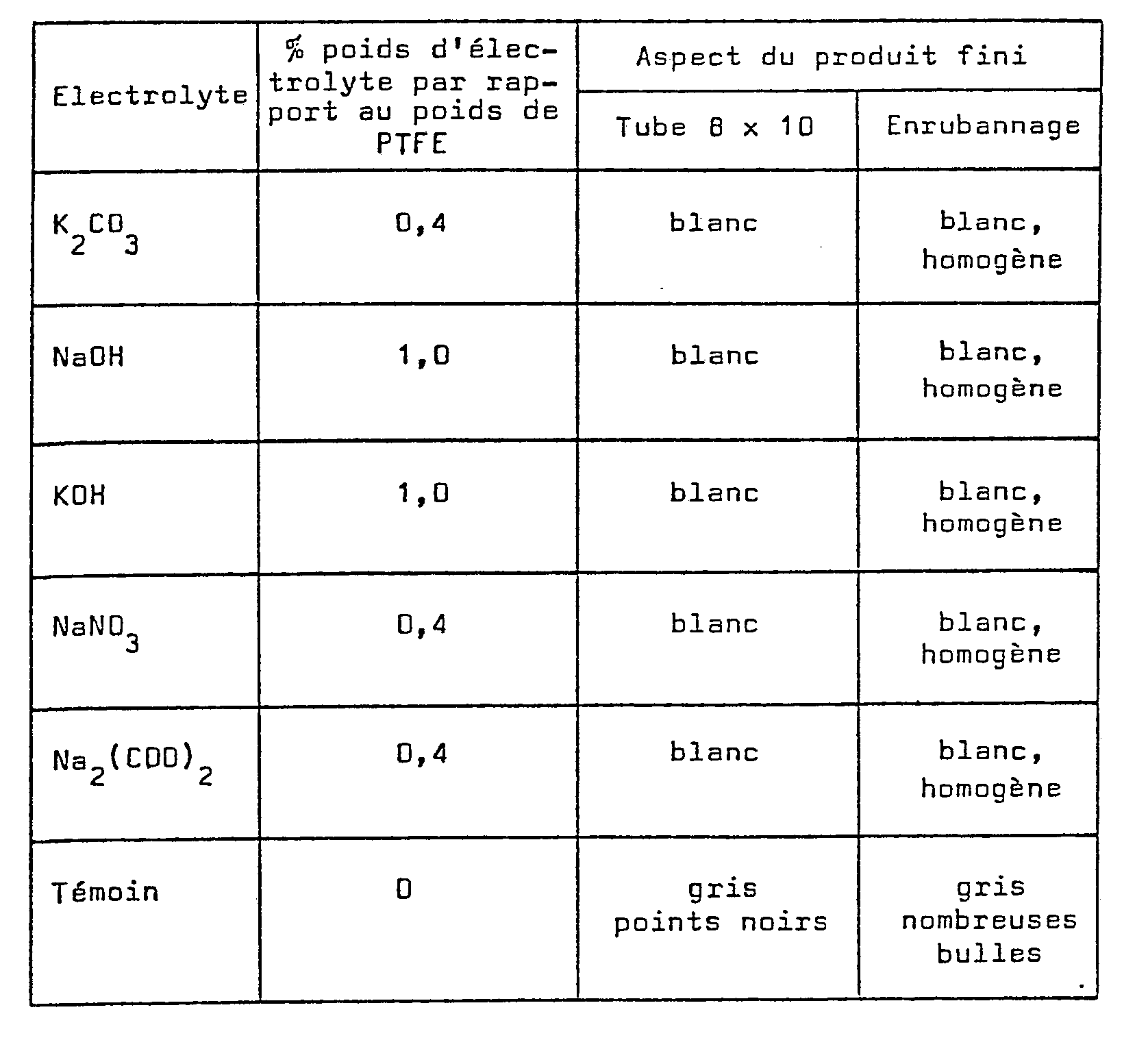
- Cette dispersion est divisée en plusieurs parties, l'une restant non traitée comme témoin, les autres étant respectivement traitées par une solution aqueuse de K2C03,NaOH,KOH,NaNO3,Na2(COO)2 ajoutée sous légère agitation. Après homogénéisation les différentes parties sont coagulées, essorées et séchées 15 heures à 160 °C. Les produits finis, après frittage d'environ 3 minutes à 410 °C pour les tubes, et de 30 minutes à 380 °C pour l'enrubannage, ont l'aspect indiqué dans le tableau ci-après.


- Des dispersions préparées selon l'exemple 1 sont traitées dans les mêmes conditions par NaCI, KCI, BaCl2, CaCl2, MgCI2 et l'acétate de baryum, l'une étant conservée comme témoin.
- Les produits extrudés sous forme de tubes sont frittés à 410 °C pendant au moins 6 minutes, et, ceux extrudés sous forme d'enrubannage sont frittés à 380 °C pendant au moins 60 minutes. Les produits obtenus après frittage ont l'aspect indiqué dans le tableau ci-après.

- Soit une dispersion préparée selon l'exemple 1 mais avec un émulsifiant C7F15SO3Li au lieu du C8F17SO3Li. Cette dispersion est divisée en plusieurs parties et traitée selon l'exemple 1. L'aspect des produits finis, obtenus également dans les conditions de l'exemple 1, est donné dans le tableau ci-après.
- Soit une dispersion préparée selon l'exemple 1 mais avec un émulsifiant du type RfSO3L! où Rf est un mélange en poids de C6F13 : 51 %, CeF17: 26 %, C10F21 : 13 %, C12F25 : 6 %, C14F29 : 3 % et C16F33 : 1 %. Cette dispersion est divisée en plusieurs parties et les essais réalisés dans les conditions de l'exemple 1.
- Les résultats obtenus sont identiques à ceux de l'exemple 1.
Claims (2)
Applications Claiming Priority (2)
| Application Number | Priority Date | Filing Date | Title |
|---|---|---|---|
| FR8010793 | 1980-05-14 | ||
| FR8010793A FR2484422A1 (fr) | 1980-05-14 | 1980-05-14 | Procede de traitement de dispersions aqueuses de polytetrafluorethylene preparees en presence du sel de lithium d'un acide perfluoroalcanesulfonique |
Publications (2)
| Publication Number | Publication Date |
|---|---|
| EP0040136A1 EP0040136A1 (fr) | 1981-11-18 |
| EP0040136B1 true EP0040136B1 (fr) | 1985-01-09 |
Family
ID=9241967
Family Applications (1)
| Application Number | Title | Priority Date | Filing Date |
|---|---|---|---|
| EP81400702A Expired EP0040136B1 (fr) | 1980-05-14 | 1981-05-05 | Procédé de séparation du polymère d'une dispersion aqueuse de polytétrafluoréthylène préparée en présence d'un sel de lithium d'un acide perfluoroalcanesulfonique |
Country Status (5)
| Country | Link |
|---|---|
| US (1) | US4384092A (fr) |
| EP (1) | EP0040136B1 (fr) |
| JP (1) | JPS578225A (fr) |
| DE (1) | DE3168111D1 (fr) |
| FR (1) | FR2484422A1 (fr) |
Families Citing this family (24)
| Publication number | Priority date | Publication date | Assignee | Title |
|---|---|---|---|---|
| US4564661A (en) * | 1985-03-12 | 1986-01-14 | E. I. Du Pont De Nemours And Company | Tertiary perfluoroalkoxides as surfactants in PTFE dispersion polymerization |
| US4555556A (en) * | 1985-03-12 | 1985-11-26 | E. I. Du Pont De Nemours And Company | Tertiary perfluorinated compounds as rate enhancing additives in PTFE dispersion polymerization |
| DE3513262A1 (de) * | 1985-04-13 | 1986-10-23 | Hoechst Ag, 6230 Frankfurt | Verfahren zur herstellung eines agglomerierten formpulvers aus polytetrafluorethylen und metallischen fuellstoffen |
| GB9017156D0 (en) * | 1990-08-03 | 1990-09-19 | Ici Plc | Stabilisation of fluoropolymers |
| US5504170A (en) * | 1993-08-27 | 1996-04-02 | W. L. Gore & Associates, Inc. | Aqueous microemulsion polymerization of tetrafluoroethylene |
| DE69417537T2 (de) * | 1993-08-27 | 1999-10-28 | W.L. Gore & Associates, Inc. | Polymerisation von flüssigem tetrafluorethylen in wässriger dispersion |
| AU4852393A (en) * | 1993-08-27 | 1995-03-21 | W.L. Gore & Associates, Inc. | Polymerization of liquid tetrafluoroethylene in aqueous dispersion |
| US5895799A (en) * | 1995-01-18 | 1999-04-20 | W. L. Gore & Associates, Inc. | Microemulsion polymerization process for the production of small polytetrafluoroethylene polymer particles |
| WO1996022313A1 (fr) * | 1995-01-18 | 1996-07-25 | W.L. Gore & Associates, Inc. | Systemes pour la polymerisation en microemulsion de tetrafluoroethylene |
| AU690798B2 (en) * | 1995-01-18 | 1998-04-30 | W.L. Gore & Associates, Inc. | Microemulsion polymerization systems for fluoromonomers |
| US6046271A (en) * | 1995-01-18 | 2000-04-04 | W. L. Gore & Associates, Inc. | Microemulsion polymerization systems for the production of small melt-processible fluoropolymer particles |
| US5688884A (en) * | 1995-08-31 | 1997-11-18 | E. I. Du Pont De Nemours And Company | Polymerization process |
| US5789508A (en) * | 1995-08-31 | 1998-08-04 | E. I. Du Pont De Nemours And Company | Polymerization process |
| US5889104A (en) * | 1996-01-11 | 1999-03-30 | W. L. Gore & Associates, Inc. | Low dielectric constant material for use as an insulation element in an electronic device |
| EP0769788A3 (fr) | 1995-10-20 | 1998-01-14 | W.L. Gore & Associates, Inc. | Matériau à faible constante diélectrique utilisé comme élément d'isolation dans un dispositif électronique |
| US5763552A (en) * | 1996-07-26 | 1998-06-09 | E. I. Du Pont De Nemours And Company | Hydrogen-containing flourosurfacant and its use in polymerization |
| EP0972303A1 (fr) * | 1997-04-03 | 2000-01-19 | W.L. Gore & Associates, Inc. | Matiere a faible constante dielectrique avec rigidite dielectrique amelioree |
| US6689833B1 (en) * | 1997-04-09 | 2004-02-10 | E. I. Du Pont De Nemours And Company | Fluoropolymer stabilization |
| US6040370A (en) * | 1997-04-17 | 2000-03-21 | General Electric Company | Aqueous fluoropolymer dispersion and method for making fluoropolymer-containing thermoplastic resin composition |
| DE19733077A1 (de) * | 1997-07-31 | 1999-02-04 | Clariant Gmbh | Neue Kolloiddispersions-Mischungen als Schutzkolloid für die wäßrige Emulsionspolymerisation, Verfahren zu ihrer Herstellung und ihre Verwendung |
| EP1702932A4 (fr) * | 2003-12-09 | 2009-10-21 | Daikin Ind Ltd | Dispersion aqueuse de polymere fluore et son procede de production |
| EP1939222B2 (fr) * | 2005-10-17 | 2019-09-04 | AGC Inc. | Procédé de production emulsion aqueuse de polytetrafluoroethylene et poudre fine de polytetrafluoroethylene et materiau poreux produit a partir de celle-ci |
| EP2079766B1 (fr) * | 2006-11-09 | 2011-05-18 | E.I. Du Pont De Nemours And Company | Polymérisation aqueuse de monomère fluoré faisant intervenir un agent de polymérisation comprenant un acide de fluoropolyéther ou un sel de celui-ci et un tensioactif d'acide de fluoropolyéther ou d'un sel de celui-ci à poids moléculaire élevé |
| JP2016113466A (ja) * | 2014-12-10 | 2016-06-23 | 株式会社クレハ | フッ化ビニリデン系樹脂組成物および成形物ならびにそれらの製造方法 |
Family Cites Families (11)
| Publication number | Priority date | Publication date | Assignee | Title |
|---|---|---|---|---|
| US2559751A (en) * | 1950-06-29 | 1951-07-10 | Du Pont | Fluoroalkylsulfuric compounds |
| GB931959A (en) * | 1960-03-04 | 1963-07-24 | Kettering Found Charles F | A fuel cell |
| FR1292771A (fr) * | 1960-06-22 | 1962-05-04 | Ici Ltd | Compositions de polytétrafluoréthylène à mouler |
| US3345317A (en) * | 1963-04-04 | 1967-10-03 | Thiokol Chemical Corp | Emulsion polymerization of tetrafluoroethylene using trifluorotrichloroethane as emulsion stabilizer |
| US3419522A (en) * | 1965-11-22 | 1968-12-31 | Du Pont | Nongraying, nonyellowing polytetrafluoroethylene molding powder |
| GB1364081A (en) * | 1970-07-25 | 1974-08-21 | Daikin Ind Ltd | Polymer compositions |
| FR2125752A5 (fr) * | 1971-02-19 | 1972-09-29 | Ugine Kuhlmann | |
| US3752789A (en) * | 1971-08-20 | 1973-08-14 | Du Pont | Isolation of a fluoropolymer from a latex |
| FR2286153A1 (fr) * | 1974-09-24 | 1976-04-23 | Ugine Kuhlmann | Procede de polymerisation ou de copolymerisation en emulsion du fluorure de vinylidene |
| FR2289583A1 (fr) * | 1974-10-29 | 1976-05-28 | Ugine Kuhlmann | Compositions de revetement a base de polytetrafluorethylene |
| US4169087A (en) * | 1977-08-24 | 1979-09-25 | E. I. Dupont De Nemours And Co. | Product and process of preparing tetrafluoroethylene polymer aqueous dispersions |
-
1980
- 1980-05-14 FR FR8010793A patent/FR2484422A1/fr active Granted
-
1981
- 1981-04-24 US US06/257,243 patent/US4384092A/en not_active Expired - Fee Related
- 1981-05-05 EP EP81400702A patent/EP0040136B1/fr not_active Expired
- 1981-05-05 DE DE8181400702T patent/DE3168111D1/de not_active Expired
- 1981-05-14 JP JP7153581A patent/JPS578225A/ja active Granted
Also Published As
| Publication number | Publication date |
|---|---|
| DE3168111D1 (en) | 1985-02-21 |
| JPS578225A (en) | 1982-01-16 |
| US4384092A (en) | 1983-05-17 |
| EP0040136A1 (fr) | 1981-11-18 |
| FR2484422A1 (fr) | 1981-12-18 |
| JPH0217574B2 (fr) | 1990-04-20 |
| FR2484422B1 (fr) | 1982-06-11 |
Similar Documents
| Publication | Publication Date | Title |
|---|---|---|
| EP0040136A1 (fr) | Procédé de séparation du polymère d'une dispersion aqueuse de polytétrafluoréthylène préparée en présence d'un sel de lithium d'un acide perfluoroalcanesulfonique | |
| CA1215498A (fr) | Preparation de poly(fluorure de vinylidene) de qualite elevee, en emulsion aqueuse | |
| JP5732850B2 (ja) | ポリテトラフルオロエチレンファインパウダーの製造方法 | |
| DE60105909T2 (de) | Feinpulveriges Polytetrafluoräthylen | |
| US5180803A (en) | Stabilization of fluoropolymers | |
| DE1900112A1 (de) | Verfahren zur kontinuierlichen Polymerisation von Vinylmonomeren | |
| EP0030663A2 (fr) | Polymères fluorés en particules stratifiées et procédé pour leur préparation | |
| TW201718661A (zh) | 改質聚四氟乙烯之水性乳化液、細粉末及延伸多孔體之製造方法 | |
| WO2009128432A1 (fr) | Procédé de fabrication de fine poudre de polytétrafluoroéthylène | |
| DE2165239A1 (de) | Verfahren zur Herstellung von Fluorelastomer-Terpolymeren | |
| DE1044410B (de) | Verfahren zur Polymerisation und Mischpolymerisation von Perfluorolefinen | |
| US3088941A (en) | Process for the preparation of improved polytetrafluoroethylene extrusion powder | |
| CN110662778A (zh) | 改性聚四氟乙烯及其制造方法 | |
| WO2016170918A1 (fr) | Poudre fine de polytétrafluoroéthylène modifié, son procédé de production, et câble et tube électriques produits tous deux en l'utilisant | |
| DE60200159T2 (de) | Verfahren zur Herstellung von Tetrafluoroethylenpolymere mit exzellenter Festigkeit | |
| EP0031268B1 (fr) | Procédé de polymérisation du tétrafluoréthylène en dispersion aqueuse | |
| EP1065223A1 (fr) | Procede de production d'une dispersion aqueuse contenant du polytetrafluoroethylene | |
| JP6742321B2 (ja) | 変性ポリテトラフルオロエチレンファインパウダー、その製造方法、およびチューブまたはホースの製造方法 | |
| CA2213707C (fr) | Latex bipopule de polymeres a base de chlorure de vinyle, ses procedes d'obtention et son application dans des plastisols a rheologie amelioree | |
| EP1380605A1 (fr) | Procédé de fabrication du polymère du fluorure de vinylidène | |
| DE60109119T2 (de) | Verfahren zum Herstellen von Paraffinwachs | |
| DE2523570A1 (de) | Verfahren zur herstellung von homound copolymerisaten des tetrafluoraethylens | |
| DE2739708C2 (de) | Verfahren zur Homo- oder Mischpolymerisation von Vinylhalogeniden in wäßriger Dispersion | |
| DE916470C (de) | Verfahren zur Herstellung waessriger Kolloiddispersionen von Polymeren | |
| RU2158275C1 (ru) | Способ получения водной дисперсии сополимера тетрафторэтилена |
Legal Events
| Date | Code | Title | Description |
|---|---|---|---|
| PUAI | Public reference made under article 153(3) epc to a published international application that has entered the european phase |
Free format text: ORIGINAL CODE: 0009012 |
|
| 17P | Request for examination filed |
Effective date: 19810508 |
|
| AK | Designated contracting states |
Designated state(s): DE FR GB IT NL |
|
| RAP1 | Party data changed (applicant data changed or rights of an application transferred) |
Owner name: SOCIETE ATOCHEM |
|
| ITF | It: translation for a ep patent filed | ||
| GRAA | (expected) grant |
Free format text: ORIGINAL CODE: 0009210 |
|
| AK | Designated contracting states |
Designated state(s): DE FR GB IT NL |
|
| REF | Corresponds to: |
Ref document number: 3168111 Country of ref document: DE Date of ref document: 19850221 |
|
| PLBE | No opposition filed within time limit |
Free format text: ORIGINAL CODE: 0009261 |
|
| STAA | Information on the status of an ep patent application or granted ep patent |
Free format text: STATUS: NO OPPOSITION FILED WITHIN TIME LIMIT |
|
| 26N | No opposition filed | ||
| ITTA | It: last paid annual fee | ||
| PGFP | Annual fee paid to national office [announced via postgrant information from national office to epo] |
Ref country code: GB Payment date: 19920424 Year of fee payment: 12 |
|
| PGFP | Annual fee paid to national office [announced via postgrant information from national office to epo] |
Ref country code: FR Payment date: 19920511 Year of fee payment: 12 |
|
| PGFP | Annual fee paid to national office [announced via postgrant information from national office to epo] |
Ref country code: DE Payment date: 19920529 Year of fee payment: 12 |
|
| PGFP | Annual fee paid to national office [announced via postgrant information from national office to epo] |
Ref country code: NL Payment date: 19920531 Year of fee payment: 12 |
|
| PG25 | Lapsed in a contracting state [announced via postgrant information from national office to epo] |
Ref country code: GB Effective date: 19930505 |
|
| PG25 | Lapsed in a contracting state [announced via postgrant information from national office to epo] |
Ref country code: NL Effective date: 19931201 |
|
| GBPC | Gb: european patent ceased through non-payment of renewal fee |
Effective date: 19930505 |
|
| NLV4 | Nl: lapsed or anulled due to non-payment of the annual fee | ||
| PG25 | Lapsed in a contracting state [announced via postgrant information from national office to epo] |
Ref country code: FR Effective date: 19940131 |
|
| PG25 | Lapsed in a contracting state [announced via postgrant information from national office to epo] |
Ref country code: DE Effective date: 19940201 |
|
| REG | Reference to a national code |
Ref country code: FR Ref legal event code: ST |