EP0040885A1 - Méthode pour le contrôle non-destructif de tuiles ou autres articles en béton ou en céramique - Google Patents
Méthode pour le contrôle non-destructif de tuiles ou autres articles en béton ou en céramique Download PDFInfo
- Publication number
- EP0040885A1 EP0040885A1 EP81200549A EP81200549A EP0040885A1 EP 0040885 A1 EP0040885 A1 EP 0040885A1 EP 81200549 A EP81200549 A EP 81200549A EP 81200549 A EP81200549 A EP 81200549A EP 0040885 A1 EP0040885 A1 EP 0040885A1
- Authority
- EP
- European Patent Office
- Prior art keywords
- article
- articles
- roofing
- production line
- thickness
- Prior art date
- Legal status (The legal status is an assumption and is not a legal conclusion. Google has not performed a legal analysis and makes no representation as to the accuracy of the status listed.)
- Withdrawn
Links
- 238000000034 method Methods 0.000 title claims abstract description 31
- 238000007689 inspection Methods 0.000 title claims abstract description 22
- 239000000919 ceramic Substances 0.000 title claims abstract description 4
- 230000001066 destructive effect Effects 0.000 title description 3
- 238000004519 manufacturing process Methods 0.000 claims abstract description 33
- 238000010924 continuous production Methods 0.000 claims abstract description 3
- 238000005259 measurement Methods 0.000 claims description 28
- 230000003068 static effect Effects 0.000 claims description 11
- 239000000835 fiber Substances 0.000 claims description 2
- 239000000725 suspension Substances 0.000 claims description 2
- 239000003086 colorant Substances 0.000 claims 1
- 239000002184 metal Substances 0.000 claims 1
- 238000003825 pressing Methods 0.000 claims 1
- 238000005303 weighing Methods 0.000 description 6
- 238000001125 extrusion Methods 0.000 description 4
- 238000005070 sampling Methods 0.000 description 4
- 239000003365 glass fiber Substances 0.000 description 3
- 238000000465 moulding Methods 0.000 description 3
- XLYOFNOQVPJJNP-UHFFFAOYSA-N water Substances O XLYOFNOQVPJJNP-UHFFFAOYSA-N 0.000 description 3
- 230000001419 dependent effect Effects 0.000 description 2
- 238000006073 displacement reaction Methods 0.000 description 2
- 239000000463 material Substances 0.000 description 2
- 239000004570 mortar (masonry) Substances 0.000 description 2
- 238000012856 packing Methods 0.000 description 2
- 239000002002 slurry Substances 0.000 description 2
- 230000005236 sound signal Effects 0.000 description 2
- 238000003892 spreading Methods 0.000 description 2
- 238000003860 storage Methods 0.000 description 2
- 230000002411 adverse Effects 0.000 description 1
- 150000001875 compounds Chemical class 0.000 description 1
- 238000001035 drying Methods 0.000 description 1
- 239000008187 granular material Substances 0.000 description 1
- 230000009474 immediate action Effects 0.000 description 1
- 238000011326 mechanical measurement Methods 0.000 description 1
- 238000003908 quality control method Methods 0.000 description 1
- 239000002994 raw material Substances 0.000 description 1
- 230000002787 reinforcement Effects 0.000 description 1
- 230000000630 rising effect Effects 0.000 description 1
- 238000005507 spraying Methods 0.000 description 1
- 238000002604 ultrasonography Methods 0.000 description 1
Images
Classifications
-
- B—PERFORMING OPERATIONS; TRANSPORTING
- B28—WORKING CEMENT, CLAY, OR STONE
- B28B—SHAPING CLAY OR OTHER CERAMIC COMPOSITIONS; SHAPING SLAG; SHAPING MIXTURES CONTAINING CEMENTITIOUS MATERIAL, e.g. PLASTER
- B28B5/00—Producing shaped articles from the material in moulds or on moulding surfaces, carried or formed by, in or on conveyors irrespective of the manner of shaping
- B28B5/02—Producing shaped articles from the material in moulds or on moulding surfaces, carried or formed by, in or on conveyors irrespective of the manner of shaping on conveyors of the endless-belt or chain type
-
- B—PERFORMING OPERATIONS; TRANSPORTING
- B28—WORKING CEMENT, CLAY, OR STONE
- B28B—SHAPING CLAY OR OTHER CERAMIC COMPOSITIONS; SHAPING SLAG; SHAPING MIXTURES CONTAINING CEMENTITIOUS MATERIAL, e.g. PLASTER
- B28B13/00—Feeding the unshaped material to moulds or apparatus for producing shaped articles; Discharging shaped articles from such moulds or apparatus
- B28B13/04—Discharging the shaped articles
-
- B—PERFORMING OPERATIONS; TRANSPORTING
- B28—WORKING CEMENT, CLAY, OR STONE
- B28B—SHAPING CLAY OR OTHER CERAMIC COMPOSITIONS; SHAPING SLAG; SHAPING MIXTURES CONTAINING CEMENTITIOUS MATERIAL, e.g. PLASTER
- B28B17/00—Details of, or accessories for, apparatus for shaping the material; Auxiliary measures taken in connection with such shaping
- B28B17/0063—Control arrangements
- B28B17/0072—Product control or inspection
-
- B—PERFORMING OPERATIONS; TRANSPORTING
- B28—WORKING CEMENT, CLAY, OR STONE
- B28B—SHAPING CLAY OR OTHER CERAMIC COMPOSITIONS; SHAPING SLAG; SHAPING MIXTURES CONTAINING CEMENTITIOUS MATERIAL, e.g. PLASTER
- B28B5/00—Producing shaped articles from the material in moulds or on moulding surfaces, carried or formed by, in or on conveyors irrespective of the manner of shaping
- B28B5/04—Producing shaped articles from the material in moulds or on moulding surfaces, carried or formed by, in or on conveyors irrespective of the manner of shaping in moulds moved in succession past one or more shaping stations
-
- G—PHYSICS
- G07—CHECKING-DEVICES
- G07C—TIME OR ATTENDANCE REGISTERS; REGISTERING OR INDICATING THE WORKING OF MACHINES; GENERATING RANDOM NUMBERS; VOTING OR LOTTERY APPARATUS; ARRANGEMENTS, SYSTEMS OR APPARATUS FOR CHECKING NOT PROVIDED FOR ELSEWHERE
- G07C3/00—Registering or indicating the condition or the working of machines or other apparatus, other than vehicles
- G07C3/14—Quality control systems
Definitions
- the invention relates to a method for the inspection of concrete or ceramic roofing-tiles or other articles being substantially flat but profiled and manufactured in a continuous production line.
- the inspected samples are tested on their strength destructively but also the articles being not tested on strength but on other properties one may generally consider as being lost.
- Said deviations may also be of such a kind that the properties are only slightly effected adversely for example a too high thickness by which it is a question of material wastage.
- the production of the articles is usual carried out automatically and at deviations it always deals with high numbers of articles having said wrong properties.
- the invention has the object to improve the known method by inspecting non-destructively each article or each n th article in the production line and to store the measured data. In this way it is possible to intervene early in the production by which the number of articles not meeting the specified requirements are kept as low as possible.
- the inspection can be carried out statically and/or dynamically.
- a static inspection each n article is removed from the production line inspected in static condition and fed back to an empty position in the production line.
- each article or each n th article is inspected in the production line itself. Thus, the articles are not removed from the production line.
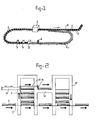
- a roofing-tile press 2 implemented as extrusion device is filled with concrete mortar pressed through the extrusion mouth.
- the extrusion opening is bounded at the lower side by the advanced bottom molds 1.
- the cavities in the bottom molds 1 are filled up with concrete mortar.
- a slurry is fed onto the top surface of the molded roofing-tiles 4 and at 5 a granulate is supplied.
- the roofing-tiles 4 being wet yet are transported further in the bottom molds.
- roofing-tiles 4 with the bottom molds 1 are stacked in racks and advanced into a drying device not shown.
- the dry roofing-tiles 4 still in the bottom molds 1 come back again to the production line.
- the cured roofing-tiles 4 are lifted from the bottom molds 1 and advanced on a conveyor 7 to a packing device (not shown).
- the empty bottom molds 1 are fed back to the roofing-tile press 2.
- a device 8 in which they are sprayed with molding oil.
- the roofing-tiles can be inspected at different locations and on different quantities.
- the inspection can be static or dynamic.
- the roofing-tile remains in the production line and the inspection must be carried out in a time period determined by the speed of the production and moreover, a moving article must be inspected.
- the spacing between the measuring location of the thickness of the wet roofing-tiles immediately after the extrusion and the supply of empty molds before the roofing-tile press is known both in measure and in number of roofing-tiles respectively molds.
- the thickness of the molds - which may be vary by gradual wear - can be measured at said location - thus before the roofing-tile press - .
- Said thickness is stored in a memo-register and processed in measuring mold with roofing-tile.
- the memo-register is reloaded continuously with a measuring number (at the left hand and right hand measured at the edge), whereas the processed number is cleared.
- the storage of the thickness of the roofing-tile may be continuous, but deviations exceeding a predetermined - preadjusted - tolerance can be signalized for immediate action. For example, red light: too high thickness and yellow light: too thin.
- each cured roofing-tile is tested stationary, at least the roofing-tile is removed from the production line.
- said static inspection takes place behind the device 6 and after the roofing-tiles 4 are separated from the bottom molds 1, for example at the location A.
- a device to be used therefore is schematically shown in fig. 2.
- the device shown in fig. 2 consists of two towers 9 and 10 alongside and above the transporter and therebetween the measuring table 11.
- the n th roofing-tile 4 to be inspected statically actuates an elevator in the tower 9 when the roofing-tile is positioned in the tower 9. Said elevator moves the roofing-tile 4 stepwise upwards until the top level is reached. Then, a reciprocating plunjer 12 is activated shifting the n th roofing-tile 4 onto the measuring table 11. Simultaneously, an arm 13 having a paw 14 moving with the plunjer shifts the roofing tile already inspected to the tower 10 in which an elevator is provided moving stepwise and downwards the roofing-tile and moving it back to an empty place on the conveyor 7. At retrac ting the plunjer 12 the paw 14 tilts and is inactive.
- the roofing-tile is stationary on the measuring table 11.
- the ro6fing-tiles which need not to be inspected are normally advanced further on the conveyor 7.
- the roofing-tile to be inspected is pointed out by a counter and a photo-cell.
- n roofing-tile Dependent on the adjustment each n roofing-tile is removed from the production line and supplied.
- the roofing-tiles 4 advance with a high velocity (1,0 - 1,2 m/sec.) on the conveyor 7 the roofing-tile 4 arrived in the tower 9 should be taken from the production line with the high speed.
- measuring sensors not shown will measure the width at two locations and transmit said width as a signal to the storage apparatus.
- the thickness is measured and also transmitted by a measuring sensor of the shear type. Said measurement of thickness is also effected at two locations.
- the weight of the roofing-tile is measured by means of pressure boxes on which the respective strips seat.
- the strength of the roofing-tiles is measured with an ultrasonic measurement, in which a transmitter beneath the roofing-tile contacts the roofing-tile through a conductive medium, for example water, and at the upper side a receiver receives in the same way the measuring signal.
- a conductive medium for example water
- the roofing-tile is shifted to an equal lift belt in the tower 10. Simultaneously with the rising lift belt, said lift belt moves downwards so that the roofing tile is placed on the conveyor belt 7 where before a roofing-tile is lifted from.
- the available measuring time is dependent on the number of sampling, for example with each 20th roofing-tile this is 10 sec. gross. With each 10th roofing-tile this is 5 sec. gross.
- each roofing-tile (or each second or third roofing-tile) is inspected which is too rapid for the apparatus of the static method.
- the roofing-tiles to be measured advance with a conformable movement in this case 1.00 a 1,20 m/sec. by means of a conveyor belt in the direction of the packing station.
- the roofing-tiles are separated from their molds and are supplied with a maximum velocity of 1,20 m/sec and a minimum spacing of 100 mm between the roofing-tiles.
- the measurement of width (at two locations of the roofing-tile simultaneously or after each other) will preferably be carried out on a conveyor belt being approximately 100 mm narrower than the roofing-tile to be measured.
- the roofing-tile is positioned correctly for the measurement by means of an adjusted guide.
- the side-guide of the roofing-tile on the belt is open such that the measurement may be effected freely and non-obstructed.
- the measurement of width may be carried out by a mechanic sensor on predetermined locations, in which the switch on is provided by a photo-cell eventually coupled with a counter.
- an inclined arrangement can be chosen for measuring only the upper edge.
- the measurement of length may be implemented optically in the same way, in which the location of measurement is preferably at'the valley (thus the lowest portion of the roofing- tiles surface), i.e. at two locations simultaneously or after each other. Mechanical measurement of length is more difficult here by the fact that the roofing-tile is advanced in the measuring direction.
- the measuring sensor would assume the same displacement velocity as the roofing-tile along a specified path this is possible in a mechanical way.
- a roofing-tile must be advanced on cables (thus free accessible from below), on which said roofing-tile moves with a velocity of 1,00 à 1,20 m/sec.
- the measurement of thickness is also carried out when it is advanced on cables.
- the weight of the roofing-tile can be determined by means of a weighing belt. Said weighing belt is accommodated in the cable conveyor such that the roofing-tile is free delivered from the cables. The length of the weighing belt is maximally 100 mm longer than the roofing-tile to be weighed.
- the weighing operation of the roofing-tile with belt should be carried out such that the horizontal forces are eliminated. Therefore the weighing belt is supported on pressure boxes the centre of which is at the level of the roofing-tile. Moreover, the weighing belt should be supported against horizontal movements, whereas vertical movements must be not obstructed.
- the strength of the roofing-tiles should be measured non-des- structive. As a method therefore it is thought of measurements with ultrasound, in which the measuring heads above and beneath the roofing-tile transmit respectively measure through a suitable medium, for example water, a sound signal representing as reference the structure. From comparing measurements with destructive tests of strength said dimensionless reference cipher may be translated into real strength ciphers.
- a further important inspection comprises the establishment whether the roofing-tile is provided with the necessary suspension cams.
- Said cams are constituted by cavities in the bottom molds 1. When for example the spraying device 7 has delivered too much molding oil said cavity is partly filled up with oil and a correct cam cannot be molded. A cam can also break off during the molding and transport.
- Said cams can be missing at the left hand or right hand.
- a simple method for ascertaining whether the left hand cam is present comprises the step of urging the roofing-tile downwards at said location. If the left hand cam is lacking the roofing-tile tilts up at the right hand. This may be determined by a switch or photo cell. This is also in force for the right hand cam.
Landscapes
- Engineering & Computer Science (AREA)
- Ceramic Engineering (AREA)
- Chemical & Material Sciences (AREA)
- Mechanical Engineering (AREA)
- Manufacturing & Machinery (AREA)
- Automation & Control Theory (AREA)
- Quality & Reliability (AREA)
- Physics & Mathematics (AREA)
- General Physics & Mathematics (AREA)
- Length Measuring Devices With Unspecified Measuring Means (AREA)
Applications Claiming Priority (2)
| Application Number | Priority Date | Filing Date | Title |
|---|---|---|---|
| NL8002968 | 1980-05-22 | ||
| NL8002968A NL8002968A (nl) | 1980-05-22 | 1980-05-22 | Werkwijze voor het niet-destructief keuren van betonnen of keramische dakpannen of andere voorwerpen. |
Publications (1)
| Publication Number | Publication Date |
|---|---|
| EP0040885A1 true EP0040885A1 (fr) | 1981-12-02 |
Family
ID=19835345
Family Applications (1)
| Application Number | Title | Priority Date | Filing Date |
|---|---|---|---|
| EP81200549A Withdrawn EP0040885A1 (fr) | 1980-05-22 | 1981-05-21 | Méthode pour le contrôle non-destructif de tuiles ou autres articles en béton ou en céramique |
Country Status (2)
| Country | Link |
|---|---|
| EP (1) | EP0040885A1 (fr) |
| NL (1) | NL8002968A (fr) |
Cited By (2)
| Publication number | Priority date | Publication date | Assignee | Title |
|---|---|---|---|---|
| GB2144386A (en) * | 1983-06-23 | 1985-03-06 | Vs Engineering Limited | Method and apparatus for use in production lines |
| EP0132312A3 (fr) * | 1983-06-23 | 1986-06-11 | V.S. Engineering Limited | Méthode et dispositif destinés à être utilisé sur des chaínes de production |
Citations (7)
| Publication number | Priority date | Publication date | Assignee | Title |
|---|---|---|---|---|
| DE593018C (de) * | 1933-08-19 | 1934-02-20 | Vorm Georg Dorst A G Maschf | Maschine zum selbsttaetigen Sortieren keramischer Platten |
| US3666093A (en) * | 1970-08-18 | 1972-05-30 | Forrest Paschal Machinery Co | Apparatus for sensing and ejecting bricks of improper size |
| FR2226220A1 (fr) * | 1973-04-19 | 1974-11-15 | Villeroy & Boch | |
| DE2333164A1 (de) * | 1973-06-29 | 1975-04-03 | Keller & Co C | Einrichtung zum aussortieren von bestimmten, z. b. beschaedigten gegenstaenden wie ziegelsteine u. dgl. aus einer ziegelreihe |
| US3941686A (en) * | 1975-03-27 | 1976-03-02 | Owens-Illinois, Inc. | Inspection machine memory |
| DE2809803A1 (de) * | 1977-03-07 | 1978-09-21 | Costantini | Vorrichtung zur klassifizierung und/oder auswertung der farbtoenung von kacheln und/oder fliesen |
| DE2907700A1 (de) * | 1978-03-02 | 1979-09-06 | Gustavsberg Ab | Aggregat zum automatischen sortieren gebrannter ziegelsteine |
-
1980
- 1980-05-22 NL NL8002968A patent/NL8002968A/nl not_active Application Discontinuation
-
1981
- 1981-05-21 EP EP81200549A patent/EP0040885A1/fr not_active Withdrawn
Patent Citations (7)
| Publication number | Priority date | Publication date | Assignee | Title |
|---|---|---|---|---|
| DE593018C (de) * | 1933-08-19 | 1934-02-20 | Vorm Georg Dorst A G Maschf | Maschine zum selbsttaetigen Sortieren keramischer Platten |
| US3666093A (en) * | 1970-08-18 | 1972-05-30 | Forrest Paschal Machinery Co | Apparatus for sensing and ejecting bricks of improper size |
| FR2226220A1 (fr) * | 1973-04-19 | 1974-11-15 | Villeroy & Boch | |
| DE2333164A1 (de) * | 1973-06-29 | 1975-04-03 | Keller & Co C | Einrichtung zum aussortieren von bestimmten, z. b. beschaedigten gegenstaenden wie ziegelsteine u. dgl. aus einer ziegelreihe |
| US3941686A (en) * | 1975-03-27 | 1976-03-02 | Owens-Illinois, Inc. | Inspection machine memory |
| DE2809803A1 (de) * | 1977-03-07 | 1978-09-21 | Costantini | Vorrichtung zur klassifizierung und/oder auswertung der farbtoenung von kacheln und/oder fliesen |
| DE2907700A1 (de) * | 1978-03-02 | 1979-09-06 | Gustavsberg Ab | Aggregat zum automatischen sortieren gebrannter ziegelsteine |
Cited By (2)
| Publication number | Priority date | Publication date | Assignee | Title |
|---|---|---|---|---|
| GB2144386A (en) * | 1983-06-23 | 1985-03-06 | Vs Engineering Limited | Method and apparatus for use in production lines |
| EP0132312A3 (fr) * | 1983-06-23 | 1986-06-11 | V.S. Engineering Limited | Méthode et dispositif destinés à être utilisé sur des chaínes de production |
Also Published As
| Publication number | Publication date |
|---|---|
| NL8002968A (nl) | 1981-12-16 |
Similar Documents
| Publication | Publication Date | Title |
|---|---|---|
| EP0326284B1 (fr) | Appareil et méthode de traitement du bois | |
| CN205808295U (zh) | 一种花键检测机 | |
| GB1106274A (en) | Method and apparatus for packing articles in a regular array in a container | |
| US4403669A (en) | Apparatus for weighing continuously-moving articles particularly useful for grading produce | |
| CN206935820U (zh) | 一种石膏板在线检测和分拣装置 | |
| CN109239579A (zh) | 全自动线路板电测设备 | |
| CN212421712U (zh) | 一种在线监控的陶瓷粉料自动换仓系统 | |
| US4095925A (en) | Cementitious product making system with product height gauging mechanism | |
| CN210533921U (zh) | 泡沫板材连续生产过程用密度检测装置 | |
| KR100638283B1 (ko) | 타이어 트레드 자동 조인트 감지장치 | |
| US3963397A (en) | Cementitious product making system with product height gauging mechanism | |
| CN104290444B (zh) | 不干胶标签检测设备停机控制方法 | |
| US4607536A (en) | Apparatus for sampling similar laminar articles | |
| CN118219389A (zh) | 一种陶瓷垫块用自动模压、检测系统及其工作方法 | |
| US4170911A (en) | Log cutting apparatus | |
| CN109656215A (zh) | 制证控制方法和装置 | |
| CN210312392U (zh) | 全自动下板机 | |
| CN110547227A (zh) | 一种鸭蛋蛋壳破损检测分拣装置及其方法 | |
| CN210585945U (zh) | 覆铜板检测分拣系统 | |
| US4036570A (en) | Cementitious product making system with product height gauging mechanism | |
| NL8002968A (nl) | Werkwijze voor het niet-destructief keuren van betonnen of keramische dakpannen of andere voorwerpen. | |
| GB1566457A (en) | Cutting a block of material such as clay | |
| CN213647649U (zh) | 食品切条计量装置 | |
| CN224022612U (zh) | 一种咸鸭蛋分拣装置 | |
| KR20220104604A (ko) | 원형의 회전테이블을 이용한 전자 중량선별기 |
Legal Events
| Date | Code | Title | Description |
|---|---|---|---|
| PUAI | Public reference made under article 153(3) epc to a published international application that has entered the european phase |
Free format text: ORIGINAL CODE: 0009012 |
|
| AK | Designated contracting states |
Designated state(s): AT BE CH DE FR GB IT LU NL SE |
|
| 17P | Request for examination filed |
Effective date: 19820526 |
|
| STAA | Information on the status of an ep patent application or granted ep patent |
Free format text: STATUS: THE APPLICATION IS DEEMED TO BE WITHDRAWN |
|
| 18D | Application deemed to be withdrawn |
Effective date: 19840112 |
|
| RIN1 | Information on inventor provided before grant (corrected) |
Inventor name: OFFERMANN, JEAN JOSEPH MARIE |