EP0040928A2 - Gasprobennehmer - Google Patents
Gasprobennehmer Download PDFInfo
- Publication number
- EP0040928A2 EP0040928A2 EP81302133A EP81302133A EP0040928A2 EP 0040928 A2 EP0040928 A2 EP 0040928A2 EP 81302133 A EP81302133 A EP 81302133A EP 81302133 A EP81302133 A EP 81302133A EP 0040928 A2 EP0040928 A2 EP 0040928A2
- Authority
- EP
- European Patent Office
- Prior art keywords
- pump
- valve
- pressure
- counter
- gas
- Prior art date
- Legal status (The legal status is an assumption and is not a legal conclusion. Google has not performed a legal analysis and makes no representation as to the accuracy of the status listed.)
- Granted
Links
Images


Classifications
-
- G—PHYSICS
- G01—MEASURING; TESTING
- G01N—INVESTIGATING OR ANALYSING MATERIALS BY DETERMINING THEIR CHEMICAL OR PHYSICAL PROPERTIES
- G01N1/00—Sampling; Preparing specimens for investigation
- G01N1/02—Devices for withdrawing samples
- G01N1/22—Devices for withdrawing samples in the gaseous state
- G01N1/2202—Devices for withdrawing samples in the gaseous state involving separation of sample components during sampling
- G01N1/2205—Devices for withdrawing samples in the gaseous state involving separation of sample components during sampling with filters
-
- G—PHYSICS
- G05—CONTROLLING; REGULATING
- G05D—SYSTEMS FOR CONTROLLING OR REGULATING NON-ELECTRIC VARIABLES
- G05D7/00—Control of flow
- G05D7/06—Control of flow characterised by the use of electric means
- G05D7/0617—Control of flow characterised by the use of electric means specially adapted for fluid materials
- G05D7/0629—Control of flow characterised by the use of electric means specially adapted for fluid materials characterised by the type of regulator means
- G05D7/0688—Control of flow characterised by the use of electric means specially adapted for fluid materials characterised by the type of regulator means by combined action on throttling means and flow sources
-
- G—PHYSICS
- G01—MEASURING; TESTING
- G01N—INVESTIGATING OR ANALYSING MATERIALS BY DETERMINING THEIR CHEMICAL OR PHYSICAL PROPERTIES
- G01N1/00—Sampling; Preparing specimens for investigation
- G01N1/02—Devices for withdrawing samples
- G01N1/22—Devices for withdrawing samples in the gaseous state
- G01N1/24—Suction devices
-
- G—PHYSICS
- G01—MEASURING; TESTING
- G01N—INVESTIGATING OR ANALYSING MATERIALS BY DETERMINING THEIR CHEMICAL OR PHYSICAL PROPERTIES
- G01N1/00—Sampling; Preparing specimens for investigation
- G01N1/02—Devices for withdrawing samples
- G01N1/22—Devices for withdrawing samples in the gaseous state
- G01N1/2202—Devices for withdrawing samples in the gaseous state involving separation of sample components during sampling
- G01N2001/222—Other features
- G01N2001/2223—Other features aerosol sampling devices
Definitions
- the present invention relates to a gas sampler and more particularly to a gas sampler whose speed is controlled in dependence upon the pressure across a valve, e.g. in order to obtain a constant volume flow rate.
- a particular use of such a sampler is to draw air through a filter.
- UK Patent Specification 1,556,791 A gas sampler is disclosed in UK Patent Specification 1,556,791 in which the pump is controlled in dependence on the pressure across the valve via an integrator.
- UK 1,556,791 requires the presence of a reservoir to smooth the flow between the pump and the valve.
- the object of the present invention is to provide a gas sampler of simple construction and highly stable flow.
- a rotary pump together with the integrator provides a highly stable flow. Integration of a signal representing the pressure across the valve produces an output signal dependent on the time-averaged pressure produced by the pump. This smooths the regular fluctuations in working pressure which are present even when a rotary pump is used.
- the use of a rotary pump has the advantage that such pumps become blocked by impurities in the gas less easily than other pumps.
- a pressure monitor in the form of a pressure actuated switch, the proportion of "on” time to “off” time being the integrated value of the pressure produced-by the pump.
- This pressure switch may sense the pressure downstream of the pump, between the pump and the valve.
- the present invention further provides a detector which detects when the pressure across the valve is less than a predetermined value for less than a predetermined time, and a counter which counts the time the pump is running, the detector being adapted to stop the counter when said predetermined time has elapsed until the pressure across the valve has risen to said predetermined value.
- a control system is thus provided to stop the counter. There may also be provided a visual indication of when the system malfunctions due to insufficient flow through the valve.
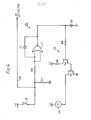
- the gas sampler has a conduit 10 through which the gas to be sampled is drawn by means of a rotary pump 12.
- the flow rate of the gas through the conduit 10 is controlled by a valve 14 which may, for example, be a manually adjusted needle valve.
- a manometer 16 is connected downstream of the valve 14. It is preferable, however, that the flow rate should be calibrated by use of an accurate flow gauge (not shown) before the sampler is used. Thus the manometer 16 acts as an indication that flow is present, rather than an accurate display.
- Variations in flow of the gas in the conduit 10 occur due to the operation of the pump 12.
- the use of a rotary vane pump minimises these variations, and also has the advantage of ease of maintainence.
- the variations in flow are detected across the valve 14 by a pressure switch 18.
- This switch 18 opens and closes in dependence on the pressure in the conduit 10, and is adapted to close when the pressure of the gas in the conduit 10 rises above a predetermined value.
- the position of this switch 18 is detected, then integrated and inverted by an integrator 20.
- the output of the integrator 20 is fed to an amplifier 22 which controls the-speed of rotation of a motor 24.
- the pump 12 is connected directly to the motor 24. Hence the pump 12 is regulated by the position of the switch 18.
- the switch 18 If the switch 18 is open or closed for equal lengths of time, the output of the integrator will be constant and the motor speed will be constant. If the switch 18 is. open for longer than it is closed, for example, due to a pressure drop in the conduit 10, the integrator 20 gives a positive output which causes the motor to speed up the pump 12, thereby increasing the flow. Similarly, if the switch 18 is closed for longer than it is open, the pump 12 is slowed down, to reduce the flow. Thus, a stabilized flow is provided in the conduit 10.
- the motor may be a low inertia, skew-wound, ironless DC motor which operates at speeds between 1000 and 2500 rpm.
- the pump may be a three bladed rotary vane pump.
- a filter 26 is connected to the inlet of the conduit 10, to collect impurities or dust particles in the sampled gas.
- the whole device is for instance carried by a person working in a place where there is harmful aust, which is collected on the filter for subsequent analysis.
- To determine the person's exposure it is necessary to know accurately the amount of gas passing through the filter and the time of operation of the sampler. For this a steady flow rate is required.
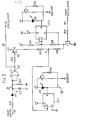
- the gas sampler is powered by a battery E which provides two outputs, one being a voltage +V through a resistor R1 and the second being a voltage +S through a current limiter circuit 28.
- the current limiter circuit 28 comprises, in a known way, three transistors T1 to T3 and four resistors R2 to R5.
- the current limiter circuit ensures that the current to the control system is not more than 250 mA , thereby preventing the generation of a spark should the circuit fail.
- a switch SW1 is provided to isolate completely the battery E.
- the battery E may be rechargeable and charging is then achieved through diodes D1 and D2. It is not necessary to provide a stabilizing circuit for the battery E because any fluctuations in pump speed due to changes in battery voltage are compensated for by the motor control circuit formed by the switch 18, the integrator 20 and the amplifier 22.
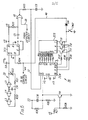
- the sampler is controlled by a control circuit shown schematically in Fig. 3.
- the operation of the sensor 18, integrator 20, amplifier 22 and motor 24 have already been described in connection. with Fig. 1.
- the control circuit is regulated by an oscillator 30, preferably constructed using CMOS components to minimise power consumption.
- the oscillator 30 produces pulses which are divided to produce pulses at minute intervals which are fed via line 32 to a counter 34.
- the counter 34 drives a display (not shown), preferably a light emitting diode (hereinafter abbreviated to LED) display which provides a visual indication of elapsed time.
- LED light emitting diode
- the pressure switch 18 ceases to close. This is detected by a detector circuit 36 which supplies a signal via line 38 to the oscillator 30. This signal inhibits the signal from the oscillator 30 to the counter 34. Thus, if the gas flow ceases, the counter 34 is stopped. The display of the counter 34 thus provides an accurate indication of the time that the gas sampler has been operating correctly.
- the detector 36 also supplies a signal, via line 40 to a "No control" circuit 42 which activates a warning device to indicate that flow has ceased.
- This warning device may be an LED which is arranged to flash by connecting it to the oscillator 30 via line 44. Alternatively, or in addition to the LED, an audible alarm may be provided.
- a circuit 46 detects the battery voltage and provides a display when the battery voltage falls below a predetermined level. This display may be provided by a second LED which is arranged to flash by connecting it to the oscillator 30 via line 44. An audible alarm may be provided in a similar way to the "No Control" circuit 42.
- the counter 34 is started by moving the main on/off switch (not shown) to "on” and the motor 24 runs to drive the pump 12. Unless the gas flow falls below a desired value or unless the battery voltage falls, the counter 34 counts minutes throughout the sampling operation. Movement of the on/off switch to “off” stops the counter 34 and the pump 12 but does not cancel the stored time.
- the display may then be read when required by activation of a switch SW2 (see Fig. 6) in a line 48 between the oscillator 30 and the counter 34. A small amount of current is required to store the sampling time in the counter 34 but this is sufficiently low (about 4mA) that the battery life in this state is sufficiently long for most purposes. With five fully charged 1.2 ampere-hour nickel cadmium cells forming the battery E, the display may be stored for about ten days. The stored time may be cancelled by disconnecting the battery E from the rest of the circuit i.e. by opening switch SW1.
- the device should preferably be made compact. This may be achieved by mounting the pressure switch 13, and the valve directly onto the pump 12, or by connecting the valve to the pump by short lengths of suitable tubing. All the electronic components may be mounted on a single circuit board and the battery secured under this board. To provide a device which is resistant to external damage, the components of the sampling pump may be housed in a housing made, for example, of stainless steel. The only external features of the housing are the manometer, the LED display, the on and off switch, the battery isolate switch SW1, and the inlet of the conduit 10. To prevent accidental operation, the switches may be recessed in the housing.
- the motor control circuit is shown in more detail in Fig. 4.
- the integrator 20 comprises a capacitor C1, resistors R6 and R7 and a logic element L1 in the form of a NOR gate.
- the integrator 20 is connected across the stabilized voltage +S via the pressure switch 18.
- the switch 18 is also connected to the detector 36 via line 50.
- the output of the integrator 20 is fed to the amplifier 22 comprising capacitor C2, resistors R8 and R9 and transistors T4 and T5.
- the output from the integrator 20 is fed to the base electrode of transistor T4 which is connected to the base electrode of transistor T5.
- the emitter of transistor T5 is earthedwhilst the collector electrode of transistor T5 is connected to the voltage +V via the motor 24.
- fluctuations in the conductivity of transistor T5, which conductivity is determined by the emitter current of transistor T4 cause fluctuations in the voltage appearing across the motor 24.
- the speed of the motor 24 is thus regulated.
- FIG. 5 shows the detector 36, the "No Control" circuit 42 and the battery monitor in more detail.
- the input to the detector 36 is from the switch 18 via the line 50.
- the detector 36 comprises resistors R10 and R11, diode D3, capacitor C3 and logic element L2. If the switch 18 is open,. an input is provided to logic element L2 through resistor R10 and diode D3. This charges the capacitor C3, and since the logic element L2 is a NOR gate, results in no output on the line 52. Provided that the potential at point A is sufficiently high, the NOR gate L2 will not give any output. Therefore, if the switch 18 opens, the initial potential at point A, due to the charge on the capacitor C3, is sufficient to prevent an output from NOR gate L2. The capacitor C3 then discharges through resistor R11 (and not through R10 due to diode D3) and the potential at point A therefore falls exponentially with time.
- the capacitor C3 is recharged and the situation returns to its original state. This is the case when the switch 18 is opening and closing due to fluctuations of the pressure in the conduit 10. If, however, the switch 18 ceases to close (due for example to blockage of the filter 26) then the capacitor C3 discharges sufficiently for the potential at A to fall below a predetermined threshold such that the NOR gate outputs a signal on line 52. This is the "No Control" signal.
- the "No Control" signal is fed to the oscillator 30, via the line 38 and also via line 40 and resistor R12 to the base electrode of transistor T6.
- Transistor T6 is connected in series with resistors R13 and R14 and transistor T7 across the voltage +S from the battery circuit. Therefore, when a signal is applied to transistor T6 via line 40, transistor T6 is rendered conductive and this raises the potential at point B between resistors R13 and R14.
- the potential at point B is monitored by an integrated circuit IC1 which compares the potential at B with the voltage +S and when the difference between these potentials falls sufficiently, activates an LED D4.
- the LED D4 thus may provide a visual indication of the "No Control" signal. Simultaneously a signal may be provided via resistor R15 and transistor T8 to a buzzer (not shown).
- the base electrode of transistor T7 receives a signal from the oscillator 30 via line 44 containing a resistor R16. If a voltage appears on line 44, this renders transistor T7 conductive and reduces the potential at point B. Since the signal on line 44 oscillates, this causes the potential at B to oscillate and hence the LED D4 flashes.
- Transistor T7 is also connected in series with resistors R17 and R18 across voltage +S.
- the potential at point C between resistors R17 and R18 is monitored by integrated circuit IC2 which provides an output to a LED D5 which therefore flashes when the battery voltage falls below a predetermined value.
- Diode D5 may be connected across transistor T9 and R19 in a similar way to diode D4, or alternatively, diode D5 may be connected to transistor T8 and R15.
- Diode D5 flashes due to the oscillating signal applied to the base electrode of T7 and this provides a visual indication to show when the battery power is low. Once diode D5 is illuminated, the sampler should be turned off completely (by opening SW1) and the battery then recharged.
- the oscillator 30 has three logic gates L3, L4 and L5 which are interconnected via resistors R20, R21 and R22 and capacitor C4 in a known way to produce a square wave signal oscillating at a predetermined frequency (e.g. 273.1 Hz). This frequency may be varied e.g. by ⁇ 10% by varying the resistance of resistor R22.
- the output of logic element L5 is fed to an integrated circuit IC3 which divides this frequency by a predetermined number (e.g. 2 14 ) and produces pulses at minute intervals which are fed to a logic element L6, via capacitor C5.
- Capacitor C5 is also connected in series with resistor R23 between an output of the integrated circuit IC3 and the voltage +S.
- Integrated circuit IC3 also supplies a second output via resistor R24 to line 44 to transistor T7 and also via line 48 and diode D to the counter 34.
- This signal may be of a lower frequency than the signal supplied to logic element L6, e.g. pulses at half second intervals.
- Capacitor C6 is a decoupling capacitor.
- Logic element L6 is a NOR gate which also receives an input via line 38 from the detector circuit 36. A signal on line 38 inhibits NOR gate LC6 arid hence stops the counter 34. Thus, when the detector 36 determines that the switch 18 has ceased to close, the counter is stopped as no pulses pass from IC3.
- NOR gate LC6 If NOR gate LC6 is not inhibited, then pulses are passed via resistor R25 and line 34 to an input. of a integrated circuit IC4. Resistor R24 is also connected via a capacitor C6 to earth.
- the peripheral circuit of IC4 comprises resistors R26 and R27 connected in series across voltage + S, the mid point of resistors R26 and R27 being connected to the base electrode of a transistor T10.
- the emitter electrode of transistor T10 is earthed whilst its collector electrode is connected to integrated circuit IC4, to earth via resistor R28 and to voltage +S via resistor R29 and capacitor C7 connected in parallel.
- the counter 34 counts the pulses on line 32 and records the number of minutes elapsed in integrated circuit IC5 which is connected to a three digit LED display (not shown) (integrated circuit IC5 being connected to integrated circuit IC4.by resistors R30 to R36, one for each of the segments of each of the LED displays).
- switch SW2 may be closed, which earths the emitter. electrodes of transistors T11, T12 and T13, each of which has its collector electrode connected to one of the digits of the display via integrated circuit IC5.
- Transistors T11 to T13 have their base electrodes connected via resistors R37 to R39 to integrated circuit IC4. Closing switch SW2 illuminates the LED display and provides a visual indication of the number of minutes the counter 34 has been running i.e. the number of minutes the pump 12 has been running minus the number of minutes for which the device was in a "No Control" state.
- a gas sampler according to the present invention may thus provide a compact and reliable device which provides stable flow over a range of conditions e.g. temperature, flow rateand with a low power requirement.
Landscapes
- Life Sciences & Earth Sciences (AREA)
- General Physics & Mathematics (AREA)
- Engineering & Computer Science (AREA)
- Physics & Mathematics (AREA)
- Health & Medical Sciences (AREA)
- Biomedical Technology (AREA)
- Automation & Control Theory (AREA)
- Molecular Biology (AREA)
- Chemical & Material Sciences (AREA)
- Analytical Chemistry (AREA)
- Biochemistry (AREA)
- General Health & Medical Sciences (AREA)
- Immunology (AREA)
- Pathology (AREA)
- Sampling And Sample Adjustment (AREA)
Applications Claiming Priority (2)
| Application Number | Priority Date | Filing Date | Title |
|---|---|---|---|
| GB8015942 | 1980-05-14 | ||
| GB8015942 | 1980-05-14 |
Publications (3)
| Publication Number | Publication Date |
|---|---|
| EP0040928A2 true EP0040928A2 (de) | 1981-12-02 |
| EP0040928A3 EP0040928A3 (en) | 1982-04-28 |
| EP0040928B1 EP0040928B1 (de) | 1984-09-19 |
Family
ID=10513422
Family Applications (1)
| Application Number | Title | Priority Date | Filing Date |
|---|---|---|---|
| EP19810302133 Expired EP0040928B1 (de) | 1980-05-14 | 1981-05-13 | Gasprobennehmer |
Country Status (1)
| Country | Link |
|---|---|
| EP (1) | EP0040928B1 (de) |
Cited By (7)
| Publication number | Priority date | Publication date | Assignee | Title |
|---|---|---|---|---|
| US4576054A (en) * | 1983-07-12 | 1986-03-18 | Lalin Hill S | Dual mode gas sampler and pneumatic flow control system |
| US4589292A (en) * | 1984-12-05 | 1986-05-20 | Delhaye Jean Noel | Process and apparatus for sampling ambient air at a work place |
| US4841786A (en) * | 1986-05-02 | 1989-06-27 | Forschungs-& Entwicklungs-Kg | Specimen distributing system |
| DE3822360A1 (de) * | 1988-07-01 | 1990-01-04 | Kettrup Antonius | Gasprobennehmer |
| EP0434526A1 (de) * | 1989-12-21 | 1991-06-26 | Societe Nationale D'exploitation Industrielle Des Tabacs Et Allumettes | Rauchmaschine |
| ES2140337A1 (es) * | 1998-01-19 | 2000-02-16 | Univ Catalunya Politecnica | Contador de tiempo de funcionamiento de bombas de achique. |
| GB2382669A (en) * | 2001-08-09 | 2003-06-04 | Casella Cel Ltd | Personal air sampling system with flow rate control means |
Family Cites Families (3)
| Publication number | Priority date | Publication date | Assignee | Title |
|---|---|---|---|---|
| US4123932A (en) * | 1977-05-25 | 1978-11-07 | E. I. Du Pont De Nemours And Company | Dosimeter for monitoring working areas |
| GB1556791A (en) * | 1977-09-27 | 1979-11-28 | Du Pont | Manufacture of a constant air flow samping mechanism |
| US4257746A (en) * | 1978-10-02 | 1981-03-24 | E. I. Du Pont De Nemours And Company | Dosimeter having a low air flow rate |
-
1981
- 1981-05-13 EP EP19810302133 patent/EP0040928B1/de not_active Expired
Cited By (9)
| Publication number | Priority date | Publication date | Assignee | Title |
|---|---|---|---|---|
| US4576054A (en) * | 1983-07-12 | 1986-03-18 | Lalin Hill S | Dual mode gas sampler and pneumatic flow control system |
| US4589292A (en) * | 1984-12-05 | 1986-05-20 | Delhaye Jean Noel | Process and apparatus for sampling ambient air at a work place |
| US4841786A (en) * | 1986-05-02 | 1989-06-27 | Forschungs-& Entwicklungs-Kg | Specimen distributing system |
| DE3822360A1 (de) * | 1988-07-01 | 1990-01-04 | Kettrup Antonius | Gasprobennehmer |
| EP0434526A1 (de) * | 1989-12-21 | 1991-06-26 | Societe Nationale D'exploitation Industrielle Des Tabacs Et Allumettes | Rauchmaschine |
| FR2656421A1 (fr) * | 1989-12-21 | 1991-06-28 | Tabacs & Allumettes Ind | Machine a fumer. |
| US5117845A (en) * | 1989-12-21 | 1992-06-02 | Societe Nationale D'exploitation Industrielle Des Tabacs Et Allumettes | Smoking machine |
| ES2140337A1 (es) * | 1998-01-19 | 2000-02-16 | Univ Catalunya Politecnica | Contador de tiempo de funcionamiento de bombas de achique. |
| GB2382669A (en) * | 2001-08-09 | 2003-06-04 | Casella Cel Ltd | Personal air sampling system with flow rate control means |
Also Published As
| Publication number | Publication date |
|---|---|
| EP0040928B1 (de) | 1984-09-19 |
| EP0040928A3 (en) | 1982-04-28 |
Similar Documents
| Publication | Publication Date | Title |
|---|---|---|
| EP0181679B1 (de) | Pumpeinheit | |
| CA1150802A (en) | Personal sampling pump | |
| US4314484A (en) | Self-compensating optical drop count apparatus for measuring volumetric fluid flow | |
| US4257746A (en) | Dosimeter having a low air flow rate | |
| US4344429A (en) | Bubble detector with feedback circuit for improved sensitivity | |
| CA1139401A (en) | Dosimeter having constant flow pump | |
| US4038982A (en) | Electrically controlled intravenous infusion set | |
| US4183244A (en) | Ultrasonic flow rate measuring apparatus | |
| CA1121175A (en) | Volume calculator for incentive spirometer | |
| US4105028A (en) | Positive control intravenous fluid administration | |
| US4112926A (en) | Method and apparatus for measuring and treating hyperactivity in human beings | |
| EP0205561A1 (de) | Tropfennachweissystem. | |
| EP0040928B1 (de) | Gasprobennehmer | |
| US4432248A (en) | Fluid sampling | |
| US3739636A (en) | Linear readout flowmeter | |
| US4460353A (en) | Drop controller | |
| CA1062498A (en) | Dosimeter for monitoring working areas | |
| US3979953A (en) | Mass flow meter for cryogenic fluid | |
| LILIENFELD et al. | Portable instantaneous mass monitor for coal mine dust | |
| US4143318A (en) | Wide range digital meter | |
| GB2195037A (en) | Constant current electric motor drive for fan | |
| US3322115A (en) | Achilles reflex test apparatus | |
| US3553583A (en) | Circuit for measuring the rate of a series of events by event interval response | |
| US4914638A (en) | Doppler effect speedometer | |
| US3489013A (en) | Vibration analyzing apparatus |
Legal Events
| Date | Code | Title | Description |
|---|---|---|---|
| PUAI | Public reference made under article 153(3) epc to a published international application that has entered the european phase |
Free format text: ORIGINAL CODE: 0009012 |
|
| AK | Designated contracting states |
Designated state(s): GB |
|
| RBV | Designated contracting states (corrected) |
Designated state(s): DE FR GB |
|
| PUAL | Search report despatched |
Free format text: ORIGINAL CODE: 0009013 |
|
| AK | Designated contracting states |
Designated state(s): GB |
|
| 17P | Request for examination filed |
Effective date: 19821018 |
|
| GRAA | (expected) grant |
Free format text: ORIGINAL CODE: 0009210 |
|
| RBV | Designated contracting states (corrected) |
Designated state(s): GB |
|
| AK | Designated contracting states |
Designated state(s): GB |
|
| PLBE | No opposition filed within time limit |
Free format text: ORIGINAL CODE: 0009261 |
|
| STAA | Information on the status of an ep patent application or granted ep patent |
Free format text: STATUS: NO OPPOSITION FILED WITHIN TIME LIMIT |
|
| 26N | No opposition filed | ||
| GBPC | Gb: european patent ceased through non-payment of renewal fee | ||
| PG25 | Lapsed in a contracting state [announced via postgrant information from national office to epo] |
Ref country code: GB Effective date: 19881118 |