EP0041048A2 - Gemische zur Herstellung von stickstoffhaltigen Polyaddukten - Google Patents
Gemische zur Herstellung von stickstoffhaltigen Polyaddukten Download PDFInfo
- Publication number
- EP0041048A2 EP0041048A2 EP81810189A EP81810189A EP0041048A2 EP 0041048 A2 EP0041048 A2 EP 0041048A2 EP 81810189 A EP81810189 A EP 81810189A EP 81810189 A EP81810189 A EP 81810189A EP 0041048 A2 EP0041048 A2 EP 0041048A2
- Authority
- EP
- European Patent Office
- Prior art keywords
- alkyl
- formula
- substituted
- component
- compounds
- Prior art date
- Legal status (The legal status is an assumption and is not a legal conclusion. Google has not performed a legal analysis and makes no representation as to the accuracy of the status listed.)
- Granted
Links
- 0 C*N1C(C)C1 Chemical compound C*N1C(C)C1 0.000 description 2
Classifications
-
- C—CHEMISTRY; METALLURGY
- C08—ORGANIC MACROMOLECULAR COMPOUNDS; THEIR PREPARATION OR CHEMICAL WORKING-UP; COMPOSITIONS BASED THEREON
- C08G—MACROMOLECULAR COMPOUNDS OBTAINED OTHERWISE THAN BY REACTIONS ONLY INVOLVING UNSATURATED CARBON-TO-CARBON BONDS
- C08G73/00—Macromolecular compounds obtained by reactions forming a linkage containing nitrogen with or without oxygen or carbon in the main chain of the macromolecule, not provided for in groups C08G12/00 - C08G71/00
- C08G73/06—Polycondensates having nitrogen-containing heterocyclic rings in the main chain of the macromolecule
- C08G73/0622—Polycondensates containing six-membered rings, not condensed with other rings, with nitrogen atoms as the only ring hetero atoms
- C08G73/0638—Polycondensates containing six-membered rings, not condensed with other rings, with nitrogen atoms as the only ring hetero atoms with at least three nitrogen atoms in the ring
- C08G73/065—Preparatory processes
- C08G73/0655—Preparatory processes from polycyanurates
-
- Y—GENERAL TAGGING OF NEW TECHNOLOGICAL DEVELOPMENTS; GENERAL TAGGING OF CROSS-SECTIONAL TECHNOLOGIES SPANNING OVER SEVERAL SECTIONS OF THE IPC; TECHNICAL SUBJECTS COVERED BY FORMER USPC CROSS-REFERENCE ART COLLECTIONS [XRACs] AND DIGESTS
- Y10—TECHNICAL SUBJECTS COVERED BY FORMER USPC
- Y10T—TECHNICAL SUBJECTS COVERED BY FORMER US CLASSIFICATION
- Y10T428/00—Stock material or miscellaneous articles
- Y10T428/31504—Composite [nonstructural laminate]
- Y10T428/31551—Of polyamidoester [polyurethane, polyisocyanate, polycarbamate, etc.]
-
- Y—GENERAL TAGGING OF NEW TECHNOLOGICAL DEVELOPMENTS; GENERAL TAGGING OF CROSS-SECTIONAL TECHNOLOGIES SPANNING OVER SEVERAL SECTIONS OF THE IPC; TECHNICAL SUBJECTS COVERED BY FORMER USPC CROSS-REFERENCE ART COLLECTIONS [XRACs] AND DIGESTS
- Y10—TECHNICAL SUBJECTS COVERED BY FORMER USPC
- Y10T—TECHNICAL SUBJECTS COVERED BY FORMER US CLASSIFICATION
- Y10T428/00—Stock material or miscellaneous articles
- Y10T428/31504—Composite [nonstructural laminate]
- Y10T428/31786—Of polyester [e.g., alkyd, etc.]
Definitions
- the invention relates to a mixture for the production of new crosslinked nitrogen-containing polyadducts.
- the mixture contains an organic compound with at least 2 carbon atoms and at least 2 hydroxyl groups and an N-cyano lactam.
- N-cyanolactams are effective polymerization catalysts, e.g. for the anionic polymerization of ⁇ -pyrrolidone (DE-AS 1 261 671) or in the production of polyamides (DE-OS 1 905 098).
- N-cyanolactams are suitable as addition-capable polymerization components for the production of crosslinked polyadducts.
- a preferred form of the invention are mixtures in which component b) is present in amounts such that 0.2 to 3.0 hydroxyl equivalents of component b) fall on 1 mol a).
- Suitable compounds of formula I are for example N-Cyanpyrrolidon, N-Cyanpi p Eridon, N-Cyancaprolactam, N-Cyancapryllactam, N-Cyanoenanthlactam, N-Cyancaprinlactam, N-Cyanlaurinlactam, N-cyano- ⁇ -methylcaprolactam or N-cyano- ⁇ ethyl caprolactam.
- N is preferably an integer from 3 to 5.
- R 1 and R 2 in the compounds of the formula II are preferably hydrogen.
- Monomeric organic compounds can be used as component b), such as:
- Q is a straight-chain or branched, saturated or unsaturated, optionally interrupted with 0-bridged aliphatic radical with 2-12 C atoms, a saturated or unsaturated divalent cycloaliphatic radical with 5-6 C atoms or the group means, or optionally the derivatives of said radicals substituted with halogen, C 1 -C 4 alkoxy, phenoxy or C 1 -C 4 alkylphenoxy, or the group wherein n 'is a number from 1 to 4 and Y 1 for C 5 -C 6 cycloalkylene, phenylene, for the group stands, or a 2-valent optionally condensed N-heterocycle.
- Examples of compounds of the formula IV are: ethylene glycol, propane-1,2-diol, propane-1,3-diol, butane-1,3-diol, butane-1,4-diol, hexane-1,6-diol, Dodecane-1,12-diol, neopentyl glycol, 2-ethyl-hexane-1,3-diol, xylylene glycol, bis- (hydroxyethyl ether) of bisphenol A, and also unsaturated ones, such as butene-1,4-diol, butyne-1,4 -diol, also cycloaliphatic, such as cyclohexane-1,2-diol, cyclohexane-1,3-diol, cyclohexane-1,4-diol, hydrogenated bisphenol A, 1,4-bis (hydroxymethyl) cyclohexane, also diethylene
- Preferred compounds of the formula IV are those in which Q is a methylene chain having 2 to 6 carbon atoms or the group means, where n 'and Y 1 have the meaning given above.
- Y 2 is a direct bond, a straight-chain or branched divalent alkyl radical having 2-12 C atoms, a saturated or unsaturated C 5 -C 6 cycloalkylene or phenylene which is optionally substituted by C 1 -C 4 alkyl and which is optionally substituted by C 1 - C 4 alkyl may be substituted, and Q 'has the meaning given for Q or is the -CH group being attached to the -OH group.
- Examples of compounds of the formula V are: bis (hydroxyethyl) terephthalic acid esters, and the addition products of ethylene oxide, propylene oxide, styrene oxide with dicarboxylic acids, such as oxalic acid, succinic acid, glutaric acid, adipic acid, sebacic acid, dodecanedicarboxylic acid, phthalic acid or isophthalic acid.
- dicarboxylic acids such as oxalic acid, succinic acid, glutaric acid, adipic acid, sebacic acid, dodecanedicarboxylic acid, phthalic acid or isophthalic acid.
- Preferred as the divalent hydroxy ester is a compound of the formula V, in which Y 2 is a C 2 -C 8 methylene chain, cyclohexylene, cyclohexenylene or phenylene, and Q 'is ethylene.
- C 3 -C 6 aliphatic trihydroxy compounds are preferred, in particular 1,2,3-trihydroxypropane, 1,1,1-trimethylolethane and 1,1,1-trimethylolpropane.
- epoxy compounds e.g. Ethylene oxide, propylene oxide or styrene oxide
- 2- and polyvalent hydroxy compounds as defined under A and C, arise.
- Component b) can also be oligomeric organic compounds, e.g.
- polyalkylene glycols such as e.g. Polyethylene glycols, polypropylene glycols and polybutylene glycols with an average molecular weight of 150-6000, preferably 150 to 4000.
- tri- or tetrahydroxy compounds as described under C, can also be added in amounts such that 1 mol of tri- or TetrahydroxyENS is incorporated, so that branched hydroxy oligoesters with 3 or 4 hydroxyl end groups are formed.
- the oligoesters preferably have an average molecular weight of 200 to 4000, in particular 200 to 2000.
- Mixtures of the compounds mentioned can also be used as component b), e.g. Group A diols together with Group G oligoesters containing hydroxyl end groups or with Group C trihydroxy compounds.
- a group A glycol is preferably used as component b). used.
- hydroxyl equivalents of component b) in the mixture according to the invention can be c) a monohydroxy compound of the formula III wherein R 3 is a straight-chain or branched C I -C 12 alkyl or C 3 -C 18 alkenyl, saturated C S -C 7 cycloalkyl or C I -C 4 alkyl substituted with an N- or O -containing heterocycle, where the R 3 radicals, with the exception of alkenyl, optionally bearing one or more substituents, may be replaced.
- a further preferred form of the invention are mixtures in which components b) and c) are used in amounts such that 0.2 to 3.0 hydroxyl equivalents of components b) and c) fall on 1 mol a).
- R 3 when it is C 1 -C 12 alkyl, for example, A acetoxy, C 1 -C 4 alkoxy, such as methoxy, ethoxy, n-butoxy, cyclohexyl or phenyl, especially ethoxy or phenyl, into consideration.
- a acetoxy, C 1 -C 4 alkoxy such as methoxy, ethoxy, n-butoxy, cyclohexyl or phenyl, especially ethoxy or phenyl, into consideration.
- R 3 if this is C 5 -C 7 cycloalkyl, for example C 1 -C 4 alkyl, such as methyl, isopropyl or tert-butyl, but preferably methyl.
- Suitable substituents for R 3 if this is a C 1 -C 4 alkyl substituted by an N- or 0-heterocycle for example C 1 -C 4 alkyl, such as methyl or tert-butyl, preferably methyl, are suitable , where these substituents are each on the heterocycle.
- R 3 in the formula III is C 1 -C 12 alkyl, it can be, for example, methyl, ethyl, isopropyl, n-butyl, n-hexyl, 2-ethylhexyl or n-dodecyl.
- R 3 is substituted C 1 -C 12 alkyl groups, preference is given to 2-methoxyethyl, 2-ethoxyethyl, 2-butoxyethyl, cyclohexylmethyl, benzyl and a-phenylethyl, in particular 3-ethoxypropyl or benzyl.
- R 3 is C 3 -C 18 alkenyl, it can be, for example, allyl, methallyl, 2-methyl-butenyl or 8-octadecenyl.
- R 3 is C 5 -C 7 cycloalkyl, it can be, for example, cyclopentyl, cyclohexyl or cycloheptyl.
- R 3 is preferably cyclopentyl or cyclohexyl, in particular cyclohexyl.
- Suitable substituted C 5 -C 7 cycloalkyl are preferably 3-methoxycyclopentyl or in particular 4-methylcyclohexyl.
- R 3 is C 1 -C 4 alkyl, substituted by an N- or 0-containing heterocycle, it can be furfuryl or piperidinoethyl.
- R 3 is C 1 -C 4 alkyl groups which carry an N- or 0-heterocycle, which are optionally substituted on the heterocycle with C 1 -C 4 alkyl, R 3 is in particular 3- (5 ', 5'-dimethylhydantoin ) -propyl.
- Examples of compounds of the formula III are ethanol, isopropanol, allyl alcohol, cyclohexanol, furfuryl alcohol or benzyl alcohol.
- the polyaddition reaction can take place at 0 ° C. to + 300 ° C., preferably at + 20 ° C. to + 250 ° C.
- component c By adding component c), the flexibility of the cross-linked molded articles can be increased. Furthermore, it may be desirable for technical reasons to reduce the viscosity of the resin mixture to be processed by component c). For this purpose it can be used in amounts of 0-30 mol% of the hydroxy equivalents, preferably 1-15 mol%.
- N-cyanolactams react with di- and polyhydroxy compounds to form cyclic and linear tri- and oligomerization products.
- the addition of the hydroxyl group to the N-cyanolactam takes place with the formation of ester groups and intermediate release of the highly reactive cyanamide group.
- the course of the reaction can be illustrated by the following scheme: and wherein R is the organic radical with at least 2 carbon atoms and at least 2 hydroxyl groups of component b).
- Linear oligomerization products as well as isomelamine and melamine structures are involved in the formation of the crosslinked polyadducts.
- the polyaddition can optionally be carried out in the presence of a catalyst.
- Suitable catalysts are, for example, tertiary amines, such as triethylamine or benzyldimethylamine, pyridine and substituted pyridine derivatives, such as, for example, 4-dimethylaminopyridine, alkali metal alcoholates, such as, for example, sodium hexylate, imidazoles, such as, for example, 2-ethyl-4-methylimidazole, quaternary ammonium salts, such as, for example, tetramethylammonium chloride or benzyltrimethylammonium chloride, benzyltrimethylammonium chloride, for example tin-II-chloride, lithium chloride, and also boron trifluoride etherate or Np-chlorophenyl-N ', N'-dimethylurea.
- the catalysts can be used in amounts of 0.1 to 5% by weight, preferably 0.1 to 2% by weight, based on the reaction mixture.
- the starting compounds of the formula I and II can be prepared by the process described in DE-OS 1 905 098 or 1 175 678. They are characterized by good storage stability even at elevated temperatures.
- hydroxy compounds of components b) and c) are commercially available or can be prepared in a simple manner by known methods.
- the curable mixtures according to the invention can be used as casting resins, adhesives, foams. They can also be processed to coatings on substrates such as wood, glass, textiles, metal, pottery and filled with fillers such as activated carbon, carbon black, wood flour, diatomaceous earth, pigments, glass fibers or metal powders before processing.
- the resin systems are tested by means of torsional adhesive strength tests.
- the N-cyanolactam and an equivalent amount of the hydroxyl compound (1 equivalent OH per mole of cyanolactam) are mixed, resulting in more or less viscous, homogeneous mixtures at room temperature or, if appropriate, elevated temperature.
- catalytic amounts of a catalyst are added to the mixtures.
- Example 7 To produce a casting plate in the format 200 ⁇ 200 ⁇ 4 mm from N-cyanopyrrolidone and trimethylolpropane in a molar ratio of 3: 1, 156.4 g (1.42 mol) of N-cyanopyrrolidone and 43.6 g (0.47 mol ) Trimethylolpropane mixed in a beaker and the mixture heated to 60 ° C for clarification. 0.5 g (0.25% by weight, based on the total amount of the two reactants) of 4-dimethylaminopyridine as a catalyst are added to the clear solution.
- the solution is then cooled to 30 ° C. and degassed in a high vacuum at 1,333 ⁇ 10 -5 bar.
- the clear, homogeneous mixture is then poured into a mold pretreated with a commercially available release agent based on silicone oil and preheated to 60 ° C.
- the curing is carried out in an oven at 60 ° C. for 2 hours, at 90 ° C. for 2 hours and finally at 120 ° C. for 2 hours.
- EXAMPLE 8 The procedure is as in Example 7, but with the difference that in a molar ratio approx. 2: 1 136.62 g (0.99 mol) N-cyano caprolactam and 63.48 g (0.46 mol) 1 4-bis (hydroxymethyl) benzene and 1 g (0.5% by weight based on the total amount of the two reactants) 4-dimethylaminopyridine as a catalyst.
- the temperature required to clarify the mixture is 120 ° C.
- the degassed reaction mixture is poured into a mold preheated to 130 ° C.
- Curing takes place at 130 ° C for 2 hours and at 180 ° C for 1 hour.
- Example 10 The procedure is as in Example 7, but with the difference that 1,4-bis (hydroxymethyl) cyclohexane is used instead of trimethylolpropane.
- the temperature required to clarify the mixtures is 80 ° C.
- the pretreated reaction mixture is poured into molds that have been preheated to 80 ° C.
- the curing takes place for 4 hours at 100 ° C and 1 hour at 180 ° C.
Landscapes
- Chemical & Material Sciences (AREA)
- Health & Medical Sciences (AREA)
- Chemical Kinetics & Catalysis (AREA)
- Medicinal Chemistry (AREA)
- Polymers & Plastics (AREA)
- Organic Chemistry (AREA)
- Macromolecular Compounds Obtained By Forming Nitrogen-Containing Linkages In General (AREA)
- Compositions Of Macromolecular Compounds (AREA)
- Polymers With Sulfur, Phosphorus Or Metals In The Main Chain (AREA)
Abstract
Description
- Die Erfindung betrifft ein Gemisch zur Herstellung von neuen vernetzten stickstoffhaltigen Polyaddukten. Das Gemisch enthält eine organische Verbindung mit mindestens 2 C-Atomen und mindestens 2 Hydroxy-Gruppen und ein N-Cyanlactam.
- Aus der DE-OS 2-533 119 ist es bekannt, hochmolekulare Polytriazine dadurch herzustellen, dass man di- und polyfunktionelle aromatische Cyanamide mit di- und polyfunktionellen aromatischen Cyanaten bei erhöhter Temperatur umsetzt. Analogerweise erhält man substituierte Polytriazine durch die Umsetzung von aromatischen Cyanaten mit aromatischen N-Cyansulfonamiden, wie in der DE-OS 2 533 126 beschrieben ist, oder durch Polyaddition von N-Cyanamidaryl-cyanaten.
- Weiterhin ist die Homo- und Copolymerisation von Alkylendicyanamiden in der US-PS 3 291 673 beschrieben. Man erhält harte, farblose und transparente Polymere, deren Struktur nicht näher beschrieben wird.
- Es ist aus der US-PS 3 308 101 bekannt, dass die Umsetzung von Monocyanamiden mit Biscyanamiden zu vernetzten Polymeren mit wiederkehrenden Melaminstruktureinheiten führt.
- Weiterhin ist die Herstellung von substituierten Polyaminen durch die Polyaddition von Bis-cyanamiden sekundärer Alkylendiamine durch thermische Behandlung in der US-PS 3 779 997 beschrieben.
- Auch die Polymerisation polyfunktioneller Cyanamide sekundärer Amine mit katalytischen bis mehr als molaren Mengen ein- oder mehrwertiger Hydroxylverbindurgen bei Temperaturen von 50-250°C zu polymeren Produkten ist aus der DE-OS 1.595 651 bekannt.
- Ferner ist bekannt, dass N-Cyanlactame wirksame Polymerisationskatalysatoren sind, z.B. für die anionische Polymerisation von α-Pyrrolidon (DE-AS 1 261 671) oder bei der Herstellung von Polyamiden (DE-OS 1 905 098).
- Es wurde nun gefunden, dass sich N-Cyanlactame als additionsfähige Polymerisationskomponenten zur Herstellung von vernetzten Polyaddukten eignen.
- Gegenstand der vorliegenden Erfindung ist daher ein Gemisch zur Herstellung von vernetzten stickstoffhaltigen Polyaddukten, das dadurch gekennzeichnet ist, dass es
- a) ein N-Cyanlactam der Formel I oder II

- b) eine monomere oder oligomere organische Verbindung mit mindestens 2 C-Atomen und mindestens 2-Hydroxy-Gruppen, enthält.
- Eine Vorzugsform der Erfindung stellen Gemische dar, in welchen die Komponente b) in solchen Mengen enthalten ist, dass auf 1 Mol a) 0,2 bis 3,0-Hydroxyläquivalente der Komponente b) fallen.
- Geeignete Verbindungen der Formel I sind z.B. N-Cyanpyrrolidon, N-Cyanpiperidon, N-Cyancaprolactam, N-Cyancapryllactam, N-Cyanoenanthlactam, N-Cyancaprinlactam, N-Cyanlaurinlactam, N-Cyan-ε-methylcaprolactam oder N-Cyan-ε-äthylcaprolactam.
- Bevorzugt ist n eine ganze Zahl von 3 bis 5.
- R1 und R2 sind in den Verbindungen der Formel II bevorzugt Wasserstoff.
- Als Komponente b) können monomere organische Verbindungen verwendet werden, wie z.B::
-


- Beispiele für Verbindungen der Formel IV sind: Aethylenglykol, Propan-1,2-diol, Propan-1,3-diol, Butan-1,3-diol, Butan-1,4-diol, Hexan-1,6-diol, Dodecan-1,12-diol, Neopentylglykol, 2-Aethyl-hexan-l,3-diol, Xylylenglykol, Bis-(hydroxyäthyläther) von Bisphenol A, ferner ungesättigte, wie Buten-1,4-diol, Butin-1,4-diol, ferner cycloaliphatische, wie Cyclohexan-1,2-diol, Cyclohexan-l,3-diol, Cyclohexan-1,4-diol, hydriertes Bisphenol A, 1,4-Bis-(hydroxymethyl)-cyclohexan, ferner Diäthylenglykol, Dipropylenglykol, 2,3-Dihydroxypropyläther von p-Methylphenol, 1,3-Bis-hydroxyäthylhydantoin, N,N'-Bis-hydroxyäthyl-benzimidazol oder N,N'-Bis-hydroxyäthyl-perimidon.
- Bevorzugt sind Verbindungen der Formel IV, worin Q eine Methylenkette mit 2 bis 6 C-Atomen oder die Gruppe

-


- Beispiele für Verbindungen der Formel V sind: Bis-(hydroxyäthyl)-terephthalsäureester, sowie die Anlagerungsprodukte von Aethylenoxid, Propylenoxid, Styroloxid an Dicarbonsäuren, wie Oxalsäure, Bernsteinsäure, Glutarsäure, Adipinsäure, Sebacinsäure, Dodecandicarbonsäure, Phthalsäure oder Isophthalsäure.
- Bevorzugt ist als 2-wertiger Hydroxyester eine Verbindung der Formel V, worin Y2 eine C2-C8 Methylenkette, Cyclohexylen, Cyclohexenylen oder Phenylen bedeutet, und Q' Aethylen ist.
- welche geradkettige oder verzweigte gesättigte aliphatische Verbindungen sein können, wie z.B. 1,1,1-Trimethyloläthan, 1,2,3-Trihydroxypropan, 1,1,1-Trimethylolpropan, Hexan-1,2,6-triol oder Pentaerythrit, und N-heterocyclische Trihydroxyverbindungen, wie z.B. 1,3;5-Tri-hydroxy- äthylcyanurat.
- Bevorzugt sind C3-C6 aliphatische Trihydroxyverbindungen, insbesondere 1,2,3-Trihydroxypropan, 1,1,1-Trimethyloläthan und 1,1,1-Trimethylolpropan.
- die aus der Anlagerung von 1 bis 2 Mol Epoxidverbindungen, wie z.B. Aethylenoxid, Propylenoxid oder Styroloxid,an 2- und mehrwertige Hydroxyverbindungen, wie sie unter A und C definiert sind, entstehen.
- Als Komponente b) können auch oligomere organische Verbindungen verwendet werden, z.B.
-

- F. Polyalkylenglykole, wie z.B. Polyäthylenglykole, Polypropylenglykole und Polybutylenglykole mit einem durchschnittlichen Molgewicht von 150-6000, vorzugsweise 150 bis 4000.
- die aus der Umsetzung von Glykolen oder Polyolen, wie sie unter A, C, und D beschrieben sind, und Dicarbonsäuren der Formel HOOC-Y2-COOH oder Lactone der Formel

- Bei der Synthese der Hydroxyoligoester können auch Tri- oder Tetrahydroxyverbindungen, wie sie unter C beschrieben sind,in solchen Mengen zugegeben werden, dass pro Mol Hydroxyoligoester 1 Mol Tri- bzw. Tetrahydroxyverbindung eingebaut wird, sodass verzweigte Hydroxyoligoester mit 3 bzw. 4 Hydroxylendgruppen entstehen.
- Die Oligoester besitzen bevorzugt ein durchschnittliches Molgewicht von 200 bis 4000, insbesondere 200 bis 2000.
- Als Komponente b) können auch Gemische der genannten Verbindungen eingesetzt werden, wie z.B. Diole der Gruppe A zusammen mit Hydroxyl-Endgruppen enthaltenden Oligoestern der Gruppe G oder mit Trihydroxyverbindungen der Gruppe C.
- Bevorzugt wird als Komponente b) ein Glykol der Gruppe A verwendet. verwendet.
- Weiterhin kann in dem erfindungsgemässen Gemisch bis zu 30 Mol % der Hydroxyläquivalente der Komponente b) durch c) eine Monohydroxyverbindung der Formel III

- Eine weitere Vorzugsform der Erfindung stellen Gemische dar, in welchen man die Komponenten b) und c) in solchen Mengen verwendet, dass auf 1 Mol a) 0,2 bis 3,0 Hydroxyläquivalente der Komponenten b) und c) fallen.
- - Als geeignete Substituenten kommen für R3, wenn dieses C1-C12 Alkyl ist, z.B. Acetoxy, C1-C4-Alkoxy, wie beispielsweise Methoxy, Aethoxy, n-Butoxy, Cyclohexyl oder Phenyl, insbesondere Aethoxy oder Phenyl, in Betracht. Als geeignete Substituenten kommen für R3, wenn dieses C5-C7 Cycloalkyl bedeutet, z.B. C1-C4 Alkyl, wie Methyl, Isopropyl oder tert.-Butyl, vorzugsweise jedoch Methyl in Betracht. Als geeignete Substituenten kommen für R3, wenn dieses ein mit einem N- oder 0-Heterocyclus-substituiertes C1-C4 Alkyl bedeutet, beispielsweise C1-C4 Alkyl, wie Methyl oder tert.-Butyl, vorzugsweise Methyl, in Frage, wobei diese Substituenten jeweils am Heterocyclus sind.
- Bedeutet R3 in der Formel III C1-C12 Alkyl, so kann es beispielsweise Methyl, Aethyl, Isopropyl, n-Butyl, n-Hexyl, 2-Aethylhexyl oder n-Dodecyl sein.
- Bedeutet R3 substituierte C1-C12 Alkylgruppen, so kommen vorzugsweise 2-Methoxyäthyl, 2-Aethoxyäthyl, 2-Butoxyäthyl, Cyclohexylmethyl, Benzyl und a-Phenyläthyl in Betracht, insbesondere 3-Aethoxypropyl oder Benzyl.
- Bedeutet R3 C3-C18 Alkenyl, so kann es beispielsweise Allyl, Methallyl, 2-Methyl-butenyl oder 8-Octadecenyl sein.
- Bedeutet R3 C5-C7 Cycloalkyl, so kann es beispielsweise Cyclopentyl, Cyclohexyl oder Cycloheptyl sein. Bevorzugt ist R3 Cyclopentyl oder Cyclohexyl, insbesondere Cyclohexyl.
- Als substituiertes C5-C7 Cycloalkyl kommen vorzugsweise 3-Methoxycyclopentyl oder insbesondere 4-Methylcyclohexyl in Betracht.
- Bedeutet R3 C1-C4 Alkyl, substituiert mit einem N- oder 0-haltigen Heterocyclus, so kann es sich dabei um Furfuryl oder Piperidinoäthyl handeln.
- Bedeutet R3 C1-C4 Alkylgruppen, welche einen N- oder 0-Heterocyclus tragen, die gegebenenfalls am Heterocyclus mit C1-C4 Alkyl substituiert sind, so kommt als R3 insbesondere 3-(5',5'-Dimethylhydantoin)-propyl in Betracht.
- Beispiele von Verbindungen der Formel III sind Aethanol, Isopropanol, Allylalkohol, Cyclohexanol, Furfurylalkohol oder Benzylalkohol.
- Bevorzugt sind Monohydroxyverbindungen der Formel III, worin R 3 C1-C12 Alkyl bedeutet.
- Die Polyadditionsreaktion kann bei 0°C bis +300°C,vorzugsweise bei +20°C bis + 250°C, erfolgen.
- Durch den Zusatz der Komponente c) kann die Flexibilität der vernetzten Formkörper erhöht werden. Ferner kann es aus arbeitstechnischen Gründen wünschenswert sein, die Viskosität der zu verarbeitenden Harzmischung durch die Komponente c) herabzusetzen. Zu diesem Zweck kann sie in Mengen von 0-30 Mol% der Hydroxyäquivalente, vorzugsweise 1-15 Mol%, eingesetzt werden.
- N-Cyanlactame reagieren mit Di- und Polyhydroxyverbindungen unter Bildung von cyclischen und linearen Tri- und Oligomerisationsprodukten. Die Addition der Hydroxylgruppe an das N-Cyanlactam erfolgt unter Ausbildung von Estergruppen und intermediärer Freisetzung der hochreaktiven Cyanamidgruppe. Der Reaktionsablauf kann durch das folgende Schema illustriert werden:


- An der Bildung der vernetzten Polyaddukte sind lineare Oligomerisationsprodukte sowie Isomelamin- und Melaminstrukturen beteiligt.
- Die Polyaddition kann gegebenenfalls in Gegenwart eines Katalysators erfolgen. Geeignete Katalysatoren sind z.B. tertiäre Amine, wie Triäthylamin oder Benzyldimethylamin, Pyridin und substituierte Pyridinderivate, wie z.B. 4-Dimethylaminopyridin, Alkalialkoholate, wie z.B. Natriumhexylat, Imidazole, wie z.B. 2-Aethyl-4-methyl-imidazol, quaternäre Ammoniumsalze, wie z.B. Tetramethylammoniumchlorid oder Benzyltrimethylammoniumchlorid, Lewis-Säuren, wie z.B. Zinn-II-chlorid, Lithiumchlorid, ferner auch Bortrifluorid-ätherat oder N-p-Chlorphenyl-N',N'-dimethylharnstoff.
- Die Katalysatoren können in Mengen von 0,1 bis 5 Gew.-Z, vorzugsweise 0,1 bis 2 Gew.-%, bezogen auf das Reaktionsgemisch, eingesetzt werden.
- Die Ausgangsverbindungen der Formel I und II können nach dem in den DE-OS 1 905 098 oder 1 175 678 beschriebenen Verfahren hergestellt werden. Sie zeichnen sich durch gute Lagerstabilität selbst bei erhöhter Temperatur aus.
- Die Hydroxyverbindungen der Komponente b) und c) sind im Handel erhältlich oder nach bekannten Methoden auf einfache Weise herzustellen.
- Die erfindungsgemässen härtbaren Mischungen können als Giessharze, Klebstoffe, Schaumstoffe verwendet werden. Sie können auch auf Unterlagen, wie Holz, Glas, Textilien, Metall, Tonwaren, zu Ueberzügen verarbeitet und vor der Verarbeitung mit Füllstoffen, wie Aktivkohle, Russ, Holzmehl, Kieselgur, Pigmenten, Glasfasern oder Metallpulvern, versetzt werden.
- Die folgenden Beispiele erläutern die Erfindung.
- Die Prüfung der Harzsysteme erfolgt durch Torsionsklebefestigkeitsversuche. Zu diesem Zweck werden das N-Cyanlactam und eine äquivalente Menge der Hydroxylverbindung (1 Aequivalent OH pro Mol Cyanlactam)gemischt, wobei bei Raumtemperatur oder gegebenenfalls erhöhter Temperatur mehr oder weniger viskose, homogene Gemische entstehen. Den Gemischen werden in einigen Fällen katalytische Mengen eines Katalysators zugegeben.
- Zur Messung der Torsionsklebefestigkeit werden 5 Hohlzylinder (Aussendurchmesser 12 mm) aus Aluminium mit der zu prüfenden Harzmischung auf eine kräftige Aluminiumplatte geklebt, wobei die Klebeflächen des Zylinders sowie der Platte zuvor nach dem Pickling-Verfahren (1 Std. Chromschwefelsäure bei 60°C) gereinigt und behandelt werden. Anschliessend werden die Testproben unterschiedlichen Härtungszeiten und -temperaturen unterworfen. Nach Abkühlung auf Raumtemperatur wird mittels eines Sechskantrohres ein stetig zunehmendes Torsionsmoment auf die Hohlzylinder ausgeübt. Ueber einen Hebelarm wird das Drehmoment, welches die Verklebung belastet, von einem Kraftaufnehmer gemessen und elektrisch registriert, Die Schubspannung in der Klebstoffschicht wächst dann bis zum Bruch, wobei die zum Bruch aufzuwendende Kraft in Nmm registriert wird.
- Beispiel 1: N-Cyanpyrrolidon und 1,4-Bis-(hydroxymethyl)-benzol werden im Molverhältnis 2:1 gemischt und ohne Zugabe eines Katalysators bei verschiedenen Temperaturen gehärtet. Torsionsklebefestigkeit:
- Gehärtet 1 Stunde bei 100°C: 35,3 Nmm-2
- Gehärtet 1 Stunde bei 140°C: 44,5 Nmm-2
- Gehärtet 1 Stunde bei 180°C: 57,0 Nmm -2
- Gehärtet 5 Stunden bei 140°C: 39,7 Nmm-2
- Beispiel 2: N-Cyanpyrrolidon und 1,6-Hexandiol werden im Molverhältnis 2:1 gemischt und unter Zugabe von 1 Gew.-% Benzyldimethylamin als Katalysator bei verschiedenen Temperaturen gehärtet. Torsionsklebefestigkeit:
- Gehärtet 1 Stunde bei 180°C.: 34,5 Nmm-2
- Gehärtet 5 Stunden bei 140°C: 23,6 Nmm-2
- Beispiel 3: N-Cyanpiperidon und 1,4-Bis-(hydroxymethyl)-benzol werden im Molverhältnis 2:1 gemischt und ohne Zugabe eines Katalysators bei verschiedenen Temperaturen gehärtet. Torsionsklebefestigkeit:
- Gehärtet 1 Stunde bei 100°C: 27,8 Nmm-2
- Gehärtet 1 Stunde bei 140°C: 59,0 Nmm-2
- Gehärtet 1 Stunde bei 180°C: 58,1 Nmm-2
- Gehärtet 5 Stunden bei 140°C: 64,8 Nmm-2
- Beispiel 4: N-Cyanpiperidon und 1,6-Hexandiol werden im Molverhältnis 2:1 gemischt und unter Zugabe von 1 Gew.-% Benzyldimethylamin als Katalysator bei verschiedenen Temperaturen gehärtet. Torsionsklebefestigkeit:
- Gehärtet 1 Stunde bei 180°C: 34,7 Nmm-2
- Gehärtet 5 Stunden bei 140°C: 15,5 Nmm-2
- Beispiel 5: N-Cyancaprolactam und 1,4-Bis-(hydroxymethyl)-benzol werden im Molverhältnis 2:1 gemischt und ohne Zugabe eines Katalysators bei verschiedenen Temperaturen gehärtet. Torsionsklebefestigkeit
- Gehärtet 1 Stunde bei 100°C: 11,4 Nmm-2
- Gehärtet 1 Stunde bei 140°C: 49,5 Nmm-2
- Gehärtet 1 Stunde bei 180°C: 50,5 Nmm-2
- Gehärtet 5 Stunden bei 140°C: 51,6 Nmm-2
- Beispiel 6: N-Cyancaprolactam und 1,6-Hexandiol werden im Molverhältnis 2:1 gemischt und unter Zugabe von 1 Gew.-% Benzyldimethylamin als Katalysator bei verschiedenen Temperaturen gehärtet. Torsionsklebefestigkeit:
- Gehärtet 1 Stunde bei 140°C: 20 Nmm-2
- Gehärtet 1 Stunde bei 180°C: 36 Nmm-2
- Gehärtet 5 Stunden bei 140°C: 28 Nmm-2
- Beispiel 7: Zur Herstellung einer Giessplatte im Format 200 x 200 x 4 mm aus N-Cyanpyrrolidon und Trimethylolpropan im Molverhältnis 3:1 werden 156,4 g (1,42 Mol) N-Cyanpyrrolidon und 43,6 g (0,47 Mol) Trimethylolpropan in einem Becherglas gemischt und die Mischung zur Klärung auf 60°C erwärmt. Der klaren Lösung werden 0,5 g (0,25 Gew.-%, bezogen auf die Gesamtmenge der beiden Reaktionspartner) 4-Dimethylaminopyridin als Katalysator zugemischt.
- Sodann wird die Lösung auf 30°C abgekühlt und im Hochvakuum bei 1.333·10-5 bar entgast. Anschliessend wird die klare homogene Mischung in eine mit einem handelsüblichen Trennmittel auf der Basis von Silikonöl vorbehandelte und auf 60°C vorgewärmte Form gegossen. Die Härtung wird in einem Ofen während 2 Stunden bei 60°C, 2 Stunden bei 90°C und abschliessend 2 Stunden bei 120°C durchgeführt.
- Es werden Formplatten mit folgenden Eigenschaften erhalten:


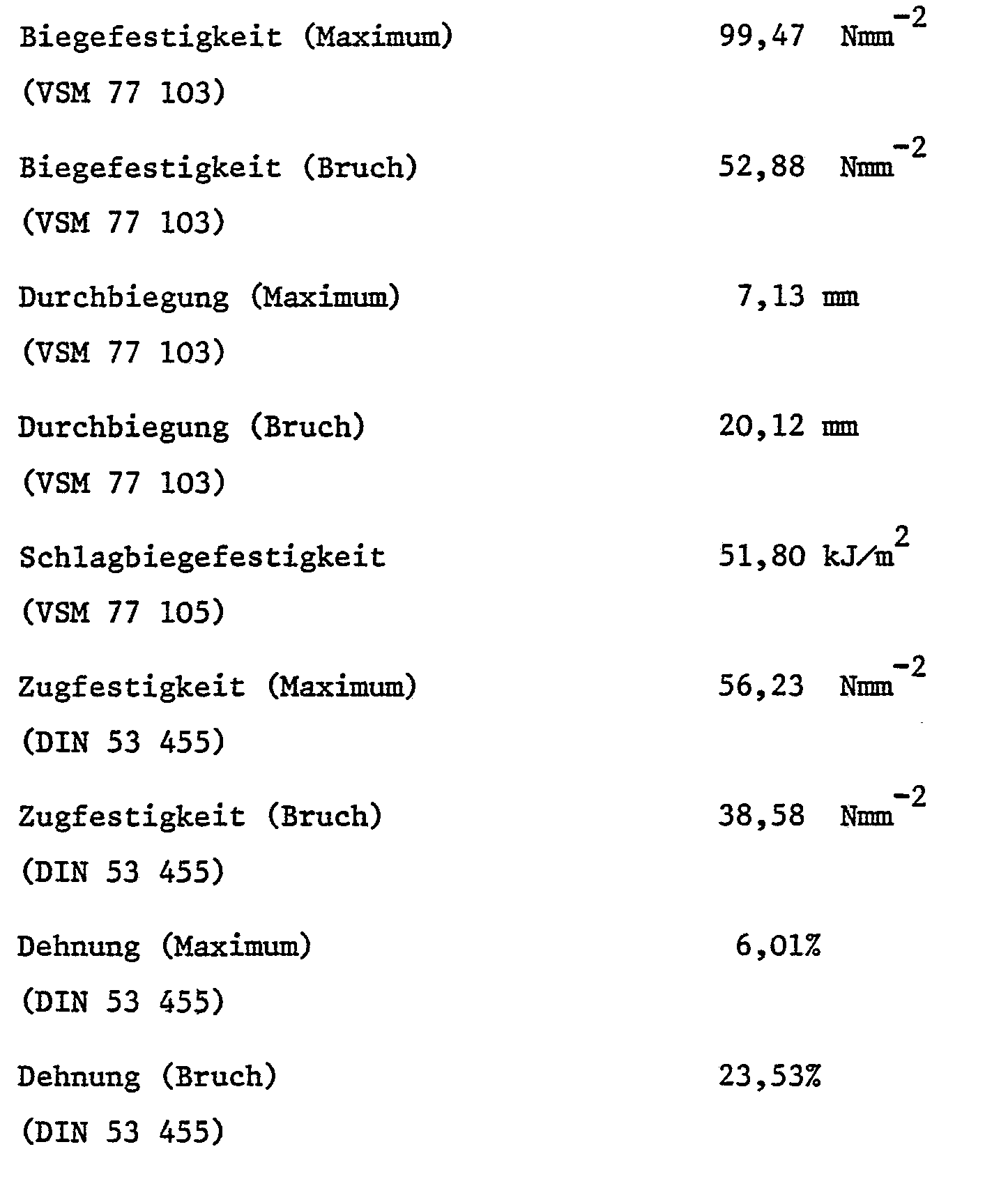
- Beispiel 8: Man verfährt wie im Beispiel 7, jedoch mit dem Unterschied, dass man im Molverhältnis ca. 2:1 136,62 g (0,99 Mol) N-Cyancaprolactam und 63,48 g (0,46 Mol) 1,4-Bis-(hydroxymethyl)-benzol sowie lg (0,5 Gew.-% bezogen auf die Gesamtmenge der beiden Reaktionspartner) 4-Dimethylaminopyridin als Katalysator zur Reaktion bringt. Die zur Klärung der Mischung erforderliche Temperatur beträgt 120°C. Das entgaste Reaktonsgemisch wird in eine auf 130°C vorgewärmte Form gegossen.
- Die Härtung erfolgt während 2 Stunden bei 130°C und 1 Stunde bei 180°C.
- Es werden Formplatten mit folgenden Eigenschaften erhalten:
-
- Die folgenden Mischungen werden erstellt:

- Es werden Formplatten mit folgenden Eigenschaften erhalten:

- Beispiel 10 Man verfährt wie im Beispiel 7, jedoch mit dem Unterschied, dass man anstelle von Trimethylolpropan 1,4-Bis-(hydroxymethyl)-cyclohexan verwendet. Die zur Klärung der Mischungen erforderliche Temperatur beträgt 80°C.
- Die folgenden Mischungen werden erstellt:

- Das vorbehandelte Reaktionsgemisch wird in Formen gegossen, die auf 80°C vorgewärmt wurden. Die Härtung erfolgt während 4 Stunden bei 100°C und 1 Stunde bei 180°C.
- Es werden Formplatten mit folgenden Eigenschaften erhalten:

Claims (9)


Applications Claiming Priority (2)
| Application Number | Priority Date | Filing Date | Title |
|---|---|---|---|
| CH405580 | 1980-05-23 | ||
| CH4055/80 | 1980-05-23 |
Publications (3)
| Publication Number | Publication Date |
|---|---|
| EP0041048A2 true EP0041048A2 (de) | 1981-12-02 |
| EP0041048A3 EP0041048A3 (en) | 1982-09-22 |
| EP0041048B1 EP0041048B1 (de) | 1985-01-02 |
Family
ID=4268976
Family Applications (1)
| Application Number | Title | Priority Date | Filing Date |
|---|---|---|---|
| EP81810189A Expired EP0041048B1 (de) | 1980-05-23 | 1981-05-18 | Gemische zur Herstellung von stickstoffhaltigen Polyaddukten |
Country Status (5)
| Country | Link |
|---|---|
| US (1) | US4368317A (de) |
| EP (1) | EP0041048B1 (de) |
| JP (1) | JPS5718728A (de) |
| CA (1) | CA1182950A (de) |
| DE (1) | DE3168018D1 (de) |
Families Citing this family (1)
| Publication number | Priority date | Publication date | Assignee | Title |
|---|---|---|---|---|
| IT1212123B (it) * | 1986-02-21 | 1989-11-08 | Ciba Geigy Spa | Nuovi composti polimerici contenenti gruppi piperidinici, utilizzabili come stabilizzanti per polimeri sintetici. |
Family Cites Families (8)
| Publication number | Priority date | Publication date | Assignee | Title |
|---|---|---|---|---|
| BE631857A (de) * | 1962-05-04 | |||
| US3291673A (en) * | 1962-05-14 | 1966-12-13 | Nippon Carbide Kogyo Kk | Process of bonding articles with alkylene dicyanamide at temperatures below 100u deg. |
| US3308101A (en) * | 1963-09-24 | 1967-03-07 | Du Pont | Novel polymeric materials |
| DE1905098A1 (de) * | 1969-02-01 | 1970-08-13 | Bayer Ag | Verfahren zur Herstellung von Polyamiden |
| US3642725A (en) * | 1969-11-05 | 1972-02-15 | Bayer Ag | Polymers of polyfunctional cyanamides of secondary amines |
| US3779997A (en) * | 1972-06-12 | 1973-12-18 | Minnesota Mining & Mfg | Poly(hexasubstituted melamines) |
| DE2533126A1 (de) * | 1975-07-24 | 1977-02-10 | Bayer Ag | Polytriazine und ein verfahren zu deren herstellung |
| DE2533119A1 (de) * | 1975-07-24 | 1977-02-10 | Bayer Ag | Hochmolekulare polytriazine aus loeslichen polymeren n-cyan-isoharnstoffaethern |
-
1981
- 1981-05-11 US US06/262,571 patent/US4368317A/en not_active Expired - Fee Related
- 1981-05-18 EP EP81810189A patent/EP0041048B1/de not_active Expired
- 1981-05-18 DE DE8181810189T patent/DE3168018D1/de not_active Expired
- 1981-05-21 CA CA000378011A patent/CA1182950A/en not_active Expired
- 1981-05-22 JP JP7789881A patent/JPS5718728A/ja active Pending
Also Published As
| Publication number | Publication date |
|---|---|
| EP0041048B1 (de) | 1985-01-02 |
| US4368317A (en) | 1983-01-11 |
| DE3168018D1 (en) | 1985-02-14 |
| JPS5718728A (en) | 1982-01-30 |
| EP0041048A3 (en) | 1982-09-22 |
| CA1182950A (en) | 1985-02-19 |
Similar Documents
| Publication | Publication Date | Title |
|---|---|---|
| EP0105024B1 (de) | Substituierte ungesättigte bicyclische Imide und deren Polymeren | |
| EP0166693B1 (de) | Substituierte ungesättigte, hydroxylgruppenhaltige bicyclische Imide und deren Polymere | |
| EP0227598A1 (de) | Stabile imidenthaltende Stoffgemische | |
| DE69125131T2 (de) | Herstellung von Verbindungen | |
| DE69033049T2 (de) | Epoxydharze auf Basis von Naphthol, Verfahren für ihre Herstellung und diese enthaltende Epoxydharzverbindungen | |
| EP0018950A1 (de) | Einkomponentensysteme auf der Basis kristalliner Epoxidharze und ihre Verwendung | |
| DE3035807A1 (de) | Verfahen zur tiefenhaertung photohaertbarer massen | |
| DE2838842C2 (de) | ||
| DE68904944T2 (de) | Polyalkenylphenolverbindung. | |
| DE1904110A1 (de) | Neue langkettige,aliphatische oder cycloaliphatische Saeurereste enthaltende Polyglycidylester,Verfahren zu ihrer Herstellung und ihrer Anwendung | |
| EP0385937A1 (de) | Härtbare Gemische auf Basis von aromatischen Bismaleinimiden | |
| DE2549403A1 (de) | Haertbare gemische | |
| EP0231149B1 (de) | Mercaptan enthaltende Polyphenole | |
| EP0041048B1 (de) | Gemische zur Herstellung von stickstoffhaltigen Polyaddukten | |
| EP0157740A2 (de) | Glycidyloxydiketone | |
| DE1570958B2 (de) | Latent härtbare Harzmasse | |
| DE1418692B2 (de) | Neue glycidylaether und verfahren zu ihrer herstellung | |
| DE3750305T2 (de) | Polymaleimid und eine Zusammensetzung, die dieses Polymer enthält. | |
| EP0190102B1 (de) | Substituierte ungesättigte, sulfonyloxygruppenhaltige bicyclische Imide als Katalysatoren für die kationische Polymerisation | |
| DE1470785C3 (de) | Verfahren zur Herstellung von Epoxydpolyaddukten | |
| DE2319815A1 (de) | Propionsaeureglycidylestergruppen enthaltende cycloalkanone | |
| EP0297030B1 (de) | Epoxidgruppenhaltige Polycycloacetale | |
| DE1816095A1 (de) | Neue heterocyclische N,N'-Diglycidylverbindungen,Verfahren zu ihrer Herstellung und ihre Anwendung | |
| DE2342432A1 (de) | Neue hydroxyalkyl-verbindungen und das verfahren zu ihrer herstellung | |
| EP0047228B1 (de) | Gemische zur Herstellung von stickstoffhaltigen Polyaddukten |
Legal Events
| Date | Code | Title | Description |
|---|---|---|---|
| PUAI | Public reference made under article 153(3) epc to a published international application that has entered the european phase |
Free format text: ORIGINAL CODE: 0009012 |
|
| 17P | Request for examination filed |
Effective date: 19810520 |
|
| AK | Designated contracting states |
Designated state(s): CH DE FR GB NL |
|
| PUAL | Search report despatched |
Free format text: ORIGINAL CODE: 0009013 |
|
| AK | Designated contracting states |
Designated state(s): CH DE FR GB NL |
|
| GRAA | (expected) grant |
Free format text: ORIGINAL CODE: 0009210 |
|
| AK | Designated contracting states |
Designated state(s): CH DE FR GB LI NL |
|
| REF | Corresponds to: |
Ref document number: 3168018 Country of ref document: DE Date of ref document: 19850214 |
|
| ET | Fr: translation filed | ||
| PLBE | No opposition filed within time limit |
Free format text: ORIGINAL CODE: 0009261 |
|
| STAA | Information on the status of an ep patent application or granted ep patent |
Free format text: STATUS: NO OPPOSITION FILED WITHIN TIME LIMIT |
|
| 26N | No opposition filed | ||
| PGFP | Annual fee paid to national office [announced via postgrant information from national office to epo] |
Ref country code: NL Payment date: 19870531 Year of fee payment: 7 |
|
| PG25 | Lapsed in a contracting state [announced via postgrant information from national office to epo] |
Ref country code: NL Effective date: 19881201 |
|
| NLV4 | Nl: lapsed or anulled due to non-payment of the annual fee | ||
| PG25 | Lapsed in a contracting state [announced via postgrant information from national office to epo] |
Ref country code: FR Free format text: LAPSE BECAUSE OF NON-PAYMENT OF DUE FEES Effective date: 19890131 |
|
| REG | Reference to a national code |
Ref country code: FR Ref legal event code: ST |
|
| PG25 | Lapsed in a contracting state [announced via postgrant information from national office to epo] |
Ref country code: GB Effective date: 19890518 |
|
| PG25 | Lapsed in a contracting state [announced via postgrant information from national office to epo] |
Ref country code: LI Effective date: 19890531 Ref country code: CH Effective date: 19890531 |
|
| GBPC | Gb: european patent ceased through non-payment of renewal fee | ||
| REG | Reference to a national code |
Ref country code: CH Ref legal event code: PL |
|
| PG25 | Lapsed in a contracting state [announced via postgrant information from national office to epo] |
Ref country code: DE Effective date: 19900201 |