EP0041329A2 - Verfahren zur selektiven Adsorption von Sauerstoff - Google Patents
Verfahren zur selektiven Adsorption von Sauerstoff Download PDFInfo
- Publication number
- EP0041329A2 EP0041329A2 EP81302163A EP81302163A EP0041329A2 EP 0041329 A2 EP0041329 A2 EP 0041329A2 EP 81302163 A EP81302163 A EP 81302163A EP 81302163 A EP81302163 A EP 81302163A EP 0041329 A2 EP0041329 A2 EP 0041329A2
- Authority
- EP
- European Patent Office
- Prior art keywords
- oxygen
- nitrogen
- air
- adsorption
- temperature
- Prior art date
- Legal status (The legal status is an assumption and is not a legal conclusion. Google has not performed a legal analysis and makes no representation as to the accuracy of the status listed.)
- Granted
Links
Images


Classifications
-
- B—PERFORMING OPERATIONS; TRANSPORTING
- B01—PHYSICAL OR CHEMICAL PROCESSES OR APPARATUS IN GENERAL
- B01J—CHEMICAL OR PHYSICAL PROCESSES, e.g. CATALYSIS OR COLLOID CHEMISTRY; THEIR RELEVANT APPARATUS
- B01J20/00—Solid sorbent compositions or filter aid compositions; Sorbents for chromatography; Processes for preparing, regenerating or reactivating thereof
- B01J20/02—Solid sorbent compositions or filter aid compositions; Sorbents for chromatography; Processes for preparing, regenerating or reactivating thereof comprising inorganic material
- B01J20/10—Solid sorbent compositions or filter aid compositions; Sorbents for chromatography; Processes for preparing, regenerating or reactivating thereof comprising inorganic material comprising silica or silicate
- B01J20/16—Alumino-silicates
- B01J20/18—Synthetic zeolitic molecular sieves
-
- B—PERFORMING OPERATIONS; TRANSPORTING
- B01—PHYSICAL OR CHEMICAL PROCESSES OR APPARATUS IN GENERAL
- B01D—SEPARATION
- B01D53/00—Separation of gases or vapours; Recovering vapours of volatile solvents from gases; Chemical or biological purification of waste gases, e.g. engine exhaust gases, smoke, fumes, flue gases, aerosols
- B01D53/02—Separation of gases or vapours; Recovering vapours of volatile solvents from gases; Chemical or biological purification of waste gases, e.g. engine exhaust gases, smoke, fumes, flue gases, aerosols by adsorption, e.g. preparative gas chromatography
- B01D53/04—Separation of gases or vapours; Recovering vapours of volatile solvents from gases; Chemical or biological purification of waste gases, e.g. engine exhaust gases, smoke, fumes, flue gases, aerosols by adsorption, e.g. preparative gas chromatography with stationary adsorbents
-
- B—PERFORMING OPERATIONS; TRANSPORTING
- B01—PHYSICAL OR CHEMICAL PROCESSES OR APPARATUS IN GENERAL
- B01D—SEPARATION
- B01D2253/00—Adsorbents used in seperation treatment of gases and vapours
- B01D2253/10—Inorganic adsorbents
- B01D2253/106—Silica or silicates
- B01D2253/108—Zeolites
-
- B—PERFORMING OPERATIONS; TRANSPORTING
- B01—PHYSICAL OR CHEMICAL PROCESSES OR APPARATUS IN GENERAL
- B01D—SEPARATION
- B01D2256/00—Main component in the product gas stream after treatment
- B01D2256/10—Nitrogen
-
- B—PERFORMING OPERATIONS; TRANSPORTING
- B01—PHYSICAL OR CHEMICAL PROCESSES OR APPARATUS IN GENERAL
- B01D—SEPARATION
- B01D2256/00—Main component in the product gas stream after treatment
- B01D2256/12—Oxygen
-
- B—PERFORMING OPERATIONS; TRANSPORTING
- B01—PHYSICAL OR CHEMICAL PROCESSES OR APPARATUS IN GENERAL
- B01D—SEPARATION
- B01D2257/00—Components to be removed
- B01D2257/10—Single element gases other than halogens
- B01D2257/102—Nitrogen
-
- B—PERFORMING OPERATIONS; TRANSPORTING
- B01—PHYSICAL OR CHEMICAL PROCESSES OR APPARATUS IN GENERAL
- B01D—SEPARATION
- B01D2257/00—Components to be removed
- B01D2257/10—Single element gases other than halogens
- B01D2257/104—Oxygen
-
- B—PERFORMING OPERATIONS; TRANSPORTING
- B01—PHYSICAL OR CHEMICAL PROCESSES OR APPARATUS IN GENERAL
- B01D—SEPARATION
- B01D2259/00—Type of treatment
- B01D2259/40—Further details for adsorption processes and devices
- B01D2259/402—Further details for adsorption processes and devices using two beds
-
- B—PERFORMING OPERATIONS; TRANSPORTING
- B01—PHYSICAL OR CHEMICAL PROCESSES OR APPARATUS IN GENERAL
- B01D—SEPARATION
- B01D53/00—Separation of gases or vapours; Recovering vapours of volatile solvents from gases; Chemical or biological purification of waste gases, e.g. engine exhaust gases, smoke, fumes, flue gases, aerosols
- B01D53/02—Separation of gases or vapours; Recovering vapours of volatile solvents from gases; Chemical or biological purification of waste gases, e.g. engine exhaust gases, smoke, fumes, flue gases, aerosols by adsorption, e.g. preparative gas chromatography
- B01D53/04—Separation of gases or vapours; Recovering vapours of volatile solvents from gases; Chemical or biological purification of waste gases, e.g. engine exhaust gases, smoke, fumes, flue gases, aerosols by adsorption, e.g. preparative gas chromatography with stationary adsorbents
- B01D53/047—Pressure swing adsorption
Definitions
- This invention relates to a novel process for the selective adsorption of oxygen in order to separate, remove or concentrate oxygen from a mixed gas consisting essentially of oxygen and nitrogen, for example, the air.
- separation or concentration of oxygen can be achieved either by a process for separating oxygen or by a process for separating nitrogen as far as the air is used as a starting material.
- a representative example of them is a process in which a deep cooling separation apparatus is used which is designed to cool the air to extremely low temperatures to separate oxygen or nitrogen making use of difference in the boiling point between oxygen and nitrogen.
- This apparatus is suited for producing a large amount of oxygen and production of most of oxygen and nitrogen in this country depends upon the deep cooling separation apparatus.
- this prior art is disadvantageous in that a large amount of power and a large-scale installments are needed for operating the process.
- aluminasilicate based high molecular adsorbents recently developed by Union Carbide Corporation, etc. and put to practical use.
- these adsorbents those called molecular sieves "5A” and “13X” (tradenames for products of Union Carbide Corporation) have a very high adsorptivity (1.2 g N 2/ 100 g at NTP) to nitrogen and therefore, a process for the separation or concentration of oxygen by removing nitrogen selectively from the air using these adsorbents has been put to practical use.
- the molecular sieves of the types of "5A” and “13X” have an adsorptivity which follows Langmuir adsorption isotherm and when the pressure reaches 1.5 ata the increase in its adsorptivity is not so large as compared with the increase in the pressure, and a very large amount of nitrogen is needed since molar ratio of N 2/ 0 2 of the air is 4. Therefore, scale merit accompanying enlargement of the apparatus is rather small, which will limit the application of this prior art process to small volume installments.
- a process which uses a transient metal based organic complex capable of selectively absorbing oxygen could be considered useful.
- a cyclic cobalt complex called "salcomine” can absorb 1 mol of oxygen per 2 mols of salcomine.
- the absorption by salcomine is reversible with respect to changes in temperature and pressure so that it is theoretically possible to achieve separation or concentration of oxygen by means of temperature increase-temperature decrease cycle or pressure increase-pressure decrease cycle of the air.
- sever deterioration of the organic complex occurs according as absorption and liberation of oxygen are repeated and the organic complex itself is expensive. Therefore, its application will practically be limited to use as a special carrier.
- the separation, removal or concentration of oxygen can generally been classified into two groups from the practical viewpoint. That is, on one hand, for a small volume oxygen production process, a pressure swing process is used in which nitrogen is removed from the air using molecular sieves, and on the other hand, for a large volume oxygen production process, a deep cooling separation process is used in which the air is cooled to an extremely low temperature.
- a pressure swing process is used in which nitrogen is removed from the air using molecular sieves
- a deep cooling separation process is used in which the air is cooled to an extremely low temperature.
- an object of this invention is to improve the defects of the above-described conventional processes for producing oxygen and provide an adsorbent capable of adsorbing oxygen preferentially, thereby decreasing costs incurred for the production of oxygen remarkably and miniaturizing the installments used in the process for the production of oxygen to a greater extent.
- Na-A type zeolite does not adsorb oxygen selectively at room temperature when it is charged in an adsorbing column and the air is passed therethrough at high pressures but behaves, like the above-described molecular sieves "5A” and "13X", as a nitrogen-selective adsorbent, while under cooling conditions at a temperature below room temperature, the amount of oxygen adsorbed increases but that of nitrogen decreases with decreased temperature and at about -30°C the adsorption of nitrogen becomes negligible as compared with that of oxygen resulting in that the Na-A type zeolite comes to serve as oxygen-selective adsorbent for two-component system consisting essentially of oxygen and nitrogen which, in appearance, adsorbs oxygen almost exclusively.
- Japanese Patent Publication No. 1161/65 describes to the effect that Na-A type zeolite adsorbs nitrogen in an amount 3 times as large as that of oxygen at room temperature but the adsorption rate of oxygen is higher than that of nitrogen so that when passing the air through an adsorbing column charged with Na-A type zeolite at high rates the zeolite therein can in appearance behave as an oxygen-selective adsorbent in a dynamic state.
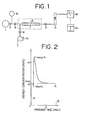
- Fig.l is a schematical illustration of an apparatus designed so as to measure the air separability of the Na-A type zeolite.
- Reference numeral 1 is a high pressure air cylinder.
- the high pressure air discharged from the cylinder is supplied, via a decompressor 2, to a valve 3.
- a Bourdon's tube barometer is arranged between the decompressor 2 and the valve 3 to enable measurement of the pressure.
- the inlet pressure was adjusted to 5 ata by means of the decompressor 2 and the Bourdon's tube barometer 4.
- adsorbing column 6 having an inner diameter of 10 mm and a length of 300 ml was charged with the Na-A type zeolite 7 immediately after washing with water, which did not show any adsorptivity at all. For this reason, the adsorbing column 6 was arranged in a temperature controlling bath 8 capable of being adjusted of its temperature over the range of from -70°C to 600°C. In order to pretreat the adsorbent the valve 3 and a valve 5 were closed, a valve 9 was opened, the pressure in the adsorbing column was reduced to 0.1 Torr using a vacuum pump 10, the temperature controlling bath 8 was adjusted to 45.0°C and dehydration treatment was carried out for 1 hour.
- valves 3, 5 were opened again to pass the high pressure air which was fed in toto, via a float type flow meter 11, to an oxygen densitometer 12 to measure the outlet 0 2 concentration.
- the data thus-obtained were recorded with an automatic recording meter 13.
- F ig. 2 shows an example of change in the outlet 0 2 concentration with the passage of time in the case where the testing apparatus as shown in Fig. 1 was used and the adsorbing column 6 was charged with 15 g of the Na-A type zeolite powders with adjusting the inlet gas flow rate to 100 N ml/min. and the inlet air pressure to 5 ata.
- the horizontal axis X indicates time with its scale being calibrated in minute, while the vertical axis Y represents oxygen concentration in volume %.
- a standard line a is drawn at an oxygen concentration of 20.8 %. From the data on change in the outlet oxygen concentration of the Na-A type zeolite with lapse of time shown in Fig. 2 it can be seen that the outlet oxygen concentration decreases initially from 20.8 % to 18 %, then increases rapidly to 46 % followed by decreasing gradually till the break through of the adsorbent which occurred about 5 minutes after the outset of passing the air.
- the amount of oxygen adsorbed per unit time is larger than the amount of nitrogen adsorbed per unit time in the initial stage of adsorption and as a result the outlet oxygen concentration decreases.
- the amount of nitrogen adsorbed per unit time exceeds that of oxygen adsorbed per unit time and the outlet oxygen concentrations increases. Thereafter, the adsorbent becomes saturated with oxygen and nitrogen and therefore the outlet oxygen concentration comes to decrease gradually and reaches finally the inlet gas concentration.
- the amount of oxygen or nitrogen adsorbed by Na-A type zeolite in a single component system of oxygen or nitrogen is 2.2 ml of oxygen or 6.2 ml of nitrogen per g of the adsorbent under the conditions of 20°C and 1 ata as described in Kitagawa and Suzuki: "Fundamentals and Design of Adsorption" page 226.
- change in the outlet oxygen concentration with lapse of time as shown in Fig. 2 was determined using the same apparatus as shown in Fig. 1 with changing the inlet gas flow rate to 50,200 or 300 N ml/min. and keeping other conditions the same as those in the case where it is 100 N ml/min.
- Na-A type zeolites have special properties which have as far as is known, not been described in or suggested from any publications at all. That is, Na-A type zeolites exhibit the above-described air separability at room temperature, while both minimum and maximum values of the outlet oxygen concentration decrease with decreased temperature and they behave as a complete oxygen-preferential adsorbent under dynamic adsorption conditions where at about -30°C, the amount of nitrogen adsorbed is so small as compared with that of oxygen adsorbed that the former can be considered negligible.
- the process for the selective adsorption and separation of oxygen according to this invention is superior in purity of the outlet nitrogen gas and oxygen collectivity of the adsorbent over the conventional processes for the adsorption and separation of oxygen using Na-A type zeolite at room temperature since selectivity of the adsorbent is very high in this invention.
- the temperature of the temperature controlling bath 8 was decreased from room temperature to -30°C to cool the inlet air and the adsorbent and change in the outlet oxygen concentration with lapse of time for each temperature was measured.
- Data on change in the outlet oxygen concentration with lapse of time when the temperature of the adsorbing tower was adjusted to 0°C and -30°C are shown in Figs. 3 and 4, respectively.
- the reference numerals are the same as used in Fig. 2.
- the graphs shown in Figs. 2, 3 and 4 are based on the data of repeated adsorption carried out by closing the valves 3, 5 after the break through of the adsorbent, opening a valve 9, regenerating the adsorbed gas under isothermal conditions using the vacuum pump 10, reopening the valves 3, 5, reclosing the valve 9 and passing high pressure air through the adsorbing column.
- adsorption and description cycles each for at least about 24 hours, data on change in the outlet oxygen concentration with lapse of time obtained under the same conditions always showed a good reproducibility.
- Fig. 4 shows that in the change in the outlet oxygen concentration with lapse of time, the initial decrease in the oxygen concentration reduces to 1.5 % and after staying in the neighbourhood of 1.5 % for a while it increases gradually, but its maximum value is 22 % at most.
- the process for the selective adsorption and separation of oxygen with Na-A type zeolite according to this invention is a quite novel process for adsorption and separation which is selective to oxygen and has not been suggested in any publications as far as is known.
- This process has an advantage in that a very large amount of oxygen can be adsorbed as well as the following features.
- the process for the selection adsorption and separation of oxygen according to this invention can widely be applied to a variety of fields.
- an oxygen concentration apparatus making use of molecular sieves it is applicable either to temperature swing type or to pressure swing type and provides on oxygen adsorptivity which is overwhelmingly superior over that of the conventional N 2 adsorption type molecular sieves, thereby cutting a path to miniaturization of apparatus used and reduction in the costs for the concentration of oxygen.
- the adsorbent for oxygen of this invention can be used in the removal of oxygen from other gases having different composition.
- this invention provides a very cheap agent for the adsorption and removal of oxygen.
- Temperature conditions at lower temperature side cannot be selected depending upon the above-described properties of adsorbents alone.
- an absorption refrigerating machine may be used.
- a temperature of about -25°C is optional.
- an optional temperature is about -10°C and when.an expansion tubine driven by pressure nitrogen gas after having passed through the adsorbing column a temperature range of -30°C to -50°C is preferred.
- suitable temperature which is to be selected at lower temperature side depends on the manner of cooling rather than the properties of the adsorbent.
- Fig. 5 shows a schematic illustration of a pressure swing type oxygen producing apparatus.
- reference numerals 17 - 24 are automatic change-over valves
- 25, 26 are adsorbing columns packed with the oxygen adsorbent used in this invention.
- 27 is a heat exchanger for cooling to low temperature
- 28 is an adsorbing column for defumidifying and removing carbonaceous gas
- 29 is a precooler
- 30 is an air compressor
- 31 is an air strainer
- 32 is a throttle valve. Control device and the like for controlling the automatic change over valves, etc. are not shown.
- the adsorbing column 25 is in the step of adsorption and the adsorbing column 26 in the step of regeneration.
- the air supplied through the air strainer 31 and removed of dusts is pressurized by the air compressor 30 and then predehydrated and cooled to room temperature in the precooler 29.
- the air After dehumidifying and removing carbonaceous gas in the adsorbing column 28, the air is further cooled in the heat exchanger for cooling to low temperature 27 to -30°C and is fed via the valve 20 to the adsorbing column 25 in which oxygen in the pressurized air is adsorbed selectively by the adsorbent and the air is enriched with nitrogen.
- This nitrogen-rich air is fed out of the adsorbing column 25 through the valve 17.
- the valves 17, 20 attached to the adsorbing column 25 are opened and the valves 18, 19 are closed.
- the adsorbent in the adsorbing column 26 is regenerated under reduced pressure while adsorption operation is under way in the adsorbing column 25. That is, at that time of the valves 21 to 24 attached to the adsorbing column 26, the valves 21, 22, 24 are closed and the valve 23 is open and the pressure within the adsorbing column 26 is reduced to atmospheric or subatmospheric pressure to desorb a portion of the adsorbate adsorbed during the step of adsorption and the air enriched with oxygen is fed out from the adsorbing column via the valve 23.
- valve 22- is opened and the air is fed into the adsorbing column 26 via the throttle valves 32 and the valve 22 by means of a ventilating means (not shown) to operate a step of scavenging in which oxygen-rich air-gap gas and the remaining adsorbate in the adsorbing column are brought out via the valve 23.
- the adsorbing column is subjected to the step of adsorption and at the same time the adsorbing column 25 is subjected to the step of regeneration.
- steps of adsorption and regeneration are repeated continually to take out oxygen-rich air and (or) nitrogen-rich air.
- an adsorbing column having an inner diameter of 50 mm and a length of 600 mm is packed with 1 kg of Na-A type zeolite molded into balls of about 1 mm in diameter using a conventional tablet machine, and adsorption and separation of oxygen is carried out under low temperature conditions of inlet air flow rate of 20 Nl/min. and a temperature of -30°C with the pressure of the air supplied being swung between 1 and 5 eta.
Landscapes
- Chemical & Material Sciences (AREA)
- Analytical Chemistry (AREA)
- Chemical Kinetics & Catalysis (AREA)
- Engineering & Computer Science (AREA)
- General Chemical & Material Sciences (AREA)
- Oil, Petroleum & Natural Gas (AREA)
- Inorganic Chemistry (AREA)
- Organic Chemistry (AREA)
- Separation Of Gases By Adsorption (AREA)
- Solid-Sorbent Or Filter-Aiding Compositions (AREA)
Applications Claiming Priority (2)
| Application Number | Priority Date | Filing Date | Title |
|---|---|---|---|
| JP6710080A JPS56163717A (en) | 1980-05-22 | 1980-05-22 | Selective adsorbing method of oxygen |
| JP67100/80 | 1980-05-22 |
Publications (3)
| Publication Number | Publication Date |
|---|---|
| EP0041329A2 true EP0041329A2 (de) | 1981-12-09 |
| EP0041329A3 EP0041329A3 (en) | 1982-01-20 |
| EP0041329B1 EP0041329B1 (de) | 1984-10-10 |
Family
ID=13335123
Family Applications (1)
| Application Number | Title | Priority Date | Filing Date |
|---|---|---|---|
| EP19810302163 Expired EP0041329B1 (de) | 1980-05-22 | 1981-05-15 | Verfahren zur selektiven Adsorption von Sauerstoff |
Country Status (3)
| Country | Link |
|---|---|
| EP (1) | EP0041329B1 (de) |
| JP (1) | JPS56163717A (de) |
| DE (1) | DE3166562D1 (de) |
Cited By (2)
| Publication number | Priority date | Publication date | Assignee | Title |
|---|---|---|---|---|
| EP0144430A4 (de) * | 1983-03-08 | 1985-07-30 | Daido Oxygen | Vorrichtung zur herstellung von stickstoffgas hoher reinheit. |
| EP0512781A1 (de) * | 1991-05-09 | 1992-11-11 | The BOC Group plc | Verbesserungen in Druckwechsel-Adsorptionsvorrichtungen |
Families Citing this family (1)
| Publication number | Priority date | Publication date | Assignee | Title |
|---|---|---|---|---|
| JPS60147086A (ja) * | 1984-01-11 | 1985-08-02 | 大同酸素株式会社 | 高純度窒素ガス製造装置 |
Family Cites Families (1)
| Publication number | Priority date | Publication date | Assignee | Title |
|---|---|---|---|---|
| SU516410A1 (ru) * | 1973-12-06 | 1976-06-05 | Ленинградский технологический институт холодильной промышленности | Способ очистки аргона |
-
1980
- 1980-05-22 JP JP6710080A patent/JPS56163717A/ja active Granted
-
1981
- 1981-05-15 EP EP19810302163 patent/EP0041329B1/de not_active Expired
- 1981-05-15 DE DE8181302163T patent/DE3166562D1/de not_active Expired
Cited By (2)
| Publication number | Priority date | Publication date | Assignee | Title |
|---|---|---|---|---|
| EP0144430A4 (de) * | 1983-03-08 | 1985-07-30 | Daido Oxygen | Vorrichtung zur herstellung von stickstoffgas hoher reinheit. |
| EP0512781A1 (de) * | 1991-05-09 | 1992-11-11 | The BOC Group plc | Verbesserungen in Druckwechsel-Adsorptionsvorrichtungen |
Also Published As
| Publication number | Publication date |
|---|---|
| JPS56163717A (en) | 1981-12-16 |
| JPS6226808B2 (de) | 1987-06-11 |
| EP0041329B1 (de) | 1984-10-10 |
| DE3166562D1 (en) | 1984-11-15 |
| EP0041329A3 (en) | 1982-01-20 |
Similar Documents
| Publication | Publication Date | Title |
|---|---|---|
| EP0040935A2 (de) | Sauerstoff-Adsorbent und seine Anwendung zur Trennung von Sauerstoff und Stickstoff | |
| EP0008619B1 (de) | Verfahren zur schnellen adiabatischen Druckwechseladsorption | |
| US5085674A (en) | Duplex adsorption process | |
| US5411721A (en) | Process for the rejection of CO2 from natural gas | |
| Kikkinides et al. | Concentration and recovery of carbon dioxide from flue gas by pressure swing adsorption | |
| US3237377A (en) | Oxygen concentration process | |
| CA2234924C (en) | Multilayer adsorbent beds for psa gas separation | |
| JP2988625B2 (ja) | 温度スイング吸着方法 | |
| US4421531A (en) | Adiabatic pressure swing absorption process for removing low concentrations of oxygen from mixed gas streams | |
| CA2236611C (en) | Ozone recovery by zeolite adsorbents | |
| US5492682A (en) | Hydrogen purification | |
| US5689974A (en) | Method and apparatus for pre-purification for air cryogenic separation plant | |
| EP0458350B1 (de) | Verbesserte Steuerung der Durchführung der Druckwechseladsorption | |
| JPH0359727B2 (de) | ||
| Rege et al. | Kinetic separation of oxygen and argon using molecular sieve carbon | |
| ATE284753T1 (de) | Selektiver zeolith-x für argon/sauerstoff | |
| ZA200702064B (en) | Combined cryogenic distillation and PSA for argon production | |
| CN1059267C (zh) | 超纯氮的生产 | |
| KR20080102160A (ko) | 압축 공기 생성 방법 및 생성 장치 | |
| US4421530A (en) | Process for removing oxygen from mixed gas streams using a swing adiabatic absorption-isothermal desorption cycle | |
| JPH0459926B2 (de) | ||
| JP2004148315A (ja) | 原料ガス流からの亜酸化窒素除去方法及び装置 | |
| EP0041329B1 (de) | Verfahren zur selektiven Adsorption von Sauerstoff | |
| GB2171927A (en) | Method and apparatus for separating a gaseous mixture | |
| Sircar et al. | A pressure swing adsorption process for production of 23–50% oxygen-enriched air |
Legal Events
| Date | Code | Title | Description |
|---|---|---|---|
| PUAI | Public reference made under article 153(3) epc to a published international application that has entered the european phase |
Free format text: ORIGINAL CODE: 0009012 |
|
| PUAL | Search report despatched |
Free format text: ORIGINAL CODE: 0009013 |
|
| AK | Designated contracting states |
Designated state(s): BE DE FR GB LU NL |
|
| AK | Designated contracting states |
Designated state(s): BE DE FR GB LU NL |
|
| 17P | Request for examination filed |
Effective date: 19820510 |
|
| GRAA | (expected) grant |
Free format text: ORIGINAL CODE: 0009210 |
|
| AK | Designated contracting states |
Designated state(s): BE DE FR GB LU NL |
|
| REF | Corresponds to: |
Ref document number: 3166562 Country of ref document: DE Date of ref document: 19841115 |
|
| ET | Fr: translation filed | ||
| PLBE | No opposition filed within time limit |
Free format text: ORIGINAL CODE: 0009261 |
|
| STAA | Information on the status of an ep patent application or granted ep patent |
Free format text: STATUS: NO OPPOSITION FILED WITHIN TIME LIMIT |
|
| 26N | No opposition filed | ||
| REG | Reference to a national code |
Ref country code: GB Ref legal event code: 746 |
|
| REG | Reference to a national code |
Ref country code: FR Ref legal event code: DL |
|
| EPTA | Lu: last paid annual fee | ||
| PGFP | Annual fee paid to national office [announced via postgrant information from national office to epo] |
Ref country code: GB Payment date: 19970506 Year of fee payment: 17 |
|
| PGFP | Annual fee paid to national office [announced via postgrant information from national office to epo] |
Ref country code: FR Payment date: 19970513 Year of fee payment: 17 |
|
| PGFP | Annual fee paid to national office [announced via postgrant information from national office to epo] |
Ref country code: DE Payment date: 19970523 Year of fee payment: 17 |
|
| PGFP | Annual fee paid to national office [announced via postgrant information from national office to epo] |
Ref country code: NL Payment date: 19970529 Year of fee payment: 17 |
|
| PGFP | Annual fee paid to national office [announced via postgrant information from national office to epo] |
Ref country code: LU Payment date: 19970612 Year of fee payment: 17 |
|
| PGFP | Annual fee paid to national office [announced via postgrant information from national office to epo] |
Ref country code: BE Payment date: 19970627 Year of fee payment: 17 |
|
| PG25 | Lapsed in a contracting state [announced via postgrant information from national office to epo] |
Ref country code: LU Free format text: LAPSE BECAUSE OF NON-PAYMENT OF DUE FEES Effective date: 19980515 Ref country code: GB Free format text: LAPSE BECAUSE OF NON-PAYMENT OF DUE FEES Effective date: 19980515 |
|
| PG25 | Lapsed in a contracting state [announced via postgrant information from national office to epo] |
Ref country code: FR Free format text: LAPSE BECAUSE OF NON-PAYMENT OF DUE FEES Effective date: 19980531 Ref country code: BE Free format text: LAPSE BECAUSE OF NON-PAYMENT OF DUE FEES Effective date: 19980531 |
|
| BERE | Be: lapsed |
Owner name: MITSUBISHI JUKOGYO K.K. Effective date: 19980531 |
|
| PG25 | Lapsed in a contracting state [announced via postgrant information from national office to epo] |
Ref country code: NL Free format text: LAPSE BECAUSE OF NON-PAYMENT OF DUE FEES Effective date: 19981201 |
|
| GBPC | Gb: european patent ceased through non-payment of renewal fee |
Effective date: 19980515 |
|
| NLV4 | Nl: lapsed or anulled due to non-payment of the annual fee |
Effective date: 19981201 |
|
| PG25 | Lapsed in a contracting state [announced via postgrant information from national office to epo] |
Ref country code: DE Free format text: LAPSE BECAUSE OF NON-PAYMENT OF DUE FEES Effective date: 19990302 |
|
| REG | Reference to a national code |
Ref country code: FR Ref legal event code: ST |