EP0042674B1 - Procédé pour le raffinage de liquides électriquement isolants - Google Patents
Procédé pour le raffinage de liquides électriquement isolants Download PDFInfo
- Publication number
- EP0042674B1 EP0042674B1 EP81302408A EP81302408A EP0042674B1 EP 0042674 B1 EP0042674 B1 EP 0042674B1 EP 81302408 A EP81302408 A EP 81302408A EP 81302408 A EP81302408 A EP 81302408A EP 0042674 B1 EP0042674 B1 EP 0042674B1
- Authority
- EP
- European Patent Office
- Prior art keywords
- absorbent
- process according
- electric field
- liquid
- electric insulating
- Prior art date
- Legal status (The legal status is an assumption and is not a legal conclusion. Google has not performed a legal analysis and makes no representation as to the accuracy of the status listed.)
- Expired
Links
- 239000007788 liquid Substances 0.000 title claims abstract description 58
- 238000000034 method Methods 0.000 title claims abstract description 41
- 238000007670 refining Methods 0.000 title claims description 6
- 239000002250 absorbent Substances 0.000 claims abstract description 63
- 230000002745 absorbent Effects 0.000 claims abstract description 63
- 239000000356 contaminant Substances 0.000 claims abstract description 28
- 230000005684 electric field Effects 0.000 claims abstract description 27
- 239000002245 particle Substances 0.000 claims abstract description 22
- 239000010457 zeolite Substances 0.000 claims abstract description 13
- 229910021536 Zeolite Inorganic materials 0.000 claims abstract description 12
- HNPSIPDUKPIQMN-UHFFFAOYSA-N dioxosilane;oxo(oxoalumanyloxy)alumane Chemical compound O=[Si]=O.O=[Al]O[Al]=O HNPSIPDUKPIQMN-UHFFFAOYSA-N 0.000 claims abstract description 12
- OKTJSMMVPCPJKN-UHFFFAOYSA-N Carbon Chemical group [C] OKTJSMMVPCPJKN-UHFFFAOYSA-N 0.000 claims description 20
- 238000010521 absorption reaction Methods 0.000 claims description 20
- 239000011148 porous material Substances 0.000 claims description 14
- 150000001875 compounds Chemical class 0.000 claims description 10
- PNEYBMLMFCGWSK-UHFFFAOYSA-N aluminium oxide Inorganic materials [O-2].[O-2].[O-2].[Al+3].[Al+3] PNEYBMLMFCGWSK-UHFFFAOYSA-N 0.000 claims description 9
- NLYAJNPCOHFWQQ-UHFFFAOYSA-N kaolin Chemical compound O.O.O=[Al]O[Si](=O)O[Si](=O)O[Al]=O NLYAJNPCOHFWQQ-UHFFFAOYSA-N 0.000 claims description 9
- 239000011362 coarse particle Substances 0.000 claims description 8
- 239000000203 mixture Substances 0.000 claims description 5
- 230000003068 static effect Effects 0.000 claims description 5
- 239000005995 Aluminium silicate Substances 0.000 claims description 4
- 235000012211 aluminium silicate Nutrition 0.000 claims description 4
- 230000008030 elimination Effects 0.000 claims description 3
- 238000003379 elimination reaction Methods 0.000 claims description 3
- 238000001556 precipitation Methods 0.000 claims description 3
- 239000011248 coating agent Substances 0.000 claims description 2
- 238000000576 coating method Methods 0.000 claims description 2
- 239000011810 insulating material Substances 0.000 claims description 2
- 239000002184 metal Substances 0.000 claims 4
- 229910052751 metal Inorganic materials 0.000 claims 4
- 150000002739 metals Chemical class 0.000 claims 2
- 150000002736 metal compounds Chemical class 0.000 claims 1
- 229910021645 metal ion Inorganic materials 0.000 claims 1
- 239000012535 impurity Substances 0.000 abstract description 16
- 239000000463 material Substances 0.000 description 13
- 239000003921 oil Substances 0.000 description 8
- 239000010419 fine particle Substances 0.000 description 6
- 238000009833 condensation Methods 0.000 description 5
- 230000005494 condensation Effects 0.000 description 5
- 230000000694 effects Effects 0.000 description 4
- 239000000126 substance Substances 0.000 description 4
- 230000006866 deterioration Effects 0.000 description 3
- 239000013541 low molecular weight contaminant Substances 0.000 description 3
- UFHFLCQGNIYNRP-UHFFFAOYSA-N Hydrogen Chemical compound [H][H] UFHFLCQGNIYNRP-UHFFFAOYSA-N 0.000 description 2
- XEEYBQQBJWHFJM-UHFFFAOYSA-N Iron Chemical compound [Fe] XEEYBQQBJWHFJM-UHFFFAOYSA-N 0.000 description 2
- 239000012530 fluid Substances 0.000 description 2
- 238000010438 heat treatment Methods 0.000 description 2
- 239000001257 hydrogen Substances 0.000 description 2
- 229910052739 hydrogen Inorganic materials 0.000 description 2
- 150000002500 ions Chemical class 0.000 description 2
- RYGMFSIKBFXOCR-UHFFFAOYSA-N Copper Chemical compound [Cu] RYGMFSIKBFXOCR-UHFFFAOYSA-N 0.000 description 1
- 206010041662 Splinter Diseases 0.000 description 1
- 230000003213 activating effect Effects 0.000 description 1
- 230000004523 agglutinating effect Effects 0.000 description 1
- 230000004520 agglutination Effects 0.000 description 1
- 229910052782 aluminium Inorganic materials 0.000 description 1
- -1 aluminum silicates Chemical class 0.000 description 1
- QVGXLLKOCUKJST-UHFFFAOYSA-N atomic oxygen Chemical compound [O] QVGXLLKOCUKJST-UHFFFAOYSA-N 0.000 description 1
- 229910052793 cadmium Inorganic materials 0.000 description 1
- BDOSMKKIYDKNTQ-UHFFFAOYSA-N cadmium atom Chemical compound [Cd] BDOSMKKIYDKNTQ-UHFFFAOYSA-N 0.000 description 1
- 229910052802 copper Inorganic materials 0.000 description 1
- 239000010949 copper Substances 0.000 description 1
- 238000010586 diagram Methods 0.000 description 1
- 239000010735 electrical insulating oil Substances 0.000 description 1
- 230000005611 electricity Effects 0.000 description 1
- 238000011043 electrofiltration Methods 0.000 description 1
- 229910001385 heavy metal Inorganic materials 0.000 description 1
- 229910052742 iron Inorganic materials 0.000 description 1
- 235000000396 iron Nutrition 0.000 description 1
- 239000002480 mineral oil Substances 0.000 description 1
- 239000002808 molecular sieve Substances 0.000 description 1
- 239000001301 oxygen Substances 0.000 description 1
- 229910052760 oxygen Inorganic materials 0.000 description 1
- 238000006116 polymerization reaction Methods 0.000 description 1
- 238000002360 preparation method Methods 0.000 description 1
- 230000008929 regeneration Effects 0.000 description 1
- 238000011069 regeneration method Methods 0.000 description 1
- 238000000926 separation method Methods 0.000 description 1
- URGAHOPLAPQHLN-UHFFFAOYSA-N sodium aluminosilicate Chemical compound [Na+].[Al+3].[O-][Si]([O-])=O.[O-][Si]([O-])=O URGAHOPLAPQHLN-UHFFFAOYSA-N 0.000 description 1
- 239000007787 solid Substances 0.000 description 1
- 238000007738 vacuum evaporation Methods 0.000 description 1
- 239000008158 vegetable oil Substances 0.000 description 1
- 235000013311 vegetables Nutrition 0.000 description 1
Images
Classifications
-
- C—CHEMISTRY; METALLURGY
- C10—PETROLEUM, GAS OR COKE INDUSTRIES; TECHNICAL GASES CONTAINING CARBON MONOXIDE; FUELS; LUBRICANTS; PEAT
- C10G—CRACKING HYDROCARBON OILS; PRODUCTION OF LIQUID HYDROCARBON MIXTURES, e.g. BY DESTRUCTIVE HYDROGENATION, OLIGOMERISATION, POLYMERISATION; RECOVERY OF HYDROCARBON OILS FROM OIL-SHALE, OIL-SAND, OR GASES; REFINING MIXTURES MAINLY CONSISTING OF HYDROCARBONS; REFORMING OF NAPHTHA; MINERAL WAXES
- C10G25/00—Refining of hydrocarbon oils in the absence of hydrogen, with solid sorbents
-
- B—PERFORMING OPERATIONS; TRANSPORTING
- B01—PHYSICAL OR CHEMICAL PROCESSES OR APPARATUS IN GENERAL
- B01D—SEPARATION
- B01D15/00—Separating processes involving the treatment of liquids with solid sorbents; Apparatus therefor
-
- B—PERFORMING OPERATIONS; TRANSPORTING
- B03—SEPARATION OF SOLID MATERIALS USING LIQUIDS OR USING PNEUMATIC TABLES OR JIGS; MAGNETIC OR ELECTROSTATIC SEPARATION OF SOLID MATERIALS FROM SOLID MATERIALS OR FLUIDS; SEPARATION BY HIGH-VOLTAGE ELECTRIC FIELDS
- B03C—MAGNETIC OR ELECTROSTATIC SEPARATION OF SOLID MATERIALS FROM SOLID MATERIALS OR FLUIDS; SEPARATION BY HIGH-VOLTAGE ELECTRIC FIELDS
- B03C5/00—Separating dispersed particles from liquids by electrostatic effect
-
- C—CHEMISTRY; METALLURGY
- C10—PETROLEUM, GAS OR COKE INDUSTRIES; TECHNICAL GASES CONTAINING CARBON MONOXIDE; FUELS; LUBRICANTS; PEAT
- C10G—CRACKING HYDROCARBON OILS; PRODUCTION OF LIQUID HYDROCARBON MIXTURES, e.g. BY DESTRUCTIVE HYDROGENATION, OLIGOMERISATION, POLYMERISATION; RECOVERY OF HYDROCARBON OILS FROM OIL-SHALE, OIL-SAND, OR GASES; REFINING MIXTURES MAINLY CONSISTING OF HYDROCARBONS; REFORMING OF NAPHTHA; MINERAL WAXES
- C10G32/00—Refining of hydrocarbon oils by electric or magnetic means, by irradiation, or by using microorganisms
- C10G32/02—Refining of hydrocarbon oils by electric or magnetic means, by irradiation, or by using microorganisms by electric or magnetic means
Definitions
- the present invention relates to a process for efficiently absorbing and eliminating impurities in electric insulating liquids by means of a combination of high electric field action and ion-radical absorbent action.
- impurities consists primarily of low molecular weight materials ordinarily present in low concentrations in the electric insulating liquid.
- oily liquids such as vegetable or mineral oils are used as insulating liquids and these materials are relatively pure electric insulating liquids per se.
- life of such insulating oils depends upon the degree of refinement from the polar compounds or unsaturated compounds which are present in the oils, when a low degree of refining of such oils is carried out.
- Such polar and/or unsaturated compounds serve to deteriorate the electric insulating capacities of the liquid by, e.g. making them more conductive and thus such polar and unsaturated compounds are undesirable.
- the conventionally used oily insulating liquids deteriorate as a result of polymerization caused by the existing oxygen or hydrogen in the liquids, or by condensation due to the existence of hydrogen generated from a Corona discharge when used as an electric insulating liquid.
- the insulating oils should be refined as highly as possible before pouring into an electrical device so as to eliminate electrically conductive impurities of low molecular weight at low concentrations as discussed above, which contaminants seem to represent the chief cause of deterioration of these liquids.
- the fine particles of contaminants found in insulating liquids e.g., polar compounds and unsaturated compounds
- absorbents such as activated kaolin or activated alumina
- the coarse or large particles have been eliminated by such means as a percolator or a centrifugal separation and precipitation device.
- This large pore size causes a loss of the oily liquid itself because the pore sizes of these materials are such as to absorb substantial quantities of such insulating liquid, while at the same low molecular weight fine particles of contaminants are not sufficiently absorbed by such activated alumina and kaolin materials, because such activated absorbents indiscriminately permit the absorption of the oil and low molecular weight materials and do not preferentially absorb the low molecular weight contaminants, which is the very purpose of such absorption procedure.
- the absorbing powers of these kaolin and alumina materials are such that the pore capillarity of said materials are not very strong compared with the viscous resistance of the oils and thus the absorbing power is limited and the percentages of low molecular weight contaminants of low concentration absorbed by these conventional materials are extremely low and practically non- existent.
- activated kaolin has the capacity to lower the concentration of such contaminants only to 50-60 ppm whereas activated alumina lowers it to about 30 ppm.
- the hydrate concentration less than this figure, i.e. to 5-10 ppm it is necessary to use vacuum evaporation together with the absorbing process and a large quantity of absorbent and a long processing time are required.
- One method is to impart a static electrical field to the condensation absorbent mixed with the insulating liquid and another method is to impart a static voltage from an electrode where the porous substances are initially filled in between the electrodes.
- the former method has the disadvantage that the condensation absorbent immersed in the liquid causes oil deterioration and the latter method has the disadvantage that leaking electric current increases in the early stage by agglutinating the fine particles to the substance to be filtered and it takes time to reproduce the absorbing fine particles, which are re-scattered in the liquid by the action of this electric current.
- a process of refining an electric insulating liquid to remove contaminant particles therefrom comprises applying an electric field to the liquid to ionize or charge the contaminant particles and exposing the liquid to a surface contactant to which said contaminant particles adhere, characterised by exposure, subsequent to an ionizer stage, to an absorbent having an ion-radical structure with small pores to remove finer charged contaminant particles and then elimination of coarse particles, not previously absorbed, by means of separator.
- Such absorbent material having an ion-radical such as zeolite, has pores which are generally smaller than the molecules of the electrical insulating liquid whose absorption thereby is therefore inhibited but at the same time the pores are large enough to permit the smaller, lower molecular weight, molecules of the contaminants or impurities, particularly electrically conductive impurities, to be selectively and preferentially absorbed.
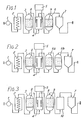
- Figure 1 represents one embodiment of the present invention.
- 1 is a pump
- 2 is a heater
- 3 is a front treatment tank
- 4 is an ionizer
- 5 is its power resource device
- 6 is an absorption tank
- 7 is a percolator.
- the front treatment tank 3 is filled with absorbents 8, such as activated kaolin and activated alumina, and the insulative effect of the untreated liquid increases by dehydrating and eliminating most of the condensation molecules by absorption after contacting the absorbent material 8.
- the front treatment tank 3 is a first absorbent treatment designed to increase the effect of ionizing and electrifying the insulating material in the ionizer 4.
- other absorbents such as activated carbon or a zeolite absorbent can be used in the same tank as long as the same results and effect are obtained or indeed mixtures of such absorbents may be used.
- the heater 2 is for activating the absorptive capacity of the front treatment tank 3 and the heating temperature is 50-60°C, when the activated kaolin or the activated alumina is used in the front treatment tank 3. If other absorbents are used, it is desirable to maintain the heating temperature below this range because the liquid easily deteriorates at temperatures higher than 60°C.
- a high voltage electric field is imparted to the untreated liquid.
- This high voltage electric field can be replaced by a static electric field, an alternating electric field, a high frequency electric field and combined or superimposed electric fields, etc.
- the means are not so important as the ultimate objective which is to ionize or charge the impurities so that they are easily removed in a subsequent absorptive step described later.
- the impurities in the liquid are ionized or charged with electricity and at the same time the fine particles are condensed and tend to adhere to each other in solution, thereby forming somewhat larger or coarser particles.
- the ionized and electrified liquid in ionizer 4 of Figure 1 is sent into the following absorption tank 6.
- a granule-shaped or splinter-shaped absorbent 9 having ion-radicals in its structure is present in the absorption tank 6.
- a zeolite absorbent can be employed, and/or an activated absorbent, such as an activated carbon material and/or a resinous absorbent or mixtures thereof, as long as the absorbent has an ion-radical in its structure.
- Preferred absorbents are zeolite and activated carbon.
- zeolites are a class of synthetic aluminum silicates that can be hydrated, and are of the type: These compounds have been disclosed in detailed in R. F. Gould "Molecular Sieve Zeolites-I", Advances in Chemistry Series 101, American Chemical Society, Washington, D.C. 1971.
- zeolite absorbents contemplated herein are ordinarily less than 1 nanometre [10 angstroms (A)] and that of activated carbon absorbents are usually less than 4 nanometres [40 angstoms (A)] in general, these porous structures are so much smaller than the molecules of the treated electric insulating liquid that the molecules of the liquid are not absorbed and thus loss of the liquid as happens in the prior art method is avoided.
- the pore sizes of such absorbents are small, they have a high capacity to absorb the low molecular impurities present in such liquids and this, coupled with the coulomb force or attraction between the absorbent and the charged impurities in the previous step, makes it possible with the use of such absorbents to selectively eliminate these low molecular weight contaminants which interfere with the insulating properties of the electrical insulating fluid.
- the absorbent may be an absorbent with an ion-radical or a cation-radical, or mixtures thereof, depending on whether or not the charge on the contaminants is positive or negative.
- the absorbent such as a zeolite absorbent
- the absorbent is coated on the surface thereof with the same substance or conductive contaminants known to exist in the insulating fluids, such as iron, copper and cadmium molecules or irons.
- the absorption of impurities is speeded up by virtue of the multilayer electro-static effect that occurs, in that the same kind of ion grows in accumulated layers in stratified form, when the heavy metal ion begins to agglutinate on the surface of the absorbent.
- the liquid is passed through the absorption tank 6 into the percolator 7 where the coarse or large particles which are unabsorbed by the absorbent in absorption tank 6 are separated out or eliminated.
- this percolator can be substituted in Figure 1 by any device which can eliminate the coarse particles directly so a device such as a centrifuge and precipitation tank can be used instead of the percolator 7.
- These coarse impurities are those impurities which become agglutinated by the action of the high voltage electric field applied in the ionizer 4 which cause the particles to grow to micro-unit size, such that they are not absorbed by the absorbent 9 in the tank 6.
- FIG. 2 shows another embodiment of the present invention having two absorption tanks following the ionizer 4.
- the first absorption tank 6a is filled with an absorbent having anion-radicals, such as zeolite absorbent and a second absortion tank 6b filled with an absorbent having a cation-radical in its structure, such as typified by activated carbon absorbents; these two absorption tanks 6a and 6b have absorbents of opposite polarities.
- the cation-radical impurities in the electrical insulating liquid are eliminated in the first absorption tank 6a and the anion-radical impurities are eliminated in the second absorption tank 6b.
- the absorbent used may have many types of ion-radicals in its structure
- the absorbent for each absorption tank can be suitably chosen so as to eliminate contaminants charged with oppositely charged impurities.
- the other parts of the apparatus are the same as in Figure 1 namely, the pump 1, the heater 2, the front treatment tank 3, the ionizer 4 and the percolator 7 are the same as in Figure 1.
- FIG. 3 shows still another embodiment of the present invention.
- an idle tank 10 is installed between the absorption tank 6 and the direct eliminating device, such as the percolator 7.
- the tank 10 serves to maintain the liquid in the tank to condense and agglutinate the particles so as to facilitate efficient elimination in percolator 7 and/or any other particle eliminating device.
- the pipes between tank 6 and percolator 7 may be adjusted in length to increase the time between the exit from tank 7 and entrance into percolator 7 so as to provide sufficient time to increase the condensation or agglutination of the particles not absorbed in the absorbent 6.
- the heater 2 and the front treatment tank 3 comprising the first treatment steps of the disclosed process, preceding the ionizer 4 can be suitably modified or omitted in the case when the insulating liquid having good insulating quality is refined.
- refining herein is also meant the regeneration of the used liquid so as to purify the electrical insulating liquid after being used in an electrical device.
Landscapes
- Chemical & Material Sciences (AREA)
- Oil, Petroleum & Natural Gas (AREA)
- Chemical Kinetics & Catalysis (AREA)
- Engineering & Computer Science (AREA)
- General Chemical & Material Sciences (AREA)
- Organic Chemistry (AREA)
- Life Sciences & Earth Sciences (AREA)
- Microbiology (AREA)
- Analytical Chemistry (AREA)
- Treatment Of Liquids With Adsorbents In General (AREA)
- Lubricants (AREA)
- Organic Insulating Materials (AREA)
- Electrostatic Separation (AREA)
- Solid-Sorbent Or Filter-Aiding Compositions (AREA)
- Water Treatment By Electricity Or Magnetism (AREA)
Claims (20)
Priority Applications (1)
| Application Number | Priority Date | Filing Date | Title |
|---|---|---|---|
| AT81302408T ATE8969T1 (de) | 1980-06-19 | 1981-06-01 | Verfahren zum raffinieren elektrisch isolierender fluessigkeiten. |
Applications Claiming Priority (2)
| Application Number | Priority Date | Filing Date | Title |
|---|---|---|---|
| JP8383480A JPS579002A (en) | 1980-06-19 | 1980-06-19 | Method of refining electrically insulating liquid |
| JP83834/80 | 1980-06-19 |
Publications (3)
| Publication Number | Publication Date |
|---|---|
| EP0042674A2 EP0042674A2 (fr) | 1981-12-30 |
| EP0042674A3 EP0042674A3 (en) | 1982-05-12 |
| EP0042674B1 true EP0042674B1 (fr) | 1984-08-15 |
Family
ID=13813719
Family Applications (1)
| Application Number | Title | Priority Date | Filing Date |
|---|---|---|---|
| EP81302408A Expired EP0042674B1 (fr) | 1980-06-19 | 1981-06-01 | Procédé pour le raffinage de liquides électriquement isolants |
Country Status (4)
| Country | Link |
|---|---|
| EP (1) | EP0042674B1 (fr) |
| JP (1) | JPS579002A (fr) |
| AT (1) | ATE8969T1 (fr) |
| DE (1) | DE3165546D1 (fr) |
Cited By (1)
| Publication number | Priority date | Publication date | Assignee | Title |
|---|---|---|---|---|
| US9928026B2 (en) | 2006-09-12 | 2018-03-27 | Sonos, Inc. | Making and indicating a stereo pair |
Families Citing this family (3)
| Publication number | Priority date | Publication date | Assignee | Title |
|---|---|---|---|---|
| US4502957A (en) * | 1981-11-24 | 1985-03-05 | Ciba-Geigy Corporation | Process for purifying organic solutions |
| CN111760328B (zh) * | 2020-07-08 | 2022-06-10 | 山东西奥生物科技有限公司 | 一种老旧变压器油性能恢复工艺与复合吸附柱及其装填和再生方法 |
| WO2023089354A1 (fr) * | 2021-11-16 | 2023-05-25 | Hediger Richard | Procédé de production d'un additif pour carburant |
Family Cites Families (8)
| Publication number | Priority date | Publication date | Assignee | Title |
|---|---|---|---|---|
| CH545130A (fr) * | 1970-09-15 | 1973-12-15 | Battelle Memorial Institute | Procédé de purification d'une solution conductrice ionique |
| DE2436498A1 (de) * | 1974-07-29 | 1976-02-12 | Karl Heinz Hartkorn | Oxidations- und adsorptions-verfahren zur entfernung von stoerenden stoffen in fluessigkeiten |
| JPS523802A (en) * | 1975-06-24 | 1977-01-12 | Furukawa Electric Co Ltd | Production of foamed polyolefin leather |
| JPS5294000A (en) * | 1976-02-02 | 1977-08-08 | Nissin Electric Co Ltd | Method of refining orthophosphoric acid ester oil for electric insulation |
| JPS5295099A (en) * | 1976-02-04 | 1977-08-10 | Nissin Electric Co Ltd | Method of refining orthophosphoric acid ester oil for electric insulation |
| JPS53143999A (en) * | 1977-05-20 | 1978-12-14 | Nissin Electric Co Ltd | Method of refining positive phosphoric ester oil for electric insulation |
| US4139441A (en) * | 1978-02-10 | 1979-02-13 | Chevron Research Company | Electrofiltration with bi-directional potential pretreatment |
| JPS5513175A (en) * | 1978-07-17 | 1980-01-30 | Inoue Sangyo Kk | Filtration |
-
1980
- 1980-06-19 JP JP8383480A patent/JPS579002A/ja active Pending
-
1981
- 1981-06-01 AT AT81302408T patent/ATE8969T1/de not_active IP Right Cessation
- 1981-06-01 EP EP81302408A patent/EP0042674B1/fr not_active Expired
- 1981-06-01 DE DE8181302408T patent/DE3165546D1/de not_active Expired
Cited By (1)
| Publication number | Priority date | Publication date | Assignee | Title |
|---|---|---|---|---|
| US9928026B2 (en) | 2006-09-12 | 2018-03-27 | Sonos, Inc. | Making and indicating a stereo pair |
Also Published As
| Publication number | Publication date |
|---|---|
| JPS579002A (en) | 1982-01-18 |
| ATE8969T1 (de) | 1984-09-15 |
| EP0042674A2 (fr) | 1981-12-30 |
| EP0042674A3 (en) | 1982-05-12 |
| DE3165546D1 (en) | 1984-09-20 |
Similar Documents
| Publication | Publication Date | Title |
|---|---|---|
| US4941962A (en) | Electrostatic adsorptive fluid filtering apparatus | |
| US3839176A (en) | Method and apparatus for removing contaminants from liquids | |
| US5106468A (en) | Electrophoretic separation | |
| US5861089A (en) | Electric field enhanced coalescence of emulsions comprising a silicon containing compound or silicon containing polymer | |
| US4579637A (en) | Method and apparatus for separating impurities from low conductivity liquids | |
| US3767571A (en) | Oil removal from waste waters | |
| DE3629102C2 (fr) | ||
| EP0042674B1 (fr) | Procédé pour le raffinage de liquides électriquement isolants | |
| US4358379A (en) | Process for refining electric insulating liquids | |
| GB2177625A (en) | Fluid filtering apparatus | |
| US3970536A (en) | Liquid treating method and apparatus | |
| Larson et al. | Electrical and chemical demulsification techniques for microemulsion liquid membranes | |
| US8357289B2 (en) | Method and system for removing contaminants from a fluid | |
| US4634510A (en) | Clarifying a contaminated fluid | |
| CN205774345U (zh) | 一种静电与聚结滤油机装置 | |
| US2336542A (en) | Method of treating emulsions | |
| RU2240865C1 (ru) | Сорбирующий материал, способ его изготовления и использования | |
| EP0179870B1 (fr) | Separation d'une phase dispersee d'une phase continue | |
| KR830002254B1 (ko) | 전기 절연성 액체의 정제방법 | |
| JPH0889845A (ja) | フィルタ | |
| CN1230131A (zh) | 静电聚结 | |
| CA1306442C (fr) | Methode d'aspiration d'une phrase dispersee d'une phase continue, et appareil connexe | |
| SU1068170A1 (ru) | Способ электростатической очистки слабопровод щих жидкостей | |
| CA1275069A (fr) | Separation de la phase disperse d'une phase continue | |
| CN114681956A (zh) | 乳液的破乳方法及其应用 |
Legal Events
| Date | Code | Title | Description |
|---|---|---|---|
| PUAI | Public reference made under article 153(3) epc to a published international application that has entered the european phase |
Free format text: ORIGINAL CODE: 0009012 |
|
| AK | Designated contracting states |
Designated state(s): AT BE CH DE FR GB IT LU NL SE |
|
| PUAL | Search report despatched |
Free format text: ORIGINAL CODE: 0009013 |
|
| AK | Designated contracting states |
Designated state(s): AT BE CH DE FR GB IT LU NL SE |
|
| 17P | Request for examination filed |
Effective date: 19820329 |
|
| ITF | It: translation for a ep patent filed | ||
| GRAA | (expected) grant |
Free format text: ORIGINAL CODE: 0009210 |
|
| AK | Designated contracting states |
Designated state(s): AT BE CH DE FR GB IT LI LU NL SE |
|
| REF | Corresponds to: |
Ref document number: 8969 Country of ref document: AT Date of ref document: 19840915 Kind code of ref document: T |
|
| REF | Corresponds to: |
Ref document number: 3165546 Country of ref document: DE Date of ref document: 19840920 |
|
| ET | Fr: translation filed | ||
| PLBE | No opposition filed within time limit |
Free format text: ORIGINAL CODE: 0009261 |
|
| STAA | Information on the status of an ep patent application or granted ep patent |
Free format text: STATUS: NO OPPOSITION FILED WITHIN TIME LIMIT |
|
| PG25 | Lapsed in a contracting state [announced via postgrant information from national office to epo] |
Ref country code: LU Free format text: LAPSE BECAUSE OF NON-PAYMENT OF DUE FEES Effective date: 19850630 |
|
| 26N | No opposition filed | ||
| PGFP | Annual fee paid to national office [announced via postgrant information from national office to epo] |
Ref country code: AT Payment date: 19860613 Year of fee payment: 6 |
|
| PGFP | Annual fee paid to national office [announced via postgrant information from national office to epo] |
Ref country code: NL Payment date: 19860630 Year of fee payment: 6 |
|
| PG25 | Lapsed in a contracting state [announced via postgrant information from national office to epo] |
Ref country code: AT Effective date: 19870601 |
|
| PG25 | Lapsed in a contracting state [announced via postgrant information from national office to epo] |
Ref country code: SE Effective date: 19870602 |
|
| PG25 | Lapsed in a contracting state [announced via postgrant information from national office to epo] |
Ref country code: LI Effective date: 19870630 Ref country code: CH Effective date: 19870630 |
|
| BERE | Be: lapsed |
Owner name: INOUE NOBORU Effective date: 19870630 |
|
| PG25 | Lapsed in a contracting state [announced via postgrant information from national office to epo] |
Ref country code: NL Effective date: 19880101 |
|
| NLV4 | Nl: lapsed or anulled due to non-payment of the annual fee | ||
| PG25 | Lapsed in a contracting state [announced via postgrant information from national office to epo] |
Ref country code: FR Free format text: LAPSE BECAUSE OF NON-PAYMENT OF DUE FEES Effective date: 19880226 |
|
| REG | Reference to a national code |
Ref country code: CH Ref legal event code: PL |
|
| PG25 | Lapsed in a contracting state [announced via postgrant information from national office to epo] |
Ref country code: DE Effective date: 19880301 |
|
| GBPC | Gb: european patent ceased through non-payment of renewal fee | ||
| REG | Reference to a national code |
Ref country code: FR Ref legal event code: ST |
|
| PG25 | Lapsed in a contracting state [announced via postgrant information from national office to epo] |
Ref country code: GB Effective date: 19881118 |
|
| PG25 | Lapsed in a contracting state [announced via postgrant information from national office to epo] |
Ref country code: BE Effective date: 19890630 |
|
| EUG | Se: european patent has lapsed |
Ref document number: 81302408.0 Effective date: 19880711 |