EP0043143B1 - Préparation stéréosélective de carboxylates d'acides cyclopropanoiques et leurs applications comme intermédiaires de pyréthroides - Google Patents
Préparation stéréosélective de carboxylates d'acides cyclopropanoiques et leurs applications comme intermédiaires de pyréthroides Download PDFInfo
- Publication number
- EP0043143B1 EP0043143B1 EP81105152A EP81105152A EP0043143B1 EP 0043143 B1 EP0043143 B1 EP 0043143B1 EP 81105152 A EP81105152 A EP 81105152A EP 81105152 A EP81105152 A EP 81105152A EP 0043143 B1 EP0043143 B1 EP 0043143B1
- Authority
- EP
- European Patent Office
- Prior art keywords
- compound
- solvent
- process according
- dehydrohalogenation
- effected
- Prior art date
- Legal status (The legal status is an assumption and is not a legal conclusion. Google has not performed a legal analysis and makes no representation as to the accuracy of the status listed.)
- Expired
Links
- 0 C*[N+]1(*)**1 Chemical compound C*[N+]1(*)**1 0.000 description 1
Classifications
-
- C—CHEMISTRY; METALLURGY
- C07—ORGANIC CHEMISTRY
- C07C—ACYCLIC OR CARBOCYCLIC COMPOUNDS
- C07C67/00—Preparation of carboxylic acid esters
- C07C67/30—Preparation of carboxylic acid esters by modifying the acid moiety of the ester, such modification not being an introduction of an ester group
Definitions
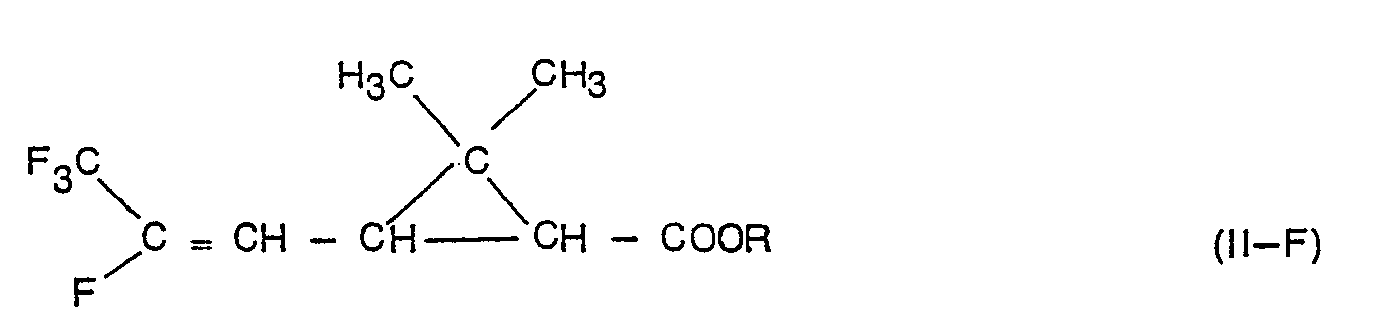
- This invention relates to a process for stereoselectively synthetizing intermediates for pyrethroids and, more particularly, to a two-step process for stereoselectively synthetizing lower alkyl esters of the cis-2,2-dimethyl-3-( ⁇ -fluoro-(3-trifluoromethyl-vinyl)-cyclopropanecarboxylic acid.
- the cis isomerism in the cyclopropane ring is the one which generally imparts the highest insecticide activity to synthetic pyrethroids, wherefore considerable efforts have been made in the research field with a view to isolating cis isomers or at least to obtaining mixtures enriched in the cis isomer.
- lactone is prepared in a somewhat complicated and expensive manner starting from lower alkyl esters of caronaldehyde (2,2-dimethyl-3-formyl-cyclopropane carboxylic acid).
- stereoselective syntheses limited as well to the preparation of 2,2-dimethyl-3-( ⁇ , ⁇ -dihalovinyl)-cyclopropane carboxylates, are described in "Synthetic Pyrethroids", ACS Symposium Series No. 42 - M. Elliott Editor - Washington 1977.
- Dehydrohalogenation is substantially conducted by treating the compounds of formula III with 2 equivalents of a base in a proper solvent.
- suitable bases are tertiary amines or alkaline alkoxides, particularly suited being the system consisting of an alkaline alkoxide and of the corresponding alcohol as solvent.
- sodium-tert.butoxide in tetrahydrofuran is employed as a base.
- British patent application No. 2,000,764 describes, but does not exemplify, the possibility of obtaining compounds of formula II by dehydrohalogenation with a base of compounds of formula A, B or C, but nothing is specified about the forming of single isomers.
- the only known method of obtaining an individual isomer of the compounds of formula II consists in separating it from the isomeric mixture by means of column chromatography or. fractionated crystallization of the carboxylate acids derived from the esters of formula II.
- Predominant formation of the cis isomer means that in the mixture of the two cis and trans isomers, the cis isomer constitutes at least 70% of said mixutre.
- GB-A-1 520 690 discloses the preparation of 6,6,6-trihalo-3,3-dimethyl-4-hexenoic acid esters, comprising dehydrohalogenating a corresponding 4,6,6,6-tetrahalo-3,3-dimethylhexanoic acid ester in which the 4-halogen atom is not iodine but is of higher atomic number than any of the 6-halog p n atoms with an organic amine.
- This publication does not describe the formation of cyclopropane rings in the obtained unsaturated acid esters.
- the process forming the object of this invention can be schematically represented as in the following scheme 1.
- the first step of the process (reaction 1, scheme 1) is conducted by dehydrohalogenating the compound of formula III ⁇ F, in which substituent Y is an atom of chlorine or of bromine (preferably bromine), by means of a primary or secondary amine, preferably a secondary cyclic amine, and in an apolar or low-polarity solvent.
- the temperature at which the reaction occurs is not critical. It can range from 0°C to the boiling temperature of the solvent. For practical purposes it is preferable to operate at the boiling temperature of the solvent in order to cause the reaction to occur more rapidly.
- a tertiary amine such as pyridine or triethylamine
- a tertiary amine such as pyridine or triethylamine
- reaction 1 As secondary amines suitable for being employed in reaction 1 we may cite: piperidine, pyrrolidine, morpholine, piperazine, tetramethylguanidine, etc., or also mixtures of various secondary amines.
- the amount of amine utilized for effecting the selective monohydrohalogenation of the compounds of formula III-F may be stoichiometric or in excess.
- Another possibility consists in employing an amine in catalytic amounts, namely in considerable defect in respect of the amount of halogenhydric acid (HY) to be neutralized.
- halogenhydric acid-accepting alkaline base it is possible to use a hydroxide a salt having an alkaline reaction or a hydride.
- the base is an alkaline hydroxide
- this may be used in aqueous solution
- the base is an alkaline hydride
- such hydride may be used as a suspension in the same reaction solvent.
- a two-phase system is so obtained which consists of an organic phase (apolar solvent, compound of formula 111-F, secondary amine) and of an aqueous phase (water, alkaline base), or of a solid phase (alkaline hydride).
- apolar solvent compound of formula 111-F, secondary amine
- aqueous phase water, alkaline base
- alkaline hydride solid phase
- reaction 1 is conducted by simply mixing the organic solvent with the base and with the compound of formula III-F and by heating, under stirring, the reaction mixture at the reflux temperature of the solvent. After a few hours a high conversion degree of the compound of formula III-F is reached.
- reaction conditions are analogous.
- reaction 2 consists in the dehydrohalogenation of compound A' obtained from step 1.
- reaction temperature is not critical when apolar solvents are used and, in this case, it is therefore possible to operate between 0°C and the reflux temperature of the solvent, the latter being preferred for practical purposes.
- Inorganic bases suited to reaction 2 are alkaline alcoholates or alkaline hydrides in the presence of alcoholates. Particularly suited is the use, for example, of at least a stoichiometric amounts of an alkaline hydride in the presence of a catalytic amount of an alcoholate prepared "in situ" by addition of a little amount of the corresponding alcohol.
- the reaction is conducted by mixing the solvent, the alkaline base and the compound of formula A' and by stirring the reaction mixture at the reflux temperature of the solvent, in the case of apolar solvents, or at a temperature lower than 50°C if an ether is used as a solvent.
- the compounds of formula II-F may exist in the form of isomers E and Z (isomerism on the double bond).
- reaction 1 By virtue of the high selectivity of reaction 1 also at high conversion percentages, it is possible to carry out the process forming the object of the present invention also according to a variant which proves particularly useful for practical purposes.
- Said variant consists in carrying out reactions 1 and 2 ----- without isolating compound A'.
- reaction 2 After having conducted reaction 1 according to the above-mentioned conditions, the resulting reaction mixture is additioned with a necessary amount of inorganic base, whereupon it is operated in accordance with what has been described for reaction 2.
- the process object of this invention allows to obtain, in a stereoselective way, the cis isomers of the cyclopropane carboxylic acids of formula II-F.
- reaction mixture was heated at reflux for 2 hours. After cooling, the organic phase was washed with acid water and successively with a NaOH solution at 10%, then with water up to a neutral pH, and anhydrified with anhydrous Na 2 SO 4 .
- the organic solution was distilled at reduced pressure collecting the fraction which distilled between 52.5° and 55°C at 0.5 mm Hg (25 g.).
- reaction mixture was maintained at reflux for 7 hours. After cooling, a sample of the organic phase subjected to gas chromatographic analysis revealed the complete disappearance of the starting ester and the appearance of one peak only corresponding to the compound ethyl 3,3-dimethyl-6-bromo-6,7,7,7-tetrafluoro-hept-4-enoate.
- the operative modalities are analogous to the ones of example 1.
- the tests from 3.1 to 3.6 evidence the high selectivity of reaction 1 towards compound A', when primary or secondary amines and low polar solvents are employed.
- the reaction mixture was kept under stirring at --- reflux temperature for 5 hours.
- the ratio between cis and trans isomers in the dehydrohalogenation product [ethyl-2,2-dimethyl-3-( ⁇ -trifluoromethyl-p-fluoro-vinyl)-cyclopropane was determined by means of gas chromatographic analysis (GLC).
- Tests 6.9 and 6.10 evidence how the same reaction, if conducted in high polar solvents, even at low temperature, is not stereoselective.
- the reaction mixture was maintained under stirring at reflux temperature for 7 hours.
- Object of this example is to describe the preparation of the analitically pure cis isomer of the compound ethyl 2,2-dimethyl-3-( ⁇ -trifluoromethyl- ⁇ -fluoro)vinyl-cyclopropane-carboxylate.
- fraction I consisted of the pure cis isomer
- fraction II consisted of the pure trans isomer
- fraction III was a mixture of cis and trans isomers.
- Alkyl C 1 -C 4 is methyl, ethyl, propyl, i-propyl, butyl, i-butyl, sec.-butyl and tert.-butyl.
Landscapes
- Chemical & Material Sciences (AREA)
- Organic Chemistry (AREA)
- Organic Low-Molecular-Weight Compounds And Preparation Thereof (AREA)
Claims (16)




Applications Claiming Priority (2)
| Application Number | Priority Date | Filing Date | Title |
|---|---|---|---|
| IT8023180A IT1131883B (it) | 1980-07-02 | 1980-07-02 | Processo per la sintesi stereoselettiva di ciclopropancarbossilati intermaedi per piretroidi |
| IT2318080 | 1980-07-02 |
Publications (3)
| Publication Number | Publication Date |
|---|---|
| EP0043143A2 EP0043143A2 (fr) | 1982-01-06 |
| EP0043143A3 EP0043143A3 (en) | 1982-10-13 |
| EP0043143B1 true EP0043143B1 (fr) | 1985-06-19 |
Family
ID=11204601
Family Applications (1)
| Application Number | Title | Priority Date | Filing Date |
|---|---|---|---|
| EP81105152A Expired EP0043143B1 (fr) | 1980-07-02 | 1981-07-02 | Préparation stéréosélective de carboxylates d'acides cyclopropanoiques et leurs applications comme intermédiaires de pyréthroides |
Country Status (6)
| Country | Link |
|---|---|
| US (1) | US4442301A (fr) |
| EP (1) | EP0043143B1 (fr) |
| JP (1) | JPS5745141A (fr) |
| CA (1) | CA1165770A (fr) |
| DE (1) | DE3171009D1 (fr) |
| IT (1) | IT1131883B (fr) |
Families Citing this family (4)
| Publication number | Priority date | Publication date | Assignee | Title |
|---|---|---|---|---|
| FR2499979A1 (fr) * | 1981-02-13 | 1982-08-20 | Roussel Uclaf | Procede d'epimerisation d'acides trans chrysanthemiques |
| US4772695A (en) * | 1982-09-24 | 1988-09-20 | Societe Nationale Des Poudres Et Explosifs | Process for the preparation of vinyl carbamates |
| JPH0773422B2 (ja) * | 1983-06-22 | 1995-08-02 | 山本電気株式会社 | 偏平用モーター電機子の製造装置 |
| GB9311054D0 (en) * | 1993-05-28 | 1993-07-14 | Zeneca Ltd | Preparation of cyclopropane esters |
Family Cites Families (9)
| Publication number | Priority date | Publication date | Assignee | Title |
|---|---|---|---|---|
| JPS5340741A (en) * | 1975-06-24 | 1978-04-13 | Sumitomo Chem Co Ltd | Novel preparation of 2,2-dimethyl-3-b,b-dihalovinyl-cyclopropanecarboxylic acid ester |
| JPS5912103B2 (ja) * | 1975-12-26 | 1984-03-21 | ザイダンホウジン サガミチユウオウカガクケンキユウシヨ | カルボンサンエステルノセイゾウホウホウ |
| US4330675A (en) * | 1977-01-24 | 1982-05-18 | Imperial Chemical Industries Limited | Halogenated esters |
| GB2000764B (en) * | 1977-03-23 | 1982-04-28 | Ici Ltd | Halogenated esters |
| US4243677A (en) * | 1978-01-20 | 1981-01-06 | Fmc Corporation | Insecticidal perhaloalkylvinylcyclopropanecarboxylates |
| IN150399B (fr) * | 1978-01-20 | 1982-09-25 | Fmc Corp | |
| US4258202A (en) * | 1978-02-28 | 1981-03-24 | Montedison S.P.A. | Cyclopropanecarboxylic acids and esters |
| BG48921A3 (en) * | 1978-02-28 | 1991-06-14 | Montedison Spa | Method for destroying of insects |
| DE2831193A1 (de) * | 1978-07-15 | 1980-01-24 | Bayer Ag | Fluoralkenylsubstituierte cyclopropancarbonsaeureester und ihre verwendung als insektizide |
-
1980
- 1980-07-02 IT IT8023180A patent/IT1131883B/it active
-
1981
- 1981-06-26 JP JP56098502A patent/JPS5745141A/ja active Granted
- 1981-06-29 CA CA000380843A patent/CA1165770A/fr not_active Expired
- 1981-06-29 US US06/278,676 patent/US4442301A/en not_active Expired - Fee Related
- 1981-07-02 EP EP81105152A patent/EP0043143B1/fr not_active Expired
- 1981-07-02 DE DE8181105152T patent/DE3171009D1/de not_active Expired
Also Published As
| Publication number | Publication date |
|---|---|
| US4442301A (en) | 1984-04-10 |
| EP0043143A3 (en) | 1982-10-13 |
| EP0043143A2 (fr) | 1982-01-06 |
| CA1165770A (fr) | 1984-04-17 |
| JPS5745141A (en) | 1982-03-13 |
| JPH0148255B2 (fr) | 1989-10-18 |
| DE3171009D1 (en) | 1985-07-25 |
| IT1131883B (it) | 1986-06-25 |
| IT8023180A0 (it) | 1980-07-02 |
Similar Documents
| Publication | Publication Date | Title |
|---|---|---|
| CH636073A5 (en) | Process for the preparation of substituted cyclopropanecarboxylates | |
| US4442301A (en) | Process for stereoselectively synthesizing cyclopropane carboxylates | |
| EP0221635B1 (fr) | Alcools fluorés et leurs esters insecticides | |
| US4937308A (en) | Preparation of alkyl O,O-dialkyl-γ-phosphonotiglates | |
| US4415748A (en) | Intermediates for insecticidal synthetic pyrethroids | |
| US4258202A (en) | Cyclopropanecarboxylic acids and esters | |
| KR100239232B1 (ko) | 할로겐화된 알콜의 제조방법 | |
| US9278899B2 (en) | Method for producing 3,5-dimethyldodecanoic acid; and 4-carboxy-3,5-Dimethyl-3,5-dodecadienoic acid | |
| US4285778A (en) | Process for the manufacture of halogenated hydrocarbons | |
| EP0010859A1 (fr) | Procédé de préparation d'esters d'acide cyclopropanecarboxylique | |
| EP0842137B1 (fr) | Procede de preparation d'acides cyclopropane carboxyliques et de leurs intermediaires | |
| US5047581A (en) | Isolation of cis-isomers from isomeric mixtures of cis/transcyclopropanecarboxylates | |
| JP3593127B2 (ja) | シクロプロパンエステルの製造 | |
| US4419524A (en) | Process for the preparation of dihalovinylcyclopropanecarboxylic acids | |
| EP0038575B1 (fr) | Acides cyanovinylcyclopropane carboxylique et leur méthode de préparation | |
| JP4464275B2 (ja) | アルキリデン置換−1,4−ジオン誘導体の製造法 | |
| US5723649A (en) | Preparation of cyclopropane esters | |
| GB2110686A (en) | Preparation of 2,2-dimethyl-cyclopropanecarboxylate having in the 3-position a halosubstituted dienic substituent | |
| US3978093A (en) | Synthesis of hydroxycyclopenten-1-ones | |
| US4032577A (en) | Unsaturated ketones | |
| US4071542A (en) | Synthesis of hydroxycyclopenten-1-ones | |
| EP0022607A1 (fr) | Procédé de préparation d'hydrocarbures halogénés | |
| US4092482A (en) | Process for preparing 6,6,6-trihalo-3,3-dimethyl-4-hexenoates | |
| GB2073754A (en) | Preparation of 3,7,11- Trimethyl-2,4-dodecadienoates and Starting Materials Therefor | |
| JPH0412253B2 (fr) |
Legal Events
| Date | Code | Title | Description |
|---|---|---|---|
| PUAI | Public reference made under article 153(3) epc to a published international application that has entered the european phase |
Free format text: ORIGINAL CODE: 0009012 |
|
| AK | Designated contracting states |
Designated state(s): BE CH DE FR GB NL |
|
| PUAL | Search report despatched |
Free format text: ORIGINAL CODE: 0009013 |
|
| AK | Designated contracting states |
Designated state(s): BE CH DE FR GB NL |
|
| 17P | Request for examination filed |
Effective date: 19830407 |
|
| GRAA | (expected) grant |
Free format text: ORIGINAL CODE: 0009210 |
|
| AK | Designated contracting states |
Designated state(s): BE CH DE FR GB LI NL |
|
| REF | Corresponds to: |
Ref document number: 3171009 Country of ref document: DE Date of ref document: 19850725 |
|
| ET | Fr: translation filed | ||
| PLBE | No opposition filed within time limit |
Free format text: ORIGINAL CODE: 0009261 |
|
| STAA | Information on the status of an ep patent application or granted ep patent |
Free format text: STATUS: NO OPPOSITION FILED WITHIN TIME LIMIT |
|
| 26N | No opposition filed | ||
| PGFP | Annual fee paid to national office [announced via postgrant information from national office to epo] |
Ref country code: GB Payment date: 19900622 Year of fee payment: 10 |
|
| PGFP | Annual fee paid to national office [announced via postgrant information from national office to epo] |
Ref country code: FR Payment date: 19900717 Year of fee payment: 10 |
|
| PGFP | Annual fee paid to national office [announced via postgrant information from national office to epo] |
Ref country code: CH Payment date: 19900726 Year of fee payment: 10 |
|
| PGFP | Annual fee paid to national office [announced via postgrant information from national office to epo] |
Ref country code: NL Payment date: 19900731 Year of fee payment: 10 Ref country code: DE Payment date: 19900731 Year of fee payment: 10 |
|
| PGFP | Annual fee paid to national office [announced via postgrant information from national office to epo] |
Ref country code: BE Payment date: 19900808 Year of fee payment: 10 |
|
| PG25 | Lapsed in a contracting state [announced via postgrant information from national office to epo] |
Ref country code: GB Effective date: 19910702 |
|
| PG25 | Lapsed in a contracting state [announced via postgrant information from national office to epo] |
Ref country code: LI Effective date: 19910731 Ref country code: CH Effective date: 19910731 Ref country code: BE Effective date: 19910731 |
|
| BERE | Be: lapsed |
Owner name: MONTEDISON S.P.A. Effective date: 19910731 |
|
| PG25 | Lapsed in a contracting state [announced via postgrant information from national office to epo] |
Ref country code: NL Effective date: 19920201 |
|
| GBPC | Gb: european patent ceased through non-payment of renewal fee | ||
| NLV4 | Nl: lapsed or anulled due to non-payment of the annual fee | ||
| PG25 | Lapsed in a contracting state [announced via postgrant information from national office to epo] |
Ref country code: FR Effective date: 19920331 |
|
| REG | Reference to a national code |
Ref country code: CH Ref legal event code: PL |
|
| PG25 | Lapsed in a contracting state [announced via postgrant information from national office to epo] |
Ref country code: DE Effective date: 19920401 |
|
| REG | Reference to a national code |
Ref country code: FR Ref legal event code: ST |