EP0043436B1 - Mittel und Verfahren zum Färben von Haaren - Google Patents
Mittel und Verfahren zum Färben von Haaren Download PDFInfo
- Publication number
- EP0043436B1 EP0043436B1 EP81104079A EP81104079A EP0043436B1 EP 0043436 B1 EP0043436 B1 EP 0043436B1 EP 81104079 A EP81104079 A EP 81104079A EP 81104079 A EP81104079 A EP 81104079A EP 0043436 B1 EP0043436 B1 EP 0043436B1
- Authority
- EP
- European Patent Office
- Prior art keywords
- hair
- phenol
- coupler
- methyl
- amino
- Prior art date
- Legal status (The legal status is an assumption and is not a legal conclusion. Google has not performed a legal analysis and makes no representation as to the accuracy of the status listed.)
- Expired
Links
- 239000000203 mixture Substances 0.000 title claims description 20
- 238000000034 method Methods 0.000 title claims description 7
- 238000004043 dyeing Methods 0.000 title description 9
- 239000000126 substance Substances 0.000 claims description 32
- 150000002989 phenols Chemical class 0.000 claims description 12
- -1 2,5-diaminobenzyl Chemical group 0.000 claims description 9
- 125000004432 carbon atom Chemical group C* 0.000 claims description 8
- MHAJPDPJQMAIIY-UHFFFAOYSA-N Hydrogen peroxide Chemical compound OO MHAJPDPJQMAIIY-UHFFFAOYSA-N 0.000 claims description 7
- 238000004040 coloring Methods 0.000 claims description 7
- ROTDRFLEBIUGFT-UHFFFAOYSA-N 2-(hydroxymethyl)-5-methylphenol Chemical compound CC1=CC=C(CO)C(O)=C1 ROTDRFLEBIUGFT-UHFFFAOYSA-N 0.000 claims description 6
- CWLKGDAVCFYWJK-UHFFFAOYSA-N 3-aminophenol Chemical compound NC1=CC=CC(O)=C1 CWLKGDAVCFYWJK-UHFFFAOYSA-N 0.000 claims description 6
- PLIKAWJENQZMHA-UHFFFAOYSA-N 4-aminophenol Chemical compound NC1=CC=C(O)C=C1 PLIKAWJENQZMHA-UHFFFAOYSA-N 0.000 claims description 6
- 230000001590 oxidative effect Effects 0.000 claims description 6
- GHMLBKRAJCXXBS-UHFFFAOYSA-N resorcinol Chemical compound OC1=CC=CC(O)=C1 GHMLBKRAJCXXBS-UHFFFAOYSA-N 0.000 claims description 6
- FBMQNRKSAWNXBT-UHFFFAOYSA-N 1,4-diaminoanthracene-9,10-dione Chemical compound O=C1C2=CC=CC=C2C(=O)C2=C1C(N)=CC=C2N FBMQNRKSAWNXBT-UHFFFAOYSA-N 0.000 claims description 5
- CBCKQZAAMUWICA-UHFFFAOYSA-N 1,4-phenylenediamine Chemical compound NC1=CC=C(N)C=C1 CBCKQZAAMUWICA-UHFFFAOYSA-N 0.000 claims description 5
- 239000002253 acid Substances 0.000 claims description 5
- VUEKJJIFJWIRJO-UHFFFAOYSA-N 2-(hydroxymethyl)-6-methylphenol Chemical compound CC1=CC=CC(CO)=C1O VUEKJJIFJWIRJO-UHFFFAOYSA-N 0.000 claims description 4
- AXDJCCTWPBKUKL-UHFFFAOYSA-N 4-[(4-aminophenyl)-(4-imino-3-methylcyclohexa-2,5-dien-1-ylidene)methyl]aniline;hydron;chloride Chemical compound Cl.C1=CC(=N)C(C)=CC1=C(C=1C=CC(N)=CC=1)C1=CC=C(N)C=C1 AXDJCCTWPBKUKL-UHFFFAOYSA-N 0.000 claims description 4
- CIWBSHSKHKDKBQ-JLAZNSOCSA-N Ascorbic acid Chemical compound OC[C@H](O)[C@H]1OC(=O)C(O)=C1O CIWBSHSKHKDKBQ-JLAZNSOCSA-N 0.000 claims description 4
- 239000003995 emulsifying agent Substances 0.000 claims description 4
- 125000004435 hydrogen atom Chemical group [H]* 0.000 claims description 4
- GEHJYWRUCIMESM-UHFFFAOYSA-L sodium sulfite Chemical compound [Na+].[Na+].[O-]S([O-])=O GEHJYWRUCIMESM-UHFFFAOYSA-L 0.000 claims description 4
- 239000002562 thickening agent Substances 0.000 claims description 4
- 239000000080 wetting agent Substances 0.000 claims description 4
- AQXYVFBSOOBBQV-UHFFFAOYSA-N 1-amino-4-hydroxyanthracene-9,10-dione Chemical compound O=C1C2=CC=CC=C2C(=O)C2=C1C(O)=CC=C2N AQXYVFBSOOBBQV-UHFFFAOYSA-N 0.000 claims description 3
- OBCSAIDCZQSFQH-UHFFFAOYSA-N 2-methyl-1,4-phenylenediamine Chemical compound CC1=CC(N)=CC=C1N OBCSAIDCZQSFQH-UHFFFAOYSA-N 0.000 claims description 3
- ZTMADXFOCUXMJE-UHFFFAOYSA-N 2-methylbenzene-1,3-diol Chemical compound CC1=C(O)C=CC=C1O ZTMADXFOCUXMJE-UHFFFAOYSA-N 0.000 claims description 3
- 229940018563 3-aminophenol Drugs 0.000 claims description 3
- JQVAPEJNIZULEK-UHFFFAOYSA-N 4-chlorobenzene-1,3-diol Chemical compound OC1=CC=C(Cl)C(O)=C1 JQVAPEJNIZULEK-UHFFFAOYSA-N 0.000 claims description 3
- QGNGOGOOPUYKMC-UHFFFAOYSA-N 4-hydroxy-6-methylaniline Chemical compound CC1=CC(O)=CC=C1N QGNGOGOOPUYKMC-UHFFFAOYSA-N 0.000 claims description 3
- DBFYESDCPWWCHN-UHFFFAOYSA-N 5-amino-2-methylphenol Chemical compound CC1=CC=C(N)C=C1O DBFYESDCPWWCHN-UHFFFAOYSA-N 0.000 claims description 3
- 150000007529 inorganic bases Chemical class 0.000 claims description 3
- 150000007530 organic bases Chemical class 0.000 claims description 3
- 229940031826 phenolate Drugs 0.000 claims description 3
- XGNXYCFREOZBOL-UHFFFAOYSA-N 1,3-benzodioxol-5-amine Chemical compound NC1=CC=C2OCOC2=C1 XGNXYCFREOZBOL-UHFFFAOYSA-N 0.000 claims description 2
- VLZVIIYRNMWPSN-UHFFFAOYSA-N 2-Amino-4-nitrophenol Chemical compound NC1=CC([N+]([O-])=O)=CC=C1O VLZVIIYRNMWPSN-UHFFFAOYSA-N 0.000 claims description 2
- HCPJEHJGFKWRFM-UHFFFAOYSA-N 2-amino-5-methylphenol Chemical compound CC1=CC=C(N)C(O)=C1 HCPJEHJGFKWRFM-UHFFFAOYSA-N 0.000 claims description 2
- ALQKEYVDQYGZDN-UHFFFAOYSA-N 2-amino-6-methylphenol Chemical compound CC1=CC=CC(N)=C1O ALQKEYVDQYGZDN-UHFFFAOYSA-N 0.000 claims description 2
- HGUYBLVGLMAUFF-UHFFFAOYSA-N 2-methoxybenzene-1,4-diamine Chemical compound COC1=CC(N)=CC=C1N HGUYBLVGLMAUFF-UHFFFAOYSA-N 0.000 claims description 2
- HVHNMNGARPCGGD-UHFFFAOYSA-N 2-nitro-p-phenylenediamine Chemical compound NC1=CC=C(N)C([N+]([O-])=O)=C1 HVHNMNGARPCGGD-UHFFFAOYSA-N 0.000 claims description 2
- HEMGYNNCNNODNX-UHFFFAOYSA-N 3,4-diaminobenzoic acid Chemical compound NC1=CC=C(C(O)=O)C=C1N HEMGYNNCNNODNX-UHFFFAOYSA-N 0.000 claims description 2
- YRUSZWMOVICUOY-UHFFFAOYSA-N 5-(2-hydroxyethyl)-2-methylphenol Chemical compound CC1=CC=C(CCO)C=C1O YRUSZWMOVICUOY-UHFFFAOYSA-N 0.000 claims description 2
- JSFUMBWFPQSADC-UHFFFAOYSA-N Disperse Blue 1 Chemical compound O=C1C2=C(N)C=CC(N)=C2C(=O)C2=C1C(N)=CC=C2N JSFUMBWFPQSADC-UHFFFAOYSA-N 0.000 claims description 2
- LUSZGTFNYDARNI-UHFFFAOYSA-N Sesamol Chemical compound OC1=CC=C2OCOC2=C1 LUSZGTFNYDARNI-UHFFFAOYSA-N 0.000 claims description 2
- 239000003963 antioxidant agent Substances 0.000 claims description 2
- 235000006708 antioxidants Nutrition 0.000 claims description 2
- 235000010323 ascorbic acid Nutrition 0.000 claims description 2
- 229960005070 ascorbic acid Drugs 0.000 claims description 2
- 239000011668 ascorbic acid Substances 0.000 claims description 2
- 239000000982 direct dye Substances 0.000 claims description 2
- IPSIPYMEZZPCPY-UHFFFAOYSA-N new fuchsin Chemical compound [Cl-].C1=CC(=[NH2+])C(C)=CC1=C(C=1C=C(C)C(N)=CC=1)C1=CC=C(N)C(C)=C1 IPSIPYMEZZPCPY-UHFFFAOYSA-N 0.000 claims description 2
- 235000010265 sodium sulphite Nutrition 0.000 claims description 2
- 125000000217 alkyl group Chemical group 0.000 claims 2
- 125000002768 hydroxyalkyl group Chemical group 0.000 claims 2
- 150000004707 phenolate Chemical class 0.000 claims 2
- WEMFUFMJQFVTSW-UHFFFAOYSA-N compositin Natural products CC=C(C)C(=O)OC1CC(O)C2(C)COC3C2C1(C)C1CCC2(C)C(CC=C2C1(C)C3OC(=O)C(C)=CC)c1ccoc1 WEMFUFMJQFVTSW-UHFFFAOYSA-N 0.000 claims 1
- 239000000118 hair dye Substances 0.000 description 24
- 239000000975 dye Substances 0.000 description 6
- XLYOFNOQVPJJNP-UHFFFAOYSA-N water Substances O XLYOFNOQVPJJNP-UHFFFAOYSA-N 0.000 description 5
- 239000003795 chemical substances by application Substances 0.000 description 4
- 239000000499 gel Substances 0.000 description 4
- 238000002360 preparation method Methods 0.000 description 4
- WZCQRUWWHSTZEM-UHFFFAOYSA-N 1,3-phenylenediamine Chemical compound NC1=CC=CC(N)=C1 WZCQRUWWHSTZEM-UHFFFAOYSA-N 0.000 description 3
- BAHPQISAXRFLCL-UHFFFAOYSA-N 2,4-Diaminoanisole Chemical compound COC1=CC=C(N)C=C1N BAHPQISAXRFLCL-UHFFFAOYSA-N 0.000 description 3
- VOZKAJLKRJDJLL-UHFFFAOYSA-N 2,4-diaminotoluene Chemical compound CC1=CC=C(N)C=C1N VOZKAJLKRJDJLL-UHFFFAOYSA-N 0.000 description 3
- HEMHJVSKTPXQMS-UHFFFAOYSA-M Sodium hydroxide Chemical compound [OH-].[Na+] HEMHJVSKTPXQMS-UHFFFAOYSA-M 0.000 description 3
- KRKNYBCHXYNGOX-UHFFFAOYSA-N citric acid Chemical compound OC(=O)CC(O)(C(O)=O)CC(O)=O KRKNYBCHXYNGOX-UHFFFAOYSA-N 0.000 description 3
- 150000001875 compounds Chemical class 0.000 description 3
- 239000000470 constituent Substances 0.000 description 3
- 239000006071 cream Substances 0.000 description 3
- 230000037308 hair color Effects 0.000 description 3
- 239000007800 oxidant agent Substances 0.000 description 3
- GHOKWGTUZJEAQD-ZETCQYMHSA-N (D)-(+)-Pantothenic acid Chemical compound OCC(C)(C)[C@@H](O)C(=O)NCCC(O)=O GHOKWGTUZJEAQD-ZETCQYMHSA-N 0.000 description 2
- 229940075142 2,5-diaminotoluene Drugs 0.000 description 2
- QGZKDVFQNNGYKY-UHFFFAOYSA-N Ammonia Chemical compound N QGZKDVFQNNGYKY-UHFFFAOYSA-N 0.000 description 2
- IJGRMHOSHXDMSA-UHFFFAOYSA-N Atomic nitrogen Chemical compound N#N IJGRMHOSHXDMSA-UHFFFAOYSA-N 0.000 description 2
- ISWSIDIOOBJBQZ-UHFFFAOYSA-N Phenol Chemical compound OC1=CC=CC=C1 ISWSIDIOOBJBQZ-UHFFFAOYSA-N 0.000 description 2
- 125000003277 amino group Chemical group 0.000 description 2
- 238000006243 chemical reaction Methods 0.000 description 2
- HVYWMOMLDIMFJA-DPAQBDIFSA-N cholesterol Chemical compound C1C=C2C[C@@H](O)CC[C@]2(C)[C@@H]2[C@@H]1[C@@H]1CC[C@H]([C@H](C)CCCC(C)C)[C@@]1(C)CC2 HVYWMOMLDIMFJA-DPAQBDIFSA-N 0.000 description 2
- 235000014113 dietary fatty acids Nutrition 0.000 description 2
- 239000000839 emulsion Substances 0.000 description 2
- 239000000194 fatty acid Substances 0.000 description 2
- 229930195729 fatty acid Natural products 0.000 description 2
- 150000004665 fatty acids Chemical class 0.000 description 2
- 150000002191 fatty alcohols Chemical class 0.000 description 2
- 125000002887 hydroxy group Chemical group [H]O* 0.000 description 2
- RLSSMJSEOOYNOY-UHFFFAOYSA-N m-cresol Chemical compound CC1=CC=CC(O)=C1 RLSSMJSEOOYNOY-UHFFFAOYSA-N 0.000 description 2
- 229940018564 m-phenylenediamine Drugs 0.000 description 2
- 230000003647 oxidation Effects 0.000 description 2
- 238000007254 oxidation reaction Methods 0.000 description 2
- 238000003786 synthesis reaction Methods 0.000 description 2
- 230000002110 toxicologic effect Effects 0.000 description 2
- 231100000027 toxicology Toxicity 0.000 description 2
- NKNCGBHPGCHYCQ-UHFFFAOYSA-N (2,5-diaminophenyl)methanol Chemical compound NC1=CC=C(N)C(CO)=C1 NKNCGBHPGCHYCQ-UHFFFAOYSA-N 0.000 description 1
- OQWWMUWGSBRNMA-UHFFFAOYSA-N 1-(2,4-diaminophenoxy)ethanol Chemical compound CC(O)OC1=CC=C(N)C=C1N OQWWMUWGSBRNMA-UHFFFAOYSA-N 0.000 description 1
- 229940113489 2,4-diaminophenoxyethanol Drugs 0.000 description 1
- NKTOLZVEWDHZMU-UHFFFAOYSA-N 2,5-xylenol Chemical compound CC1=CC=C(C)C(O)=C1 NKTOLZVEWDHZMU-UHFFFAOYSA-N 0.000 description 1
- KWSVXCAQFTWTEF-UHFFFAOYSA-N 2-(2,5-diaminophenyl)ethanol Chemical compound NC1=CC=C(N)C(CCO)=C1 KWSVXCAQFTWTEF-UHFFFAOYSA-N 0.000 description 1
- RUXVXMGMLQZXOL-UHFFFAOYSA-N 2-(4-methyl-3-nitrophenyl)ethanol Chemical compound CC1=CC=C(CCO)C=C1[N+]([O-])=O RUXVXMGMLQZXOL-UHFFFAOYSA-N 0.000 description 1
- GXXXUZIRGXYDFP-UHFFFAOYSA-N 2-(4-methylphenyl)acetic acid Chemical compound CC1=CC=C(CC(O)=O)C=C1 GXXXUZIRGXYDFP-UHFFFAOYSA-N 0.000 description 1
- HZAXFHJVJLSVMW-UHFFFAOYSA-N 2-Aminoethan-1-ol Chemical compound NCCO HZAXFHJVJLSVMW-UHFFFAOYSA-N 0.000 description 1
- KJTXCKZBFHBRQT-UHFFFAOYSA-N 2-amino-5-ethoxyphenol Chemical compound CCOC1=CC=C(N)C(O)=C1 KJTXCKZBFHBRQT-UHFFFAOYSA-N 0.000 description 1
- WHSXTWFYRGOBGO-UHFFFAOYSA-N 3-methylsalicylic acid Chemical compound CC1=CC=CC(C(O)=O)=C1O WHSXTWFYRGOBGO-UHFFFAOYSA-N 0.000 description 1
- NJESAXZANHETJV-UHFFFAOYSA-N 4-methylsalicylic acid Chemical compound CC1=CC=C(C(O)=O)C(O)=C1 NJESAXZANHETJV-UHFFFAOYSA-N 0.000 description 1
- JSCNCRWPXOTDDZ-UHFFFAOYSA-N 5-amino-2-chlorophenol Chemical compound NC1=CC=C(Cl)C(O)=C1 JSCNCRWPXOTDDZ-UHFFFAOYSA-N 0.000 description 1
- WZNKBDUWSKJHEG-UHFFFAOYSA-N 54941-44-5 Chemical compound CC1=CC=C(CC(O)=O)C=C1[N+]([O-])=O WZNKBDUWSKJHEG-UHFFFAOYSA-N 0.000 description 1
- GHOKWGTUZJEAQD-UHFFFAOYSA-N Chick antidermatitis factor Natural products OCC(C)(C)C(O)C(=O)NCCC(O)=O GHOKWGTUZJEAQD-UHFFFAOYSA-N 0.000 description 1
- FEWJPZIEWOKRBE-JCYAYHJZSA-N Dextrotartaric acid Chemical compound OC(=O)[C@H](O)[C@@H](O)C(O)=O FEWJPZIEWOKRBE-JCYAYHJZSA-N 0.000 description 1
- UFHFLCQGNIYNRP-UHFFFAOYSA-N Hydrogen Chemical compound [H][H] UFHFLCQGNIYNRP-UHFFFAOYSA-N 0.000 description 1
- 239000004166 Lanolin Substances 0.000 description 1
- 229920000877 Melamine resin Polymers 0.000 description 1
- IOVCWXUNBOPUCH-UHFFFAOYSA-N Nitrous acid Chemical compound ON=O IOVCWXUNBOPUCH-UHFFFAOYSA-N 0.000 description 1
- 239000005662 Paraffin oil Substances 0.000 description 1
- CDBYLPFSWZWCQE-UHFFFAOYSA-L Sodium Carbonate Chemical compound [Na+].[Na+].[O-]C([O-])=O CDBYLPFSWZWCQE-UHFFFAOYSA-L 0.000 description 1
- 229920002472 Starch Chemical class 0.000 description 1
- FEWJPZIEWOKRBE-UHFFFAOYSA-N Tartaric acid Natural products [H+].[H+].[O-]C(=O)C(O)C(O)C([O-])=O FEWJPZIEWOKRBE-UHFFFAOYSA-N 0.000 description 1
- GSEJCLTVZPLZKY-UHFFFAOYSA-N Triethanolamine Chemical compound OCCN(CCO)CCO GSEJCLTVZPLZKY-UHFFFAOYSA-N 0.000 description 1
- XSQUKJJJFZCRTK-UHFFFAOYSA-N Urea Chemical compound NC(N)=O XSQUKJJJFZCRTK-UHFFFAOYSA-N 0.000 description 1
- 230000002378 acidificating effect Effects 0.000 description 1
- 239000013543 active substance Substances 0.000 description 1
- 150000004996 alkyl benzenes Chemical class 0.000 description 1
- 229940045714 alkyl sulfonate alkylating agent Drugs 0.000 description 1
- 150000008052 alkyl sulfonates Chemical class 0.000 description 1
- 125000005211 alkyl trimethyl ammonium group Chemical group 0.000 description 1
- 150000001412 amines Chemical class 0.000 description 1
- 229910021529 ammonia Inorganic materials 0.000 description 1
- 125000000129 anionic group Chemical group 0.000 description 1
- 239000001000 anthraquinone dye Substances 0.000 description 1
- 239000007864 aqueous solution Substances 0.000 description 1
- 125000003118 aryl group Chemical group 0.000 description 1
- 239000000987 azo dye Substances 0.000 description 1
- 230000015572 biosynthetic process Effects 0.000 description 1
- 229910021538 borax Inorganic materials 0.000 description 1
- 239000004202 carbamide Substances 0.000 description 1
- 125000003178 carboxy group Chemical group [H]OC(*)=O 0.000 description 1
- 239000003054 catalyst Substances 0.000 description 1
- 125000002091 cationic group Chemical group 0.000 description 1
- 239000001913 cellulose Chemical class 0.000 description 1
- 229920002678 cellulose Chemical class 0.000 description 1
- 239000013043 chemical agent Substances 0.000 description 1
- 235000012000 cholesterol Nutrition 0.000 description 1
- 235000019646 color tone Nutrition 0.000 description 1
- 239000003086 colorant Substances 0.000 description 1
- 239000008139 complexing agent Substances 0.000 description 1
- 239000000490 cosmetic additive Substances 0.000 description 1
- 230000006735 deficit Effects 0.000 description 1
- 239000001257 hydrogen Substances 0.000 description 1
- 229910052739 hydrogen Inorganic materials 0.000 description 1
- 239000004615 ingredient Substances 0.000 description 1
- 229940039717 lanolin Drugs 0.000 description 1
- 235000019388 lanolin Nutrition 0.000 description 1
- 239000012280 lithium aluminium hydride Substances 0.000 description 1
- 150000004988 m-phenylenediamines Chemical class 0.000 description 1
- JDSHMPZPIAZGSV-UHFFFAOYSA-N melamine Chemical compound NC1=NC(N)=NC(N)=N1 JDSHMPZPIAZGSV-UHFFFAOYSA-N 0.000 description 1
- 230000007935 neutral effect Effects 0.000 description 1
- 238000006396 nitration reaction Methods 0.000 description 1
- 239000001005 nitro dye Substances 0.000 description 1
- 125000000449 nitro group Chemical group [O-][N+](*)=O 0.000 description 1
- 229910052757 nitrogen Inorganic materials 0.000 description 1
- SNQQPOLDUKLAAF-UHFFFAOYSA-N nonylphenol Chemical class CCCCCCCCCC1=CC=CC=C1O SNQQPOLDUKLAAF-UHFFFAOYSA-N 0.000 description 1
- 239000003921 oil Substances 0.000 description 1
- 150000007524 organic acids Chemical class 0.000 description 1
- 238000006053 organic reaction Methods 0.000 description 1
- 238000005691 oxidative coupling reaction Methods 0.000 description 1
- 229940055726 pantothenic acid Drugs 0.000 description 1
- 235000019161 pantothenic acid Nutrition 0.000 description 1
- 239000011713 pantothenic acid Substances 0.000 description 1
- 239000002304 perfume Substances 0.000 description 1
- ISWSIDIOOBJBQZ-UHFFFAOYSA-M phenolate Chemical compound [O-]C1=CC=CC=C1 ISWSIDIOOBJBQZ-UHFFFAOYSA-M 0.000 description 1
- 239000002453 shampoo Substances 0.000 description 1
- 235000010339 sodium tetraborate Nutrition 0.000 description 1
- 239000000243 solution Substances 0.000 description 1
- 239000008107 starch Chemical class 0.000 description 1
- 235000019698 starch Nutrition 0.000 description 1
- 239000011975 tartaric acid Substances 0.000 description 1
- 235000002906 tartaric acid Nutrition 0.000 description 1
- AAAQKTZKLRYKHR-UHFFFAOYSA-N triphenylmethane Chemical compound C1=CC=CC=C1C(C=1C=CC=CC=1)C1=CC=CC=C1 AAAQKTZKLRYKHR-UHFFFAOYSA-N 0.000 description 1
- BSVBQGMMJUBVOD-UHFFFAOYSA-N trisodium borate Chemical compound [Na+].[Na+].[Na+].[O-]B([O-])[O-] BSVBQGMMJUBVOD-UHFFFAOYSA-N 0.000 description 1
Classifications
-
- A—HUMAN NECESSITIES
- A61—MEDICAL OR VETERINARY SCIENCE; HYGIENE
- A61K—PREPARATIONS FOR MEDICAL, DENTAL OR TOILETRY PURPOSES
- A61K8/00—Cosmetics or similar toiletry preparations
- A61K8/18—Cosmetics or similar toiletry preparations characterised by the composition
- A61K8/30—Cosmetics or similar toiletry preparations characterised by the composition containing organic compounds
- A61K8/33—Cosmetics or similar toiletry preparations characterised by the composition containing organic compounds containing oxygen
- A61K8/34—Alcohols
- A61K8/347—Phenols
-
- A—HUMAN NECESSITIES
- A61—MEDICAL OR VETERINARY SCIENCE; HYGIENE
- A61Q—SPECIFIC USE OF COSMETICS OR SIMILAR TOILETRY PREPARATIONS
- A61Q5/00—Preparations for care of the hair
- A61Q5/10—Preparations for permanently dyeing the hair
-
- C—CHEMISTRY; METALLURGY
- C07—ORGANIC CHEMISTRY
- C07C—ACYCLIC OR CARBOCYCLIC COMPOUNDS
- C07C205/00—Compounds containing nitro groups bound to a carbon skeleton
- C07C205/13—Compounds containing nitro groups bound to a carbon skeleton the carbon skeleton being further substituted by hydroxy groups
- C07C205/19—Compounds containing nitro groups bound to a carbon skeleton the carbon skeleton being further substituted by hydroxy groups having nitro groups bound to carbon atoms of six-membered aromatic rings and hydroxy groups bound to acyclic carbon atoms
Definitions
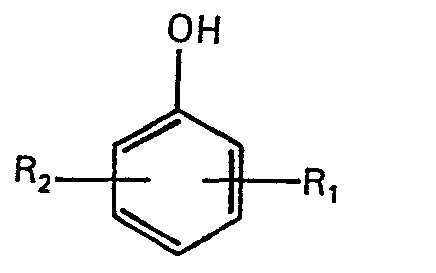
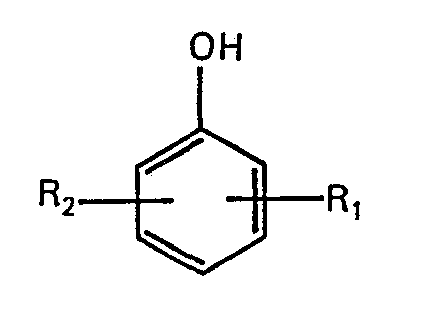
- the invention relates to an agent and a method for the oxidative dyeing of hair based on a substituted phenol of the general formula wherein R 1 represents a hydroxyalkyl radical with 1 to 4 carbon atoms and R 2 represents a hydrogen atom or an alkyl radical with 1 to 4 carbon atoms, as a coupler substance.
- Oxidation dyes have become very important for hair coloring.
- the coloration arises from the reaction of certain developer substances with certain coupler substances in the presence of a suitable oxidizing agent.
- Mainly 1,4-diaminobenzene, 2,5-diaminotoluene, 3-methyl-4-aminophenol and p-aminophenol are used as developer substances.
- the preferred coupler substances are a-naphthol, resorcinol, 4-chlororesorcinol, 2-methylresorcinol, m-aminophenol, 5-amino-o-cresol and derivatives of m-phenylenediamine such as m-toluenediamine and 2,4-diaminoanisole.
- Oxidation dyes which are used to dye human hair, are subject to numerous special requirements. So they have to be harmless from a toxicological and dermatological point of view and enable the dyeing to be achieved in the desired intensity. It is also necessary that a wide range of different color shades can be produced by combining suitable developer and coupler components. In addition, good light, permanent wave, acid and rub fastness is required for the hair colorations that can be achieved. In any case, such hair coloring must remain stable over a period of at least 4 to 6 weeks without exposure to light, chemical agents and rubbing.
- m-phenylenediamine currently used as a blue coupler in hair dyes, its derivatives m-toluenediamine and 2,4-diaminoanisole, and also more recently recommended blue couplers, such as 1-hydroxy-3-amino-6-chlorobenzene and 2,4-diaminophenoxyethanol, cannot yet satisfactorily meet the above requirements.
- agents for the oxidative dyeing of hair which comprise a combination of developer substances known in hair dyeing with at least one substituted phenol of the general formula wherein R 1 is a hydroxyalkyl radical with 1 to 4 carbon atoms and R 2 represents a hydrogen atom or an alkyl radical with 1 to 4 carbon atoms, also in the form of the phenolate with organic or inorganic bases, contained as a coupler substance, do an excellent job.
- the substituted phenols of the formula given as coupler substances in the hair colorants according to the invention are readily soluble in water with the addition of alkalis such as sodium hydroxide and also have an unexpectedly good shelf life, in particular as a component of the hair colorants according to the invention.
- the coupler substances mentioned of which 2-hydroxymethyl-5-methylphenol and 3- ( ⁇ -hydroxyethyl) -6-methylphenol are preferred, in a concentration of 0.01 to 3.0 percent by weight, in particular 0.1 to 2.0 percent by weight.
- the hair colorants can additionally contain known coupler substances, in particular a-naphthol, 3,4-diaminobenzoic acid, resorcinol, 4-chlororesorcinol, 2-methylresorcinol, m-aminophenol and 3-amino-6-methylphenol.
- coupler substances in particular a-naphthol, 3,4-diaminobenzoic acid, resorcinol, 4-chlororesorcinol, 2-methylresorcinol, m-aminophenol and 3-amino-6-methylphenol.
- 4-hydroxy-1,2-methylenedioxybenzene and 4-amino-1,2-methylenedioxybenzene can also be used advantageously as a coupler substance.
- 1,4-diaminobenzene, 2,5-diaminotoluene, 2,5-diaminoanisole, p-aminophenol and 3-methyl-4-aminophenol come as a constituent of the hair colorants according to the invention dress.
- 2,5-Diaminobenzyl alcohol and 2- ( ⁇ -hydroxyethyl) -1, 4-diaminobenzene can also be used advantageously as a developer substance.
- Both the substituted phenols of the formula given and the known coupler and developer substances can be contained in the hair dye alone or in a mixture with one another.
- the total amount of developer-coupler substance combination contained in the hair colorants described here should be 0.1 to 5.0 percent by weight, in particular 0.5 to 3.0 percent by weight.
- the developer components are generally used in approximately equimolar amounts, based on the coupler components. However, it is not a disadvantage if the developer component is present in a certain excess or deficit in this regard.
- the hair colorants of this application can additionally use other color components, for example 6-amino-3-methylphenol, 6-amino-2-methylphenol and 6-amino-3-ethoxyphenol, and also conventional direct dyes, for example triphenylmethane dyes such as Diamond Fuchsin (CI 42510) and Leather Ruby HF (CI 42520), aromatic nitro dyes such as 2-nitro-1, 4-diaminobenzene and 2-amino-4-nitrophenol, azo dyes such as Acid Brown 4 (CI 14805) and Acid Blue 135 (C.1.13385), anthraquinone dyes such as Disperse Red 15 (CI 60710) and Disperse Violet 1 (CI 61 100), also contain 1,4,5,8-tetraamino-anthraquinone and 1,4-diamino-anthraquinone.
- direct dyes for example triphenylmethane dyes such as Diamond Fuchsin (CI 42510) and Leather Ruby HF (CI 42520), aromatic nitro
- the hair colorants can also contain other conventional cosmetic additives, for example antioxidants such as ascorbic acid or sodium sulfite, perfume oils, complexing agents, wetting agents, emulsifiers, thickeners, care agents and others.
- antioxidants such as ascorbic acid or sodium sulfite
- perfume oils such as ascorbic acid or sodium sulfite
- complexing agents such as ascorbic acid or sodium sulfite
- wetting agents such ascorbic acid or sodium sulfite
- emulsifiers such as thickeners, care agents and others.
- the preparation form can be that of a solution, preferably a cream, a gel or an emulsion.
- Their composition is a mixture of the dye components with the constituents customary for such preparations.
- the usual constituents of creams, emulsions or gels are, for example, wetting agents or emulsifiers from the classes of anionic, cationic or nonionic surface-active substances such as fatty alcohol sulfates, alkyl sulfonates, alkyl benzene sulfonates, alkyl trimethyl ammonium salts, oxyethylated fatty alcohols, oxyethylated nonylphenols, fatty acid alkanolamides, further thickeners such as higher fatty alcohols, starch, cellulose derivatives, paraffin oil and fatty acids as well as care substances such as lanolin derivatives, cholesterol and pantothenic acid.
- ingredients mentioned are used in the amounts customary for such purposes, for example the wetting agents and emulsifiers in concentrations of about 0.5 to 30 percent by weight, while the thickeners can be present in the preparations in an amount of about 0.1 to 25 percent by weight .
- the hair colorants according to the invention can react weakly acidic, neutral or alkaline.
- they have a pH in the alkaline range between 8.0 and 11.5, the setting preferably being made with ammonia.
- organic amines for example monoethanolamine or triethanolamine, can also be used.
- the hair colorants which contain a combination of developer substances known in hair dyeing with at least one substituted phenol of the stated formula as a coupler substance and optionally additionally known coupler substances are mixed with an oxidizing agent shortly before use and worn Mix on hair.
- the main oxidizing agents used to develop hair coloring are hydrogen peroxide, for example as a 6% aqueous solution or its addition compounds with urea, melamine or sodium borate.
- the mixture is allowed to act on the hair at 15 to 50 ° C for about 10 to 45 minutes, preferably 30 minutes, then the hair is rinsed with water and dried. If necessary, after this rinse, wash with a shampoo and possibly rinse with a weak organic acid, such as citric acid or tartaric acid.
- substituted phenols according to the formula contained in the agents according to the invention are known compounds or compounds which can be prepared by conventional organic synthesis methods described in the literature.
- 2-hydroxymethyl-5-methylphenol starts from the m-cresotinic acid available in technical quantities, converts it into the corresponding m-cresotinic acid ester and reduces it2 with lithium aluminum hydride.
- 2-hydroxymethyl-6-methylphenol can be prepared from o-cresotinic acid.
- the hair colorants according to the invention offer a wide range of different color shades, depending on the type and composition of the color components, which range from blonde to brown, ashy, purple, violet, golden to blue and matt shades.
- the colors are characterized by their special durability and fastness to wear.
- the observed coloring result is independent of the structure of the hair being dyed. This means that the color tones achieved with the hair colorants according to the invention are readily reproducible.
- 50 g of the above hair dye are mixed shortly before use with 50 ml of hydrogen peroxide solution (6%) and the mixture is then applied to blonde human hair. After an exposure time of 30 minutes at about 40 ° C, rinsed with water and dried. The hair is colored with an intense shade of blue.
- this hair dye Shortly before use, 50 g of this hair dye are mixed with 50 ml of hydrogen peroxide solution (6%) and the mixture is allowed to act on blonde human hair at 40 ° C. for 30 minutes. Then it is rinsed with water and dried. The hair has a gray-violet-bluish color.
- this hair dye is mixed with 50 ml of hydrogen peroxide solution (6%) shortly before use and the mixture is then applied to blonde human hair. After an exposure time of 30 minutes at 40 ° C, rinsed with water and dried. The hair is colored light ash brown.
Landscapes
- Health & Medical Sciences (AREA)
- Chemical & Material Sciences (AREA)
- Life Sciences & Earth Sciences (AREA)
- Organic Chemistry (AREA)
- General Health & Medical Sciences (AREA)
- Veterinary Medicine (AREA)
- Public Health (AREA)
- Animal Behavior & Ethology (AREA)
- Emergency Medicine (AREA)
- Birds (AREA)
- Epidemiology (AREA)
- Cosmetics (AREA)
- Coloring (AREA)
Description
- Die Erfindung betrifft ein Mittel und ein Verfahren zum oxidativen Färben von Haaren auf der Basis eines substituierten Phenols der allgemeinen Formel
- Für die Haarfärbung haben Oxidationsfarbstoffe eine wesentliche Bedeutung erlangt. Die Färbung entsteht hierbei durch die Reaktion bestimmter Entwicklersubstanzen mit bestimmten Kupplersubstanzen in Gegenwart eines geeigneten Oxidationsmittels.
- Als Entwicklersubstanzen werden hauptsächlich 1,4-Diaminobenzol, 2,5-Diaminotoluol, 3-Methyl-4-aminophenol und p-Aminophenol eingesetzt. Die bevorzugt verwendeten Kupplersubstanzen sind a-Naphthol, Resorcin, 4-Chlorresorcin, 2-Methylresorcin, m-Aminophenol, 5-Amino-o-kresol und Derivate des m-Phenylendiamins wie m-Toluylendiamin und 2,4-Diaminoanisol. Diese Derivate sowie das m-Phenylendiamin selbst haben hierbei wegen ihrer Fähigkeit, bei der oxidativen Kupplung mit 1,4-Diaminobenzol bzw. 1,4-Diaminobenzolderivaten Blautöne zu erzeugen, als sogenannte Blaukuppler Bedeutung erlangt.
- An Oxidationsfarbstoffe, die zum Färben von menschlichen Haaren Verwendung finden, sind zahlreiche besondere Anforderungen gestellt. So müssen sie in toxikologischer und dermatologischer Hinsicht unbedenklich sein und die Erzielung von Färbungen in der gewünschten Intensität ermöglichen. Weiterhin ist es erforderlich, dass durch Kombination geeigneter Entwickler-und Kupplerkomponenten eine breite Palette unterschiedlicher Farbnuancen erzeugt werden kann. Ausserdem wird für die erzielbaren Haarfärbungen eine gute Licht-, Dauerwell-, Säure-und Reibechtheit gefordert. Auf jeden Fall aber müssen solche Haarfärbungen ohne Einwirkung von Licht, chemischen Mitteln und Reibung über einen Zeitraum von mindestens 4 bis 6 Wochen stabil bleiben.
- Das zurzeit in Haarfärbemitteln als Blaukuppler verwendete m-Phenylendiamin, dessen Derivate m-Toluylendiamin und 2,4-Diaminoanisol sowie auch in neuerer Zeit empfohlene Blaukuppler, wie beispielsweise 1-Hydroxy-3-amino-6-chlorbenzol und 2,4-Diaminophenoxyethanol, können die vorstehend genannten Anforderungen jedoch noch nicht zufriedenstellend erfüllen.
- Es bestand daher die Aufgabe, nach einem Haarfärbemittel sowie einem Haarfärbeverfahren zu suchen, bei dem die gestellten Anforderungen in optimaler Weise erfüllt werden.
- Hierzu wurde nun gefunden, dass Mittel zum oxidativen Färben von Haaren, welche eine Kombination von in der Haarfärbung bekannten Entwicklersubstanzen mit mindestens einem substituierten Phenol der allgemeinen Formel

- Die als Kupplersubstanzen in den erfindungsgemässen Haarfärbemitteln enthaltenen substituierten Phenole der angegebenen Formel sind unter Zusatz von Alkalien wie beispielsweise Natriumhydroxid gut in Wasser löslich und weisen ausserdem eine unerwartet gute Lagerbeständigkeit, insbesondere als Bestandteil der erfindungsgemässen Haarfärbemittel, auf.
- Beispiele für geeignete, in den erfindungsgemässen Haarfärbemitteln enthaltene Kupplersubstanzen der angegebenen Formel sind insbesondere
- 3-(ß-Hydroxyethyl)-phenol
- 3-(y-Hydroxypropyl)-phenol
- 3-(ß-Hydroxyethyl)-6-methyl-phenol
- 2-(ß-Hydroxyethyl)-5-methyl-phenol
- 2-Hydroxymethyl-5-methyl-phenol
- 2-Hydroxymethyl-6-methyl-phenol
- In den Haarfärbemitteln sollen die genannten Kupplersubstanzen, von denen 2-Hydroxymethyl-5-methyl-phenol und 3-(ß-Hydroxyethyl)-6-methyl-phenol bevorzugt werden, in einer Konzentration von 0,01 bis 3,0 Gewichtsprozent, insbesondere 0,1 bis 2,0 Gewichtsprozent, enthalten sein.
- Ausserdem können die Haarfärbemittel zusätzlich bekannte Kupplersubstanzen, insbesondere a-Naphthol, 3,4-Diaminobenzoesäure, Resorcin, 4-Chlorresorcin, 2-Methylresorcin, m-Aminophenol und 3-Amino-6-methyl-phenol enthalten. Ferner können auch 4-Hydroxy-1,2-methylendioxy- benzol und 4-Amino-1,2-methylendioxybenzol vorteilhaft als Kupplersubstanz eingesetzt werden.
- Von den bekannten Entwicklersubstanzen kommen als Bestandteil der erfindungsgemässen Haarfärbemittel vor allem 1,4-Diaminobenzol, 2,5-Diaminotoluol, 2,5-Diaminoanisol, p-Aminophenol sowie 3-Methyl-4-aminophenol in Betracht. Auch 2,5-Diaminobenzylalkohol und 2-(ß-Hydroxyethyl)-1 ,4-diaminobenzol sind vorteilhaft als Entwicklersubstanz verwendbar.
- Sowohl die erfindungsgemäss verwendeten substituierten Phenole der angegebenen Formel als auch die bekannten Kuppler- und Entwicklersubstanzen können in den Haarfärbemitteln jeweils allein oder im Gemisch miteinander enthalten sein.
- Die Gesamtmenge der in den hier beschriebenen Haarfärbemitteln enthaltenen Entwicklersubstanz-Kupplersubstanz-Kombination soll 0,1 bis 5,0 Gewichtsprozent, insbesondere 0,5 bis 3,0 Gewichtsprozent, betragen.
- Die Entwicklerkomponenten werden im allgemeinen in etwa äquimolaren Mengen, bezogen auf die Kupplerkomponenten, eingesetzt. Es ist aber nicht nachteilig, wenn die Entwicklerkomponente diesbezüglich in einem gewissen Überschuss oder Unterschuss vorhanden ist.
- Weiterhin können die Haarfärbemittel dieser Anmeldung zusätzlich andere Farbkomponenten, beispielsweise 6-Amino-3-methyl-phenol, 6-Amino-2-methyl-phenol und 6-Amino-3-ethoxy-phenol, sowie ferner übliche direktziehende Farbstoffe, zum Beispiel Triphenylmethanfarbstoffe wie Diamond Fuchsin (C.I. 42510) und Leather Ruby HF (C.I. 42520), aromatische Nitrofarbstoffe wie 2-Nitro-1 ,4-diaminobenzol und 2-Amino-4-nitrophenol, Azofarbstoffe wie Acid Brown 4 (C.I. 14805) und Acid Blue 135 (C.1. 13385), Anthrachinonfarbstoffe wie Disperse Red 15 (C.I. 60710) und Disperse Violet 1 (C.I. 61 100), ausserdem 1,4,5,8-Tetraamino-anthrachinon und 1,4-Diamino-anthrachinon enthalten.
- Darüber hinaus können in den Haarfärbemitteln noch weitere übliche kosmetische Zusätze, beispielsweise Antioxidantien wie Ascorbinsäure oder Natriumsulfit, Parfümöle, Komplexbildner, Netzmittel, Emulgatoren, Verdicker, Pflegestoffe und andere vorhanden sein.
- Die Zubereitungsform kann die einer Lösung, vorzugsweise einer Creme, eines Gels oder einer Emulsion sein. Ihre Zusammensetzung stellt eine Mischung der Farbstoffkomponenten mit den für solche Zubereitungen üblichen Bestandteilen dar. Als übliche Bestandteile von Cremes, Emulsionen oder Gelen kommen beispielsweise Netzmittel oder Emulgatoren aus den Klassen der anionischen, kationischen oder nichtionogenen oberflächenaktiven Substanzen wie Fettalkoholsulfate, Alkylsulfonate, Alkylbenzolsulfonate, Alkyltrimethylammoniumsalze, oxethylierte Fettalkohole, oxethylierte Nonylphenole, Fettsäurealkanolamide, ferner Verdicker wie höhere Fettalkohole, Stärke, Cellulosederivate, Paraffinöl und Fettsäuren sowie ausserdem Pflegestoffe wie Lanolinderivate, Cholesterin und Pantothensäure in Betracht. Die erwähnten Bestandteile werden in den für solche Zwecke üblichen Mengen verwendet, zum Beispiel die Netzmittel und Emulgatoren in Konzentrationen von etwa 0,5 bis 30 Gewichtsprozent, während die Verdicker in einer Menge von etwa 0,1 bis 25 Gewichtsprozent in den Zubereitungen enthalten sein können.
- Je nach Zusammensetzung können die erfindungsgemässen Haarfärbemittel schwach sauer, neutral oder alkalisch reagieren. Insbesondere weisen sie einen pH-Wert im alkalischen Bereich zwischen 8,0 und 11,5 auf, wobei die Einstellung vorzugsweise mit Ammoniak erfolgt. Es können aber auch organische Amine, zum Beispiel Monoethanolamin oder Triethanolamin, Verwendung finden.
- Bei dem erfindungsgemässen Verfahren zur oxidativen Färbung von Haaren vermischt man die Haarfärbemittel, welche eine Kombination von in der Haarfärbung bekannten Entwicklersubstanzen mit mindestens einem substituierten Phenol der angegebenen Formel als Kupplersubstanz sowie gegebenenfalls zusätzlich bekannte Kupplersubstanzen enthalten, kurz vor dem Gebrauch mit einem Oxidationsmittel und trägt dieses Gemisch auf das Haar auf. Als Oxidationsmittel zur Entwicklung der Haarfärbung kommt hauptsächlich Hydrogenperoxid, beispielsweise als 6%ige wässrige Lösung bzw. dessen Additionsverbindungen an Harnstoff, Melamin oder Natriumborat in Betracht. Man lässt das Gemisch bei 15 bis 50°C etwa 10 bis 45 Minuten lang, vorzugsweise 30 Minuten lang, auf das Haar einwirken, spült sodann das Haar mit Wasser aus und trocknet. Gegebenenfalls wird im Anschluss an diese Spülung mit einem Shampoo gewaschen und eventuell mit einer schwachen organischen Säure, wie zum Beispiel Zitronensäure oder Weinsäure, nachgespült.
- Die in den erfindungsgemässen Mitteln enthaltenen substituierten Phenole gemäss der Formel sind bekannte Verbindungen oder nach üblichen in der Literatur beschriebenen organischen Syntheseverfahren darstellbare Verbindungen.
- Beispielsweise geht man bei der Herstellung des 2-Hydroxymethyl-5-methyl-phenols von der in technischen Mengen verfügbaren m-Kresotinsäure aus, führt diese durch Veresterung' in den entsprechenden m-Kresotinsäureester über und reduziert2 mit Lithiumaluminiumhydrid. Auf die gleiche Weise kann 2-Hydroxymethyl-6-methylphenol aus o-Kresotinsäure hergestellt werden.
- Zur Synthese von 3-(ß-Hydroxyethyl)-6-methyl-phenol wird 4-Methyl-phenylessigsäure durch Nitrierung zu 4-Methyl-3-nitro-phenylessigsäure umgesetzt. Anschliessend erfolgt die selektive Reduktion3 der Carboxyl-Gruppe mit Borhydrid, wobei 2-(4'-Methyl-3'-nitro-phenyl)-ethanol erhalten wird. Hierauf wird die NitroGruppe mit Wasserstoff in Gegenwart eines Patinkatalysators zur Amino-Gruppe reduziert. Schliesslich wird die Amino-Gruppe bei der Umsetzung mit salpetriger Säure unter Stickstoffeliminierung durch eine OH-Gruppe ersetzt.
- 1 Houben-Weyl, Methoden der Organischen Chemie, 4. Auflage, VIII, 525.
- 2 Organikum, VEB Deutscher Verlag der Wissenschaften, Berlin (1976) 614.
- Organic Reactions 6(1951 ) 469.
- 3 H.C. Brown, B.C. Subba Rao, J. Am. Chem. Soc. 82 (1960) 681.
- Hinsichtlich der färberischen Möglichkeiten bieten die erfindungsgemässen Haarfärbemittel je nach Art und Zusammensetzung der Farbkomponenten eine breite Palette verschiedener Farbnuancen, welche sich von blonden über braune, aschige, purpurne, violette, goldene bis hin zu blauen sowie matten Farbtönen erstrecken. Hierbei zeichnen sich die Farbtöne durch ihre besondere Beständigkeit und Trageechtheit aus. Darüber hinaus ist das beobachtete Färbeergebnis unabhängig von der Struktur des jeweilig gefärbten Haares. Das bedeutet, dass die mit den erfindungsgemässen Haarfärbemitteln erzielten Farbtöne gut reproduzierbar sind.
- Von wesentlicher Bedeutung ist ferner der durch die Verwendung der substituierten Phenole der angegebenen Formel in den hier beschriebenen Haarfärbemitteln in toxikologischer und dermatologischer Hinsicht, zum Beispiel gegenüber den bekannten Blaukupplern 2,4-Diaminotoluol, 2,4-Diaminoanisol und 1,3-Diaminobenzol, erzielte Fortschritt, welcher auf den beiden in den substituierten Phenolen enthaltenen Hydroxylgruppen (für den Fall, dass R1 einen Hydroxyalkylrest darstellt) und der damit verbundenen Abnahme der Lipoidlöslichkeit beruht.
- Von besonderer Bedeutung ist weiterhin, dass mit einigen der hier beschriebenen substituierten Phenole gemäss der Formel, zum Beispiel mit 2-Hydroxymethyl-5-methyl-phenol, erstmals neue Blaukuppler vorliegen, die im Gegensatz zu Kupplern ähnlicher Strukturformel - wie zum Beispiel 2,5-Dimethylphenol und m-Kresol - überraschenderweise dem damit gefärbten Haar keinen unangenehmen, stechenden kresolischen Geruch verleihen.
- Schliesslich ist mit Hilfe der erfindungsgemässen Haarfärbemittel auch eine Anfärbung von ergrauten, chemisch nicht vorgeschädigtem Haar problemlos und mit sehr guter Deckkraft möglich.
- Die nachfolgenden Beispiele sollen den Erfindungsgegenstand näher erläutern.
-

- 50 g des obigen Haarfärbemittels werden kurz vor dem Gebrauch mit 50 ml Hydrogenperoxidlösung (6%ig) vermischt und das Gemisch anschliessend auf blonde menschliche Haare aufgetragen. Nach einer Einwirkungszeit von 30 Minuten bei etwa 40°C wird mit Wasser gespült und getrocknet. Das Haar ist mit einem intensiven Blauton gefärbt.
-

- Man vermischt kurz vor dem Gebrauch 50 g dieses Haarfärbemittels mit 50 ml Hydrogenperoxidlösung (6%ig) und lässt das Gemisch 30 Minuten lang bei 40°C auf blonde menschliche Haare einwirken. Danach wird mit Wasser gespült und getrocknet. Das Haar hat eine grauviolett-bläuliche Färbung erhalten.
-

- 50 g dieses Haarfärbemittels werden kurz vor dem Gebrauch mit 50 ml Hydrogenperoxidlösung (6%ig) vermischt und das Gemisch anschliessend auf blonde menschliche Haare aufgebracht. Nach einer Einwirkungszeit von 30 Minuten bei 40°C wird mit Wasser gespült und getrocknet. Das Haar ist hellaschbraun gefärbt.
- Alle in der vorliegenden Anmeldung angegebenen Prozentzahlen stellen Gewichtsprozente dar.
Claims (11)

Applications Claiming Priority (2)
| Application Number | Priority Date | Filing Date | Title |
|---|---|---|---|
| DE19803025715 DE3025715A1 (de) | 1980-07-07 | 1980-07-07 | Mittel und verfahren zum faerben von haaren |
| DE3025715 | 1980-07-07 |
Publications (2)
| Publication Number | Publication Date |
|---|---|
| EP0043436A1 EP0043436A1 (de) | 1982-01-13 |
| EP0043436B1 true EP0043436B1 (de) | 1983-08-31 |
Family
ID=6106598
Family Applications (1)
| Application Number | Title | Priority Date | Filing Date |
|---|---|---|---|
| EP81104079A Expired EP0043436B1 (de) | 1980-07-07 | 1981-05-27 | Mittel und Verfahren zum Färben von Haaren |
Country Status (7)
| Country | Link |
|---|---|
| US (1) | US4755188A (de) |
| EP (1) | EP0043436B1 (de) |
| JP (1) | JPS57501126A (de) |
| BR (1) | BR8108676A (de) |
| DE (2) | DE3025715A1 (de) |
| MX (1) | MX152694A (de) |
| WO (1) | WO1982000092A1 (de) |
Families Citing this family (6)
| Publication number | Priority date | Publication date | Assignee | Title |
|---|---|---|---|---|
| DE3239295A1 (de) * | 1982-10-23 | 1984-04-26 | Henkel KGaA, 4000 Düsseldorf | Haarfaerbemittel |
| US5910304A (en) * | 1982-12-13 | 1999-06-08 | Texas A&M University System | Low-dose oral administration of interferons |
| DE3441148A1 (de) * | 1984-11-10 | 1986-05-15 | Wella Ag, 6100 Darmstadt | Oxidationshaarfaerbemittel auf der basis von 4-amino-2-hydroxyalkylphenolen |
| DE3610396A1 (de) * | 1986-03-27 | 1987-10-01 | Wella Ag | Mittel und verfahren zur oxidativen faerbung von haaren |
| US8047024B2 (en) * | 2007-05-07 | 2011-11-01 | Whirlpool Corporation | Control and wash cycle for activation and deactivation of chemistry in the wash bath of an automatic washer |
| FR2974509B1 (fr) * | 2011-04-29 | 2013-10-11 | Oreal | Composition de coloration mettant en oeuvre un coupleur phenolique particulier en milieu riche en corps gras, procedes et dispositif |
Family Cites Families (6)
| Publication number | Priority date | Publication date | Assignee | Title |
|---|---|---|---|---|
| FR1426889A (fr) * | 1964-03-02 | 1966-02-04 | Oreal | Nouvelle solution tinctoriale pour cheveux |
| LU54273A1 (de) * | 1967-08-08 | 1969-03-24 | ||
| CA986019A (en) * | 1971-03-30 | 1976-03-23 | Edward J. Milbrada | Oxidation hair dyes and process |
| US3861868A (en) * | 1971-03-30 | 1975-01-21 | Procter & Gamble | Dyeing human hair with oxidation dyes and arginine or a protamine protein |
| GB1489344A (en) * | 1974-01-18 | 1977-10-19 | Unilever Ltd | Hair dyeing composition |
| DE2840830A1 (de) * | 1978-09-20 | 1980-04-03 | Wella Ag | Mittel und verfahren zum faerben von haaren |
-
1980
- 1980-07-07 DE DE19803025715 patent/DE3025715A1/de not_active Withdrawn
-
1981
- 1981-05-27 DE DE8181104079T patent/DE3160813D1/de not_active Expired
- 1981-05-27 JP JP56501829A patent/JPS57501126A/ja active Pending
- 1981-05-27 EP EP81104079A patent/EP0043436B1/de not_active Expired
- 1981-05-27 WO PCT/EP1981/000057 patent/WO1982000092A1/de not_active Ceased
- 1981-05-27 BR BR8108676A patent/BR8108676A/pt unknown
- 1981-07-02 MX MX188136A patent/MX152694A/es unknown
-
1987
- 1987-01-20 US US07/005,256 patent/US4755188A/en not_active Expired - Fee Related
Also Published As
| Publication number | Publication date |
|---|---|
| MX152694A (es) | 1985-10-11 |
| DE3160813D1 (en) | 1983-10-06 |
| WO1982000092A1 (en) | 1982-01-21 |
| EP0043436A1 (de) | 1982-01-13 |
| BR8108676A (pt) | 1982-05-25 |
| US4755188A (en) | 1988-07-05 |
| DE3025715A1 (de) | 1982-01-28 |
| JPS57501126A (de) | 1982-07-01 |
Similar Documents
| Publication | Publication Date | Title |
|---|---|---|
| EP0007537B1 (de) | Mittel zur Färbung von Haaren | |
| EP0008039B1 (de) | Verwendung eines 6-Amino-3-methyl-phenol enthaltenden Mittels zum Färben von Haaren | |
| EP0395837B1 (de) | Oxidationshaarfärbemittel auf der Basis von 4-Aminophenol-derivaten sowie neue 4-Aminophenol-derivate | |
| DE3031709C2 (de) | ||
| EP0241716B1 (de) | Mittel und Verfahren zur oxidativen Färbung von Haaren | |
| EP0252351A1 (de) | Neue 5-Alkoxy-2,4-diamino-alkylbenzole sowie Haarfärbemittel mit 5-Alkoxy-2,4-diamino-alkyl-benzolen | |
| DE3132885C2 (de) | ||
| WO1986002829A1 (fr) | Teinture pour cheveux, du type a oxydation, basee sur l'emploi de 4-amino-2-hydroxyalkylphenols | |
| DE2835776C2 (de) | ||
| EP0043436B1 (de) | Mittel und Verfahren zum Färben von Haaren | |
| DE3229973A1 (de) | 1,3-diamino-4-(2',2',2'-trifluorethoxy)-benzol, verfahren zu dessen herstellung und diese verbindung enthaltende haarfaerbemittel | |
| DE3743769A1 (de) | Mittel zur oxidativen faerbung von haaren | |
| EP0107027B1 (de) | Haarfärbemittel | |
| DE3028202C2 (de) | ||
| EP0012965B1 (de) | Mittel und Verfahren zur Färbung von Haaren | |
| EP0706787B1 (de) | Oxidationshaarfärbemittel | |
| DE2840830C2 (de) | ||
| DE2951377C2 (de) | ||
| WO1995017877A1 (de) | Verwendung von allylaminophenolen in oxidationsfärbemitteln | |
| DE3038284C2 (de) | Mittel und Verfahren zur oxidativen Färbung von Haaren | |
| DE2906108A1 (de) | Mittel und verfahren zum faerben von haaren | |
| EP0778019A1 (de) | Oxidationshaarfärbemittel | |
| DE3314565A1 (de) | 1-methylsulfonymethoxy-2,4-diaminobenzol, verfahren zu dessen herstellung und diese verbindung enthaltende haarfaerbemittel | |
| DE3521995A1 (de) | 3-mesylamino-anilinverbindungen, verfahren zu ihrer herstellung sowie oxidationshaarfaerbemittel mit einem gehalt an diesen verbindungen |
Legal Events
| Date | Code | Title | Description |
|---|---|---|---|
| PUAI | Public reference made under article 153(3) epc to a published international application that has entered the european phase |
Free format text: ORIGINAL CODE: 0009012 |
|
| AK | Designated contracting states |
Designated state(s): DE FR GB IT SE |
|
| ITCL | It: translation for ep claims filed |
Representative=s name: BARZANO' E ZANARDO ROMA S.P.A. |
|
| 17P | Request for examination filed |
Effective date: 19820521 |
|
| ITF | It: translation for a ep patent filed | ||
| GRAA | (expected) grant |
Free format text: ORIGINAL CODE: 0009210 |
|
| AK | Designated contracting states |
Designated state(s): DE FR GB IT SE |
|
| REF | Corresponds to: |
Ref document number: 3160813 Country of ref document: DE Date of ref document: 19831006 |
|
| ET | Fr: translation filed | ||
| PLBE | No opposition filed within time limit |
Free format text: ORIGINAL CODE: 0009261 |
|
| STAA | Information on the status of an ep patent application or granted ep patent |
Free format text: STATUS: NO OPPOSITION FILED WITHIN TIME LIMIT |
|
| 26N | No opposition filed | ||
| PGFP | Annual fee paid to national office [announced via postgrant information from national office to epo] |
Ref country code: FR Payment date: 19900330 Year of fee payment: 10 |
|
| PGFP | Annual fee paid to national office [announced via postgrant information from national office to epo] |
Ref country code: GB Payment date: 19900402 Year of fee payment: 10 |
|
| PGFP | Annual fee paid to national office [announced via postgrant information from national office to epo] |
Ref country code: DE Payment date: 19900409 Year of fee payment: 10 |
|
| PGFP | Annual fee paid to national office [announced via postgrant information from national office to epo] |
Ref country code: SE Payment date: 19900522 Year of fee payment: 10 |
|
| ITTA | It: last paid annual fee | ||
| PG25 | Lapsed in a contracting state [announced via postgrant information from national office to epo] |
Ref country code: GB Effective date: 19910527 |
|
| PG25 | Lapsed in a contracting state [announced via postgrant information from national office to epo] |
Ref country code: SE Effective date: 19910528 |
|
| GBPC | Gb: european patent ceased through non-payment of renewal fee | ||
| PG25 | Lapsed in a contracting state [announced via postgrant information from national office to epo] |
Ref country code: FR Effective date: 19920131 |
|
| PG25 | Lapsed in a contracting state [announced via postgrant information from national office to epo] |
Ref country code: DE Effective date: 19920303 |
|
| REG | Reference to a national code |
Ref country code: FR Ref legal event code: ST |
|
| EUG | Se: european patent has lapsed |
Ref document number: 81104079.9 Effective date: 19911209 |