EP0044497A2 - Verfahren zur Herstellung heterocyclisch substituierter 4-Oxiphenoxialkancarbonsäurederivate - Google Patents
Verfahren zur Herstellung heterocyclisch substituierter 4-Oxiphenoxialkancarbonsäurederivate Download PDFInfo
- Publication number
- EP0044497A2 EP0044497A2 EP81105457A EP81105457A EP0044497A2 EP 0044497 A2 EP0044497 A2 EP 0044497A2 EP 81105457 A EP81105457 A EP 81105457A EP 81105457 A EP81105457 A EP 81105457A EP 0044497 A2 EP0044497 A2 EP 0044497A2
- Authority
- EP
- European Patent Office
- Prior art keywords
- alkyl
- halogen
- phenyl
- alkoxy
- mono
- Prior art date
- Legal status (The legal status is an assumption and is not a legal conclusion. Google has not performed a legal analysis and makes no representation as to the accuracy of the status listed.)
- Granted
Links
Classifications
-
- C—CHEMISTRY; METALLURGY
- C07—ORGANIC CHEMISTRY
- C07D—HETEROCYCLIC COMPOUNDS
- C07D263/00—Heterocyclic compounds containing 1,3-oxazole or hydrogenated 1,3-oxazole rings
- C07D263/52—Heterocyclic compounds containing 1,3-oxazole or hydrogenated 1,3-oxazole rings condensed with carbocyclic rings or ring systems
- C07D263/54—Benzoxazoles; Hydrogenated benzoxazoles
- C07D263/58—Benzoxazoles; Hydrogenated benzoxazoles with hetero atoms or with carbon atoms having three bonds to hetero atoms with at the most one bond to halogen, e.g. ester or nitrile radicals, directly attached in position 2
-
- C—CHEMISTRY; METALLURGY
- C07—ORGANIC CHEMISTRY
- C07D—HETEROCYCLIC COMPOUNDS
- C07D235/00—Heterocyclic compounds containing 1,3-diazole or hydrogenated 1,3-diazole rings, condensed with other rings
- C07D235/02—Heterocyclic compounds containing 1,3-diazole or hydrogenated 1,3-diazole rings, condensed with other rings condensed with carbocyclic rings or ring systems
- C07D235/04—Benzimidazoles; Hydrogenated benzimidazoles
- C07D235/24—Benzimidazoles; Hydrogenated benzimidazoles with hetero atoms or with carbon atoms having three bonds to hetero atoms with at the most one bond to halogen, e.g. ester or nitrile radicals, directly attached in position 2
- C07D235/26—Oxygen atoms
-
- C—CHEMISTRY; METALLURGY
- C07—ORGANIC CHEMISTRY
- C07D—HETEROCYCLIC COMPOUNDS
- C07D277/00—Heterocyclic compounds containing 1,3-thiazole or hydrogenated 1,3-thiazole rings
- C07D277/60—Heterocyclic compounds containing 1,3-thiazole or hydrogenated 1,3-thiazole rings condensed with carbocyclic rings or ring systems
- C07D277/62—Benzothiazoles
- C07D277/68—Benzothiazoles with hetero atoms or with carbon atoms having three bonds to hetero atoms with at the most one bond to halogen, e.g. ester or nitrile radicals, directly attached in position 2
Definitions
- the compounds of formula I are e.g. B. known from DE-OS 26 40 730 or were proposed in German patent applications P 29 14 300.8 and P 30 18 003.1. They are characterized by excellent herbicidal activity, particularly against grassy weeds.
- this reaction has the disadvantage that, with the exception of the oxazoles, relatively long reaction times are required. So z. B.
- optically active 2- (4'-hydroxyphenoxy) alkanecarboxylic acid esters of the formula II when using optically active 2- (4'-hydroxyphenoxy) alkanecarboxylic acid esters of the formula II as starting materials, optically active end products can be obtained, such as those e.g. B. are described in DE-OS 27 58 002.
- the phenols of the formula II are known from the literature (for example JJ Org. Chem. 39, 214 (1974)) or can be prepared analogously to known processes will.
- the compounds of the formula III can be prepared by known processes, for example from the corresponding 2-mercaptobenzoxazoles or 2-mercaptobenzthiazoles, by alkylation and subsequent oxidation with potassium permanganate, hydrogen peroxide or organic peracids (v g l. J. Chem. Soc. 1949, 3311; Eur. J. Med. Chem. 1978, 171; J. Heterocycl. Chein. 13, 491 (1976); Chem. Pharm. Bull. 17, 1958 (1969)).
- the method according to the invention avoids the disadvantages described above. After a relatively short reaction time, it provides the compounds of the formula I in high yields and good purity, without the functional groups present in the Z radical being attacked. This was surprising and, due to the state of the art, was not predictable.
- the reaction of 2-alkylsulfonylbenzthiuzole derivatives with aliphatic alcohols, primary or secondary amines or CH-acidic compounds is already known (cf. J. Chem. Soc. 1949, 3311; J. Heterocycl. Chem. 13, 491 (1976); Eur J. Med. Chem.
- the radical R 11 can in principle be any aliphatic, cycloaliphatic, araliphatic or aromatic radical; However, it is advantageous to use starting materials in which R 11 denotes low molecular weight alkyl, alkenyl, alkoxyalkyl or carbalkoxyalkyl or phenyl or benzyl, since such compounds are the easiest and cheapest to obtain.
- the nucleofugic group -S (O) n -R 11 is replaced by the deprotonated phenol component. If, for example, 6-chloro-2-methylsulfonyl-benzothiazole is allowed to react with a phenol of the formula II with the addition of potassium carbonate, then after the reaction, in addition to the desired compound 1 and potassium hydrogen carbonate, potassium methyl sulfinate is isolated in almost quantitative yield.
- the molar ratio of reaction components II and III is not critical and can be varied within wide limits. However, since the removal of unreacted starting product requires additional operations, it is preferred to work with approximately equimolar amounts or with an excess of no more than 10% of compound II.
- the process according to the invention can be carried out in the presence or absence of solvents. However, the reactions are preferably carried out in the presence of solvents which are inert under the reaction conditions.
- polar aprotic solvents e.g. B. acid amides such as dimethylformamide, dimethylacetamide and N-methylpyrrolidone, further dimethyl sulfoxide, nitriles such as acetonitrile or propionitrile, ketones such as acetone, methyl ethyl ketone or methyl isobutyl ketone, ethers such as tetrahydrofuran or dioxane and aromatic and ali phatic hydrocarbons such as chlorobenzene or cyclohexane.
- acid amides such as dimethylformamide, dimethylacetamide and N-methylpyrrolidone
- nitriles such as acetonitrile or propionitrile
- ketones such as acetone, methyl ethy
- organic bases are suitable as basic compounds, e.g. B. tertiary amines such as triethylamine, and in particular inorganic bases such as alkali carbonates (Na 2 CO 3 , K 2 CO 3 ). They are used in at least stoichiometric, preferably in at least equimolar (based on II) or in an excess of 5 to 20%.
- B. tertiary amines such as triethylamine
- inorganic bases such as alkali carbonates (Na 2 CO 3 , K 2 CO 3 ). They are used in at least stoichiometric, preferably in at least equimolar (based on II) or in an excess of 5 to 20%.
- the compound of the formula II with the basic compound is expediently first warmed to the reaction temperature in a suitable solvent, the salt of the compound II being formed at least in part. Then, add the heterocyclic component b che aer formula III, optionally dissolved in the same solvent, to and stirring is continued at elevated temperature until the reaction is complete.
- the reactants can also be combined in a different order.
- the reaction temperatures can be varied within wide limits and are between 20 and 160 ° C., preferably between 40 and 85 ° C., optionally at the boiling point of the solvent used.
- the reaction time depends on the temperature, the solvent used and the II: III ratio and decreases with increasing temperature and increasing excess of II.
- the reaction is usually complete after 20 minutes to 8 hours.
- the reaction is advantageously, but not necessarily, carried out under a protective gas. Nitrogen is preferred as the inert gas.
- the salt formed is filtered off and the solvent is distilled off. Any excess II present is removed by basic extraction.
- the compounds of formula I obtained can be further purified by distillation or chromatography, but this is generally not necessary because of the high purity of the products.
Landscapes
- Chemical & Material Sciences (AREA)
- Organic Chemistry (AREA)
- Heterocyclic Carbon Compounds Containing A Hetero Ring Having Nitrogen And Oxygen As The Only Ring Hetero Atoms (AREA)
- Thiazole And Isothizaole Compounds (AREA)
Abstract

Description
- Gegenstand der vorliegenden Erfindung ist ein Verfahren zur Herstellung von 2-[4'-(Benzoxazolyl-2"-oxi,-Benzthiazolyl-2"-oxi und Benzimidazolyl-2"-oxi)-phenoxi] alkancarbonsäurederivaten der allgemeinen Formel I

- R Halogen, CF3, NO2, CN,(C1-C4)-Alkyl, (C1-C4)-Alkoxi oder (C1-C4)-Alkylthio,
- A 0, S, NH oder N-(C1-C4)-Alkyl,
- R1 H oder (C1-C4)-Alkyl,
- Z eine Gruppe der Formel


- R2 H, (C1-C12)-Alkyl, das gegebenenfalls durch 1-6 Halogen, vorzugsweise F, Cl Br und/oder durch OH, (C1-C6)-Alkoxi, (C1-C4)-Alkylthio, (C1-C6)-Alkoxi-(C2-C6)- alkoxi, Halogen (C -C2)-alkoxi, Methoxi- äthoxi-äthexi,(C1-C4)-Alkylamino, Di-(C1-C4)-alkyl- amino, Phenyl, Oxiranyl und/oder Phenoxi substituiert ist, wobei letzteres ebenfalls ein- bis zweifach durch Halogen oder (C1-C4)-Alkyl substituiert sein kann,
(C5-C6)-Cycloalkyl, das gegebenenfalls durch Halogen oder Methyl substituiert ist, (C3-C6)-Alkenyl, Halogen-(C3-C6)-alkenyl oder (C5-C6)-Cycloakenyl, (C3-C4)-Alkinyl, das gegebenenfalls ein- oder zweifach durch (C1-C6)-Alkyl, Phenyl, Halogen bzw. (C1-C2)-Alkoxi substituiert ist,
Phenyl, das gegebenenfalls ein- bis dreifach durch (C1-C4)-Alkyl, (C1-C4)-Alkoxi, Halogen, NO2 oder CF3 substituiert ist, -

- R4 und R5 gleich oder verschieden sind und H, (C1-C6)-Alkyl, Hydroxy-(C1-C6)-alkyl, (C5-C6)-Cycloalkyl oder Phenyl, das gegebenenfalls ein- bis dreifach durch (C1-C4)-Alkyl, (C1-C4)-Alkoxi, Halogen oder CF3 substituiert ist, mit der Maßgabe, daß R4 und R5 nicht gemeinsam Phenyl sind, bedeuten oder gemeinsam eine Methyenkette mit 2,4 oder 5 Gliedern bilden, in der eine CH2-Gruppe gegebenenfalls durch 0, NH oder N(CH3) ersetzt sein kann,
- R 6 H oder CH
- R7 H, CH3 oder C2H5,
- R8 H, CH3, C2H5- oder Phenyl,
- R9 (C1-C6)-Alkyl, das gegebenenfalls ein- bis dreifach durch Halogen substituiert ist, Cyclopropyl, (C3-C6)-Alkenyl, Phenyl, (C1-C4)-Alkyl-phenyl, (C1-C4)- Alkoxi-phenyl, Halogen-phenyl, Trifluormethylphenyl oder Nitrophenyl sowie
- R10 (C1-C4)-Alkyl oder Phenyl, das auch ein- oder zweifach durch Halogen, CF3, NO2 oder (C1-C4)-Alkyl substituiert sein kann,
- n I oder 2 ist und
- R11 einen aliphatischen,cycloaliphatischen, araliphatischen oder aromatischen Rest
- Die Verbindungen der Formel I sind z. B. aus der DE-OS 26 40 730 bekannt oder wurden in den deutschen Patentanmeldungen P 29 14 300.8 und P 30 18 003.1 vorgeschlagen. Sie zeichnen sich durch eine hervorragende herbizide Wirksamkeit insbesondere gegen grasartige Unkräuter aus.
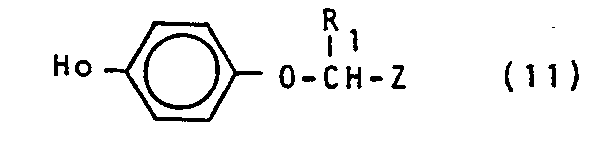
- Die Verbindungen der allgemeinen Formel I lassen sich z. B. durch Umsetzung entsprechender Phenole der Formel II mit 2-Halogenbenzoxazolen, 2-Halogenbenzthiazolen und 2-Halogenbenzimidazolen der allgemeinen Formel IV

- Nach dem erfindungsgemäßen Verfahren lassen sich prinzipiell alle Verbindungen der allgemeinen Formel I darstellen.
- Bevorzugt wird das Verfahren zur Herstellung von Verbindungen der Formel I angewandt, bei denen der Rest
- R F, Cl. Br, CF3 oder NO2 in 6-Stellung,
- m O oder 1,
- R1 Methyl und
- Z -COOR2 bedeutet.
- Bei Verwendung von optisch aktiven 2-(4'-Hydroxy- phenoxy)-alkancarbonsäureestern der Formel II als Ausgangsstoffe lassen sich optisch aktive Endprodukte erhalten, wie sie z. B. in der DE-OS 27 58 002 beschrieben sind.
- Die Phenole der Formel II sind aus der Literatur bekannt (z. B. J. Org. Chem. 39, 214 (1974)) oder können in Analogie zu bekannten Verfahren hergestellt werden. Die Verbindungen der Formel III lassen sich nach bekannten Verfahren z.B. aus den entsprechenden 2-Mercaptobenzoxazolen bzw. 2-Mercaptobenzthiazolen durch Alkylierung und anschließende Oxidation mit Kaliumpermanganat, Wasserstoffperoxid oder organischen Persäuren herstellen(vgl. J. Chem.Soc. 1949, 3311; Eur. J. Med. Chem. 1978, 171; J. Heterocycl. Chein. 13, 491 (1976); Chem. Pharm. Bull . 17, 1958 (1969)).
- Wegen der Bedeutung der Verbindungen I als Pflanzenschutzmittel bestand ein dringendes Bedürfnis nach einem verbesserten Herstellungsverfahren. Das erfindungsgemäße Verfahren vermeidet die oben beschriebenen Nachteile. Es liefert bereits nach relativ kurzer Reaktionszeit die Verbindungen der Formel I in hohen Ausbeuten und guter Reinheit, ohne daß die im Rest Z vorhandenen funktionellen Gruppen angegriffen werden. Dies war überraschend und aufgrund des Standes der Technik nicht vorhersehbar. Zwar ist die Umsetzung von 2-Alkylsulfonylbenzthiuzolderivaten mit aliphatischen Alkoholen, primären oder sekundären Aminen oder CH-aciden Verbindungen bereits bekannt (vgl. J. Chem. Soc. 1949, 3311; J. Heterocycl. Chem. 13, 491 (1976); Eur. J. Med. Chem. 1978, 171), doch sind entsprechende Umsetzungen mit Phenolen bisher nicht beschrieben worden. Der Rest R11 kann grundsätzlich ein beliebiger aliphatischcr, cycloaliphatischer, araliphatischer oder aromatischer Rest sein; zweckmäßigerweise verwendet man jedoch Ausgangsstoffe, in denen R11 niedermolekulares Alkyl, Alkenyl, Alkoxyalkyl oder Carbalkoxyalkyl bzw. Phenyl oder Benzyl bedeutet, da derartige Verbindungen am leichtesten und kostengünstigsten zugänglich sind.
- Beispiele hierfür sind:
- 2- Methylsulfonyl-benzthiazol oder -benzoxazol,
- 2-Äthylsulfonyl-benzthiazol oder -benzoxazol,
- 6-Chlor-2-methylsulfonylbemzthiazol oder -benzoxazol,
- 6-Brom-2-methylsulfonyl-benzthiazol,
- 6-Chlor-2-methylsulfinyl-benzthiazol,
- Äthyl(benzthiazol-2-yl)-sulfonylacetat,
- Methyl(6-chlorbenzthiazol-2-yl)sulfonylacetat oder 6-Chlor-2-phenylsulfonyl-benztHazol bzw. -benzoxazol.
- Bei der erfindungsgemäßen Umsetzung wird die nucleofuge Gruppe -S(O)n-R11 durch die deprotonierte Phenolkomponente ersetzt. Läßt man zum Beiapiel 6-Chlor-2-methylsulfonyl-benzthiazol unter Zusatz von Kaliumcarbonat mit einem Phenol der Formel II reagieren, so isoliert man nach der Reaktion neben der gewünschten Verbindung 1 und Kaliumhydrogencarbonat Kaliummethylsulfinat in fast quantitativer Ausbeute. Das Molverhältnis der Reaktionskomponenten II und III ist nicht kritisch und kann in weiten Grenzen variiert werden. Da jedoch die Abtrennung von nicht umgesetztem Ausgangsprodukt zusätzliche Operationen erfordert, arbeitet man bevorzugt mit etwa äquimolaren Mengen bzw. mit einem Überschuß von nicht mehr als 10 % der Verbindung II.
- Das erfindungsgemäße Verfahren kann in An- oder Abwesenheit von Lösungsmitteln durchgeführt werden. Bevorzugt werden die Umsetzungen jedoch in Gegenwart von unter den Reaktionsbedingungen inerten Lösungsmitteln durchgeführt. Als solche eignen sich vorzugsweise polare aprotische Lösungsmittel, z. B. Säureamide wie Dimethylformamid, Dimethylacetamid und N-Methylpyrrolidon, weiterhin Dimethylsulfoxid, Nitrile wie Acetonitril oder Propionitril, Ketone wie Aceton, Methyläthylketon oder Methylisobutylketon, Äther wie Tetrahydrofuran oder Dioxan und aromatische und aliphatische Kohlenwasserstoffe wie Chlorbenzol oder Cyclohexan.
- Als basische Verbindungen eignen sich die üblichen organischen Basen, z. B. tertiäre Amine wie Triäthylamin, und insbesondere anorganische Basen wie AlkaliCarbonate (Na2CO3,K2CO3). Sie werden in mindestens stöchiometrischen, vorzugsweise in mindestens äquimolaren Menten (bezogen auf II) bzw. in einem Überschuß von 5 bis 20 % eingesetzt.
- Zur Durchführung des Verfahrens erwärmt man zweckmäßigerweise die Verbindung der Formel II mit der basischen Verbindung in einem geeigneten Lösungsmittel zunächst auf Reaktionstemperatur, wobei zumindest teilweise das Salz der Verbindung II gebildet wird. Dann gibt man die heterocyclibche Komponente aer Formel III, gegebenenfalls gelöst in dem gleichen Lösungsmittel, zu und rührt so lange bei erhöhter Temperatur, bis die Umsetzung beendet ist. Jedoch können die Reaktionspartner auch in anderer Reihenfolge zusammegegeben werden.
- Die Reaktionstemperaturen sind in weiten Grenzen variierbar und liegen zwischen 20 und 160 C, vorzugsweise zwischen 40 und 85°C, gegebenenfalls beim Siedepunkt des verwendeten Lösungsmittels. Die Reaktionsdauer hängt von der Temperatur, vom verwendeten Lösungsmittel und von dem Verhältnis II : III ab und wird geringer mit zunehmender Temperatur und wachsendem Überschuß an II. Gewöhnlich ist die Umsetzung nach 20 Minuten bis 8 Stunden beendet. Die Reaktion wird zweckmäßigerweise, jedoch nicht notwendigerweise unter Schutzgas durchgeführt. Als Inertgas wird Stickstoff bevorzugt.
- Nach beendeter Reaktion wird von gebildetem Salz abfiltriert und das Lösungsmittel abdestilliert. Ein eventuell vorhandener Überschuß an II wird durch basische Extraktion entfernt.
- Die erhaltenen Verbindungen der Formel I können durch Destillieren oder Chromatographieren weiter gereinigt werden, doch ist dies wegen der hohen Reinheit der Produkte im allgemeinen nicht nötig.
- Die nachfolgenden Beispiele erläutern das erfindungsgemäße Verfahren.
- 21 g (0,1 Mol) 2-(4'-Hydroxyphenoxy)-propionsäure- äthylester werden mit 16,6 g (0,12 Mol) Kaliumcarbonat in 150 ml Acetonitril anderthalb Stunden am Rückfluß erhitzt. Man gibt 24,75 g (0,1 1 Mol) 6-Chlor-2-methyl- sulfonylbenzthiazol in 100 ml Acetonitril gelöst zu und erhitzt weitere 5 Stunden zum Sieden, filtriert heiß vom Salzanteil ab, wäscht mit Acetonitril nach und destilliert das Lösungsmittel ab. Der verbleibende Rückstand wird in 200 ml Toluol gelöst, die Lösung mehrfach mit verdünnter NaHCO3-Lösung gewaschen und über Na2SO4 getrocknet. Nach dem Abdestillieren des Toluols hinterbleiben 37 g (98 %
- d. Th.) an 2-[4'-(6"-Chlorbenzthiazol-2"-yl-oxy)-phenoxy]-propionsäureäthylester, Fp. 54°C.

- Unter Verwendung von 31 g (0,1 Mol) 2-Phenylsulfonylbenzthiazol nach 6 Stunden Reaktionszeit 32,2 g (94 % d. Th. 2-[4'-(Benzthiazol-2"-yl-oxy)-phenoxy]-propionsäureäthylester vom Kp. 201 - 204°C%0.13 mbar:

- Unter Verwendung von 19,6 g (0,1 Mol) 2-(4'-Hydroxi- phenoxy)-propionsäuremethylester und 23,2 g (0,1 Mol) 6-Chlor-2-methylsufinyl-benzthiazol nach 6 Stunden Reaktionszeit 30,5 g (84 % d. Th.) 2-[4'-(6"-Chlorbenzthiazol-2"-yl-oxi)-phenoxi]-propionsäuremethylester vom Kp. 226 - 228°C/Q13 mbar:

- Unter Verwendung von 23,2 g (0,1 Mol) 6-Chlor-2-methylsulfonylbenzoxazol nach 30 Minuten Reaktionszeit 31,8 g (88,6 % d.Th.) an 2-[4'-(6'-Chlorbenzoxazol-2"-yl-oxi)-phenoxi]-propionsäureäthylester vom Fp. 81 - 82°C:

- Unter Verwendung von 21 g (0,1 Mol) D-(+)-2-(4'-Hy- droxyphenoxy)-propionsäureäthylester und 26,2 g (0,1 Mol) 6-Chlor-2-äthylsulfunylbenzthiazol nach 6 Stunden Reaktionszeit 35,5 g (94 % d. Th.) D-(+)-2-[4-(6-Chlorbenzthiazol-2-yl-oxy)-phenox]-propion- säureäthylester vom Fp. 53°C und


Furfuryl, Tetrahydrofurfuryl oder ein Kationäquivalent einer organischen oder anorganischen Base, oder Reste der Formeln
bedeuten, das dadurch gekennzeichnet ist, da3 man Phenole der Formel II


bedeutet, in Gegenwart basischer Verbindungen umsetzt.
Claims (1)
- Verfahren zur Herstellung von 2-[4'-(Benzoxazolyl-2"-oxi,-Benzthiazolyl-2"-oxi und Benzimidazolyl-2"-oxi)-phenoxi] alkancarbonsäurederivaten der allgemeinen Formel I
 R Halogen, CF3, NO2, CN,(C1-C4)-Alkyl, (C1-C4)-Alkoxi oder (C1-C4)-Alkylthio,A O, S, NH oder N-(C1-C4)-Alkyl,R1 H oder (C1-C4)-Alkyl,Z eine Gruppe der Formel
 R 2 H, (C1-C12)-Alkyl, das gegebenenfalls durch 1-6 Halogen, vorzugsweise F, Cl Br und/oder durch OH, (C1-C6)-Alkoxi, (C1-C4)-Alkylthio, (C1-C6)-Alkoxi-(C2-C6)- alkoxi, Halogen (C1-C2)-alkoxi, Methoxi- äthoxi-äthoxi,(C1-C4)-Alkylsmino, Di-(C1-C4)-alkyl- amino, Phenyl, Oxiranyl und/oder Phenoxi substituiert ist, wobei letzteres ebenfalls ein- bis zweifach durch Halogen oder (C1-C4)-Alkyl substituiert sein kann,(C5-C6)-Cycloalkyl, das gegebenenfalls durch Halogen oder Methyl substituiert ist, (C3-C6)-Alkenyl, Halogen-(C3-C6)-alkenyl oder (C5-C6)-Cycloakenyl, (C3-C4)-Alhinyl, das gegebenenfalls ein- oder zweifach durch (C1-C6)-Alkyl, Phenyl, Halogen bzw. (C1-C2)-Alkoxi substituiert ist,Phenyl, das gegebenenfalls ein- bis dreifach durch (C1-C4)-Alkyl, (C1-C4)-Alkoxi, Halogen, NO2 oder CF3 substituiert ist,
Furfuryl, Tetrahydrofurfuryl oder ein Kationäquivalent einer organischen oder anorganischen Base, oder Reste der Formeln R3 (C1-C6)-Alkyl, Phenyl-(C1-C2)-alkyl, wobei der Phenylrest ein- oder zweifach durch (C1-C4)-Alkyl und/oder Halogen substituiert sein kann, (C3-C6)-Alkenyl oder Phenyl, das auch ein- oder zweifach durch (C1-C4)-Alkyl und/oder Halogen substituiert sein kann,R4 und R gleich oder verschieden sind und H, (C1-C6)-Alkyl, Hydroxy-(C1-C6)-alkyl, (C5-C6)-Cycloalkyl oder Phenyl, das gegebenenfalls ein- bis dreifach durch (C1-C4)-Alkyl, (C1-C4-Alkoxi, Halogen oder CF3 substituiert ist, mit der Maßgabe, daß R4 und R5 ni cht gemeinsam Phenyl sind,bedeuten oder gemeinsam eine Methylenkette mit 2,4 oder 5 Gliedern bilden, in der eine CH2-Gruppe gegebenenfalls durch 0, NH oder N(CH3) ersetzt sein kann,R6 H oder CH3R7 H, CH3 oder C2H5,R8 H, CH3, C2H5- oder Phenyl,R9 (C1-C6)-Alkyl, das gegebenenfalls ein- bis dreifach durch Halogen substituiert ist, Cyclopropyl, (C3-C6)-Alkenyl, Phenyl, (C1-C4)-Alkyl-phenyl, (C1-C4)-Alkoxi-phenyl, Halogen-phenyl, Trifluormethylphenyl oder Nitrophenyl sowieR10 (C1-C4)-Alkyl oder Phenyl, das auch ein- oder zweifach durch Halogen, CF3, NO2 oder (C1-C4)-Alkyl substituiert sein kann,
bedeuten, dadurch gekennzeichnet, daß man Phenole der Formel II
 n 1 oder 2 ist undR11 einen aliphatischen,cycloaliphatischen, araliphatischen oder aromatischen Rest
bedeutet, in Gegenwart basischer Verbindungen umsetzt.
Applications Claiming Priority (2)
| Application Number | Priority Date | Filing Date | Title |
|---|---|---|---|
| DE3027483 | 1980-07-19 | ||
| DE19803027483 DE3027483A1 (de) | 1980-07-19 | 1980-07-19 | Verfahren zur herstellung heterocyclisch substituierter 4-oxiphenoxialkancarbonsaeurederivate |
Publications (3)
| Publication Number | Publication Date |
|---|---|
| EP0044497A2 true EP0044497A2 (de) | 1982-01-27 |
| EP0044497A3 EP0044497A3 (en) | 1982-04-07 |
| EP0044497B1 EP0044497B1 (de) | 1984-11-28 |
Family
ID=6107649
Family Applications (1)
| Application Number | Title | Priority Date | Filing Date |
|---|---|---|---|
| EP81105457A Expired EP0044497B1 (de) | 1980-07-19 | 1981-07-13 | Verfahren zur Herstellung heterocyclisch substituierter 4-Oxiphenoxialkancarbonsäurederivate |
Country Status (4)
| Country | Link |
|---|---|
| EP (1) | EP0044497B1 (de) |
| JP (1) | JPS5753468A (de) |
| DE (2) | DE3027483A1 (de) |
| IL (1) | IL63343A (de) |
Cited By (3)
| Publication number | Priority date | Publication date | Assignee | Title |
|---|---|---|---|---|
| EP0107123B1 (de) * | 1982-10-14 | 1987-07-01 | BASF Aktiengesellschaft | Anilinderivate, Verfahren zu ihrer Herstellung und ihre Verwendung zur Bekämpfung unerwünschten Pflanzenwuchses |
| EP3110415A4 (de) * | 2014-02-28 | 2017-12-13 | The Texas A & M University System | Zusammensetzungen und verfahren zur hemmung von myobakterien |
| EP4209486A1 (de) | 2022-01-07 | 2023-07-12 | Adama Agan Ltd. | Verfahren zur herstellung von aryloxyphenoxypropionsäurederivaten in einer unpolarer lössungsmittel mit einem tertiä-amine katalysator |
Families Citing this family (8)
| Publication number | Priority date | Publication date | Assignee | Title |
|---|---|---|---|---|
| DE3109582A1 (de) * | 1981-03-13 | 1982-10-28 | Bayer Ag, 5090 Leverkusen | N-(2,2,2-trifluorethyl)-n-alkyl- azolyloxyessigsaeureamide, verfahren zu ihrer herstellung und ihre verwendung als herbizide sowie neue zwischenprodukte zu ihrer herstellung |
| EP0157225B1 (de) * | 1984-03-14 | 1988-01-20 | CASSELLA Aktiengesellschaft | Verfahren zur Herstellung von Benzimidazolyl,-Benzoxazolyl- und Benzthiazolyloxyphenoxypropionsäurederivaten |
| DE3422861A1 (de) * | 1984-06-20 | 1986-01-02 | Bayer Ag, 5090 Leverkusen | Verfahren zur herstellung von heteroaryloxyacetamiden |
| DE3502266A1 (de) * | 1985-01-24 | 1986-08-07 | Bayer Ag, 5090 Leverkusen | Optisch aktive phenoxypropionsaeure-derivate |
| US5156667A (en) * | 1986-03-07 | 1992-10-20 | Dowelanco | Derivatives of 4-((aryloxy)phenoxy)alkenols and their herbicidal uses |
| US4935522A (en) * | 1988-03-21 | 1990-06-19 | Hoechst Celanese Corporation | Process for producing ethyl 2-[4'-(6"-chloro-2"-benzoxazolyloxy)phenoxy]propionate |
| JPH0721591Y2 (ja) * | 1988-11-11 | 1995-05-17 | 和歌山鉄工株式会社 | カレンダーローラの焼損防止装置 |
| JP4951994B2 (ja) * | 2006-02-21 | 2012-06-13 | 三菱電機株式会社 | エレベータの釣合錘装置 |
Family Cites Families (5)
| Publication number | Priority date | Publication date | Assignee | Title |
|---|---|---|---|---|
| BE792402A (fr) * | 1971-12-07 | 1973-06-07 | Ciba Geigy | Composes heterocycliques azotes et medicaments anthelminthiqueset antimicrobiens qui en contiennent |
| DE2758002A1 (de) * | 1976-09-10 | 1979-07-05 | Hoechst Ag | Optisch aktive herbizide mittel |
| DE2640730C2 (de) * | 1976-09-10 | 1983-08-25 | Hoechst Ag, 6230 Frankfurt | Benzoxazolyloxy- und Benzothiazolyloxy-phenoxy-Verbindungen und diese enthaltende herbizide Mittel |
| DE2830066A1 (de) * | 1978-07-08 | 1980-01-17 | Hoechst Ag | 4-oxyphenoxyalkansaeurederivate und diese enthaltende herbizide mittel |
| DE2914300A1 (de) * | 1979-04-09 | 1980-11-13 | Hoechst Ag | Heterocyclische phenylether und diese enthaltende herbizide mittel |
-
1980
- 1980-07-19 DE DE19803027483 patent/DE3027483A1/de not_active Withdrawn
-
1981
- 1981-07-13 EP EP81105457A patent/EP0044497B1/de not_active Expired
- 1981-07-13 DE DE8181105457T patent/DE3167449D1/de not_active Expired
- 1981-07-16 IL IL63343A patent/IL63343A/xx unknown
- 1981-07-17 JP JP56110994A patent/JPS5753468A/ja active Pending
Cited By (4)
| Publication number | Priority date | Publication date | Assignee | Title |
|---|---|---|---|---|
| EP0107123B1 (de) * | 1982-10-14 | 1987-07-01 | BASF Aktiengesellschaft | Anilinderivate, Verfahren zu ihrer Herstellung und ihre Verwendung zur Bekämpfung unerwünschten Pflanzenwuchses |
| EP3110415A4 (de) * | 2014-02-28 | 2017-12-13 | The Texas A & M University System | Zusammensetzungen und verfahren zur hemmung von myobakterien |
| EP4209486A1 (de) | 2022-01-07 | 2023-07-12 | Adama Agan Ltd. | Verfahren zur herstellung von aryloxyphenoxypropionsäurederivaten in einer unpolarer lössungsmittel mit einem tertiä-amine katalysator |
| WO2023131947A1 (en) | 2022-01-07 | 2023-07-13 | Adama Agan Ltd. | Process for the preparation of aryloxyphenoxypropionic acid derivatives in a non polar solvent with a tertiary amine catalyst |
Also Published As
| Publication number | Publication date |
|---|---|
| DE3027483A1 (de) | 1982-02-25 |
| EP0044497B1 (de) | 1984-11-28 |
| JPS5753468A (en) | 1982-03-30 |
| IL63343A0 (en) | 1981-10-30 |
| EP0044497A3 (en) | 1982-04-07 |
| DE3167449D1 (en) | 1985-01-10 |
| IL63343A (en) | 1985-05-31 |
Similar Documents
| Publication | Publication Date | Title |
|---|---|---|
| EP0165537B1 (de) | Verfahren zur Herstellung von Heteroaryloxyacetamiden | |
| EP0044497B1 (de) | Verfahren zur Herstellung heterocyclisch substituierter 4-Oxiphenoxialkancarbonsäurederivate | |
| DE2207549A1 (de) | 1-aminouracile und deren salze, verfahren zu ihrer herstellung und ihre verwendung als herbizide | |
| DE2858737C2 (de) | ||
| CH626777A5 (en) | Herbicide | |
| EP0000924B1 (de) | Heterocyclische Phenyläther und Verfahren zu ihrer Herstellung | |
| DE2126148A1 (en) | Prepn of uracil derivs - useful as plant - protection agents and their inters | |
| EP0075840A2 (de) | Heterocyclische Phenyläther, Verfahren zu deren Herstellung und diese enthaltende herbizide Mittel | |
| EP0971907B1 (de) | Verfahren zur herstellung von 1,3-disubstituierten 2-nitroguanidinen | |
| DE3139457A1 (de) | Neue substituierte benzanilidether, verfahren zu ihrer herstellung, ihre verwendung als fungizide und zwischenprodukte hierfuer | |
| DE1921737A1 (de) | Heterocyclische Acylreste enthaltende Sulfonylharnstoffe und Sulfonylsemicarbazide mit antidiabetischer Wirkung | |
| EP0324336B2 (de) | Verfahren zur Herstellung von 3-Cyano-4-aryl-pyrrolen | |
| CH642821A5 (en) | Pesticidal preparations containing imidazolines, and their use for controlling pests | |
| EP0471262A1 (de) | Verfahren zur Herstellung von substituierten 3-Aminoacrylestern | |
| DE2406972C3 (de) | Verfahren zur Herstellung von 5-Sulfamoylanthranilsäuren | |
| EP0015005B1 (de) | Substituierte Phenoxialkancarbonsäurederivate, Verfahren zu ihrer Herstellung und ihre Verwendung als Herbizide | |
| DE2035796A1 (de) | Verfahren zum Austausch von N Nitroso | |
| EP0378046B1 (de) | Verfahren zur Herstellung von 3-Phenylpyrrolderivaten | |
| DE1134382B (de) | Verfahren zur Herstellung von Thiolphosphor-, -phosphon-, -phosphin- bzw. Thionothiolphosphor-, -phosphon-, -phosphinsaeureestern | |
| EP0156198B1 (de) | Verfahren zur Herstellung von Isocyanaten | |
| DE3637507A1 (de) | Neues verfahren zur herstellung von teilweise neuen 3-sulfenylmaleinimiden und ihre verwendung | |
| DE3702282A1 (de) | 2-cyan-2-oximino-acetamide | |
| DE2830066A1 (de) | 4-oxyphenoxyalkansaeurederivate und diese enthaltende herbizide mittel | |
| DE3830238A1 (de) | Verfahren zur herstellung von 1-substituierten 2-(nitroimino)-1,3-diazacycloalkan-derivaten | |
| DE1670899C3 (de) |
Legal Events
| Date | Code | Title | Description |
|---|---|---|---|
| PUAI | Public reference made under article 153(3) epc to a published international application that has entered the european phase |
Free format text: ORIGINAL CODE: 0009012 |
|
| 17P | Request for examination filed |
Effective date: 19811030 |
|
| AK | Designated contracting states |
Designated state(s): BE CH DE FR GB NL |
|
| PUAL | Search report despatched |
Free format text: ORIGINAL CODE: 0009013 |
|
| AK | Designated contracting states |
Designated state(s): BE CH DE FR GB NL |
|
| GRAA | (expected) grant |
Free format text: ORIGINAL CODE: 0009210 |
|
| AK | Designated contracting states |
Designated state(s): BE CH DE FR GB LI NL |
|
| REF | Corresponds to: |
Ref document number: 3167449 Country of ref document: DE Date of ref document: 19850110 |
|
| ET | Fr: translation filed | ||
| PLBE | No opposition filed within time limit |
Free format text: ORIGINAL CODE: 0009261 |
|
| STAA | Information on the status of an ep patent application or granted ep patent |
Free format text: STATUS: NO OPPOSITION FILED WITHIN TIME LIMIT |
|
| 26N | No opposition filed | ||
| PGFP | Annual fee paid to national office [announced via postgrant information from national office to epo] |
Ref country code: NL Payment date: 19870731 Year of fee payment: 7 |
|
| PG25 | Lapsed in a contracting state [announced via postgrant information from national office to epo] |
Ref country code: DE Effective date: 19880401 |
|
| PG25 | Lapsed in a contracting state [announced via postgrant information from national office to epo] |
Ref country code: GB Effective date: 19880713 |
|
| PG25 | Lapsed in a contracting state [announced via postgrant information from national office to epo] |
Ref country code: LI Effective date: 19880731 Ref country code: CH Effective date: 19880731 Ref country code: BE Effective date: 19880731 |
|
| BERE | Be: lapsed |
Owner name: HOECHST A.G. Effective date: 19880731 |
|
| PG25 | Lapsed in a contracting state [announced via postgrant information from national office to epo] |
Ref country code: NL Effective date: 19890201 |
|
| NLV4 | Nl: lapsed or anulled due to non-payment of the annual fee | ||
| GBPC | Gb: european patent ceased through non-payment of renewal fee | ||
| PG25 | Lapsed in a contracting state [announced via postgrant information from national office to epo] |
Ref country code: FR Free format text: LAPSE BECAUSE OF NON-PAYMENT OF DUE FEES Effective date: 19890331 |
|
| REG | Reference to a national code |
Ref country code: CH Ref legal event code: PL |
|
| REG | Reference to a national code |
Ref country code: FR Ref legal event code: ST |