EP0044732A2 - Akustischer Oberflächenwellenwandler mit verbesserter Frequenzcharakteristik - Google Patents
Akustischer Oberflächenwellenwandler mit verbesserter Frequenzcharakteristik Download PDFInfo
- Publication number
- EP0044732A2 EP0044732A2 EP81303301A EP81303301A EP0044732A2 EP 0044732 A2 EP0044732 A2 EP 0044732A2 EP 81303301 A EP81303301 A EP 81303301A EP 81303301 A EP81303301 A EP 81303301A EP 0044732 A2 EP0044732 A2 EP 0044732A2
- Authority
- EP
- European Patent Office
- Prior art keywords
- interdigital electrode
- electrode
- finger
- edge
- surface wave
- Prior art date
- Legal status (The legal status is an assumption and is not a legal conclusion. Google has not performed a legal analysis and makes no representation as to the accuracy of the status listed.)
- Granted
Links
Images




Classifications
-
- H—ELECTRICITY
- H03—ELECTRONIC CIRCUITRY
- H03H—IMPEDANCE NETWORKS, e.g. RESONANT CIRCUITS; RESONATORS
- H03H9/00—Networks comprising electromechanical or electro-acoustic elements; Electromechanical resonators
- H03H9/02—Details
- H03H9/125—Driving means, e.g. electrodes, coils
- H03H9/145—Driving means, e.g. electrodes, coils for networks using surface acoustic waves
- H03H9/14544—Transducers of particular shape or position
- H03H9/14552—Transducers of particular shape or position comprising split fingers
-
- H—ELECTRICITY
- H03—ELECTRONIC CIRCUITRY
- H03H—IMPEDANCE NETWORKS, e.g. RESONANT CIRCUITS; RESONATORS
- H03H9/00—Networks comprising electromechanical or electro-acoustic elements; Electromechanical resonators
- H03H9/02—Details
- H03H9/02535—Details of surface acoustic wave devices
- H03H9/02637—Details concerning reflective or coupling arrays
-
- H—ELECTRICITY
- H03—ELECTRONIC CIRCUITRY
- H03H—IMPEDANCE NETWORKS, e.g. RESONANT CIRCUITS; RESONATORS
- H03H9/00—Networks comprising electromechanical or electro-acoustic elements; Electromechanical resonators
- H03H9/02—Details
- H03H9/02535—Details of surface acoustic wave devices
- H03H9/02818—Means for compensation or elimination of undesirable effects
-
- H—ELECTRICITY
- H03—ELECTRONIC CIRCUITRY
- H03H—IMPEDANCE NETWORKS, e.g. RESONANT CIRCUITS; RESONATORS
- H03H9/00—Networks comprising electromechanical or electro-acoustic elements; Electromechanical resonators
- H03H9/02—Details
- H03H9/125—Driving means, e.g. electrodes, coils
- H03H9/145—Driving means, e.g. electrodes, coils for networks using surface acoustic waves
- H03H9/14544—Transducers of particular shape or position
- H03H9/14564—Shifted fingers transducers
- H03H9/14567—Stepped-fan shaped transducers
-
- H—ELECTRICITY
- H03—ELECTRONIC CIRCUITRY
- H03H—IMPEDANCE NETWORKS, e.g. RESONANT CIRCUITS; RESONATORS
- H03H9/00—Networks comprising electromechanical or electro-acoustic elements; Electromechanical resonators
- H03H9/02—Details
- H03H9/125—Driving means, e.g. electrodes, coils
- H03H9/145—Driving means, e.g. electrodes, coils for networks using surface acoustic waves
- H03H9/14544—Transducers of particular shape or position
- H03H9/1457—Transducers having different finger widths
Definitions
- This invention relates to an acoustic surface wave transducer, and in particular, relates to such a device with improved inband frequency characteristics.
- the present acoustic surface wave transducer is applicable to a mechanical bandpass filter, a delay line, a convolver, and/or a resonator, for use in the HF, VHF and/or UHF bands.
- Fig. 1 of the accompanying drawings shows a basic structure of a prior acoustic surface wave device, in which a piezoelectric substrate 1 is made of, for instance, lithium niobate (L i N b 0 3 ), LiTa03, or PZT.
- Interdigital electrodes 2A and 2B are positioned on the surface of the substrate 1.
- a high-frequency power source 4 is coupled to the first interdigital electrode 2A, and output terminals 5a,5b are coupled to the second interdigital electrode 2B.
- the electrodes 2A and 2B are positioned with a predetermined spacing L, and each interdigital electrode is so arranged that the fingers overlap one another by a distance d.
- a mechanical vibration is induced in the substrate 1, and that vibration propagates in the substrate 1, in a direction perpendicular to the fingers, in the form of an acoustic surface wave.
- the second (reception) interdigital electrode 2B located along the path of the acoustic surface wave, transduces the mechanical energy in the substrate 1 to electrical energy.
- signal processing is performed, so that the device acts as a delay line, a bandpass filter, an oscillator, a mixer and/or a convolver.
- each finger of an interdigital electrode may be 1/4 wavelength, or 1/8 wavelength.
- a finger of 1/8 wavelength width and a finger of 5/8 wavelength width may be arranged-alternately.
- the arrangement of 1/8 wavelength width fingers with a spacing of 1/8 wavelength is called a split type interdigital electrode.
- US Patent No. 3,810,257 and US Patent No.3,886,504 disclose some examples.
- the former discloses a transducer which reduces triple transit signals, and the latter discloses an improvement in the resonator devices.
- Fig.2 shows another prior transducer, in which the overlap distance d between adjacent fingers is not constant, but depends upon the position of the fingers.
- a symbol A shows the direction of propagation of an acoustic surface wave.
- An interdigital electrode having a non-uniform overlap distance d is called an apodized electrode, whilst an interdigital electrode having a constant overlap distance is called a regular electrode.
- a bandpass filter using a regular interdigital electrode provides a single-hump frequency characteristic as shown in Fig.3A, where the horizontal axis represents the frequency, and the vertical axis represents the response level.
- a bandpass filter with an apodized interdigital electrode provides a flat frequency characteristic as shown in Fig.3B.
- the overlap distance between adjacent electrode fingers is long at the middle portion of the electrode, and is short at both of the end portions of the electrode.
- a strong acoustic wave is generated at the middle portion of the electrode, and a rather weak acoustic wave is generated at the end portions of the electrode.
- An apodized electrode is preferable for a bandpass filter which has the improved flat frequency characteristic as shown in Fig.3B.
- a flat characteristic is important for a bandpass filter in a television transmission system, which requires a characteristic with less than 0.2 dB deviation in the inband frequency response.
- the prior transducer of Fig.2 includes features for improving the characteristics of the filter.
- One such feature is the presence of an acoustical absorber 3, made of plastics material, near the end of the substrate 1 for preventing the effect of reflection of the wave at the end of the substrate.
- a second feature is the provision of a rough or uneven bottom surface of the substrate 1 for scattering acoustic waves directed towards the inside of the substrate, to eliminate the effect of internally-directed waves.
- the prior acoustic wave transducers described above have the disadvantage that the amplitude characteristic and the group delay characteristic have a rather large inband deviation D as shown in Fig.3C.
- a bandpass filter When a bandpass filter is used in a television transmission apparatus, that inband deviation must be less than 0.2 dB in the amplitude characteristic, and less than 20 nS in the group delay characteristic.
- a prior bandpass filter is no better than 0.6 dB of inband deviation for the amplitude characteristic, and 60 nS for the group delay characteristic. Therefore, when the inband deviation characteristics must be extremely small, a prior acoustic wave filter cannot be utilised. Instead, an LC (inductance/capacitance) filter has been used for that purpose.
- an LC filter has the disadvantages that it is large, the precise adjustment of an inductance and/or capacitance is necessary, and the phase characteristics deteriorate at the boundaries of the pass band and the attenuation bands.
- an acoustic surface wave transducer comprises a substrate at least a surface of which is piezoelectric; a first interdigital electrode having a pair of comb-like half-electrodes engaged interdigitally with each other, disposed on the piezoelectric surface, and being operable to convert an input electrical signal to acoustic surface waves which propagate on the piezoelectric surface; a second interdigital electrode having a pair of comb-like half-electrodes engaged interdigitally with each other, disposed on the piezoelectric surface and spaced from the first interdigital electrode by a predetermined distance, to convert the acoustic surface waves in the piezoelectric surface to an output electrical signal; an edge-effect canceller provided at at least one of the extreme edges of at least one of the interdigital electrodes, the edge-effect canceller being constructed so that the length of the extreme end finger of the respective half-electrode is approximately half the length of the second extreme end finger of said half- electrode, and
- the edge-effect canceller may be located either on a transmission interdigital electrode, or on a reception interdigital electrode, and may be located at both ends of each interdigital electrode.
- acoustic surface wave by using a laser holographic technique at the side wall of the substrate as shown in Fig.4B, and found that there are generated not only a desired surface wave A, but also undesired waves E and D which are generated at the external edge of the extreme end finger.
- the undesired waves are not only a surface wave E, but also a bulk wave D which is directed into the substrate.
- the effect of the bulk wave D can be cancelled by a conventional uneven or rough bottom surface of the substrate.
- the undesired surface wave E degrades the characteristics of a filter.
- the wavelength of the undesired surface wave E is almost the same as the wavelength of the desired acoustic surface wave which is generated between two adjacent fingers.
- the wave E may be a Rayleigh wave, or a pseudo-acoustic surface wave, although the physical mechanism for the generation of the undesired wave is unknown.
- Fig.4C shows an example of an impulse response of an interdigital electrode.
- an interdigital electrode is a regular interdigital electrode which has the same facing lengths for all of the fingers, the envelope EN of an impulse response is triangular.
- the basic concept of the present invention is to eliminate that edge effect, which gives rise to an undesired acoustic surface wave which is generated at the outer edge of the extreme end fingers, by providing an edge-effect canceller.
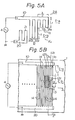
- Figs.5A and 5B show a first embodiment of the present transducer, in which a first comb-line half- electrode 10 comprises a plurality of fingers lla, 11b, 12a, 12b.
- a second halfelectrode 20 is grounded, and a source 4 applies an alternating signal between the first and second half-electrodes 10 and 20.
- Those half-electrodes are interdigitally engaged, as shown in the figures, to form an interdigital electrode. Since the half-electrode 20 is grounded, it does not give rise to an edge effect, i.e. the extreme edge of the half- electrode 20 does not generate an undesired acoustic surface wave. Therefore, it is necessary only to prevent the edge effect of the first half-electrode 10.
- the first half-electrode 10 has two fingers 11 and 12 which are located outside the extreme end finger 21 of the second half-electrode.
- the fingers 11 and 12 are, in practice, preferably split into sub-fingers 11a, 11b and 12a, 12b, respectively, for a reason which will be explained later.
- the length of the second extreme end finger 12 is twice as long as the extreme end finger 11.
- the spacing between the extreme edge of the finger 11 and the extreme edge of the finger 12 is designed to be 1/2 wavelength.
- the undesired surface wave E-a has the same strength as the undesired surface wave E-b, since the lengths L 1 and L 2 which generate the undesired surface waves are equal, and that the phase of the wave E-a is opposite to that of the wave E-b, since the edges of the fingers 11 and 12 are spaced apart by 1/2 wavelength. Accordingly, the two undesired surface waves E-a and E-b are cancelled by each other, and those waves are not received by the reception interdigital electrode. Henee, the edge effect is cancelled, and the inband deviation of a filter is improved. Therefore, the structure of Fig.5A constitutes an edge-effect canceller K 1 , or an undesired-wave canceller.
- the fingers 11 and 12 are split into sub-fingers 11a, llb and 12a, 12b, respectively,as mentioned above.
- a split finger has the advantage that it can cancel the reflection of the surface wave due to the difference of the acoustic impedance between the substrate with an electrode conductor, and the substrate with no electrode conductor.
- the width of each sub-finger, and the spacing between adjacent sub-fingers is 1/8 wavelength.
- the present invention is applicable not only to split electrodes, but also to ordinary electrodes. In the latter case the width of each finger 11 and 12, and the spacing between the fingers, is 1/4 wavelength.
- Fig.5B shows the structure of just the detailed actual transducer, and the concept of Fig.5B is the same as that of Fig.5A.
- the length L 1 of the extreme end finger 11 is half that of the second extreme end finger 12, and the spacing between the fingers 11 and 12 is 1/2 wavelength. Therefore, the undesired surface wave E-b generated at a portion 12c (shown hatched) of the finger 12 is cancelled by the undesired surface wave E-a generated by the finger 11.
- Fig.5B has dummy fingers 14 which confront with the corresponding facing fingers of the opposite electrode, and a floating (i.e. unconnected) finger 13 located between the extreme end finger 11 and the dummy finger 14 at the extreme end portion.
- the dummy finger and the floating finger do not generate an acoustic surface wave, but are provided just for the smooth transmission of the surface wave on the substrate by reducing the difference in sound velocity between the substrate covered with an electrode conductor and the substrate with no electrode conductor.
- the presence of a dummy finger and a floating finger further improves the characteristics of the transducer.
- the acoustic surface wave transducer of Figs.5A and 5B may have a plastics acoustical absorbent as shown in Fig.2, and the bottom of the substrate may be rough or uneven to scatter a bulk wave as described with reference to Fig.4B.
- Fig.6 shows another transducer according to the present invention, in which a pair of interdigital half-electrodes 30 and 40 are excited by a balanced- type power source 4. That is to say, neither half- electrode is grounded.
- both of the electrodes 30 and 40 have a structure for preventing edge effect.
- each finger is divided into a pair of sub-fingers.
- the length L 1 of the extreme end finger 31 of the half-electrode 30 is half the length of the second extreme end finger 32
- the length L 2 of the extreme end finger 41 of the second half-electrode 40 is half the length of the second extreme end finger 42.
- the spacing between the fingers 31 and 32, and the fingers 41 and 42, is 1/2 wavelength.
- an undesired surface wave E-c generated by the edge of the finger 31 is cancelled by an undesired surface wave E-d generated by the edge of the finger 32, so that these waves have no effect on the reception electrode.
- an undesired surface wave E-e generated by the top half portion of the finger 42 is cancelled by an undesired surface wave.E-f generated by the edge of the finger 41.
- fingers 33 and 43 are floating fingers.
- Fig. 7. shows another embodiment of the present invention, in which a pair of interdigital electrodes 50 and 60 are excited by a balanced power source 4, and neither electrode is grounded.
- the length L of the extreme end finger 51 of the first electrode 50 is the same as the length L of the extreme end finger 61 of the second electrode 60. Since the electrodes 50 and 60 are excited by the balanced power source, an undesired surface wave E-g generated by the edge of the finger 51 is a phase which is opposite to that of an undesired surface wave E-h generated by the edge of the finger 61.
- those two undesired surface waves cancel each other as far as the reception electrode is concerned.
- Fig.8 shows the structure of another transducer according to the present invention, in which electrodes 55 and 65 with fingers of 1/4 wavelength width are utilised, whereas the previous embodiments of Figs.5A, 5B, 6 and 7 use electrodes with split fingers 1/8 wavelength-wide.
- the electrodes are excited by an unbalanced power source 4, and the electrode 65 is grounded.
- the length L 1 of a finger 56 at the extreme end of the electrode 55 is half the length of the adjacent finger 57 of the electrode 55, and the spacing between the fingers 56 and 57 is 1/2 wavelength. Therefore, an undesired surface wave E-i generated by the edge of the finger 56 is cancelled by an undesired wave E-j generated by the finger 57.
- a dummy finger 66 and a floating finger 67 are provided.
- Fig.9A shows another structure of the present transducer, in which an interdigital half-electrode has a finger of 1/8 wavelength width and a finger of 5/8 wavelength width. It is assumed that the electrodes 70 and 80 are excited by an unbalanced power source and that the electrode 80 is grounded. Therefore, the electrode 70 has an undesired-wave canceller, and the electrode 80 has no undesired-wave canceller.
- the extreme end finger 71 of the electrode 70 has a width of 5/8 wavelength at a root portion which is coupled to a common arm 75 of the electrode 70, and has a width of 1/8 wavelength at its other end.
- the length L of the portion with the 1/8 wavelength width is the same as the length L of the portion with the 5/8 wavelength width.
- the spacing between the right-hand edge of the 5/8 wavelength width portion and the right-hand edge of the 1/8 wavelength width portion is, of course, 1/2 wavelength. Accordingly, an undesired surface wave E-k generated at the edge of the 5/8 wavelength width portion of the finger 71 has a phase difference of 1/2 wavelength relative to an undesired surface wave E-1 generated at the edge of the 1/8 wavelength width portion of the finger 71. Hence, those undesired surface wavelengths cancel each other.
- Fig.9B shows a modification of the embodiment of Fig.9A.
- the distinguishing features of the embodiment of Fig.9B are the presence of a split floating electrode 91a, and the division of the extreme end finger 91 of the electrode 90 intotwo sub-fingers as shown in the figure. Due to the presence of the floating electrode 91a, the ratio of the length of the substrate covered with the electrode conductor to the total length of the substrate in the direction of transmission of the wave becomes almost equal for all of the paths, and the sound velocity of the surface wave therefore becomes substantially equal for all of the paths. Accordingly, the wave front of the acoustic surface wave generated by the interdigital electrode is not impaired, and an excellent transducer or a bandpass filter is obtained.
- Figs.10A to 10D show some applications of the present undesired-wave canceller to a bandpass filter.
- a piezoelectric substrate 1 a transmission interdigital electrode 2A, a reception interdigital electrode 2B, a power source 4, and output terminals 5a and 5b.
- Fig.10A has an undesired-wave canceller K 1 on the transmission interdigital electrode at the side nearer to the reception interdigital electrode.
- the length of the extreme end finger is half that of the second finger from the end, and the spacing between those two fingers is 1/2 wavelength.
- undesired-wave cancellers K 1 and K 2 are provided on opposite sides of the transmission interdigital electrode 2A. By use of this configuration the characteristics of the transducer are further improved.
- an undesired-wave canceller K 3 is provided at the reception interdigital electrode 2B at the side nearer to the transmission interdigital electrode 2A.
- the effect of the Fig.10C configuration is almost the same as that of Fig.10A.
- undesired-wave cancellers K 3 and K 4 are provided at opposite sides of the reception interdigital electrode 2B.
- the effect of the Fig.10D configuration is almost the same as that of Fig.10B.
- the preferred substrate is of lithium-niobate (L i N b 0 3 ) with surface dimensions of 14 mm x 23 mm and a thickness of 1 mm.
- the transmission interdigital electrode is an apodized electrode having 60 pairs of split fingers each having a width of 1/8 wavelength
- the reception interdigital electrode is a regular electrode having 5 pairs of split fingers each having a width of 1/8 wavelength.
- the electrodes are made of gold plated on the nichrome substrate, and are deposited on the piezoelectric substrate by a conventional photolithograph process.
- the inband deviation of the above bandpass filter is less than 0.2 dB for the amplitude characteristic, and less than 20 nano-second for the group delay characteristic.
- the best characteristics obtained from a conventional bandpass filter have been 0.6 dB and 60 nano-second, respectively.
- the deviation of the present filter is improved by a factor of three as compared with a conventional filter.
- the present invention cancels the edge effect of an interdigital electrode in an acoustic surface wave transducer device by using a pair of fingers spaced by 1/2 wavelength.
- the undesired surface wave generated at the edge of the extreme end finger is cancelled, and the characteristics of an acoustic surface wave device are thereby improved.
- the present invention is applicable to all kinds of acoustic surface wave devices and, in particular, the inband deviation of a bandpass filter is improved.
Landscapes
- Physics & Mathematics (AREA)
- Acoustics & Sound (AREA)
- Surface Acoustic Wave Elements And Circuit Networks Thereof (AREA)
Applications Claiming Priority (2)
| Application Number | Priority Date | Filing Date | Title |
|---|---|---|---|
| JP99763/80 | 1980-07-23 | ||
| JP9976380A JPS5725714A (en) | 1980-07-23 | 1980-07-23 | Elastic surface wave converter |
Publications (3)
| Publication Number | Publication Date |
|---|---|
| EP0044732A2 true EP0044732A2 (de) | 1982-01-27 |
| EP0044732A3 EP0044732A3 (en) | 1982-02-10 |
| EP0044732B1 EP0044732B1 (de) | 1985-04-24 |
Family
ID=14256008
Family Applications (1)
| Application Number | Title | Priority Date | Filing Date |
|---|---|---|---|
| EP81303301A Expired EP0044732B1 (de) | 1980-07-23 | 1981-07-17 | Akustischer Oberflächenwellenwandler mit verbesserter Frequenzcharakteristik |
Country Status (4)
| Country | Link |
|---|---|
| US (1) | US4406964A (de) |
| EP (1) | EP0044732B1 (de) |
| JP (1) | JPS5725714A (de) |
| DE (1) | DE3170117D1 (de) |
Cited By (2)
| Publication number | Priority date | Publication date | Assignee | Title |
|---|---|---|---|---|
| EP0088400A3 (de) * | 1982-03-08 | 1985-09-18 | Siemens Aktiengesellschaft | Interdigitalwandler mit Unterdrückung reflektierter Störsignale |
| DE4126335A1 (de) * | 1991-08-08 | 1993-02-18 | Siemens Matsushita Components | Oberflaechenwellen-resonator |
Families Citing this family (9)
| Publication number | Priority date | Publication date | Assignee | Title |
|---|---|---|---|---|
| JPS60140917A (ja) * | 1983-12-28 | 1985-07-25 | Toshiba Corp | 弾性表面波トランスジユ−サ |
| JPS632414A (ja) * | 1986-06-21 | 1988-01-07 | Alps Electric Co Ltd | 弾性表面波共振子 |
| US4870312A (en) * | 1987-02-19 | 1989-09-26 | Hazeltine Corporation | Surface wave device having anti-reflective shield |
| DE4010310A1 (de) * | 1990-03-30 | 1991-10-02 | Siemens Ag | Oberflaechenwellenwandler, insbesondere in splitfinger-ausfuehrung, mit unterdrueckung von reflexionen endstaendiger wandlerfinger |
| CA2069370C (en) * | 1992-05-25 | 1995-12-05 | Robert C. Peach | Interdigital transducer for use in a surface acoustic wave filter |
| US6346761B1 (en) * | 1999-01-27 | 2002-02-12 | Hitachi Denshi Kabushiki Kaisha | Surface acoustic wave device capable of suppressing spurious response due to non-harmonic higher-order modes |
| DE10309250B4 (de) * | 2003-03-03 | 2015-10-22 | Epcos Ag | Elektroakustischer Wandler für mit Oberflächenwellen arbeitendes Bauelement |
| JP4184220B2 (ja) | 2003-10-01 | 2008-11-19 | 富士通メディアデバイス株式会社 | 弾性表面波デバイス |
| JP2018037719A (ja) * | 2016-08-29 | 2018-03-08 | 株式会社村田製作所 | 弾性波装置 |
Family Cites Families (5)
| Publication number | Priority date | Publication date | Assignee | Title |
|---|---|---|---|---|
| JPS5566118A (en) * | 1978-11-13 | 1980-05-19 | Matsushita Electric Ind Co Ltd | Elastic surface wave device |
| US4206380A (en) * | 1978-12-22 | 1980-06-03 | Hitachi, Ltd. | Piezoelectric surface acoustic wave device with suppression of reflected signals |
| JPS55125713A (en) * | 1979-03-22 | 1980-09-27 | Toshiba Corp | Surface elastic wave device |
| JPS5925525B2 (ja) * | 1979-08-31 | 1984-06-19 | 株式会社東芝 | 弾性表面波共振子 |
| JPS56122215A (en) * | 1980-02-29 | 1981-09-25 | Nec Corp | Reed screen type electrode |
-
1980
- 1980-07-23 JP JP9976380A patent/JPS5725714A/ja active Pending
-
1981
- 1981-07-15 US US06/283,630 patent/US4406964A/en not_active Expired - Lifetime
- 1981-07-17 DE DE8181303301T patent/DE3170117D1/de not_active Expired
- 1981-07-17 EP EP81303301A patent/EP0044732B1/de not_active Expired
Cited By (2)
| Publication number | Priority date | Publication date | Assignee | Title |
|---|---|---|---|---|
| EP0088400A3 (de) * | 1982-03-08 | 1985-09-18 | Siemens Aktiengesellschaft | Interdigitalwandler mit Unterdrückung reflektierter Störsignale |
| DE4126335A1 (de) * | 1991-08-08 | 1993-02-18 | Siemens Matsushita Components | Oberflaechenwellen-resonator |
Also Published As
| Publication number | Publication date |
|---|---|
| EP0044732B1 (de) | 1985-04-24 |
| DE3170117D1 (en) | 1985-05-30 |
| EP0044732A3 (en) | 1982-02-10 |
| US4406964A (en) | 1983-09-27 |
| JPS5725714A (en) | 1982-02-10 |
Similar Documents
| Publication | Publication Date | Title |
|---|---|---|
| US5646584A (en) | Saw filter including electrodes of opposing polarity | |
| US6856214B2 (en) | Surface wave devices with low passband ripple | |
| EP0044732B1 (de) | Akustischer Oberflächenwellenwandler mit verbesserter Frequenzcharakteristik | |
| US4044321A (en) | Surface acoustic wave band pass filtering | |
| US3662293A (en) | Acoustic-wave transmitting device | |
| US4307356A (en) | Surface acoustic wave device | |
| US4342011A (en) | Surface acoustic wave device | |
| US6462633B1 (en) | Surface acoustic wave device including parallel connected main and sub-filters | |
| US3988703A (en) | Acoustic surface wave device having split-isolated or split-connected multistrip coupler | |
| US4814658A (en) | SAW device with continuous finger pattern | |
| US6429569B1 (en) | Surface acoustic wave device and communication apparatus | |
| US4047130A (en) | Surface acoustic wave filter | |
| US5818310A (en) | Series-block and line-width weighted saw filter device | |
| US4370633A (en) | Acoustic wave bandpass electrical filters | |
| US4870312A (en) | Surface wave device having anti-reflective shield | |
| US4516094A (en) | Acoustic surface wave device | |
| US4727275A (en) | Acoustic surface wave device | |
| GB2070379A (en) | Acoustic wave bandpass electrical filters | |
| US4205285A (en) | Acoustic surface wave device | |
| US4346322A (en) | Elastic surface wave device | |
| US3987379A (en) | Acoustic surface wave filter having combined split-isolated and split-connected coupler | |
| US4426595A (en) | Acoustic surface wave device with improved band-pass characteristics | |
| JPH11205081A (ja) | 弾性表面波フィルタ | |
| US4375624A (en) | Surface wave acoustic device with compensation for spurious frequency response modes | |
| US4551695A (en) | Surface acoustic device having multistrip coupler comprised of alternate coupled and uncoupled strips |
Legal Events
| Date | Code | Title | Description |
|---|---|---|---|
| PUAI | Public reference made under article 153(3) epc to a published international application that has entered the european phase |
Free format text: ORIGINAL CODE: 0009012 |
|
| PUAL | Search report despatched |
Free format text: ORIGINAL CODE: 0009013 |
|
| 17P | Request for examination filed |
Effective date: 19810728 |
|
| AK | Designated contracting states |
Designated state(s): DE FR GB |
|
| AK | Designated contracting states |
Designated state(s): DE FR GB |
|
| GRAA | (expected) grant |
Free format text: ORIGINAL CODE: 0009210 |
|
| AK | Designated contracting states |
Designated state(s): DE FR GB |
|
| REF | Corresponds to: |
Ref document number: 3170117 Country of ref document: DE Date of ref document: 19850530 |
|
| ET | Fr: translation filed | ||
| PLBE | No opposition filed within time limit |
Free format text: ORIGINAL CODE: 0009261 |
|
| STAA | Information on the status of an ep patent application or granted ep patent |
Free format text: STATUS: NO OPPOSITION FILED WITHIN TIME LIMIT |
|
| 26N | No opposition filed | ||
| PGFP | Annual fee paid to national office [announced via postgrant information from national office to epo] |
Ref country code: GB Payment date: 19980708 Year of fee payment: 18 |
|
| PGFP | Annual fee paid to national office [announced via postgrant information from national office to epo] |
Ref country code: FR Payment date: 19980709 Year of fee payment: 18 |
|
| PGFP | Annual fee paid to national office [announced via postgrant information from national office to epo] |
Ref country code: DE Payment date: 19980724 Year of fee payment: 18 |
|
| PG25 | Lapsed in a contracting state [announced via postgrant information from national office to epo] |
Ref country code: GB Free format text: LAPSE BECAUSE OF NON-PAYMENT OF DUE FEES Effective date: 19990717 |
|
| PG25 | Lapsed in a contracting state [announced via postgrant information from national office to epo] |
Ref country code: FR Free format text: THE PATENT HAS BEEN ANNULLED BY A DECISION OF A NATIONAL AUTHORITY Effective date: 19990731 |
|
| GBPC | Gb: european patent ceased through non-payment of renewal fee |
Effective date: 19990717 |
|
| PG25 | Lapsed in a contracting state [announced via postgrant information from national office to epo] |
Ref country code: DE Free format text: LAPSE BECAUSE OF NON-PAYMENT OF DUE FEES Effective date: 20000503 |
|
| REG | Reference to a national code |
Ref country code: FR Ref legal event code: ST |