EP0044918B1 - Schaltungsanordnung zum Auf- bzw. Abbau einer Datenverbindung - Google Patents
Schaltungsanordnung zum Auf- bzw. Abbau einer Datenverbindung Download PDFInfo
- Publication number
- EP0044918B1 EP0044918B1 EP81104055A EP81104055A EP0044918B1 EP 0044918 B1 EP0044918 B1 EP 0044918B1 EP 81104055 A EP81104055 A EP 81104055A EP 81104055 A EP81104055 A EP 81104055A EP 0044918 B1 EP0044918 B1 EP 0044918B1
- Authority
- EP
- European Patent Office
- Prior art keywords
- circuit arrangement
- equipment
- arrangement according
- line
- connection
- Prior art date
- Legal status (The legal status is an assumption and is not a legal conclusion. Google has not performed a legal analysis and makes no representation as to the accuracy of the status listed.)
- Expired
Links
Images

Classifications
-
- H—ELECTRICITY
- H04—ELECTRIC COMMUNICATION TECHNIQUE
- H04M—TELEPHONIC COMMUNICATION
- H04M1/00—Substation equipment, e.g. for use by subscribers
- H04M1/26—Devices for calling a subscriber
- H04M1/27—Devices whereby a plurality of signals may be stored simultaneously
- H04M1/272—Devices whereby a plurality of signals may be stored simultaneously with provision for storing only one subscriber number at a time, e.g. by keyboard or dial
- H04M1/2725—Devices whereby a plurality of signals may be stored simultaneously with provision for storing only one subscriber number at a time, e.g. by keyboard or dial using electronic memories
-
- H—ELECTRICITY
- H04—ELECTRIC COMMUNICATION TECHNIQUE
- H04M—TELEPHONIC COMMUNICATION
- H04M11/00—Telephonic communication systems specially adapted for combination with other electrical systems
- H04M11/06—Simultaneous speech and data transmission, e.g. telegraphic transmission over the same conductors
-
- H—ELECTRICITY
- H04—ELECTRIC COMMUNICATION TECHNIQUE
- H04M—TELEPHONIC COMMUNICATION
- H04M11/00—Telephonic communication systems specially adapted for combination with other electrical systems
- H04M11/08—Telephonic communication systems specially adapted for combination with other electrical systems specially adapted for optional reception of entertainment or informative matter
- H04M11/085—Telephonic communication systems specially adapted for combination with other electrical systems specially adapted for optional reception of entertainment or informative matter using a television receiver, e.g. viewdata system
Definitions
- the invention relates to a circuit arrangement for setting up or clearing down a connection with the aid of a data transmission device according to the preamble of the main claim.
- Such screen text modems which are provided with an automatic dialing device, together with a television set which is set up for screen text reception, allow the owner or user of a telephone connection to consume the new service screen text via his telephone connection line, whereby telephony and screen text reception are only optionally possible.
- the on-screen text modems must have a mains-independent power supply due to a request from the German Federal Post Office, which is why they are fed via the telephone connection line.
- the object of the invention is therefore to provide a circuit arrangement of the type mentioned above which, with little effort, allows the task of a connection to be successfully continued after supply current interruptions or to automatically start a new setup.
- a circuit arrangement for monitoring an input voltage has become known from European patent application No. 0023695 (published on February 11, 1981), in which a drop below a certain input voltage value is reported by means of sensors and an idle state which consumes a little current is set depending on the duration of the voltage dip by switching off the operating voltage buffered by the input voltage by means of energy stores for the consumers, and the normal operating state being restored after the drop in the input voltage has been eliminated.
- the solution according to the invention has the advantages that, with little effort, bypassing a voluminous energy store, the establishment of a data connection is successfully completed or restarted in the shortest possible time in an energy-saving manner after interruptions of the feeding loop current, without central switching devices being occupied unnecessarily long are.
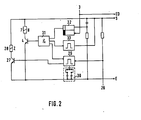
- FIG. 1 shows a functional circuit diagram of a screen text modem and FIG. 2 shows further details of the line interface device.
- the dash-dot block in FIG. 1 comprises a screen text modem which is also suitable for use in private branch exchanges and which is connected to the wires a, b of the telephone connection line FAL and, if appropriate, earth, which is connected to the telephone set 1 via the wires a ', b' and which is connected to the data terminal device DEE (here screen text device) via the four lines control and power supply S, received data ED, send data SD and return line E.
- DEE here screen text device
- the screen text modem contains the line connection device 5, which is fed by the screen text device, and the following function blocks, which are fed via the telephone line FAL: speech loop test device 2, reverse polarity protection and selector switch 8, 9, switch 11, power supply circuit 13 for obtaining the supply voltage from the loop current, sequence control with automatic dialing device 10, 10a, demodulator DEMOD, modulator MOD, multiplex device MUX and identification and telephone number memory. Further blocks which are not essential to the invention are not shown in FIG. 1.
- the storage device 22 for storing the operating states of the data transmission device is connected to the controller 10 via a rectifier g and a charging capacitor C2 to the output of the power supply 13 and via the control lines NW, NW and Reset.
- the circuit works as follows.
- the modem is switched on by energizing a changeover relay U of the line switching device 5 and connecting the wire a via the changeover contact u of the said relay to the loop input of the reverse polarity protection 8 or the selector contact device nsi 9.
- the connection establishment procedure takes place, after a short waiting time by the controller 10 or by the dialing device 10a, the digits of one or, if necessary, several ten-digit telephone numbers are provided from the telephone number memory and dialing pulses are generated for the nsi contact.
- various audible tones as well as modem IDs and code words are exchanged between the selected screen text center and the screen text modem, and data transfer is possible after a positive test result.
- the sequence controller 10 sets the relevant operating state memory in the memory device 22 via the line NW.
- the sequential control system 10 is then put into a defined basic state by the memory device 22 via the reset line in order to cause malfunctions. to prevent the voltage breakdown on capacitor C1 or on sequencer 10.
- the signal reset is canceled again by the memory device 22.
- the operating state memory of the memory device 22 is queried by the sequence controller 10 and the former is returned to the stored initial operating state.
- the charging capacitor C2 and corresponding switching means at the input of the memory device 22, which advantageously consists of CMOS circuits, are dimensioned such that the operating state memories are automatically reset to the initial operating state when a certain adjustable line interruption time (for example 10 s) is exceeded, which enables a new connection to be established.
- a certain adjustable line interruption time for example 10 s
- a selection arrangement 20 is provided for the selection and setting of the corresponding official initiation procedure.
- This selection arrangement can advantageously be implemented as a selection matrix with wire jumpers or switches.
- the sequence controller 10 is connected to this selection arrangement 20 and generates the corresponding operating state steps when a data connection is requested.
- the controller 10 is advantageously implemented as a microprocessor controller with PROM or EPROM memory, as a result of which the power consumption of the modem can be kept very low.
- a memory 21 is provided for storing code number sequences or pause sequences.
- the sequence of digits or pauses can, however, also be stored in the memory for telephone numbers which already exists per se, as a result of which only a few additional operating state steps are required in the sequence controller 10, since the code number can then be dialed in the same way as the dialing of the telephone number of the remote subscriber.
- Fig. 1 an embodiment as a switch 23 is drawn.
- the relay contact solution is therefore preferred to a semiconductor structure, for example a self-blocking field-effect transistor or a VMOS element, because firstly the relay contact is an ideal short-circuit contact with a resistance of 1, secondly because the problem of additional lightning protection for the semiconductor elements is eliminated and thirdly because a relay simultaneously operates the required electrical isolation if its excitation current from the line interface unit 5 and thus from the screen text device ie is therefore not supplied by the office, so that an additional optocoupler between the office loop and the line interface unit 5 can be omitted.
- a semiconductor structure for example a self-blocking field-effect transistor or a VMOS element
- FIG. 2 shows the line switching device 5 according to FIG. 1 in more detail. It essentially contains an FL, two monoflops 33 and 29, an AND gate 31, the three inputs of which are connected to the output of the flip-flop 32 and to the negated outputs of the two monoflops 33 and 29, the relay U, 7 , with a series-connected switching transistor 4, the base of which is controlled by the output of the AND gate 31, and the relay Z, 28, with a series-connected transistor 27, the base of which is driven by the normal output of the second monoflop 29.
- the circuit works as follows. If a connection is to be established, voltage is applied to the line switching device via the control and power supply line S or the return conductor E. This sets the flip-flop 32 and triggers the monoflop 33. If the connection is occupied, a pulse is generated by the speech loop test circuit 2 within 1.5 s after S is set, and the flip-flop 32 is reset via 3. If, on the other hand, the connection is free, the third input of the AND gate 31 is also set after the monoflop 33 time has elapsed, as a result of which the switching transistor 4 is turned on by the output of the AND gate 31 and the changeover relay U is excited.
- the relay Z After termination of the switching time of the second monoflop 29, which can be varied by means of capacitors and bridges in an adjusting device 30, the relay Z is switched off again and the changeover relay U is switched on accordingly.
- the arrangement according to the invention does not remain limited to a single earth key simulation, but, if the sequence control 10 is set accordingly, two earth key simulations separated by a defined pause can also be carried out for an official reason.
Landscapes
- Engineering & Computer Science (AREA)
- Signal Processing (AREA)
- Computer Networks & Wireless Communication (AREA)
- Telephonic Communication Services (AREA)
- Sub-Exchange Stations And Push- Button Telephones (AREA)
- Road Signs Or Road Markings (AREA)
- Working Measures On Existing Buildindgs (AREA)
- Monitoring And Testing Of Exchanges (AREA)
- Adhesive Tapes (AREA)
- Data Exchanges In Wide-Area Networks (AREA)
- Coupling Device And Connection With Printed Circuit (AREA)
- Communication Control (AREA)
Description
- Die Erfindung betrifft eine Schaltungsanordnung zum Auf- bzw. Abbau einer Verbindung mit Hilfe einer Datenübertragungseinrichtung gemäss Oberbegriff des Hauptanspruchs.
- Solche Anordnungen sind bekannt geworden beispielsweise als Bildschirmtextmodem bei der Entwicklung und Planung des zukünftigen neuen Dienstes Bildschirmtext, wobei stellvertretend zitiert seien die deutschen Offenlegungsschriften Nrn. 2823283, 2840845, 2942441 und der Aufsatz "Funktion der Teilnehmereinrichtungen für Bildschirmtext" von Bambach, Koeck, Schüssler in Fernmeldepraxis Bd. 56/1979, Nr. 24.
- Derartige Bildschrimtextmodems, die mit automatischer Wähleinrichtung versehen sind, gestatten zusammen mit einem Fernsehgerät, das für Bildschirmtextempfang eingerichtet ist, dem Inhaber oder Benutzer eines Fernsprechanschlusses den Konsum des neuen Dienstes Bildschirmtext über seine Fernsprechanschlussleitung, wobei Fernsprechen und Bildschirmtextempfang nur wahlweise möglich sind.
- Die Bildschirmtextmodems müssen aufgrund einer Forderung der Deutschen Bundespost eine netzunabhängige Stromversorgung aufweisen, deshalb werden sie über die Fernsprechanschlussleitung gespeist.
- Beim Aufbau einer Bildschirmtextverbindung können kurzzeitige Speisestromunterbrechungen bzw. -einbrüche auftreten, die dazu führen können, dass der Verbindungsaufbau gestört wird und evtl. vom Teilnehmer erneut gestartet werden muss. Je nach Verweildauer: des einzelnen Teilnehmers in einem solchen Fall, können hierdurch wichtige Organe der Vermittlungseinrichtungen unnötig lange belegt werden. Besonders wichtig ist dieser Aspekt bei Einsatz von Bildschirmtextmodems in Nebenstellenwählanlagen.
- Die Erfindung hat sich deshalb zur Aufgabe gestellt, eine Schaltungsanordnung der obengenannten Art anzugeben, die es bei kleinem Aufwand gestattet, nach Speisestromunterbrechungen die Aufgabe einer Verbindung erfolgreich weiterzuführen oder selbsttätig einen neuen Aufbau zu starten.
- Die Lösung dieser Aufgabe erfolgt mit den in den Patentansprüchen angegebenen Mitteln.
- Zwar wurde schon vorgeschlagen, den Energiespeicher für die Stromversorgung der Datenübertragungseinrichtung zu vergrössern. Die erforderliche Vergrösserung würde jedoch mindestens eine bis zwei Grössenordnungen betragen, um auch die langen, bis zu einigen Sekunden betragenden Stromunterbrechungen bei der Amtsanlassung in Nebenstellenanlagen zu überbrücken, und einen grossen Platzbedarf beanspruchen. Auch wurde schon vorgeschlagen, die Datenübertragungseinrichtung vom Wechselspannungsnetz zusätzlich mit Strom zu versorgen. Dies hat jedoch den Nachteil, dass aufwendige Blitzschutzmassnahmen getroffen werden müssen.
- Durch die Europäische Patentanmeldung Nr. 0023695 (veröffentlicht am 11.2.81) ist eine Schaltungsanordnung zum Überwachen einer Eingangsspannung bekannt geworden, wobei mittels Fühler das Unterschreiten eines bestimmten Eingangsspannungswertes gemeldet wird und wobei in Abhängigkeit von der Dauer des Spannungseinbruchs ein wenig Strom verbrauchender Ruhezustand eingestellt wird, indem die mittels Energiespeicher von der Eingangsspannung gepufferte Betriebsspannung für die Verbraucher abgeschaltet wird, und wobei nach Aufhebung des Eingangsspannungseinbruchs, der Normalbetriebszustand wiederhergestellt wird.
- Die erfindungsgemässe Lösung bietet die Vorteile, dass bei wenig Aufwand, unter Umgehung eines voluminösen Energiespeichers, in energiesparender Weise nach Unterbrechungen des speisenden Schleifenstromes der Aufbau einer Datenverbindung in kürzest möglicher Zeit erfolgreich zu Ende geführt oder neu gestartet wird, ohne dass zentrale Vermittlungseinrichtungen unnötig lange belegt sind.
- Im folgenden wird die Erfindung anhand der Figuren beschrieben.
- Die Fig. 1 zeigt ein Funktionsschaltbild eines Bildschirmtextmodems und die Fig. 2 weitere Einzelheiten der Leitungsanschalteinrichtung.
- Der strichpunktierte Block der Fig. 1 umfasst einen Bildschirmtextmodem, der auch für den Einsatz in Nebenstellenanlagen geeignet ist und der an die Adern a, b der Fernsprechanschlussleitung FAL und gegebenenfalls Erde angeschlossen ist, der über die Adern a', b' mit dem Telefonapparat 1 und der über die vier Leitungen Steuerung und Stromversorgung S, Empfangsdaten ED, Sendedaten SD und Rückleitung E mit der Datenendeinrichtung DEE (hier Bildschirmtextgerät) verbunden ist. Der Bildschirmtextmodem enthält die Leitungsanschalteinrichtung 5, die vom Bildschirmtextgerät gespeist wird, sowie die folgenden, über die FemsprechanschlussIeitung FALgespeisten Funktionsblöcke: Sprechschleifentesteinrichtung 2, Verpolungsschutz und Wählschalter 8, 9, Weiche 11, Stromversorgungsschaltung 13 zur Gewinnung der Versorgungsspannung aus dem Schleifenstrom, Ablaufsteuerung mit automatischer Wähleinrichtung 10, 10a, Demodulator DEMOD, Modulator MOD, Multiplexeinrichtung MUX sowie Kennungs- und Telefonnummern-Speicher. Weitere für die Erfindung unwesentliche Blöcke sind in Fig. 1 nicht wiedergegeben.
- Die erfindungsgemässe Speichereinrichtung 22 zur Abspeicherung der Betriebszustände der Datenübertragungseinrichtung ist über einen Gleichrichter g und einen Ladekondensator C2 an den Ausgang der Stromversorgung 13 und über die Steuerleitungen NW, NW und Reset mit der Steuerung 10 verbunden.
- Die Funktionsweise der Schaltung ist folgende.
- Wenn durch Betätigung der Taste Wählen am Fernbedienungsgeber des Datenendgerätes DEE eine Verbindung aufgebaut werden soll, wird über die Leitung S Speisespannung an die Leitungsanschalteinrichtung 5 gelegt, die somit mittels Sprechschleifentesteinrichtung 2, deren Ausgang mittels Optokoppler an die zum Eingang der Leitungsanschalteinrichtung 5 führende Leitung 3 verbunden ist, feststellen kann, ob der Fernsprechanschluss belegt ist oder nicht. Bei belegtem Anschluss wird innerhalb von 1,5 s nach Setzen von S von der Sprechschleifentestschaltung 2 ein Signal erzeugt, das von der Leitungsanschalteinrichtung 5 zur Datenendeinrichtung DEE übertragen, dort ausgewertet wird und zur Abschaltung von S führt. Bei freiem Anschluss wird der Modem angeschaltet, indem ein Umschaltrelais U der Leitungsanschalteinrichtung 5 erregt wird und die Ader a über den Umschaltkontakt u des genannten Relais an den Schleifeneingang des Verpolungsschutzes 8 bzw. der Wählkontakteinrichtung nsi 9 gelegt wird. Nach.Aufbau der Betriebsspannung erfolgt die Verbindungsaufbauprozedur, wobei nach einer kurzen Wartezeit durch die Steuerung 10 bzw. durch die Wähleinrichtung 1 Oa die Ziffern einer oder gegebenenfalls mehrerer zehnstelligen Rufnummern aus dem Telefonnummern-Speicher bereitgestellt und Wählimpulse für den nsi-Kontakt erzeugt werden. Nach Abschluss des Verbindungsaufbaus werden verschiedene Hörtöne sowie Modemkennungen und Codewörter zwischen angewählter Bildschirmtextzentrale und Bildschirmtextmodem ausgetauscht und nach positivem Prüfungsergebnis ein Datentransfer ermöglicht.
- Findet nun während des Verbindungsaufbaues eine Unterbrechung oder ein Einbruch des Schleifenstromes statt, so wird dies von der Stromversorgung 13 über die Leitung LU an die Steuerung 10 gemeldet, die eine kurze Zeit lang (in der Grössenordnung 200 ms) durch den Kondensator C1 weiterversorgt wird. In dieser Zeit wird durch die Ablaufsteuerung 10 über die Leitung NW in der Speichereinrichtung 22 der betreffende Betriebszustandsspeicher gesetzt. Anschliessend wird die Ablaufsteuerung 10 durch die Speichereinrichtung 22 über die Leitung Reset in einen definierten Grundzustand versetzt, um Fehlfunktionen infolge. des Spannungszusammenbruchs am Kondensator C1 bzw. an der Ablaufsteuerung 10 zu verhindern. Bei Spannungswiederkehr wird das Signal Reset durch die Speichereinrichtung 22 wieder zurückgenommen. Danach werden durch die Ablaufsteuerung 10 die Betriebszustandsspeicher der Speichereinrichtung 22 abgefragt und erstere in den eingespeicherten Ausgangsbetriebszustand zurückversetzt.
- In einer Ausgestaltung der Erfindung sind der Ladekondensator C2 und entsprechende Schaltmittel am Eingang der Speichereinrichtung 22, die vorteilhafterweise aus CMOS-Schaltkreisen besteht, so dimensioniert, dass die Betriebszustandsspeicher bei Überschreitung einer bestimmten einstellbaren Leitungsunterbrechungszeit (beispielsweise 10 s) automatisch in den Anfangsbetriebszustand zurückversetzt werden, wodurch ein erneuter Verbindungsaufbau ermöglicht wird.
- Dies gestattet auch den Einsatz der erfindungsgemässen Anordnung in Nebenstellenanlagen, bei denen vor der eigentlichen Wahl des Fernteilnehmers eine Amtsanlassung zu erfolgen hat. Dabei gibt es drei gebräuchliche Amtsanlassungsprozeduren:
- 1. Wahl einer oder mehrerer Kennziffern,
- 2. Betätigung einer Erdtaste,
- 3. Betätigung einer sog. Flashtaste.
- Zur Auswahl und Einstellung der entsprechenden Amtsanlassungsprozedur ist erfindungsgemäss eine Auswahlanordnung 20 vorgesehen. Diese Auswahlanordnung kann vorteilhafterweise als Auswahlmatrix mit Drahtbrücken oder Schaltern realisiert sein. Die Ablaufsteuerung 10 ist mit dieser Auswahlanordnung 20 verbunden und erzeugt bei einem Datenverbindungswunsch die entsprechenden Betriebszustandsschritte. Vorteilhafterweise ist die Steuerung 10 als Mikroprozessorsteuerung mit PROM- bzw. EPROM-Speicher realisiert, wodurch der Stromverbrauch des Modems sehr niedrig gehalten werden kann.
- Bei Einsatz des erfindungsgemässen Modems in Nebenstellenanlagen mit der ersten Amtsanlassungsprozedur ist in einer Ausgestaltung ein Speicher 21 zur Einspeicherung von Kennziffern- bzw. Pausenfolgen vorgesehen. Die Kennziffern- bzw. Pausenfolgen können jedoch auch in dem an sich schon vorhandenen Speicher für Telefonnummern abgelegtwerden, wodurch nur wenige zusätzliche Betriebszustandsschritte in der Ablaufsteuerung 10 erforderlich sind, da dann die Kennziffernvorwahl in der gleichen Weise wie die Wahl der Telefonnummer des Fernteilnehmers erfolgen kann.
- Bei Einsatz der erfindungsgemässen Anordnung in Nebenstellenanlagen mit Amtsanlassung durch Erdtastenbetätigung, wobei die beiden Adern a und b mit Erde verbunden werden, sind zwei Relaisschaltkontakte z vorgesehen, die als Umschalte- bzw. Arbeitskontakte realisiert sein können.
- In Fig. 1 ist eine Ausführung als Umschalter 23 gezeichnet. Die Relaiskontaktlösung wird deshalb einer Halbleiterstruktur beispielsweise einem selbstsperrenden Feldeffekttransistor oder einem VMOS-Element vorgezogen, weil erstens der Relaiskontakt ein idealer Kurzschlusskontakt mit einem Widerstand von 1 darstellt, weil zweitens das Problem des zusätzlichen Blitzschutzes für die Halbleiterelemente entfällt und drittens, weil ein Relais gleichzeitig die erforderliche galvanische Trennung mit sich bringt, wenn sein Erregerstrom von der Leitungsanschalteeinheit 5 und damitvom Bildschirmtextgerät d.h. also nicht vom Amt geliefert wird, so dass ein zusätzlicher Optokoppler zwischen Amtsschleife und Leitungsanschalteeinheit 5 entfallen kann.
- Das oben Gesagte gilt ebenfalls für die Amtsanlassungsprozedur durch Flashtastenbetätigung, wodurch der Schleifenstrom eine definierte Zeit (beispielsweise 80 ms) unterbrochen wird. Diese Schleifenunterbrechung wird erfindungsgemäss ebenfalls mit einem Relaiskontaktpaar z durchgeführt, wobei bei der Realisierung als Umschaltekontaktblock 23 der Fig. 1 die Brücke 25 aufgetrennt werden muss.
- In Fig. 2 ist die Leitungsanschalteeinrichtung 5 nach Fig. 1 detaillierter dargestellt. Sie enthält im wesentlichen ein FL, zwei Monoflops 33 und 29, ein UND-Verknüpfungsglied 31, dessen drei Eingänge mit dem Ausgang des Flip-Flops 32 bzw. mit den negierten Ausgängen der beiden Monoflops 33 und 29 verbunden sind, das Relais U, 7, mit einem in Reihe geschalteten Schalttransistor 4, dessen Basis durch den Ausgang des UND-Gliedes 31 angesteuert wird, und dem Relais Z, 28, mit einem ebenfalls in Reihe geschalteten Transistor 27, dessen Basis vom Normalausgang des zweiten Monoflops 29 angesteuert wird.
- Die Schaltung funktioniert wie folgt. Soll eine Verbindung aufgebaut werden, so wird über die Steuerung und Stromversorgungsleitung S bzw. den Rückleiter E Spannung an die Leitungsanschalteeinrichtung gelegt. Dadurch werden das Flip-Flop 32 gesetzt und das Monoflop 33 getriggert. Bei belegtem Anschluss wird innerhalb 1,5 s nach Setzen von S von der Sprechschleifentestschaltung 2 ein Impuls erzeugt, der über 3 das Flip-Flop 32 zurücksetzt. Ist dagegen der Anschluss frei, so wird nach Ablauf der Monoflop-33-Zeit auch der dritte Eingang des UND-Gliedes 31 gesetzt, wodurch der Schalttransistor 4 vom Ausgang des UND-Gliedes 31 leitend gesteuert und das Umschaltrelais U erregt wird.
- Bei den Amstanlassungsprozeduren Erd- bzw. Flashtaste wird von der Ablaufsteuerung 10 über einen Optokoppler auf den negierten Eingang 26 des zweiten Monoflops 29 ein kurzer Triggerimpuls gegeben; wodurch der Schalttransistor 27 durch den Ausgang des zweiten Monoflops 29 angesteuert und das RelaisZerregtwird. Gleichzeitig wird über den negierten Ausgang des zweiten Monoflops 29 die UND-Bedingung am UND-Verknüpfungsglied 31 aufgehoben, wodurch das Umschaltrelais U abfällt. Dies hat den Vorteil, dass der vom Bildschirmtextendgerät gelieferte Strom voll dem Erd- bzw. Flashtastensimulationsrelais Z zur Verfügung gestellt werden kann. Dies ist deshalb von grosser Bedeutung, da auf der Steuerleitung S lediglich eine Spannung von 4 V zugelassen ist, wodurch die angebotene Schaltleistung eng begrenzt ist.
- Nach Beendigung der mittels- Kondensatoren und Brücken in einer Einstellvorrichtung 30 variierbaren Schaltzeit des zweiten Monoflops 29 wird das Relais Z wieder ab- und das Umschaltrelais U entsprechend zugeschaltet.
- Selbstverständlich bleibt die erfindungsgemässe Anordnung nicht beschränkt auf eine einzige Erdtastensimulation, sondern es können bei entsprechender Einstellung der Ablaufsteuerung 10 beispielsweise auch zwei durch eine definierte Pause getrennte Erdtastensimulationen für eine Amtsanlassung durchgeführt werden.
Claims (9)
Priority Applications (1)
| Application Number | Priority Date | Filing Date | Title |
|---|---|---|---|
| AT81104055T ATE6894T1 (de) | 1980-07-25 | 1981-05-27 | Schaltungsanordnung zum auf- bzw. abbau einer datenverbindung. |
Applications Claiming Priority (2)
| Application Number | Priority Date | Filing Date | Title |
|---|---|---|---|
| DE19803028236 DE3028236A1 (de) | 1980-07-25 | 1980-07-25 | Schaltungsanordnung zum auf- bzw. abbau einer datenverbindung |
| DE3028236 | 1980-07-25 |
Publications (2)
| Publication Number | Publication Date |
|---|---|
| EP0044918A1 EP0044918A1 (de) | 1982-02-03 |
| EP0044918B1 true EP0044918B1 (de) | 1984-03-28 |
Family
ID=6108104
Family Applications (1)
| Application Number | Title | Priority Date | Filing Date |
|---|---|---|---|
| EP81104055A Expired EP0044918B1 (de) | 1980-07-25 | 1981-05-27 | Schaltungsanordnung zum Auf- bzw. Abbau einer Datenverbindung |
Country Status (6)
| Country | Link |
|---|---|
| US (1) | US4434326A (de) |
| EP (1) | EP0044918B1 (de) |
| AT (1) | ATE6894T1 (de) |
| CA (1) | CA1173181A (de) |
| DE (2) | DE3028236A1 (de) |
| DK (1) | DK156867C (de) |
Families Citing this family (9)
| Publication number | Priority date | Publication date | Assignee | Title |
|---|---|---|---|---|
| US4591663A (en) * | 1983-11-17 | 1986-05-27 | Trad, Inc. | Servo-linearized opto-electronic analog interface |
| US4640988A (en) * | 1984-04-03 | 1987-02-03 | Robinton Products, Inc. | Telephone interrupter |
| US4571463A (en) * | 1984-06-01 | 1986-02-18 | Code-A-Phone Corporation | Method and system for automatically inserting at least one pause into means for memorizing a dialing sequence |
| US4654482A (en) * | 1984-10-15 | 1987-03-31 | Deangelis Lawrence J | Home merchandise ordering telecommunications terminal |
| US4698757A (en) * | 1984-11-15 | 1987-10-06 | International Business Machines Corp. | Terminal procedure for utilizing host processor log on and log off prompts |
| JPS62104356A (ja) * | 1985-10-31 | 1987-05-14 | Ricoh Co Ltd | フアクシミリ装置 |
| GB2185362B (en) * | 1985-12-16 | 1989-10-18 | Ricoh Kk | Time limited data communication system |
| KR930001641A (ko) * | 1991-06-17 | 1993-01-16 | 정용문 | 키텔레폰 시스템의 리스타트시 통화로 복구 방법 |
| JP3046229B2 (ja) * | 1995-10-04 | 2000-05-29 | キヤノン株式会社 | 電話装置 |
Family Cites Families (10)
| Publication number | Priority date | Publication date | Assignee | Title |
|---|---|---|---|---|
| FR2261694A5 (de) * | 1973-09-05 | 1975-09-12 | Honeywell Bull Soc Ind | |
| DE2536200C2 (de) * | 1975-08-13 | 1983-04-21 | Standard Elektrik Lorenz Ag, 7000 Stuttgart | Schaltungsanordnung zur Überwachung einer Sprechader in Fernsprechapparaten |
| DE2719827A1 (de) | 1977-05-04 | 1978-11-09 | Licentia Gmbh | System zur auswahl und wiedergabe von bildschirmtext |
| DE2814837C2 (de) * | 1978-04-06 | 1980-01-10 | Standard Elektrik Lorenz Ag, 7000 Stuttgart | Datenmodem, insbesondere für Bildschirmtextbetrieb |
| DE2823283C2 (de) | 1978-05-27 | 1984-02-02 | ANT Nachrichtentechnik GmbH, 7150 Backnang | Verfahren zum Auf- bzw. Abbau einer Verbindung zwischen einem Fernsehgerät und einer Bildschirmtextdatenbank |
| DE2840845C2 (de) | 1978-09-20 | 1985-05-23 | ANT Nachrichtentechnik GmbH, 7150 Backnang | Verfahren zum Auf- bzw. Abbau einer Verbindung zwischen einem Fernsehgerät und einer Bildschirmtextdatenbank |
| DE2931436C2 (de) * | 1979-08-02 | 1981-08-20 | Siemens AG, 1000 Berlin und 8000 München | Schaltungsanordnung zum Überwachen einer Eingangsspannung |
| DE2931529A1 (de) | 1979-08-03 | 1981-02-19 | Standard Elektrik Lorenz Ag | Teilnehmerseitiges datenuebertragungsgeraet, insbesondere fuer bildschirmtextbetrieb |
| DE2942441C2 (de) | 1979-10-20 | 1986-11-20 | ANT Nachrichtentechnik GmbH, 7150 Backnang | Zusatzeinrichtung zum Auf- bzw. Abbau einer Verbindung zwischen einem Fernsehgerät und einer Bildschirmtextdatenbank |
| US4291200A (en) | 1979-10-31 | 1981-09-22 | Bell Telephone Laboratories, Incorporated | Voice and data switching arrangement |
-
1980
- 1980-07-25 DE DE19803028236 patent/DE3028236A1/de not_active Withdrawn
-
1981
- 1981-05-27 EP EP81104055A patent/EP0044918B1/de not_active Expired
- 1981-05-27 DE DE8181104055T patent/DE3162861D1/de not_active Expired
- 1981-05-27 AT AT81104055T patent/ATE6894T1/de not_active IP Right Cessation
- 1981-07-10 DK DK307581A patent/DK156867C/da not_active IP Right Cessation
- 1981-07-24 US US06/286,584 patent/US4434326A/en not_active Expired - Fee Related
- 1981-07-24 CA CA000382549A patent/CA1173181A/en not_active Expired
Also Published As
| Publication number | Publication date |
|---|---|
| DE3162861D1 (en) | 1984-05-03 |
| CA1173181A (en) | 1984-08-21 |
| DK156867B (da) | 1989-10-09 |
| DK156867C (da) | 1990-02-26 |
| DK307581A (da) | 1982-01-26 |
| US4434326A (en) | 1984-02-28 |
| ATE6894T1 (de) | 1984-04-15 |
| EP0044918A1 (de) | 1982-02-03 |
| DE3028236A1 (de) | 1982-03-18 |
Similar Documents
| Publication | Publication Date | Title |
|---|---|---|
| DE1762969B2 (de) | Schaltungsanordnung zum anzeigen der berechtigungsklasse in fernmeldevermittlungsanlagen | |
| EP0044918B1 (de) | Schaltungsanordnung zum Auf- bzw. Abbau einer Datenverbindung | |
| DE19630456B4 (de) | ISDN-Telefon | |
| DE1166282B (de) | Schaltungsanordnung fuer Fernsprechvermittlungsanlagen mit Verbindungssaetzen | |
| DE2522957A1 (de) | Schaltungsanordnung fuer ueber ihre anschlussleitungen gespeiste teilnehmerstationen mit impulstastwahl in fernmelde-, insbesondere fernsprechanlagen | |
| DE416087C (de) | Schaltungsanordnung fuer Fernsprechanlagen mit Waehlerbetrieb, bei welchen Register von einer anrufenden Stelle eingestellt werden | |
| DE3213217A1 (de) | Verfahren und schaltungsanordnung zur fernbedienung elektrischer geraete | |
| DE635284C (de) | Anordnung fuer selbsttaetige Fernsprechanlagen | |
| DE739734C (de) | Schaltungsanordnung fuer Fernsprechanlagen mit Waehlerbetrieb | |
| DE2740876A1 (de) | Kanalsucher fuer ein funktelefon und verfahren zu deren betrieb | |
| DE1256265C2 (de) | Schaltungsanordnung fuer fernmeldevermittlungsanlagen, insbesondere fernsprechanlagen, mit einem koppelfeld, einrichtungen fuer die aufnahme und weitergabe von wahlkennzeichen und einem zentralen markierer | |
| DE2949513C2 (de) | Notrufanlage | |
| DE1512062A1 (de) | Nachrichtenuebertragungssystem | |
| DE1512100A1 (de) | Nachrichtenvermittlungsanlage mit Steuersignal-Verzoegerungseinrichtung | |
| DE1462399B2 (de) | Schaltungsanordnung fuer fernsprechanlagen insbesondere fernsprechnebenstellenanlagen oder linienwaehleranlagen | |
| DE915232C (de) | Schaltungsanordnung fuer Fernschreib-Nebenstellenanlagen mit Waehlerbetrieb | |
| DE2912744A1 (de) | Verfahren fuer fernsprech- und fernsprechnebenstellenanlagen mit zyklischem abtasten von verbindungsleitungen unter zuhilfenahme eines zentral angeordneten speichers | |
| DE903597C (de) | Schaltungsanordnung fuer Fernsprechnebenstellenanlagen mit Waehlerbetrieb | |
| DE2706825A1 (de) | Schaltungsanordnung fuer fernmeldevermittlungsanlagen, insbesondere fernsprechvermittlungsanlagen, mit verbindungsindividuellen und steuernden gemeinsamen einrichtungen | |
| DE2748560C2 (de) | Schaltungsanordnung für Fernmeldevermittlungsanlagen, insbesondere Fernsprechvermittlungsanlagen, mit verbindungsindividuellen Schalteinrichtungen und ihnen zugeordneten teilzentralen Steuereinrichtungen | |
| DE3310608A1 (de) | Schaltungsanordnung fuer eine kleine waehlnebenstellenanlage | |
| DE19730295C2 (de) | Einrichtung zur Nutzung von Komfort-Merkmalen des Telefondienstes an über TK-Anlagen an analoge Wählanschlüsse eines Telefonnetzes angeschlossenen Endgeräten | |
| DE939090C (de) | Schaltungsanordnung fuer Fernmelde-, insbesondere Fernsprechanlagen mit Waehlerbetrieb | |
| DE667086C (de) | Schaltungsanordnung zum wahlweisen Anruf in Fernmelde-, insbesondere Fernsprechanlagen, mit Gesellschaftsleitungen | |
| DE3610730A1 (de) | Einrichtung fuer eine zweit-nebenstellenanlage |
Legal Events
| Date | Code | Title | Description |
|---|---|---|---|
| PUAI | Public reference made under article 153(3) epc to a published international application that has entered the european phase |
Free format text: ORIGINAL CODE: 0009012 |
|
| AK | Designated contracting states |
Designated state(s): AT BE CH DE FR GB LI LU NL SE |
|
| 17P | Request for examination filed |
Effective date: 19820225 |
|
| RAP1 | Party data changed (applicant data changed or rights of an application transferred) |
Owner name: AEG - TELEFUNKEN NACHRICHTENTECHNIK GMBH |
|
| RAP1 | Party data changed (applicant data changed or rights of an application transferred) |
Owner name: ANT NACHRICHTENTECHNIK GMBH |
|
| GRAA | (expected) grant |
Free format text: ORIGINAL CODE: 0009210 |
|
| AK | Designated contracting states |
Designated state(s): AT BE CH DE FR GB LI LU NL SE |
|
| REF | Corresponds to: |
Ref document number: 6894 Country of ref document: AT Date of ref document: 19840415 Kind code of ref document: T |
|
| REF | Corresponds to: |
Ref document number: 3162861 Country of ref document: DE Date of ref document: 19840503 |
|
| ET | Fr: translation filed | ||
| PLBE | No opposition filed within time limit |
Free format text: ORIGINAL CODE: 0009261 |
|
| STAA | Information on the status of an ep patent application or granted ep patent |
Free format text: STATUS: NO OPPOSITION FILED WITHIN TIME LIMIT |
|
| 26N | No opposition filed | ||
| R20 | Corrections of a patent specification |
Effective date: 19880406 |
|
| PGFP | Annual fee paid to national office [announced via postgrant information from national office to epo] |
Ref country code: GB Payment date: 19930511 Year of fee payment: 13 |
|
| PGFP | Annual fee paid to national office [announced via postgrant information from national office to epo] |
Ref country code: FR Payment date: 19930518 Year of fee payment: 13 |
|
| PGFP | Annual fee paid to national office [announced via postgrant information from national office to epo] |
Ref country code: SE Payment date: 19930527 Year of fee payment: 13 Ref country code: AT Payment date: 19930527 Year of fee payment: 13 |
|
| PGFP | Annual fee paid to national office [announced via postgrant information from national office to epo] |
Ref country code: NL Payment date: 19930531 Year of fee payment: 13 |
|
| PGFP | Annual fee paid to national office [announced via postgrant information from national office to epo] |
Ref country code: BE Payment date: 19930601 Year of fee payment: 13 |
|
| PGFP | Annual fee paid to national office [announced via postgrant information from national office to epo] |
Ref country code: LU Payment date: 19930602 Year of fee payment: 13 |
|
| PGFP | Annual fee paid to national office [announced via postgrant information from national office to epo] |
Ref country code: CH Payment date: 19930617 Year of fee payment: 13 |
|
| EPTA | Lu: last paid annual fee | ||
| PG25 | Lapsed in a contracting state [announced via postgrant information from national office to epo] |
Ref country code: LU Free format text: LAPSE BECAUSE OF NON-PAYMENT OF DUE FEES Effective date: 19940527 Ref country code: GB Effective date: 19940527 Ref country code: AT Effective date: 19940527 |
|
| PG25 | Lapsed in a contracting state [announced via postgrant information from national office to epo] |
Ref country code: SE Effective date: 19940528 |
|
| PG25 | Lapsed in a contracting state [announced via postgrant information from national office to epo] |
Ref country code: LI Effective date: 19940531 Ref country code: CH Effective date: 19940531 Ref country code: BE Effective date: 19940531 |
|
| PGFP | Annual fee paid to national office [announced via postgrant information from national office to epo] |
Ref country code: DE Payment date: 19940707 Year of fee payment: 14 |
|
| BERE | Be: lapsed |
Owner name: ANT NACHRICHTENTECHNIK G.M.B.H. Effective date: 19940531 |
|
| PG25 | Lapsed in a contracting state [announced via postgrant information from national office to epo] |
Ref country code: NL Effective date: 19941201 |
|
| NLV4 | Nl: lapsed or anulled due to non-payment of the annual fee | ||
| GBPC | Gb: european patent ceased through non-payment of renewal fee |
Effective date: 19940527 |
|
| EUG | Se: european patent has lapsed |
Ref document number: 81104055.9 Effective date: 19941210 |
|
| PG25 | Lapsed in a contracting state [announced via postgrant information from national office to epo] |
Ref country code: FR Effective date: 19950131 |
|
| REG | Reference to a national code |
Ref country code: CH Ref legal event code: PL |
|
| EUG | Se: european patent has lapsed |
Ref document number: 81104055.9 |
|
| REG | Reference to a national code |
Ref country code: FR Ref legal event code: ST |
|
| PG25 | Lapsed in a contracting state [announced via postgrant information from national office to epo] |
Ref country code: DE Effective date: 19960201 |